


Degenerate art

Encyclopedia
Degenerate art is the English
translation of the German
entartete Kunst, a term adopted by the Nazi regime in Germany
to describe virtually all modern art
. Such art
was banned on the grounds that it was un-German
or Jewish Bolshevist
in nature, and those identified as degenerate artists were subjected to sanctions. These included being dismissed from teaching positions, being forbidden to exhibit or to sell their art, and in some cases being forbidden to produce art entirely.
Degenerate Art was also the title of an exhibition, mounted by the Nazis in Munich
in 1937, consisting of modernist artworks chaotically hung and accompanied by text labels deriding the art. Designed to inflame public opinion against modernism, the exhibition subsequently traveled to several other cities in Germany and Austria
.
While modern styles of art were prohibited, the Nazis promoted painting
s and sculpture
s that were traditional in manner and that exalted the "blood and soil
" values of racial purity, militarism
, and obedience. Similarly, music was expected to be tonal
and free of any jazz
influences; films and plays were censored
.
, Dada
and surrealism
—following hot on the heels of symbolism
, post-Impressionism
and Fauvism
—were not universally appreciated. The majority of people in Germany, as elsewhere, did not care for the new art which many resented as elitist, morally suspect, and too often incomprehensible.
Under the Weimar government of the 1920s, Germany emerged as a leading center of the avant-garde
—the birthplace of Expressionism
in painting and sculpture, of the atonal music
al compositions of Arnold Schoenberg
, and the jazz-influenced work of Paul Hindemith
and Kurt Weill
. Robert Wiene
's The Cabinet of Dr. Caligari (1920), and F.W. Murnau's Nosferatu (1922), brought Expressionism to cinema
.
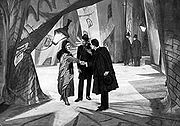 The Nazis viewed the culture of the Weimar period with disgust. Their response stemmed partly from a conservative aesthetic
taste, and partly from their determination to use culture as a propaganda
tool. On both counts, a painting such as Otto Dix
's War Cripples (1920) was anathema to them. It unsparingly depicts four badly disfigured veterans of the First World War, then a familiar sight on Berlin
's streets, rendered in caricature
d style. Featured in the Degenerate Art exhibition, it would hang next to a label accusing Dix—himself a volunteer in World War I—of "an insult to the German heroes of the Great War".
As dictator, Hitler
gave his personal taste in art the force of law to a degree never before seen. Only in Stalin's
Soviet Union
, where Socialist Realism
was the mandatory style, had a state shown such concern with regulation of the arts. In the case of Germany, the model was to be classical Greek and Roman
art, seen by Hitler as an art whose exterior form embodied an inner racial ideal.
The reason for this, as Henry Grosshans points out, is that Hitler "saw Greek and Roman art as uncontaminated by Jewish influences. Modern art was [seen as] an act of aesthetic violence by the Jews against the German spirit. Such was true to Hitler even though only Liebermann
, Meidner
, Freundlich
, and Marc Chagall
, among those who made significant contributions to the German modernist movement, were Jewish. But Hitler [...] took upon himself the responsibility of deciding who, in matters of culture, thought and acted like a Jew."
The supposedly "Jewish" nature of all art that was indecipherable, distorted, or that represented "depraved" subject matter was explained through the concept of degeneracy, which held that distorted and corrupted art was a symptom of an inferior race. By propagating the theory of degeneracy, the Nazis combined their anti-Semitism
with their drive to control the culture, thus consolidating public support for both campaigns.
devised the theory
presented in his 1892 book, Entartung
. Nordau drew upon the writings of the criminologist
Cesare Lombroso
, whose The Criminal Man, published in 1876, attempted to prove that there were "born criminals" whose atavistic
personality traits could be detected by scientifically measuring abnormal physical characteristics. Nordau developed from this premise a critique of modern art
, explained as the work of those so corrupted and enfeebled by modern life that they have lost the self-control needed to produce coherent works. He attacked Aestheticism
in English literature
and described the mysticism
of the Symbolist movement
in French literature
as a product of mental pathology. Explaining the painterliness
of Impressionism
as the sign of a diseased visual cortex, he decried modern degeneracy while praising traditional German culture. Despite the fact that Nordau was Jewish and a key figure in the Zionist movement (Lombroso was also Jewish), his theory of artistic degeneracy would be seized upon by German National Socialists during the Weimar Republic
as a rallying point for their anti-Semitic and racist demand for Aryan
purity in art.
Belief in a Germanic spirit—defined as mystical, rural
, moral, bearing ancient wisdom, and noble in the face of a tragic destiny—existed long before the rise of the Nazis; the composer Richard Wagner
celebrated such ideas in his work. Beginning before World War I
the well-known German architect and painter Paul Schultze-Naumburg
's influential writings, which invoked racial theories in condemning modern art and architecture
, supplied much of the basis for Adolf Hitler's belief that classical Greece
and the Middle Ages
were the true sources of Aryan art. Schultze-Naumburg subsequently wrote such books as Die Kunst der Deutschen. Ihr Wesen und ihre Werke (The art of the Germans. Its nature and its works) and Kunst und Rasse (Art and Race), the latter published in 1928, in which he argued that only racially pure artists could produce a healthy art which upheld timeless ideals
of classical beauty, while racially mixed modern artists produced disordered artworks and monstrous depictions of the human form. By reproducing examples of modern art next to photographs of people with deformities and diseases, he graphically reinforced the idea of modernism as a sickness. Alfred Rosenberg
developed this theory in Der Mythos des 20. Jahrhunderts
(Myth of the Twentieth Century), published in 1933, which became a best-seller in Germany and made Rosenberg the Party's leading ideological spokesman.
(Reich Culture Chamber) was established, with Joseph Goebbels
, Hitler's Reichminister für Volksaufklärung und Propaganda (Reich Minister for Public Enlightenment and Propaganda
) in charge. Subchambers within the Culture Chamber, representing the individual arts (music, film, literature, architecture, and the visual arts) were created; these were membership groups consisting of "racially pure" artists supportive of the Party, or willing to be compliant. Goebbels made it clear: "In future only those who are members of a chamber are allowed to be productive in our cultural life. Membership is open only to those who fulfill the entrance condition. In this way all unwanted and damaging elements have been excluded." By 1935 the Reich Culture Chamber had 100,000 members.
Nonetheless there was, during the period 1933-1934, some confusion within the Party on the question of Expressionism
. Goebbels and some others believed that the forceful works of such artists as Emil Nolde
, Ernst Barlach
and Erich Heckel
exemplified the Nordic spirit; as Goebbels explained, "We National Socialists are not unmodern; we are the carrier of a new modernity, not only in politics and in social matters, but also in art and intellectual matters." However, a faction led by Rosenberg despised the Expressionists, leading to a bitter ideological dispute which was settled only in September 1934, when Hitler declared that there would be no place for modernist experimentation in the Reich.
Although books by Franz Kafka
could no longer be bought by 1939, works by ideologically suspect authors such as Hermann Hesse
and Hans Fallada
were widely read. Mass culture was less stringently regulated than high culture, possibly because the authorities feared the consequences of too heavy-handed interference in popular entertainment. Thus, until the outbreak of the war, most Hollywood films could be screened, including It Happened One Night
, San Francisco
, and Gone with the Wind
. While performance of atonal music was banned, the prohibition of jazz was less strictly enforced. Benny Goodman
and Django Reinhardt
were popular, and leading British and American jazz bands continued to perform in major cities until the war; thereafter, dance bands officially played "swing" rather than the banned jazz.
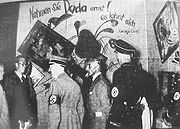
, the head of the Reichskammer der Bildenden Künste (Reich Chamber of Visual Art), in charge of a six-man commission authorized to confiscate from museums and art collections throughout the Reich, any remaining art deemed modern, degenerate, or subversive. These works were then to be presented to the public in an exhibit intended to incite further revulsion against the "perverse Jewish spirit" penetrating German culture.
Over 5,000 works were seized, including 1,052 by Nolde, 759 by Heckel, 639 by Ernst Ludwig Kirchner
and 508 by Max Beckmann
, as well as smaller numbers of works by such artists as Alexander Archipenko
, Marc Chagall
, James Ensor
, Henri Matisse
, Pablo Picasso
and Vincent van Gogh
. The Entartete Kunst exhibit, featuring over 650 paintings, sculptures, prints, and books from the collections of thirty two German museums, premiered in Munich
on July 19, 1937 and remained on view until November 30 before travelling to eleven other cities in Germany and Austria.
The exhibit was held on the second floor of a building formerly occupied by the Institute of Archaeology
. Viewers had to reach the exhibit by means of a narrow staircase. The first sculpture was an oversized, theatrical portrait of Jesus
, which purposely intimidated viewers as they literally bumped into it in order to enter. The rooms were made of temporary partitions and deliberately chaotic and overfilled. Pictures were crowded together, sometimes unframed, usually hung by cord.
The first three rooms were grouped thematically. The first room contained works considered demeaning of religion; the second featured works by Jewish artists in particular; the third contained works deemed insulting to the women, soldiers and farmers of Germany. The rest of the exhibit had no particular theme.
There were slogans painted on the walls. For example:
Speeches of Nazi party leaders contrasted with artist manifesto
s from various art movements, such as Dada
and Surrealism
. Next to many paintings were labels indicating how much money a museum spent to acquire the artwork. In the case of paintings acquired during the post-war Weimar
hyperinflation
of the early 1920s, when the cost of a kilo loaf of bread reached 233 billion
German mark
s, the prices of the paintings were of course greatly exaggerated. The exhibit was designed to promote the idea that modernism was a conspiracy
by people who hated German decency, frequently identified as Jewish-Bolshevist, although only six of the 112 artists included in the exhibition were in fact Jewish.
A few weeks after the opening of the exhibition, Goebbels ordered a second and more thorough scouring of German art collections; inventory lists indicate that the artworks seized in this second round, combined with those gathered prior to the exhibition, amounted to some 16,558 works.
Coinciding with the Entartete Kunst exhibition, the Grosse deutsche Kunstausstellung (Great German art exhibition) made its premiere amid much pageantry. This exhibition, held at the palatial Haus der deutschen Kunst
(House of German Art), displayed the work of officially approved artists such as Arno Breker
and Adolf Wissel
. At the end of four months Entartete Kunst had attracted over two million visitors, nearly three and a half times the number that visited the nearby Grosse deutsche Kunstausstellung.
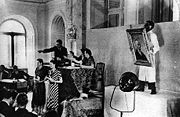
German artists were now branded both enemies of the state and a threat to German culture. Many went into exile
. Max Beckmann
fled to Amsterdam
on the opening day of the entartete Kunst exhibit. Max Ernst
emigrated to America with the assistance of Peggy Guggenheim
. Ernst Ludwig Kirchner
committed suicide in Switzerland
in 1938. Paul Klee
spent his years in exile in Switzerland
, yet was unable to obtain Swiss citizenship because of his status as a degenerate artist.
Other artists remained in internal exile. Otto Dix
retreated to the countryside to paint unpeopled landscapes in a meticulous style that would not provoke the authorities. The Reichskulturkammer forbade artists such as Edgar Ende
and Emil Nolde
from purchasing painting materials. Those who remained in Germany were forbidden to work at universities
and were subject to surprise raids by the Gestapo
in order to ensure that they were not violating the ban on producing artwork; Nolde secretly carried on painting, but using only watercolors (so as not to be betrayed by the telltale odor of oil paint
). Although officially no artists were put to death because of their work, those of Jewish descent who did not escape from Germany in time were sent to concentration camps. Others were murdered in the Action T4
(see for example Elfriede Lohse-Wächtler
).
After the exhibit, paintings were sorted out for sale and sold in Switzerland at auction; some pieces were acquired by museums, others by private collectors. Nazi officials took many for their private use: for example, Hermann Göring
took fourteen valuable pieces, including a Van Gogh
and a Cézanne
. In March, 1939, the Berlin Fire Brigade burned approximately 4000 works which had little value on the international market.
A large amount of 'degenerate art' by Picasso
, Dalí
, Ernst, Klee, Léger and Miró
was destroyed in a bonfire on the night of July 27, 1942 in the gardens of the Galerie nationale du Jeu de Paume
in Paris
.
After the collapse of Nazi Germany and the invasion of Berlin
by the Red Army
, some artwork from the exhibit was found buried underground. It is unclear how many of these then reappeared in the Hermitage Museum
in Saint Petersburg
where they still remain.
In 2010, as work began to extend an underground line
from Alexanderplatz
through the historic city centre to the Brandenburg Gate
, a number of sculptures from the degenerate art exhibition were unearthed in the cellar of a private house close to the "Rote Rathaus". These included, for example, the bronze
cubist style statue of a female dancer by the artist Marg Moll, and are now on display at the Neues Museum
.
English language
English is a West Germanic language that arose in the Anglo-Saxon kingdoms of England and spread into what was to become south-east Scotland under the influence of the Anglian medieval kingdom of Northumbria...
translation of the German
German language
German is a West Germanic language, related to and classified alongside English and Dutch. With an estimated 90 – 98 million native speakers, German is one of the world's major languages and is the most widely-spoken first language in the European Union....
entartete Kunst, a term adopted by the Nazi regime in Germany
Nazi Germany
Nazi Germany , also known as the Third Reich , but officially called German Reich from 1933 to 1943 and Greater German Reich from 26 June 1943 onward, is the name commonly used to refer to the state of Germany from 1933 to 1945, when it was a totalitarian dictatorship ruled by...
to describe virtually all modern art
Modern art
Modern art includes artistic works produced during the period extending roughly from the 1860s to the 1970s, and denotes the style and philosophy of the art produced during that era. The term is usually associated with art in which the traditions of the past have been thrown aside in a spirit of...
. Such art
Art
Art is the product or process of deliberately arranging items in a way that influences and affects one or more of the senses, emotions, and intellect....
was banned on the grounds that it was un-German
Germany
Germany , officially the Federal Republic of Germany , is a federal parliamentary republic in Europe. The country consists of 16 states while the capital and largest city is Berlin. Germany covers an area of 357,021 km2 and has a largely temperate seasonal climate...
or Jewish Bolshevist
Jewish Bolshevism
Jewish Bolshevism, Judeo-Bolshevism, and known as Żydokomuna in Poland, is an antisemitic stereotype based on the claim that Jews have been the driving force behind or are disproportionately involved in the modern Communist movement, or sometimes more specifically Russian Bolshevism.The expression...
in nature, and those identified as degenerate artists were subjected to sanctions. These included being dismissed from teaching positions, being forbidden to exhibit or to sell their art, and in some cases being forbidden to produce art entirely.
Degenerate Art was also the title of an exhibition, mounted by the Nazis in Munich
Munich
Munich The city's motto is "" . Before 2006, it was "Weltstadt mit Herz" . Its native name, , is derived from the Old High German Munichen, meaning "by the monks' place". The city's name derives from the monks of the Benedictine order who founded the city; hence the monk depicted on the city's coat...
in 1937, consisting of modernist artworks chaotically hung and accompanied by text labels deriding the art. Designed to inflame public opinion against modernism, the exhibition subsequently traveled to several other cities in Germany and Austria
Austria
Austria , officially the Republic of Austria , is a landlocked country of roughly 8.4 million people in Central Europe. It is bordered by the Czech Republic and Germany to the north, Slovakia and Hungary to the east, Slovenia and Italy to the south, and Switzerland and Liechtenstein to the...
.
While modern styles of art were prohibited, the Nazis promoted painting
Painting
Painting is the practice of applying paint, pigment, color or other medium to a surface . The application of the medium is commonly applied to the base with a brush but other objects can be used. In art, the term painting describes both the act and the result of the action. However, painting is...
s and sculpture
Sculpture
Sculpture is three-dimensional artwork created by shaping or combining hard materials—typically stone such as marble—or metal, glass, or wood. Softer materials can also be used, such as clay, textiles, plastics, polymers and softer metals...
s that were traditional in manner and that exalted the "blood and soil
Blood and soil
Blood and Soil refers to an ideology that focuses on ethnicity based on two factors, descent and homeland/Heimat...
" values of racial purity, militarism
Militarism
Militarism is defined as: the belief or desire of a government or people that a country should maintain a strong military capability and be prepared to use it aggressively to defend or promote national interests....
, and obedience. Similarly, music was expected to be tonal
Tonality
Tonality is a system of music in which specific hierarchical pitch relationships are based on a key "center", or tonic. The term tonalité originated with Alexandre-Étienne Choron and was borrowed by François-Joseph Fétis in 1840...
and free of any jazz
Jazz
Jazz is a musical style that originated at the beginning of the 20th century in African American communities in the Southern United States. It was born out of a mix of African and European music traditions. From its early development until the present, jazz has incorporated music from 19th and 20th...
influences; films and plays were censored
Censorship
thumb|[[Book burning]] following the [[1973 Chilean coup d'état|1973 coup]] that installed the [[Military government of Chile |Pinochet regime]] in Chile...
.
Reaction against modernism
The early twentieth century was a period of wrenching changes in the arts. In the visual arts, such innovations as cubismCubism
Cubism was a 20th century avant-garde art movement, pioneered by Pablo Picasso and Georges Braque, that revolutionized European painting and sculpture, and inspired related movements in music, literature and architecture...
, Dada
Dada
Dada or Dadaism is a cultural movement that began in Zurich, Switzerland, during World War I and peaked from 1916 to 1922. The movement primarily involved visual arts, literature—poetry, art manifestoes, art theory—theatre, and graphic design, and concentrated its anti-war politics through a...
and surrealism
Surrealism
Surrealism is a cultural movement that began in the early 1920s, and is best known for the visual artworks and writings of the group members....
—following hot on the heels of symbolism
Symbolism (arts)
Symbolism was a late nineteenth-century art movement of French, Russian and Belgian origin in poetry and other arts. In literature, the style had its beginnings with the publication Les Fleurs du mal by Charles Baudelaire...
, post-Impressionism
Post-Impressionism
Post-Impressionism is the term coined by the British artist and art critic Roger Fry in 1910 to describe the development of French art since Manet. Fry used the term when he organized the 1910 exhibition Manet and Post-Impressionism...
and Fauvism
Fauvism
Fauvism is the style of les Fauves , a short-lived and loose group of early twentieth-century Modern artists whose works emphasized painterly qualities and strong colour over the representational or realistic values retained by Impressionism...
—were not universally appreciated. The majority of people in Germany, as elsewhere, did not care for the new art which many resented as elitist, morally suspect, and too often incomprehensible.
Under the Weimar government of the 1920s, Germany emerged as a leading center of the avant-garde
Avant-garde
Avant-garde means "advance guard" or "vanguard". The adjective form is used in English to refer to people or works that are experimental or innovative, particularly with respect to art, culture, and politics....
—the birthplace of Expressionism
Expressionism
Expressionism was a modernist movement, initially in poetry and painting, originating in Germany at the beginning of the 20th century. Its typical trait is to present the world solely from a subjective perspective, distorting it radically for emotional effect in order to evoke moods or ideas...
in painting and sculpture, of the atonal music
Music
Music is an art form whose medium is sound and silence. Its common elements are pitch , rhythm , dynamics, and the sonic qualities of timbre and texture...
al compositions of Arnold Schoenberg
Arnold Schoenberg
Arnold Schoenberg was an Austrian composer, associated with the expressionist movement in German poetry and art, and leader of the Second Viennese School...
, and the jazz-influenced work of Paul Hindemith
Paul Hindemith
Paul Hindemith was a German composer, violist, violinist, teacher, music theorist and conductor.- Biography :Born in Hanau, near Frankfurt, Hindemith was taught the violin as a child...
and Kurt Weill
Kurt Weill
Kurt Julian Weill was a German-Jewish composer, active from the 1920s, and in his later years in the United States. He was a leading composer for the stage who was best known for his fruitful collaborations with Bertolt Brecht...
. Robert Wiene
Robert Wiene
Robert Wiene was an important film director of the German silent cinema.Robert Wiene was born in Breslau, as the elder son of the successful theatre actor Carl Wiene. His younger brother Conrad also became an actor, but Robert Wiene at first studied law at the University of Berlin. In 1908 he also...
's The Cabinet of Dr. Caligari (1920), and F.W. Murnau's Nosferatu (1922), brought Expressionism to cinema
Film
A film, also called a movie or motion picture, is a series of still or moving images. It is produced by recording photographic images with cameras, or by creating images using animation techniques or visual effects...
.
Aesthetics
Aesthetics is a branch of philosophy dealing with the nature of beauty, art, and taste, and with the creation and appreciation of beauty. It is more scientifically defined as the study of sensory or sensori-emotional values, sometimes called judgments of sentiment and taste...
taste, and partly from their determination to use culture as a propaganda
Propaganda
Propaganda is a form of communication that is aimed at influencing the attitude of a community toward some cause or position so as to benefit oneself or one's group....
tool. On both counts, a painting such as Otto Dix
Otto Dix
Wilhelm Heinrich Otto Dix was a German painter and printmaker, noted for his ruthless and harshly realistic depictions of Weimar society and the brutality of war. Along with George Grosz, he is widely considered one of the most important artists of the Neue Sachlichkeit.-Early life and...
's War Cripples (1920) was anathema to them. It unsparingly depicts four badly disfigured veterans of the First World War, then a familiar sight on Berlin
Berlin
Berlin is the capital city of Germany and is one of the 16 states of Germany. With a population of 3.45 million people, Berlin is Germany's largest city. It is the second most populous city proper and the seventh most populous urban area in the European Union...
's streets, rendered in caricature
Caricature
A caricature is a portrait that exaggerates or distorts the essence of a person or thing to create an easily identifiable visual likeness. In literature, a caricature is a description of a person using exaggeration of some characteristics and oversimplification of others.Caricatures can be...
d style. Featured in the Degenerate Art exhibition, it would hang next to a label accusing Dix—himself a volunteer in World War I—of "an insult to the German heroes of the Great War".
As dictator, Hitler
Adolf Hitler
Adolf Hitler was an Austrian-born German politician and the leader of the National Socialist German Workers Party , commonly referred to as the Nazi Party). He was Chancellor of Germany from 1933 to 1945, and head of state from 1934 to 1945...
gave his personal taste in art the force of law to a degree never before seen. Only in Stalin's
Joseph Stalin
Joseph Vissarionovich Stalin was the Premier of the Soviet Union from 6 May 1941 to 5 March 1953. He was among the Bolshevik revolutionaries who brought about the October Revolution and had held the position of first General Secretary of the Communist Party of the Soviet Union's Central Committee...
Soviet Union
Soviet Union
The Soviet Union , officially the Union of Soviet Socialist Republics , was a constitutionally socialist state that existed in Eurasia between 1922 and 1991....
, where Socialist Realism
Socialist realism
Socialist realism is a style of realistic art which was developed in the Soviet Union and became a dominant style in other communist countries. Socialist realism is a teleologically-oriented style having its purpose the furtherance of the goals of socialism and communism...
was the mandatory style, had a state shown such concern with regulation of the arts. In the case of Germany, the model was to be classical Greek and Roman
Ancient Rome
Ancient Rome was a thriving civilization that grew on the Italian Peninsula as early as the 8th century BC. Located along the Mediterranean Sea and centered on the city of Rome, it expanded to one of the largest empires in the ancient world....
art, seen by Hitler as an art whose exterior form embodied an inner racial ideal.
The reason for this, as Henry Grosshans points out, is that Hitler "saw Greek and Roman art as uncontaminated by Jewish influences. Modern art was [seen as] an act of aesthetic violence by the Jews against the German spirit. Such was true to Hitler even though only Liebermann
Max Liebermann
Max Liebermann was a German-Jewish painter and printmaker best known for his etching and lithography.-Biography:...
, Meidner
Ludwig Meidner
Ludwig Meidner was a German expressionist painter and printmaker born in Bernstadt, Silesia. He was apprenticed to a stonemason, but the apprenticeship was not completed. He studied at the Royal School of Art in Breslau and, from 1906-07 at the Julien and Cormon Academies in Paris where he met...
, Freundlich
Otto Freundlich
Otto Freundlich was a German painter and sculptor of Jewish origin and one of the first generation of abstract artists.-Life:...
, and Marc Chagall
Marc Chagall
Marc Chagall Art critic Robert Hughes referred to Chagall as "the quintessential Jewish artist of the twentieth century."According to art historian Michael J...
, among those who made significant contributions to the German modernist movement, were Jewish. But Hitler [...] took upon himself the responsibility of deciding who, in matters of culture, thought and acted like a Jew."
The supposedly "Jewish" nature of all art that was indecipherable, distorted, or that represented "depraved" subject matter was explained through the concept of degeneracy, which held that distorted and corrupted art was a symptom of an inferior race. By propagating the theory of degeneracy, the Nazis combined their anti-Semitism
Anti-Semitism
Antisemitism is suspicion of, hatred toward, or discrimination against Jews for reasons connected to their Jewish heritage. According to a 2005 U.S...
with their drive to control the culture, thus consolidating public support for both campaigns.
Degeneracy
The term Entartung (or "degeneracy") had gained currency in Germany by the late 19th century when the critic and author Max NordauMax Nordau
Max Simon Nordau , born Simon Maximilian Südfeld in Pest, Hungary, was a Zionist leader, physician, author, and social critic....
devised the theory
Theory
The English word theory was derived from a technical term in Ancient Greek philosophy. The word theoria, , meant "a looking at, viewing, beholding", and referring to contemplation or speculation, as opposed to action...
presented in his 1892 book, Entartung
Degeneration (Max Nordau)
Degeneration , was Max Nordau's major work. It is a moralistic attack on so-called degenerate art, as well as a polemic against the effects of a range of rising social phenomena of the period, such as rapid urbanization and its perceived effects on the human body.-Summary:Nordau begins his work...
. Nordau drew upon the writings of the criminologist
Criminology
Criminology is the scientific study of the nature, extent, causes, and control of criminal behavior in both the individual and in society...
Cesare Lombroso
Cesare Lombroso
Cesare Lombroso, born Ezechia Marco Lombroso was an Italian criminologist and founder of the Italian School of Positivist Criminology. Lombroso rejected the established Classical School, which held that crime was a characteristic trait of human nature...
, whose The Criminal Man, published in 1876, attempted to prove that there were "born criminals" whose atavistic
Atavism
Atavism is the tendency to revert to ancestral type. In biology, an atavism is an evolutionary throwback, such as traits reappearing which had disappeared generations before. Atavisms can occur in several ways...
personality traits could be detected by scientifically measuring abnormal physical characteristics. Nordau developed from this premise a critique of modern art
Modern art
Modern art includes artistic works produced during the period extending roughly from the 1860s to the 1970s, and denotes the style and philosophy of the art produced during that era. The term is usually associated with art in which the traditions of the past have been thrown aside in a spirit of...
, explained as the work of those so corrupted and enfeebled by modern life that they have lost the self-control needed to produce coherent works. He attacked Aestheticism
Aestheticism
Aestheticism was a 19th century European art movement that emphasized aesthetic values more than socio-political themes for literature, fine art, the decorative arts, and interior design...
in English literature
English literature
English literature is the literature written in the English language, including literature composed in English by writers not necessarily from England; for example, Robert Burns was Scottish, James Joyce was Irish, Joseph Conrad was Polish, Dylan Thomas was Welsh, Edgar Allan Poe was American, J....
and described the mysticism
Mysticism
Mysticism is the knowledge of, and especially the personal experience of, states of consciousness, i.e. levels of being, beyond normal human perception, including experience and even communion with a supreme being.-Classical origins:...
of the Symbolist movement
Symbolism (arts)
Symbolism was a late nineteenth-century art movement of French, Russian and Belgian origin in poetry and other arts. In literature, the style had its beginnings with the publication Les Fleurs du mal by Charles Baudelaire...
in French literature
French literature
French literature is, generally speaking, literature written in the French language, particularly by citizens of France; it may also refer to literature written by people living in France who speak traditional languages of France other than French. Literature written in French language, by citizens...
as a product of mental pathology. Explaining the painterliness
Painterly
Painterliness is a translation of the German term , a word popularized by Swiss art historian Heinrich Wölfflin in order to help focus, enrich and standardize the terms being used by art historians of his time to characterize works of art...
of Impressionism
Impressionism
Impressionism was a 19th-century art movement that originated with a group of Paris-based artists whose independent exhibitions brought them to prominence during the 1870s and 1880s...
as the sign of a diseased visual cortex, he decried modern degeneracy while praising traditional German culture. Despite the fact that Nordau was Jewish and a key figure in the Zionist movement (Lombroso was also Jewish), his theory of artistic degeneracy would be seized upon by German National Socialists during the Weimar Republic
Weimar Republic
The Weimar Republic is the name given by historians to the parliamentary republic established in 1919 in Germany to replace the imperial form of government...
as a rallying point for their anti-Semitic and racist demand for Aryan
Aryan race
The Aryan race is a concept historically influential in Western culture in the period of the late 19th century and early 20th century. It derives from the idea that the original speakers of the Indo-European languages and their descendants up to the present day constitute a distinctive race or...
purity in art.
Belief in a Germanic spirit—defined as mystical, rural
Rural
Rural areas or the country or countryside are areas that are not urbanized, though when large areas are described, country towns and smaller cities will be included. They have a low population density, and typically much of the land is devoted to agriculture...
, moral, bearing ancient wisdom, and noble in the face of a tragic destiny—existed long before the rise of the Nazis; the composer Richard Wagner
Richard Wagner
Wilhelm Richard Wagner was a German composer, conductor, theatre director, philosopher, music theorist, poet, essayist and writer primarily known for his operas...
celebrated such ideas in his work. Beginning before World War I
World War I
World War I , which was predominantly called the World War or the Great War from its occurrence until 1939, and the First World War or World War I thereafter, was a major war centred in Europe that began on 28 July 1914 and lasted until 11 November 1918...
the well-known German architect and painter Paul Schultze-Naumburg
Paul Schultze-Naumburg
Paul Schultze-Naumburg was a Nazi architect and one of Nazi Germany's most vocal political critics of modern architecture...
's influential writings, which invoked racial theories in condemning modern art and architecture
Modern architecture
Modern architecture is generally characterized by simplification of form and creation of ornament from the structure and theme of the building. It is a term applied to an overarching movement, with its exact definition and scope varying widely...
, supplied much of the basis for Adolf Hitler's belief that classical Greece
Greece
Greece , officially the Hellenic Republic , and historically Hellas or the Republic of Greece in English, is a country in southeastern Europe....
and the Middle Ages
Middle Ages
The Middle Ages is a periodization of European history from the 5th century to the 15th century. The Middle Ages follows the fall of the Western Roman Empire in 476 and precedes the Early Modern Era. It is the middle period of a three-period division of Western history: Classic, Medieval and Modern...
were the true sources of Aryan art. Schultze-Naumburg subsequently wrote such books as Die Kunst der Deutschen. Ihr Wesen und ihre Werke (The art of the Germans. Its nature and its works) and Kunst und Rasse (Art and Race), the latter published in 1928, in which he argued that only racially pure artists could produce a healthy art which upheld timeless ideals
Platonic idealism
Platonic idealism usually refers to Plato's theory of forms or doctrine of ideas,Some commentators hold Plato argued that truth is an abstraction...
of classical beauty, while racially mixed modern artists produced disordered artworks and monstrous depictions of the human form. By reproducing examples of modern art next to photographs of people with deformities and diseases, he graphically reinforced the idea of modernism as a sickness. Alfred Rosenberg
Alfred Rosenberg
' was an early and intellectually influential member of the Nazi Party. Rosenberg was first introduced to Adolf Hitler by Dietrich Eckart; he later held several important posts in the Nazi government...
developed this theory in Der Mythos des 20. Jahrhunderts
The Myth of the Twentieth Century
The Myth of the Twentieth Century is a book by Alfred Rosenberg, one of the principal ideologues of the Nazi party and editor of the Nazi paper Völkischer Beobachter. It was the most influential Nazi text after Hitler's Mein Kampf. The titular "myth" is "the myth of blood, which under the sign of...
(Myth of the Twentieth Century), published in 1933, which became a best-seller in Germany and made Rosenberg the Party's leading ideological spokesman.
Purge
Hitler's rise to power on January 31, 1933 was quickly followed by actions intended to cleanse the culture of degeneracy: book burnings were organized, artists and musicians were dismissed from teaching positions, and curators who had shown a partiality to modern art were replaced by Party members. In September 1933 the ReichskulturkammerReichskulturkammer
The Reichskulturkammer was an institution of Nazi Germany. It was established by law on 22 September 1933 in the course of the Gleichschaltung process at the instigation of Reich Minister Joseph Goebbels as a professional organization of all German creative artists...
(Reich Culture Chamber) was established, with Joseph Goebbels
Joseph Goebbels
Paul Joseph Goebbels was a German politician and Reich Minister of Propaganda in Nazi Germany from 1933 to 1945. As one of Adolf Hitler's closest associates and most devout followers, he was known for his zealous oratory and anti-Semitism...
, Hitler's Reichminister für Volksaufklärung und Propaganda (Reich Minister for Public Enlightenment and Propaganda
Propaganda
Propaganda is a form of communication that is aimed at influencing the attitude of a community toward some cause or position so as to benefit oneself or one's group....
) in charge. Subchambers within the Culture Chamber, representing the individual arts (music, film, literature, architecture, and the visual arts) were created; these were membership groups consisting of "racially pure" artists supportive of the Party, or willing to be compliant. Goebbels made it clear: "In future only those who are members of a chamber are allowed to be productive in our cultural life. Membership is open only to those who fulfill the entrance condition. In this way all unwanted and damaging elements have been excluded." By 1935 the Reich Culture Chamber had 100,000 members.
Nonetheless there was, during the period 1933-1934, some confusion within the Party on the question of Expressionism
German Expressionism
German Expressionism refers to a number of related creative movements beginning in Germany before the First World War that reached a peak in Berlin, during the 1920s...
. Goebbels and some others believed that the forceful works of such artists as Emil Nolde
Emil Nolde
Emil Nolde was a German painter and printmaker. He was one of the first Expressionists, a member of Die Brücke, and is considered to be one of the great oil painting and watercolour painters of the 20th century. He is known for his vigorous brushwork and expressive choice of colors...
, Ernst Barlach
Ernst Barlach
Ernst Barlach was a German expressionist sculptor, printmaker and writer. Although he was a supporter of the war in the years leading to World War I, his participation in the war made him change his position, and he is mostly known for his sculptures protesting against the war...
and Erich Heckel
Erich Heckel
Erich Heckel was a German painter and printmaker, and a founding member of the Die Brücke group which existed 1905-1913.-Biography:Heckel was born in Döbeln . His parents were born in Saxony...
exemplified the Nordic spirit; as Goebbels explained, "We National Socialists are not unmodern; we are the carrier of a new modernity, not only in politics and in social matters, but also in art and intellectual matters." However, a faction led by Rosenberg despised the Expressionists, leading to a bitter ideological dispute which was settled only in September 1934, when Hitler declared that there would be no place for modernist experimentation in the Reich.
Although books by Franz Kafka
Franz Kafka
Franz Kafka was a culturally influential German-language author of short stories and novels. Contemporary critics and academics, including Vladimir Nabokov, regard Kafka as one of the best writers of the 20th century...
could no longer be bought by 1939, works by ideologically suspect authors such as Hermann Hesse
Hermann Hesse
Hermann Hesse was a German-Swiss poet, novelist, and painter. In 1946, he received the Nobel Prize in Literature...
and Hans Fallada
Hans Fallada
Hans Fallada , born Rudolf Wilhelm Friedrich Ditzen in Greifswald, Germany, was a German writer of the first half of the 20th century. Some of his better known novels include Little Man, What Now? and Every Man Dies Alone...
were widely read. Mass culture was less stringently regulated than high culture, possibly because the authorities feared the consequences of too heavy-handed interference in popular entertainment. Thus, until the outbreak of the war, most Hollywood films could be screened, including It Happened One Night
It Happened One Night
It Happened One Night is a 1934 American romantic comedy film with elements of screwball comedy directed by Frank Capra, in which a pampered socialite tries to get out from under her father's thumb, and falls in love with a roguish reporter . The plot was based on the story Night Bus by Samuel...
, San Francisco
San Francisco (film)
San Francisco is a 1936 musical-drama directed by Woody Van Dyke, based on the April 18, 1906 San Francisco earthquake. The film, which was the top grossing movie of that year, stars Clark Gable, Jeanette MacDonald, and Spencer Tracy. The then very popular singing of MacDonald helped make this film...
, and Gone with the Wind
Gone with the Wind (film)
Gone with the Wind is a 1939 American historical epic film adapted from Margaret Mitchell's Pulitzer-winning 1936 novel of the same name. It was produced by David O. Selznick and directed by Victor Fleming from a screenplay by Sidney Howard...
. While performance of atonal music was banned, the prohibition of jazz was less strictly enforced. Benny Goodman
Benny Goodman
Benjamin David “Benny” Goodman was an American jazz and swing musician, clarinetist and bandleader; widely known as the "King of Swing".In the mid-1930s, Benny Goodman led one of the most popular musical groups in America...
and Django Reinhardt
Django Reinhardt
Django Reinhardt was a pioneering virtuoso jazz guitarist and composer who invented an entirely new style of jazz guitar technique that has since become a living musical tradition within French gypsy culture...
were popular, and leading British and American jazz bands continued to perform in major cities until the war; thereafter, dance bands officially played "swing" rather than the banned jazz.
The Entartete Kunst exhibit
By 1937, the concept of degeneracy was firmly entrenched in Nazi policy. On June 30 of that year Goebbels put Adolf ZieglerAdolf Ziegler
Adolf Ziegler was a German painter and politician.He was tasked by the Nazi Party to oversee the purging of "Degenerate art", made by most of the German modern artists. He was the favoured painter of Hitler...
, the head of the Reichskammer der Bildenden Künste (Reich Chamber of Visual Art), in charge of a six-man commission authorized to confiscate from museums and art collections throughout the Reich, any remaining art deemed modern, degenerate, or subversive. These works were then to be presented to the public in an exhibit intended to incite further revulsion against the "perverse Jewish spirit" penetrating German culture.
Over 5,000 works were seized, including 1,052 by Nolde, 759 by Heckel, 639 by Ernst Ludwig Kirchner
Ernst Ludwig Kirchner
Ernst Ludwig Kirchner was a German expressionist painter and printmaker and one of the founders of the artists group Die Brücke or "The Bridge", a key group leading to the foundation of Expressionism in 20th century art. He volunteered for army service in the First World War, but soon suffered a...
and 508 by Max Beckmann
Max Beckmann
Max Beckmann was a German painter, draftsman, printmaker, sculptor, and writer. Although he is classified as an Expressionist artist, he rejected both the term and the movement...
, as well as smaller numbers of works by such artists as Alexander Archipenko
Alexander Archipenko
Alexander Porfyrovych Archipenko was a Ukrainian avant-garde artist, sculptor, and graphic artist.-Biography:...
, Marc Chagall
Marc Chagall
Marc Chagall Art critic Robert Hughes referred to Chagall as "the quintessential Jewish artist of the twentieth century."According to art historian Michael J...
, James Ensor
James Ensor
James Sidney Edouard, Baron Ensor was a Flemish-Belgian painter and printmaker, an important influence on expressionism and surrealism who lived in Ostend for almost his entire life...
, Henri Matisse
Henri Matisse
Henri Matisse was a French artist, known for his use of colour and his fluid and original draughtsmanship. He was a draughtsman, printmaker, and sculptor, but is known primarily as a painter...
, Pablo Picasso
Pablo Picasso
Pablo Diego José Francisco de Paula Juan Nepomuceno María de los Remedios Cipriano de la Santísima Trinidad Ruiz y Picasso known as Pablo Ruiz Picasso was a Spanish expatriate painter, sculptor, printmaker, ceramicist, and stage designer, one of the greatest and most influential artists of the...
and Vincent van Gogh
Vincent van Gogh
Vincent Willem van Gogh , and used Brabant dialect in his writing; it is therefore likely that he himself pronounced his name with a Brabant accent: , with a voiced V and palatalized G and gh. In France, where much of his work was produced, it is...
. The Entartete Kunst exhibit, featuring over 650 paintings, sculptures, prints, and books from the collections of thirty two German museums, premiered in Munich
Munich
Munich The city's motto is "" . Before 2006, it was "Weltstadt mit Herz" . Its native name, , is derived from the Old High German Munichen, meaning "by the monks' place". The city's name derives from the monks of the Benedictine order who founded the city; hence the monk depicted on the city's coat...
on July 19, 1937 and remained on view until November 30 before travelling to eleven other cities in Germany and Austria.
The exhibit was held on the second floor of a building formerly occupied by the Institute of Archaeology
Archaeology
Archaeology, or archeology , is the study of human society, primarily through the recovery and analysis of the material culture and environmental data that they have left behind, which includes artifacts, architecture, biofacts and cultural landscapes...
. Viewers had to reach the exhibit by means of a narrow staircase. The first sculpture was an oversized, theatrical portrait of Jesus
Jesus
Jesus of Nazareth , commonly referred to as Jesus Christ or simply as Jesus or Christ, is the central figure of Christianity...
, which purposely intimidated viewers as they literally bumped into it in order to enter. The rooms were made of temporary partitions and deliberately chaotic and overfilled. Pictures were crowded together, sometimes unframed, usually hung by cord.
The first three rooms were grouped thematically. The first room contained works considered demeaning of religion; the second featured works by Jewish artists in particular; the third contained works deemed insulting to the women, soldiers and farmers of Germany. The rest of the exhibit had no particular theme.
There were slogans painted on the walls. For example:
- Insolent mockery of the Divine under Centrist rule
- Revelation of the Jewish racial soul
- An insult to German womanhood
- The ideal—cretin and whore
- Deliberate sabotage of national defense
- German farmers—a Yiddish view
- The Jewish longing for the wilderness reveals itself—in Germany the NegroNegroThe word Negro is used in the English-speaking world to refer to a person of black ancestry or appearance, whether of African descent or not...
becomes the racial ideal of a degenerate art - Madness becomes method
- Nature as seen by sick minds
- Even museum bigwigs called this the "art of the German people"
Speeches of Nazi party leaders contrasted with artist manifesto
Manifesto
A manifesto is a public declaration of principles and intentions, often political in nature. Manifestos relating to religious belief are generally referred to as creeds. Manifestos may also be life stance-related.-Etymology:...
s from various art movements, such as Dada
Dada
Dada or Dadaism is a cultural movement that began in Zurich, Switzerland, during World War I and peaked from 1916 to 1922. The movement primarily involved visual arts, literature—poetry, art manifestoes, art theory—theatre, and graphic design, and concentrated its anti-war politics through a...
and Surrealism
Surrealism
Surrealism is a cultural movement that began in the early 1920s, and is best known for the visual artworks and writings of the group members....
. Next to many paintings were labels indicating how much money a museum spent to acquire the artwork. In the case of paintings acquired during the post-war Weimar
Weimar
Weimar is a city in Germany famous for its cultural heritage. It is located in the federal state of Thuringia , north of the Thüringer Wald, east of Erfurt, and southwest of Halle and Leipzig. Its current population is approximately 65,000. The oldest record of the city dates from the year 899...
hyperinflation
Hyperinflation
In economics, hyperinflation is inflation that is very high or out of control. While the real values of the specific economic items generally stay the same in terms of relatively stable foreign currencies, in hyperinflationary conditions the general price level within a specific economy increases...
of the early 1920s, when the cost of a kilo loaf of bread reached 233 billion
1000000000 (number)
1,000,000,000 is the natural number following 999,999,999 and preceding 1,000,000,001.In scientific notation, it is written as 109....
German mark
German mark
The Deutsche Mark |mark]], abbreviated "DM") was the official currency of West Germany and Germany until the adoption of the euro in 2002. It is commonly called the "Deutschmark" in English but not in German. Germans often say "Mark" or "D-Mark"...
s, the prices of the paintings were of course greatly exaggerated. The exhibit was designed to promote the idea that modernism was a conspiracy
Conspiracy theory
A conspiracy theory explains an event as being the result of an alleged plot by a covert group or organization or, more broadly, the idea that important political, social or economic events are the products of secret plots that are largely unknown to the general public.-Usage:The term "conspiracy...
by people who hated German decency, frequently identified as Jewish-Bolshevist, although only six of the 112 artists included in the exhibition were in fact Jewish.
A few weeks after the opening of the exhibition, Goebbels ordered a second and more thorough scouring of German art collections; inventory lists indicate that the artworks seized in this second round, combined with those gathered prior to the exhibition, amounted to some 16,558 works.
Coinciding with the Entartete Kunst exhibition, the Grosse deutsche Kunstausstellung (Great German art exhibition) made its premiere amid much pageantry. This exhibition, held at the palatial Haus der deutschen Kunst
Haus der Kunst
The Haus der Kunst is an art museum in Munich, Germany. It is located at Prinzregentenstrasse 1 at the southern edge of the Englischer Garten, Munich's largest park.-History:...
(House of German Art), displayed the work of officially approved artists such as Arno Breker
Arno Breker
Arno Breker was a German sculptor, best known for his public works in Nazi Germany, which were endorsed by the authorities as the antithesis of degenerate art....
and Adolf Wissel
Adolf Wissel
Adolf Wissel was a German painter. He was one of the official artists of Nazism.Wissel, who was born in Velber, was a painter in the genre of Nazi Folk Art, the idea being that these paintings should show the simple, natural life of a farming family. The phrase 'union with the soil' best...
. At the end of four months Entartete Kunst had attracted over two million visitors, nearly three and a half times the number that visited the nearby Grosse deutsche Kunstausstellung.
The fate of the artists and their work
Avant-gardeAvant-garde
Avant-garde means "advance guard" or "vanguard". The adjective form is used in English to refer to people or works that are experimental or innovative, particularly with respect to art, culture, and politics....
German artists were now branded both enemies of the state and a threat to German culture. Many went into exile
Exile
Exile means to be away from one's home , while either being explicitly refused permission to return and/or being threatened with imprisonment or death upon return...
. Max Beckmann
Max Beckmann
Max Beckmann was a German painter, draftsman, printmaker, sculptor, and writer. Although he is classified as an Expressionist artist, he rejected both the term and the movement...
fled to Amsterdam
Amsterdam
Amsterdam is the largest city and the capital of the Netherlands. The current position of Amsterdam as capital city of the Kingdom of the Netherlands is governed by the constitution of August 24, 1815 and its successors. Amsterdam has a population of 783,364 within city limits, an urban population...
on the opening day of the entartete Kunst exhibit. Max Ernst
Max Ernst
Max Ernst was a German painter, sculptor, graphic artist, and poet. A prolific artist, Ernst was one of the primary pioneers of the Dada movement and Surrealism.-Early life:...
emigrated to America with the assistance of Peggy Guggenheim
Peggy Guggenheim
Marguerite "Peggy" Guggenheim was an American art collector. Born to a wealthy New York City family, she was the daughter of Benjamin Guggenheim, who went down with the Titanic in 1912 and the niece of Solomon R. Guggenheim, who would establish the Solomon R...
. Ernst Ludwig Kirchner
Ernst Ludwig Kirchner
Ernst Ludwig Kirchner was a German expressionist painter and printmaker and one of the founders of the artists group Die Brücke or "The Bridge", a key group leading to the foundation of Expressionism in 20th century art. He volunteered for army service in the First World War, but soon suffered a...
committed suicide in Switzerland
Switzerland
Switzerland name of one of the Swiss cantons. ; ; ; or ), in its full name the Swiss Confederation , is a federal republic consisting of 26 cantons, with Bern as the seat of the federal authorities. The country is situated in Western Europe,Or Central Europe depending on the definition....
in 1938. Paul Klee
Paul Klee
Paul Klee was born in Münchenbuchsee, Switzerland, and is considered both a German and a Swiss painter. His highly individual style was influenced by movements in art that included expressionism, cubism, and surrealism. He was, as well, a student of orientalism...
spent his years in exile in Switzerland
Switzerland
Switzerland name of one of the Swiss cantons. ; ; ; or ), in its full name the Swiss Confederation , is a federal republic consisting of 26 cantons, with Bern as the seat of the federal authorities. The country is situated in Western Europe,Or Central Europe depending on the definition....
, yet was unable to obtain Swiss citizenship because of his status as a degenerate artist.
Other artists remained in internal exile. Otto Dix
Otto Dix
Wilhelm Heinrich Otto Dix was a German painter and printmaker, noted for his ruthless and harshly realistic depictions of Weimar society and the brutality of war. Along with George Grosz, he is widely considered one of the most important artists of the Neue Sachlichkeit.-Early life and...
retreated to the countryside to paint unpeopled landscapes in a meticulous style that would not provoke the authorities. The Reichskulturkammer forbade artists such as Edgar Ende
Edgar Ende
Edgar Karl Alfons Ende was a German surrealist painter and father of the children's novelist Michael Ende....
and Emil Nolde
Emil Nolde
Emil Nolde was a German painter and printmaker. He was one of the first Expressionists, a member of Die Brücke, and is considered to be one of the great oil painting and watercolour painters of the 20th century. He is known for his vigorous brushwork and expressive choice of colors...
from purchasing painting materials. Those who remained in Germany were forbidden to work at universities
University
A university is an institution of higher education and research, which grants academic degrees in a variety of subjects. A university is an organisation that provides both undergraduate education and postgraduate education...
and were subject to surprise raids by the Gestapo
Gestapo
The Gestapo was the official secret police of Nazi Germany. Beginning on 20 April 1934, it was under the administration of the SS leader Heinrich Himmler in his position as Chief of German Police...
in order to ensure that they were not violating the ban on producing artwork; Nolde secretly carried on painting, but using only watercolors (so as not to be betrayed by the telltale odor of oil paint
Oil paint
Oil paint is a type of slow-drying paint that consists of particles of pigment suspended in a drying oil, commonly linseed oil. The viscosity of the paint may be modified by the addition of a solvent such as turpentine or white spirit, and varnish may be added to increase the glossiness of the...
). Although officially no artists were put to death because of their work, those of Jewish descent who did not escape from Germany in time were sent to concentration camps. Others were murdered in the Action T4
Action T4
Action T4 was the name used after World War II for Nazi Germany's eugenics-based "euthanasia" program during which physicians killed thousands of people who were "judged incurably sick, by critical medical examination"...
(see for example Elfriede Lohse-Wächtler
Elfriede Lohse-Wächtler
Elfriede Lohse Wächtler was a German painter of the avant-garde whose works were banned as "degenerate art", and in some cases destroyed, by the Third Reich. She was killed in a former psychiatric institution at Sonnenstein castle in Pirna under Action T4, a forced euthanasia program of Nazi Germany...
).
After the exhibit, paintings were sorted out for sale and sold in Switzerland at auction; some pieces were acquired by museums, others by private collectors. Nazi officials took many for their private use: for example, Hermann Göring
Hermann Göring
Hermann Wilhelm Göring, was a German politician, military leader, and a leading member of the Nazi Party. He was a veteran of World War I as an ace fighter pilot, and a recipient of the coveted Pour le Mérite, also known as "The Blue Max"...
took fourteen valuable pieces, including a Van Gogh
Vincent van Gogh
Vincent Willem van Gogh , and used Brabant dialect in his writing; it is therefore likely that he himself pronounced his name with a Brabant accent: , with a voiced V and palatalized G and gh. In France, where much of his work was produced, it is...
and a Cézanne
Paul Cézanne
Paul Cézanne was a French artist and Post-Impressionist painter whose work laid the foundations of the transition from the 19th century conception of artistic endeavour to a new and radically different world of art in the 20th century. Cézanne can be said to form the bridge between late 19th...
. In March, 1939, the Berlin Fire Brigade burned approximately 4000 works which had little value on the international market.
A large amount of 'degenerate art' by Picasso
Pablo Picasso
Pablo Diego José Francisco de Paula Juan Nepomuceno María de los Remedios Cipriano de la Santísima Trinidad Ruiz y Picasso known as Pablo Ruiz Picasso was a Spanish expatriate painter, sculptor, printmaker, ceramicist, and stage designer, one of the greatest and most influential artists of the...
, Dalí
Salvador Dalí
Salvador Domènec Felip Jacint Dalí i Domènech, Marquis de Púbol , commonly known as Salvador Dalí , was a prominent Spanish Catalan surrealist painter born in Figueres,Spain....
, Ernst, Klee, Léger and Miró
Joan Miró
Joan Miró i Ferrà was a Spanish Catalan painter, sculptor, and ceramicist born in Barcelona.Earning international acclaim, his work has been interpreted as Surrealism, a sandbox for the subconscious mind, a re-creation of the childlike, and a manifestation of Catalan pride...
was destroyed in a bonfire on the night of July 27, 1942 in the gardens of the Galerie nationale du Jeu de Paume
Galerie nationale du Jeu de Paume
The Galerie nationale du Jeu de Paume is a museum of contemporary art in the north-west corner of the Tuileries Gardens in Paris.The building was constructed in 1861 during the reign of Napoleon III...
in Paris
Paris
Paris is the capital and largest city in France, situated on the river Seine, in northern France, at the heart of the Île-de-France region...
.
After the collapse of Nazi Germany and the invasion of Berlin
Berlin
Berlin is the capital city of Germany and is one of the 16 states of Germany. With a population of 3.45 million people, Berlin is Germany's largest city. It is the second most populous city proper and the seventh most populous urban area in the European Union...
by the Red Army
Red Army
The Workers' and Peasants' Red Army started out as the Soviet Union's revolutionary communist combat groups during the Russian Civil War of 1918-1922. It grew into the national army of the Soviet Union. By the 1930s the Red Army was among the largest armies in history.The "Red Army" name refers to...
, some artwork from the exhibit was found buried underground. It is unclear how many of these then reappeared in the Hermitage Museum
Hermitage Museum
The State Hermitage is a museum of art and culture in Saint Petersburg, Russia. One of the largest and oldest museums of the world, it was founded in 1764 by Catherine the Great and has been opened to the public since 1852. Its collections, of which only a small part is on permanent display,...
in Saint Petersburg
Saint Petersburg
Saint Petersburg is a city and a federal subject of Russia located on the Neva River at the head of the Gulf of Finland on the Baltic Sea...
where they still remain.
In 2010, as work began to extend an underground line
Underground railway
Underground railway may refer to:*The Underground Railroad, a network of clandestine routes by which African slaves in the 19th century United States attempted to escape*Rapid transit, urban railways that sometimes use tunnels...
from Alexanderplatz
Alexanderplatz
Alexanderplatz is a large public square and transport hub in the central Mitte district of Berlin, near the Fernsehturm. Berliners often call it simply Alex, referring to a larger neighborhood stretching from Mollstraße in the northeast to Spandauer Straße and the City Hall in the southwest.-Early...
through the historic city centre to the Brandenburg Gate
Brandenburg Gate
The Brandenburg Gate is a former city gate and one of the most well-known landmarks of Berlin and Germany. It is located west of the city centre at the junction of Unter den Linden and Ebertstraße, immediately west of the Pariser Platz. It is the only remaining gate of a series through which...
, a number of sculptures from the degenerate art exhibition were unearthed in the cellar of a private house close to the "Rote Rathaus". These included, for example, the bronze
Bronze
Bronze is a metal alloy consisting primarily of copper, usually with tin as the main additive. It is hard and brittle, and it was particularly significant in antiquity, so much so that the Bronze Age was named after the metal...
cubist style statue of a female dancer by the artist Marg Moll, and are now on display at the Neues Museum
Neues Museum
The ' is a museum in Berlin, Germany, located to the north of the Altes Museum on Museum Island.It was built between 1843 and 1855 according to plans by Friedrich August Stüler, a student of Karl Friedrich Schinkel. The museum was closed at the beginning of World War II in 1939, and was heavily...
.
Artists in the 1937 Munich show
- Jankel AdlerJankel AdlerJankel Adler was a Polish painter and printmaker.-Biography:He was born as the seventh of ten children in Tuszyn, a suburb of Łódź. In 1912 he began training as an engraver with his uncle in Belgrade. He moved in 1914 to Germany where he lived for a time with his sister in Barmen...
- Ernst BarlachErnst BarlachErnst Barlach was a German expressionist sculptor, printmaker and writer. Although he was a supporter of the war in the years leading to World War I, his participation in the war made him change his position, and he is mostly known for his sculptures protesting against the war...
- Rudolf BauerRudolf Bauer (artist)Alexander Georg Rudolf Bauer was a German-born painter who was involved in the avant-garde group Der Sturm in Berlin, and whose work would become central to the Non-Objective art collection of Solomon R...
- Philipp Bauknecht
- Otto Baum
- Willi BaumeisterWilli BaumeisterWilli Baumeister was a German painter, scenic designer, art professor, and typographer.-Life:Willi Baumeister, born in Stuttgart in 1889, completed an apprenticeship as a decorative painter in his native city from 1905 to 1907, followed by military service...
- Herbert BayerHerbert BayerHerbert Bayer was an Austrian American graphic designer, painter, photographer, sculptor, art director, environmental & interior designer, and architect, who was widely recognized as the last living member of the Bauhaus and was instrumental in the development of the Atlantic Richfield Company's...
- Max BeckmannMax BeckmannMax Beckmann was a German painter, draftsman, printmaker, sculptor, and writer. Although he is classified as an Expressionist artist, he rejected both the term and the movement...
- Rudolf BellingRudolf BellingRudolf Belling was a German sculptor.-Artistic theories:At the very beginning of the 20th century Rudolf Belling’s name was something like a battlecry. The composer of the "Dreiklang" evoked frequent and hefty discussions...
- Paul Bindel
- Theo Brün
- Max BurchartzMax BurchartzMax Hubert Innocenz Maria Burchartz was a German photographer.-Life:Max Burchartz was the son of a fabric manufacturer, Otto Burchartz and his wife Maria. After his basic schooling he received training in his father's weaving mill and studied at a textile technical school as well as an art school...
- Fritz Burger-Mühlfeld
- Paul CamenischPaul CamenischPaul Camenisch was a Swiss painter.-References:*This article was initially translated from the German Wikipedia....
- Heinrich CampendonkHeinrich CampendonkHeinrich Campendonk was a Dutch painter of German birth.He was born in Krefeld. He was a member of the Der Blaue Reiter group, from 1911 to 1912. When the Nazi regime came to power in 1933, he was among the many modernists condemned as degenerate artists, and prohibited from exhibiting...
- Karl Caspar
- Maria Caspar-Filser
- Pol Cassel
- Marc ChagallMarc ChagallMarc Chagall Art critic Robert Hughes referred to Chagall as "the quintessential Jewish artist of the twentieth century."According to art historian Michael J...
- Lovis CorinthLovis CorinthLovis Corinth was a German painter and printmaker whose mature work realized a synthesis of impressionism and expressionism....
- Heinrich Maria DavringhausenHeinrich Maria DavringhausenHeinrich Maria Davringhausen was a German painter associated with the New Objectivity.Davringhausen was born in Aachen. Mostly self-taught as a painter, he began as a sculptor, studying briefly at the Düsseldorf Academy of Arts before participating in a group exhibition at Flechtheim's gallery in...
- Walter Dexel
- Johannes Diesner
- Otto DixOtto DixWilhelm Heinrich Otto Dix was a German painter and printmaker, noted for his ruthless and harshly realistic depictions of Weimar society and the brutality of war. Along with George Grosz, he is widely considered one of the most important artists of the Neue Sachlichkeit.-Early life and...
- Pranas DomšaitisPranas DomšaitisPranas Domšaitis also Franz Domscheit was a painter.Born in Cropiens, a village in the Kingdom of Prussia near its border with Lithuania, Domšaitis spent his first 27 years as a farmer...
- Hans Christoph Drexel
- Johannes Driesch
- Heinrich Eberhard
- Max ErnstMax ErnstMax Ernst was a German painter, sculptor, graphic artist, and poet. A prolific artist, Ernst was one of the primary pioneers of the Dada movement and Surrealism.-Early life:...
- Hans FeibuschHans FeibuschHans Feibusch was a German painter and sculptor who lived and worked in Britain for much of his career, having escaped the Third Reich....
- Lyonel FeiningerLyonel FeiningerLyonel Charles Feininger was a German-American painter, and a leading exponent of Expressionism. He also worked as a caricaturist and comic strip artist.-Life and work:...
- Conrad FelixmüllerConrad FelixmüllerConrad Felixmüller was a German Expressionist painter. Born in as Conrad Felix Müller, he chose Felixmüller as his nom d'artiste....
- Otto FreundlichOtto FreundlichOtto Freundlich was a German painter and sculptor of Jewish origin and one of the first generation of abstract artists.-Life:...
- Xaver Fuhr
- Ludwig Gies
- Werner GillesWerner GillesWerner Gilles was a German artist.Gilles was born in Rheydt/Rheinland He found his artistic calling while at the academies of Kassel and Weimar, studying under Lyonel Feininger of the Bauhaus school. He later moved after 1921 to Istria, Italy...
- Otto GleichmannOtto GleichmannOtto Gleichmann was a key figure in German expressionism. He produced oil paintings, watercolor paintings, sketches, lithographs and pictures in mixed media....
- Rudolph Grossmann
- George GroszGeorge GroszGeorg Ehrenfried Groß was a German artist known especially for his savagely caricatural drawings of Berlin life in the 1920s...
- Hans GrundigHans GrundigHans Grundig was a German painter and graphic artist associated with the New Objectivity movement.He was born in Dresden and, after an apprenticeship as an interior decorator, studied in 1920–1921 at the Dresden School of Arts and Crafts. He then studied at the Dresden Academy from 1922–1923...
- Rudolf Haizmann
- Raoul HausmannRaoul HausmannRaoul Hausmann was an Austrian artist and writer. One of the key figures in Berlin Dada, his experimental photographic collages, sound poetry and institutional critiques would have a profound influence on the European Avant-Garde in the aftermath of World War I.-Early biography:Raoul Hausmann was...
- Guido Hebert
- Erich HeckelErich HeckelErich Heckel was a German painter and printmaker, and a founding member of the Die Brücke group which existed 1905-1913.-Biography:Heckel was born in Döbeln . His parents were born in Saxony...
- Wilhelm Heckrott
- Jacoba van Heemskerck
- Hans Siebert von Heister
- Oswald Herzog
- Werner Heuser
- Heinrich HoerleHeinrich HoerleHeinrich Hoerle was a German constructivist artist of the New Objectivity movement.Hoerle was born in Cologne. He studied at the Cologne School of Arts and Crafts but was mostly self-taught as an artist. After military service in World War I he met Franz Wilhelm Seiwert in 1919 and worked with him...
- Karl HoferKarl HöferKarl Höfer was a German officer. During World War I he became known as the Held vom Kemmelberge for his actions at the Kemmelberg....
- Eugen Hoffmann
- Johannes IttenJohannes IttenJohannes Itten was a Swiss expressionist painter, designer, teacher, writer and theorist associated with the Bauhaus school...
- Alexej von JawlenskyAlexej von JawlenskyAlexej Georgewitsch von Jawlensky was a Russian expressionist painter active in Germany. He was a key member of the New Munich Artist's Association , Der Blaue Reiter group and later the Die Blaue Vier .-Life and work:Alexej von Jawlensky was born in Torzhok, a town in Tver...
- Eric Johansson
- Hans Jürgen Kallmann
- Wassily KandinskyWassily KandinskyWassily Wassilyevich Kandinsky was an influential Russian painter and art theorist. He is credited with painting the first purely-abstract works. Born in Moscow, Kandinsky spent his childhood in Odessa. He enrolled at the University of Moscow, studying law and economics...
- Hanns Katz
- Ernst Ludwig KirchnerErnst Ludwig KirchnerErnst Ludwig Kirchner was a German expressionist painter and printmaker and one of the founders of the artists group Die Brücke or "The Bridge", a key group leading to the foundation of Expressionism in 20th century art. He volunteered for army service in the First World War, but soon suffered a...
- Paul KleePaul KleePaul Klee was born in Münchenbuchsee, Switzerland, and is considered both a German and a Swiss painter. His highly individual style was influenced by movements in art that included expressionism, cubism, and surrealism. He was, as well, a student of orientalism...
- Cesar KleinCesar KleinCésar Klein was a German Expressionist painter and designer, probably best known as one of the founders the November Group and the Arbeitsrat für Kunst....
- Paul KleinschmidtPaul KleinschmidtPaul Kleinschmidt, was a German painter.As a student of art at the Berlin Akademie Kleinschmidt's greatest influence was Anton von Werner Adolf von Menzel, who was at the time Kleinschmidt's history art teacher....
- Oskar KokoschkaOskar KokoschkaOskar Kokoschka was an Austrian artist, poet and playwright best known for his intense expressionistic portraits and landscapes.-Biography:...
- Otto Lange
- Wilhelm LehmbruckWilhelm LehmbruckWilhelm Lehmbruck was a German sculptor.- Biography :Born in Duisburg, he studied sculpture arts at the academy of arts in Düsseldorf and contributed to an exhibition at the Grand Palais in Paris. From 1910–1914 he lived in Paris, where he met Modigliani, Brancusi, and Archipenko...
- Elfriede Lohse-WächtlerElfriede Lohse-WächtlerElfriede Lohse Wächtler was a German painter of the avant-garde whose works were banned as "degenerate art", and in some cases destroyed, by the Third Reich. She was killed in a former psychiatric institution at Sonnenstein castle in Pirna under Action T4, a forced euthanasia program of Nazi Germany...
- El LissitzkyEl Lissitzky, better known as El Lissitzky , was a Russian artist, designer, photographer, typographer, polemicist and architect. He was an important figure of the Russian avant garde, helping develop suprematism with his mentor, Kazimir Malevich, and designing numerous exhibition displays and propaganda works...
- Oskar Lüthy
- Franz MarcFranz MarcFranz Marc was a German painter and printmaker, one of the key figures of the German Expressionist movement...
- Gerhard MarcksGerhard MarcksGerhard Marcks was a German sculptor, who is also well-known for his drawings, woodcuts, lithographs and ceramics.-Background:...
- Ewald MataréEwald MataréEwald Wilhelm Hubert Mataré was a German painter and sculptor, who dealt with, among other things, the figures of men and animals in a stylized form.-Career:...
- Ludwig MeidnerLudwig MeidnerLudwig Meidner was a German expressionist painter and printmaker born in Bernstadt, Silesia. He was apprenticed to a stonemason, but the apprenticeship was not completed. He studied at the Royal School of Art in Breslau and, from 1906-07 at the Julien and Cormon Academies in Paris where he met...
- Jean MetzingerJean MetzingerJean Metzinger was a French painter.Metzinger was born in Nantes, France. Initially he was influenced by Fauvism and Impressionism, but from 1908 he was associated with Cubism. Metzinger was a member of the Section d'Or group of artists...
- Constantin von Mitschke-Collande
- László Moholy-NagyLászló Moholy-NagyLászló Moholy-Nagy was a Hungarian painter and photographer as well as professor in the Bauhaus school. He was highly influenced by constructivism and a strong advocate of the integration of technology and industry into the arts.-Early life:...
- Margarethe (Marg) Moll
- Oskar Moll
- Johannes Molzahn
- Piet MondrianPiet MondrianPieter Cornelis "Piet" Mondriaan, after 1906 Mondrian , was a Dutch painter.He was an important contributor to the De Stijl art movement and group, which was founded by Theo van Doesburg. He evolved a non-representational form which he termed Neo-Plasticism...
- Georg MucheGeorg MucheGeorg Muche was a German painter, printmaker, architect, author, and teacher.-Early life and education:Georg Muche was born on 8 May 1895 in Querfurt, in the south of Saxony-Anhalt, Germany and grew up in the Rhön area...
- Otto MuellerOtto MuellerOtto Mueller or Müller was a German painter and printmaker of the Die Brücke expressionist movement.-Life and work:...
- Erich(?) Nagel
- Heinrich Nauen
- Ernst Wilhelm NayErnst Wilhelm NayErnst Wilhelm Nay was a German abstract painter influenced by L'Art Informel.Ernst Wilhelm Nay studied under Karl Hofer at the Berlin Art Academy from 1925 until 1928. His first sources of inspiration resulted from his preoccupation with Ernst Ludwig Kirchner and Henri Matisse as well as Caspar...
- Karel Niestrath
- Emil NoldeEmil NoldeEmil Nolde was a German painter and printmaker. He was one of the first Expressionists, a member of Die Brücke, and is considered to be one of the great oil painting and watercolour painters of the 20th century. He is known for his vigorous brushwork and expressive choice of colors...
- Otto PankokOtto PankokOtto Pankok was a German painter, printmaker, and sculptor.-Biography:He was born in Mülheim on the Ruhr. In 1912 he began his formal training as an artist at the Art Academies in Düsseldorf and Weimar...
- Max PechsteinMax PechsteinHermann Max Pechstein was a German expressionist painter and printmaker, and a member of Die Brücke group.-Life and career:...
- Max Peiffer-Watenphul
- Hans PurrmannHans PurrmannHans Marsilius Purrmann was a German artist. He was born in Speyer where he also grew up. He completed an apprenticeship as a scene painter and interior decorator, and subsequently studied in Karlsruhe and Munich before going to Paris in 1906. It was here he became a student and later a friend of...
- Max Rauh
- Hans RichterHans Richter (artist)Hans Richter was a painter, graphic artist, avant-gardist, film-experimenter and producer. He was born in Berlin into a well-to-do family and died in Minusio, near Locarno, Switzerland.-Germany:...
- Emy Röder
- Christian RohlfsChristian RohlfsChristian Rohlfs was a German painter, one of the important representatives of German expressionism....
- Edwin ScharffEdwin ScharffEdwin Scharff was a German sculptor.He was born in Neu-Ulm and died in Hamburg.In 1928 he won a bronze medal in the art competitions of the Olympic Games for his "Médaille pour les Jeux Olympiques"...
- Oskar SchlemmerOskar SchlemmerOskar Schlemmer was a German painter, sculptor, designer and choreographer associated with the Bauhaus school. In 1923 he was hired as Master of Form at the Bauhaus theatre workshop, after working some time at the workshop of sculpture...
- Rudolf SchlichterRudolf SchlichterRudolf Schlichter was a German artist and one of the most important representatives of the Neue Sachlichkeit movement....
- Karl Schmidt-RottluffKarl Schmidt-RottluffKarl Schmidt-Rottluff was a German expressionist painter and printmaker, and a member of Die Brücke.-Life and work:...
- Werner Scholz
- Lothar SchreyerLothar SchreyerLothar Schreyer was a German artist, editor, and gallery owner.He studied law and art history at the universities of University of Heidelberg, Humboldt University of Berlin and University of Leipzig, with a doctorate in law, in 1910.From 1911 to 1918, he worked as a dramatic advisor, and assistant...
- Otto SchubertOtto SchubertOtto Schubert Jr. was a hotelier under whose management the Adolphus Hotel in Dallas, Texas grew to national prominence.-Career:...
- Kurt SchwittersKurt SchwittersKurt Hermann Eduard Karl Julius Schwitters was a German painter who was born in Hanover, Germany. Schwitters worked in several genres and media, including Dada, Constructivism, Surrealism, poetry, sound, painting, sculpture, graphic design, typography and what came to be known as...
- Lasar SegallLasar SegallThe artist Lasar Segall was a Brazilian Jewish painter, engraver and sculptor born in Lithuania. Segall's work is derived from impressionism, expressionism and modernism...
- Friedrich Skade
- Friedrich (Fritz) Stuckenberg
- Paul ThalheimerPaul ThalheimerPaul Thalheimer was a German painter and graphic designer who was best known for his Christian motifs.He studied art at the academies of Stuttgart and München, and settled down in München for most of his life...
- Johannes Tietz
- Arnold Topp
- Friedrich Vordemberge-GildewartFriedrich Vordemberge-GildewartFriedrich Vordemberge-Gildewart was a German Neo-plasticist painter...
- Karl VölkerKarl VölkerKarl Völker was a German architect and painter associated with the New Objectivity movement.He was born in Halle, Saxony-Anhalt and, after an apprenticeship as an interior decorator, studied in 1912-1913 at the Dresden School of Arts and Crafts where Richard Guhr was his teacher...
- Christoph Voll
- William Wauer
- Gert Heinrich WollheimGert Heinrich WollheimGert Heinrich Wollheim was a German painter associated with the New Objectivity, and later an expressionist who worked in America after 1947.-Life and work:...
Artistic movements condemned as degenerate
- BauhausBauhaus', commonly known simply as Bauhaus, was a school in Germany that combined crafts and the fine arts, and was famous for the approach to design that it publicized and taught. It operated from 1919 to 1933. At that time the German term stood for "School of Building".The Bauhaus school was founded by...
- CubismCubismCubism was a 20th century avant-garde art movement, pioneered by Pablo Picasso and Georges Braque, that revolutionized European painting and sculpture, and inspired related movements in music, literature and architecture...
- DadaDadaDada or Dadaism is a cultural movement that began in Zurich, Switzerland, during World War I and peaked from 1916 to 1922. The movement primarily involved visual arts, literature—poetry, art manifestoes, art theory—theatre, and graphic design, and concentrated its anti-war politics through a...
- ExpressionismExpressionismExpressionism was a modernist movement, initially in poetry and painting, originating in Germany at the beginning of the 20th century. Its typical trait is to present the world solely from a subjective perspective, distorting it radically for emotional effect in order to evoke moods or ideas...
- FauvismFauvismFauvism is the style of les Fauves , a short-lived and loose group of early twentieth-century Modern artists whose works emphasized painterly qualities and strong colour over the representational or realistic values retained by Impressionism...
- ImpressionismImpressionismImpressionism was a 19th-century art movement that originated with a group of Paris-based artists whose independent exhibitions brought them to prominence during the 1870s and 1880s...
- New ObjectivityNew ObjectivityThe New Objectivity is a term used to characterize the attitude of public life in Weimar Germany as well as the art, literature, music, and architecture created to adapt to it...
- SurrealismSurrealismSurrealism is a cultural movement that began in the early 1920s, and is best known for the visual artworks and writings of the group members....
External links
- Original Source 1937/1938, Gothic type, including pictures, 32 pp.
- the same, but Latin type, without pictures
- "Degenerate Art", A Teacher's Guide to the Holocaust
- Nazis Looted Europe's Great Art
- State Hermitage Museum, Russia
- How Greatest War in history became a war for history
- Entartete Kunst website
- Sensational Find in a Bombed-Out Cellar - slideshow by Der SpiegelDer SpiegelDer Spiegel is a German weekly news magazine published in Hamburg. It is one of Europe's largest publications of its kind, with a weekly circulation of more than one million.-Overview:...
- "Entartete Kunst: Degenerate Art", notes and a supplement to the film