

All Quiet on the Western Front

Encyclopedia
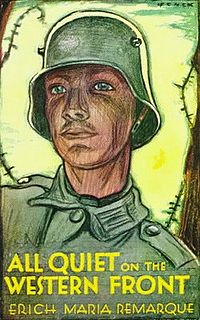
All Quiet on the Western Front is a novel by Erich Maria Remarque
, a German veteran of World War I
. The book describes the German soldiers' extreme physical and mental stress during the war, and the detachment from civilian life felt by many of these soldiers upon returning home from the front.
The novel was first published in November and December 1928 in the German newspaper Vossische Zeitung
and in book form in late January 1929. The book and its sequel, The Road Back
, were among the books banned and burned in Nazi Germany
. It sold 2.5 million copies in twenty-five languages in its first eighteen months in print.
In 1930, the book was adapted as an Oscar-winning film of the same name, directed by Lewis Milestone
.
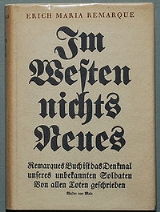
gives the title as All Quiet on the Western Front. The literal translation of "Im Westen nichts Neues" is "Nothing New in the West," with "West" being the war front; the phrase refers to the content of an official communiqué at the end of the novel.
Brian Murdoch's
1993 translation would render the phrase as "there was nothing new to report on the western front" within the narrative. Explaining his retention of the original book-title, he says:
The phrase "all quiet on the western front" later became popular slang for lack of action, initially reference to the Phoney War on World War II
's Western Front, but latterly in reference to anything from sport to politics.
shortly after the start of World War I
. Bäumer arrives at the Western Front
with his friends and schoolmates (Tjaden, Müller, Kropp and a number of other characters). There they meet Stanislaus Katczinsky, an older soldier, nicknamed Kat, who becomes Paul's mentor. While fighting at the front, Bäumer and his comrades have to engage in frequent battles and endure the dangerous and often squalid conditions of warfare.
At the very beginning of the book Erich Maria Remarque says "This book is to be neither an accusation nor a confession, and least of all an adventure, for death is not an adventure to those who stand face to face with it. It will try simply to tell of a generation of men who, even though they may have escaped shells, were destroyed by the war." The book does not focus on heroic stories of bravery, but rather gives a view of the conditions in which the soldiers find themselves. The monotony between battles, the constant threat of artillery
fire and bombardments, the struggle to find food, the lack of training of young recruits (meaning less chances of survival), and the overarching role of random chance in the lives and deaths of the soldiers are described in detail. The battles fought here have no names and seem to have little overall significance, except for the impending possibility of injury or death for Bäumer and his comrades. Only pitifully small pieces of land are gained, about the size of a football field, which are often lost again later. Remarque often refers to the living soldiers as old and dead, emotionally drained and shaken. "We are not youth any longer. We don't want to take the world by storm. We are fleeing from ourselves, from our life. We were eighteen and had begun to love life and the world; and we had to shoot it to pieces."
Paul's visit on leave to his home highlights the cost of the war on his psyche. The town has not changed since he went off to war; however, he finds that he does "not belong here anymore, it is a foreign world." He feels disconnected from most of the townspeople. His father asks him "stupid and distressing" questions about his war experiences, not understanding "that a man cannot talk of such things." An old schoolmaster lectures him about strategy and advancing to Paris, while insisting that Paul and his friends know only their "own little sector" of the war but nothing of the big picture. Indeed, the only person he remains connected to is his dying mother, with whom he shares a tender, yet restrained relationship. The night before he is to return from leave, he stays up with her, exchanging small expressions of love and concern for each other. He thinks to himself, "Ah! Mother, Mother! How can it be that I must part from you? Here I sit and there you are lying; we have so much to say, and we shall never say it." In the end, he concludes that he "ought never to have come [home] on leave."
Paul feels glad to be reunited with his comrades. Soon after, he volunteers to go on a patrol and kills a man for the first time in hand-to-hand combat. He watches the man die, in pain for hours. He feels remorse and asks forgiveness from the man's corpse. He is devastated and later confesses to Kat and Albert, who try to comfort him and reassure him that it is only part of the war.
They are then sent on what Paul calls a "good job." They must guard a village that is being shelled too heavily. The men enjoy themselves but while evacuating the villagers, Paul and Albert are wounded.
They recuperate in a Catholic hospital and Paul returns to active duty.
By now, the war is nearing its end and the German Army is retreating. In despair, Paul watches as his friends fall one by one. It is the death of Kat that eventually makes Paul careless about living. In the final chapter, he comments that peace is coming soon, but he does not see the future as bright and shining with hope. Paul feels that he has no aims left in life and that their generation will be different and misunderstood. When he finally dies at the end of the novel, the situation report of the frontline states that "All is Quiet on the Western Front" highlighting the insignificance of an individual soldier during a war.
Before the War, Paul was a creative, sensitive, and passionate person, writing poems and having a clear love for his family. But as the war changed his attitude and personality, poems and other aspects of his past life become something Paul could not remember having any link to, and he learns to disconnect himself from his feelings. He feels he can't tell anyone about his experiences, and feels like an outsider where his family is concerned.
By the end of the book, Paul realizes that he no longer knows what to do with himself and decides that he has nothing more to lose. The war appears to have snuffed out his hopes and dreams, which he feels he can never regain.
. Both he and Bäumer end up spending time in a Roman Catholic hospital together, Bäumer suffering from shrapnel wounds to the leg and arm. Though Kropp initially plans to commit suicide
if he requires an amputation, the book suggests he postponed suicide because of the strength of military camaraderie. Kropp and Bäumer part ways when Bäumer is recalled to his regiment after recovering. Paul comments that saying farewell was "very hard, but it is something a soldier learns to deal with."
-digger by profession. Overall, his size and behavior make him seem older than Paul, yet he is the same age as Paul and his school-friends (roughly 19 at the start of the book). Haie in addition has a good sense of humor. During combat, he is injured in his back, fatally (Chapter 6) — the resulting wound is large enough for Paul to see Haie's breathing lung when Himmelstoß carries him to safety.
Kat is also well known for his ability to scavenge nearly any item needed, above all, food. At one point he secures four tins of lobster. Bäumer describes Kat as possessing a sixth sense
. One night, Bäumer along with a group of other soldiers are holed up in a factory with neither rations nor comfortable bedding. Katczinsky leaves for a short while, returning with straw to put over the bare wires of the beds. Later, to feed the hungry men, Kat brings bread, a bag of horse flesh, a lump of fat, a pinch of salt and a pan in which to cook the food.
Kat is hit by shrapnel at the end of the story, leaving him with a smashed shin. Paul carries him back to camp on his back, only to discover upon their arrival that a stray splinter had hit Kat in the back of the head and killed him on the way. He is thus the last of Paul's close friends to die in battle. It is Kat's death that eventually makes Bäumer careless whether he survives the war or not, but that he can face the rest of his life without fear. "Let the months and the years come, they can take nothing from me, they can take nothing more. I am so alone, and so without hope that I can confront them without fear."
, but it is unclear whether he is the same person as in the prequel.
of Paul and his friends, including Kropp, Leer, Müller, and Behm. Behaving "in a way that cost [him] nothing," Kantorek is a strong supporter of the war and encourages Bäumer and other students in his class to join the war effort. Among twenty enlistees was Joseph Behm, the first of the class to die in battle. In an example of tragic irony, Behm was the only one who did not want to enter the war. Kantorek is a hypocrite, urging the young men he teaches to fight in the name of patriotism, while not voluntarily enlisting himself. In a twist of fate, Kantorek is later called up as a soldier as well. He very reluctantly joins the ranks of his former students, only to be grilled and taunted by Mittelstädt, one of the students he had earlier persuaded to enlist.
and believed to be dead by his friends. The next day, when he is seen walking blindly around no-man's-land, it is discovered that he was only unconscious. However, he is killed before he can be rescued.
. The screenplay was by Maxwell Anderson
, George Abbott
, Del Andrews
, C. Gardner Sullivan
, with uncredited work by Walter Anthony
and Milestone. It stars Louis Wolheim
, Lew Ayres
, John Wray
, Arnold Lucy
and Ben Alexander.
The film won the Academy Award for Best Picture
in 1930 for its producer Carl Laemmle Jr.
, and an Academy Award for Directing
for Lewis Milestone
. It was the first all-talking non-musical film to win the Best Picture Oscar. It also received two further nominations: Best Cinematography
, for Arthur Edeson
, and Best Writing Achievement
for Abbott, Anderson and Andrews.
In June 2009, an announcement was made that All Quiet on the Western Front will be remade. The cast, crew, and director
will be announced before the film's shoot in late 2012. The remake is scheduled for release sometime in 2013 with Daniel Radcliffe
starring as Bäumer.
, starring Richard Thomas
of The Waltons
as Paul Bäumer and Ernest Borgnine
as Kat. Although filmed in color, instead of black and white as the earlier 1930 film adaptation was, the wasted and desolated landscapes and environment are very effectively conveyed. An overall element of bleakness prevails throughout.
. It starred Robert Lonsdale as Paul Bäumer and Shannon Graney as Katczinsky. It was dramatised by Dave Sheasby
and directed by David Hunter.
's 1982 album, Jump Up!
features the song, "All Quiet On The Western Front
" (written by Elton and Bernie Taupin
). The song is a sorrowful rendition of the novel's story ("It's gone all quiet on the Western Front / Male Angels sigh / ghosts in a flooded trench / As Germany dies").
commissioned a play of the book by Robin Kingsland prior to a UK Tour.
Erich Maria Remarque
Erich Maria Remarque was a German author, best known for his novel All Quiet on the Western Front.-Life and work:...
, a German veteran of World War I
World War I
World War I , which was predominantly called the World War or the Great War from its occurrence until 1939, and the First World War or World War I thereafter, was a major war centred in Europe that began on 28 July 1914 and lasted until 11 November 1918...
. The book describes the German soldiers' extreme physical and mental stress during the war, and the detachment from civilian life felt by many of these soldiers upon returning home from the front.
The novel was first published in November and December 1928 in the German newspaper Vossische Zeitung
Vossische Zeitung
The Vossische Zeitung was the well known liberal German newspaper that was published in Berlin . Its predecessor was founded in 1704...
and in book form in late January 1929. The book and its sequel, The Road Back
The Road Back
The Road Back is a novel by German author Erich Maria Remarque. The novel was first serialized in the German newspaper Vossische Zeitung between December 1930 and January 1931, and published in book form in April 1931. It details the experience of young men in Germany who have returned from the...
, were among the books banned and burned in Nazi Germany
Nazi Germany
Nazi Germany , also known as the Third Reich , but officially called German Reich from 1933 to 1943 and Greater German Reich from 26 June 1943 onward, is the name commonly used to refer to the state of Germany from 1933 to 1945, when it was a totalitarian dictatorship ruled by...
. It sold 2.5 million copies in twenty-five languages in its first eighteen months in print.
In 1930, the book was adapted as an Oscar-winning film of the same name, directed by Lewis Milestone
Lewis Milestone
Lewis Milestone was a Russian-American motion picture director. He is known for directing Two Arabian Knights and All Quiet on the Western Front , both of which received Academy Awards for Best Director...
.
Title and translation
The 1930 English translation by Arthur Wesley WheenArthur Wesley Wheen
Arthur Wesley Wheen , MM & 2 Bars, was an Australian who chose to live his adult life in England. In 1920 he arrived in England on a Rhodes Scholarship, awarded on the basis of academic excellence and the Military Medal with two bars which he received in World War I...
gives the title as All Quiet on the Western Front. The literal translation of "Im Westen nichts Neues" is "Nothing New in the West," with "West" being the war front; the phrase refers to the content of an official communiqué at the end of the novel.
Brian Murdoch's
Brian O Murdoch
Brian O. Murdoch is Emeritus professor of German at the University of Stirling, Scotland. He is best known for his work on the Medieval popular Bible, a term which he coined....
1993 translation would render the phrase as "there was nothing new to report on the western front" within the narrative. Explaining his retention of the original book-title, he says:
Although it does not match the German exactly, Wheen's title has justly become part of the English language and is retained here with gratitude.
The phrase "all quiet on the western front" later became popular slang for lack of action, initially reference to the Phoney War on World War II
World War II
World War II, or the Second World War , was a global conflict lasting from 1939 to 1945, involving most of the world's nations—including all of the great powers—eventually forming two opposing military alliances: the Allies and the Axis...
's Western Front, but latterly in reference to anything from sport to politics.
Plot summary
The book tells the story of Paul Bäumer, a soldier who—urged on by his school teacher—joins the German armyGerman Army (German Empire)
The German Army was the name given the combined land forces of the German Empire, also known as the National Army , Imperial Army or Imperial German Army. The term "Deutsches Heer" is also used for the modern German Army, the land component of the German Bundeswehr...
shortly after the start of World War I
World War I
World War I , which was predominantly called the World War or the Great War from its occurrence until 1939, and the First World War or World War I thereafter, was a major war centred in Europe that began on 28 July 1914 and lasted until 11 November 1918...
. Bäumer arrives at the Western Front
Western Front (World War I)
Following the outbreak of World War I in 1914, the German Army opened the Western Front by first invading Luxembourg and Belgium, then gaining military control of important industrial regions in France. The tide of the advance was dramatically turned with the Battle of the Marne...
with his friends and schoolmates (Tjaden, Müller, Kropp and a number of other characters). There they meet Stanislaus Katczinsky, an older soldier, nicknamed Kat, who becomes Paul's mentor. While fighting at the front, Bäumer and his comrades have to engage in frequent battles and endure the dangerous and often squalid conditions of warfare.
At the very beginning of the book Erich Maria Remarque says "This book is to be neither an accusation nor a confession, and least of all an adventure, for death is not an adventure to those who stand face to face with it. It will try simply to tell of a generation of men who, even though they may have escaped shells, were destroyed by the war." The book does not focus on heroic stories of bravery, but rather gives a view of the conditions in which the soldiers find themselves. The monotony between battles, the constant threat of artillery
Artillery
Originally applied to any group of infantry primarily armed with projectile weapons, artillery has over time become limited in meaning to refer only to those engines of war that operate by projection of munitions far beyond the range of effect of personal weapons...
fire and bombardments, the struggle to find food, the lack of training of young recruits (meaning less chances of survival), and the overarching role of random chance in the lives and deaths of the soldiers are described in detail. The battles fought here have no names and seem to have little overall significance, except for the impending possibility of injury or death for Bäumer and his comrades. Only pitifully small pieces of land are gained, about the size of a football field, which are often lost again later. Remarque often refers to the living soldiers as old and dead, emotionally drained and shaken. "We are not youth any longer. We don't want to take the world by storm. We are fleeing from ourselves, from our life. We were eighteen and had begun to love life and the world; and we had to shoot it to pieces."
Paul's visit on leave to his home highlights the cost of the war on his psyche. The town has not changed since he went off to war; however, he finds that he does "not belong here anymore, it is a foreign world." He feels disconnected from most of the townspeople. His father asks him "stupid and distressing" questions about his war experiences, not understanding "that a man cannot talk of such things." An old schoolmaster lectures him about strategy and advancing to Paris, while insisting that Paul and his friends know only their "own little sector" of the war but nothing of the big picture. Indeed, the only person he remains connected to is his dying mother, with whom he shares a tender, yet restrained relationship. The night before he is to return from leave, he stays up with her, exchanging small expressions of love and concern for each other. He thinks to himself, "Ah! Mother, Mother! How can it be that I must part from you? Here I sit and there you are lying; we have so much to say, and we shall never say it." In the end, he concludes that he "ought never to have come [home] on leave."
Paul feels glad to be reunited with his comrades. Soon after, he volunteers to go on a patrol and kills a man for the first time in hand-to-hand combat. He watches the man die, in pain for hours. He feels remorse and asks forgiveness from the man's corpse. He is devastated and later confesses to Kat and Albert, who try to comfort him and reassure him that it is only part of the war.
They are then sent on what Paul calls a "good job." They must guard a village that is being shelled too heavily. The men enjoy themselves but while evacuating the villagers, Paul and Albert are wounded.
They recuperate in a Catholic hospital and Paul returns to active duty.
By now, the war is nearing its end and the German Army is retreating. In despair, Paul watches as his friends fall one by one. It is the death of Kat that eventually makes Paul careless about living. In the final chapter, he comments that peace is coming soon, but he does not see the future as bright and shining with hope. Paul feels that he has no aims left in life and that their generation will be different and misunderstood. When he finally dies at the end of the novel, the situation report of the frontline states that "All is Quiet on the Western Front" highlighting the insignificance of an individual soldier during a war.
Themes
One of the major themes of the novel is the difficulty of soldiers to revert to civilian life after having experienced extreme combat situations. Remarque comments in the preface that "[All Quiet on the Western Front] will try simply to tell of a generation of men who, even though they may have escaped shells, were destroyed by the war." This internal destruction can be found as early as the first chapter as Paul comments that, although all the boys are young, their youth has left them. When on leave from the front, Paul feels strongly isolated from his family and removed from daily life. Another topic concerns how soldiers' lives are put at risk by their commanding officers who seem unaware of the trauma of their charges.Main characters
Paul Bäumer
Paul Bäumer is the main character and narrator. At 19 years of age, Paul enlists in the German Army and is deployed to the Western Front where he experiences the severe psychological and physical effects of the war.Before the War, Paul was a creative, sensitive, and passionate person, writing poems and having a clear love for his family. But as the war changed his attitude and personality, poems and other aspects of his past life become something Paul could not remember having any link to, and he learns to disconnect himself from his feelings. He feels he can't tell anyone about his experiences, and feels like an outsider where his family is concerned.
By the end of the book, Paul realizes that he no longer knows what to do with himself and decides that he has nothing more to lose. The war appears to have snuffed out his hopes and dreams, which he feels he can never regain.
Albert Kropp
Kropp was in Paul's class at school and is described as the clearest thinker of the group. Kropp is wounded towards the end of the novel and undergoes an amputationAmputation
Amputation is the removal of a body extremity by trauma, prolonged constriction, or surgery. As a surgical measure, it is used to control pain or a disease process in the affected limb, such as malignancy or gangrene. In some cases, it is carried out on individuals as a preventative surgery for...
. Both he and Bäumer end up spending time in a Roman Catholic hospital together, Bäumer suffering from shrapnel wounds to the leg and arm. Though Kropp initially plans to commit suicide
Suicide
Suicide is the act of intentionally causing one's own death. Suicide is often committed out of despair or attributed to some underlying mental disorder, such as depression, bipolar disorder, schizophrenia, alcoholism, or drug abuse...
if he requires an amputation, the book suggests he postponed suicide because of the strength of military camaraderie. Kropp and Bäumer part ways when Bäumer is recalled to his regiment after recovering. Paul comments that saying farewell was "very hard, but it is something a soldier learns to deal with."
Haie Westhus
Haie is described as being tall and strong, and a peatPeat
Peat is an accumulation of partially decayed vegetation matter or histosol. Peat forms in wetland bogs, moors, muskegs, pocosins, mires, and peat swamp forests. Peat is harvested as an important source of fuel in certain parts of the world...
-digger by profession. Overall, his size and behavior make him seem older than Paul, yet he is the same age as Paul and his school-friends (roughly 19 at the start of the book). Haie in addition has a good sense of humor. During combat, he is injured in his back, fatally (Chapter 6) — the resulting wound is large enough for Paul to see Haie's breathing lung when Himmelstoß carries him to safety.
Fredrich Müller
Müller is about 18 and a half years of age, one of Bäumer's classmates, when he also joins the German army as a volunteer to go to the war. Carrying his old school books with him to the battlefield, he constantly reminds himself of the importance of learning and education. Even while under enemy fire, he "mutters propositions in physics". He became interested in Kemmerich's boots and inherits them when Kemmerich dies early in the novel. He is killed later in the book after being shot point-blank in the stomach with a flare gun. As he was dying "quite conscious and in terrible pain", he gave his boots which he inherited from Kemmerich to Paul.Stanislaus Katczinsky
Also known as Kat, he has the most positive influence on Paul and his comrades on the battlefield. Katczinsky was a cobbler in civilian life; he is older than Paul Bäumer and his comrades, about 40 years old, and serves as their leadership figure. He also represents a literary model highlighting the differences between the younger and older soldiers. While the older men have already had a life of professional and personal experience before the war, Bäumer and the men of his age have had little life experience or time for personal growth.Kat is also well known for his ability to scavenge nearly any item needed, above all, food. At one point he secures four tins of lobster. Bäumer describes Kat as possessing a sixth sense
Sixth sense
Sixth sense may refer to:* Extrasensory perception , commonly called the sixth sense* Equilibrioception , the commonly accepted sixth physiological sense* SixthSense, a wearable gestural interface...
. One night, Bäumer along with a group of other soldiers are holed up in a factory with neither rations nor comfortable bedding. Katczinsky leaves for a short while, returning with straw to put over the bare wires of the beds. Later, to feed the hungry men, Kat brings bread, a bag of horse flesh, a lump of fat, a pinch of salt and a pan in which to cook the food.
Kat is hit by shrapnel at the end of the story, leaving him with a smashed shin. Paul carries him back to camp on his back, only to discover upon their arrival that a stray splinter had hit Kat in the back of the head and killed him on the way. He is thus the last of Paul's close friends to die in battle. It is Kat's death that eventually makes Bäumer careless whether he survives the war or not, but that he can face the rest of his life without fear. "Let the months and the years come, they can take nothing from me, they can take nothing more. I am so alone, and so without hope that I can confront them without fear."
Tjaden
One of Bäumer's non-schoolmate friends. Before the war Tjaden was a locksmith. A big eater with a grudge against the former postman-turned corporal Himmelstoß (thanks to his strict 'disciplinary actions'), he manages to forgive Himmelstoß later in the book. Throughout the book, Paul frequently remarks on how much of an eater he is, yet somehow manages to stay as "thin as a rake." Tjaden appears as a well-liked school teacher in the sequel, The Road BackThe Road Back
The Road Back is a novel by German author Erich Maria Remarque. The novel was first serialized in the German newspaper Vossische Zeitung between December 1930 and January 1931, and published in book form in April 1931. It details the experience of young men in Germany who have returned from the...
, but it is unclear whether he is the same person as in the prequel.
Kantorek
Kantorek was the schoolmasterSchoolmaster
A schoolmaster, or simply master, once referred to a male school teacher. This usage survives in British public schools, but is generally obsolete elsewhere.The teacher in charge of a school is the headmaster...
of Paul and his friends, including Kropp, Leer, Müller, and Behm. Behaving "in a way that cost [him] nothing," Kantorek is a strong supporter of the war and encourages Bäumer and other students in his class to join the war effort. Among twenty enlistees was Joseph Behm, the first of the class to die in battle. In an example of tragic irony, Behm was the only one who did not want to enter the war. Kantorek is a hypocrite, urging the young men he teaches to fight in the name of patriotism, while not voluntarily enlisting himself. In a twist of fate, Kantorek is later called up as a soldier as well. He very reluctantly joins the ranks of his former students, only to be grilled and taunted by Mittelstädt, one of the students he had earlier persuaded to enlist.
Peter Leer
Leer is a soldier in Bäumer's company, and one of his classmates. He is very popular with women; when he and his comrades meet three French women, he is the first to seduce one of them. Bäumer describes Leer's ability to attract women by saying "Leer is an old hand at the game". In chapter 11, Leer is hit by a shell fragment, which also hits Bertinck. The shrapnel tears open Leer's hip, causing him to bleed to death quickly. His death causes Paul to ask himself, "What use is it to him now that he was such a good mathematician in school?"Bertinck
Lieutenant Bertinck is the leader of Bäumer's company. His men have a great respect for him, and Bertinck has great respect for his men. He permits them to eat the rations of the men that had been killed in action, standing up to the chef Ginger who would only allow them their allotted share. Bertinck is genuinely despondent when he learns that few of his men had survived an engagement. When he and the other characters are trapped in a trench under heavy attack, Bertinck, who has been injured in the firefight, spots a flamethrower team advancing on them. He gets out of cover and takes aim on the flamethrower but misses, and gets hit by enemy fire. With his next shot he kills the flamethrower, and immediately afterwards an enemy shell explodes on his position blowing off his chin. The same explosion also fatally wounds Leer.Himmelstoß
Corporal Himmelstoß (spelled Himmelstoss in some editions) was a post-man before enlisting in the war. He is a power-hungry corporal with special contempt for Paul and his friends, taking sadistic pleasure in punishing the minor infractions of his trainees during their basic training in preparation for their deployment. Paul later figures that the training taught by Himmelstoß made them "hard, suspicious, pitiless, and tough" but most importantly it taught them comradeship. However, Bäumer and his comrades have a chance to get back at Himmelstoß because of his punishments, mercilessly whipping him on the night before they board trains to go to the front. Himmelstoß later joins them at the front, revealing himself as a coward who shirks his duties for fear of getting hurt or killed, and pretends to be wounded because of a scratch on his face. Paul Bäumer beats him because of it and when a lieutenant comes along looking for men for a trench charge, Himmelstoß joins and leads the charge. He carries Haie Westhus' body to Bäumer after he is fatally wounded. Matured and repentant through his experiences Himmelstoß later asks for forgiveness from his previous charges. As he becomes the new staff cook, to prove his friendship he secures two pounds of sugar for Bäumer and half a pound of butter for Tjaden.Detering
Detering is a farmer who constantly longs to return to his wife and farm. He is also fond of horses and is angered when he sees them used in combat. He says, "It is of the vilest baseness to use horses in the war," when the group hears several wounded horses writhe and scream for a long time before dying during a bombardment. He tries to shoot them to put them out of misery, but is stopped by Kat to keep their current position hidden. He is driven to desert when he sees a cherry tree in blossom, which reminds him of home too much and inspires him to leave. He is found by military police and court-martialed, and is never heard from again.Josef Hamacher
Hamacher is a patient at the Catholic hospital where Paul and Albert Kropp are temporarily stationed. He has an intimate knowledge of the workings of the hospital. He also has a "shooting license," certifying him as sporadically not responsible for his actions due to a head wound, though he is clearly quite sane and exploiting his license so he can stay in the hospital and away from the war as long as possible.Franz Kemmerich
A young boy only of 19 years. Franz Kemmerich had enlisted in the army for World War I along with his best friend and classmate, Bäumer. Kemmerich is shot in the leg early in the story; his injured leg had to be amputated, and he dies shortly after. In anticipation of Kemmerich's imminent death, Müller was eager to get his boots. While in the hospital, someone stole Kemmerich's watch from him, causing him great distress, prompting him to ask about his watch every time his friends came to visit him in the hospital.Joseph Behm
A student in Paul's class. Behm was the only student that was not quickly influenced by Kantorek's patriotism to join the war. Eventually, due to pressure from friends and Kantorek, he joins the war. He is the first of Paul's friends to die. He is blinded in no man's landNo man's land
No man's land is a term for land that is unoccupied or is under dispute between parties that leave it unoccupied due to fear or uncertainty. The term was originally used to define a contested territory or a dumping ground for refuse between fiefdoms...
and believed to be dead by his friends. The next day, when he is seen walking blindly around no-man's-land, it is discovered that he was only unconscious. However, he is killed before he can be rescued.
Film
In 1930, an American film of the novel was made, directed by Lewis MilestoneLewis Milestone
Lewis Milestone was a Russian-American motion picture director. He is known for directing Two Arabian Knights and All Quiet on the Western Front , both of which received Academy Awards for Best Director...
. The screenplay was by Maxwell Anderson
Maxwell Anderson
James Maxwell Anderson was an American playwright, author, poet, journalist and lyricist.-Early years:Anderson was born in Atlantic, Pennsylvania, the second of eight children to William Lincoln "Link" Anderson, a Baptist minister, and Charlotte Perrimela Stephenson, both of Scots and Irish descent...
, George Abbott
George Abbott
George Francis Abbott was an American theater producer and director, playwright, screenwriter, and film director and producer whose career spanned more than nine decades.-Early years:...
, Del Andrews
Del Andrews
Del Andrews , born Udell Endrows, was a Hollywood writer/director in the 1920s. He primarily worked on low budget westerns, writing and directing films starring Hoot Gibson, Fred Thomson, and Bob Custer....
, C. Gardner Sullivan
C. Gardner Sullivan
C. Gardner Sullivan was an American screenwriter and motion picture producer. He was a prolific writer with more than 350 films among his credits. In 1924, the magazine Story World selected him on a list of the ten individuals who had contributed the most to the advancement of the motion picture...
, with uncredited work by Walter Anthony
Walter Anthony
Walter Anthony was a screenplay, titles and documentary film writer. Before Walter started writing in films he was a dramatic and musical critic for San Francisco Morning Call....
and Milestone. It stars Louis Wolheim
Louis Wolheim
Louis Wolheim was an American character actor.His trademark broken nose was the result of an injury sustained while playing football for Cornell University. Despite his rugged visage, Wolheim was intelligent and cultivated, speaking French, German, Spanish, and Yiddish. He was also a mathematics...
, Lew Ayres
Lew Ayres
Lew Ayres was an American actor, best known for starring as Paul in All Quiet on the Western Front and for playing Dr...
, John Wray
John Wray (actor)
John Wray was an American character actor of stage and screen.Wray was one of the many Broadway actors to descend on Hollywood in the aftermath of the sound revolution, and quickly made an indelible impression on the era in a variety of substantial character roles, such as the Arnold...
, Arnold Lucy
Arnold Lucy
Arnold Lucy was a British actor claimed to have performed on the fabled London West End stage over 1,200 times before making his early film debut in the early 1910s during the Golden Era of the Hollywood system...
and Ben Alexander.
The film won the Academy Award for Best Picture
Academy Award for Best Picture
The Academy Award for Best Picture is one of the Academy Awards of Merit presented annually by the Academy of Motion Picture Arts and Sciences to artists working in the motion picture industry. The Best Picture category is the only category in which every member of the Academy is eligible not only...
in 1930 for its producer Carl Laemmle Jr.
Carl Laemmle Jr.
Carl Laemmle Jr. was in charge of production at Universal Studios from about 1928 to 1936. He was the son of Carl Laemmle, the founder of Universal Pictures. Laemmle, called “Junior”, by his friends and family, developed a reputation for spending too much money at the studios on several films that...
, and an Academy Award for Directing
Academy Award for Directing
The Academy Award for Achievement in Directing , usually known as the Best Director Oscar, is one of the Awards of Merit presented by the Academy of Motion Picture Arts and Sciences to directors working in the motion picture industry...
for Lewis Milestone
Lewis Milestone
Lewis Milestone was a Russian-American motion picture director. He is known for directing Two Arabian Knights and All Quiet on the Western Front , both of which received Academy Awards for Best Director...
. It was the first all-talking non-musical film to win the Best Picture Oscar. It also received two further nominations: Best Cinematography
Academy Award for Best Cinematography
The Academy Award for Best Cinematography is an Academy Award awarded each year to a cinematographer for work in one particular motion picture.-History:...
, for Arthur Edeson
Arthur Edeson
Arthur Edeson, A.S.C. was a film cinematographer, born in New York City.He was nominated for three Academy Awards in his career in cinema.-Career:...
, and Best Writing Achievement
Academy Award for Writing Adapted Screenplay
The Academy Award for Writing Adapted Screenplay is one of the Academy Awards, the most prominent film awards in the United States. It is awarded each year to the writer of a screenplay adapted from another source...
for Abbott, Anderson and Andrews.
In June 2009, an announcement was made that All Quiet on the Western Front will be remade. The cast, crew, and director
will be announced before the film's shoot in late 2012. The remake is scheduled for release sometime in 2013 with Daniel Radcliffe
Daniel Radcliffe
Daniel Jacob Radcliffe is an English actor who rose to prominence playing the titular character in the Harry Potter film series....
starring as Bäumer.
TV film
In 1979, the film was remade for CBS television by Delbert MannDelbert Mann
Delbert Martin Mann, Jr. was an American television and film director. He won the Palme d'Or at the Cannes Film Festival and the Academy Award for Best Director for the film Marty...
, starring Richard Thomas
Richard Thomas (actor)
Richard Earl Thomas is an American actor, best known for his role as budding author John-Boy Walton in the CBS drama The Waltons.- Early life :Thomas was born Richard Earl Thomas in New York,...
of The Waltons
The Waltons
The Waltons is an American television series created by Earl Hamner, Jr., based on his book Spencer's Mountain, and a 1963 film of the same name. The show centered on a family growing up in a rural Virginia community during the Great Depression and World War II. The series pilot was a television...
as Paul Bäumer and Ernest Borgnine
Ernest Borgnine
Ernest Borgnine is an American actor of television and film. His career has spanned more than six decades. He was an unconventional lead in many films of the 1950s, including his Academy Award-winning turn in the 1955 film Marty...
as Kat. Although filmed in color, instead of black and white as the earlier 1930 film adaptation was, the wasted and desolated landscapes and environment are very effectively conveyed. An overall element of bleakness prevails throughout.
Radio
On November 9, 2008, a radio adaptation was broadcast on BBC Radio 3BBC Radio 3
BBC Radio 3 is a national radio station operated by the BBC within the United Kingdom. Its output centres on classical music and opera, but jazz, world music, drama, culture and the arts also feature. The station is the world’s most significant commissioner of new music, and its New Generation...
. It starred Robert Lonsdale as Paul Bäumer and Shannon Graney as Katczinsky. It was dramatised by Dave Sheasby
Dave Sheasby
David Sheasby , was an acclaimed playwright, director, dramatist and radio producer who was based in Sheffield, England....
and directed by David Hunter.
Music
Elton JohnElton John
Sir Elton Hercules John, CBE, Hon DMus is an English rock singer-songwriter, composer, pianist and occasional actor...
's 1982 album, Jump Up!
Jump Up!
Jump Up! is the 16th studio album by British singer/songwriter Elton John, released in 1982 on Rocket Records except in the US and Canada, where it was released on Geffen Records. It features such songs as "Empty Garden ", a tribute to John Lennon...
features the song, "All Quiet On The Western Front
All Quiet on the Western Front (song)
"All Quiet on the Western Front" is a song by Elton John with lyrics by Bernie Taupin. It is the closing track of his 1982 album, Jump Up!. It was also released as a single in the U.K. without charting....
" (written by Elton and Bernie Taupin
Bernie Taupin
Bernard John "Bernie" Taupin is an English lyricist, poet, and singer, best known for his long-term collaboration with Elton John, writing the lyrics for the majority of the star's songs, making his lyrics some of the best known in pop-rock's history.In 1967, Taupin answered an advertisement in...
). The song is a sorrowful rendition of the novel's story ("It's gone all quiet on the Western Front / Male Angels sigh / ghosts in a flooded trench / As Germany dies").
Theatre
In 2009, Nottingham PlayhouseNottingham Playhouse
The Nottingham Playhouse is a theatre in Nottingham, England. It was first established as a repertory theatre in the 1950s when it operated from a former cinema. Directors during this period included Val May and Frank Dunlop.-The building:...
commissioned a play of the book by Robin Kingsland prior to a UK Tour.
External links
- CliffsNotes
- Spark Notes
- All Quiet on the Western Front study guide, themes, quotes, literary devices, multimedia, teacher resources