

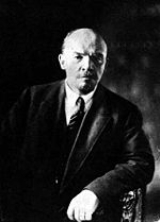
Leninism

Encyclopedia
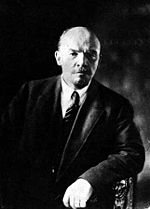
Revolution
A revolution is a fundamental change in power or organizational structures that takes place in a relatively short period of time.Aristotle described two types of political revolution:...
vanguard party
Vanguard party
A vanguard party is a political party at the forefront of a mass action, movement, or revolution. The idea of a vanguard party has its origins in the Communist Manifesto by Karl Marx and Friedrich Engels...
, and the achievement of a direct-democracy dictatorship of the proletariat
Dictatorship of the proletariat
In Marxist socio-political thought, the dictatorship of the proletariat refers to a socialist state in which the proletariat, or the working class, have control of political power. The term, coined by Joseph Weydemeyer, was adopted by the founders of Marxism, Karl Marx and Friedrich Engels, in the...
, as political prelude to the establishment of socialism
Socialism
Socialism is an economic system characterized by social ownership of the means of production and cooperative management of the economy; or a political philosophy advocating such a system. "Social ownership" may refer to any one of, or a combination of, the following: cooperative enterprises,...
. Developed by, and named for, the Russian revolutionary Lenin (Vladimir Ilyich Ulyanov, 1870–1924), Leninism comprises political
Political science
Political Science is a social science discipline concerned with the study of the state, government and politics. Aristotle defined it as the study of the state. It deals extensively with the theory and practice of politics, and the analysis of political systems and political behavior...
and socialist economic theories
Political economy
Political economy originally was the term for studying production, buying, and selling, and their relations with law, custom, and government, as well as with the distribution of national income and wealth, including through the budget process. Political economy originated in moral philosophy...
, developed from Marxism
Marxism
Marxism is an economic and sociopolitical worldview and method of socioeconomic inquiry that centers upon a materialist interpretation of history, a dialectical view of social change, and an analysis and critique of the development of capitalism. Marxism was pioneered in the early to mid 19th...
, and Lenin’s interpretations of Marxist theory
Marxist philosophy
Marxist philosophy or Marxist theory are terms that cover work in philosophy that is strongly influenced by Karl Marx's materialist approach to theory or that is written by Marxists...
, for practical application to the socio-political conditions of the agrarian Russian Empire
Russian Empire
The Russian Empire was a state that existed from 1721 until the Russian Revolution of 1917. It was the successor to the Tsardom of Russia and the predecessor of the Soviet Union...
(1721–1917) of the early 20th century. In February 1917, Leninism was the Russian application of Marxist economics and political philosophy, effected and realised by the Bolshevik party, the vanguard party who led the fight for the political independence of the working class
Working class
Working class is a term used in the social sciences and in ordinary conversation to describe those employed in lower tier jobs , often extending to those in unemployment or otherwise possessing below-average incomes...
. Functionally, the vanguard party provided the political education, and the revolutionary leadership and organisation necessary to depose capitalism in Imperial Russia. After the October Revolution
October Revolution
The October Revolution , also known as the Great October Socialist Revolution , Red October, the October Uprising or the Bolshevik Revolution, was a political revolution and a part of the Russian Revolution of 1917...
of 1917, Leninism was the dominant version of Marxism in Russia, and then the official ideology
Ideology
An ideology is a set of ideas that constitutes one's goals, expectations, and actions. An ideology can be thought of as a comprehensive vision, as a way of looking at things , as in common sense and several philosophical tendencies , or a set of ideas proposed by the dominant class of a society to...
of Soviet democracy
Soviet democracy
Soviet democracy or sometimes council democracy is a form of democracy in which workers' councils called "soviets" , consisting of worker-elected delegates, form organs of power possessing both legislative and executive power. The soviets begin at the local level and onto a national parliament-like...
(by workers’ council) in the Russian Socialist Federal Soviet Republic (RSFSR), before its unitary amalgamation into the Union of Soviet Socialist Republics
Soviet Union
The Soviet Union , officially the Union of Soviet Socialist Republics , was a constitutionally socialist state that existed in Eurasia between 1922 and 1991....
(USSR), in 1922. As a political-science term, Leninism entered common usage in 1922, only after infirmity ended Lenin’s participation in governing the Russian Communist Party. Two years later, in July 1924, at the fifth congress of the Communist International
Comintern
The Communist International, abbreviated as Comintern, also known as the Third International, was an international communist organization initiated in Moscow during March 1919...
(Comintern), Grigory Zinoviev
Grigory Zinoviev
Grigory Yevseevich Zinoviev , born Ovsei-Gershon Aronovich Radomyslsky Apfelbaum , was a Bolshevik revolutionary and a Soviet Communist politician...
popularized the use of the term Leninism to denote “vanguard-party revolution”.
Historical background
In the 19th century, The Communist ManifestoThe Communist Manifesto
The Communist Manifesto, originally titled Manifesto of the Communist Party is a short 1848 publication written by the German Marxist political theorists Karl Marx and Friedrich Engels. It has since been recognized as one of the world's most influential political manuscripts. Commissioned by the...
(1848), by Karl Marx, called for the international political unification of the European working class
Working class
Working class is a term used in the social sciences and in ordinary conversation to describe those employed in lower tier jobs , often extending to those in unemployment or otherwise possessing below-average incomes...
es in order to achieve a Communist revolution; and proposed that because the socio-economic organization of communism was of a higher form than that of capitalism, a workers’ revolution
Revolution
A revolution is a fundamental change in power or organizational structures that takes place in a relatively short period of time.Aristotle described two types of political revolution:...
would first occur in the economically advanced, industrialized countries. Yet, in the early 20th century, the socio-economic backwardness of Imperial Russia (uneven and combined economic development) facilitated rapid and intensive industrialization, which produced a united, working-class proletariat
Proletariat
The proletariat is a term used to identify a lower social class, usually the working class; a member of such a class is proletarian...
in a predominantly rural, agrarian peasant society. Moreover, because the industrialization was financed mostly with foreign capital, Imperial Russia
Russian Empire
The Russian Empire was a state that existed from 1721 until the Russian Revolution of 1917. It was the successor to the Tsardom of Russia and the predecessor of the Soviet Union...
(1721–1917) did not possess a revolutionary bourgeoisie
Bourgeoisie
In sociology and political science, bourgeoisie describes a range of groups across history. In the Western world, between the late 18th century and the present day, the bourgeoisie is a social class "characterized by their ownership of capital and their related culture." A member of the...
with political and economic influence upon the workers and the peasants (as occurred in the French Revolution
French Revolution
The French Revolution , sometimes distinguished as the 'Great French Revolution' , was a period of radical social and political upheaval in France and Europe. The absolute monarchy that had ruled France for centuries collapsed in three years...
, 1789). So, although Russia's political economy
Political economy
Political economy originally was the term for studying production, buying, and selling, and their relations with law, custom, and government, as well as with the distribution of national income and wealth, including through the budget process. Political economy originated in moral philosophy...
principally was agrarian and semi-feudal
Feudalism
Feudalism was a set of legal and military customs in medieval Europe that flourished between the 9th and 15th centuries, which, broadly defined, was a system for ordering society around relationships derived from the holding of land in exchange for service or labour.Although derived from the...
, the task of democratic revolution therefore fell to the urban, industrial working class, as the only social class
Social class
Social classes are economic or cultural arrangements of groups in society. Class is an essential object of analysis for sociologists, political scientists, economists, anthropologists and social historians. In the social sciences, social class is often discussed in terms of 'social stratification'...
capable of effecting land reform and democratization, in view that the Russian propertied classes would attempt to suppress any revolution. In April 1917, Lenin published the April Theses, the strategy of the October Revolution
October Revolution
The October Revolution , also known as the Great October Socialist Revolution , Red October, the October Uprising or the Bolshevik Revolution, was a political revolution and a part of the Russian Revolution of 1917...
, which proposed that the Russian revolution was not an isolated national event, but a fundamentally international event, i.e. the first world socialist revolution. Thus, Lenin's practical application of Marxism and working-class urban revolution to the social, political, and economic conditions of the agrarian peasant society that was Tsarist Russia sparked the “revolutionary nationalism of the poor” to depose
Deposition (politics)
Deposition by political means concerns the removal of a politician or monarch. It may be done by coup, impeachment, invasion or forced abdication...
the absolute monarchy
Absolute monarchy
Absolute monarchy is a monarchical form of government in which the monarch exercises ultimate governing authority as head of state and head of government, his or her power not being limited by a constitution or by the law. An absolute monarch thus wields unrestricted political power over the...
of the three-hundred-year Romanov dynasty (1613–1917).
Democratic centralism, the 'vanguard party', and revolution
In the pamphlet What is to be Done? (1902), Lenin argued that a revolutionary party (vanguard partyVanguard party
A vanguard party is a political party at the forefront of a mass action, movement, or revolution. The idea of a vanguard party has its origins in the Communist Manifesto by Karl Marx and Friedrich Engels...
), largely drawn from the working class, should take up a political campaign within society. He argued that this was the only way the proletariat
Proletariat
The proletariat is a term used to identify a lower social class, usually the working class; a member of such a class is proletarian...
(the working class) could successfully achieve a revolution, and contrasted this with the purely trade-union-based struggle (an "economist" struggle) that was being advocated by other socialist groups at the time. He followed Marx in distinguishing between the purely economic campaign (of strike action for wage increases and other concessions from capitalists) and the political campaign (of arguing for socialist changes in broader society) - the latter of which required a revolutionary party.
Following the example of the First International, Lenin organised this party under democratic centralism
Democratic centralism
Democratic centralism is the name given to the principles of internal organization used by Leninist political parties, and the term is sometimes used as a synonym for any Leninist policy inside a political party...
, epitomised in the slogan "freedom in discussion, unity in action". For example, Lenin wrote:
Of course, the application of this principle in practice will sometimes give rise to disputes and misunderstandings; but only on the basis of this principle can all disputes and all misunderstandings be settled honourably for the Party. ... The principle of democratic centralism and autonomy for local Party organisations implies universal and full freedom to criticise, so long as this does not disturb the unity of a definite action; it rules out all criticism which disrupts or makes difficult the unity of an action decided on by the Party.Lenin, V.I. (1905) Freedom to Criticise and Unity of Action, from Lenin Collected Works, Progress Publishers, 1965, Moscow, Volume 10, pages 442-443. Available online at: http://www.marxists.org/archive/lenin/works/1906/may/20c.htm (accessed 30th November 2011)
Full democratic debate was an accepted part of inner-party Bolshevik practice under Lenin, even after the banning of party factions in 1921. While Lenin was a guiding influence on the party, he did not exercise absolute power, and continuously engaged in debate and discussion to have his point of view accepted. (This formed a contrast with the practice after Lenin's illness and death in 1923-24.)
Although Lenin supported political reform prior to a successful revolution (including running candidates to an elected Duma when the opportunity presented itself), Lenin held that capitalism
Capitalism
Capitalism is an economic system that became dominant in the Western world following the demise of feudalism. There is no consensus on the precise definition nor on how the term should be used as a historical category...
could ultimately only be overthrown with revolution
Revolution
A revolution is a fundamental change in power or organizational structures that takes place in a relatively short period of time.Aristotle described two types of political revolution:...
, not with gradual reform. Attempts to reform capitalism — from within (Fabianism) and from without (social democracy
Social democracy
Social democracy is a political ideology of the center-left on the political spectrum. Social democracy is officially a form of evolutionary reformist socialism. It supports class collaboration as the course to achieve socialism...
) — were expected to fail because the class which holds economic power (the capitalist class in bourgois society) determines the nature of political power.
Under Leninism the purpose of the vanguard party is to achieve the support of the proletariat and give it a forum for political expression, lead the revolution, depose the incumbent government and transfer power of government to working class institutions, thereby establishing the dictatorship of the proletariat
Dictatorship of the proletariat
In Marxist socio-political thought, the dictatorship of the proletariat refers to a socialist state in which the proletariat, or the working class, have control of political power. The term, coined by Joseph Weydemeyer, was adopted by the founders of Marxism, Karl Marx and Friedrich Engels, in the...
. This change in the nature of the ruling class then opens the way to the full development of socialism.
Proletarian government
A socialist society would be governed with a form of direct democracyDirect democracy
Direct democracy is a form of government in which people vote on policy initiatives directly, as opposed to a representative democracy in which people vote for representatives who then vote on policy initiatives. Direct democracy is classically termed "pure democracy"...
practised and effected by means of elected soviets
Soviet (council)
Soviet was a name used for several Russian political organizations. Examples include the Czar's Council of Ministers, which was called the “Soviet of Ministers”; a workers' local council in late Imperial Russia; and the Supreme Soviet of the Soviet Union....
(workers’ councils) - these were an innovation of the failed 1905 Russian Revolution. Lenin responded to this innovation by pointing out that it formed a real world manifestation of the Marxist "democratic dictatorship of the proletariat."
Soviets would be composed of representatives of factory committees and trade unions. As such, they would exclude capitalists as a class, and ensure government by the working class and poor peasants. This was the "dictatorship of the proletariat", as opposed to the "dictatorship of capital" practiced in bourgois democracies. In Leninist theory prior to 1924, the 'vanguard party' would form only one of a range of political parties competing within this framework. It was only the specific circumstances of the civil war, and the stepwise defection of opposing political parties to methods of terrorism or to the aid of the White Armies that led to the eventual banning of other parties, and the Bolshevik 'vanguard party' becoming the only legal political voice. This was an eventuality that Lenin did not regard as a natural part of his body of theory, although it was later claimed as a part of Leninist practice by Stalin and others after his death.
Chapter five of The State and Revolution (1917) describes:
. . . the dictatorship of the proletariat — i.e. the organisation of the vanguard of the oppressed as the ruling class for the purpose of crushing the oppressors. . . . An immense expansion of democracy, which for the first time becomes democracy for the poor, democracy for the people, and not democracy for the rich: . . . and suppression by force, i.e. exclusion from democracy, for the exploiters and oppressors of the people — this is the change which democracy undergoes during the transition from capitalism to communism.
Lenin wrote that a revolution in under-developed Russia would require an alliance of the proletariat and peasantry, as the proletariat would be too numerically weak to take power entirely on its own terms. He advanced the slogan "For a democratic dictatorship of the proletariat and peasantry." Trotsky argued that the proletariat should be at the forefront of the revolution, as this was the only way to give it a truly socialist and democratic content (oweing the to middle-class aspirations of much of the peasantry). Lenin initially disputed this formula, but later adopted it prior to the 1917 Russian Revolution.
Imperialism
In the course of developing the Russian application of MarxismMarxism
Marxism is an economic and sociopolitical worldview and method of socioeconomic inquiry that centers upon a materialist interpretation of history, a dialectical view of social change, and an analysis and critique of the development of capitalism. Marxism was pioneered in the early to mid 19th...
, the pamphlet Imperialism, the Highest Stage of Capitalism
Imperialism, the Highest Stage of Capitalism
Imperialism, the Highest Stage of Capitalism , by Lenin, describes the function of financial capital in generating profits from imperial colonialism, as the final stage of capitalist development to ensure greater profits...
(1916) is Lenin’s explanation of a an economic development that Karl Marx predicted: that capitalism would become a global financial system, wherein advanced industrial countries would export financial capital
Financial capital
Financial capital can refer to money used by entrepreneurs and businesses to buy what they need to make their products or provide their services or to that sector of the economy based on its operation, i.e. retail, corporate, investment banking, etc....
to their colonial
Colonialism
Colonialism is the establishment, maintenance, acquisition and expansion of colonies in one territory by people from another territory. It is a process whereby the metropole claims sovereignty over the colony and the social structure, government, and economics of the colony are changed by...
countries, to finance the exploitation of their natural resources and the labour of the native populace. This superexploitation
Superprofit
Superprofit , is a concept in Karl Marx's critique of political economy, subsequently elaborated by Lenin and other Marxist thinkers.-The origin of the concept in Marx's Capital:...
of poor countries allows the capitalist countries to maintain some of their homeland workers politically content with a slightly-higher standard of living, and so ensure peaceful labour-capital relations in the capitalist homeland. (see: labour aristocracy, globalization
Globalization
Globalization refers to the increasingly global relationships of culture, people and economic activity. Most often, it refers to economics: the global distribution of the production of goods and services, through reduction of barriers to international trade such as tariffs, export fees, and import...
) Hence, a proletarian revolution
Proletarian revolution
A proletarian revolution is a social and/or political revolution in which the working class attempts to overthrow the bourgeoisie. Proletarian revolutions are generally advocated by socialists, communists, and most anarchists....
could not occur in the developed capitalist countries, while the imperialist global-finance system was intact; thus an under-developed country would feature the first proletarian revolution; and, in the early 20th century, Imperial Russia was the weakest country in the capitalist global-finance system. In 1915, Lenin wrote:
Workers of the world, unite!Workers of the world, unite!The political slogan Workers of the world, unite! is one of the most famous rallying cries of communism, found in The Communist Manifesto , by Karl Marx and Friedrich Engels...
— Uneven economic and political development is an absolute law of capitalism. Hence the victory of socialism is possible, first in several, or even in one capitalist country taken separately. The victorious proletariat of that country, having expropriated the capitalists and organised its own socialist production, would stand up against the rest of the world, the capitalist world.
The "National Question"
While Lenin accepted the existence of nationalistNationalism
Nationalism is a political ideology that involves a strong identification of a group of individuals with a political entity defined in national terms, i.e. a nation. In the 'modernist' image of the nation, it is nationalism that creates national identity. There are various definitions for what...
feeling among oppressed peoples - and championed the right of an oppressed nation to seek national self-determination (see below), he opposed the ethnic chauvinism of “Greater Russia”, partly because it was a cultural
Cultural hegemony
Cultural hegemony is the philosophic and sociological theory, by the Marxist philosopher Antonio Gramsci, that a culturally diverse society can be dominated by one social class, by manipulating the societal culture so that its ruling-class worldview is imposed as the societal norm, which then is...
obstacle to establishing the proletarian dictatorship in the territories of the deposed Tsarist Russian Empire. He wrote:
We fight against the privileges and violence of the oppressor nation, and do not in any way condone strivings for privileges on the part of the oppressed nation. ... The bourgeois nationalism of any oppressed nation has a general democratic content that is directed against oppression, and it is this content that we unconditionally support. At the same time we strictly distinguish it from the tendency towards national exclusiveness ... Can a nation be free if it oppresses other nations? It cannot.
The "internationalist" perspectives of Bolshevism and Marxism
Marxism
Marxism is an economic and sociopolitical worldview and method of socioeconomic inquiry that centers upon a materialist interpretation of history, a dialectical view of social change, and an analysis and critique of the development of capitalism. Marxism was pioneered in the early to mid 19th...
are based upon the class struggle
Class struggle
Class struggle is the active expression of a class conflict looked at from any kind of socialist perspective. Karl Marx and Friedrich Engels wrote "The [written] history of all hitherto existing society is the history of class struggle"....
that transcends nationalism, ethnocentrism, and religion — intellectual
Intellectualism
Intellectualism denotes the use and development of the intellect, the practice of being an intellectual, and of holding intellectual pursuits in great regard. Moreover, in philosophy, “intellectualism” occasionally is synonymous with “rationalism”, i.e. knowledge derived mostly from reason and...
obstacles to class consciousness — which the ruling classes manipulate to divide the working class. However, Lenin was adamant that to overcome the barrier of nationalist feelings, it was necessary to acknowledge their existence among oppressed peoples and guarantee them national independence (in the form of the right of secession). On the basis of national self-determination, it would then be natural for socialist states to overcome nationalist ideas and come together in a federation. Lenin wrote,
...nothing holds up the development and strengthening of proletarian class solidarity so much as national injustice; "offended" nationals are not sensitive to anything so much as to the feeling of equality and the violation of this equality, if only through negligence or jest - to the violation of that equality by their proletarian comrades.
Culture
It was an accepted part of Marxist practice that the role of Marxists was to politically educateEducation
Education in its broadest, general sense is the means through which the aims and habits of a group of people lives on from one generation to the next. Generally, it occurs through any experience that has a formative effect on the way one thinks, feels, or acts...
the workers and peasants to dispel the societal false consciousness of religion
Religion
Religion is a collection of cultural systems, belief systems, and worldviews that establishes symbols that relate humanity to spirituality and, sometimes, to moral values. Many religions have narratives, symbols, traditions and sacred histories that are intended to give meaning to life or to...
and nationalism
Nationalism
Nationalism is a political ideology that involves a strong identification of a group of individuals with a political entity defined in national terms, i.e. a nation. In the 'modernist' image of the nation, it is nationalism that creates national identity. There are various definitions for what...
that were the cultural status quo taught by the bourgeoisie
Bourgeoisie
In sociology and political science, bourgeoisie describes a range of groups across history. In the Western world, between the late 18th century and the present day, the bourgeoisie is a social class "characterized by their ownership of capital and their related culture." A member of the...
to facilitate their economic exploitation
Exploitation
This article discusses the term exploitation in the meaning of using something in an unjust or cruel manner.- As unjust benefit :In political economy, economics, and sociology, exploitation involves a persistent social relationship in which certain persons are being mistreated or unfairly used for...
of peasant and worker, however, this role, as understood by Lenin, did not resemble the oppression familiar under Stalin using this formula. The Central Committee, under Lenin's influence, stated that the development of worker's culture should not be 'hamstrung from above'
Leninism after 1924
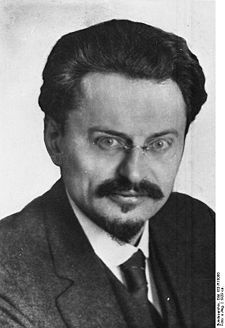
October Revolution
The October Revolution , also known as the Great October Socialist Revolution , Red October, the October Uprising or the Bolshevik Revolution, was a political revolution and a part of the Russian Revolution of 1917...
Russia, Stalinism
Stalinism
Stalinism refers to the ideology that Joseph Stalin conceived and implemented in the Soviet Union, and is generally considered a branch of Marxist–Leninist ideology but considered by some historians to be a significant deviation from this philosophy...
and Trotskyism
Trotskyism
Trotskyism is the theory of Marxism as advocated by Leon Trotsky. Trotsky considered himself an orthodox Marxist and Bolshevik-Leninist, arguing for the establishment of a vanguard party of the working-class...
were the principal philosophies of Communism
Communism
Communism is a social, political and economic ideology that aims at the establishment of a classless, moneyless, revolutionary and stateless socialist society structured upon common ownership of the means of production...
claiming legitimate ideological descent from Leninism; each denied the political legitimacy of the other.
Lenin vs Stalin
In 1924, until shortly before his death, Lenin worked to counter the disproportionate political influence of his revolutionary comrade Josef Stalin
Joseph Stalin
Joseph Vissarionovich Stalin was the Premier of the Soviet Union from 6 May 1941 to 5 March 1953. He was among the Bolshevik revolutionaries who brought about the October Revolution and had held the position of first General Secretary of the Communist Party of the Soviet Union's Central Committee...
, in part for abuses he had committed against the populace of Georgia
Georgia (country)
Georgia is a sovereign state in the Caucasus region of Eurasia. Located at the crossroads of Western Asia and Eastern Europe, it is bounded to the west by the Black Sea, to the north by Russia, to the southwest by Turkey, to the south by Armenia, and to the southeast by Azerbaijan. The capital of...
. The action against Stalin aligned with Lenin's continued advocacy of the right of the national (ethnic) groups of the former Russian Empire to politically express their national and territorial independence; the right of national self-determination was a key theoretical component of Leninism. He wrote that Stalin has "unlimited authority concentrated in his hands, and I am not sure whether he will always be capable of using that authority with sufficient caution"Lenin, V.I. 1923-24 "Last Testament" Letters to the Congress, in Lenin Collected Works, Volume 36 (p. 593-611). Available online at: http://www.marxists.org/archive/lenin/works/1922/dec/testamnt/congress.htm (accessed 30th November 2011), and sought to form a bloc with Trotsky to remove Stalin from his position as General Secretary of the party.
Trotskyism vs Stalinism
After Lenin’s death (21 January 1924), Leon Trotsky
Leon Trotsky
Leon Trotsky , born Lev Davidovich Bronshtein, was a Russian Marxist revolutionary and theorist, Soviet politician, and the founder and first leader of the Red Army....
waged an ideological battle against the influence of Josef Stalin
Joseph Stalin
Joseph Vissarionovich Stalin was the Premier of the Soviet Union from 6 May 1941 to 5 March 1953. He was among the Bolshevik revolutionaries who brought about the October Revolution and had held the position of first General Secretary of the Communist Party of the Soviet Union's Central Committee...
, who formed a series of ruling blocs within the Russian Communist Party (first with Zinoviev and Kamenev, then with Bukharin, and finally with only his own personal influence).
Stalin and his various allies determined official government policy from 1924 onwards. These ruling cliques repeatedly worked to deny their political opponents the right to organise as an opposition. The re-instatement of Soviet democracy, along with freedom of discussion within the Communist Party, became a key part of the platform of the Left Opposition (and later the Joint Opposition), of which Trotsky was a guiding influence.
In the course of instituting government policy, Stalin promoted a doctrine of Socialism in One Country
Socialism in One Country
Socialism in One Country was a theory put forth by Joseph Stalin in 1924, elaborated by Nikolai Bukharin in 1925 and finally adopted as state policy by Stalin...
(adopted 1925), wherein the USSR would establish socialism
Socialism
Socialism is an economic system characterized by social ownership of the means of production and cooperative management of the economy; or a political philosophy advocating such a system. "Social ownership" may refer to any one of, or a combination of, the following: cooperative enterprises,...
in Russia on its own economic foundations alone (albeit while still supporting revolutions elsewhere). Trotsky held that socialism in one country would be too economically constrained, and that the USSR would require assistance from the rise of new socialist countries in the developed world in order to adequately develop an industrial economy, which he regarded as essential for maintaining Soviet democracy (already heavily undermined in 1924). Furthermore, Trotsky's theory of Permanent Revolution
Permanent Revolution
Permanent revolution is a term within Marxist theory, established in usage by Karl Marx and Friedrich Engels by at least 1850 but which has since become most closely associated with Leon Trotsky. The use of the term by different theorists is not identical...
held that revolutions in under-developed countries would go further than dismantling feudal regimes, and establish socialist democracies without necessarily passing through an extended period of capitalist rule. Thus, revolutionary workers should form a political alliance with poor peasants, but not with capitalist parties. In contrast, Stalin and his allies believed that an alliance with capitalist parties was essential to revolution, and they practised this doctrine during the failed 1925-1927 Chinese Revolution (resulting in the massacre of the Chinese Communist Party by the capitalist Kuomintang), and later extended it to be standard Comintern policy.
The Oppositionists
Until being exiled from Russia in 1929, Leon Trotsky
Leon Trotsky
Leon Trotsky , born Lev Davidovich Bronshtein, was a Russian Marxist revolutionary and theorist, Soviet politician, and the founder and first leader of the Red Army....
helped to develop and lead the Left Opposition (and later the Joint Opposition) along with former members of the Workers Opposition, the Decemists, and later the Zinovievists. 'Trotskyism' predominated within this movement, characterised by a demand for a return to Soviet democracy, the expansion of inner-party democracy, industrialisation, 'permanent revolution', and socialist internationalism. This trend countered Stalin's political dominance of the Russian Communist Party, notably characterised by the official 'cult of Lenin', the rejection of permanent revolution, and the concept of “socialism in one country”.
The economic policy of Stalin and his allies vacillated between appeasing capitalist interests in the countryside, and crushing them entirely. Similarly, industrialisation was also first rejected by the ruling cliques, then pursued in a brutal manner. In both cases, the Oppositionists were to decry what they saw as the dangerously regressive nature of the former policy, and the unprecedented brutality of the latter. Trotsky would later describe this vaccilation in Stalinist policy as a symptom of the undemocratic nature of a ruling bureaucracy.Trotsky, L.D. (1938) The Revolution Betrayed
Throughout the 1920s and 1930s, Stalin fought and ultimately defeated the political influence of Trotsky and the Trotskyists in Russia, by means of fabrications and slander (which by 1927 even extended to playing upon anti-Semitic feelings), programmed censorship
Censorship
thumb|[[Book burning]] following the [[1973 Chilean coup d'état|1973 coup]] that installed the [[Military government of Chile |Pinochet regime]] in Chile...
, expulsions, exile (internal and external), imprisonment, and executions (official and unofficial) during the Moscow Trials
Moscow Trials
The Moscow Trials were a series of show trials conducted in the Soviet Union and orchestrated by Joseph Stalin during the Great Purge of the 1930s. The victims included most of the surviving Old Bolsheviks, as well as the leadership of the Soviet secret police...
(state trials in 1936–38 which formed part of the Great Purge
Great Purge
The Great Purge was a series of campaigns of political repression and persecution in the Soviet Union orchestrated by Joseph Stalin from 1936 to 1938...
of most of the Old Bolshevik
Old Bolshevik
Old Bolshevik , also Old Bolshevik Guard or Old Party Guard, was an unofficial designation for those who were members of the Bolshevik party before the Russian Revolution of 1917, many of whom were either tried and executed by the NKVD during Stalin era purges or died under suspicious...
s who had led the revolution). These practices were also used to eliminate former secret policemen from the NKVD
NKVD
The People's Commissariat for Internal Affairs was the public and secret police organization of the Soviet Union that directly executed the rule of power of the Soviets, including political repression, during the era of Joseph Stalin....
(People’s Commissariat for Internal Affairs).
Stalin later named the official ideology “Marxism-Leninism
Marxism-Leninism
Marxism–Leninism is a communist ideology, officially based upon the theories of Marxism and Vladimir Lenin, that promotes the development and creation of a international communist society through the leadership of a vanguard party over a revolutionary socialist state that represents a dictatorship...
”, whilst opponents continued to call it “Stalinism
Stalinism
Stalinism refers to the ideology that Joseph Stalin conceived and implemented in the Soviet Union, and is generally considered a branch of Marxist–Leninist ideology but considered by some historians to be a significant deviation from this philosophy...
”.
Philosophic successors
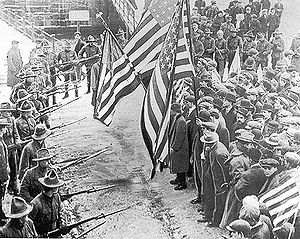
Vanguard party
A vanguard party is a political party at the forefront of a mass action, movement, or revolution. The idea of a vanguard party has its origins in the Communist Manifesto by Karl Marx and Friedrich Engels...
revolution), despite its origin as as Communist
Communism
Communism is a social, political and economic ideology that aims at the establishment of a classless, moneyless, revolutionary and stateless socialist society structured upon common ownership of the means of production...
revolutionary praxis, was adopted throughout the political spectrum.
- In the Republic of ChinaRepublic of ChinaThe Republic of China , commonly known as Taiwan , is a unitary sovereign state located in East Asia. Originally based in mainland China, the Republic of China currently governs the island of Taiwan , which forms over 99% of its current territory, as well as Penghu, Kinmen, Matsu and other minor...
(Taiwan), the ideologically right-wing, and anti-Communist, KuomintangKuomintangThe Kuomintang of China , sometimes romanized as Guomindang via the Pinyin transcription system or GMD for short, and translated as the Chinese Nationalist Party is a founding and ruling political party of the Republic of China . Its guiding ideology is the Three Principles of the People, espoused...
party was so organised.
- In the People's Republic of ChinaPeople's Republic of ChinaChina , officially the People's Republic of China , is the most populous country in the world, with over 1.3 billion citizens. Located in East Asia, the country covers approximately 9.6 million square kilometres...
, the Communist Party of ChinaCommunist Party of ChinaThe Communist Party of China , also known as the Chinese Communist Party , is the founding and ruling political party of the People's Republic of China...
was organised as a Leninist vanguard partyVanguard partyA vanguard party is a political party at the forefront of a mass action, movement, or revolution. The idea of a vanguard party has its origins in the Communist Manifesto by Karl Marx and Friedrich Engels...
, based upon MaoismMaoismMaoism, also known as the Mao Zedong Thought , is claimed by Maoists as an anti-Revisionist form of Marxist communist theory, derived from the teachings of the Chinese political leader Mao Zedong . Developed during the 1950s and 1960s, it was widely applied as the political and military guiding...
(The Thought of Mao Zedong), the Chinese practical application of Marxism-LeninismMarxism-LeninismMarxism–Leninism is a communist ideology, officially based upon the theories of Marxism and Vladimir Lenin, that promotes the development and creation of a international communist society through the leadership of a vanguard party over a revolutionary socialist state that represents a dictatorship...
, specific to Chinese socio-economic conditions.
In turn, Maoism became the theoretical basis of some third world
Third World
The term Third World arose during the Cold War to define countries that remained non-aligned with either capitalism and NATO , or communism and the Soviet Union...
revolutionary vanguard parties, e.g. the Communist Party of Peru – Red Fatherland, the Communist Party of Cuba
Communist Party of Cuba
The Communist Party of Cuba is the governing political party in Cuba. It is a communist party of the Marxist-Leninist model. The Cuban constitution ascribes the role of the Party to be the "leading force of society and of the state"...
, the Sandinista National Liberation Front
Sandinista National Liberation Front
The Sandinista National Liberation Front is a socialist political party in Nicaragua. Its members are called Sandinistas in both English and Spanish...
, et al. Moreover, contemporary Leninists propose that globalization
Globalization
Globalization refers to the increasingly global relationships of culture, people and economic activity. Most often, it refers to economics: the global distribution of the production of goods and services, through reduction of barriers to international trade such as tariffs, export fees, and import...
is the continuation of 19th-century imperialism
Imperialism
Imperialism, as defined by Dictionary of Human Geography, is "the creation and/or maintenance of an unequal economic, cultural, and territorial relationships, usually between states and often in the form of an empire, based on domination and subordination." The imperialism of the last 500 years,...
, wherein developed-country capitalists exploit the working class
Working class
Working class is a term used in the social sciences and in ordinary conversation to describe those employed in lower tier jobs , often extending to those in unemployment or otherwise possessing below-average incomes...
of under-developed and developed countries with low wages, over-long workdays, and intensive working conditions that disallow labour unions
Trade union
A trade union, trades union or labor union is an organization of workers that have banded together to achieve common goals such as better working conditions. The trade union, through its leadership, bargains with the employer on behalf of union members and negotiates labour contracts with...
. (see 1912 Lawrence Textile Strike)
Formal ideology
Because Leninism was composed as and for revolution
Revolution
A revolution is a fundamental change in power or organizational structures that takes place in a relatively short period of time.Aristotle described two types of political revolution:...
ary praxis, it has been argued that it is neither rigorously proper philosophy
Political philosophy
Political philosophy is the study of such topics as liberty, justice, property, rights, law, and the enforcement of a legal code by authority: what they are, why they are needed, what, if anything, makes a government legitimate, what rights and freedoms it should protect and why, what form it...
nor discrete political theory
Political science
Political Science is a social science discipline concerned with the study of the state, government and politics. Aristotle defined it as the study of the state. It deals extensively with the theory and practice of politics, and the analysis of political systems and political behavior...
; its formation as such was established in the anthology History and Class Consciousness
History and Class Consciousness
History and Class Consciousness is a book by Georg Lukács, written in 1923. Class consciousness, as described by Lukács, is opposed to any psychological conception of consciousness, which forms the basis of individual or mass psychology . According to Lukács, each social class has a determined...
(1923), wherein the Hungarian intellectual György Lukács (1885–1971) developed Lenin’s ideas of revolutionary praxis. As a Marxist theoretician, Lukács’s ideological
Ideology
An ideology is a set of ideas that constitutes one's goals, expectations, and actions. An ideology can be thought of as a comprehensive vision, as a way of looking at things , as in common sense and several philosophical tendencies , or a set of ideas proposed by the dominant class of a society to...
definition of Leninism (vanguard-party revolution) illustrated Lenin’s prescient 1915 dictum about a revolutionary’s commitment to the cause: “One cannot be a revolutionary Social–Democrat without participating, according to one’s powers, in developing this theory [Marxism], and adapting it to changed conditions.”
See also
- MarxismMarxismMarxism is an economic and sociopolitical worldview and method of socioeconomic inquiry that centers upon a materialist interpretation of history, a dialectical view of social change, and an analysis and critique of the development of capitalism. Marxism was pioneered in the early to mid 19th...
- TrotskyismTrotskyismTrotskyism is the theory of Marxism as advocated by Leon Trotsky. Trotsky considered himself an orthodox Marxist and Bolshevik-Leninist, arguing for the establishment of a vanguard party of the working-class...
- Democratic centralismDemocratic centralismDemocratic centralism is the name given to the principles of internal organization used by Leninist political parties, and the term is sometimes used as a synonym for any Leninist policy inside a political party...
- The State and Revolution
- Marxism-LeninismMarxism-LeninismMarxism–Leninism is a communist ideology, officially based upon the theories of Marxism and Vladimir Lenin, that promotes the development and creation of a international communist society through the leadership of a vanguard party over a revolutionary socialist state that represents a dictatorship...
- He who does not work neither shall he eat
- An equal amount of products for an equal amount of labor
- Lenin's national policy
- New Economic PolicyNew Economic PolicyThe New Economic Policy was an economic policy proposed by Vladimir Lenin, who called it state capitalism. Allowing some private ventures, the NEP allowed small animal businesses or smoke shops, for instance, to reopen for private profit while the state continued to control banks, foreign trade,...
- Anti-LeninismAnti-LeninismAnti-Leninism is the opposition to thought known as Leninism or Bolshevism.-Opposition from Marxists:Opposition to Leninism can be traced back to the split in the Russian Social Democratic Labour Party into the Menshevik and Bolshevik factions at the 2nd Congress of the RSDLP...
Further reading
Key works of V.I. Lenin- The Development of Capitalism in Russia, 1899
- What Is To Be Done? Burning Questions of Our Movement, 1902
- The Three Sources and Three Component Parts of Marxism, 1913
- The Right of Nations to Self-Determination, 1914
- Imperialism, the Highest Stage of Capitalism, 1917
- The State and Revolution, 1917
- The Tasks of the Proletariat in the Present Revolution (The "April Theses"), 1917
- “Left-Wing” Childishness and the Petty Bourgois Mentality, 1918
- Left-Wing Communism: an Infantile Disorder, 1920
- "Last Testament" Letters to the Congress, 1923-24
Historians
- Isaac Deutscher. The Prophet Armed: Trotsky 1879-1921, 1954
- Isaac Deutscher. The Prophet Unarmed: Trotsky 1921-1929, 1959
- Moshe Lewin. Lenin's Last Struggle, 1969
- Edward Hallett Carr. The Russian Revolution From Lenin to Stalin: 1917-1929, 1979
Later authors
- Paul Blackledge.What was Done an extended review of Lars Lih's Lenin Rediscovered from International SocialismInternational Socialism (journal)International Socialism is a British-based quarterly magazine of socialist theory published by the Socialist Workers Party. It is currently edited by Alex Callinicos, who took over after the death of Chris Harman in November 2009....
- Marcel LiebmanMarcel LiebmanMarcel Liebman was a Belgian Marxist historian of political sociology and theory, active at the Université Libre de Bruxelles and Vrije Universiteit Brussel.- Biography :...
. Leninism Under Lenin. The Merlin Press. 1980. ISBN 0-85036-261-X - Roy MedvedevRoy MedvedevRoy Aleksandrovich Medvedev |Georgia]]) is a Russian historian renowned as the author of the dissident history of Stalinism, Let History Judge , first published in English in 1972...
. Leninism and Western Socialism. Verso Books. 1981. ISBN 0-86091-739-8 - Neil Harding. Leninism. Duke University Press. 1996. ISBN 0-8223-1867-9
- Joseph StalinJoseph StalinJoseph Vissarionovich Stalin was the Premier of the Soviet Union from 6 May 1941 to 5 March 1953. He was among the Bolshevik revolutionaries who brought about the October Revolution and had held the position of first General Secretary of the Communist Party of the Soviet Union's Central Committee...
. Foundations of Leninism. University Press of the Pacific. 2001. ISBN 0-89875-212-4 - CLR James. Notes on Dialectics: Hegel, Marx, Lenin. Pluto Press. 2005. ISBN 0-7453-2491-6
- Edmund WilsonEdmund WilsonEdmund Wilson was an American writer and literary and social critic and noted man of letters.-Early life:Wilson was born in Red Bank, New Jersey. His father, Edmund Wilson, Sr., was a lawyer and served as New Jersey Attorney General. Wilson attended The Hill School, a college preparatory...
. To the Finland StationTo the Finland StationTo the Finland Station: A Study in the Writing and Acting of History is a book by American critic and historian Edmund Wilson. The work presents the history of revolutionary thought and the birth of socialism, from the French Revolution through the collaboration of Marx and Engels to the arrival...
: A Study in the Writing and Acting of History. Phoenix Press. 2004. ISBN 0-7538-1800-0 - Non-Leninist Marxism: Writings on the Workers Councils (texts by GorterHerman GorterHerman Gorter was a Dutch poet and socialist. He was a leading member of the Tachtigers, a highly influential group of Dutch writers who worked together in Amsterdam in the 1880s, centered around De Nieuwe Gids .Gorter's first book, a 4,000 verse epic poem called "Mei" , sealed his reputation...
, PannekoekAntonie PannekoekAntonie Pannekoek was a Dutch astronomer and Marxist theorist. He was one of the main theorists of council communism .- Biography :...
, PankhurstSylvia PankhurstEstelle Sylvia Pankhurst was an English campaigner for the suffragist movement in the United Kingdom. She was for a time a prominent left communist who then devoted herself to the cause of anti-fascism.-Early life:...
and RühleOtto RühleOtto Rühle was a German Marxist active in opposition to both the First and Second World Wars, and a founder with along with Karl Liebknecht, Rosa Luxemburg, Franz Mehring and others of the group and magazine Internationale, which posed a revolutionary internationalism against a world of warring...
), Red and Black Publishers, St Petersburg, Florida, 2007. ISBN 978-0-9791813-6-8 - Paul Le Blanc. Lenin and the Revolutionary Party. Humanities Press International, Inc. 1990. ISBN 0-391-03604-1.
- A. James GregorA. James GregorA. James Gregor is a Professor of Political Science at the University of California, Berkeley who is well known for his research on fascism, Marxism, and national security...
. The Faces of Janus. Yale University Press. 2000. ISBN 0-300-10602-5.
External links
Works by Vladimir Lenin:- What is to be Done?
- Imperialism: The Highest Stage of Capitalism
- The State and Revolution
- The Lenin Archive at Marxists.org
- First Conference of the Communist International
Other links:
- Marcel Liebman on Lenin and democracy
- An excerpt on Leninism and State Capitalism from the work of Noam Chomsky
- Organizational Questions of the Russian Social Democracy by Rosa LuxemburgRosa LuxemburgRosa Luxemburg was a Marxist theorist, philosopher, economist and activist of Polish Jewish descent who became a naturalized German citizen...
- LENIN'S PHILOSOPHY by Karl KorschKarl Korsch-Biography:Korsch was born in Tostedt, near Hamburg, to Carl August Korsch, a secretary at the cantonal court and his wife Therese. In 1898 the family moved to Meiningen, Thuringia and Korsch senior attained the position of a managing clerk in a bank...
- Cyber Leninism
- Leninist Ebooks
- Lenin as a Philosopher by Anton Pannekoek
- The Lenin Legend by Paul MattickPaul MattickPaul Mattick Sr. was a Marxist political writer and social revolutionary, whose thought can be placed within the council communist and left communist traditions...
- Dead Labor: Marx and Lenin Reconsidered by Paul Craig RobertsPaul Craig RobertsPaul Craig Roberts is an American economist and a columnist for Creators Syndicate. He served as an Assistant Secretary of the Treasury in the Reagan Administration earning fame as a co-founder of Reaganomics. He is a former editor and columnist for the Wall Street Journal, Business Week, and...