
All Topics  
John Locke

 
John Locke

   Email Print
   Bookmark   Link


John Locke


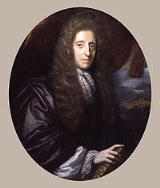
John Locke (; 29 August 1632 – 28 October 1704) was an English philosopher. Locke is considered the first of the British empiricists
Empiricism

In philosophy, empiricism is a theory of knowledge which asserts that knowledge arises from experience. Empiricism is one of several competing views about how we know "things," part of the branch of philosophy called epistemology, or "theory of knowledge"....
, but is equally important to social contract
Social contract

Social contract describes a broad class of theories that try to explain the ways in which people form nations and maintain social order. The notion of the social contract implies that the people give up some rights to a government or other authority in order to receive or maintain social order....
 theory. His ideas had enormous influence on the development of epistemology
Epistemology

Epistemology or theory of knowledge is the branch of philosophy concerned with the nature and scope of knowledge. It addresses the questions:...
 and political philosophy
Political philosophy

Political philosophy is the study of questions about the city, government, politics, liberty, justice, property, rights, law and the enforcement of a legal code by authority: what they are, why they are needed, what makes a The purpose of government, what rights and freedoms it should protect and why, what form it should take and why, what t...
, and he is widely regarded as one of the most influential Enlightenment thinkers, classical republicans
Classical republicanism

Classical republicanism is a form of republicanism originating from and inspired by the governmental forms and writings of classical antiquity....
, and contributors to liberal theory
Contributions to liberal theory

This is a partial list of individual contributions to Liberalism on a worldwide scale. These individuals are strongly associated philosophers of the Enlightenment....
. His writings influenced Voltaire
Voltaire

Fran?ois-Marie Arouet , better known by the pen name Voltaire, was a French Age of Enlightenment writer, essayist, and philosophy known for his wit, philosophical sport, and defense of civil liberty, including freedom of religion and free trade....
 and Rousseau, many Scottish Enlightenment
Scottish Enlightenment

The Scottish Enlightenment was the period in 18th century Scotland characterised by an outpouring of intellectual and scientific accomplishments....
 thinkers, as well as the American revolutionaries
American Revolution

The American Revolution refers to the political upheaval during the last half of the 18th century in which the Thirteen Colonies of North America overthrew the governance of the British Empire and then rejected the British monarchy to become the sovereign United States of America....
.


Discussion
Ask a question about 'John Locke'
Start a new discussion about 'John Locke'
Answer questions from other users
Full Discussion Forum


Recent Posts


Quotations


...there cannot any one moral Rule be propos'd, whereof a Man may not justly demand a Reason.

Book I, Ch. 3, sec. 4

A sound mind in a sound body, is a short but full description of a happy state in this world.

Sec. 1

All men are liable to error; and most men are, in many points, by passion or interest, under temptation to it.

Book IV, Ch. 20, sec. 17

He that uses his words loosely and unsteadily will either not be minded or not understood.

Book III, Ch. 10, sec. 31

He that will have his son have a respect for him and his orders, must himself have a great reverence for his son.

Sec. 65

It is one thing to show a man that he is in error, and another to put him in possession of the truth.

Book IV, Ch. 7, sec. 11


Encyclopedia


John Locke (; 29 August 1632 – 28 October 1704) was an English philosopher. Locke is considered the first of the British empiricists
Empiricism

In philosophy, empiricism is a theory of knowledge which asserts that knowledge arises from experience. Empiricism is one of several competing views about how we know "things," part of the branch of philosophy called epistemology, or "theory of knowledge"....
, but is equally important to social contract
Social contract

Social contract describes a broad class of theories that try to explain the ways in which people form nations and maintain social order. The notion of the social contract implies that the people give up some rights to a government or other authority in order to receive or maintain social order....
 theory. His ideas had enormous influence on the development of epistemology
Epistemology

Epistemology or theory of knowledge is the branch of philosophy concerned with the nature and scope of knowledge. It addresses the questions:...
 and political philosophy
Political philosophy

Political philosophy is the study of questions about the city, government, politics, liberty, justice, property, rights, law and the enforcement of a legal code by authority: what they are, why they are needed, what makes a The purpose of government, what rights and freedoms it should protect and why, what form it should take and why, what t...
, and he is widely regarded as one of the most influential Enlightenment thinkers, classical republicans
Classical republicanism

Classical republicanism is a form of republicanism originating from and inspired by the governmental forms and writings of classical antiquity....
, and contributors to liberal theory
Contributions to liberal theory

This is a partial list of individual contributions to Liberalism on a worldwide scale. These individuals are strongly associated philosophers of the Enlightenment....
. His writings influenced Voltaire
Voltaire

Fran?ois-Marie Arouet , better known by the pen name Voltaire, was a French Age of Enlightenment writer, essayist, and philosophy known for his wit, philosophical sport, and defense of civil liberty, including freedom of religion and free trade....
 and Rousseau, many Scottish Enlightenment
Scottish Enlightenment

The Scottish Enlightenment was the period in 18th century Scotland characterised by an outpouring of intellectual and scientific accomplishments....
 thinkers, as well as the American revolutionaries
American Revolution

The American Revolution refers to the political upheaval during the last half of the 18th century in which the Thirteen Colonies of North America overthrew the governance of the British Empire and then rejected the British monarchy to become the sovereign United States of America....
. This influence is reflected in the American Declaration of Independence.

Locke's theory of mind is often cited as the origin for modern conceptions of identity and "the self", figuring prominently in the later works of philosophers such as David Hume
David Hume

David Hume was a Scotland philosopher, economist, historian and a key figure in the history of Western philosophy and the Scottish Enlightenment....
, Jean-Jacques Rousseau
Jean-Jacques Rousseau

Jean Jacques Rousseau was a major philosopher, writer, and composer of the eighteenth century The Age of Enlightenment, whose political philosophy influenced the French Revolution and the development of modern political and educational thought....
 and Immanuel Kant
Immanuel Kant

Immanuel Kant was an 18th-century German Philosophy from the Kingdom of Prussia city of K?nigsberg . He is regarded as one of the most influential thinkers of modern Europe and of the late Age of Enlightenment....
. Locke was the first philosopher to define the self through a continuity of "consciousness". He also postulated that the mind was a "blank slate" or "tabula rasa
Tabula rasa

Tabula rasa refers to the epistemology thesis that individuals are born without built-in mental content and that their knowledge comes from experience and sensory perception....
"; that is, contrary to Cartesian or Christian philosophy
Christian philosophy

Christian philosophy is a term to describe the fusion of various fields of philosophy with the Theology doctrines of Christianity. Christian philosophy originated during the Middle Ages as medieval theologians attempted to demonstrate to the religious authorities that Greek philosophy and Christian faith were, in fact, compatible methods for...
, Locke maintained that people are born without innate ideas.

Life

Locke's father, who was also named John Locke, was a country lawyer and clerk to the Justices of the Peace in Chew Magna
Chew Magna

Chew Magna is a village within the Chew Valley in Bath and North East Somerset, England. To the south of the village is Chew Valley Lake. The village is on the B3130, about from Bristol, from Bath, Somerset, from the city of Wells, and from Bristol International Airport....
, who had served as a captain of cavalry for the Parliamentarian
Roundhead

"Roundheads" was the nickname given to the Puritan supporters of Parliament of England during the English Civil War. Also known as Parliamentarians, they were the supporters of Oliver Cromwell against Charles I of England ....
 forces during the early part of the English Civil War
English Civil War

The English Civil War was a series of armed conflicts and political machinations between Roundhead and Cavalier. The First English Civil War and Second English Civil War civil wars pitted the supporters of Charles I of England against the supporters of the Long Parliament, while the Third English Civil War saw fighting between supporters...
. His mother, Agnes Keene, was a tanner's daughter and reputed to be very beautiful. Both parents were Puritan
Puritan

A Puritan of 16th and 17th century England was an associate of any number of religious groups advocating for more "purity" of worship and doctrine, as well as personal and group pietism....
s. Locke was born on 29 August 1632, in a small thatched cottage by the church in Wrington
Wrington

Wrington is a village and civil parish in North Somerset, England. It lies in the valley of the Congresbury Yeo river about east of Weston-super-Mare and south-east of Yatton....
, Somerset
Somerset

Somerset is a Counties of England in South West England. The county town is Taunton, which is in the south of the county. The Ceremonial counties of England of Somerset borders the counties of Bristol and Gloucestershire to the north, Wiltshire to the east, Dorset to the south-east, and Devon to the south-west....
, about twelve miles from Bristol
Bristol

Bristol is a City status in the United Kingdom, unitary authority area and Ceremonial counties of England in South West England, west of London, and east of Cardiff....
. He was baptized
Baptism

In Christianity, baptism is the ritual act, with the use of water, by which one is admitted as a full member of the Christian Church and, in the view of some, as a member of the particular Church in which the baptism is administered....
 the same day. Soon after Locke's birth, the family moved to the market town
Market town

Market town or market right is a law term, originating in the medieval period, for a European settlement that has the right to host Market, distinguishing them from villages and city....
 of Pensford
Pensford

Pensford is a village in the civil parish of Publow and Pensford in Somerset, England. It lies in the Chew Valley 7 miles south of Bristol and 8 miles west of Bath, Somerset....
, about seven miles south of Bristol, where Locke grew up in a rural Tudor house in Belluton
Belluton

Belluton is a village in Somerset, England. It is in the district of Bath and North East Somerset and is located due south of the city of Bristol and due west of the city of Bath, Somerset....
.

In 1647, Locke was sent to the prestigious Westminster School
Westminster School

The Royal College of St. Peter in Westminster, almost always known as Westminster School, is one of Britain's leading independent schools, with the highest Oxbridge acceptance rate of any secondary school or college....
 in London
London

London is the capital of both England and the United Kingdom, and the most populous municipality in the European Union. An important settlement for two millennia, History of London goes back to its founding by the Roman Empire....
 under the sponsorship of Alexander Popham
Alexander Popham

Alexander Popham was an English people politician. He is now remembered for his role as patron of the philosopher John Locke.He was born at Littlecote House in Wiltshire, the son of Francis Popham and Anne Dudley, and grandson of Sir John Popham....
, a member of Parliament
Member of Parliament

A Member of Parliament, or MP, is a representative of the voters to a parliament. In many countries the term applies specifically to members of the lower house, as upper houses often have a unique title, such as senate, and thus also have unique titles for its members, such as senators....
 and former commander of the younger Locke's father. After completing his studies there, he was admitted to Christ Church, Oxford
Christ Church, Oxford

Christ Church , is one of the largest Colleges of the University of Oxford of the University of Oxford in England. As well as being a college, Christ Church is also the cathedral church of the diocese of Oxford, namely Christ Church Cathedral, Oxford....
. The dean of the college at the time was John Owen
John Owen (theologian)

John Owen was an England Nonconformist church leader and theologian....
, vice-chancellor of the university. Although a capable student, Locke was irritated by the undergraduate curriculum of the time. He found the works of modern philosophers, such as René Descartes
René Descartes

Ren? Descartes , , also known as Renatus Cartesius , was a French philosophy, mathematician, scientist, and writer who spent most of his adult life in the Dutch Republic....
, more interesting than the classical
Classics

Classics is the branch of the Humanities comprising the languages, literature, philosophy, history, art, and other culture of the ancient Mediterranean World; especially Ancient Greece and Ancient Rome during Classical Antiquity ....
 material taught at the university. Through his friend Richard Lower, whom he knew from the Westminster School, Locke was introduced to medicine and the experimental philosophy being pursued at other universities and in the English Royal Society
Royal Society

The Royal Society of London for the Improvement of Natural Knowledge, known simply as the Royal Society, or even the Royal, is a learned society for science that was founded in 1660 and is considered by most to be the oldest such society still in existence....
, of which he eventually became a member.

Locke was awarded a bachelor's degree
Bachelor's degree

A bachelor's degree is usually an undergraduate academic degree awarded for a course or major that generally lasts for three, four, or in some cases and countries, five or six years....
 in 1656 and a master's degree in 1658. He obtained a bachelor of medicine in 1674, having studied medicine
Medicine

Medicine is the art and science of healing. It encompasses a range of health care practices evolved to maintain and restore health by the prevention and treatment of illness....
 extensively during his time at Oxford
Oxford

Oxford is a City status in the United Kingdom, and the county town of Oxfordshire, in South East England. It has a population of 151,000. The rivers River Cherwell and River Thames run through Oxford and meet south of the city centre....
 and worked with such noted scientists and thinkers as Robert Boyle
Robert Boyle

Robert Boyle was an Irish People theologian, natural philosopher, chemist, physicist, inventor, and early gentleman scientist, noted for his work in physics and chemistry....
, Thomas Willis
Thomas Willis

Thomas Willis was an English people doctor who played an important part in the history of anatomy, neurology and psychiatry. He was a founding member of the Royal Society....
, Robert Hooke
Robert Hooke

Robert Hooke, Fellow of the Royal Society was an England natural philosopher and polymath who played an important role in the scientific revolution, through both experimental and theoretical work....
 and Richard Lower. In 1666, he met Lord Anthony Ashley Cooper, 1st Earl of Shaftesbury, who had come to Oxford seeking treatment for a liver
Liver

The liver is a vital organ present in vertebrates and some other animals; it has a wide range of functions, a few of which are detoxification, protein synthesis, and production of biochemicals necessary for digestion....
 infection. Cooper was impressed with Locke and persuaded him to become part of his retinue.

Locke had been looking for a career and in 1667 moved into Shaftesbury's home at Exeter House in London, to serve as Lord Ashley's personal physician. In London
London

London is the capital of both England and the United Kingdom, and the most populous municipality in the European Union. An important settlement for two millennia, History of London goes back to its founding by the Roman Empire....
, Locke resumed his medical studies under the tutelage of Thomas Sydenham
Thomas Sydenham

Thomas Sydenham , was an England physician. He was born at Wynford Eagle in Dorset, where his father was a gentleman of property....
. Sydenham had a major effect on Locke's natural philosophical thinking an effect that would become evident in the An Essay Concerning Human Understanding
An Essay Concerning Human Understanding

An Essay Concerning Human Understanding is one of John Locke's two most famous works, the other being his Second Treatise on Civil Government....
.


Locke's medical knowledge was put to the test when Shaftesbury's liver infection
Infection

An infection is the detrimental colonization of a host organism by a foreign species. In an infection, the infecting organism seeks to utilize the host resources to multiply ....
 became life-threatening. Locke coordinated the advice of several physicians and was probably instrumental in persuading Shaftesbury to undergo an operation (then life-threatening itself) to remove the cyst. Shaftesbury survived and prospered, crediting Locke with saving his life.

It was in Shaftesbury's household, during 1671, that the meeting took place, described in the Epistle to the reader of the Essay, which was the genesis of what would later become Essay. Two extant Drafts still survive from this period. It was also during this time that Locke served as Secretary of the Board of Trade and Plantations and Secretary to the Lords and Proprietors of the Carolinas, helping to shape his ideas on international trade and economics.

Shaftesbury, as a founder of the Whig
British Whig Party

The Whigs are often described as one of two political party in Kingdom of England and later the United Kingdom from the late 17th to the mid-19th centuries....
 movement, exerted great influence on Locke's political ideas. Locke became involved in politics when Shaftesbury became Lord Chancellor
Lord Chancellor

The Lord High Chancellor of Great Britain, or Lord Chancellor, is a senior and important functionary in the government of the United Kingdom....
 in 1672. Following Shaftesbury's fall from favour in 1675, Locke spent some time travelling across France. He returned to England in 1679 when Shaftesbury's political fortunes took a brief positive turn. Around this time, most likely at Shaftesbury's prompting, Locke composed the bulk of the Two Treatises of Government
Two Treatises of Government

The Two Treatises of Government is a work of political philosophy published anonymously in 1689 by John Locke. The First Treatise attacks patriarchalism in the form of sentence-by-sentence refutation of Robert Filmer's Patriarcha and the Second Treatise outlines a theory of political or Civil_society#Pre-modern_history based...
. Locke wrote the Treatises to defend the Glorious Revolution
Glorious Revolution

The Glorious Revolution, also called the Revolution of 1688, was the overthrow of British monarchy James II of England in 1688 by a union of Parliament of England with an invading army led by the Dutch Republic stadtholder William III of England , who as a result ascended the English throne as William III of England....
 of 1688, but also to counter the absolutist political philosophy of Sir Robert Filmer and Thomas Hobbes
Thomas Hobbes

Thomas Hobbes was an English philosophy, remembered today for his work on political philosophy. His 1651 book Leviathan established the foundation for most of Western political philosophy from the perspective of social contract theory....
. Though Locke was associated with the influential Whigs, his ideas about natural rights and government are today considered quite revolutionary for that period in English history.

However, Locke fled to the Netherlands
Netherlands

The Netherlands is a country that is part of the Kingdom of the Netherlands. It is a parliamentary democratic constitutional monarchy. The Netherlands is located in North-West Europe, and bordered by the North Sea to the north and west, Belgium to the south, and Germany to the east....
, Holland, in 1683, under strong suspicion of involvement in the Rye House Plot
Rye House Plot

The Rye House Plot of 1683 was a plan to assassinate King Charles II of England and his brother James II of England. Historians vary in their assessment of the degree to which details of the conspiracy were finalized....
 (though there is little evidence to suggest that he was directly involved in the scheme). In the Netherlands Locke had time to return to his writing, spending a great deal of time re-working the Essay and composing the Letter on Toleration. Locke did not return home until after the Glorious Revolution
Glorious Revolution

The Glorious Revolution, also called the Revolution of 1688, was the overthrow of British monarchy James II of England in 1688 by a union of Parliament of England with an invading army led by the Dutch Republic stadtholder William III of England , who as a result ascended the English throne as William III of England....
. Locke accompanied William of Orange
William III of England

William III was a Prince of Orange by birth. From 1672 onwards, he governed as List_of_stadtholders_for_the_Low_Countries_provinces William III of Orange over Holland, Zeeland, Utrecht, Guelders, and Overijssel of the Dutch Republic....
's wife back to England in 1688. The bulk of Locke's publishing took place after his arrival back in England his aforementioned Essay Concerning Human Understanding, the Two Treatises of Civil Government and A Letter Concerning Toleration
A Letter Concerning Toleration

A Letter Concerning Toleration by John Locke was originally published in 1689. Its initial publication was in Latin, though it was immediately translated into other languages....
 all appearing in quick succession upon his return from exile.

Locke's close friend Lady Masham invited him to join her at the Mashams' country house in Essex. Although his time there was marked by variable health from asthma
Asthma

Asthma is a common chronic obstructive pulmonary disease, in which the Lung constrict, become inflammation, and are lined with excessive amounts of thickened mucus, often in response to one or more triggers....
 attacks, he nevertheless became an intellectual hero of the Whigs
British Whig Party

The Whigs are often described as one of two political party in Kingdom of England and later the United Kingdom from the late 17th to the mid-19th centuries....
. During this period he discussed matters with such figures as John Dryden
John Dryden

John Dryden was an influential English poet, literary critic, translator, and playwright who dominated the literary life of English Restoration to such a point that the period came to be known in literary circles as the Age of Dryden....
 and Isaac Newton
Isaac Newton

Sir Isaac Newton, Fellow of the Royal Society was an English people physicist, mathematician, Astronomy, Natural philosophy, Alchemy, and Theology and one of the the 100 in human history....
.

He died in 28 October 1704, and is buried in the churchyard of the village of High Laver
High Laver

High Laver is a village in the Epping Forest district of the County of Essex, England. It is located 4 miles east of Harlow and 1.4 miles north-west of Moreton, Essex....
, east of Harlow
Harlow

Harlow is a new town and local government district in Essex, England. It is located in the west of the county and on the border with Hertfordshire, on the River Stort....
 in Essex
Essex

Essex is a counties of England in the East of England England. The county town is Chelmsford, and the highest point of the county is Chrishall Common near the village of Langley, Essex, close to the Hertfordshire border, which reaches ....
, where he had lived in the household of Sir Francis Masham since 1691. Locke never married nor had children.

Events that happened during Locke's lifetime include the English Restoration
English Restoration

The English Restoration, or simply The Restoration began in 1660 when the English monarchy, Scottish monarchy and Irish monarchy were restored under Charles II of England after the Interregnum that followed the English Civil War....
, the Great Plague of London
Great Plague of London

The Great Plague was a massive outbreak of disease in England that killed an estimated 100,000 people, a third of London's population. The disease was historically identified as bubonic plague, an infection by the bacterium Yersinia pestis, transmitted through a flea vector ....
 and the Great Fire of London
Great Fire of London

The Great Fire of London was a major conflagration that swept through the central parts of London, England, from Sunday, 2 September to Wednesday, 5 September 1666....
. He did not quite see the Act of Union of 1707, though the thrones of England and Scotland were held by the same monarch throughout his lifetime. Constitutional monarchy
Constitutional monarchy

A constitutional monarchy is a form of constitutional government, where in either an elected or hereditary monarch is the head of state, unlike in an absolute monarchy, wherein the king or the queen is the sole source of political power, as he or she is not legally bound by the constitution....
 and parliamentary democracy were in their infancy during Locke's time.

Locke's epitaph

Original Latin:

English Translation:

Influence

Locke exercised a profound influence on political philosophy, in particular on modern liberalism
Liberalism

Liberalism is a broad class of political philosophy that considers individualism liberty and equality to be the most important political goals....
. Michael Zuckert has in fact argued that Locke launched liberalism by tempering Hobbesian absolutism and clearly separating the realms of Church and State. He had a strong influence on Voltaire
Voltaire

Fran?ois-Marie Arouet , better known by the pen name Voltaire, was a French Age of Enlightenment writer, essayist, and philosophy known for his wit, philosophical sport, and defense of civil liberty, including freedom of religion and free trade....
 who called him "le sage Locke". His arguments concerning liberty
Liberty

Liberty, the freedom to act or believe without being stopped by unnecessary force, is generally considered in modern time to be a concept of political philosophy and identifies the condition in which an individual has the right to act according to his or her own free will....
 and the social contract
Social contract

Social contract describes a broad class of theories that try to explain the ways in which people form nations and maintain social order. The notion of the social contract implies that the people give up some rights to a government or other authority in order to receive or maintain social order....
 later influenced the written works of Alexander Hamilton
Alexander Hamilton

Alexander Hamilton was the first Secretary of the Treasury, a Founding Fathers of the United States, economist, and political philosopher. He led calls for the Philadelphia Convention, was one of America's first Constitutional lawyers, and cowrote the Federalist Papers, a primary source for Constitutional interpretation....
, James Madison
James Madison

James Madison was an American politician and political philosopher who served as the List of Presidents of the United States President of the United States , and one of the Founding Fathers of the United States....
, Thomas Jefferson
Thomas Jefferson

Thomas Jefferson was the List of Presidents of the United States President of the United States , the principal author of the United States Declaration of Independence , and one of the most influential Founding Fathers of the United States for his promotion of the ideals of republicanism in the United States....
, and other Founding Fathers of the United States
Founding Fathers of the United States

The Founding Fathers of the United States were the political leaders who signed the United States Declaration of Independence or otherwise participated in the American Revolution as leaders of the Patriot s, or who participated in drafting the United States Constitution eleven years later....
. In fact, several passages from the Second Treatise are reproduced verbatim in the Declaration of Independence, most notably the reference to a "long train of abuses." Today, most contemporary libertarians claim him as an influence.

But Locke's influence may have been even more profound in the realm of epistemology. Locke redefined subjectivity, or self, and intellectual historians such as Charles Taylor and Jerrold Seigel argue that Locke's Essay Concerning Human Understanding (1690) marks the beginning of the modern conception of the self.

Constitution of Carolina

Appraisals of Locke have often been tied to appraisals of liberalism
Liberalism

Liberalism is a broad class of political philosophy that considers individualism liberty and equality to be the most important political goals....
 in general, and also to appraisals of the United States. Detractors note that (in 1671) he was a major investor in the English slave-trade through the Royal Africa Company, as well as through his participation in drafting the Fundamental Constitution of the Carolinas
Fundamental Constitutions of Carolina

The Fundamental Constitutions of Carolina were adopted in March 1669 by the eight Lords Proprietor#Lords Proprietary of Carolina of the Province of Carolina, which included most of the land in between what is now Virginia and Florida....
 while Shaftesbury
Anthony Ashley-Cooper, 1st Earl of Shaftesbury

Anthony Ashley-Cooper, 1st Earl of Shaftesbury Privy Council of England , known as Sir Anthony Ashley-Cooper, 2nd Baronet, from 1631 to 1661 and as The Lord Ashley from 1661 to 1672, was a prominent England politician of the Commonwealth of England and during the reign of Charles II of England....
's secretary
Secretary

A secretary is either an administrative assistant in administration , or a certain type of mid- or high-level governmental position, such as a Secretary of State....
, which established a feudal aristocracy and gave a master absolute power over his slaves. They note that as a secretary to the Council of Trade and Plantations (1673-4) and a member of the Board of Trade (1696-1700) Locke was, in fact, "one of just half a dozen men who created and supervised both the colonies and their iniquitous systems of servitude" Some see his statements on unenclosed
Enclosure

Enclosure or inclosure is the process by which common land is taken into fully private ownership and use. Common land is land which is owned by one person, but over which other people have certain traditional rights, such as arable farming, mowing meadows for hay, or grazing livestock....
 property
Property

Property is any physical or virtual entity that is ownership by an individual or jointly by a group of individuals. An owner of property has the right to consumption, sell, Renting, mortgage, transfer and exchange his or her property....
 as having justified the displacement of the Native Americans
Native Americans in the United States

Native Americans in the United States are the Indigenous peoples of the Americas from the regions of North America now encompassed by the continental United States United States, including parts of Alaska and the island state of Hawaii....
. Because of his opposition to aristocracy and slavery in his major writings, he is accused of hypocrisy, or of caring only for the liberty of English
English people

The English are a nation and ethnic group native to England who speak English language in England. The English identity as a people is of early medieval origin, when they were known in Old English as the Anglecynn....
 capitalists
Capitalism

Capitalism is an economic system in which wealth, and the means of producing wealth, are private property and controlled rather than commonly, publicly, or state-owned and controlled....
.

Theory of value and property

Locke uses the word property in both broad and narrow senses. In a broad sense, it covers a wide range of human interests and aspirations; more narrowly, it refers to material goods. He argues that property is a natural right and it is derived from labor.

Locke believed that ownership of property
Property

Property is any physical or virtual entity that is ownership by an individual or jointly by a group of individuals. An owner of property has the right to consumption, sell, Renting, mortgage, transfer and exchange his or her property....
 is created by the application of labor. In addition, property precedes government and government cannot "dispose of the estates of the subjects arbitrarily." Karl Marx
Karl Marx

Karl Heinrich Marx was a Germanphilosophy, political economy, historian, sociologist, humanism, political theorist and revolutionary credited as the founder of communism....
 later critiqued Locke's theory of property in his social theory.

Political theory


Locke's political theory was founded on social contract
Social contract

Social contract describes a broad class of theories that try to explain the ways in which people form nations and maintain social order. The notion of the social contract implies that the people give up some rights to a government or other authority in order to receive or maintain social order....
 theory. Unlike Thomas Hobbes, Locke believed that human nature
Human nature

Human nature is the concept that there are a set of characteristics, including ways of thinking, feeling and acting, that all 'normal' human beings have in common....
 is characterized by reason and tolerance. Like Hobbes, Locke believed that human nature allowed men to be selfish. This is apparent with the introduction of currency. In a natural state
State of nature

State of nature is a term in political philosophy used in social contract theories to describe the hypothetical condition of humanity before the state's foundation and its monopoly on the legitimate use of physical force....
 all people were equal and independent, and everyone had a natural right to defend his “life, health, liberty, or possessions.” Like Hobbes, Locke assumed that the sole right to defend in the state of nature was not enough, so people established a civil society
Civil society

Civil society is composed of the totality of voluntary civic and social organizations and institutions that form the basis of a functioning society as opposed to the force-backed structures of a state and commercial institutions of the market....
 to resolve conflicts in a civil way with help from government in a state of society. However, Locke never refers to Hobbes by name and may instead have been responding to other writers of the day. Locke also advocated governmental separation of powers
Separation of powers

Separation of powers, a term ascribed to France Age of Enlightenment political philosopher Charles de Secondat, baron de Montesquieu, is a model for the governance of democracy states, having its origins in an ancient idea of mixed government....
 and believed that revolution is not only a right
Right of revolution

In political philosophy, the right of revolution is a right or duty, variously stated throughout history, possessed by subjects of a state that justifies their action to Revolution the government to whom the subjects otherwise would owe allegiance....
 but an obligation in some circumstances. These ideas would come to have profound influence on the Constitution of the United States and its Declaration of Independence
United States Declaration of Independence

The United States Declaration of Independence is a statement adopted by the Second Continental Congress on July 4, 1776, which announced that the Thirteen Colonies then at war with Kingdom of Great Britain were now independent states, and thus no longer a part of the British Empire....
.

Limits to accumulation
Labor creates property, but it also does contain limits to its accumulation: man’s capacity to produce and man’s capacity to consume. According to Locke, unused property is waste and an offense against nature. However, with the introduction of “durable” goods, men could exchange their excessive perishable goods for goods that would last longer and thus not offend the natural law. The introduction of money marks the culmination of this process. Money makes possible the unlimited accumulation of property without causing waste through spoilage. He also includes gold or silver as money because they may be “hoarded up without injury to anyone,” since they do not spoil or decay in the hands of the possessor. The introduction of money eliminates the limits of accumulation. Locke stresses that inequality has come about by tacit agreement on the use of money, not by the social contract establishing civil society or the law of land regulating property. Locke is aware of a problem posed by unlimited accumulation but does not consider it his task. He just implies that government would function to moderate the conflict between the unlimited accumulation of property and a more nearly equal distribution of wealth and does not say which principles that government should apply to solve this problem. However, not all elements of his thought form a consistent whole. For example, labor theory of value of the Two Treatises of Government
Two Treatises of Government

The Two Treatises of Government is a work of political philosophy published anonymously in 1689 by John Locke. The First Treatise attacks patriarchalism in the form of sentence-by-sentence refutation of Robert Filmer's Patriarcha and the Second Treatise outlines a theory of political or Civil_society#Pre-modern_history based...
 stands side by side with the demand-and-supply theory developed in a letter he wrote titled Some Considerations on the Consequences of the Lowering of Interest and the Raising of the Value of Money. Moreover, Locke anchors property in labor but in the end upholds the unlimited accumulation of wealth.

Locke on price theory

Locke’s general theory of value and price is a supply and demand
Supply and demand

...
 theory, which was set out in a letter to a Member of Parliament
Member of Parliament

A Member of Parliament, or MP, is a representative of the voters to a parliament. In many countries the term applies specifically to members of the lower house, as upper houses often have a unique title, such as senate, and thus also have unique titles for its members, such as senators....
 in 1691, titled Some Considerations on the Consequences of the Lowering of Interest and the Raising of the Value of Money. Supply is quantity and demand is rent
Economic rent

Economic rent is the difference between what a factor of production is paid and how much it would need to be paid to remain in its current use....
. “The price of any commodity rises or falls by the proportion of the number of buyer and sellers.” and “that which regulates the price... [of goods] is nothing else but their quantity in proportion to their rent.” The quantity theory of money forms a special case of this general theory. His idea is based on “money answers all things” (Ecclesiastes) or “rent of money is always sufficient, or more than enough,” and “varies very little…” Regardless of whether the demand for money is unlimited or constant, Locke concludes that as far as money is concerned, the demand is exclusively regulated by its quantity. He also investigates the determinants of demand and supply. For supply, goods in general are considered valuable because they can be exchanged, consumed and they must be scarce. For demand, goods are in demand because they yield a flow of income. Locke develops an early theory of capitalization
Capitalization

Capitalization is writing a word with its first grapheme as a majuscule and the remaining letters in Lower case , in those writing systems which have a letter case....
, such as land, which has value because “by its constant production of saleable commodities it brings in a certain yearly income.” Demand for money is almost the same as demand for goods or land; it depends on whether money is wanted as medium of exchange or as loanable funds
Loanable funds

In economics, the loanable funds market is a hypothetical market that brings savers and borrowers together, also bringing together the money available in commercial banks and lending institutions available for firms and households to finance expenditures, either investments or Consumption ....
. For medium of exchange “money is capable by exchange to procure us the necessaries or conveniences of life.” For loanable funds, “it comes to be of the same nature with land by yielding a certain yearly income … or interest.”

Monetary thoughts
Locke distinguishes two functions of money
Money

Money is anything that is generally accepted as payment for goods and services and repayment of debts. The main uses of money are as a medium of exchange, a unit of account, and a store of value....
, as a "counter" to measure value, and as a "pledge" to lay claim to goods. He believes that silver and gold, as opposed to paper money, are the appropriate currency for international transactions. Silver and gold, he says, are treated to have equal value by all of humanity and can thus be treated as a pledge by anyone, while the value of paper money is only valid under the government which issues it.

Locke argues that a country should seek a favorable balance of trade
Balance of trade

The balance of trade is the difference between the monetary value of exports and International trades in an economy over a certain period of time....
, lest it fall behind other countries and suffer a loss in its trade. Since the world money stock grows constantly, a country must constantly seek to enlarge its own stock. Locke develops his theory of foreign exchanges, in addition to commodity movements, there are also movements in country stock of money, and movements of capital determine exchange rates. The latter is less significant and less volatile than commodity movements. As for a country’s money stock
Money supply

In economics, money supply, or money stock, is the total amount of money available in an economy at a particular point in time. There are several ways to define "money", but standard measures usually include currency in circulation and demand deposits....
, if it is large relative to that of other countries, it will cause the country’s exchange to rise above par, as an export balance would do.

He also prepares estimates of the cash
Cash

Cash refers to money in the physical form of currency, such as banknotes and coins.In bookkeeping and finance, "cash" refers to current assets comprised of currency or currency equivalents that can be accessed immediately or near-immediately ....
 requirements for different economic groups (landholders, laborers and brokers). In each group the cash requirements are closely related to the length of the pay period. He argues the brokers – middlemen – whose activities enlarge the monetary circuit and whose profits eat into the earnings of laborers and landholders, had a negative influence on both one's personal and the public economy that they supposedly contributed to.

The self

Locke defines the self as "that conscious thinking thing, (whatever substance, made up of whether spiritual, or material, simple, or compounded, it matters not) which is sensible, or conscious of pleasure and pain, capable of happiness or misery, and so is concerned for itself, as far as that consciousness extends". He does not, however, ignore "substance", writing that "the body too goes to the making the man." The Lockean self is therefore a self-aware and self-reflective consciousness that is fixed in a body.

In his Essay, Locke explains the gradual unfolding of this conscious mind. Arguing against both the Augustinian view of man as originally sinful
Original sin

Original sin is, according to a doctrine in Christian theology, humanity's state of sin resulting from the Fall of Man. While the Old Testament and the New Testament, which frequently speak of the sinfulness of humans, do not contain the terms "original sin" or "ancestral sin", the doctrine expressed by these terms is claimed to be based on t...
 and the Cartesian
René Descartes

Ren? Descartes , , also known as Renatus Cartesius , was a French philosophy, mathematician, scientist, and writer who spent most of his adult life in the Dutch Republic....
 position, which holds that man innately knows basic logical propositions, Locke posits an "empty" mind, a tabula rasa, which is shaped by experience; sensation
Sensation

Sensation is the Fiction-writing modes for portraying a character's perception of the senses. According to Ron Rozelle, ?. . .the success of your story or novel will depend on many things, but the most crucial is your ability to bring your reader into it....
s and reflections being the two sources of all our idea
Idea

An idea is a form formed by consciousness through the process of Ideation . Human capability to contemplate ideas is associated with the ability of reasoning, human self-reflection, and of the ability to acquire and apply intellect, intuition, inspiration, etc.....
s. Locke's Some Thoughts Concerning Education
Some Thoughts Concerning Education

Some Thoughts Concerning Education is a 1693 in literature treatise on education written by the England philosopher John Locke. For over a century, it was the most important philosophical work on education in United Kingdom....
 is an outline on how to educate this mind: he expresses the belief that education maketh the man, or, more fundamentally, that the mind is an "empty cabinet", with the statement, "I think I may say that of all the men we meet with, nine parts of ten are what they are, good or evil, useful or not, by their education."

Locke also wrote that "the little and almost insensible impressions on our tender infancies have very important and lasting consequences." He argued that the "associations of ideas
Association of Ideas

Association of Ideas, or Mental association, is a term used principally in the history of philosophy and of History of psychology to refer to explanations about the conditions under which representations arise in consciousness, and also for a principle put forward by an important historical school of thinkers to account generally for th...
" that one makes when young are more important than those made later because they are the foundation of the self: they are, put differently, what first mark the tabula rasa. In his Essay, in which is introduced both of these concepts, Locke warns against, for example, letting "a foolish maid" convince a child that "goblins and sprites" are associated with the night for "darkness shall ever afterwards bring with it those frightful ideas, and they shall be so joined, that he can no more bear the one than the other."

"Associationism", as this theory would come to be called, exerted a powerful influence over eighteenth-century thought, particularly educational theory
Education theory

Education theory is the theory of the purpose, application and interpretation of education and learning. Its history begins with classical Ancient Greeks educationalists and sophists and includes, since the 18th century, pedagogy and andragogy....
, as nearly every educational writer warned parents not to allow their children to develop negative associations. It also led to the development of psychology
Psychology

Psychology is an academic and applied science discipline involving the science study of human mental functions and behavior. Occasionally it also relies on symbolic hermeneutics and critical theory, although these traditions are less pronounced than in other social sciences such as sociology....
 and other new disciplines with David Hartley
David Hartley (philosopher)

David Hartley was an English philosophy and founder of the Associationism school of psychology....
's attempt to discover a biological mechanism for associationism in his Observations on Man
Observations on Man

Observations on Man, his Frame, his Duty, and his Expectations is eighteenth-century British philosopher David Hartley major work. Published in two parts in 1749, it puts forth Hartley's principle theories: the doctrine of vibrations and the doctrine of associations....
 (1749
1749 in literature

The year 1749 in literature involved some significant events and new books....
).

List of major works

  • (1689) A Letter Concerning Toleration
    A Letter Concerning Toleration

    A Letter Concerning Toleration by John Locke was originally published in 1689. Its initial publication was in Latin, though it was immediately translated into other languages....
    • (1690) A Second Letter Concerning Toleration
    • (1692) A Third Letter for Toleration
  • (1689) Two Treatises of Government
    Two Treatises of Government

    The Two Treatises of Government is a work of political philosophy published anonymously in 1689 by John Locke. The First Treatise attacks patriarchalism in the form of sentence-by-sentence refutation of Robert Filmer's Patriarcha and the Second Treatise outlines a theory of political or Civil_society#Pre-modern_history based...
  • (1690) An Essay Concerning Human Understanding
    An Essay Concerning Human Understanding

    An Essay Concerning Human Understanding is one of John Locke's two most famous works, the other being his Second Treatise on Civil Government....
  • (1693) Some Thoughts Concerning Education
    Some Thoughts Concerning Education

    Some Thoughts Concerning Education is a 1693 in literature treatise on education written by the England philosopher John Locke. For over a century, it was the most important philosophical work on education in United Kingdom....
  • (1695) The Reasonableness of Christianity, as Delivered in the Scriptures
    • (1695) A Vindication of the Reasonableness of Christianity


Major unpublished or posthumous manuscripts

  • (1660) First Tract of Government (or the English Tract)
  • (c.1662) Second Tract of Government (or the Latin Tract)
  • (1664) Questions Concerning the Law of Nature (definitive Latin text, with facing accurate English trans. in Robert Horwitz et al., eds., John Locke, Questions Concerning the Law of Nature, Ithaca: Cornell University Press, 1990).
  • (1667) Essay Concerning Toleration
  • (1706) Of the Conduct of the Understanding
    Of the Conduct of the Understanding

    John Locke Of the Conduct of the Understanding describes how to think clearly and rationally; it is a handbook for autodidacts. It complements Locke Some Thoughts Concerning Education which explains how to educate children....
  • (1707) A Paraphrase and Notes on the Epistles of St. Paul


Secondary literature

  • Ashcraft, Richard, 1986. Revolutionary Politics & Locke's Two Treatises of Government. Princeton: Princeton University Press. (Discusses the relationship between Locke's philosophy and his political activities.)
  • Ayers, Michael R., 1991. Locke. Epistemology & Ontology Routledge (The standard work on Locke's Essay Concerning Human Understanding.)
  • Bailyn, Bernard, 1992 (1967). The Ideological Origins of the American Revolution. Harvard Uni. Press. (Discusses the influence of Locke and other thinkers upon the American Revolution and on subsequent American political thought.)
  • G. A. Cohen, 1995. 'Marx and Locke on Land and Labour', in his Self-Ownership, Freedom and Equality, Oxford University Press.
  • Cox, Richard, Locke on War and Peace, Oxford: Oxford University Press, 1960. (A discussion of Locke's theory of international relations.)
  • Chappell, Vere, ed., 19nn. The Cambridge Companion to Locke. Cambridge Uni. Press.
  • Dunn, John, 1984. Locke. Oxford Uni. Press. (A succinct introduction.)
  • ------, 1969. The Political Thought of John Locke: An Historical Account of the Argument of the "Two Treatises of Government". Cambridge Uni. Press. (Introduced the interpretation which emphasises the theological element in Locke's political thought.)
  • Macpherson. C. B.
    C. B. Macpherson

    Crawford Brough Macpherson O.C. M.Sc. D. Sc. was an influential Canada political science who taught political theory at the University of Toronto....
     The Political Theory of Possessive Individualism: Hobbes to Locke (Oxford: Oxford University Press, 1962). (Establishes the deep affinity from Hobbes to Harrington, the Levellers, and Locke through to nineteenth-century utilitarianism).
  • Pangle, Thomas
    Thomas Pangle

    Thomas Lee Pangle BA PhD FRSC is an United States Political science. He currently holds the Joe R. Long Chair in Democratic Studies in the Department of Government at the University of Texas at Austin and from 1979 to 2004 was Professor in the Department of Political Science at the University of Toronto....
    , The Spirit of Modern Republicanism: The Moral Vision of the American Founders and the Philosophy of Locke (Chicago: University of Chicago Press, 1988; paperback ed., 1990), 334 pages. (Challenges Dunn's, Tully's, Yolton's, and other conventional readings.)
  • Strauss, Leo, Natural Right and History, chap. 5B (Chicago: University of Chicago Press, 1953). (Argues from a non-Marxist point of view for a deep affinity between Hobbes and Locke.)
  • Strauss, Leo, "Locke's Doctrine of Natural law," American Political Science Review 52 (1958) 490–501. (A critique of W. von Leyden's edition of Locke's unpublished writings on natural law.)
  • Tully, James, 1980. "A Discourse on Property : John Locke and his Adversaries" Cambridge Uni. Press
  • Waldron, Jeremy
    Jeremy Waldron

    Jeremy Waldron is a professor of law and philosophy at the New York University School of Law. Waldron is currently Fowler-Hamilton Visiting Fellow at Christ Church, Oxford....
    , 2002. God, Locke and Equality. Cambridge Uni. Press.
  • Yolton, J. W., ed., 1969. John Locke: Problems and Perspectives. Cambridge Uni. Press.
  • Zuckert, Michael, Launching Liberalism: On Lockean Political Philosophy. Lawrence, KS: University Press of Kansas.
  • Locke Studies, appearing annually, publishes scholarly work on John Locke.


See also

  • Classical republicanism
    Classical republicanism

    Classical republicanism is a form of republicanism originating from and inspired by the governmental forms and writings of classical antiquity....
  • Liberalism
    Liberalism

    Liberalism is a broad class of political philosophy that considers individualism liberty and equality to be the most important political goals....
  • Libertarianism
    Libertarianism

    Libertarianism is a term used by a political spectrum of Political philosophy which seek to promote individual liberty and seek to minimize or abolish the state....
  • Contributions to liberal theory
    Contributions to liberal theory

    This is a partial list of individual contributions to Liberalism on a worldwide scale. These individuals are strongly associated philosophers of the Enlightenment....
  • Locke's theory of consciousness as the basis of personal identity
    Consciousness

    Consciousness is a difficult term to define, because the word is used and understood in a wide variety of ways, so that it frequently happens that what one person sees as a definition of consciousness is seen by others as about something else altogether....
  • Lockean proviso
    Lockean proviso

    The Lockean Proviso is a portion of John Locke's labor theory of property which says that though individuals have a right to acquire private property from nature, that they must leave "enough and as good in common...to others."...
  • Polish brethren
    Polish Brethren

    Polish Brethren was the name of a Protestant Poland church from the 16th century....
     (the religious group, whose ideas were incorporated into Locke's theories)


Further reading


External links


Works

  • The Works of John Locke
  • , edited by Jonathan Bennett
    Jonathan Bennett (philosopher)

    Jonathan F. Bennett is a United Kingdom philosopher of philosophy of language and metaphysics, and a historian of early modern philosophy.Bennett was educated at Oxford University....


Resources

  • by Caspar Hewett
  • A complex and positive answer to question - by Jerome Huyler
------