All Topics  
Willem de Kooning

 
Willem De Kooning

   Email Print
   Bookmark   Link


Willem de Kooning


Willem de Kooning (April 24, 1904 – March 19, 1997) was an abstract expressionist artist, born in Rotterdam
Rotterdam

Rotterdam ; city and municipality in the Netherlands province of South Holland, situated in the west of the Netherlands. The municipality is the List of cities in the Netherlands with over 100,000 people in the country, with a population of 584,046 on 1 January 2007 and comprises the southern part of the Randstad, the List of metropolitan are...
, the Netherlands.

In the post-World War II
World War II

World War II, or the Second World War , was a global military conflict which involved a Participants in World War II, including all of the great powers, organised into two opposing military alliances: the Allies of World War II and the Axis powers....
 era, de Kooning painted in a style that came to be referred to variously as Abstract expressionism
Abstract expressionism

Abstract expressionism was an American post?World War II art movement. It was the first specifically American movement to achieve worldwide influence and also the one that put New York City at the center of the art world, a role formerly filled by Paris....
, Action painting
Action painting

Action painting, sometimes called "gestural abstraction", is a style of painting in which paint is spontaneously dribbled, splashed or smeared onto the canvas, rather than being carefully applied....
, and the New York School
New York School

The New York School was an informal group of American poets, Paintings, dancers, and musicians active in the 1950s, 1960s in New York City. The poets, painters, composers, dancers, and musicians often drew inspiration from Surrealism and the contemporary avant-garde art movements, in particular action painting, abstract expressionism, Jazz...
. Other painters that developed this school of painting include Jackson Pollock
Jackson Pollock

Paul Jackson Pollock was an influential American painter and a major force in the abstract expressionism movement. In October 1945, he married the artist Lee Krasner....
, Franz Kline
Franz Kline

Franz Kline was an American painter mainly associated with the Abstract Expressionism painters who were centered, geographically, around New York, and temporally, in the 1940s and 1950s; but not limited to that setting....
, Arshile Gorky
Arshile Gorky

Arshile Gorky , was an Armenians-born United States painter who had a seminal influence on Abstract Expressionism....
, Mark Rothko
Mark Rothko

Mark Rothko, born Marcus Rothkowitz , was a Latvian-born United States painter and printmaker. He is classified as an abstract expressionism, although he himself rejected this label, and even resisted the classification as an "abstract painter"....
, Hans Hofmann
Hans Hofmann

Hans Hofmann was a German-born American abstract expressionism painter. He was born in Wei?enburg in Bayern, Bavaria on March 21, 1880 the son of Theodor and Franziska Hofmann....
, Robert Motherwell
Robert Motherwell

Robert Motherwell was an Visual arts of the United States abstract expressionism Painting and printmaker. He was one of the youngest of the New York School , which also included Jackson Pollock, Mark Rothko, Willem de Kooning, and Philip Guston...
, Philip Guston
Philip Guston

Philip Guston was a notable painter and printmaker in the New York School, which included many of the Abstract Expressionism, such as Jackson Pollock and Willem De Kooning....
 and Clyfford Still
Clyfford Still

Clyfford Still was an United States Painting, and one of the leading figures of Abstract Expressionism....
 among others.

ooning's parents, Leendert de Kooning and Cornelia Nobel, were divorced when he was about five years old, and he was raised by his mother and a stepfather.


Discussion
Ask a question about 'Willem de Kooning'
Start a new discussion about 'Willem de Kooning'
Answer questions from other users
Full Discussion Forum


Quotations


Every time I put my hands in my pockets I find someone else's fingers there.

I am eclectic by chance.I can open any artbook and find a painting I could be influenced by.

The followers of Abstract expressionism keep the Impressionist manner of looking at the scene but leave out the scene.


Encyclopedia


Willem de Kooning (April 24, 1904 – March 19, 1997) was an abstract expressionist artist, born in Rotterdam
Rotterdam

Rotterdam ; city and municipality in the Netherlands province of South Holland, situated in the west of the Netherlands. The municipality is the List of cities in the Netherlands with over 100,000 people in the country, with a population of 584,046 on 1 January 2007 and comprises the southern part of the Randstad, the List of metropolitan are...
, the Netherlands.

In the post-World War II
World War II

World War II, or the Second World War , was a global military conflict which involved a Participants in World War II, including all of the great powers, organised into two opposing military alliances: the Allies of World War II and the Axis powers....
 era, de Kooning painted in a style that came to be referred to variously as Abstract expressionism
Abstract expressionism

Abstract expressionism was an American post?World War II art movement. It was the first specifically American movement to achieve worldwide influence and also the one that put New York City at the center of the art world, a role formerly filled by Paris....
, Action painting
Action painting

Action painting, sometimes called "gestural abstraction", is a style of painting in which paint is spontaneously dribbled, splashed or smeared onto the canvas, rather than being carefully applied....
, and the New York School
New York School

The New York School was an informal group of American poets, Paintings, dancers, and musicians active in the 1950s, 1960s in New York City. The poets, painters, composers, dancers, and musicians often drew inspiration from Surrealism and the contemporary avant-garde art movements, in particular action painting, abstract expressionism, Jazz...
. Other painters that developed this school of painting include Jackson Pollock
Jackson Pollock

Paul Jackson Pollock was an influential American painter and a major force in the abstract expressionism movement. In October 1945, he married the artist Lee Krasner....
, Franz Kline
Franz Kline

Franz Kline was an American painter mainly associated with the Abstract Expressionism painters who were centered, geographically, around New York, and temporally, in the 1940s and 1950s; but not limited to that setting....
, Arshile Gorky
Arshile Gorky

Arshile Gorky , was an Armenians-born United States painter who had a seminal influence on Abstract Expressionism....
, Mark Rothko
Mark Rothko

Mark Rothko, born Marcus Rothkowitz , was a Latvian-born United States painter and printmaker. He is classified as an abstract expressionism, although he himself rejected this label, and even resisted the classification as an "abstract painter"....
, Hans Hofmann
Hans Hofmann

Hans Hofmann was a German-born American abstract expressionism painter. He was born in Wei?enburg in Bayern, Bavaria on March 21, 1880 the son of Theodor and Franziska Hofmann....
, Robert Motherwell
Robert Motherwell

Robert Motherwell was an Visual arts of the United States abstract expressionism Painting and printmaker. He was one of the youngest of the New York School , which also included Jackson Pollock, Mark Rothko, Willem de Kooning, and Philip Guston...
, Philip Guston
Philip Guston

Philip Guston was a notable painter and printmaker in the New York School, which included many of the Abstract Expressionism, such as Jackson Pollock and Willem De Kooning....
 and Clyfford Still
Clyfford Still

Clyfford Still was an United States Painting, and one of the leading figures of Abstract Expressionism....
 among others.

Biography

De Kooning's parents, Leendert de Kooning and Cornelia Nobel, were divorced when he was about five years old, and he was raised by his mother and a stepfather. His early artistic training included eight years at the Rotterdam Academy of Fine Arts and Techniques. In the 1920s he worked as an assistant to the art director of a Rotterdam department store.

In 1926, De Kooning entered the United States as a stowaway on a British freighter, the SS Shelly, to Newport News, Virginia
Newport News, Virginia

Newport News is an independent city in the Hampton Roads region of Virginia. It is at the south-western end of the Virginia Peninsula, on the north shore of the James River extending southeast from Skiffe's Creek along many miles of waterfront to the river's mouth at Newport News Point on the harbor of Hampton Roads....
. He then went by ship to Boston, and took a train from Boston to Rhode Island
Rhode Island

Rhode Island and Providence Plantations, more commonly referred to as Rhode Island , is a U.S. state in the New England region of the United States....
, and eventually settled in Hoboken, New Jersey
Hoboken, New Jersey

Hoboken is a City in Hudson County, New Jersey, New Jersey, United States. As of the 2000 United States Census, the city's population was 38,577....
, where he supported himself as a house painter until moving to a studio in Manhattan
Manhattan

Manhattan is one of the five borough of New York City, located primarily on Manhattan Island at the mouth of the Hudson River.With a United States Census of 1,620,867 living in a land area of 22.96 square miles , Manhattan, coextensive with New York County, is the most population density county in the United States, w...
 in 1927. In 1929 he met the artist and critic John D. Graham
John D. Graham

John D. Graham was a Russian-born United States Modernist / figurative painter.He was born Ivan Gratianovitch Dombrowsky in Kiev, Ukraine. He attended law school and served in the Circassian Regiment of the Russian army, earned the Saint George's Cross during World War I, and was imprisoned as a counterrevolutionary by the Bolsheviks after...
, who would become an important stimulus and supporter. He also met the painter Arshile Gorky
Arshile Gorky

Arshile Gorky , was an Armenians-born United States painter who had a seminal influence on Abstract Expressionism....
, who became one of De Kooning's closest and most influential friends.

In October 1935, De Kooning began to work on the WPA (Works Progress Administration
Works Progress Administration

The Works Progress Administration was the largest New Deal agency, employing millions of people and affecting almost every locality in the United States, especially rural and western mountain populations....
) Federal Art Project
Federal Art Project

The Federal Art Project was the visual arts arm of the Great Depression-era New Deal Work Projects Administration Federal One program in the United States....
, and he won the Logan Medal of the arts
Logan Medal of the arts

The Logan Medal of the Arts is a prize started by patron of the arts Frank Granger Logan, founder of the brokerage house of Logan & Bryan. Logan served for over 50 years on the board of the Chicago Art Institute, and became its honorary president....
. He was employed by this work-relief program until July 1937, when he resigned because of his alien status. This period of about two years provided the artist, who had been supporting himself during the early Depression by commercial jobs, with his first opportunity to devote full time to creative work. He worked on both the easel-painting and mural divisions of the project (the several murals he designed were never executed).

In 1938, probably under the influence of Gorky, De Kooning embarked on a series of male figures, including Two Men Standing, Man, and Seated Figure (Classic Male), while simultaneously embarking on a more purist series of lyrically colored abstractions, such as Pink Landscape and Elegy. As his work progressed, the heightened colors and elegant lines of the abstractions began to creep into the more figurative works, and the coincidence of figures and abstractions continued well into the 1940s. This period includes the representational but somewhat geometricized Woman and Standing Man, along with numerous untitled abstractions whose biomorphic forms increasingly suggest the presence of figures. By about 1945 the two tendencies seemed to fuse perfectly in Pink Angels.

In 1938, De Kooning met Elaine Marie Fried, later known as Elaine de Kooning
Elaine de Kooning

Elaine Marie de Kooning , was an Abstract Expressionism Painting and a vibrant figure in the New York School. She was born Elaine Marie Fried in Brooklyn, New York, USA....
, whom he married in 1943. She also became a significant artist. During the 1940s and thereafter, he became increasingly identified with the Abstract Expressionist movement and was recognized as one of its leaders in the mid-1950s. In 1948, De Kooning had his first one-man show, which consisted of his black-and-white enamel compositions, at the Charles Egan Gallery
Charles Egan Gallery

"The Charles Egan Gallery opened at 63 East 57th Street in about 1945, when Charles Egan was in his mid-30's. A group show the next year included works by Willem de Kooning, Joseph Stella, Josef Albers....
 in New York. He taught at Black Mountain College
Black Mountain College

Black Mountain College was a university founded in 1933 near Asheville, North Carolina as a new kind of college in the United States in which the study of art was seen to be central to a liberal arts education, and in which John Dewey's principles of education played a major role....
 in North Carolina in 1948 and at the Yale School of Art in 1950/51.

Mature works


In 1946, too poor to buy artists' pigments, he turned to black and white household enamels
Enamel paint

An enamel paint is a paint that air dries to a hard, usually glossy, finish. In reality, most commercially-available enamel paints are significantly softer than either vitreous enamel or stoved synthetic resins....
 to paint a series of large abstractions; of these works, Light in August (c. 1946) and Black Friday (1948) are essentially black with white elements, whereas Zurich (1947) and Mailbox (1947/48) are white with black. Developing out of these works in the period after his first show were complex, agitated abstractions such as Asheville (1948/49), Attic (1949), and Excavation (1950; Art Institute of Chicago
Art Institute of Chicago

The School of the Art Institute of Chicago is one of America's premiere fine arts colleges, located in Chicago, Illinois. It is associated with the museum of the same name, The Art Institute of Chicago, but is not related to, nor should be confused with, the chain of schools known as The Art Institutes....
), which reintroduced color and seem to sum up with taut decisiveness the problems of free-associative composition he had struggled with for many years.

The hallmark of de Kooning's style was an emphasis on complex figure ground ambiguity. Background figures would overlap other figures causing them to appear in the foreground, which in turn might be overlapped by dripping lines of paint thus positioning the area into the background.

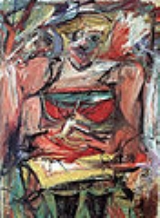
De Kooning had painted women regularly in the early 1940s and again from 1947 to 1949. The biomorphic shapes of his early abstractions were derived from objects found in the studio. But it was not until 1950 that he began to explore the subject of women exclusively. In the summer of that year he began Woman I (located at the Museum of Modern Art
Museum of Modern Art

The Museum of Modern Art is an art museum located in Midtown Manhattan in New York City, USA, on 53rd Street, between Fifth and Sixth Avenues....
, New York City), which went through innumerable metamorphoses before it was finished in 1952. During this period he also created other paintings of women. These works were shown at the Sidney Janis
Sidney Janis

Sidney Janis was a wealthy clothing manufacturer and art collector who opened an art gallery in New York City in 1948. His gallery quickly gained prominence, for he not only exhibited the work of most of the emerging leaders of Abstract Expressionism, but also that of such important European artists as Pierre Bonnard, Paul Klee, Joan Mir%C...
 Gallery in 1953 and caused a sensation, chiefly because they were figurative when most of his fellow Abstract Expressionists were painting abstractly and because of their blatant technique and imagery. The appearance of aggressive brushwork and the use of high-key colors combine to reveal a woman all too congruent with some of modern man's most widely held sexual fears. The toothy snarls, overripe, pendulous breasts, vacuous eyes, and blasted extremities imaged the darkest Freud
Sigmund Freud

Sigmund Freud , born Sigismund Schlomo Freud , was an Austrian psychiatrist who founded the psychoanalysis of psychology. Freud is best known for his theories of the unconscious mind and the defense mechanism of Psychological repression and for creating the clinical practice of psychoanalysis for curing psychopathology through dialogue...
ian insights. Some of these paintings also seemed to hearken back to early Mesopotamian / Akkadian works, with the large, almost "all-seeing" eyes.

The Woman paintings II through VI (1952-53) are all variants on this theme, as are Woman and Bicycle (1953; Whitney Museum of American Art
Whitney Museum of American Art

The Whitney Museum of American Art, often referred to simply as "the Whitney", harbors one of the most important Collection of 20th century United States art....
, New York) and Two Women in the Country (1954). The deliberate vulgarity of these paintings contrasts with the French painter Jean Dubuffet
Jean Dubuffet

Jean Philippe Arthur Dubuffet was one of the most famous France Paintings and sculpture of the second half of the 20th century....
's no less harsh Corps de Dame series of 1950, in which the female, formed with a rich topography of earth colours, relates more directly to universal symbols.

From the late 1950s to the early 1960s, De Kooning entered a new phase of nearly pure abstractions more related to landscape than to the human figure. These paintings, such as "Bolton Landing" (1957) and "Door to the River" (1960) bear broad brushstrokes and calligraphic tendencies similar to works of his contemporary Franz Kline.

In 1963, De Kooning moved permanently to East Hampton
East Hampton

East Hampton or its variants is the name of several places in the United States:*East Hampton, Connecticut*East Hampton , New York*East Hampton , New York...
, Long Island
Long Island

Long Island is an island located in southeastern New York, United States, just east of Manhattan. Stretching northeast into the Atlantic Ocean, Long Island contains four counties, two of which are Borough s of New York City, and two of which are mainly suburban....
, and returned to depicting women while also referencing the landscape in such paintings as Woman, Sag harbor and Clam Diggers.

Willem de Kooning was diagnosed with, in all probability, Alzheimer's disease
Alzheimer's disease

Alzheimer's disease , also called Alzheimer disease, Senile Dementia of the Alzheimer Type or simply Alzheimer's, is the most common form of dementia....
. After his wife, Elaine, died on February 1, 1989, his daughter, Lisa, and his lawyer, John Eastman were granted guardianship over De Kooning. As the style of his later works continued to evolve into early 1989, his vintage works drew increasing profits; at Sotheby's auctions Pink Lady (1944) sold for US$3.6 million in 1987 and Interchange (1955) brought $20.6 million in 1989.

There is much debate over the relevance and significance of his 1980s paintings, many of which became clean, sparse, and almost graphic, while alluding to the biomorphic lines of his early works. Some have said his very last works, present a new direction of compositional complexity and daring color juxtapositions. Some speculate that his mental condition and previous life of alcoholism
Alcoholism

Alcoholism is a term with multiple and sometimes conflicting definitions to describe the detrimental effects of alcohol intake.In common and historic usage, alcoholism refers to any condition that results in the continued consumption of alcoholic beverages despite health problems and negative social consequences....
 had rendered him unable to carry out the mastery indicated in his early works, while others see these late works as boldly prophetic of directions that some current painters continue to pursue. Unfortunately, gossip has tainted the scant critical commentary afforded these last works, which have yet to be seriously assessed.

Bibliography

  • Marika Herskovic, (New York School Press, 2003.) ISBN 0-9677994-1-4
  • Marika Herskovic, (New York School Press, 2000.) ISBN 0-9677994-0-6
  • Edvard Lieber, Willem de Kooning: Reflections in the Studio, 2000, Harry N. Abrams, Inc. ISBN 0-8109-4560-6


See also

  • Abstract expressionism
    Abstract expressionism

    Abstract expressionism was an American post?World War II art movement. It was the first specifically American movement to achieve worldwide influence and also the one that put New York City at the center of the art world, a role formerly filled by Paris....
  • Action painting
    Action painting

    Action painting, sometimes called "gestural abstraction", is a style of painting in which paint is spontaneously dribbled, splashed or smeared onto the canvas, rather than being carefully applied....
  • Elaine de Kooning
    Elaine de Kooning

    Elaine Marie de Kooning , was an Abstract Expressionism Painting and a vibrant figure in the New York School. She was born Elaine Marie Fried in Brooklyn, New York, USA....
  • Impasto
    Impasto

    In English, the borrowed Italian word impasto most commonly refers to a technique used in painting, where paint is laid on an area of the surface very thickly, usually thickly enough that the brush or painting-knife strokes are visible....
  • Women in art
  • Woman III
    Woman III

    Woman III is a painting by abstract expressionist painter Willem de Kooning. Woman III is one of a series of six paintings by de Kooning done between 1951 and 1953 in which the central theme was a woman....


External links