


Minimalism

Encyclopedia
Minimalism describes movements in various forms of art and design, especially visual art
and music
, where the work is set out to expose the essence, essentials or identity of a subject through eliminating all non-essential forms, features or concepts. As a specific movement in the arts it is identified with developments in post–World War II Western Art, most strongly with American visual arts in the 1960s and early 1970s. Prominent artists associated with this movement include Donald Judd
, John McCracken
, Agnes Martin
, Dan Flavin
, Robert Morris
, Anne Truitt
, and Frank Stella
. It is rooted in the reductive aspects of Modernism
, and is often interpreted as a reaction against Abstract expressionism
and a bridge to Postminimal
art practices.
The terms have expanded to encompass a movement in music which features repetition and iteration, as in the compositions of La Monte Young
, Terry Riley
, Steve Reich
, Philip Glass
, and John Adams. Minimalist compositions are sometimes known as systems music
.
The term "minimalist" is often applied colloquially to designate anything which is spare or stripped to its essentials. It has also been used to describe the plays
and novel
s of Samuel Beckett
, the films of Robert Bresson
, the stories of Raymond Carver
, and even the automobile designs of Colin Chapman
. The word was first used in English in the early 20th century to describe the Mensheviks.
and architecture
where in the subject is reduced to its necessary elements. Minimalist design has been highly influenced by Japanese traditional design and architecture. In addition, the work of De Stijl
artists is a major source of reference for this kind of work. De Stijl expanded the ideas that could be expressed by using basic elements such as lines and planes organized in very particular manners.
Architect Ludwig Mies van der Rohe
adopted the motto "Less is more" to describe his aesthetic tactic of arranging the numerous necessary components of a building to create an impression of extreme simplicity, by enlisting every element and detail to serve multiple visual and functional purposes (such as designing a floor to also serve as the radiator, or a massive fireplace to also house the bathroom). Designer Buckminster Fuller
adopted the engineer's goal of "Doing more with less", but his concerns were oriented towards technology and engineering rather than aesthetics. A similar sentiment was industrial designer Dieter Rams
' motto, "Less but better" adapted from van der Rohe. The structure uses relatively simple elegant designs; ornamentations are quality rather than quantity. The structure's beauty is also determined by playing with lighting, using the basic geometric shapes as outlines, using only a single shape or a small number of like shapes for components for design unity, using tasteful non-fussy bright color combinations, usually natural textures and colors, and clean and fine finishes. Using sometimes the beauty of natural patterns on stone cladding and real wood encapsulated within ordered simplified structures, and real metal producing a simplified but prestigious architecture and interior design. May use color brightness balance and contrast between surface colors to improve visual aesthetics. The structure would usually have industrial and space age style utilities (lamps, stoves, stairs, technology, etc.), neat and straight components (like walls or stairs) that appear to be machined with machines, flat or nearly flat roofs, pleasing negative spaces, and large windows to let in lots of sunlight. This and science fiction may have contributed to the late twentieth century futuristic architecture design, and modern home decor. Modern minimalist home architecture with its unnecessary internal walls removed probably have led to the popularity of the open plan kitchen and living room style.
Another modern master who exemplifies reductivist ideas is Luis Barragán
. In minimalism, the architectural designers pay special attention to the connection between perfect planes, elegant lighting, and careful consideration of the void spaces left by the removal of three-dimensional shapes from an architectural design. The more attractive looking minimalist home designs are not truly minimalist, because these use more expensive building materials and finishes, and are relatively larger.
Contemporary architects working in this tradition include John Pawson
, Eduardo Souto de Moura
, Álvaro Siza Vieira
, Tadao Ando
, Alberto Campo Baeza
, Yoshio Taniguchi
, Peter Zumthor
, Hugh Newell Jacobsen
, Vincent Van Duysen, Claudio Silvestrin
, Michael Gabellini
, and Richard Gluckman
.
philosophy.
The considerations for ‘essences’ are light, form, detail of material, space, place and human condition. Minimalist architects not only consider the physical qualities of the building. Moreover, they look deeply into the spiritual dimension and the invisible, by listen to the figure and pay attention to the details, people, space, nature and materials. Which reveals the abstract quality of something that is invisible and search for the essence from those invisible qualities. Such as natural light, sky, earth and air. In addition, they open up dialogue with the surrounding environment to decide the most essential materials for the construction and create relationships between buildings and sites.
In minimalist architecture, design elements convey the message of simplicity. The basic geometric forms, elements without decoration, simple materials and the repetitions of structures represent a sense of order and essential quality.The movement of natural light in buildings reveals simple and clean spaces. In late 19th century as the arts and crafts movement began popular in Britain, people values the attitude of ‘truth to materials’, which respect the profound and innate characteristic of materials. They manipulate humility attitude towards material by listen to it, which is ‘listen to figure’ and try to find out every essentiality from the identity of material. Therefore minimalist architects benefit from seeking the essence and simplicity by rediscovers the valuable qualities in the simple and common materials.
Zen concepts of simplicity transmit the ideas of freedom and essence of living. Simplicity is not only aesthetic value, it has a moral perception that looks into the nature of truth and reveals the inner qualities of materials and objects for the essence. For example, the sand garden in Ryoanji temple demonstrates the concept of simplicity and the essentiality from the considered setting of a few stones and a huge empty space.
The Japanese aesthetic principle of Ma
refers to empty or open space. That removes all the unnecessary internal walls and opens up the space between interior and the exterior. Frank Lloyd Wright
was influenced by the design element of Japanese sliding door that allows to bring the exterior to the interior. The emptiness of spatial arrangement is another idea that reduces everything down to the most essential quality.
The Japanese aesthetic of Wabi
values the quality of simple and plain objects. It appreciates the absence of unnecessary features to view life in quietness and reveals the most innate character of materials. For example, the Japanese flora art, also known as Ikebana
has the meaning of let flower express itself. People cut off the branches, leaves and blossoms from the plants and only retain the essential part from the plant. Which conveys the idea of essential quality and innate character in nature.
conveys the Japanese traditional spirit and his own perception of nature in his works. His design concepts are materials, pure geometry and nature. He normally uses concrete or natural wood and basic structural form to achieve austerity and rays of light in space. He also sets up dialogue between the site and nature to create relationship and order with the buildings. Ando’s works and the translation of Japanese aesthetic principles are highly influential on Japanese architecture.
In Vitra Conference Pavilion, Weil am Rhein, 1993, the concepts are to bring together the relationships between building, human movement, site and nature. Which as one main point of minimalism ideology that establish dialogue between the building and site. The building uses the simple forms of circle and rectangle to contrast the filled and void space of the interior and nature. In the foyer, there is a large landscape window that looks out to the exterior. This achieves the simple and silence of architecture and enhances the light, wind, time and nature in space.
John Pawson
is a British minimalist architect, his design concepts are soul, light and order. He believes that though reduced clutter and simplification of the interior to a point that gets beyond the idea of essential quality, there is a sense of clarity and richness of simplicity instead of emptiness. The materials in his design reveal the perception toward space, surface and volume. Moreover, he likes to use natural materials because of their aliveness, sense of depth and quality of individual. He is also attracted by the important influences from Japanese Zen Philosophy.
Calvin Klein Madison Avenue, New York, 1995-96, is a boutique that conveys Calvin Klein’s ideas of fashion. John Pawson’s interior design concepts for this project are to create simple, peaceful and orderly spatial arrangements. He used stone floors and white walls to achieve simplicity and harmony for space. He also emphasises reduction and eliminates the visual distortions, such as the air conditioning and lamps to achieve a sense of purity for interior.
Alberto Campo Baeza
is a Spanish architect and describes his work as essential architecture. He values the concepts of light, idea and space. Light is essential and achieves the relationship between inhabitants and the building. Ideas are to meet the function and context of space, forms and construction. Space is shaped by the minimal geometric forms to avoid decoration that is not essential.
Gasper House, Zahora, 1992 is a residence that client requested to be independent. High walls create the enclosed space and the stone floors used in house and courtyard show the continuality of interior and exterior. The white colour of the walls reveals the simplicity and unity of the building. The feature of the structure make lines to form the continuously horizontal house, therefore natural light projects horizontally through the building.
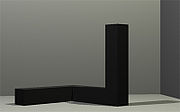
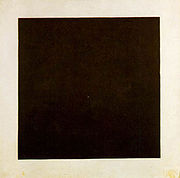
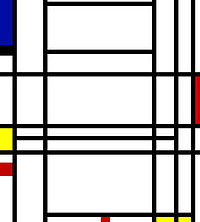 Minimalism in visual art, generally referred to as "minimal art", literalist art and ABC Art emerged in New York in the early 1960s. Initially minimal art appeared in New York in the 60s as new and older artists moved toward geometric abstraction; exploring via painting in the cases of Frank Stella
, Kenneth Noland
, Al Held
, Ellsworth Kelly
, Robert Ryman
and others; and sculpture in the works of various artists including David Smith, Anthony Caro
, Tony Smith
, Sol LeWitt
, Carl Andre
, Dan Flavin
, Donald Judd
and others. Judd's sculpture were showcased in 1964 at the Green Gallery
in Manhattan as were Flavin's first fluorescent light works, while other leading Manhattan galleries like the Leo Castelli Gallery
and the Pace Gallery
also began to showcase artists focused on geometric abstraction. In addition there were two seminal and influential museum exhibitions: Primary Structures: Younger American and British Sculpture shown from April 27 - June 12, 1966 at the Jewish Museum
in New York
, organized by the museum's Curator of Painting and Sculpture, Kynaston McShine and Systemic Painting, at the Solomon R. Guggenheim Museum
curated by Lawrence Alloway
also in 1966 that showcased Geometric abstraction in the American art world via Shaped canvas
, Color Field
, and Hard-edge painting
. In the wake of those exhibitions and a few others the art movement
called minimal art emerged.
In a much more broad and general sense, one might, in fact, find European roots of Minimalism in the geometric abstractions of painters in the Bauhaus
, in the works of Piet Mondrian
and other artists associated with the De Stijl
movement, in the Russian Constructivist
movement, and in the work of the Romanian sculptor Constantin Brâncuşi
. Minimal art is also inspired in part by the paintings of Barnett Newman
, Ad Reinhardt
, Josef Albers
, and the works of artists as diverse as Pablo Picasso
, Marcel Duchamp
, Giorgio Morandi
, and others. It is regarded as a reaction against the painterly subjectivity of Abstract Expressionism
as well as the discourse, institutions and ideologies that promoted Abstract Expressionism.
Artist and critic Thomas Lawson
noted in his 1977 catalog essay Last Exit: Painting, minimalism did not reject Clement Greenberg
's claims about modernist painting's reduction to surface and materials so much as take his claims literally. According to Lawson minimalism was the result, even though the term "minimalism" was not generally embraced by the artists associated with it, and many practitioners of art designated minimalist by critics did not identify it as a movement as such. Also taking exception to this claim was Clement Greenberg himself; in his 1978 postscript to his essay Modernist Painting he disavowed this incorrect interpretation of what he said; Greenberg wrote:
There have been some further constructions of what I wrote that go over into preposterousness: That I regard flatness and the inclosing of flatness not just as the limiting conditions of pictorial art, but as criteria of aesthetic quality in pictorial art; that the further a work advances the self-definition of an art, the better that work is bound to be. The philosopher or art historian who can envision me -- or anyone at all -- arriving at aesthetic judgments in this way reads shockingly more into himself or herself than into my article.
In contrast to the to the previous decade's more subjective Abstract Expressionists
, with the exceptions of Barnett Newman
and Ad Reinhardt
, minimalists were influenced by composers John Cage
and LaMonte Young
, poet William Carlos Williams
, and the landscape architect Frederick Law Olmsted
. They very explicitly stated that their art was not about self-expression, unlike the previous decade's more subjective philosophy about art making theirs was objective. In general, Minimalism's features included geometric
, often cubic
forms purged of much metaphor
, equality of parts, repetition, neutral surfaces, and industrial materials.
Robert Morris
, an influential theorist and artist, wrote a three part essay, "Notes on Sculpture 1-3", originally published across three issues of Artforum
in 1966. In these essays, Morris attempted to define a conceptual framework and formal elements for himself and one that would embrace the practices of his contemporaries. These essays paid great attention to the idea of the gestalt - "parts... bound together in such a way that they create a maximum resistance to perceptual separation." Morris later described an art represented by a "marked lateral spread and no regularized units or symmetrical intervals..." in "Notes on Sculpture 4: Beyond Objects", originally published in Artforum
, 1969, continuing to say that "indeterminacy of arrangement of parts is a literal aspect of the physical existence of the thing." The general shift in theory of which this essay is an expression suggests the transitions into what would later be referred to as postminimalism
.
One of the first artists specifically associated with minimalism was the painter, Frank Stella
, whose early "pinstripe" paintings were included in the 1959 show, 16 Americans, organized by Dorothy Miller at the Museum of Modern Art
in New York. The width of the stripes in Frank Stellas's pinstripe paintings were determined by the dimensions of the lumber used for stretchers, visible as the depth of the painting when viewed from the side, used to construct the supportive chassis upon which the canvas was stretched. The decisions about structures on the front surface of the canvas were therefore not entirely subjective, but pre-conditioned by a "given" feature of the physical construction of the support. In the show catalog, Carl Andre
noted, "Art excludes the unnecessary. Frank Stella has found it necessary to paint stripe
s. There is nothing else in his painting." These reductive works were in sharp contrast to the energy-filled and apparently highly subjective and emotionally-charged paintings of Willem de Kooning
or Franz Kline
and, in terms of precedent among the previous generation of abstract expressionists, leaned more toward the less gestural, often somber, color field
paintings of Barnett Newman
and Mark Rothko
. Although Stella received immediate attention from the MoMA show, artists including Kenneth Noland
, Gene Davis
, Robert Motherwell
and Robert Ryman
had also begun to explore stripes, monochromatic
and Hard-edge
formats from the late 50s through the 1960s.
Because of a tendency in minimal art to exclude the pictorial, illusionistic and fictive in favor of the literal, there was a movement away from painterly and toward sculptural concerns. Donald Judd
had started as a painter, and ended as a creator of objects. His seminal essay, "Specific Objects" (published in Arts Yearbook 8, 1965), was a touchstone of theory for the formation of minimalist aesthetics. In this essay, Judd found a starting point for a new territory for American art, and a simultaneous rejection of residual inherited European artistic values. He pointed to evidence of this development in the works of an array of artists active in New York at the time, including Jasper Johns
, Dan Flavin and Lee Bontecou
. Of "preliminary" importance for Judd was the work of George Earl Ortman
, who had concretized and distilled painting's forms into blunt, tough, philosophically charged geometries. These Specific Objects inhabited a space not then comfortably classifiable as either painting or sculpture. That the categorical identity of such objects was itself in question, and that they avoided easy association with well-worn and over-familiar conventions, was a part of their value for Judd.
This movement was heavily criticised by modernist formalist art critics and historians. Some critics thought minimal art represented a misunderstanding of the modern dialectic of painting and sculpture as defined by critic Clement Greenberg
, arguably the dominant American critic of painting in the period leading up to the 1960s. The most notable critique of minimalism was produced by Michael Fried, a formalist critic, who objected to the work on the basis of its "theatricality". In Art and Objecthood (published in Artforum
in June 1967) he declared that the minimal work of art, particularly minimal sculpture, was based on an engagement with the physicality of the spectator. He argued that work like Robert Morris's transformed the act of viewing into a type of spectacle
, in which the artifice of the act observation
and the viewer's participation in the work were unveiled. Fried saw this displacement of the viewer's experience from an aesthetic engagement within, to an event outside of the artwork as a failure of minimal art. Fried's essay was immediately challenged by postminimalist and earth artist
Robert Smithson
in a letter to the editor in the October issue of Artforum
. Smithson stated the following: "What Fried fears most is the consciousness
of what he is doing--namely being himself theatrical."
In addition to the already mentioned Robert Morris
, Frank Stella
, Carl Andre
, Robert Ryman
and Donald Judd
other minimal artists include: Robert Mangold
, Larry Bell
, Dan Flavin
, Sol LeWitt
, Brice Marden
, Agnes Martin
, Jo Baer
, John McCracken
, Ad Reinhardt
, Fred Sandback
, Richard Serra
, Tony Smith
, Blinky Palermo
and Anne Truitt
.
Ad Reinhardt
, actually an artist of the Abstract Expressionist
generation, but one whose reductive
nearly all-black paintings seemed to anticipate minimalism, had this to say about the value of a reductive approach to art:
The more stuff in it, the busier the work of art, the worse it is. More is less. Less is more. The eye is a menace to clear sight. The laying bare of oneself is obscene. Art begins with the getting rid of nature.
Reinhardt's remark directly addresses and contradicts Hans Hofmann
's regard for nature as the source of his own abstract expressionist paintings. In a famous exchange between Hofmann and Jackson Pollock
as told by Lee Krasner
in an interview with Dorothy Strickler (1964-11-02) for the Smithsonian Institution Archives of American Art
. In Krasner's words,
"When I brought Hofmann
up to meet Pollock and see his work which was before we moved here, Hofmann’s reaction was — one of the questions he asked Jackson was, do you work from nature? There were no still lifes around or models around and Jackson’s answer was, I am nature. And Hofmann’s reply was, Ah, but if you work by heart, you will repeat yourself. To which Jackson did not reply at all." The meeting between Pollock and Hofmann took place in 1942.
Some 1940s-era crime fiction of writers such as James M. Cain
and Jim Thompson
adopted a stripped-down, matter-of-fact prose style to considerable effect; some classify this prose style as minimalism.
Another strand of literary minimalism arose in response to the Metafiction
trend of the 1960s and early 1970s (John Barth
, Robert Coover
, and William H. Gass
). These writers were also spare with prose and kept a psychological distance from their subject matter.
Minimalist authors, or those who are identified with minimalism during certain periods of their writing careers, include the following: Raymond Carver
, Ann Beattie
, Bret Easton Ellis
, Charles Bukowski
, Ernest Hemingway
, K. J. Stevens
, Amy Hempel
, Bobbie Ann Mason
, Tobias Wolff
, Grace Paley
, Sandra Cisneros
, Mary Robison
, Frederick Barthelme
, Richard Ford
, and Alicia Erian
.
American poets such as Stephen Crane
, William Carlos Williams
, early Ezra Pound
, Robert Creeley
, Robert Grenier
, and Aram Saroyan
are sometimes identified with their minimalist style. The term "minimalism" is also sometimes associated with the briefest of poetic genres, haiku
, which originated in Japan but has been domesticated in English literature by poets such as Nick Virgilio
, Raymond Roseliep
, and George Swede
.
The Irish author Samuel Beckett
is also known for his minimalist plays and prose, as is the Norwegian writer Jon Fosse
.
In his novel The Easy Chain, author Evan Dara
includes a 60-page section written in the style of musical minimalism, in particular inspired by composer Steve Reich
. Intending to represent the psychological state (agitation) of the novel's main character, the section's successive lines of text are built on repetitive and developing phrases.
or Downtown music
named in the 1960s based mostly in consonant harmony
, steady pulse (if not immobile drones
), stasis or gradual transformation, and often reiteration of musical phrases
or smaller units such as figures
, motifs
, and cells
. It may include features such as additive process and phase shifting. Starting in the early 1960s as a scruffy underground scene in San Francisco alternative spaces and New York lofts, minimalism spread to become the most popular experimental music style of the late 20th century. The movement originally involved dozens of composers, although only five—Terry Riley
, Steve Reich
, Philip Glass
, John Adams and, less visibly if more seminally, La Monte Young
—emerged to become publicly associated with it in America. In Europe, its chief exponents were Louis Andriessen
, Karel Goeyvaerts
, Michael Nyman
, Gavin Bryars
, Steve Martland
, Henryk Górecki
, Arvo Pärt
, and John Tavener
. The term "minimal music" was derived around 1970 by Michael Nyman from the concept of minimalism, which was earlier applied to the visual arts
.
Visual arts
The visual arts are art forms that create works which are primarily visual in nature, such as ceramics, drawing, painting, sculpture, printmaking, design, crafts, and often modern visual arts and architecture...
and music
Minimalist music
Minimal music is a style of music associated with the work of American composers La Monte Young, Terry Riley, Steve Reich, and Philip Glass. It originated in the New York Downtown scene of the 1960s and was initially viewed as a form of experimental music called the New York Hypnotic School....
, where the work is set out to expose the essence, essentials or identity of a subject through eliminating all non-essential forms, features or concepts. As a specific movement in the arts it is identified with developments in post–World War II Western Art, most strongly with American visual arts in the 1960s and early 1970s. Prominent artists associated with this movement include Donald Judd
Donald Judd
Donald Clarence Judd was an American artist associated with minimalism . In his work, Judd sought autonomy and clarity for the constructed object and the space created by it, ultimately achieving a rigorously democratic presentation without compositional hierarchy...
, John McCracken
John McCracken
John Harvey McCracken was a contemporary artist who lived and worked in Santa Fe, New Mexico and New York.- Education/teaching :...
, Agnes Martin
Agnes Martin
Agnes Bernice Martin was an American abstract painter, often referred to as a minimalist; Martin considered herself an abstract expressionist.She won a National Medal of Arts from the National Endowment for the Arts in 1998....
, Dan Flavin
Dan Flavin
Dan Flavin was an American minimalist artist famous for creating sculptural objects and installations from commercially available fluorescent light fixtures.-Early life and career:...
, Robert Morris
Robert Morris (artist)
Robert Morris is an American sculptor, conceptual artist and writer. He is regarded as one of the most prominent theorists of Minimalism along with Donald Judd but he has also made important contributions to the development of performance art, land art, the Process Art movement and installation...
, Anne Truitt
Anne Truitt
Anne Truitt was a major American artist of the mid-20th century; she is associated with both minimalism and Color Field artists like Morris Louis and Kenneth Noland....
, and Frank Stella
Frank Stella
Frank Stella is an American painter and printmaker, significant within the art movements of minimalism and post-painterly abstraction.-Biography:...
. It is rooted in the reductive aspects of Modernism
Modernism
Modernism, in its broadest definition, is modern thought, character, or practice. More specifically, the term describes the modernist movement, its set of cultural tendencies and array of associated cultural movements, originally arising from wide-scale and far-reaching changes to Western society...
, and is often interpreted as a reaction against Abstract expressionism
Abstract expressionism
Abstract expressionism was an American post–World War II art movement. It was the first specifically American movement to achieve worldwide influence and put New York City at the center of the western art world, a role formerly filled by Paris...
and a bridge to Postminimal
Postminimalism
Postminimalism is an art term coined by Robert Pincus-Witten in 1971 used in various artistic fields for work which is influenced by, or attempts to develop and go beyond, the aesthetic of minimalism...
art practices.
The terms have expanded to encompass a movement in music which features repetition and iteration, as in the compositions of La Monte Young
La Monte Young
La Monte Thornton Young is an American avant-garde composer, musician, and artist.Young is generally recognized as the first minimalist composer. His works have been included among the most important and radical post-World War II avant-garde, experimental, and contemporary music. Young is...
, Terry Riley
Terry Riley
Terrence Mitchell Riley, is an American composer intrinsically associated with the minimalist school of Western classical music and was a pioneer of the movement...
, Steve Reich
Steve Reich
Stephen Michael "Steve" Reich is an American composer who together with La Monte Young, Terry Riley, and Philip Glass is a pioneering composer of minimal music...
, Philip Glass
Philip Glass
Philip Glass is an American composer. He is considered to be one of the most influential composers of the late 20th century and is widely acknowledged as a composer who has brought art music to the public .His music is often described as minimalist, along with...
, and John Adams. Minimalist compositions are sometimes known as systems music
Systems music
Systems music is a term which has been used to describe the work of composers who concern themselves primarily with sound continuums which evolve gradually, often over very long periods of time . Historically, the American minimalists Steve Reich, La Monte Young and Philip Glass are considered the...
.
The term "minimalist" is often applied colloquially to designate anything which is spare or stripped to its essentials. It has also been used to describe the plays
Play (theatre)
A play is a form of literature written by a playwright, usually consisting of scripted dialogue between characters, intended for theatrical performance rather than just reading. There are rare dramatists, notably George Bernard Shaw, who have had little preference whether their plays were performed...
and novel
Novel
A novel is a book of long narrative in literary prose. The genre has historical roots both in the fields of the medieval and early modern romance and in the tradition of the novella. The latter supplied the present generic term in the late 18th century....
s of Samuel Beckett
Samuel Beckett
Samuel Barclay Beckett was an Irish avant-garde novelist, playwright, theatre director, and poet. He wrote both in English and French. His work offers a bleak, tragicomic outlook on human nature, often coupled with black comedy and gallows humour.Beckett is widely regarded as among the most...
, the films of Robert Bresson
Robert Bresson
-Life and career:Bresson was born at Bromont-Lamothe, Puy-de-Dôme, the son of Marie-Élisabeth and Léon Bresson. Little is known of his early life and the year of his birth, 1901 or 1907, varies depending on the source. He was educated at Lycée Lakanal in Sceaux, Hauts-de-Seine, close to Paris, and...
, the stories of Raymond Carver
Raymond Carver
Raymond Clevie Carver, Jr. was an American short story writer and poet. Carver is considered a major American writer of the late 20th century and also a major force in the revitalization of the short story in the 1980s....
, and even the automobile designs of Colin Chapman
Colin Chapman
Anthony Colin Bruce Chapman CBE was an influential British designer, inventor, and builder in the automotive industry, and founder of Lotus Cars....
. The word was first used in English in the early 20th century to describe the Mensheviks.
Minimalist design
The term minimalism is also used to describe a trend in designDesign
Design as a noun informally refers to a plan or convention for the construction of an object or a system while “to design” refers to making this plan...
and architecture
Architecture
Architecture is both the process and product of planning, designing and construction. Architectural works, in the material form of buildings, are often perceived as cultural and political symbols and as works of art...
where in the subject is reduced to its necessary elements. Minimalist design has been highly influenced by Japanese traditional design and architecture. In addition, the work of De Stijl
De Stijl
De Stijl , propagating the group's theories. Next to van Doesburg, the group's principal members were the painters Piet Mondrian , Vilmos Huszár , and Bart van der Leck , and the architects Gerrit Rietveld , Robert van 't Hoff , and J.J.P. Oud...
artists is a major source of reference for this kind of work. De Stijl expanded the ideas that could be expressed by using basic elements such as lines and planes organized in very particular manners.
Architect Ludwig Mies van der Rohe
Ludwig Mies van der Rohe
Ludwig Mies van der Rohe was a German architect. He is commonly referred to and addressed as Mies, his surname....
adopted the motto "Less is more" to describe his aesthetic tactic of arranging the numerous necessary components of a building to create an impression of extreme simplicity, by enlisting every element and detail to serve multiple visual and functional purposes (such as designing a floor to also serve as the radiator, or a massive fireplace to also house the bathroom). Designer Buckminster Fuller
Buckminster Fuller
Richard Buckminster “Bucky” Fuller was an American systems theorist, author, designer, inventor, futurist and second president of Mensa International, the high IQ society....
adopted the engineer's goal of "Doing more with less", but his concerns were oriented towards technology and engineering rather than aesthetics. A similar sentiment was industrial designer Dieter Rams
Dieter Rams
Dieter Rams is a German industrial designer closely associated with the consumer products company Braun and the Functionalist school of industrial design.- Life and career :...
' motto, "Less but better" adapted from van der Rohe. The structure uses relatively simple elegant designs; ornamentations are quality rather than quantity. The structure's beauty is also determined by playing with lighting, using the basic geometric shapes as outlines, using only a single shape or a small number of like shapes for components for design unity, using tasteful non-fussy bright color combinations, usually natural textures and colors, and clean and fine finishes. Using sometimes the beauty of natural patterns on stone cladding and real wood encapsulated within ordered simplified structures, and real metal producing a simplified but prestigious architecture and interior design. May use color brightness balance and contrast between surface colors to improve visual aesthetics. The structure would usually have industrial and space age style utilities (lamps, stoves, stairs, technology, etc.), neat and straight components (like walls or stairs) that appear to be machined with machines, flat or nearly flat roofs, pleasing negative spaces, and large windows to let in lots of sunlight. This and science fiction may have contributed to the late twentieth century futuristic architecture design, and modern home decor. Modern minimalist home architecture with its unnecessary internal walls removed probably have led to the popularity of the open plan kitchen and living room style.
Another modern master who exemplifies reductivist ideas is Luis Barragán
Luis Barragán
Luis Barragán Morfin was a Mexican architect. He was self-trained.-Early life:Educated as an engineer, he graduated from the Escuela Libre de Ingenieros in Guadalajara in 1923 and was self-trained as an architect.After graduation, he travelled through Spain, France , and...
. In minimalism, the architectural designers pay special attention to the connection between perfect planes, elegant lighting, and careful consideration of the void spaces left by the removal of three-dimensional shapes from an architectural design. The more attractive looking minimalist home designs are not truly minimalist, because these use more expensive building materials and finishes, and are relatively larger.
Contemporary architects working in this tradition include John Pawson
John Pawson
John Pawson is a British designer associated with the minimalist aesthetic.-Biography:Pawson studied at Eton College and the Architectural Association School of Architecture and is married to Catherine and has two children, Caius and Benedict.-Selected projects:London's Cannelle Cake Shop, several...
, Eduardo Souto de Moura
Eduardo Souto de Moura
-Life and career:Souto de Moura was born in Porto, and studied sculpture before switching to architecture at the School of Fine Arts of the University of Porto, the current FAUP - Faculdade de Arquitectura da Universidade do Porto, and receiving his degree in 1980. From 1974 to 1979 he worked with...
, Álvaro Siza Vieira
Álvaro Siza Vieira
Álvaro Joaquim de Melo Siza Vieira, GOSE, GCIH, is a Portuguese architect, born 25 June 1933 in Matosinhos a small coastal town by Porto. He is internationally known as Álvaro Siza .-Life and career:...
, Tadao Ando
Tadao Ando
is a Japanese architect whose approach to architecture was once categorized by Francesco Dal Co as critical regionalism. Ando has led a storied life, working as a truck driver and boxer prior to settling on the profession of architecture, despite never having taken formal training in the field...
, Alberto Campo Baeza
Alberto Campo Baeza
Alberto Campo Baeza is a Spanish architect. He took classes at the E.T.S. Arquitectura de Madrid, and graduated in 1971...
, Yoshio Taniguchi
Yoshio Taniguchi
Yoshio Taniguchi is a Japanese architect best known for his redesign of the Museum of Modern Art in New York which was reopened November 20, 2004.- Biography :...
, Peter Zumthor
Peter Zumthor
Peter Zumthor is a Swiss architect and winner of the 2009 Pritzker Prize.-Early life:Zumthor was born in Basel, the son of a cabinet-maker...
, Hugh Newell Jacobsen
Hugh Newell Jacobsen
Hugh Newell Jacobsen is a prominent United States architect.-Education and early career:Hugh Newell Jacobsen was born in Grand Rapids, Michigan in 1929. Educated at the University of Maryland, he received a BA in 1951. He also attended the Architectural Association School of Architecture in...
, Vincent Van Duysen, Claudio Silvestrin
Claudio Silvestrin
Claudio Silvestrin is an Italian architect and designer, and a British citizen.He was educated in Milan, under the guidance of A. G. Fronzoni, before moving to the Architectural Association in London....
, Michael Gabellini
Michael Gabellini
Michael Gabellini is a renowned minimalist architect and interior designer. He has won the progressive architecture award as well as awards from the American Institute of Architects and three Decade of Design Awards from the International Interior Design Association.In 1991 he established...
, and Richard Gluckman
Gluckman Mayner Architects
Gluckman Mayner Architects is an architecture firm located in New York City with Richard Gluckman and David Mayner in partnership since 1998. The architects are known for minimalist design, evident in five pioneering art galleries that moved into the Chelsea gallery district from the SoHo...
.
Minimalist architecture and space
The term ‘minimalism’ is a trend from early 19th century and gradually became an important movement in response to the over decorated design of the previous period. Minimalist architecture became popular in the late 1980s in London and New York. Where architects and fashion designers worked together in the boutiques to achieve simplicity, using white elements, cold lighting, large space with minimum objects and furniture. Minimalist architecture simplifies living space to reveal the essential quality of buildings and conveys simplicity in attitudes toward life. It is highly inspired from the Japanese traditional design and the concept of ZenZen
Zen is a school of Mahāyāna Buddhism founded by the Buddhist monk Bodhidharma. The word Zen is from the Japanese pronunciation of the Chinese word Chán , which in turn is derived from the Sanskrit word dhyāna, which can be approximately translated as "meditation" or "meditative state."Zen...
philosophy.
Concepts and design elements
The concept of minimalist architecture is to strip everything down to its essential quality and achieve simplicity. The idea is not completely without ornamentation, but that all parts, details and joinery are considered as reduced to a stage where no one can remove anything further to improve the design.The considerations for ‘essences’ are light, form, detail of material, space, place and human condition. Minimalist architects not only consider the physical qualities of the building. Moreover, they look deeply into the spiritual dimension and the invisible, by listen to the figure and pay attention to the details, people, space, nature and materials. Which reveals the abstract quality of something that is invisible and search for the essence from those invisible qualities. Such as natural light, sky, earth and air. In addition, they open up dialogue with the surrounding environment to decide the most essential materials for the construction and create relationships between buildings and sites.
In minimalist architecture, design elements convey the message of simplicity. The basic geometric forms, elements without decoration, simple materials and the repetitions of structures represent a sense of order and essential quality.The movement of natural light in buildings reveals simple and clean spaces. In late 19th century as the arts and crafts movement began popular in Britain, people values the attitude of ‘truth to materials’, which respect the profound and innate characteristic of materials. They manipulate humility attitude towards material by listen to it, which is ‘listen to figure’ and try to find out every essentiality from the identity of material. Therefore minimalist architects benefit from seeking the essence and simplicity by rediscovers the valuable qualities in the simple and common materials.
Influences from Japanese tradition
The idea of simplicity appears in many cultures, especially the Japanese traditional culture of Zen Philosophy. Japanese manipulate the Zen culture into aesthetic and design elements for their buildings. This idea of architecture has influenced Western Society, especially in America since the mid 18th century. Moreover, it inspired the minimalist architecture in the 19th century.Zen concepts of simplicity transmit the ideas of freedom and essence of living. Simplicity is not only aesthetic value, it has a moral perception that looks into the nature of truth and reveals the inner qualities of materials and objects for the essence. For example, the sand garden in Ryoanji temple demonstrates the concept of simplicity and the essentiality from the considered setting of a few stones and a huge empty space.
The Japanese aesthetic principle of Ma
Ma (negative space)
Ma is a Japanese word which can be roughly translated as "gap", "space", "pause" or "the space between two structural parts." The spatial concept is experienced progressively through intervals of spatial designation. In Japanese, ma, the word for space, suggests interval...
refers to empty or open space. That removes all the unnecessary internal walls and opens up the space between interior and the exterior. Frank Lloyd Wright
Frank Lloyd Wright
Frank Lloyd Wright was an American architect, interior designer, writer and educator, who designed more than 1,000 structures and completed 500 works. Wright believed in designing structures which were in harmony with humanity and its environment, a philosophy he called organic architecture...
was influenced by the design element of Japanese sliding door that allows to bring the exterior to the interior. The emptiness of spatial arrangement is another idea that reduces everything down to the most essential quality.
The Japanese aesthetic of Wabi
WABI
WABI or wabi may refer to:* Wabi , a product from Sun Microsystems that implements the Microsoft Windows API specifications* WABI-TV, a television station licensed to Bangor, Maine, United States...
values the quality of simple and plain objects. It appreciates the absence of unnecessary features to view life in quietness and reveals the most innate character of materials. For example, the Japanese flora art, also known as Ikebana
Ikebana
is the Japanese art of flower arrangement, also known as .-Etymology:"Ikebana" is from the Japanese and . Possible translations include "giving life to flowers" and "arranging flowers".- Approach :...
has the meaning of let flower express itself. People cut off the branches, leaves and blossoms from the plants and only retain the essential part from the plant. Which conveys the idea of essential quality and innate character in nature.
Minimalist architects and their works
The Japanese minimalist architect, Tadao AndoTadao Ando
is a Japanese architect whose approach to architecture was once categorized by Francesco Dal Co as critical regionalism. Ando has led a storied life, working as a truck driver and boxer prior to settling on the profession of architecture, despite never having taken formal training in the field...
conveys the Japanese traditional spirit and his own perception of nature in his works. His design concepts are materials, pure geometry and nature. He normally uses concrete or natural wood and basic structural form to achieve austerity and rays of light in space. He also sets up dialogue between the site and nature to create relationship and order with the buildings. Ando’s works and the translation of Japanese aesthetic principles are highly influential on Japanese architecture.
In Vitra Conference Pavilion, Weil am Rhein, 1993, the concepts are to bring together the relationships between building, human movement, site and nature. Which as one main point of minimalism ideology that establish dialogue between the building and site. The building uses the simple forms of circle and rectangle to contrast the filled and void space of the interior and nature. In the foyer, there is a large landscape window that looks out to the exterior. This achieves the simple and silence of architecture and enhances the light, wind, time and nature in space.
John Pawson
John Pawson
John Pawson is a British designer associated with the minimalist aesthetic.-Biography:Pawson studied at Eton College and the Architectural Association School of Architecture and is married to Catherine and has two children, Caius and Benedict.-Selected projects:London's Cannelle Cake Shop, several...
is a British minimalist architect, his design concepts are soul, light and order. He believes that though reduced clutter and simplification of the interior to a point that gets beyond the idea of essential quality, there is a sense of clarity and richness of simplicity instead of emptiness. The materials in his design reveal the perception toward space, surface and volume. Moreover, he likes to use natural materials because of their aliveness, sense of depth and quality of individual. He is also attracted by the important influences from Japanese Zen Philosophy.
Calvin Klein Madison Avenue, New York, 1995-96, is a boutique that conveys Calvin Klein’s ideas of fashion. John Pawson’s interior design concepts for this project are to create simple, peaceful and orderly spatial arrangements. He used stone floors and white walls to achieve simplicity and harmony for space. He also emphasises reduction and eliminates the visual distortions, such as the air conditioning and lamps to achieve a sense of purity for interior.
Alberto Campo Baeza
Alberto Campo Baeza
Alberto Campo Baeza is a Spanish architect. He took classes at the E.T.S. Arquitectura de Madrid, and graduated in 1971...
is a Spanish architect and describes his work as essential architecture. He values the concepts of light, idea and space. Light is essential and achieves the relationship between inhabitants and the building. Ideas are to meet the function and context of space, forms and construction. Space is shaped by the minimal geometric forms to avoid decoration that is not essential.
Gasper House, Zahora, 1992 is a residence that client requested to be independent. High walls create the enclosed space and the stone floors used in house and courtyard show the continuality of interior and exterior. The white colour of the walls reveals the simplicity and unity of the building. The feature of the structure make lines to form the continuously horizontal house, therefore natural light projects horizontally through the building.
Minimal art, minimalism in visual art
Frank Stella
Frank Stella is an American painter and printmaker, significant within the art movements of minimalism and post-painterly abstraction.-Biography:...
, Kenneth Noland
Kenneth Noland
Kenneth Noland was an American abstract painter. He was one of the best-known American Color field painters, although in the 1950s he was thought of as an abstract expressionist and in the early 1960s he was thought of as a minimalist painter. Noland helped establish the Washington Color School...
, Al Held
Al Held
Al Held was an American Abstract expressionist painter. He was particularly well known for his large scale Hard-edge paintings.-Background and education:...
, Ellsworth Kelly
Ellsworth Kelly
Ellsworth Kelly is an American painter and sculptor associated with Hard-edge painting, Color Field painting and the Minimalist school. His works demonstrate unassuming techniques emphasizing the simplicity of form found similar to the work of John McLaughlin. Kelly often employs bright colors to...
, Robert Ryman
Robert Ryman
Robert Ryman is an American painter identified with the movements of monochrome painting, minimalism, and conceptual art. He is best known for abstract, white-on-white paintings. He lives and works in New York.-Early life and career:...
and others; and sculpture in the works of various artists including David Smith, Anthony Caro
Anthony Caro
Sir Anthony Alfred Caro, OM, CBE is an English abstract sculptor whose work is characterised by assemblages of metal using 'found' industrial objects.-Background and early life:...
, Tony Smith
Tony Smith (sculptor)
Tony Smith was an American sculptor, visual artist, architectural designer, and a noted theorist on art. He is often cited as a pioneering figure in American Minimalist sculpture.-Education:...
, Sol LeWitt
Sol LeWitt
Solomon "Sol" LeWitt was an American artist linked to various movements, including Conceptual art and Minimalism....
, Carl Andre
Carl Andre
Carl Andre is an American minimalist artist recognized for his ordered linear format and grid format sculptures. His sculptures range from large public artworks to more intimate tile patterns arranged on the floor of an exhibition space Carl Andre (born September 16, 1935) is an American...
, Dan Flavin
Dan Flavin
Dan Flavin was an American minimalist artist famous for creating sculptural objects and installations from commercially available fluorescent light fixtures.-Early life and career:...
, Donald Judd
Donald Judd
Donald Clarence Judd was an American artist associated with minimalism . In his work, Judd sought autonomy and clarity for the constructed object and the space created by it, ultimately achieving a rigorously democratic presentation without compositional hierarchy...
and others. Judd's sculpture were showcased in 1964 at the Green Gallery
Green Gallery
The Green Gallery was an art gallery that operated between 1960 and 1965 and was located at 15 West 57th Street in Manhattan, New York, United States. The director of the gallery was Richard Bellamy , and it was one of the first uptown galleries to show the work of the downtown New York avant-garde...
in Manhattan as were Flavin's first fluorescent light works, while other leading Manhattan galleries like the Leo Castelli Gallery
Leo Castelli
Leo Castelli was an American art dealer. He was best known to the public as an art dealer whose gallery showcased cutting edge Contemporary art for five decades...
and the Pace Gallery
Pace Gallery
The Pace Gallery is a New York City-based exhibition space. It was founded in 1960 in Boston by Arne Glimcher.-PaceWildenstein:From 1993 until April 1, 2010, the gallery became "PaceWildenstein," a joint business venture between the Pace Gallery and Wildenstein & Co....
also began to showcase artists focused on geometric abstraction. In addition there were two seminal and influential museum exhibitions: Primary Structures: Younger American and British Sculpture shown from April 27 - June 12, 1966 at the Jewish Museum
Jewish Museum (New York)
The Jewish Museum of New York, an art museum and repository of cultural artifacts, is the leading Jewish museum in the United States. With over 26,000 objects, it contains the largest collection of art and Jewish culture outside of museums in Israel. The museum is housed at 1109 Fifth Avenue, in...
in New York
New York City
New York is the most populous city in the United States and the center of the New York Metropolitan Area, one of the most populous metropolitan areas in the world. New York exerts a significant impact upon global commerce, finance, media, art, fashion, research, technology, education, and...
, organized by the museum's Curator of Painting and Sculpture, Kynaston McShine and Systemic Painting, at the Solomon R. Guggenheim Museum
Solomon R. Guggenheim Museum
The Solomon R. Guggenheim Museum is a well-known museum located on the Upper East Side of Manhattan in New York City, United States. It is the permanent home to a renowned collection of Impressionist, Post-Impressionist, early Modern, and contemporary art and also features special exhibitions...
curated by Lawrence Alloway
Lawrence Alloway
Lawrence Alloway was an English art critic and curator who worked in the United States from the 1960s. In the 1950s he was a leading member of the Independent Group in the UK and in the 1960s was an influential writer and curator in the US...
also in 1966 that showcased Geometric abstraction in the American art world via Shaped canvas
Shaped canvas
Shaped canvases are paintings that depart from the normal flat, rectangular configuration. Canvases may be shaped by altering their outline, while retaining their flatness. An ancient, traditional example is the tondo, a painting on a round canvas: Raphael, as well as some other Renaissance...
, Color Field
Color Field
Color Field painting is a style of abstract painting that emerged in New York City during the 1940s and 1950s. It was inspired by European modernism and closely related to Abstract Expressionism, while many of its notable early proponents were among the pioneering Abstract Expressionists...
, and Hard-edge painting
Hard-edge painting
Hard-edge painting is painting in which abrupt transitions are found between color areas. Color areas are often of one unvarying color. The Hard-edge painting style is related to Geometric abstraction, Op Art, Post-painterly Abstraction, and Color Field painting.-History of the term:The term was...
. In the wake of those exhibitions and a few others the art movement
Art movement
An art movement is a tendency or style in art with a specific common philosophy or goal, followed by a group of artists during a restricted period of time, or, at least, with the heyday of the movement defined within a number of years...
called minimal art emerged.
In a much more broad and general sense, one might, in fact, find European roots of Minimalism in the geometric abstractions of painters in the Bauhaus
Bauhaus
', commonly known simply as Bauhaus, was a school in Germany that combined crafts and the fine arts, and was famous for the approach to design that it publicized and taught. It operated from 1919 to 1933. At that time the German term stood for "School of Building".The Bauhaus school was founded by...
, in the works of Piet Mondrian
Piet Mondrian
Pieter Cornelis "Piet" Mondriaan, after 1906 Mondrian , was a Dutch painter.He was an important contributor to the De Stijl art movement and group, which was founded by Theo van Doesburg. He evolved a non-representational form which he termed Neo-Plasticism...
and other artists associated with the De Stijl
De Stijl
De Stijl , propagating the group's theories. Next to van Doesburg, the group's principal members were the painters Piet Mondrian , Vilmos Huszár , and Bart van der Leck , and the architects Gerrit Rietveld , Robert van 't Hoff , and J.J.P. Oud...
movement, in the Russian Constructivist
Constructivism (art)
Constructivism was an artistic and architectural philosophy that originated in Russia beginning in 1919, which was a rejection of the idea of autonomous art. The movement was in favour of art as a practice for social purposes. Constructivism had a great effect on modern art movements of the 20th...
movement, and in the work of the Romanian sculptor Constantin Brâncuşi
Constantin Brancusi
Constantin Brâncuşi was a Romanian-born sculptor who made his career in France. As a child he displayed an aptitude for carving wooden farm tools. Formal studies took him first to Bucharest, then to Munich, then to the École des Beaux-Arts in Paris...
. Minimal art is also inspired in part by the paintings of Barnett Newman
Barnett Newman
Barnett Newman was an American artist. He is seen as one of the major figures in abstract expressionism and one of the foremost of the color field painters.-Early life:...
, Ad Reinhardt
Ad Reinhardt
Adolph Frederick Reinhardt was an Abstract painter active in New York beginning in the 1930s and continuing through the 1960s. He was a member of the American Abstract Artists and was a part of the movement centered around the Betty Parsons Gallery that became known as Abstract Expressionism...
, Josef Albers
Josef Albers
Josef Albers was a German-born American artist and educator whose work, both in Europe and in the United States, formed the basis of some of the most influential and far-reaching art education programs of the 20th century....
, and the works of artists as diverse as Pablo Picasso
Pablo Picasso
Pablo Diego José Francisco de Paula Juan Nepomuceno María de los Remedios Cipriano de la Santísima Trinidad Ruiz y Picasso known as Pablo Ruiz Picasso was a Spanish expatriate painter, sculptor, printmaker, ceramicist, and stage designer, one of the greatest and most influential artists of the...
, Marcel Duchamp
Marcel Duchamp
Marcel Duchamp was a French artist whose work is most often associated with the Dadaist and Surrealist movements. Considered by some to be one of the most important artists of the 20th century, Duchamp's output influenced the development of post-World War I Western art...
, Giorgio Morandi
Giorgio Morandi
Giorgio Morandi was an Italian painter and printmaker who specialized in still life. His paintings are noted for their tonal subtlety in depicting apparently simple subjects, which were limited mainly to vases, bottles, bowls, flowers, and landscapes.-Biography:Giorgio Morandi was born in Bologna...
, and others. It is regarded as a reaction against the painterly subjectivity of Abstract Expressionism
Abstract expressionism
Abstract expressionism was an American post–World War II art movement. It was the first specifically American movement to achieve worldwide influence and put New York City at the center of the western art world, a role formerly filled by Paris...
as well as the discourse, institutions and ideologies that promoted Abstract Expressionism.
Artist and critic Thomas Lawson
Thomas Lawson (artist)
Thomas Lawson is an artist, writer, and Dean of the School of Art at California Institute for the Arts. He has exhibited paintings at the Metropolitan Museum of Art in New York City as part of the Pictures Generation exhibit, Metro Pictures in New York, Anthony Reynolds in London and LAXART in Los...
noted in his 1977 catalog essay Last Exit: Painting, minimalism did not reject Clement Greenberg
Clement Greenberg
Clement Greenberg was an American essayist known mainly as an influential visual art critic closely associated with American Modern art of the mid-20th century...
's claims about modernist painting's reduction to surface and materials so much as take his claims literally. According to Lawson minimalism was the result, even though the term "minimalism" was not generally embraced by the artists associated with it, and many practitioners of art designated minimalist by critics did not identify it as a movement as such. Also taking exception to this claim was Clement Greenberg himself; in his 1978 postscript to his essay Modernist Painting he disavowed this incorrect interpretation of what he said; Greenberg wrote:
There have been some further constructions of what I wrote that go over into preposterousness: That I regard flatness and the inclosing of flatness not just as the limiting conditions of pictorial art, but as criteria of aesthetic quality in pictorial art; that the further a work advances the self-definition of an art, the better that work is bound to be. The philosopher or art historian who can envision me -- or anyone at all -- arriving at aesthetic judgments in this way reads shockingly more into himself or herself than into my article.
In contrast to the to the previous decade's more subjective Abstract Expressionists
Abstract expressionism
Abstract expressionism was an American post–World War II art movement. It was the first specifically American movement to achieve worldwide influence and put New York City at the center of the western art world, a role formerly filled by Paris...
, with the exceptions of Barnett Newman
Barnett Newman
Barnett Newman was an American artist. He is seen as one of the major figures in abstract expressionism and one of the foremost of the color field painters.-Early life:...
and Ad Reinhardt
Ad Reinhardt
Adolph Frederick Reinhardt was an Abstract painter active in New York beginning in the 1930s and continuing through the 1960s. He was a member of the American Abstract Artists and was a part of the movement centered around the Betty Parsons Gallery that became known as Abstract Expressionism...
, minimalists were influenced by composers John Cage
John Cage
John Milton Cage Jr. was an American composer, music theorist, writer, philosopher and artist. A pioneer of indeterminacy in music, electroacoustic music, and non-standard use of musical instruments, Cage was one of the leading figures of the post-war avant-garde...
and LaMonte Young
La Monte Young
La Monte Thornton Young is an American avant-garde composer, musician, and artist.Young is generally recognized as the first minimalist composer. His works have been included among the most important and radical post-World War II avant-garde, experimental, and contemporary music. Young is...
, poet William Carlos Williams
William Carlos Williams
William Carlos Williams was an American poet closely associated with modernism and Imagism. He was also a pediatrician and general practitioner of medicine, having graduated from the University of Pennsylvania...
, and the landscape architect Frederick Law Olmsted
Frederick Law Olmsted
Frederick Law Olmsted was an American journalist, social critic, public administrator, and landscape designer. He is popularly considered to be the father of American landscape architecture, although many scholars have bestowed that title upon Andrew Jackson Downing...
. They very explicitly stated that their art was not about self-expression, unlike the previous decade's more subjective philosophy about art making theirs was objective. In general, Minimalism's features included geometric
Geometry
Geometry arose as the field of knowledge dealing with spatial relationships. Geometry was one of the two fields of pre-modern mathematics, the other being the study of numbers ....
, often cubic
Cube
In geometry, a cube is a three-dimensional solid object bounded by six square faces, facets or sides, with three meeting at each vertex. The cube can also be called a regular hexahedron and is one of the five Platonic solids. It is a special kind of square prism, of rectangular parallelepiped and...
forms purged of much metaphor
Metaphor
A metaphor is a literary figure of speech that uses an image, story or tangible thing to represent a less tangible thing or some intangible quality or idea; e.g., "Her eyes were glistening jewels." Metaphor may also be used for any rhetorical figures of speech that achieve their effects via...
, equality of parts, repetition, neutral surfaces, and industrial materials.
Robert Morris
Robert Morris (artist)
Robert Morris is an American sculptor, conceptual artist and writer. He is regarded as one of the most prominent theorists of Minimalism along with Donald Judd but he has also made important contributions to the development of performance art, land art, the Process Art movement and installation...
, an influential theorist and artist, wrote a three part essay, "Notes on Sculpture 1-3", originally published across three issues of Artforum
Artforum
Artforum is an international monthly magazine specializing in contemporary art.-Publication:The magazine is published ten times a year, September through May, along with an annual summer issue...
in 1966. In these essays, Morris attempted to define a conceptual framework and formal elements for himself and one that would embrace the practices of his contemporaries. These essays paid great attention to the idea of the gestalt - "parts... bound together in such a way that they create a maximum resistance to perceptual separation." Morris later described an art represented by a "marked lateral spread and no regularized units or symmetrical intervals..." in "Notes on Sculpture 4: Beyond Objects", originally published in Artforum
Artforum
Artforum is an international monthly magazine specializing in contemporary art.-Publication:The magazine is published ten times a year, September through May, along with an annual summer issue...
, 1969, continuing to say that "indeterminacy of arrangement of parts is a literal aspect of the physical existence of the thing." The general shift in theory of which this essay is an expression suggests the transitions into what would later be referred to as postminimalism
Postminimalism
Postminimalism is an art term coined by Robert Pincus-Witten in 1971 used in various artistic fields for work which is influenced by, or attempts to develop and go beyond, the aesthetic of minimalism...
.
One of the first artists specifically associated with minimalism was the painter, Frank Stella
Frank Stella
Frank Stella is an American painter and printmaker, significant within the art movements of minimalism and post-painterly abstraction.-Biography:...
, whose early "pinstripe" paintings were included in the 1959 show, 16 Americans, organized by Dorothy Miller at the Museum of Modern Art
Museum of Modern Art
The Museum of Modern Art is an art museum in Midtown Manhattan in New York City, on 53rd Street, between Fifth and Sixth Avenues. It has been important in developing and collecting modernist art, and is often identified as the most influential museum of modern art in the world...
in New York. The width of the stripes in Frank Stellas's pinstripe paintings were determined by the dimensions of the lumber used for stretchers, visible as the depth of the painting when viewed from the side, used to construct the supportive chassis upon which the canvas was stretched. The decisions about structures on the front surface of the canvas were therefore not entirely subjective, but pre-conditioned by a "given" feature of the physical construction of the support. In the show catalog, Carl Andre
Carl Andre
Carl Andre is an American minimalist artist recognized for his ordered linear format and grid format sculptures. His sculptures range from large public artworks to more intimate tile patterns arranged on the floor of an exhibition space Carl Andre (born September 16, 1935) is an American...
noted, "Art excludes the unnecessary. Frank Stella has found it necessary to paint stripe
Stripe
Stripe or Stripes may refer to:* Stripes * Stripes * S.T.R.I.P.E., a fictional superhero* Striper, a fish* Stripes Convenience Stores* Data striping, a data storage technique...
s. There is nothing else in his painting." These reductive works were in sharp contrast to the energy-filled and apparently highly subjective and emotionally-charged paintings of Willem de Kooning
Willem de Kooning
Willem de Kooning was a Dutch American abstract expressionist artist who was born in Rotterdam, the Netherlands....
or Franz Kline
Franz Kline
Franz Jozef Kline was an American painter mainly associated with the Abstract Expressionist movement centered around New York in the 1940s and 1950s. He was born in Wilkes-Barre, Pennsylvania, and attended Girard College, an academy in Philadelphia for fatherless boys...
and, in terms of precedent among the previous generation of abstract expressionists, leaned more toward the less gestural, often somber, color field
Color Field
Color Field painting is a style of abstract painting that emerged in New York City during the 1940s and 1950s. It was inspired by European modernism and closely related to Abstract Expressionism, while many of its notable early proponents were among the pioneering Abstract Expressionists...
paintings of Barnett Newman
Barnett Newman
Barnett Newman was an American artist. He is seen as one of the major figures in abstract expressionism and one of the foremost of the color field painters.-Early life:...
and Mark Rothko
Mark Rothko
Mark Rothko, born Marcus Rothkowitz , was a Russian-born American painter. He is classified as an abstract expressionist, although he himself rejected this label, and even resisted classification as an "abstract painter".- Childhood :Mark Rothko was born in Dvinsk, Vitebsk Province, Russian...
. Although Stella received immediate attention from the MoMA show, artists including Kenneth Noland
Kenneth Noland
Kenneth Noland was an American abstract painter. He was one of the best-known American Color field painters, although in the 1950s he was thought of as an abstract expressionist and in the early 1960s he was thought of as a minimalist painter. Noland helped establish the Washington Color School...
, Gene Davis
Gene Davis (painter)
Gene Davis was an American painter known especially for his paintings of vertical stripes of color, and was a member of the group of abstract painters in Washington DC during the 1960s known as the Washington Color School....
, Robert Motherwell
Robert Motherwell
Robert Motherwell American painter, printmaker and editor. He was one of the youngest of the New York School , which also included Jackson Pollock, Mark Rothko, Willem de Kooning, and Philip Guston....
and Robert Ryman
Robert Ryman
Robert Ryman is an American painter identified with the movements of monochrome painting, minimalism, and conceptual art. He is best known for abstract, white-on-white paintings. He lives and works in New York.-Early life and career:...
had also begun to explore stripes, monochromatic
Monochrome
Monochrome describes paintings, drawings, design, or photographs in one color or shades of one color. A monochromatic object or image has colors in shades of limited colors or hues. Images using only shades of grey are called grayscale or black-and-white...
and Hard-edge
Hard-edge painting
Hard-edge painting is painting in which abrupt transitions are found between color areas. Color areas are often of one unvarying color. The Hard-edge painting style is related to Geometric abstraction, Op Art, Post-painterly Abstraction, and Color Field painting.-History of the term:The term was...
formats from the late 50s through the 1960s.
Because of a tendency in minimal art to exclude the pictorial, illusionistic and fictive in favor of the literal, there was a movement away from painterly and toward sculptural concerns. Donald Judd
Donald Judd
Donald Clarence Judd was an American artist associated with minimalism . In his work, Judd sought autonomy and clarity for the constructed object and the space created by it, ultimately achieving a rigorously democratic presentation without compositional hierarchy...
had started as a painter, and ended as a creator of objects. His seminal essay, "Specific Objects" (published in Arts Yearbook 8, 1965), was a touchstone of theory for the formation of minimalist aesthetics. In this essay, Judd found a starting point for a new territory for American art, and a simultaneous rejection of residual inherited European artistic values. He pointed to evidence of this development in the works of an array of artists active in New York at the time, including Jasper Johns
Jasper Johns
Jasper Johns, Jr. is an American contemporary artist who works primarily in painting and printmaking.-Life:Born in Augusta, Georgia, Jasper Johns spent his early life in Allendale, South Carolina with his paternal grandparents after his parents' marriage failed...
, Dan Flavin and Lee Bontecou
Lee Bontecou
Lee Bontecou is an American artist who was born 15 January 1931 in Providence, Rhode Island. She attended the Art Students League of New York from 1952 to 1955, where she studied with the sculptor William Zorach. She received a Fulbright scholarship to study in Rome in 1957-1958 and the Louis...
. Of "preliminary" importance for Judd was the work of George Earl Ortman
George Earl Ortman
George Earl Ortman is an American painter, printmaker, constructionist and sculptor. His work has been referred to as Neo-Dada, Pop art,Minimalism, and Hard Edge...
, who had concretized and distilled painting's forms into blunt, tough, philosophically charged geometries. These Specific Objects inhabited a space not then comfortably classifiable as either painting or sculpture. That the categorical identity of such objects was itself in question, and that they avoided easy association with well-worn and over-familiar conventions, was a part of their value for Judd.
This movement was heavily criticised by modernist formalist art critics and historians. Some critics thought minimal art represented a misunderstanding of the modern dialectic of painting and sculpture as defined by critic Clement Greenberg
Clement Greenberg
Clement Greenberg was an American essayist known mainly as an influential visual art critic closely associated with American Modern art of the mid-20th century...
, arguably the dominant American critic of painting in the period leading up to the 1960s. The most notable critique of minimalism was produced by Michael Fried, a formalist critic, who objected to the work on the basis of its "theatricality". In Art and Objecthood (published in Artforum
Artforum
Artforum is an international monthly magazine specializing in contemporary art.-Publication:The magazine is published ten times a year, September through May, along with an annual summer issue...
in June 1967) he declared that the minimal work of art, particularly minimal sculpture, was based on an engagement with the physicality of the spectator. He argued that work like Robert Morris's transformed the act of viewing into a type of spectacle
Spectacle
In general, spectacle refers to an event that is memorable for the appearance it creates. Derived in Middle English from c. 1340 as "specially prepared or arranged display" it was borrowed from Old French spectacle, itself a reflection of the Latin spectaculum "a show" from spectare "to view,...
, in which the artifice of the act observation
Observation
Observation is either an activity of a living being, such as a human, consisting of receiving knowledge of the outside world through the senses, or the recording of data using scientific instruments. The term may also refer to any data collected during this activity...
and the viewer's participation in the work were unveiled. Fried saw this displacement of the viewer's experience from an aesthetic engagement within, to an event outside of the artwork as a failure of minimal art. Fried's essay was immediately challenged by postminimalist and earth artist
Land art
Land art, Earthworks , or Earth art is an art movement which emerged in the United States in the late 1960s and early 1970s, in which landscape and the work of art are inextricably linked...
Robert Smithson
Robert Smithson
Robert Smithson was an American artist famous for his land art.-Background and education:Smithson was born in Passaic, New Jersey and studied painting and drawing in New York City at the Art Students League of New York....
in a letter to the editor in the October issue of Artforum
Artforum
Artforum is an international monthly magazine specializing in contemporary art.-Publication:The magazine is published ten times a year, September through May, along with an annual summer issue...
. Smithson stated the following: "What Fried fears most is the consciousness
Consciousness
Consciousness is a term that refers to the relationship between the mind and the world with which it interacts. It has been defined as: subjectivity, awareness, the ability to experience or to feel, wakefulness, having a sense of selfhood, and the executive control system of the mind...
of what he is doing--namely being himself theatrical."
In addition to the already mentioned Robert Morris
Robert Morris (artist)
Robert Morris is an American sculptor, conceptual artist and writer. He is regarded as one of the most prominent theorists of Minimalism along with Donald Judd but he has also made important contributions to the development of performance art, land art, the Process Art movement and installation...
, Frank Stella
Frank Stella
Frank Stella is an American painter and printmaker, significant within the art movements of minimalism and post-painterly abstraction.-Biography:...
, Carl Andre
Carl Andre
Carl Andre is an American minimalist artist recognized for his ordered linear format and grid format sculptures. His sculptures range from large public artworks to more intimate tile patterns arranged on the floor of an exhibition space Carl Andre (born September 16, 1935) is an American...
, Robert Ryman
Robert Ryman
Robert Ryman is an American painter identified with the movements of monochrome painting, minimalism, and conceptual art. He is best known for abstract, white-on-white paintings. He lives and works in New York.-Early life and career:...
and Donald Judd
Donald Judd
Donald Clarence Judd was an American artist associated with minimalism . In his work, Judd sought autonomy and clarity for the constructed object and the space created by it, ultimately achieving a rigorously democratic presentation without compositional hierarchy...
other minimal artists include: Robert Mangold
Robert Mangold
Robert Mangold is an American minimalist artist.- Works :“Robert Mangold’s paintings,” wrote Michael Kimmelman in the New York Times in 1997, “are more complicated to describe than they seem, which is partly what’s good about them: the way they invite intense scrutiny, which, in the nature of good...
, Larry Bell
Larry Bell (artist)
Larry Bell is a contemporary American artist and sculptor. He lives and works in Taos, New Mexico, and maintains a studio in Venice, California. From 1957 to 1959 he studied at the Chouinard Art Institute in Los Angeles as a student of Robert Irwin, Richards Ruben, Robert Chuey, and Emerson Woelfer...
, Dan Flavin
Dan Flavin
Dan Flavin was an American minimalist artist famous for creating sculptural objects and installations from commercially available fluorescent light fixtures.-Early life and career:...
, Sol LeWitt
Sol LeWitt
Solomon "Sol" LeWitt was an American artist linked to various movements, including Conceptual art and Minimalism....
, Brice Marden
Brice Marden
Brice Marden , is an American artist, generally described as Minimalist, although his work defies specific categorization. He lives in New York and Eagles Mere.Marden is represented by the Matthew Marks Gallery.-Life:...
, Agnes Martin
Agnes Martin
Agnes Bernice Martin was an American abstract painter, often referred to as a minimalist; Martin considered herself an abstract expressionist.She won a National Medal of Arts from the National Endowment for the Arts in 1998....
, Jo Baer
Jo Baer
Josephine Gail "Jo" Baer, born Josephine Kleinberg August 7, 1929, is an American artist, whose works are associated with minimalist art...
, John McCracken
John McCracken
John Harvey McCracken was a contemporary artist who lived and worked in Santa Fe, New Mexico and New York.- Education/teaching :...
, Ad Reinhardt
Ad Reinhardt
Adolph Frederick Reinhardt was an Abstract painter active in New York beginning in the 1930s and continuing through the 1960s. He was a member of the American Abstract Artists and was a part of the movement centered around the Betty Parsons Gallery that became known as Abstract Expressionism...
, Fred Sandback
Fred Sandback
Fred Sandback was a minimalist conceptual-based sculptor known for his yarn sculptures, drawings, and prints.-Life and work:...
, Richard Serra
Richard Serra
Richard Serra is an American minimalist sculptor and video artist known for working with large-scale assemblies of sheet metal. Serra was involved in the Process Art Movement.-Early life and education:...
, Tony Smith
Tony Smith (sculptor)
Tony Smith was an American sculptor, visual artist, architectural designer, and a noted theorist on art. He is often cited as a pioneering figure in American Minimalist sculpture.-Education:...
, Blinky Palermo
Blinky Palermo
Blinky Palermo, was a German abstract painter.-Early life and education:Palermo was born Peter Schwarze in Leipzig, Germany, in 1943, and adopted as an infant, with his twin brother, Michael, by foster parents named Heisterkamp, became Peter Heisterkamp, and moved to Münster in 1952...
and Anne Truitt
Anne Truitt
Anne Truitt was a major American artist of the mid-20th century; she is associated with both minimalism and Color Field artists like Morris Louis and Kenneth Noland....
.
Ad Reinhardt
Ad Reinhardt
Adolph Frederick Reinhardt was an Abstract painter active in New York beginning in the 1930s and continuing through the 1960s. He was a member of the American Abstract Artists and was a part of the movement centered around the Betty Parsons Gallery that became known as Abstract Expressionism...
, actually an artist of the Abstract Expressionist
Abstract expressionism
Abstract expressionism was an American post–World War II art movement. It was the first specifically American movement to achieve worldwide influence and put New York City at the center of the western art world, a role formerly filled by Paris...
generation, but one whose reductive
Reductionism
Reductionism can mean either an approach to understanding the nature of complex things by reducing them to the interactions of their parts, or to simpler or more fundamental things or a philosophical position that a complex system is nothing but the sum of its parts, and that an account of it can...
nearly all-black paintings seemed to anticipate minimalism, had this to say about the value of a reductive approach to art:
The more stuff in it, the busier the work of art, the worse it is. More is less. Less is more. The eye is a menace to clear sight. The laying bare of oneself is obscene. Art begins with the getting rid of nature.
Reinhardt's remark directly addresses and contradicts Hans Hofmann
Hans Hofmann
Hans Hofmann was a German-born American abstract expressionist painter.-Biography:Hofmann was born in Weißenburg, Bavaria on March 21, 1880, the son of Theodor and Franziska Hofmann. When he was six he moved with his family to Munich...
's regard for nature as the source of his own abstract expressionist paintings. In a famous exchange between Hofmann and Jackson Pollock
Jackson Pollock
Paul Jackson Pollock , known as Jackson Pollock, was an influential American painter and a major figure in the abstract expressionist movement. During his lifetime, Pollock enjoyed considerable fame and notoriety. He was regarded as a mostly reclusive artist. He had a volatile personality, and...
as told by Lee Krasner
Lee Krasner
Lee Krasner was an influential abstract expressionist painter in the second half of the 20th century. On October 25, 1945, she married artist Jackson Pollock, who was also influential in the Abstract Expressionism movement....
in an interview with Dorothy Strickler (1964-11-02) for the Smithsonian Institution Archives of American Art
Archives of American Art
The Archives of American Art is the largest collection of primary resources documenting the history of the visual arts in the United States. More than 16 million items of original material are housed in the Archives' research centers in Washington, D.C...
. In Krasner's words,
"When I brought Hofmann
Hans Hofmann
Hans Hofmann was a German-born American abstract expressionist painter.-Biography:Hofmann was born in Weißenburg, Bavaria on March 21, 1880, the son of Theodor and Franziska Hofmann. When he was six he moved with his family to Munich...
up to meet Pollock and see his work which was before we moved here, Hofmann’s reaction was — one of the questions he asked Jackson was, do you work from nature? There were no still lifes around or models around and Jackson’s answer was, I am nature. And Hofmann’s reply was, Ah, but if you work by heart, you will repeat yourself. To which Jackson did not reply at all." The meeting between Pollock and Hofmann took place in 1942.
Literary minimalism
Literary minimalism is characterized by an economy with words and a focus on surface description. Minimalist authors eschew adverbs and prefer allowing context to dictate meaning. Readers are expected to take an active role in the creation of a story, to "choose sides" based on oblique hints and innuendo, rather than reacting to directions from the author. The characters in minimalist stories and novels tend to be unexceptional.Some 1940s-era crime fiction of writers such as James M. Cain
James M. Cain
James Mallahan Cain was an American author and journalist. Although Cain himself vehemently opposed labeling, he is usually associated with the hardboiled school of American crime fiction and seen as one of the creators of the roman noir...
and Jim Thompson
Jim Thompson (writer)
James Myers Thompson was an American author and screenwriter, known for his pulp crime fiction....
adopted a stripped-down, matter-of-fact prose style to considerable effect; some classify this prose style as minimalism.
Another strand of literary minimalism arose in response to the Metafiction
Metafiction
Metafiction, also known as Romantic irony in the context of Romantic works of literature, is a type of fiction that self-consciously addresses the devices of fiction, exposing the fictional illusion...
trend of the 1960s and early 1970s (John Barth
John Barth
John Simmons Barth is an American novelist and short-story writer, known for the postmodernist and metafictive quality of his work.-Life:...
, Robert Coover
Robert Coover
Robert Lowell Coover is an American author and professor in the Literary Arts program at Brown University. He is generally considered a writer of fabulation and metafiction.-Life and works:...
, and William H. Gass
William H. Gass
William Howard Gass is an American novelist, short story writer, essayist, critic, and former philosophy professor. He has written two novels, three collections of short stories, a collection of novellas, and seven volumes of essays, three of which have won National Book Critics Circle Award...
). These writers were also spare with prose and kept a psychological distance from their subject matter.
Minimalist authors, or those who are identified with minimalism during certain periods of their writing careers, include the following: Raymond Carver
Raymond Carver
Raymond Clevie Carver, Jr. was an American short story writer and poet. Carver is considered a major American writer of the late 20th century and also a major force in the revitalization of the short story in the 1980s....
, Ann Beattie
Ann Beattie
Ann Beattie is an American short story writer and novelist. She has received an award for excellence from the American Academy and Institute of Arts and Letters and a PEN/Bernard Malamud Award for excellence in the short story form. Her work has been compared to that of Alice Adams, J.D. Salinger,...
, Bret Easton Ellis
Bret Easton Ellis
Bret Easton Ellis is an American novelist and short story writer. His works have been translated into 27 different languages. He was regarded as one of the so-called literary Brat Pack, which also included Tama Janowitz and Jay McInerney...
, Charles Bukowski
Charles Bukowski
Henry Charles Bukowski was an American poet, novelist and short story writer. His writing was influenced by the social, cultural and economic ambience of his home city of Los Angeles...
, Ernest Hemingway
Ernest Hemingway
Ernest Miller Hemingway was an American author and journalist. His economic and understated style had a strong influence on 20th-century fiction, while his life of adventure and his public image influenced later generations. Hemingway produced most of his work between the mid-1920s and the...
, K. J. Stevens
K. J. Stevens
K.J. Stevens is an American novelist and short story writer. His writing has appeared in The Adirondack Review, Fluid Magazine, Me Three, Circle Magazine, Cellar Door, Prose Ax, Temenos, and BloodLotus...
, Amy Hempel
Amy Hempel
Amy Hempel is an American short story writer, journalist, and university professor at Brooklyn College.-Life:Hempel was born in Chicago, Illinois...
, Bobbie Ann Mason
Bobbie Ann Mason
Bobbie Ann Mason is an American novelist, short story writer, essayist, and literary critic from Kentucky.With four siblings Mason grew up on her family's dairy farm outside of Mayfield, Kentucky. As a child she loved to read, so her parents, Wilburn and Christina Mason, always made sure she had...
, Tobias Wolff
Tobias Wolff
Tobias Jonathan Ansell Wolff is an American author. He is known for his memoirs, particularly This Boy's Life , and his short stories. He has also written two novels.-Biography:Wolff was born in 1945 in Birmingham, Alabama...
, Grace Paley
Grace Paley
Grace Paley was an American-Jewish short story writer, poet, and political activist.-Biography:Grace Paley was born in the Bronx to Isaac and Manya Ridnyik Goodside, who anglicized the family name from Gutseit on immigrating from Ukraine. Her father was a doctor. The family spoke Russian and...
, Sandra Cisneros
Sandra Cisneros
Sandra Cisneros is an American writer best known for her acclaimed first novel The House on Mango Street and her subsequent short story collection Woman Hollering Creek and Other Stories...
, Mary Robison
Mary Robison
Mary Cennamo Robison is an American short story writer and novelist. She has published four collections of stories, and four novels, including her 2001 novel Why Did I Ever, winner of the 2001 Los Angeles Times Book Prize for fiction. Her most recent novel, released in 2009, is One D.O.A., One...
, Frederick Barthelme
Frederick Barthelme
Fredrick Barthelme is an American novelist and short story author, well known as one of the seminal writers of minimalist fiction...
, Richard Ford
Richard Ford
Richard Ford is a Pulitzer Prize-winning American novelist and short story writer. His best-known works are the novel The Sportswriter and its sequels, Independence Day and The Lay of the Land, and the short story collection Rock Springs, which contains several widely anthologized stories.-Early...
, and Alicia Erian
Alicia Erian
-Biography:Alicia Erian was born 1967 in Syracuse, New York to an Egyptian father and American mother of Polish descent. She received a B.A. in English from SUNY Binghamton and a M.F.A. in writing from Vermont College. A writer of short stories, some of her work has appeared in Zoetrope and the...
.
American poets such as Stephen Crane
Stephen Crane
Stephen Crane was an American novelist, short story writer, poet and journalist. Prolific throughout his short life, he wrote notable works in the Realist tradition as well as early examples of American Naturalism and Impressionism...
, William Carlos Williams
William Carlos Williams
William Carlos Williams was an American poet closely associated with modernism and Imagism. He was also a pediatrician and general practitioner of medicine, having graduated from the University of Pennsylvania...
, early Ezra Pound
Ezra Pound
Ezra Weston Loomis Pound was an American expatriate poet and critic and a major figure in the early modernist movement in poetry...
, Robert Creeley
Robert Creeley
Robert Creeley was an American poet and author of more than sixty books. He is usually associated with the Black Mountain poets, though his verse aesthetic diverged from that school's. He was close with Charles Olson, Robert Duncan, Allen Ginsberg, John Wieners and Ed Dorn. He served as the Samuel P...
, Robert Grenier
Robert Grenier (poet)
Robert Grenier is a contemporary American poet associated with the Language School. He was founding co-editor of the influential magazine This...
, and Aram Saroyan
Aram Saroyan
Aram Saroyan is an American poet, novelist, biographer, memoirist and playwright. There has been a resurgence of interest in his work in the 21st century, evidenced by the publication in 2007 of several previous collections reissued together as Complete Minimal Poems.- Biography :Saroyan was born...
are sometimes identified with their minimalist style. The term "minimalism" is also sometimes associated with the briefest of poetic genres, haiku
Haiku
' , plural haiku, is a very short form of Japanese poetry typically characterised by three qualities:* The essence of haiku is "cutting"...
, which originated in Japan but has been domesticated in English literature by poets such as Nick Virgilio
Nick Virgilio
Nicholas Anthony Virgilio was an internationally recognized haiku poet who is credited with helping to popularize the Japanese style of poetry in the United States....
, Raymond Roseliep
Raymond Roseliep
Raymond Roseliep was a poet and contemporary master of the English haiku and Catholic priest. He has been described as "the John Donne of Western haiku."- Early life :...
, and George Swede
George Swede
George Swede , is a Canadian psychologist, poet and children's writer who lives in Toronto, Ontario...
.
The Irish author Samuel Beckett
Samuel Beckett
Samuel Barclay Beckett was an Irish avant-garde novelist, playwright, theatre director, and poet. He wrote both in English and French. His work offers a bleak, tragicomic outlook on human nature, often coupled with black comedy and gallows humour.Beckett is widely regarded as among the most...
is also known for his minimalist plays and prose, as is the Norwegian writer Jon Fosse
Jon Fosse
Jon Fosse is a Norwegian author and dramatist.Fosse was born in Haugesund, Norway and currently lives in Bergen. He debuted in 1983 with the novel Raudt, svart . His first play, Og aldri skal vi skiljast, was performed and published in 1994. Jon Fosse has written novels, short stories, poetry,...
.
In his novel The Easy Chain, author Evan Dara
Evan Dara
Evan Dara is an American postmodern novelist. In 1995, his first novel The Lost Scrapbook won the 12th Annual FC/2 Illinois State University National Fiction Competition judged by William T. Vollmann...
includes a 60-page section written in the style of musical minimalism, in particular inspired by composer Steve Reich
Steve Reich
Stephen Michael "Steve" Reich is an American composer who together with La Monte Young, Terry Riley, and Philip Glass is a pioneering composer of minimal music...
. Intending to represent the psychological state (agitation) of the novel's main character, the section's successive lines of text are built on repetitive and developing phrases.
Minimal music
Minimal music is an originally American genre of experimentalExperimental music
Experimental music refers, in the English-language literature, to a compositional tradition which arose in the mid-20th century, applied particularly in North America to music composed in such a way that its outcome is unforeseeable. Its most famous and influential exponent was John Cage...
or Downtown music
Downtown music
Downtown music is a subdivision of American music, closely related to experimental music. The scene the term describes began in 1960, when Yoko Ono—one of the Fluxus artists, at that time still seven years away from meeting John Lennon—opened her loft at 112 Chambers Street to be used...
named in the 1960s based mostly in consonant harmony
Consonance and dissonance
In music, a consonance is a harmony, chord, or interval considered stable, as opposed to a dissonance , which is considered to be unstable...
, steady pulse (if not immobile drones
Drone (music)
In music, a drone is a harmonic or monophonic effect or accompaniment where a note or chord is continuously sounded throughout most or all of a piece. The word drone is also used to refer to any part of a musical instrument that is just used to produce such an effect.-A musical effect:A drone...
), stasis or gradual transformation, and often reiteration of musical phrases
Phrase (music)
In music and music theory, phrase and phrasing are concepts and practices related to grouping consecutive melodic notes, both in their composition and performance...
or smaller units such as figures
Figure (music)
A musical figure is the shortest idea in music, a short succession of notes, often recurring. It may have melodic pitch, harmonic progression and rhythmic . The 1964 Grove's Dictionary defines the figure as "the exact counterpart of the German 'motiv' and the French 'motif'": it produces a "single...
, motifs
Motif (music)
In music, a motif or motive is a short musical idea, a salient recurring figure, musical fragment or succession of notes that has some special importance in or is characteristic of a composition....
, and cells
Cell (music)
The 1957 Encyclopédie Larousse defines a cell in music as a "small rhythmic and melodic design that can be isolated, or can make up one part of a thematic context." The cell may be distinguished from the figure or motif:...
. It may include features such as additive process and phase shifting. Starting in the early 1960s as a scruffy underground scene in San Francisco alternative spaces and New York lofts, minimalism spread to become the most popular experimental music style of the late 20th century. The movement originally involved dozens of composers, although only five—Terry Riley
Terry Riley
Terrence Mitchell Riley, is an American composer intrinsically associated with the minimalist school of Western classical music and was a pioneer of the movement...
, Steve Reich
Steve Reich
Stephen Michael "Steve" Reich is an American composer who together with La Monte Young, Terry Riley, and Philip Glass is a pioneering composer of minimal music...
, Philip Glass
Philip Glass
Philip Glass is an American composer. He is considered to be one of the most influential composers of the late 20th century and is widely acknowledged as a composer who has brought art music to the public .His music is often described as minimalist, along with...
, John Adams and, less visibly if more seminally, La Monte Young
La Monte Young
La Monte Thornton Young is an American avant-garde composer, musician, and artist.Young is generally recognized as the first minimalist composer. His works have been included among the most important and radical post-World War II avant-garde, experimental, and contemporary music. Young is...
—emerged to become publicly associated with it in America. In Europe, its chief exponents were Louis Andriessen
Louis Andriessen
Louis Andriessen is a Dutch composer and pianist based in Amsterdam. He teaches composition at the Royal Conservatory of The Hague...
, Karel Goeyvaerts
Karel Goeyvaerts
Karel Goeyvaerts was a Belgian composer.-Life:After studies at the Royal Flemish Music Conservatory in Antwerp, Goeyvaerts studied composition in Paris with Darius Milhaud and analysis with Olivier Messiaen...
, Michael Nyman
Michael Nyman
Michael Laurence Nyman, CBE is an English composer of minimalist music, pianist, librettist and musicologist, known for the many film scores he wrote during his lengthy collaboration with the filmmaker Peter Greenaway, and his multi-platinum soundtrack album to Jane Campion's The Piano...
, Gavin Bryars
Gavin Bryars
Richard Gavin Bryars is an English composer and double bassist. He has been active in, or has produced works in, a variety of styles of music, including jazz, free improvisation, minimalism, historicism, experimental music, avant-garde and neoclassicism.-Early life and career:Born in Goole, East...
, Steve Martland
Steve Martland
Steve Martland is an English composer.-Life and Music :Martland was born in Liverpool, England and studied composition at Liverpool University and in the Netherlands with Louis Andriessen...
, Henryk Górecki
Henryk Górecki
Henryk Mikołaj Górecki was a composer of contemporary classical music. He studied at the State Higher School of Music in Katowice between 1955 and 1960. In 1968, he joined the faculty and rose to provost before resigning in 1979. Górecki became a leading figure of the Polish avant-garde during...
, Arvo Pärt
Arvo Pärt
Arvo Pärt is an Estonian classical composer and one of the most prominent living composers of sacred music. Since the late 1970s, Pärt has worked in a minimalist style that employs his self-made compositional technique, tintinnabuli. His music also finds its inspiration and influence from...
, and John Tavener
John Tavener
Sir John Tavener is a British composer, best known for such religious, minimal works as "The Whale", and "Funeral Ikos"...
. The term "minimal music" was derived around 1970 by Michael Nyman from the concept of minimalism, which was earlier applied to the visual arts
Visual arts
The visual arts are art forms that create works which are primarily visual in nature, such as ceramics, drawing, painting, sculpture, printmaking, design, crafts, and often modern visual arts and architecture...
.
See also
- List of minimalist artists
- Minimal technoMinimal technoMinimal techno is a minimalist sub-genre of techno. It is characterized by a stripped-down aesthetic that exploits the use of repetition, and understated development. This style of dance music production generally adheres to the motto less is more; a principle that has been previously utilized, to...
- Minimalism (computing)
- Minimalist musicMinimalist musicMinimal music is a style of music associated with the work of American composers La Monte Young, Terry Riley, Steve Reich, and Philip Glass. It originated in the New York Downtown scene of the 1960s and was initially viewed as a form of experimental music called the New York Hypnotic School....
- Neo-minimalismNeo-minimalismNeo-minimalism is an amorphous art movement of the late 20th and early 21st centuries. It has alternatively been called "neo-geometric" or "neo-geo" art...
- Abstract ImagistsAbstract ImagistsAbstract Imagists is a term derived from a 1961 exhibition in the Guggenheim Museum, New York called American Abstract Expressionists and Imagists. This exhibition was the first in the series of programs for the investigation of tendencies in American and European painting and sculpture.-Style:It...
- Capsule wardrobeCapsule wardrobeA capsule wardrobe is a set of clothing, which can be as small as six pieces or as large as 24 items or more, which can be mixed and matched to create a wide variety of outfits...
- Formalism (art)Formalism (art)In art theory, formalism is the concept that a work's artistic value is entirely determined by its form--the way it is made, its purely visual aspects, and its medium. Formalism emphasizes compositional elements such as color, line, shape and texture rather than realism, context, and content...
- Geometric abstraction
- KISS principleKISS principleKISS is an acronym for the design principle Keep it simple, Stupid!. Other variations include "keep it simple and stupid", "keep it short and simple", "keep it simple sir", "keep it simple or be stupid" or "keep it simple and straightforward"...
- Kmart realismKmart realismKmart realism, also termed Dirty realism is a form of social minimalist literature found in American short fiction. , It is defined as "A literary genre characterized by a spare, terse style that features struggling, working-class characters in sterile, bleak environments."...
- Lyrical AbstractionLyrical AbstractionLyrical Abstraction is either of two related but distinctly separate trends in Post-war Modernist painting, and a third definition is the usage as a descriptive term. It is a descriptive term characterizing a type of abstract painting related to Abstract Expressionism; in use since the 1940s...
- MaximalismMaximalismThe term maximalism is sometimes associated with post-modern novels, such as by David Foster Wallace and Thomas Pynchon, where digression, reference, and elaboration of detail occupy a great fraction of the text....
- Modular constructivismModular constructivismModular constructivism is a style of sculpture that emerged in the 1950s and 1960s and was associated especially with Erwin Hauer and Norman Carlberg...
- Monochrome paintingMonochrome paintingMonochromatic painting has been an important component of avant-garde visual art throughout the 20th century and into the 21st century. Painters have created the exploration of one color, the examination of values changing across a surface, the expressivity of texture and nuance, expressing a wide...
- PostminimalismPostminimalismPostminimalism is an art term coined by Robert Pincus-Witten in 1971 used in various artistic fields for work which is influenced by, or attempts to develop and go beyond, the aesthetic of minimalism...
- Shaped canvasShaped canvasShaped canvases are paintings that depart from the normal flat, rectangular configuration. Canvases may be shaped by altering their outline, while retaining their flatness. An ancient, traditional example is the tondo, a painting on a round canvas: Raphael, as well as some other Renaissance...
- Simple livingSimple livingSimple living encompasses a number of different voluntary practices to simplify one's lifestyle. These may include reducing one's possessions or increasing self-sufficiency, for example. Simple living may be characterized by individuals being satisfied with what they need rather than want...
- Verb displacementVerb displacementVerb displacement as it relates to prose, is a technique used to impart a lyrical or poetic feel to a phrase, sentence, or paragraph. This technique finds particular expression in minimalist literature....
Footnotes
- Haskell, Barbara. BLAM! The Explosion of Pop, Minimalism and Performance 1958-1964. New York: W.W. Norton & Company, Inc. in association with the Whitney Museum of American Art, 1984.
External links
- Article on Minimalist Art at the Dia Beacon Museum"Dia Beacon", Tiziano Thomas Dossena, Bridge Apulia USA N.9, 2003