
All Topics  
Kazimir Malevich

 
Kazimir Malevich

   Email Print
   Bookmark   Link


Kazimir Malevich


Kazimir Severinovich Malevich ( , , ), (February 23, 1878 – May 15, 1935) was a painter
Painting

Painting is the practice of applying paint, pigment, color or other medium to a surface . In art, the term describes both the act and the result, which is called a painting....
 and art
Art

Art is the process or product of deliberately arranging elements in a way that appeals to the senses or emotions. It encompasses a diverse range of human activities, creations, and modes of expression, including music and literature....
 theoretician, pioneer of geometric abstract art
Geometric abstract art

Geometric abstraction is a form of abstract art based on the use of geometric forms sometimes, though not always, placed in Perspective space and combined into non-objective compositions....
 and the originator of the Avant-garde
Avant-garde

Avant-garde means "advance guard" or "vanguard". The adjective form is used in English, to refer to people or works that are experimental or innovative, particularly with respect to art, culture, and politics....
 Suprematist movement.

Life and work
Kazimir Malevich was born near Kiev
Kiev

Kiev, also known as Kyiv , is the Capital and the largest city of Ukraine, located in the north central part of the country on the Dnieper River....
 in the Kiev Governorate
Kiev Governorate

Kiev Governorate , or Government of Kiev, was an administrative unit of the Russian Empire.Kiev Governorate was established in 1708 and renamed a namestnichestvo in 1781....
 of the Russian Empire
Russian Empire

File:Russian Emperor Flag.jpgFile:Romanov Flag.svgThe Russian Empire was a state that existed from 1721 until the Russian Revolution of 1917....
. His parents, Seweryn and Ludwika Malewicz, were ethnic Poles
Poles

The Polish people, or Poles , are a West Slavs ethnic group of Central Europe, living predominantly in Poland. Poles are sometimes defined as people who share a common Polish culture and are of Polish descent....
, and he was baptised in the Roman Catholic Church
Roman Catholic Church

The Roman Catholic Church, officially known as the Catholic Church is the world's largest Christianity Ecclesia , representing over half of all Christians and one-sixth of the world population....
. His father was the manager of a sugar factory.


Discussion
Ask a question about 'Kazimir Malevich'
Start a new discussion about 'Kazimir Malevich'
Answer questions from other users
Full Discussion Forum


Encyclopedia


Kazimir Severinovich Malevich ( , , ), (February 23, 1878 – May 15, 1935) was a painter
Painting

Painting is the practice of applying paint, pigment, color or other medium to a surface . In art, the term describes both the act and the result, which is called a painting....
 and art
Art

Art is the process or product of deliberately arranging elements in a way that appeals to the senses or emotions. It encompasses a diverse range of human activities, creations, and modes of expression, including music and literature....
 theoretician, pioneer of geometric abstract art
Geometric abstract art

Geometric abstraction is a form of abstract art based on the use of geometric forms sometimes, though not always, placed in Perspective space and combined into non-objective compositions....
 and the originator of the Avant-garde
Avant-garde

Avant-garde means "advance guard" or "vanguard". The adjective form is used in English, to refer to people or works that are experimental or innovative, particularly with respect to art, culture, and politics....
 Suprematist movement.

Life and work


Kazimir Malevich was born near Kiev
Kiev

Kiev, also known as Kyiv , is the Capital and the largest city of Ukraine, located in the north central part of the country on the Dnieper River....
 in the Kiev Governorate
Kiev Governorate

Kiev Governorate , or Government of Kiev, was an administrative unit of the Russian Empire.Kiev Governorate was established in 1708 and renamed a namestnichestvo in 1781....
 of the Russian Empire
Russian Empire

File:Russian Emperor Flag.jpgFile:Romanov Flag.svgThe Russian Empire was a state that existed from 1721 until the Russian Revolution of 1917....
. His parents, Seweryn and Ludwika Malewicz, were ethnic Poles
Poles

The Polish people, or Poles , are a West Slavs ethnic group of Central Europe, living predominantly in Poland. Poles are sometimes defined as people who share a common Polish culture and are of Polish descent....
, and he was baptised in the Roman Catholic Church
Roman Catholic Church

The Roman Catholic Church, officially known as the Catholic Church is the world's largest Christianity Ecclesia , representing over half of all Christians and one-sixth of the world population....
. His father was the manager of a sugar factory. Kazimir was the first of fourteen children, although only nine of the children survived into adulthood. His family moved often and he spent most childhood in the villages of Ukraine
Ukraine

Ukraine is a country in Eastern Europe. It is bordered by Russia to the east; Belarus to the north; Poland, Slovakia, and Hungary to the west; Romania and Moldova to the southwest; and the Black Sea and Sea of Azov to the south....
 amidst sugar-beet plantations, far from centers of culture. Until age 12 he knew nothing of professional artists, though art had surrounded him in childhood. He delighted in peasant embroidery, and in decorated walls and stoves. He himself was able to paint in the peasant style. He studied drawing in Kiev from 1895 to 1896.
Malevich
In 1904, after the death of his father, he moved to Moscow
Moscow

Moscow is the capital and the largest types of inhabited localities in Russia of the Russian Federation. It is also the largest European cities and metropolitan areas, with the Moscow metropolitan area ranking among the largest urban areas in the world....
. He studied at the Moscow School of Painting, Sculpture and Architecture
Moscow School of Painting, Sculpture and Architecture

The Moscow School of Painting, Sculpture and Architecture was one of the largest educational institutions in Russia. The school was formed by the 1865 merger of a private art college, established in Moscow in 1832, and the Palace School of Architecture, established in 1749 by Dmitry Ukhtomsky....
 from 1904 to 1910 and in the studio of Fedor Rerberg in Moscow (1904–1910). In 1911 he participated in the second exhibition of the group Soyuz Molodyozhi
Soyuz Molodyozhi

Soyuz Molodyozhi was an artistic group and an art magazine of Russian avant-garde organized in 1910.There were more than 30 members of the group and most of other Russian avant-garde participated in their exhibitions....
 (Union of Youth) in St. Petersburg, together with Vladimir Tatlin
Vladimir Tatlin

Vladimir Yevgrafovich Tatlin worked as a painter and architect. With Kazimir Malevich he was one of the two most important figures in the Russian avant-garde art movement of the 1920s, and he later became the most important artist in the Constructivism movement....
 and, in 1912, the group held its third exhibition, which included works by Aleksandra Ekster
Aleksandra Ekster

Aleksandra Aleksandrovna Ekster was a Russian-Ukraine Painting , designer, and one of the founders of Art Deco....
, Tatlin and others. In the same year he participated in an exhibition by the collective Donkey's Tail
Donkey's Tail

Donkey's Tail was a Russian artistic group created from the most radical members of the Jack of Diamonds group. The group included such painters as: Mikhail Larionov , Natalia Gontcharova, Kazimir Malevich, Marc Chagall, and Alexander Shevchenko....
 in Moscow. By that time his works were influenced by Natalia Goncharova
Natalia Goncharova

Natalia Sergeevna Goncharova was a Russian avant-garde artist , Painting and costume designer. Her great-aunt was Natalia Pushkina, wife of the poet Alexander Pushkin....
 and Mikhail Larionov
Mikhail Larionov

Mikhail Fyodorovich Larionov was an avant-garde Russian painter....
, Russian avant-garde painters who were particularly interested in Russian folk art called lubok
Lubok

In Russian language, Lubok or more exactly, lubok picture means a variety of Russian folk art such as prints in woodcut, characterized by simple graphics and narratives derived from the oral tradition and written folklore....
. In March 1913 a major exhibition of Aristarkh Lentulov
Aristarkh Lentulov

Aristarkh Lentulov was a major Russian avant-garde artist of Cubism orientation who also worked on set designs for the theatre....
's paintings opened in Moscow. The effect of this exhibition was comparable with that of Paul Cezanne
Paul Cézanne

Paul C?zanne was a French artist and Post-Impressionist Painting whose work laid the foundations of the transition from the 19th century conception of artistic endeavour to a new and radically different world of art in the 20th century....
 in Paris in 1907, as all the main Russian avant-garde artists of the time (including Malevich) immediately absorbed the cubist
Cubism

Cubism was a 20th century avant-garde art movement, pioneered by Pablo Picasso and Georges Braque, that revolutionized European painting and sculpture, and inspired related movements in music and literature....
 principles and began using them in their works. Already in the same year the Cubo-Futurist opera Victory Over the Sun
Victory over the Sun

Victory over the Sun is a Russian Futurism opera premiered in 1913 at the Luna Park in Saint Petersburg.The opera was intended to underline parallels between literary text, musical score, and the art of painting....
 with Malevich's stage-set became a great success. In 1914 Malevich exhibited his works in the Salon des Independants in Paris together with Alexander Archipenko
Alexander Archipenko

Alexander Porfyrovych Archipenko was a Ukrainians avant-garde artist, sculptor and graphic artist....
, Sonia Delaunay
Sonia Delaunay

Sonia Delaunay was a Jews-France artist who, with her husband Robert Delaunay and others, cofounded the Orphism art movement, noted for its use of strong colors and geometric shapes....
, Aleksandra Ekster
Aleksandra Ekster

Aleksandra Aleksandrovna Ekster was a Russian-Ukraine Painting , designer, and one of the founders of Art Deco....
 and Vadim Meller
Vadym Meller

Vadym Meller or Vadim Meller, was a Ukrainians-Russians USSR Painting, avant-garde artist , theater designer, book illustrator and architect....
, among others.

It remains one of the great mysteries of 20th century art, how, while leading a comfortable career, during which he just followed all the latest trends in art, in 1915 Malevich suddenly came up with the idea of Suprematism
Suprematism

Suprematism : is an art movement focused on fundamental geometric forms which formed in Russia in 1915-1916.When Kasimir Malevich originated Suprematism in 1915 he was an established painter having exhibited in the Donkey's Tail and the Der Blaue Reiter exhibitions of 1912 with cubo-futurism works....
. The fact that Malevich throughout all his life was signing and re-signing his works using earlier dates makes this u-turn in his artistic career even more ambiguous. Be that as it may, in 1915 he published his manifesto From Cubism to Suprematism. In 1915-1916 he worked with other Suprematist artists in a peasant/artisan co-operative in Skoptsi and Verbovka village. In 1916-1917 he participated in exhibitions of the Jack of Diamonds
Jack of Diamonds (artists)

Jack of Diamonds , also called Knave Of Diamonds, was a group of artists founded in 1909 in Moscow. The group included Robert Falk, Aristarkh Lentulov, Ilya Mashkov, Alexander V....
 group in Moscow together with Nathan Altman
Nathan Altman

File:Akhmatova 1914.jpgNathan Isaevich Altman was a Russian avant-garde artist, Cubist Painting, stage designer and book illustrator....
, David Burliuk
David Burliuk

David Davidovich Burliuk was a Ukrainians avant-garde artist , book illustrator, publicist, and author associated with Russian Futurism....
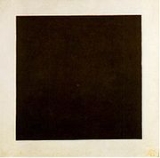
 and A. Ekster, among others. Famous examples of his Suprematist works include Black Square (1915) and White on White (1918).

In 1918 Malevich decorated a play Mystery Bouffe by Vladimir Mayakovskiy produced by Vsevolod Meyerhold
Vsevolod Meyerhold

Vsevolod Emilevich Meyerhold was a Russian theatre director, actor and Theatrical producer whose provocative experiments dealing with physical being and symbolism in an unconventional theatre setting made him one of the seminal forces in modern theatre....
.

Malevich also acknowledged that his fascination with aerial photography
Aerial photography

Aerial photography is the taking of photographs of the ground from an elevated position. The term usually refers to images in which the camera is not supported by a ground-based structure....
 and aviation
Aviation

File:Norwegian military Bell 412SP helicopters.jpgAviation refers to activities involving man-made flying devices , including the people, organizations, and regulatory bodies involved with them....
 led him to abstract
Abstract art

Abstract art uses a visual language of form, color and line to create a composition which may exist with a degree of independence from visual references in the world....
ions inspired by or derived from aerial landscapes. Harvard doctoral candidate writes: “In his later writings, Malevich defined the 'additional element' as the quality of any new visual environment bringing about a change in perception .... In a series of diagrams illustrating the ‘environments' that influence various painterly styles, the Suprematist is associated with a series of aerial views rendering the familiar landscape
Landscape

Landscape comprises the visible features of an area of land, including physical elements such as landforms, living elements of flora and fauna, abstract elements such as lighting and weather conditions, and human elements, for instance human activity or the built environment....
 into an abstraction..." (excerpted from Ms. Bekman Chadaga's paper delivered at Columbia University's 2000 symposium, "Art, Technology, and Modernity in Russia and Eastern Europe").

Malevich Selfportrait Small
After the October Revolution, Malevich became a member of the Collegium on the Arts of Narkompros
Narkompros

People's Commissariat for Education or Narkompros was the Soviet agency charged with the administration of public education and most of other issues related to culture....
, the commission for the protection of monuments and the museums commission (all from 1918-1919). He taught at the Vitebsk
Vitebsk

Vitebsk, also known as Viciebsk or Vitsyebsk , is a city in Belarus, near the border with Russia and Latvia. The capital of the Vitebsk Oblast, in 2004 it had 342,381 inhabitants, making it the country's fourth largest city....
 Practical Art School in the USSR
Soviet Union

The Union of Soviet Socialist Republics was a Constitution of the Soviet Union socialist state that existed in Eurasia from 1922 to 1991.The name is a translation of the , romanization of Russian Soyuz Sovetskikh Sotsialisticheskikh Respublik, abbreviated ????, SSSR....
 (now part of Belarus
Belarus

Belarus is a landlocked country in Eastern Europe, bordered by Russia to the north and east, Ukraine to the south, Poland to the west, and Lithuania and Latvia to the north....
) (1919-1922), the Leningrad Academy of Arts (1922-1927), the Kiev State Art Institute (1927-1929), and the House of the Arts in Leningrad (1930). He wrote the book The World as Non-Objectivity (Munich 1926; English trans. 1959) which outlines his Suprematist theories.

In 1927, he traveled to Warsaw
Warsaw

Warsaw is the Capital and World's largest cities of Poland. It is located on the Vistula River roughly from both the Baltic Sea coast and the Carpathian Mountains....
 and then to Berlin
Berlin

Berlin is the Capital of Germany city and one of sixteen States of Germany of Germany. With a population of 3.4 million within its city limits, Berlin is the country's largest city....
 and Munchen for a retrospective which finally brought him international recognition. He arranged to leave most of the paintings behind when he returned to the Soviet Union
Soviet Union

The Union of Soviet Socialist Republics was a Constitution of the Soviet Union socialist state that existed in Eurasia from 1922 to 1991.The name is a translation of the , romanization of Russian Soyuz Sovetskikh Sotsialisticheskikh Respublik, abbreviated ????, SSSR....
. Malevich's assumption that a shifting in the attitudes of the Soviet authorities
Nomenklatura

The nomenklatura were a small, elite subset of the general population in the Soviet Union and other Eastern Bloc countries who held various key administrative positions in all spheres of those countries' activity: government, industry, agriculture, education, etc....
 towards the modernist
Modernism

Modernism, in its broadest definition, is modern thought, character, or practice. More specifically, the term describes both a set of cultural tendencies and an array of associated cultural movements, originally arising from wide-scale and far-reaching changes to Western culture in the late nineteenth and early twentieth century....
 art movement would take place after the death of Lenin and Trotsky's fall from power, were proven correct in a couple of years, when the Stalinist
Stalinism

File:Joseph Stalin.jpgStalinism is a term that purportedly describes the political system of the Soviet Union under the leadership of Joseph Stalin, leader of the Soviet Union from 1929?1953....
 regime turned against formes of abstractism, considering them a type of "bourgeois
Bourgeoisie

Bourgeoisie is a classification used in analyzing human societies to describe a social class of people. Historically, the bourgeoisie comes from the middle or merchant classes of the Middle Ages, whose status or power came from employment, education, and wealth, as distinguished from those whose power came from being born into an aristocrati...
" art, that could not express social realities. As a consequence, many of his works were confiscated and he was banned from creating and exhibiting similar art.

Critics derided Malevich for reaching art by negating everything good and pure: love of life and love of nature. The Westernizer artist and art historian Alexandre Benois
Alexandre Benois

Alexandre Nikolayevich Benois , an influential artist, art critic, historian, preservationist, and founding member of Mir iskusstva. His influence on the modern ballet and stage design is considered seminal....
 was one such critic. Malevich responded that art can advance and develop for art's sake alone, regardless of its pleasure: art does not need us, and it never needed us since stars first shone in the sky.

Malevich's work only recently reappeared in art exhibitions in Russia after a long absence. Since then art followers have labored to reintroduce the artist to Russian lovers of painting. A book of his theoretical works with an anthology of reminiscences and writings has been published. Many stains on his reputation in Russia remain, however. Recently Ukrainian art followers established the precise birthdate of the artist: February 23, 1879. Malevich and Ukraine, by professor D. Gorbachev, 2006, Kiev, reveals many new biographical details.

Malevich died of cancer in Leningrad on May 15, 1935. On his deathbed he was exhibited with the black square above him. His ashes were sent to Nemchinovka, and buried in a field near his dacha
Dacha

Dacha is a Russian word for seasonal or year-round second homes located in the exurbs of Soviet and Russian cities. In some cases it is occupied part of the year by its owner or rented out to urban residents as a summer retreat....
. A white cube decorated with a black square was placed on his tomb. The city of Leningrad bestowed a pension on Malevich's mother and daughter. "No phenomenon is mortal," Malevich wrote in an unpublished manuscript, "and this means not only the body but the idea as well, a symbol that one is eternally reincarnated in another form which actually exists in the conscious and unconscious person."

Posthumous sales


Black Square, the fourth version of his magnum opus
Magnum opus

Magnum opus , from the Latin meaning great work, refers to the largest, and perhaps the best, greatest, most popular, or most renowned achievement of an author, artist, or composer....
 painted in the 1920's, sold at a state auction in Russia for the equivalent of one million dollars. The work was purchased by the Russian philanthropist, Vladimir Olegovich Potanin, who donated it to the State Hermitage Museum shortly thereafter. On November 3, 2008 a work by Malevich entitled Suprematist Composition from 1916 set the world record for any Russian work of art and any work sold at auction for that year, selling at Sotheby’s in New York City for just over $60 million U.S. (far surpassing his previous record of $17 million set in 2000).

Malevich in Popular Culture
Popular culture

Popular culture is the totality of Distinction memes, ideas, Perspective s and Attitude s that are deemed preferred per an informal consensus within the mainstream of a given culture....


  • The smuggling of Malevich paintings out of Russia is a key to the plot line of Martin Cruz Smith
    Martin Cruz Smith

    Martin Cruz Smith was born in Reading, Pennsylvania, in 1942. He originally wrote under the name Martin Smith only to discover there were other writers with the same name....
    's thriller Red Square
    Red Square (novel)

    Red Square is a Crime by Martin Cruz Smith, set in the Soviet Union in the year 1991. It is a sequel to Gorky Park and Polar Star and features Investigator Arkady Renko....
    .
  • Noah Charney's novel, The Art Thief tells the story of two stolen Malevich White on White paintings, and discusses the implications of Malevich's radical Suprematist compositions on the art world.


Selected works

  • 1912 Morning in the Country after Snowstorm
  • 1912 The Woodcutter
  • 1912-13 Reaper on Red Background
  • 1914 The Aviator
  • 1914 An Englishman in Moscow
  • 1914 Soldier of the First Division
  • 1915 Black Square and Red Square
  • 1915 Red Square: Painterly Realism of a Peasant Woman in Two Dimensions
  • 1915 Suprematist Composition
  • 1915 Suprematism (1915)
  • 1915 Suprematist Painting: Aeroplane Flying
  • 1915 Suprematism: Self-Portrait in Two Dimensions
  • 1915-16 Suprematist Painting (Ludwigshafen)
  • 1916 Suprematist Painting (1916)
  • 1916 Supremus No. 56
  • 1916-17 Suprematism (1916-17)
  • 1917 Suprematist Painting (1917)
  • 1928-32 Complex Presentiment: Half-Figure in a Yellow Shirt
  • 1932-34 Running Man


Gallery


See also

  • Aerial landscape art
    Aerial landscape art

    Aerial landscape art is painting or other visual art which depicts or evokes the appearance of a landscape art as seen from above, usually from a considerable distance, as it might be viewed from an aircraft or spacecraft....
  • Aleksandra Ekster
    Aleksandra Ekster

    Aleksandra Aleksandrovna Ekster was a Russian-Ukraine Painting , designer, and one of the founders of Art Deco....
  • El Lissitzky
    El Lissitzky

    , better known as El Lissitzky , was a Russian artist, designer, photographer, typographer, polemicist and architect. He was an important figure of the Russian avant garde, helping develop suprematism with his mentor, Kazimir Malevich, and designing numerous Art exhibition displays and propaganda works for the former Soviet Union....
  • IRWIN
    Irwin

    Irwin may refer to:...
  • Lyubov Popova
    Lyubov Popova

    Lyubov Sergeyevna Popova was a Russian avant-garde artist , Painting and designer....
  • OBERIU
    Oberiu

    OBERIU was a short-lived avant-garde grouping of Russian Russian Futurism poets in 1920s-1930s.The OBERIU was founded in 1928 in poetry by Daniil Kharms and Alexander Vvedensky ....
  • Suprematism
    Suprematism

    Suprematism : is an art movement focused on fundamental geometric forms which formed in Russia in 1915-1916.When Kasimir Malevich originated Suprematism in 1915 he was an established painter having exhibited in the Donkey's Tail and the Der Blaue Reiter exhibitions of 1912 with cubo-futurism works....
  • Supremus
    Supremus

    Supremus was a group of Russian avant-garde artists led by the "father" of Suprematism, Kazimir Malevich. It included Aleksandra Ekster, Liubov Popova, Olga Rozanova,Ivan Kliun, Ivan Puni, Nadezhda Udaltsova, Nina Genke-Meller, Ksenia Boguslavskaya and others....
  • UNOVIS
    UNOVIS

    UNOVIS was a short-lived but influential group of Russian artists, founded and led by Kazimir Malevich at the Vitebsk Art School in 1919.Initially formed by students and known as MOLPOSNOVIS, the group formed to explore and develop new theories and concepts in art....
  • :ru:????????? ????? ???????????? ?????????


External links and references

  • The "Black Square" based on Kazimir Malevich.