


Wyndham Lewis

Encyclopedia
Percy Wyndham Lewis was an English painter and author (he dropped the name 'Percy', which he disliked). He was a co-founder of the Vorticist movement in art, and edited the literary magazine of the Vorticists, BLAST. His novels include his pre-World War I-era novel Tarr
(set in Paris), and The Human Age, a trilogy comprising The Childermass (1928), Monstre Gai and Malign Fiesta (both 1955), set in the afterworld. A fourth volume of The Human Age, The Trial of Man, was begun by Lewis but left in a fragmentary state at the time of his death. He also wrote two autobiographical volumes, Blasting and Bombardiering
(1937) and Rude Assignment: A Narrative of my Career Up-to-Date (1950).
. His British mother and American father separated about 1893. His mother subsequently returned to England, where Lewis was educated, first at Rugby School
, then at the Slade School of Art, University College, London, before spending most of the 1900s travelling around Europe and studying art in Paris.
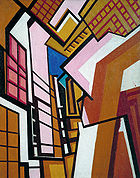 Mainly residing in London from 1908, Lewis published his first work (accounts of his travels in Brittany) in Ford Madox Ford
's The English Review in 1909. He was an unlikely founder-member of the Camden Town Group
in 1911. In 1912 he exhibited his Cubo-Futurist
illustrations to Timon of Athens (later issued as a portfolio, the proposed edition of Shakespeare's play
never materialising) and three major oil-paintings at the second Post-Impressionist exhibition. This brought him into close contact with the Bloomsbury Group
, particularly Roger Fry
and Clive Bell
, with whom he soon fell out. In 1912 he was commissioned to produce a decorative mural, a drop curtain, and more designs for The Cave of the Golden Calf
, an avant-garde cabaret and nightclub on London's Heddon Street.
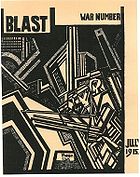 It was in the years 1913–15 that he developed the style of geometric abstraction for which he is best known today, a style which his friend Ezra Pound
dubbed "Vorticism
." Lewis found the strong structure of Cubist painting appealing, but said it did not seem "alive" compared to Futurist
art, which, conversely, lacked structure. Vorticism combined the two movements in a strikingly dramatic critique of modernity. In his early visual works, particularly versions of village life in Brittany showing dancers (ca. 1910–12), Lewis may have been influenced by the process philosophy
of Henri Bergson
, whose lectures he attended in Paris. Though he was later savagely critical of Bergson, he admitted in a letter to Theodore Weiss (19 April 1949) that he "began by embracing his evolutionary system." Nietzsche was an equally important influence.
 After a brief tenure at the Omega Workshops
, Lewis quarrelled with the founder, Roger Fry
, over a commission to provide wall decorations for the Daily Mail
Ideal Home Exhibition, which Lewis believed Fry had misappropriated. He walked out with several Omega artists to start a competing workshop called the Rebel Art Centre. The Centre operated for only four months, but it gave birth to the Vorticist group and the publication, BLAST
. In BLAST Lewis wrote the group's manifesto, several essays expounding his Vorticist aesthetic (distinguishing it from other avant-garde practices), and a modernist drama, "Enemy of the Stars." The magazine also included reproductions of now lost Vorticist works by Lewis and others.
, though Lewis's patron, John Quinn
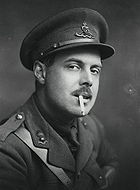
, organised a Vorticist exhibition at the Penguin Club in New York in 1917. Lewis was posted to the western front, and served as a second lieutenant in the Royal Artillery. Much of his time was spent in Forward Observation Posts looking down at apparently deserted German lines, registering targets and calling down fire from batteries massed around the rim of the Ypres Salient. It was dangerous work and he made vivid accounts of narrow misses and deadly artillery duels. After the Third Battle of Ypres in 1917, he was appointed as an official war artist
for both the Canadian and British governments, beginning work in December 1917.
For the Canadians he painted A Canadian Gun-Pit (1918, National Gallery of Canada, Ottawa
) from sketches made on Vimy Ridge. For the British he painted one of his best known works, A Battery Shelled (1919, Imperial War Museum, drawing on his own experience in charge of a 6-inch howitzer at Ypres. Lewis exhibited his war drawings and some other paintings of the war in an exhibition, "Guns," in 1918.
His first novel Tarr
was also published in book-form in 1918, having been serialised in The Egoist
during 1916–17. It is widely regarded as one of the key modernist texts. Lewis later documented his experiences and opinions of this period of his life in the autobiographical Blasting and Bombardiering (1937), which covered his life up to 1926.
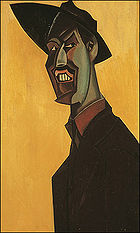 After the war, Lewis resumed his career as a painter, with a major exhibition, Tyros and Portraits, at the Leicester Galleries in 1921. "Tyros" were satirical caricatural figures intended by Lewis to comment on the culture of the "new epoch" that succeeded the First World War. A Reading of Ovid
and Mr Wyndham Lewis as a Tyro are the only surviving oil paintings from this series. As part of the same project, Lewis also launched his second magazine, The Tyro, of which there were only two issues. The second (1922) contained an important statement of Lewis's visual aesthetic: "Essay on the Objective of Plastic Art in our Time". It was during the early 1920s that he perfected his incisive draughtsmanship.
By the late 1920s, he was not painting so much, but instead concentrating on writing. He launched yet another magazine, The Enemy (three issues, 1927–29), largely written by himself and declaring its belligerent critical stance in its title. The magazine, and the theoretical and critical works he published between 1926 and 1929, mark his deliberate separation from the avant-garde and his previous associates. Their work, he believed, failed to show sufficient critical awareness of those ideologies that worked against truly revolutionary change in the West. As a result their work became a vehicle for these pernicious ideologies. His major theoretical and cultural statement from this period is The Art of Being Ruled (1926). Time and Western Man (1927) is a cultural and philosophical discussion that includes penetrating critiques of James Joyce
, Gertrude Stein
and Ezra Pound that are still read. In the domain of philosophy, Lewis attacked the "time philosophy" (i.e. process philosophy
) of Bergson, Samuel Alexander
, Alfred North Whitehead
and others.
(1930) he wrote a biting satirical attack on the London literary scene, including a long chapter caricaturing the Sitwell
family, which did not help his position in the literary world. His book Hitler (1931), which presented Adolf Hitler
as a "man of peace" whose party-members were threatened by communist street violence, confirmed his unpopularity among liberals and anti-fascists, especially after Hitler came to power in 1933. He later wrote The Hitler Cult (1939), a book which firmly revoked his earlier willingness to entertain Hitler, but politically Lewis remained an isolated figure in the 1930s. In Letter to Lord Byron, Auden
called him "that lonely old volcano of the Right." Lewis thought there was what he called a "left-wing orthodoxy" in Britain in the '30s. He believed it was not in Britain's interest to ally itself with the Soviet Union
, "which the newspapers most of us read tell us has slaughtered out-of-hand, only a few years ago, millions of its better fed citizens, as well as its whole imperial family".
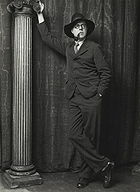 Lewis's novels have been criticised for their satirical and hostile portrayals of Jews, homosexuals, and other minorities. The 1918 novel Tarr was revised and republished in 1928. In an expanded incident a new Jewish character is given a key role in making sure a duel is fought. This has been interpreted as an allegorical representation of a supposed Zionist conspiracy against the West. The Apes of God (1930) has been interpreted similarly, because many of the characters satirised are Jewish, including the modernist author and editor Julius Ratner, a portrait which blends anti-semitic stereotype with historical literary figures (John Rodker
and James Joyce; though the Joyce element consists solely in the use of the word "epiphany" in the parody of Rodker included in the novel). A key feature of these interpretations is that Lewis is held to have kept his conspiracy theories hidden and marginalised. Since the publication of Anthony Julius's T. S. Eliot, Anti-Semitism, and Literary Form (1995, revised 2003), where Lewis's anti-semitism is described as "essentially trivial", this view is no longer taken seriously. Somewhat belatedly, he recognised the reality of Nazi treatment of Jews after a visit to Berlin in 1937. He then wrote an attack on anti-semitism: The Jews, Are They Human? (published early in 1939; the title is modelled on a contemporary best-seller, The English, Are They Human?). The book was favourably reviewed in The Jewish Chronicle
.
During the years 1934–35 Lewis wrote The Revenge for Love (1937) set in the period leading up to the Spanish Civil War
, regarded by many as his best novel. It is strongly critical of communist activity in Spain, and presents English intellectual fellow-travellers as deluded.
Lewis' interests and activities in the 1930s were by no means exclusively political. Despite serious illness necessitating several operations, he was very productive as a critic and painter, and produced a book of poems, One-Way Song, in 1933 (the link below gives access to a recording of him reading an extract). He also produced a revised version of Enemy of the Stars, first published in Blast in 1914 as an example to his literary colleagues of how Vorticist literature should be written. It is a proto-absurdist, Expressionist
drama, and some critics have identified it as a precursor to the plays of Samuel Beckett
. An important book of critical essays also belongs to this period: Men without Art (1934). It grew out of a defence of Lewis's own satirical practice in The Apes of God, and puts forward a theory of 'non-moral', or metaphysical, satire. But the book is probably best remembered for one of the first commentaries on Faulkner
, and a famous essay on Hemingway
.
. It was included in an exhibition at the Leicester Galleries in 1937 that Lewis hoped would re-establish his reputation as a painter. After the publication in The Times
of a letter of support for the exhibition, asking that something from the show be purchased for the national collection (signed by, among others, Stephen Spender
, W. H. Auden, Geoffrey Grigson
, Rebecca West
, Naomi Mitchison
, Henry Moore
and Eric Gill
) the Tate Gallery
bought the painting, Red Scene. Like others from the exhibition, it shows an influence from Surrealism
and de Chirico's Metaphysical Painting. Lewis was highly critical of the ideology of Surrealism, but admired the visual qualities of some Surrealist art.
Lewis then also produced many of the portraits for which he is well-known, including pictures of Edith Sitwell
(1923–36), T. S. Eliot
(1938 and again in 1949) and Ezra Pound
(1939). The rejection of the 1938 portrait of Eliot by the selection committee of the Royal Academy
for their annual exhibition caused a furore, with front-page headlines prompted by the resignation of Augustus John
in protest. However, no less an authority than Walter Sickert
once claimed that: 'Wyndham Lewis [is] the greatest portraitist of this or any other time', though it was left to Lewis to make this statement public.
in the United States and Canada. Artistically the period is mainly important for the series of watercolour fantasies around the themes of creation, crucifixion and bathing that he produced in Toronto in 1941–42. He returned to England in 1945. By 1951, he was completely blind. In 1950 he published the autobiographical Rude Assignment, in 1951 a collection of allegorical short stories about life in "the capital of a dying empire," entitled "Rotting Hill," and in 1952 a book of essays on writers such as George Orwell
, Jean-Paul Sartre
and André Malraux
, entitled "The Writer and the Absolute." This was followed by the semi-autobiograpical novel "Self Condemned" (1954), a major late statement.
now commissioned him to complete the 1928 "The Childermass," to be broadcast in a dramatisation by D. G. Bridson on the "Third Programme" and published as "The Human Age." The 1928 volume was set in the afterworld, "outside Heaven" and dramatised in fantastic form the cultural critique Lewis had developed in his polemical works of the period. The continuations take the protagonist, James Pullman (a writer), to a modern Purgatory and then to Hell, where Dante
sque punishment is inflicted on sinners by means of modern industrial techniques. Pullman becomes chief advisor to Satan (here known as Sammael
) in his scheme to undermine the divine and institute a "Human Age." The work has been read as continuing the self-assessment begun by Lewis in "Self Condemned." But Pullman is not merely autobiographical; the character is a composite intellectual, intended to have wider representative significance.
In 1956 the Tate Gallery
held a major exhibition of his work, "Wyndham Lewis and Vorticism," in the catalogue to which he declared that "Vorticism, in fact, was what I, personally, did and said at a certain period"—a statement which brought forth a series of "Vortex Pamphlets" from his fellow "BLAST" signatory William Roberts.
A pituitary tumour which had caused him to go blind since 1951 (its growth placing pressure on the optic nerve), ended his artistic career, though he continued writing until his death in 1957.
Always interested in Roman Catholicism, he nevertheless never converted.
Lewis wrote 40 books. Other works include "Mrs. Duke's Million" (written about 1908-9 but not published until 1977); "Snooty Baronet" (a satire on behaviorism
, 1932); "Doom of Youth" (a sociological account of youth culture, 1932); "The Red Priest" (his last novel, 1956); and "The Demon of Progress in the Arts" (on extremism in the visual arts, 1954).
In recent years there has been a renewal of critical and biographical interest in Lewis and his work, and he is now regarded as a major British artist and writer of the twentieth century. An exhibition of his books, magazines, paintings and drawings was held at Rugby School
in November 2007 to commemorate the 50th anniversary of his death. The National Portrait Gallery in London held a major retrospective of his portraits in 2008. In 2010 Oxford World Classics published a critical edition of the 1928 text of "Tarr" edited by Scott W. Klein of Wake Forest University. The Nasher Museum of Art
at Duke University
held an exhibition entitled "The Vorticists
: Rebel Artists in London and New York, 1914–18" from 30 September 2010 through 2 January 2011.. The exhibition then travelled to the Peggy Guggenheim Collection, Venice (29 January – 15 May 2011: 'I Vorticisti: Artisti ribellia a Londra e New York, 1914–1918') and then to Tate Britain
under the title 'The Vorticists: Manifesto for a Modern World' between 14 June and 4 September 2011.
Tarr
Tarr is a modernist novel by Wyndham Lewis, written in 1909-11, revised and expanded in 1914-15 and first serialized in The Egoist from April 1916 until November 1917...
(set in Paris), and The Human Age, a trilogy comprising The Childermass (1928), Monstre Gai and Malign Fiesta (both 1955), set in the afterworld. A fourth volume of The Human Age, The Trial of Man, was begun by Lewis but left in a fragmentary state at the time of his death. He also wrote two autobiographical volumes, Blasting and Bombardiering
Blasting and Bombardiering
Blasting and Bombardiering is the autobiography of the English painter, novelist, and satirist Percy Wyndham Lewis. It was published in 1937. It was in this work that Lewis first identified the "Men of 1914" group of himself, Ezra Pound, T. S. Eliot, and James Joyce....
(1937) and Rude Assignment: A Narrative of my Career Up-to-Date (1950).
Early life
Lewis was reputedly born on his father's yacht off the Canadian province of Nova ScotiaNova Scotia
Nova Scotia is one of Canada's three Maritime provinces and is the most populous province in Atlantic Canada. The name of the province is Latin for "New Scotland," but "Nova Scotia" is the recognized, English-language name of the province. The provincial capital is Halifax. Nova Scotia is the...
. His British mother and American father separated about 1893. His mother subsequently returned to England, where Lewis was educated, first at Rugby School
Rugby School
Rugby School is a co-educational day and boarding school located in the town of Rugby, Warwickshire, England. It is one of the oldest independent schools in Britain.-History:...
, then at the Slade School of Art, University College, London, before spending most of the 1900s travelling around Europe and studying art in Paris.
The Omega Workshop and Vorticism
Ford Madox Ford
Ford Madox Ford was an English novelist, poet, critic and editor whose journals, The English Review and The Transatlantic Review, were instrumental in the development of early 20th-century English literature...
's The English Review in 1909. He was an unlikely founder-member of the Camden Town Group
Camden Town Group
The Camden Town Group was a group of English Post-Impressionist artists active 1911-1913. They gathered frequently at the studio of painter Walter Sickert in the Camden Town area of London.-History:...
in 1911. In 1912 he exhibited his Cubo-Futurist
Cubo-Futurism
Cubo-Futurism was the main school of painting and sculpture practiced by the Russian Futurists.When Aristarkh Lentulov returned from Paris in 1913 and exhibited his works in Moscow, the Russian Futurist painters adopted the forms of Cubism and combined them with the Italian Futurists'...
illustrations to Timon of Athens (later issued as a portfolio, the proposed edition of Shakespeare's play
Timon of Athens
The Life of Timon of Athens is a play by William Shakespeare about the fortunes of an Athenian named Timon , generally regarded as one of his most obscure and difficult works...
never materialising) and three major oil-paintings at the second Post-Impressionist exhibition. This brought him into close contact with the Bloomsbury Group
Bloomsbury Group
The Bloomsbury Group or Bloomsbury Set was a group of writers, intellectuals, philosophers and artists who held informal discussions in Bloomsbury throughout the 20th century. This English collective of friends and relatives lived, worked or studied near Bloomsbury in London during the first half...
, particularly Roger Fry
Roger Fry
Roger Eliot Fry was an English artist and art critic, and a member of the Bloomsbury Group. Establishing his reputation as a scholar of the Old Masters, he became an advocate of more recent developments in French painting, to which he gave the name Post-Impressionism...
and Clive Bell
Clive Bell
Arthur Clive Heward Bell was an English Art critic, associated with formalism and the Bloomsbury Group.- Origins :Clive Bell was born in East Shefford, Berkshire, in 1881...
, with whom he soon fell out. In 1912 he was commissioned to produce a decorative mural, a drop curtain, and more designs for The Cave of the Golden Calf
The Cave of the Golden Calf
The Cave of the Golden Calf was a night club in London. It opened in an underground location at 9 Heddon Street, just off Regent Street, in 1912 and became a haunt for the wealthy, aristocratic and bohemian...
, an avant-garde cabaret and nightclub on London's Heddon Street.
Ezra Pound
Ezra Weston Loomis Pound was an American expatriate poet and critic and a major figure in the early modernist movement in poetry...
dubbed "Vorticism
Vorticism
Vorticism, an offshoot of Cubism, was a short-lived modernist movement in British art and poetry of the early 20th century. It was based in London but international in make-up and ambition.-Origins:...
." Lewis found the strong structure of Cubist painting appealing, but said it did not seem "alive" compared to Futurist
Futurism (art)
Futurism was an artistic and social movement that originated in Italy in the early 20th century. It emphasized and glorified themes associated with contemporary concepts of the future, including speed, technology, youth and violence, and objects such as the car, the airplane and the industrial city...
art, which, conversely, lacked structure. Vorticism combined the two movements in a strikingly dramatic critique of modernity. In his early visual works, particularly versions of village life in Brittany showing dancers (ca. 1910–12), Lewis may have been influenced by the process philosophy
Process philosophy
Process philosophy identifies metaphysical reality with change and dynamism. Since the time of Plato and Aristotle, philosophers have posited true reality as "timeless", based on permanent substances, whilst processes are denied or subordinated to timeless substances...
of Henri Bergson
Henri Bergson
Henri-Louis Bergson was a major French philosopher, influential especially in the first half of the 20th century. Bergson convinced many thinkers that immediate experience and intuition are more significant than rationalism and science for understanding reality.He was awarded the 1927 Nobel Prize...
, whose lectures he attended in Paris. Though he was later savagely critical of Bergson, he admitted in a letter to Theodore Weiss (19 April 1949) that he "began by embracing his evolutionary system." Nietzsche was an equally important influence.
Omega Workshops
The Omega Workshops was a design enterprise founded by members of the Bloomsbury Group and established in 1913. It was located at 33 Fitzroy Square in London, and was founded with the intention of providing graphic expression to the essence of the Bloomsbury ethos...
, Lewis quarrelled with the founder, Roger Fry
Roger Fry
Roger Eliot Fry was an English artist and art critic, and a member of the Bloomsbury Group. Establishing his reputation as a scholar of the Old Masters, he became an advocate of more recent developments in French painting, to which he gave the name Post-Impressionism...
, over a commission to provide wall decorations for the Daily Mail
Daily Mail
The Daily Mail is a British daily middle-market tabloid newspaper owned by the Daily Mail and General Trust. First published in 1896 by Lord Northcliffe, it is the United Kingdom's second biggest-selling daily newspaper after The Sun. Its sister paper The Mail on Sunday was launched in 1982...
Ideal Home Exhibition, which Lewis believed Fry had misappropriated. He walked out with several Omega artists to start a competing workshop called the Rebel Art Centre. The Centre operated for only four months, but it gave birth to the Vorticist group and the publication, BLAST
BLAST (journal)
BLAST was the short-lived literary magazine of the Vorticist movement in Britain. Two editions were published: the first on 2 July 1914 and the second a year later on 15 July 1915...
. In BLAST Lewis wrote the group's manifesto, several essays expounding his Vorticist aesthetic (distinguishing it from other avant-garde practices), and a modernist drama, "Enemy of the Stars." The magazine also included reproductions of now lost Vorticist works by Lewis and others.
World War I: Artillery officer and war artist
After the Vorticists' only U.K. exhibition in 1915, the movement broke up, largely as a result of World War IWorld War I
World War I , which was predominantly called the World War or the Great War from its occurrence until 1939, and the First World War or World War I thereafter, was a major war centred in Europe that began on 28 July 1914 and lasted until 11 November 1918...
, though Lewis's patron, John Quinn
John Quinn
John Quinn or Jack Quinn is the name of:*Jack Quinn , White House counsel, 1995–1996*Jack Quinn , Congressman from New York*Jack Quinn III, Assemblyman from Erie County, New York and son of the Congressman...
, organised a Vorticist exhibition at the Penguin Club in New York in 1917. Lewis was posted to the western front, and served as a second lieutenant in the Royal Artillery. Much of his time was spent in Forward Observation Posts looking down at apparently deserted German lines, registering targets and calling down fire from batteries massed around the rim of the Ypres Salient. It was dangerous work and he made vivid accounts of narrow misses and deadly artillery duels. After the Third Battle of Ypres in 1917, he was appointed as an official war artist
War artist
A war artist depicts some aspect of war through art; this might be a pictorial record or it might commemorate how "war shapes lives." War artists have explored a visual and sensory dimension of war which is often absent in written histories or other accounts of warfare.- Definition and context:A...
for both the Canadian and British governments, beginning work in December 1917.
For the Canadians he painted A Canadian Gun-Pit (1918, National Gallery of Canada, Ottawa
Ottawa
Ottawa is the capital of Canada, the second largest city in the Province of Ontario, and the fourth largest city in the country. The city is located on the south bank of the Ottawa River in the eastern portion of Southern Ontario...
) from sketches made on Vimy Ridge. For the British he painted one of his best known works, A Battery Shelled (1919, Imperial War Museum, drawing on his own experience in charge of a 6-inch howitzer at Ypres. Lewis exhibited his war drawings and some other paintings of the war in an exhibition, "Guns," in 1918.
His first novel Tarr
Tarr
Tarr is a modernist novel by Wyndham Lewis, written in 1909-11, revised and expanded in 1914-15 and first serialized in The Egoist from April 1916 until November 1917...
was also published in book-form in 1918, having been serialised in The Egoist
The Egoist (periodical)
The Egoist was a London literary magazine published from 1914 to 1919, during which time it published important early modernist poetry and fiction. In its manifesto, it claimed to "recognise no taboos," and published a number of controversial works, such as parts of Ulysses...
during 1916–17. It is widely regarded as one of the key modernist texts. Lewis later documented his experiences and opinions of this period of his life in the autobiographical Blasting and Bombardiering (1937), which covered his life up to 1926.
The 1920s
Ovid
Publius Ovidius Naso , known as Ovid in the English-speaking world, was a Roman poet who is best known as the author of the three major collections of erotic poetry: Heroides, Amores, and Ars Amatoria...
and Mr Wyndham Lewis as a Tyro are the only surviving oil paintings from this series. As part of the same project, Lewis also launched his second magazine, The Tyro, of which there were only two issues. The second (1922) contained an important statement of Lewis's visual aesthetic: "Essay on the Objective of Plastic Art in our Time". It was during the early 1920s that he perfected his incisive draughtsmanship.
By the late 1920s, he was not painting so much, but instead concentrating on writing. He launched yet another magazine, The Enemy (three issues, 1927–29), largely written by himself and declaring its belligerent critical stance in its title. The magazine, and the theoretical and critical works he published between 1926 and 1929, mark his deliberate separation from the avant-garde and his previous associates. Their work, he believed, failed to show sufficient critical awareness of those ideologies that worked against truly revolutionary change in the West. As a result their work became a vehicle for these pernicious ideologies. His major theoretical and cultural statement from this period is The Art of Being Ruled (1926). Time and Western Man (1927) is a cultural and philosophical discussion that includes penetrating critiques of James Joyce
James Joyce
James Augustine Aloysius Joyce was an Irish novelist and poet, considered to be one of the most influential writers in the modernist avant-garde of the early 20th century...
, Gertrude Stein
Gertrude Stein
Gertrude Stein was an American writer, poet and art collector who spent most of her life in France.-Early life:...
and Ezra Pound that are still read. In the domain of philosophy, Lewis attacked the "time philosophy" (i.e. process philosophy
Process philosophy
Process philosophy identifies metaphysical reality with change and dynamism. Since the time of Plato and Aristotle, philosophers have posited true reality as "timeless", based on permanent substances, whilst processes are denied or subordinated to timeless substances...
) of Bergson, Samuel Alexander
Samuel Alexander
Samuel Alexander OM was an Australian-born British philosopher. He was the first Jewish fellow of an Oxbridge college.-Early life:...
, Alfred North Whitehead
Alfred North Whitehead
Alfred North Whitehead, OM FRS was an English mathematician who became a philosopher. He wrote on algebra, logic, foundations of mathematics, philosophy of science, physics, metaphysics, and education...
and others.
Politics and fiction
In The Apes of GodThe Apes of God
The Apes of God is a 1930 novel by the British artist and writer Wyndham Lewis. It is a satire of London's contemporary literary and artistic scene....
(1930) he wrote a biting satirical attack on the London literary scene, including a long chapter caricaturing the Sitwell
The Sitwells
The Sitwells , from Scarborough, North Yorkshire, were three siblings, who formed an identifiable literary and artistic clique around themselves in London in the period roughly 1916 to 1930...
family, which did not help his position in the literary world. His book Hitler (1931), which presented Adolf Hitler
Adolf Hitler
Adolf Hitler was an Austrian-born German politician and the leader of the National Socialist German Workers Party , commonly referred to as the Nazi Party). He was Chancellor of Germany from 1933 to 1945, and head of state from 1934 to 1945...
as a "man of peace" whose party-members were threatened by communist street violence, confirmed his unpopularity among liberals and anti-fascists, especially after Hitler came to power in 1933. He later wrote The Hitler Cult (1939), a book which firmly revoked his earlier willingness to entertain Hitler, but politically Lewis remained an isolated figure in the 1930s. In Letter to Lord Byron, Auden
W. H. Auden
Wystan Hugh Auden , who published as W. H. Auden, was an Anglo-American poet,The first definition of "Anglo-American" in the OED is: "Of, belonging to, or involving both England and America." See also the definition "English in origin or birth, American by settlement or citizenship" in See also...
called him "that lonely old volcano of the Right." Lewis thought there was what he called a "left-wing orthodoxy" in Britain in the '30s. He believed it was not in Britain's interest to ally itself with the Soviet Union
Soviet Union
The Soviet Union , officially the Union of Soviet Socialist Republics , was a constitutionally socialist state that existed in Eurasia between 1922 and 1991....
, "which the newspapers most of us read tell us has slaughtered out-of-hand, only a few years ago, millions of its better fed citizens, as well as its whole imperial family".
John Rodker
John Rodker was a British writer, modernist poet, and publisher of some of the major modernist figures. He was born in Manchester into a Jewish immigrant family, who moved to London while he was still young.-Career:...
and James Joyce; though the Joyce element consists solely in the use of the word "epiphany" in the parody of Rodker included in the novel). A key feature of these interpretations is that Lewis is held to have kept his conspiracy theories hidden and marginalised. Since the publication of Anthony Julius's T. S. Eliot, Anti-Semitism, and Literary Form (1995, revised 2003), where Lewis's anti-semitism is described as "essentially trivial", this view is no longer taken seriously. Somewhat belatedly, he recognised the reality of Nazi treatment of Jews after a visit to Berlin in 1937. He then wrote an attack on anti-semitism: The Jews, Are They Human? (published early in 1939; the title is modelled on a contemporary best-seller, The English, Are They Human?). The book was favourably reviewed in The Jewish Chronicle
The Jewish Chronicle
The Jewish Chronicle is a London-based Jewish newspaper. Founded in 1841, it is the oldest continuously published Jewish newspaper in the world.-Publication data and readership figures:...
.
During the years 1934–35 Lewis wrote The Revenge for Love (1937) set in the period leading up to the Spanish Civil War
Spanish Civil War
The Spanish Civil WarAlso known as The Crusade among Nationalists, the Fourth Carlist War among Carlists, and The Rebellion or Uprising among Republicans. was a major conflict fought in Spain from 17 July 1936 to 1 April 1939...
, regarded by many as his best novel. It is strongly critical of communist activity in Spain, and presents English intellectual fellow-travellers as deluded.
Lewis' interests and activities in the 1930s were by no means exclusively political. Despite serious illness necessitating several operations, he was very productive as a critic and painter, and produced a book of poems, One-Way Song, in 1933 (the link below gives access to a recording of him reading an extract). He also produced a revised version of Enemy of the Stars, first published in Blast in 1914 as an example to his literary colleagues of how Vorticist literature should be written. It is a proto-absurdist, Expressionist
Expressionism
Expressionism was a modernist movement, initially in poetry and painting, originating in Germany at the beginning of the 20th century. Its typical trait is to present the world solely from a subjective perspective, distorting it radically for emotional effect in order to evoke moods or ideas...
drama, and some critics have identified it as a precursor to the plays of Samuel Beckett
Samuel Beckett
Samuel Barclay Beckett was an Irish avant-garde novelist, playwright, theatre director, and poet. He wrote both in English and French. His work offers a bleak, tragicomic outlook on human nature, often coupled with black comedy and gallows humour.Beckett is widely regarded as among the most...
. An important book of critical essays also belongs to this period: Men without Art (1934). It grew out of a defence of Lewis's own satirical practice in The Apes of God, and puts forward a theory of 'non-moral', or metaphysical, satire. But the book is probably best remembered for one of the first commentaries on Faulkner
William Faulkner
William Cuthbert Faulkner was an American writer from Oxford, Mississippi. Faulkner worked in a variety of media; he wrote novels, short stories, a play, poetry, essays and screenplays during his career...
, and a famous essay on Hemingway
Ernest Hemingway
Ernest Miller Hemingway was an American author and journalist. His economic and understated style had a strong influence on 20th-century fiction, while his life of adventure and his public image influenced later generations. Hemingway produced most of his work between the mid-1920s and the...
.
Return to painting
After becoming better known for his writing than his painting in the 1920s and early '30s, he returned to more concentrated work on visual art, and paintings from the 1930s and 1940s constitute some of his best-known work. The Surrender of Barcelona (1936–37) makes a significant statement about the Spanish Civil WarSpanish Civil War
The Spanish Civil WarAlso known as The Crusade among Nationalists, the Fourth Carlist War among Carlists, and The Rebellion or Uprising among Republicans. was a major conflict fought in Spain from 17 July 1936 to 1 April 1939...
. It was included in an exhibition at the Leicester Galleries in 1937 that Lewis hoped would re-establish his reputation as a painter. After the publication in The Times
The Times
The Times is a British daily national newspaper, first published in London in 1785 under the title The Daily Universal Register . The Times and its sister paper The Sunday Times are published by Times Newspapers Limited, a subsidiary since 1981 of News International...
of a letter of support for the exhibition, asking that something from the show be purchased for the national collection (signed by, among others, Stephen Spender
Stephen Spender
Sir Stephen Harold Spender CBE was an English poet, novelist and essayist who concentrated on themes of social injustice and the class struggle in his work...
, W. H. Auden, Geoffrey Grigson
Geoffrey Grigson
Geoffrey Edward Harvey Grigson was a British writer. He was born in Pelynt, a village near Looe in Cornwall.-Life:...
, Rebecca West
Rebecca West
Cicely Isabel Fairfield , known by her pen name Rebecca West, or Dame Rebecca West, DBE was an English author, journalist, literary critic and travel writer. A prolific, protean author who wrote in many genres, West was committed to feminist and liberal principles and was one of the foremost public...
, Naomi Mitchison
Naomi Mitchison
Naomi May Margaret Mitchison, CBE was a Scottish novelist and poet. She was appointed CBE in 1981; she was also entitled to call herself Lady Mitchison, CBE since 5 October 1964 .- Childhood and family background :Naomi Margaret Haldane was...
, Henry Moore
Henry Moore
Henry Spencer Moore OM CH FBA was an English sculptor and artist. He was best known for his semi-abstract monumental bronze sculptures which are located around the world as public works of art....
and Eric Gill
Eric Gill
Arthur Eric Rowton Gill was a British sculptor, typeface designer, stonecutter and printmaker, who was associated with the Arts and Crafts movement...
) the Tate Gallery
Tate Gallery
The Tate is an institution that houses the United Kingdom's national collection of British Art, and International Modern and Contemporary Art...
bought the painting, Red Scene. Like others from the exhibition, it shows an influence from Surrealism
Surrealism
Surrealism is a cultural movement that began in the early 1920s, and is best known for the visual artworks and writings of the group members....
and de Chirico's Metaphysical Painting. Lewis was highly critical of the ideology of Surrealism, but admired the visual qualities of some Surrealist art.
Lewis then also produced many of the portraits for which he is well-known, including pictures of Edith Sitwell
Edith Sitwell
Dame Edith Louisa Sitwell DBE was a British poet and critic.-Background:Edith Sitwell was born in Scarborough, North Yorkshire, the oldest child and only daughter of Sir George Sitwell, 4th Baronet, of Renishaw Hall; he was an expert on genealogy and landscaping...
(1923–36), T. S. Eliot
T. S. Eliot
Thomas Stearns "T. S." Eliot OM was a playwright, literary critic, and arguably the most important English-language poet of the 20th century. Although he was born an American he moved to the United Kingdom in 1914 and was naturalised as a British subject in 1927 at age 39.The poem that made his...
(1938 and again in 1949) and Ezra Pound
Ezra Pound
Ezra Weston Loomis Pound was an American expatriate poet and critic and a major figure in the early modernist movement in poetry...
(1939). The rejection of the 1938 portrait of Eliot by the selection committee of the Royal Academy
Royal Academy
The Royal Academy of Arts is an art institution based in Burlington House on Piccadilly, London. The Royal Academy of Arts has a unique position in being an independent, privately funded institution led by eminent artists and architects whose purpose is to promote the creation, enjoyment and...
for their annual exhibition caused a furore, with front-page headlines prompted by the resignation of Augustus John
Augustus John
Augustus Edwin John OM, RA, was a Welsh painter, draughtsman, and etcher. For a short time around 1910, he was an important exponent of Post-Impressionism in the United Kingdom....
in protest. However, no less an authority than Walter Sickert
Walter Sickert
Walter Richard Sickert , born in Munich, Germany, was a painter who was a member of the Camden Town Group in London. He was an important influence on distinctively British styles of avant-garde art in the 20th century....
once claimed that: 'Wyndham Lewis [is] the greatest portraitist of this or any other time', though it was left to Lewis to make this statement public.
The 1940s and after
Lewis spent World War IIWorld War II
World War II, or the Second World War , was a global conflict lasting from 1939 to 1945, involving most of the world's nations—including all of the great powers—eventually forming two opposing military alliances: the Allies and the Axis...
in the United States and Canada. Artistically the period is mainly important for the series of watercolour fantasies around the themes of creation, crucifixion and bathing that he produced in Toronto in 1941–42. He returned to England in 1945. By 1951, he was completely blind. In 1950 he published the autobiographical Rude Assignment, in 1951 a collection of allegorical short stories about life in "the capital of a dying empire," entitled "Rotting Hill," and in 1952 a book of essays on writers such as George Orwell
George Orwell
Eric Arthur Blair , better known by his pen name George Orwell, was an English author and journalist...
, Jean-Paul Sartre
Jean-Paul Sartre
Jean-Paul Charles Aymard Sartre was a French existentialist philosopher, playwright, novelist, screenwriter, political activist, biographer, and literary critic. He was one of the leading figures in 20th century French philosophy, particularly Marxism, and was one of the key figures in literary...
and André Malraux
André Malraux
André Malraux DSO was a French adventurer, award-winning author, and statesman. Having traveled extensively in Indochina and China, Malraux was noted especially for his novel entitled La Condition Humaine , which won the Prix Goncourt...
, entitled "The Writer and the Absolute." This was followed by the semi-autobiograpical novel "Self Condemned" (1954), a major late statement.
The Human Age and retrospective exhibition
The BBCBBC
The British Broadcasting Corporation is a British public service broadcaster. Its headquarters is at Broadcasting House in the City of Westminster, London. It is the largest broadcaster in the world, with about 23,000 staff...
now commissioned him to complete the 1928 "The Childermass," to be broadcast in a dramatisation by D. G. Bridson on the "Third Programme" and published as "The Human Age." The 1928 volume was set in the afterworld, "outside Heaven" and dramatised in fantastic form the cultural critique Lewis had developed in his polemical works of the period. The continuations take the protagonist, James Pullman (a writer), to a modern Purgatory and then to Hell, where Dante
DANTE
Delivery of Advanced Network Technology to Europe is a not-for-profit organisation that plans, builds and operates the international networks that interconnect the various national research and education networks in Europe and surrounding regions...
sque punishment is inflicted on sinners by means of modern industrial techniques. Pullman becomes chief advisor to Satan (here known as Sammael
Samael
Samael is an important archangel in Talmudic and post-Talmudic lore, a figure who is accuser, seducer and destroyer, and has been regarded as both good and evil...
) in his scheme to undermine the divine and institute a "Human Age." The work has been read as continuing the self-assessment begun by Lewis in "Self Condemned." But Pullman is not merely autobiographical; the character is a composite intellectual, intended to have wider representative significance.
In 1956 the Tate Gallery
Tate Gallery
The Tate is an institution that houses the United Kingdom's national collection of British Art, and International Modern and Contemporary Art...
held a major exhibition of his work, "Wyndham Lewis and Vorticism," in the catalogue to which he declared that "Vorticism, in fact, was what I, personally, did and said at a certain period"—a statement which brought forth a series of "Vortex Pamphlets" from his fellow "BLAST" signatory William Roberts.
A pituitary tumour which had caused him to go blind since 1951 (its growth placing pressure on the optic nerve), ended his artistic career, though he continued writing until his death in 1957.
Always interested in Roman Catholicism, he nevertheless never converted.
Lewis wrote 40 books. Other works include "Mrs. Duke's Million" (written about 1908-9 but not published until 1977); "Snooty Baronet" (a satire on behaviorism
Behaviorism
Behaviorism , also called the learning perspective , is a philosophy of psychology based on the proposition that all things that organisms do—including acting, thinking, and feeling—can and should be regarded as behaviors, and that psychological disorders are best treated by altering behavior...
, 1932); "Doom of Youth" (a sociological account of youth culture, 1932); "The Red Priest" (his last novel, 1956); and "The Demon of Progress in the Arts" (on extremism in the visual arts, 1954).
In recent years there has been a renewal of critical and biographical interest in Lewis and his work, and he is now regarded as a major British artist and writer of the twentieth century. An exhibition of his books, magazines, paintings and drawings was held at Rugby School
Rugby School
Rugby School is a co-educational day and boarding school located in the town of Rugby, Warwickshire, England. It is one of the oldest independent schools in Britain.-History:...
in November 2007 to commemorate the 50th anniversary of his death. The National Portrait Gallery in London held a major retrospective of his portraits in 2008. In 2010 Oxford World Classics published a critical edition of the 1928 text of "Tarr" edited by Scott W. Klein of Wake Forest University. The Nasher Museum of Art
Nasher Museum of Art
The Nasher Museum of Art is the art museum of Duke University, and is located on Duke's campus in Durham, North Carolina, USA. The $24 million museum was designed by architect Rafael Viñoly and opened on October 2, 2005...
at Duke University
Duke University
Duke University is a private research university located in Durham, North Carolina, United States. Founded by Methodists and Quakers in the present day town of Trinity in 1838, the school moved to Durham in 1892. In 1924, tobacco industrialist James B...
held an exhibition entitled "The Vorticists
Vorticism
Vorticism, an offshoot of Cubism, was a short-lived modernist movement in British art and poetry of the early 20th century. It was based in London but international in make-up and ambition.-Origins:...
: Rebel Artists in London and New York, 1914–18" from 30 September 2010 through 2 January 2011.. The exhibition then travelled to the Peggy Guggenheim Collection, Venice (29 January – 15 May 2011: 'I Vorticisti: Artisti ribellia a Londra e New York, 1914–1918') and then to Tate Britain
Tate Britain
Tate Britain is an art gallery situated on Millbank in London, and part of the Tate gallery network in Britain, with Tate Modern, Tate Liverpool and Tate St Ives. It is the oldest gallery in the network, opening in 1897. It houses a substantial collection of the works of J. M. W. Turner.-History:It...
under the title 'The Vorticists: Manifesto for a Modern World' between 14 June and 4 September 2011.
Further reading
- Ayers, David. (1992) Wyndham Lewis and Western Man. Basingstoke and London: Macmillan.
- Chaney, Edward (1990) "Wyndham Lewis: The Modernist as Pioneering Anti-Modernist", Modern PaintersModern Painters (magazine)Modern Painters is a monthly art magazine published in New York City by Louise Blouin Media. The magazine is published 10 times per year; it includes profiles on two international artists per issue; columns by international contributors; interviews with and articles by contemporary artists and...
(Autumn, 1990), III, no. 3, pp. 106–09. - Edwards, Paul. (2000) Wyndham Lewis, Painter and Writer. New Haven and London: Yale U P.
- Edwards, Paul and Humphreys, Richard (2010) "Wyndham Lewis (1882–1957)". Madrid: Fundación Juan March
- Gasiorek, Andrzej (2004) Wyndham Lewis and Modernism. Tavistock: Northcote House.
- Jameson, Fredric. (1979) Fables of Aggression: Wyndham Lewis, the Modernist as Fascist. Berkeley, Los Angeles and London: University of California Press.
- Kenner, Hugh. (1954) Wyndham Lewis. New York: New Directions.
- Klein, Scott W. (1994) The Fictions of James Joyce and Wyndham Lewis: Monsters of Nature and Design. Cambridge: Cambridge University Press.
- Michel, Walter (1971) Wyndham Lewis: paintings and drawings Berkeley: University of California Press.
- Meyers, Jeffrey (1980) The Enemy: A Biography of Wyndham Lewis. London and Henley: Routledge & Keegan Paul.
- Morrow, Bradford and Bernard Lafourcade (1978) A Bibliography of the Writings of Wyndham Lewis. Santa Barbara: Black Sparrow Press.
- Normand, Tom. (1993) Wyndham Lewis the Artist: Holding the Mirror up to Politics. Cambridge. Cambridge University Press.
- O'Keeffe, Paul (2000) Some Sort of Genius: A Biography of Wyndham Lewis. London: Cape.
- J. Rothenstein, Modern English Painters Lewis To Moore (1956)
- Schenker, Daniel. (1992) Wyndham Lewis: Religion and Modernism. Tuscaloosa: U of Alabama Press.
External links
- "“Long Live the Vortex!” and “Our Vortex” (1914) by Lewis at the Poetry Foundation
- Website of the Wyndham Lewis Society
- "Art view: Wyndham Lewis: painter, polemicist, iconoclast" 22 September 22 New York Times
- Portraits at the National Portrait Gallery, London.
- "Time and Western Man" essay from Yale
- "Self Condemned," essay about Lewis and Canada in The Walrus, October 2010
Archive
- Wyndham Lewis Collection at Carl Kroch Library, Cornell
- Wyndham Lewis' Art Collection at the Harry Ransom Center at The University of Texas at Austin
- Wyndham Lewis collection at University of Victoria, Special Collections
- Art and Literary Works by Wyndham Lewis from the C.J. Fox Collection at University of Victoria, Special Collections