
All Topics  
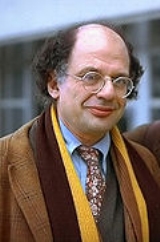
Allen Ginsberg

 
Allen Ginsberg

   Email Print
   Bookmark   Link


Allen Ginsberg


Irwin Allen Ginsberg (June 3, 1926 – April 5, 1997) was an American
United States

The United States of America is a Federal government constitutional republic comprising U.S. state and a federal district. The country is situated mostly in central North America, where its Contiguous United States and Washington, D.C., the Capital districts and territories, lie between the Pacific Ocean and Atlantic Oceans, Borders of the U...
 poet
Poet

A poet is a person who writes poetry....
. Ginsberg is best known for the poem "Howl
Howl

Howl is a poem written by Allen Ginsberg as part of his 1956 collection of poetry titled Howl and Other Poems.The poem is considered to be one of the principal works of the Beat Generation along with Jack Kerouac's On the Road and William S....
" (1956), celebrating his friends who were members of the Beat Generation
Beat generation

The Beat Generation is a term used to describe a group of American writers who came to prominence in the 1950s, and also the cultural phenomena that they wrote about and inspired ....
 and attacking what he saw as the destructive forces of materialism and conformity in the United States.

berg was born into a Jew
Jew

A Jew is a member of the Jewish people, an ethnoreligious group that traces its ancestry to the Israelites or Hebrews of the Ancient Near East....
ish family in Newark, New Jersey
Newark, New Jersey

Newark is the largest City in New Jersey, and the county seat of Essex County, New Jersey. Newark has a population of 281,402, making it not only List of Municipalities in New Jersey but also the 65th List of United States cities by population Newark is also home to major corporations, such as Prudential Financial....
, and grew up in nearby Paterson
Paterson, New Jersey

Paterson is a City in Passaic County, New Jersey, New Jersey, United States. As of the United States 2000 Census, the city population was 149,222....
.


Discussion
Ask a question about 'Allen Ginsberg'
Start a new discussion about 'Allen Ginsberg'
Answer questions from other users
Full Discussion Forum


Recent Posts


Quotations


America I'm putting my queer shoulder to the wheel.

America (1956)

The CIA and the Mafia are in cahoots.

Hadda be Playin' on a Jukebox (1975)


Encyclopedia


Irwin Allen Ginsberg (June 3, 1926 – April 5, 1997) was an American
United States

The United States of America is a Federal government constitutional republic comprising U.S. state and a federal district. The country is situated mostly in central North America, where its Contiguous United States and Washington, D.C., the Capital districts and territories, lie between the Pacific Ocean and Atlantic Oceans, Borders of the U...
 poet
Poet

A poet is a person who writes poetry....
. Ginsberg is best known for the poem "Howl
Howl

Howl is a poem written by Allen Ginsberg as part of his 1956 collection of poetry titled Howl and Other Poems.The poem is considered to be one of the principal works of the Beat Generation along with Jack Kerouac's On the Road and William S....
" (1956), celebrating his friends who were members of the Beat Generation
Beat generation

The Beat Generation is a term used to describe a group of American writers who came to prominence in the 1950s, and also the cultural phenomena that they wrote about and inspired ....
 and attacking what he saw as the destructive forces of materialism and conformity in the United States.

Life


Early life and family

Ginsberg was born into a Jew
Jew

A Jew is a member of the Jewish people, an ethnoreligious group that traces its ancestry to the Israelites or Hebrews of the Ancient Near East....
ish family in Newark, New Jersey
Newark, New Jersey

Newark is the largest City in New Jersey, and the county seat of Essex County, New Jersey. Newark has a population of 281,402, making it not only List of Municipalities in New Jersey but also the 65th List of United States cities by population Newark is also home to major corporations, such as Prudential Financial....
, and grew up in nearby Paterson
Paterson, New Jersey

Paterson is a City in Passaic County, New Jersey, New Jersey, United States. As of the United States 2000 Census, the city population was 149,222....
. His father Louis Ginsberg was a poet and a high school teacher. Ginsberg's mother, Naomi Livergant Ginsberg (who was affected by epileptic seizures and mental illness
Mental illness

A mental disorder or mental illness is a psychological or behavioral pattern that occurs in an individual and is thought to cause distress or disability that is not expected as part of normal development or culture....
es such as paranoia
Paranoia

Paranoia is a thought process characterized by excessive anxiety or fear, often to the point of irrationality and delusion. Paranoid thinking typically includes persecutory beliefs concerning a perceived threat towards oneself....
) was an active member of the Communist Party
Communist Party USA

The Communist Party of the United States of America is a Marxist-Leninist political party in the United States.The CPUSA is based in New York City, its newspaper, originally The Daily Worker, is today the People's Weekly World, and its monthly magazine is Political Affairs Magazine....
 and often took Ginsberg and his brother Eugene to party meetings. Ginsberg later said that his mother "made up bedtime stories that all went something like: 'The good king rode forth from his castle, saw the suffering workers and healed them.'"

As a young teenager, Ginsberg began to write letters to The New York Times about political issues such as World War II
World War II

World War II, or the Second World War , was a global military conflict which involved a Participants in World War II, including all of the great powers, organised into two opposing military alliances: the Allies of World War II and the Axis powers....
 and workers' rights. When he was in junior high school, he accompanied his mother by bus to her therapist. The trip disturbed Ginsberg — he mentioned it and other moments from his childhood in his long autobiographical poem "Kaddish for Naomi Ginsberg (1894-1956)
Kaddish (poem)

Kaddish is a poem by Beat generation writer Allen Ginsberg about the death of his mother, Naomi, in 1956. After her death, a rabbi would not allow the traditional Kaddish to be read with Ginsberg's Christian and atheist friends, so he rebelled and wrote a kaddish of his own....
." While in high school, Ginsberg began reading Walt Whitman
Walt Whitman

Walter Whitman was an United States Poetry of the United States, essayist, journalism, and humanism. He was a part of the transition between Transcendentalism and literary realism, incorporating both views in his works....
; he said he was inspired by his teacher's passion in reading.

In 1943, Ginsberg graduated from Eastside High School
Eastside High School (Paterson, New Jersey)

Eastside High School is a four-year public high school in Paterson, New Jersey, New Jersey, United States, that serves the eastern section of Paterson....
 and briefly attended Montclair State College before entering Columbia University
Columbia University

Columbia University in the City of New York , is a private university in the United States and a member of the Ivy League. Columbia's main campus lies in the Morningside Heights, Manhattan neighborhood in the borough of Manhattan, in New York City....
 on a scholarship from the Young Men's Hebrew Association of Paterson. In 1945, he joined the Merchant Marine to earn money to continue his education at Columbia. While at Columbia, Ginsberg contributed to the Columbia Review literary journal, the Jester
Jester of Columbia

The Jester of Columbia, or simply the Jester, is a humor magazine at Columbia University in New York City. Founded on April Fool's Day, 1901, it is one of the oldest such publications in the United States....
 humor magazine, won the Woodberry Poetry Prize and served as president of the Philolexian Society
Philolexian Society

The Philolexian Society of Columbia University is one of the oldest collegiate literary societies in the United States, and the oldest student group at Columbia....
, the campus literary and debate group.

Ginsberg worked for a while as a clerk in the Gotham Book Mart
Gotham Book Mart

The Gotham Book Mart, in operation from 1920 to 2007, was a famous Manhattan bookstore and cultural landmark. The business was located first in a small basement space on West 45th Street near the Theatre District, New York, it then moved to 51 West 47th Street, then spent many years at 41 West 47th Street within the Diamond District in Manha...
, a renowned bookstore and literary hotspot, where he undoubtedly came in contact with many renowned authors and poets.

New York Beats

In Ginsberg's freshman year at Columbia he met fellow undergraduate Lucien Carr
Lucien Carr

Lucien Carr was a key member of the original New York City circle of the Beat Generation in the 1940s; later he worked for many years as an editor for United Press International....
, who introduced him to a number of future Beat writers including Jack Kerouac
Jack Kerouac

Jack Kerouac was an American author, poet and Painting. Alongside William S. Burroughs and Allen Ginsberg, he is considered a pioneer of the Beat Generation....
, William S. Burroughs
William S. Burroughs

William Seward Burroughs II was an United States novelist, essayist, social critic, Painting and spoken word performer.Much of Burroughs's work is semi-autobiographical, drawn from his experiences as an opiate addict, a condition that marked the last fifty years of his life....
, and John Clellon Holmes
John Clellon Holmes

John Clellon Holmes , born in Holyoke, Massachusetts Massachusetts, was an author, poet and professor, best known for his 1952 novel Go . Go is considered the first "Beat Generation" novel, and depicted events in his life with friends Jack Kerouac, Neal Cassady and Allen Ginsberg....
. They bonded because they saw in one another excitement about the potential of the youth of America, a potential which existed outside the strict conformist confines of post-World War II McCarthy-era America. Ginsberg and Carr talked excitedly about a "New Vision" (a phrase adapted from Arthur Rimbaud
Arthur Rimbaud

Jean Nicolas Arthur Rimbaud was a French people poet, born in Charleville-M?zi?res. As part of the decadent movement, his influence on modern literature, music and art has been enduring and pervasive....
) for literature and America. Carr also introduced Ginsberg to Neal Cassady
Neal Cassady

Neal Leon Cassady was a major figure of the Beat Generation of the 1950s and the psychedelic movement of the 1960s, perhaps best known for being characterized as Dean Moriarty in Jack Kerouac's novel On the Road....
, for whom Ginsberg had a long infatuation. Kerouac later described the meeting between Ginsberg and Cassady in the first chapter of his 1957 novel On the Road
On the Road

On the Road is a novel by American writer Jack Kerouac, written in April 1951, and published by Viking Press in 1957 in literature. It is a largely Autobiography work that was based on the spontaneous road trips of Kerouac and his friends across mid-century America....
. Kerouac saw them then as the dark (Ginsberg) and light (Cassady) side of their "New Vision." Kerouac's perception had to do partly with Ginsberg's association with Communism (though Ginsberg himself was never a Communist); Kerouac called Ginsberg "Carlo Marx" in On the Road. This was a source of strain in their relationship since Kerouac grew increasingly distrustful of Communism.

In 1948 in an apartment in Harlem
Harlem

Harlem is a Neighbourhood in the New York City borough of Manhattan, long known as a major African-American residential, cultural, and business center....
, Ginsberg had an auditory hallucination of William Blake
William Blake

William Blake was an English people English poetry, Painting, and printmaker. Largely unrecognized during his lifetime, Blake is now considered a seminal figure in the history of both poetry and the visual arts of the Romanticism....
 reading his poems "Ah, Sunflower
Ah, Sunflower

Ah Sunflower is a poem written by the English poet William Blake. It was published as part of his collection Songs of Experience in 1794.Allen Ginsberg had an auditory hallucination of Blake reading "Ah, Sunflower"....
", "The Sick Rose
The Sick Rose

The Sick Rose is a poem by William Blake, published in Songs of Experience in 1794....
", and "Little Girl Lost" (later referred to as his "Blake vision"). Ginsberg was reading these poems at the time, and he said he was very familiar with them; at one point he claimed he heard them being read by what sounded like the voice of God but what he interpreted as the voice of Blake. He had at that moment pivotal revelations that defined his understanding of the universe. He believed that he witnessed then the interconnectedness of the universe. He looked at lattice work on the fire escape and realized some hand had crafted that; he then looked at the sky and intuited that some hand had crafted that also, or rather that the sky was the hand that crafted itself. He explained that this hallucination was not inspired by drug use, but said he sought to recapture that feeling later with various drugs.

Also in New York, Ginsberg met Gregory Corso
Gregory Corso

Gregory Nunzio Corso was an United States poet, youngest of the inner circle of Beat Generation writers ....
 in the Pony Stable Bar, one of New York's first openly lesbian bars. Corso, recently released from prison, was supported by the Pony Stable patrons and was writing poetry there the night of their meeting. Ginsberg claims he was immediately attracted to Corso, who was straight but understanding of homosexuality after three years in prison. Ginsberg was even more struck by reading Corso's poems, realizing Corso was "spiritually gifted." Ginsberg introduced Corso to the rest of his inner circle. In their first meeting at the Pony Stable, Corso showed Ginsberg a poem about a woman who lived across the street from him, and sunbathed naked in the window. Amazingly, the woman happened to be Ginsberg's former girlfriend from one of his forays into heterosexuality. Ginsberg and Corso remained life-long friends and collaborators.

It was also during this period that Ginsberg was romantically involved with Elise Cowen
Elise Cowen

Elise Nada Cowen was an American poet and part of the Beat generation.Born to a wealthy Jewish family in Long Island, New York, Cowen wrote poetry from a young age, enjoying the works of T....
.

San Francisco Renaissance

In 1954 in San Francisco, Ginsberg met Peter Orlovsky
Peter Orlovsky

Peter Orlovsky is an American poet best known for his lifelong relationship with Beat Generation poet Allen Ginsberg....
, with whom he fell in love and who remained his life-long friend.

Also in San Francisco Ginsberg met members of the San Francisco Renaissance and other poets who would later be associated with the Beat Generation in a broader sense. Ginsberg's mentor William Carlos Williams
William Carlos Williams

William Carlos Williams was an list of American poets closely associated with Modernist poetry and Imagism. He was also a pediatrician and general practitioner of medicine....
 wrote an introductory letter to San Francisco Renaissance figurehead Kenneth Rexroth
Kenneth Rexroth

Kenneth Rexroth was an American poet, translator and critical essayist. He was among the first poets in the United States to explore traditional Japanese poetic forms such as haiku....
, who then introduced Ginsberg into the San Francisco poetry scene. There, Ginsberg also met three budding poets and Zen
Zen

Zen is a school of Mahayana Buddhism, referred to in Chinese as Ch?n. Ch?n is itself derived from the Sanskrit Dhyana, which means "meditation" ....
 enthusiasts who were friends at Reed College
Reed College

Reed College is a Private school, Independent school liberal arts college located in southeast Portland, Oregon. Founded in 1908, Reed is a highly selective four-year residential college with a campus located in Portland's residential Eastmoreland, Portland, Oregon neighborhood, featuring architecture based on the Tudor style architecture-Got...
: Gary Snyder
Gary Snyder

Gary Snyder is an American poet , essayist, lecturer, and environmentalism . Snyder is a winner of a Pulitzer Prize for Poetry. His work, in his various roles, reflects an immersion in both Buddhism spirituality and nature....
, Philip Whalen
Philip Whalen

Philip Whalen was an American poet, Zen Buddhist, and a key figure in the San Francisco Renaissance and the Beat generation....
, and Lew Welch
Lew Welch

Lewis Barrett Welch, Jr. is an American poet associated with the Beat generation of poets, artists, and iconoclasts.According to Aram Saroyan who wrote Genesis Angels: The Saga of Lew Welch and the Beat Generation, Welch decided to become a writer after reading Gertrude Stein's long story "Melanctha." Welch published and performed wid...
. In 1959, along with poets John Kelly, Bob Kaufman
Bob Kaufman

Bob Kaufman , born Robert Garnell Kaufman, was an United States Beat poet and surrealist inspired by jazz music. In France, where his poetry had a large following, he was known as the "American Rimbaud."...
, A. D. Winans
A. D. Winans

Allan Davis Winans , known as A. D. Winans, is an United States poet, essayist, and short story writer. Moving to San Francisco's North Beach in 1958, he became a Beat poet and friends with Bob Kaufman, Jack Micheline, and Charles Bukowski....
, and William Margolis, Ginsberg was one of the founders of the Beatitude poetry magazine.

Wally Hedrick
Wally Hedrick

Wally Bill Hedrick was a seminal American artist in the 1950s California counterculture, gallerist, and educator who came to prominence in the early 1960s....
 — a painter and co-founder of the Six Gallery — approached Ginsberg in the summer of 1955 and asked him to organize a poetry reading at the Six Gallery. At first, Ginsberg refused, but once he’d written a rough draft of "Howl", he changed his "fucking mind," as he put it. Ginsberg advertised the event as "Six Poets at the Six Gallery." One of the most important events in Beat mythos, known simply as "The Six Gallery reading
Six Gallery reading

The Six Gallery reading was a poetry-reading , which occurred at the Six Gallery on Friday, October 7, 1955 at 3119 Fillmore Street in San Francisco....
" took place on October 7, 1955. The event, in essence, brought together the East and West Coast factions of the Beat Generation. Of more personal significance to Ginsberg: that night was the first public reading of "Howl", a poem that brought worldwide fame to Ginsberg and to many of the poets associated with him. An account of that night can be found in Kerouac's novel The Dharma Bums
The Dharma Bums

The Dharma Bums is a 1958 novel by Beat Generation author Jack Kerouac. The semi-fictional accounts in the novel are based upon events that occurred years after the events of On the Road....
,
describing how change was collected from audience members to buy jugs of wine, and Ginsberg reading passionately, drunken, with arms outstretched. A taped recording of the reading of "Howl" that Ginsberg gave at Reed College
Reed College

Reed College is a Private school, Independent school liberal arts college located in southeast Portland, Oregon. Founded in 1908, Reed is a highly selective four-year residential college with a campus located in Portland's residential Eastmoreland, Portland, Oregon neighborhood, featuring architecture based on the Tudor style architecture-Got...
 has recently been rediscovered and appeared on their from 9am PST 15 February 2008.

Ginsberg's principal work, "Howl", is well-known for its opening line: "I saw the best minds of my generation destroyed by madness, starving hysterical naked...." "Howl" was considered scandalous at the time of its publication, because of the rawness of its language, which is frequently explicit. Shortly after its 1956 publication by San Francisco's City Lights Bookstore
City Lights Bookstore

City Lights is an independent bookstore- publisher combination that specializes in world literature, the arts, and progressive politics. It also houses the nonprofit City Lights Foundation, which publishes selected titles related to San Francisco culture....
, it was banned for obscenity. The ban became a cause célèbre
Cause célèbre

A cause c?l?bre is an issue or incident arousing widespread controversy, outside campaigning and heated public debate. It is particularly used for prolific and long-running legal cases....
 among defenders of the First Amendment
First Amendment to the United States Constitution

The First Amendment to the United States Constitution is the part of the United States Bill of Rights that expressly prohibits the United States Congress from making laws "Establishment Clause of the First Amendment" or that prohibit the Free Exercise Clause of the First Amendment, laws that infringe the Freedom of speech in the United State...
, and was later lifted after Judge Clayton W. Horn declared the poem to possess redeeming social importance.

Biographical references in "Howl"
Ginsberg claimed at one point that all of his work was an extended biography (like Kerouac's Duluoz Legend). "Howl" is not only a biography of Ginsberg's experiences before 1955, but a history of the Beat Generation
Beat generation

The Beat Generation is a term used to describe a group of American writers who came to prominence in the 1950s, and also the cultural phenomena that they wrote about and inspired ....
. Ginsberg also later claimed that at the core of "Howl" were his unresolved emotions about his schizophrenic mother. Though "Kaddish" deals more explicitly with his mother (so explicitly that a line-by-line analysis would be simultaneously overly-exhaustive and relatively unrevealing), "Howl" in many ways is driven by the same emotions. Though references in most of his poetry reveal much about his biography, his relationship to other members of the Beat Generation, and his own political views, "Howl
Howl

Howl is a poem written by Allen Ginsberg as part of his 1956 collection of poetry titled Howl and Other Poems.The poem is considered to be one of the principal works of the Beat Generation along with Jack Kerouac's On the Road and William S....
", his most famous poem, is still perhaps the best place to start. See "Howl"
Howl

Howl is a poem written by Allen Ginsberg as part of his 1956 collection of poetry titled Howl and Other Poems.The poem is considered to be one of the principal works of the Beat Generation along with Jack Kerouac's On the Road and William S....
.


To Paris and the "Beat Hotel"

In 1957, Ginsberg surprised the literary world by abandoning San Francisco. After a spell in Morocco
Morocco

Morocco , officially the Kingdom of Morocco , is a country located in North Africa with a population of nearly 34 million and an area just under 447,000 km2....
, he and Peter Orlovsky joined Gregory Corso in Paris. Corso introduced them to a shabby lodging house above a bar at 9 rue Gît-le-Coeur that was to become known as the Beat Hotel
Beat Hotel

The Beat Hotel was a small, run-down hotel of 42 rooms at 9 Rue G?t-le-C?ur in the Latin Quarter of Paris, notable chiefly as a residence for members of the Beat poetry movement of the mid-20th century ...
. They were soon joined by William Burroughs and others. It was a productive, creative time for all of them. There, Ginsberg finished his epic poem "Kaddish", Corso composed "Bomb" and "Marriage", and Burroughs (with help from Ginsberg and Corso) put together Naked Lunch
Naked Lunch

Naked Lunch is a novel by William S. Burroughs originally published in 1959.The book was originally published with the title The Naked Lunch in Paris in 1959 by Olympia Press....
,
from previous writings. This period was documented by the photographer Harold Chapman
Harold Chapman

Of his background, upbringing and childhood years, the photographer Harold Stephen Chapman has revealed only that he was ?born in Deal on a Saturday morning at 9.30am on 26 March, 1927.? Deal is a quiet seaside town in the county of Kent, on the south coast of England....
, who moved in at about the same time, and took pictures constantly of the residents of the "hotel" until it closed in 1963.

Continuing literary activity

Allen Ginsberg Und Peter Orlowski Arm
Though "Beat" is most accurately applied to Ginsberg and his closest friends (Corso, Orlovsky, Kerouac, Burroughs, etc.), the term "Beat Generation" has become associated with many of the other poets Ginsberg met and became friends with in the late 1950s and early 1960s. A key feature of this term seems to be a friendship with Ginsberg. Friendship with Kerouac or Burroughs might also apply, but both writers later strove to disassociate themselves from the name "Beat Generation." Part of their dissatisfaction with the term came from the mistaken identification of Ginsberg as the leader. Ginsberg never claimed to be the leader of a movement. He did, however, claim that many of the writers with whom he had become friends in this period shared many of the same intentions and themes. Some of these friends include: Bob Kaufman
Bob Kaufman

Bob Kaufman , born Robert Garnell Kaufman, was an United States Beat poet and surrealist inspired by jazz music. In France, where his poetry had a large following, he was known as the "American Rimbaud."...
; LeRoi Jones before he became Amiri Baraka
Amiri Baraka

Amiri Baraka, formerly known as Leroi Jones, is an American writer of poetry, drama, essays, and music criticism....
, who, after reading "Howl", wrote a letter to Ginsberg on a sheet of toilet paper; Diane DiPrima; Jim Cohn
Jim Cohn

Jim Cohn is a poet, and poetry activist in the United States. He was born in Highland Park, Illinois, in 1953. He received a BA from the University of Colorado at Boulder in English and a Certificate of Poetics from the Jack Kerouac School of Disembodied Poetics at Naropa University where he was a teaching assistant to Allen Ginsberg....
; poets associated with the Black Mountain College
Black Mountain College

Black Mountain College was a university founded in 1933 near Asheville, North Carolina as a new kind of college in the United States in which the study of art was seen to be central to a liberal arts education, and in which John Dewey's principles of education played a major role....
 such as Robert Creeley
Robert Creeley

Robert Creeley was an American poet and author of more than sixty books. He is usually associated with the Black Mountain poets, though his verse aesthetic diverged from that school's....
 and Denise Levertov
Denise Levertov

Denise Levertov was a United Kingdom-born American poet....
; poets associated with the New York School
New York School

The New York School was an informal group of American poets, Paintings, dancers, and musicians active in the 1950s, 1960s in New York City. The poets, painters, composers, dancers, and musicians often drew inspiration from Surrealism and the contemporary avant-garde art movements, in particular action painting, abstract expressionism, Jazz...
 such as Frank O'Hara
Frank O'Hara

Francis Russell O'Hara was an Poetry of the United States who, along with John Ashbery, James Schuyler, Barbara Guest and Kenneth Koch, was a key member of what was known as the New York School of poetry....
 and Kenneth Koch
Kenneth Koch

Kenneth Koch was an United States poet, playwright, and professor, active from the 1950s until his death at age 77. He was a prominent poet of the New York School of poetry, a loose group of poets including Frank O'Hara and John Ashbery that eschewed contemporary introspective poetry in favor of an exuberant, cosmopolitan style that drew ma...
. Later in his life, Ginsberg formed a bridge between the beat movement of the 1950s and the hippies of the 1960s, befriending, among others, Timothy Leary
Timothy Leary

Timothy Francis Leary was an American writer, psychologist, futurist, and advocate of psychedelic drug research and one of the first people whose remains have been sent into space....
, Ken Kesey
Ken Kesey

Kenneth Elton Kesey was an United States author, best known for his novel One Flew Over the Cuckoo's Nest , and as a counter-cultural figure who, some consider , was a link between the Beat Generation of the 1950s and the hippies of the 1960s....
, and Bob Dylan. Ginsberg gave his last ever reading at Booksmith
Booksmith

Founded in October 1976, The Booksmith is an independent bookstore located in the Haight Ashbury neighborhood of San Francisco. When first opened, the store was located at 1746 Haight Street, below the former I-Beam ....
, a bookstore located in the Haight Ashbury neighborhood of San Francisco, a few months before his death.

Buddhism and Krishnaism

Ginsberg's spiritual journey began early on with his spontaneous visions, and continued with an early trip to India
India

India, officially the Republic of India , is a country in South Asia. It is the List of countries and outlying territories by total area country by geographical area, the List of countries by population country, and the most populous liberal democracy in the world....
 and a chance encounter on a New York City street with Chögyam Trungpa
Chögyam Trungpa

Ch?gyam Trungpa was a Buddhism meditation master, scholar, teacher, poet, artist, and a Trungpa t?lkus. Widely recognized, both by Tibetan Buddhists and by other spiritual practitioners and scholars, as a preeminent teacher of Tibetan Buddhism, he was a major figure in the dissemination of Tibetan Buddhism to the West, founding Vajradhatu a...
 Rinpoche
Rinpoche

Rinpoche or Rimpoche is an honorific title used in Tibetan Buddhism. It literally means "precious one". The title is generally reserved for tulkus and those recognized by the proper authorities within a lineage as "choje lamas" ....
 (they both tried to catch the same cab), a Tibetan Buddhist meditation master of the Vajrayana
Vajrayana

Vajrayana Buddhism is also known as Tantric Buddhism, Tantrayana, Mantranaya, Mantrayana, Secret Mantra, Esoteric Buddhism and the Diamond Vehicle ....
 school, who became his friend and life-long teacher. Ginsberg helped Trungpa (and New York poet Anne Waldman) in founding the Jack Kerouac School of Disembodied Poetics at Naropa Institute
Naropa University

Naropa University is a private American liberal arts university in Boulder, Colorado, Colorado. Founded in 1974 by Tibetan Buddhist teacher Ch?gyam Trungpa, it is named for the eleventh-century Indian Buddhist sage Naropa, an abbot of Nalanda....
 in Boulder
Boulder, Colorado

Boulder is a Colorado municipalities#Home_Rule_Municipality that is the county seat and most populous city of Boulder County, Colorado, Colorado, in the United States....
, Colorado
Colorado

The State of Colorado is a U.S. state located in the Mountain States of the United States of America. Colorado may also be considered to be a part of the Western United States and Southwestern United States regions of the United States....
.

Ginsberg was also involved with Krishnaism
Krishnaism

File:Krishna Holding Mount Govardhan - Crop.jpgKrishnaism, is a term that is often used to describe a number of Hindu religious traditions, that are among the Hindu denominations centered on devotion to Radha Krishna or other forms of Krishna, or Vishnu in a sentiment of Krishna....
. He befriended A.C. Bhaktivedanta Swami Prabhupada, the founder of the Hare Krishna
Hare Krishna

The Hare Krishna mantra, also referred to reverentially as the Maha Mantra , is a sixteen-word Vaishnava mantra made well known outside of India by the International Society for Krishna Consciousness ....
 movement in the Western world, a relationship that is documented by Satsvarupa dasa Goswami
Satsvarupa dasa Goswami

Satsvarupa das Goswami , is a senior disciple of A. C. Bhaktivedanta Swami Prabhupada, who founded the International Society for Krishna Consciousness , better known in the west as the Hare Krishna movement....
 in his biographical account Srila Prabhupada Lilamrta. Ginsberg donated money, materials, and his reputation to help the Swami establish the first temple, and toured with him to promote his cause.

Music and chanting were both important parts of Ginsberg's live delivery during poetry readings. He often accompanied himself on a harmonium
Harmonium

A harmonium is a free-standing keyboard instrument similar to a reed organ or pipe organ. Sound is produced by air, supplied by foot-operated or hand-operated bellows, being blown through sets of Free reed aerophone, resulting in a sound similar to that of an accordion....
, and was often accompanied by a guitarist. When Ginsberg asked if he could sing a song in praise of Lord Krishna
Krishna

Krishna is a deity worshiped across many traditions in Hinduism in a variety of different perspectives. While many Vaishnava groups recognize him as an avatar of Vishnu, other traditions within Krishnaism consider Krishna to be svayam bhagavan, or the supreme being....
 on William F. Buckley, Jr.
William F. Buckley, Jr.

William Frank Buckley Jr. was an United States Conservatism in the United States author and political commentator. He founded the political magazine National Review in 1955, hosted 1429 episodes of the television show Firing Line from 1966 until 1999, and was a nationally Print syndication newspaper columnist....
's TV show Firing Line
Firing Line

Firing Line was an American Public affairs programming show founded and hosted by Conservatism William F. Buckley, Jr.. Its 1,504 episodes over 33 years made Firing Line the longest-running public affairs show in television history with a single host....
 on September 3, 1968, Buckley acceded and the poet chanted slowly as he played dolefully on a harmonium. According to Richard Brookhiser
Richard Brookhiser

Richard Brookhiser is an United States journalist, biographer and historian. He is a senior editor at National Review and columnist for The New York Observer....
, an associate of Buckley's, the host commented that it was "the most unharried Krishna
Hare Krishna

The Hare Krishna mantra, also referred to reverentially as the Maha Mantra , is a sixteen-word Vaishnava mantra made well known outside of India by the International Society for Krishna Consciousness ....
 I've ever heard."

Attendance to his poetry readings was generally standing room only
Standing room only

An event is described as standing room only when it is so well-attended that all of the chairs in the venue are occupied leaving only flat spaces of pavement or flooring for other attendees to stand....
 for most of his career, no matter where in the world he appeared. Ginsberg came in touch with the Hungryalist
Hungry generation

Hungry GenerationThe Hungry Generation was a literary movement in the Bengali language launched by what is known today as the Hungryalist quartet, i.e....
 poets of Bengal
Bengal

Bengal , is a historical and geographical region in the northeast of South Asia. Today it is mainly divided between the independent sovereign nation of the Bangladesh and the state of West Bengal in India, although some regions of the previous kingdoms of Bengal are now part of the neighboring Indian states of Bihar, Assam, Tripura and Oris...
, especially Malay Roy Choudhury
Malay Roy Choudhury

Malay Roy Choudhury is a Bengali Poetry and novelist who founded the "Hungryalist Movement" in the 1960s. His literary works have been reviewed by sixty critics in HAOWA 49, a quarterly magazine which devoted its January 2001 special issue to Roy Choudhury's life and works....
, who introduced Ginsberg to the three fishes with one head of Indian emperor Jalaluddin Mohammad Akbar
Akbar the Great

Jalaluddin Muhammad Akbar , also known as Akbar the Great was the son of Nasiruddin Humayun whom he succeeded as ruler of the Mughal Empire from 1556 to 1605....
. The three fishes symbolised coexistence of all thought, philosophy and religion.

Death

Ginsberg won the National Book Award
National Book Award

The National Book Awards are among the most eminent literary prizes in the United States. Started in 1950, the awards are presented annually to American authors for literature published in the prior year, as well as lifetime achievement awards including the "Medal of Distinguished Contribution to American Letters" and the "Literarian Award"....
 for his book The Fall of America
The Fall of America: Poems of These States

A book of poetry by Allen Ginsberg, published by City Lights in 1973 for which Ginsberg won the National Book Award. It's characterized by a prophetic tone inspired by William Blake and Walt Whitman, as well as an objective view characterized by William Carlos Williams....
. In 1993, the French Minister of Culture awarded him the medal of Chevalier des Arts et des Lettres
Ordre des Arts et des Lettres

The Ordre des Arts et des Lettres is an Order of France, established on 2 May 1957 by the Minister of Culture , and confirmed as part of the Ordre National du M?rite by President of France Charles de Gaulle in 1963....
 (the Order of Arts and Letters).

Ginsberg gave what is thought to be his last reading at The Booksmith
Booksmith

Founded in October 1976, The Booksmith is an independent bookstore located in the Haight Ashbury neighborhood of San Francisco. When first opened, the store was located at 1746 Haight Street, below the former I-Beam ....
 in San Francisco December 16, 1996. He died April 5, 1997, surrounded by family and friends in his East Village
East Village, Manhattan

The East Village is a neighborhood in the borough of Manhattan in New York City. It lies east of Greenwich Village, south of Gramercy, Manhattan and Peter Cooper Village?Stuyvesant Town, and north of the Lower East Side, Manhattan....
 loft in New York City
New York City

The City of New York is the List of United States cities by population in the United States, while the New York metropolitan area ranks among the List of urban areas by population....
, succumbing to liver cancer
Liver cancer

Hepatic tumors are tumors or growths on or in the liver . These growths can be benign or malignant . They may be discovered on medical imaging , or may be present in patients as an abdominal mass, hepatomegaly, abdominal pain, jaundice, or some other liver dysfunction....
 via complications of hepatitis
Hepatitis

Hepatitis implies injury to the liver characterized by the presence of inflammatory cell s in the Tissue of the organ. The name is from ancient Greek hepar , the root being hepat- , meaning liver, and suffix -itis, meaning "inflammation" ....
. He was 70 years old. Ginsberg continued to write through his final illness, with his last poem, "Things I'll Not Do (Nostalgias)", written on March 30.

Ginsberg is buried in his family plot in Gomel Chesed Cemetery, one of a cluster of Jewish cemeteries at the corner of McClellan Street and Mt. Olivet Avenue near the city lines of Elizabeth and Newark
Newark, New Jersey

Newark is the largest City in New Jersey, and the county seat of Essex County, New Jersey. Newark has a population of 281,402, making it not only List of Municipalities in New Jersey but also the 65th List of United States cities by population Newark is also home to major corporations, such as Prudential Financial....
, New Jersey
New Jersey

New Jersey is a state in the Mid-Atlantic States and Northeastern United States regions of the United States. It is bordered on the north by New York, on the east by the Hudson River and the Atlantic Ocean, on the southwest by Delaware, and on the west by Pennsylvania....
. The family plot, located toward the western edge of the cemetery at the far end of the walk from the third gate along Mt. Olivet Avenue, is marked by a large Ginsberg and Litzky stone, and Ginsberg himself and each family member have smaller markers. The grave itself and the cemetery are neither picturesque nor otherwise notable (Ginsberg's grave is located near the rear fence of the flat cemetery, which is in the midst of an industrial area); although it has not become a major place of pilgrimage, there is a steady trickle of visitors to the grave, as indicated by a handful of stones always on his marker and the occasional book or other item left by other poets and admirers.

Controversial political activism

Ginsberg's willingness to talk about taboo subjects made him a controversial figure during the conservative 1950s and a significant figure in the 1960s. But Ginsberg continued to broach controversial subjects throughout the 1970s, '80s, and '90s. When explaining how he approached controversial topics, he often pointed to Herbert Huncke
Herbert Huncke

Herbert Huncke was a sub-culture icon, writer, homosexuality pioneer , drug addict, criminal, and participant in various American social movements of the 20th century....
: he said that when he first got to know Huncke in the 1940s, Ginsberg saw that he was sick from his heroin addiction, but at the time heroin was a taboo subject and Huncke was left with nowhere to go for help.

Likewise, he continuously attempted to force the world into a dialogue about controversial subjects because he thought that no change could be made in a polite silence.

Role in Vietnam War protests

Ginsberg also played a key role in ensuring that a 1965 protest of the Vietnam war
Vietnam War

The Vietnam War, also known as the Second Indochina Wars, the Vietnam Conflict, or often in Vietnam the American War occurred in Vietnam, Laos and Cambodia from 1959 to April 30, 1975....
, which took place at the Oakland-Berkeley city line and drew several thousand marchers, was not violently interrupted by the California chapter of the notorious motorcycle gang, the Hells Angels
Hells Angels

The Hells Angels Motorcycle Club is a world-wide "Motorcycle club#One Percenters" Motorcycle_club#Outlaw_Motorcycle_Gangs whose members typically ride Harley-Davidson motorcycles....
, and their leader, Sonny Barger.

The day prior to the scheduled march, the Hell's Angels attacked the front line of a smaller scale protest where a confrontation between police and demonstrators was brewing. The Hell's Angels came in on motorcycles and slashed banners while yelling "Go back to Russia, you fucking communists!" at the protesters. The Hell's Angels then vowed to disrupt the larger protest the next day.

Ginsberg traveled to Barger's home in Oakland
Oakland, California

Oakland , founded in 1852, is the eighth-largest city in the U.S. state of California and the county seat of Alameda County, California. Oakland is approximately 8 miles east of San Francisco and the cities are separated by San Francisco Bay....
 to talk the situation through. It is rumored that he offered Barger and other members of the Hell's Angels LSD
LSD

Lysergic acid diethylamide, LSD, LSD-25, or acid, is a semisynthetic psychedelic drug of the ergoline family. Its unusual psychological effects, which include visuals of colored patterns behind the eyes in the mind, a sense of time distorting, and crawling geometric patterns, have made it one of the most widely known psyched...
 as a gesture of friendship and goodwill. In the end, Barger and the other Hell's Angels that were present came away deeply impressed by the courage of Ginsberg and his companion Ken Kesey
Ken Kesey

Kenneth Elton Kesey was an United States author, best known for his novel One Flew Over the Cuckoo's Nest , and as a counter-cultural figure who, some consider , was a link between the Beat Generation of the 1950s and the hippies of the 1960s....
. They vowed not to attack the next day's protest march and furthermore deemed Ginsberg a man who was worth helping out.

It was shortly after the Tompkins Square Park riots in New York that Ginsberg was involved in a fracas with the Mentofreeist group and was assaulted by its leader, Vargus Pike. Pike was arrested, and was later released when Ginsberg, sporting a black eye, refused to press charges.

Relationship to Communism

He talked openly about his connections with Communism
Communism

Communism is a socioeconomic structure and political ideology that promotes the establishment of an egalitarianism, classlessness, stateless society based on common ownership and control of the means of production and property in general....
 and his admiration for past heroes of Communism and the labor movement at a time in America when the Red Scare and McCarthyism
McCarthyism

McCarthyism is the politically motivated practice of making accusations of disloyalty, subversion, or treason without proper regard for evidence....
 were recent memories. Later he travelled to several Communist countries to promote free speech. He claimed Communist countries, China for example, welcomed him in because they thought he was an enemy of Capitalism
Capitalism

Capitalism is an economic system in which wealth, and the means of producing wealth, are private property and controlled rather than commonly, publicly, or state-owned and controlled....
 but often turned against him when they saw him as a trouble maker. In his poem "America
America (poem)

"America" is a poem by Allen Ginsberg, written in 1956. It appears in his collection Howl.The poem is in the first person and reads much like a monologue....
", written on 17 January 1956 in Berkeley, a line reads "America I used to be a communist when I was a kid I'm not sorry..." followed directly by "I smoke marijuana every chance I get...."

Ginsberg admired Castro along with many other quasi-Marxist figures from the 20th century. In 1965 Ginsberg was deported from Cuba
Cuba

The Republic of Cuba is a country in the Caribbean. It consists of the island of Cuba , the island of Isla de la Juventud, and several adjacent small islands....
 for publicly protesting against Cuba's anti-marijuana stance; Ginsberg's expulsion was also said to have come after he had described Che Guevara
Che Guevara

Ernesto "Che" Guevara , commonly known as Che Guevara, El Che, or simply Che, was an Argentina Marxism revolutionary, politician, author, physician, military theorist, and guerrilla leader....
 as "cute".

The Cubans sent him to Czechoslovakia
Czechoslovakia

Czechoslovakia was a sovereign state in Central Europe that existed from October 1918 until 1992 . On January 1, 1993, Czechoslovakia dissolution of Czechoslovakia into the Czech Republic and Slovakia....
, where one week after being named the King of a May Day parade, Ginsberg was labeled an "immoral menace" by the Czech government because of his free expression of radical ideas, and was then deported. Vaclav Havel
Václav Havel

V?clav Havel is a Czechs playwright, writer and politician. He was the tenth and last List of Presidents of Czechoslovakia of Czechoslovakia and the first List of presidents of the Czech Republic ....
 points to Ginsberg as an important inspiration in striving for freedom . Biographer Jonah Raskin writes that despite Ginsberg's often stark opposition to communist orthodoxy, he held "his own idiosyncratic version of communism".

In 1970 Ginsberg objected to being characterized as a Communist, stating publicly, "I am not, as a matter of fact, a member of the Communist party, nor am I dedicated to the overthrow of [the U.S.] government or any government by violence. ... I must say that I see little difference between the armed and violent governments both Communist and Capitalist that I have observed ..."

The character of Ginsberg in Jack Kerouac's On the Road
On the Road

On the Road is a novel by American writer Jack Kerouac, written in April 1951, and published by Viking Press in 1957 in literature. It is a largely Autobiography work that was based on the spontaneous road trips of Kerouac and his friends across mid-century America....
 is named Carlo Marx.

Gay rights and free speech

One contribution that is often considered his most significant and most controversial was his openness about homosexuality
Homosexuality

Homosexuality refers to human sexual behavior or same-sex attraction between people of the same sex or to homosexual orientation. As a sexual orientation, homosexuality refers to "having sexual and romantic attraction primarily or exclusively to members of one?s own sex"; "it also refers to an individual?s sense of personal and social identi...
. Ginsberg was an early proponent of freedom for men who loved other men. In 1943 he discovered within himself "mountains of homosexuality." He expressed this desire openly and graphically in his poetry. He also struck a note for gay marriage by listing Peter Orlovsky, his lifelong companion, as his spouse in his Who's Who entry. Later homosexual writers saw his frank talk about homosexuality as an opening to speak more openly and honestly about something often before only hinted at or spoken of in metaphor.

In writing about sexuality in graphic detail and in his frequent use of language seen as indecent he challenged—and ultimately changed—obscenity laws. He was a staunch supporter of others whose expression challenged obscenity laws (William S. Burroughs and Lenny Bruce
Lenny Bruce

Lenny Bruce , born Leonard Alfred Schneider, was an United States stand-up comedian, writer, Cultural critic and satire of the 1950s and 1960s....
, for example).

Association with NAMBLA

Ginsberg also spoke out in defense of the freedom of expression of the North American Man/Boy Love Association
North American Man/Boy Love Association

The North American Man/Boy Love Association is a New York City and San Francisco-based unincorporated organization in the United States that Pro-pedophile activism the liberalisation of laws against sexual relations between adult and Age of consent males - resolving to "end the oppression of men and boys who have freely chosen mutually conse...
 (NAMBLA). He defended his membership by stating:

"Attacks on NAMBLA stink of politics, witchhunting for profit, humorlessness, vanity, anger and ignorance."

In "Thoughts on NAMBLA", a 1994 essay published in the collection Deliberate Prose
Deliberate Prose

Deliberate Prose - Essays 1952 to 1995is a collection of essays penned by Allen Ginsberg in the years 1952 to 1995. The writer and poet was consistently outspoken and passionate about his beliefs....
, Ginsberg stated, "I joined NAMBLA in defense of free speech." In the essay, he referred to NAMBLA "as a forum for reform of those laws on youthful sexuality which members deem oppressive, a discussion society not a sex club." Ginsberg expressed the opinion that the appreciation of youthful bodies and "the human form divine" has been a common theme throughout history, "from Rome's Vatican, to Florence's Uffizi galleries, to New York's Metropolitan Museum of Art". Essentially, Ginsberg felt that laws regarding the issue needed to be more openly discussed and that NAMBLA provided a "platform of debate."

Demystification of drugs

Ginsberg also talked often about drug use. Throughout the 1960s he took an active role in the demystification of LSD and with Timothy Leary
Timothy Leary

Timothy Francis Leary was an American writer, psychologist, futurist, and advocate of psychedelic drug research and one of the first people whose remains have been sent into space....
 worked to promote its common use. He was also for many decades an advocate of marijuana legalization, and at the same time warned his audiences against the hazards of tobacco in his Put Down Your Cigarette Rag (Don't Smoke): "Don't Smoke Don't Smoke Nicotine Nicotine No / No don't smoke the official Dope Smoke Dope Dope."

Career

Allenginsberg
Though early on he had intentions to be a labor lawyer, Ginsberg wrote poetry for most of his life. Most of his very early poetry was written in formal rhyme and meter like his father or like his idol William Blake. His admiration for the writing of Jack Kerouac
Jack Kerouac

Jack Kerouac was an American author, poet and Painting. Alongside William S. Burroughs and Allen Ginsberg, he is considered a pioneer of the Beat Generation....
 inspired him to take poetry more seriously. Though he took odd jobs to support himself, in 1955, upon the advice of a psychiatrist, Ginsberg dropped out of the working world to devote his entire life to poetry. Soon after, he wrote "Howl
Howl

Howl is a poem written by Allen Ginsberg as part of his 1956 collection of poetry titled Howl and Other Poems.The poem is considered to be one of the principal works of the Beat Generation along with Jack Kerouac's On the Road and William S....
", the poem that brought him and his friends much fame and allowed him to live as a professional poet for the rest of his life. Later in life, Ginsberg entered academia, teaching poetry as Distinguished Professor of English at Brooklyn College
Brooklyn College

Brooklyn College is a senior college of the City University of New York, located in Brooklyn, New York.Established in 1930 by the New York City Board of Higher Education, the College had its beginnings as the Downtown Brooklyn branches of Hunter College and the City College of New York ....
 from 1986 until his death.

Inspiration from friends

Since Ginsberg's poetry is intensely personal, and since much of the vitality of those associated with the beat generation
Beat generation

The Beat Generation is a term used to describe a group of American writers who came to prominence in the 1950s, and also the cultural phenomena that they wrote about and inspired ....
 comes from mutual inspiration, much credit for style, inspiration, and content can be given to Ginsberg's friends.

Ginsberg claimed throughout his life that his biggest inspiration was Kerouac's concept of "spontaneous prose". He believed literature should come from the soul without conscious restrictions. However, Ginsberg was much more prone to revise than Kerouac. For example, when Kerouac saw the first draft of "Howl" he disliked the fact that Ginsberg had made editorial changes in pencil (transposing "negro" and "angry" in the first line, for example). Kerouac only wrote out his concepts of Spontaneous Prose at Ginsberg's insistence because Ginsberg wanted to learn how to apply the technique to his poetry.

An important figure when considering inspiration for "Howl" is Carl Solomon. The full title is "Howl for Carl Solomon." Solomon was a Dada
Dada

Dada or Dadaism is a cultural movement that began in Z?rich, Switzerland, during World War I and peaked from 1916 to 1922. The movement primarily involved visual arts, literature?poetry, art manifestoes, aesthetics?theatre, and graphic design, and concentrated its anti-war politics through a rejection of the prevailing standards in art...
 and Surrealism
Surrealism

Surrealism is a cultural movement that began in the early-1920s, and is best known for the visual artworks and writings of the group members....
 enthusiast (he introduced Ginsberg to Artaud) who suffered bouts of depression. Solomon wanted to commit suicide, but he thought a form of suicide appropriate to dadaism would be to go to a mental institution and demand a lobotomy. The institution refused, giving him many forms of therapy
Psychotherapy

Psychotherapy is an intentional interpersonal relationship used by trained psychotherapists to aid a wiktionary:Client in problems of living. It aims to increase the individual's sense of health and reduce their subjective sense of discomfort....
, including electroshock therapy
Electroconvulsive therapy

Electroconvulsive therapy , also known as electroshock, is a well established, albeit controversial psychiatry treatment in which seizures are electrically induced in anesthetized patients for therapeutic effect....
. Much of the final section of the first part of "Howl" is a description of this.

Ginsberg used Solomon as an example of all those ground down by the machine of "Moloch
Moloch

Moloch, Molech, Molekh, or Molek, representing semitic ??? mlk, is either the name of a deity or the name of a particular kind of human sacrifice associated with fire....
." Moloch, to whom the second section is addressed, is a Levantine god to whom children were sacrificed. Ginsberg may have gotten the name from the Kenneth Rexroth poem "Thou Shalt Not Kill", a poem about the death of one of Ginsberg's heroes, Dylan Thomas
Dylan Thomas

Dylan Marlais Thomas was a Welsh people poet who wrote exclusively in English. In addition to poetry, he wrote short stories and scripts for film and radio, which he often performed himself....
. But Moloch is mentioned a few times in the Torah
Torah

The term "Torah" , or Five Books of Moses or Pentateuch, refers to the entirety of Judaism's founding Halakha and ethical religious texts....
 and references to Ginsberg's Jewish background are not infrequent in his work. Ginsberg said the image of Moloch was inspired by peyote
Peyote

Lophophora williamsii , better known by its common name Peyote, , is a small, spineless cactus. It is native to southwestern Texas and through central Mexico....
 visions he had of the Francis Drake Hotel in San Francisco which appeared to him as a skull; he took it as a symbol of the city (not specifically San Francisco, but all cities). Ginsberg later acknowledged in various publications and interviews that behind the visions of the Francis Drake Hotel were memories of the Moloch of Fritz Lang's film Metropolis
Metropolis (film)

Metropolis is a silent film science fiction film directed by Fritz Lang and written by Lang and Thea von Harbou. Lang and von Harbou, who were married, wrote the screenplay in , and the story was novelized by von Harbou in 1926 in literature....
 (1927) and of the woodcut novels of Lynd Ward
Lynd Ward

Lynd Kendall Ward was an United States artist and storyteller, and son of Methodist minister and prominent political organizer Harry F. Ward. He illustrated some 200 juvenile and adult books....
. Moloch has subsequently been interpreted as any system of control, including the conformist society of post-World War II America focused on material gain, which Ginsberg frequently blamed for the destruction of all those outside of societal norms.

He also made sure to emphasize that Moloch is a part of all of us: the decision to defy socially created systems of control—and therefore go against Moloch—is a form of self-destruction. Many of the characters Ginsberg references in "Howl", such as Neal Cassady and Herbert Huncke, destroyed themselves through excessive substance abuse or a generally wild lifestyle. The personal aspects of "Howl" are perhaps as important as the political aspects. Carl Solomon, the prime example of a "best mind" destroyed by defying society, is associated with Ginsberg's schizophrenic mother: the line "with mother finally ****** (fucked)" comes after a long section about Carl Solomon, and in Part III, Ginsberg says "I'm with you in Rockland where you imitate the shade of my mother." Ginsberg later admitted that the drive to write "Howl" was fueled by sympathy for his ailing mother, an issue which he was not yet ready to deal with directly. He dealt with it directly with 1959's "Kaddish".

Inspiration from mentors and idols

Ginsberg's poetry
Poetry

Poetry is a form of literature art in which language is used for its aesthetics and evocative qualities in addition to, or in lieu of, its apparent meaning ....
 was strongly influenced by Modernism
Modernism

Modernism, in its broadest definition, is modern thought, character, or practice. More specifically, the term describes both a set of cultural tendencies and an array of associated cultural movements, originally arising from wide-scale and far-reaching changes to Western culture in the late nineteenth and early twentieth century....
 (specifically Ezra Pound
Ezra Pound

Ezra Weston Loomis Pound was an United States expatriate poetry, critic and intellectual who was a major figure of the Modernist poetry movement in the first half of the 20th century....
, T. S. Eliot
T. S. Eliot

'Thomas Stearns Eliot', Order of Merit , was a poet, dramatist, and literary critic. He received the Nobel Prize in Literature in 1948. Among his most famous writings are the poems The Love Song of J....
, Hart Crane
Hart Crane

Harold Hart Crane was an United States poet. Finding both inspiration and provocation in the poetry of T. S. Eliot, Crane wrote poetry that was traditional in form, difficult and often Archaism in language, and which sought to express something more than the ironic despair that Crane found in Eliot's poetry....
, and most importantly William Carlos Williams
William Carlos Williams

William Carlos Williams was an list of American poets closely associated with Modernist poetry and Imagism. He was also a pediatrician and general practitioner of medicine....
), Romanticism
Romanticism

Romanticism is a complex artistic, literary, and intellectual movement that originated in the second half of the 18th century in Western Europe, and gained strength during the Industrial Revolution....
 (specifically Percy Shelley and John Keats
John Keats

John Keats was an England poetry who became one of the principal poets of the English Romanticism movement during the early nineteenth century....
), the beat and cadence of jazz
Jazz

Jazz is a primarily American musical art form which originated at the beginning of the 20th century in African American communities in the Southern United States from a confluence of African and European music traditions....
 (specifically that of bop
Bop

BOP or bop may refer to:* bop, a Smacking, Strike , or Punch *bop, a style to dance solo to Rockabilly or Blues music, Common since to 50s till today...
 musicians such as Charlie Parker
Charlie Parker

Charles Parker, Jr. was an American jazz saxophonist and composer.Parker is widely considered one of the most influential of jazz musicians, along with Louis Armstrong and Duke Ellington....
), and his Kagyu
Kagyu

The Kagyu or Kagyupa school, also known as the "Oral Lineage" or Whispered Transmission school, is today one of four main schools of Himalayan or Tibetan Buddhism, the other three being the Nyingma , Sakya , and Gelug ....
 Buddhist
Buddhism

Buddhism is a family of beliefs and practices considered by most to be a religionand is based on the teachings attributed to Siddhartha Gautama, commonly known as "The Buddha" , who was born in what is today Nepal....
 practice and Jewish background. He considered himself to have inherited the visionary poetic mantle handed down from the English poet and artist William Blake
William Blake

William Blake was an English people English poetry, Painting, and printmaker. Largely unrecognized during his lifetime, Blake is now considered a seminal figure in the history of both poetry and the visual arts of the Romanticism....
, and the American poet Walt Whitman
Walt Whitman

Walter Whitman was an United States Poetry of the United States, essayist, journalism, and humanism. He was a part of the transition between Transcendentalism and literary realism, incorporating both views in his works....
. The power of Ginsberg's verse, its searching, probing focus, its long and lilting lines, as well as its New World
New World

The New World is one of the names used for the non-Eurasian/non-African parts of the Earth, specifically the Americas and Australasia. When the term originated in the late 15th century, the Americas were new to the Europeans, who previously thought of the world as consisting only of Europe, Asia, and Africa ....
 exuberance, all echo the continuity of inspiration that he claimed.

He studied poetry under William Carlos Williams
William Carlos Williams

William Carlos Williams was an list of American poets closely associated with Modernist poetry and Imagism. He was also a pediatrician and general practitioner of medicine....
, who was then in the middle of writing his epic poem Paterson
Paterson (poem)

Paterson is a poem by influential modern American poet William Carlos Williams.The poem is composed of five books and a fragment of a sixth book....
 about the industrial city near his home. Ginsberg, after attending a reading by Williams, sent the older poet several of his poems and wrote an introductory letter. Most of these early poems were rhymed and metered and included archaic pronouns like "thee." Williams hated the poems. He told Ginsberg later, "In this mode perfection is basic, and these poems are not perfect."

Though he hated the early poems, Williams loved the exuberance in Ginsberg's letter. He included the letter in a later part of "Paterson." He taught Ginsberg not to emulate the old masters but to speak with his own voice and the voice of the common American. Williams taught him to focus on strong visual images, in line with Williams' own motto "No ideas but in things." His time studying under Williams led to a tremendous shift from the early formalist work to the brilliance of his later work. Early breakthrough poems include "Bricklayer's Lunch Hour" and "Dream Record."

Carl Solomon introduced Ginsberg to the work of Antonin Artaud ("To Have Done with the Judgement of God" and "Van Gogh: The Man Suicided by Society"), and Jean Genet (Our Lady of the Flowers). Philip Lamantia
Philip Lamantia

Philip Lamantia was an American poet and lecturer. Lamantia's visionary poems were ecstatic, terror-filled, and erotic which explored the subconscious world of dreams and linked it to the experience of daily life....
 introduced him to other Surrealists and Surrealism continued to be an influence (for example, sections of Kaddish were inspired by André Breton
André Breton

Andr? Breton was a French writer, poet, and surrealist theorist, and is best known as the main founder of surrealism. His writings include the Surrealist Manifesto of 1924, in which he defined surrealism as pure psychic automatism....
's "Free Union"). Ginsberg claimed that the anaphoric repetition of "Howl" and other poems was inspired by Christopher Smart in such poems as "Jubilate Agno." Ginsberg also claimed other more traditional influences, such as: Franz Kafka
Franz Kafka

Franz Kafka was one of the major fiction writers of the 20th century. He was born to a middle-class German language-speaking Jewish family in Prague, Austria-Hungary, presently the Czech Republic....
, Herman Melville
Herman Melville

Herman Melville was an American novelist, short story writer, essayist and poet. His first three books gained much attention, the first becoming a bestseller, but after a fast-blooming literary success in the late 1840s, his popularity declined precipitously in the mid-1850s and never recovered during his lifetime....
, Fyodor Dostoevsky
Fyodor Dostoevsky

Fyodor Mikhaylovich Dostoyevsky "An Honest Thief"* "Elka i svad'ba" ; English translation: "A Christmas Tree and a Wedding"* Belye nochi ; English translation: White Nights ...
, Edgar Allan Poe
Edgar Allan Poe

Edgar Allan Poe was an American poet, Short story writer, Editing and Literary criticism, and is considered part of the American Romanticism. Best known for his tales of Mystery and the macabre, Poe was one of the earliest American practitioners of the short story and is considered the inventor of the Detective fiction genre....
, and even Emily Dickinson
Emily Dickinson

Emily Elizabeth Dickinson was an American poet. Born in Amherst, Massachusetts to a successful family with strong community ties, she lived a mostly introverted and reclusive life....
.

Ginsberg also made an intense study of haiku
Haiku

' ', plural haiku, is a form of Japanese poetry, consisting of 17 Mora e , in three metrical phrases of 5, 7 and 5 morae respectively. Haiku typically contain a kigo, or seasonal reference, and a kireji or verbal caesura....
 and the paintings of Paul Cézanne
Paul Cézanne

Paul C?zanne was a French artist and Post-Impressionist Painting whose work laid the foundations of the transition from the 19th century conception of artistic endeavour to a new and radically different world of art in the 20th century....
, from which he adapted a concept important to his work, which he called the "Eyeball Kick". He noticed in viewing Cézanne's paintings that when the eye moved from one color to a contrasting color, the eye would spasm
Saccade

A saccade is a fast eye movements, head or other part of an animal's body or device. It can also be a fast shift in frequency of an emitted signal or other quick change....
, or "kick." Likewise, he discovered that the contrast of two seeming opposites was a common feature in haiku. Ginsberg used this technique in his poetry, putting together two starkly dissimilar images: something weak with something strong, an artifact of high culture with an artifact of low culture, something holy with something unholy. The example Ginsberg most often used was "hydrogen jukebox" (which later became the title of an opera he wrote with Philip Glass
Philip Glass

Philip Glass is an American music composer. He is considered one of the most influential composers of the late-20th century and is widely acknowledged as a composer who has brought art music to the public ....
). Another example is Ginsberg's observation on Bob Dylan during Dylan's hectic and intense 1966 electric-guitar tour, fuelled by a cocktail of amphetamines, opiates, alcohol, and psychedelics, as a "Dexedrine Clown". The phrases "eyeball kick" and "hydrogen jukebox" both show up in "Howl", as well as a direct quote from Cézanne: "Pater Omnipotens Aeterna Deus".

Style and technique

From the study of his idols and mentors and the inspiration of his friends—not to mention his own experiments—Ginsberg developed an individualistic style that's easily identified as Ginsbergian. "Howl" came out during a potentially hostile literary environment less welcoming to poetry outside of tradition; there was a renewed focus on form and structure among academic poets and critics partly inspired by New Criticism
New Criticism

New Criticism was a dominant trend in England and United States literary criticism of the mid twentieth century, from the 1920s to the early 1960s....
. Consequently, Ginsberg often had to defend his choice to break away from traditional poetic structure, often citing Williams, Pound, and Whitman as precursors. Ginsberg's style may have seemed to critics chaotic or unpoetic, but to Ginsberg it was an open, ecstatic expression of thoughts and feelings that were naturally poetic. He believed strongly that traditional formalist considerations were archaic and didn't apply to reality. Though some, Diana Trilling for example, have pointed to Ginsberg's occasional use of meter (for example the anapest of "who came back to Denver and waited in vain"), Ginsberg denied any intention toward meter and claimed instead that meter follows the natural poetic voice, not the other way around; he said, as he learned from Williams, that natural speech is occasionally dactylic, so poetry that imitates natural speech will sometimes fall into a dactylic structure but only accidentally. Like Williams, Ginsberg's line breaks were often determined by breath: one line in "Howl", for example, should be read in one breath. Ginsberg claimed he developed such a long line because he had long breaths (saying perhaps it was because he talked fast, or he did yoga, or he was Jewish). The long line could also be traced back to his study of Walt Whitman; Ginsberg claimed Whitman's long line was a dynamic technique few other poets had ventured to develop further. Whitman is often compared to Ginsberg because their poetry sexualized aspects of the male form — though there is no direct evidence Whitman was homosexual

Many of Ginsberg's early long line experiments contain some sort of anaphoric repetition, or repetition of a "fixed base" (for example "who" in "Howl", "America" in "America"), and this has become a recognizable feature of Ginsberg's style. However, he said later this was a crutch because he lacked confidence in his style; he didn't yet trust "free flight". In the 60s, after employing it in some sections of Kaddish ("caw" for example) he, for the most part, abandoned the anaphoric repetition.

Several of his earlier experiments with methods for formatting poems as a whole become regular aspects of his style in later poems. In the original draft of "Howl", each line is in a "stepped triadic" format reminiscent of Williams (see "Ivy Leaves", for example). He abandoned the "stepped triadic" when he developed his long line, but the stepped lines showed up later, most significantly in the travelogues of The Fall of America. "Howl" and "Kaddish", arguably his two most important poems, are both organized as an inverted pyramid, with larger sections leading to smaller sections. In "America", he experimented with a mix of longer and shorter lines.

"Lightning's blue glare fills Oklahoma plains, the train rolls east casting yellow shadow on grass Twenty years ago approaching Texas, I saw sheet lightning cover Heaven's corners... An old man catching fireflies on the porch at night watched the Herd Boy cross the Milky Way to meet the Weaving Girl... How can we war against that?" (From Iron Horse, 1972)

See also

  • Central Park Be-In
    Central Park Be-In

    Between 1967 and 1968 several "be-ins" were held in Central Park to protest against various issues such as US involvement in the Vietnam War and racism....
  • The Life and Times of Allen Ginsberg
  • Allen Ginsberg Live in London
    Allen Ginsberg Live in London

    Allen Ginsberg Live in London is a film of Allen Ginsberg reading his poetry live on stage and singing and performing a Tibetan meditation in London on 19 October 1995 at megatripolis club-night, at Heaven nightclub....
Category:Works by Allen Ginsberg
  • Sheri Martinelli
    Sheri Martinelli

    Sheri Martinelli, was an United States painter, muse and poet....
  • Hungry generation
    Hungry generation

    Hungry GenerationThe Hungry Generation was a literary movement in the Bengali language launched by what is known today as the Hungryalist quartet, i.e....


Bibliography

Ginsberg Sm Sm
*
Chelsea on the Edge: The Adventures of an American Theater

Chelsea on the Edge: The Adventures of an American Theater is a book by Davi Napoleon about the onstage triumphs and the offstage turmoil at the Chelsea Theater Center of Brooklyn....
, Davi Napoleon
Davi Napoleon

Davi Napoleon, aka Davida Skurnick is an United States theater historian and critic. She was educated at the University of Michigan in Ann Arbor, Michigan, where she earned a BA and an MA in psychology while studying playwriting with Kenneth Thorpe Rowe....
. Includes discussion of Robert Kalfin
Robert Kalfin

Robert Zangwill Kalfin is an American stage Theatre director and producer who has worked on and off Broadway theatre and at regional theaters throughout the country....
's off-Broadway multi-media production of
Kaddish.Iowa State University Press. ISBN-0-8138-1713-7, 1991.
  • Howl and Other Poems
    Howl and Other Poems

    Howl and Other Poems is a collection of poetry by Allen Ginsberg published November 1, 1956. It contains Ginsberg's most famous poem, Howl, which is considered to be one of the principal works of the Beat Generation as well as "A Supermarket in California", "Transcription of Organ Music", "Sunflower Sutra", "America", "In the Baggage Roo...
    (1956) ISBN 9780872860179
  • Howl & Other Poems 50th Anniversary Edition (2006) ISBN 9780061137457
  • Kaddish and Other Poems
    Kaddish and Other Poems

    Kaddish, a poem in two parts written by beat writer Allen Ginsberg, was first published in Kaddish and Other Poems 1958-1960. The book was part of the Pocket Poet Series published by City Lights Books....
    (1961) ISBN 9780872860193
  • Empty Mirror: Early Poems (1961)
  • Reality Sandwiches
    Reality Sandwiches

    File:RealitySandwiches.jpgReality Sandwiches is a book of poetry by Allen Ginsberg published by City Lights Publishers in 1963. It came out between Ginsberg's two most important collections: Howl and Kaddish....
    (1963) ISBN 9780872860216
  • The Yage Letters
    The Yage Letters

    The Yage Letters, first published in 1963, is a collection of correspondence and other writings by Beat Generation authors William S. Burroughs and Allen Ginsberg....
    (1963) – with William S. Burroughs
  • Planet News
    Planet News

    Planet News is a book of poetry written by Allen Ginsberg and published by City Lights. It is number twenty three in the Pocket Poets series....
    (1971) ISBN 9780872860209
  • First Blues: Rags, Ballads & Harmonium Songs 1971 - 1974 (1975), ISBN 0-916190-05-6
  • The Gates of Wrath: Rhymed Poems 1948 – 1951 (1972)
  • The Fall of America: Poems of These States
    The Fall of America: Poems of These States

    A book of poetry by Allen Ginsberg, published by City Lights in 1973 for which Ginsberg won the National Book Award. It's characterized by a prophetic tone inspired by William Blake and Walt Whitman, as well as an objective view characterized by William Carlos Williams....
    (1973) ISBN 9780872860636
  • Iron Horse
    Iron horse

    Iron horse may refer to:* A train or locomotive* Iron Horse, a worldwide network of FLR-9 antennas used for SIGINT purposes during the Cold War...
    (1972)
  • Mind Breaths
    Mind Breaths

    Mind Breaths is a book of poetry by Allen Ginsberg published by City Lights Publishers. It contains poems written by Ginsberg between 1972 and 1977....
    (1978) ISBN 9780872860926
  • Plutonian Ode: Poems 1977 – 1980 (1981) ISBN 9780872861251
  • Collected Poems 1947 – 1980 (1984) Republished with later material added as Collected Poems 1947-1997, New York, Harper Collins, 2006
  • White Shroud Poems
    White Shroud Poems

    White Shroud Poems: 1980?1985 is an Allen Ginsberg book of poetry published in 1986....
    : 1980 – 1985 (1986)
  • Cosmopolitan Greetings Poems: 1986 – 1993 (1994)
  • Howl Annotated (1995)
  • Illuminated Poems (1996)
  • Selected Poems: 1947 – 1995 (1996)
  • Death and Fame: Poems 1993 – 1997 (1999)
  • Deliberate Prose
    Deliberate Prose

    Deliberate Prose - Essays 1952 to 1995is a collection of essays penned by Allen Ginsberg in the years 1952 to 1995. The writer and poet was consistently outspoken and passionate about his beliefs....
     1952 – 1995 (2000)
  • The Letters of Allen Ginsberg (Philadelphia, Da Capo Press, 2008) ISBN-10: 0306814633 ISBN-13: 978-0306814631


Further reading

  • Bullough, Vern L. "Before Stonewall: Activists for Gay and Lesbian Rights in Historical Context." Harrington Park Press, 2002. pp 304-311.
  • Charters, Ann (ed.). The Portable Beat Reader. Penguin Books. New York. 1992. ISBN 0-670-83885-3 (hc); ISBN 0140151028 (pbk)
  • Clark, Thomas. "Allen Ginsberg." Writers at Work—The Paris Review Interviews. 3.1 (1968) pp.279-320.
  • Gifford, Barry (ed.). As Ever: The Collected Letters of Allen Ginsberg & Neal Cassady. Berkeley: Creative Arts Books (1977).
  • Ginsberg, Allen. Travels with Ginsberg: A Postcard Book. San Francisco: City Lights (2002). ISBN 9780872863972
  • Podhoretz, Norman. "At War with Allen Ginsberg", in Ex-Friends (Free Press, 1999), 22-56. ISBN0-684-85594-1.
  • Miles, Barry. Ginsberg: A Biography. London: Virgin Publishing Ltd. (2001), paperback, 628 pages, ISBN 0-7535-0486-3
  • Hrebeniak, Michael. Action Writing: Jack Kerouac's Wild Form, Carbondale, IL: Southern Illinois UP, 2006.
  • Raskin, Jonah
    Jonah Raskin

    Jonah Raskin , an American writer who left an East Coast university teaching position to participate in the 1970s radical counterculture as a free-lance journalist, returned to the academy in California in the 1980s to write probing studies of Abbie Hoffman and Allen Ginsberg, and reviews of northern California writers whom he styled as ?nati...
    .
    American Scream: Allen Ginsberg's Howl and the Making of the Beat Generation. Berkeley: University of California Press, 2004. ISBN 0-520-24015-4


  • Schumacher, Michael (ed.). Family Business: Selected Letters Between a Father and Son. Bloomsbury (2002), paperback, 448 pages, ISBN 1-58234-216-4
  • Schumacher, Michael. Dharma Lion: A Biography of Allen Ginsberg. New York: St. Martin's Press, 1994.
  • Trigilio, Tony. Allen Ginsberg's Buddhist Poetics. Carbondale, IL: Southern Illinois University Press, 2007. ISBN 0809327554
  • Trigilio, Tony. "Strange Prophecies Anew": Rereading Apocalypse in Blake, H.D., and Ginsberg. Madison, NJ: Fairleigh Dickinson University Press, 2000. ISBN 0838638546.
  • Tytell, John. Naked Angels: Kerouac, Ginsberg, Burroughs. Chicago: Ivan R. Dee, 1976. ISBN 1-56663-683-3
  • Warner, Simon (ed.). Howl for Now: A 50th anniversary celebration of Allen Ginsberg's epic protest poem. West Yorkshire, UK: Route (2005), paperback, 144 pages, ISBN 1-901927-25-3
  • Warner, Simon. "Raising the Consciousness? Re-visiting Allen Ginsberg's 1965 trip to Liverpool", chapter in Centre of the Creative Universe: Liverpool and the Avant Garde, edited by Christoph Grunenberg and Robert Knifton. Liverpool & Chicago: Liverpool University Press & Chicago University Press, 2007


External links

  • *
  • With audio clips, poems, and related essays, from the Academy of American Poets
  • , at the Harry Ransom Center at the University of Texas at Austin
    University of Texas at Austin

    The University of Texas at Austin is a public university research university located in Austin, Texas, Texas, United States, and is the flagship#University campuses institution of University of Texas System....


Resources

  • (1,330 linear ft.) are housed in the at