
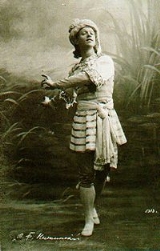
Vaslav Nijinsky ( /
Vaclav Fomič Nižinskij; ˌvatslɐf foˌmʲitʃ nʲɪˈʐinskʲɪj; ; ; March 12, 1890 - April 8, 1950) was a
RussianThe Russian people are an East Slavic ethnic group native to Russia, speaking the Russian language and primarily living in Russia and neighboring countries....
balletBallet is a type of performance dance, that originated in the Italian Renaissance courts of the 15th century, and which was further developed in France and Russia as a concert dance form. The early portions preceded the invention of the proscenium stage and were presented in large chambers with...
dancer and choreographer of
Polishthumb|right|180px|The state flag of [[Poland]] as used by Polish government and diplomatic authoritiesThe Polish people, or Poles , are a nation indigenous to Poland. They are united by the Polish language, which belongs to the historical Lechitic subgroup of West Slavic languages of Central Europe...
descent, cited as the greatest male dancer of the 20th century. He grew to be celebrated for his virtuosity and for the depth and intensity of his characterizations. He could perform
en pointeEn pointe means "on the tip" and is a part of classical ballet technique, usually practised using specially reinforced shoes called pointe shoes or toe shoes. The technique developed from the desire for dancers to appear weightless and sylph-like and has evolved to enable dancers to dance on the...
, a rare skill among male dancers at the time (Albright, 2004) and his ability to perform seemingly gravity-defying leaps was also legendary. The choreographer
Bronislava NijinskaBronislava Nijinska - February 22, 1972)) was a Russian dancer, choreographer, and teacher of Polish descent.Nijinska was born in Minsk, the third child of the Polish dancers Tomasz and Eleonora Nijinska . Her brother was Vaslav Nijinsky...
was his sister. He also had a brother Stassik Nijinsky.
Biography
Vaslav Nijinsky was born in
KievKiev or Kyiv is the capital and the largest city of Ukraine, located in the north central part of the country on the Dnieper River. The population as of the 2001 census was 2,611,300. However, higher numbers have been cited in the press....
,
UkraineUkraine is a country in Eastern Europe. It has an area of 603,628 km², making it the second largest contiguous country on the European continent, after Russia...
as
Wacław Niżyński, to ethnic Polish parents, dancers Tomasz Niżyński and Eleonora Bereda. Nijinsky was christened in
WarsawWarsaw is the capital and largest city of Poland. It is located on the Vistula River, roughly from the Baltic Sea and from the Carpathian Mountains. Its population in 2010 was estimated at 1,716,855 residents with a greater metropolitan area of 2,631,902 residents, making Warsaw the 10th most...
, and considered himself to be a
Polethumb|right|180px|The state flag of [[Poland]] as used by Polish government and diplomatic authoritiesThe Polish people, or Poles , are a nation indigenous to Poland. They are united by the Polish language, which belongs to the historical Lechitic subgroup of West Slavic languages of Central Europe...
despite difficulties in properly speaking the language as a result of his childhood in Russia's interior where his parents worked.
In 1900 Nijinsky joined the Imperial Ballet School, where he studied under
Enrico CecchettiEnrico Cecchetti was an Italian ballet dancer, mime, and founder of the Cecchetti method. The son of two dancers from Civitanova Marche, he was born in the costuming room of the Teatro Tordinona in Rome. After an illustrious career as a dancer in Europe, he went to dance for the Imperial Ballet in...
, Nikolai Legat, and
Pavel GerdtPavel Andreyevich Gerdt, also known as Paul Gerdt , was the Premier Danseur Noble of the Imperial Ballet, the Bolshoi Kamenny Theatre, and the Mariinsky Theatre for 56 years, making his debut in 1860, and retiring in 1916...
. At 18 years old he was given a string of leads. In 1910, the company's
Prima ballerina assolutaPrima ballerina assoluta is a rank or title given to notable female ballet dancers. To be recognised as a prima ballerina assoluta is a very rare honour, reserved only for the most exceptional soloists, usually those who have achieved international acclaim....
Mathilde KschessinskaMathilda-Marie Feliksovna Kschessinskaya She was known in the West as Mathilde Kschessinska or Matilda Kshesinskaya.- Life :Kschessinska was born at Ligovo, near Peterhof. Like all her Polish family, to whom she was known as Matylda Krzesińska, Mathilde performed at the Imperial Mariinsky Theatre...
selected Nijinsky to dance in a revival of
Marius PetipaVictor Marius Alphonse Petipa was a French ballet dancer, teacher and choreographer. Petipa is considered to be the most influential ballet master and choreographer of ballet that has ever lived....
's
Le TalismanThe Talisman - Fantastic ballet in 4 Acts-7 Scenes, with choreography by Marius Petipa, and music by Riccardo Drigo. Libretto by Konstantin Augustovich Tarnovsky and Marius Petipa....
, during which Nijinsky created a sensation in the role of the Wind God Vayou.
A turning point for Nijinsky was his meeting
Sergei DiaghilevSergei Pavlovich Diaghilev , usually referred to outside of Russia as Serge, was a Russian art critic, patron, ballet impresario and founder of the Ballets Russes, from which many famous dancers and choreographers would arise.-Early life and career:...
, a celebrated and highly innovative producer of ballet and opera as well as art exhibitions, who concentrated on promoting Russian visual and musical art abroad, particularly in Paris. Nijinsky and Diaghilev became lovers for a time, and Diaghilev was heavily involved in directing and managing Nijinsky's career. In 1909 Diaghilev took a company of Russian opera and ballet stars to Paris featuring Nijinsky and Anna Pavlova. The season of colorful Russian ballets and operas, works mostly new to the West, was a great success. It led Diaghilev to create his famous company the
Ballets RussesThe Ballets Russes was an itinerant ballet company from Russia which performed between 1909 and 1929 in many countries. Directed by Sergei Diaghilev, it is regarded as the greatest ballet company of the 20th century. Many of its dancers originated from the Imperial Ballet of Saint Petersburg...
with choreographer
Michel FokineMichel Fokine was a groundbreaking Russian choreographer and dancer.-Biography:...
and designer
Léon BakstLéon Samoilovitch Bakst was a Russian painter and scene- and costume designer. He was a member of the Sergei Diaghilev circle and the Ballets Russes, for which he designed exotic, richly coloured sets and costumes...
. The Paris seasons of the Ballets Russes were an artistic and social sensation; setting trends in art, dance, music and fashion for the next decade.
Nijinsky's unique talent showed in Fokine's pieces such as Le Pavillon d'Armide (music by
Nikolai TcherepninNikolai Nikolayevich Tcherepnin was a Russian composer, pianist, and conductor. He was born in Saint Petersburg and studied under Nikolai Rimsky-Korsakov at the Saint Petersburg Conservatory...
), Cleopatra (music by
Anton ArenskyAnton Stepanovich Arensky -Biography:Arensky was born in Novgorod, Russia. He was musically precocious and had composed a number of songs and piano pieces by the age of nine...
and other Russian composers) and a
divertissementDivertissement is used, in a similar sense to the Italian 'divertimento', for a light piece of music for a small group of players, however the French term has additional meanings....
La Fète. His expressive execution of a
pas de deuxIn ballet, a pas de deux is a duet in which ballet dancers perform the dance together. It usually consists of an entrée, adagio, two variations , and a coda.-Notable Pas de deux:...
from The Sleeping Beauty (
TchaikovskyPyotr Ilyich Tchaikovsky Pyotr Ilyich Tchaikovsky Pyotr Ilyich Tchaikovsky (Russian: Пётр Ильи́ч Чайко́вский ; often "Peter Ilich Tchaikovsky" in English. His names are also transliterated "Piotr" or "Petr"; "Ilitsch", "Il'ich" or "Illyich"; and "Tschaikowski", "Tschaikowsky", "Chajkovskij"...
) was a tremendous success; in 1910 he performed in
GiselleGiselle is a ballet in two acts with a libretto by Jules-Henri Vernoy de Saint-Georges and Théophile Gautier, music by Adolphe Adam, and choreography by Jean Coralli and Jules Perrot. The librettist took his inspiration from a poem by Heinrich Heine...
, and Fokine's ballets
CarnavalCarnaval is a ballet of the Ballets Russes, based on the music of Robert Schumann's, Carnaval, for piano, as orchestrated by Aleksandr Glazunov, Nikolai Rimsky-Korsakov, Anatole Liadov, Alexander Tcherepnin...
and
ScheherazadeSheherazade , Op. 35, is a symphonic suite composed by Nikolai Rimsky-Korsakov in 1888. Based on One Thousand and One Nights, sometimes known as The Arabian Nights, this orchestral work combines two features common to Russian music and of Rimsky-Korsakov in particular: dazzling, colourful...
(based on the orchestral suite by
Rimsky-KorsakovNikolai Andreyevich Rimsky-Korsakov was a Russian composer, and a member of the group of composers known as The Five.The Five, also known as The Mighty Handful or The Mighty Coterie, refers to a circle of composers who met in Saint Petersburg, Russia, in the years 1856–1870: Mily Balakirev , César...
). His partnership with
Tamara KarsavinaTamara Platonovna Karsavina was a famous Russian ballerina, renowned for her beauty, who was most noted as a Principal Artist of the Imperial Russian Ballet and later the Ballets Russes of Serge Diaghilev...
, also of the
Mariinsky TheatreThe Mariinsky Theatre is a historic theatre of opera and ballet in Saint Petersburg, Russia. Opened in 1860, it became the preeminent music theatre of late 19th century Russia, where many of the stage masterpieces of Tchaikovsky, Mussorgsky, and Rimsky-Korsakov received their premieres. The...
, was legendary, and they have been called the "most exemplary artists of the time".
Then Nijinsky went back to the Mariinsky Theatre, but was dismissed for appearing on-stage during a performance as Albrecht in Giselle wearing tights without the modesty trunks obligatory for male dancers in the company. The Dowager Empress Maria Feodorovna complained that his appearance was obscene, and he was dismissed. It is probable that the scandal was arranged by Diaghilev in order that Nijinsky could be free to appear with his company, in the West, where many of his projects now centered around him. He danced lead roles in Fokine's new productions
Le Spectre de la RoseLe Spectre de la Rose is a ballet of the Ballets Russes based on a poem by Théophile Gautier. The music, by Carl Maria von Weber, was his 1819 piano piece Invitation to the Dance, in the 1841 orchestration by Hector Berlioz. Choreography was by Michel Fokine and set and costume design by Léon Bakst...
(
WeberCarl Maria Friedrich Ernst von Weber was a German composer, conductor, pianist, guitarist and critic, one of the first significant composers of the Romantic school....
) and
Igor StravinskyIgor Fyodorovich Stravinsky ; 6 April 1971) was a Russian, later naturalized French, and then naturalized American composer, pianist, and conductor....
's
PetrushkaPetrouchka or Petrushka is a ballet with music by Russian composer Igor Stravinsky, composed in 1910–11 and revised in 1947....
, in which his impersonation of a lovelorn puppet was widely hailed.
Nijinsky took the creative reins and choreographed ballets, which pushed boundaries and stirred controversy. His ballets were L'après-midi d'un faune (The Afternoon of a Faun, based on
Claude DebussyClaude-Achille Debussy was a French composer. Along with Maurice Ravel, he was one of the most prominent figures working within the field of impressionist music, though he himself intensely disliked the term when applied to his compositions...
's
Prélude à l'après-midi d'un faunePrélude à l'après-midi d'un faune , commonly known by its English title Prelude to the Afternoon of a Faun, is a symphonic poem for orchestra by Claude Debussy, approximately 10 minutes in duration...
) (1912),
JeuxJeux is the last work for orchestra written by Claude Debussy. Described as a "poème dansé" , it was originally intended to accompany a ballet, and was written for the Ballets Russes of Serge Diaghilev to choreography by Vaslav Nijinsky. Debussy initially objected to the scenario, but...
(1913), Till Eulenspiegel (1916). In
The Rite of SpringThe Rite of Spring, original French title Le sacre du printemps , is a ballet with music by Igor Stravinsky; choreography by Vaslav Nijinsky; and concept, set design and costumes by Nicholas Roerich...
(Le Sacre du Printemps), with music by Stravinsky) (1913), Nijinsky created choreography that exceeded the limits of traditional ballet and propriety. For the first time, his audiences were experiencing the futuristic, new direction of modern dance. The radically angular movements expressed the heart of Stravinsky's radically modern score. Unfortunately, Nijinsky's new trends in dance caused a riotous reaction at the Théâtre de Champs-Élysées when they premiered in Paris. As the title character in L'après-midi d'un faune the final tableau (or scene), during which he mimed masturbation with the scarf of a nymph, caused a scandal; he was accused by half of Paris of obscenity, but defended by such artists as
Auguste RodinFrançois-Auguste-René Rodin , known as Auguste Rodin , was a French sculptor. Although Rodin is generally considered the progenitor of modern sculpture, he did not set out to rebel against the past...
,
Odilon RedonBertrand-Jean Redon, better known as Odilon Redon was a French symbolist painter, printmaker, draughtsman and pastellist.-Life:...
and
Marcel ProustValentin Louis Georges Eugène Marcel Proust was a French novelist, critic, and essayist best known for his monumental À la recherche du temps perdu...
.
In 1913 the Ballets Russes toured South America. Diaghilev did not make this journey, because of a superstitious fear that he would die on the ocean if he ever sailed. Free from supervision, Nijinsky became acquainted with
Romola de PulszkyRomola de Pulszky , , was a Hungarian aristocrat, the daughter of a Hungarian actress who became the wife of the famous ballet dancer Vaslav Nijinsky.-Biography:...
, a Hungarian countess. An ardent fan of Nijinsky, she took up ballet and used her family connections to get close to him. Despite her efforts to attract him, Nijinsky initially appeared unaware of her interest. Finally, on board the ship on tour to South America she succeeded in engaging his affections. They were married in
Buenos AiresBuenos Aires is the capital and largest city of Argentina, and the second-largest metropolitan area in South America, after São Paulo. It is located on the western shore of the estuary of the Río de la Plata, on the southeastern coast of the South American continent...
. When the company returned to Europe Diaghilev is reported to have flown into a rage, culminating in Nijinsky's dismissal. Nijinsky tried in vain to create his own troupe, but a crucial London engagement failed due to administrative problems.
During World War I, Nijinsky was interned in Hungary. Diaghilev with the help of King
Alfonso XIII of SpainAlfonso XIII was King of Spain from 1886 until 1931. His mother, Maria Christina of Austria, was appointed regent during his minority...
succeeded in getting him out for a North American tour in 1916. During this time, Nijinsky choreographed and danced the leading role in Till Eulenspiegel. However, it was around this time in his life that signs of his
schizophreniaSchizophrenia is a mental disorder characterized by a disintegration of thought processes and of emotional responsiveness. It most commonly manifests itself as auditory hallucinations, paranoid or bizarre delusions, or disorganized speech and thinking, and it is accompanied by significant social...
were becoming apparent to members of the company. He suffered a nervous breakdown in 1919, and his career effectively ended. He was diagnosed with schizophrenia and taken to Switzerland by his wife, where he was treated unsuccessfully by psychiatrist
Eugen BleulerPaul Eugen Bleuler was a Swiss psychiatrist most notable for his contributions to the understanding of mental illness and for coining the term "schizophrenia."-Biography:...
.
He spent the rest of his life in and out of psychiatric hospitals and asylums. During the last days of World War II, Nijinsky danced in public for the last time. He encountered a group of Russian soldiers decamped outside of Vienna, playing traditional folk tunes. Inspired by the music and his reunion with his countrymen, he leapt into an exquisite dance, astounding the men with the complexity and grace of his figures. The experience restored some of Nijinsky's capacity for communication, after having maintained long periods of almost absolute silence. Nijinsky died in a clinic in
LondonLondon is the capital city of :England and the :United Kingdom, the largest metropolitan area in the United Kingdom, and the largest urban zone in the European Union by most measures. Located on the River Thames, London has been a major settlement for two millennia, its history going back to its...
on April 8, 1950 and was buried in London until 1953 when his body was moved to
Montmartre CemeteryMontmartre Cemetery is a cemetery in the 18th arrondissement of Paris, France.-History:Cemeteries had been banned from Paris since the shutting down of the Cimetière des Innocents in 1786, as they presented health hazards...
, Paris, France beside the graves of
Gaétan VestrisGaetano Apolline Baldassarre Vestris , French ballet dancer, was born in Florence and made his debut at the opera in 1749....
,
Théophile GautierPierre Jules Théophile Gautier was a French poet, dramatist, novelist, journalist, art critic and literary critic....
, and
Emma LivryEmma Livry was one of the last ballerinas of the Romantic ballet era and a protégée of Marie Taglioni...
.
After his death, a medical examiner hoping to account for Nijinsky's amazing leaps, cut open Nijinsky's feet to see if the bones or formations were any different from the feet of an average male. Disappointed, he discovered nothing unusual.
Legacy
Nijinsky's daughter Kyra married the Ukrainian conductor
Igor MarkevitchIgor Markevitch was a Ukrainian, Italian, and French composer and conductor.- Origin :Igor Markevich was born in Kiev, to an old family of Ukrainian Cossack starshyna ennobled in the 18th century...
, and they had a son named Vaslav. The marriage ended in divorce.
Nijinsky's Diary was written during the six weeks he spent in Switzerland before being committed to the asylum. Obscure and confused, it is obviously the work of a schizophrenic, but in many ways reflects a loving nature, combining elements of autobiography with appeals for compassion toward the less fortunate, and for vegetarianism and animal rights. Nijinsky writes of the importance of feeling as opposed to reliance on reason and logic alone, and he denounces the practice of
art criticismArt criticism is the discussion or evaluation of visual art.Art critics usually criticize art in the context of aesthetics or the theory of beauty...
as being nothing more than a way for those who practice it to indulge their own egos rather than focusing on what the artist was trying to say. The diary also contains bitter and conflicted thoughts regarding his relationship with Diaghilev.
As a dancer Nijinsky was extraordinary for his time. Towards the end of her life his dance partner Karsavina suggested that any young dancer out of the Royal Ballet School could now perform the technical feats with which he astonished his contemporaries. His main talent was probably as much in his charisma and skill in mime and characterization as strictly technical ability (Stanislas Idzikowski could leap as high and as far). In
epiceneEpicene is an adjective for loss of gender distinction, often specific loss of masculinity. It includes:* effeminacy — a man with characteristics that are traditionally feminine...
roles such as the god in Le Dieu Bleu, the rose in Spectre or the favourite slave in Scheherezade he was unsurpassed.
Nijinsky is immortalized in numerous still photographs, many of which were made by
E.O. HoppéEmil Otto Hoppé was a German-born British portrait, travel, and topographic photographer active between 1907 and 1945...
, who extensively photographed the Ballets Russes London seasons between 1909 and 1921. However no film exists of Nijinsky dancing. Diaghilev never allowed the Ballets Russes to be filmed. He felt that the quality of film at the time could never capture the artistry of his dancers and that the reputation of the company would suffer if people saw it only in short jerky films.
In plays
- Clownmaker (1975) Richard Crane/Faynia Williams Edinburgh Festival Fringe First Award, transfer to London and New York
- In 1974-75, Terence Rattigan
Sir Terence Mervyn Rattigan CBE was one of England's most popular 20th-century dramatists. His plays are generally set in an upper-middle-class background...
was commissioned to write a play about Nijinsky and Diaghilev, as the BBC's Play of the Month. He completed the script and was very happy with it, but Romola Nijinsky objected to her late husband's being depicted as a homosexual. Rattigan, himself a homosexual, was sympathetic to her view and decided he did not want the work produced in his lifetime, so he withdrew it. He died in 1977; the play has never been staged.
- A Cavalier for Milady: A Play in Two Scenes
One-act plays by Tennessee Williams is a list of the one-act plays written by American playwright Tennessee Williams.-Beauty Is the Word:...
[c. 1976] is a one act play by Tennessee WilliamsThomas Lanier "Tennessee" Williams III was an American writer who worked principally as a playwright in the American theater. He also wrote short stories, novels, poetry, essays, screenplays and a volume of memoirs...
that includes a fantastical, non-literal appearance by Nijinsky. In the play, an adult woman named Nance (who is dressed a Victorian eraThe Victorian era of British history was the period of Queen Victoria's reign from 20 June 1837 until her death on 22 January 1901. It was a long period of peace, prosperity, refined sensibilities and national self-confidence...
child) has been left by her mother with a hostile "babysitter," who is distressed by the attention that Nance is paying to a Greek statue of a "naked man" (while keeping her fingers running on her lap). Eventually the babysitter leaves and an apparition of Nijinsky appears and comforts Nance about her mental state in a strange, touching interaction.
- Chinchilla (1977) by Robert David MacDonald.
- Nijinsky: God's Mad Clown (1986) by Glenn J. Blumstein.
- Niżyński (2005) by Waldemar Zawodzinski.
Dancing With Demons, Diaghilev, Nijinsky and the Ballets Russes, (2011) by Richard Crane/ Faynia Williams, V&A Museum London and Brighton Festival
- In 2011, actor/playwright Jade Esteban Estrada
Jade Esteban Estrada is a successful Latin pop singer, comedian, choreographer, actor, political commentator, and human rights activist...
portrayed Nijinsky in the solo musical, "ICONS: The Lesbian and Gay History of the World, Vol. 5."
In film
- Nijinsky (uncompleted film, 1970)
The
screenplayA screenplay or script is a written work that is made especially for a film or television program. Screenplays can be original works or adaptations from existing pieces of writing. In them, the movement, actions, expression, and dialogues of the characters are also narrated...
was written by
Edward AlbeeEdward Franklin Albee III is an American playwright who is best known for The Zoo Story , The Sandbox , Who's Afraid of Virginia Woolf? , and a rewrite of the screenplay for the unsuccessful musical version of Capote's Breakfast at Tiffany's . His works are considered well-crafted, often...
. The film was to be directed by
Tony RichardsonCecil Antonio "Tony" Richardson was an English theatre and film director and producer.-Early life:Richardson was born in Shipley, Yorkshire in 1928, the son of Elsie Evans and Clarence Albert Richardson, a chemist...
and star
Rudolf NureyevRudolf Khametovich Nureyev was a Russian dancer, considered one of the most celebrated ballet dancers of the 20th century. Nureyev's artistic skills explored expressive areas of the dance, providing a new role to the male ballet dancer who once served only as support to the women.In 1961 he...
as Nijinsky,
Claude JadeClaude Marcelle Jorré, better known as Claude Jade , was a French actress, known for starring as Christine in François Truffaut's three films Stolen Kisses , Bed and Board and Love on the Run . Jade acted in theatre, film and television...
as Romola and
Paul ScofieldDavid Paul Scofield, CH, CBE , better known as Paul Scofield, was an English actor of stage and screen...
as Diaghilev, but producers
Albert R. BroccoliAlbert Romolo Broccoli, CBE , nicknamed "Cubby", was an American film producer, who made more than 40 motion pictures throughout his career, most of them in the United Kingdom, and often filmed at Pinewood Studios. Co-founder of Danjaq, LLC and EON Productions, Broccoli is most notable as the...
and
Harry SaltzmanHarry Saltzman was a Canadian theatre and film producer best known for his mega-gamble which resulted in his co-producing the James Bond film series with Albert R...
canceled the project.
- Nijinsky
Nijinsky is a 1980 American biographical film directed by Herbert Ross. Hugh Wheeler, whose screenplay centers on the later life and career of Vaslav Nijinsky, used the legendary dancer's personal diaries and his wife's 1933 book Life of Nijinsky as his primary source materials.-Synopsis:The film...
(1980)
Directed by
Herbert RossHerbert Ross was an American film director, producer, choreographer and actor.-Early life and career:Born Herbert David Ross in Brooklyn, New York, he made his stage debut as Third Witch with a touring company of Macbeth in 1942...
, starring
George de la PeñaGeorge de la Peña is an American ballet dancer, musical theatre performer, choreographer, actor, and teacher. He was born in New York City, New York, U.S....
as Nijinsky,
Leslie BrowneLeslie Browne is an American ballet dancer and actress.She was born Leslie Brown, the daughter of Kelly Brown and Isabel Mirrow. She had two brothers and one sister; her brother Kevin is a film producer. At the age of seven she began dancing, and would be trained at her father's studio in Arizona,...
as Romola,
Alan BatesSir Alan Arthur Bates CBE was an English actor, who came to prominence in the 1960s, a time of high creativity in British cinema, when he demonstrated his versatility in films ranging from the popular children’s story Whistle Down the Wind to the "kitchen sink" drama A Kind of Loving...
as Diaghilev and
Jeremy IronsJeremy John Irons is an English actor. After receiving classical training at the Bristol Old Vic Theatre School, Irons began his acting career on stage in 1969, and has since appeared in many London theatre productions including The Winter's Tale, Macbeth, Much Ado About Nothing, The Taming of the...
as Fokine. Romola Nijinsky had a writing credit for the film.
- The Diaries of Vaslav Nijinsky (2001)
Directed and written by
Paul CoxPaulus Henriqus Benedictus "Paul" Cox is an award-winning Australian film director.Cox was born in Venlo, Limburg, the Netherlands, the son of Else , a native of Germany, and Wim Cox, a documentary film producer. Cox emigrated to Australia in 1965...
. The screenplay was based directly on Nijinsky's diaries and read over related imagery. The subject matter included his work, his sickness, and his relationships with Diaghilev as well as his wife.
A TV drama, directed by
Andy WilsonAndy Wilson is a British film, TV and theatre director, born in 1958.-Early career:Wilson began his career as a performer with Circus Lumiere...
. Centers around the first performance of The Rite of Spring. Nijinsky is portrayed by
Adam GarciaAdam Garcia is an Australian actor and tap dancer of partial Colombian descent .-Career:...
.
- Nijinsky & Neumeier Soulmates in Dance (2009)
Documentary on influence of Nijinsky's work on the contemporary American choreographer
John NeumeierJohn Neumeier is a well-known American ballet dancer, choreographer, and director. He has been the director and chief choreographer of the Hamburg Ballet since 1973. 5 years later he founded the Hamburg Ballet School, which also includes a boarding school...
. Produced by Lothar Mattner for WDR/ARTE.
By Jan Kounen
- Coco Chanel & Igor Stravinsky
Coco Chanel & Igor Stravinsky is a 2009 French film directed by Jan Kounen. It was chosen as the Closing Film of the 2009 Cannes Film Festival, and was shown on 24 May 2009....
(2009)
A French film directed by
Jan KounenJan Kounen is a Dutch-born French film director and producer.In France, he is mostly known for his films Dobermann , Blueberry, l'experience secrete and 99 francs ....
about an affair between Coco Chanel and Igor Stravinsky. Nijinsky is portrayed in scenes depicting the creation of The Rite of Spring. Character of Nijinsky played by Polish actor Marek Kossakowski.
In poetry
- The War of Vaslav Nijinsky (1981) by poet Frank Bidart
Frank Bidart is an American academic and poet.-Biography:In 1957, he began to study at the University of California at Riverside and went on to Harvard, where he was a student and friend of Robert Lowell and Elizabeth Bishop...
- September 1, 1939
"September 1, 1939" is a poem by W. H. Auden written on the occasion of the outbreak of World War II. It was first published in The New Republic issue of October 18, 1939, and was first published in book form in Auden's collection Another Time ....
(1939) by poet W.H. Auden
In music
- In 2011, composer Jade Esteban Estrada
Jade Esteban Estrada is a successful Latin pop singer, comedian, choreographer, actor, political commentator, and human rights activist...
wrote the song "Beautiful" for the musical, ICONS: The Lesbian and Gay History of the World, Vol. 5.
- A verse of the song "Dancing" from the album Mask (1981) by the Bauhaus refers to Nijinsky "...Dancing on hallowed ground/Dancing Nijinsky style/Dancing with the lost and found..."
- A verse of the song "Prospettiva Nevskj" from the Album "Patriots" (1980) by Franco Battiato quotes Nijinsky, his peculiar dancing style, and hints to his relation with Diaghilev "poi guardavamo con le facce assenti la grazia innaturale di Nijinsky. E poi di lui si innamorò perdutamente il suo impresario e dei balletti russi "
Sources
- Albright, Daniel (2004). "Modernism and Music: An Anthology of Sources", p. 19. University of Chicago Press. ISBN 0-226-01267-0.
- Bergamini, John (1969) "The Tragic Dynasty: A History of the Romanovs", pg. 430. Konecky and Konecky. ISBN 1-56852-160-X
- Buckle, Richard
Christopher Richard Sandford Buckle, better known as Richard Buckle, was a lifelong devotee of ballet, and a well-known ballet critic. He founded the magazine Ballet in 1939, and revived it after the war...
(1971) "Nijinsky"
- Buckle, Richard
Christopher Richard Sandford Buckle, better known as Richard Buckle, was a lifelong devotee of ballet, and a well-known ballet critic. He founded the magazine Ballet in 1939, and revived it after the war...
(1979) "Diaghilev
- Kopelson, Kevin
Kevin Kopelson, born in 1960, is an American literary critic. He received a B.A. from Yale University, a J.D. from Columbia University, and a Ph.D. from Brown University...
(1997) The Queer Afterlife of Vaslav Nijinsky. Stanford University Press. ISBN 0-8047-2950-6
- Parker, Derek (1988) "Nijinsky: God of the Dance"
External links