

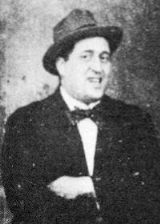
Guillaume Apollinaire

Encyclopedia
Wilhelm Albert Włodzimierz Apolinary Kostrowicki, known as Guillaume Apollinaire (ɡijom apɔliˈnɛʁ; Rome
, 26 August 1880 – 9 November 1918, Paris
) was a French
poet
, playwright
, short story writer, novelist, and art critic
born in Italy to a Polish
mother.
Among the foremost poets of the early 20th century, he is credited with coining the word Surrealism
and writing one of the earliest works described as surrealist, the play
The Breasts of Tiresias
(1917, used as the basis for a 1947 opera
). Two years after being wounded in World War I
, he died in the Spanish flu
pandemic
of 1918 at age 38.
born near Navahrudak (now in Belarus
). His maternal grandfather was a general in the Russian Imperial Army, killed in the Crimean War
. Apollinaire's father is unknown but may have been Francesco Flugi d'Aspermont, a Swiss Italian aristocrat who disappeared early from Apollinaire's life. Apollinaire was partly educated in Monaco
.
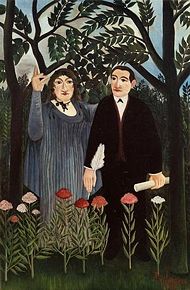
Apollinaire was one of the most popular members of the artistic community of Montparnasse
in Paris. His friends and collaborators in that period included Pablo Picasso
, Gertrude Stein
, Max Jacob
, André Salmon
, Marie Laurencin
, André Breton
, André Derain
, Faik Konica
, Blaise Cendrars
, Pierre Reverdy
, Alexandra Exter, Jean Cocteau
, Erik Satie
, Ossip Zadkine
, Marc Chagall
, and Marcel Duchamp
. In 1911, he joined the Puteaux Group, a branch of the cubist movement.
On 7 September 1911, police arrested and jailed him on suspicion of aiding and abetting the theft of the Mona Lisa
and a number of Egyptian statuettes from the Louvre
, but released him a week later. These thefts were committed by a Russian friend to whom Apollinaire gave shelter, and Apollinaire voluntarily surrendered a number of stolen statuettes left behind by him. Apollinaire implicated his friend Pablo Picasso
, who was also brought in for questioning in the theft of Mona Lisa, but he was also exonerated. He once called for the Louvre
to be burnt down. Apollinaire was active as a journalist and art critic for Matin, Intransigean, and Paris Journal.
He fought in World War I
and, in 1916, received a serious shrapnel wound to the temple. He wrote Les Mamelles de Tirésias
while recovering from this wound. During this period he coined the word surrealism
in the program notes for Jean Cocteau
and Erik Satie
's ballet
Parade
, first performed on 18 May 1917. He also published an artistic manifesto, L'Esprit nouveau et les poètes. Apollinaire's status as a literary critic is most famous and influential in his recognition of the Marquis de Sade
, whose works were for a long time obscure, yet arising in popularity as an influence upon the Dada
and Surrealist art movements going on in Montparnasse at the beginning of the twentieth century as, "The freest spirit that ever existed."
The war-weakened Apollinaire died of influenza
during the Spanish Flu
pandemic of 1918. He was interred in the Père Lachaise Cemetery
, Paris
.
was L'enchanteur pourrissant (1909), but Alcools
(1913) established his reputation. The poems, influenced in part by the Symbolist
s, juxtapose the old and the new, combining traditional poetic forms with modern imagery. In 1913, Apollinaire published the essay
Les Peintres cubistes on the cubist painters, a movement which he helped to define. He also coined the term orphism to describe a tendency towards absolute abstraction in the paintings of Robert Delaunay
and others.
 In 1907, Apollinaire wrote the well-known erotic novel
, The Eleven Thousand Rods (Les Onze Mille Verges). Officially banned in France until 1970, various printings of it circulated widely for many years. Apollinaire never publicly acknowledged authorship of the novel. Another erotic novel attributed to him was The Exploits of a Young Don Juan
(Les exploits d'un jeune Don Juan), in which the 15-year-old hero fathers three children with various members of his entourage, including his aunt. The book was made into a movie in 1987.
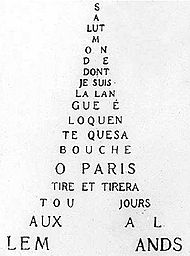
Shortly after his death, Calligrammes
, a collection of his concrete poetry
(poetry in which typography and layout adds to the overall effect), and more orthodox, though still modernist poems informed by Apollinaire's experiences in the First World War and in which he often used the technique of automatic writing, was published.
In his youth Apollinaire lived for a short while in Belgium
, mastering the Walloon
dialect sufficiently to write poetry through that medium, some of which has survived.
Poetry:
Prose:
Plays:
Articles:
Rome
Rome is the capital of Italy and the country's largest and most populated city and comune, with over 2.7 million residents in . The city is located in the central-western portion of the Italian Peninsula, on the Tiber River within the Lazio region of Italy.Rome's history spans two and a half...
, 26 August 1880 – 9 November 1918, Paris
Paris
Paris is the capital and largest city in France, situated on the river Seine, in northern France, at the heart of the Île-de-France region...
) was a French
France
The French Republic , The French Republic , The French Republic , (commonly known as France , is a unitary semi-presidential republic in Western Europe with several overseas territories and islands located on other continents and in the Indian, Pacific, and Atlantic oceans. Metropolitan France...
poet
Poet
A poet is a person who writes poetry. A poet's work can be literal, meaning that his work is derived from a specific event, or metaphorical, meaning that his work can take on many meanings and forms. Poets have existed since antiquity, in nearly all languages, and have produced works that vary...
, playwright
Playwright
A playwright, also called a dramatist, is a person who writes plays.The term is not a variant spelling of "playwrite", but something quite distinct: the word wright is an archaic English term for a craftsman or builder...
, short story writer, novelist, and art critic
Art critic
An art critic is a person who specializes in evaluating art. Their written critiques, or reviews, are published in newspapers, magazines, books and on web sites...
born in Italy to a Polish
Poland
Poland , officially the Republic of Poland , is a country in Central Europe bordered by Germany to the west; the Czech Republic and Slovakia to the south; Ukraine, Belarus and Lithuania to the east; and the Baltic Sea and Kaliningrad Oblast, a Russian exclave, to the north...
mother.
Among the foremost poets of the early 20th century, he is credited with coining the word Surrealism
Surrealism
Surrealism is a cultural movement that began in the early 1920s, and is best known for the visual artworks and writings of the group members....
and writing one of the earliest works described as surrealist, the play
Play (theatre)
A play is a form of literature written by a playwright, usually consisting of scripted dialogue between characters, intended for theatrical performance rather than just reading. There are rare dramatists, notably George Bernard Shaw, who have had little preference whether their plays were performed...
The Breasts of Tiresias
The Breasts of Tiresias
The Breasts of Tiresias is a surrealist play by Guillaume Apollinaire. Written in 1903, the play received its first production in a revised version in 1917...
(1917, used as the basis for a 1947 opera
Les mamelles de Tirésias
Les mamelles de Tirésias is a surrealist two-act opéra bouffe by Francis Poulenc, based on the play of the same title by Guillaume Apollinaire, which was written in 1903 but first performed in 1917...
). Two years after being wounded in World War I
World War I
World War I , which was predominantly called the World War or the Great War from its occurrence until 1939, and the First World War or World War I thereafter, was a major war centred in Europe that began on 28 July 1914 and lasted until 11 November 1918...
, he died in the Spanish flu
Spanish flu
The 1918 flu pandemic was an influenza pandemic, and the first of the two pandemics involving H1N1 influenza virus . It was an unusually severe and deadly pandemic that spread across the world. Historical and epidemiological data are inadequate to identify the geographic origin...
pandemic
Pandemic
A pandemic is an epidemic of infectious disease that is spreading through human populations across a large region; for instance multiple continents, or even worldwide. A widespread endemic disease that is stable in terms of how many people are getting sick from it is not a pandemic...
of 1918 at age 38.
Life
Born Wilhelm Apolinary Kostrowicki and raised speaking French, among other languages, he was a Russian subject. He emigrated to France in his late teens and adopted the name Guillaume Apollinaire. His mother, born Angelika Kostrowicka, was a Polish noblewomanSzlachta
The szlachta was a legally privileged noble class with origins in the Kingdom of Poland. It gained considerable institutional privileges during the 1333-1370 reign of Casimir the Great. In 1413, following a series of tentative personal unions between the Grand Duchy of Lithuania and the Kingdom of...
born near Navahrudak (now in Belarus
Belarus
Belarus , officially the Republic of Belarus, is a landlocked country in Eastern Europe, bordered clockwise by Russia to the northeast, Ukraine to the south, Poland to the west, and Lithuania and Latvia to the northwest. Its capital is Minsk; other major cities include Brest, Grodno , Gomel ,...
). His maternal grandfather was a general in the Russian Imperial Army, killed in the Crimean War
Crimean War
The Crimean War was a conflict fought between the Russian Empire and an alliance of the French Empire, the British Empire, the Ottoman Empire, and the Kingdom of Sardinia. The war was part of a long-running contest between the major European powers for influence over territories of the declining...
. Apollinaire's father is unknown but may have been Francesco Flugi d'Aspermont, a Swiss Italian aristocrat who disappeared early from Apollinaire's life. Apollinaire was partly educated in Monaco
Monaco
Monaco , officially the Principality of Monaco , is a sovereign city state on the French Riviera. It is bordered on three sides by its neighbour, France, and its centre is about from Italy. Its area is with a population of 35,986 as of 2011 and is the most densely populated country in the...
.
Apollinaire was one of the most popular members of the artistic community of Montparnasse
Montparnasse
Montparnasse is an area of Paris, France, on the left bank of the river Seine, centred at the crossroads of the Boulevard du Montparnasse and the Rue de Rennes, between the Rue de Rennes and boulevard Raspail...
in Paris. His friends and collaborators in that period included Pablo Picasso
Pablo Picasso
Pablo Diego José Francisco de Paula Juan Nepomuceno María de los Remedios Cipriano de la Santísima Trinidad Ruiz y Picasso known as Pablo Ruiz Picasso was a Spanish expatriate painter, sculptor, printmaker, ceramicist, and stage designer, one of the greatest and most influential artists of the...
, Gertrude Stein
Gertrude Stein
Gertrude Stein was an American writer, poet and art collector who spent most of her life in France.-Early life:...
, Max Jacob
Max Jacob
Max Jacob was a French poet, painter, writer, and critic.-Life and career:After spending his childhood in Quimper, Brittany, France, he enrolled in the Paris Colonial School, which he left in 1897 for an artistic career...
, André Salmon
André Salmon
André Salmon was a French poet, art critic and writer. He was one of the defenders of cubism, with Guillaume Apollinaire and Maurice Raynal.-Biography:Andre Salmon was born in Paris...
, Marie Laurencin
Marie Laurencin
Marie Laurencin was a French painter and printmaker. -Biography:Laurencin was born in Paris, where she was raised by her mother and lived much of her life. At 18, she studied porcelain painting in Sèvres...
, André Breton
André Breton
André Breton was a French writer and poet. He is known best as the founder of Surrealism. His writings include the first Surrealist Manifesto of 1924, in which he defined surrealism as "pure psychic automatism"....
, André Derain
André Derain
André Derain was a French artist, painter, sculptor and co-founder of Fauvism with Henri Matisse.-Early years:...
, Faik Konica
Faik Konica
Faik Konica , born in Konitsa, was one of the greatest figures of Albanian culture in the early decades of the twentieth century. Prewar Albanian minister to Washington, his literary review, Albania, became the focal publication of Albanian writers living abroad...
, Blaise Cendrars
Blaise Cendrars
Frédéric Louis Sauser , better known as Blaise Cendrars, was a Swiss novelist and poet naturalized French in 1916. He was a writer of considerable influence in the modernist movement.-Early years:...
, Pierre Reverdy
Pierre Reverdy
Pierre Reverdy was a French poet associated with surrealism and cubism.Pierre Reverdy was born in Narbonne and grew up near the Montagne Noire in his father's house. Reverdy came from a family of sculptors. His father taught him to read and write. He studied at Toulouse and Narbonne.Reverdy...
, Alexandra Exter, Jean Cocteau
Jean Cocteau
Jean Maurice Eugène Clément Cocteau was a French poet, novelist, dramatist, designer, playwright, artist and filmmaker. His circle of associates, friends and lovers included Kenneth Anger, Pablo Picasso, Jean Hugo, Jean Marais, Henri Bernstein, Marlene Dietrich, Coco Chanel, Erik Satie, María...
, Erik Satie
Erik Satie
Éric Alfred Leslie Satie was a French composer and pianist. Satie was a colourful figure in the early 20th century Parisian avant-garde...
, Ossip Zadkine
Ossip Zadkine
Ossip Zadkine was a Belarusian-born artist who lived in France. He is primarily known as a sculptor, but also produced paintings and lithographs.-Early years and career:...
, Marc Chagall
Marc Chagall
Marc Chagall Art critic Robert Hughes referred to Chagall as "the quintessential Jewish artist of the twentieth century."According to art historian Michael J...
, and Marcel Duchamp
Marcel Duchamp
Marcel Duchamp was a French artist whose work is most often associated with the Dadaist and Surrealist movements. Considered by some to be one of the most important artists of the 20th century, Duchamp's output influenced the development of post-World War I Western art...
. In 1911, he joined the Puteaux Group, a branch of the cubist movement.
On 7 September 1911, police arrested and jailed him on suspicion of aiding and abetting the theft of the Mona Lisa
Mona Lisa
Mona Lisa is a portrait by the Italian artist Leonardo da Vinci. It is a painting in oil on a poplar panel, completed circa 1503–1519...
and a number of Egyptian statuettes from the Louvre
Louvre
The Musée du Louvre – in English, the Louvre Museum or simply the Louvre – is one of the world's largest museums, the most visited art museum in the world and a historic monument. A central landmark of Paris, it is located on the Right Bank of the Seine in the 1st arrondissement...
, but released him a week later. These thefts were committed by a Russian friend to whom Apollinaire gave shelter, and Apollinaire voluntarily surrendered a number of stolen statuettes left behind by him. Apollinaire implicated his friend Pablo Picasso
Pablo Picasso
Pablo Diego José Francisco de Paula Juan Nepomuceno María de los Remedios Cipriano de la Santísima Trinidad Ruiz y Picasso known as Pablo Ruiz Picasso was a Spanish expatriate painter, sculptor, printmaker, ceramicist, and stage designer, one of the greatest and most influential artists of the...
, who was also brought in for questioning in the theft of Mona Lisa, but he was also exonerated. He once called for the Louvre
Louvre
The Musée du Louvre – in English, the Louvre Museum or simply the Louvre – is one of the world's largest museums, the most visited art museum in the world and a historic monument. A central landmark of Paris, it is located on the Right Bank of the Seine in the 1st arrondissement...
to be burnt down. Apollinaire was active as a journalist and art critic for Matin, Intransigean, and Paris Journal.
He fought in World War I
World War I
World War I , which was predominantly called the World War or the Great War from its occurrence until 1939, and the First World War or World War I thereafter, was a major war centred in Europe that began on 28 July 1914 and lasted until 11 November 1918...
and, in 1916, received a serious shrapnel wound to the temple. He wrote Les Mamelles de Tirésias
The Breasts of Tiresias
The Breasts of Tiresias is a surrealist play by Guillaume Apollinaire. Written in 1903, the play received its first production in a revised version in 1917...
while recovering from this wound. During this period he coined the word surrealism
Surrealism
Surrealism is a cultural movement that began in the early 1920s, and is best known for the visual artworks and writings of the group members....
in the program notes for Jean Cocteau
Jean Cocteau
Jean Maurice Eugène Clément Cocteau was a French poet, novelist, dramatist, designer, playwright, artist and filmmaker. His circle of associates, friends and lovers included Kenneth Anger, Pablo Picasso, Jean Hugo, Jean Marais, Henri Bernstein, Marlene Dietrich, Coco Chanel, Erik Satie, María...
and Erik Satie
Erik Satie
Éric Alfred Leslie Satie was a French composer and pianist. Satie was a colourful figure in the early 20th century Parisian avant-garde...
's ballet
Ballet
Ballet is a type of performance dance, that originated in the Italian Renaissance courts of the 15th century, and which was further developed in France and Russia as a concert dance form. The early portions preceded the invention of the proscenium stage and were presented in large chambers with...
Parade
Parade (ballet)
Parade is a ballet with music by Erik Satie and a one-act scenario by Jean Cocteau. The ballet was composed 1916-1917 for Serge Diaghilev's Ballets Russes...
, first performed on 18 May 1917. He also published an artistic manifesto, L'Esprit nouveau et les poètes. Apollinaire's status as a literary critic is most famous and influential in his recognition of the Marquis de Sade
Marquis de Sade
Donatien Alphonse François, Marquis de Sade was a French aristocrat, revolutionary politician, philosopher, and writer famous for his libertine sexuality and lifestyle...
, whose works were for a long time obscure, yet arising in popularity as an influence upon the Dada
Dada
Dada or Dadaism is a cultural movement that began in Zurich, Switzerland, during World War I and peaked from 1916 to 1922. The movement primarily involved visual arts, literature—poetry, art manifestoes, art theory—theatre, and graphic design, and concentrated its anti-war politics through a...
and Surrealist art movements going on in Montparnasse at the beginning of the twentieth century as, "The freest spirit that ever existed."
The war-weakened Apollinaire died of influenza
Influenza
Influenza, commonly referred to as the flu, is an infectious disease caused by RNA viruses of the family Orthomyxoviridae , that affects birds and mammals...
during the Spanish Flu
Spanish flu
The 1918 flu pandemic was an influenza pandemic, and the first of the two pandemics involving H1N1 influenza virus . It was an unusually severe and deadly pandemic that spread across the world. Historical and epidemiological data are inadequate to identify the geographic origin...
pandemic of 1918. He was interred in the Père Lachaise Cemetery
Père Lachaise Cemetery
Père Lachaise Cemetery is the largest cemetery in the city of Paris, France , though there are larger cemeteries in the city's suburbs.Père Lachaise is in the 20th arrondissement, and is reputed to be the world's most-visited cemetery, attracting hundreds of thousands of visitors annually to the...
, Paris
Paris
Paris is the capital and largest city in France, situated on the river Seine, in northern France, at the heart of the Île-de-France region...
.
Works
Apollinaire's first collection of poetryPoetry
Poetry is a form of literary art in which language is used for its aesthetic and evocative qualities in addition to, or in lieu of, its apparent meaning...
was L'enchanteur pourrissant (1909), but Alcools
Alcools
Alcools is a collection of poems by the French author Guillaume Apollinaire.- External links :* Alcools * Alcools...
(1913) established his reputation. The poems, influenced in part by the Symbolist
Symbolism (arts)
Symbolism was a late nineteenth-century art movement of French, Russian and Belgian origin in poetry and other arts. In literature, the style had its beginnings with the publication Les Fleurs du mal by Charles Baudelaire...
s, juxtapose the old and the new, combining traditional poetic forms with modern imagery. In 1913, Apollinaire published the essay
Essay
An essay is a piece of writing which is often written from an author's personal point of view. Essays can consist of a number of elements, including: literary criticism, political manifestos, learned arguments, observations of daily life, recollections, and reflections of the author. The definition...
Les Peintres cubistes on the cubist painters, a movement which he helped to define. He also coined the term orphism to describe a tendency towards absolute abstraction in the paintings of Robert Delaunay
Robert Delaunay
Robert Delaunay was a French artist who, with his wife Sonia Delaunay and others, cofounded the Orphism art movement, noted for its use of strong colours and geometric shapes. His later works were more abstract, reminiscent of Paul Klee...
and others.
Novel
A novel is a book of long narrative in literary prose. The genre has historical roots both in the fields of the medieval and early modern romance and in the tradition of the novella. The latter supplied the present generic term in the late 18th century....
, The Eleven Thousand Rods (Les Onze Mille Verges). Officially banned in France until 1970, various printings of it circulated widely for many years. Apollinaire never publicly acknowledged authorship of the novel. Another erotic novel attributed to him was The Exploits of a Young Don Juan
Don Juan
Don Juan is a legendary, fictional libertine whose story has been told many times by many authors. El burlador de Sevilla y convidado de piedra by Tirso de Molina is a play set in the fourteenth century that was published in Spain around 1630...
(Les exploits d'un jeune Don Juan), in which the 15-year-old hero fathers three children with various members of his entourage, including his aunt. The book was made into a movie in 1987.
Shortly after his death, Calligrammes
Calligrammes
Calligrammes, subtitled Poems of war and peace 1913-1916, is a collection of poems by Guillaume Apollinaire, and was first published in 1918 . Calligrammes is noted for how the typeface and spatial arrangement of the words on a page plays just as much of a role in the meaning of each poem as the...
, a collection of his concrete poetry
Concrete poetry
Concrete poetry or shape poetry is poetry in which the typographical arrangement of words is as important in conveying the intended effect as the conventional elements of the poem, such as meaning of words, rhythm, rhyme and so on....
(poetry in which typography and layout adds to the overall effect), and more orthodox, though still modernist poems informed by Apollinaire's experiences in the First World War and in which he often used the technique of automatic writing, was published.
In his youth Apollinaire lived for a short while in Belgium
Belgium
Belgium , officially the Kingdom of Belgium, is a federal state in Western Europe. It is a founding member of the European Union and hosts the EU's headquarters, and those of several other major international organisations such as NATO.Belgium is also a member of, or affiliated to, many...
, mastering the Walloon
Walloon language
Walloon is a Romance language which was spoken as a primary language in large portions of the Walloon Region of Belgium and some villages of Northern France until the middle of the 20th century. It belongs to the langue d'oïl language family, whose most prominent member is the French language...
dialect sufficiently to write poetry through that medium, some of which has survived.
Poetry:
- Le bestiaire ou le cortège d’Orphée, 1911
- Alcools, 1913
- Vitam impendere amori, 1917
- CalligrammesCalligrammesCalligrammes, subtitled Poems of war and peace 1913-1916, is a collection of poems by Guillaume Apollinaire, and was first published in 1918 . Calligrammes is noted for how the typeface and spatial arrangement of the words on a page plays just as much of a role in the meaning of each poem as the...
, poèmes de la paix et de la guerre 1913-1916, 1918 (published shortly after Apollinaire's death) - Il y a..., 1925
- Julie ou la rose, 1927
- Ombre de mon amour, poems addressed to Louise de Coligny-Châtillon, 1947
- Poèmes secrets à Madeleine, pirated edition, 1949
- Le Guetteur mélancolique, previously unpublished works, 1952
- Poèmes à Lou, 1955
- Soldes, previously unpublished works, 1985
- Et moi aussi je suis peintre, album of drawings for Calligrammes, from a private collection, published 2006
Prose:
- Mirely ou le Petit Trou pas cher, 1900
- "Que faire?",
- Les Onze Mille Verges ou les amours d'un hospodar, 1907
- L'enchanteur pourrissant, 1909
- L'Hérèsiarque et Cie (short story collection), 1910
- Les exploits d’un jeune Don Juan, 1911
- La Rome des Borgia, 1914
- La Fin de Babylone - L'Histoire romanesque 1/3, 1914
- Les Trois Don Juan - L'Histoire romanesque 2/3, 1915
- Le poète assassiné, 1916
- La femme assise, 1920
- Les Épingles (short story collection), 1928
Plays:
- Les Mamelles de TirésiasThe Breasts of TiresiasThe Breasts of Tiresias is a surrealist play by Guillaume Apollinaire. Written in 1903, the play received its first production in a revised version in 1917...
, play, 1917 - La Bréhatine, screenplay (collaboration with André Billy), 1917
- Couleurs du temps, 1918
- Casanova, published 1952
Articles:
- Le Théâtre Italien, illustrated encyclopedia, 1910
- Pages d'histoire, chronique des grands siècles de France, chronicles, 1912
- Méditations esthétiques. Les peintres cubistes, 1913
- La Peinture moderne, 1913
- L'Antitradition futuriste, manifeste synthèse, 1913
- Case d'Armons, 1915
- L'esprit nouveau et les poètes, 1918
- Le Flâneur des Deux Rives, chronicles, 1918
External links
- Ebooks from Apollinaire in french at Livres & Ebooks
- Poems in Spanish: A media voz Biografía y poemas de Apollinaire
- Guillaume Apollinaire at amediavoz.com
- Audio recordings of Apollinaire reading his poems "Le Pont Mirabeau", "Marie" and "Le Voyageur"
- English verse translation of Le Pont Mirabeau
- Apollinaire at ubuweb (includes examples of his work)
- The Exploits of a Young Don Juan an e-book (in French)
- Guillaume Apollinaire (poems in French and English)
- Les onze mille verges an e-book (in French)
- Apollinaire-rif at rifondou.walon.org (re. Walloon poetry]
- A digital rendition of Apollinaire's best known poem, "Il Pleut"