

Dada

Encyclopedia

Cultural movement
A cultural movement is a change in the way a number of different disciplines approach their work. This embodies all art forms, the sciences, and philosophies. Historically, different nations or regions of the world have gone through their own independent sequence of movements in culture, but as...
that began in Zurich
Zürich
Zurich is the largest city in Switzerland and the capital of the canton of Zurich. It is located in central Switzerland at the northwestern tip of Lake Zurich...
, Switzerland
Switzerland
Switzerland name of one of the Swiss cantons. ; ; ; or ), in its full name the Swiss Confederation , is a federal republic consisting of 26 cantons, with Bern as the seat of the federal authorities. The country is situated in Western Europe,Or Central Europe depending on the definition....
, during World War I
World War I
World War I , which was predominantly called the World War or the Great War from its occurrence until 1939, and the First World War or World War I thereafter, was a major war centred in Europe that began on 28 July 1914 and lasted until 11 November 1918...
and peaked from 1916 to 1922. The movement primarily involved visual arts
Visual arts
The visual arts are art forms that create works which are primarily visual in nature, such as ceramics, drawing, painting, sculpture, printmaking, design, crafts, and often modern visual arts and architecture...
, literature
Literature
Literature is the art of written works, and is not bound to published sources...
—poetry
Poetry
Poetry is a form of literary art in which language is used for its aesthetic and evocative qualities in addition to, or in lieu of, its apparent meaning...
, art manifesto
Art manifesto
The art manifesto has been a recurrent feature associated with the avant-garde in Modernism. Art manifestos are mostly extreme in their rhetoric and intended for shock value to achieve a revolutionary effect. They often address wider issues, such as the political system...
es, art theory
Aesthetics
Aesthetics is a branch of philosophy dealing with the nature of beauty, art, and taste, and with the creation and appreciation of beauty. It is more scientifically defined as the study of sensory or sensori-emotional values, sometimes called judgments of sentiment and taste...
—theatre
Theatre
Theatre is a collaborative form of fine art that uses live performers to present the experience of a real or imagined event before a live audience in a specific place. The performers may communicate this experience to the audience through combinations of gesture, speech, song, music or dance...
, and graphic design
Graphic design
Graphic design is a creative process – most often involving a client and a designer and usually completed in conjunction with producers of form – undertaken in order to convey a specific message to a targeted audience...
, and concentrated its anti-war
Anti-war
An anti-war movement is a social movement, usually in opposition to a particular nation's decision to start or carry on an armed conflict, unconditional of a maybe-existing just cause. The term can also refer to pacifism, which is the opposition to all use of military force during conflicts. Many...
politics through a rejection of the prevailing standards in art
Art
Art is the product or process of deliberately arranging items in a way that influences and affects one or more of the senses, emotions, and intellect....
through anti-art
Anti-art
Anti-art is a loosely-used term applied to an array of concepts and attitudes that reject prior definitions of art and question art in general. Anti-art tends to conduct this questioning and rejection from the vantage point of art...
cultural works. Its purpose was to ridicule what its participants considered to be the meaninglessness of the modern world. In addition to being anti-war, dada was also anti-bourgeois and anarchist in nature.
Dada activities included public gatherings, demonstrations, and publication of art/literary journals; passionate coverage of art, politics, and culture were topics often discussed in a variety of media. The movement influenced later styles like the avant-garde
Avant-garde
Avant-garde means "advance guard" or "vanguard". The adjective form is used in English to refer to people or works that are experimental or innovative, particularly with respect to art, culture, and politics....
and downtown music
Downtown music
Downtown music is a subdivision of American music, closely related to experimental music. The scene the term describes began in 1960, when Yoko Ono—one of the Fluxus artists, at that time still seven years away from meeting John Lennon—opened her loft at 112 Chambers Street to be used...
movements, and groups including surrealism
Surrealism
Surrealism is a cultural movement that began in the early 1920s, and is best known for the visual artworks and writings of the group members....
, Nouveau réalisme, pop art
Pop art
Pop art is an art movement that emerged in the mid 1950s in Britain and in the late 1950s in the United States. Pop art challenged tradition by asserting that an artist's use of the mass-produced visual commodities of popular culture is contiguous with the perspective of fine art...
, Fluxus
Fluxus
Fluxus—a name taken from a Latin word meaning "to flow"—is an international network of artists, composers and designers noted for blending different artistic media and disciplines in the 1960s. They have been active in Neo-Dada noise music and visual art as well as literature, urban planning,...
and punk rock
Punk rock
Punk rock is a rock music genre that developed between 1974 and 1976 in the United States, the United Kingdom, and Australia. Rooted in garage rock and other forms of what is now known as protopunk music, punk rock bands eschewed perceived excesses of mainstream 1970s rock...
.
Dada is the groundwork to abstract art and sound poetry, a starting point for performance art, a prelude to postmodernism, an influence on pop art, a celebration of antiart to be later embraced for anarcho-political uses in the 1960s and the movement that lay the foundation for Surrealism.
—Marc Lowenthal, translator's introduction to Francis PicabiaFrancis PicabiaFrancis Picabia was a French painter, poet, and typographist, associated with both the Dada and Surrealist art movements.- Early life :...
's I Am a Beautiful Monster: Poetry, Prose, And Provocation
Overview
Dada was an informal international movement, with participants in Europe and North America. The beginnings of Dada correspond to the outbreak of World War I. For many participants, the movement was a protest against the bourgeoisBourgeoisie
In sociology and political science, bourgeoisie describes a range of groups across history. In the Western world, between the late 18th century and the present day, the bourgeoisie is a social class "characterized by their ownership of capital and their related culture." A member of the...
nationalist
Nationalism
Nationalism is a political ideology that involves a strong identification of a group of individuals with a political entity defined in national terms, i.e. a nation. In the 'modernist' image of the nation, it is nationalism that creates national identity. There are various definitions for what...
and colonialist
Colonialism
Colonialism is the establishment, maintenance, acquisition and expansion of colonies in one territory by people from another territory. It is a process whereby the metropole claims sovereignty over the colony and the social structure, government, and economics of the colony are changed by...
interests, which many Dadaists believed were the root cause of the war, and against the cultural and intellectual conformity—in art and more broadly in society—that corresponded to the war.

Capitalism
Capitalism is an economic system that became dominant in the Western world following the demise of feudalism. There is no consensus on the precise definition nor on how the term should be used as a historical category...
society had led people into war. They expressed their rejection of that ideology in artistic expression that appeared to reject logic and embrace chaos
Randomness
Randomness has somewhat differing meanings as used in various fields. It also has common meanings which are connected to the notion of predictability of events....
and irrationality
Irrationality
Irrationality is cognition, thinking, talking or acting without inclusion of rationality. It is more specifically described as an action or opinion given through inadequate reasoning, emotional distress, or cognitive deficiency...
. For example, George Grosz
George Grosz
Georg Ehrenfried Groß was a German artist known especially for his savagely caricatural drawings of Berlin life in the 1920s...
later recalled that his Dadaist art was intended as a protest "against this world of mutual destruction."
According to Hans Richter
Hans Richter
Hans Richter may refer to:*Hans Richter , Austrian conductor*Hans Richter , designer of the Volksbühne in Berlin and villa Heller in Ústí nad Labem...
, Dada was not art, it was "anti-art
Anti-art
Anti-art is a loosely-used term applied to an array of concepts and attitudes that reject prior definitions of art and question art in general. Anti-art tends to conduct this questioning and rejection from the vantage point of art...
". Everything for which art stood, Dada represented the opposite. Where art was concerned with traditional aesthetics
Aesthetics
Aesthetics is a branch of philosophy dealing with the nature of beauty, art, and taste, and with the creation and appreciation of beauty. It is more scientifically defined as the study of sensory or sensori-emotional values, sometimes called judgments of sentiment and taste...
, Dada ignored aesthetics. If art was to appeal to sensibilities, Dada was intended to offend. Through their rejection of traditional culture and aesthetics, the Dadaists hoped to destroy traditional culture and aesthetics.
As Hugo Ball
Hugo Ball
Hugo Ball was a German author, poet and one of the leading Dada artists.Hugo Ball was born in Pirmasens, Germany and was raised in a middle-class Catholic family. He studied sociology and philosophy at the universities of Munich and Heidelberg...
expressed it, "For us, art is not an end in itself ... but it is an opportunity for the true perception and criticism of the times we live in."
A reviewer from the American Art News
ARTnews
ARTnews is an arts magazine based in New York, founded by James Clarence Hyde in 1902 as Hyde’s Weekly Art News. It is published 11 times a year.ARTnews covers all art, from ancient to Post-modernism...
stated at the time that "Dada philosophy is the sickest, most paralyzing
Paralysis
Paralysis is loss of muscle function for one or more muscles. Paralysis can be accompanied by a loss of feeling in the affected area if there is sensory damage as well as motor. A study conducted by the Christopher & Dana Reeve Foundation, suggests that about 1 in 50 people have been diagnosed...
and most destructive thing that has ever originated from the brain of man." Art historians have described Dada as being, in large part, a "reaction to what many of these artists saw as nothing more than an insane spectacle of collective homicide
Homicide
Homicide refers to the act of a human killing another human. Murder, for example, is a type of homicide. It can also describe a person who has committed such an act, though this use is rare in modern English...
."
Years later, Dada artists described the movement as "a phenomenon bursting forth in the midst of the postwar economic and moral crisis, a savior, a monster, which would lay waste to everything in its path. [It was] a systematic work of destruction and demoralization... In the end it became nothing but an act of sacrilege."
Zurich
In 1916, Hugo BallHugo Ball
Hugo Ball was a German author, poet and one of the leading Dada artists.Hugo Ball was born in Pirmasens, Germany and was raised in a middle-class Catholic family. He studied sociology and philosophy at the universities of Munich and Heidelberg...
, Emmy Hennings
Emmy Hennings
Emmy Hennings was a performer and poet. She was also the wife of celebrated Dadaist Hugo Ball. Despite her own achievements, it is difficult to come by information about Hennings that is not directly related to her relationship with Hugo Ball.-Life and work:Hennings was born in Flensburg, Germany...
, Tristan Tzara
Tristan Tzara
Tristan Tzara was a Romanian and French avant-garde poet, essayist and performance artist. Also active as a journalist, playwright, literary and art critic, composer and film director, he was known best for being one of the founders and central figures of the anti-establishment Dada movement...
, Jean Arp
Jean Arp
Jean Arp / Hans Arp was a German-French, or Alsatian, sculptor, painter, poet and abstract artist in other media such as torn and pasted paper....
, Marcel Janco
Marcel Janco
Marcel Janco was a Romanian and Israeli visual artist, architect, art theorist and cultural promoter, known as the co-inventor of Dadaism and a leading exponent of Constructivism in Eastern Europe. His first contribution came in the 1910s, when he joined up with poets Tristan Tzara and Ion Vinea...
, Richard Huelsenbeck
Richard Huelsenbeck
Richard Huelsenbeck was a poet, writer and drummer born in Frankenau, Hessen-Nassau.Carl Wilhelm Richard Hülsenbeck was a medical student on the eve of World War I. He was invalided out of the army and emigrated to Zürich, Switzerland in February 1916, where he fell in with the Cabaret Voltaire...
, Sophie Täuber, and Hans Richter
Hans Richter (artist)
Hans Richter was a painter, graphic artist, avant-gardist, film-experimenter and producer. He was born in Berlin into a well-to-do family and died in Minusio, near Locarno, Switzerland.-Germany:...
, along with others, discussed art and put on performances in the Cabaret Voltaire
Cabaret Voltaire (Zürich)
Cabaret Voltaire was the name of a nightclub in Zurich, Switzerland. It was founded by Hugo Ball, with his companion Emmy Hennings on February 5, 1916 as a cabaret for artistic and political purposes. Other founding members were Marcel Janco, Richard Huelsenbeck, Tristan Tzara, and Jean Arp...
expressing their disgust with the war and the interests that inspired it.
Some sources state that Dada coalesced on October 6 at the Cabaret Voltaire. Other sources state that Dada did not originate fully in a Zurich literary salon but grew out of an already vibrant artistic tradition in Eastern Europe, particularly Romania, that transposed to Switzerland when a group of Jewish modernist
Modernism
Modernism, in its broadest definition, is modern thought, character, or practice. More specifically, the term describes the modernist movement, its set of cultural tendencies and array of associated cultural movements, originally arising from wide-scale and far-reaching changes to Western society...
artists (Tzara, Marcel
Marcel Janco
Marcel Janco was a Romanian and Israeli visual artist, architect, art theorist and cultural promoter, known as the co-inventor of Dadaism and a leading exponent of Constructivism in Eastern Europe. His first contribution came in the 1910s, when he joined up with poets Tristan Tzara and Ion Vinea...
& Iuliu Iancu, Arthur Segal
Arthur Segal
Arthur Segal was a Romanian artist and author.- Early life :Segal was born to Jewish parents in Iaşi, Romania, and studied at the Berlin Academy from 1892...
, and others) settled in Zurich. In the years prior to World War I similar art had already risen in Bucharest and other Eastern European cities; it is likely that DADA's catalytic
Catalysis
Catalysis is the change in rate of a chemical reaction due to the participation of a substance called a catalyst. Unlike other reagents that participate in the chemical reaction, a catalyst is not consumed by the reaction itself. A catalyst may participate in multiple chemical transformations....
was the arrival at Zurich of artists like Tzara and Janco.
Having left Germany
Germany
Germany , officially the Federal Republic of Germany , is a federal parliamentary republic in Europe. The country consists of 16 states while the capital and largest city is Berlin. Germany covers an area of 357,021 km2 and has a largely temperate seasonal climate...
and Romania
Romania
Romania is a country located at the crossroads of Central and Southeastern Europe, on the Lower Danube, within and outside the Carpathian arch, bordering on the Black Sea...
during World War I, the artists found themselves in Switzerland
Switzerland
Switzerland name of one of the Swiss cantons. ; ; ; or ), in its full name the Swiss Confederation , is a federal republic consisting of 26 cantons, with Bern as the seat of the federal authorities. The country is situated in Western Europe,Or Central Europe depending on the definition....
, a country recognized for its neutrality. Inside this space of political neutrality they decided to use abstraction to fight against the social, political, and cultural ideas of that time. The dadaists believed those ideas to be a byproduct of bourgeois society, a society so apathetic it would rather fight a war against itself than challenge the status quo
Status quo
Statu quo, a commonly used form of the original Latin "statu quo" – literally "the state in which" – is a Latin term meaning the current or existing state of affairs. To maintain the status quo is to keep the things the way they presently are...
.
Marcel Janco
Marcel Janco
Marcel Janco was a Romanian and Israeli visual artist, architect, art theorist and cultural promoter, known as the co-inventor of Dadaism and a leading exponent of Constructivism in Eastern Europe. His first contribution came in the 1910s, when he joined up with poets Tristan Tzara and Ion Vinea...
recalled,
- We had lost confidence in our culture. Everything had to be demolished. We would begin again after the tabula rasaTabula rasaTabula rasa is the epistemological theory that individuals are born without built-in mental content and that their knowledge comes from experience and perception. Generally proponents of the tabula rasa thesis favour the "nurture" side of the nature versus nurture debate, when it comes to aspects...
. At the Cabaret Voltaire we began by shocking common sense, public opinion, education, institutions, museums, good taste, in short, the whole prevailing order.
The Cabaret closed its doors in early July and then at the first public soiree at Waag Hall on July 14, 1916, Ball recited the first manifesto. In 1917, Tzara wrote a second Dada manifesto considered one of the most important Dada writings, which was published in 1918. Other manifestos followed.
A single issue of the magazine Cabaret Voltaire was the first publication to come out of the movement.
After the cabaret closed down, activities moved to a new gallery and Hugo Ball
Hugo Ball
Hugo Ball was a German author, poet and one of the leading Dada artists.Hugo Ball was born in Pirmasens, Germany and was raised in a middle-class Catholic family. He studied sociology and philosophy at the universities of Munich and Heidelberg...
left for Bern. Tzara began a relentless campaign to spread Dada ideas. He bombarded French and Italian artists and writers with letters, and soon emerged as the Dada leader and master strategist. The Cabaret Voltaire
Cabaret Voltaire (Zürich)
Cabaret Voltaire was the name of a nightclub in Zurich, Switzerland. It was founded by Hugo Ball, with his companion Emmy Hennings on February 5, 1916 as a cabaret for artistic and political purposes. Other founding members were Marcel Janco, Richard Huelsenbeck, Tristan Tzara, and Jean Arp...
re-opened, and is still in the same place at the Spiegelgasse 1 in the Niederdorf.
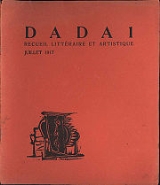
Zurich Dada, with Tzara at the helm, published the art and literature review Dada beginning in July 1917, with five editions from Zurich and the final two from Paris.
When World War I ended in 1918, most of the Zurich Dadaists returned to their home countries, and some began Dada activities in other cities. Others, such as Swiss native Sophie Täuber, would remain in Zurich into the 1920s.
Berlin

Anti-art
Anti-art is a loosely-used term applied to an array of concepts and attitudes that reject prior definitions of art and question art in general. Anti-art tends to conduct this questioning and rejection from the vantage point of art...
as other groups. Their activity and art was more political
Politics
Politics is a process by which groups of people make collective decisions. The term is generally applied to the art or science of running governmental or state affairs, including behavior within civil governments, but also applies to institutions, fields, and special interest groups such as the...
and social
Social
The term social refers to a characteristic of living organisms...
, with corrosive manifestos
Art manifesto
The art manifesto has been a recurrent feature associated with the avant-garde in Modernism. Art manifestos are mostly extreme in their rhetoric and intended for shock value to achieve a revolutionary effect. They often address wider issues, such as the political system...
and propaganda
Propaganda
Propaganda is a form of communication that is aimed at influencing the attitude of a community toward some cause or position so as to benefit oneself or one's group....
, satire
Satire
Satire is primarily a literary genre or form, although in practice it can also be found in the graphic and performing arts. In satire, vices, follies, abuses, and shortcomings are held up to ridicule, ideally with the intent of shaming individuals, and society itself, into improvement...
, public demonstrations
Demonstration (people)
A demonstration or street protest is action by a mass group or collection of groups of people in favor of a political or other cause; it normally consists of walking in a mass march formation and either beginning with or meeting at a designated endpoint, or rally, to hear speakers.Actions such as...
and overt political activities. It has been suggested that this is at least partially due to Berlin's proximity to the front, and that for an opposite effect, New York's geographic distance from the war spawned its more theoretically-driven, less political nature.
In February 1918, Huelsenbeck gave his first Dada speech in Berlin, and produced a Dada manifesto later in the year. Hannah Höch
Hannah Höch
Hannah Höch was a German Dada artist. She is best known for her work of the Weimar period, when she was one of the originators of photomontage.-Biography:...
and George Grosz
George Grosz
Georg Ehrenfried Groß was a German artist known especially for his savagely caricatural drawings of Berlin life in the 1920s...
used Dada to express post-World War I communist
Communism
Communism is a social, political and economic ideology that aims at the establishment of a classless, moneyless, revolutionary and stateless socialist society structured upon common ownership of the means of production...
sympathies. Grosz, together with John Heartfield
John Heartfield
John Heartfield is the anglicized name of the German photomontage artist Helmut Herzfeld...
, developed the technique of photomontage
Photomontage
Photomontage is the process and result of making a composite photograph by cutting and joining a number of other photographs. The composite picture was sometimes photographed so that the final image is converted back into a seamless photographic print. A similar method, although one that does not...
during this period. The artists published a series of short-lived political magazine
Magazine
Magazines, periodicals, glossies or serials are publications, generally published on a regular schedule, containing a variety of articles. They are generally financed by advertising, by a purchase price, by pre-paid magazine subscriptions, or all three...
s, and held the First International Dada Fair, 'the greatest project yet conceived by the Berlin Dadaists', in the summer of 1920. As well as the main members of Berlin Dada, Grosz, Raoul Hausmann
Raoul Hausmann
Raoul Hausmann was an Austrian artist and writer. One of the key figures in Berlin Dada, his experimental photographic collages, sound poetry and institutional critiques would have a profound influence on the European Avant-Garde in the aftermath of World War I.-Early biography:Raoul Hausmann was...
, Höch, Johannes Baader
Johannes Baader
Johannes Baader , originally trained as an architect, was a writer and artist associated with Dada in Berlin....
, Huelsenbeck and Heartfield, the exhibition also included work by Otto Dix
Otto Dix
Wilhelm Heinrich Otto Dix was a German painter and printmaker, noted for his ruthless and harshly realistic depictions of Weimar society and the brutality of war. Along with George Grosz, he is widely considered one of the most important artists of the Neue Sachlichkeit.-Early life and...
, Francis Picabia
Francis Picabia
Francis Picabia was a French painter, poet, and typographist, associated with both the Dada and Surrealist art movements.- Early life :...
, Jean Arp, Max Ernst
Max Ernst
Max Ernst was a German painter, sculptor, graphic artist, and poet. A prolific artist, Ernst was one of the primary pioneers of the Dada movement and Surrealism.-Early life:...
, Rudolf Schlichter
Rudolf Schlichter
Rudolf Schlichter was a German artist and one of the most important representatives of the Neue Sachlichkeit movement....
, Johannes Baargeld
Johannes Theodor Baargeld
Johannes Theodor Baargeld was a pseudonym of Alfred Emanuel Ferdinand Grünwald , a German painter and poet who, together with Max Ernst, founded the Cologne Dada group. He also used the name Zentrodada in connection with Dada.Baargeld was born in Stettin , Prussian Pomerania. He studied...
and others. In all, over 200 works were exhibited, surrounded by incendiary slogans, some of which also ended up written on the walls of the Nazi's Entartete Kunst exhibition in 1937. Despite high ticket prices, the exhibition made a loss, with only one recorded sale.
The Berlin group published periodicals such as Club Dada, Der Dada, Everyman His Own Football
Jedermann sein eigner Fussball
"Jedermann sein eigner Fussball" was an illustrated bimonthly published by Malik Verlag . The satirical periodical in tabloid format was published on February 15, 1919, and confiscated immediately on publication by the police...
, and Dada Almanach.
Cologne
In CologneCologne
Cologne is Germany's fourth-largest city , and is the largest city both in the Germany Federal State of North Rhine-Westphalia and within the Rhine-Ruhr Metropolitan Area, one of the major European metropolitan areas with more than ten million inhabitants.Cologne is located on both sides of the...
, Ernst, Baargeld, and Arp launched a controversial Dada exhibition in 1920 which focused on nonsense and anti-bourgeois sentiments. Cologne's Early Spring Exhibition was set up in a pub, and required that participants walk past urinals while being read lewd poetry by a woman in a communion
Eucharist
The Eucharist , also called Holy Communion, the Sacrament of the Altar, the Blessed Sacrament, the Lord's Supper, and other names, is a Christian sacrament or ordinance...
dress. The police closed the exhibition on grounds of obscenity, but it was re-opened when the charges were dropped.
New York
Like Zurich, New York CityNew York City
New York is the most populous city in the United States and the center of the New York Metropolitan Area, one of the most populous metropolitan areas in the world. New York exerts a significant impact upon global commerce, finance, media, art, fashion, research, technology, education, and...
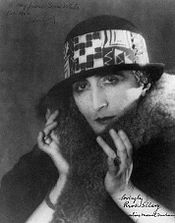
was a refuge for writers and artists from World War I. Soon after arriving from France in 1915, Marcel Duchamp
Marcel Duchamp
Marcel Duchamp was a French artist whose work is most often associated with the Dadaist and Surrealist movements. Considered by some to be one of the most important artists of the 20th century, Duchamp's output influenced the development of post-World War I Western art...
and Francis Picabia
Francis Picabia
Francis Picabia was a French painter, poet, and typographist, associated with both the Dada and Surrealist art movements.- Early life :...
met American artist Man Ray
Man Ray
Man Ray , born Emmanuel Radnitzky, was an American artist who spent most of his career in Paris, France. Perhaps best described simply as a modernist, he was a significant contributor to both the Dada and Surrealist movements, although his ties to each were informal...
. By 1916 the three of them became the center of radical anti-art activities in the United States. American Beatrice Wood
Beatrice Wood
Beatrice Wood was an American artist and studio potter, who late in life was dubbed the "Mama of Dada," and served as a partial inspiration for the character of Rose DeWitt Bukater in James Cameron's 1997 film, Titanic...
, who had been studying in France, soon joined them, along with Elsa von Freytag-Loringhoven
Elsa von Freytag-Loringhoven
Baroness Elsa von Freytag-Loringhoven was a German-born avant-garde, Dadaist artist and poet who worked for several years in Greenwich Village, New York City, United States.-Early life:Freytag-Loringhoven was born Elsa Hildegard Plötz in Swinemünde , German Empire,...
. Arthur Cravan
Arthur Cravan
Arthur Cravan was known as a pugilist, a poet, a larger-than-life character, and an idol of the Dada and Surrealism movements. He was the second son of Otho Holland Lloyd and Hélène Clara St. Clair of Armenian desent. His brother, Otho, was born in 1885...
, fleeing conscription in France, was also present for a time. Much of their activity centered in Alfred Stieglitz
Alfred Stieglitz
Alfred Stieglitz was an American photographer and modern art promoter who was instrumental over his fifty-year career in making photography an accepted art form...
's gallery, 291, and the home of Walter and Louise Arensberg.
The New Yorkers, though not particularly organized, called their activities Dada, but they did not issue manifestos. They issued challenges to art and culture through publications such as The Blind Man
The Blind Man
The Blind Man was an art and Dada journal published by the New York Dadaists in 1917.Henri-Pierre Roche, Beatrice Wood, and Mina Loy contributed to the first, Independents' Number issue; Walter Arensberg , Gabrielle Buffet-Picabia , Robert Carlton Brown , Frank Crowninshield , Charles Demuth The...
, Rongwrong, and New York Dada in which they criticized the traditionalist basis for museum art. New York Dada lacked the disillusionment of European Dada and was instead driven by a sense of irony and humor. In his book Adventures in the arts: informal chapters on painters, vaudeville and poets Marsden Hartley
Marsden Hartley
Marsden Hartley was an American Modernist painter, poet, and essayist.-Early life and education:Hartley was born in Lewiston, Maine, where his English parents had settled. He was the youngest of nine children. His mother died when he was eight, and his father remarried four years later to Martha...
included an essay on "The Importance of Being 'Dada'".
Readymades of Marcel Duchamp
The readymades of Marcel Duchamp are ordinary manufactured objects that the artist selected and modified, as an antidote to what he called "retinal art". By simply choosing the object and repositioning or joining, titling and signing it, the object became art...
" (found objects) such as a bottle rack, and got involved with the Society of Independent Artists
Society of Independent Artists
Society of Independent Artists was an association of American artists founded in 1916 and based in New York.Based on the French Société des Artistes Indépendants, the goal of the society was to hold annual exhibitions by avant-garde artists. Exhibitions were to be open to anyone who wanted to...
. In 1917 he submitted the now famous Fountain
Fountain (Duchamp)
Fountain is a 1917 work by Marcel Duchamp. It is one of the pieces which he called readymades. In such pieces he made use of an already existing object. In this case Duchamp used a urinal, which he titled Fountain and signed "R. Mutt". Readymades also go by the term Found object...
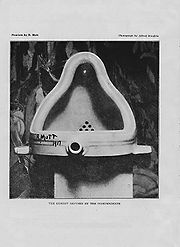
, a urinal signed R. Mutt, to the Society of Independent Artists show only to have the piece rejected. First an object of scorn within the arts community, the Fountain
Fountain (Duchamp)
Fountain is a 1917 work by Marcel Duchamp. It is one of the pieces which he called readymades. In such pieces he made use of an already existing object. In this case Duchamp used a urinal, which he titled Fountain and signed "R. Mutt". Readymades also go by the term Found object...
has since become almost canonized by some. The committee presiding over Britain
United Kingdom
The United Kingdom of Great Britain and Northern IrelandIn the United Kingdom and Dependencies, other languages have been officially recognised as legitimate autochthonous languages under the European Charter for Regional or Minority Languages...
's prestigious Turner Prize
Turner Prize
The Turner Prize, named after the painter J. M. W. Turner, is an annual prize presented to a British visual artist under the age of 50. Awarding the prize is organised by the Tate gallery and staged at Tate Britain. Since its beginnings in 1984 it has become the United Kingdom's most publicised...
in 2004, for example, called it "the most influential work of modern art." In an attempt to "pay homage to the spirit of Dada" a performance artist named Pierre Pinoncelli
Pierre Pinoncelli
Pierre Pinoncelli is a performance artist most famous for damaging two of the eight copies of Fountain by Marcel Duchamp with a hammer, as a statement that the work had lost its provocative value...
made a crack in The Fountain with a hammer in January 2006; he also urinated on it in 1993.
Picabia's travels tied New York, Zurich and Paris groups together during the Dadaist period. For seven years he also published the Dada periodical 391
391 (magazine)
391 was a periodical created and edited by the Dadaist Francis Picabia. It first appeared in January 1917 in Barcelona, and continued to be published until 1924...
in Barcelona, New York City, Zurich, and Paris from 1917 through 1924.
By 1921, most of the original players moved to Paris where Dada experienced its last major incarnation (see Neo-Dada
Neo-Dada
Neo-Dada is a label applied primarily to audio and visual art that has similarities in method or intent to earlier Dada artwork. It is the foundation of Fluxus, Pop Art and Nouveau réalisme. Neo-Dada is exemplified by its use of modern materials, popular imagery, and absurdist contrast...
for later activity).
Paris
The French avant-gardeAvant-garde
Avant-garde means "advance guard" or "vanguard". The adjective form is used in English to refer to people or works that are experimental or innovative, particularly with respect to art, culture, and politics....
kept abreast of Dada activities in Zurich with regular communications from Tristan Tzara
Tristan Tzara
Tristan Tzara was a Romanian and French avant-garde poet, essayist and performance artist. Also active as a journalist, playwright, literary and art critic, composer and film director, he was known best for being one of the founders and central figures of the anti-establishment Dada movement...
(whose pseudonym means "sad in country," a name chosen to protest the treatment of Jews in his native Romania), who exchanged letters, poems, and magazines with Guillaume Apollinaire
Guillaume Apollinaire
Wilhelm Albert Włodzimierz Apolinary Kostrowicki, known as Guillaume Apollinaire was a French poet, playwright, short story writer, novelist, and art critic born in Italy to a Polish mother....
, André Breton
André Breton
André Breton was a French writer and poet. He is known best as the founder of Surrealism. His writings include the first Surrealist Manifesto of 1924, in which he defined surrealism as "pure psychic automatism"....
, Max Jacob
Max Jacob
Max Jacob was a French poet, painter, writer, and critic.-Life and career:After spending his childhood in Quimper, Brittany, France, he enrolled in the Paris Colonial School, which he left in 1897 for an artistic career...
, Clément Pansaers
Clement Pansaers
Clément Pansaers was the main proponent of the Dada movement in Belgium.He began writing poetry in 1916 after abandoning his career as an Egyptologist...
, and other French writers, critics and artists.
Paris had arguably been the classical music capital of the world since the advent of musical Impressionism in the late 19th century. One of its practitioners, Erik Satie
Erik Satie
Éric Alfred Leslie Satie was a French composer and pianist. Satie was a colourful figure in the early 20th century Parisian avant-garde...
, collaborated with Picasso and Cocteau in a mad, scandalous ballet called Parade
Parade (ballet)
Parade is a ballet with music by Erik Satie and a one-act scenario by Jean Cocteau. The ballet was composed 1916-1917 for Serge Diaghilev's Ballets Russes...
. First performed by the Ballets Russes
Ballets Russes
The Ballets Russes was an itinerant ballet company from Russia which performed between 1909 and 1929 in many countries. Directed by Sergei Diaghilev, it is regarded as the greatest ballet company of the 20th century. Many of its dancers originated from the Imperial Ballet of Saint Petersburg...
in 1917, it succeeded in creating a scandal but in a different way than Stravinsky's Le Sacre du Printemps had done almost five years earlier. This was a ballet that was clearly parodying itself, something traditional ballet patrons would obviously have serious issues with.
Dada in Paris surged in 1920 when many of the originators converged there. Inspired by Tzara, Paris Dada soon issued manifestos, organized demonstrations, staged performances and produced a number of journals (the final two editions of Dada, Le Cannibale, and Littérature featured Dada in several editions.)
The first introduction of Dada artwork to the Parisian public was at the Salon des Indépendants in 1921. Jean Crotti
Jean Crotti
Jean Crotti was a French painter.Crotti was born in Bulle, Fribourg, Switzerland. He first studied in Munich, Germany at the School of Decorative Arts, then at age 23 moved to Paris to study art at the Académie Julian. Initially he was influenced by Impressionism, then by Fauvism and Art Nouveau...
exhibited works associated with Dada including a work entitled, Explicatif bearing the word Tabu. In the same year Tzara staged his Dadaist play The Gas Heart to howls of derision from the audience. When it was re-staged in 1923 in a more professional production, the play provoked a theatre riot
Riot
A riot is a form of civil disorder characterized often by what is thought of as disorganized groups lashing out in a sudden and intense rash of violence against authority, property or people. While individuals may attempt to lead or control a riot, riots are thought to be typically chaotic and...
(initiated by André Breton
André Breton
André Breton was a French writer and poet. He is known best as the founder of Surrealism. His writings include the first Surrealist Manifesto of 1924, in which he defined surrealism as "pure psychic automatism"....
) that heralded the split within the movement that was to produce Surrealism
Surrealism
Surrealism is a cultural movement that began in the early 1920s, and is best known for the visual artworks and writings of the group members....
. Tzara's last attempt at a Dadaist drama was his "ironic
Irony
Irony is a rhetorical device, literary technique, or situation in which there is a sharp incongruity or discordance that goes beyond the simple and evident intention of words or actions...
tragedy
Tragedy
Tragedy is a form of art based on human suffering that offers its audience pleasure. While most cultures have developed forms that provoke this paradoxical response, tragedy refers to a specific tradition of drama that has played a unique and important role historically in the self-definition of...
" Handkerchief of Clouds
Handkerchief of Clouds
Handkerchief of Clouds: A Tragedy in Fifteen Acts is a French-language Dadaist play by Romanian-born author Tristan Tzara. Tzara described it as an "ironic tragedy" or a "tragic farce", composed of 15 short acts, each with an accompanying commentary, with a strong influence from "the serialized...
in 1924.
Netherlands
In the Netherlands the Dada movement centered mainly around Theo van DoesburgTheo van Doesburg
Theo van Doesburg was a Dutch artist, practicing in painting, writing, poetry and architecture. He is best known as the founder and leader of De Stijl.-Biography:-Early life:...
, best known for establishing the De Stijl
De Stijl
De Stijl , propagating the group's theories. Next to van Doesburg, the group's principal members were the painters Piet Mondrian , Vilmos Huszár , and Bart van der Leck , and the architects Gerrit Rietveld , Robert van 't Hoff , and J.J.P. Oud...
movement and magazine of the same name. Van Doesburg mainly focused on poetry, and included poems from many well-known Dada writers in De Stijl such as Hugo Ball
Hugo Ball
Hugo Ball was a German author, poet and one of the leading Dada artists.Hugo Ball was born in Pirmasens, Germany and was raised in a middle-class Catholic family. He studied sociology and philosophy at the universities of Munich and Heidelberg...
, Hans Arp and Kurt Schwitters
Kurt Schwitters
Kurt Hermann Eduard Karl Julius Schwitters was a German painter who was born in Hanover, Germany. Schwitters worked in several genres and media, including Dada, Constructivism, Surrealism, poetry, sound, painting, sculpture, graphic design, typography and what came to be known as...
. Van Doesburg became a friend of Schwitters, and together they organized the so-called Dutch Dada campaign in 1923, where Van Doesburg promoted a leaflet about Dada (entitled What is Dada?), Schwitters read his poems, Vilmos Huszàr
Vilmos Huszàr
Vilmos Huszár was a Hungarian painter and designer. He lived in The Netherlands, where he was one of the founder members of the art movement De Stijl....
demonstrated a mechanical dancing doll and Nelly Van Doesburg (Theo's wife), played avant-garde
Avant-garde
Avant-garde means "advance guard" or "vanguard". The adjective form is used in English to refer to people or works that are experimental or innovative, particularly with respect to art, culture, and politics....
compositions on piano.
Van Doesburg wrote Dada poetry himself in De Stijl, although under a pseudonym, I.K. Bonset, which was only revealed after his death in 1931. 'Together' with I.K. Bonset, he also published a short-lived Dutch
Dutch culture
thumb|right|250px|[[Netherlandish Proverbs|Dutch proverbs]], by [[Pieter Bruegel the Elder]]. Dutch culture may refer to:* used more narrowly, the Culture of the Netherlands* used more widely Culture of Dutch-speaking Europe, including...
Dada magazine called Mécano.
Georgia
Although Dada itself was unknown in GeorgiaGeorgia (country)
Georgia is a sovereign state in the Caucasus region of Eurasia. Located at the crossroads of Western Asia and Eastern Europe, it is bounded to the west by the Black Sea, to the north by Russia, to the southwest by Turkey, to the south by Armenia, and to the southeast by Azerbaijan. The capital of...
until at least 1920, from 1917-1921 a group of poets called themselves "41st Degree" (referring both to the latitude of Tbilisi
Tbilisi
Tbilisi is the capital and the largest city of Georgia, lying on the banks of the Mt'k'vari River. The name is derived from an early Georgian form T'pilisi and it was officially known as Tiflis until 1936...
, Georgia and to the temperature of a high fever) organized along Dadaist lines. The most important figure in this group was Iliazd
Ilia Zdanevich
Ilia Mikhailovich Zdanevich , known as Iliazd , was a Georgian and French writer and artist, with the Dada movement....
, whose radical typographical designs visually echo the publications of the Dadaists. After his flight to Paris in 1921, he collaborated with Dadaists on publications and events.
Yugoslavia
In YugoslaviaYugoslavia
Yugoslavia refers to three political entities that existed successively on the western part of the Balkans during most of the 20th century....
there was heavy Dada activity between 1920 and 1922 run mainly by Dragan Aleksic
Dragan Aleksic
Dragan Aleksić was a Yugoslavian Dadaist painter, founder of the Yugoslavian branch of Dadaism, termed "Yugo-Dada."...
and including Mihailo S. Petrov, Zenitist's two brothers Ljubomir Micic and Branko Ve Poljanski. Aleksic used the term "Yugo-Dada" and is known to have been in contact with Raoul Hausmann
Raoul Hausmann
Raoul Hausmann was an Austrian artist and writer. One of the key figures in Berlin Dada, his experimental photographic collages, sound poetry and institutional critiques would have a profound influence on the European Avant-Garde in the aftermath of World War I.-Early biography:Raoul Hausmann was...
, Kurt Schwitters
Kurt Schwitters
Kurt Hermann Eduard Karl Julius Schwitters was a German painter who was born in Hanover, Germany. Schwitters worked in several genres and media, including Dada, Constructivism, Surrealism, poetry, sound, painting, sculpture, graphic design, typography and what came to be known as...
, and Tristan Tzara
Tristan Tzara
Tristan Tzara was a Romanian and French avant-garde poet, essayist and performance artist. Also active as a journalist, playwright, literary and art critic, composer and film director, he was known best for being one of the founders and central figures of the anti-establishment Dada movement...
.
Tokyo
A prominent Dada group in JapanJapan
Japan is an island nation in East Asia. Located in the Pacific Ocean, it lies to the east of the Sea of Japan, China, North Korea, South Korea and Russia, stretching from the Sea of Okhotsk in the north to the East China Sea and Taiwan in the south...
was MAVO (JA), founded by Tomoyoshi Murayama
Tomoyoshi Murayama
was a Japanese artist, playwright and drama producer active during the Showa period of Japan.-Early life:Murayama was born in the Kanda Suehiro district of Tokyo. His father, who was a medic in the Imperial Japanese Navy, died when he was nine years old. His mother became a fervent Christian after...
and Masamu Yanase (DE, JA). Other prominent artists were Jun Tsuji
Jun Tsuji
was a Japanese author: a poet, essayist, playwright, and translator. He has also been described as a Dadaist, nihilist, epicurean, shakuhachi musician, actor, feminist, and bohemian...
, Eisuke Yoshiyuki, Shinkichi Takahashi (JA) and Katsue Kitasono.
Poetry; music and sound
Dada was not confined to the visual and literary arts; its influence reached into sound and music. Kurt SchwittersKurt Schwitters
Kurt Hermann Eduard Karl Julius Schwitters was a German painter who was born in Hanover, Germany. Schwitters worked in several genres and media, including Dada, Constructivism, Surrealism, poetry, sound, painting, sculpture, graphic design, typography and what came to be known as...
developed what he called sound poems
Sound poetry
Sound poetry is an artistic form bridging between literary and musical composition, in which the phonetic aspects of human speech are foregrounded instead of more conventional semantic and syntactic values; "verse without words"...
and composers such as Erwin Schulhoff
Erwin Schulhoff
Erwin Schulhoff was a Czech composer and pianist.-Life:Born in Prague of Jewish-German origin, Schulhoff was one of the brightest figures in a generation of European musicians whose successful careers were prematurely terminated by the rise of the Nazi regime in Germany...
, Hans Heusser and Albert Savinio wrote Dada music, while members of Les Six
Les Six
Les six is a name, inspired by The Five, given in 1920 by critic Henri Collet in an article titled "" to a group of six composers working in Montparnasse whose music is often seen as a reaction against the musical style of Richard Wagner and impressionist music.-Members:Formally, the Groupe des...
collaborated with members of the Dada movement and had their works performed at Dada gatherings. The above mentioned Erik Satie
Erik Satie
Éric Alfred Leslie Satie was a French composer and pianist. Satie was a colourful figure in the early 20th century Parisian avant-garde...
dabbled with Dadaist ideas throughout his career although he is primarily associated with musical Impressionism
Impressionism
Impressionism was a 19th-century art movement that originated with a group of Paris-based artists whose independent exhibitions brought them to prominence during the 1870s and 1880s...
.
In the very first Dada publication, Hugo Ball
Hugo Ball
Hugo Ball was a German author, poet and one of the leading Dada artists.Hugo Ball was born in Pirmasens, Germany and was raised in a middle-class Catholic family. He studied sociology and philosophy at the universities of Munich and Heidelberg...
describes a "balalaika orchestra playing delightful folk-songs." African music and jazz
Jazz
Jazz is a musical style that originated at the beginning of the 20th century in African American communities in the Southern United States. It was born out of a mix of African and European music traditions. From its early development until the present, jazz has incorporated music from 19th and 20th...
was common at Dada gatherings, signaling a return to nature and naive primitivism
Primitivism
Primitivism is a Western art movement that borrows visual forms from non-Western or prehistoric peoples, such as Paul Gauguin's inclusion of Tahitian motifs in paintings and ceramics...
.
Legacy
Social realism
Social Realism, also known as Socio-Realism, is an artistic movement, expressed in the visual and other realist arts, which depicts social and racial injustice, economic hardship, through unvarnished pictures of life's struggles; often depicting working class activities as heroic...
and other forms of modernism
Modernism
Modernism, in its broadest definition, is modern thought, character, or practice. More specifically, the term describes the modernist movement, its set of cultural tendencies and array of associated cultural movements, originally arising from wide-scale and far-reaching changes to Western society...
. Some theorists argue that Dada was actually the beginning of postmodern art
Postmodern art
Postmodern art is a term used to describe an art movement which was thought to be in contradiction to some aspect of modernism, or to have emerged or developed in its aftermath...
.
By the dawn of World War II
World War II
World War II, or the Second World War , was a global conflict lasting from 1939 to 1945, involving most of the world's nations—including all of the great powers—eventually forming two opposing military alliances: the Allies and the Axis...
, many of the European Dadaists had emigrated to the United States. Some died in death camps under Adolf Hitler
Adolf Hitler
Adolf Hitler was an Austrian-born German politician and the leader of the National Socialist German Workers Party , commonly referred to as the Nazi Party). He was Chancellor of Germany from 1933 to 1945, and head of state from 1934 to 1945...
, who persecuted the kind of "Degenerate art
Degenerate art
Degenerate art is the English translation of the German entartete Kunst, a term adopted by the Nazi regime in Germany to describe virtually all modern art. Such art was banned on the grounds that it was un-German or Jewish Bolshevist in nature, and those identified as degenerate artists were...
" that Dada represented. The movement became less active as post-World War II optimism led to new movements in art and literature.
Dada is a named influence and reference of various anti-art
Anti-art
Anti-art is a loosely-used term applied to an array of concepts and attitudes that reject prior definitions of art and question art in general. Anti-art tends to conduct this questioning and rejection from the vantage point of art...
and political and cultural movements including the Situationist International and culture jamming
Culture jamming
Culture jamming, coined in 1984, denotes a tactic used by many anti-consumerist social movements to disrupt or subvert mainstream cultural institutions, including corporate advertising. Guerrilla semiotics and night discourse are sometimes used synonymously with the term culture jamming.Culture...
groups like the Cacophony Society
Cacophony Society
The Cacophony Society is “a randomly gathered network of free spirits united in the pursuit of experiences beyond the pale of mainstream society.” It was started in 1986 by surviving members of the now defunct Suicide Club of San Francisco....
.
At the same time that the Zurich Dadaists made noise and spectacle at the Cabaret Voltaire
Cabaret Voltaire (Zürich)
Cabaret Voltaire was the name of a nightclub in Zurich, Switzerland. It was founded by Hugo Ball, with his companion Emmy Hennings on February 5, 1916 as a cabaret for artistic and political purposes. Other founding members were Marcel Janco, Richard Huelsenbeck, Tristan Tzara, and Jean Arp...
, Vladimir Lenin
Vladimir Lenin
Vladimir Ilyich Lenin was a Russian Marxist revolutionary and communist politician who led the October Revolution of 1917. As leader of the Bolsheviks, he headed the Soviet state during its initial years , as it fought to establish control of Russia in the Russian Civil War and worked to create a...
wrote his revolutionary plans for Russia in a nearby apartment. Tom Stoppard
Tom Stoppard
Sir Tom Stoppard OM, CBE, FRSL is a British playwright, knighted in 1997. He has written prolifically for TV, radio, film and stage, finding prominence with plays such as Arcadia, The Coast of Utopia, Every Good Boy Deserves Favour, Professional Foul, The Real Thing, and Rosencrantz and...
used this coincidence as a premise for his play Travesties
Travesties
Travesties is a play by Tom Stoppard.The play centres on the figure of Henry Carr, an elderly man who reminisces about Zürich in 1917 during the First World War, and his interactions with James Joyce when he was writing Ulysses, Tristan Tzara during the rise of Dada, and Lenin leading up to the...
(1974), which includes Tzara, Lenin, and James Joyce
James Joyce
James Augustine Aloysius Joyce was an Irish novelist and poet, considered to be one of the most influential writers in the modernist avant-garde of the early 20th century...
as characters. French writer Dominique Noguez imagined Lenin as a member of the Dada group in his tongue-in-cheek Lénine Dada (1989).
The Cabaret Voltaire fell into disrepair until it was occupied from January to March, 2002, by a group proclaiming themselves Neo-Dada
Neo-Dada
Neo-Dada is a label applied primarily to audio and visual art that has similarities in method or intent to earlier Dada artwork. It is the foundation of Fluxus, Pop Art and Nouveau réalisme. Neo-Dada is exemplified by its use of modern materials, popular imagery, and absurdist contrast...
ists, led by Mark Divo
Mark Divo
Mark Divo is a Luxembourgeois conceptual artist and curator who organises large scale interactive art projects incorporating the work of a number of well-known underground artists. His own work involves performance, photography, installation, often using found material.-Career:Between 1988 and...
. The group included Jan Thieler
Leumund Cult
Jan Theiler, alias Pastor Leumund, born 1967, Germany. In the 1990s he was an influential curator, performance artist and musician on the underground scene organising large-scale music and performance events at various venues in East-Berlin including the Duncker14, K77, Prater, Kule, Tacheles and...
, Ingo Giezendanner
Ingo Giezendanner
Ingo Giezendanner is a painter and installation artist and member of the Kroesos Foundation. He lives and works in Zurich, Switzerland.Since 1998, Ingo Giezendanner, alias GRRRR, has been documenting the urban...
, Aiana Calugar, Lennie Lee
Lennie Lee
Lennie Lee is a South African conceptual artist who lives and works in London.-Life and career:Lennie Lee is a British artist born in Johannesburg, South Africa. He moved to the UK in 1960. He was educated at Dulwich college in London before winning a scholarship to study philosophy at Christ...
and Dan Jones. After their eviction the space became a museum dedicated to the history of Dada. The work of Lee and Jones remained on the walls of the museum.
Several notable retrospective
Retrospective
Retrospective generally means to take a look back at events that already have taken place. For example, the term is used in medicine, describing a look back at a patient's medical history or lifestyle.-Music:...
s have examined the influence of Dada upon art and society. In 1967, a large Dada retrospective was held in Paris, France. In 2006, the Museum of Modern Art
Museum of Modern Art
The Museum of Modern Art is an art museum in Midtown Manhattan in New York City, on 53rd Street, between Fifth and Sixth Avenues. It has been important in developing and collecting modernist art, and is often identified as the most influential museum of modern art in the world...
in New York City held a Dada exhibition in conjunction with the National Gallery of Art
National Gallery of Art
The National Gallery of Art and its Sculpture Garden is a national art museum, located on the National Mall between 3rd and 9th Streets at Constitution Avenue NW, in Washington, DC...
in Washington D.C. and the Centre Pompidou in Paris.
Collage
The dadaists imitated the techniques developed during the cubist movement through the pasting of cut pieces of paper items, but extended their art to encompass items such as transportation tickets, maps, plastic wrappers, etc. to portray aspects of life, rather than representing objects viewed as still life.Photomontage
The Dadaists - the "monteurs" (mechanics) - used scissors and glue rather than paintbrushes and paints to express their views of modern life through images presented by the media. A variation on the collage technique, photomontage utilized actual or reproductions of real photographs printed in the press. In Cologne, Max Ernst used images from World War I to illustrate messages of the destruction of war.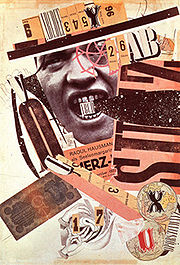
Assemblage
The assemblageAssemblage (art)
Assemblage is an artistic process. In the visual arts, it consists of making three-dimensional or two-dimensional artistic compositions by putting together found objects...
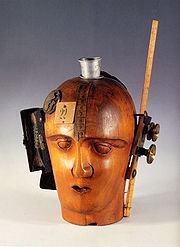
s were three-dimensional variations of the collage – the assembly of everyday objects to produce meaningful or meaningless (relative to the war) pieces of work including war objects and trash. Objects were nailed, screwed or fastened together in different fashions. Assemblages could be seen in the round or could be hung on a wall.
Readymades
Marcel DuchampMarcel Duchamp
Marcel Duchamp was a French artist whose work is most often associated with the Dadaist and Surrealist movements. Considered by some to be one of the most important artists of the 20th century, Duchamp's output influenced the development of post-World War I Western art...
began to view the manufactured objects of his collection as objects of art, which he called "readymades
Readymades of Marcel Duchamp
The readymades of Marcel Duchamp are ordinary manufactured objects that the artist selected and modified, as an antidote to what he called "retinal art". By simply choosing the object and repositioning or joining, titling and signing it, the object became art...
". He would add signatures and titles to some, converting them into artwork that he called "readymade aided" or "rectified readymades". Duchamp wrote: "One important characteristic was the short sentence which I occasionally inscribed on the 'readymade.' That sentence, instead of describing the object like a title, was meant to carry the mind of the spectator towards other regions more verbal. Sometimes I would add a graphic detail of presentation which in order to satisfy my craving for alliterations, would be called 'readymade aided.'" One such example of Duchamp's readymade works is the urinal that was turned onto its back, signed "R. Mutt", titled "Fountain", and submitted to the Society of Independent Artists exhibition that year.
See also
- Art interventionArt interventionArt intervention is an interaction with a previously existing artwork, audience or venue/space. It has the auspice of conceptual art and is commonly a form of performance art. It is associated with the Viennese Actionists, the Dada movement and Neo-Dadaists...
- Bonzo Dog Doo-Dah BandBonzo Dog Doo-Dah BandThe Bonzo Dog Doo-Dah Band are a band created by a group of British art-school denizens of the 1960s...
- The Central Council of Dada for the World RevolutionThe Central Council of Dada for the World RevolutionThe Central Council of Dada for the World Revolution was the name of the political party set up by the Berlin Dada movement following World War I....
- Épater la bourgeoisieÉpater la bourgeoisieÉpater la bourgeoisie or épater le bourgeois is a French phrase that became a rallying cry for the French Decadent poets of the late 19th century including Baudelaire and Rimbaud...
- FuturismFuturismFuturism was an artistic and social movement that originated in Italy in the early 20th century.Futurism or futurist may refer to:* Afrofuturism, an African-American and African diaspora subculture* Cubo-Futurism* Ego-Futurism...
- HappeningHappeningA happening is a performance, event or situation meant to be considered art, usually as performance art. Happenings take place anywhere , are often multi-disciplinary, with a nonlinear narrative and the active participation of the audience...
External links
- Dada art - includes images showing the characteristics of Dada
- The International Dada Archive - includes scans of publications
- Dadart - includes history, bibliography, documents, and news
- Dada magazine translated into English and remastered for the internet.
Manifestos
- Text of Hugo Ball's 1916 Dada Manifesto
- Text of Tristan Tzara's 1918 Dada Manifesto
- Excerpts of Tristan Tzara's Dada Manifesto (1918) and Lecture on Dada (1922)