

Russian Revolution of 1905

Encyclopedia
The 1905 Russian Revolution was a wave of mass political and social unrest that spread through vast areas of the Russian Empire
. Some of it was directed against the government, while some was undirected. It included worker strike
s, peasant unrest, and military mutinies. It led to the establishment of limited constitutional monarchy
, the State Duma of the Russian Empire
, the multi-party system
, and the Russian Constitution of 1906
.
Constitutionalists (1903) and the Union of Liberation (1904) which called for a constitutional monarchy. Russian socialists formed two major groups: the Socialist-Revolutionary Party
, following the Russian populist
tradition, and the Marxist Russian Social Democratic Labour Party
.
In the autumn of 1904, liberals started a series of banquets celebrating the 40th anniversary of the liberal court statutes and calling for political reforms and establishment of a constitution. On , the Moscow City Duma passed a resolution, demanding establishment of an elected national legislature, full freedom of the press
, and freedom of religion
. Similar resolutions and appeals from other city dumas and zemstvo councils followed.
Tsar Nicholas II made a move to fulfill many of these demands, appointing liberal Pyotr Dmitrievich Sviatopolk-Mirskii
Minister of the Interior after the assassination of Vyacheslav von Plehve
. On , the Tsar issued a manifesto promising the broadening of the Zemstvo and local municipal councils' authority, insurance for industrial workers, the emancipation of Inorodtsy
, and the abolition of censorship. However, the crucial point of representative national legislature was missing in the manifesto.
(a railway and artillery supplier) in Saint Petersburg. Sympathy strikes in other parts of the city raised the number of strikers to over 80,000. Controversial Orthodox priest George Gapon
, who headed a police-sponsored workers' association, led a huge workers' procession to the Winter Palace
to deliver a petition to the Czar on Sunday, . The troops guarding the Winter Palace who had been ordered to tell the demonstrators not to pass a certain point, according to Sergei Witte
, opened fire on them, which resulted in more than 200 (according to Witte) to 1000 deaths. The event became known as Bloody Sunday
, and is usually considered the start of the active phase of the revolution.
The events in St. Petersburg provoked public indignation and a series of massive strikes that spread quickly throughout the industrial centres of the Russian Empire. Polish socialists — both the PPS
and the SDKPiL
— called for a general strike. By the end of January 1905, over 400,000 workers in Russian Poland
were on strike (see Revolution in the Kingdom of Poland (1905–1907)). Half of European Russia's industrial workers went on strike in 1905, 93.2% in Poland. There were also strikes in Finland
and the Baltic
coast. In Riga
, 80 protesters were killed on , and in Warsaw
a few days later over 100 strikers were shot on the streets. By February, there were strikes in the Caucasus
, and by April, in the Urals
and beyond. In March, all higher academic institutions were forcibly closed for the remainder of the year, adding radical students to the striking workers. A strike by railway workers on quickly developed into a general strike in Saint Petersburg and Moscow. This prompted the setting up of the short-lived Saint Petersburg Soviet of Workers' Deputies, a largely Menshevik
group led by Leon Trotsky
, which organised strike action in over 200 factories. By , over 2 million workers were on strike and there were almost no active railways in all of Russia. Growing inter-ethnic confrontation throughout the Caucasus resulted in Armenian-Tatar massacres, heavily damaging the cities and the Baku oilfields.
With the unsuccessful and bloody Russo-Japanese War
(1904–1905) there was unrest in army reserve units. On January 2, 1905 Port Arthur was lost, and the Russian Baltic Fleet
was defeated at Tsushima
; in February 1905, the Russian army was defeated at Mukden
, losing almost 80,000 men in the process. Witte was dispatched to make peace, negotiating the Treaty of Portsmouth
(signed ). In 1905, there were naval mutinies at Sevastopol
(see Sevastopol Uprising), Vladivostok
, and Kronstadt
, peaking in June with the mutiny aboard the Battleship Potemkin
— some sources claim over 2,000 sailors died in the restoration of order. The mutinies were disorganised and quickly crushed. Despite these mutinies, the armed forces were largely apolitical and remained mostly loyal, if dissatisfied — and were widely used by the government to control the 1905 unrest.
Nationalist groups had been angered by the Russification
undertaken since Alexander II
. The Poles, Finns, and the Baltic provinces all sought autonomy, and also freedom to use their national languages and promote their own culture. Muslim groups were also active — the First Congress of the Muslim Union took place in August 1905. Certain groups took the opportunity to settle differences with each other rather than the government. Some nationalists undertook anti-Jewish pogrom
s, possibly with government aid, and in total over 3000 Jews were killed.
The number of prisoners throughout the Russian Empire, which had peaked at 116,376 in 1893, fell by over a third to a record low of 75009 in January 1905, chiefly because of several mass amnesties granted by the Tsar; the historian S G Wheatcroft has wondered what role these released criminals played in the 1905–6 social unrest.
, on and appointed a government commission "to enquire without delay into the causes of discontent among the workers in the city of St Petersburg and its suburbs" in view of the strike movement. The commission was headed by Senator NV Shidlovsky, a member of the State Council
, and included officials, chiefs of government factories, and private factory owners. It was also meant to have included workers’ delegates elected according to a two-stage system. Elections of the workers delegates were, however, blocked by the socialists who wanted to divert the workers from the elections to the armed struggle. On , the Commission was dissolved without having started work.
Following the assassination of his uncle, the Grand Duke Sergei Aleksandrovich
, on , the Tsar agreed to give new concessions. On he published the Bulygin Rescript, which promised the formation of a consultative assembly, religious tolerance, freedom of speech (in the form of language rights for the Polish minority) and a reduction in the peasants' redemption payments.
On , about 300 Zemstvo and municipal representatives held three meetings in Moscow, which passed a resolution, asking for popular representation at the national level. On , Nicholas II had received a Zemstvo deputation. Responding to speeches by Prince Sergei Trubetskoi and Mr Fyodrov, the Tsar confirmed his promise to convene an assembly of people’s representatives.
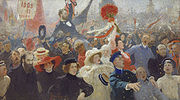 Tsar Nicholas II agreed on to the creation of a State Duma of the Russian Empire
but with consultative powers only. When its slight powers and limits on the electorate were revealed, unrest redoubled. The Saint Petersburg Soviet was formed and called for a general strike in October, refusal to pay taxes, and the withdrawal of bank deposits.
In June and July 1905, there were many peasant uprisings in which peasants seized land and tools . Disturbances in the Russian-controlled Congress Poland
culminated in June 1905 in the Łódź insurrection.
Surprisingly, only one landlord was recorded as killed. Far more violence was inflicted on peasants outside the commune: 50 deaths were recorded.
The October Manifesto
, written by Sergei Witte
and Alexis Obolenskii, was presented to the Tsar on . It closely followed the demands of the Zemstvo Congress in September, granting basic civil rights
, allowing the formation of political parties, extending the franchise towards universal suffrage
, and establishing the Duma as the central legislative body. The Tsar waited and argued for three days, but finally signed the manifesto on , owing to his desire to avoid a massacre, and a realisation that there was insufficient military force available to do otherwise. He regretted signing the document, saying that he felt "sick with shame at this betrayal of the dynasty... the betrayal was complete".
When the manifesto was proclaimed there were spontaneous demonstrations of support in all the major cities. The strikes in Saint Petersburg
and elsewhere officially ended or quickly collapsed. A political amnesty
was also offered. The concessions came hand-in-hand with renewed, and brutal, action against the unrest. There was also a backlash from the conservative elements of society, with right-wing attacks on strikers, left-wingers, and Jews.
While the Russian liberals were satisfied by the October Manifesto
and took preparations for upcoming Dumas elections, radical socialists and revolutionaries denounced the elections and called for an armed uprising to destroy the Empire.
Some of the November uprising of 1905 in Sevastopol
, headed by retired naval Lieutenant Pyotr Schmidt
, was directed against the government, while some was undirected. It included terrorism, worker strikes, peasant unrest, and military mutinies and was only suppressed after a fierce battle. The Trans-Baikal railroad fell into the hands of striker committees and demobilised soldiers returning from Manchuria
after the Russo–Japanese War. The Tsar had to send a special detachment of loyal troops along the Trans-Siberian Railway
to restore order.
Between , there was a general strike by Russian workers. The government sent in troops on 7 December, and a bitter street-by-street fight began. A week later the Semenovskii Regiment was deployed, and used artillery to break-up demonstrations and to shell workers' districts. On , with around a thousand people dead and parts of the city in ruins, the workers surrendered. After a final spasm in Moscow
, the uprisings ended in December 1905.
According to figures presented in the Duma by Professor Maksim Kovalevsky
, by April 1906, more than 14,000 people had been executed and 75,000 imprisoned.
The historian Brian Taylor states the number of deaths in the 1905 Revolution was in the "thousands", and notes the existence of one source that puts the figure at over 13,000 deaths.
(the Cadets), the peasant leaders' Labour Group (Trudoviks
), the less liberal Union of 17 October (the Octobrist
s), and the reactionary Union of Land-Owners.
The electoral laws were promulgated in December 1905—franchise to male citizens over 25 years of age, electing through four electoral colleges. This was a weighted electoral system where the votes of some sections of society were worth more than others. For example, the vote of a landowner was worth 45 times more than the vote of an industrial worker. The first elections to the Duma took place in March 1906 and were boycotted by the socialists, the SRs and the Bolsheviks. In the First Duma, there were 170 Kadets, 90 Trudoviks, 100 non-aligned peasant representatives, 63 nationalists of various hues, and 16 Octobrists.
In April 1906, the government issued the Fundamental Laws
, setting the limits of this new political order. The Tsar was confirmed as absolute leader, with complete control of the executive, foreign policy, church, and the armed forces. The status of the Duma was changed, becoming a lower chamber below the half-elected, half-appointed by the Tsar State Council
. Legislation had to be approved by the Duma, the Council, and the Tsar to become law, and in "exceptional conditions" the government could bypass the Duma.
In April 1906, Sergei Witte resigned, after having negotiated a loan of almost 900 million rubles to repair the Russian government's finances. Apparently the Tsar had lost confidence in him. Later known as "late Imperial Russia's most outstanding politician", Witte was replaced by senior Ivan Goremykin
. On , Goremykin was himself replaced by Pyotr Stolypin
.
Demanding further liberalisation and acting as a platform for "agitators", the First Duma was dissolved by the Tsar in July 1906. Despite the hopes of the Kadets and the fears of the government, there was no widespread popular reaction to this. However, an assassination attempt on Pyotr Stolypin
led to the establishment of field trials for terrorists, and over the next eight months more than a thousand people were hanged.
The Coup of June 1907
was the end of the revolution. The Duma was dispersed and the social democrat deputies were arrested. The autocracy was restored.
Notable victims of assassins included:
, and are listed in the table.
These numbers reflect only executions of civilians, and do not include a large number of summary executions by punitive army detachments and executions of military personnel that mutineed.
Peter Kropotkin
also notes that official statistics did not include executions during punitive expeditions, especially in Siberia, the Caucasus, and the Baltic provinces.
By 1906 there were 4,509 political prisoners in Russian Poland, 20% of the empire's total.
 In the Grand Duchy of Finland
, the Social Democrats
organised the general strike
of 1905 . The Red Guards
were formed, led by captain Johan Kock
. During the general strike, the Red Declaration, written by Finnish politician and journalist Yrjö Mäkelin
, was given in Tampere
, demanding dissolution of the Senate of Finland
, universal suffrage, political freedoms
, and abolition of censorship. Leader of the constitutionalists, Leo Mechelin
crafted the November Manifesto that led to the abolition of the Diet of Finland
and of the four Estates
, and to the creation of the modern Parliament of Finland
. It also resulted in a temporary halt to the Russification policy
started in 1899.
On , Russian sailors rose to rebellion in the fortress of Sveaborg (later called Suomenlinna
), Helsinki. The Finnish Red Guards supported the rebellion with a general strike, but it was quelled by the Baltic Fleet
in sixty days.
, Estonians called for freedom of the press
and assembly
, for universal suffrage, and for national autonomy. On , the Russian army opened fire in a meeting on a street market in Tallinn
, killing 94 and injuring over 200. The October Manifesto was supported in Estonia and the Estonian flag was displayed publicly for the first time. Jaan Tõnisson
used the new political freedoms to widen the rights of Estonians by establishing the first Estonian political party - National Progress Party.
Another, more radical political organisation, the Estonian Social Democratic Workers' Union was founded as well. The moderate supporters of Tõnisson and the more radical supporters of Jaan Teemant
could not reach a consensus about how to continue with the revolution, only that they both wanted to limit the rights of Baltic Germans and to end Russification. The radical views were publicly welcomed and in December 1905, martial law was declared in Tallinn. A total of 160 manors were looted, resulting in ca. 400 workers and peasants being killed by the army. Estonian gains from the revolution were minimal, but the tense stability that prevailed between 1905 and 1917 allowed Estonians to advance the aspiration of national statehood.
. On , Russian army troops opened fire on demonstrators killing 73 and injuring 200 people. During the summer 1905, the focus of revolutionary events moved to the countryside with mass meetings and demonstrations. 470 new parish administrative bodies were elected in 94% of the parishes in Latvia. The Congress of Parish Representatives was held in Riga in November. In autumn 1905, armed conflict between the Baltic German nobility and the Latvian peasants begun in the rural areas of Livland and Courland. In Courland, the peasants seized or surrounded several towns. In Livland, the fighters controlled the Rūjiena-Pärnu railway line. Martial law was declared in Courland in August 1905, and in Livland in late November. Special punitive expeditions were dispatched in mid-December to suppress the movement. They executed 1170 people without trial or investigation and burned 300 peasant homes. In 1906, the revolutionary movement gradually subsided.
Russian Empire
The Russian Empire was a state that existed from 1721 until the Russian Revolution of 1917. It was the successor to the Tsardom of Russia and the predecessor of the Soviet Union...
. Some of it was directed against the government, while some was undirected. It included worker strike
Strike action
Strike action, also called labour strike, on strike, greve , or simply strike, is a work stoppage caused by the mass refusal of employees to work. A strike usually takes place in response to employee grievances. Strikes became important during the industrial revolution, when mass labour became...
s, peasant unrest, and military mutinies. It led to the establishment of limited constitutional monarchy
Constitutional monarchy
Constitutional monarchy is a form of government in which a monarch acts as head of state within the parameters of a constitution, whether it be a written, uncodified or blended constitution...
, the State Duma of the Russian Empire
State Duma of the Russian Empire
The State Duma of the Russian Empire was a legislative assembly in the late Russian Empire, which met in the Taurida Palace in St. Petersburg. It was convened four times between 1906 and the collapse of the Empire in 1917.-History:...
, the multi-party system
Multi-party system
A multi-party system is a system in which multiple political parties have the capacity to gain control of government separately or in coalition, e.g.The Conservative-Liberal Democrat coalition in the United Kingdom formed in 2010. The effective number of parties in a multi-party system is normally...
, and the Russian Constitution of 1906
Russian Constitution of 1906
The Russian Constitution of 1906 refers to a major revision of the 1832 Fundamental Laws of the Russian Empire, which transformed the formerly absolutist state into one in which the emperor agreed for the first time to share his autocratic power with a parliament. It was enacted on April 23, 1906,...
.
Rise of the opposition
At the start of the 20th century, Russian liberals formed the Union of ZemstvoZemstvo
Zemstvo was a form of local government that was instituted during the great liberal reforms performed in Imperial Russia by Alexander II of Russia. The idea of the zemstvo was elaborated by Nikolay Milyutin, and the first zemstvo laws were put into effect in 1864...
Constitutionalists (1903) and the Union of Liberation (1904) which called for a constitutional monarchy. Russian socialists formed two major groups: the Socialist-Revolutionary Party
Socialist-Revolutionary Party
thumb|right|200px|Socialist-Revolutionary election poster, 1917. The caption in red reads "партия соц-рев" , short for Party of the Socialist Revolutionaries...
, following the Russian populist
Narodnik
Narodniks was the name for Russian socially conscious members of the middle class in the 1860s and 1870s. Their ideas and actions were known as Narodnichestvo which can be translated as "Peopleism", though is more commonly rendered "populism"...
tradition, and the Marxist Russian Social Democratic Labour Party
Russian Social Democratic Labour Party
The Russian Social Democratic Labour Party , also known as Russian Social Democratic Workers' Party or Russian Social Democratic Party, was a revolutionary socialist Russian political party formed in 1898 in Minsk to unite the various revolutionary organizations into one party...
.
In the autumn of 1904, liberals started a series of banquets celebrating the 40th anniversary of the liberal court statutes and calling for political reforms and establishment of a constitution. On , the Moscow City Duma passed a resolution, demanding establishment of an elected national legislature, full freedom of the press
Freedom of the press
Freedom of the press or freedom of the media is the freedom of communication and expression through vehicles including various electronic media and published materials...
, and freedom of religion
Freedom of religion
Freedom of religion is a principle that supports the freedom of an individual or community, in public or private, to manifest religion or belief in teaching, practice, worship, and observance; the concept is generally recognized also to include the freedom to change religion or not to follow any...
. Similar resolutions and appeals from other city dumas and zemstvo councils followed.
Tsar Nicholas II made a move to fulfill many of these demands, appointing liberal Pyotr Dmitrievich Sviatopolk-Mirskii
Pyotr Dmitrievich Sviatopolk-Mirskii
Prince Pyotr Dmitrievich Sviatopolk-Mirskii was a Russian politician and police official, Minister of the Interior in 1904–1905. He was the son of the general Dmitry Ivanovitch Sviatopolk-Mirskii and father of the literary historian D. S. Mirsky....
Minister of the Interior after the assassination of Vyacheslav von Plehve
Vyacheslav von Plehve
Vyacheslav Konstantinovich von Plehve , also Pléhve, or Pleve was the director of Imperial Russia's police and later Minister of the Interior.- Biography :...
. On , the Tsar issued a manifesto promising the broadening of the Zemstvo and local municipal councils' authority, insurance for industrial workers, the emancipation of Inorodtsy
Inorodtsy
Inorodtsy , is a legal term used in the Russian Empire in reference to non-Slavic population of the Empire. Literally meaning "of different descent/nation", it is sometimes translated as allogeneous and sometimes as "aliens"...
, and the abolition of censorship. However, the crucial point of representative national legislature was missing in the manifesto.
Start of the revolution
In December 1904, a strike occurred at the Putilov plantKirov Plant
The Kirov Plant Kirov Factory or Leningrad Kirov Plant is a major Russian machine-building plant in St. Petersburg, Russia....
(a railway and artillery supplier) in Saint Petersburg. Sympathy strikes in other parts of the city raised the number of strikers to over 80,000. Controversial Orthodox priest George Gapon
George Gapon
Georgiy Apollonovich Gapon was a Russian Orthodox priest and a popular working class leader before the Russian Revolution of 1905.-Early life:...
, who headed a police-sponsored workers' association, led a huge workers' procession to the Winter Palace
Winter Palace
The Winter Palace in Saint Petersburg, Russia, was, from 1732 to 1917, the official residence of the Russian monarchs. Situated between the Palace Embankment and the Palace Square, adjacent to the site of Peter the Great's original Winter Palace, the present and fourth Winter Palace was built and...
to deliver a petition to the Czar on Sunday, . The troops guarding the Winter Palace who had been ordered to tell the demonstrators not to pass a certain point, according to Sergei Witte
Sergei Witte
Count Sergei Yulyevich Witte , also known as Sergius Witte, was a highly influential policy-maker who presided over extensive industrialization within the Russian Empire. He served under the last two emperors of Russia...
, opened fire on them, which resulted in more than 200 (according to Witte) to 1000 deaths. The event became known as Bloody Sunday
Bloody Sunday (1905)
Bloody Sunday was a massacre on in St. Petersburg, Russia, where unarmed, peaceful demonstrators marching to present a petition to Tsar Nicholas II were gunned down by the Imperial Guard while approaching the city center and the Winter Palace from several gathering points. The shooting did not...
, and is usually considered the start of the active phase of the revolution.
The events in St. Petersburg provoked public indignation and a series of massive strikes that spread quickly throughout the industrial centres of the Russian Empire. Polish socialists — both the PPS
Polish Socialist Party
The Polish Socialist Party was one of the most important Polish left-wing political parties from its inception in 1892 until 1948...
and the SDKPiL
Social Democracy of the Kingdom of Poland and Lithuania
The Social Democracy of the Kingdom of Poland and Lithuania was a Marxist political party founded in 1893. Its original name was the "Social Democracy of the Kingdom of Poland" and it eventually became part of the Communist Workers Party of Poland...
— called for a general strike. By the end of January 1905, over 400,000 workers in Russian Poland
Congress Poland
The Kingdom of Poland , informally known as Congress Poland , created in 1815 by the Congress of Vienna, was a personal union of the Russian parcel of Poland with the Russian Empire...
were on strike (see Revolution in the Kingdom of Poland (1905–1907)). Half of European Russia's industrial workers went on strike in 1905, 93.2% in Poland. There were also strikes in Finland
Finland
Finland , officially the Republic of Finland, is a Nordic country situated in the Fennoscandian region of Northern Europe. It is bordered by Sweden in the west, Norway in the north and Russia in the east, while Estonia lies to its south across the Gulf of Finland.Around 5.4 million people reside...
and the Baltic
Baltic states
The term Baltic states refers to the Baltic territories which gained independence from the Russian Empire in the wake of World War I: primarily the contiguous trio of Estonia, Latvia, Lithuania ; Finland also fell within the scope of the term after initially gaining independence in the 1920s.The...
coast. In Riga
Riga
Riga is the capital and largest city of Latvia. With 702,891 inhabitants Riga is the largest city of the Baltic states, one of the largest cities in Northern Europe and home to more than one third of Latvia's population. The city is an important seaport and a major industrial, commercial,...
, 80 protesters were killed on , and in Warsaw
Warsaw
Warsaw is the capital and largest city of Poland. It is located on the Vistula River, roughly from the Baltic Sea and from the Carpathian Mountains. Its population in 2010 was estimated at 1,716,855 residents with a greater metropolitan area of 2,631,902 residents, making Warsaw the 10th most...
a few days later over 100 strikers were shot on the streets. By February, there were strikes in the Caucasus
Caucasus
The Caucasus, also Caucas or Caucasia , is a geopolitical region at the border of Europe and Asia, and situated between the Black and the Caspian sea...
, and by April, in the Urals
Ural Mountains
The Ural Mountains , or simply the Urals, are a mountain range that runs approximately from north to south through western Russia, from the coast of the Arctic Ocean to the Ural River and northwestern Kazakhstan. Their eastern side is usually considered the natural boundary between Europe and Asia...
and beyond. In March, all higher academic institutions were forcibly closed for the remainder of the year, adding radical students to the striking workers. A strike by railway workers on quickly developed into a general strike in Saint Petersburg and Moscow. This prompted the setting up of the short-lived Saint Petersburg Soviet of Workers' Deputies, a largely Menshevik
Menshevik
The Mensheviks were a faction of the Russian revolutionary movement that emerged in 1904 after a dispute between Vladimir Lenin and Julius Martov, both members of the Russian Social-Democratic Labour Party. The dispute originated at the Second Congress of that party, ostensibly over minor issues...
group led by Leon Trotsky
Leon Trotsky
Leon Trotsky , born Lev Davidovich Bronshtein, was a Russian Marxist revolutionary and theorist, Soviet politician, and the founder and first leader of the Red Army....
, which organised strike action in over 200 factories. By , over 2 million workers were on strike and there were almost no active railways in all of Russia. Growing inter-ethnic confrontation throughout the Caucasus resulted in Armenian-Tatar massacres, heavily damaging the cities and the Baku oilfields.
With the unsuccessful and bloody Russo-Japanese War
Russo-Japanese War
The Russo-Japanese War was "the first great war of the 20th century." It grew out of rival imperial ambitions of the Russian Empire and Japanese Empire over Manchuria and Korea...
(1904–1905) there was unrest in army reserve units. On January 2, 1905 Port Arthur was lost, and the Russian Baltic Fleet
Baltic Fleet
The Twice Red Banner Baltic Fleet - is the Russian Navy's presence in the Baltic Sea. In previous historical periods, it has been part of the navy of Imperial Russia and later the Soviet Union. The Fleet gained the 'Twice Red Banner' appellation during the Soviet period, indicating two awards of...
was defeated at Tsushima
Battle of Tsushima
The Battle of Tsushima , commonly known as the “Sea of Japan Naval Battle” in Japan and the “Battle of Tsushima Strait”, was the major naval battle fought between Russia and Japan during the Russo-Japanese War...
; in February 1905, the Russian army was defeated at Mukden
Shenyang
Shenyang , or Mukden , is the capital and largest city of Liaoning Province in Northeast China. Currently holding sub-provincial administrative status, the city was once known as Shengjing or Fengtianfu...
, losing almost 80,000 men in the process. Witte was dispatched to make peace, negotiating the Treaty of Portsmouth
Treaty of Portsmouth
The Treaty of Portsmouth formally ended the 1904-05 Russo-Japanese War. It was signed on September 5, 1905 after negotiations at the Portsmouth Naval Shipyard in Kittery, Maine in the USA.-Negotiations:...
(signed ). In 1905, there were naval mutinies at Sevastopol
Sevastopol
Sevastopol is a city on rights of administrative division of Ukraine, located on the Black Sea coast of the Crimea peninsula. It has a population of 342,451 . Sevastopol is the second largest port in Ukraine, after the Port of Odessa....
(see Sevastopol Uprising), Vladivostok
Vladivostok
The city is located in the southern extremity of Muravyov-Amursky Peninsula, which is about 30 km long and approximately 12 km wide.The highest point is Mount Kholodilnik, the height of which is 257 m...
, and Kronstadt
Kronstadt
Kronstadt , also spelled Kronshtadt, Cronstadt |crown]]" and Stadt for "city"); is a municipal town in Kronshtadtsky District of the federal city of St. Petersburg, Russia, located on Kotlin Island, west of Saint Petersburg proper near the head of the Gulf of Finland. Population: It is also...
, peaking in June with the mutiny aboard the Battleship Potemkin
Russian battleship Potemkin
The Potemkin was a pre-dreadnought battleship of the Imperial Russian Navy's Black Sea Fleet. The ship was made famous by the Battleship Potemkin uprising, a rebellion of the crew against their oppressive officers in June 1905...
— some sources claim over 2,000 sailors died in the restoration of order. The mutinies were disorganised and quickly crushed. Despite these mutinies, the armed forces were largely apolitical and remained mostly loyal, if dissatisfied — and were widely used by the government to control the 1905 unrest.
Nationalist groups had been angered by the Russification
Russification
Russification is an adoption of the Russian language or some other Russian attributes by non-Russian communities...
undertaken since Alexander II
Alexander II of Russia
Alexander II , also known as Alexander the Liberator was the Emperor of the Russian Empire from 3 March 1855 until his assassination in 1881...
. The Poles, Finns, and the Baltic provinces all sought autonomy, and also freedom to use their national languages and promote their own culture. Muslim groups were also active — the First Congress of the Muslim Union took place in August 1905. Certain groups took the opportunity to settle differences with each other rather than the government. Some nationalists undertook anti-Jewish pogrom
Pogrom
A pogrom is a form of violent riot, a mob attack directed against a minority group, and characterized by killings and destruction of their homes and properties, businesses, and religious centres...
s, possibly with government aid, and in total over 3000 Jews were killed.
The number of prisoners throughout the Russian Empire, which had peaked at 116,376 in 1893, fell by over a third to a record low of 75009 in January 1905, chiefly because of several mass amnesties granted by the Tsar; the historian S G Wheatcroft has wondered what role these released criminals played in the 1905–6 social unrest.
Government response
The Tsar dismissed the Minister of the Interior, Pyotr Sviatopolk-MirskiiPyotr Dmitrievich Sviatopolk-Mirskii
Prince Pyotr Dmitrievich Sviatopolk-Mirskii was a Russian politician and police official, Minister of the Interior in 1904–1905. He was the son of the general Dmitry Ivanovitch Sviatopolk-Mirskii and father of the literary historian D. S. Mirsky....
, on and appointed a government commission "to enquire without delay into the causes of discontent among the workers in the city of St Petersburg and its suburbs" in view of the strike movement. The commission was headed by Senator NV Shidlovsky, a member of the State Council
State Council of Imperial Russia
The State Council was the supreme state advisory body to the Tsar in Imperial Russia.-18th century:Early Tsars' Councils were small and dealt primarily with the external politics....
, and included officials, chiefs of government factories, and private factory owners. It was also meant to have included workers’ delegates elected according to a two-stage system. Elections of the workers delegates were, however, blocked by the socialists who wanted to divert the workers from the elections to the armed struggle. On , the Commission was dissolved without having started work.
Following the assassination of his uncle, the Grand Duke Sergei Aleksandrovich
Grand Duke Sergei Alexandrovich of Russia
Grand Duke Sergei Alexandrovich of Russia was a son of Emperor Alexander II of Russia...
, on , the Tsar agreed to give new concessions. On he published the Bulygin Rescript, which promised the formation of a consultative assembly, religious tolerance, freedom of speech (in the form of language rights for the Polish minority) and a reduction in the peasants' redemption payments.
On , about 300 Zemstvo and municipal representatives held three meetings in Moscow, which passed a resolution, asking for popular representation at the national level. On , Nicholas II had received a Zemstvo deputation. Responding to speeches by Prince Sergei Trubetskoi and Mr Fyodrov, the Tsar confirmed his promise to convene an assembly of people’s representatives.
Height of the revolution
State Duma of the Russian Empire
The State Duma of the Russian Empire was a legislative assembly in the late Russian Empire, which met in the Taurida Palace in St. Petersburg. It was convened four times between 1906 and the collapse of the Empire in 1917.-History:...
but with consultative powers only. When its slight powers and limits on the electorate were revealed, unrest redoubled. The Saint Petersburg Soviet was formed and called for a general strike in October, refusal to pay taxes, and the withdrawal of bank deposits.
In June and July 1905, there were many peasant uprisings in which peasants seized land and tools . Disturbances in the Russian-controlled Congress Poland
Congress Poland
The Kingdom of Poland , informally known as Congress Poland , created in 1815 by the Congress of Vienna, was a personal union of the Russian parcel of Poland with the Russian Empire...
culminated in June 1905 in the Łódź insurrection.
Surprisingly, only one landlord was recorded as killed. Far more violence was inflicted on peasants outside the commune: 50 deaths were recorded.
The October Manifesto
October Manifesto
The October Manifesto was issued on 17 October, 1905 by Tsar Nicholas II of Russia under the influence of Count Sergei Witte as a response to the Russian Revolution of 1905....
, written by Sergei Witte
Sergei Witte
Count Sergei Yulyevich Witte , also known as Sergius Witte, was a highly influential policy-maker who presided over extensive industrialization within the Russian Empire. He served under the last two emperors of Russia...
and Alexis Obolenskii, was presented to the Tsar on . It closely followed the demands of the Zemstvo Congress in September, granting basic civil rights
Civil rights
Civil and political rights are a class of rights that protect individuals' freedom from unwarranted infringement by governments and private organizations, and ensure one's ability to participate in the civil and political life of the state without discrimination or repression.Civil rights include...
, allowing the formation of political parties, extending the franchise towards universal suffrage
Universal suffrage
Universal suffrage consists of the extension of the right to vote to adult citizens as a whole, though it may also mean extending said right to minors and non-citizens...
, and establishing the Duma as the central legislative body. The Tsar waited and argued for three days, but finally signed the manifesto on , owing to his desire to avoid a massacre, and a realisation that there was insufficient military force available to do otherwise. He regretted signing the document, saying that he felt "sick with shame at this betrayal of the dynasty... the betrayal was complete".
When the manifesto was proclaimed there were spontaneous demonstrations of support in all the major cities. The strikes in Saint Petersburg
Saint Petersburg
Saint Petersburg is a city and a federal subject of Russia located on the Neva River at the head of the Gulf of Finland on the Baltic Sea...
and elsewhere officially ended or quickly collapsed. A political amnesty
Amnesty
Amnesty is a legislative or executive act by which a state restores those who may have been guilty of an offense against it to the positions of innocent people, without changing the laws defining the offense. It includes more than pardon, in as much as it obliterates all legal remembrance of the...
was also offered. The concessions came hand-in-hand with renewed, and brutal, action against the unrest. There was also a backlash from the conservative elements of society, with right-wing attacks on strikers, left-wingers, and Jews.
While the Russian liberals were satisfied by the October Manifesto
October Manifesto
The October Manifesto was issued on 17 October, 1905 by Tsar Nicholas II of Russia under the influence of Count Sergei Witte as a response to the Russian Revolution of 1905....
and took preparations for upcoming Dumas elections, radical socialists and revolutionaries denounced the elections and called for an armed uprising to destroy the Empire.
Some of the November uprising of 1905 in Sevastopol
Sevastopol
Sevastopol is a city on rights of administrative division of Ukraine, located on the Black Sea coast of the Crimea peninsula. It has a population of 342,451 . Sevastopol is the second largest port in Ukraine, after the Port of Odessa....
, headed by retired naval Lieutenant Pyotr Schmidt
Pyotr Schmidt
Pyotr Petrovich Schmidt was one of the leaders of the Sevastopol Uprising during the Russian Revolution of 1905.-Early years:Pyotr Petrovich Schmidt was born in 1867 in Odessa into the family of a naval officer. His father Pyotr Petrovich Schmidt participated in the defense of Sebastopol during...
, was directed against the government, while some was undirected. It included terrorism, worker strikes, peasant unrest, and military mutinies and was only suppressed after a fierce battle. The Trans-Baikal railroad fell into the hands of striker committees and demobilised soldiers returning from Manchuria
Manchuria
Manchuria is a historical name given to a large geographic region in northeast Asia. Depending on the definition of its extent, Manchuria usually falls entirely within the People's Republic of China, or is sometimes divided between China and Russia. The region is commonly referred to as Northeast...
after the Russo–Japanese War. The Tsar had to send a special detachment of loyal troops along the Trans-Siberian Railway
Trans-Siberian Railway
The Trans-Siberian Railway is a network of railways connecting Moscow with the Russian Far East and the Sea of Japan. It is the longest railway in the world...
to restore order.
Between , there was a general strike by Russian workers. The government sent in troops on 7 December, and a bitter street-by-street fight began. A week later the Semenovskii Regiment was deployed, and used artillery to break-up demonstrations and to shell workers' districts. On , with around a thousand people dead and parts of the city in ruins, the workers surrendered. After a final spasm in Moscow
Moscow Uprising of 1905
The Moscow Uprising occurred 7–17 December 1905; it was centred in the Presnia district and was mainly led by the Bolsheviks. It ended in defeat for the revolutionaries and provoked a swift counter-revolution that lasted till 1907.- Triggers :...
, the uprisings ended in December 1905.
According to figures presented in the Duma by Professor Maksim Kovalevsky
Maksim Kovalevsky
Maksim Maksimovich Kovalevsky was a sociologist and professor of Legal History at the University of St Petersburg.He studied at the University of Kharkov under Dmitri Kachanovsky....
, by April 1906, more than 14,000 people had been executed and 75,000 imprisoned.
The historian Brian Taylor states the number of deaths in the 1905 Revolution was in the "thousands", and notes the existence of one source that puts the figure at over 13,000 deaths.
Duma and Stolypin
Among the political parties formed, or made legal, were the liberal-intelligentsia Constitutional Democratic partyConstitutional Democratic party
The Constitutional Democratic Party was a liberal political party in the Russian Empire. Party members were called Kadets, from the abbreviation K-D of the party name...
(the Cadets), the peasant leaders' Labour Group (Trudoviks
Trudoviks
The Trudoviks were a moderate Labour party in early 20th Century Russia...
), the less liberal Union of 17 October (the Octobrist
Octobrist
The Octobrist Party was a non-revolutionary centrist Russian political party formally called Union of October 17 . The party's programme of moderate constitutionalism called for the fulfilment of Tsar Nicholas II's October Manifesto granted at the peak of the Russian Revolution of 1905...
s), and the reactionary Union of Land-Owners.
The electoral laws were promulgated in December 1905—franchise to male citizens over 25 years of age, electing through four electoral colleges. This was a weighted electoral system where the votes of some sections of society were worth more than others. For example, the vote of a landowner was worth 45 times more than the vote of an industrial worker. The first elections to the Duma took place in March 1906 and were boycotted by the socialists, the SRs and the Bolsheviks. In the First Duma, there were 170 Kadets, 90 Trudoviks, 100 non-aligned peasant representatives, 63 nationalists of various hues, and 16 Octobrists.
In April 1906, the government issued the Fundamental Laws
Russian Constitution of 1906
The Russian Constitution of 1906 refers to a major revision of the 1832 Fundamental Laws of the Russian Empire, which transformed the formerly absolutist state into one in which the emperor agreed for the first time to share his autocratic power with a parliament. It was enacted on April 23, 1906,...
, setting the limits of this new political order. The Tsar was confirmed as absolute leader, with complete control of the executive, foreign policy, church, and the armed forces. The status of the Duma was changed, becoming a lower chamber below the half-elected, half-appointed by the Tsar State Council
State Council of Imperial Russia
The State Council was the supreme state advisory body to the Tsar in Imperial Russia.-18th century:Early Tsars' Councils were small and dealt primarily with the external politics....
. Legislation had to be approved by the Duma, the Council, and the Tsar to become law, and in "exceptional conditions" the government could bypass the Duma.
In April 1906, Sergei Witte resigned, after having negotiated a loan of almost 900 million rubles to repair the Russian government's finances. Apparently the Tsar had lost confidence in him. Later known as "late Imperial Russia's most outstanding politician", Witte was replaced by senior Ivan Goremykin
Ivan Goremykin
Ivan Logginovitch Goremykin was a Russian prime minister during World War I and politician with extremely conservative political views.-Biography:He was born on 8 November 1839....
. On , Goremykin was himself replaced by Pyotr Stolypin
Pyotr Stolypin
Pyotr Arkadyevich Stolypin served as the leader of the 3rd DUMA—from 1906 to 1911. His tenure was marked by efforts to repress revolutionary groups, as well as for the institution of noteworthy agrarian reforms. Stolypin hoped, through his reforms, to stem peasant unrest by creating a class of...
.
Demanding further liberalisation and acting as a platform for "agitators", the First Duma was dissolved by the Tsar in July 1906. Despite the hopes of the Kadets and the fears of the government, there was no widespread popular reaction to this. However, an assassination attempt on Pyotr Stolypin
Pyotr Stolypin
Pyotr Arkadyevich Stolypin served as the leader of the 3rd DUMA—from 1906 to 1911. His tenure was marked by efforts to repress revolutionary groups, as well as for the institution of noteworthy agrarian reforms. Stolypin hoped, through his reforms, to stem peasant unrest by creating a class of...
led to the establishment of field trials for terrorists, and over the next eight months more than a thousand people were hanged.
The Coup of June 1907
Coup of June 1907
The Coup of June 1907 is the name commonly given to the dissolution of the Second State Duma, the arrest of some its members and a fundamental change in the Russian electoral law by Tsar Nicholas II of Russia on June 16, 1907 . It is sometimes called coup d'état of June 3, 1907 because it was on...
was the end of the revolution. The Duma was dispersed and the social democrat deputies were arrested. The autocracy was restored.
Rise of terrorism
The years 1904 and 1907 were a time of decline for the mass movements, such as strikes and political demonstrations, but also a time of rising political terrorism. SR Combat Organization and other combat groups carried out numerous assassinations targeting civil servants and police, and robberies. Between 1906 and 1909, revolutionaries killed 7,293 people, of whom 2,640 were officials, and wounded 8,061.Notable victims of assassins included:
- Dmitry SipyaginDmitry SipyaginDmitry Sergeyevich Sipyagin , a Russian statesman.Born in Kiev, Sipyagin graduated from the Judicial Department of St Petersburg University in 1876. Served in the MVD as Vice-Governor of Kharkov , Governor of Courland and Governor of Moscow...
– Minister of Interior. Killed in Saint PetersburgSaint PetersburgSaint Petersburg is a city and a federal subject of Russia located on the Neva River at the head of the Gulf of Finland on the Baltic Sea...
. - Nikolai Bobrikov – Governor-General of FinlandGovernor-General of FinlandGovernor-General of Finland ; was the military commander and the highest administrator of Finland sporadically under Swedish rule in the 17th and 18th centuries and continuously in the autonomous Grand Duchy of Finland between 1808 and 1917.-Swedish rule:...
. Killed in HelsinkiHelsinkiHelsinki is the capital and largest city in Finland. It is in the region of Uusimaa, located in southern Finland, on the shore of the Gulf of Finland, an arm of the Baltic Sea. The population of the city of Helsinki is , making it by far the most populous municipality in Finland. Helsinki is...
. - Vyacheslav von PlehveVyacheslav von PlehveVyacheslav Konstantinovich von Plehve , also Pléhve, or Pleve was the director of Imperial Russia's police and later Minister of the Interior.- Biography :...
– Minister of Interior. Killed in Saint PetersburgSaint PetersburgSaint Petersburg is a city and a federal subject of Russia located on the Neva River at the head of the Gulf of Finland on the Baltic Sea...
. - Grand Duke Sergei Alexandrovich of RussiaGrand Duke Sergei Alexandrovich of RussiaGrand Duke Sergei Alexandrovich of Russia was a son of Emperor Alexander II of Russia...
– Killed in Moscow. - Eliel Soisalon-SoininenEliel Soisalon-SoininenEliel Soisalon-Soininen , was a Finnish Chancellor of Justice....
– Chancellor of JusticeChancellor of JusticeIn some countries, the Chancellor of Justice is a government official responsible for supervising the lawfulness of government actions. The Chancellor does not have the power to strike down laws In some countries, the Chancellor of Justice is a government official responsible for supervising the...
of Finland. Killed in HelsinkiHelsinkiHelsinki is the capital and largest city in Finland. It is in the region of Uusimaa, located in southern Finland, on the shore of the Gulf of Finland, an arm of the Baltic Sea. The population of the city of Helsinki is , making it by far the most populous municipality in Finland. Helsinki is...
. - Victor Sakharov – former war minister. Killed .
- Admiral Chukhnin – the Black Sea Fleet commander. Killed .
- Aleksey IgnatyevAleksey IgnatyevCount Alexei Pavlovich Ignatiev was a Russian political figure. His brother Nicholas Pavlovich Ignatiev was Chairman of the Committee of Ministers between 1872 and 1880....
– Killed .
Repression
The years of revolution were marked by a dramatic rise in the numbers of death sentences and executions. Different figures on the number of executions were compared by Senator Nikolai TagantsevNikolai Tagantsev
Nikolai Tagantsev — was a Russian lawyer, legal scholar, and criminologist.Senator . He was one of the authors of the Russian penal code of 1903. Member of the State Council ....
, and are listed in the table.
| Year | Number of executions by different accounts | |||
|---|---|---|---|---|
| Report by Ministry of Internal Affairs Police Department to the State Duma State Duma of the Russian Empire The State Duma of the Russian Empire was a legislative assembly in the late Russian Empire, which met in the Taurida Palace in St. Petersburg. It was convened four times between 1906 and the collapse of the Empire in 1917.-History:... on . |
Report by Ministry of War Ministry of War (Russia) Ministry of War of the Russian Empire, was an administrative body in the Russian Empire from 1802 to 1917.It was established in 1802 as the Ministry of ground armed forces taking over responsibilities from the College of War during the Government reform of Alexander I... Military Justice department |
Figures by Oscar Gruzenberg Oscar Gruzenberg Oskar Osipovich Gruzenberg was a prominent Russian defense attorney.- Life :Gruzenberg was born to a family of a Jewish merchant in Kiev in 1866 . After graduation from a gymnasium in Kiev, Gruzenberg enrolled in Kiev University to study jurisprudence... . |
Report by Mikhail Borovitinov, assistant head of Ministry of Justice Ministry of Justice of the Russian Empire Ministry of Justice — one of the Russian Empire's central public institutions.Established on 8 September 1802. The Ministry was headed by the Minister - Structure :... Chief Prison Administration, at the International Prison Congress in Washington, 1910. |
|
| 1905 | 10 | 19 | 26 | 20 |
| 1906 | 144 | 236 | 225 | 144 |
| 1907 | 456 | 627 | 624 | 1139 |
| 1908 | 825 | 1330 | 1349 | 825 |
| Total | 1435 + 683 = 2118 | 2212 | 2235 | 2628 |
| Year | Number of executions |
|---|---|
| 1909 | 537 |
| 1910 | 129 |
| 1911 | 352 |
| 1912 | 123 |
| 1913 | 25 |
These numbers reflect only executions of civilians, and do not include a large number of summary executions by punitive army detachments and executions of military personnel that mutineed.
Peter Kropotkin
Peter Kropotkin
Prince Pyotr Alexeyevich Kropotkin was a Russian zoologist, evolutionary theorist, philosopher, economist, geographer, author and one of the world's foremost anarcho-communists. Kropotkin advocated a communist society free from central government and based on voluntary associations between...
also notes that official statistics did not include executions during punitive expeditions, especially in Siberia, the Caucasus, and the Baltic provinces.
By 1906 there were 4,509 political prisoners in Russian Poland, 20% of the empire's total.
Finland
Grand Duchy of Finland
The Grand Duchy of Finland was the predecessor state of modern Finland. It existed 1809–1917 as part of the Russian Empire and was ruled by the Russian czar as Grand Prince.- History :...
, the Social Democrats
Social Democratic Party of Finland
The Social Democratic Party of Finland is one of the three major political parties in Finland, along with the Centre Party and the National Coalition Party. Jutta Urpilainen is the current SDP leader. The party has been in the Finnish government cabinet for long periods and has set many...
organised the general strike
General strike
A general strike is a strike action by a critical mass of the labour force in a city, region, or country. While a general strike can be for political goals, economic goals, or both, it tends to gain its momentum from the ideological or class sympathies of the participants...
of 1905 . The Red Guards
Red Guards (Finland)
The Red Guards formed the army of Red Finland during the Finnish Civil War in 1918. The combined strength of the Red Guard was about 30,000 at the beginning of the Civil War, and peaked at 90,000-120,000 during the course of the conflict....
were formed, led by captain Johan Kock
Johan Kock
Captain Johan Kock was a Finnish soldier who had been decommissioned from the Finnish army in Viipuri in 1897. Kock was a revolutionary who was the leader of the Finnish Red Guards from 1905 to 1906.-Biography:...
. During the general strike, the Red Declaration, written by Finnish politician and journalist Yrjö Mäkelin
Yrjö Mäkelin
Yrjö Esalas Emanuel Mäkelin , a shoemaker, was Finnish Left-Socialist, journalist, Member of Parliament 1908–1910, 1913–1917....
, was given in Tampere
Tampere
Tampere is a city in southern Finland. It is the most populous inland city in any of the Nordic countries. The city has a population of , growing to approximately 300,000 people in the conurbation and over 340,000 in the metropolitan area. Tampere is the third most-populous municipality in...
, demanding dissolution of the Senate of Finland
Senate of Finland
The Senate of Finland combined the functions of cabinet and supreme court in the Grand Duchy of Finland from 1816 to 1917 and in the independent Republic of Finland from 1917 to 1918....
, universal suffrage, political freedoms
Freedom (political)
Political freedom is a central philosophy in Western history and political thought, and one of the most important features of democratic societies...
, and abolition of censorship. Leader of the constitutionalists, Leo Mechelin
Leo Mechelin
Leopold Henrik Stanislaus Mechelin was a Finnish professor, statesman, senator and liberal reformer...
crafted the November Manifesto that led to the abolition of the Diet of Finland
Diet of Finland
The Diet of Finland , was the legislative assembly of the Grand Duchy of Finland from 1809 to 1906 and the recipient of the powers of the Swedish Riksdag of the Estates....
and of the four Estates
Estates of the realm
The Estates of the realm were the broad social orders of the hierarchically conceived society, recognized in the Middle Ages and Early Modern period in Christian Europe; they are sometimes distinguished as the three estates: the clergy, the nobility, and commoners, and are often referred to by...
, and to the creation of the modern Parliament of Finland
Parliament of Finland
The Eduskunta , is the parliament of Finland. The unicameral parliament has 200 members and meets in the Parliament House in Helsinki. The latest election to the parliament took place on April 17, 2011.- Constitution :...
. It also resulted in a temporary halt to the Russification policy
Russification of Finland
The policy of Russification of Finland was a governmental policy of the Russian Empire aimed at limiting the special status of the Grand Duchy of Finland and possibly the termination of its political autonomy and cultural uniqueness...
started in 1899.
On , Russian sailors rose to rebellion in the fortress of Sveaborg (later called Suomenlinna
Suomenlinna
Suomenlinna, until 1918 Viapori , or Sveaborg , is an inhabited sea fortress built on six islands , and which now forms part of the city of Helsinki, the capital of Finland.Suomenlinna is a UNESCO World Heritage site and popular with both tourists and locals, who...
), Helsinki. The Finnish Red Guards supported the rebellion with a general strike, but it was quelled by the Baltic Fleet
Baltic Fleet
The Twice Red Banner Baltic Fleet - is the Russian Navy's presence in the Baltic Sea. In previous historical periods, it has been part of the navy of Imperial Russia and later the Soviet Union. The Fleet gained the 'Twice Red Banner' appellation during the Soviet period, indicating two awards of...
in sixty days.
Estonia
In the Governorate of EstoniaGovernorate of Estonia
The Governorate of Estonia or Estland, also known as the Government of Estonia or Province of Estonia, was a governorate of the Russian Empire in what is now northern Estonia.-Historical overview:...
, Estonians called for freedom of the press
Freedom of the press
Freedom of the press or freedom of the media is the freedom of communication and expression through vehicles including various electronic media and published materials...
and assembly
Freedom of assembly
Freedom of assembly, sometimes used interchangeably with the freedom of association, is the individual right to come together and collectively express, promote, pursue and defend common interests...
, for universal suffrage, and for national autonomy. On , the Russian army opened fire in a meeting on a street market in Tallinn
Tallinn
Tallinn is the capital and largest city of Estonia. It occupies an area of with a population of 414,940. It is situated on the northern coast of the country, on the banks of the Gulf of Finland, south of Helsinki, east of Stockholm and west of Saint Petersburg. Tallinn's Old Town is in the list...
, killing 94 and injuring over 200. The October Manifesto was supported in Estonia and the Estonian flag was displayed publicly for the first time. Jaan Tõnisson
Jaan Tõnisson
Jaan Tõnisson VR I/3, II/3 and III/1 was an Estonian statesman, serving as the Prime Minister of Estonia twice during 1919 to 1920 and as the Foreign Minister of Estonia from 1931 to 1932.-Early life:...
used the new political freedoms to widen the rights of Estonians by establishing the first Estonian political party - National Progress Party.
Another, more radical political organisation, the Estonian Social Democratic Workers' Union was founded as well. The moderate supporters of Tõnisson and the more radical supporters of Jaan Teemant
Jaan Teemant
Jaan Teemant was an Estonian lawyer and politician.Teemant studied in H. Treffner's Private High School. In 1901 he graduated from the Department of Law the St. Petersburg University. He was a solicitor in Tallinn. In 1904–1905 was a member of the Tallinn Municipal Council...
could not reach a consensus about how to continue with the revolution, only that they both wanted to limit the rights of Baltic Germans and to end Russification. The radical views were publicly welcomed and in December 1905, martial law was declared in Tallinn. A total of 160 manors were looted, resulting in ca. 400 workers and peasants being killed by the army. Estonian gains from the revolution were minimal, but the tense stability that prevailed between 1905 and 1917 allowed Estonians to advance the aspiration of national statehood.
Latvia
Following the shooting of demonstrators in St. Petersburg a wide-scale general strike began in RigaRiga
Riga is the capital and largest city of Latvia. With 702,891 inhabitants Riga is the largest city of the Baltic states, one of the largest cities in Northern Europe and home to more than one third of Latvia's population. The city is an important seaport and a major industrial, commercial,...
. On , Russian army troops opened fire on demonstrators killing 73 and injuring 200 people. During the summer 1905, the focus of revolutionary events moved to the countryside with mass meetings and demonstrations. 470 new parish administrative bodies were elected in 94% of the parishes in Latvia. The Congress of Parish Representatives was held in Riga in November. In autumn 1905, armed conflict between the Baltic German nobility and the Latvian peasants begun in the rural areas of Livland and Courland. In Courland, the peasants seized or surrounded several towns. In Livland, the fighters controlled the Rūjiena-Pärnu railway line. Martial law was declared in Courland in August 1905, and in Livland in late November. Special punitive expeditions were dispatched in mid-December to suppress the movement. They executed 1170 people without trial or investigation and burned 300 peasant homes. In 1906, the revolutionary movement gradually subsided.
External links
- Russian Graphic Art and the Revolution of 1905. From the collection of the Beinecke Rare Book and Manuscript Library at Yale University
- The Year 1905 by Leon TrotskyLeon TrotskyLeon Trotsky , born Lev Davidovich Bronshtein, was a Russian Marxist revolutionary and theorist, Soviet politician, and the founder and first leader of the Red Army....
- Russia and reform (1907) by Bernard ParesBernard ParesSir Bernard Pares KBE was an English historian and academic known for his work on Russia.-Early Life:Pares was educated at Harrow School and Trinity College, Cambridge, where he graduated in Classics taking a third...
- Russian Chronology 1904-1914, including the Revolution of 1905 and its aftermath
- Estonia during the Russian Revolution of 1905 (in Estonian)
- 1905 An article on the events of 1905 from an anarchist perspective (Anarcho-Syndicalist Review, no. 42/3, Winter 2005)