
All Topics  
Marcel Duchamp

 
Marcel Duchamp

   Email Print
   Bookmark   Link


Marcel Duchamp


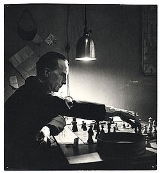
Marcel Duchamp (28 July 1887 – 2 October 1968, ) was a French
France

France , officially the French Republic , is a country whose Metropolitan France is located in Western Europe and that also comprises various Overseas departments and territories of France....
 artist whose work is most often associated with the Dadaist
Dada

Dada or Dadaism is a cultural movement that began in Z?rich, Switzerland, during World War I and peaked from 1916 to 1922. The movement primarily involved visual arts, literature?poetry, art manifestoes, aesthetics?theatre, and graphic design, and concentrated its anti-war politics through a rejection of the prevailing standards in art...
 and Surrealist
Surrealism

Surrealism is a cultural movement that began in the early-1920s, and is best known for the visual artworks and writings of the group members....
 movements. Duchamp's output influenced the development of post-World War I
World War I

World War I, or the First World War , was a global military conflict which involved the Great powers, organized into two opposing military alliances: the Allies of World War I and the Central Powers....
 Western art. He advised modern art collectors, such as Peggy Guggenheim
Peggy Guggenheim

Marguerite "Peggy" Guggenheim was an United States art collector. Born to a wealthy New York City family, she was the daughter of Benjamin Guggenheim, who went down with the RMS Titanic in 1912 and the niece of Solomon R....
 and other prominent figures, thereby helping to shape the tastes of Western art
Western art history

Also see articles: History of painting, Western paintingWestern Art' redirects here. For art of the American West, see Artists of the American West...
 during this period.

A playful man, Duchamp challenged conventional thought about artistic processes and art marketing, not so much by writing, but through subversive actions such as dubbing a urinal "art" and naming it Fountain
Fountain (Duchamp)

Fountain is a 1917 work by Marcel Duchamp. It is one of the pieces which he called Readymades of Marcel Duchamp , because he made use of an already existing object—in this case a urinal, which he titled Fountain and signed "R....
.


Discussion
Ask a question about 'Marcel Duchamp'
Start a new discussion about 'Marcel Duchamp'
Answer questions from other users
Full Discussion Forum


Recent Posts


Encyclopedia


Marcel Duchamp (28 July 1887 – 2 October 1968, ) was a French
France

France , officially the French Republic , is a country whose Metropolitan France is located in Western Europe and that also comprises various Overseas departments and territories of France....
 artist whose work is most often associated with the Dadaist
Dada

Dada or Dadaism is a cultural movement that began in Z?rich, Switzerland, during World War I and peaked from 1916 to 1922. The movement primarily involved visual arts, literature?poetry, art manifestoes, aesthetics?theatre, and graphic design, and concentrated its anti-war politics through a rejection of the prevailing standards in art...
 and Surrealist
Surrealism

Surrealism is a cultural movement that began in the early-1920s, and is best known for the visual artworks and writings of the group members....
 movements. Duchamp's output influenced the development of post-World War I
World War I

World War I, or the First World War , was a global military conflict which involved the Great powers, organized into two opposing military alliances: the Allies of World War I and the Central Powers....
 Western art. He advised modern art collectors, such as Peggy Guggenheim
Peggy Guggenheim

Marguerite "Peggy" Guggenheim was an United States art collector. Born to a wealthy New York City family, she was the daughter of Benjamin Guggenheim, who went down with the RMS Titanic in 1912 and the niece of Solomon R....
 and other prominent figures, thereby helping to shape the tastes of Western art
Western art history

Also see articles: History of painting, Western paintingWestern Art' redirects here. For art of the American West, see Artists of the American West...
 during this period.

A playful man, Duchamp challenged conventional thought about artistic processes and art marketing, not so much by writing, but through subversive actions such as dubbing a urinal "art" and naming it Fountain
Fountain (Duchamp)

Fountain is a 1917 work by Marcel Duchamp. It is one of the pieces which he called Readymades of Marcel Duchamp , because he made use of an already existing object—in this case a urinal, which he titled Fountain and signed "R....
. He produced relatively few artworks, while moving quickly through the avant-garde
Avant-garde

Avant-garde means "advance guard" or "vanguard". The adjective form is used in English, to refer to people or works that are experimental or innovative, particularly with respect to art, culture, and politics....
 circles of his time.

The creative act is not performed by the artist alone; the spectator brings the work in contact with the external world by deciphering and interpreting its inner qualifications and thus adds his contribution to the creative act.


Childhood

Marcel Duchamp was born in Blainville-Crevon
Blainville-Crevon

Blainville-Crevon is a communes of France in the Seine-Maritime departments of France of the Haute-Normandie region of northern France....
 Seine-Maritime
Seine-Maritime

Seine-Maritime is a France departments of France in Normandy. Before 1955 it was known as Seine-Inf?rieure....
 in the Haute-Normandie
Haute-Normandie

Haute-Normandie is one of the 26 regions of France of France. It was created in 1956 from two d?partements: Seine-Maritime and Eure, when Normandy was divided into Basse-Normandie and Haute-Normandie....
 region of France
France

France , officially the French Republic , is a country whose Metropolitan France is located in Western Europe and that also comprises various Overseas departments and territories of France....
, and grew up in a family that enjoyed cultural activities. The art of painter and engraver Emile Nicolle, his maternal grandfather, filled the house, and the family liked to play chess, read books, paint and make music together.
Duchampbrothers
Of Eugene and Lucie Duchamp's seven children, one died as an infant and four became successful artists. Marcel Duchamp was the brother of:
  • Jacques Villon
    Jacques Villon

    Jacques Villon was a French cubist painter and printmaker....
     (1875-1963), painter, printmaker
  • Raymond Duchamp-Villon
    Raymond Duchamp-Villon

    Raymond Duchamp-Villon was a France sculptor.Duchamp-Villon was born Pierre-Maurice-Raymond Duchamp in Damville, Eure, in the Haute-Normandie region of France, the second son of Eugene and Lucie Duchamp....
      (1876-1918), sculptor
  • Suzanne Duchamp-Crotti
    Suzanne Duchamp

    Suzanne Duchamp-Crotti was a France Dada painter. Born in Blainville-Crevon, Seine-Maritime in the Haute-Normandie Region of France, she was the fourth of six children born into the artistic family of Eugene and Lucie Duchamp....
     (1889-1963), painter


As a child, with his two older brothers already away from home at school in Rouen, Duchamp was close to his sister Suzanne, who was a willing accomplice in games and activities conjured by his fertile imagination. At 10 years old, Duchamp followed in his brothers' footsteps when he left home and began schooling at the Lycée Corneille in Rouen. For the next 7 years, he was locked into an educational regime which focused on intellectual development. Though he was not an outstanding student, his best subject was mathematics, and he won two mathematics prizes at the school. He also won a prize for drawing in 1903, and at his commencement in 1904 he won a coveted first prize, validating his recent decision to become an artist.

He took drawing classes, and learned academic drawing from a teacher who unsuccessfully attempted to protect his students from Impressionism
Impressionism

Impressionism was a 19th-century art movement that began as a loose association of Paris-based artists art exhibition their art publicly in the 1860s....
, Post-Impressionism
Post-Impressionism

Post-Impressionism is the term coined by the British artist and art critic Roger Fry in 1910 to describe the development of French art since Edouard Manet....
 and other avant-garde influences. However, Duchamp's true artistic mentor was his brother Jacques Villon, whose fluid and incisive style he sought to imitate. At 14, his first serious art attempts were drawings and watercolors depicting Suzanne Duchamp in various poses and activities. That summer he also painted landscapes in an Impressionist style using oils.

Early work

Duchamp's early art works align with Post-Impressionist
Post-Impressionism

Post-Impressionism is the term coined by the British artist and art critic Roger Fry in 1910 to describe the development of French art since Edouard Manet....
 styles. He experimented with classical techniques and subjects, as well as with Cubism
Cubism

Cubism was a 20th century avant-garde art movement, pioneered by Pablo Picasso and Georges Braque, that revolutionized European painting and sculpture, and inspired related movements in music and literature....
 and Fauvism
Fauvism

Les Fauves were a short-lived and loose grouping of early 20th century Modern artists whose works emphasized painterly qualities and strong colour over the Realism or Representation values retained by Impressionism....
. When he was later asked about what had influenced him at the time, Duchamp cited the work of Symbolist painter Odilon Redon
Odilon Redon

Bertrand-Jean Redon, better known as Odilon Redon was a Symbolist painters and printmaker, born in Bordeaux, Aquitaine, France....
, whose approach to art was not outwardly anti-academic, but quietly individual.

He studied art at the Académie Julian
Académie Julian

The Acad?mie Julian was an art school in Paris, France.Rodolphe Julian established the Acad?mie Julian in 1868 at the Passage des Panoramas, as a private studio school for art students....
 from 1904 to 1905, but preferred playing billiards to attending classes. During this time Duchamp drew and sold cartoons which reflected his ribald humor. Many of the drawings use visual and/or verbal pun
Pun

A pun, or paronomasia, is a form of word play that deliberately exploits ambiguity between similar-sounding words for humour or rhetorical effect....
s. Such play with words and symbols engaged his imagination for the rest of his life.

In 1905 he began his compulsory military service, working for a printer in Rouen. There he learned typography
Typography

Typography is the art and techniques of typesetting, type design, and modifying type glyphs. Type glyphs are created and modified using a variety of illustration techniques....
 and printing
Printing

Printing is a process for reproducing text and image, typically with ink on paper using a printing press. It is often carried out as a large-scale industrial process, and is an essential part of publishing and transaction printing....
 processes – skills he would use in his later work.

Due to his brother Jacques Villon's membership in the prestigious Académie royale de peinture et de sculpture Duchamp's work was exhibited in the 1908 Salon d'Automne
Salon d'Automne

In 1903, the first Salon d'Automne was organized by Georges Rouault, Andr? Derain, Henri Matisse and Albert Marquet as a reaction to the conservative policies of the official Paris Salon....
. The following year his work was featured in the Salon des Indépendants. Of Duchamp's pieces in the show, critic Guillaume Apollinaire
Guillaume Apollinaire

Wilhelm Albert Wlodzimierz Apolinary de Waz-Kostrowicki, known as Guillaume Apollinaire was a France poet, writer, and art critic born in Italy to a Polish mother....
 criticized what he called "Duchamp's very ugly nudes", though the two were to become friends. Duchamp also became life-long friends with exuberant artist Francis Picabia
Francis Picabia

Francis Picabia was a well-known painter and poet born of a France mother and a Spain father who was an attach? at the Cuban legation in Paris, France....
 after meeting him at the 1911 Salon d' Automne, and Picabia proceeded to introduce him to a lifestyle of fast cars and 'high' living.

In 1911 at his eldest brother Jacques Villon's home in Puteaux
Puteaux

Puteaux is a commune in France in the western suburbs of Paris, France. It is located in the heart of the Hauts-de-Seine D?partements of France, at from the Kilometre Zero....
 the Duchamp brothers hosted a regular discussion group with other artists and writers including Picabia
Francis Picabia

Francis Picabia was a well-known painter and poet born of a France mother and a Spain father who was an attach? at the Cuban legation in Paris, France....
, Robert Delaunay
Robert Delaunay

Robert Delaunay was a French artist who used Orphism , which is similar to abstract art, abstraction and cubism in his work. Delaunay concentrated on Orphism, while his later works were more abstract art, reminiscent of Paul Klee....
, Fernand Léger
Fernand Léger

Joseph Fernand Henri L?ger was a France painting, sculpture, and film director....
, Roger de la Fresnaye
Roger de La Fresnaye

Roger de La Fresnaye was a France cubist Painting.He was born in Le Mans where his father, an officer in the French army, was temporarily stationed....
, Albert Gleizes
Albert Gleizes

Albert Gleizes , was a French painter. Born Albert L?on Gleizes and raised in Paris, France, he was the son of a fabric designer who ran a large industrial design workshop....
, Jean Metzinger
Jean Metzinger

Jean Metzinger was a French Painting.Initially he was influenced by Fauvism and Impressionism, but from 1908 he was associated with Cubism. Metzinger was a member of the Section d'Or group of artists....
, Juan Gris
Juan Gris

Jos? Victoriano Gonz?lez-P?rez , better known as Juan Gris, was a Spanish Painting and sculptor who lived and worked in France most of his life....
, and Alexander Archipenko
Alexander Archipenko

Alexander Porfyrovych Archipenko was a Ukrainians avant-garde artist, sculptor and graphic artist....
. The group came to be known as the Puteaux Group, and the artists' work was dubbed Orphic cubism. Uninterested in the Cubists' seriousness or in their focus on visual matters, Duchamp did not join in discussions of Cubist theory, and gained a reputation of being shy. However, that same year he painted in a Cubist style, and added an impression of motion by using repetitive imagery.

During this period Duchamp's fascination with transition, change, movement and distance became manifest, and like many artists of the time, he was intrigued with the concept of depicting a "Fourth dimension
Fourth dimension

In physics and mathematics, a vector of n real number can be understood as a Coordinate system in an n-dimensional Euclidean space. When n = 4, the set of all such locations is called 4-dimensional Euclidean space....
" in art.

Works from this period included his first "machine" painting, (1911), which he gave to his brother Raymond Duchamp-Villon. The Coffee Mill shows similarity to the "grinder" mechanism of the Large Glass he was to paint years later.

In his 1911 there is the Cubist overlapping frames and multiple perspectives of his two brothers playing chess, but to that Duchamp added elements conveying the unseen mental activity of the players. (Notably, "échec" is French for "failure".)
Duchamp   Nude Descending A Staircase

Nude Descending a Staircase No.2

Duchamp's first work to provoke significant controversy was Nude Descending a Staircase, No. 2
Nude Descending a Staircase, No. 2

Nude Descending a Staircase, No. 2 is a 1912 painting by Marcel Duchamp.In the composition, Duchamp depicts motion by successive superimposed images, similar to stroboscopic motion photography....
 (Nu descendant un escalier n° 2) (1912). The painting depicts the mechanistic motion of a nude, with superimposed facets, similar to motion pictures
Film

Film encompasses individual motion pictures, the field of film as an art form, and the film industry. Films are produced by recording images from the world with cameras, or by creating images using animation techniques or special effects....
. It shows elements of both the fragmentation and synthesis of the Cubists
Cubism

Cubism was a 20th century avant-garde art movement, pioneered by Pablo Picasso and Georges Braque, that revolutionized European painting and sculpture, and inspired related movements in music and literature....
, and the movement and dynamism of the Futurists
Futurism (art)

Futurism was an art Art movement that originated in Italy in the early 20th century. It was largely an Italian phenomenon, though there were parallel movements in Russia, England and elsewhere....
.

He first submitted the piece to appear at the Cubist Salon des Indépendants, but jurist Albert Gleizes
Albert Gleizes

Albert Gleizes , was a French painter. Born Albert L?on Gleizes and raised in Paris, France, he was the son of a fabric designer who ran a large industrial design workshop....
 asked Duchamp's brothers to have him voluntarily withdraw the painting, or to paint over the title that he had painted on the work and rename it something else. Duchamp's brothers did approach him with Gleizes' request, but Duchamp quietly refused. Of the incident Duchamp later recalled, "I said nothing to my brothers. But I went immediately to the show and took my painting home in a taxi. It was really a turning point in my life, I can assure you. I saw that I would not be very much interested in groups after that."

He later submitted the painting to the 1913 "Armory Show
Armory Show

Many exhibitions have been held in the vast spaces of U.S. United States National Guard Armory , but the Armory Show refers to the International Exhibition of Modern Art that was organized by the Association of American Painters and Sculptors and opened in New York City's 69th Regiment Armory, on Lexington Avenue between...
" in New York City. The exhibition was officially named the International Exhibition of Modern Art, displayed works of American artists, and was also the first major exhibition of modern trends coming out of Paris. American show-goers, accustomed to realistic art, were scandalized, and the Nude was at the center of much of the controversy.

Leaving "retinal art" behind

At about this time, Duchamp read Max Stirner
Max Stirner

Johann Kaspar Schmidt , better known as Max Stirner , was a German philosopher, who ranks as one of the literary fathers of nihilism, existentialism, post-modernism and anarchism, especially of individualist anarchism....
's philosophical tract, The Ego and Its Own
The Ego and Its Own

The Ego and Its Own is a philosophy work by German language philosopher Max Stirner , first published in 1844....
, the study of which he considered another turning point in his artistic and intellectual development. He called it "...a remarkable book ... which advances no formal theories, but just keeps saying that the ego is always there in everything."

Duchamp also noted the stage adaptation of Raymond Roussel
Raymond Roussel

Raymond Roussel was a France poet, novelist, playwright, musician, and chess enthusiast. Through his novels, poems, and plays he exerted a profound influence on certain groups within French literature of the 20th century, including the Surrealists, Oulipo, and the authors of the nouveau roman....
's 1910 novel, Impressions d'Afrique which featured plots that turned in on themselves, word play, surrealistic sets and humanoid machines. He credited the drama with having radically changed his approach to art, and having inspired him to begin the creation of his The Bride Stripped Bare By Her Bachelors, Even
The Bride Stripped Bare By Her Bachelors, Even

The Bride Stripped Bare by Her Bachelors, Even most often called The Large Glass, is an artwork by Marcel Duchamp.Duchamp carefully created The Bride Stripped Bare by Her Bachelors, Even, working on the piece from 1915 to 1923....
,
also known as The Large Glass.

While in Germany in 1912 he painted the last of his Cubist-like paintings and a "Bride Stripped Bare by Her Bachelors" image, and began making plans for The Large Glass — scribbling short notes to himself, sometimes with hurried sketches. It would be over 10 years before this piece was completed. Little else is known about the two-month stay in Germany except that the friend he visited was intent on showing him the sights and the nightlife.

Later that year he travelled with Picabia, Apollinaire and Gabrielle Buffet-Picabia through the Jura mountains
Jura mountains

The Jura Mountains are a small mountain range located north of the Alps, separating the Rhine and Rhone River rivers and forming part of the drainage divide of each....
, an adventure that Buffet-Picabia described as one of their "forays of demoralization, which were also forays of witticism and clownery ... the disintegration of the concept of art." Duchamp's notes from the trip avoid logic and sense, and have a surrealistic, mythical connotation.

Duchamp painted few canvases after 1912, and in those he did, he attempted to remove "painterly
Painterly

Painterly is a translation of the German language term malerisch, one of the opposed categories popularized by Swiss art historian Heinrich W?lfflin in order to help focus, enrich and standardize the terms being used by art historians of his time to characterize Work of art....
" effects, and instead to use a technical drawing approach.

His broad interests led him to an exhibition of aviation technology during this period, after which Duchamp said to his friend Constantin Brancusi
Constantin Brancusi

Constantin Br?ncusi ), was an internationally renowned Romanian sculpture whose sculptures, which blend simplicity and sophistication, led the way for modern art sculptors....
, "Painting is washed up. Who will ever do anything better than that propeller? Tell me, can you do that?" Brancusi later sculpted bird forms
Bird in Space

"Bird in Space" is a series of sculptures by Constantin Brancusi, a Romanian sculptor. The original work was created in 1923. It was sold in 2005 for $27.5 million, a record for a sculpture sold in an auction....
, which U.S. Customs officials mistook for aviation parts and for which they attempted to collect import duties.

During this decade Duchamp began working as a librarian in the Bibliotèque Sainte-Geneviève, where he earned a living wage and withdrew from painting circles into scholarly realms. He studied math and physics – areas in which exciting new discoveries were taking place. The theoretical writings of Henri Poincaré
Henri Poincaré

Jules Henri Poincar? was a French mathematician and theoretical physicist, and a philosophy of science. Poincar? is often described as a polymath, and in mathematics as The Last Universalist, since he excelled in all fields of the discipline as it existed during his lifetime....
 particularly intrigued and inspired Duchamp. Poincaré postulated that the laws believed to govern matter were created solely by the minds that "understood" them and that no theory could be considered "true." "The things themselves are not what science can reach..., but only the relations between things. Outside of these relations there is no knowable reality", Poincaré wrote in 1902.

Duchamp's own art-science experiments began during his tenure at the library. To make one of his favorite pieces, , he dropped three 1-meter lengths of thread onto prepared canvases, one at a time, from a height of 1 meter. The threads landed in three random undulating positions. He varnished them into place on the blue-black canvas strips and attached them to glass. He then cut three wood slats into the shapes of the curved strings, and put all the pieces into a croquet box. Three small leather signs with the title printed in gold were glued to each of the "stoppage" backgrounds. The piece appears to literally follow Poincaré's School of the Thread, part of a book on classical mechanics.

Work on The Large Glass continued into 1913, with his invention of inventing a repertoire of forms. He made notes, sketches and painted studies, and even drew some of his ideas on the wall of his apartment.

In his studio he mounted a bicycle wheel upside down onto a stool, spinning it occasionally just to watch it. Later he denied that its creation was purposeful, though it has come to be known as the first of his "Readymades"
Readymades of Marcel Duchamp

The Found art of Marcel Duchamp are ordinary manufactured objects that he selected and modified, as an antidote to what he called "retinal art"....
. "I enjoyed looking at it", he said. "Just as I enjoy looking at the flames dancing in the fireplace."

Meanwhile, Nude Descending a Staircase No. 2 scandalized Americans at the Armory Show
Armory Show

Many exhibitions have been held in the vast spaces of U.S. United States National Guard Armory , but the Armory Show refers to the International Exhibition of Modern Art that was organized by the Association of American Painters and Sculptors and opened in New York City's 69th Regiment Armory, on Lexington Avenue between...
, and the sale of all four of his paintings in the show financed his trip to America in 1915.

After World War I
World War I

World War I, or the First World War , was a global military conflict which involved the Great powers, organized into two opposing military alliances: the Allies of World War I and the Central Powers....
 was declared in 1914, with his brothers and many friends in military service and himself exempted, Duchamp felt uncomfortable in Paris. He decided to emigrate to the then-neutral United States. To his surprise, he found he was a celebrity when he arrived in New York in 1915, where he quickly befriended art patron Katherine Dreier and artist Man Ray
Man Ray

Man Ray, born Emmanuel Radnitzky , was an American artist who spent most of his career in Paris, France. Perhaps best described simply as a modernist, he was a significant contributor to both the Dada and Surrealism movements, although his ties to each were informal....
. Duchamp's circle included art patrons Louise and Walter Conrad Arensberg, actress and artist Beatrice Wood
Beatrice Wood

Beatrice Wood was an United States artist and studio potter, who late in life was dubbed the "Mama of Dada," and served as a partial inspiration for the character of List of characters in Titanic #Rose DeWitt Bukater in James Cameron's 1997 film, Titanic ....
 and Francis Picabia
Francis Picabia

Francis Picabia was a well-known painter and poet born of a France mother and a Spain father who was an attach? at the Cuban legation in Paris, France....
, as well as other avant-garde
Avant-garde

Avant-garde means "advance guard" or "vanguard". The adjective form is used in English, to refer to people or works that are experimental or innovative, particularly with respect to art, culture, and politics....
 figures. Though he spoke little English, in the course of supporting himself by giving French lessons and through some library work, he quickly learned the language.

For two years the Arensbergs, who would remain his friends and patrons for 42 years, were the landlords of his studio. In lieu of rent, they agreed that his payment would be The Large Glass. An art gallery offered Duchamp $10,000 per year in exchange for all of his yearly production, but Duchamp declined the offer, preferring to work on The Large Glass.

Société Anonyme

Duchamp created the Société Anonyme
Société Anonyme (art)

Soci?t? Anonyme, Inc. was an art organization founded in 1920 by Katherine Dreier, Man Ray and Marcel Duchamp. The society sponsored lectures, concerts, publications, and exhibitions of modern art, including the International Exhibition of Modern Art at the Brooklyn Museum in 1926....
 in 1920, along with Katherine Dreier and Man Ray
Man Ray

Man Ray, born Emmanuel Radnitzky , was an American artist who spent most of his career in Paris, France. Perhaps best described simply as a modernist, he was a significant contributor to both the Dada and Surrealism movements, although his ties to each were informal....
. This was the beginning of his life-long involvement in art dealing and collecting. The group collected modern art works, and arranged modern art exhibitions and lectures throughout the 1930s.

By this time Walter Pach
Walter Pach

File:Walter Pach 2a7c41796d b.jpgWalter Pach was an artist, critic, lecturer, art adviser, and art historian who wrote extensively about modern art and championed the cause of modern art....
, one of the coordinators of the 1913 Armory Show
Armory Show

Many exhibitions have been held in the vast spaces of U.S. United States National Guard Armory , but the Armory Show refers to the International Exhibition of Modern Art that was organized by the Association of American Painters and Sculptors and opened in New York City's 69th Regiment Armory, on Lexington Avenue between...
, sought Duchamp's advice on modern art. Beginning with Société Anonyme, Dreier also depended on Duchamp's counsel in gathering her collection, as did Arensberg. Later Peggy Guggenheim
Peggy Guggenheim

Marguerite "Peggy" Guggenheim was an United States art collector. Born to a wealthy New York City family, she was the daughter of Benjamin Guggenheim, who went down with the RMS Titanic in 1912 and the niece of Solomon R....
, Museum of Modern Art
Museum of Modern Art

The Museum of Modern Art is an art museum located in Midtown Manhattan in New York City, USA, on 53rd Street, between Fifth and Sixth Avenues....
 directors Alfred Barr
Alfred Barr

Alfred Hamilton Barr, Jr. , known as Alfred H. Barr, Jr., was an art historian and the first director of the Museum of Modern Art in New York City....
 and James Johnson Sweeney
James Johnson Sweeney

James Johnson Sweeney was a curator, and writer about modern art. From 1935 to 1946, he was curator for the Museum of Modern Art. He was the second director of the Solomon R....
 consulted with Duchamp on their modern art collections and shows.

Dada

Duchamp Fountaine
New York Dada
Dada

Dada or Dadaism is a cultural movement that began in Z?rich, Switzerland, during World War I and peaked from 1916 to 1922. The movement primarily involved visual arts, literature?poetry, art manifestoes, aesthetics?theatre, and graphic design, and concentrated its anti-war politics through a rejection of the prevailing standards in art...
 had a less serious tone than that of European Dadaism, and was not a particularly organized venture. Duchamp's friend Picabia connected with the Dada group in Zürich, bringing to New York the Dadaist ideas of absurdity and "anti-art". A group met almost nightly at the Arensberg
Walter Arensberg

Walter Conrad Arensberg was an American art collector, critic and poet. His father was part owner and president of a crucible steel company. He majored in English and philosophy at Harvard University....
 home, or caroused in Greenwich Village
Greenwich Village

Greenwich Village , often simply called the Village, is a largely residential area on the lower west side of southern Manhattan in New York City....
. Together with Man Ray
Man Ray

Man Ray, born Emmanuel Radnitzky , was an American artist who spent most of his career in Paris, France. Perhaps best described simply as a modernist, he was a significant contributor to both the Dada and Surrealism movements, although his ties to each were informal....
, Duchamp contributed his ideas and humor to the New York activities, many of which ran concurrent with the development of his Readymades
Readymades of Marcel Duchamp

The Found art of Marcel Duchamp are ordinary manufactured objects that he selected and modified, as an antidote to what he called "retinal art"....
 and The Large Glass. They also worked on the concept of "found art"
Found art

The term found art—more commonly found object or readymade—describes art created from the undisguised, but often modified, use of objects that are not normally considered art, often because they already have a non-art function....
.

The most prominent example of Duchamp's association with Dada was his submission of Fountain
Fountain (Duchamp)

Fountain is a 1917 work by Marcel Duchamp. It is one of the pieces which he called Readymades of Marcel Duchamp , because he made use of an already existing object—in this case a urinal, which he titled Fountain and signed "R....
, a urinal, to the Society of Independent Artists
Society of Independent Artists

Society of Independent Artists was an association of American artists founded in 1916 and based in New York City.Based on the French Soci?t? des Artistes Ind?pendants, the goal of the society was to hold annual exhibitions by avant-garde artists....
 exhibit in 1917. Artworks in the Independent Artists shows were not selected by jury, and all pieces submitted were displayed. However, the show committee insisted that Fountain was not art, and rejected it from the show. This caused an uproar amongst the Dadaists, and led Duchamp to resign from the board of the Independent Artists.

Along with Henri-Pierre Roché
Henri-Pierre Roché

Henri-Pierre Roch? was a French author who was involved with the Dada movement.Born in Paris, France, Henri-Pierre Roch? was a respected journalist as well as an art collector and dealer....
 and Beatrice Wood
Beatrice Wood

Beatrice Wood was an United States artist and studio potter, who late in life was dubbed the "Mama of Dada," and served as a partial inspiration for the character of List of characters in Titanic #Rose DeWitt Bukater in James Cameron's 1997 film, Titanic ....
, Duchamp published a Dada magazine in New York, entitled The Blind Man
The Blind Man

The Blind Man was an art and Dada journal published by the New York Dadaists in 1917.Henri-Pierre Roche, Beatrice Wood, Marcel Duchamp, Walter Arensberg, Mina Loy, Francis Picabia and Gabrielle Buffet-Picabia were among those involved in the magazine that saw only two editions to publication....
, which included art, literature, humor and commentary.

When he returned to Paris after World War I, Duchamp did not participate in the Dada group.

Readymades

"Readymades" were found objects which Duchamp chose and presented as art. The first such object was Bicycle Wheel
Bicycle wheel

A bicycle wheel is a wheel, most commonly a Wire wheels, designed for a bicycle. A pair is often called a wheelset, especially in the context of ready built "off the shelf" performance-oriented wheels....
, an inverted bicycle wheel mounted on a stool, which Duchamp assembled in 1913. However, he did not coin the term "readymade" until 1915.

Bottle Rack (1914), a bottle drying rack signed by Duchamp, is considered to be the first "pure" readymade. Prelude to a Broken Arm (1915), a snow shovel, followed soon after. His Fountain
Fountain (Duchamp)

Fountain is a 1917 work by Marcel Duchamp. It is one of the pieces which he called Readymades of Marcel Duchamp , because he made use of an already existing object—in this case a urinal, which he titled Fountain and signed "R....
, a urinal signed with the pseudonym "R. Mutt", shocked the art world in 1917. Fountain was selected in 2004 as "the most influential artwork of the 20th century" by 500 renowned artists and historians.

In 1919, Duchamp made a parody
Parody

A parody , in contemporary usage, is a work created to mock, comment on, or poke fun at an original work, its subject, or author, or some other target, by means of humorous, satiric or ironic imitation....
 of the Mona Lisa
Mona Lisa

Mona Lisa is a 16th century portrait painting painted in oil painting on a poplar panel painting by Leonardo da Vinci during the Italian Renaissance....
 by adorning a cheap reproduction of the painting with a mustache and goatee. To this he added the rude inscription L.H.O.O.Q.
L.H.O.O.Q.

L.H.O.O.Q. is a work of art by Marcel Duchamp first conceived in 1919. The work is one of what Duchamp referred to as Readymades of Marcel Duchamp....
, a pun which, when read out loud in French
French language

French is a Romance language spoken around the world by around 80 million people as first language, by 190 million as second language, and by about another 200 million people as an acquired tongue, with significant speakers in 54 countries....
, sounds like "Elle a chaud au cul". This can be translated as "She has a hot ass", implying that the woman in the painting is in a state of sexual excitement and availability. It may also have been intended as a Freudian joke, referring to Leonardo da Vinci
Leonardo da Vinci

Leonardo di ser Piero da Vinci was an Italy polymath, being a scientist, mathematician, engineer, inventor, anatomist, Painting, sculptor, architect, botanist, musician and writer....
's alleged homosexuality
Homosexuality

Homosexuality refers to human sexual behavior or same-sex attraction between people of the same sex or to homosexual orientation. As a sexual orientation, homosexuality refers to "having sexual and romantic attraction primarily or exclusively to members of one?s own sex"; "it also refers to an individual?s sense of personal and social identi...
.

According to Rhonda Roland Shearer
Rhonda Roland Shearer

Rhonda Roland Shearer is a sculptor, scholar, and journalist, who founded the nonprofit organization Art Science Research Laboratory with her late husband Stephen Jay Gould....
, the apparent Mona Lisa reproduction is in fact a copy modeled partly on Duchamp's own face. Research published by Shearer also speculates that Duchamp himself may have created some of the objects which he claimed to have been "found".

The Large Glass

Duchamp Largeglass
Duchamp carefully created a masterpiece, The Bride Stripped Bare by Her Bachelors, Even (The Large Glass)
The Bride Stripped Bare By Her Bachelors, Even

The Bride Stripped Bare by Her Bachelors, Even most often called The Large Glass, is an artwork by Marcel Duchamp.Duchamp carefully created The Bride Stripped Bare by Her Bachelors, Even, working on the piece from 1915 to 1923....
, working on the piece from 1915 to 1923, with the exception of periods in Buenos Aires and Paris in 1918 - 1920. He executed the work on two panes of glass with materials such as lead foil, fuse wire, and dust. It combines chance procedures, plotted perspective studies, and laborious craftsmanship. His notes for the piece, published as The Green Box, reflect the creation of unique rules of physics, and a mythology which describes the work. He stated that his "hilarious picture" is intended to depict the erratic encounter between a bride and her nine bachelors.

Until 1969 when the Philadelphia Museum of Art
Philadelphia Museum of Art

The Philadelphia Museum of Art, known locally and colloquially as "The Art Museum", is among the largest art museums in the United States....
 revealed Duchamp's Etant donnés
Étant donnés

?tant donn?s is Marcel Duchamp's last major art work which surprised the art world that believed he'd given up art for chess 25 years earlier....
 tableau, The Large Glass was thought to have been his last major work.

Kinetic works

Duchamp's interest in kinetic works
Kinetic art

File:Whirligig.jpgKinetic art is art that contains moving parts or depends on motion for its effect. The moving parts are generally powered by wind, a motor or the observer....
 can be discerned as early as the notes for The Large Glass and the Bicycle Wheel
Bicycle wheel

A bicycle wheel is a wheel, most commonly a Wire wheels, designed for a bicycle. A pair is often called a wheelset, especially in the context of ready built "off the shelf" performance-oriented wheels....
 readymade, and despite losing interest in "retinal art", he retained interest in visual phenomena.

In 1920, with help from Man Ray
Man Ray

Man Ray, born Emmanuel Radnitzky , was an American artist who spent most of his career in Paris, France. Perhaps best described simply as a modernist, he was a significant contributor to both the Dada and Surrealism movements, although his ties to each were informal....
, Duchamp built a motorized sculpture, Rotative plaques verre, optique de précision ("Rotary Glass Plates, Precision Optics"). The piece, which he did not consider to be art, involved a motor to spin pieces of rectangular glass on which were painted segments of a circle. When the apparatus spins, an optical illusion occurs, in which the segments appear to be closed concentric circles. ()

Man Ray
Man Ray

Man Ray, born Emmanuel Radnitzky , was an American artist who spent most of his career in Paris, France. Perhaps best described simply as a modernist, he was a significant contributor to both the Dada and Surrealism movements, although his ties to each were informal....
 set up equipment to photograph the initial experiment, but when they turned the machine on for the second time, a belt broke, and caught a piece of the glass, which after glancing off of Man Ray's head, shattered into bits.

After moving back to Paris in 1923, at André Breton
André Breton

Andr? Breton was a French writer, poet, and surrealist theorist, and is best known as the main founder of surrealism. His writings include the Surrealist Manifesto of 1924, in which he defined surrealism as pure psychic automatism....
's urging and through the financing of Jacques Doucet, Duchamp built another optical device based on the first one - . This time the optical element was a globe cut in half, with black concentric circles painted on it. When it spins, the circles appear to move backwards and forwards in space. Duchamp asked that Doucet not exhibit the apparatus as art.

Rotoreliefs were the next phase of Duchamp's spinning works. To make the optical "play toys" he painted designs on flat cardboard circles and spun them on a phonographic turntable. When spinning, the flat disks appeared three-dimensional. He had a printer produce 500 sets of six of the designs, and set up a booth at a 1935 Paris inventors' show to sell them. The venture was a financial disaster, but some optical scientists thought they might be of use in restoring three-dimensional stereoscopic sight to people who have lost vision one eye. ()

In collaboration with Man Ray
Man Ray

Man Ray, born Emmanuel Radnitzky , was an American artist who spent most of his career in Paris, France. Perhaps best described simply as a modernist, he was a significant contributor to both the Dada and Surrealism movements, although his ties to each were informal....
 and Marc Allégret
Marc Allégret

Marc All?gret was a French screenwriter and film director.Born in Basel, Basel-Stadt, Switzerland, he was the elder brother of Yves All?gret....
, Duchamp filmed early versions of the Rotoreliefs and they named the film Anémic Cinéma
Anemic Cinema

Anemic Cinema or An?mic Cin?ma is a Dadaist, surrealist, or experimental film made by Marcel Duchamp. The film depicts whirling animation -- which Duchamp called Rotoreliefs -- alternated with puns in French language....
 (1926).

Later, in Alexander Calder
Alexander Calder

Alexander Calder , also known as Sandy Calder, was an United States Sculpture and artist most famous for inventing the mobile . In addition to mobile and stabile sculpture, Alexander Calder also created paintings, lithography, toys, tapestry and jewelry, and designed carpets....
's studio in 1931, while looking at the sculptor's kinetic works, Duchamp suggested that these should be called"mobile
Mobile (sculpture)

A mobile is a type of kinetic sculpture constructed to take advantage of the principle of equilibrium. It consists of a number of rods, from which weighted objects or further rods hang....
s". Calder agreed to use this novel term in his upcoming show. To this day, sculptures of this type are called "mobiles".

Rrose Sélavy

Rroseselavy
"Rrose Sélavy", also spelled Rose Sélavy, was one of Duchamp's pseudonyms. The name, a pun
Pun

A pun, or paronomasia, is a form of word play that deliberately exploits ambiguity between similar-sounding words for humour or rhetorical effect....
, sounds like the French phrase "Eros, c'est la vie", which may be translated as "Eros, such is life". It has also been read as "arroser la vie" ("to make a toast to life").

Sélavy emerged in 1921 in a series of photographs by Man Ray
Man Ray

Man Ray, born Emmanuel Radnitzky , was an American artist who spent most of his career in Paris, France. Perhaps best described simply as a modernist, he was a significant contributor to both the Dada and Surrealism movements, although his ties to each were informal....
 showing Duchamp dressed as a woman. Through the 1920s Man Ray and Duchamp collaborated on more photos of Sélavy. Duchamp later used the name as the byline on written material and signed several creations with it. These included at least one sculpture
Sculpture

Sculpture is Three-dimensional space artwork created by shaping or combining hard and or plastic material, sound, and or text and or light, commonly Stone sculpture , metal, glass, or wood....
, Why Not Sneeze Rrose Sélavy?
Why Not Sneeze Rrose Sélavy?

Why not Sneeze, Rrose S?lavy? is a 1921 "Readymades of Marcel Duchamp" sculpture by Marcel Duchamp.Duchamp made the piece as a birdcage containing a thermometer, a piece of cuttlebone and 151 marble cubes....
. The sculpture, a type of readymade
Readymades of Marcel Duchamp

The Found art of Marcel Duchamp are ordinary manufactured objects that he selected and modified, as an antidote to what he called "retinal art"....
 called an assemblage, consists of an oral
Mouth

The mouth, buccal cavity, or oral cavity is the first portion of the alimentary canal that receives food and begins digestion by mechanically breaking up the solid food particles into smaller pieces and mixing them with saliva....
 thermometer
Thermometer

The thermometer is a device that measures temperature or temperature gradient using a variety of different principles; it comes from the Greek language roots thermo, heat, and meter, to measure....
, and several dozen small cubes of marble
Marble

Marble is a nonfoliated metamorphic rock resulting from the metamorphism of limestone, composed mostly of calcite . It is extensively used for Marble sculpture, as a architecture material, and in many other applications....
 resembling sugar
Sugar

Sugar is a class of edible crystalline substances, mainly sucrose, lactose, and fructose. Human taste buds interpret its flavor as sweet. Sugar as a basic food carbohydrate primarily comes from sugar cane and from sugar beet, but also appears in fruit, honey, sorghum, sugar maple , and in many other sources....
 cubes inside a birdcage
Birdcage

A birdcage is a cage designed to house birds as pets.Antique birdcages are often popular as collectors' items or as household decor but most are not suitable for housing live birds, being too small, or of unsafe materials or construction....
.

The inspiration for the name "Rrose Sélavy" may have been Belle da Costa Greene
Belle da Costa Greene

Belle da Costa Greene was the librarian to J. P. Morgan and after his death she became the first director of the Pierpont Morgan Library.She was born Belle Marion Greener in Washington, D.C., and grew up there and in New York City....
, J.P. Morgan's librarian of the Pierpont Morgan Library. Following the death of J.P. Morgan, Sr., Greene became the Library's director, working there for a total of forty-three years. Empowered by the Morgans, she built the library collection, buying and selling rare manuscripts, books and art
Art

Art is the process or product of deliberately arranging elements in a way that appeals to the senses or emotions. It encompasses a diverse range of human activities, creations, and modes of expression, including music and literature....
.

Transition from art to chess

In 1918 Duchamp made a hiatus from the New York art scene, interrupting his work on the Large Glass, and went to Buenos Aires
Buenos Aires

Buenos Aires is the Capital and largest city of Argentina. It is located on the southern shore of the R?o de la Plata, on the southeastern coast of the South American continent....
, Argentina
Argentina

Argentina, officially the Argentine Republic , is a country in South America, constituted as a federation of 23 provinces and an autonomous city....
. He remained for nine months and often played chess
Chess

Chess is a recreational and competitive game played between two Player . Sometimes called Western chess or international chess to distinguish it from History of chess and other chess variants, the current form of the game emerged in Southern Europe during the second half of the 15th century after evolving from similar, much older...
. He even carved from wood his own chess set, with the assistance of a local craftsman who made the knights
Knight (chess)

The knight is a chess piece in the game of chess, representing a knight . It is normally represented by a horse's head, leading some to refer to it informally as a "horse"....
. He moved to Paris in 1919, and then back to the United States in 1920. Upon his return to Paris in 1923, Duchamp was, in essence, no longer a practicing artist. Instead, he played chess
Chess

Chess is a recreational and competitive game played between two Player . Sometimes called Western chess or international chess to distinguish it from History of chess and other chess variants, the current form of the game emerged in Southern Europe during the second half of the 15th century after evolving from similar, much older...
, which he studied for the rest of his life to the exclusion of most other activities.

Duchamp can be seen, very briefly, playing chess with Man Ray
Man Ray

Man Ray, born Emmanuel Radnitzky , was an American artist who spent most of his career in Paris, France. Perhaps best described simply as a modernist, he was a significant contributor to both the Dada and Surrealism movements, although his ties to each were informal....
 in the short film Entr'acte
Entr'acte (film)

Entr'acte is a short film directed by Ren? Clair, which premiered as an entr'acte for the Ballets Su?dois production Rel?che at the Th??tre des Champs-?lys?es in Paris....
 (1924) by Rene Clair
René Clair

Ren? Clair born Ren?-Lucien Chomette, was a France filmmaker....
. He designed the 1925 Poster for the Third French Chess Championship, and as a competitor in the event, finished at fifty percent (3-3, with two draws). Thus he earned the title of chess master
Chess master

A chess master is a chess player of such skill that he/she can usually beat chess experts, who themselves typically can nearly always prevail against most amateurs....
. During this period his fascination with chess so distressed his first wife that she glued his pieces to the board
Chessboard

A chessboard is the type of checkerboard used in the game of chess, and consists of 64 squares arranged in two alternating colors . The colors are called "black" and "white" , although the actual colors are usually dark green and buff for boards used in competition, and often natural shades of light and dark woods for home boards....
. Duchamp continued to play in the French Championships and also in the Olympiad
Olympiad

An Olympiad is a period of four years, associated with the Ancient Olympic Games of Classical Greece. In the Hellenistic period, beginning with Ephorus, Olympiads were used as Epoch ....
s from 1928-1933, favoring hypermodern
Hypermodernism (chess)

Hypermodernism is a school of chess thought which advocates controlling the centre of the board with distant pieces rather than with pawn , thus inviting the opponent to occupy the centre with pawns which can then become objects of attack....
 openings such as the Nimzo-Indian.

Sometime in the early 1930s, Duchamp reached the height of his ability, but realized that he had little chance of winning recognition in top-level chess. In following years, his participation in chess tournaments declined, but he discovered correspondence chess
Correspondence chess

Correspondence chess is chess played by various forms of long-distance correspondence, usually through a correspondence chess server, through e-mail or by the postal system; less common methods which have been employed include fax and homing pigeon....
 and became a chess journalist, writing weekly newspaper columns. While his contemporaries were achieving spectacular success in the art world by selling their works to high-society collectors, Duchamp observed "I am still a victim of chess. It has all the beauty of art - and much more. It cannot be commercialized. Chess is much purer than art in its social position."

In 1932 Duchamp teamed with chess theorist Vitaly Halberstadt
Vitaly Halberstadt

Vitaly Halberstadt was a French chess player, problemist and above all a noted endgame study composer.Born in Odessa, Ukraine , he emigrated to France....
 to publish "L'opposition et cases conjuguées sont réconciliées" (Opposition and Sister Squares are Reconciled). This treatise describes the Lasker-Reichhelm position
Corresponding squares

Corresponding squares in chess occur in some chess endgames, usually ones that are mostly blocked. If squares x and y are corresponding squares, it means that if one player moves to x then the other player must move to y in order to hold his position....
, an extremely rare position that can arise in the endgame. Using enneagram
Enneagram

In geometry, an enneagram is a nine-pointed geometric figure. The term derives from two ancient Greek words: ennea and gramma ....
-like charts that fold upon themselves, the authors demonstrated that in this position, the most Black can hope for is a draw
Draw (chess)

In chess, a draw is one of the possible outcomes of a game, the others being a win for White and a win for Black . Traditionally, in tournaments a draw is worth a half point to each player, while a win is worth one point to the victor and none to the loser....
.

The theme of the "endgame" is important to an understanding of Duchamp's complex attitude towards his artistic career. Irish playwright Samuel Beckett
Samuel Beckett

Samuel Barclay Beckett was an Irish people writer, dramatist and poet. Beckett's work offers a bleak outlook on human culture and both formally and philosophically became increasingly minimalism....
 was an associate of Duchamp, and used the theme as the narrative device for the 1957 play of the same name, "Endgame"
Endgame (play)

Endgame, by Samuel Beckett, is a one-act Play with four characters. It was originally written in French , entitled Fin de partie; as was his custom, Beckett himself translated it into English ....
. In 1968, Duchamp played an artistically important chess match with avant-garde composer John Cage
John Cage

John Milton Cage Jr. was an American composer. A pioneer of Aleatoric music, electronic music and Extended technique, Cage was one of the leading figures of the post-war avant-garde and, in the opinion of many, the most influential American composer of the 20th century....
, at a concert entitled "Reunion". Music was produced by a series of photoelectric cells underneath the chessboard, triggered sporadically by normal game play.

On choosing a career in chess, Duchamp said: "If Bobby Fischer
Bobby Fischer

Robert James "Bobby" Fischer was an United States and Icelandic chess Grandmaster , and the eleventh World Chess Champion.As a teenager, Fischer became famous as a chess prodigy....
 came to me for advice, I certainly would not discourage him - as if anyone could - but I would try to make it positively clear that he will never have any money from chess, live a monk-like existence and know more rejection than any artist ever has, struggling to be known and accepted." Duchamp left a legacy to chess in the form of an enigmatic endgame problem he composed in 1943. The problem was included in the announcement for Julian Lev's gallery exhibition "Through the Big End of the Opera Glass", printed on translucent paper with the faint inscription: "White to play and win." Grandmasters and endgame specialists have since grappled with the problem, with most concluding that there is no solution.

Artistic involvement and marriages

Although Duchamp was no longer considered to be an active artist, he continued to consult with artists, art dealers and collectors, From 1925 he often travelled between France and the United States, and made New York's Greenwich Village his home in 1942.

In June 1927, Duchamp married Lydie Sarazin-Lavassor, however, they divorced six months later. It was rumored that Duchamp had chosen a marriage of convenience, because Sarazin-Lavassor was the daughter of a wealthy automobile manufacturer. Early in January 1928, Duchamp said that he could no longer bear the responsibility and confinement of marriage, and soon thereafter they were divorced.

From the mid-1930s onwards, he collaborated with the Surrealists
Surrealism

Surrealism is a cultural movement that began in the early-1920s, and is best known for the visual artworks and writings of the group members....
, however, he did not join the movement despite the coaxing of André Breton
André Breton

Andr? Breton was a French writer, poet, and surrealist theorist, and is best known as the main founder of surrealism. His writings include the Surrealist Manifesto of 1924, in which he defined surrealism as pure psychic automatism....
. From then until 1944, together with Max Ernst
Max Ernst

Max Ernst was a German Painting, sculptor, graphic artist, and poet. A prolific artist, Ernst is considered to be one of the primary pioneers of Dada movement and Surrealism....
, Eugenio Granell
Eugenio Granell

Eugenio Granell was an artist often described as the last Spanish Surrealist painter.Born in La Coru?a in the north-western region of Galicia , Eugenio Fern?ndez Granell started out as a political radical and a musician....
 and Breton
André Breton

Andr? Breton was a French writer, poet, and surrealist theorist, and is best known as the main founder of surrealism. His writings include the Surrealist Manifesto of 1924, in which he defined surrealism as pure psychic automatism....
, Duchamp edited the Surrealist periodical VVV
VVV (journal)

VVV was a journal devoted to the dissemination of Surrealism, published in New York City from 1942 through 1944.Only four issues of VVV were ever produced ....
, and also served as an advisory editor for the magazine View
View (magazine)

View was an American literary and art magazine published from 1940 to 1947 by artist and writer Charles Henri Ford, and writer and film critic Parker Tyler....
, which featured him in its March 1945 edition, thus introducing him to a broader American audience.

In 1954, he and Alexina "Teeny" Sattler
Alexina Duchamp

Alexina "Teeny" Duchamp was the second wife of artist and chess player, Marcel Duchamp. She was born Alexina Sattler in Cincinnati, Ohio in 1906....
 married, and they remained together until his death. Duchamp became a United States citizen in 1955.

His influence on the art world remained behind the scenes until the late 1950s, when he was "discovered" by young artists such as Robert Rauschenberg
Robert Rauschenberg

Robert Rauschenberg was an American artist who came to prominence in the 1950s transition from Abstract Expressionism to Pop Art. Rauschenberg is perhaps most famous for his "Combines" of the 1950s, in which non-traditional materials and objects were employed in innovative combinations....
 and Jasper Johns
Jasper Johns

File:Jasper Johns's 'Map', 1961.jpgJasper Johns, Jr. is a contemporary American artist who works primarily in painting and printmaking. He is represented by the Matthew Marks Gallery....
, who were eager to escape the dominance of Abstract Expressionism
Abstract expressionism

Abstract expressionism was an American post?World War II art movement. It was the first specifically American movement to achieve worldwide influence and also the one that put New York City at the center of the art world, a role formerly filled by Paris....
.

Interest in Duchamp was reignited in the 1960s, and he gained international public recognition. 1963 saw his first retrospective exhibition at the Pasadena Art Museum, and in 1966 the Tate Gallery
Tate Gallery

Tate is the United Kingdom's national museum of British and Modern Art, and is a network of four art galleries in England: Tate Britain , Tate Liverpool , Tate St Ives and Tate Modern , with a complementary website, Tate Online ....
 hosted a large exhibit of his work. Other major institutions, including the Philadelphia Art Museum and the Metropolitan Museum of Art
Metropolitan Museum of Art

The Metropolitan Museum of Art is an art museum located on the eastern edge of Central Park, along what is known as Museum Mile, New York City in New York City, USA....
, followed, with large showings of Duchamp's work. He was invited to lecture on art and to participate in formal discussions, as well as sitting for interviews with major publications.

As the last surviving member of the Duchamp family of artists, in 1967 Duchamp helped to organize an exhibition in Rouen, France, called "Les Duchamp: Jacques Villon, Raymond Duchamp-Villon, Marcel Duchamp, Suzanne Duchamp." Parts of this family exhibition were later shown again at the Musée National d'Art Moderne in Paris.

Exhibition design

Duchamp was the designer of the 1938 International Surrealist Exhibition, which was held at the Gallerie des Beaux-arts, Paris. The show featured more than 60 artists from different countries, including approximately 300 paintings, objects, collages, photographs and installations.

The surrealists wanted to create an exhibition which in itself would be a creative act, and called on Duchamp to do so. At the exhibition's entrance he placed Salvador Dalí
Salvador Dalí

Salvador Domingo Felipe Jacinto Dal? i Dom?nech, 1st Marquis of P?bol was a Spain Catalonia surrealist painter born in Figueres.Dal? was a skilled Technical drawing, best known for the striking and bizarre images in his surrealism work....
's This work consisted of a taxicab rigged to produce a drizzle of water down the inside of the windows, a shark-headed creature in the driver's seat, and a blond mannequin crawling with live snails in the back. In this way Duchamp greeted entering patrons, who were in full evening dress.

Surrealist Street filled one side of the lobby with mannequins dressed by various surrealists. The main hall was a simulation of a dark subterranean cave with 1,200 coal bags suspended from the ceiling. Illumination was provided only by a single light bulb, so patrons were given flashlights with which to view the art.

An installation by Wolfgang Paalen
Wolfgang Paalen

Wolfgang Paalen was an Austrian-Mexican Painting and theorist....
 was composed of oak leaves and a water-filled pond with water lilies and reeds, and the aroma of roasting coffee filled the air. Around midnight, the visitors witnessed the dancing shimmer of a sparsely dressed girl who suddenly arose from the reed, jumped on a bed, shrieked hysterically, then disappeared just as quickly. Much to the surrealists' satisfaction the exhibition scandalized the viewers.

In 1942, for the First Papers of Surrealism show in New York, surrealists again called on Duchamp to design the exhibition. This time he wove a three-dimensional web of string throughout the rooms of the space, in some cases making it almost impossible to see the works. Duchamp made a secret arrangement with an associate's son to bring young friends to the opening of the show. When the finely dressed patrons arrived, they found a dozen children in athletic clothes kicking and passing balls, and skipping rope. Duchamp's design of the catalog for the show included "found", rather than posed, photographs of the artists.

Etant donnés

Duchamp's final major art work surprised the art world that believed he had given up art for chess 25 years earlier. Entitled Etant donnés
Étant donnés

?tant donn?s is Marcel Duchamp's last major art work which surprised the art world that believed he'd given up art for chess 25 years earlier....
: 1° la chute d'eau / 2° le gaz d'éclairage
("Given: 1. The Waterfall, 2. The Illuminating Gas"), it is a tableau, visible only through a peep hole in a wooden door.A nude woman can be seen lying on her back with her face hidden, legs spread, and one hand holding a gas lamp in the air against a landscape backdrop. Duchamp had worked secretly on the piece from 1946 to 1966 in his Greenwich Village
Greenwich Village

Greenwich Village , often simply called the Village, is a largely residential area on the lower west side of southern Manhattan in New York City....
 studio while even his closest friends thought he had abandoned art.

Death and burial

Marcel Duchamp died on October 2, 1968 in Neuilly-sur-Seine
Neuilly-sur-Seine

Neuilly-sur-Seine is a commune in France bordering the western limit of the city of Paris, France. It is located from the Kilometre Zero. It is one of the most densely populated municipalities in Europe....
, France, and is buried in the Rouen Cemetery, in Rouen
Rouen

Rouen is the historical capital city of Normandy, in northwestern France on the River Seine, and currently the capital of the Haute-Normandie r?gion in France....
, France. His grave bears the epitaph, "D'ailleurs, c'est toujours les autres qui meurent;" or "Besides, it's always other people who die."

Legacy

A quotation erroneously attributed to Duchamp suggests a negative attitude toward later trends in 20th-century art:

However, this was actually written in 1961 by fellow Dadaist Hans Richter
Hans Richter

Hans Richter may refer to:*Hans Richter , Austrian conductor*Hans Richter , designer of the Volksb?hne in Berlin and villa Heller in ?st? nad Labem ...
, in the second person, i.e. "You threw the bottle-rack...". Although a marginal note in the letter suggests that Duchamp generally approved of the statement, Richter did not make the distinction clear until many years later.

Duchamp's attitude was actually more favorable, as evidenced by another statement made in 1964:

The Prix Marcel Duchamp
Marcel Duchamp Prize

The Marcel Duchamp Prize is an annual award given to a young artist. The winner receives ?35,000 personally and up to ?30,000 in order to produce an exhibition of their work in the Modern Art museum ....
 (Marcel Duchamp Prize), established in 2000, is an annual award given to a young artist by the Centre Georges Pompidou
Centre Georges Pompidou

Centre Georges Pompidou is a complex in the Beaubourg area of the 4th arrondissement of Paris, near Les Halles and the Le Marais. It was designed in the style of high-tech architecture....
. In 2004, as a testimony to the legacy of Duchamp's work to the art world, his Fountain was voted "most influential artwork of the 20th century" by a panel of prominent artists and art historians.

See also

  • Armory Show
    Armory Show

    Many exhibitions have been held in the vast spaces of U.S. United States National Guard Armory , but the Armory Show refers to the International Exhibition of Modern Art that was organized by the Association of American Painters and Sculptors and opened in New York City's 69th Regiment Armory, on Lexington Avenue between...
  • History of painting
    History of painting

    The history of painting reaches back in time to artifacts from pre-historic humans, and spans all cultures, that represents a continuous, though disrupted, tradition from Antiquity....
  • Western painting
    Western painting

    The history of Western painting represents a continuous, though disrupted, tradition from classical antiquity. Until the mid 19th century it was primarily concerned with Representational art and Classical antiquity modes of production, after which time more Modern art, Abstract art and Conceptual art forms gained favor....
  • Shock art
    Shock art

    Shock art is contemporary art that incorporates disturbing imagery, sound or scents to create a shocking experience. While the art form's proponents argue that it is "embedded with social commentary" and critics dismiss it as "cultural pollution", it is an increasingly marketable art, described by one art critic in 2001 as "the safest kind o...


Selected works

  • Portrait of Chess Players (Portrait de joueurs d'echecs) (1911).
  • Nude Descending a Staircase, No. 2
    Nude Descending a Staircase, No. 2

    Nude Descending a Staircase, No. 2 is a 1912 painting by Marcel Duchamp.In the composition, Duchamp depicts motion by successive superimposed images, similar to stroboscopic motion photography....
     (Nu descendant un Escalier. No. 2)
    (1912).
  • Readymades of Marcel Duchamp
    Readymades of Marcel Duchamp

    The Found art of Marcel Duchamp are ordinary manufactured objects that he selected and modified, as an antidote to what he called "retinal art"....
     (1915- )
    • Fountain
      Fountain (Duchamp)

      Fountain is a 1917 work by Marcel Duchamp. It is one of the pieces which he called Readymades of Marcel Duchamp , because he made use of an already existing object—in this case a urinal, which he titled Fountain and signed "R....
       (1917)
    • L.H.O.O.Q.
      L.H.O.O.Q.

      L.H.O.O.Q. is a work of art by Marcel Duchamp first conceived in 1919. The work is one of what Duchamp referred to as Readymades of Marcel Duchamp....
       (1919)
  • The Bride Stripped Bare by Her Bachelors, Even (La Mariée mis à nu par ses célibataires, même). Often called The Large Glass. (1915-1923).
    • The Green Box. Notes and studies for The Bride Stripped Bare by Her Bachelors, Even
      The Bride Stripped Bare By Her Bachelors, Even

      The Bride Stripped Bare by Her Bachelors, Even most often called The Large Glass, is an artwork by Marcel Duchamp.Duchamp carefully created The Bride Stripped Bare by Her Bachelors, Even, working on the piece from 1915 to 1923....
      . (1915-1923)
  • Rrose Sélavy
    Rrose Sélavy

    Rrose S?lavy, or Rose S?lavy, was one of the pseudonyms of artist Marcel Duchamp. The name, a pun, sounds like the French phrase "Eros, c'est la vie", which translates to English as "eros, that's life"....
     (1921- ) Duchamp's female "alter-ego" who signed some works and was photographed by Man Ray.
  • Rotoreliefs (1920s)
  • Obligation Monte Carlo (1924) Also called Monte Carlo Bond. First done as a lithograph and collage in 1924 and again as a lithograph in 1938 for the Paris art revue XXe Siecle.
  • Anémic Cinéma Film (1926)
  • Given: 1 The Waterfall, 2. The Illuminating Gas.
    Étant donnés

    ?tant donn?s is Marcel Duchamp's last major art work which surprised the art world that believed he'd given up art for chess 25 years earlier....
     (French: Etant donnés: 1. la chute d'eau/2. le gaz d'éclairage. Translation note: "Etant donnés" translates from French to English as "Being given", with emphasis on the existent 'Being' however the work is known in English as Given: 1 The....) (1946-1966)


External links

Duchamp works
  • Philadelphia Museum of Art
    Philadelphia Museum of Art

    The Philadelphia Museum of Art, known locally and colloquially as "The Art Museum", is among the largest art museums in the United States....
     houses the Arensbergs' large collection of Duchamp's work. ()
  • The Israel Museum
    Israel Museum

    The Israel Museum, Jerusalem was founded in 1965 as Israel's national museum. It is situated on a hill in the Givat Ram neighborhood of Jerusalem, near the Knesset, the Israeli Supreme Court, and the Hebrew University of Jerusalem....
     has many of Duchamp's works in its Vera and Arturo Schwarz Collection of Dada and Surrealist Art. ()
  • The Museum of Modern Art
    Museum of Modern Art

    The Museum of Modern Art is an art museum located in Midtown Manhattan in New York City, USA, on 53rd Street, between Fifth and Sixth Avenues....
     has many Duchamp works. ()
  • An explanation about the "Roue de bicyclette" by Duchamp ()


Essays by Duchamp
  • Marcel Duchamp: The Creative Act (1957)


General resources
  • Andrew Stafford: - animated explanations.
  • - annual review published by L'association pour l'etude de Marcel Duchamp.
  • - Personal website dedicated to Duchamp.
  • - Art Science Research Laboratory site about researching Duchamp.
  • - Olga's Gallery pages with biography and images.
  • - animated.
  • - the Online Research Companion.
  • - A great multimedia presentation about Duchamp's history and work.


Essays about Duchamp
  • Marc Décimo: Marcel Duchamp mis à nu. A propos du processus créatif (Marcel Duchamp Stripped Bare. Apropos of the creative Act), Les presses du réel, Dijon (France), 2004.
  • Marc Décimo:The Marcel Duchamp Library, perhaps (La Bibliothèque de Marcel Duchamp, peut-être), Les presses du réel, Dijon (France), 2001.
Lydie Fischer Sarazin-Levassor, A Marriage in Check. The Heart of the Bride Stripped by her Bachelor, even, Les presses du réel, Dijon (France), 2007.
  • Rhonda Roland Shearer:
  • Michael Beyer:
  • Hilton Kramer: , The New Criterion
    The New Criterion

    The New Criterion is a New York City-based monthly literary magazine and journal of artistic and cultural criticism, edited by Hilton Kramer and Roger Kimball....


Audio and video
  • - readings by Duchamp on the audio CDs
  • - Music, lectures, and film
  • with Richard Hamilton
    Richard Hamilton (artist)

    Richard Hamilton is an England Painting and collage artist. His 1956 collage titled Just What Is It that Makes Today's Homes So Different, So Appealing?, produced for the This Is Tomorrow exhibition of the Independent Group in London, is considered by critics and historians to be one of the early works of Pop Art....
     and Sarat Maharaj from Tate Britain
    Tate Britain

    Tate Britain is an art gallery situated on Millbank in London, and part of the Tate Gallery gallery network in United Kingdom, with Tate Modern, Tate Liverpool and Tate St Ives....
    . (RealPlayer required.)
  • published on the Tellus Audio Cassette Magazine
    Tellus Audio Cassette Magazine

    Launched from the Lower East Side, Manhattan in 1983 as a subscription only bimonthly publication, the Tellus cassette series took full advantage of the popular cassette medium to promote cutting-edge downtown music, documenting the New York scene and advancing experimental composers of the time ? the first 2 issues being devoted to NY arti...
     @ Ubuweb
    UbuWeb

    UbuWeb is a large web-based educational resource for avant-garde material available on the internet, founded in 1996 by poet Kenneth Goldsmith. It offers visual, concrete and sound poetry, expanding to include film and sound art mp3 archives....