


Missionary

Encyclopedia
A missionary is a member of a religious group sent into an area to do evangelism
or ministries of service, such as education
, literacy
, social justice
, health care
and economic development
. The word "mission" originates from 1598 when the Jesuits sent members abroad, derived from the Latin missionem (nom. missio), meaning "act of sending" or mittere, meaning "to send". The word was used in light of its biblical usage; In the Latin translation of the Bible, Christ uses the word when sending the disciples to preach in his name.
The term is most commonly used for Christian missions, but can be used for any creed or ideology.
missionary can be defined as "one who is to witness across cultures." The Lausanne Congress of 1974, defined the term, related to Christian mission as, "to form a viable indigenous church-planting movement." Recognizing justice as being at the heart of the Gospels, some modern missionaries now promote the development of western government, education and economic structure in the place of pre-existing local systems and tradition. Missionaries can be found in many countries around the world.
instructed the apostles to make disciples
of all nations . This verse is referred to by Christian missionaries as the Great Commission
and inspires missionary work.
was extensive throughout the Roman Empire
. During the Middle Ages the Christian monasteries and missionaries such as Saint Patrick
, and Adalbert of Prague
propagated learning and religion beyond the boundaries of the old Roman Empire. In the 7th century Gregory the Great sent missionaries including Augustine of Canterbury
into England. During the Age of Discovery
, the Roman Catholic Church
established a number of Missions
in the Americas and other colonies through the Augustinians
, Franciscans and Dominicans
in order to spread Christianity in the New World and to convert the Native Americans
and other indigenous people. At the same time, missionaries such as Francis Xavier
as well as other Jesuits, Augustinians, Franciscans and Dominicans were moving into Asia and the far East. The Portuguese sent missions into Africa. These are some of the most well-known missions in history. While some of these missions were associated with imperialism and oppression, others (notably Matteo Ricci
's Jesuit mission to China) were relatively peaceful and focused on integration rather than cultural imperialism.
Much contemporary Catholic missionary work has undergone profound change since the Second Vatican Council
, and has become explicitly conscious of Social Justice
issues and the dangers of cultural imperialism
or economic exploitation disguised as religious conversion. Contemporary Christian missionaries argue that working for justice is a constitutive part of preaching the Gospel, and observe the principles of inculturation
in their missionary work.
As the church normally organizes itself along territorial lines, and because they had the human and material resources, religious orders—some even specializing in it—undertook most missionary work, especially in the early phases. Over time a normalised church structure was gradually established in the mission area, often starting with special jurisdictions known as apostolic prefectures and apostolic vicariates. These developing churches eventually intended 'graduating' to regular diocesan status with a local episcopacy appointed, especially after decolonization, as the church structures often reflect the political-administrative reality.
, under the Orthodox Church of Constantinople was vigorous in its missionary outreach under the Roman Empire
and continuing Byzantine Empire
, and its missionary outreach had lasting effect, either founding, influencing or establishing formal relations with some 16 Orthodox national churches including the Romanian Orthodox Church
, the Georgian Orthodox and Apostolic Church
and the Ukrainian Orthodox Church (both said to have been founded by the missionary Apostle Andrew), the Bulgarian Orthodox Church
(said to have been founded by the missionary Apostle Paul). The two ninth century saints Cyril
and Methodius had extensive missionary success in Eastern Europe. The Byzantines expanded their missionary work in Ukraine after a mass baptism in Kiev in 988. The Serbian Orthodox Church
had its origins in the conversion by Byzantine missionaries of the Serb tribes when they arrived in the Balkans in the 7th century. Orthodox missionaries also worked successfully among the Estonians from the 10th to the 12th centuries founding the Estonian Orthodox Church
.
Under the Russian Empire
of the 19th century, missionaries such as Nicholas Ilminsky moved into the subject lands and propagated Orthodoxy, including through Belarus
, Latvia
, Moldova
, Finland
, Estonia, Ukraine, and China
. The Russian St. Nicholas of Japan took Eastern Orthodoxy to Japan
in the 19th century. The Russian Orthodox Church
also sent missionaries to Alaska
beginning in the 18th century, including Saint Herman of Alaska
, to minister to the Native Americans
. The Russian Orthodox Church Outside Russia
continued missionary work outside Russia after the 1917 Russian Revolution
, resulting in the establishment of many new dioceses in the diaspora
, from which numerous converts have been made in Eastern Europe
, North America
and Oceania
.
missionaries were John Eliot
and contemporary ministers including John Cotton
and Richard Bourne, who ministered to the Algonquin natives who lived in lands claimed by representatives of the Massachusetts Bay Colony in the early 17th century. Quaker "publishers of truth" visited Boston and other mid-17th century colonies but were not always well-received.
The Danish government included Lutheran missionaries among the colonists in many of its colonies, Bartholomaeus Ziegenbalg
in Tranquebar India
in the late 17th century. However, the first organized Protestant mission work was carried out beginning in 1732 by the Moravian Brethren of Herrnhut
in Saxony
Germany
(die evangelische Brüdergemeine). While on a visit in 1732 to Copenhagen
for the coronation of his cousin King Christian VI, the Moravian Church's patron—Nicolas Ludwig, Count von Zinzendorf--got to know a slave from the Danish colony in the West Indies. When he returned to Herrnhut with the slave, he inspired the inhabitants of the village—it was fewer than 30 houses then—to send out "messengers" to the slaves in the West Indies. The first missionaries landed in St. Thomas
in December 1732. Work soon was started in another Danish colony, Greenland. Within 30 years, there were Moravian missionaries active on every continent, and this at a time when there were fewer than 300 people in Herrnhut. They are famous for their selfless work, living as slaves among the slaves and together with the native Americans, the Delaware (i.e. Lenni Lenape) and Cherokee
Indian tribes. Today, the work in the former mission provinces of the worldwide Moravian Church is carried on by native workers. The fastest growing area of the work is in Tanzania
in Eastern Africa
. The Moravian work in South Africa
inspired William Carey and the founders of the British Baptist
missions. Today, 7 of every 10 Moravians are in a former mission field and belong to a race other than Caucasian.
s, Jesus videos
, and establishing evangelical churches in more remote, less Christianized areas.
Internationally, the focus for many years in the later 20th century was on reaching every "people group" with Christianity by the year 2000. Bill Bright's leadership with Campus Crusade, the Southern Baptist International Mission Board
, The Joshua Project, and others brought about the need to know who these "unreached people group
s" are and how those wanting to tell about the Christian God and share a Christian Bible could reach them. The focus for these organizations transitioned from a "country focus" to a "people group focus." (From "What is a People Group?" by Dr. Orville Boyd Jenkins: A "people group" is an ethnolinguistic group with a common self-identity that is shared by the various members. There are two parts to that word: ethno and linguistic. Language is a primary and dominant identifying factor of a people group. But there are other factors that determine or are associated with ethnicity.)
What can be viewed as a success by those inside and outside the church from this focus is a higher level of cooperation and friendliness among churches and denominations. It is very common for those working on international fields to not only cooperate in efforts to share their gospel message
but view the work of their groups in a similar light. Also, with the increased study and awareness of different people groups, western mission efforts have become far more sensitive to the cultural nuances of those they are going to and those they are working with in the effort.
Over the years, as indigenous churches have matured, the church of the "Global South" (Africa, Asia and Latin America) has become the driving force in missions. Korean and African missionaries can now be found all over the world. These missionaries represent a major shift in church history.
Brazil, Nigeria, and other countries have had large numbers of their Christian adherents go to other countries and start churches. These non-western missionaries often have unparalleled success because they need few western resources and comforts to sustain their livelihood while doing the work they have chosen among a new culture and people.
, founded in 1792 as the Particular Baptist Society for the Propagation of the Gospel Amongst the Heathen.
The London Missionary Society
was an evangelical organisation, bringing together from its inception both Anglicans and Nonconformists; it was founded in England in 1795 with missions in Africa and the islands of the South Pacific. The Colonial Missionary Society
was created in 1836, and directed its efforts towards promoting Congregationalist forms of Christianity
among “British or other European settlers” rather than indigenous peoples.
Both of these merged in 1966, and the resultant organisation is now known as the Council for World Mission
.
The Church Mission Society
, first known as the Society for Missions to Africa and the East, was founded in 1799 by evangelical Anglicans centred around the anti-slavery activist William Wilberforce
. It bent its efforts to the Coptic Church, the Ethiopian Church, and India, especially Kerala
; it continues to this day. Many of the network of churches they established
became the Anglican Communion
.
In 1809 the London Society for Promoting Christianity Amongst the Jews was founded, which pioneered mission amongst the Jewish people; it continues today as the Church's Ministry Among Jewish People
. In 1865 the China Inland Mission
was founded, going well beyond British controlled areas; it continues as the OMF, working throughout East Asia
.

The Church of Jesus Christ of Latter-day Saints has an active missionary program. Their purpose is to invite others to come unto Christ by helping them receive the restored gospel through faith in Jesus Christ and His Atonement, repentance, baptism, receiving the gift of the Holy Ghost, and enduring to the end. Young men between the ages of 19 and 25 (usually beginning at the age of 19) are encouraged to prepare themselves to serve a two-year, self-funded (the LDS Church pays for transportation, health and dental care, etc. the missionary pays a monthly amount), full-time proselytizing mission. Young women and retired couples may serve missions as well. Young women who desire to serve as missionaries serve at an older age, 21 or older, and often for only one and a half years. Missionaries typically spend one to three months in a Missionary Training Center
where they study the scriptures, learn new languages, and otherwise prepare themselves to teach the Gospel of Jesus Christ and understand the culture in which and the people among whom they will be living. The LDS Church has about 53,000 missionaries worldwide.
means to "invite" (in Arabic, literally "calling") to Islam
, estimated to be the second largest religion next to Christianity. From the 7th century it spread rapidly from the Arabian Peninsula
to the rest of the world through the initial Muslim conquests
, and subsequently with traders and explorers after the death of the Prophet
Muhammad
.
Initially, the spread of Islam came through the dawah efforts of Muhammad and those who followed him. After his death in 632 CE, much of the expansion of the empire came through conquest, such as that of North Africa
and later Spain
(Al-Andalus
), and the Islamic conquest of Persia
putting an end to the Sassanid Empire
and spreading the reach of Islam to as far East as Khorasan
, which would later become the cradle of Islamic civilization during the Islamic Golden Age
and a stepping-stone towards the introduction of Islam to the Turkic tribes living in and bordering the area.
The missionary movements peaked during the Islamic Golden Age
, with the expansion of foreign trade routes, primarily into the Indo-Pacific
and as far South as the isle of Zanzibar
and the South-Eastern shores of Africa
.
 With the coming about of the tradition of Sufism
, Islamic missionary activities increased considerably. The mystical nature of the tradition had an all-encompassing aspect, a property many societies in Asia
could relate to. Later, with the conquest of Anatolia
by the Seljuk Turks, missionaries would find easier passage to the lands then formerly belonging to the Byzantine Empire
. In the earlier stages of the Ottoman Empire
, a Turkic
form of Shamanism
was still widely practiced in Anatolia, which soon started to give in to the mysticism offered by Sufism
. The teachings of Jalal ad-Din Muhammad Rumi
, who migrated from Khorasan
to Anatolia
, are good examples to the mystical aspect of Sufism
.
During the Ottoman
presence in the Balkans
, missionary movements were also taken up by people from aristocratic families hailing from the region, who had been educated in Constantinople
or any other major city within the Empire, in famed madrassahs and kulliye
s. Most of the time, such individuals were sent back to the place of their origin, being appointed important positions in the local governing body. This approach often resulted in the building of mosques and local kulliye
s for future generations to benefit from, as well as spreading the teachings of Islam.
The spread of Islam towards Central
and West Africa
has been prominent but slow, until the early 19th century. Previously, the only connection was through Transsaharan trade, of which the Mali Empire
, consisting predominantly of African and Berber tribes, stands as a strong proof of the early Islamization of the Sub-Saharan region. The gateways prominently expanded to include the aforementioned trade routes through the Eastern shores of the African continent. With the European colonization of Africa, missionaries were almost in competition with the European Christian missionaries operating in the colonies.
The Muslim population of the US has increased greatly in the last one hundred years, with much of the growth driven by widespread conversion. Up to one-third of American Muslims are African American
s who have converted to Islam during the last seventy years. Conversion to Islam in prisons
, and in large urban areas has also contributed to its growth over the years.
An estimated US$
45 billion has been spent by the Saudi Arabian government financing mosques and Islamic schools in foreign countries. Ain al-Yaqeen
, a Saudi newspaper, reported in 2002 that Saudi funds may have contributed to building as many as 1,500 mosques and 2,000 other Islamic centers.
There is evidence of Arab Muslim traders entering Indonesia as early as the 8th century. Indonesia's early people were animists, Hindus and Buddhists. However it was not until the end of the 13th century that the process of "Islamization" began to spread throughout the areas local communities and port towns. The spread, although at first introduced through Arab Muslim traders, continued to saturate through the Indonesian people as local rulers and royalty began to adopt the religion, subsequently their subjects would mirror their conversion. The "Islamization" process continued as Muslim traders married the local women, with some of the wealthier traders marrying into the families of the ruling elite.
Recently, Muslim groups have engaged in missionary work in Malawi. Much of this is performed by the African Muslim Agency
, based in Angola
. The Kuwait
-sponsored AMA has translated the Qur'an
into Chichewa
(Cinyanja), one of the official languages of Malawi, and has engaged in other missionary work in the country. All of the major cities in the country have mosques, and there are several Islamic schools.
Several South Africa
n, Kuwait
i and other Muslim agencies are active in Mozambique, with one important one being the African Muslim Agency
. The spread of Islam
into West Africa
, beginning with ancient Ghana
in the ninth century, was mainly the result of the commercial activities of North Africa
n Muslims. The empires of both Mali
and Songhai
that followed ancient Ghana in the Western Sudan adopted the religion. Islam made its entry into the northern territories of modern Ghana around the fifteenth century. Mande
speakers (who in Ghana are known as Wangara
) traders and clerics carried the religion into the area. The northeastern sector of the country was also influenced by an influx of Hausa
Muslim traders from the 16th Century onwards
Islamic influence first came to be felt in India in the early 7th century with the advent of Arab traders. Trade relations have existed between Arabia and the Indian subcontinent
from ancient times. Even in the pre-Islamic era
, Arab traders used to visit the Malabar region, which linked them with the ports of South East Asia. According to Historians Elliot and Dowson in their book The History of India as told by its own Historians
, the first ship bearing Muslim travelers was seen on the Indian coast as early as 630 AD. H.G. Rawlinson, in his book: Ancient and Medieval History of India claims the first Arab Muslims
settled on the Indian coast in the last part of the 7th century AD. Shaykh Zainuddin Makhdum’s “Tuhfat al-Mujahidin” also is a reliable work. This fact is corroborated, by J. Sturrock in his South Kanara and Madras Districts Manuals, and also by Haridas Bhattacharya in Cultural Heritage of India Vol. IV. It was with the advent of Islam that the Arabs became a prominent cultural force in the world. The Arab merchants and traders became the carriers of the new religion and they propagated it wherever they went.
Islam in Bulgaria can be traced back to the mid-ninth century when there were Islamic missionaries in Bulgaria, evidenced by a letter from Pope Nicholas to Boris of Bulgaria that the Saracens must be extirpated.
Pioneer Muslim missionaries to the Kenyan interior were largely Tanganyikans, who coupled their missionary work with trade, along the centres began along the railway line, such as, Kibwezi, Makindu and Nairobi.
Outstanding amongst them was Maalim Mtondo, a Tanganyikan credited with being the first Muslim missionary to Nairobi. Reaching Nairobi at the close of the Nineteenth Century, he led a group of other Muslims, and enthusiastic missionaries from the coast to establish a ‘Swahili village’ in the present day Pumwani.
A small mosque was built to serve as a starting point and he began preaching Islam in earnest. He soon attracted several Kikuyus and Wakambas, who became his disciples.
In 1380 Karim ul' Makhdum
the first Arabian Islamic missionary
reached the Sulu Archipelago
and Jolo
in the Philippines and established Islam in the country. In 1390 the Minangkabau's Prince Rajah Baguinda and his followers preached Islam on the islands. The Sheik Karimal Makdum Mosque
was the first mosque established in the Philippines on Simunul
in Mindanao
in the 14th century. Subsequent settlements by Arab missionaries traveling to Malaysia and Indonesia
helped strengthen Islam in the Philippines and each settlement was governed by a Datu
, Rajah and a Sultan
. Islamic provinces founded in the Philippines included the Sultanate of Maguindanao, Sultanate of Sulu and other parts of the southern Philippines.
states clearly that missionary activities are not a priority.
Modern Jewish teachers repudiate proselytization of Gentiles in order to convert them. The reason for this is that Gentiles already have a complete relationship with God via the Noahidic covenant (See Noahide Laws
); there is therefore no need for them to become Jewish, which requires more work of them. In addition, Judaism espouses a concept of "quality" not "quantity". It is more important in the eyes of Jews to have converts who are completely committed to observing Jewish law, than to have converts who will violate the Abrahamic covenant into which they have been initiated.
Jewish religious groups encourage "Outreach" to Jews The outreach or "kiruv" movements encourage Jews to become more knowledgeable and observant of Jewish religious law. People who become more observant are known as baalei teshuva
. "Outreach" is done worldwide, by organizations such as Chabad Lubavitch, Aish Hatorah, Ohr Somayach, and Partners In Torah. There are also many such organizations in the USA.
Members of the American Reform
movement began a program to convert to Judaism the non-Jewish spouses of its intermarried members and non-Jews who have an interest in Judaism. Their rationale is that so many Jews were lost during the Holocaust
that newcomers must be sought out and welcomed. This approach has been repudiated by Orthodox
and Conservative
Jews as unrealistic and posing a danger. They say that these efforts make Judaism seem an easy religion to join and observe when in reality being Jewish involves many difficulties and sacrifices.
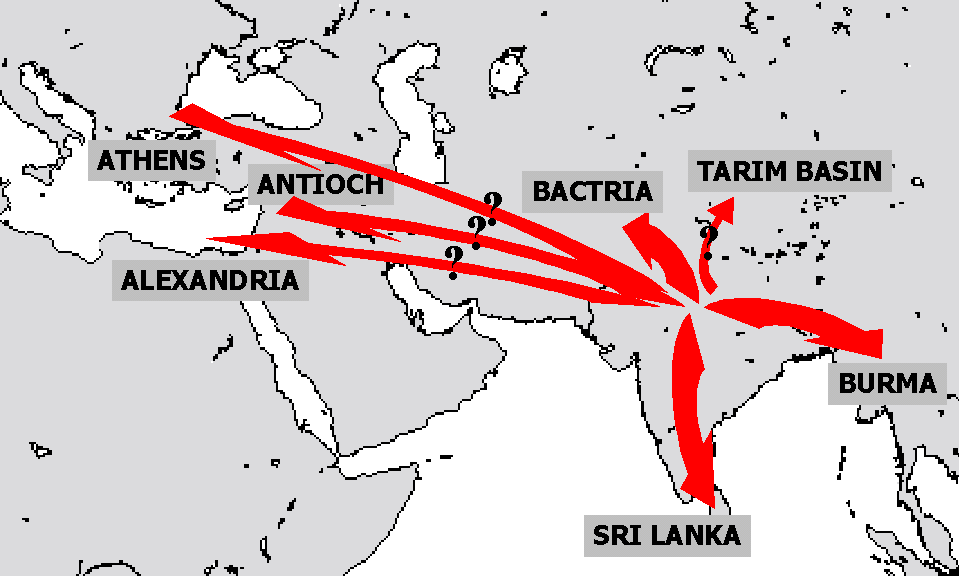 Buddhism
is the world's third great missionary religion.
The first missions were sent by Buddhism. The first Buddhist missionaries were called "Dharma Bhanaks". The Emperor Ashoka
was a significant early Buddhist missioner. In the 3rd century BCE, Dharmaraksita
—among others—was sent out by emperor Ashoka to proselytize the Buddhist tradition through the Indian Maurya Empire
, but also into the Mediterranean as far as Greece. Gradually, all India and the neighboring island of Ceylon were converted. Then Buddhism spread eastward and southeastward to the present lands of Burma, Thailand, Laos, Cambodia, Vietnam, and Indonesia. Buddhism was spread among the Turkic people during the 2nd and 3rd centuries BCE into modern-day Pakistan
, Kashmir
, Afghanistan
, eastern and coastal Iran
, Uzbekistan
, Turkmenistan
and Tajikistan
. It was also taken into China
brought by Kasyapa Matanga
in the 2nd century CE, Lokaksema
and An Shigao translated Buddhist sutras into Chinese. Dharmarakṣa
was one of the greatest translators of Mahayana Buddhist scriptures into Chinese. Dharmaraksa came to the Chinese capital of Luoyang
in 266 CE, where he made the first known translations of the Lotus Sutra
and the Dasabhumika Sutra, which were to become some of the classic texts of Chinese Mahayana Buddhism. Altogether, Dharmaraksa translated around 154 Hīnayāna
and Mahāyāna
sutra
s, representing most of the important texts of Buddhism available in the Western Regions. His proselytizing is said to have converted many to Buddhism in China, and made Chang'an
, present-day Xi'an
, a major center of Buddhism. Buddhism expanded rapidly, especially among the common people, and by 381 A.D. most of the people of northwest China were Buddhist. Winning converts also among the rulers and scholars, by the end of the T'ang Dynasty Buddhism was found everywhere in China.
Marananta brought Buddhism to the Korean Peninsula in the 4th century CE. Seong of Baekje
, known as a great patron of Buddhism
in Korea
, built many temples and welcomed priests bringing Buddhist texts directly from India
. In 528, Baekje officially adopted Buddhism as its state religion. He sent tribute missions to Liang in 534 and 541, on the second occasion requesting artisans as well as various Buddhist works and a teacher. According to Chinese records, all these requests were granted. A subsequent mission was sent in 549, only to find the Liang capital in the hands of the rebel Hou Jing
, who threw them in prison for lamenting the fall of the capital. He is credited with having sent a mission in 538 to Japan
that brought an image of Shakyamuni and several sutras to the Japanese court. This has traditionally been considered the official introduction of Buddhism to Japan. An account of this is given in Gangōji Garan Engi
. First supported by the Soga clan, Buddhism rose over the objections of the pro-Shinto Mononobe and Buddhism entrenched itself in Japan with the conversion of Prince Shotoku Taishi. When in 710 Emperor Shomu established a new capital at Nara modeled after the capital of China, Buddhism received official support and began to flourish.
Padmasambhava
, The Lotus Born, was a sage guru from Oḍḍiyāna who is said to have transmitted Vajrayana Buddhism to Bhutan and Tibet and neighbouring countries in the 8th century
The use of missions, formation of councils and monastic institutions influenced the emergence of Christian missions and organizations which had similar structures formed in places which were formerly Buddhist missions.
During the 19th and 20th centuries, Western intellectuals such as Schopenhauer
, Henry David Thoreau
, Max Müller
and esoteric societies such as the Theosophical Society
of H.P. Blavatsky and the Buddhist Society, London
spread interest in Buddhism. Writers such as Hermann Hesse
and Jack Kerouac
, in the West, and the hippie
generation of the late 1960s and early 1970s led to a re-discovery of Buddhism. During the 20th and 21st centuries Buddhism has again been propagated by missionaries into the West such as the Dalai Lama
and monks including Lama Surya Das (Tibetan Buddhism). Tibetan Buddhism
has been significantly active and successful in the West since the Chinese takeover of Tibet in 1959. Today Buddhists make a decent proportion of several countries in the West such as New Zealand, Australia, Canada, the Netherlands, France, and the United states
The immense popularity and goodwill ushered in by Tibet
's Dalai Lama
(who has been made honorary Canadian citizen) put Buddhism in a favourable light. Many non-Asian Canadians embraced Buddhism in various traditions and some have become leaders in their respective sangha
s.
In the early 1990s, the French Buddhist Union (UBF, founded in 1986) estimated there to be 600,000 to 650,000 Buddhists in France, with 150,000 French converts among them. In 1999, sociologist Frédéric Lenoir estimated there are 10,000 converts and up to 5 million “sympathizers”, although other researchers have questioned these numbers.
Taisen Deshimaru
was a Japanese Zen Buddhist who founded numerous zendo
s in France. Thich Nhat Hanh, a Nobel Peace Prize
-nominated, Vietnam
ese-born Zen Buddhist, founded the Unified Buddhist Church
(Eglise Bouddhique Unifiée) in France in 1969. Plum Village
, a monastery and retreat center in the Dordogne
in southern France, is his residence and the headquarters of his international sangha
.
In 1968 Leo Boer and wener van de Wetering founded a Zen
group, and through two books made Zen popular in the Netherlands. The guidance of the group was taken over by Erik Bruijn who is still in charge of a flourishing community. The largest Zen group at this moment is the Kanzeon Sangha, led by Nico Tydeman under the supervision of the American Zen master Dennis Genpo Merzel, Roshi, a former student of Maezumi Roshi in Los Angeles. This group has a relatively large centre where a teacher and some students live permanently. But many other groups are also represented in the Netherlands, like the Order of Buddhist Contemplatives in Apeldoorn, the Thich Nhat Hanh Order of Interbeing and the International Zen Institute Noorderpoort monastery/retreat centre in Drenthe, led by Jiun Hogen Roshi.
Perhaps the most widely visible Buddhist leader in the world is Tenzin Gyatso, the current Dalai Lama
, who first visited the United States in 1979. As the exiled political leader of Tibet
, he has become a popular cause célèbre. His early life was depicted in Hollywood films such as Kundun
and Seven Years in Tibet
. He has attracted celebrity religious followers such as Richard Gere
and Adam Yauch
. The first Western-born Tibetan Buddhist monk was Robert A. F. Thurman, now an academic supporter of the Dalai Lama. The Dalai Lama maintains a North American headquarters at Namgyal Monastery
in Ithaca, New York
.
Lewis M. Hopfe in his "Religions of the World" suggested that "Buddhism is perhaps on the verge of another great missionary outreach"(1987:170)
was introduced into Java by travelers from India in ancient times... When the early Javanese princes accepted Hinduism, they did not give up all of their early animistic beliefs—they simply combined the new ideas with them. Several centuries ago many Hindus left Java for Bali
rather than converting to Islam
. Hinduism has survived in Bali ever since. Dang Hyang Nirartha
was responsible for facilitating a refashioning of Balinese Hinduism. He was an important promoter of the idea of moksha in Indonesia. He founded the Shaivite priesthood that is now ubiquitous in Bali, and is now regarded as the ancestor of all Shaivite pandits
Shantidas Adhikari
was a Hindu
preacher from Sylhet
who converted King Pamheiba
of Manipur
to Hinduism
in 1717 C.E.
.
In modern days, Hatha Yoga
is a major missionary effort on behalf of Hinduism. In particular, Yoga centers and retreats gently lead people into the spiritual exercises and worldview of Hinduism. After those are prepared, education in doctrine and activities is easy and natural.
Historically, Hinduism has only recently had a large influence in western countries such as the United Kingdom, New Zealand, and Canada. Since 1960s many westerners attracted by the world view presented in Asian religious systems including Hinduism have converted to Hinduism. Canada was no exception. Many native born Canadians of various ethnicities have converted during the last 50 years through the actions of the Ramakrishna Mission
, ISKCON, Arya Samaj
and other missionary organizations as well as due to the visits and guidance of Indian Gurus such as Guru Maharaj, Sai Baba
, the controversial Rajneesh
and others. The International Society for Krishna Consciousness has a presence in New Zealand, running temples in Auckland, Hamilton, Wellington and Christchurch.
Paramahansa Yogananda
an India
n yogi
and guru
introduced many westerners to the teachings of meditation and Kriya Yoga
through his book, Autobiography of a Yogi
.
Swami Vivekananda
, the founder of the Ramakrishna Mission is one of the greatest Hindu missionaries to The West
have emigrated to countries all over the world – especially to English-speaking and East Asian nations. In doing so they have retained, to a high degree, their distinctive cultural and religious identity.
Sikhs are not ubiquitous worldwide in the way that adherents of larger world religions are, and they remain primarily an ethnic religion. But they can be found in many international cities and have become an especially strong religious presence in the United Kingdom and Canada.
One morning, when he was twenty-eight, Guru Nanak Dev went as usual down to the river to bathe and meditate. It was said that he was gone for three days. When he reappeared, it is said he was "filled with the spirit of God". His first words after his re-emergence were: "there is no Hindu, there is no Muslim". With this secular principle he began his missionary work. He made four distinct major journeys, in the four different directions, which are called Udasis, spanning many thousands of kilometres, preaching the message of God.
Currently there are Gurdwaras in over 50 countries
There are some missionary organization, the most famous is probably the The Sikh Missionary Society UK
. The Aim of the Sikh Missionary Society is the "Advancement of the Sikh faith in the U.K and abroad" which is brought about by various activities:
The basis of their achievement and interest in the field of Sikh Faith and Panjabi Language.
There have been several Sikh missionaries, some of which were:
Sikhs have emigrated to many countries of the world since Indian independence in 1947. The places in which Sikh communities are found include Britain, East Africa, Canada, the US, Malaysia and most European countries.
has a definite evangelical missionary ethic and has achieved considerable geographic spread, with members organized in about 40 countries. Formal conversion to and affiliation with Tenrikyo are signified by an initial ritual called a "Besseki pledge""
"The first missionary of Tsukihi was Miki's daughter Kokan who went to Osaka as a street-missionary"
"Currently Tenrikyo has 3 million adherents, 17,000 churches, and 20,000 mission stations worldwide"
"Tenrikyo membership exploded in it's early years and leveled off in the mid 1900's. According to the Ministry of Education (1963), there were 2,350,000 members and 15,000 churches. Several Tenrikyo congregations were established in Hawaii, Brazil, Korea, China, and the Philippines among other countries"
"The first mission in Australia was established in 1978 in Boronia Road, Boronia. This mission later became the first Tenrikyo church in Australia in 1989."
Tenrikyo has over 37000 units in Japan and 941 units outside of Japan(as of 1998), including over 380 units in Brazil, over two hundred units in North America(199 units in the United States), 150 units in South Korea(as of 1998), 79 units in Taiwan, 75 units in Hawai(as of 1998)
Tenrikyo has units in Argentina, Australia, Brazil, Canada, Chile, Colombia, Democratic Republic of Congo, Ecuador, France, Germany, Hawai, Hong Kong, India, Italy, Kenya, South Korea, Laos, Martinique, Mexico, Netherlands, New Zealand, Paraguay, Peru, Philippines, Spain, Switzerland, Taiwan, Thailand, United Kingdom, United States, and Venezuela
For some two centuries the Jains remained a small community of monks and followers. But in the 4th century BC they gained strength and spread from Bihar to Orissa, then so South India and westwards to Gujarat and the Punjab, where Jain communities became firmly established, particularly among the mercantile classes.
The period of the Mauryan Dynasty to the twelfth century A.D. was the period of Jainism's greatest growth and influence. Thereafer the Jainas in the South and Central regions lost ground in face of rising Hindu devotional movements. Jainism retreated to the West and Northwest, which have remained its stronghold to the present.
Emperor Samprati
is regarded as the "Jain Ashoka" for his patronage and efforts to spreading Jainism in east India. Samprati, according to Jain historians, is considered more powerful and famous than Ashoka himself. Samprati built thousands of Jain Temples in India, many of which are still in use, such as the Jain temples at Viramgam and Palitana (Gujarat), Agar Malwa (Ujjain). Within three and a half years, he got one hundred and twenty-five thousand new temples built, thirty-six thousand repaired, twelve and a half million murtis, holy statues, consecrated and ninety-five thousand metal murtis prepared. Samprati is said to have erected Jain temples throughout his empire. He founded Jain monasteries even in non-Aryan territory, and almost all ancient Jain temples or monuments of unknown origin are popularly attributed to him. It may be noted that all the Jain monuments of Rajasthan and Gujarat, with unknown builders are also attributed to Emperor Samprati
Virachand Gandhi
(1864–1901) from Mahuva represented Jains at the first World Parliament of Religions in Chicago in 1893 and won a silver medal. Gandhi was most likely the first Jain & First Gujarati to travel to the United States and his statue still stands at the Jain temple in Chicago. In his time he was world famous personality .
Gandhi represented Jains in Chicago because the Great Jain Saint Param Pujya Acharya Vijayanandsuri, also known as Acharya Atmaram, was invited to represent the Jain religion at first World Parliament of Religions held in 1893. As Jain monks do not travel overseas, he recommended the bright young scholar Virchand Gandhi to be the emissary for the religion. Today there are 100,000 Jains in the U.S
There are also tens of thousands of Jains located in the UK and Canada
Evangelism
Evangelism refers to the practice of relaying information about a particular set of beliefs to others who do not hold those beliefs. The term is often used in reference to Christianity....
or ministries of service, such as education
Education
Education in its broadest, general sense is the means through which the aims and habits of a group of people lives on from one generation to the next. Generally, it occurs through any experience that has a formative effect on the way one thinks, feels, or acts...
, literacy
Literacy
Literacy has traditionally been described as the ability to read for knowledge, write coherently and think critically about printed material.Literacy represents the lifelong, intellectual process of gaining meaning from print...
, social justice
Social justice
Social justice generally refers to the idea of creating a society or institution that is based on the principles of equality and solidarity, that understands and values human rights, and that recognizes the dignity of every human being. The term and modern concept of "social justice" was coined by...
, health care
Health care
Health care is the diagnosis, treatment, and prevention of disease, illness, injury, and other physical and mental impairments in humans. Health care is delivered by practitioners in medicine, chiropractic, dentistry, nursing, pharmacy, allied health, and other care providers...
and economic development
Economic development
Economic development generally refers to the sustained, concerted actions of policymakers and communities that promote the standard of living and economic health of a specific area...
. The word "mission" originates from 1598 when the Jesuits sent members abroad, derived from the Latin missionem (nom. missio), meaning "act of sending" or mittere, meaning "to send". The word was used in light of its biblical usage; In the Latin translation of the Bible, Christ uses the word when sending the disciples to preach in his name.
The term is most commonly used for Christian missions, but can be used for any creed or ideology.
Christian missions
A ChristianChristianity
Christianity is a monotheistic religion based on the life and teachings of Jesus as presented in canonical gospels and other New Testament writings...
missionary can be defined as "one who is to witness across cultures." The Lausanne Congress of 1974, defined the term, related to Christian mission as, "to form a viable indigenous church-planting movement." Recognizing justice as being at the heart of the Gospels, some modern missionaries now promote the development of western government, education and economic structure in the place of pre-existing local systems and tradition. Missionaries can be found in many countries around the world.
Biblical mandate
JesusJesus
Jesus of Nazareth , commonly referred to as Jesus Christ or simply as Jesus or Christ, is the central figure of Christianity...
instructed the apostles to make disciples
Disciple (Christianity)
In Christianity, the disciples were the students of Jesus during his ministry. While Jesus attracted a large following, the term disciple is commonly used to refer specifically to "the Twelve", an inner circle of men whose number perhaps represented the twelve tribes of Israel...
of all nations . This verse is referred to by Christian missionaries as the Great Commission
Great Commission
The Great Commission, in Christian tradition, is the instruction of the resurrected Jesus Christ to his disciples, that they spread his teachings to all the nations of the world. It has become a tenet in Christian theology emphasizing missionary work, evangelism, and baptism...
and inspires missionary work.
Catholic missions
The New Testament missionary outreach of the Christian church from the time of St PaulPaul of Tarsus
Paul the Apostle , also known as Saul of Tarsus, is described in the Christian New Testament as one of the most influential early Christian missionaries, with the writings ascribed to him by the church forming a considerable portion of the New Testament...
was extensive throughout the Roman Empire
Roman Empire
The Roman Empire was the post-Republican period of the ancient Roman civilization, characterised by an autocratic form of government and large territorial holdings in Europe and around the Mediterranean....
. During the Middle Ages the Christian monasteries and missionaries such as Saint Patrick
Saint Patrick
Saint Patrick was a Romano-Briton and Christian missionary, who is the most generally recognized patron saint of Ireland or the Apostle of Ireland, although Brigid of Kildare and Colmcille are also formally patron saints....
, and Adalbert of Prague
Adalbert of Prague
This article is about St Adalbert of Prague. For other uses, see Adalbert .Saint Adalbert, Czech: ; , , Czech Roman Catholic saint, a Bishop of Prague and a missionary, was martyred in his efforts to convert the Baltic Prussians. He evangelized Poles and Hungarians. St...
propagated learning and religion beyond the boundaries of the old Roman Empire. In the 7th century Gregory the Great sent missionaries including Augustine of Canterbury
Augustine of Canterbury
Augustine of Canterbury was a Benedictine monk who became the first Archbishop of Canterbury in the year 597...
into England. During the Age of Discovery
Age of Discovery
The Age of Discovery, also known as the Age of Exploration and the Great Navigations , was a period in history starting in the early 15th century and continuing into the early 17th century during which Europeans engaged in intensive exploration of the world, establishing direct contacts with...
, the Roman Catholic Church
Roman Catholic Church
The Catholic Church, also known as the Roman Catholic Church, is the world's largest Christian church, with over a billion members. Led by the Pope, it defines its mission as spreading the gospel of Jesus Christ, administering the sacraments and exercising charity...
established a number of Missions
Mission (Christian)
Christian missionary activities often involve sending individuals and groups , to foreign countries and to places in their own homeland. This has frequently involved not only evangelization , but also humanitarian work, especially among the poor and disadvantaged...
in the Americas and other colonies through the Augustinians
Augustinians
The term Augustinians, named after Saint Augustine of Hippo , applies to two separate and unrelated types of Catholic religious orders:...
, Franciscans and Dominicans
Dominican Order
The Order of Preachers , after the 15th century more commonly known as the Dominican Order or Dominicans, is a Catholic religious order founded by Saint Dominic and approved by Pope Honorius III on 22 December 1216 in France...
in order to spread Christianity in the New World and to convert the Native Americans
Indigenous peoples of the Americas
The indigenous peoples of the Americas are the pre-Columbian inhabitants of North and South America, their descendants and other ethnic groups who are identified with those peoples. Indigenous peoples are known in Canada as Aboriginal peoples, and in the United States as Native Americans...
and other indigenous people. At the same time, missionaries such as Francis Xavier
Francis Xavier
Francis Xavier, born Francisco de Jasso y Azpilicueta was a pioneering Roman Catholic missionary born in the Kingdom of Navarre and co-founder of the Society of Jesus. He was a student of Saint Ignatius of Loyola and one of the first seven Jesuits, dedicated at Montmartre in 1534...
as well as other Jesuits, Augustinians, Franciscans and Dominicans were moving into Asia and the far East. The Portuguese sent missions into Africa. These are some of the most well-known missions in history. While some of these missions were associated with imperialism and oppression, others (notably Matteo Ricci
Matteo Ricci
Matteo Ricci, SJ was an Italian Jesuit priest, and one of the founding figures of the Jesuit China Mission, as it existed in the 17th-18th centuries. His current title is Servant of God....
's Jesuit mission to China) were relatively peaceful and focused on integration rather than cultural imperialism.
Much contemporary Catholic missionary work has undergone profound change since the Second Vatican Council
Second Vatican Council
The Second Vatican Council addressed relations between the Roman Catholic Church and the modern world. It was the twenty-first Ecumenical Council of the Catholic Church and the second to be held at St. Peter's Basilica in the Vatican. It opened under Pope John XXIII on 11 October 1962 and closed...
, and has become explicitly conscious of Social Justice
Social justice
Social justice generally refers to the idea of creating a society or institution that is based on the principles of equality and solidarity, that understands and values human rights, and that recognizes the dignity of every human being. The term and modern concept of "social justice" was coined by...
issues and the dangers of cultural imperialism
Cultural imperialism
Cultural imperialism is the domination of one culture over another. Cultural imperialism can take the form of a general attitude or an active, formal and deliberate policy, including military action. Economic or technological factors may also play a role...
or economic exploitation disguised as religious conversion. Contemporary Christian missionaries argue that working for justice is a constitutive part of preaching the Gospel, and observe the principles of inculturation
Inculturation
Inculturation is a term used in Christianity, especially in the Roman Catholic Church, referring to the adaptation of the way Church teachings are presented to non-Christian cultures, and to the influence of those cultures on the evolution of these teachings....
in their missionary work.
As the church normally organizes itself along territorial lines, and because they had the human and material resources, religious orders—some even specializing in it—undertook most missionary work, especially in the early phases. Over time a normalised church structure was gradually established in the mission area, often starting with special jurisdictions known as apostolic prefectures and apostolic vicariates. These developing churches eventually intended 'graduating' to regular diocesan status with a local episcopacy appointed, especially after decolonization, as the church structures often reflect the political-administrative reality.
Orthodox missions
The Eastern Orthodox ChurchEastern Orthodox Church
The Orthodox Church, officially called the Orthodox Catholic Church and commonly referred to as the Eastern Orthodox Church, is the second largest Christian denomination in the world, with an estimated 300 million adherents mainly in the countries of Belarus, Bulgaria, Cyprus, Georgia, Greece,...
, under the Orthodox Church of Constantinople was vigorous in its missionary outreach under the Roman Empire
Roman Empire
The Roman Empire was the post-Republican period of the ancient Roman civilization, characterised by an autocratic form of government and large territorial holdings in Europe and around the Mediterranean....
and continuing Byzantine Empire
Byzantine Empire
The Byzantine Empire was the Eastern Roman Empire during the periods of Late Antiquity and the Middle Ages, centred on the capital of Constantinople. Known simply as the Roman Empire or Romania to its inhabitants and neighbours, the Empire was the direct continuation of the Ancient Roman State...
, and its missionary outreach had lasting effect, either founding, influencing or establishing formal relations with some 16 Orthodox national churches including the Romanian Orthodox Church
Romanian Orthodox Church
The Romanian Orthodox Church is an autocephalous Eastern Orthodox church. It is in full communion with other Eastern Orthodox churches, and is ranked seventh in order of precedence. The Primate of the church has the title of Patriarch...
, the Georgian Orthodox and Apostolic Church
Georgian Orthodox and Apostolic Church
The Georgian Apostolic Autocephalous Orthodox Church is an autocephalous part of the Eastern Orthodox Church. Since the 4th century AD, Georgian Orthodoxy has been the state religion of Georgia, and it remains the country's largest religious institution....
and the Ukrainian Orthodox Church (both said to have been founded by the missionary Apostle Andrew), the Bulgarian Orthodox Church
Bulgarian Orthodox Church
The Bulgarian Orthodox Church - Bulgarian Patriarchate is an autocephalous Eastern Orthodox Church with some 6.5 million members in the Republic of Bulgaria and between 1.5 and 2.0 million members in a number of European countries, the Americas and Australia...
(said to have been founded by the missionary Apostle Paul). The two ninth century saints Cyril
Saints Cyril and Methodius
Saints Cyril and Methodius were two Byzantine Greek brothers born in Thessaloniki in the 9th century. They became missionaries of Christianity among the Slavic peoples of Bulgaria, Great Moravia and Pannonia. Through their work they influenced the cultural development of all Slavs, for which they...
and Methodius had extensive missionary success in Eastern Europe. The Byzantines expanded their missionary work in Ukraine after a mass baptism in Kiev in 988. The Serbian Orthodox Church
Serbian Orthodox Church
The Serbian Orthodox Church is one of the autocephalous Orthodox Christian churches, ranking sixth in order of seniority after Constantinople, Alexandria, Antioch, Jerusalem, and Russia...
had its origins in the conversion by Byzantine missionaries of the Serb tribes when they arrived in the Balkans in the 7th century. Orthodox missionaries also worked successfully among the Estonians from the 10th to the 12th centuries founding the Estonian Orthodox Church
Estonian Orthodox Church
The Church of Estonia or Estonian Apostolic Orthodox Church is an autonomous Orthodox church whose primate is confirmed by the Ecumenical Patriarch of Constantinople...
.
Under the Russian Empire
Russian Empire
The Russian Empire was a state that existed from 1721 until the Russian Revolution of 1917. It was the successor to the Tsardom of Russia and the predecessor of the Soviet Union...
of the 19th century, missionaries such as Nicholas Ilminsky moved into the subject lands and propagated Orthodoxy, including through Belarus
Belarus
Belarus , officially the Republic of Belarus, is a landlocked country in Eastern Europe, bordered clockwise by Russia to the northeast, Ukraine to the south, Poland to the west, and Lithuania and Latvia to the northwest. Its capital is Minsk; other major cities include Brest, Grodno , Gomel ,...
, Latvia
Latvian Orthodox Church
The Latvian Orthodox Church is a self-governing Eastern Orthodox Church under the jurisdiction of the Patriarchate of Moscow. The primate of the church carries the title of Metropolitan of Riga and all Latvia...
, Moldova
Moldova
Moldova , officially the Republic of Moldova is a landlocked state in Eastern Europe, located between Romania to the West and Ukraine to the North, East and South. It declared itself an independent state with the same boundaries as the preceding Moldavian Soviet Socialist Republic in 1991, as part...
, Finland
Finnish Orthodox Church
The Finnish Orthodox Church is an autonomous Orthodox archdiocese of the Patriarchate of Constantinople. The Church has a legal position as a national church in the country, along with the Evangelical Lutheran Church of Finland....
, Estonia, Ukraine, and China
Chinese Orthodox Church
The Chinese Autonomous Orthodox Church is an autonomous Eastern Orthodox church in China. It was granted autonomy by its mother church, the Russian Orthodox Church in the mid-1950s.-Ancient Period:...
. The Russian St. Nicholas of Japan took Eastern Orthodoxy to Japan
Japanese Orthodox Church
The Japanese Orthodox Church or The Orthodox Church in Japan is an autonomous church of Eastern Orthodoxy under the omophorion of the Russian Orthodox Church.-History:...
in the 19th century. The Russian Orthodox Church
Russian Orthodox Church
The Russian Orthodox Church or, alternatively, the Moscow Patriarchate The ROC is often said to be the largest of the Eastern Orthodox churches in the world; including all the autocephalous churches under its umbrella, its adherents number over 150 million worldwide—about half of the 300 million...
also sent missionaries to Alaska
Alaska
Alaska is the largest state in the United States by area. It is situated in the northwest extremity of the North American continent, with Canada to the east, the Arctic Ocean to the north, and the Pacific Ocean to the west and south, with Russia further west across the Bering Strait...
beginning in the 18th century, including Saint Herman of Alaska
Herman of Alaska
Saint Herman of Alaska was one of the first Eastern Orthodox missionaries to the New World, and is considered by Orthodox Christians to be the patron saint of the Americas.-Biography:Saint Herman was born in the town of Serpukhov in the Moscow Diocese around 1756...
, to minister to the Native Americans
Indigenous peoples of the Americas
The indigenous peoples of the Americas are the pre-Columbian inhabitants of North and South America, their descendants and other ethnic groups who are identified with those peoples. Indigenous peoples are known in Canada as Aboriginal peoples, and in the United States as Native Americans...
. The Russian Orthodox Church Outside Russia
Russian Orthodox Church Outside Russia
The Russian Orthodox Church Outside Russia , also called the Russian Orthodox Church Abroad, ROCA, or ROCOR) is a semi-autonomous part of the Russian Orthodox Church....
continued missionary work outside Russia after the 1917 Russian Revolution
Russian Revolution of 1917
The Russian Revolution is the collective term for a series of revolutions in Russia in 1917, which destroyed the Tsarist autocracy and led to the creation of the Soviet Union. The Tsar was deposed and replaced by a provisional government in the first revolution of February 1917...
, resulting in the establishment of many new dioceses in the diaspora
Diaspora
A diaspora is "the movement, migration, or scattering of people away from an established or ancestral homeland" or "people dispersed by whatever cause to more than one location", or "people settled far from their ancestral homelands".The word has come to refer to historical mass-dispersions of...
, from which numerous converts have been made in Eastern Europe
Eastern Europe
Eastern Europe is the eastern part of Europe. The term has widely disparate geopolitical, geographical, cultural and socioeconomic readings, which makes it highly context-dependent and even volatile, and there are "almost as many definitions of Eastern Europe as there are scholars of the region"...
, North America
North America
North America is a continent wholly within the Northern Hemisphere and almost wholly within the Western Hemisphere. It is also considered a northern subcontinent of the Americas...
and Oceania
Oceania
Oceania is a region centered on the islands of the tropical Pacific Ocean. Conceptions of what constitutes Oceania range from the coral atolls and volcanic islands of the South Pacific to the entire insular region between Asia and the Americas, including Australasia and the Malay Archipelago...
.
First Protestant missions
Among the first ProtestantProtestantism
Protestantism is one of the three major groupings within Christianity. It is a movement that began in Germany in the early 16th century as a reaction against medieval Roman Catholic doctrines and practices, especially in regards to salvation, justification, and ecclesiology.The doctrines of the...
missionaries were John Eliot
John Eliot (missionary)
John Eliot was a Puritan missionary to the American Indians. His efforts earned him the designation “the Indian apostle.”-English education and Massachusetts ministry:...
and contemporary ministers including John Cotton
John Cotton
John Cotton was an English clergyman and colonist. He was a principal figure among the New England Puritan ministers, who also included Thomas Hooker, Increase Mather , John Davenport, and Thomas Shepard and John Norton, who wrote his first biography...
and Richard Bourne, who ministered to the Algonquin natives who lived in lands claimed by representatives of the Massachusetts Bay Colony in the early 17th century. Quaker "publishers of truth" visited Boston and other mid-17th century colonies but were not always well-received.
The Danish government included Lutheran missionaries among the colonists in many of its colonies, Bartholomaeus Ziegenbalg
Bartholomaeus Ziegenbalg
Bartholomäus Ziegenbalg was a member of the Lutheran clergy and the first Pietist missionary to India.-Early life:...
in Tranquebar India
India
India , officially the Republic of India , is a country in South Asia. It is the seventh-largest country by geographical area, the second-most populous country with over 1.2 billion people, and the most populous democracy in the world...
in the late 17th century. However, the first organized Protestant mission work was carried out beginning in 1732 by the Moravian Brethren of Herrnhut
Herrnhut
Herrnhut is a municipality in the district of Görlitz, in the Free State of Saxony, Germany.It has access to Bundesstraße 178 between Löbau and Zittau...
in Saxony
Saxony
The Free State of Saxony is a landlocked state of Germany, contingent with Brandenburg, Saxony Anhalt, Thuringia, Bavaria, the Czech Republic and Poland. It is the tenth-largest German state in area, with of Germany's sixteen states....
Germany
Germany
Germany , officially the Federal Republic of Germany , is a federal parliamentary republic in Europe. The country consists of 16 states while the capital and largest city is Berlin. Germany covers an area of 357,021 km2 and has a largely temperate seasonal climate...
(die evangelische Brüdergemeine). While on a visit in 1732 to Copenhagen
Copenhagen
Copenhagen is the capital and largest city of Denmark, with an urban population of 1,199,224 and a metropolitan population of 1,930,260 . With the completion of the transnational Øresund Bridge in 2000, Copenhagen has become the centre of the increasingly integrating Øresund Region...
for the coronation of his cousin King Christian VI, the Moravian Church's patron—Nicolas Ludwig, Count von Zinzendorf--got to know a slave from the Danish colony in the West Indies. When he returned to Herrnhut with the slave, he inspired the inhabitants of the village—it was fewer than 30 houses then—to send out "messengers" to the slaves in the West Indies. The first missionaries landed in St. Thomas
Saint Thomas, U.S. Virgin Islands
Saint Thomas is an island in the Caribbean Sea and with the islands of Saint John, Saint Croix, and Water Island a county and constituent district of the United States Virgin Islands , an unincorporated territory of the United States. Located on the island is the territorial capital and port of...
in December 1732. Work soon was started in another Danish colony, Greenland. Within 30 years, there were Moravian missionaries active on every continent, and this at a time when there were fewer than 300 people in Herrnhut. They are famous for their selfless work, living as slaves among the slaves and together with the native Americans, the Delaware (i.e. Lenni Lenape) and Cherokee
Cherokee
The Cherokee are a Native American people historically settled in the Southeastern United States . Linguistically, they are part of the Iroquoian language family...
Indian tribes. Today, the work in the former mission provinces of the worldwide Moravian Church is carried on by native workers. The fastest growing area of the work is in Tanzania
Tanzania
The United Republic of Tanzania is a country in East Africa bordered by Kenya and Uganda to the north, Rwanda, Burundi, and the Democratic Republic of the Congo to the west, and Zambia, Malawi, and Mozambique to the south. The country's eastern borders lie on the Indian Ocean.Tanzania is a state...
in Eastern Africa
Africa
Africa is the world's second largest and second most populous continent, after Asia. At about 30.2 million km² including adjacent islands, it covers 6% of the Earth's total surface area and 20.4% of the total land area...
. The Moravian work in South Africa
South Africa
The Republic of South Africa is a country in southern Africa. Located at the southern tip of Africa, it is divided into nine provinces, with of coastline on the Atlantic and Indian oceans...
inspired William Carey and the founders of the British Baptist
Baptist
Baptists comprise a group of Christian denominations and churches that subscribe to a doctrine that baptism should be performed only for professing believers , and that it must be done by immersion...
missions. Today, 7 of every 10 Moravians are in a former mission field and belong to a race other than Caucasian.
Evangelical church missions
With a dramatic increase in efforts since the 1900s, and a strong push since the Lausanne I: The International Congress on World Evangelization in Switzerland in 1974, evangelical groups have focused efforts on sending missionaries to every ethnic group in the world. While this effort has not been completed, increased attention has brought larger numbers of people distributing BibleBible
The Bible refers to any one of the collections of the primary religious texts of Judaism and Christianity. There is no common version of the Bible, as the individual books , their contents and their order vary among denominations...
s, Jesus videos
Jesus (1979 film)
Jesus , is a 1979 motion picture which depicts the life of Jesus Christ according primarily to the Gospel of Luke in the Bible...
, and establishing evangelical churches in more remote, less Christianized areas.
Internationally, the focus for many years in the later 20th century was on reaching every "people group" with Christianity by the year 2000. Bill Bright's leadership with Campus Crusade, the Southern Baptist International Mission Board
International Mission Board
The International Mission Board is a missionary sending agency affiliated with the Southern Baptist Convention which operates in virtually every nation except the United States and Canada...
, The Joshua Project, and others brought about the need to know who these "unreached people group
Unreached people group
An unreached people group refers to an ethnic group without an indigenous, self propagating Christian church movement. Any ethnic or ethnolinguistic nation without enough Christians to evangelize the rest of the nation is an Unreached People Group...
s" are and how those wanting to tell about the Christian God and share a Christian Bible could reach them. The focus for these organizations transitioned from a "country focus" to a "people group focus." (From "What is a People Group?" by Dr. Orville Boyd Jenkins: A "people group" is an ethnolinguistic group with a common self-identity that is shared by the various members. There are two parts to that word: ethno and linguistic. Language is a primary and dominant identifying factor of a people group. But there are other factors that determine or are associated with ethnicity.)
What can be viewed as a success by those inside and outside the church from this focus is a higher level of cooperation and friendliness among churches and denominations. It is very common for those working on international fields to not only cooperate in efforts to share their gospel message
Gospel
A gospel is an account, often written, that describes the life of Jesus of Nazareth. In a more general sense the term "gospel" may refer to the good news message of the New Testament. It is primarily used in reference to the four canonical gospels of Matthew, Mark, Luke, and John...
but view the work of their groups in a similar light. Also, with the increased study and awareness of different people groups, western mission efforts have become far more sensitive to the cultural nuances of those they are going to and those they are working with in the effort.
Over the years, as indigenous churches have matured, the church of the "Global South" (Africa, Asia and Latin America) has become the driving force in missions. Korean and African missionaries can now be found all over the world. These missionaries represent a major shift in church history.
Brazil, Nigeria, and other countries have had large numbers of their Christian adherents go to other countries and start churches. These non-western missionaries often have unparalleled success because they need few western resources and comforts to sustain their livelihood while doing the work they have chosen among a new culture and people.
The British missionary societies
One of the first large-scale missionary endeavours of the British colonial age was the Baptist Missionary SocietyBaptist Missionary Society
rightBMS World Mission is a Christian missionary society founded by Baptists from England in 1792. It was originally called the Particular Baptist Society for the Propagation of the Gospel Amongst the Heathen, but for most of its life was known as the Baptist Missionary Society...
, founded in 1792 as the Particular Baptist Society for the Propagation of the Gospel Amongst the Heathen.
The London Missionary Society
London Missionary Society
The London Missionary Society was a non-denominational missionary society formed in England in 1795 by evangelical Anglicans and Nonconformists, largely Congregationalist in outlook, with missions in the islands of the South Pacific and Africa...
was an evangelical organisation, bringing together from its inception both Anglicans and Nonconformists; it was founded in England in 1795 with missions in Africa and the islands of the South Pacific. The Colonial Missionary Society
Colonial Missionary Society
The Colonial Missionary Society was formed in May 1836 as a “distinct society for the Colonies” following the report of a deputation to Canada by representatives of Congregational churches from Britain...
was created in 1836, and directed its efforts towards promoting Congregationalist forms of Christianity
Christianity
Christianity is a monotheistic religion based on the life and teachings of Jesus as presented in canonical gospels and other New Testament writings...
among “British or other European settlers” rather than indigenous peoples.
Both of these merged in 1966, and the resultant organisation is now known as the Council for World Mission
Council for World Mission
The Council for World Mission is a worldwide community of Christian churches. The 31 members share their resources of money, people, skills and insights to carry out their missionary work.CWM was established in 1977 in its present form...
.
The Church Mission Society
Church Mission Society
The Church Mission Society, also known as the Church Missionary Society, is a group of evangelistic societies working with the Anglican Communion and Protestant Christians around the world...
, first known as the Society for Missions to Africa and the East, was founded in 1799 by evangelical Anglicans centred around the anti-slavery activist William Wilberforce
William Wilberforce
William Wilberforce was a British politician, a philanthropist and a leader of the movement to abolish the slave trade. A native of Kingston upon Hull, Yorkshire, he began his political career in 1780, eventually becoming the independent Member of Parliament for Yorkshire...
. It bent its efforts to the Coptic Church, the Ethiopian Church, and India, especially Kerala
Kerala
or Keralam is an Indian state located on the Malabar coast of south-west India. It was created on 1 November 1956 by the States Reorganisation Act by combining various Malayalam speaking regions....
; it continues to this day. Many of the network of churches they established
Church planting
Church planting is a process that results in a new Christian church being established. It should be distinguished from church development, where a new service, new worship centre or fresh expression is created that is integrated into an already established congregation...
became the Anglican Communion
Anglican Communion
The Anglican Communion is an international association of national and regional Anglican churches in full communion with the Church of England and specifically with its principal primate, the Archbishop of Canterbury...
.
In 1809 the London Society for Promoting Christianity Amongst the Jews was founded, which pioneered mission amongst the Jewish people; it continues today as the Church's Ministry Among Jewish People
Church's Ministry Among Jewish People
Church's Ministry Among Jewish People is an Anglican missionary society founded in 1809.-History:...
. In 1865 the China Inland Mission
China Inland Mission
OMF International is an interdenominational Protestant Christian missionary society, founded in Britain by Hudson Taylor on 25 June 1865.-Overview:...
was founded, going well beyond British controlled areas; it continues as the OMF, working throughout East Asia
East Asia
East Asia or Eastern Asia is a subregion of Asia that can be defined in either geographical or cultural terms...
.
Latter-day Saint missionaries
The Church of Jesus Christ of Latter-day Saints has an active missionary program. Their purpose is to invite others to come unto Christ by helping them receive the restored gospel through faith in Jesus Christ and His Atonement, repentance, baptism, receiving the gift of the Holy Ghost, and enduring to the end. Young men between the ages of 19 and 25 (usually beginning at the age of 19) are encouraged to prepare themselves to serve a two-year, self-funded (the LDS Church pays for transportation, health and dental care, etc. the missionary pays a monthly amount), full-time proselytizing mission. Young women and retired couples may serve missions as well. Young women who desire to serve as missionaries serve at an older age, 21 or older, and often for only one and a half years. Missionaries typically spend one to three months in a Missionary Training Center
Missionary Training Center
Missionary Training Centers are centers devoted to training missionaries for The Church of Jesus Christ of Latter-day Saints. The flagship MTC is located in Provo, Utah, USA, adjacent to the campus of Brigham Young University....
where they study the scriptures, learn new languages, and otherwise prepare themselves to teach the Gospel of Jesus Christ and understand the culture in which and the people among whom they will be living. The LDS Church has about 53,000 missionaries worldwide.
Islamic missions
DawahDawah
Da‘wah or Dawah usually denotes the preaching of Islam. Da‘wah literally means "issuing a summons" or "making an invitation", being the active participle of a verb meaning variously "to summon" or "to invite"...
means to "invite" (in Arabic, literally "calling") to Islam
Islam
Islam . The most common are and . : Arabic pronunciation varies regionally. The first vowel ranges from ~~. The second vowel ranges from ~~~...
, estimated to be the second largest religion next to Christianity. From the 7th century it spread rapidly from the Arabian Peninsula
Arabian Peninsula
The Arabian Peninsula is a land mass situated north-east of Africa. Also known as Arabia or the Arabian subcontinent, it is the world's largest peninsula and covers 3,237,500 km2...
to the rest of the world through the initial Muslim conquests
Muslim conquests
Muslim conquests also referred to as the Islamic conquests or Arab conquests, began with the Islamic prophet Muhammad. He established a new unified polity in the Arabian Peninsula which under the subsequent Rashidun and Umayyad Caliphates saw a century of rapid expansion of Muslim power.They...
, and subsequently with traders and explorers after the death of the Prophet
Prophets of Islam
Muslims identify the Prophets of Islam as those humans chosen by God and given revelation to deliver to mankind. Muslims believe that every prophet was given a belief to worship God and their respective followers believed it as well...
Muhammad
Muhammad
Muhammad |ligature]] at U+FDF4 ;Arabic pronunciation varies regionally; the first vowel ranges from ~~; the second and the last vowel: ~~~. There are dialects which have no stress. In Egypt, it is pronounced not in religious contexts...
.
Initially, the spread of Islam came through the dawah efforts of Muhammad and those who followed him. After his death in 632 CE, much of the expansion of the empire came through conquest, such as that of North Africa
North Africa
North Africa or Northern Africa is the northernmost region of the African continent, linked by the Sahara to Sub-Saharan Africa. Geopolitically, the United Nations definition of Northern Africa includes eight countries or territories; Algeria, Egypt, Libya, Morocco, South Sudan, Sudan, Tunisia, and...
and later Spain
Spain
Spain , officially the Kingdom of Spain languages]] under the European Charter for Regional or Minority Languages. In each of these, Spain's official name is as follows:;;;;;;), is a country and member state of the European Union located in southwestern Europe on the Iberian Peninsula...
(Al-Andalus
Al-Andalus
Al-Andalus was the Arabic name given to a nation and territorial region also commonly referred to as Moorish Iberia. The name describes parts of the Iberian Peninsula and Septimania governed by Muslims , at various times in the period between 711 and 1492, although the territorial boundaries...
), and the Islamic conquest of Persia
Islamic conquest of Persia
The Muslim conquest of Persia led to the end of the Sassanid Empire in 644, the fall of Sassanid dynasty in 651 and the eventual decline of the Zoroastrian religion in Persia...
putting an end to the Sassanid Empire
Sassanid Empire
The Sassanid Empire , known to its inhabitants as Ērānshahr and Ērān in Middle Persian and resulting in the New Persian terms Iranshahr and Iran , was the last pre-Islamic Persian Empire, ruled by the Sasanian Dynasty from 224 to 651...
and spreading the reach of Islam to as far East as Khorasan
Greater Khorasan
Greater Khorasan or Ancient Khorasan is a historical region of Greater Iran mentioned in sources from Sassanid and Islamic eras which "frequently" had a denotation wider than current three provinces of Khorasan in Iran...
, which would later become the cradle of Islamic civilization during the Islamic Golden Age
Islamic Golden Age
During the Islamic Golden Age philosophers, scientists and engineers of the Islamic world contributed enormously to technology and culture, both by preserving earlier traditions and by adding their own inventions and innovations...
and a stepping-stone towards the introduction of Islam to the Turkic tribes living in and bordering the area.
The missionary movements peaked during the Islamic Golden Age
Islamic Golden Age
During the Islamic Golden Age philosophers, scientists and engineers of the Islamic world contributed enormously to technology and culture, both by preserving earlier traditions and by adding their own inventions and innovations...
, with the expansion of foreign trade routes, primarily into the Indo-Pacific
Indo-Pacific
The Indo-Pacific is a biogeographic region of the Earth's seas, comprising the tropical waters of the Indian Ocean, the western and central Pacific Ocean, and the seas connecting the two in the general area of Indonesia...
and as far South as the isle of Zanzibar
Zanzibar
Zanzibar ,Persian: زنگبار, from suffix bār: "coast" and Zangi: "bruin" ; is a semi-autonomous part of Tanzania, in East Africa. It comprises the Zanzibar Archipelago in the Indian Ocean, off the coast of the mainland, and consists of numerous small islands and two large ones: Unguja , and Pemba...
and the South-Eastern shores of Africa
Africa
Africa is the world's second largest and second most populous continent, after Asia. At about 30.2 million km² including adjacent islands, it covers 6% of the Earth's total surface area and 20.4% of the total land area...
.
Sufism
Sufism or ' is defined by its adherents as the inner, mystical dimension of Islam. A practitioner of this tradition is generally known as a '...
, Islamic missionary activities increased considerably. The mystical nature of the tradition had an all-encompassing aspect, a property many societies in Asia
Asia
Asia is the world's largest and most populous continent, located primarily in the eastern and northern hemispheres. It covers 8.7% of the Earth's total surface area and with approximately 3.879 billion people, it hosts 60% of the world's current human population...
could relate to. Later, with the conquest of Anatolia
Anatolia
Anatolia is a geographic and historical term denoting the westernmost protrusion of Asia, comprising the majority of the Republic of Turkey...
by the Seljuk Turks, missionaries would find easier passage to the lands then formerly belonging to the Byzantine Empire
Byzantine Empire
The Byzantine Empire was the Eastern Roman Empire during the periods of Late Antiquity and the Middle Ages, centred on the capital of Constantinople. Known simply as the Roman Empire or Romania to its inhabitants and neighbours, the Empire was the direct continuation of the Ancient Roman State...
. In the earlier stages of the Ottoman Empire
Ottoman Empire
The Ottoman EmpireIt was usually referred to as the "Ottoman Empire", the "Turkish Empire", the "Ottoman Caliphate" or more commonly "Turkey" by its contemporaries...
, a Turkic
Turkic peoples
The Turkic peoples are peoples residing in northern, central and western Asia, southern Siberia and northwestern China and parts of eastern Europe. They speak languages belonging to the Turkic language family. They share, to varying degrees, certain cultural traits and historical backgrounds...
form of Shamanism
Shamanism
Shamanism is an anthropological term referencing a range of beliefs and practices regarding communication with the spiritual world. To quote Eliade: "A first definition of this complex phenomenon, and perhaps the least hazardous, will be: shamanism = technique of ecstasy." Shamanism encompasses the...
was still widely practiced in Anatolia, which soon started to give in to the mysticism offered by Sufism
Sufism
Sufism or ' is defined by its adherents as the inner, mystical dimension of Islam. A practitioner of this tradition is generally known as a '...
. The teachings of Jalal ad-Din Muhammad Rumi
Jalal ad-Din Muhammad Rumi
Jalāl ad-Dīn Muḥammad Balkhī , also known as Jalāl ad-Dīn Muḥammad Rūmī and popularly known as Mevlānā in Turkey and Mawlānā in Iran and Afghanistan but known to the English-speaking world simply as Rumi was a 13th-century Persian Muslim poet, jurist, theologian, and Sufi mystic...
, who migrated from Khorasan
Greater Khorasan
Greater Khorasan or Ancient Khorasan is a historical region of Greater Iran mentioned in sources from Sassanid and Islamic eras which "frequently" had a denotation wider than current three provinces of Khorasan in Iran...
to Anatolia
Anatolia
Anatolia is a geographic and historical term denoting the westernmost protrusion of Asia, comprising the majority of the Republic of Turkey...
, are good examples to the mystical aspect of Sufism
Sufism
Sufism or ' is defined by its adherents as the inner, mystical dimension of Islam. A practitioner of this tradition is generally known as a '...
.
During the Ottoman
Ottoman Empire
The Ottoman EmpireIt was usually referred to as the "Ottoman Empire", the "Turkish Empire", the "Ottoman Caliphate" or more commonly "Turkey" by its contemporaries...
presence in the Balkans
Balkans
The Balkans is a geopolitical and cultural region of southeastern Europe...
, missionary movements were also taken up by people from aristocratic families hailing from the region, who had been educated in Constantinople
Constantinople
Constantinople was the capital of the Roman, Eastern Roman, Byzantine, Latin, and Ottoman Empires. Throughout most of the Middle Ages, Constantinople was Europe's largest and wealthiest city.-Names:...
or any other major city within the Empire, in famed madrassahs and kulliye
Kulliye
Kollyaii refers to the regions Songhor سنقر and Koliai . Kollyaii is a mountainous county in Kermanshah Province, which is in the west of Iran. According to 1996 census, Sonqor had a population of 112,214. It consists of two districts: the central district and nine townships...
s. Most of the time, such individuals were sent back to the place of their origin, being appointed important positions in the local governing body. This approach often resulted in the building of mosques and local kulliye
Kulliye
Kollyaii refers to the regions Songhor سنقر and Koliai . Kollyaii is a mountainous county in Kermanshah Province, which is in the west of Iran. According to 1996 census, Sonqor had a population of 112,214. It consists of two districts: the central district and nine townships...
s for future generations to benefit from, as well as spreading the teachings of Islam.
The spread of Islam towards Central
Central Africa
Central Africa is a core region of the African continent which includes Burundi, the Central African Republic, Chad, the Democratic Republic of the Congo, and Rwanda....
and West Africa
West Africa
West Africa or Western Africa is the westernmost region of the African continent. Geopolitically, the UN definition of Western Africa includes the following 16 countries and an area of approximately 5 million square km:-Flags of West Africa:...
has been prominent but slow, until the early 19th century. Previously, the only connection was through Transsaharan trade, of which the Mali Empire
Mali Empire
The Mali Empire or Mandingo Empire or Manden Kurufa was a West African empire of the Mandinka from c. 1230 to c. 1600. The empire was founded by Sundiata Keita and became renowned for the wealth of its rulers, especially Mansa Musa I...
, consisting predominantly of African and Berber tribes, stands as a strong proof of the early Islamization of the Sub-Saharan region. The gateways prominently expanded to include the aforementioned trade routes through the Eastern shores of the African continent. With the European colonization of Africa, missionaries were almost in competition with the European Christian missionaries operating in the colonies.
The Muslim population of the US has increased greatly in the last one hundred years, with much of the growth driven by widespread conversion. Up to one-third of American Muslims are African American
African American
African Americans are citizens or residents of the United States who have at least partial ancestry from any of the native populations of Sub-Saharan Africa and are the direct descendants of enslaved Africans within the boundaries of the present United States...
s who have converted to Islam during the last seventy years. Conversion to Islam in prisons
Conversion to Islam in prisons
-Concern in United States:Concern over jailhouse conversions to Islam first rose in 2001 when Imam Warith Deen Umara, Islamic chaplain for the New York State prison system, was reported to have praised the September 11 attacks...
, and in large urban areas has also contributed to its growth over the years.
An estimated US$
United States dollar
The United States dollar , also referred to as the American dollar, is the official currency of the United States of America. It is divided into 100 smaller units called cents or pennies....
45 billion has been spent by the Saudi Arabian government financing mosques and Islamic schools in foreign countries. Ain al-Yaqeen
Ain al-Yaqeen
Ain al-Yaqeen is an Arab news magazine published weekly that focuses on political topics.-External links:* *...
, a Saudi newspaper, reported in 2002 that Saudi funds may have contributed to building as many as 1,500 mosques and 2,000 other Islamic centers.
There is evidence of Arab Muslim traders entering Indonesia as early as the 8th century. Indonesia's early people were animists, Hindus and Buddhists. However it was not until the end of the 13th century that the process of "Islamization" began to spread throughout the areas local communities and port towns. The spread, although at first introduced through Arab Muslim traders, continued to saturate through the Indonesian people as local rulers and royalty began to adopt the religion, subsequently their subjects would mirror their conversion. The "Islamization" process continued as Muslim traders married the local women, with some of the wealthier traders marrying into the families of the ruling elite.
Recently, Muslim groups have engaged in missionary work in Malawi. Much of this is performed by the African Muslim Agency
African Muslim Agency
The Africa Muslims Agency is an humanitarian, development and Dawah organization based in Kuwait with offices across Africa. The agency has established itself in much of Africa, including Sierra Leone, Mali, Mozambique, Madagascar, Zimbabwe, Angola, the Gambia and particularly South Africa...
, based in Angola
Angola
Angola, officially the Republic of Angola , is a country in south-central Africa bordered by Namibia on the south, the Democratic Republic of the Congo on the north, and Zambia on the east; its west coast is on the Atlantic Ocean with Luanda as its capital city...
. The Kuwait
Kuwait
The State of Kuwait is a sovereign Arab state situated in the north-east of the Arabian Peninsula in Western Asia. It is bordered by Saudi Arabia to the south at Khafji, and Iraq to the north at Basra. It lies on the north-western shore of the Persian Gulf. The name Kuwait is derived from the...
-sponsored AMA has translated the Qur'an
Qur'an
The Quran , also transliterated Qur'an, Koran, Alcoran, Qur’ān, Coran, Kuran, and al-Qur’ān, is the central religious text of Islam, which Muslims consider the verbatim word of God . It is regarded widely as the finest piece of literature in the Arabic language...
into Chichewa
Chichewa language
Chewa, also known as Nyanja, is a language of the Bantu language family. The gender prefix chi- is used for languages, so the language is also known as Chichewa and Chinyanja.-Distribution:...
(Cinyanja), one of the official languages of Malawi, and has engaged in other missionary work in the country. All of the major cities in the country have mosques, and there are several Islamic schools.
Several South Africa
South Africa
The Republic of South Africa is a country in southern Africa. Located at the southern tip of Africa, it is divided into nine provinces, with of coastline on the Atlantic and Indian oceans...
n, Kuwait
Kuwait
The State of Kuwait is a sovereign Arab state situated in the north-east of the Arabian Peninsula in Western Asia. It is bordered by Saudi Arabia to the south at Khafji, and Iraq to the north at Basra. It lies on the north-western shore of the Persian Gulf. The name Kuwait is derived from the...
i and other Muslim agencies are active in Mozambique, with one important one being the African Muslim Agency
African Muslim Agency
The Africa Muslims Agency is an humanitarian, development and Dawah organization based in Kuwait with offices across Africa. The agency has established itself in much of Africa, including Sierra Leone, Mali, Mozambique, Madagascar, Zimbabwe, Angola, the Gambia and particularly South Africa...
. The spread of Islam
Islam
Islam . The most common are and . : Arabic pronunciation varies regionally. The first vowel ranges from ~~. The second vowel ranges from ~~~...
into West Africa
West Africa
West Africa or Western Africa is the westernmost region of the African continent. Geopolitically, the UN definition of Western Africa includes the following 16 countries and an area of approximately 5 million square km:-Flags of West Africa:...
, beginning with ancient Ghana
Ghana
Ghana , officially the Republic of Ghana, is a country located in West Africa. It is bordered by Côte d'Ivoire to the west, Burkina Faso to the north, Togo to the east, and the Gulf of Guinea to the south...
in the ninth century, was mainly the result of the commercial activities of North Africa
North Africa
North Africa or Northern Africa is the northernmost region of the African continent, linked by the Sahara to Sub-Saharan Africa. Geopolitically, the United Nations definition of Northern Africa includes eight countries or territories; Algeria, Egypt, Libya, Morocco, South Sudan, Sudan, Tunisia, and...
n Muslims. The empires of both Mali
Mali Empire
The Mali Empire or Mandingo Empire or Manden Kurufa was a West African empire of the Mandinka from c. 1230 to c. 1600. The empire was founded by Sundiata Keita and became renowned for the wealth of its rulers, especially Mansa Musa I...
and Songhai
Songhai Empire
The Songhai Empire, also known as the Songhay Empire, was a state located in western Africa. From the early 15th to the late 16th century, Songhai was one of the largest Islamic empires in history. This empire bore the same name as its leading ethnic group, the Songhai. Its capital was the city...
that followed ancient Ghana in the Western Sudan adopted the religion. Islam made its entry into the northern territories of modern Ghana around the fifteenth century. Mande
Mande
Mande may refer to:* Mandé peoples of western Africa* Mande languages* Manding, a term covering a subgroup of Mande peoples, and sometimes used for one of them, Mandinka* Garo people of northeastern India and northern Bangladesh...
speakers (who in Ghana are known as Wangara
Soninke Wangara
The Wangara were Soninke clans specialized in trade, Islamic scholarship and law . Particularly active in the gold trade, they were a group of Mande traders, loosely associated to the medieval West African Empires of Ghana and Mali.-History:A Malian source, cited in the Tarikh al-Sudan,...
) traders and clerics carried the religion into the area. The northeastern sector of the country was also influenced by an influx of Hausa
Hausa people
The Hausa are one of the largest ethnic groups in West Africa. They are a Sahelian people chiefly located in northern Nigeria and southeastern Niger, but having significant numbers living in regions of Cameroon, Ghana, Cote d'Ivoire, Chad and Sudan...
Muslim traders from the 16th Century onwards
Islamic influence first came to be felt in India in the early 7th century with the advent of Arab traders. Trade relations have existed between Arabia and the Indian subcontinent
Indian subcontinent
The Indian subcontinent, also Indian Subcontinent, Indo-Pak Subcontinent or South Asian Subcontinent is a region of the Asian continent on the Indian tectonic plate from the Hindu Kush or Hindu Koh, Himalayas and including the Kuen Lun and Karakoram ranges, forming a land mass which extends...
from ancient times. Even in the pre-Islamic era
Pre-Islamic Arabia
Pre-Islamic Arabia refers to the Arabic civilization which existed in the Arabian Plate before the rise of Islam in the 630s. The study of Pre-Islamic Arabia is important to Islamic studies as it provides the context for the development of Islam.-Studies:...
, Arab traders used to visit the Malabar region, which linked them with the ports of South East Asia. According to Historians Elliot and Dowson in their book The History of India as told by its own Historians
The History of India as told by its own Historians
The History of India, as Told by Its Own Historians. The Muhammadan Period is a book with eight volumes written by H. M. Elliot and edited by John Dowson. The book was published in 1867-1877 in London. It is a well-known and reputed reference work for the history of medieval India. Despite being...
, the first ship bearing Muslim travelers was seen on the Indian coast as early as 630 AD. H.G. Rawlinson, in his book: Ancient and Medieval History of India claims the first Arab Muslims
Arab Muslims
Arab Muslims are adherents of the religion of Islam who identify linguistically, culturally, or genealogically as Arabs. They greatly outnumber other ethnic groups in the Middle East. Muslims who are not Arabs are called mawali by Arab Muslims....
settled on the Indian coast in the last part of the 7th century AD. Shaykh Zainuddin Makhdum’s “Tuhfat al-Mujahidin” also is a reliable work. This fact is corroborated, by J. Sturrock in his South Kanara and Madras Districts Manuals, and also by Haridas Bhattacharya in Cultural Heritage of India Vol. IV. It was with the advent of Islam that the Arabs became a prominent cultural force in the world. The Arab merchants and traders became the carriers of the new religion and they propagated it wherever they went.
Islam in Bulgaria can be traced back to the mid-ninth century when there were Islamic missionaries in Bulgaria, evidenced by a letter from Pope Nicholas to Boris of Bulgaria that the Saracens must be extirpated.
Pioneer Muslim missionaries to the Kenyan interior were largely Tanganyikans, who coupled their missionary work with trade, along the centres began along the railway line, such as, Kibwezi, Makindu and Nairobi.
Outstanding amongst them was Maalim Mtondo, a Tanganyikan credited with being the first Muslim missionary to Nairobi. Reaching Nairobi at the close of the Nineteenth Century, he led a group of other Muslims, and enthusiastic missionaries from the coast to establish a ‘Swahili village’ in the present day Pumwani.
A small mosque was built to serve as a starting point and he began preaching Islam in earnest. He soon attracted several Kikuyus and Wakambas, who became his disciples.
In 1380 Karim ul' Makhdum
Makhdum Karim
Makhdum Karim was a 14th century Arab trader who brought Islam to the Philippines, in 1380. He established a mosque in Sulu, known as Sheik Karimal Makdum Mosque which is the oldest mosque in the country. There are saying about Makhdum Karim, that he has the power to walk through water , fly, and...
the first Arabian Islamic missionary
Dawah
Da‘wah or Dawah usually denotes the preaching of Islam. Da‘wah literally means "issuing a summons" or "making an invitation", being the active participle of a verb meaning variously "to summon" or "to invite"...
reached the Sulu Archipelago
Sulu Archipelago
The Sulu Archipelago is a chain of islands in the southwestern Philippines. This archipelago is considered to be part of the Moroland by the local rebel independence movement. This island group forms the northern limit of the Celebes Sea....
and Jolo
Jolo
Jolo may refer to:* Jolo Island* Jolo, Sulu* Jolo, West Virginia* Jolo is also the nickname of Swedish author Jan Olof Olsson....
in the Philippines and established Islam in the country. In 1390 the Minangkabau's Prince Rajah Baguinda and his followers preached Islam on the islands. The Sheik Karimal Makdum Mosque
Sheik Karimal Makdum Mosque
The Sheik Karimal Makdum Mosque was the first mosque established in the Philippines by the Arab trader Makhdum Karim in 1380.The original mosque is located inside the new building. The burial ground of Sheik Al Makdum is located beside the mosque....
was the first mosque established in the Philippines on Simunul
Simunul, Tawi-Tawi
Simunul is a 4th class municipality in the province of Tawi-Tawi, Philippines. According to the 2000 census, it has a population of 31,962 people in 4,910 households. The language spoken is Sama, also known as Sinama or Samal. The first Muslims in the Philippines are said to have arrived at...
in Mindanao
Mindanao
Mindanao is the second largest and easternmost island in the Philippines. It is also the name of one of the three island groups in the country, which consists of the island of Mindanao and smaller surrounding islands. The other two are Luzon and the Visayas. The island of Mindanao is called The...
in the 14th century. Subsequent settlements by Arab missionaries traveling to Malaysia and Indonesia
Indonesia
Indonesia , officially the Republic of Indonesia , is a country in Southeast Asia and Oceania. Indonesia is an archipelago comprising approximately 13,000 islands. It has 33 provinces with over 238 million people, and is the world's fourth most populous country. Indonesia is a republic, with an...
helped strengthen Islam in the Philippines and each settlement was governed by a Datu
Datu
Datu is the title for tribal chiefs, sovereign princes, and monarchs in the Visayas and Mindanao Regions of the Philippines. Together with Lakan , Apo in Central and Northern Luzon, Sultan and Rajah, they are titles used for native royalty, and are still currently used in the Philippines...
, Rajah and a Sultan
Sultan
Sultan is a title with several historical meanings. Originally, it was an Arabic language abstract noun meaning "strength", "authority", "rulership", and "dictatorship", derived from the masdar سلطة , meaning "authority" or "power". Later, it came to be used as the title of certain rulers who...
. Islamic provinces founded in the Philippines included the Sultanate of Maguindanao, Sultanate of Sulu and other parts of the southern Philippines.
Missionaries and Judaism
Despite some inter-Testamental Jewish missionary activity, contemporary JudaismJudaism
Judaism ) is the "religion, philosophy, and way of life" of the Jewish people...
states clearly that missionary activities are not a priority.
Modern Jewish teachers repudiate proselytization of Gentiles in order to convert them. The reason for this is that Gentiles already have a complete relationship with God via the Noahidic covenant (See Noahide Laws
Noahide Laws
The Seven Laws of Noah form the major part of the Noachide Laws, or Noahide Code. This code is a set of moral imperatives that, according to the Talmud, were given by God as a binding set of laws for the "children of Noah" – that is, all of humankind...
); there is therefore no need for them to become Jewish, which requires more work of them. In addition, Judaism espouses a concept of "quality" not "quantity". It is more important in the eyes of Jews to have converts who are completely committed to observing Jewish law, than to have converts who will violate the Abrahamic covenant into which they have been initiated.
Jewish religious groups encourage "Outreach" to Jews The outreach or "kiruv" movements encourage Jews to become more knowledgeable and observant of Jewish religious law. People who become more observant are known as baalei teshuva
Baal teshuva
Baal teshuva or ba'al teshuvah , sometimes abbreviated to BT, is a term referring to a Jew who turns to embrace Orthodox Judaism. Baal teshuva literally means, "repentant", i.e., one who has repented or "returned" to God...
. "Outreach" is done worldwide, by organizations such as Chabad Lubavitch, Aish Hatorah, Ohr Somayach, and Partners In Torah. There are also many such organizations in the USA.
Members of the American Reform
Reform Judaism
Reform Judaism refers to various beliefs, practices and organizations associated with the Reform Jewish movement in North America, the United Kingdom and elsewhere. In general, it maintains that Judaism and Jewish traditions should be modernized and should be compatible with participation in the...
movement began a program to convert to Judaism the non-Jewish spouses of its intermarried members and non-Jews who have an interest in Judaism. Their rationale is that so many Jews were lost during the Holocaust
The Holocaust
The Holocaust , also known as the Shoah , was the genocide of approximately six million European Jews and millions of others during World War II, a programme of systematic state-sponsored murder by Nazi...
that newcomers must be sought out and welcomed. This approach has been repudiated by Orthodox
Orthodox Judaism
Orthodox Judaism , is the approach to Judaism which adheres to the traditional interpretation and application of the laws and ethics of the Torah as legislated in the Talmudic texts by the Sanhedrin and subsequently developed and applied by the later authorities known as the Gaonim, Rishonim, and...
and Conservative
Conservative Judaism
Conservative Judaism is a modern stream of Judaism that arose out of intellectual currents in Germany in the mid-19th century and took institutional form in the United States in the early 1900s.Conservative Judaism has its roots in the school of thought known as Positive-Historical Judaism,...
Jews as unrealistic and posing a danger. They say that these efforts make Judaism seem an easy religion to join and observe when in reality being Jewish involves many difficulties and sacrifices.
Baha'i Pioneering
Buddhist missions
Buddhism
Buddhism is a religion and philosophy encompassing a variety of traditions, beliefs and practices, largely based on teachings attributed to Siddhartha Gautama, commonly known as the Buddha . The Buddha lived and taught in the northeastern Indian subcontinent some time between the 6th and 4th...
is the world's third great missionary religion.
The first missions were sent by Buddhism. The first Buddhist missionaries were called "Dharma Bhanaks". The Emperor Ashoka
Ashoka
Ashok Maurya or Ashoka , popularly known as Ashoka the Great, was an Indian emperor of the Maurya Dynasty who ruled almost all of the Indian subcontinent from ca. 269 BC to 232 BC. One of India's greatest emperors, Ashoka reigned over most of present-day India after a number of military conquests...
was a significant early Buddhist missioner. In the 3rd century BCE, Dharmaraksita
Dharmaraksita
For the teacher of Atisha, see Dharmarakshita .Dharmarakṣita , or Dhammarakkhita , was one of the missionaries sent by the Mauryan emperor Ashoka to proselytize the Buddhist faith. He is described as being a Greek For the teacher of Atisha, see Dharmarakshita (Sumatran).Dharmarakṣita (Sanskrit),...
—among others—was sent out by emperor Ashoka to proselytize the Buddhist tradition through the Indian Maurya Empire
Maurya Empire
The Maurya Empire was a geographically extensive Iron Age historical power in ancient India, ruled by the Mauryan dynasty from 321 to 185 BC...
, but also into the Mediterranean as far as Greece. Gradually, all India and the neighboring island of Ceylon were converted. Then Buddhism spread eastward and southeastward to the present lands of Burma, Thailand, Laos, Cambodia, Vietnam, and Indonesia. Buddhism was spread among the Turkic people during the 2nd and 3rd centuries BCE into modern-day Pakistan
Pakistan
Pakistan , officially the Islamic Republic of Pakistan is a sovereign state in South Asia. It has a coastline along the Arabian Sea and the Gulf of Oman in the south and is bordered by Afghanistan and Iran in the west, India in the east and China in the far northeast. In the north, Tajikistan...
, Kashmir
Kashmir
Kashmir is the northwestern region of the Indian subcontinent. Until the mid-19th century, the term Kashmir geographically denoted only the valley between the Great Himalayas and the Pir Panjal mountain range...
, Afghanistan
Afghanistan
Afghanistan , officially the Islamic Republic of Afghanistan, is a landlocked country located in the centre of Asia, forming South Asia, Central Asia and the Middle East. With a population of about 29 million, it has an area of , making it the 42nd most populous and 41st largest nation in the world...
, eastern and coastal Iran
Iran
Iran , officially the Islamic Republic of Iran , is a country in Southern and Western Asia. The name "Iran" has been in use natively since the Sassanian era and came into use internationally in 1935, before which the country was known to the Western world as Persia...
, Uzbekistan
Uzbekistan
Uzbekistan , officially the Republic of Uzbekistan is a doubly landlocked country in Central Asia and one of the six independent Turkic states. It shares borders with Kazakhstan to the west and to the north, Kyrgyzstan and Tajikistan to the east, and Afghanistan and Turkmenistan to the south....
, Turkmenistan
Turkmenistan
Turkmenistan , formerly also known as Turkmenia is one of the Turkic states in Central Asia. Until 1991, it was a constituent republic of the Soviet Union, the Turkmen Soviet Socialist Republic . Turkmenistan is one of the six independent Turkic states...
and Tajikistan
Tajikistan
Tajikistan , officially the Republic of Tajikistan , is a mountainous landlocked country in Central Asia. Afghanistan borders it to the south, Uzbekistan to the west, Kyrgyzstan to the north, and China to the east....
. It was also taken into China
China
Chinese civilization may refer to:* China for more general discussion of the country.* Chinese culture* Greater China, the transnational community of ethnic Chinese.* History of China* Sinosphere, the area historically affected by Chinese culture...
brought by Kasyapa Matanga
Kasyapa Matanga
Kasyapa Matanga was an Indian Buddhist monk who is believed to have introduced Buddhism to China in the 1st century CE....
in the 2nd century CE, Lokaksema
Lokaksema
Lokakṣema , born around 147 CE, was the earliest known Buddhist monk to have translated Mahayana sutras into the Chinese language and as such was an important figure in Buddhism in China. The name Lokakṣema means 'welfare of the world' in Sanskrit.-Origins:Lokaksema was a Kushan of Yuezhi ethnicity...
and An Shigao translated Buddhist sutras into Chinese. Dharmarakṣa
Dharmaraksa
' was one a translators of Mahayana Buddhist scriptures into Chinese. Scriptural catalogues describe him as of Yuezhi origin. His family lived at Dunhuang, where he was born around 230 CE...
was one of the greatest translators of Mahayana Buddhist scriptures into Chinese. Dharmaraksa came to the Chinese capital of Luoyang
Luoyang
Luoyang is a prefecture-level city in western Henan province of Central China. It borders the provincial capital of Zhengzhou to the east, Pingdingshan to the southeast, Nanyang to the south, Sanmenxia to the west, Jiyuan to the north, and Jiaozuo to the northeast.Situated on the central plain of...
in 266 CE, where he made the first known translations of the Lotus Sutra
Lotus Sutra
The Lotus Sūtra is one of the most popular and influential Mahāyāna sūtras, and the basis on which the Tiantai and Nichiren sects of Buddhism were established.-Title:...
and the Dasabhumika Sutra, which were to become some of the classic texts of Chinese Mahayana Buddhism. Altogether, Dharmaraksa translated around 154 Hīnayāna
Hinayana
Hīnayāna is a Sanskrit and Pāli term literally meaning: the "Inferior Vehicle", "Deficient Vehicle", the "Abandoned Vehicle", or the "Defective Vehicle". The term appeared around the 1st or 2nd century....
and Mahāyāna
Mahayana
Mahāyāna is one of the two main existing branches of Buddhism and a term for classification of Buddhist philosophies and practice...
sutra
Sutra
Sūtra is an aphorism or a collection of such aphorisms in the form of a manual. Literally it means a thread or line that holds things together and is derived from the verbal root siv-, meaning to sew , as does the medical term...
s, representing most of the important texts of Buddhism available in the Western Regions. His proselytizing is said to have converted many to Buddhism in China, and made Chang'an
Chang'an
Chang'an is an ancient capital of more than ten dynasties in Chinese history, today known as Xi'an. Chang'an literally means "Perpetual Peace" in Classical Chinese. During the short-lived Xin Dynasty, the city was renamed "Constant Peace" ; yet after its fall in AD 23, the old name was restored...
, present-day Xi'an
Xi'an
Xi'an is the capital of the Shaanxi province, and a sub-provincial city in the People's Republic of China. One of the oldest cities in China, with more than 3,100 years of history, the city was known as Chang'an before the Ming Dynasty...
, a major center of Buddhism. Buddhism expanded rapidly, especially among the common people, and by 381 A.D. most of the people of northwest China were Buddhist. Winning converts also among the rulers and scholars, by the end of the T'ang Dynasty Buddhism was found everywhere in China.
Marananta brought Buddhism to the Korean Peninsula in the 4th century CE. Seong of Baekje
Seong of Baekje
Seong of Baekje was the 26th king of Baekje, one of the Three Kingdoms of Korea. He was a son of Muryeong of Baekje. He made Buddhism the state religion, moved the national capital, and succeeded in reclaiming the center of the Korean Peninsula, only to be betrayed by an ally.-Foreign relations...
, known as a great patron of Buddhism
Buddhism
Buddhism is a religion and philosophy encompassing a variety of traditions, beliefs and practices, largely based on teachings attributed to Siddhartha Gautama, commonly known as the Buddha . The Buddha lived and taught in the northeastern Indian subcontinent some time between the 6th and 4th...
in Korea
Korea
Korea ) is an East Asian geographic region that is currently divided into two separate sovereign states — North Korea and South Korea. Located on the Korean Peninsula, Korea is bordered by the People's Republic of China to the northwest, Russia to the northeast, and is separated from Japan to the...
, built many temples and welcomed priests bringing Buddhist texts directly from India
India
India , officially the Republic of India , is a country in South Asia. It is the seventh-largest country by geographical area, the second-most populous country with over 1.2 billion people, and the most populous democracy in the world...
. In 528, Baekje officially adopted Buddhism as its state religion. He sent tribute missions to Liang in 534 and 541, on the second occasion requesting artisans as well as various Buddhist works and a teacher. According to Chinese records, all these requests were granted. A subsequent mission was sent in 549, only to find the Liang capital in the hands of the rebel Hou Jing
Hou Jing
Hou Jing , courtesy name Wanjing , was a general for the Chinese states Northern Wei, Eastern Wei, and Liang Dynasty, and briefly, after controlling the Liang imperial regime for several years, usurped the Liang throne, establishing a state of Han...
, who threw them in prison for lamenting the fall of the capital. He is credited with having sent a mission in 538 to Japan
Japan
Japan is an island nation in East Asia. Located in the Pacific Ocean, it lies to the east of the Sea of Japan, China, North Korea, South Korea and Russia, stretching from the Sea of Okhotsk in the north to the East China Sea and Taiwan in the south...
that brought an image of Shakyamuni and several sutras to the Japanese court. This has traditionally been considered the official introduction of Buddhism to Japan. An account of this is given in Gangōji Garan Engi
Gangoji Garan Engi
, often abbreviated to Gangōji Garan Engi, is a Japanese Buddhist text. It is one volume in length and was compiled by an unnamed Buddhist monk in 747.-Contents:...
. First supported by the Soga clan, Buddhism rose over the objections of the pro-Shinto Mononobe and Buddhism entrenched itself in Japan with the conversion of Prince Shotoku Taishi. When in 710 Emperor Shomu established a new capital at Nara modeled after the capital of China, Buddhism received official support and began to flourish.
Padmasambhava
Padmasambhava
Padmasambhava ; Mongolian ловон Бадмажунай, lovon Badmajunai, , Means The Lotus-Born, was a sage guru from Oddiyāna who is said to have transmitted Vajrayana Buddhism to Bhutan and Tibet and neighbouring countries in the 8th century...
, The Lotus Born, was a sage guru from Oḍḍiyāna who is said to have transmitted Vajrayana Buddhism to Bhutan and Tibet and neighbouring countries in the 8th century
The use of missions, formation of councils and monastic institutions influenced the emergence of Christian missions and organizations which had similar structures formed in places which were formerly Buddhist missions.
During the 19th and 20th centuries, Western intellectuals such as Schopenhauer
Arthur Schopenhauer
Arthur Schopenhauer was a German philosopher known for his pessimism and philosophical clarity. At age 25, he published his doctoral dissertation, On the Fourfold Root of the Principle of Sufficient Reason, which examined the four separate manifestations of reason in the phenomenal...
, Henry David Thoreau
Henry David Thoreau
Henry David Thoreau was an American author, poet, philosopher, abolitionist, naturalist, tax resister, development critic, surveyor, historian, and leading transcendentalist...
, Max Müller
Max Müller
Friedrich Max Müller , more regularly known as Max Müller, was a German philologist and Orientalist, one of the founders of the western academic field of Indian studies and the discipline of comparative religion...
and esoteric societies such as the Theosophical Society
Theosophical Society
The Theosophical Society is an organization formed in 1875 to advance the spiritual principles and search for Truth known as Theosophy. The original organization, after splits and realignments has several successors...
of H.P. Blavatsky and the Buddhist Society, London
Buddhist Society, London
The Buddhist Society is a UK registered charity with the stated aim to:The Buddhist Society is an inter-denominational and non-sectarian lay organization. It offers talks and classes on the teachings of all the different major mainstream Buddhist schools and traditions, as well as a structured...
spread interest in Buddhism. Writers such as Hermann Hesse
Hermann Hesse
Hermann Hesse was a German-Swiss poet, novelist, and painter. In 1946, he received the Nobel Prize in Literature...
and Jack Kerouac
Jack Kerouac
Jean-Louis "Jack" Lebris de Kerouac was an American novelist and poet. He is considered a literary iconoclast and, alongside William S. Burroughs and Allen Ginsberg, a pioneer of the Beat Generation. Kerouac is recognized for his spontaneous method of writing, covering topics such as Catholic...
, in the West, and the hippie
Hippie
The hippie subculture was originally a youth movement that arose in the United States during the mid-1960s and spread to other countries around the world. The etymology of the term 'hippie' is from hipster, and was initially used to describe beatniks who had moved into San Francisco's...
generation of the late 1960s and early 1970s led to a re-discovery of Buddhism. During the 20th and 21st centuries Buddhism has again been propagated by missionaries into the West such as the Dalai Lama
Dalai Lama
The Dalai Lama is a high lama in the Gelug or "Yellow Hat" branch of Tibetan Buddhism. The name is a combination of the Mongolian word далай meaning "Ocean" and the Tibetan word bla-ma meaning "teacher"...
and monks including Lama Surya Das (Tibetan Buddhism). Tibetan Buddhism
Tibetan Buddhism
Tibetan Buddhism is the body of Buddhist religious doctrine and institutions characteristic of Tibet and certain regions of the Himalayas, including northern Nepal, Bhutan, and India . It is the state religion of Bhutan...
has been significantly active and successful in the West since the Chinese takeover of Tibet in 1959. Today Buddhists make a decent proportion of several countries in the West such as New Zealand, Australia, Canada, the Netherlands, France, and the United states
The immense popularity and goodwill ushered in by Tibet
Tibet
Tibet is a plateau region in Asia, north-east of the Himalayas. It is the traditional homeland of the Tibetan people as well as some other ethnic groups such as Monpas, Qiang, and Lhobas, and is now also inhabited by considerable numbers of Han and Hui people...
's Dalai Lama
Dalai Lama
The Dalai Lama is a high lama in the Gelug or "Yellow Hat" branch of Tibetan Buddhism. The name is a combination of the Mongolian word далай meaning "Ocean" and the Tibetan word bla-ma meaning "teacher"...
(who has been made honorary Canadian citizen) put Buddhism in a favourable light. Many non-Asian Canadians embraced Buddhism in various traditions and some have become leaders in their respective sangha
Sangha
Sangha is a word in Pali or Sanskrit that can be translated roughly as "association" or "assembly," "company" or "community" with common goal, vision or purpose...
s.
In the early 1990s, the French Buddhist Union (UBF, founded in 1986) estimated there to be 600,000 to 650,000 Buddhists in France, with 150,000 French converts among them. In 1999, sociologist Frédéric Lenoir estimated there are 10,000 converts and up to 5 million “sympathizers”, although other researchers have questioned these numbers.
Taisen Deshimaru
Taisen Deshimaru
was a Japanese Sōtō Zen Buddhist teacher.-Early life:Born in the Saga Prefecture of Kyūshū, Deshimaru was raised by his grandfather, a former Samurai before the Meiji Revolution, and by his mother, a devout follower of the Jōdo Shinshū sect of Buddhism...
was a Japanese Zen Buddhist who founded numerous zendo
Zendo
or is a Japanese term translating roughly as "meditation hall". In Zen Buddhism, the zen-dō is a spiritual dōjō where zazen is practiced...
s in France. Thich Nhat Hanh, a Nobel Peace Prize
Nobel Peace Prize
The Nobel Peace Prize is one of the five Nobel Prizes bequeathed by the Swedish industrialist and inventor Alfred Nobel.-Background:According to Nobel's will, the Peace Prize shall be awarded to the person who...
-nominated, Vietnam
Vietnam
Vietnam – sometimes spelled Viet Nam , officially the Socialist Republic of Vietnam – is the easternmost country on the Indochina Peninsula in Southeast Asia. It is bordered by China to the north, Laos to the northwest, Cambodia to the southwest, and the South China Sea –...
ese-born Zen Buddhist, founded the Unified Buddhist Church
Unified Buddhist Church
The Unified Buddhist Church was founded by Thich Nhat Hanh in France in 1969, during the Vietnam War...
(Eglise Bouddhique Unifiée) in France in 1969. Plum Village
Plum Village
Plum Village is a Buddhist meditation center in the Dordogne, in southern France. It was founded by Vietnamese monk Thích Nhất Hạnh, and his colleague Bhikkhuni Chân Không, in 1982.-History:...
, a monastery and retreat center in the Dordogne
Dordogne
Dordogne is a départment in south-west France. The départment is located in the region of Aquitaine, between the Loire valley and the High Pyrénées named after the great river Dordogne that runs through it...
in southern France, is his residence and the headquarters of his international sangha
Sangha
Sangha is a word in Pali or Sanskrit that can be translated roughly as "association" or "assembly," "company" or "community" with common goal, vision or purpose...
.
In 1968 Leo Boer and wener van de Wetering founded a Zen
Zen
Zen is a school of Mahāyāna Buddhism founded by the Buddhist monk Bodhidharma. The word Zen is from the Japanese pronunciation of the Chinese word Chán , which in turn is derived from the Sanskrit word dhyāna, which can be approximately translated as "meditation" or "meditative state."Zen...
group, and through two books made Zen popular in the Netherlands. The guidance of the group was taken over by Erik Bruijn who is still in charge of a flourishing community. The largest Zen group at this moment is the Kanzeon Sangha, led by Nico Tydeman under the supervision of the American Zen master Dennis Genpo Merzel, Roshi, a former student of Maezumi Roshi in Los Angeles. This group has a relatively large centre where a teacher and some students live permanently. But many other groups are also represented in the Netherlands, like the Order of Buddhist Contemplatives in Apeldoorn, the Thich Nhat Hanh Order of Interbeing and the International Zen Institute Noorderpoort monastery/retreat centre in Drenthe, led by Jiun Hogen Roshi.
Perhaps the most widely visible Buddhist leader in the world is Tenzin Gyatso, the current Dalai Lama
Dalai Lama
The Dalai Lama is a high lama in the Gelug or "Yellow Hat" branch of Tibetan Buddhism. The name is a combination of the Mongolian word далай meaning "Ocean" and the Tibetan word bla-ma meaning "teacher"...
, who first visited the United States in 1979. As the exiled political leader of Tibet
Tibet
Tibet is a plateau region in Asia, north-east of the Himalayas. It is the traditional homeland of the Tibetan people as well as some other ethnic groups such as Monpas, Qiang, and Lhobas, and is now also inhabited by considerable numbers of Han and Hui people...
, he has become a popular cause célèbre. His early life was depicted in Hollywood films such as Kundun
Kundun
Kundun is a 1997 epic biographical film written by Melissa Mathison and directed by Martin Scorsese. It is based on the life and writings of the 14th Dalai Lama, the exiled political and spiritual leader of Tibet...
and Seven Years in Tibet
Seven Years in Tibet (1997 film)
Seven Years in Tibet is a 1997 film based on the book of the same name written by Austrian mountaineer Heinrich Harrer on his experiences in Tibet between 1944 and 1951 during the Second World War, the interim period, and the Chinese People's Liberation Army's invasion of Tibet in 1950. The film...
. He has attracted celebrity religious followers such as Richard Gere
Richard Gere
Richard Tiffany Gere is an American actor. He began acting in the 1970s, playing a supporting role in Looking for Mr. Goodbar, and a starring role in Days of Heaven. He came to prominence in 1980 for his role in the film American Gigolo, which established him as a leading man and a sex symbol...
and Adam Yauch
Adam Yauch
Adam Nathaniel Yauch , , is a founding member of hip hop trio the Beastie Boys. He is frequently known by his stage name, MCA, and other pseudonyms such as Nathanial Hörnblowér.-Early life:...
. The first Western-born Tibetan Buddhist monk was Robert A. F. Thurman, now an academic supporter of the Dalai Lama. The Dalai Lama maintains a North American headquarters at Namgyal Monastery
Namgyal Monastery
Namgyal Monastery is a Tibetan Buddhist monastery associated with the Dalai Lamas. Founded in 1575 by the Third Dalai Lama, Sonam Gyatso, Namgyal Monastery was historically housed within the Potala Palace...
in Ithaca, New York
Ithaca, New York
The city of Ithaca, is a city in upstate New York and the county seat of Tompkins County, as well as the largest community in the Ithaca-Tompkins County metropolitan area...
.
Lewis M. Hopfe in his "Religions of the World" suggested that "Buddhism is perhaps on the verge of another great missionary outreach"(1987:170)
Hindu missions
HinduismHinduism
Hinduism is the predominant and indigenous religious tradition of the Indian Subcontinent. Hinduism is known to its followers as , amongst many other expressions...
was introduced into Java by travelers from India in ancient times... When the early Javanese princes accepted Hinduism, they did not give up all of their early animistic beliefs—they simply combined the new ideas with them. Several centuries ago many Hindus left Java for Bali
Bali
Bali is an Indonesian island located in the westernmost end of the Lesser Sunda Islands, lying between Java to the west and Lombok to the east...
rather than converting to Islam
Islam
Islam . The most common are and . : Arabic pronunciation varies regionally. The first vowel ranges from ~~. The second vowel ranges from ~~~...
. Hinduism has survived in Bali ever since. Dang Hyang Nirartha
Dang Hyang Nirartha
Danghyang Nirartha also known as Pedanda Shakti Wawu Rauh was a Saivite religious figure in Bali and a Hindu traveler during the 16th century C.E.. He was the founder of the Shaivite priesthood in Bali.- Early life :...
was responsible for facilitating a refashioning of Balinese Hinduism. He was an important promoter of the idea of moksha in Indonesia. He founded the Shaivite priesthood that is now ubiquitous in Bali, and is now regarded as the ancestor of all Shaivite pandits
Shantidas Adhikari
Shantidas Adhikari
Shantidas Adhikari was a Hindu preacher from Sylhet who converted King Pamheiba of Manipur to Hinduism in 1717 C.E..-External links:* Indian Express - August 18, 2006...
was a Hindu
Hindu
Hindu refers to an identity associated with the philosophical, religious and cultural systems that are indigenous to the Indian subcontinent. As used in the Constitution of India, the word "Hindu" is also attributed to all persons professing any Indian religion...
preacher from Sylhet
Sylhet
Sylhet , is a major city in north-eastern Bangladesh. It is the main city of Sylhet Division and Sylhet District, and was granted metropolitan city status in March 2009. Sylhet is located on the banks of the Surma Valley and is surrounded by the Jaintia, Khasi and Tripura hills...
who converted King Pamheiba
Pamheiba
Meidingu Pamheiba was an emperor in Manipur in the early 18th century. After conversion to Hinduism, he made it the official religion of Manipur in 1717...
of Manipur
Manipur
Manipur is a state in northeastern India, with the city of Imphal as its capital. Manipur is bounded by the Indian states of Nagaland to the north, Mizoram to the south and Assam to the west; it also borders Burma to the east. It covers an area of...
to Hinduism
Hinduism
Hinduism is the predominant and indigenous religious tradition of the Indian Subcontinent. Hinduism is known to its followers as , amongst many other expressions...
in 1717 C.E.
Common Era
Common Era ,abbreviated as CE, is an alternative designation for the calendar era originally introduced by Dionysius Exiguus in the 6th century, traditionally identified with Anno Domini .Dates before the year 1 CE are indicated by the usage of BCE, short for Before the Common Era Common Era...
.
In modern days, Hatha Yoga
Hatha yoga
Hatha yoga , also called hatha vidya , is a system of yoga introduced by Yogi Swatmarama, a Hindu sage of 15th century India, and compiler of the Hatha Yoga Pradipika....
is a major missionary effort on behalf of Hinduism. In particular, Yoga centers and retreats gently lead people into the spiritual exercises and worldview of Hinduism. After those are prepared, education in doctrine and activities is easy and natural.
Historically, Hinduism has only recently had a large influence in western countries such as the United Kingdom, New Zealand, and Canada. Since 1960s many westerners attracted by the world view presented in Asian religious systems including Hinduism have converted to Hinduism. Canada was no exception. Many native born Canadians of various ethnicities have converted during the last 50 years through the actions of the Ramakrishna Mission
Ramakrishna Mission
Ramakrishna Math and Ramakrishna Mission are twin organizations which form the core of a worldwide spiritual movement known as Ramakrishna Movement or Vedanta Movement. The Ramakrishna Mission is a philanthropic, volunteer organization founded by Ramakrishna's chief disciple Swami Vivekananda on...
, ISKCON, Arya Samaj
Arya Samaj
Arya Samaj is a Hindu reform movement founded by Swami Dayananda on 10 April 1875. He was a sannyasi who believed in the infallible authority of the Vedas. Dayananda emphasized the ideals of brahmacharya...
and other missionary organizations as well as due to the visits and guidance of Indian Gurus such as Guru Maharaj, Sai Baba
Sai Baba of Shirdi
Sai Baba of Shirdi , also known as Shirdi Sai Baba , was an Indian guru, yogi, and fakir who is regarded by his Hindu and Muslim devotees as a saint....
, the controversial Rajneesh
Rajneesh
Osho , born Chandra Mohan Jain , and also known as Acharya Rajneesh from the 1960s onwards, as Bhagwan Shree Rajneesh during the 1970s and 1980s and as Osho from 1989, was an Indian mystic, guru, and spiritual teacher who garnered an international following.A professor of philosophy, he travelled...
and others. The International Society for Krishna Consciousness has a presence in New Zealand, running temples in Auckland, Hamilton, Wellington and Christchurch.
Paramahansa Yogananda
Paramahansa Yogananda
Paramahansa Yogananda , born Mukunda Lal Ghosh , was an Indian yogi and guru who introduced many westerners to the teachings of meditation and Kriya Yoga through his book, Autobiography of a...
an India
India
India , officially the Republic of India , is a country in South Asia. It is the seventh-largest country by geographical area, the second-most populous country with over 1.2 billion people, and the most populous democracy in the world...
n yogi
Yoga
Yoga is a physical, mental, and spiritual discipline, originating in ancient India. The goal of yoga, or of the person practicing yoga, is the attainment of a state of perfect spiritual insight and tranquility while meditating on Supersoul...
and guru
Guru
A guru is one who is regarded as having great knowledge, wisdom, and authority in a certain area, and who uses it to guide others . Other forms of manifestation of this principle can include parents, school teachers, non-human objects and even one's own intellectual discipline, if the...
introduced many westerners to the teachings of meditation and Kriya Yoga
Kriya Yoga
Kriya Yoga finds mention in the ancient spiritual texts of Patanjali Yogasutras "Tapah svadhyayeshvara pranidhani kriyayogah" . It was later revived by Yogiraj Sri Shyamacharan Lahiri in the 19th century. Subsequently Paramhansa Yogananda in his Autobiography of a Yogi reported the same for his...
through his book, Autobiography of a Yogi
Autobiography of a Yogi
In 1946, Paramahansa Yogananda , published his life story, Autobiography of a Yogi, which introduced many westerners to meditation and yoga...
.
Swami Vivekananda
Swami Vivekananda
Swami Vivekananda , born Narendranath Dutta , was the chief disciple of the 19th century mystic Ramakrishna Paramahansa and the founder of the Ramakrishna Math and the Ramakrishna Mission...
, the founder of the Ramakrishna Mission is one of the greatest Hindu missionaries to The West
Sikh missions
SikhsSikhism
Sikhism is a monotheistic religion founded during the 15th century in the Punjab region, by Guru Nanak Dev and continued to progress with ten successive Sikh Gurus . It is the fifth-largest organized religion in the world and one of the fastest-growing...
have emigrated to countries all over the world – especially to English-speaking and East Asian nations. In doing so they have retained, to a high degree, their distinctive cultural and religious identity.
Sikhs are not ubiquitous worldwide in the way that adherents of larger world religions are, and they remain primarily an ethnic religion. But they can be found in many international cities and have become an especially strong religious presence in the United Kingdom and Canada.
One morning, when he was twenty-eight, Guru Nanak Dev went as usual down to the river to bathe and meditate. It was said that he was gone for three days. When he reappeared, it is said he was "filled with the spirit of God". His first words after his re-emergence were: "there is no Hindu, there is no Muslim". With this secular principle he began his missionary work. He made four distinct major journeys, in the four different directions, which are called Udasis, spanning many thousands of kilometres, preaching the message of God.
Currently there are Gurdwaras in over 50 countries
There are some missionary organization, the most famous is probably the The Sikh Missionary Society UK
The Sikh Missionary Society UK
The Aim of the Sikh Missionary Society is the "Advancement of the Sikh faith in the U.K and abroad" which is brought about by various activities:...
. The Aim of the Sikh Missionary Society is the "Advancement of the Sikh faith in the U.K and abroad" which is brought about by various activities:
- To Produce and distribute books on the Sikh Faith in English and Panjabi, and other languages to enlighten the younger generation of Sikhs as well as non-Sikhs.
- To Advise and support young students in schools, colleges and universities on Sikh issues and Sikh traditions.
- To Arrange Classes, Lectures, Seminars, Conferences, Gurmat camps and the celebration of Holy Sikh Events.
The basis of their achievement and interest in the field of Sikh Faith and Panjabi Language.
- To make available all Sikh Artefacts, Posters, Literature, Music, Educational Videos, DVDs and Multimedia CD-ROMs
There have been several Sikh missionaries, some of which were:
- Bhai GurdasBhai GurdasBhai Gurdas was a Punjabi Sikh writer, historian, preacher and religious figure. He was the original scribe of the Guru Granth Sahib and a companion of four of the Sikh Gurus.-Early life:...
(1551 – 25 August 1636) who was a PunjabiPunjabi peopleThe Punjabi people , ਪੰਜਾਬੀ ), also Panjabi people, are an Indo-Aryan group from South Asia. They are the second largest of the many ethnic groups in South Asia. They originate in the Punjab region, which has been been the location of some of the oldest civilizations in the world including, the...
SikhSikhA Sikh is a follower of Sikhism. It primarily originated in the 15th century in the Punjab region of South Asia. The term "Sikh" has its origin in Sanskrit term शिष्य , meaning "disciple, student" or शिक्ष , meaning "instruction"...
writer, historian, missionary, and religious figure. He was the original scribe of the Guru Granth SahibGuru Granth SahibSri Guru Granth Sahib , or Adi Granth, is the religious text of Sikhism. It is the final and eternal guru of the Sikhs. It is a voluminous text of 1430 angs, compiled and composed during the period of Sikh gurus, from 1469 to 1708...
and a companion of four of the Sikh GurusSikh GurusThe Sikh Gurus established Sikhism from over the centuries beginning in the year 1469. Sikhism was founded by the first guru, Guru Nanak, and subsequently, all in order were referred to as "Nanak", and as "Lights", making their teachings in the holy scriptures, equivalent...
.
- Giani Pritam Singh DhillonGiani Pritam Singh DhillonGiani Pritam Singh Dhillon was an Indian freedom fighter and Sikh missionary who, as a member of the Ghadar Party, was instrumental in the planning of the failed 1915 Ghadar conspiracy in the British Indian Army. Giani Pritam Singh Dhillon was a close friend of Gurbaksh Singh Dhillon, famous Sikh...
who was an Indian freedom fighterIndian independence movementThe term Indian independence movement encompasses a wide area of political organisations, philosophies, and movements which had the common aim of ending first British East India Company rule, and then British imperial authority, in parts of South Asia...
- Bhai Amrik SinghBhai Amrik SinghBhai Amrik Singh was the President of the Sikh Students Federation after being elected into the position on July 2, 1977 and remained president until his death on June 6, 1984. He had passed his Masters in Punjabi from Khalsa College in Amritsar. After this he began research work on his Ph.D...
who devoted much of his life to Sikh missionary activities. Amrik Singh was also one of the Sikh community's most prominent leaders along with Sant Jarnail Singh Bhindranwale.
- Jathedar Sadhu Singh BhauraJathedar Sadhu Singh BhauraJathedar Sadhu Singh Bhaura , was a Sikh missionary who rose to be the Jathedar or high priest of Sri Akal Takhat, Amritsar, was born the son of Bhai Ran Singh and Mai Atam Kaur, on 6 June 1905 at Chakk No...
(1905–1984), who was a Sikh missionary who rose to be the Jathedar or high priest of Sri Akal Takhat, Amritsar
Sikhs have emigrated to many countries of the world since Indian independence in 1947. The places in which Sikh communities are found include Britain, East Africa, Canada, the US, Malaysia and most European countries.
Tenrikyo missions
"TenrikyoTenrikyo
Tenrikyo is a monotheistic religion originating in revelations to a 19th-century Japanese woman named Nakayama Miki, known as Oyasama by followers...
has a definite evangelical missionary ethic and has achieved considerable geographic spread, with members organized in about 40 countries. Formal conversion to and affiliation with Tenrikyo are signified by an initial ritual called a "Besseki pledge""
"The first missionary of Tsukihi was Miki's daughter Kokan who went to Osaka as a street-missionary"
"Currently Tenrikyo has 3 million adherents, 17,000 churches, and 20,000 mission stations worldwide"
"Tenrikyo membership exploded in it's early years and leveled off in the mid 1900's. According to the Ministry of Education (1963), there were 2,350,000 members and 15,000 churches. Several Tenrikyo congregations were established in Hawaii, Brazil, Korea, China, and the Philippines among other countries"
"The first mission in Australia was established in 1978 in Boronia Road, Boronia. This mission later became the first Tenrikyo church in Australia in 1989."
Tenrikyo has over 37000 units in Japan and 941 units outside of Japan(as of 1998), including over 380 units in Brazil, over two hundred units in North America(199 units in the United States), 150 units in South Korea(as of 1998), 79 units in Taiwan, 75 units in Hawai(as of 1998)
Tenrikyo has units in Argentina, Australia, Brazil, Canada, Chile, Colombia, Democratic Republic of Congo, Ecuador, France, Germany, Hawai, Hong Kong, India, Italy, Kenya, South Korea, Laos, Martinique, Mexico, Netherlands, New Zealand, Paraguay, Peru, Philippines, Spain, Switzerland, Taiwan, Thailand, United Kingdom, United States, and Venezuela
Jain missions
According to Jaina tradition, Mahavira's following had swelled to 14,000 monks and 36,000 nuns by the time of his death in 527 B.C.For some two centuries the Jains remained a small community of monks and followers. But in the 4th century BC they gained strength and spread from Bihar to Orissa, then so South India and westwards to Gujarat and the Punjab, where Jain communities became firmly established, particularly among the mercantile classes.
The period of the Mauryan Dynasty to the twelfth century A.D. was the period of Jainism's greatest growth and influence. Thereafer the Jainas in the South and Central regions lost ground in face of rising Hindu devotional movements. Jainism retreated to the West and Northwest, which have remained its stronghold to the present.
Emperor Samprati
Samprati
Samrat Samprati was an emperor of Maurya dynasty who reigned from c.224–215 BCE. He was the son of Ashoka's blind son, Kunala. He succeeded his cousin, Dasharatha as emperor of the Mauryan Empire and ruled almost the entire present-day Indian subcontinent....
is regarded as the "Jain Ashoka" for his patronage and efforts to spreading Jainism in east India. Samprati, according to Jain historians, is considered more powerful and famous than Ashoka himself. Samprati built thousands of Jain Temples in India, many of which are still in use, such as the Jain temples at Viramgam and Palitana (Gujarat), Agar Malwa (Ujjain). Within three and a half years, he got one hundred and twenty-five thousand new temples built, thirty-six thousand repaired, twelve and a half million murtis, holy statues, consecrated and ninety-five thousand metal murtis prepared. Samprati is said to have erected Jain temples throughout his empire. He founded Jain monasteries even in non-Aryan territory, and almost all ancient Jain temples or monuments of unknown origin are popularly attributed to him. It may be noted that all the Jain monuments of Rajasthan and Gujarat, with unknown builders are also attributed to Emperor Samprati
Virachand Gandhi
Virachand Gandhi
Virachand Raghavji Gandhi from Mahuva represented Jains at the first World Parliament of Religions in Chicago in 1893 and won a silver medal. Gandhi was most likely the first Jain & First Gujarati to travel to the United States and his statue still stands at the Jain temple in Chicago...
(1864–1901) from Mahuva represented Jains at the first World Parliament of Religions in Chicago in 1893 and won a silver medal. Gandhi was most likely the first Jain & First Gujarati to travel to the United States and his statue still stands at the Jain temple in Chicago. In his time he was world famous personality .
Gandhi represented Jains in Chicago because the Great Jain Saint Param Pujya Acharya Vijayanandsuri, also known as Acharya Atmaram, was invited to represent the Jain religion at first World Parliament of Religions held in 1893. As Jain monks do not travel overseas, he recommended the bright young scholar Virchand Gandhi to be the emissary for the religion. Today there are 100,000 Jains in the U.S
There are also tens of thousands of Jains located in the UK and Canada
Famous american missionaries
- Gerónimo Boscana
- Anton DocherAnton DocherAnton Docher was a French Roman Catholic priest, missionary and defender of the Indians. He was born in 1852 in Le Crest, a small wine growing village of Puy de Dôme in Auvergne. He lived in the pueblo of Isleta in the state of New Mexico for 34 years...
- Antonio de OlivaresAntonio de OlivaresAntonio de Olivares was a Spanish Franciscan known by officiate at the first Mass celebrated in Texas, for contributing to the founding of San Antonio and for his exploration in this city.-Biography:...
- John Stewart (missionary)John Stewart (missionary)John Stewart was a missionary to the Wyandot Indians of Ohio and founder of what is often considered the first Methodist mission in America. Stewart was born in Powhatan County, Virginia to free Negro parents who were of mixed ancestry; a mix of white, black, and Indian.-References:...
- John WesleyJohn WesleyJohn Wesley was a Church of England cleric and Christian theologian. Wesley is largely credited, along with his brother Charles Wesley, as founding the Methodist movement which began when he took to open-air preaching in a similar manner to George Whitefield...
See also
- Christianity and colonialismChristianity and colonialismChristianity and colonialism are often closely associated because Catholicism and Protestantism were the religions of the European colonial powers and acted in many ways as the "religious arm" of those powers. According to Edward Andrews, Christian missionaries were initially portrayed as "visible...
- EvangelismEvangelismEvangelism refers to the practice of relaying information about a particular set of beliefs to others who do not hold those beliefs. The term is often used in reference to Christianity....
- Indigenous church mission theoryIndigenous church mission theoryIndigenous churches are churches suited to local culture and led by local Christians. There have been two main Protestant strategies proposed for the creation of indigenous churches:...
- MissiologyMissiologyMissiology is the area of practical theology that investigates the mandate, message, and mission of the Christian church, especially the nature of missionary work...
- Mission (Christian)Mission (Christian)Christian missionary activities often involve sending individuals and groups , to foreign countries and to places in their own homeland. This has frequently involved not only evangelization , but also humanitarian work, especially among the poor and disadvantaged...
- Missionary KidsMissionary KidsMissionary Kids are the children of missionary parents, and thus most were born and/or raised abroad...
- Missionary orderMissionary orderA missionary order is a religious order of the Roman Catholic church devoted to active missionary work....
- ProselytismProselytismProselytizing is the act of attempting to convert people to another opinion and, particularly, another religion. The word proselytize is derived ultimately from the Greek language prefix προσ- and the verb ἔρχομαι in the form of προσήλυτος...
- Religious conversionReligious conversionReligious conversion is the adoption of a new religion that differs from the convert's previous religion. Changing from one denomination to another within the same religion is usually described as reaffiliation rather than conversion.People convert to a different religion for various reasons,...
- Short-term missionsShort-term missionsA short-term mission is the mobilization of a Christian missionary for a short period of time ranging from days to a year; many short-term missions are called mission trips...