

Anhalt

Encyclopedia
Anhalt was a sovereign county
(after 1806 duchy
) in Germany
, located between the Harz Mountains and the river Elbe
in Middle Germany
. It now forms part of the state of Saxony-Anhalt
.
. In the 12th century, it came under the rule of Esico (died 1059 or 1060). His son was Adalbert II (died 1080) and his grandson Otto the Rich
appears to have been the first to assume the title of count of Anhalt. Otto, also known as count of Ballenstedt, was the father of Albert the Bear, count of Anhalt, who conquered the Slavic territory of Brandenburg. When Albert died in 1170, his son Bernhard
, who received the title of duke of Saxony in 1180, became count of Anhalt. Bernhard died in 1212, and Anhalt, now separated from Saxony, passed to his son Henry I, who in 1218 took the title of prince and was the real founder of the princely house of Anhalt. Henry I is included among the Minnesingers of Codex Manesse
.
and Zerbst
. The family ruling in Aschersleben became extinct in 1315, and this district was subsequently incorporated in the neighboring Bishopric of Halberstadt
, thus dividing the territory of Anhalt-Bernburg
in two separate pieces. The last prince of the original line of Anhalt-Bernburg died in 1468 and his lands were inherited by the princes of the sole remaining line, that of Anhalt-Zerbst
. The territory belonging to this branch of the family had been divided in 1396, and after the acquisition of Bernburg Prince George I
made a further partition of Zerbst (Zerbst and Dessau). Early in the 16th century, however, owing to the death or abdication of several princes, the family had become narrowed down to the two branches of Anhalt-Köthen and Anhalt-Dessau (issued both from Anhalt-Dessau in 1471).
Wolfgang of Anhalt
, called the Confessor, who became prince of Anhalt-Köthen in 1508, was the second ruler in the world to introduce the Reformation
to his country. He was a co-signer of the Augsburg Confession
in 1530, and after the Battle of Mühlberg
in 1547 was placed under Imperial ban and deprived of his lands by Emperor Charles V
. After the peace of Passau
in 1552 he bought back his principality, but as he was childless he surrendered it in 1562 to his kinsmen the princes of Anhalt-Dessau. Ernest I, Prince of Anhalt-Dessau
(d. 1516) left three sons, John V
, George III
, and Joachim
, who ruled their lands together for many years, and who favoured the Lutheran doctrine, which thus became dominant in Anhalt. About 1546 the three brothers divided their principality and founded the lines of Zerbst
, Plötzkau and Dessau. This division, however, was only temporary, as the acquisition of Köthen
, and a series of deaths among the ruling princes, enabled Joachim Ernest
, a son of John V, to unite the whole of Anhalt under his rule in 1570.
 Joachim Ernest died in 1586, and his five sons ruled the land in common until 1603, when owing to the lack of primogeniture, Anhalt was again divided, and the lines of Dessau, Bernburg, Plötzkau, Zerbst and Köthen were re-founded. The principality was ravaged during the Thirty Years' War
, and in the earlier part of this struggle Christian I of Anhalt-Bernburg took an important part. In 1635 an arrangement was made by the various princes of Anhalt, which gave a certain authority to the eldest member of the family, who was thus able to represent the principality as a whole. This proceeding was probably due to the necessity of maintaining an appearance of unity in view of the disturbed state of European politics.
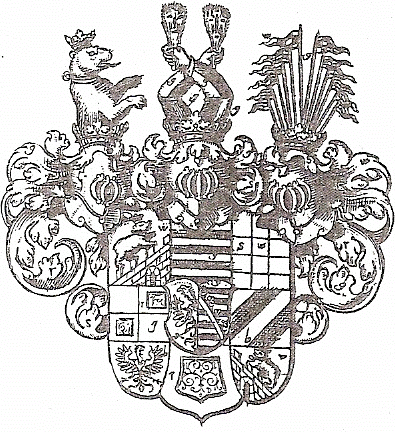 In 1665, the branch of Anhalt-Köthen became extinct, and according to a family compact this district was inherited by Lebrecht, Prince of Anhalt-Plötzkau
, who surrendered Plötzkau to Bernburg, and took the title of prince of Anhalt-Köthen. In the same year the princes of Anhalt decided that if any branch of the family became extinct its lands should be equally divided between the remaining branches. This arrangement was carried out after the death of Frederick Augustus, Prince of Anhalt-Zerbst
in 1793, and Zerbst was divided between the three remaining princes. During these years the policy of the different princes was marked, perhaps intentionally, by considerable uniformity. Once or twice Calvinism
was favoured by a prince, but in general the house was loyal to the doctrines of Martin Luther
. The growth of Prussia
provided Anhalt with a formidable neighbour, and the long-delayed establishment of primogeniture
by all branches of the family prevented further divisions of the principality.
In 1806, Napoleon
elevated the remaining states of Anhalt-Bernburg, Anhalt-Dessau and Anhalt-Köthen to duchies; in the meantime, Anhalt-Plötzkau and Anhalt-Zerbst had ceased to exist. These duchies were united again in 1863, due to the extinction of the Köthen and Bernburg lines. The new duchy consisted of two large portions, Eastern and Western Anhalt, separated by the interposition of a part of the Prussian Province of Saxony
and of five exclaves surrounded by Prussia
n territory: Alsleben
, Mühlingen
, Dornburg
, Gödnitz
and Tilkerode-Abberode
. The eastern and larger portion of the duchy was enclosed by the Prussian government district of Potsdam
(in the Prussian province of Brandenburg
) and by Magdeburg
and Merseburg
, belonging to the Prussian province of Saxony. The western or smaller portion, the so-called Upper Duchy or Ballenstedt
, was also enclosed by the two latter districts as well as by the Duchy of Brunswick-Lüneburg
.
When a united state, the capital of Anhalt was Dessau
.
Along with the fall of all German monarchies, the Duchy of Anhalt came to an end in 1918–19 during the revolution that followed the end of World War I
. It was replaced by the Free State of Anhalt
within the Weimar Republic
. After World War II
, the Free State was united with the Prussian parts of Saxony to form Saxony-Anhalt
. Subsequently, Saxony-Anhalt was dissolved in 1952, but re-established prior to the German reunification
in 1990, since when it has been one of the sixteen (Bundes)länder
(states) of Germany
.
range, hilly, the Ramberg (Harz)
peak being the tallest at 1,900 ft (579 m). From the Harz the country gently shelves down to the Saale
; and between this river and the Elbe
is particularly fertile. East of the Elbe, the land is mostly a flat sandy plain, with extensive pine
forests, interspersed with bog-land and rich pastures. The Elbe is the chief river, intersecting the eastern portion of the former duchy, from east to west, and at Rosslau is met by the Mulde
. The navigable Saale takes a northerly direction through the central portion of the territory and receives, on the right, the Fuhne
and, on the left, the Wipper
and the Bode
.
The climate is generally mild, less so in the higher regions to the south-west. The area of the former duchy is 906 miles² (2300 km²), and the population in 1905 was 328,007, a ratio of about 351 to the square mile (909 km²).
, Köthen, Zerbst
, Bernburg
and Ballenstedt
, of which that of Bernburg was the most, and that of Ballenstedt the least, populated. Of the towns, four, viz. Dessau, Bernburg, Köthen and Zerbst, had populations exceeding 20,000. The inhabitants of the former duchy, with the exception of about 12,000 Roman Catholics and 1700 Jews, were members of the Evangelical State Church of Anhalt . The supreme ecclesiastical authority was the consistory
in Dessau; while a synod
of 39 members, elected for six years, assembled at periods to deliberate on internal matters touching the organization of the church. The Roman Catholics were under the bishop of Paderborn.
s, was a constitutional monarchy
. The duke, who bore the title of "Highness", wielded the executive power while sharing the legislation
with the estates
. The diet
(Landtag
) was composed of thirty-six members, of whom two were appointed by the duke, eight were representatives of landowners paying the highest taxes, two of the highest assessed members of the commercial and manufacturing classes, fourteen of the other electors
of the towns and ten of the rural districts. The representatives were chosen for six years by indirect vote and must have completed their twenty-fifth year. The duke governed through a minister of state
, who was the praeses of all the departments — finance, home affairs, education, public worship and statistics.
Partitioned between Anhalt-Aschersleben, Anhalt-Bernburg
, and Anhalt-Zerbst
in 1252
County
A county is a jurisdiction of local government in certain modern nations. Historically in mainland Europe, the original French term, comté, and its equivalents in other languages denoted a jurisdiction under the sovereignty of a count A county is a jurisdiction of local government in certain...
(after 1806 duchy
Duchy
A duchy is a territory, fief, or domain ruled by a duke or duchess.Some duchies were sovereign in areas that would become unified realms only during the Modern era . In contrast, others were subordinate districts of those kingdoms that unified either partially or completely during the Medieval era...
) in Germany
Germany
Germany , officially the Federal Republic of Germany , is a federal parliamentary republic in Europe. The country consists of 16 states while the capital and largest city is Berlin. Germany covers an area of 357,021 km2 and has a largely temperate seasonal climate...
, located between the Harz Mountains and the river Elbe
Elbe
The Elbe is one of the major rivers of Central Europe. It rises in the Krkonoše Mountains of the northwestern Czech Republic before traversing much of Bohemia , then Germany and flowing into the North Sea at Cuxhaven, 110 km northwest of Hamburg...
in Middle Germany
Middle Germany
Central Germany is an economic and cultural region in Germany. Its exact borders depend on context, but it is often defined as being a region within the federal states of Saxony, Thuringia and Saxony-Anhalt, or a smaller part of this region .The name dates from the German Empire, when the region...
. It now forms part of the state of Saxony-Anhalt
Saxony-Anhalt
Saxony-Anhalt is a landlocked state of Germany. Its capital is Magdeburg and it is surrounded by the German states of Lower Saxony, Brandenburg, Saxony, and Thuringia.Saxony-Anhalt covers an area of...
.
Dukes of Anhalt
During the 9th century, the area was part of the Duchy of SaxonyDuchy of Saxony
The medieval Duchy of Saxony was a late Early Middle Ages "Carolingian stem duchy" covering the greater part of Northern Germany. It covered the area of the modern German states of Bremen, Hamburg, Lower Saxony, North Rhine-Westphalia, and Saxony-Anhalt and most of Schleswig-Holstein...
. In the 12th century, it came under the rule of Esico (died 1059 or 1060). His son was Adalbert II (died 1080) and his grandson Otto the Rich
Otto, Count of Ballenstedt
Otto, Count of Ballenstedt, called Otto the Rich , was the first Ascanian prince to call himself count of Anhalt, and was also briefly named duke of Saxony...
appears to have been the first to assume the title of count of Anhalt. Otto, also known as count of Ballenstedt, was the father of Albert the Bear, count of Anhalt, who conquered the Slavic territory of Brandenburg. When Albert died in 1170, his son Bernhard
Bernhard, Count of Anhalt
Bernhard, Count of Anhalt was a German prince of the House of Ascania, Count of Anhalt and Ballenstedt, and Lord of Bernburg through his paternal inheritance...
, who received the title of duke of Saxony in 1180, became count of Anhalt. Bernhard died in 1212, and Anhalt, now separated from Saxony, passed to his son Henry I, who in 1218 took the title of prince and was the real founder of the princely house of Anhalt. Henry I is included among the Minnesingers of Codex Manesse
Codex Manesse
The Codex Manesse, Manesse Codex, or Große Heidelberger Liederhandschrift is a Liederhandschrift , the single most comprehensive source of Middle High German Minnesang poetry, written and illustrated between ca. 1304 when the main part was completed, and ca...
.
Princes of Anhalt
On Henry's death in 1252, his three sons partitioned the principality and founded, respectively, the lines of Aschersleben, BernburgAnhalt-Bernburg
Anhalt-Bernburg was a principality of the Holy Roman Empire and a duchy of the German Confederation ruled by the House of Ascania with its residence at Bernburg in present-day Saxony-Anhalt...
and Zerbst
Principality of Anhalt-Zerbst
Anhalt-Zerbst was a principality located in Germany. It was established for the first time in 1252 following the partition of the principality of Anhalt. The capital of the state was located at Zerbst. Anhalt-Zerbst ceased to exist in 1396 when it was partitioned between Anhalt-Dessau and...
. The family ruling in Aschersleben became extinct in 1315, and this district was subsequently incorporated in the neighboring Bishopric of Halberstadt
Bishopric of Halberstadt
The Bishopric of Halberstadt was a Roman Catholic diocese from 804 until 1648 and an ecclesiastical state of the Holy Roman Empire from the late Middle Ages...
, thus dividing the territory of Anhalt-Bernburg
Anhalt-Bernburg
Anhalt-Bernburg was a principality of the Holy Roman Empire and a duchy of the German Confederation ruled by the House of Ascania with its residence at Bernburg in present-day Saxony-Anhalt...
in two separate pieces. The last prince of the original line of Anhalt-Bernburg died in 1468 and his lands were inherited by the princes of the sole remaining line, that of Anhalt-Zerbst
Principality of Anhalt-Zerbst
Anhalt-Zerbst was a principality located in Germany. It was established for the first time in 1252 following the partition of the principality of Anhalt. The capital of the state was located at Zerbst. Anhalt-Zerbst ceased to exist in 1396 when it was partitioned between Anhalt-Dessau and...
. The territory belonging to this branch of the family had been divided in 1396, and after the acquisition of Bernburg Prince George I
George I, Prince of Anhalt-Dessau
George I, Prince of Anhalt-Dessau , was a German prince of the House of Ascania and ruler of the principality of Anhalt-Dessau....
made a further partition of Zerbst (Zerbst and Dessau). Early in the 16th century, however, owing to the death or abdication of several princes, the family had become narrowed down to the two branches of Anhalt-Köthen and Anhalt-Dessau (issued both from Anhalt-Dessau in 1471).
Wolfgang of Anhalt
Wolfgang, Prince of Anhalt-Köthen
Wolfgang, Prince of Anhalt-Köthen , was a German prince of the House of Ascania and ruler of the principality of Anhalt-Köthen...
, called the Confessor, who became prince of Anhalt-Köthen in 1508, was the second ruler in the world to introduce the Reformation
Protestant Reformation
The Protestant Reformation was a 16th-century split within Western Christianity initiated by Martin Luther, John Calvin and other early Protestants. The efforts of the self-described "reformers", who objected to the doctrines, rituals and ecclesiastical structure of the Roman Catholic Church, led...
to his country. He was a co-signer of the Augsburg Confession
Augsburg Confession
The Augsburg Confession, also known as the "Augustana" from its Latin name, Confessio Augustana, is the primary confession of faith of the Lutheran Church and one of the most important documents of the Lutheran reformation...
in 1530, and after the Battle of Mühlberg
Battle of Mühlberg
The Battle of Mühlberg was a large battle at Mühlberg in the Electorate of Saxony during the Protestant Reformation at which the Catholic princes of the Holy Roman Empire led by the Emperor Charles I of Spain and V of the Holy Roman Empire decisively defeated the Lutheran Schmalkaldic League of...
in 1547 was placed under Imperial ban and deprived of his lands by Emperor Charles V
Charles V, Holy Roman Emperor
Charles V was ruler of the Holy Roman Empire from 1519 and, as Charles I, of the Spanish Empire from 1516 until his voluntary retirement and abdication in favor of his younger brother Ferdinand I and his son Philip II in 1556.As...
. After the peace of Passau
Peace of Passau
Holy Roman Emperor Charles V had won a victory against Protestantism in the Schmalkaldic War of 1547. Many Protestant princes were unhappy with the religious terms of the Augsburg Interim imposed after this victory. In January 1552, led by Maurice of Saxony, many formed an alliance with Henry II of...
in 1552 he bought back his principality, but as he was childless he surrendered it in 1562 to his kinsmen the princes of Anhalt-Dessau. Ernest I, Prince of Anhalt-Dessau
Ernest I, Prince of Anhalt-Dessau
Ernest I, Prince of Anhalt-Dessau , was a German prince of the House of Ascania and ruler of the principality of Anhalt-Dessau....
(d. 1516) left three sons, John V
John V, Prince of Anhalt-Zerbst
John V of Anhalt-Zerbst , was a German prince of the House of Ascania and ruler of the principality of Anhalt-Dessau...
, George III
George III, Prince of Anhalt-Dessau
George III, Prince of Anhalt-Dessau , was a German prince of the House of Ascania and ruler of the principality of Anhalt-Dessau...
, and Joachim
Joachim I, Prince of Anhalt-Dessau
Joachim I, Prince of Anhalt-Dessau , was a German prince of the House of Ascania and ruler of the principality of Anhalt-Dessau...
, who ruled their lands together for many years, and who favoured the Lutheran doctrine, which thus became dominant in Anhalt. About 1546 the three brothers divided their principality and founded the lines of Zerbst
Principality of Anhalt-Zerbst
Anhalt-Zerbst was a principality located in Germany. It was established for the first time in 1252 following the partition of the principality of Anhalt. The capital of the state was located at Zerbst. Anhalt-Zerbst ceased to exist in 1396 when it was partitioned between Anhalt-Dessau and...
, Plötzkau and Dessau. This division, however, was only temporary, as the acquisition of Köthen
Anhalt-Köthen
Anhalt-Köthen has existed on two separate occasions. The first state was created in 1396 when the Anhalt-Zerbst was partitioned between Anhalt-Dessau and Anhalt-Köthen. The first creation lasted until 1552 when it was inherited by Anhalt-Dessau....
, and a series of deaths among the ruling princes, enabled Joachim Ernest
Joachim Ernest, Prince of Anhalt
Joachim Ernest of Anhalt , was a German prince of the House of Ascania, ruler of the principality of Anhalt-Zerbst, and from 1570 sole ruler of all the Anhalt lands....
, a son of John V, to unite the whole of Anhalt under his rule in 1570.
Thirty Years' War
The Thirty Years' War was fought primarily in what is now Germany, and at various points involved most countries in Europe. It was one of the most destructive conflicts in European history....
, and in the earlier part of this struggle Christian I of Anhalt-Bernburg took an important part. In 1635 an arrangement was made by the various princes of Anhalt, which gave a certain authority to the eldest member of the family, who was thus able to represent the principality as a whole. This proceeding was probably due to the necessity of maintaining an appearance of unity in view of the disturbed state of European politics.
Lebrecht, Prince of Anhalt-Köthen
Lebrecht of Anhalt-Köthen , was a German prince of the House of Ascania and ruler of the principality of Anhalt-Plötzkau...
, who surrendered Plötzkau to Bernburg, and took the title of prince of Anhalt-Köthen. In the same year the princes of Anhalt decided that if any branch of the family became extinct its lands should be equally divided between the remaining branches. This arrangement was carried out after the death of Frederick Augustus, Prince of Anhalt-Zerbst
Frederick Augustus, Prince of Anhalt-Zerbst
Frederick Augustus, Prince of Anhalt-Zerbst , was a German prince of the House of Ascania and the last ruler of the Principality of Anhalt-Zerbst....
in 1793, and Zerbst was divided between the three remaining princes. During these years the policy of the different princes was marked, perhaps intentionally, by considerable uniformity. Once or twice Calvinism
Calvinism
Calvinism is a Protestant theological system and an approach to the Christian life...
was favoured by a prince, but in general the house was loyal to the doctrines of Martin Luther
Martin Luther
Martin Luther was a German priest, professor of theology and iconic figure of the Protestant Reformation. He strongly disputed the claim that freedom from God's punishment for sin could be purchased with money. He confronted indulgence salesman Johann Tetzel with his Ninety-Five Theses in 1517...
. The growth of Prussia
Prussia
Prussia was a German kingdom and historic state originating out of the Duchy of Prussia and the Margraviate of Brandenburg. For centuries, the House of Hohenzollern ruled Prussia, successfully expanding its size by way of an unusually well-organized and effective army. Prussia shaped the history...
provided Anhalt with a formidable neighbour, and the long-delayed establishment of primogeniture
Primogeniture
Primogeniture is the right, by law or custom, of the firstborn to inherit the entire estate, to the exclusion of younger siblings . Historically, the term implied male primogeniture, to the exclusion of females...
by all branches of the family prevented further divisions of the principality.
19th-century duchies
In 1806, Napoleon
Napoleon I of France
Napoleon Bonaparte was a French military and political leader during the latter stages of the French Revolution.As Napoleon I, he was Emperor of the French from 1804 to 1815...
elevated the remaining states of Anhalt-Bernburg, Anhalt-Dessau and Anhalt-Köthen to duchies; in the meantime, Anhalt-Plötzkau and Anhalt-Zerbst had ceased to exist. These duchies were united again in 1863, due to the extinction of the Köthen and Bernburg lines. The new duchy consisted of two large portions, Eastern and Western Anhalt, separated by the interposition of a part of the Prussian Province of Saxony
Province of Saxony
The Province of Saxony was a province of the Kingdom of Prussia and later the Free State of Prussia from 1816 until 1945. Its capital was Magdeburg.-History:The province was created in 1816 out of the following territories:...
and of five exclaves surrounded by Prussia
Prussia
Prussia was a German kingdom and historic state originating out of the Duchy of Prussia and the Margraviate of Brandenburg. For centuries, the House of Hohenzollern ruled Prussia, successfully expanding its size by way of an unusually well-organized and effective army. Prussia shaped the history...
n territory: Alsleben
Alsleben
Alsleben is a town in the district of Salzlandkreis, in Saxony-Anhalt, Germany. It is situated on the river Saale, south of Bernburg. It is part of the Verbandsgemeinde Saale-Wipper....
, Mühlingen
Großmühlingen
thumb|right|100px|Coat of armsGroßmühlingen is a former municipality in the district of Salzlandkreis, in Saxony-Anhalt, Germany. Since January 2008, it is part of the municipality Bördeland.-See also:...
, Dornburg
Dornburg
Dornburg is a town in the Saale-Holzland district, in Thuringia, Germany. It sits atop a small hill of 400 ft above the Saale. Since 1 December 2008, it is part of the town Dornburg-Camburg.-Main sights:...
, Gödnitz
Gödnitz
Gödnitz is a village and a former municipality in the district of Anhalt-Bitterfeld, in Saxony-Anhalt, Germany. Since 1 January 2010, it is part of the town Zerbst....
and Tilkerode-Abberode
Abberode
Abberode is a village and a former municipality in the Mansfeld-Südharz district, Saxony-Anhalt, Germany. Since 6 March 2009, it is part of the town Mansfeld....
. The eastern and larger portion of the duchy was enclosed by the Prussian government district of Potsdam
Potsdam
Potsdam is the capital city of the German federal state of Brandenburg and part of the Berlin/Brandenburg Metropolitan Region. It is situated on the River Havel, southwest of Berlin city centre....
(in the Prussian province of Brandenburg
Province of Brandenburg
The Province of Brandenburg was a province of the Kingdom of Prussia and the Free State of Prussia from 1815 to 1946.-History:The first people who are known to have inhabited Brandenburg were the Suevi. They were succeeded by the Slavonians, whom Henry II conquered and converted to Christianity in...
) and by Magdeburg
Magdeburg
Magdeburg , is the largest city and the capital city of the Bundesland of Saxony-Anhalt, Germany. Magdeburg is situated on the Elbe River and was one of the most important medieval cities of Europe....
and Merseburg
Merseburg
Merseburg is a town in the south of the German state of Saxony-Anhalt on the river Saale, approx. 14 km south of Halle . It is the capital of the Saalekreis district. It had a diocese founded by Archbishop Adalbert of Magdeburg....
, belonging to the Prussian province of Saxony. The western or smaller portion, the so-called Upper Duchy or Ballenstedt
Ballenstedt
Ballenstedt is a town in the Harz district, in the German state of Saxony-Anhalt. It is situated at the northern rim of the Harz mountain range, about 10 km southeast of Quedlinburg. The municipality includes the villages of Badeborn and Oppenrode...
, was also enclosed by the two latter districts as well as by the Duchy of Brunswick-Lüneburg
Brunswick-Lüneburg
The Duchy of Brunswick-Lüneburg , or more properly Duchy of Brunswick and Lüneburg, was an historical ducal state from the late Middle Ages until the late Early Modern era within the North-Western domains of the Holy Roman Empire of the German Nation, in what is now northern Germany...
.
When a united state, the capital of Anhalt was Dessau
Dessau
Dessau is a town in Germany on the junction of the rivers Mulde and Elbe, in the Bundesland of Saxony-Anhalt. Since 1 July 2007, it is part of the merged town Dessau-Roßlau. Population of Dessau proper: 77,973 .-Geography:...
.
Along with the fall of all German monarchies, the Duchy of Anhalt came to an end in 1918–19 during the revolution that followed the end of World War I
World War I
World War I , which was predominantly called the World War or the Great War from its occurrence until 1939, and the First World War or World War I thereafter, was a major war centred in Europe that began on 28 July 1914 and lasted until 11 November 1918...
. It was replaced by the Free State of Anhalt
Free State of Anhalt
The Free State of Anhalt was formed after Joachim Ernst, Duke of Anhalt abdicated on 12 November 1918, ending the Duchy of Anhalt. It was a state of Germany during the time of the Weimar Republic...
within the Weimar Republic
Weimar Republic
The Weimar Republic is the name given by historians to the parliamentary republic established in 1919 in Germany to replace the imperial form of government...
. After World War II
World War II
World War II, or the Second World War , was a global conflict lasting from 1939 to 1945, involving most of the world's nations—including all of the great powers—eventually forming two opposing military alliances: the Allies and the Axis...
, the Free State was united with the Prussian parts of Saxony to form Saxony-Anhalt
Saxony-Anhalt
Saxony-Anhalt is a landlocked state of Germany. Its capital is Magdeburg and it is surrounded by the German states of Lower Saxony, Brandenburg, Saxony, and Thuringia.Saxony-Anhalt covers an area of...
. Subsequently, Saxony-Anhalt was dissolved in 1952, but re-established prior to the German reunification
German reunification
German reunification was the process in 1990 in which the German Democratic Republic joined the Federal Republic of Germany , and when Berlin reunited into a single city, as provided by its then Grundgesetz constitution Article 23. The start of this process is commonly referred by Germans as die...
in 1990, since when it has been one of the sixteen (Bundes)länder
States of Germany
Germany is made up of sixteen which are partly sovereign constituent states of the Federal Republic of Germany. Land literally translates as "country", and constitutionally speaking, they are constituent countries...
(states) of Germany
Germany
Germany , officially the Federal Republic of Germany , is a federal parliamentary republic in Europe. The country consists of 16 states while the capital and largest city is Berlin. Germany covers an area of 357,021 km2 and has a largely temperate seasonal climate...
.
Geography
In the west, the land is undulating and in the extreme northwest, where it forms part of the HarzHarz
The Harz is the highest mountain range in northern Germany and its rugged terrain extends across parts of Lower Saxony, Saxony-Anhalt and Thuringia. The name Harz derives from the Middle High German word Hardt or Hart , latinized as Hercynia. The legendary Brocken is the highest summit in the Harz...
range, hilly, the Ramberg (Harz)
Ramberg (Harz)
The Ramberg, also called the Ramberg Massif, is a granite massif, about 30 square kilometres in area, in the eastern part of the Harz Mountains of central Germany. It is located in the federal state of Saxony-Anhalt and lies southwest of Quedlinburg, between Friedrichsbrunn, Gernrode, Harzgerode...
peak being the tallest at 1,900 ft (579 m). From the Harz the country gently shelves down to the Saale
Saale
The Saale, also known as the Saxon Saale and Thuringian Saale , is a river in Germany and a left-bank tributary of the Elbe. It is not to be confused with the smaller Franconian Saale, a right-bank tributary of the Main, or the Saale in Lower Saxony, a tributary of the Leine.-Course:The Saale...
; and between this river and the Elbe
Elbe
The Elbe is one of the major rivers of Central Europe. It rises in the Krkonoše Mountains of the northwestern Czech Republic before traversing much of Bohemia , then Germany and flowing into the North Sea at Cuxhaven, 110 km northwest of Hamburg...
is particularly fertile. East of the Elbe, the land is mostly a flat sandy plain, with extensive pine
Pine
Pines are trees in the genus Pinus ,in the family Pinaceae. They make up the monotypic subfamily Pinoideae. There are about 115 species of pine, although different authorities accept between 105 and 125 species.-Etymology:...
forests, interspersed with bog-land and rich pastures. The Elbe is the chief river, intersecting the eastern portion of the former duchy, from east to west, and at Rosslau is met by the Mulde
Mulde
The Mulde is a river in Saxony and Saxony-Anhalt, Germany. It is a left tributary of the Elbe and 124 km in length.The river is formed by the confluence, near Colditz, of the Zwickauer Mulde and the Freiberger Mulde , both rising from the Ore Mountains...
. The navigable Saale takes a northerly direction through the central portion of the territory and receives, on the right, the Fuhne
Fuhne
Fuhne is a river of Saxony-Anhalt, Germany....
and, on the left, the Wipper
Wipper
Wipper can refer to:*Wipper , a river in Saxony-Anhalt, Germany, originating in the Harz*Wipper , a river in Thuringia, Germany*Wipper, the name of the river Wupper in its upper course*the German name for the river Wieprza in Poland...
and the Bode
Bode
Bode may refer to:in people by surname:*Boyd Henry Bode , American academic and philosopher*Bruce Bode, MD, FACE, American diabetes specialist*Denise Bode , American politician*Erin Bode, American singer...
.
The climate is generally mild, less so in the higher regions to the south-west. The area of the former duchy is 906 miles² (2300 km²), and the population in 1905 was 328,007, a ratio of about 351 to the square mile (909 km²).
Population
The country was divided into the districts of DessauDessau
Dessau is a town in Germany on the junction of the rivers Mulde and Elbe, in the Bundesland of Saxony-Anhalt. Since 1 July 2007, it is part of the merged town Dessau-Roßlau. Population of Dessau proper: 77,973 .-Geography:...
, Köthen, Zerbst
Zerbst
Zerbst is a town in the district of Anhalt-Bitterfeld, in Saxony-Anhalt, Germany. Until the administrative reform of 2007, Zerbst was the capital of the Anhalt-Zerbst district. Since the 1 January 2010 local government reform, Zerbst has about 24,000 inhabitants.It is not clear when was it founded;...
, Bernburg
Bernburg
Bernburg is a town in Saxony-Anhalt, Germany, capital of the district of Salzlandkreis. It is situated on the river Saale, approx. 30 km downstream from Halle. The town is dominated by its huge Renaissance castle featuring a museum as well as a popular, recently updated bear pit in its...
and Ballenstedt
Ballenstedt
Ballenstedt is a town in the Harz district, in the German state of Saxony-Anhalt. It is situated at the northern rim of the Harz mountain range, about 10 km southeast of Quedlinburg. The municipality includes the villages of Badeborn and Oppenrode...
, of which that of Bernburg was the most, and that of Ballenstedt the least, populated. Of the towns, four, viz. Dessau, Bernburg, Köthen and Zerbst, had populations exceeding 20,000. The inhabitants of the former duchy, with the exception of about 12,000 Roman Catholics and 1700 Jews, were members of the Evangelical State Church of Anhalt . The supreme ecclesiastical authority was the consistory
Consistory
-Antiquity:Originally, the Latin word consistorium meant simply 'sitting together', just as the Greek synedrion ....
in Dessau; while a synod
Synod
A synod historically is a council of a church, usually convened to decide an issue of doctrine, administration or application. In modern usage, the word often refers to the governing body of a particular church, whether its members are meeting or not...
of 39 members, elected for six years, assembled at periods to deliberate on internal matters touching the organization of the church. The Roman Catholics were under the bishop of Paderborn.
Constitution
The duchy, by virtue of a fundamental law, proclaimed on September 17, 1859 and subsequently modified by various decreeDecree
A decree is a rule of law issued by a head of state , according to certain procedures . It has the force of law...
s, was a constitutional monarchy
Constitutional monarchy
Constitutional monarchy is a form of government in which a monarch acts as head of state within the parameters of a constitution, whether it be a written, uncodified or blended constitution...
. The duke, who bore the title of "Highness", wielded the executive power while sharing the legislation
Legislation
Legislation is law which has been promulgated by a legislature or other governing body, or the process of making it...
with the estates
Estates of the realm
The Estates of the realm were the broad social orders of the hierarchically conceived society, recognized in the Middle Ages and Early Modern period in Christian Europe; they are sometimes distinguished as the three estates: the clergy, the nobility, and commoners, and are often referred to by...
. The diet
Diet (assembly)
In politics, a diet is a formal deliberative assembly. The term is mainly used historically for the Imperial Diet, the general assembly of the Imperial Estates of the Holy Roman Empire, and for the legislative bodies of certain countries.-Etymology:...
(Landtag
Landtag
A Landtag is a representative assembly or parliament in German-speaking countries with some legislative authority.- Name :...
) was composed of thirty-six members, of whom two were appointed by the duke, eight were representatives of landowners paying the highest taxes, two of the highest assessed members of the commercial and manufacturing classes, fourteen of the other electors
Voting
Voting is a method for a group such as a meeting or an electorate to make a decision or express an opinion—often following discussions, debates, or election campaigns. It is often found in democracies and republics.- Reasons for voting :...
of the towns and ten of the rural districts. The representatives were chosen for six years by indirect vote and must have completed their twenty-fifth year. The duke governed through a minister of state
Minister of State
Minister of State is a title borne by politicians or officials in certain countries governed under a parliamentary system. In some countries a "minister of state" is a junior minister, who is assigned to assist a specific cabinet minister...
, who was the praeses of all the departments — finance, home affairs, education, public worship and statistics.
Rulers of Anhalt, Middle Ages
- Esico of BallenstedtEsico of BallenstedtEsico of Ballenstedt is the top ancestor of the House of Ascania, i.e., he is the oldest member of the house known for certain. Little is known about him, but he is assumed to have been count of the Schwabengau and of the Harzgau with his seat at Ballenstedt...
?–1059/1060, first Count of Anhalt - Otto, Count of BallenstedtOtto, Count of BallenstedtOtto, Count of Ballenstedt, called Otto the Rich , was the first Ascanian prince to call himself count of Anhalt, and was also briefly named duke of Saxony...
- Albert the Bear ?–1170
- BernhardBernhard, Count of AnhaltBernhard, Count of Anhalt was a German prince of the House of Ascania, Count of Anhalt and Ballenstedt, and Lord of Bernburg through his paternal inheritance...
1170–1212 - Henry IHenry I, Count of AnhaltHenry I, Count of Anhalt was a German prince of the House of Ascania and Count of Anhalt.He was the oldest son of Bernhard III, Duke of Saxony and Count of Anhalt, by his wife Brigitte a daughter of Canute V of Denmark....
1212–1252 (Prince from 1218)
Partitioned between Anhalt-Aschersleben, Anhalt-Bernburg
Anhalt-Bernburg
Anhalt-Bernburg was a principality of the Holy Roman Empire and a duchy of the German Confederation ruled by the House of Ascania with its residence at Bernburg in present-day Saxony-Anhalt...
, and Anhalt-Zerbst
Principality of Anhalt-Zerbst
Anhalt-Zerbst was a principality located in Germany. It was established for the first time in 1252 following the partition of the principality of Anhalt. The capital of the state was located at Zerbst. Anhalt-Zerbst ceased to exist in 1396 when it was partitioned between Anhalt-Dessau and...
in 1252
Dukes of Anhalt, 1863–1918
- Leopold IVLeopold IV, Duke of AnhaltLeopold IV Frederick, Duke of Anhalt was a German prince of the House of Ascania.From 1817 until 1853 he was ruler of the duchy of Anhalt-Dessau and from 1847 until 1853 also ruler of the duchy of Anhalt-Köthen...
1863–1871 - Frederick IFrederick I, Duke of AnhaltFrederick I was a German prince of the house of Ascania who ruled the Duchy of Anhalt from 1871 to 1904.-Early life:...
1871–1904 - Frederick IIFrederick II, Duke of AnhaltFrederick II was the Duke of Anhalt from 1904 until 1918.-Early life:He was born in Dessau in 1856 as the second son of Hereditary Prince Frederick of Anhalt-Dessau and his wife Princess Antoinette of Saxe-Altenburg....
1904–1918 - EduardEduard, Duke of AnhaltEduard Georg Wilhelm, Duke of Anhalt was a German prince of the House of Ascania and the penultimate ruler of the Duchy of Anhalt from April to September 1918.-Early life:...
1918 - Joachim ErnstJoachim Ernst, Duke of AnhaltJoachim Ernst, Duke of Anhalt was the last ruler of the Duchy of Anhalt.-Biography:He was born in Dessau the son of Duke Eduard of Anhalt and Princess Luise of Saxe-Altenburg , the daughter of Prince Moritz of Saxe-Altenburg.He succeeded his father as Duke of Anhalt on September 13, 1918, however...
1918
Heads of the House of Anhalt since 1918
- Duke Joachim ErnstJoachim Ernst, Duke of AnhaltJoachim Ernst, Duke of Anhalt was the last ruler of the Duchy of Anhalt.-Biography:He was born in Dessau the son of Duke Eduard of Anhalt and Princess Luise of Saxe-Altenburg , the daughter of Prince Moritz of Saxe-Altenburg.He succeeded his father as Duke of Anhalt on September 13, 1918, however...
1918–1947 - Prince Friedrich 1947–1963
- Prince EduardEduard, Prince of AnhaltPrince Julius Eduard of Anhalt is the head of the House of Ascania, the family which ruled the Duchy of Anhalt until 1918. He uses the style His Highness.-Early life and family:...
1963–present
External links
- http://www.deutsche-schutzgebiete.de/herzogtum_anhalt.htm
- Map of Saxony and Anhalt in 1789
- Overview over the various splits of German principalities