

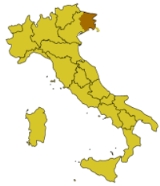
Friuli

Encyclopedia
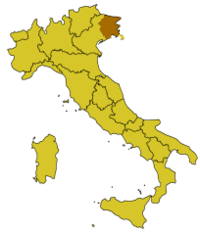
Friuli-Venezia Giulia
Friuli–Venezia Giulia is one of the twenty regions of Italy, and one of five autonomous regions with special statute. The capital is Trieste. It has an area of 7,858 km² and about 1.2 million inhabitants. A natural opening to the sea for many Central European countries, the region is...
, i.e. the province (administrative provinces) of Udine
Province of Udine
The Province of Udine is a province in the autonomous Friuli-Venezia Giulia region of Italy, bordering Austria and Slovenia. Its capital is the city of Udine....
, Pordenone
Province of Pordenone
The Province of Pordenone is a province in the autonomous Friuli-Venezia Giulia region of Italy. Its capital is the city of Pordenone. The territory was carved out of the Province of Udine in 1968....
, Gorizia
Province of Gorizia
The Province of Gorizia is a province in the autonomous Friuli–Venezia Giulia region of Italy.-Overview:Its capital is the city of Gorizia. It belonged to the Province of Udine between 1924 and 1927 and the communes of Sonzia, Plezzo, Bergogna, Caporetto, Tolmino, Circhina, Santa Lucia d'Isonzo,...
, excluding Trieste
Province of Trieste
The Province of Trieste is a province in the autonomous Friuli-Venezia Giulia region of Italy. Its capital is the city of Trieste.It has an area of 212 km², and a total population of 236,520...
. The historical capital and most important city of Friuli is Udine
Udine
Udine is a city and comune in northeastern Italy, in the middle of Friuli-Venezia Giulia region, between the Adriatic sea and the Alps , less than 40 km from the Slovenian border. Its population was 99,439 in 2009, and that of its urban area was 175,000.- History :Udine is the historical...
, it was also the capital in the Middle Ages of the Patriarchate of Aquileia
Patriarchate of Aquileia (State)
The Patriarchate of Aquileia was an Imperial State in the Friulian region of Northeastern Italy under the control of the Patriarchs of Aquileia.- Foundation :...
. Other important towns are Pordenone
Pordenone
Pordenone is a comune of Pordenone province of northeast Italy in the Friuli-Venezia Giulia region.The name comes from the Latin "Portus Naonis" meaning the port on the river Noncello - History :...
, Gorizia
Gorizia
Gorizia is a town and comune in northeastern Italy, in the autonomous region of Friuli Venezia Giulia. It is located at the foot of the Julian Alps, bordering Slovenia. It is the capital of the Province of Gorizia, and it is a local center of tourism, industry, and commerce. Since 1947, a twin...
, Sacile
Sacile
Sacile is a town and comune in the province of Pordenone, in the Friuli-Venezia Giulia region of north-east Italy. It is known as the "Garden of the Serenissima" after the many palaces that were constructed along the river Livenza for the nobility of the Most Serene Republic of...
, Codroipo
Codroipo
Codroipo is a comune in the Province of Udine in the Italian region Friuli-Venezia Giulia, located about 70 km northwest of Trieste and about 20 km southwest of Udine.The town was founded in Roman times and named Quadruvium...
, Cervignano del Friuli
Cervignano del Friuli
Cervignano del Friuli is a comune in the province of Udine, Italy. the most important town of Bassa Friulana. It lies at about 12 km from the Laguna di Grado and at about 18 km from the Adriatic Sea; from the point of view of viability, its position is peculiar since it lies at the...
, Cividale del Friuli
Cividale del Friuli
-External links:*...
, Gemona del Friuli
Gemona del Friuli
Gemona del Friuli is a comune in the Province of Udine in the Italian region Friuli-Venezia Giulia, located about 90 km northwest of Trieste and about 25 km northwest of Udine....
, Monfalcone
Monfalcone
Monfalcone is a town and comune of the province of Gorizia , located on the coast of the Gulf of Trieste. Monfalcone means "Mount of Falcon" in Italian....
, and Tolmezzo
Tolmezzo
Tolmezzo is a town and comune in the province of Udine, part of the Friuli-Venezia Giulia region of north-eastern Italy.-Geography:Tolmezzo is located at the feet of the Strabut Mountain, between the Tagliamento River and the Bût stream. Nearby is the Mount Amariana...
.
Geography

Carnic Alps
The Carnic Alps are a range of the Southern Limestone Alps in East Tyrol, Carinthia, South Tyrol and Friuli . They extend from east to west for about between the Gail River, a tributary of the Drava and the Tagliamento, forming the border between Austria and Italy.They are named after the Roman...
, on the east by the Julian Alps
Julian Alps
The Julian Alps are a mountain range of the Southern Limestone Alps that stretches from northeastern Italy to Slovenia, where they rise to 2,864 m at Mount Triglav. They are named after Julius Caesar, who founded the municipium of Cividale del Friuli at the foot of the mountains...
and the Timavo
Timavo
The River, known in Slovene as the or , is a 2-km river in the Province of Trieste. It has four sources near San Giovanni near Duino and outflows in the Gulf of Panzano between Trieste and Monfalcone , Italy....
river, and on the south by the Adriatic Sea
Adriatic Sea
The Adriatic Sea is a body of water separating the Italian Peninsula from the Balkan peninsula, and the system of the Apennine Mountains from that of the Dinaric Alps and adjacent ranges...
. Rivers flowing southwards from the mountains are numerous. Other important rivers include the Torre
Torre
Torre means tower in six Romance languages and may refer to:- Biology :* Muir-Torre syndrome, the inherited cancer syndrome...
, Natisone
Natisone
The Natisone is a river that flows for some time as a border river between Slovenia and Italy, continues in Slovenia and then crosses the border and continues in Eastern Friuli, in north-eastern Italy...
, Stella, Isonzo, Ausa
Ausa
Ausa is a city and a municipal council in Latur District in the state of Maharashtra, India.- Geography :Ausa is located at . It has an average elevation of 634 metres ....
, and Tagliamento. The northern part of the region is completely mountainous. From west to east, the region's highest peaks are, in the Friulian Dolomites
Dolomites
The Dolomites are a mountain range located in north-eastern Italy. It is a part of Southern Limestone Alps and extends from the River Adige in the west to the Piave Valley in the east. The northern and southern borders are defined by the Puster Valley and the Sugana Valley...
— the Cima dei Preti
Cima dei Preti
Cima dei Preti is a mountain in the Carnic Prealps, the highest peak of the Friulian Dolomites, Italy. It is located at the boundaries between the provinces of Pordenone and Belluno....
, 2703 metres (8,868.1 ft), Duranno 2652 metres (8,700.8 ft), and Cridola
Monte Cridola
Monte Cridola is a mountain of the Veneto, Italy. It has an elevation of 2581 metres....
2581 metres (8,467.8 ft); in the Carnic Alps
Carnic Alps
The Carnic Alps are a range of the Southern Limestone Alps in East Tyrol, Carinthia, South Tyrol and Friuli . They extend from east to west for about between the Gail River, a tributary of the Drava and the Tagliamento, forming the border between Austria and Italy.They are named after the Roman...
— Mount Peralba 2694 metres (8,838.6 ft), Mount Bìvera 2474 metres (8,116.8 ft) and Mount Coglians
Coglians
Mount Coglians is a mountain in the Carnic Alps, at the border between Italy and Austria , west to the Monte Croce Carnico pass...
2780 metres (9,120.7 ft); in the Julian Alps, the Jôf Fuârt 2666 metres (8,746.7 ft), the Jôf di Montasio
Jôf di Montasio
Jôf di Montasio or Montaž with the altitude of 2,754 meters is the second highest peak of the Julian Alps, surpassed only by Mount Triglav. The original Slovene name of the mountain is Špik nad Policami or Poliški Špik, however nowadays the most used is Montaž, borrowed from the Italian...
2754 metres (9,035.4 ft), Mangart
Mangart
Mangart or Mangrt is a mountain in the Julian Alps, located on the border between Italy and Slovenia. With an elevation of , it is the fourth-highest peak in Slovenia. It was first ascended in 1794 by the naturalist Franz von Hohenwart...
2677 metres (8,782.8 ft), and Canin
Kanin (mountain)
The Kanin or Canin is a mountain in the Julian Alps on the border of Slovenia and Italy. Its highest summit is at 2,587 m above sea level...
2587 metres (8,487.5 ft), which dominates the plain. The Friulian mountains surround the course of the Tagliamento river, which, at the latitude of Gemona del Friuli
Gemona del Friuli
Gemona del Friuli is a comune in the Province of Udine in the Italian region Friuli-Venezia Giulia, located about 90 km northwest of Trieste and about 25 km northwest of Udine....
first crosses the hills that occupy the center of the Friuli, then flows into a large flood plain. This plain is commonly divided into the High Friulian plain and the Low Friulian plain (Bassa Friulana
Bassa Friulana
The Bassa Friulana is a low-lying and level area of Friuli, specifically the very southern part of the province of Udine, in the north-eastern Italian region of Friuli-Venezia Giulia....
), whose boundary is the Napoleonic road that connects the cities of Codroipo
Codroipo
Codroipo is a comune in the Province of Udine in the Italian region Friuli-Venezia Giulia, located about 70 km northwest of Trieste and about 20 km southwest of Udine.The town was founded in Roman times and named Quadruvium...
and Palmanova
Palmanova
Palmanova is a town and comune in northeastern Italy, close to the border with Slovenia. It is located 20 km from Udine, 28 km from Gorizia and 55 km from Trieste near the junction of the Autostrada Alpe-Adria and the Autostrada Venezia-Trieste .Palmanova is famous for its fortress...
. To the south of this road is the risorgive zone, where water resurfaces from underground waterways in spring-fed pools throughout the area. South of the plains lie the lagoons of Marano
Marano
Marano as a surname has noble Italian origin, derives from last name Marani of Vicenza that came to Naples in the 16th century with Francesco Antonio buried in the church of Sant'Antonelli to Caponapoli in the ancient center of Naples city...
and Grado
Grado, Italy
Grado is a town and comune in the north-eastern Italian region of Friuli-Venezia Giulia, located on a peninsula of the Adriatic Sea between Venice and Trieste....
, which are nature preserves. Friuli's covers an area of 8240 square kilometre, subdivided among the provinces of Udine 4905 square kilometre, Pordenone 2178 square kilometre and Gorizia 466 square kilometre.
Climate
Above mean sea level
The term above mean sea level refers to the elevation or altitude of any object, relative to the average sea level datum. AMSL is used extensively in radio by engineers to determine the coverage area a station will be able to reach...
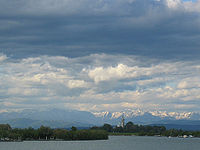
. In the coldest month, January, temperatures vary between approximately 4.5 °C (40.1 °F) in Monfalcone and nearly -5 C in Passo di Monte Croce Carnico, with intermediate temperatures of 3 °C (37.4 °F) in Udine and -2 C or -3 Cin Valcanale. Gorizia, a short distance from Udine, enjoys a particularly milder micro-climate with its approximate annual average of 4 °C (39.2 °F). In the warmest month, July, the temperatures range between 22.5 °C (72.5 °F) - 24 °C (75.2 °F) along the coast and plains and the 14 °C (57.2 °F) - 16 °C (60.8 °F) in Val Canale. Precipitation in Friuli is relatively abundant; the distribution of rainfall varies a great deal during the course of the year. Minimum values in the southern part generally fall between 1200 millimetres (47.2 in) and 1500 millimetres (59.1 in) (Gorizia over 1350 millimetres (53.1 in) and Udine over 1400 millimetres (55.1 in)), whereas the alpine area's maximum annual rainfall is approximately 3000 millimetres (118.1 in). The Julian Prealps is one of Italy's rainiest regions: Musi receives about 3300 millimetres (129.9 in) of annual precipitation and can receive 400 millimetres (15.7 in) in a single month. In some areas of Friuli, excessive rainfall has caused erosion and the flooding of many rivers. Snow is sparse in the southern plains (3 or 4 snowy days each year in Udine and Pordenone) but falls more consistently further to the north (Val Canale 25 days, Sauris 23 days, and Passo di Monte Croce Carnico 28 days).
Demography
Friuli has a little under one million people.| Zona | Population (2005) | Land Area (km²) |
Population Density (inh./km²) |
|---|---|---|---|
| Province of Gorizia Gorizia Gorizia is a town and comune in northeastern Italy, in the autonomous region of Friuli Venezia Giulia. It is located at the foot of the Julian Alps, bordering Slovenia. It is the capital of the Province of Gorizia, and it is a local center of tourism, industry, and commerce. Since 1947, a twin... |
140,681 | 466 | 302 |
| Province of Udine Udine Udine is a city and comune in northeastern Italy, in the middle of Friuli-Venezia Giulia region, between the Adriatic sea and the Alps , less than 40 km from the Slovenian border. Its population was 99,439 in 2009, and that of its urban area was 175,000.- History :Udine is the historical... |
528,246 | 4,905 | 108 |
| Province of Pordenone Pordenone Pordenone is a comune of Pordenone province of northeast Italy in the Friuli-Venezia Giulia region.The name comes from the Latin "Portus Naonis" meaning the port on the river Noncello - History :... |
297,699 | 2,178 | 137 |
| Total | 966,626 | 7,549 | 128 |
One of the most important demographic phenomena in Friuli was emigration. It began in the final decades of the nineteenth century and ended in the 1970s. It is estimated that more than a million Friulian people emigrated away over a period of approximately one hundred years. According to the most recent census by AIRE (2005), Friulian émigrés living abroad number 134,936. Of these, 56.0% reside in Europe, 24.0% in South America, 10.3% in North America and 4.7% in Oceania
Oceania
Oceania is a region centered on the islands of the tropical Pacific Ocean. Conceptions of what constitutes Oceania range from the coral atolls and volcanic islands of the South Pacific to the entire insular region between Asia and the Americas, including Australasia and the Malay Archipelago...
. This data only reflects those Friulians and their descendants who have Italian citizenship. The descendants of Friulians are excluded from the census because they aren't Italian citizens. Friulians in the world have supported cultural associations called Fogolârs furlans, of which there are 46 in Italy and 156 in the rest of the world.
Ente Friuli nel Mondo (Friuli in the World)
In 1953, to assist Friulians in foreign countries and to coordinate the activities of the Fogolârs Furlans, the organization Ente Friuli nel Mondo (Friulians in the World), was founded. It publishes a magazine, Friuli nel Mondo, and 25,000 copies are distributed in 78 different countries. The organization deucates émigrés and their descendants about their origins, ethnic identity, and maintains connections among Friulians around the world.
The origins and the Roman age
Castellieri culture
The Castellieri culture developed in Istria during the Mid-Bronze Age, and later expanded into the modern Venezia Giulia, Dalmatia and the neighbouring areas. It lasted for more than a millennium, from the 15th century BC until the Roman conquest in the 3rd century BC...
.The region was populated, during the course of 4th century BC, by Celtic-speaking
Celtic languages
The Celtic languages are descended from Proto-Celtic, or "Common Celtic"; a branch of the greater Indo-European language family...
peoples, in particular by the Carnics, who introduced advanced techniques of working iron and silver. Beginning from the 2nd century BC, Friuli was colonized by the Romans
Ancient Rome
Ancient Rome was a thriving civilization that grew on the Italian Peninsula as early as the 8th century BC. Located along the Mediterranean Sea and centered on the city of Rome, it expanded to one of the largest empires in the ancient world....
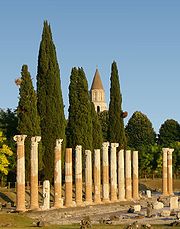
: Aquileia
Aquileia
Aquileia is an ancient Roman city in what is now Italy, at the head of the Adriatic at the edge of the lagoons, about 10 km from the sea, on the river Natiso , the course of which has changed somewhat since Roman times...
was the fourth largest city of Italy during Roman imperial times, capital of Regio X of the Italia
Italia (Roman province)
Italia was the name of the Italian peninsula of the Roman Empire.-Under the Republic and Augustan organization:During the Republic and the first centuries of the empire, Italia was not a province, but rather the territory of the city of Rome, thus having a special status: for example, military...
province (the Augustan region Venetia et Histria). The city was the most important river port on the Natissa
Natisone
The Natisone is a river that flows for some time as a border river between Slovenia and Italy, continues in Slovenia and then crosses the border and continues in Eastern Friuli, in north-eastern Italy...
river, dominating trade between the Adriatic Sea
Adriatic Sea
The Adriatic Sea is a body of water separating the Italian Peninsula from the Balkan peninsula, and the system of the Apennine Mountains from that of the Dinaric Alps and adjacent ranges...
and northern Europe (carried over the Via Iulia Augusta road).
Aquileia owed its importance to the strategic position it has on the Adriatic sea and its proximity to the Alps. This location allowing Rome to intercept barbarian invasions from the East. Julius Caesar
Julius Caesar
Gaius Julius Caesar was a Roman general and statesman and a distinguished writer of Latin prose. He played a critical role in the gradual transformation of the Roman Republic into the Roman Empire....
quartered his legions in Aquileia during winter. The development of other centers, such as Forum Iulii (Cividale del Friuli
Cividale del Friuli
-External links:*...
) and Iulium Carnicum (Zuglio
Zuglio
Zuglio is a comune in the Province of Udine in the Italian region Friuli-Venezia Giulia, located about 110 km northwest of Trieste and about 45 km northwest of Udine in the Val Bût....
), contributed to the increase in economic and cultural wealth of Friuli until the first barbarian incursions, at the beginning of 5th century. In the final decades of the 3rd century, Aquileia became the center of one of the most prestigious bishoprics of the empire, competing in Italy with Milan
Milan
Milan is the second-largest city in Italy and the capital city of the region of Lombardy and of the province of Milan. The city proper has a population of about 1.3 million, while its urban area, roughly coinciding with its administrative province and the bordering Province of Monza and Brianza ,...
and, subsequently, Ravenna
Ravenna
Ravenna is the capital city of the Province of Ravenna in the Emilia-Romagna region of Italy and the second largest comune in Italy by land area, although, at , it is little more than half the size of the largest comune, Rome...
, for second place to Rome. A Hun invasion marked the start of Friuli's decline: Aquileia, protected by meagre forces, was forced to surrender and was razed to the ground by Attila in 452
452
Year 452 was a leap year starting on Tuesday of the Julian calendar. At the time, it was known as the Year of the Consulship of Herculanus and Sporacius...
. After the retreat of the Huns, the survivors, who had found shelter in the lagoon of Grado
Grado, Italy
Grado is a town and comune in the north-eastern Italian region of Friuli-Venezia Giulia, located on a peninsula of the Adriatic Sea between Venice and Trieste....
, returned to the city, but found it completely destroyed. The reconstruction of Aquileia was never completed and it never regained the old splendour of the capital of X Regio. The city remained important even after the fall of the Western Roman Empire, due to the creation of the Patriarchate of Aquileia. It ranked among the highest ecclesiastic authorities in Italy from the mid-6th century onward. The lack of security in the Friulian plain, crossroads of all the great barbarian invasions, drove many people to seek shelter on the islands of the lagoons or in fortified hill-villages, causing a generalized depopulation of the more fertile part of the region and its consequent impoverishment.
Middle Ages
Western Roman Empire
The Western Roman Empire was the western half of the Roman Empire after its division by Diocletian in 285; the other half of the Roman Empire was the Eastern Roman Empire, commonly referred to today as the Byzantine Empire....
, Friuli belonged to the kingdom of Odoacer
Odoacer
Flavius Odoacer , also known as Flavius Odovacer, was the first King of Italy. His reign is commonly seen as marking the end of the Western Roman Empire. Though the real power in Italy was in his hands, he represented himself as the client of Julius Nepos and, after Nepos' death in 480, of the...
and subsequently to that of Theodoric the Great
Theodoric the Great
Theodoric the Great was king of the Ostrogoths , ruler of Italy , regent of the Visigoths , and a viceroy of the Eastern Roman Empire...
. The Byzantine
Byzantine Empire
The Byzantine Empire was the Eastern Roman Empire during the periods of Late Antiquity and the Middle Ages, centred on the capital of Constantinople. Known simply as the Roman Empire or Romania to its inhabitants and neighbours, the Empire was the direct continuation of the Ancient Roman State...
reconquest under Justinian I
Justinian I
Justinian I ; , ; 483– 13 or 14 November 565), commonly known as Justinian the Great, was Byzantine Emperor from 527 to 565. During his reign, Justinian sought to revive the Empire's greatness and reconquer the lost western half of the classical Roman Empire.One of the most important figures of...
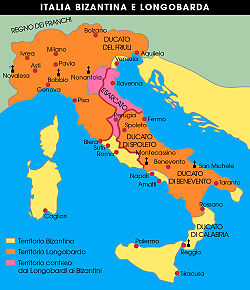
was brief in the region, in 568 it was one of the first provinces conquered by the Lombards
Lombards
The Lombards , also referred to as Longobards, were a Germanic tribe of Scandinavian origin, who from 568 to 774 ruled a Kingdom in Italy...
, who invaded from Pannonia
Pannonia
Pannonia was an ancient province of the Roman Empire bounded north and east by the Danube, coterminous westward with Noricum and upper Italy, and southward with Dalmatia and upper Moesia....
. The Lombard king Alboin
Alboin
Alboin was king of the Lombards from about 560 until 572. During his reign the Lombards ended their migrations by settling in Italy, the northern part of which Alboin conquered between 569 and 572...
established the Duchy of Friuli
Duchy of Friuli
The Duchy of Friuli was one of the great territorial Lombard duchies, the first to be established. It was an important buffer between the Lombard kingdom of Italy and the Slavs...
, the first Lombard duchy, and granted it to his relative Gisulf I
Gisulf I of Friuli
Gisulf I was probably the first duke of Friuli , a nephew of Alboin, first king of the Lombards in Italy. Alboin appointed him duke around 569 after the Lombard conquest of the region, though some scholars believe he appointed Gisulf's father, his brother, Grasulf, duke.Before this, Gisulf had been...
. The capital of the duchy was established at Forum Iulii (Cividale del Friuli
Cividale del Friuli
-External links:*...
), which became the most important city of the area and for where it derived its name.
The duchy of Friuli was from the start one of the most important Lombard duchies. It served as a barrier against the threat of invasion by the Avars
Eurasian Avars
The Eurasian Avars or Ancient Avars were a highly organized nomadic confederacy of mixed origins. They were ruled by a khagan, who was surrounded by a tight-knit entourage of nomad warriors, an organization characteristic of Turko-Mongol groups...
and Slavs from Pannonia
Pannonia
Pannonia was an ancient province of the Roman Empire bounded north and east by the Danube, coterminous westward with Noricum and upper Italy, and southward with Dalmatia and upper Moesia....
. Among the duchies of the North, which were closely aligned with the crown (unlike Spoleto
Duchy of Spoleto
The independent Duchy of Spoleto was a Lombard territory founded about 570 in central Italy by the Lombard dux Faroald.- Lombards :The Lombards, a Germanic people, had invaded Italy in 568 and conquered much of it, establishing a Kingdom divided between several dukes dependent on the King, who had...
and Benevento
Duchy of Benevento
The Duchy and later Principality of Benevento was the southernmost Lombard duchy in medieval Italy, centred on Benevento, a city central in the Mezzogiorno. Owing to the Ducatus Romanus of the popes, which cut it off from the rest of Lombard Italy, Benevento was from the first practically...
to the South), it was the most powerful, probably due to its marcher
Marches
A march or mark refers to a border region similar to a frontier, such as the Welsh Marches, the borderland between England and Wales. During the Frankish Carolingian Dynasty, the word spread throughout Europe....
status. Among later dukes, Ratchis
Ratchis
Ratchis was the Duke of Friuli and King of the Lombards . His father was Duke Pemmo. His Roman wife was Tassia. He ruled in peace until he besieged, for reasons unknown, Perugia. Pope Zachary convinced him to lift the siege and he abdicated and entered, with his family, the abbey of Montecassino...
became king in 744 and his ducal successor, Aistulf
Aistulf
Aistulf was the Duke of Friuli from 744, King of Lombards from 749, and Duke of Spoleto from 751. His father was the Duke Pemmo.After his brother Ratchis became king, Aistulf succeeded him in Friuli. He succeeded him later as king when Ratchis abdicated to a monastery...
, succeeded him as king in 749. The historian Paul the Deacon
Paul the Deacon
Paul the Deacon , also known as Paulus Diaconus, Warnefred, Barnefridus and Cassinensis, , was a Benedictine monk and historian of the Lombards.-Life:...
was born in Friuli (730/5), he went on to write the Historia Langobardorum and taught Latin grammar at Charlemagne
Charlemagne
Charlemagne was King of the Franks from 768 and Emperor of the Romans from 800 to his death in 814. He expanded the Frankish kingdom into an empire that incorporated much of Western and Central Europe. During his reign, he conquered Italy and was crowned by Pope Leo III on 25 December 800...
's court. Another teacher and a trusted advisor Charlemagne's court, Paulinus, was born at Cividale and eventually became patriach of Aquileia.
After the Regnum Italiae
Kingdom of Italy (medieval)
The Kingdom of Italy was a political entity under control of Carolingian dynasty of Francia first, after the defeat of the Lombards in 774. It was finally incorporated as a part of the Holy Roman Empire in 962....
fell to the Franks
Franks
The Franks were a confederation of Germanic tribes first attested in the third century AD as living north and east of the Lower Rhine River. From the third to fifth centuries some Franks raided Roman territory while other Franks joined the Roman troops in Gaul. Only the Salian Franks formed a...
, the duchy of Friuli was reorganized into counties according to the Frankish model. The region was again reorganized into the March of Friuli
March of Friuli
The March of Friuli was a Carolingian frontier march against the Slavs and Avars in the ninth and tenth centuries. It was a successor to the Lombard Duchy of Friuli....
in 846. The march was granted to the Unruoching dynasty
Unruochings
The Unruochings were a Frankish noble family who established themselves in Italy. The family is named for the first member to come to prominence, Unruoch II of Friuli ....
. Friuli became the base of power of Berengar I
Berengar I of Italy
Berengar of Friuli was the Margrave of Friuli from 874 until no earlier than 890 and no later than 896, King of Italy from 887 until his death, and Holy Roman Emperor from 915 until his death.Berengar rose to become one of the most influential laymen in the empire of Charles the Fat before he...
during his struggles for the throne of Italy between 888 and 924.
The march was transformed under his rule, its territory extended to Lake Garda
Lake Garda
Lake Garda is the largest lake in Italy. It is located in Northern Italy, about half-way between Brescia and Verona, and between Venice and Milan. Glaciers formed this alpine region at the end of the last ice age...
, the capital moved to Verona
Verona
Verona ; German Bern, Dietrichsbern or Welschbern) is a city in the Veneto, northern Italy, with approx. 265,000 inhabitants and one of the seven chef-lieus of the region. It is the second largest city municipality in the region and the third of North-Eastern Italy. The metropolitan area of Verona...
, and a new March of Verona and Aquileia established in its place. The territory was now subjected to the Duchy of Bavaria
Duchy of Bavaria
The Duchy of Bavaria was the only one of the stem duchies from the earliest days of East Francia and the Kingdom of Germany to preserve both its name and most of its territorial extent....
, then to the Duchy of Carinthia
Duchy of Carinthia
The Duchy of Carinthia was a duchy located in southern Austria and parts of northern Slovenia. It was separated from the Duchy of Bavaria in 976, then the first newly created Imperial State beside the original German stem duchies....
, for more than a century.
On 3 April 1077, the Emperor Henry IV
Henry IV, Holy Roman Emperor
Henry IV was King of the Romans from 1056 and Holy Roman Emperor from 1084 until his forced abdication in 1105. He was the third emperor of the Salian dynasty and one of the most powerful and important figures of the 11th century...
granted the county of Friuli, with ducal status, to Sigaerd, Patriarch of Aquileia
Patriarch of Aquileia
The Patriarch of Aquileia was an office in the Roman Catholic Church. During the Middle Ages the Patriarchate of Aquileia was a temporal state in Northern Italy. The Patriarchate of Aquileia as a church office was suppressed in 1752....
. In the succeeding centuries, the patriarchate expanded its control over neighboring Trieste
Trieste
Trieste is a city and seaport in northeastern Italy. It is situated towards the end of a narrow strip of land lying between the Adriatic Sea and Italy's border with Slovenia, which lies almost immediately south and east of the city...
, Istria
Istria
Istria , formerly Histria , is the largest peninsula in the Adriatic Sea. The peninsula is located at the head of the Adriatic between the Gulf of Trieste and the Bay of Kvarner...
, Carinthia
Duchy of Carinthia
The Duchy of Carinthia was a duchy located in southern Austria and parts of northern Slovenia. It was separated from the Duchy of Bavaria in 976, then the first newly created Imperial State beside the original German stem duchies....
, Styria, and Cadore
Cadore
Cadore is a "comunità montana" in the Italian region of Veneto, in the northernmost part of the province of Belluno bordering on Austria, the Trentino-Alto Adige/Südtirol and Friuli-Venezia Giulia. It is watered by the Piave River poured forth from the Carnic Alps...
. The patriarchal state of Friuli was one of the best organized polities of the Italian Middle Ages. From the 12th century it possessed a parliament
Parliament
A parliament is a legislature, especially in those countries whose system of government is based on the Westminster system modeled after that of the United Kingdom. The name is derived from the French , the action of parler : a parlement is a discussion. The term came to mean a meeting at which...
representing the communes
Comune
In Italy, the comune is the basic administrative division, and may be properly approximated in casual speech by the English word township or municipality.-Importance and function:...
as well as the nobility and the clergy. This institution only survived six centuries, remaining alive yet weak even during Venetian
Republic of Venice
The Republic of Venice or Venetian Republic was a state originating from the city of Venice in Northeastern Italy. It existed for over a millennium, from the late 7th century until 1797. It was formally known as the Most Serene Republic of Venice and is often referred to as La Serenissima, in...
domination. It convened for the last time in 1805, when it was abolished by Napoleon Bonaparte. The Patriarch Marquardo of Randeck (1365–1381) had gathered together and codified all the laws of Friuli and promulgated them as the Constitutiones Patriae Foriiulii ("Constitutions of the Country of Friuli"). Cividale del Friuli was seat of the Patriarchate until 1238, when the patriarch moved his seat to Udine
Udine
Udine is a city and comune in northeastern Italy, in the middle of Friuli-Venezia Giulia region, between the Adriatic sea and the Alps , less than 40 km from the Slovenian border. Its population was 99,439 in 2009, and that of its urban area was 175,000.- History :Udine is the historical...
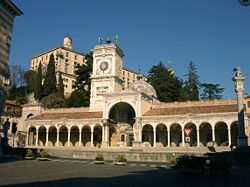
, where he had a magnificent episcopal edifice constructed. Udine was so important that it in time became the institutional capital of Friuli.
Venetian domination to Bourbon Restoration
Austrian Empire
The Austrian Empire was a modern era successor empire, which was centered on what is today's Austria and which officially lasted from 1804 to 1867. It was followed by the Empire of Austria-Hungary, whose proclamation was a diplomatic move that elevated Hungary's status within the Austrian Empire...
, the Kingdom of Hungary
Kingdom of Hungary
The Kingdom of Hungary comprised present-day Hungary, Slovakia and Croatia , Transylvania , Carpatho Ruthenia , Vojvodina , Burgenland , and other smaller territories surrounding present-day Hungary's borders...
and the Venetian Republic, it was the theatre of the war between Hungary and Venice, and was conquered by the latter. Friuli maintained some form of autonomy, by keeping its own Parliament ruling on the old territory of the Patriarchate, an autonomy not granted to the other cities and provinces submitted to Venice (even Venetian ones); on the other side, it maintained also its feudal nobility, which was able to keep their feudal rights over the land and its inhabitants for some time.
Friuli was the eastern border of the Stato da Tera, and suffered both from the Turkish raids and from the border wars with Austria. These wars led to poverty and instability of the rural population, with the inability to cultivate the land crossed by fighting armies and with the forced surrender of all livestock to feed traveling troops. The lumber needed to build Venetian ships caused complete deforestation of the Bassa Friulana
Bassa Friulana
The Bassa Friulana is a low-lying and level area of Friuli, specifically the very southern part of the province of Udine, in the north-eastern Italian region of Friuli-Venezia Giulia....
and central Friuli. Venice took possession of collective farms belonging to rural Friulian communities and seriously impoverishing them. These properties in turn would be sold by Venice during the 17th century to raise cash to alleviate their poor financial condition.
Beginning in the 1630s the Venetian Republic entered a relative decline, due to the enlarging horizon of European markets (going now from Asia to Africa to Americas); Venetian richest families often directed financial resources into unproductive investments (specifically real estate), while there was a loss of competitiveness in industries and services. Friuli was subject to increasingly fiscal pressure and its industries and commercial activities were affected too.
The political populism practiced by Venice, according to some historians, looked for ways to limit the most oppressive and anachronistic effects of feudalism
Feudalism
Feudalism was a set of legal and military customs in medieval Europe that flourished between the 9th and 15th centuries, which, broadly defined, was a system for ordering society around relationships derived from the holding of land in exchange for service or labour.Although derived from the...
. Other researchers affirm that the Venetian aristocratic government maintained a most oppressive feudal condition in Friuli. These policies were practiced by the Venetian government to ensure the support of the urban and rural population as a counterbalance to the independent tendencies and power of local oligarchies and aristocrats.
An important jacquerie
Jacquerie
The Jacquerie was a popular revolt in late medieval Europe by peasants that took place in northern France in the summer of 1358, during the Hundred Years' War. The revolt, which was violently suppressed after a few weeks of violence, centered in the Oise valley north of Paris...
, known as Joibe Grasse 1511 (Fat Thursday 1511
Friulan Revolt of 1511
The revolt of the Cruel Thursday of abundance was a revolt that broke out in 1511 in Friuli....
), was started in Udine on February 27 by starving Udinesi citizens. They were subsequently joined by the farmers and the revolt spread to the whole territory of Friûl, against the feudal rule of some noble families; some other noble family, like the pro-Venetian Savorgnan, initially supported the revolters. This insurrection was one of the largest in Renaissance Italy and it lasted from 27 February until March 1, when it ended as Venice dispatched around one hundred cavalry to put down the rebellion. The chiefs of the revolt were executed, but the feudal powers of the Friulian noblemen were reduced.
With the 1516 Noyon pacts
War of the League of Cambrai
The War of the League of Cambrai, sometimes known as the War of the Holy League and by several other names, was a major conflict in the Italian Wars...
the boundary between the Venetian Republic and the County of Gorizia and Gradisca, now in the hands of the House of Habsburg, were redefined. Venice lost the upper Isonzo valley (that is the Gastaldia of Tolmino with Plezzo and Idria), but it kept Monfalcone
Monfalcone
Monfalcone is a town and comune of the province of Gorizia , located on the coast of the Gulf of Trieste. Monfalcone means "Mount of Falcon" in Italian....
, Marano
Marano
Marano as a surname has noble Italian origin, derives from last name Marani of Vicenza that came to Naples in the 16th century with Francesco Antonio buried in the church of Sant'Antonelli to Caponapoli in the ancient center of Naples city...
and a series of shed feudal islands in the Western Friuli stayed with the Archduke of Austria (until 1543). Between 1615 and 1617 Venice and Austria again fought for the possession of the fort of Gradisca d'Isonzo. The so-called War of Gradisca ended with a return to the status quo.
Beginning in 1516 the Habsburg Empire controlled eastern Friuli, while western and central Friuli was Venetian. In 1797, the year of the Treaty of Campo Formio
Treaty of Campo Formio
The Treaty of Campo Formio was signed on 18 October 1797 by Napoleon Bonaparte and Count Philipp von Cobenzl as representatives of revolutionary France and the Austrian monarchy...
, this part of the Friuli was surrendered to Austria. For a brief period from 1805 until the Bourbon Restoration
Bourbon Restoration
The Bourbon Restoration is the name given to the period following the successive events of the French Revolution , the end of the First Republic , and then the forcible end of the First French Empire under Napoleon – when a coalition of European powers restored by arms the monarchy to the...
, Friuli belonged to the Italic Kingdom.
From the Restoration to the Great War
In 1815, the Congress of ViennaCongress of Vienna
The Congress of Vienna was a conference of ambassadors of European states chaired by Klemens Wenzel von Metternich, and held in Vienna from September, 1814 to June, 1815. The objective of the Congress was to settle the many issues arising from the French Revolutionary Wars, the Napoleonic Wars,...
confirmed the union of Veneto and Friuli with Austrian Lombardy, to constitute the Kingdom of Lombardy-Venetia. In 1838, the District of Portogruaro was removed from the Province of the Friuli due to the Austrians' wishes and assigned to the Province of Venice. Protogruaro had a long history of being part of Friulian culture, geography and language. Today it has asked to return under the administration of the Friuli region. In 1866 central Friuli (today's province of Udine
Province of Udine
The Province of Udine is a province in the autonomous Friuli-Venezia Giulia region of Italy, bordering Austria and Slovenia. Its capital is the city of Udine....
) and western Friuli (today's province of Pordenone
Province of Pordenone
The Province of Pordenone is a province in the autonomous Friuli-Venezia Giulia region of Italy. Its capital is the city of Pordenone. The territory was carved out of the Province of Udine in 1968....
) were joined Italy with Veneto after the Third Italian War of Independence
Third Italian War of Independence
The Third Italian War of Independence was a conflict which paralleled the Austro-Prussian War, and was fought between the Kingdom of Italy and the Austrian Empire.-Background:...
, while eastern Friuli (the so-called County of Gorizia and Gradisca) remained under Austria until the end of World War I.
During World War I, Friuli was a theater of battle that had serious consequences for the civilian population, specifically the Battle of Caporetto
Battle of Caporetto
The Battle of Caporetto , took place from 24 October to 19 November 1917, near the town of Kobarid , on the Austro-Italian front of World War I...
.
Autonomist movements
Friuli has a large number of Friulan native speakers. There are some movements and political parties that advocate a more autonomous Friuli in line with historical borders, such as the Lega Nord Friuli-Venezia GiuliaLega Nord Friuli-Venezia Giulia
Lega Nord Friuli-Venezia Giulia is a regionalist political party in Italy which is the regional section of Lega Nord in Friuli-Venezia Giulia....
, Friuli Movement
Friuli Movement
Friuli Movement is a regionalist political party active in Friuli, Italy since 1966.The party is currently active, but has lost importance...
, Giulian Front
Giulian Front
Giulian Front is a regionalist political party active in the Province of Trieste, Italy.Formed in the mid 1990s, the party strives for the independence of Trieste from Italy , in line with a tradition started with the Independence Front for the Free Giulian State after World War II and continued...
and the Front Furlan.
Regional languages and dialects
While standard ItalianItalian language
Italian is a Romance language spoken mainly in Europe: Italy, Switzerland, San Marino, Vatican City, by minorities in Malta, Monaco, Croatia, Slovenia, France, Libya, Eritrea, and Somalia, and by immigrant communities in the Americas and Australia...
is the primary official language of the region, several other regional languages and dialects are spoken in Friuli.
Friulian
Friulian language
Friulan , is a Romance language belonging to the Rhaeto-Romance family, spoken in the Friuli region of northeastern Italy. Friulan has around 800,000 speakers, the vast majority of whom also speak Italian...
is spoken in the provinces of Udine, Gorizia and Pordenone.
Venetian
Venetian language
Venetian or Venetan is a Romance language spoken as a native language by over two million people, mostly in the Veneto region of Italy, where of five million inhabitants almost all can understand it. It is sometimes spoken and often well understood outside Veneto, in Trentino, Friuli, Venezia...
and its sub-dialects are usually spoken (for historical reasons) on the western border regions (i.e. Pordenone
Pordenone
Pordenone is a comune of Pordenone province of northeast Italy in the Friuli-Venezia Giulia region.The name comes from the Latin "Portus Naonis" meaning the port on the river Noncello - History :...
), sparingly in a few internal towns (i.e. Gorizia
Gorizia
Gorizia is a town and comune in northeastern Italy, in the autonomous region of Friuli Venezia Giulia. It is located at the foot of the Julian Alps, bordering Slovenia. It is the capital of the Province of Gorizia, and it is a local center of tourism, industry, and commerce. Since 1947, a twin...
, etc.) and historically in some places along the Adriatic coast.
In the southeastern part of Friuli, a Venetian transitional dialect is spoken, called Bisiaco, that has influences of both Slovene and Friulian.
Slovene dialects are spoken in the largely rural border mountain region known as Venetian Slovenia
Venetian Slovenia
Venetian Slovenia is a small mountainous region in northeastern Italy . Most of the region is located in the Italian region of Friuli Venezia Giulia, in the area between the towns of Cividale del Friuli, Tarcento and Gemona ....
. German
German language
German is a West Germanic language, related to and classified alongside English and Dutch. With an estimated 90 – 98 million native speakers, German is one of the world's major languages and is the most widely-spoken first language in the European Union....
(Bavarian dialect) is spoken in Val Canale (mostly in Tarvisio
Tarvisio
Tarvisio is a town in the Province of Udine, in the northeastern part of the autonomous Friuli–Venezia Giulia region in Italy...
and Pontebba
Pontebba
Pontebba is a comune in the Province of Udine in the Italian region Friuli-Venezia Giulia. It is located about 100 km northwest of Trieste and about 50 km north of Udine, on the border with Austria...
); in some of Val Canale's municipalities (particularly in Malborghetto Valbruna
Malborghetto Valbruna
Malborghetto Valbruna is a comune in the Province of Udine in the Italian region Friuli-Venezia Giulia, located about 100 km northwest of Trieste and about 50 km northeast of Udine, on the border with Austria. , it had a population of 1,025 and an area of 120.5 km²...
), Carinthian Slovenian
Carinthian Slovenes
Carinthian Slovenes are the Slovene-speaking population group in the Austrian State of Carinthia. The Carinthian Slovenes send representatives to the National Ethnic Groups Advisory Council...
dialects are spoken too. German-related dialects are spoken in several ancient enclaves like Timau, Zahre (Sauris
Sauris
Sauris is a comune in the Province of Udine in the Italian region Friuli-Venezia Giulia, located about 120 km northwest of Trieste and about 60 km northwest of Udine...
) and Plodn (Sappada
Sappada
Sappada is a comune in the Province of Belluno in the Italian region Veneto, located about 130 km north of Venice and about 60 km northeast of Belluno...
).
Slovene is also spoken in the Collio area north of Gorizia. In the Resia
Resia
Resia is a comune in the Province of Udine in the Italian region of Friuli-Venezia Giulia. It is located in the Alpine valley with the same name, about 90 km northwest of Trieste and about 35 km north of Udine, on the border with Slovenia and around 20 km from the border with Austria...
valley, between Venetian Slovenia
Venetian Slovenia
Venetian Slovenia is a small mountainous region in northeastern Italy . Most of the region is located in the Italian region of Friuli Venezia Giulia, in the area between the towns of Cividale del Friuli, Tarcento and Gemona ....
and the Val Canale, most of the inhabitants still speak an archaic dialect of Slovene, known as Resian.
Note: only Friulian, Slovenian and German are allowed to be local secondary official languages in their historic areas, but not their related dialects.
See also
- List of Friulian place names
- List of dukes and margraves of Friuli
- BenandantiBenandantiThe Benandanti were an agrarian fertility cult in the Friuli district of Northern Italy in the 16th and 17th centuries. Between 1575 and 1675, the Benandanti were tried as heretics or witches under the Roman Inquisition, and their beliefs assimilated to Satanism...
- TrivenetoTrivenetoThe name Tre Venezie was created in 1863 by historical linguist Graziadio Isaia Ascoli . The area included what would become by 1866-1919 the three Italian regions of Venezia Euganea, Venezia Giulia and Venezia Tridentina...
- Venetian SloveniaVenetian SloveniaVenetian Slovenia is a small mountainous region in northeastern Italy . Most of the region is located in the Italian region of Friuli Venezia Giulia, in the area between the towns of Cividale del Friuli, Tarcento and Gemona ....