


Opole

Encyclopedia
Opole AUD is a city in southern Poland
on the Oder River (Odra). It has a population of 125,992 (June 2009) and is the capital of the Upper Silesia
, Opole Voivodeship
and, also the seat of Opole County
. Today, many German
Upper Silesia
ns and Poles of German
ancestry live in the Opole region; in the city itself, Germans make up less than 3% of population.
s of the Slavic
Opolanie
. At the end of the century Silesia
became part of Poland and was ruled by the Piast dynasty; the land of the pagan Opolanie was conquered by Duke Mieszko I in 992. From the 11th-12th centuries it was also a castellany
. After the death of Duke Władysław II the Exile, Silesia was divided in 1163 between two Piast lines- the Wrocławska line in Lower Silesia
and the Opolsko-Raciborska
of Upper Silesia
. Opole would became a duchy
in 1172 and would share much in common with the Duchy of Racibórz
, with which it was often combined. In 1281 Upper Silesia was divided further between the heirs of the dukes. The Duchy of Opole was temporarily reestablished in 1290.
In the early 13th century Duke Casimir I of Opole
decided to move the settlement from the Pasieka island into the right shore of the Odra river (Since the 17th century it is the old Stream bed
of Odra known as Młynówka). All of the inhabitants had to be moved in order to make place for the duke's new castle that was eventually built in the place of the old city. Former inhabitants of Ostrówek together with German
merchants that immigrated here from the West, received first town rights probably as early as around, 1217 though this date is disputed. Opole received German town law
in 1254, which was expanded with Neumarkt law in 1327 and Magdeburg rights
in 1410. Opole developed during the rule of duke Bolko I of Opole
. In this time the castle was finally completed and new buildings, including the city walls and the Holy Cross church, were constructed. Along with most of Silesia
, in 1327 the Duchy of Opole came under the sovereignty of the Kingdom of Bohemia
, itself part of the Holy Roman Empire
. In 1521 the Duchy of Racibórz
(Ratibor) was inherited by the Duchy of Opole, by then also known by its German equivalent - Oppeln. The second castle of Opole was probably founded in the 14th century by duke Władysław Opolczyk, though some sources claim that it was originally a wooden stronghold of Opole's castellan
dating into 12th century.
With the death of King Louis II
of Bohemia at the Battle of Mohács
, Silesia was inherited by Ferdinand I
, placing Opole under the sovereignty of the Habsburg Monarchy
of Austria
. The Habsburgs took control of the region in 1532 after the last Piast duke of Opole - Jan II the Good
died. In those days the city was still mainly Polish-speaking (around 63 %), with other nationalities represented mainly by Germans, Czechs and Jews. The last two dukes of Opole: Nicholas II of Niemodlin
and Jan II the Good did not know German at all.
Beginning in 1532 the Habsburgs pawned the duchy to different rulers including several monarchs of Poland (see Dukes of Opole
). With the abdication of King John II Casimir of Poland
as the last Duke of Opole in 1668, the region passed to the direct control of the Habsburgs. At the beginning of the 18th century the amount of Germans in Opole was estimated at around 20%.
King Frederick II
of Prussia
conquered most of Silesia from Austria in 1740 during the Silesian Wars
; Prussian control was confirmed in the Peace of Breslau in 1742. During the Prussian rule the ethnic structure of the city began to change. In the early 20th century the amount of Polish and bilingual citizens of Opole, according to the official German statistics, varied from 25 to 31%. From 1816–1945 Opole was the capital of Regierungsbezirk
Oppeln within Prussia. The city became part of the German Empire
during the unification of Germany
in 1871.
After the defeat of Imperial Germany in World War I
, a plebiscite was held on 20 March 1921 in Oppeln to determine if the city would be in the Weimar Republic
or become part of the Second Polish Republic
. 20,816 (94.7%) votes were cast for Germany, 1,098 (5.0%) for Poland, and 70 (0.3%) votes were declared invalid. Voter participation was 95.9%. Results of the plebiscite in the Opole-Land county were different, with 30% of population voting for Poland.
Oppeln was the administrative seat of the Province of Upper Silesia
from 1919–1939. With the defeat of Poland in the Invasion of Poland
at the beginning of World War II
in 1939, formerly Polish Eastern Upper Silesia was re-added to the Province of Upper Silesa and Oppeln lost its status as provincial capital to Katowice (renamed Kattowitz).
On 15 February 1941 and 26 February 1941, two deportation transports with 2,003 Jewish men, women and children on board left Vienna
Aspang Station to Opole, By March 1941, 8,000 Jews were deported to the ghetto
which had been set up in Opole. From May 1941, 800 men capable of work were deployed as forced labourers in Deblin. Liquidation of Opole ghetto began in the spring 1942. A transport to Belzec extermination camp
left on 31 March 1942 and deportations to Sobibor followed in May and October 1942. Of the 2,003 Viennese Jews, twenty-eight are known to have survived. [Note: The deportation of Viennese Jews to Opole most likely is a reference to a historical event that happened in "the other Opole," a town by the same time in Lublin, in eastern Poland. Therefore, the facts in this paragraph may not be factual as they apply to the Opole this article refers to.]
After the end of the Second World War in 1945, Oppeln was transferred from Germany to Poland according to the Potsdam Conference
, and given its original Slavic name of Opole. Opole became part of the Katowice Voivodeship
from 1946–1950, after which it became part of the Opole Voivodeship
. Unlike other parts of the Recovered Territories
, Opole and the surrounding region's autochthon population remained and was not forcibly expelled as elsewhere
. Over 1 million Silesians who considered themselves Poles or were treated as such by the authorities due to their language and customs were allowed to stay after they were verified as Poles in a special verification process. It involved declaring Polish nationality
and an oath of allegiance to the Polish nation.
In the later years however many of them left to West Germany
to flee the communist Eastern Bloc
(see Emigration from Poland to Germany after World War II). Today Opole, along with the surrounding region, is known as a centre of the German minority in Poland
that recruits mainly from the descendants of the positively verified autochthons. In the city itself however only 2,46% of the inhabitants declared German nationality according to the last national census
of 2002.
class="wikitable">
Year
Population
1850
8,280
1858 ²
8,877
1875
12,694
1890
19,000
1905
30,112
1910 ³
33,907
1924
43,000
1932
45,532
1936
50,561
17 May 1939
50,540
24 March 1945
170
class="wikitable">
Year
Population
July 1945
13,000
1946
40,000
1950
50,300
1956
56,400
1960
63,500
1965
70,000
1971
87,800
1973
92,600
31 December 1989
127,653
Census
1992
129,552
Census
2002
129,946
30 June 2004
125,992
¹ First census of the city
² 8,320 German nationality (93,7%) and 557 Polish nationality (6,3%)
³ 80% German-speaking, 16% Polish- or Slavic Silesian-speaking, and 4% German- and Polish-speaking
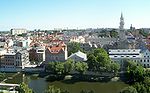 Alongside German
and Polish
, many citizens of Opole-Oppeln before 1945 used a strongly German-influenced Silesian dialect known as Wasserpolnisch, or Wasserpolak
. Because of this, the post-war Polish state administration after the annexation of Silesia in 1945 did not initiate a general expulsion of all former inhabitants
of Opole, as was done in Lower Silesia, for instance, where the population almost exclusively spoke the German language. Because they were considered "autochthonous" (Polish), the Wasserpolak-speakers instead received the right to remain in their homeland after declaring themselves as Poles. Some German speakers took advantage of this decision, allowing them to remain in their Oppeln, even when they considered themselves to be of German nationality. The city surroundings currently contain the largest German and Upper Silesian minorities in Poland. However, in Opole it is only 2.46% German. (See also Germans of Poland.)
. The city is also known for its 10th century Church of St. Adalbert
and the 14th century Church of the Holy Cross
. There is a zoo, the Ogród Zoologiczny w Opolu
.
Structures and buildings
Museums

(Sejm) elected from Opole constituency

with:
Poland
Poland , officially the Republic of Poland , is a country in Central Europe bordered by Germany to the west; the Czech Republic and Slovakia to the south; Ukraine, Belarus and Lithuania to the east; and the Baltic Sea and Kaliningrad Oblast, a Russian exclave, to the north...
on the Oder River (Odra). It has a population of 125,992 (June 2009) and is the capital of the Upper Silesia
Upper Silesia
Upper Silesia is the southeastern part of the historical and geographical region of Silesia. Since the 9th century, Upper Silesia has been part of Greater Moravia, the Duchy of Bohemia, the Piast Kingdom of Poland, again of the Lands of the Bohemian Crown and the Holy Roman Empire, as well as of...
, Opole Voivodeship
Opole Voivodeship
- Administrative division :Opole Voivodeship is divided into 12 counties : 1 city county and 11 land counties. These are further divided into 71 gminas.The counties are listed in the following table .- Economy :...
and, also the seat of Opole County
Opole County
Opole County is a unit of territorial administration and local government in Opole Voivodeship, south-western Poland. It came into being on January 1, 1999, as a result of the Polish local government reforms passed in 1998. Its administrative seat is the city of Opole, although the city is not...
. Today, many German
Germans
The Germans are a Germanic ethnic group native to Central Europe. The English term Germans has referred to the German-speaking population of the Holy Roman Empire since the Late Middle Ages....
Upper Silesia
Upper Silesia
Upper Silesia is the southeastern part of the historical and geographical region of Silesia. Since the 9th century, Upper Silesia has been part of Greater Moravia, the Duchy of Bohemia, the Piast Kingdom of Poland, again of the Lands of the Bohemian Crown and the Holy Roman Empire, as well as of...
ns and Poles of German
Germany
Germany , officially the Federal Republic of Germany , is a federal parliamentary republic in Europe. The country consists of 16 states while the capital and largest city is Berlin. Germany covers an area of 357,021 km2 and has a largely temperate seasonal climate...
ancestry live in the Opole region; in the city itself, Germans make up less than 3% of population.
History
Opole's history begins in the 8th century. It this time, according to the archeological excavations, the first Slavic settlement was founded on the Ostrówek - the northern part of the Pasieka island in the middle of the Odra river. In the early 10th century it developed into one of the main gródGrod
Grod may refer to:* Caspar Maria Grod, Wilhelm Riphahn's co-worker from 1913 to 1931* Weilern Grod, a village in Brittnau, Switzerland* Grod, 520s–528 ruler after Utigur in Patria Onoguria. He was succeeded by his brother Mugel.-See also:...
s of the Slavic
Slavic peoples
The Slavic people are an Indo-European panethnicity living in Eastern Europe, Southeast Europe, North Asia and Central Asia. The term Slavic represents a broad ethno-linguistic group of people, who speak languages belonging to the Slavic language family and share, to varying degrees, certain...
Opolanie
Opolanie
Opolanie – West Slavic tribe that lived in the region of upper Odra. Their main settlement was Opole. They were mentioned in the Bavarian Geographer, under the name Opolini, as one of the seven tribes living in Silesia...
. At the end of the century Silesia
Silesia
Silesia is a historical region of Central Europe located mostly in Poland, with smaller parts also in the Czech Republic, and Germany.Silesia is rich in mineral and natural resources, and includes several important industrial areas. Silesia's largest city and historical capital is Wrocław...
became part of Poland and was ruled by the Piast dynasty; the land of the pagan Opolanie was conquered by Duke Mieszko I in 992. From the 11th-12th centuries it was also a castellany
Castellany
A castellany was a district administered by a castellan.Castellanies appeared during the Middle Ages and in most current states are now replaced by a more modern type of country subdivision....
. After the death of Duke Władysław II the Exile, Silesia was divided in 1163 between two Piast lines- the Wrocławska line in Lower Silesia
Lower Silesia
Lower Silesia ; is the northwestern part of the historical and geographical region of Silesia; Upper Silesia is to the southeast.Throughout its history Lower Silesia has been under the control of the medieval Kingdom of Poland, the Kingdom of Bohemia and the Austrian Habsburg Monarchy from 1526...
and the Opolsko-Raciborska
Racibórz
Racibórz is a town in southern Poland with 60,218 inhabitants situated in the Silesian Voivodeship , previously in Katowice Voivodeship...
of Upper Silesia
Upper Silesia
Upper Silesia is the southeastern part of the historical and geographical region of Silesia. Since the 9th century, Upper Silesia has been part of Greater Moravia, the Duchy of Bohemia, the Piast Kingdom of Poland, again of the Lands of the Bohemian Crown and the Holy Roman Empire, as well as of...
. Opole would became a duchy
Duchy of Opole
Duchy of Opole was one of the duchies of Silesia ruled by the Piast dynasty. Its capital was Opole in Upper Silesia.After Bolesław I the Tall and his younger brother Mieszko I Tanglefoot backed by Emperor Frederick I Barbarossa had retained their Silesian heritage in 1163, they divided the...
in 1172 and would share much in common with the Duchy of Racibórz
Duchy of Racibórz
Duchy of Racibórz was one of the duchies of Silesia. Its capital was Racibórz in Upper Silesia.-History:After Bolesław I the Tall and his younger brother Mieszko I Tanglefoot backed by Emperor Frederick I Barbarossa had retained their Silesian heritage in 1163, the Duchy of Racibórz was formed in...
, with which it was often combined. In 1281 Upper Silesia was divided further between the heirs of the dukes. The Duchy of Opole was temporarily reestablished in 1290.
In the early 13th century Duke Casimir I of Opole
Casimir I of Opole
Casimir I of Opole was a Duke of Opole-Racibórz from 1211 until his death.He was the eldest child and only son of Mieszko I Tanglefoot, Duke of Opole-Racibórz and High Duke of Poland, and his wife Ludmilla, probably a Přemyslid princess.-Early life:Little is known about his early years of life,...
decided to move the settlement from the Pasieka island into the right shore of the Odra river (Since the 17th century it is the old Stream bed
Stream bed
A stream bed is the channel bottom of a stream, river or creek; the physical confine of the normal water flow. The lateral confines or channel margins, during all but flood stage, are known as the stream banks or river banks. In fact, a flood occurs when a stream overflows its banks and flows onto...
of Odra known as Młynówka). All of the inhabitants had to be moved in order to make place for the duke's new castle that was eventually built in the place of the old city. Former inhabitants of Ostrówek together with German
Germans
The Germans are a Germanic ethnic group native to Central Europe. The English term Germans has referred to the German-speaking population of the Holy Roman Empire since the Late Middle Ages....
merchants that immigrated here from the West, received first town rights probably as early as around, 1217 though this date is disputed. Opole received German town law
German town law
German town law or German municipal concerns concerns town privileges used by many cities, towns, and villages throughout Central and Eastern Europe during the Middle Ages.- Town law in Germany :...
in 1254, which was expanded with Neumarkt law in 1327 and Magdeburg rights
Magdeburg rights
Magdeburg Rights or Magdeburg Law were a set of German town laws regulating the degree of internal autonomy within cities and villages granted by a local ruler. Modelled and named after the laws of the German city of Magdeburg and developed during many centuries of the Holy Roman Empire, it was...
in 1410. Opole developed during the rule of duke Bolko I of Opole
Bolko I of Opole
Bolko I of Opole , was a Duke of Opole from 1282 , Niemodlin and Strzelce Opolskie until his death.He was the third son of Władysław, Duke of Opole-Racibórz, by his wife Euphemia, daughter of Władysław Odonic, Duke of Greater Poland.-Life:Around 1277 Bolko I was named co-ruler of the Duchy of...
. In this time the castle was finally completed and new buildings, including the city walls and the Holy Cross church, were constructed. Along with most of Silesia
Silesia
Silesia is a historical region of Central Europe located mostly in Poland, with smaller parts also in the Czech Republic, and Germany.Silesia is rich in mineral and natural resources, and includes several important industrial areas. Silesia's largest city and historical capital is Wrocław...
, in 1327 the Duchy of Opole came under the sovereignty of the Kingdom of Bohemia
Bohemia
Bohemia is a historical region in central Europe, occupying the western two-thirds of the traditional Czech Lands. It is located in the contemporary Czech Republic with its capital in Prague...
, itself part of the Holy Roman Empire
Holy Roman Empire
The Holy Roman Empire was a realm that existed from 962 to 1806 in Central Europe.It was ruled by the Holy Roman Emperor. Its character changed during the Middle Ages and the Early Modern period, when the power of the emperor gradually weakened in favour of the princes...
. In 1521 the Duchy of Racibórz
Racibórz
Racibórz is a town in southern Poland with 60,218 inhabitants situated in the Silesian Voivodeship , previously in Katowice Voivodeship...
(Ratibor) was inherited by the Duchy of Opole, by then also known by its German equivalent - Oppeln. The second castle of Opole was probably founded in the 14th century by duke Władysław Opolczyk, though some sources claim that it was originally a wooden stronghold of Opole's castellan
Castellan
A castellan was the governor or captain of a castle. The word stems from the Latin Castellanus, derived from castellum "castle". Also known as a constable.-Duties:...
dating into 12th century.
With the death of King Louis II
Louis II of Hungary and Bohemia
Louis II was King of Hungary, Bohemia and Croatia from 1516 to 1526.- Early life :Louis was the son of Ladislaus II Jagiellon and his third wife, Anne de Foix....
of Bohemia at the Battle of Mohács
Battle of Mohács
The Battle of Mohács was fought on August 29, 1526 near Mohács, Hungary. In the battle, forces of the Kingdom of Hungary led by King Louis II of Hungary and Bohemia were defeated by forces of the Ottoman Empire led by Sultan Suleiman the Magnificent....
, Silesia was inherited by Ferdinand I
Ferdinand I, Holy Roman Emperor
Ferdinand I was Holy Roman Emperor from 1558 and king of Bohemia and Hungary from 1526 until his death. Before his accession, he ruled the Austrian hereditary lands of the Habsburgs in the name of his elder brother, Charles V, Holy Roman Emperor.The key events during his reign were the contest...
, placing Opole under the sovereignty of the Habsburg Monarchy
Habsburg Monarchy
The Habsburg Monarchy covered the territories ruled by the junior Austrian branch of the House of Habsburg , and then by the successor House of Habsburg-Lorraine , between 1526 and 1867/1918. The Imperial capital was Vienna, except from 1583 to 1611, when it was moved to Prague...
of Austria
Austria
Austria , officially the Republic of Austria , is a landlocked country of roughly 8.4 million people in Central Europe. It is bordered by the Czech Republic and Germany to the north, Slovakia and Hungary to the east, Slovenia and Italy to the south, and Switzerland and Liechtenstein to the...
. The Habsburgs took control of the region in 1532 after the last Piast duke of Opole - Jan II the Good
Jan II the Good
Jan II of Opole was a Duke of Opole-Brzeg -Strzelce-Niemodlin in 1476 , ruler over Gliwice , Toszek , Niemodlin , Bytom , Koźle , and Racibórz .He was the second son of Duke Nicholas I of Opole by his wife Agnes, daughter of Duke Louis II of...
died. In those days the city was still mainly Polish-speaking (around 63 %), with other nationalities represented mainly by Germans, Czechs and Jews. The last two dukes of Opole: Nicholas II of Niemodlin
Nicholas II of Niemodlin
Nicholas II of Niemodlin , was a Duke of Opole-Brzeg-Strzelce-Niemodlin in 1476 and sole Duke of Niemodlin from 1476 until his death....
and Jan II the Good did not know German at all.
Beginning in 1532 the Habsburgs pawned the duchy to different rulers including several monarchs of Poland (see Dukes of Opole
Dukes of Opole
The following is a list of monarchs who used the title Duke of Opole and controlled the city and the surrounding area either directly or indirectly .- Piast dynasty :...
). With the abdication of King John II Casimir of Poland
John II Casimir of Poland
John II Casimir was King of Poland and Grand Duke of Lithuania during the era of the Polish–Lithuanian Commonwealth, Duke of Opole in Upper Silesia, and titular King of Sweden 1648–1660. In Poland, he is known and commonly referred as Jan Kazimierz. His parents were Sigismund III Vasa and...
as the last Duke of Opole in 1668, the region passed to the direct control of the Habsburgs. At the beginning of the 18th century the amount of Germans in Opole was estimated at around 20%.
King Frederick II
Frederick II of Prussia
Frederick II was a King in Prussia and a King of Prussia from the Hohenzollern dynasty. In his role as a prince-elector of the Holy Roman Empire, he was also Elector of Brandenburg. He was in personal union the sovereign prince of the Principality of Neuchâtel...
of Prussia
Kingdom of Prussia
The Kingdom of Prussia was a German kingdom from 1701 to 1918. Until the defeat of Germany in World War I, it comprised almost two-thirds of the area of the German Empire...
conquered most of Silesia from Austria in 1740 during the Silesian Wars
Silesian Wars
The Silesian Wars were a series of wars between Prussia and Austria for control of Silesia. They formed parts of the larger War of the Austrian Succession and Seven Years' War. They eventually ended with Silesia being incorporated into Prussia, and Austrian recognition of this...
; Prussian control was confirmed in the Peace of Breslau in 1742. During the Prussian rule the ethnic structure of the city began to change. In the early 20th century the amount of Polish and bilingual citizens of Opole, according to the official German statistics, varied from 25 to 31%. From 1816–1945 Opole was the capital of Regierungsbezirk
Regierungsbezirk
In Germany, a Government District, in German: Regierungsbezirk – is a subdivision of certain federal states .They are above the Kreise, Landkreise, and kreisfreie Städte...
Oppeln within Prussia. The city became part of the German Empire
German Empire
The German Empire refers to Germany during the "Second Reich" period from the unification of Germany and proclamation of Wilhelm I as German Emperor on 18 January 1871, to 1918, when it became a federal republic after defeat in World War I and the abdication of the Emperor, Wilhelm II.The German...
during the unification of Germany
Unification of Germany
The formal unification of Germany into a politically and administratively integrated nation state officially occurred on 18 January 1871 at the Versailles Palace's Hall of Mirrors in France. Princes of the German states gathered there to proclaim Wilhelm of Prussia as Emperor Wilhelm of the German...
in 1871.
After the defeat of Imperial Germany in World War I
World War I
World War I , which was predominantly called the World War or the Great War from its occurrence until 1939, and the First World War or World War I thereafter, was a major war centred in Europe that began on 28 July 1914 and lasted until 11 November 1918...
, a plebiscite was held on 20 March 1921 in Oppeln to determine if the city would be in the Weimar Republic
Weimar Republic
The Weimar Republic is the name given by historians to the parliamentary republic established in 1919 in Germany to replace the imperial form of government...
or become part of the Second Polish Republic
Second Polish Republic
The Second Polish Republic, Second Commonwealth of Poland or interwar Poland refers to Poland between the two world wars; a period in Polish history in which Poland was restored as an independent state. Officially known as the Republic of Poland or the Commonwealth of Poland , the Polish state was...
. 20,816 (94.7%) votes were cast for Germany, 1,098 (5.0%) for Poland, and 70 (0.3%) votes were declared invalid. Voter participation was 95.9%. Results of the plebiscite in the Opole-Land county were different, with 30% of population voting for Poland.
Oppeln was the administrative seat of the Province of Upper Silesia
Province of Upper Silesia
The Province of Upper Silesia was a province of the Free State of Prussia created in the aftermath of World War I. It comprised much of the region of Upper Silesia and was eventually divided into two administrative regions , Kattowitz and Oppeln...
from 1919–1939. With the defeat of Poland in the Invasion of Poland
Invasion of Poland (1939)
The Invasion of Poland, also known as the September Campaign or 1939 Defensive War in Poland and the Poland Campaign in Germany, was an invasion of Poland by Germany, the Soviet Union, and a small Slovak contingent that marked the start of World War II in Europe...
at the beginning of World War II
World War II
World War II, or the Second World War , was a global conflict lasting from 1939 to 1945, involving most of the world's nations—including all of the great powers—eventually forming two opposing military alliances: the Allies and the Axis...
in 1939, formerly Polish Eastern Upper Silesia was re-added to the Province of Upper Silesa and Oppeln lost its status as provincial capital to Katowice (renamed Kattowitz).
On 15 February 1941 and 26 February 1941, two deportation transports with 2,003 Jewish men, women and children on board left Vienna
Vienna
Vienna is the capital and largest city of the Republic of Austria and one of the nine states of Austria. Vienna is Austria's primary city, with a population of about 1.723 million , and is by far the largest city in Austria, as well as its cultural, economic, and political centre...
Aspang Station to Opole, By March 1941, 8,000 Jews were deported to the ghetto
Ghetto
A ghetto is a section of a city predominantly occupied by a group who live there, especially because of social, economic, or legal issues.The term was originally used in Venice to describe the area where Jews were compelled to live. The term now refers to an overcrowded urban area often associated...
which had been set up in Opole. From May 1941, 800 men capable of work were deployed as forced labourers in Deblin. Liquidation of Opole ghetto began in the spring 1942. A transport to Belzec extermination camp
Belzec extermination camp
Belzec, Polish spelling Bełżec , was the first of the Nazi German extermination camps created for implementing Operation Reinhard during the Holocaust...
left on 31 March 1942 and deportations to Sobibor followed in May and October 1942. Of the 2,003 Viennese Jews, twenty-eight are known to have survived. [Note: The deportation of Viennese Jews to Opole most likely is a reference to a historical event that happened in "the other Opole," a town by the same time in Lublin, in eastern Poland. Therefore, the facts in this paragraph may not be factual as they apply to the Opole this article refers to.]
After the end of the Second World War in 1945, Oppeln was transferred from Germany to Poland according to the Potsdam Conference
Potsdam Conference
The Potsdam Conference was held at Cecilienhof, the home of Crown Prince Wilhelm Hohenzollern, in Potsdam, occupied Germany, from 16 July to 2 August 1945. Participants were the Soviet Union, the United Kingdom, and the United States...
, and given its original Slavic name of Opole. Opole became part of the Katowice Voivodeship
Katowice Voivodeship
Katowice Voivodeship was a unit of administrative division and local government in Poland in the years 1975–1998, superseded by the Silesian Voivodeship...
from 1946–1950, after which it became part of the Opole Voivodeship
Opole Voivodeship
- Administrative division :Opole Voivodeship is divided into 12 counties : 1 city county and 11 land counties. These are further divided into 71 gminas.The counties are listed in the following table .- Economy :...
. Unlike other parts of the Recovered Territories
Recovered Territories
Recovered or Regained Territories was an official term used by the People's Republic of Poland to describe those parts of pre-war Germany that became part of Poland after World War II...
, Opole and the surrounding region's autochthon population remained and was not forcibly expelled as elsewhere
Expulsion of Germans after World War II
The later stages of World War II, and the period after the end of that war, saw the forced migration of millions of German nationals and ethnic Germans from various European states and territories, mostly into the areas which would become post-war Germany and post-war Austria...
. Over 1 million Silesians who considered themselves Poles or were treated as such by the authorities due to their language and customs were allowed to stay after they were verified as Poles in a special verification process. It involved declaring Polish nationality
Poles
thumb|right|180px|The state flag of [[Poland]] as used by Polish government and diplomatic authoritiesThe Polish people, or Poles , are a nation indigenous to Poland. They are united by the Polish language, which belongs to the historical Lechitic subgroup of West Slavic languages of Central Europe...
and an oath of allegiance to the Polish nation.
In the later years however many of them left to West Germany
West Germany
West Germany is the common English, but not official, name for the Federal Republic of Germany or FRG in the period between its creation in May 1949 to German reunification on 3 October 1990....
to flee the communist Eastern Bloc
Eastern bloc
The term Eastern Bloc or Communist Bloc refers to the former communist states of Eastern and Central Europe, generally the Soviet Union and the countries of the Warsaw Pact...
(see Emigration from Poland to Germany after World War II). Today Opole, along with the surrounding region, is known as a centre of the German minority in Poland
German minority in Poland
The registered German minority in Poland consists of 152,900 people, according to a 2002 census.The German language is used in certain areas in Opole Voivodeship , where most of the minority resides...
that recruits mainly from the descendants of the positively verified autochthons. In the city itself however only 2,46% of the inhabitants declared German nationality according to the last national census
Census
A census is the procedure of systematically acquiring and recording information about the members of a given population. It is a regularly occurring and official count of a particular population. The term is used mostly in connection with national population and housing censuses; other common...
of 2002.
Historical population
| class="wikitable"> | Year | Population |
|---|---|
| 1533 ¹ | 1,420 |
| 1691 | 1,191 |
| 1700 | 1,150 |
| 1746 | 1,161 |
| 1750 | 2,450 |
| 1787 | 2,802 |
| 1800 | 3,073 |
| 1816 | 4,050 |
| 1819 | 4,896 |
| 1825 | 5,987 |
| 1834 | 6,496 |
Census
A census is the procedure of systematically acquiring and recording information about the members of a given population. It is a regularly occurring and official count of a particular population. The term is used mostly in connection with national population and housing censuses; other common...
1992
Census
A census is the procedure of systematically acquiring and recording information about the members of a given population. It is a regularly occurring and official count of a particular population. The term is used mostly in connection with national population and housing censuses; other common...
2002
¹ First census of the city
² 8,320 German nationality (93,7%) and 557 Polish nationality (6,3%)
³ 80% German-speaking, 16% Polish- or Slavic Silesian-speaking, and 4% German- and Polish-speaking
German minority
German language
German is a West Germanic language, related to and classified alongside English and Dutch. With an estimated 90 – 98 million native speakers, German is one of the world's major languages and is the most widely-spoken first language in the European Union....
and Polish
Polish language
Polish is a language of the Lechitic subgroup of West Slavic languages, used throughout Poland and by Polish minorities in other countries...
, many citizens of Opole-Oppeln before 1945 used a strongly German-influenced Silesian dialect known as Wasserpolnisch, or Wasserpolak
Wasserpolak
Wasserpolak was the name used for people living in Upper Silesia who spoke Silesian . German equivalent is Wasserpolnisch, Czech Wasserpolák or Vasrpolák....
. Because of this, the post-war Polish state administration after the annexation of Silesia in 1945 did not initiate a general expulsion of all former inhabitants
Expulsion of Germans after World War II
The later stages of World War II, and the period after the end of that war, saw the forced migration of millions of German nationals and ethnic Germans from various European states and territories, mostly into the areas which would become post-war Germany and post-war Austria...
of Opole, as was done in Lower Silesia, for instance, where the population almost exclusively spoke the German language. Because they were considered "autochthonous" (Polish), the Wasserpolak-speakers instead received the right to remain in their homeland after declaring themselves as Poles. Some German speakers took advantage of this decision, allowing them to remain in their Oppeln, even when they considered themselves to be of German nationality. The city surroundings currently contain the largest German and Upper Silesian minorities in Poland. However, in Opole it is only 2.46% German. (See also Germans of Poland.)
Main sights
Opole hosts the annual National Festival of Polish SongNational Festival of Polish Song in Opole
National Festival of Polish Song in Opole is a yearly music festival in Opole, Poland. Together with Sopot Festival it is the most important music festival in Poland. Opole Festival is meant as a summary of yearly season of achievements of Polish song writers and performers...
. The city is also known for its 10th century Church of St. Adalbert
Adalbert of Prague
This article is about St Adalbert of Prague. For other uses, see Adalbert .Saint Adalbert, Czech: ; , , Czech Roman Catholic saint, a Bishop of Prague and a missionary, was martyred in his efforts to convert the Baltic Prussians. He evangelized Poles and Hungarians. St...
and the 14th century Church of the Holy Cross
Christian cross
The Christian cross, seen as a representation of the instrument of the crucifixion of Jesus Christ, is the best-known religious symbol of Christianity...
. There is a zoo, the Ogród Zoologiczny w Opolu
Zoo Opole
Zoo Opole , is a zoo in the city of Opole, Poland. It was founded in 1930 . About in extent, it houses around 1000 animals of about 240 different species. It is located on Bolko Island in the Oder River.-External links:...
.
Structures and buildings
- Piast tower on the island (only part that remained of Piast castle)
- a 14th century FranciscanFranciscanMost Franciscans are members of Roman Catholic religious orders founded by Saint Francis of Assisi. Besides Roman Catholic communities, there are also Old Catholic, Anglican, Lutheran, ecumenical and Non-denominational Franciscan communities....
church, a Piast mausoleumMausoleumA mausoleum is an external free-standing building constructed as a monument enclosing the interment space or burial chamber of a deceased person or persons. A monument without the interment is a cenotaph. A mausoleum may be considered a type of tomb or the tomb may be considered to be within the... - a 19th century Town Hall
- the Church of our Lady of Sorrows and St. Adalbert (Kościół Matki Boskiej Bolesnej i św. Wojciecha)
- the 14th century Holy Cross Cathedral (Bazylika katedralna Podwyższenia Krzyża Świętego)
- The art nouveauArt NouveauArt Nouveau is an international philosophy and style of art, architecture and applied art—especially the decorative arts—that were most popular during 1890–1910. The name "Art Nouveau" is French for "new art"...
Penny Bridge (Most Groszowy), currently named Green Bridge (Zielony Mostek) - Opole Main StationOpole Main StationOpole Main Station is a major rail station of the southern Polish city of Opole. It also is the biggest station of the Opole Voivodeship, with connections to all major Polish cities, several local towns of the area, as well as international locations, such as Berlin and Hamburg.First station...
, an eclectic building from early 20th century.
Museums
- Diocesan Museum (Muzeum Diecezjalne)
- Opole Regional Museum (Muzeum Śląska Opolskiego)
- Opole Village Museum (Muzeum Wsi Opolskiej)
Education
- state-run universities and colleges:
- Opole University of TechnologyOpole University of TechnologyOpole University of Technology is a university located in Opole, Poland....
(Politechnika Opolska) - University of OpoleUniversity of OpoleOpole University is a university in Opole. It was founded in 1994 from a merger of two other educational institutions.It has eight faculties:* Faculty of Philology;* Faculty of History and Pedagogy,* Faculty of Theology,...
(Uniwersytet Opolski) - Public Higher Medical Professional School in OpolePublic Higher Medical Professional School in OpolePublic Higher Medical Professional School in Opole - a state medical school in Opole, created on 1 May 2003.PMWSZ educates students in the following directions:* obstetrics* nursing...
(Państwowa Medyczna Wyższa Szkoła Zawodowa w Opolu)
- Opole University of Technology
- privately run colleges:
- Management and Administration College in Opole (Wyższa Szkoła Zarządzania i Administracji w Opolu)
- Bogdan Jański Academy (Szkoła Wyższa im. Bogdana Jańskiego)
Politics
Members of ParliamentMember of Parliament
A Member of Parliament is a representative of the voters to a :parliament. In many countries with bicameral parliaments, the term applies specifically to members of the lower house, as upper houses often have a different title, such as senate, and thus also have different titles for its members,...
(Sejm) elected from Opole constituency
- Danuta Jazłowiecka, PO
- Tadeusz JarmuziewiczTadeusz JarmuziewiczTadeusz Jarmuziewicz is a Polish politician. He was elected to Sejm on September 25, 2005 getting 9635 votes in 21 Opole district, candidating from Platforma Obywatelska list....
, PO - Ryszard KnosalaRyszard KnosalaRyszard Knosala is a Polish politician. He was elected to Sejm on September 25, 2005 getting 9087 votes in 21 Opole district, candidating from Platforma Obywatelska list.-External links:...
, PO - Leszek KorzeniowskiLeszek KorzeniowskiLeszek Korzeniowski is a Polish politician. He was elected to Sejm on September 25, 2005 getting 7798 votes in 21 Opole district, candidating from Platforma Obywatelska list.He was also a member of Sejm 2001-2005....
, PO - Sławomir Kłosowski, PiSLaw and JusticeLaw and Justice , abbreviated to PiS, is a right-wing, conservative political party in Poland. With 147 seats in the Sejm and 38 in the Senate, it is the second-largest party in the Polish parliament....
- Teresa Ceglecka-ZielonkaTeresa Ceglecka-ZielonkaTeresa Ceglecka-Zielonka is a Polish politician. She was elected to Sejm on September 25, 2005 getting 5280 votes in 21 Opole district, candidating from Prawo i Sprawiedliwość list.-External links:...
, PiS - Mieczysław Walkiewicz, PiS
- Henryk KrollHenryk KrollHenryk Kroll was a Polish politician, and the former leader of German minority in Poland. He was initially elected to Sejm in 1991. In the Polish parliamentary elections of September 25, 2005, he achieved 7852 votes in 21 Opole district, from "Mniejszość Niemiecka" list...
, German minority - Ryszard GallaRyszard GallaRyszard Galla is a Polish politician. He was elected to Sejm on September 25, 2005 getting 9072 votes in the 21st Opole district, and as of the 2011 parliamentary election is the only Sejm member from the German Minority political party.-External links:* - includes declarations of interest,...
, German minority - Józef StępkowskiJózef StepkowskiJózef Stępkowski is a Polish politician. He was elected to Sejm on September 25, 2005 getting 8714 votes in 21 Opole district, candidating from Samoobrona Rzeczpospolitej Polskiej list.-External links:...
, Samoobrona - Sandra LewandowskaSandra LewandowskaSandra Lewandowska is a Polish political figure who served in the national Parliament from September 2005 to October 2007, and whose high public profile is owed to her activities outside of the legislative field, including a tabloid-publicized romance with a much-older, leading member of her...
, Samoobrona - Tomasz GarbowskiTomasz GarbowskiTomasz Garbowski is a Polish politician. He was elected to Sejm on September 25, 2005 getting 7517 votes in 21 Opole district, candidating from Democratic Left Alliance list.-External links:...
, SLDDemocratic Left AllianceDemocratic Left Alliance is a social-democratic political party in Poland. Formed in 1991 as a coalition of centre-left parties, it was formally established as a single party on 15 April 1999. It is currently the third largest opposition party in Poland.... - Marek KawaMarek KawaMarek Kawa is a Polish politician. He was elected to Sejm on September 25, 2005 getting 6346 votes in 21 Opole district, candidating from Liga Polskich Rodzin list.-External links:...
, LPRLeague of Polish FamiliesThe League of Polish Families is a right-wing political party in Poland. It was represented in the Polish parliament, forming part of the cabinet of Jarosław Kaczyński, until the latter dissolved in September 2007....
Famous residents
- Władysław Opolczyk, count palatineCount palatineCount palatine is a high noble title, used to render several comital styles, in some cases also shortened to Palatine, which can have other meanings as well.-Comes palatinus:...
of Poland 1378 - Edwin von Drenkmann (1826–1904), famous German lawyer
- Paul KleinertPaul KleinertPaul Kleinert was a German theologian, born at Vielguth in Prussian Silesia. From 1854 to 1857 he studied at the universities of Breslau and Halle. He taught school in Oppeln and Berlin, Germany, becoming professor at the University of Berlin in 1868. In 1885-1886 he was rector at the University...
(1837–1920), German theologian - Emin PashaEmin PashaMehmed Emin Pasha — he was born Isaak Eduard Schnitzer and baptized Eduard Carl Oscar Theodor Schnitzer — was a physician, naturalist, and governor of the Egyptian province of Equatoria on the upper Nile...
(born Eduard Schnitzer) (1840–1892), explorer and governor of Africa - Jan KasprowiczJan KasprowiczJan Kasprowicz was a poet, playwright, critic and translator; a foremost representative of Young Poland.-Life:...
(1860–1926), poet - Ferdinand von Prondzynski, 19th century Prussian general, whose direct descendant Ferdinand von ProndzynskiFerdinand von ProndzynskiProfessor Ferdinand von Prondzynski is the Principal and Vice-Chancellor of Robert Gordon University in Aberdeen, Scotland. He is known as a lawyer, a legal academic, a high profile public commentator and a university leader in Ireland and Scotland...
is Principal and Vice-Chancellor of Robert Gordon UniversityRobert Gordon UniversityRobert Gordon University is located in Aberdeen, Scotland. Building on over 250 years involvement in education, it was granted university status in 1992. Robert Gordon University currently has approximately 16,407 students at its two campuses at Garthdee and the City Centre, studying on over 145...
in AberdeenAberdeenAberdeen is Scotland's third most populous city, one of Scotland's 32 local government council areas and the United Kingdom's 25th most populous city, with an official population estimate of ....
, ScotlandScotlandScotland is a country that is part of the United Kingdom. Occupying the northern third of the island of Great Britain, it shares a border with England to the south and is bounded by the North Sea to the east, the Atlantic Ocean to the north and west, and the North Channel and Irish Sea to the... - Bronisław KoraszewskiBronisław KoraszewskiBronisław Koraszewski - Polish reporter and social activist in Upper Silesia. He concentrated on fight with germanisation in the Opole region by editing in Polish and creating Polish organisations. He was the founder, editor and reporter of Gazeta Opolska and of still existing People's Bank in Opole...
(1863–1924), Polish activist, founder of Gazeta Opolska - Oscar SlaterOscar SlaterOscar Joseph Slater was a victim of British miscarriage of justice. He was born Oscar Leschziner in Oppeln, Upper Silesia, Germany to a Jewish family. Around 1893, to evade military service, he moved to London where he worked as a bookmaker using various names, including Anderson, before settling...
(1872–1948), German/Scottish victim of miscarriage of justice - Jakub KaniaJakub KaniaJakub Kania was a Polish poet, folk writer and national activist. He published in Gazeta Opolska and Katolik. During World War I he fought in the Western front. After the war he took part in the III Silesian Uprising...
(1872–1957), Polish poet and writer, soldier in the Silesian UprisingsSilesian UprisingsThe Silesian Uprisings were a series of three armed uprisings of the Poles and Polish Silesians of Upper Silesia, from 1919–1921, against German rule; the resistance hoped to break away from Germany in order to join the Second Polish Republic, which had been established in the wake of World War I... - Leo Baeck (1873–1956), rabbi
- Szymon KoszykSzymon KoszykSzymon Koszyk was a Polish writer, national and social activist. He finished Teacher's Seminary in Prószków. He collaborated with Gazeta Opolska and Der Weisse Adler. He was conscripted to the German army in 1914, he fought in the Battle of Verdun and was severely wounded. In 1918 he deserted from...
(1891–1972), reporter, teacher and Polish activist from Opole - Karol Musioł (1902–1983), president of Opole, founder of the National Festival of Polish Song in OpoleNational Festival of Polish Song in OpoleNational Festival of Polish Song in Opole is a yearly music festival in Opole, Poland. Together with Sopot Festival it is the most important music festival in Poland. Opole Festival is meant as a summary of yearly season of achievements of Polish song writers and performers...
- Joachim PrinzJoachim PrinzJoachim Prinz was a German rabbi who was outspoken against Nazism and became an American Jewish leader...
(1902, Bierdzan – 1988), rabbi, born here - Edmund OsmańczykEdmund OsmanczykEdmund Jan Osmańczyk , Polish writer, author of Encyclopedia of the United Nations and International Agreements....
(1913–1989), reporter, politician (6 times elected to the sejmSejmThe Sejm is the lower house of the Polish parliament. The Sejm is made up of 460 deputies, or Poseł in Polish . It is elected by universal ballot and is presided over by a speaker called the Marshal of the Sejm ....
and once to the senat) - Rochus MischRochus MischRochus Misch is a former Oberscharführer in the 1st SS Division Leibstandarte SS Adolf Hitler during World War II. He served as a courier, bodyguard and telephone operator for German leader Adolf Hitler from 1940 to 1945...
(1917-still alive), communications' chief of the ReichskanzleiReich ChancelleryThe Reich Chancellery was the traditional name of the office of the Chancellor of Germany in the period of the German Reich from 1871 to 1945...
and member of the Leibstandarte-SS Adolf Hitler1st SS Division Leibstandarte SS Adolf HitlerThe Leibstandarte SS Adolf Hitler was Adolf Hitler's personal bodyguard. Initially the size of a regiment, the LSSAH eventually grew into a divisional-sized unit... - Jerzy GrotowskiJerzy GrotowskiJerzy Grotowski was a Polish theatre director and innovator of experimental theatre, the "theatre laboratory" and "poor theatre" concepts....
(1933–1999), theater director - Jerzy BuzekJerzy BuzekJerzy Karol Buzek is a Polish engineer, academic lecturer and politician who was the ninth post-Cold War Prime Minister of Poland from 1997 to 2001...
(born 1940), academic and politician, President of the European ParliamentPresident of the European ParliamentThe President of the European Parliament presides over the debates and activities of the European Parliament. He or she also represents the Parliament within the EU and internationally. The President's signature is required for enacting most EU laws and the EU budget.Presidents serve...
, former Prime Minister of Poland - Chester MarcolChester MarcolCzesław "Chester" Marcol is a former American Football Placekicker for the Green Bay Packers. He was inducted into the Green Bay Packers Hall of Fame in 1987.-Early years:...
(born 1949), American FootballAmerican footballAmerican football is a sport played between two teams of eleven with the objective of scoring points by advancing the ball into the opposing team's end zone. Known in the United States simply as football, it may also be referred to informally as gridiron football. The ball can be advanced by...
Placekicker for the Green Bay PackersGreen Bay PackersThe Green Bay Packers are an American football team based in Green Bay, Wisconsin. They are members of the North Division of the National Football Conference in the National Football League . The Packers are the current NFL champions... - Bolesław PolnarBolesław PolnarBolesław Polnar is a Polish graphic artist and painter.-References:*Art navigator...
(born 1952), graphic artistGraphic designerA graphic designer is a professional within the graphic design and graphic arts industry who assembles together images, typography or motion graphics to create a piece of design. A graphic designer creates the graphics primarily for published, printed or electronic media, such as brochures and...
and painter - Andrzej Jerzy LechAndrzej Jerzy LechAndrzej Jerzy Lech - Born January 22, 1955 in Wrocław, Poland, is a Polish artist and photographer.-Life and work:Between 1981-1984 he studied at the Faculty of Fine Art Photography at the School of Visual Arts in Ostrava, the Czech Republic, in the workshop of Borek Sousedik.From 1979 to 1987 he...
(born 1955), artist and photographer - Anna Brzezińska (born 1971), fantasy writerFantasyFantasy is a genre of fiction that commonly uses magic and other supernatural phenomena as a primary element of plot, theme, or setting. Many works within the genre take place in imaginary worlds where magic is common...
- Miroslav KloseMiroslav KloseMiroslav Josef Klose is a German footballer who plays as a striker for Lazio in the Serie A. Since bursting onto the international stage at the 2002 World Cup, he has become well known for his knack of scoring headers, front-flip goal celebrations, and decisive short passing.Klose holds German...
(born 1978), football player (playing in the German national football team) - Krzysztof SzramiakKrzysztof SzramiakKrzysztof Szramiak is a Polish weightlifter.He competed in Weightlifting at the 2008 Summer Olympics in the 77 kg division finishing eighth with 352 kg. This beat his previous personal best by 2 kg....
(born 1984), Polish weightlifter - Marcin PontusMarcin PontusMarcin Pontus is a Polish footballer, who recently played for the Slovak 2. liga club FK Bodva Moldava nad Bodvou. He previously played for Resovia Rzeszow.-Career:...
(born 1985), football player
- see also: Dukes of OpoleDukes of OpoleThe following is a list of monarchs who used the title Duke of Opole and controlled the city and the surrounding area either directly or indirectly .- Piast dynasty :...
Trade
- Solaris CenterSolaris CenterSolaris Center - is a commercial and entertainment complex in Opole, Poland, located on the Copernic Square , next to the University of Opole...
- CH Karolinka
- Galeria Tesco
- Galeria Turawa
- Galeria Opolanin
- Galeria Piastowska
- Galeria Centrum
- CH Real
- CH Kaskada
International relations
Twin towns - Sister cities
Opole is twinnedTown twinning
Twin towns and sister cities are two of many terms used to describe the cooperative agreements between towns, cities, and even counties in geographically and politically distinct areas to promote cultural and commercial ties.- Terminology :...
with:
| Alytus Alytus Alytus is a city with municipal rights in southern Lithuania. It is the capital of Alytus County. Its population in 2007 was 68,835. Alytus is the historical centre of the Dzūkija region. The city lies on the banks of the Nemunas River. The major highways linking Vilnius, Kaunas, Lazdijai, and... in Lithuania Lithuania Lithuania , officially the Republic of Lithuania is a country in Northern Europe, the biggest of the three Baltic states. It is situated along the southeastern shore of the Baltic Sea, whereby to the west lie Sweden and Denmark... Agioi Anargyroi Agioi Anargyroi Agioi Anargyroi is a suburb in the northern part of Athens, Greece, named for Saints Cosmas and Damian... in Greece Greece Greece , officially the Hellenic Republic , and historically Hellas or the Republic of Greece in English, is a country in southeastern Europe.... Bonn Bonn Bonn is the 19th largest city in Germany. Located in the Cologne/Bonn Region, about 25 kilometres south of Cologne on the river Rhine in the State of North Rhine-Westphalia, it was the capital of West Germany from 1949 to 1990 and the official seat of government of united Germany from 1990 to 1999.... in Germany Germany Germany , officially the Federal Republic of Germany , is a federal parliamentary republic in Europe. The country consists of 16 states while the capital and largest city is Berlin. Germany covers an area of 357,021 km2 and has a largely temperate seasonal climate... Bruntál Bruntál Bruntál is a town located near the western boundary of Moravian-Silesian Region, in Czech Silesia. A suitable position in the middle of the Jeseníky Mountains provides an ample number of touristic opportunities to the town... in Czech Republic Czech Republic The Czech Republic is a landlocked country in Central Europe. The country is bordered by Poland to the northeast, Slovakia to the east, Austria to the south, and Germany to the west and northwest.... Carrara Carrara Carrara is a city and comune in the province of Massa-Carrara , notable for the white or blue-grey marble quarried there. It is on the Carrione River, some west-northwest of Florence.... in Italy Italy Italy , officially the Italian Republic languages]] under the European Charter for Regional or Minority Languages. In each of these, Italy's official name is as follows:;;;;;;;;), is a unitary parliamentary republic in South-Central Europe. To the north it borders France, Switzerland, Austria and... |
Grasse Grasse -See also:*Route Napoléon*Ancient Diocese of Grasse*Communes of the Alpes-Maritimes department-External links:*... in France France The French Republic , The French Republic , The French Republic , (commonly known as France , is a unitary semi-presidential republic in Western Europe with several overseas territories and islands located on other continents and in the Indian, Pacific, and Atlantic oceans. Metropolitan France... Dijon Dijon Dijon is a city in eastern France, the capital of the Côte-d'Or département and of the Burgundy region.Dijon is the historical capital of the region of Burgundy. Population : 151,576 within the city limits; 250,516 for the greater Dijon area.... in France France The French Republic , The French Republic , The French Republic , (commonly known as France , is a unitary semi-presidential republic in Western Europe with several overseas territories and islands located on other continents and in the Indian, Pacific, and Atlantic oceans. Metropolitan France... Ingolstadt Ingolstadt Ingolstadt is a city in the Free State of Bavaria, in the Federal Republic of Germany. It is located along the banks of the Danube River, in the center of Bavaria. As at 31 March 2011, Ingolstadt had 125.407 residents... in Germany Germany Germany , officially the Federal Republic of Germany , is a federal parliamentary republic in Europe. The country consists of 16 states while the capital and largest city is Berlin. Germany covers an area of 357,021 km2 and has a largely temperate seasonal climate... Ivano-Frankivsk Ivano-Frankivsk Ivano-Frankivsk is a historic city located in the western Ukraine. It is the administrative centre of the Ivano-Frankivsk Oblast , and is designated as its own separate raion within the oblast, municipality.... in Ukraine Ukraine Ukraine is a country in Eastern Europe. It has an area of 603,628 km², making it the second largest contiguous country on the European continent, after Russia... Kuopio Kuopio Kuopio is a city and a municipality located in the region of Northern Savonia, Finland. A population of makes it the ninth biggest city in the country. The city has a total area of , of which is water and half forest... in Finland Finland Finland , officially the Republic of Finland, is a Nordic country situated in the Fennoscandian region of Northern Europe. It is bordered by Sweden in the west, Norway in the north and Russia in the east, while Estonia lies to its south across the Gulf of Finland.Around 5.4 million people reside... |
Mülheim Mülheim Mülheim an der Ruhr, also called "City on the River", is a city in North Rhine-Westphalia in Germany. It is located in the Ruhr Area between Duisburg, Essen, Oberhausen and Ratingen... in Germany Germany Germany , officially the Federal Republic of Germany , is a federal parliamentary republic in Europe. The country consists of 16 states while the capital and largest city is Berlin. Germany covers an area of 357,021 km2 and has a largely temperate seasonal climate... Potsdam Potsdam Potsdam is the capital city of the German federal state of Brandenburg and part of the Berlin/Brandenburg Metropolitan Region. It is situated on the River Havel, southwest of Berlin city centre.... in Germany Germany Germany , officially the Federal Republic of Germany , is a federal parliamentary republic in Europe. The country consists of 16 states while the capital and largest city is Berlin. Germany covers an area of 357,021 km2 and has a largely temperate seasonal climate... Roanoke Roanoke, Virginia Roanoke is an independent city in the Mid-Atlantic U.S. state of Virginia and is the tenth-largest city in the Commonwealth. It is located in the Roanoke Valley of the Roanoke Region of Virginia. The population within the city limits was 97,032 as of 2010... in United States United States The United States of America is a federal constitutional republic comprising fifty states and a federal district... Székesfehérvár Székesfehérvár Székesfehérvár is a city in central Hungary and is the 9th largest in the country. Located around southwest of Budapest. It is inhabited by 101,973 people , with 136,995 in the Székesfehérvár Subregion. The city is the centre of Fejér county and the regional centre of Central Transdanubia... in Hungary Hungary Hungary , officially the Republic of Hungary , is a landlocked country in Central Europe. It is situated in the Carpathian Basin and is bordered by Slovakia to the north, Ukraine and Romania to the east, Serbia and Croatia to the south, Slovenia to the southwest and Austria to the west. The... Kragujevac Kragujevac Kragujevac is the fourth largest city in Serbia, the main city of the Šumadija region and the administrative centre of Šumadija District. It is situated on the banks of the Lepenica River... in Serbia Serbia Serbia , officially the Republic of Serbia , is a landlocked country located at the crossroads of Central and Southeast Europe, covering the southern part of the Carpathian basin and the central part of the Balkans... |
External links
- Opole - Official Tourist Information
- Municipal website
- Opole - the capital of Upper Silesia
- Webcam showing Krakowska Street in Opole