

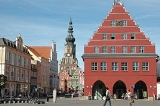
Greifswald

Encyclopedia
Greifswald (ˈɡʁaɪfsvalt), officially, the University and Hanseatic City of Greifswald (in German
Universitäts- und Hansestadt Greifswald) is a town in northeastern Germany
. It is situated in the state of Mecklenburg-Vorpommern, at an equal distance of about 250 kilometres (155.3 mi) from Germany's two largest cities, Berlin
and Hamburg
. The town borders the Baltic Sea
, and is crossed by a small river, the Ryck
. It is also located near Germany's two largest islands, Rügen
and Usedom
as well as near three of the country's 14 national parks. A former district-free town, it is the capital of the new district of Vorpommern-Greifswald
since the September 2011 district reforms.
The population is about 55,000, including 12,500 students and 5,000 employees of the University of Greifswald. Greifswald is internationally known due to the university and the Nord Stream gas pipeline project.
, approximately equidistant from Germany's two largest islands, Rügen
and Usedom
. The town is situated at the south end of the Bay of Greifswald
, the historic centre being about 5 kilometres (3.1 mi) up the river Ryck
that crosses the town. The area around Greifswald is mainly flat, and hardly reaches more than 20 metres above sea level. Two islands, Koos
and Riems, are also part of Greifswald. Three of Germany's fourteen national parks can be reached by car in one hour or less from Greifswald.
Greifswald is also roughly equidistant from Germany's two largest cities, Berlin
(240 km (149.1 mi)) and Hamburg
(260 km (161.6 mi)). The nearest larger towns are Stralsund
and Rostock
.
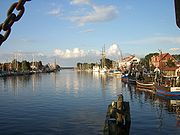
The coastal part of Greifswald at the mouth of the Ryck, named Greifswald-Wieck, evolved from a fishing village. Today it provides a small beach, a marina and the main port for Greifswald.
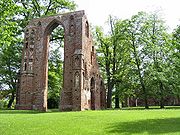 Greifswald was founded in 1199 when Cistercian monks founded the Eldena Abbey
. In 1250, Wartislaw III, Duke of Pomerania
granted town privileges to Greifswald according to the Lübeck law
.
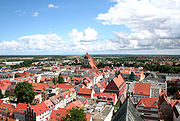 In medieval times, the site of Greifswald was an unsettled woodland which marked the border between the Danish
Principality of Rügen and the Pomeranian County of Gützkow
, which at that time was also under Danish control. In 1199, the Rugian Prince Jaromar I allowed Danish Cistercian monks to build Hilda Abbey, now Eldena Abbey
, at the mouth of the River Ryck
. Among the lands granted the monks was a natural salt evaporation pond
a short way up the river, a site also crossed by the important via regia trade route. This site was named Gryp(he)swold(e), which is the Low German
precursor of the city's modern name. However, legend says the monks were shown the best site for settlement by a mighty griffin
, living in a tree that was supposed to have grown on Greifswald's oldest street, the Schuhagen. The town's construction followed a scheme of rectangular streets, with church and market sites reserved in central positions. It was settled primarily with Germans in the course of the Ostsiedlung
, but settlers from other nations and Wends
from nearby were attracted, too.
The salt
trade helped Eldena Abbey to become a hugely influential religious centre, and Greifswald became a well-known market. When the Danes had to surrender the Pomerania
n lands south of the Ryck after losing the Battle of Bornhöved
in 1227, the town became of particular interest to the Pomeranian dukes. In 1241, the Rugian prince Wizlaw I and the Pomeranian duke Wartislaw III both granted Greifswald market rights. In 1250, the latter granted the town Lübeck law
, after he had been permitted to acquire the town site as a fief from Eldena Abbey in 1248.
When Jazco of Salzwedel from Gützkow founded a Franciscan
friary within the walls of Greifswald, the Cistercians at Eldena lost much of their influence on the city's further development. Just beyond Greifswald's western limits, a town-like suburb (Neustadt) arose, separated from Greifswald by a ditch. In 1264, Neustadt was incorporated and the ditch was filled in.
Eldena Abbey and the major buildings of Greifswald were erected in Brick Gothic
style.
Enjoying a steady population increase, Greifswald became at the end of the 13th century one of the earliest members of the Hanseatic League
, which further increased its trade and wealth. After 1296, Greifswald's citizens no longer needed to serve in the Pomeranian army, and Pomeranian dukes would not reside in the city.
In 1456, Greifswald's mayor Heinrich Rubenow laid the foundations of one of the oldest universities in the world, the University of Greifswald, which was one of the first in Germany, and was, periodically, the single oldest in Sweden
and Prussia
respectively.
In the course of Reformation
, Eldena Abbey ceased to function as a monastery. Its possessions fell to the Pomeranian dukes; the bricks of its Gothic buildings were used by the locals for other construction. Eldena lost its separate status and was later absorbed into the town of Greifswald. The religious houses within the town walls, the priories of the Blackfriars (Dominicans) in the northwest and the Greyfriars (Franciscans) in the southeast, were secularized. The buildings of the Dominicans (the "black monastery") were turned over to the university; the site is still used as part of the medical campus. The Franciscan friary ("the "grey monastery") and its succeeding buildings are now the Pomeranian State Museum.
During the Thirty Years' War
, Greifswald was occupied by imperial forces
from 1627 to 1631, and thereafter by Swedish forces
.
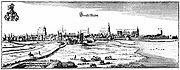
 When Swedish forces had entered the Duchy of Pomerania
in 1630 and subsequently cleared it of imperial troops, Greifswald became the last imperial stronghold in Pomerania. It was besieged by Sweden on 12 June 1631.and surrendered on 16 June when imperial commander Perusi was shot during a ride. Gustavus Adolphus of Sweden
even returned from Brandenburg
to supervise the siege, and upon his arrival received the university's homage for the liberation. After the Thirty Years' War
(1618–1648), Greifswald and the region surrounding it officially became part of the Kingdom of Sweden
as a result of the Thirty Years' War
. Swedish Pomerania
, as it was then called, remained part of the Swedish kingdom until 1815, when it became part of Prussia
as the Province of Pomerania.
The Thirty Years' War caused much starvation all over Germany, and by 1630, Greifswald's population had shrunk by two thirds. Many buildings were left vacant and fell into decay. Soon other wars followed: the Swedish-Polish War and the Swedish-Brandenburg War both involved the then Swedish town of Greifswald. In 1659 and 1678, Brandenburg troops bombarded the town. The first bombardment hit principally the northeast of the town, where 16 houses burned down. The second bombardment leveled 30 houses and damaged hundreds more all over the town. Cannon balls of this second bombardment can still be seen in the walls of St Mary's Church today.
During the Great Northern War
(1700–1721, with the town involved 1711-1713), Greifswald had to house soldiers, who vandalized several homes. While besieging neighboring Stralsund, Russian tsar
Peter the Great allied with George I of Great Britain
in the Treaty of Greifswald
. In 1713, the town hall and the stables burned down. In 1736, an even greater fire destroyed 26 houses and damaged several others. Already in 1669 and 1689, the Swedish government had issued decrees (Freiheitspatente) absolving anyone of taxes who built or rebuilt a house. These decrees were in force, though frequently modified, until 1824.
In 1763, Greifswald Botanic Garden was founded.
 About 1900, the city - for the first time since the Middle Ages - expanded significantly beyond the old city walls. Also, a major railway connected Greifswald to Stralsund
and Berlin
; a local railway line further connected Greifswald to Wolgast
.
The city survived World War II
without much destruction, even though it housed a large army garrison. During the war it was a site of camp for prisoners of Nazi Germany called Stalag II-C In April 1945, Oberst Rudolf Petershagen surrendered the city to the Red Army
without a fight.
From 1949 to 1990, Greifswald was part of the German Democratic Republic
. During this time, most historical buildings in the medieval parts of the city were neglected and a number of old buildings were pulled down. The population increased significantly, because of the construction of a power plant in Lubmin
, which was closed in the early 1990s. New suburbs were erected in the monolithic industrial socialist style (see Plattenbau
). They still house most of the city's population. These new suburbs were placed east and southeast of central Greifswald, shifting the former town center to the northwestern edge of the modern city.
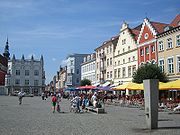
Reconstruction of the old town began in the late 1980s. Nearly all has now been restored. Before that almost all of the old northern town adjacent to the port was demolished and subsequently rebuilt. The historic marketplace is especially worth mentioning, and is one of the most beautiful in northern Germany. The city attracts many tourists, due to its proximity to the Baltic Sea
.
Greifswald's greatest population was reached in 1988, with about 68,000 inhabitants, but it decreased afterward to 55,000, where it has now stabilized. Reasons for this included migration to western cities as well as suburbanisation. However, the number of students quadrupled from 3,000 in 1990 to more than 11,000 in 2007 and the university employs 5,000 people; nearly one in three people in Greifswald are linked in some way to higher education.
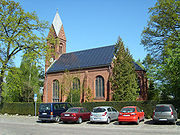
Despite its relatively small population, Greifswald retains a supra-regional relevance linked to its intellectual role as a university town and to the taking of the central functions of the former Prussian Province of Pomerania after World War II, such as the seat of the bishop of the Pomeranian Lutheran Church, the state archives (Landesarchiv) and the Pomeranian Museum (Pommersches Landesmuseum). Three courts of the state of Mecklenburg-Vorpommern are also based at Greifswald:
 Greifswald and Stralsund
are the largest cities in the Vorpommern part of Mecklenburg-Vorpommern. Of great importance to the city's economy is the local university with its 12,000 students and nearly 5,000 employees in addition to many people employed at independent research facilities such as the Friedrich Loeffler Institute
and spin-off firms.
Greifswald is also the seat of the bishopry of the Pomeranian Evangelical Church as well as the seat of the state's chief constitutional court, and chief financial court.
Tourism
plays a vital role as Greifswald is situated between the islands of Rügen
and Usedom
on the popular German Baltic coast, which brings in many tourists.
One of Europe's largest producers of photovoltaic module
s, Berlin
-based Solon SE, has a production site in Greifswald. The world's third largest producer of yacht
s worldwide, Hanse Yachts, is based in Greifswald. In the energy sector, a transnational gas pipeline from Russia to Germany will stop in Lubmin (near Greifswald). Riemser Arzeimittel is a pharmaceutical company based on the island of Riems, which is part of the city of Greifswald. Siemens
Communications F & E produces goods here as well.
In a 2008 study, Greifswald was declared Germany
's most dynamic city. According to another 2008 study, Greifswald is the "youngest city" in Germany having the highest percentage of heads of household under 30 years of age.
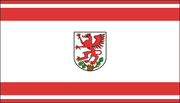 Politics in Greifswald, as in most of Western Pomerania, is traditionally dominated by the centre-right CDU. The city council is elected for five year terms. Since the last election on 7 June 2009, the 43 city council seats are allocated as follows:
, Finland, since 1959 Goleniów
, Poland, since 1986, twin town since 2006 Osnabrück
, Germany, since 1988 Lund
, Sweden, Since 1990 Hamar
, Norway, since 1997 Newport News
, USA, since 2007 Szczecin
, Poland, city friendship since 1996 Angers
, France, contacts since 1994 College Station
, USA, contacts since 1995 Szczecin
, Poland, since 2010
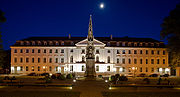
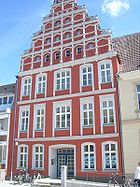 Founded in 1456, the University of Greifswald is one of the oldest universities in both Germany
and Europe
. Currently, about 11,000 students study at five faculties: theology
, law
/economics
, medicine
, philosophy
, and mathematics
/natural sciences.
The university co-operates with many research facilities, such as:
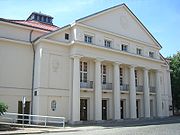
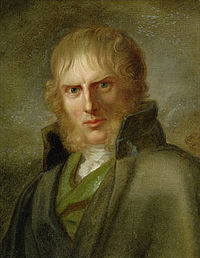
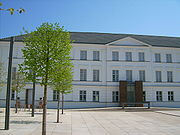 Greifswald has a number of museums and exhibitions, most notably the Pomeranian State Museum : history of Pomerania
and arts, including works by Caspar David Friedrich
, a native of Greifswald. The University of Greifswald also has a large number of collections, some of which are on display for the public.
Bearing in mind the population of only 55,000 people, Greifswald offers a wide range of events, for instance:
 According to a 2009 study, 44% of all people in Greifswald use their bicycle for daily transport within the town, which is the highest such rate in Germany. There are also public local and regional bus operators.
Local buses are run by SWG (Stadtwerke Greifswald).
Greifswald is situated at an equal distance of about 250 km (155.3 mi) to Germany's two largest cities, Berlin
and Hamburg
, which can be reached via the Autobahn 20 by car in about two hours. There are also train connections to and from Hamburg (via Stralsund
and Rostock
), and Berlin. The popular summer tourist destinations Usedom
and Rügen
can be reached both by car and by train.
Greifswald railway station
connects Greifswald with Stralsund
, Züssow
, Usedom
, Angermünde
, Eberswalde
and Berlin
. The station is also served by ICE
and EuroCity
services to cities in Germany and the Czech Republic
.
Greifswald has a port on the Baltic Sea
as well as several marinas. The historic city centre is about 3 km off the shore, and can be reached by yachts and small boats on the river Ryck
. The Bay of Greifswald
is a popular place for sailing and surfing, with Germany's two largest islands, Rügen and Usedom, just off the coast.
German language
German is a West Germanic language, related to and classified alongside English and Dutch. With an estimated 90 – 98 million native speakers, German is one of the world's major languages and is the most widely-spoken first language in the European Union....
Universitäts- und Hansestadt Greifswald) is a town in northeastern Germany
Germany
Germany , officially the Federal Republic of Germany , is a federal parliamentary republic in Europe. The country consists of 16 states while the capital and largest city is Berlin. Germany covers an area of 357,021 km2 and has a largely temperate seasonal climate...
. It is situated in the state of Mecklenburg-Vorpommern, at an equal distance of about 250 kilometres (155.3 mi) from Germany's two largest cities, Berlin
Berlin
Berlin is the capital city of Germany and is one of the 16 states of Germany. With a population of 3.45 million people, Berlin is Germany's largest city. It is the second most populous city proper and the seventh most populous urban area in the European Union...
and Hamburg
Hamburg
-History:The first historic name for the city was, according to Claudius Ptolemy's reports, Treva.But the city takes its modern name, Hamburg, from the first permanent building on the site, a castle whose construction was ordered by the Emperor Charlemagne in AD 808...
. The town borders the Baltic Sea
Baltic Sea
The Baltic Sea is a brackish mediterranean sea located in Northern Europe, from 53°N to 66°N latitude and from 20°E to 26°E longitude. It is bounded by the Scandinavian Peninsula, the mainland of Europe, and the Danish islands. It drains into the Kattegat by way of the Øresund, the Great Belt and...
, and is crossed by a small river, the Ryck
Ryck
The Ryck is a river in Mecklenburg-Vorpommern, Germany.From its source near Bartmannshagen, part of the Süderholz community northeast of Grimmen, the Ryck flows for about 28 km to the east, reaching Greifswald shortly before its mouth. The larger part of the river outside Greifswald is also...
. It is also located near Germany's two largest islands, Rügen
Rügen
Rügen is Germany's largest island. Located in the Baltic Sea, it is part of the Vorpommern-Rügen district of Mecklenburg-Vorpommern.- Geography :Rügen is located off the north-eastern coast of Germany in the Baltic Sea...
and Usedom
Usedom
Usedom is a Baltic Sea island on the border between Germany and Poland. It is situated north of the Szczecin Lagoon estuary of the River Oder in Pomerania...
as well as near three of the country's 14 national parks. A former district-free town, it is the capital of the new district of Vorpommern-Greifswald
Vorpommern-Greifswald
Vorpommern-Greifswald is a district in the east of Mecklenburg-Vorpommern, Germany. It is bounded by the districts Mecklenburgische Seenplatte, Vorpommern-Rügen, the Baltic Sea, Poland and the state Brandenburg...
since the September 2011 district reforms.
The population is about 55,000, including 12,500 students and 5,000 employees of the University of Greifswald. Greifswald is internationally known due to the university and the Nord Stream gas pipeline project.
Geography
Greifswald is located in the northeast of GermanyGermany
Germany , officially the Federal Republic of Germany , is a federal parliamentary republic in Europe. The country consists of 16 states while the capital and largest city is Berlin. Germany covers an area of 357,021 km2 and has a largely temperate seasonal climate...
, approximately equidistant from Germany's two largest islands, Rügen
Rügen
Rügen is Germany's largest island. Located in the Baltic Sea, it is part of the Vorpommern-Rügen district of Mecklenburg-Vorpommern.- Geography :Rügen is located off the north-eastern coast of Germany in the Baltic Sea...
and Usedom
Usedom
Usedom is a Baltic Sea island on the border between Germany and Poland. It is situated north of the Szczecin Lagoon estuary of the River Oder in Pomerania...
. The town is situated at the south end of the Bay of Greifswald
Bay of Greifswald
The Bay of Greifswald is a basin in the southwestern Baltic Sea, off the shores of Germany in the state of Mecklenburg-Vorpommern. With an area of 514 km², it is the largest Bodden of the German Baltic coast....
, the historic centre being about 5 kilometres (3.1 mi) up the river Ryck
Ryck
The Ryck is a river in Mecklenburg-Vorpommern, Germany.From its source near Bartmannshagen, part of the Süderholz community northeast of Grimmen, the Ryck flows for about 28 km to the east, reaching Greifswald shortly before its mouth. The larger part of the river outside Greifswald is also...
that crosses the town. The area around Greifswald is mainly flat, and hardly reaches more than 20 metres above sea level. Two islands, Koos
Koos
Koos is the largest of several small islands in the Bay of Greifswald, Mecklenburg-Vorpommern, Germany. It has an area of 772 hectares and a maximum elevation of just above three meters. The island is a largely uninhabited natural reserve with restricted access...
and Riems, are also part of Greifswald. Three of Germany's fourteen national parks can be reached by car in one hour or less from Greifswald.
Greifswald is also roughly equidistant from Germany's two largest cities, Berlin
Berlin
Berlin is the capital city of Germany and is one of the 16 states of Germany. With a population of 3.45 million people, Berlin is Germany's largest city. It is the second most populous city proper and the seventh most populous urban area in the European Union...
(240 km (149.1 mi)) and Hamburg
Hamburg
-History:The first historic name for the city was, according to Claudius Ptolemy's reports, Treva.But the city takes its modern name, Hamburg, from the first permanent building on the site, a castle whose construction was ordered by the Emperor Charlemagne in AD 808...
(260 km (161.6 mi)). The nearest larger towns are Stralsund
Stralsund
- Main sights :* The Brick Gothic historic centre is a UNESCO World Heritage Site.* The heart of the old town is the Old Market Square , with the Gothic Town Hall . Behind the town hall stands the imposing Nikolaikirche , built in 1270-1360...
and Rostock
Rostock
Rostock -Early history:In the 11th century Polabian Slavs founded a settlement at the Warnow river called Roztoc ; the name Rostock is derived from that designation. The Danish king Valdemar I set the town aflame in 1161.Afterwards the place was settled by German traders...
.
The coastal part of Greifswald at the mouth of the Ryck, named Greifswald-Wieck, evolved from a fishing village. Today it provides a small beach, a marina and the main port for Greifswald.
Early history
Eldena Abbey
Eldena Abbey , originally Hilda Abbey is a former Cistercian monastery near the present town of Greifswald in Mecklenburg-Vorpommern, Germany...
. In 1250, Wartislaw III, Duke of Pomerania
Wartislaw III, Duke of Pomerania
Wartislaw III was a Griffin duke of Pomerania-Demmin. Son of Casimir II of Pomerania-Demmin and Ingardis of Denmark, he was married to a Sophia of an unknown house. As he did not have any children, Pomerania-Demmin ceased to exist with his death.Ingardis ruled Pomerania-Demmin in place of young...
granted town privileges to Greifswald according to the Lübeck law
Lübeck law
The Lübeck law was the constitution of a municipal form of government developed at Lübeck in Schleswig-Holstein after it was made a free city in 1226. The law provides for self-government. It replaced the personal rule of tribal monarchs descending from ancient times or the rule of the regional...
.
Middle Ages and Reformation
Denmark
Denmark is a Scandinavian country in Northern Europe. The countries of Denmark and Greenland, as well as the Faroe Islands, constitute the Kingdom of Denmark . It is the southernmost of the Nordic countries, southwest of Sweden and south of Norway, and bordered to the south by Germany. Denmark...
Principality of Rügen and the Pomeranian County of Gützkow
County of Gützkow
The County of Gützkow was a part of the Duchy of Pomerania during the High Middle Ages , named after the central town of Gützkow and stretching roughly from the Peene River in the South to the Ryck River in the North. It emerged from the earlier Liutician Principality of Gützkow , that was turned...
, which at that time was also under Danish control. In 1199, the Rugian Prince Jaromar I allowed Danish Cistercian monks to build Hilda Abbey, now Eldena Abbey
Eldena Abbey
Eldena Abbey , originally Hilda Abbey is a former Cistercian monastery near the present town of Greifswald in Mecklenburg-Vorpommern, Germany...
, at the mouth of the River Ryck
Ryck
The Ryck is a river in Mecklenburg-Vorpommern, Germany.From its source near Bartmannshagen, part of the Süderholz community northeast of Grimmen, the Ryck flows for about 28 km to the east, reaching Greifswald shortly before its mouth. The larger part of the river outside Greifswald is also...
. Among the lands granted the monks was a natural salt evaporation pond
Salt evaporation pond
Salt evaporation ponds, also called salterns or salt pans, are shallow artificial ponds designed to produce salts from sea water or other brines. The seawater or brine is fed into large ponds and water is drawn out through natural evaporation which allows the salt to be subsequently harvested...
a short way up the river, a site also crossed by the important via regia trade route. This site was named Gryp(he)swold(e), which is the Low German
Low German
Low German or Low Saxon is an Ingvaeonic West Germanic language spoken mainly in northern Germany and the eastern part of the Netherlands...
precursor of the city's modern name. However, legend says the monks were shown the best site for settlement by a mighty griffin
Griffin
The griffin, griffon, or gryphon is a legendary creature with the body of a lion and the head and wings of an eagle...
, living in a tree that was supposed to have grown on Greifswald's oldest street, the Schuhagen. The town's construction followed a scheme of rectangular streets, with church and market sites reserved in central positions. It was settled primarily with Germans in the course of the Ostsiedlung
Ostsiedlung
Ostsiedlung , also called German eastward expansion, was the medieval eastward migration and settlement of Germans from modern day western and central Germany into less-populated regions and countries of eastern Central Europe and Eastern Europe. The affected area roughly stretched from Slovenia...
, but settlers from other nations and Wends
Wends
Wends is a historic name for West Slavs living near Germanic settlement areas. It does not refer to a homogeneous people, but to various peoples, tribes or groups depending on where and when it is used...
from nearby were attracted, too.
The salt
Salt
In chemistry, salts are ionic compounds that result from the neutralization reaction of an acid and a base. They are composed of cations and anions so that the product is electrically neutral...
trade helped Eldena Abbey to become a hugely influential religious centre, and Greifswald became a well-known market. When the Danes had to surrender the Pomerania
Pomerania
Pomerania is a historical region on the south shore of the Baltic Sea. Divided between Germany and Poland, it stretches roughly from the Recknitz River near Stralsund in the West, via the Oder River delta near Szczecin, to the mouth of the Vistula River near Gdańsk in the East...
n lands south of the Ryck after losing the Battle of Bornhöved
Battle of Bornhöved (1227)
The Battle of Bornhöved took place on 22 July 1227 near Bornhöved in Holstein. Count Adolf IV of Schauenburg and Holstein — leading an army consisting of troops from the cities of Lübeck and Hamburg, about 1000 Dithmarsians and combined troops of Holstein next to various north German nobles —...
in 1227, the town became of particular interest to the Pomeranian dukes. In 1241, the Rugian prince Wizlaw I and the Pomeranian duke Wartislaw III both granted Greifswald market rights. In 1250, the latter granted the town Lübeck law
Lübeck law
The Lübeck law was the constitution of a municipal form of government developed at Lübeck in Schleswig-Holstein after it was made a free city in 1226. The law provides for self-government. It replaced the personal rule of tribal monarchs descending from ancient times or the rule of the regional...
, after he had been permitted to acquire the town site as a fief from Eldena Abbey in 1248.
When Jazco of Salzwedel from Gützkow founded a Franciscan
Franciscan
Most Franciscans are members of Roman Catholic religious orders founded by Saint Francis of Assisi. Besides Roman Catholic communities, there are also Old Catholic, Anglican, Lutheran, ecumenical and Non-denominational Franciscan communities....
friary within the walls of Greifswald, the Cistercians at Eldena lost much of their influence on the city's further development. Just beyond Greifswald's western limits, a town-like suburb (Neustadt) arose, separated from Greifswald by a ditch. In 1264, Neustadt was incorporated and the ditch was filled in.
Eldena Abbey and the major buildings of Greifswald were erected in Brick Gothic
Brick Gothic
Brick Gothic is a specific style of Gothic architecture common in Northern Europe, especially in Northern Germany and the regions around the Baltic Sea that do not have natural rock resources. The buildings are essentially built from bricks...
style.
Enjoying a steady population increase, Greifswald became at the end of the 13th century one of the earliest members of the Hanseatic League
Hanseatic League
The Hanseatic League was an economic alliance of trading cities and their merchant guilds that dominated trade along the coast of Northern Europe...
, which further increased its trade and wealth. After 1296, Greifswald's citizens no longer needed to serve in the Pomeranian army, and Pomeranian dukes would not reside in the city.
In 1456, Greifswald's mayor Heinrich Rubenow laid the foundations of one of the oldest universities in the world, the University of Greifswald, which was one of the first in Germany, and was, periodically, the single oldest in Sweden
Sweden
Sweden , officially the Kingdom of Sweden , is a Nordic country on the Scandinavian Peninsula in Northern Europe. Sweden borders with Norway and Finland and is connected to Denmark by a bridge-tunnel across the Öresund....
and Prussia
Prussia
Prussia was a German kingdom and historic state originating out of the Duchy of Prussia and the Margraviate of Brandenburg. For centuries, the House of Hohenzollern ruled Prussia, successfully expanding its size by way of an unusually well-organized and effective army. Prussia shaped the history...
respectively.
In the course of Reformation
Protestant Reformation
The Protestant Reformation was a 16th-century split within Western Christianity initiated by Martin Luther, John Calvin and other early Protestants. The efforts of the self-described "reformers", who objected to the doctrines, rituals and ecclesiastical structure of the Roman Catholic Church, led...
, Eldena Abbey ceased to function as a monastery. Its possessions fell to the Pomeranian dukes; the bricks of its Gothic buildings were used by the locals for other construction. Eldena lost its separate status and was later absorbed into the town of Greifswald. The religious houses within the town walls, the priories of the Blackfriars (Dominicans) in the northwest and the Greyfriars (Franciscans) in the southeast, were secularized. The buildings of the Dominicans (the "black monastery") were turned over to the university; the site is still used as part of the medical campus. The Franciscan friary ("the "grey monastery") and its succeeding buildings are now the Pomeranian State Museum.
During the Thirty Years' War
Thirty Years' War
The Thirty Years' War was fought primarily in what is now Germany, and at various points involved most countries in Europe. It was one of the most destructive conflicts in European history....
, Greifswald was occupied by imperial forces
Capitulation of Franzburg
The Capitulation of Franzburg was a treaty providing for the capitulation of the Duchy of Pomerania to the forces of the Holy Roman Empire during the Thirty Years' War...
from 1627 to 1631, and thereafter by Swedish forces
Treaty of Stettin (1630)
The Treaty of Stettin or Alliance of Stettin was the legal framework for the occupation of the Duchy of Pomerania by the Swedish Empire during the Thirty Years' War...
.
1631/48—1815: Sweden
Duchy of Pomerania
The Duchy of Pomerania was a duchy in Pomerania on the southern coast of the Baltic Sea, ruled by dukes of the House of Pomerania ....
in 1630 and subsequently cleared it of imperial troops, Greifswald became the last imperial stronghold in Pomerania. It was besieged by Sweden on 12 June 1631.and surrendered on 16 June when imperial commander Perusi was shot during a ride. Gustavus Adolphus of Sweden
Gustavus Adolphus of Sweden
Gustav II Adolf has been widely known in English by his Latinized name Gustavus Adolphus Magnus and variously in historical writings also as Gustavus, or Gustavus the Great, or Gustav Adolph the Great,...
even returned from Brandenburg
Brandenburg
Brandenburg is one of the sixteen federal-states of Germany. It lies in the east of the country and is one of the new federal states that were re-created in 1990 upon the reunification of the former West Germany and East Germany. The capital is Potsdam...
to supervise the siege, and upon his arrival received the university's homage for the liberation. After the Thirty Years' War
Thirty Years' War
The Thirty Years' War was fought primarily in what is now Germany, and at various points involved most countries in Europe. It was one of the most destructive conflicts in European history....
(1618–1648), Greifswald and the region surrounding it officially became part of the Kingdom of Sweden
Sweden
Sweden , officially the Kingdom of Sweden , is a Nordic country on the Scandinavian Peninsula in Northern Europe. Sweden borders with Norway and Finland and is connected to Denmark by a bridge-tunnel across the Öresund....
as a result of the Thirty Years' War
Thirty Years' War
The Thirty Years' War was fought primarily in what is now Germany, and at various points involved most countries in Europe. It was one of the most destructive conflicts in European history....
. Swedish Pomerania
Swedish Pomerania
Swedish Pomerania was a Dominion under the Swedish Crown from 1630 to 1815, situated on what is now the Baltic coast of Germany and Poland. Following the Polish War and the Thirty Years' War, Sweden held extensive control over the lands on the southern Baltic coast, including Pomerania and parts...
, as it was then called, remained part of the Swedish kingdom until 1815, when it became part of Prussia
Prussia
Prussia was a German kingdom and historic state originating out of the Duchy of Prussia and the Margraviate of Brandenburg. For centuries, the House of Hohenzollern ruled Prussia, successfully expanding its size by way of an unusually well-organized and effective army. Prussia shaped the history...
as the Province of Pomerania.
The Thirty Years' War caused much starvation all over Germany, and by 1630, Greifswald's population had shrunk by two thirds. Many buildings were left vacant and fell into decay. Soon other wars followed: the Swedish-Polish War and the Swedish-Brandenburg War both involved the then Swedish town of Greifswald. In 1659 and 1678, Brandenburg troops bombarded the town. The first bombardment hit principally the northeast of the town, where 16 houses burned down. The second bombardment leveled 30 houses and damaged hundreds more all over the town. Cannon balls of this second bombardment can still be seen in the walls of St Mary's Church today.
During the Great Northern War
Great Northern War
The Great Northern War was a conflict in which a coalition led by the Tsardom of Russia successfully contested the supremacy of the Swedish Empire in northern Central Europe and Eastern Europe. The initial leaders of the anti-Swedish alliance were Peter I the Great of Russia, Frederick IV of...
(1700–1721, with the town involved 1711-1713), Greifswald had to house soldiers, who vandalized several homes. While besieging neighboring Stralsund, Russian tsar
Tsardom of Russia
The Tsardom of Russia was the name of the centralized Russian state from Ivan IV's assumption of the title of Tsar in 1547 till Peter the Great's foundation of the Russian Empire in 1721.From 1550 to 1700, Russia grew 35,000 km2 a year...
Peter the Great allied with George I of Great Britain
George I of Great Britain
George I was King of Great Britain and Ireland from 1 August 1714 until his death, and ruler of the Duchy and Electorate of Brunswick-Lüneburg in the Holy Roman Empire from 1698....
in the Treaty of Greifswald
Treaty of Greifswald
The Treaty of Greifswald was concluded on 28 October 1715, during the Great Northern War. George I of Great Britain and Elector of Hanover was assured Russian neutrality in his annexation of the Swedish dominion Bremen-Verden, on which he had agreed in the Treaty of Berlin...
. In 1713, the town hall and the stables burned down. In 1736, an even greater fire destroyed 26 houses and damaged several others. Already in 1669 and 1689, the Swedish government had issued decrees (Freiheitspatente) absolving anyone of taxes who built or rebuilt a house. These decrees were in force, though frequently modified, until 1824.
In 1763, Greifswald Botanic Garden was founded.
1815—today: Germany
Stralsund
- Main sights :* The Brick Gothic historic centre is a UNESCO World Heritage Site.* The heart of the old town is the Old Market Square , with the Gothic Town Hall . Behind the town hall stands the imposing Nikolaikirche , built in 1270-1360...
and Berlin
Berlin
Berlin is the capital city of Germany and is one of the 16 states of Germany. With a population of 3.45 million people, Berlin is Germany's largest city. It is the second most populous city proper and the seventh most populous urban area in the European Union...
; a local railway line further connected Greifswald to Wolgast
Wolgast
Wolgast is a town in the district of Vorpommern-Greifswald, in Mecklenburg-Vorpommern, Germany. It is situated on the bank of the river Peenestrom, vis-a-vis the island of Usedom that can be accessed by road and railway via a bascule bridge...
.
The city survived World War II
World War II
World War II, or the Second World War , was a global conflict lasting from 1939 to 1945, involving most of the world's nations—including all of the great powers—eventually forming two opposing military alliances: the Allies and the Axis...
without much destruction, even though it housed a large army garrison. During the war it was a site of camp for prisoners of Nazi Germany called Stalag II-C In April 1945, Oberst Rudolf Petershagen surrendered the city to the Red Army
Red Army
The Workers' and Peasants' Red Army started out as the Soviet Union's revolutionary communist combat groups during the Russian Civil War of 1918-1922. It grew into the national army of the Soviet Union. By the 1930s the Red Army was among the largest armies in history.The "Red Army" name refers to...
without a fight.
From 1949 to 1990, Greifswald was part of the German Democratic Republic
German Democratic Republic
The German Democratic Republic , informally called East Germany by West Germany and other countries, was a socialist state established in 1949 in the Soviet zone of occupied Germany, including East Berlin of the Allied-occupied capital city...
. During this time, most historical buildings in the medieval parts of the city were neglected and a number of old buildings were pulled down. The population increased significantly, because of the construction of a power plant in Lubmin
Lubmin
Lubmin is a coastal resort in the German state of Mecklenburg-Vorpommern. Lubmin is situated near Greifswald and on the Bay of Greifswald.Apart from tourism, Lubmin is a major transport and industry hub and investment location in the German energy sector...
, which was closed in the early 1990s. New suburbs were erected in the monolithic industrial socialist style (see Plattenbau
Plattenbau
Plattenbau is the German word for a building whose structure is constructed of large, prefabricated concrete slabs. The word is a compound of Platte and Bau...
). They still house most of the city's population. These new suburbs were placed east and southeast of central Greifswald, shifting the former town center to the northwestern edge of the modern city.
Reconstruction of the old town began in the late 1980s. Nearly all has now been restored. Before that almost all of the old northern town adjacent to the port was demolished and subsequently rebuilt. The historic marketplace is especially worth mentioning, and is one of the most beautiful in northern Germany. The city attracts many tourists, due to its proximity to the Baltic Sea
Baltic Sea
The Baltic Sea is a brackish mediterranean sea located in Northern Europe, from 53°N to 66°N latitude and from 20°E to 26°E longitude. It is bounded by the Scandinavian Peninsula, the mainland of Europe, and the Danish islands. It drains into the Kattegat by way of the Øresund, the Great Belt and...
.
Greifswald's greatest population was reached in 1988, with about 68,000 inhabitants, but it decreased afterward to 55,000, where it has now stabilized. Reasons for this included migration to western cities as well as suburbanisation. However, the number of students quadrupled from 3,000 in 1990 to more than 11,000 in 2007 and the university employs 5,000 people; nearly one in three people in Greifswald are linked in some way to higher education.
Despite its relatively small population, Greifswald retains a supra-regional relevance linked to its intellectual role as a university town and to the taking of the central functions of the former Prussian Province of Pomerania after World War II, such as the seat of the bishop of the Pomeranian Lutheran Church, the state archives (Landesarchiv) and the Pomeranian Museum (Pommersches Landesmuseum). Three courts of the state of Mecklenburg-Vorpommern are also based at Greifswald:
- the Supreme Administrative Court (Oberverwaltungsgericht);
- the Supreme Constitutional Court (Landesverfassungsgericht); and
- the Financial Court (Finanzgericht)
Administrative division
| District (modern) | District (historical) | Amalgamation Amalgamation (politics) A merger or amalgamation in a political or administrative sense is the combination of two or more political or administrative entities such as municipalities , counties, districts, etc. into a single entity. This term is used when the process occurs within a sovereign entity... | Size (ha) | Population |
|---|---|---|---|---|
| „Innenstadt“ (downtown) |
Innenstadt | 87,0 | 3.883 | |
| Steinbeckervorstadt | 349,6 | 163 | ||
| Fleischervorstadt | 52,7 | 2.911 | ||
| Nördliche Mühlenvorstadt | 173,8 | 4.097 | ||
| Südliche Mühlenvorstadt, Obstbausiedlung |
108,1 | 4.650 | ||
| Fettenvorstadt, Stadtrandsiedlung |
657,3 | 2.853 | ||
| Industriegebiet | 634,7 | 583 | ||
| „Schönwalde I und Südstadt“ |
Schönwalde I, Südstadt |
132,1 | 12.583 | |
| „Schönwalde II“ | Schönwalde II | 88,0 | 9.994 | |
| Groß Schönwalde | 1974 | 580,8 | 749 | |
| „Ostseeviertel“ | Ostseeviertel | 219,7 | 8.577 | |
| „Wieck“ | Ladebow | 1939 | 544,4 | 499 |
| Wieck | 1939 | 44,2 | 395 | |
| „Eldena“ | Eldena | 1939 | 675,5 | 1.994 |
| „Friedrichshagen“ | Friedrichshagen | 1960 | 436,5 | 196 |
| „Riems“ | Riems, Insel Koos Koos Koos is the largest of several small islands in the Bay of Greifswald, Mecklenburg-Vorpommern, Germany. It has an area of 772 hectares and a maximum elevation of just above three meters. The island is a largely uninhabited natural reserve with restricted access... |
233,6 | 814 | |
| (Size and population data as of 2002) | ||||
Economy
Stralsund
- Main sights :* The Brick Gothic historic centre is a UNESCO World Heritage Site.* The heart of the old town is the Old Market Square , with the Gothic Town Hall . Behind the town hall stands the imposing Nikolaikirche , built in 1270-1360...
are the largest cities in the Vorpommern part of Mecklenburg-Vorpommern. Of great importance to the city's economy is the local university with its 12,000 students and nearly 5,000 employees in addition to many people employed at independent research facilities such as the Friedrich Loeffler Institute
Friedrich Loeffler Institute
The Friedrich Loeffler Institute , is the national research centre for animal health of Germany. The institute was founded in 1910 and named for its founder Friedrich Loeffler in 1952. The FLI is situated on the Isle of Riems, which belongs to the City of Greifswald...
and spin-off firms.
Greifswald is also the seat of the bishopry of the Pomeranian Evangelical Church as well as the seat of the state's chief constitutional court, and chief financial court.
Tourism
Tourism
Tourism is travel for recreational, leisure or business purposes. The World Tourism Organization defines tourists as people "traveling to and staying in places outside their usual environment for not more than one consecutive year for leisure, business and other purposes".Tourism has become a...
plays a vital role as Greifswald is situated between the islands of Rügen
Rügen
Rügen is Germany's largest island. Located in the Baltic Sea, it is part of the Vorpommern-Rügen district of Mecklenburg-Vorpommern.- Geography :Rügen is located off the north-eastern coast of Germany in the Baltic Sea...
and Usedom
Usedom
Usedom is a Baltic Sea island on the border between Germany and Poland. It is situated north of the Szczecin Lagoon estuary of the River Oder in Pomerania...
on the popular German Baltic coast, which brings in many tourists.
One of Europe's largest producers of photovoltaic module
Photovoltaic module
A solar panel is a packaged, connected assembly of solar cells, also known as photovoltaic cells...
s, Berlin
Berlin
Berlin is the capital city of Germany and is one of the 16 states of Germany. With a population of 3.45 million people, Berlin is Germany's largest city. It is the second most populous city proper and the seventh most populous urban area in the European Union...
-based Solon SE, has a production site in Greifswald. The world's third largest producer of yacht
Yacht
A yacht is a recreational boat or ship. The term originated from the Dutch Jacht meaning "hunt". It was originally defined as a light fast sailing vessel used by the Dutch navy to pursue pirates and other transgressors around and into the shallow waters of the Low Countries...
s worldwide, Hanse Yachts, is based in Greifswald. In the energy sector, a transnational gas pipeline from Russia to Germany will stop in Lubmin (near Greifswald). Riemser Arzeimittel is a pharmaceutical company based on the island of Riems, which is part of the city of Greifswald. Siemens
Siemens
Siemens may refer toSiemens, a German family name carried by generations of telecommunications industrialists, including:* Werner von Siemens , inventor, founder of Siemens AG...
Communications F & E produces goods here as well.
In a 2008 study, Greifswald was declared Germany
Germany
Germany , officially the Federal Republic of Germany , is a federal parliamentary republic in Europe. The country consists of 16 states while the capital and largest city is Berlin. Germany covers an area of 357,021 km2 and has a largely temperate seasonal climate...
's most dynamic city. According to another 2008 study, Greifswald is the "youngest city" in Germany having the highest percentage of heads of household under 30 years of age.
City Council
- CDUChristian Democratic Union (Germany)The Christian Democratic Union of Germany is a Christian democratic and conservative political party in Germany. It is regarded as on the centre-right of the German political spectrum...
(christian/conservative) - 13 seats - Die LinkeThe Left (Germany)The Left , also commonly referred to as the Left Party , is a democratic socialist political party in Germany. The Left is the most left-wing party of the five represented in the Bundestag....
(socialist) - 10 seats - SPDSocial Democratic Party of GermanyThe Social Democratic Party of Germany is a social-democratic political party in Germany...
(social democratic) - 6 seats - GreensAlliance '90/The GreensAlliance '90/The Greens is a green political party in Germany, formed from the merger of the German Green Party and Alliance 90 in 1993. Its leaders are Claudia Roth and Cem Özdemir...
(green) - 5 seats - FDPFree Democratic Party (Germany)The Free Democratic Party , abbreviated to FDP, is a centre-right classical liberal political party in Germany. It is led by Philipp Rösler and currently serves as the junior coalition partner to the Union in the German federal government...
(liberal) - 4 seats - local citizens' movements - 5 seats
- nationalist parties - 0 seats
Twinning
KotkaKotka
Kotka is a town and municipality of Finland. Its former name is Rochensalm.Kotka is located on the coast of the Gulf of Finland at the mouth of Kymi River and it is part of the Kymenlaakso region in southern Finland. The municipality has a population of and covers an area of of which is water....
, Finland, since 1959 Goleniów
Goleniów
Goleniów is a town in Pomerania, northwestern Poland with 22,399 inhabitants . It is the capital of Goleniów County in West Pomeranian Voivodeship ; previously it was in Szczecin Voivodeship . Town area is 12.5 km², geographical situation 53°33'N and 14°49'E...
, Poland, since 1986, twin town since 2006 Osnabrück
Osnabrück
Osnabrück is a city in Lower Saxony, Germany, some 80 km NNE of Dortmund, 45 km NE of Münster, and some 100 km due west of Hanover. It lies in a valley penned between the Wiehen Hills and the northern tip of the Teutoburg Forest...
, Germany, since 1988 Lund
Lund
-Main sights:During the 12th and 13th centuries, when the town was the seat of the archbishop, many churches and monasteries were built. At its peak, Lund had 27 churches, but most of them were demolished as result of the Reformation in 1536. Several medieval buildings remain, including Lund...
, Sweden, Since 1990 Hamar
Hamar
is a town and municipality in Hedmark county, Norway. It is part of the traditional region of Hedmarken. The administrative centre of the municipality is the town of Hamar. The municipality of Hamar was separated from Vang as a town and municipality of its own in 1849...
, Norway, since 1997 Newport News
Newport News, Virginia
Newport News is an independent city located in the Hampton Roads metropolitan area of Virginia. It is at the southeastern end of the Virginia Peninsula, on the north shore of the James River extending southeast from Skiffe's Creek along many miles of waterfront to the river's mouth at Newport News...
, USA, since 2007 Szczecin
Szczecin
Szczecin , is the capital city of the West Pomeranian Voivodeship in Poland. It is the country's seventh-largest city and the largest seaport in Poland on the Baltic Sea. As of June 2009 the population was 406,427....
, Poland, city friendship since 1996 Angers
Angers
Angers is the main city in the Maine-et-Loire department in western France about south-west of Paris. Angers is located in the French region known by its pre-revolutionary, provincial name, Anjou, and its inhabitants are called Angevins....
, France, contacts since 1994 College Station
College Station, Texas
College Station is a city in Brazos County, Texas, situated in East Central Texas in the heart of the Brazos Valley. The city is located within the most populated region of Texas, near three of the 10 largest cities in the United States - Houston, Dallas, and San Antonio...
, USA, contacts since 1995 Szczecin
Szczecin
Szczecin , is the capital city of the West Pomeranian Voivodeship in Poland. It is the country's seventh-largest city and the largest seaport in Poland on the Baltic Sea. As of June 2009 the population was 406,427....
, Poland, since 2010
University
Germany
Germany , officially the Federal Republic of Germany , is a federal parliamentary republic in Europe. The country consists of 16 states while the capital and largest city is Berlin. Germany covers an area of 357,021 km2 and has a largely temperate seasonal climate...
and Europe
Europe
Europe is, by convention, one of the world's seven continents. Comprising the westernmost peninsula of Eurasia, Europe is generally 'divided' from Asia to its east by the watershed divides of the Ural and Caucasus Mountains, the Ural River, the Caspian and Black Seas, and the waterways connecting...
. Currently, about 11,000 students study at five faculties: theology
Theology
Theology is the systematic and rational study of religion and its influences and of the nature of religious truths, or the learned profession acquired by completing specialized training in religious studies, usually at a university or school of divinity or seminary.-Definition:Augustine of Hippo...
, law
Law
Law is a system of rules and guidelines which are enforced through social institutions to govern behavior, wherever possible. It shapes politics, economics and society in numerous ways and serves as a social mediator of relations between people. Contract law regulates everything from buying a bus...
/economics
Economics
Economics is the social science that analyzes the production, distribution, and consumption of goods and services. The term economics comes from the Ancient Greek from + , hence "rules of the house"...
, medicine
Medicine
Medicine is the science and art of healing. It encompasses a variety of health care practices evolved to maintain and restore health by the prevention and treatment of illness....
, philosophy
Philosophy
Philosophy is the study of general and fundamental problems, such as those connected with existence, knowledge, values, reason, mind, and language. Philosophy is distinguished from other ways of addressing such problems by its critical, generally systematic approach and its reliance on rational...
, and mathematics
Mathematics
Mathematics is the study of quantity, space, structure, and change. Mathematicians seek out patterns and formulate new conjectures. Mathematicians resolve the truth or falsity of conjectures by mathematical proofs, which are arguments sufficient to convince other mathematicians of their validity...
/natural sciences.
The university co-operates with many research facilities, such as:
- the Max-Planck-Institut für PlasmaphysikMax-Planck-Institut für PlasmaphysikThe Max-Planck-Institut für Plasmaphysik is a physics institute for the investigation of plasma physics, with the aim of working towards fusion power...
(plasma physics) which its second site (after GarchingGarching bei MünchenGarching bei München or Garching is a city in Bavaria, Germany near Munich. It is the home of several research institutes and university departments. It became a city on 14 September 1990.-Location:...
) in Greifswald and is experimenting with a stellaratorStellaratorA stellarator is a device used to confine a hot plasma with magnetic fields in order to sustain a controlled nuclear fusion reaction. It is one of the earliest controlled fusion devices, first invented by Lyman Spitzer in 1950 and built the next year at what later became the Princeton Plasma...
, WendelsteinWendelsteinWendelstein refers to* Wendelstein, a mountain in the Chiemgau * Wendelstein, Bavaria, a town in the district of Roth in Bavaria, Germany...
7-X. - Alfried KruppAlfried Krupp von Bohlen und HalbachAlfried Felix Alwyn Krupp von Bohlen und Halbach , often referred to as Alfried Krupp, was a convicted war criminal, an industrialist, a competitor in Olympic yacht races and a member of the Krupp family, which has been prominent in Germany since the early 19th century.The family company, known...
Institute of Advanced Study - Friedrich Loeffler InstituteFriedrich Loeffler InstituteThe Friedrich Loeffler Institute , is the national research centre for animal health of Germany. The institute was founded in 1910 and named for its founder Friedrich Loeffler in 1952. The FLI is situated on the Isle of Riems, which belongs to the City of Greifswald...
on the Isle of Riems (National Research Institute for Animal Health) - Institut für Niedertemperatur-Plasmaphysik (Institute of Low Temperature Plasma Physics)
- Technologiezentrum (Centre for TechnologyTechnologyTechnology is the making, usage, and knowledge of tools, machines, techniques, crafts, systems or methods of organization in order to solve a problem or perform a specific function. It can also refer to the collection of such tools, machinery, and procedures. The word technology comes ;...
) - Biotechnikum (Centre for BioscienceBioScienceBioScience is a peer-reviewed monthly sometimes daily scientific journal that is published by the American Institute of Biological Sciences . The content is written and edited for accessibility to researchers, educators, and students alike...
)
Secondary schools
- Alexander-von-HumboldtAlexander von HumboldtFriedrich Wilhelm Heinrich Alexander Freiherr von Humboldt was a German naturalist and explorer, and the younger brother of the Prussian minister, philosopher and linguist Wilhelm von Humboldt...
-Gymnasium - Friedrich-Ludwig-JahnFriedrich Ludwig JahnFriedrich Ludwig Jahn was a German gymnastics educator and nationalist. He is commonly known as Turnvater Jahn, roughly meaning "father of gymnastics" Jahn.- Life :...
-Gymnasium (founded in 1561 as schola senatoria and one of the oldest schools still existing in Germany) - Johann-Gottfried-HerderJohann Gottfried HerderJohann Gottfried von Herder was a German philosopher, theologian, poet, and literary critic. He is associated with the periods of Enlightenment, Sturm und Drang, and Weimar Classicism.-Biography:...
-Gymnasium (fused with the Jahn-Gymnasium in 2006) - Ostseegymnasium
Culture
History of Pomerania
The history of Pomerania dates back more than 10,000 years. Settlement in the area started by the end of the Vistula Glacial Stage, about 13,000 years ago. Archeological traces have been found of various cultures during the Stone and Bronze Age, of Veneti and Germanic peoples during the Iron Age...
and arts, including works by Caspar David Friedrich
Caspar David Friedrich
Caspar David Friedrich was a 19th-century German Romantic landscape painter, generally considered the most important German artist of his generation. He is best known for his mid-period allegorical landscapes which typically feature contemplative figures silhouetted against night skies, morning...
, a native of Greifswald. The University of Greifswald also has a large number of collections, some of which are on display for the public.
Bearing in mind the population of only 55,000 people, Greifswald offers a wide range of events, for instance:
- Theater Vorpommern: theatre, orchestra and opera
- Stadthalle Greifswald: medium-sized convention centre
- Festspiele Mecklenburg-Vorpommern: Greifswald is one of several sites of the state's classical music festival
- Nordischer KlangNordischer KlangNordischer Klang is the largest festival of Nordic culture in Germany. It is a major platform for artists from Denmark, Finland, Iceland, Norway, and Sweden in Germany...
is the largest festival of Nordic culture outside of the Nordic countriesNordic countriesThe Nordic countries make up a region in Northern Europe and the North Atlantic which consists of Denmark, Finland, Iceland, Norway and Sweden and their associated territories, the Faroe Islands, Greenland and Åland...
themselves - BachJohann Sebastian BachJohann Sebastian Bach was a German composer, organist, harpsichordist, violist, and violinist whose sacred and secular works for choir, orchestra, and solo instruments drew together the strands of the Baroque period and brought it to its ultimate maturity...
festival - Eldena Jazz Evenings
- Gaffelrigg summer fair
- Museumshafen: historic ships in the "museum port"
- regular literary events in the Koeppenhaus
- St. Spiritus cultural centre
- Greifswald International Students Festival (GrIStuF e. V.)
- Radio 98eins (open radio)
- Greifswald Night of Music (Greifswalder Musiknacht)
- Greifswald long-ship festival (Greifswalder Drachenbootfest)
Transport
Local buses are run by SWG (Stadtwerke Greifswald).
Greifswald is situated at an equal distance of about 250 km (155.3 mi) to Germany's two largest cities, Berlin
Berlin
Berlin is the capital city of Germany and is one of the 16 states of Germany. With a population of 3.45 million people, Berlin is Germany's largest city. It is the second most populous city proper and the seventh most populous urban area in the European Union...
and Hamburg
Hamburg
-History:The first historic name for the city was, according to Claudius Ptolemy's reports, Treva.But the city takes its modern name, Hamburg, from the first permanent building on the site, a castle whose construction was ordered by the Emperor Charlemagne in AD 808...
, which can be reached via the Autobahn 20 by car in about two hours. There are also train connections to and from Hamburg (via Stralsund
Stralsund
- Main sights :* The Brick Gothic historic centre is a UNESCO World Heritage Site.* The heart of the old town is the Old Market Square , with the Gothic Town Hall . Behind the town hall stands the imposing Nikolaikirche , built in 1270-1360...
and Rostock
Rostock
Rostock -Early history:In the 11th century Polabian Slavs founded a settlement at the Warnow river called Roztoc ; the name Rostock is derived from that designation. The Danish king Valdemar I set the town aflame in 1161.Afterwards the place was settled by German traders...
), and Berlin. The popular summer tourist destinations Usedom
Usedom
Usedom is a Baltic Sea island on the border between Germany and Poland. It is situated north of the Szczecin Lagoon estuary of the River Oder in Pomerania...
and Rügen
Rügen
Rügen is Germany's largest island. Located in the Baltic Sea, it is part of the Vorpommern-Rügen district of Mecklenburg-Vorpommern.- Geography :Rügen is located off the north-eastern coast of Germany in the Baltic Sea...
can be reached both by car and by train.
Greifswald railway station
Greifswald railway station
Greifswald is a railway station in the town of Greifswald, Mecklenburg-Vorpommern, Germany. The station lies of the Angermünde–Stralsund railway and the train services are operated by Deutsche Bahn.-Train services:...
connects Greifswald with Stralsund
Stralsund
- Main sights :* The Brick Gothic historic centre is a UNESCO World Heritage Site.* The heart of the old town is the Old Market Square , with the Gothic Town Hall . Behind the town hall stands the imposing Nikolaikirche , built in 1270-1360...
, Züssow
Züssow
Züssow is a municipality in the Vorpommern-Greifswald district, in Mecklenburg-Vorpommern, Germany.-Transport:Züssow railway station connects Züssow with Stralsund, Greifswald Angermünde, Eberswalde and Berlin. The station is also served by ICE, EuroCity and Intercity services connecting the area...
, Usedom
Usedom
Usedom is a Baltic Sea island on the border between Germany and Poland. It is situated north of the Szczecin Lagoon estuary of the River Oder in Pomerania...
, Angermünde
Angermünde
Angermünde is a town in the district of Uckermark in the state of Brandenburg, Germany. It is located on the Mündesee, 43 miles northeast of Berlin on the Berlin–Szczecin railway...
, Eberswalde
Eberswalde
Eberswalde is a major town and the administrative seat of the district Barnim in the German Federal State of Brandenburg, about 50 km northeast of Berlin. Population 42144 , geographical location . The town is often called Waldstadt , because of the large forests around it, including the...
and Berlin
Berlin
Berlin is the capital city of Germany and is one of the 16 states of Germany. With a population of 3.45 million people, Berlin is Germany's largest city. It is the second most populous city proper and the seventh most populous urban area in the European Union...
. The station is also served by ICE
Ice
Ice is water frozen into the solid state. Usually ice is the phase known as ice Ih, which is the most abundant of the varying solid phases on the Earth's surface. It can appear transparent or opaque bluish-white color, depending on the presence of impurities or air inclusions...
and EuroCity
EuroCity
EuroCity, abbreviated EC, denotes an international train service within the European inter-city rail network. In contrast to trains with the "IC" label, "EC" trains are international trains that meet certain criteria. The EuroCity label replaces the older Trans Europ Express name for...
services to cities in Germany and the Czech Republic
Czech Republic
The Czech Republic is a landlocked country in Central Europe. The country is bordered by Poland to the northeast, Slovakia to the east, Austria to the south, and Germany to the west and northwest....
.
Greifswald has a port on the Baltic Sea
Baltic Sea
The Baltic Sea is a brackish mediterranean sea located in Northern Europe, from 53°N to 66°N latitude and from 20°E to 26°E longitude. It is bounded by the Scandinavian Peninsula, the mainland of Europe, and the Danish islands. It drains into the Kattegat by way of the Øresund, the Great Belt and...
as well as several marinas. The historic city centre is about 3 km off the shore, and can be reached by yachts and small boats on the river Ryck
Ryck
The Ryck is a river in Mecklenburg-Vorpommern, Germany.From its source near Bartmannshagen, part of the Süderholz community northeast of Grimmen, the Ryck flows for about 28 km to the east, reaching Greifswald shortly before its mouth. The larger part of the river outside Greifswald is also...
. The Bay of Greifswald
Bay of Greifswald
The Bay of Greifswald is a basin in the southwestern Baltic Sea, off the shores of Germany in the state of Mecklenburg-Vorpommern. With an area of 514 km², it is the largest Bodden of the German Baltic coast....
is a popular place for sailing and surfing, with Germany's two largest islands, Rügen and Usedom, just off the coast.
Notable people
- Magnus von BraunMagnus von BraunMagnus "Mac" Freiherr von Braun was a German chemical engineer, Luftwaffe aviator, and rocket scientist at Peenemünde, the Mittelwerk, and after emigrating to the United States via Operation Paperclip, at Fort Bliss...
, chemical engineer, aviator and rocket scientist - Caspar David FriedrichCaspar David FriedrichCaspar David Friedrich was a 19th-century German Romantic landscape painter, generally considered the most important German artist of his generation. He is best known for his mid-period allegorical landscapes which typically feature contemplative figures silhouetted against night skies, morning...
, Romantic painter - Hans FalladaHans FalladaHans Fallada , born Rudolf Wilhelm Friedrich Ditzen in Greifswald, Germany, was a German writer of the first half of the 20th century. Some of his better known novels include Little Man, What Now? and Every Man Dies Alone...
, author - Wolfgang KoeppenWolfgang KoeppenWolfgang Arthur Reinhold Koeppen is one of the best known German authors of the post-war period.-Life:Koeppen was born out of wedlock in Greifswald to a seamstress. His father never accepted the fatherhood formally...
, author - Sebastian SylvesterSebastian SylvesterSebastian Sylvester is a German boxer and former IBF middleweight champion. He is currently ranked as the fourth best middleweight by Ring Magazine....
, Boxer - Toni KroosToni KroosToni Kroos is a German international footballer who plays for Bayern Munich as an attacking midfielder. He is the older brother of Werder Bremen forward Felix Kroos.-Early career:...
, Footballer for FC Bayern MunichFC Bayern MunichFC Bayern Munich , is a German sports club based in Munich, Bavaria. It is best known for its professional football team, which is the most successful football club in Germany, having won 22 national titles and 15 cups.... - Felix KroosFelix KroosFelix Kroos is a German footballer who plays as an attacking midfielder for Werder Bremen.-Career:...
, Footballer for SV Werder BremenSV Werder BremenSV Werder Bremen is a German sports club best known for its association football team playing in Bremen, in the northwest German federal state of the same name. The club was founded on 4 February 1899 as Fußballverein Werder by a group of sixteen vocational high school students who had won a prize... - Friedrich Christian RosenthalFriedrich Christian RosenthalFriedrich Christian Rosenthal was a German anatomist who was a native of Greifswald.He earned his doctorate from the University of Jena, and later opened a medical practice in Greifswald...
, anatomist - Carl Gustav RehnskiöldCarl Gustav RehnskiöldCount Carl Gustav Rehnskiöld was a Swedish Field Marshal under the command of King Charles XII of Sweden. Despite being choleric and irritable, Rehnskiöld's military skills made him the chief military advisor and second-in-command to King Charles and earned him the epithet the "Parmenio of the...
, soldier - Sibylla SchwarzSibylla SchwarzSibylla Schwarz, also known as Sibylle Schwartz was a German poet of the Baroque era.-Life :Sibylla Schwarz was the daughter of Christian Schwarz, mayor of Greifswald, and Regina Schwarz....
, poet - Josef SommerJosef SommerJosef Sommer is an American film actor.He was born Maximilian Josef Sommer in Greifswald, Germany and was raised in North Carolina, the son of Elisabeth and Clemons Sommer, a professor of art history at the University of North Carolina. He studied at the Carnegie Institute of Technology...
, actor - Robin SzolkowyRobin SzolkowyRobin Szolkowy is a German pair skater. With partner Aliona Savchenko, he is a three-time World Champion, the 2010 Olympic bronze medalist, a four-time European Champion, the 2007–08 and 2010–11 Grand Prix Final Champion, and a seven-time German National Champion.Savchenko & Szolkowy scored the...
, pair figure skater - Ludwik RydygierLudwik RydygierLudwik Rydygier was a Polish surgeon.Born in Dusocin near Graudenz , at the time part of the Province of Prussia after partitioning of Poland. Since childhood he accented his Polish roots....
, Polish surgeon - Kurt Wolff (aviator)Kurt Wolff (aviator)Oberleutnant Kurt Wolff was one of Imperial Germany's highest scoring fighter aces during World War I. After achieving 33 confirmed victories, he was killed in action at the age of 22.-Early life:...
, World War IWorld War IWorld War I , which was predominantly called the World War or the Great War from its occurrence until 1939, and the First World War or World War I thereafter, was a major war centred in Europe that began on 28 July 1914 and lasted until 11 November 1918...
flying ace
External links
- City of Greifswald (official website)
- University of Greifswald (official website)
- Pomeranian State Museum, Greifswald (official website)
- Theater Vorpommern
- Greifswald, damals und heute (private photo series on the urban agenda in the last 20 years)