

Magdeburg

Encyclopedia
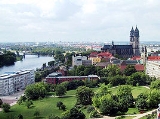
Magdeburg (ˈmakdəbʊrk; local: ˈmaxdəbʊɐ̯ç; Low Saxon
: Meideborg, ˈmaˑɪdebɔɐx), is the largest city and the capital city of the Bundesland
of Saxony-Anhalt
, Germany
. Magdeburg is situated on the Elbe
River and was one of the most important medieval cities of Europe.
Emperor Otto I
, the first Holy Roman Emperor
, lived for most of his reign in the town and was buried in the cathedral after his death. Magdeburg's version of German town law
, known as Magdeburg rights
, spread throughout Central
and Eastern Europe
. The city is also well known for the 1631 Sack of Magdeburg
, which hardened Protestant
resistance during the Thirty Years' War
.
Magdeburg is the site of two universities, the Otto-von-Guericke University and the Magdeburg-Stendal University of Applied Sciences.
Nowadays Magdeburg is a traffic junction as well as an industrial
and trading centre.
The production of chemical products, steel, paper and textiles are of particular economic significance, along with Mechanical engineering and plant engineering, Ecotechnology and life-cycle management, Health management and Logistics.
Along with ten other cities in Saxony-Anhalt
, Saxony
and Thuringia
, Magdeburg is a member of the Central German Metropolitan Region.
In 2005 Magdeburg celebrated its 1200th anniversary.
 Founded by Charlemagne
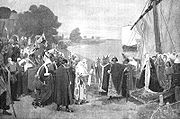
in 805 as Magadoburg (probably from Old High German
magado for big, mighty and burga for fortress), the town was fortified in 919 by King Henry I the Fowler against the Magyars and Slavs
. In 929 the city went to Edward the Elder
's daughter Edith
, through her marriage to Henry's son Otto I
, as a Morgengabe
— a Germanic customary gift received by the new bride from the groom and his family after the wedding night. Edith loved the town and often lived there; at her death she was buried in the crypt of the Benedictine
abbey of Saint Maurice
, later rebuilt as the cathedral. In 937, Magdeburg was the seat of a royal assembly. Otto I also continually returned to it and was also buried in the cathedral. He granted the abbey the right to income from various tithes and to corvée
labour from the surrounding countryside.
The Archbishopric of Magdeburg
was founded in 968 at the synod
of Ravenna
; Adalbert of Magdeburg was consecrated as its first archbishop. The archbishopric under Tilly included the bishoprics of Havelberg
, Brandenburg, Merseburg
, Meissen
, and Zeitz-Naumburg. The archbishops played a prominent role in the German colonization
of the Slavic lands east of the Elbe
river.
In 1035 Magdeburg received a patent giving the city the right to hold trade exhibitions and conventions, which form the basis of the later family of city laws
known as the Magdeburg rights
. These laws were adopted and modified throughout Central and Eastern Europe. Visitors from many countries began to trade with Magdeburg.
 In the 13th century, Magdeburg became a member of the Hanseatic League
. With more than 20,000 inhabitants Magdeburg was one of the largest cities in the Holy Roman Empire
. The town had an active maritime commerce on the west (towards Flanders
), with the countries of the North Sea
, and maintained traffic and communication with the interior (for example Brunswick
). The citizens constantly struggled against the archbishop, becoming nearly independent from him by the end of the 15th century.
In 1524 Martin Luther
was called to Magdeburg, where he preached and caused the city's defection from Catholicism
. The Protestant Reformation
had quickly found adherents in the city, where Luther had been a schoolboy. Emperor Charles V
repeatedly outlawed the unruly town, which had joined the Alliance of Torgau and the Schmalkaldic League
. Because it had not accepted the Augsburg Interim
(1548), the city, by the emperor's commands, was besieged (1550–1551) by Maurice, Elector of Saxony
, but it retained its independence. The rule of the archbishop was replaced by that of various administrators belonging to Protestant dynasties. In the following years Magdeburg gained a reputation as a stronghold of Protestantism and became the first major city to publish the writings of Luther. In Magdeburg, Matthias Flacius
and his companions wrote their anti-Catholic pamphlets and the Magdeburg Centuries
, in which they argued that the Roman Catholic Church
had become the kingdom of the Anti-Christ
.
In 1631, during the Thirty Years' War
, imperial
troops under Johann Tserclaes, Count of Tilly, stormed the city and committed a massacre, killing about 20,000 inhabitants and burning the town in the sack of Magdeburg
. The city had withstood a first siege in 1629 by Albrecht von Wallenstein
. After the war, a population of only 400 remained. According to the Peace of Westphalia
(1648), Magdeburg was assigned to Brandenburg-Prussia
after the death of the current administrator, August of Saxe-Weissenfels
, as the semi-autonomous Duchy of Magdeburg
; this occurred in 1680.
In the course of the Napoleonic Wars
, the fortress surrendered to French
troops in 1806. The city was annexed to the French-controlled Kingdom of Westphalia
in the 1807 Treaty of Tilsit
. King Jérôme
appointed Count Heinrich von Blumenthal as mayor. In 1815, after the Napoleonic Wars, Magdeburg was made the capital of the new Prussian
Province of Saxony
. In 1912, the old fortress was dismantled, and in 1908, the municipality Rothensee
became part of Magdeburg,
 Magdeburg was heavily bombed by the Royal Air Force
during WW2. The RAF bombing raid on the night of 16 January 1944, destroyed much of the city. The official death toll was 16,000 - however, at most it is now believed that between 2000-4000 citizens were killed.
Near the end of World War II
, the city of about 340,000 became capital of the Province of Magdeburg
. The Magdeburg/Rothensee plant that produced synthetic oil from lignite coal was a target of the Oil Campaign of World War II
. The impressive Gründerzeit
suburbs north of the city, called the Nordfront, were destroyed as well as the city's main street with its Baroque buildings. Post-war
the area was part of the Soviet Zone of Occupation
and many of the remaining pre-World War II city buildings were destroyed, with only a few buildings near the cathedral restored to their pre-war state. Prior to the reunification of Germany
, many surviving Gründerzeit buildings were left uninhabited and, after years of degradation, waiting for demolition. From 1949 on until German reunification on 3 October 1990, Magdeburg belonged to the German Democratic Republic
.
In 1990 Magdeburg became the capital of the new state of Saxony-Anhalt
within reunified Germany. The city centre was rebuilt almost exclusively in a modern style.

Cathedral of Saints Catherine
and Maurice
with a height of 104 m (341.21 ft), making it the highest church building of eastern Germany. It is notable for its beautiful and unique sculptures, especially the "Twelve Virgins" at the Northern Gate, the depictions of Otto I the Great
and his wife Editha
as well as the statues of St Maurice
and St Catherine
.
The predecessor of the cathedral was a church built in 937 within an abbey, called St. Maurice. Emperor Otto I the Great was buried here beside his wife in 973. St. Maurice burnt to ashes in 1207. The exact location of that church remained unknown for a long time. The foundations were rediscovered in May 2003, revealing a building 80 m (262.47 ft) long and 41 m (134.51 ft) wide.
The construction of the new church lasted 300 years. The cathedral of Saints Catherine and Maurice was the first Gothic
church building in Germany. The building of the steeples was completed as late as 1520.
While the cathedral was virtually the only building to survive the massacres of the Thirty Years' War, it nevertheless suffered damage in World War II. It was soon rebuilt and completed in 1955.
The square in front of the cathedral (sometimes called the Neuer Markt, or "new marketplace") was occupied by an imperial palace (Kaiserpfalz), which was destroyed in the fire of 1207. The stones from the ruin were used for the building of the cathedral. The presumed remains of the palace were excavated in the 1960s.
Magdeburg is one of the major towns along the Elbe Cycle Route
(Elberadweg).
The Magdeburg-Stendal University of Applied Sciences was founded in 1991. There are 30 direct study programs in five departments in Magdeburg and two departments in Stendal. The university has more than 130 professors and approximately 4,500 students at Magdeburg and 1,900 at Stendal.
currently play in the Regionalliga Nord
. The now defunct clubs SV Victoria 96 Magdeburg
and Cricket Viktoria Magdeburg
were among the first football clubs in Germany. 1. FC Magdeburg
is the only East German football club to have won a European club football competition.
There is also the very successful handball team, SC Magdeburg Gladiators
who are the first German team to win the EHF Champions League
.
City is portrayed on the map of Medieval II: Total War as a rebel castle.
with: Braunschweig
, Germany
Sarajevo
, Bosnia and Herzegovina
Nashville
, United States
Le Havre
, France
Zaporizhia
, Ukraine
Harbin
, People's Republic of China
Radom
, Poland
Low German
Low German or Low Saxon is an Ingvaeonic West Germanic language spoken mainly in northern Germany and the eastern part of the Netherlands...
: Meideborg, ˈmaˑɪdebɔɐx), is the largest city and the capital city of the Bundesland
States of Germany
Germany is made up of sixteen which are partly sovereign constituent states of the Federal Republic of Germany. Land literally translates as "country", and constitutionally speaking, they are constituent countries...
of Saxony-Anhalt
Saxony-Anhalt
Saxony-Anhalt is a landlocked state of Germany. Its capital is Magdeburg and it is surrounded by the German states of Lower Saxony, Brandenburg, Saxony, and Thuringia.Saxony-Anhalt covers an area of...
, Germany
Germany
Germany , officially the Federal Republic of Germany , is a federal parliamentary republic in Europe. The country consists of 16 states while the capital and largest city is Berlin. Germany covers an area of 357,021 km2 and has a largely temperate seasonal climate...
. Magdeburg is situated on the Elbe
Elbe
The Elbe is one of the major rivers of Central Europe. It rises in the Krkonoše Mountains of the northwestern Czech Republic before traversing much of Bohemia , then Germany and flowing into the North Sea at Cuxhaven, 110 km northwest of Hamburg...
River and was one of the most important medieval cities of Europe.
Emperor Otto I
Otto I, Holy Roman Emperor
Otto I the Great , son of Henry I the Fowler and Matilda of Ringelheim, was Duke of Saxony, King of Germany, King of Italy, and "the first of the Germans to be called the emperor of Italy" according to Arnulf of Milan...
, the first Holy Roman Emperor
Holy Roman Emperor
The Holy Roman Emperor is a term used by historians to denote a medieval ruler who, as German King, had also received the title of "Emperor of the Romans" from the Pope...
, lived for most of his reign in the town and was buried in the cathedral after his death. Magdeburg's version of German town law
German town law
German town law or German municipal concerns concerns town privileges used by many cities, towns, and villages throughout Central and Eastern Europe during the Middle Ages.- Town law in Germany :...
, known as Magdeburg rights
Magdeburg rights
Magdeburg Rights or Magdeburg Law were a set of German town laws regulating the degree of internal autonomy within cities and villages granted by a local ruler. Modelled and named after the laws of the German city of Magdeburg and developed during many centuries of the Holy Roman Empire, it was...
, spread throughout Central
Central Europe
Central Europe or alternatively Middle Europe is a region of the European continent lying between the variously defined areas of Eastern and Western Europe...
and Eastern Europe
Eastern Europe
Eastern Europe is the eastern part of Europe. The term has widely disparate geopolitical, geographical, cultural and socioeconomic readings, which makes it highly context-dependent and even volatile, and there are "almost as many definitions of Eastern Europe as there are scholars of the region"...
. The city is also well known for the 1631 Sack of Magdeburg
Sack of Magdeburg
The Sack of Magdeburg refers to the siege and subsequent plundering of the largely Protestant city of Magdeburg by the forces of the Holy Roman Empire and the Catholic League during the Thirty Years' War...
, which hardened Protestant
Protestantism
Protestantism is one of the three major groupings within Christianity. It is a movement that began in Germany in the early 16th century as a reaction against medieval Roman Catholic doctrines and practices, especially in regards to salvation, justification, and ecclesiology.The doctrines of the...
resistance during the Thirty Years' War
Thirty Years' War
The Thirty Years' War was fought primarily in what is now Germany, and at various points involved most countries in Europe. It was one of the most destructive conflicts in European history....
.
Magdeburg is the site of two universities, the Otto-von-Guericke University and the Magdeburg-Stendal University of Applied Sciences.
Nowadays Magdeburg is a traffic junction as well as an industrial
Industry
Industry refers to the production of an economic good or service within an economy.-Industrial sectors:There are four key industrial economic sectors: the primary sector, largely raw material extraction industries such as mining and farming; the secondary sector, involving refining, construction,...
and trading centre.
The production of chemical products, steel, paper and textiles are of particular economic significance, along with Mechanical engineering and plant engineering, Ecotechnology and life-cycle management, Health management and Logistics.
Along with ten other cities in Saxony-Anhalt
Saxony-Anhalt
Saxony-Anhalt is a landlocked state of Germany. Its capital is Magdeburg and it is surrounded by the German states of Lower Saxony, Brandenburg, Saxony, and Thuringia.Saxony-Anhalt covers an area of...
, Saxony
Saxony
The Free State of Saxony is a landlocked state of Germany, contingent with Brandenburg, Saxony Anhalt, Thuringia, Bavaria, the Czech Republic and Poland. It is the tenth-largest German state in area, with of Germany's sixteen states....
and Thuringia
Thuringia
The Free State of Thuringia is a state of Germany, located in the central part of the country.It has an area of and 2.29 million inhabitants, making it the sixth smallest by area and the fifth smallest by population of Germany's sixteen states....
, Magdeburg is a member of the Central German Metropolitan Region.
In 2005 Magdeburg celebrated its 1200th anniversary.
History
Charlemagne
Charlemagne was King of the Franks from 768 and Emperor of the Romans from 800 to his death in 814. He expanded the Frankish kingdom into an empire that incorporated much of Western and Central Europe. During his reign, he conquered Italy and was crowned by Pope Leo III on 25 December 800...
in 805 as Magadoburg (probably from Old High German
Old High German
The term Old High German refers to the earliest stage of the German language and it conventionally covers the period from around 500 to 1050. Coherent written texts do not appear until the second half of the 8th century, and some treat the period before 750 as 'prehistoric' and date the start of...
magado for big, mighty and burga for fortress), the town was fortified in 919 by King Henry I the Fowler against the Magyars and Slavs
Slavic peoples
The Slavic people are an Indo-European panethnicity living in Eastern Europe, Southeast Europe, North Asia and Central Asia. The term Slavic represents a broad ethno-linguistic group of people, who speak languages belonging to the Slavic language family and share, to varying degrees, certain...
. In 929 the city went to Edward the Elder
Edward the Elder
Edward the Elder was an English king. He became king in 899 upon the death of his father, Alfred the Great. His court was at Winchester, previously the capital of Wessex...
's daughter Edith
Eadgyth
Edith of England , also spelt Eadgyth or Ædgyth, was the daughter of Edward the Elder, and the wife of Otto I, Holy Roman Emperor.-Life:...
, through her marriage to Henry's son Otto I
Otto I, Holy Roman Emperor
Otto I the Great , son of Henry I the Fowler and Matilda of Ringelheim, was Duke of Saxony, King of Germany, King of Italy, and "the first of the Germans to be called the emperor of Italy" according to Arnulf of Milan...
, as a Morgengabe
Dower
Dower or morning gift was a provision accorded by law to a wife for her support in the event that she should survive her husband...
— a Germanic customary gift received by the new bride from the groom and his family after the wedding night. Edith loved the town and often lived there; at her death she was buried in the crypt of the Benedictine
Benedictine
Benedictine refers to the spirituality and consecrated life in accordance with the Rule of St Benedict, written by Benedict of Nursia in the sixth century for the cenobitic communities he founded in central Italy. The most notable of these is Monte Cassino, the first monastery founded by Benedict...
abbey of Saint Maurice
Saint Maurice
Saint Maurice was the leader of the legendary Roman Theban Legion in the 3rd century, and one of the favorite and most widely venerated saints of that group. He was the patron saint of several professions, locales, and kingdoms...
, later rebuilt as the cathedral. In 937, Magdeburg was the seat of a royal assembly. Otto I also continually returned to it and was also buried in the cathedral. He granted the abbey the right to income from various tithes and to corvée
Corvée
Corvée is unfree labour, often unpaid, that is required of people of lower social standing and imposed on them by the state or a superior . The corvée was the earliest and most widespread form of taxation, which can be traced back to the beginning of civilization...
labour from the surrounding countryside.
The Archbishopric of Magdeburg
Archbishopric of Magdeburg
The Archbishopric of Magdeburg was a Roman Catholic archdiocese and Prince-Bishopric of the Holy Roman Empire centered on the city of Magdeburg on the Elbe River....
was founded in 968 at the synod
Synod
A synod historically is a council of a church, usually convened to decide an issue of doctrine, administration or application. In modern usage, the word often refers to the governing body of a particular church, whether its members are meeting or not...
of Ravenna
Ravenna
Ravenna is the capital city of the Province of Ravenna in the Emilia-Romagna region of Italy and the second largest comune in Italy by land area, although, at , it is little more than half the size of the largest comune, Rome...
; Adalbert of Magdeburg was consecrated as its first archbishop. The archbishopric under Tilly included the bishoprics of Havelberg
Bishopric of Havelberg
The Bishopric of Havelberg was a Roman Catholic diocese founded by King Otto I, King of the Germans, in 946. The diocese was suffragan to the Archbishopric of Magdeburg. Its most famous bishop was Anselm of Havelberg. Its seat was in Havelberg in the Northern March and it roughly covered the...
, Brandenburg, Merseburg
Bishopric of Merseburg
The Bishopric of Merseburg was a episcopal see on the eastern border of the mediæval Duchy of Saxony with its centre in Merseburg, where Merseburg Cathedral was constructed...
, Meissen
Roman Catholic Diocese of Dresden-Meissen
The Diocese of Dresden-Meissen is a Diocese of Catholic Church in Germany. Founded as the Bishopric of Meissen in 968, it was dissolved in 1539 during the Protestant Reformation. The diocese was reestablished in 1921 and renamed Dresden-Meissen in 1980. The seat of the diocese is in Dresden and...
, and Zeitz-Naumburg. The archbishops played a prominent role in the German colonization
Ostsiedlung
Ostsiedlung , also called German eastward expansion, was the medieval eastward migration and settlement of Germans from modern day western and central Germany into less-populated regions and countries of eastern Central Europe and Eastern Europe. The affected area roughly stretched from Slovenia...
of the Slavic lands east of the Elbe
Elbe
The Elbe is one of the major rivers of Central Europe. It rises in the Krkonoše Mountains of the northwestern Czech Republic before traversing much of Bohemia , then Germany and flowing into the North Sea at Cuxhaven, 110 km northwest of Hamburg...
river.
In 1035 Magdeburg received a patent giving the city the right to hold trade exhibitions and conventions, which form the basis of the later family of city laws
German town law
German town law or German municipal concerns concerns town privileges used by many cities, towns, and villages throughout Central and Eastern Europe during the Middle Ages.- Town law in Germany :...
known as the Magdeburg rights
Magdeburg rights
Magdeburg Rights or Magdeburg Law were a set of German town laws regulating the degree of internal autonomy within cities and villages granted by a local ruler. Modelled and named after the laws of the German city of Magdeburg and developed during many centuries of the Holy Roman Empire, it was...
. These laws were adopted and modified throughout Central and Eastern Europe. Visitors from many countries began to trade with Magdeburg.
Hanseatic League
The Hanseatic League was an economic alliance of trading cities and their merchant guilds that dominated trade along the coast of Northern Europe...
. With more than 20,000 inhabitants Magdeburg was one of the largest cities in the Holy Roman Empire
Holy Roman Empire
The Holy Roman Empire was a realm that existed from 962 to 1806 in Central Europe.It was ruled by the Holy Roman Emperor. Its character changed during the Middle Ages and the Early Modern period, when the power of the emperor gradually weakened in favour of the princes...
. The town had an active maritime commerce on the west (towards Flanders
Flanders
Flanders is the community of the Flemings but also one of the institutions in Belgium, and a geographical region located in parts of present-day Belgium, France and the Netherlands. "Flanders" can also refer to the northern part of Belgium that contains Brussels, Bruges, Ghent and Antwerp...
), with the countries of the North Sea
North Sea
In the southwest, beyond the Straits of Dover, the North Sea becomes the English Channel connecting to the Atlantic Ocean. In the east, it connects to the Baltic Sea via the Skagerrak and Kattegat, narrow straits that separate Denmark from Norway and Sweden respectively...
, and maintained traffic and communication with the interior (for example Brunswick
Braunschweig
Braunschweig , is a city of 247,400 people, located in the federal-state of Lower Saxony, Germany. It is located north of the Harz mountains at the farthest navigable point of the Oker river, which connects to the North Sea via the rivers Aller and Weser....
). The citizens constantly struggled against the archbishop, becoming nearly independent from him by the end of the 15th century.
In 1524 Martin Luther
Martin Luther
Martin Luther was a German priest, professor of theology and iconic figure of the Protestant Reformation. He strongly disputed the claim that freedom from God's punishment for sin could be purchased with money. He confronted indulgence salesman Johann Tetzel with his Ninety-Five Theses in 1517...
was called to Magdeburg, where he preached and caused the city's defection from Catholicism
Roman Catholic Church
The Catholic Church, also known as the Roman Catholic Church, is the world's largest Christian church, with over a billion members. Led by the Pope, it defines its mission as spreading the gospel of Jesus Christ, administering the sacraments and exercising charity...
. The Protestant Reformation
Protestant Reformation
The Protestant Reformation was a 16th-century split within Western Christianity initiated by Martin Luther, John Calvin and other early Protestants. The efforts of the self-described "reformers", who objected to the doctrines, rituals and ecclesiastical structure of the Roman Catholic Church, led...
had quickly found adherents in the city, where Luther had been a schoolboy. Emperor Charles V
Charles V, Holy Roman Emperor
Charles V was ruler of the Holy Roman Empire from 1519 and, as Charles I, of the Spanish Empire from 1516 until his voluntary retirement and abdication in favor of his younger brother Ferdinand I and his son Philip II in 1556.As...
repeatedly outlawed the unruly town, which had joined the Alliance of Torgau and the Schmalkaldic League
Schmalkaldic League
The Schmalkaldic League was a defensive alliance of Lutheran princes within the Holy Roman Empire during the mid-16th century. Although originally started for religious motives soon after the start of the Protestant Reformation, its members eventually intended for the League to replace the Holy...
. Because it had not accepted the Augsburg Interim
Augsburg Interim
The Augsburg Interim is the general term given to an imperial decree ordered on May 15, 1548, at the 1548 Diet of Augsburg, after Charles V, Holy Roman Emperor, had defeated the forces of the Schmalkaldic League in the Schmalkaldic War of 1546/47...
(1548), the city, by the emperor's commands, was besieged (1550–1551) by Maurice, Elector of Saxony
Maurice, Elector of Saxony
Maurice was Duke and later Elector of Saxony. His clever manipulation of alliances and disputes gained the Albertine branch of the Wettin dynasty extensive lands and the electoral dignity....
, but it retained its independence. The rule of the archbishop was replaced by that of various administrators belonging to Protestant dynasties. In the following years Magdeburg gained a reputation as a stronghold of Protestantism and became the first major city to publish the writings of Luther. In Magdeburg, Matthias Flacius
Matthias Flacius
Matthias Flacius Illyricus was a Lutheran reformer.He was born in Carpano, a part of Albona in Istria, son of Andrea Vlacich alias Francovich and Jacobea Luciani, daughter of a wealthy and powerful Albonian family...
and his companions wrote their anti-Catholic pamphlets and the Magdeburg Centuries
Magdeburg Centuries
The Magdeburg Centuries is an ecclesiastical history, divided into thirteen centuries, covering thirteen hundred years, ending in 1298; it was first published from 1559 to 1574. It was compiled by several Lutheran scholars in Magdeburg, known as the Centuriators of Magdeburg. The chief of the...
, in which they argued that the Roman Catholic Church
Roman Catholic Church
The Catholic Church, also known as the Roman Catholic Church, is the world's largest Christian church, with over a billion members. Led by the Pope, it defines its mission as spreading the gospel of Jesus Christ, administering the sacraments and exercising charity...
had become the kingdom of the Anti-Christ
Antichrist
The term or title antichrist, in Christian theology, refers to a leader who fulfills Biblical prophecies concerning an adversary of Christ, while resembling him in a deceptive manner...
.
In 1631, during the Thirty Years' War
Thirty Years' War
The Thirty Years' War was fought primarily in what is now Germany, and at various points involved most countries in Europe. It was one of the most destructive conflicts in European history....
, imperial
Holy Roman Empire
The Holy Roman Empire was a realm that existed from 962 to 1806 in Central Europe.It was ruled by the Holy Roman Emperor. Its character changed during the Middle Ages and the Early Modern period, when the power of the emperor gradually weakened in favour of the princes...
troops under Johann Tserclaes, Count of Tilly, stormed the city and committed a massacre, killing about 20,000 inhabitants and burning the town in the sack of Magdeburg
Sack of Magdeburg
The Sack of Magdeburg refers to the siege and subsequent plundering of the largely Protestant city of Magdeburg by the forces of the Holy Roman Empire and the Catholic League during the Thirty Years' War...
. The city had withstood a first siege in 1629 by Albrecht von Wallenstein
Albrecht von Wallenstein
Albrecht Wenzel Eusebius von Wallenstein , actually von Waldstein, was a Bohemian soldier and politician, who offered his services, and an army of 30,000 to 100,000 men during the Danish period of the Thirty Years' War , to the Holy Roman Emperor Ferdinand II...
. After the war, a population of only 400 remained. According to the Peace of Westphalia
Peace of Westphalia
The Peace of Westphalia was a series of peace treaties signed between May and October of 1648 in Osnabrück and Münster. These treaties ended the Thirty Years' War in the Holy Roman Empire, and the Eighty Years' War between Spain and the Dutch Republic, with Spain formally recognizing the...
(1648), Magdeburg was assigned to Brandenburg-Prussia
Brandenburg-Prussia
Brandenburg-Prussia is the historiographic denomination for the Early Modern realm of the Brandenburgian Hohenzollerns between 1618 and 1701. Based in the Electorate of Brandenburg, the main branch of the Hohenzollern intermarried with the branch ruling the Duchy of Prussia, and secured succession...
after the death of the current administrator, August of Saxe-Weissenfels
August, Duke of Saxe-Weissenfels
Augustus of Saxe-Weissenfels , was a duke of Saxe-Weissenfels-Querfurt of the House of Wettin and administrator of the archbishopric of Magdeburg....
, as the semi-autonomous Duchy of Magdeburg
Duchy of Magdeburg
The Duchy of Magdeburg was a province of Brandenburg-Prussia from 1680 to 1701 and a province of the Kingdom of Prussia from 1701 to 1807. It replaced the Archbishopric of Magdeburg after its secularization by Brandenburg. The duchy's capitals were Magdeburg and Halle, while Burg was another...
; this occurred in 1680.
In the course of the Napoleonic Wars
Napoleonic Wars
The Napoleonic Wars were a series of wars declared against Napoleon's French Empire by opposing coalitions that ran from 1803 to 1815. As a continuation of the wars sparked by the French Revolution of 1789, they revolutionised European armies and played out on an unprecedented scale, mainly due to...
, the fortress surrendered to French
First French Empire
The First French Empire , also known as the Greater French Empire or Napoleonic Empire, was the empire of Napoleon I of France...
troops in 1806. The city was annexed to the French-controlled Kingdom of Westphalia
Kingdom of Westphalia
The Kingdom of Westphalia was a new country of 2.6 million Germans that existed from 1807-1813. It included of territory in Hesse and other parts of present-day Germany. While formally independent, it was a vassal state of the First French Empire, ruled by Napoleon's brother Jérôme Bonaparte...
in the 1807 Treaty of Tilsit
Treaties of Tilsit
The Treaties of Tilsit were two agreements signed by Napoleon I of France in the town of Tilsit in July, 1807 in the aftermath of his victory at Friedland. The first was signed on 7 July, between Tsar Alexander I of Russia and Napoleon I of France, when they met on a raft in the middle of the Neman...
. King Jérôme
Jérôme Bonaparte
Jérôme-Napoléon Bonaparte, French Prince, King of Westphalia, 1st Prince of Montfort was the youngest brother of Napoleon, who made him king of Westphalia...
appointed Count Heinrich von Blumenthal as mayor. In 1815, after the Napoleonic Wars, Magdeburg was made the capital of the new Prussian
Kingdom of Prussia
The Kingdom of Prussia was a German kingdom from 1701 to 1918. Until the defeat of Germany in World War I, it comprised almost two-thirds of the area of the German Empire...
Province of Saxony
Province of Saxony
The Province of Saxony was a province of the Kingdom of Prussia and later the Free State of Prussia from 1816 until 1945. Its capital was Magdeburg.-History:The province was created in 1816 out of the following territories:...
. In 1912, the old fortress was dismantled, and in 1908, the municipality Rothensee
Ohrekreis
The Ohrekreis was a district in the north-east of Saxony-Anhalt, Germany. Neighboring districts are Altmarkkreis Salzwedel, Stendal, Jerichower Land, the district-free city Magdeburg, Bördekreis, and the districts Helmstedt and Gifhorn in Lower Saxony...
became part of Magdeburg,
Royal Air Force
The Royal Air Force is the aerial warfare service branch of the British Armed Forces. Formed on 1 April 1918, it is the oldest independent air force in the world...
during WW2. The RAF bombing raid on the night of 16 January 1944, destroyed much of the city. The official death toll was 16,000 - however, at most it is now believed that between 2000-4000 citizens were killed.
Near the end of World War II
World War II
World War II, or the Second World War , was a global conflict lasting from 1939 to 1945, involving most of the world's nations—including all of the great powers—eventually forming two opposing military alliances: the Allies and the Axis...
, the city of about 340,000 became capital of the Province of Magdeburg
Province of Magdeburg
The Province of Magdeburg was a province of the Free State of Prussia within Nazi Germany from 1944-45. The provincial capital was Magdeburg.The province was created on 1 July 1944, out of Regierungsbezirk Magdeburg, a government region from the former Province of Saxony.The province was occupied...
. The Magdeburg/Rothensee plant that produced synthetic oil from lignite coal was a target of the Oil Campaign of World War II
Oil Campaign of World War II
The Allied Oil Campaign of World War II was directed at facilities supplying Nazi Germany with petroleum, oil, and lubrication products...
. The impressive Gründerzeit
Gründerzeit
' refers to the economic phase in 19th century Germany and Austria before the great stock market crash of 1873. At this time in Central Europe the age of industrialisation was taking place, whose beginnings were found in the 1840s...
suburbs north of the city, called the Nordfront, were destroyed as well as the city's main street with its Baroque buildings. Post-war
Post-war
A post-war period or postwar period is the interval immediately following the ending of a war and enduring as long as war does not resume. A post-war period can become an interwar period or interbellum when a war between the same parties resumes at a later date...
the area was part of the Soviet Zone of Occupation
Allied Occupation Zones in Germany
The Allied powers who defeated Nazi Germany in World War II divided the country west of the Oder-Neisse line into four occupation zones for administrative purposes during 1945–49. In the closing weeks of fighting in Europe, US forces had pushed beyond the previously agreed boundaries for the...
and many of the remaining pre-World War II city buildings were destroyed, with only a few buildings near the cathedral restored to their pre-war state. Prior to the reunification of Germany
German reunification
German reunification was the process in 1990 in which the German Democratic Republic joined the Federal Republic of Germany , and when Berlin reunited into a single city, as provided by its then Grundgesetz constitution Article 23. The start of this process is commonly referred by Germans as die...
, many surviving Gründerzeit buildings were left uninhabited and, after years of degradation, waiting for demolition. From 1949 on until German reunification on 3 October 1990, Magdeburg belonged to the German Democratic Republic
German Democratic Republic
The German Democratic Republic , informally called East Germany by West Germany and other countries, was a socialist state established in 1949 in the Soviet zone of occupied Germany, including East Berlin of the Allied-occupied capital city...
.
In 1990 Magdeburg became the capital of the new state of Saxony-Anhalt
Saxony-Anhalt
Saxony-Anhalt is a landlocked state of Germany. Its capital is Magdeburg and it is surrounded by the German states of Lower Saxony, Brandenburg, Saxony, and Thuringia.Saxony-Anhalt covers an area of...
within reunified Germany. The city centre was rebuilt almost exclusively in a modern style.
Main sights
Cathedral
One of Magdeburg's most impressive buildings is the LutheranEvangelical Church in Germany
The Evangelical Church in Germany is a federation of 22 Lutheran, Unified and Reformed Protestant regional church bodies in Germany. The EKD is not a church in a theological understanding because of the denominational differences. However, the member churches share full pulpit and altar...
Cathedral of Saints Catherine
Catherine of Alexandria
Saint Catherine of Alexandria, also known as Saint Catherine of the Wheel and The Great Martyr Saint Catherine is, according to tradition, a Christian saint and virgin, who was martyred in the early 4th century at the hands of the pagan emperor Maxentius...
and Maurice
Saint Maurice
Saint Maurice was the leader of the legendary Roman Theban Legion in the 3rd century, and one of the favorite and most widely venerated saints of that group. He was the patron saint of several professions, locales, and kingdoms...
with a height of 104 m (341.21 ft), making it the highest church building of eastern Germany. It is notable for its beautiful and unique sculptures, especially the "Twelve Virgins" at the Northern Gate, the depictions of Otto I the Great
Otto I, Holy Roman Emperor
Otto I the Great , son of Henry I the Fowler and Matilda of Ringelheim, was Duke of Saxony, King of Germany, King of Italy, and "the first of the Germans to be called the emperor of Italy" according to Arnulf of Milan...
and his wife Editha
Eadgyth
Edith of England , also spelt Eadgyth or Ædgyth, was the daughter of Edward the Elder, and the wife of Otto I, Holy Roman Emperor.-Life:...
as well as the statues of St Maurice
Saint Maurice
Saint Maurice was the leader of the legendary Roman Theban Legion in the 3rd century, and one of the favorite and most widely venerated saints of that group. He was the patron saint of several professions, locales, and kingdoms...
and St Catherine
Catherine of Alexandria
Saint Catherine of Alexandria, also known as Saint Catherine of the Wheel and The Great Martyr Saint Catherine is, according to tradition, a Christian saint and virgin, who was martyred in the early 4th century at the hands of the pagan emperor Maxentius...
.
The predecessor of the cathedral was a church built in 937 within an abbey, called St. Maurice. Emperor Otto I the Great was buried here beside his wife in 973. St. Maurice burnt to ashes in 1207. The exact location of that church remained unknown for a long time. The foundations were rediscovered in May 2003, revealing a building 80 m (262.47 ft) long and 41 m (134.51 ft) wide.
The construction of the new church lasted 300 years. The cathedral of Saints Catherine and Maurice was the first Gothic
Gothic architecture
Gothic architecture is a style of architecture that flourished during the high and late medieval period. It evolved from Romanesque architecture and was succeeded by Renaissance architecture....
church building in Germany. The building of the steeples was completed as late as 1520.
While the cathedral was virtually the only building to survive the massacres of the Thirty Years' War, it nevertheless suffered damage in World War II. It was soon rebuilt and completed in 1955.
The square in front of the cathedral (sometimes called the Neuer Markt, or "new marketplace") was occupied by an imperial palace (Kaiserpfalz), which was destroyed in the fire of 1207. The stones from the ruin were used for the building of the cathedral. The presumed remains of the palace were excavated in the 1960s.
Other sights
- Unser Lieben Frauen Monastery (Our Lady), 11th century, containing the church of St. Mary. Today a museum for Modern Art. Home of the National Collection of Small Art Statues of the GDR (Nationale Sammlung Kleinkunstplastiken der DDR).
- The Magdeburger Reiter ("Magdeburg equestrian", 1240), the first equestrian sculpture north of the alps. It probably depicts the Emperor Otto IOtto I, Holy Roman EmperorOtto I the Great , son of Henry I the Fowler and Matilda of Ringelheim, was Duke of Saxony, King of Germany, King of Italy, and "the first of the Germans to be called the emperor of Italy" according to Arnulf of Milan...
. - Town hall (1698). This building had stood on the market place since the 13th century, but it was destroyed in the Thirty Years' War; the new town hall was built in a RenaissanceRenaissanceThe Renaissance was a cultural movement that spanned roughly the 14th to the 17th century, beginning in Italy in the Late Middle Ages and later spreading to the rest of Europe. The term is also used more loosely to refer to the historical era, but since the changes of the Renaissance were not...
style influenced by Dutch architecture. It was renovated and re-opened in Oct 2005. - LandtagLandtag of Saxony-AnhaltThe Saxony-Anhalt Landtag is the state diet of the German federal state of Saxony-Anhalt. It convenes in Magdeburg and currently consists of 97 members of four Parties...
; the seat of the government of Saxony-Anhalt with its BaroqueBaroqueThe Baroque is a period and the style that used exaggerated motion and clear, easily interpreted detail to produce drama, tension, exuberance, and grandeur in sculpture, painting, literature, dance, and music...
façade built in 1724. - monuments depicting Otto von GuerickeOtto von GuerickeOtto von Guericke was a German scientist, inventor, and politician...
(1907), Eike von RepkowEike von RepgowEike von Repgow from Repgow, now Reppichau in Saxony-Anhalt), was a medieval German administrator who compiled the Sachsenspiegel in the Thirteenth Century.-The Sachsenspiegel:...
and Friedrich Wilhelm von SteubenFriedrich Wilhelm von SteubenFriedrich Wilhelm August Heinrich Ferdinand von Steuben , also referred to as the Baron von Steuben, was a Prussian-born military officer who served as inspector general and Major General of the Continental Army during the American Revolutionary War...
. - Ruins of the greatest fortress of the former Kingdom of PrussiaKingdom of PrussiaThe Kingdom of Prussia was a German kingdom from 1701 to 1918. Until the defeat of Germany in World War I, it comprised almost two-thirds of the area of the German Empire...
. - Rotehorn-Park.
- Elbauenpark containing the highest wooden structure in Germany.
- St. John Church (Johanniskirche)
- The Gruson-GewächshäuserGruson-GewächshäuserThe Gruson-Gewächshäuser, more formally known as the Gruson-Gewächshäuser Magdeburg Exotische Pflanzensammlung, is a botanical garden located in greenhouses at Schönebecker Strasse 129 b, Magdeburg, Saxony-Anhalt, Germany...
, a botanical gardenBotanical gardenA botanical garden The terms botanic and botanical, and garden or gardens are used more-or-less interchangeably, although the word botanic is generally reserved for the earlier, more traditional gardens. is a well-tended area displaying a wide range of plants labelled with their botanical names...
within a greenhouseGreenhouseA greenhouse is a building in which plants are grown. These structures range in size from small sheds to very large buildings...
complex - The Magdeburg Water BridgeMagdeburg Water BridgeThe Magdeburg Water Bridge is a navigable aqueduct in Germany, opened in October 2003. It connects the Elbe-Havel Canal to the Mittellandkanal, crossing over the Elbe River...
, Europe's longest water bridge - "Die Grüne Zitadelle" or The Green Citadel of Magdeburg, a large, pink building of a modern architectural style designed by Friedensreich HundertwasserFriedensreich HundertwasserFriedensreich Regentag Dunkelbunt Hundertwasser was an Austrian painter and architect. Born Friedrich Stowasser in Vienna, he became one of the best-known contemporary Austrian artists, although controversial, by the end of the 20th century.-Life:Hundertwasser's father Ernst Stowasser died three...
and completed in 2005. - Jerusalem Bridge.
Magdeburg is one of the major towns along the Elbe Cycle Route
Elbe Cycle Route
The Elbe Cycle Route is part of an international network of cycling routes all over Europe. It is integrated in the system of currently 37 river cycling routes in Germany and by far the most popular route for cyclists in this country.The Elbe Cycle Route starts in Prague on the Vltava, which joins...
(Elberadweg).
Venue Places
(Selection)- BördelandhalleBördelandhalleBördelandhalle is an indoor sporting arena located in Magdeburg, Germany. The capacity of the arena is 8,000 people. It is currently home to the SC Magdeburg handball team.- External links :*...
– biggest multipurpose hall in Saxony-Anhalt - AMO - culture and congresshouse
- Altes Theater am Jerichower Platz – former theater, used for party's and congresses
- Stadthalle - Concerthall
- St.-Johannis Church
- Lake-Stage at Elbauenpark
- Messe-Magdeburg
- Paulus Church
- Concerthall-„Georg Philipp Telemann“ at "Kloster unser lieben Frauen"
- Projekt 7 – Nightclub at the Otto-von-Guericke-University campus. Concerts with Indie-Pop and Rockmusic
- Factory – former factoryhall, German and international pop-, rock-, metal-, and indie-bands artists will be featured
- Kulturwerk Fichte – several types of venues and conferences
- Prinzzclub – In-Club at Halberstädter Straße – house-, electro- and blackmusic-venues
- Festung Mark – Part of the former town fortification, now rebuilt for party's and conventions
- Kunstkantine – Factory canteen, monthly electro music party's
- Funpark-Magdeburg – Disco complex with several music areas
- Kiste – Student club by the medical faculty of the University
- Feuerwache – Old Fire station - rebuilt for venues
University
The Otto-von-Guericke University Magdeburg (German: Otto-von-Guericke-Universität Magdeburg) was founded in 1993 and is one of the youngest universities in Germany. The university in Magdeburg has about 13,000 students in nine faculties. There are 11,700 papers published in international journals from this institute.The Magdeburg-Stendal University of Applied Sciences was founded in 1991. There are 30 direct study programs in five departments in Magdeburg and two departments in Stendal. The university has more than 130 professors and approximately 4,500 students at Magdeburg and 1,900 at Stendal.
Culture and Sports
Magdeburg has a proud history of sports teams, with football proving the most popular. 1. FC Magdeburg1. FC Magdeburg
1. FC Magdeburg is a German association football club playing in Magdeburg, Saxony-Anhalt.-History:Football has been played in Magdeburg since the end of the 19th century. On 15 June 1896 SV Victoria 96 Magdeburg was founded, a club that had its best days before World War II, when it participated...
currently play in the Regionalliga Nord
Regionalliga Nord
The Regionalliga Nord is currently the fourth tier of the German football league system. Until the introduction of the 3rd Liga in 2008 it was the third tier. It currently is the highest regional league for the northern and eastern part of Germany. It covers ten of the sixteen states of Germany...
. The now defunct clubs SV Victoria 96 Magdeburg
SV Victoria 96 Magdeburg
Viktoria 96 Magdeburg was a German football club playing in the Cracau district of Magdeburg, Saxony-Anhalt.-History:The club was founded under the name Victoria on 26 June 1896 by twelve ninth-graders of Magdeburg's Guericke-Realschule. Soon renamed Magdeburger Fußball-Club Viktoria von 1896, the...
and Cricket Viktoria Magdeburg
Cricket Viktoria Magdeburg
Cricket Viktoria Magdeburg was a German association football club playing in the Cracau district of Magdeburg, Saxony-Anhalt.-History:The club was established in 1897 out of the merger of FuCC Regatta Magdeburg und FC Gut Stoss Magdeburg and was originally a cricket team, one of the English sports...
were among the first football clubs in Germany. 1. FC Magdeburg
1. FC Magdeburg
1. FC Magdeburg is a German association football club playing in Magdeburg, Saxony-Anhalt.-History:Football has been played in Magdeburg since the end of the 19th century. On 15 June 1896 SV Victoria 96 Magdeburg was founded, a club that had its best days before World War II, when it participated...
is the only East German football club to have won a European club football competition.
There is also the very successful handball team, SC Magdeburg Gladiators
SC Magdeburg
SC Magdeburg is a German multi-sports club located in the city of Magdeburg, which offers athletics, canoeing, gymnastics, rowing, swimming and team handball. Historically, the club has also had a water polo section as well as a football section that was separated that as 1. FC Magdeburg in 1965...
who are the first German team to win the EHF Champions League
EHF Champions League
The EHF Champions League is the most important professional club handball competition in Europe . The competition was started in the 1956–57 season, and is administered by the European Handball Federation.The most successful teams are from Germany and Spain...
.
City is portrayed on the map of Medieval II: Total War as a rebel castle.
People
- Jessica Böhrs, German actress and singer, known for being in the movie EurotripEuroTripEuroTrip is a 2004 teen comedy film directed by Jeff Schaffer and written by Alec Berg, David Mandel and Schaffer. The main plot follows Scotty "Scott" Thomas from Hudson, Ohio who travels across Europe to search for his German pen pal Mieke , whom he initially mistakes for a man named Mike...
- Richard Falckenberg (Friedrich Otto) (1851–1920), a German philosophy historian, born here.
- Otto von GuerickeOtto von GuerickeOtto von Guericke was a German scientist, inventor, and politician...
(1602–1686), mayor and inventor of the Magdeburg hemispheresMagdeburg hemispheresThe Magdeburg hemispheres are a pair of large copper hemispheres with mating rims. When the rims were sealed with grease and the air was pumped out, the sphere contained a vacuum and could not be pulled apart by teams of horses...
. The Otto von Guericke University of Magdeburg is named after him - Carl Gustav Friedrich HasselbachCarl Gustav Friedrich HasselbachCarl Gustav Friedrich Hasselbach was a privy councillor, member of the Prussian House of Lords, and served as Lord Mayor of the city of Magdeburg from 1851 to 1881.-Life:...
(1809–1882), mayor and member of the Prussian House of Lords - Antje HarveyAntje HarveyAntje Harvey is a former German cross country skier and biathlete.She began her career as cross country skier and was a member of the East German team that won the 4 x 5 km bronze medal at the 1985 FIS Nordic World Ski Championships in Seefeld...
- Olympic biathlon athlete - Georg KaiserGeorg KaiserFriedrich Carl Georg Kaiser, called Georg Kaiser, was a German dramatist.-Biography:Kaiser was born at Magdeburg....
(1878–1945), writer - Bill KaulitzTokio HotelTokio Hotel is a pop rock band from Germany, founded in 2001 by singer Bill Kaulitz, guitarist Tom Kaulitz, drummer Gustav Schäfer and bassist Georg Listing...
, Singer/Songwriter/Producer of Tokio HotelTokio HotelTokio Hotel is a pop rock band from Germany, founded in 2001 by singer Bill Kaulitz, guitarist Tom Kaulitz, drummer Gustav Schäfer and bassist Georg Listing... - Tom KaulitzTokio HotelTokio Hotel is a pop rock band from Germany, founded in 2001 by singer Bill Kaulitz, guitarist Tom Kaulitz, drummer Gustav Schäfer and bassist Georg Listing...
, Guitarist/Songwriter/Producer of Tokio HotelTokio HotelTokio Hotel is a pop rock band from Germany, founded in 2001 by singer Bill Kaulitz, guitarist Tom Kaulitz, drummer Gustav Schäfer and bassist Georg Listing... - Stefan KretzschmarStefan KretzschmarStefan Kretzschmar is a retired professional German handball player. The son of Peter Kretzschmar, a legendary handball player and coach in the former GDR and Waltraud Kretzschmar, a former handball player for the East German team and winner of Olympic team medals in silver and bronze , he was...
, retired professional handball player and Olympic medallist - Georg ListingTokio HotelTokio Hotel is a pop rock band from Germany, founded in 2001 by singer Bill Kaulitz, guitarist Tom Kaulitz, drummer Gustav Schäfer and bassist Georg Listing...
, Bassist of Tokio HotelTokio HotelTokio Hotel is a pop rock band from Germany, founded in 2001 by singer Bill Kaulitz, guitarist Tom Kaulitz, drummer Gustav Schäfer and bassist Georg Listing... - Johann Carl Simon MorgensternJohann Carl Simon MorgensternJohann Carl Simon Morgenstern was a Livonian philologist, the first director of the library of the Imperial University of Dorpat. He coined the term Bildungsroman.-Biography:Morgenstern was born in Magdeburg...
(1770–1852), the philologist who coined the term BildungsromanBildungsromanIn literary criticism, bildungsroman or coming-of-age story is a literary genre which focuses on the psychological and moral growth of the protagonist from youth to adulthood , and in which character change is thus extremely important... - Christiane Nüsslein-VolhardChristiane Nüsslein-VolhardChristiane Nüsslein-Volhard is a German biologist who won the Albert Lasker Award for Basic Medical Research in 1991 and the Nobel Prize in Physiology or Medicine in 1995, together with Eric Wieschaus and Edward B...
(born 1942), German biologist, won the Albert Lasker Award for Basic Medical Research in 1991 and the Nobel Prize in Physiology or Medicine in 1995 - Richard OelzeRichard OelzeRichard Oelze was a German painter. He is classified as a surrealist.-Life:...
(1900–1980), painter - Erich OllenhauerErich OllenhauerErich Ollenhauer was the leader of the Social Democratic Party of Germany 1952-1963.- Early political career and exile :...
(1901–1963), leader of the Social Democratic Party of GermanySocial Democratic Party of GermanyThe Social Democratic Party of Germany is a social-democratic political party in Germany...
1952-1963. - Menahem PresslerMenahem PresslerMenahem Pressler is a German-born American pianist, founding member of the Beaux Arts Trio.-Professional career:...
(born 1923), Pianist - Ernst ReuterErnst ReuterErnst Rudolf Johannes Reuter was the German mayor of West Berlin from 1948 to 1953, during the time of the Cold War.- Early years :...
(1889–1953), mayor of Magdeburg 1931-1933, then mayor of West Berlin from 1948 to 1953. - Gustav SchäferTokio HotelTokio Hotel is a pop rock band from Germany, founded in 2001 by singer Bill Kaulitz, guitarist Tom Kaulitz, drummer Gustav Schäfer and bassist Georg Listing...
, Drummer of Tokio HotelTokio HotelTokio Hotel is a pop rock band from Germany, founded in 2001 by singer Bill Kaulitz, guitarist Tom Kaulitz, drummer Gustav Schäfer and bassist Georg Listing... - Margarete SchönMargarete SchönMargarete Schön was a German stage and film actress whose career spanned nearly fifty years. She is possibly best recalled internationally for her role as Kriemhild in director Fritz Lang's 1924 series of two silent fantasy films Die Nibelungen - Die Nibelungen: Siegfried and Nibelungen:...
(1895–1985), stage and film actress - Kurt SingerKurt SingerKurt Singer was a German economist and philosopher.Born in Magdeburg, he was a professor at Hamburg University .He taught at Tokyo Imperial University from 1931 to 1935.Singer died at Athens, Greece....
, a philosopher - Friedrich Wilhelm von SteubenFriedrich Wilhelm von SteubenFriedrich Wilhelm August Heinrich Ferdinand von Steuben , also referred to as the Baron von Steuben, was a Prussian-born military officer who served as inspector general and Major General of the Continental Army during the American Revolutionary War...
(1730–1794), an American patriot - Christoph Christian SturmChristoph Christian SturmChristoph Christian Sturm was a german preacher and author, best known for his Reflections on the Works of God in Nature. The son of Johann Jakob Sturm, a lawyer, at Augsburg, was born at Augsburg, January 25, 1740. He studied at the universities of Jena and Halle...
(1740–1786), German preacher and author, who wrote the majority of his devotional works here - Bruno TautBruno TautBruno Julius Florian Taut , was a prolific German architect, urban planner and author active during the Weimar period....
(1880–1938), city architect 1921-1923, completed two housing projects in Magdeburg - Georg Philipp TelemannGeorg Philipp TelemannGeorg Philipp Telemann was a German Baroque composer and multi-instrumentalist. Almost completely self-taught in music, he became a composer against his family's wishes. After studying in Magdeburg, Zellerfeld, and Hildesheim, Telemann entered the University of Leipzig to study law, but eventually...
(1681–1767), composer - Klaus ThunemannKlaus ThunemannKlaus Thunemann is a German bassoonist.Klaus Thunemann was born in Magdeburg, Germany. He originally studied piano but from the age of 18 focused on the bassoon. He was a student at the Hochschule für Musik in Berlin, where he studied under Willy Fugmann...
(born 1937), bassoon professor - Tokio HotelTokio HotelTokio Hotel is a pop rock band from Germany, founded in 2001 by singer Bill Kaulitz, guitarist Tom Kaulitz, drummer Gustav Schäfer and bassist Georg Listing...
, German Rock band, originated here - Henning von TresckowHenning von TresckowGeneralmajor Herrmann Karl Robert "Henning" von Tresckow was a Major General in the German Wehrmacht who organized German resistance against Adolf Hitler. He attempted to assassinate Hitler in March 1943 and drafted the Valkyrie plan for a coup against the German government...
(1901–1944), Major General in the German Wehrmacht, active in the military resistance - Camillo WalzelCamillo WalzelCamillo Walzel was an German librettist and theatre director, who wrote under the pseudonym F Zell.Walzel was born in Magdeburg. In his early years, he worked in his father lithographic factory, then studied in the Wiener Akademie der bildenden Künste, before joining the army...
(1829–1895) librettistLibrettoA libretto is the text used in an extended musical work such as an opera, operetta, masque, oratorio, cantata, or musical. The term "libretto" is also sometimes used to refer to the text of major liturgical works, such as mass, requiem, and sacred cantata, or even the story line of a...
and theatre director, who wrote under the pseudonym F Zell - Dejan ZavecDejan ZavecDejan Zavec is a Slovenian professional boxer who held the IBF Welterweight Champion title from December 2009 until September 3, 2011, when he lost it to Andre Berto. He boxes under the name Jan Zaveck. His professional record includes 33 fights: 31 wins , 2 losses, and 1 no-contest...
, Slovenian welterweight boxer, IBF Welterweight Champion - Ana NovaAna NovaAna Nova is a pornographic actress.She moved to Berlin in her early teens. After her eighteenth birthday, she went into modeling, and stripping. In 2000, she took the step into Euro-hardcore...
, German Pornographic Actress
International relations
Magdeburg is twinnedTown twinning
Twin towns and sister cities are two of many terms used to describe the cooperative agreements between towns, cities, and even counties in geographically and politically distinct areas to promote cultural and commercial ties.- Terminology :...
with: Braunschweig
Braunschweig
Braunschweig , is a city of 247,400 people, located in the federal-state of Lower Saxony, Germany. It is located north of the Harz mountains at the farthest navigable point of the Oker river, which connects to the North Sea via the rivers Aller and Weser....
, Germany
Germany
Germany , officially the Federal Republic of Germany , is a federal parliamentary republic in Europe. The country consists of 16 states while the capital and largest city is Berlin. Germany covers an area of 357,021 km2 and has a largely temperate seasonal climate...
Sarajevo
Sarajevo
Sarajevo |Bosnia]], surrounded by the Dinaric Alps and situated along the Miljacka River in the heart of Southeastern Europe and the Balkans....
, Bosnia and Herzegovina
Bosnia and Herzegovina
Bosnia and Herzegovina , sometimes called Bosnia-Herzegovina or simply Bosnia, is a country in Southern Europe, on the Balkan Peninsula. Bordered by Croatia to the north, west and south, Serbia to the east, and Montenegro to the southeast, Bosnia and Herzegovina is almost landlocked, except for the...
Nashville
Nashville, Tennessee
Nashville is the capital of the U.S. state of Tennessee and the county seat of Davidson County. It is located on the Cumberland River in Davidson County, in the north-central part of the state. The city is a center for the health care, publishing, banking and transportation industries, and is home...
, United States
United States
The United States of America is a federal constitutional republic comprising fifty states and a federal district...
Le Havre
Le Havre
Le Havre is a city in the Seine-Maritime department of the Haute-Normandie region in France. It is situated in north-western France, on the right bank of the mouth of the river Seine on the English Channel. Le Havre is the most populous commune in the Haute-Normandie region, although the total...
, France
France
The French Republic , The French Republic , The French Republic , (commonly known as France , is a unitary semi-presidential republic in Western Europe with several overseas territories and islands located on other continents and in the Indian, Pacific, and Atlantic oceans. Metropolitan France...
Zaporizhia
Zaporizhia
Zaporizhia or Zaporozhye [formerly Alexandrovsk ] is a city in southeastern Ukraine, situated on the banks of the Dnieper River. It is the administrative center of the Zaporizhia Oblast...
, Ukraine
Ukraine
Ukraine is a country in Eastern Europe. It has an area of 603,628 km², making it the second largest contiguous country on the European continent, after Russia...
Harbin
Harbin
Harbin ; Manchu language: , Harbin; Russian: Харби́н Kharbin ), is the capital and largest city of Heilongjiang Province in Northeast China, lying on the southern bank of the Songhua River...
, People's Republic of China
People's Republic of China
China , officially the People's Republic of China , is the most populous country in the world, with over 1.3 billion citizens. Located in East Asia, the country covers approximately 9.6 million square kilometres...
Radom
Radom
Radom is a city in central Poland with 223,397 inhabitants . It is located on the Mleczna River in the Masovian Voivodeship , having previously been the capital of Radom Voivodeship ; 100 km south of Poland's capital, Warsaw.It is home to the biennial Radom Air Show, the largest and...
, Poland
Poland
Poland , officially the Republic of Poland , is a country in Central Europe bordered by Germany to the west; the Czech Republic and Slovakia to the south; Ukraine, Belarus and Lithuania to the east; and the Baltic Sea and Kaliningrad Oblast, a Russian exclave, to the north...