

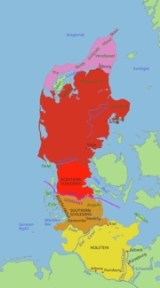
Holstein

Encyclopedia

Elbe
The Elbe is one of the major rivers of Central Europe. It rises in the Krkonoše Mountains of the northwestern Czech Republic before traversing much of Bohemia , then Germany and flowing into the North Sea at Cuxhaven, 110 km northwest of Hamburg...
and Eider
Eider River
The Eider is the longest river of the German state of Schleswig-Holstein. The river starts near Bordesholm and reaches the southwestern outskirts of Kiel on the shores of the Baltic Sea, but flows to the west, ending in the North Sea...
. It is part of Schleswig-Holstein
Schleswig-Holstein
Schleswig-Holstein is the northernmost of the sixteen states of Germany, comprising most of the historical duchy of Holstein and the southern part of the former Duchy of Schleswig...
, the northernmost state of Germany.
Holstein once existed as the County of Holstein , the later Duchy of Holstein , and was the northernmost territory of the Holy Roman Empire
Holy Roman Empire
The Holy Roman Empire was a realm that existed from 962 to 1806 in Central Europe.It was ruled by the Holy Roman Emperor. Its character changed during the Middle Ages and the Early Modern period, when the power of the emperor gradually weakened in favour of the princes...
. The history of Holstein is closely intertwined with the history of the Danish
Kingdom of Denmark
The Kingdom of Denmark or the Danish Realm , is a constitutional monarchy and sovereign state consisting of Denmark proper in northern Europe and two autonomous constituent countries, the Faroe Islands in the North Atlantic and Greenland in North America. Denmark is the hegemonial part, where the...
Duchy of Schleswig
Schleswig
Schleswig or South Jutland is a region covering the area about 60 km north and 70 km south of the border between Germany and Denmark; the territory has been divided between the two countries since 1920, with Northern Schleswig in Denmark and Southern Schleswig in Germany...
(Danish: Slesvig). The capital of Holstein is Kiel
Kiel
Kiel is the capital and most populous city in the northern German state of Schleswig-Holstein, with a population of 238,049 .Kiel is approximately north of Hamburg. Due to its geographic location in the north of Germany, the southeast of the Jutland peninsula, and the southwestern shore of the...
.
Holstein's name comes from the Holcetae, a Saxon
Saxons
The Saxons were a confederation of Germanic tribes originating on the North German plain. The Saxons earliest known area of settlement is Northern Albingia, an area approximately that of modern Holstein...
tribe mentioned by Adam of Bremen
Adam of Bremen
Adam of Bremen was a German medieval chronicler. He lived and worked in the second half of the eleventh century. He is most famous for his chronicle Gesta Hammaburgensis Ecclesiae Pontificum .-Background:Little is known of his life other than hints from his own chronicles...
as living on the north bank of the Elbe, to the west of Hamburg. The name means "dwellers in the wood" (Northern Low Saxon
Northern Low Saxon
Northern Low Saxon is a West Low German dialect.As such, it covers a great part of the West Low-German-speaking areas of northern Germany, with the exception of the border regions where Eastphalian and Westphalian are spoken...
: Hol(t)saten; ).
History
After the Migration PeriodMigration Period
The Migration Period, also called the Barbarian Invasions , was a period of intensified human migration in Europe that occurred from c. 400 to 800 CE. This period marked the transition from Late Antiquity to the Early Middle Ages...
of the Early Middle Ages
Early Middle Ages
The Early Middle Ages was the period of European history lasting from the 5th century to approximately 1000. The Early Middle Ages followed the decline of the Western Roman Empire and preceded the High Middle Ages...
, Holstein was a borderland between Nordalbingia
Nordalbingia
Nordalbingia was one of the four administrative regions of the medieval Duchy of Saxony, the others being Angria, Eastphalia, and Westphalia....
(part of Old Saxony
Old Saxony
Old Saxony is the original homeland of the Saxons in the northwest corner of modern Germany and roughly corresponds today with the contemporary Lower Saxony, Westphalia and western Saxony-Anhalt....
) at the coast of North Sea
North Sea
In the southwest, beyond the Straits of Dover, the North Sea becomes the English Channel connecting to the Atlantic Ocean. In the east, it connects to the Baltic Sea via the Skagerrak and Kattegat, narrow straits that separate Denmark from Norway and Sweden respectively...
, the land of the Slavic
Slavic peoples
The Slavic people are an Indo-European panethnicity living in Eastern Europe, Southeast Europe, North Asia and Central Asia. The term Slavic represents a broad ethno-linguistic group of people, who speak languages belonging to the Slavic language family and share, to varying degrees, certain...
Wagrians belonging to the Obotrites
Obotrites
The Obotrites , also commonly known as the Obodrites, Abotrites, or Abodrites, were a confederation of medieval West Slavic tribes within the territory of modern Mecklenburg and Holstein in northern Germany . For decades they were allies of Charlemagne in his wars against Germanic Saxons and Slavic...
at the coast of the Baltic Sea
Baltic Sea
The Baltic Sea is a brackish mediterranean sea located in Northern Europe, from 53°N to 66°N latitude and from 20°E to 26°E longitude. It is bounded by the Scandinavian Peninsula, the mainland of Europe, and the Danish islands. It drains into the Kattegat by way of the Øresund, the Great Belt and...
and the land of the Danes in Jutland
Jutland
Jutland , historically also called Cimbria, is the name of the peninsula that juts out in Northern Europe toward the rest of Scandinavia, forming the mainland part of Denmark. It has the North Sea to its west, Kattegat and Skagerrak to its north, the Baltic Sea to its east, and the Danish–German...
.
With the conquest of Old Saxony
Old Saxony
Old Saxony is the original homeland of the Saxons in the northwest corner of modern Germany and roughly corresponds today with the contemporary Lower Saxony, Westphalia and western Saxony-Anhalt....
by Charlemagne
Charlemagne
Charlemagne was King of the Franks from 768 and Emperor of the Romans from 800 to his death in 814. He expanded the Frankish kingdom into an empire that incorporated much of Western and Central Europe. During his reign, he conquered Italy and was crowned by Pope Leo III on 25 December 800...
ca. 800, he granted land north of the Eider River
Eider River
The Eider is the longest river of the German state of Schleswig-Holstein. The river starts near Bordesholm and reaches the southwestern outskirts of Kiel on the shores of the Baltic Sea, but flows to the west, ending in the North Sea...
to the Danes
Danes
Danish people or Danes are the nation and ethnic group that is native to Denmark, and who speak Danish.The first mention of Danes within the Danish territory is on the Jelling Rune Stone which mentions how Harald Bluetooth converted the Danes to Christianity in the 10th century...
by the Treaty of Heiligen
Treaty of Heiligen
The Treaty of Heiligen was signed at Heiligen in 811 between the Danish King Hemming and Charlemagne. Based on the terms of the accord, the southern boundary of Denmark was established at the Eider River...
signed in 811
811
Year 811 was a common year starting on Wednesday of the Julian calendar.- Byzantine Empire :...
. The rest of Holstein was given to Obotrites
Obotrites
The Obotrites , also commonly known as the Obodrites, Abotrites, or Abodrites, were a confederation of medieval West Slavic tribes within the territory of modern Mecklenburg and Holstein in northern Germany . For decades they were allies of Charlemagne in his wars against Germanic Saxons and Slavic...
, namely the Wagrians, and their Saxon population was deported to various areas of the empire. After 814
814
Year 814 was a common year starting on Sunday of the Julian calendar.- Europe :* Charlemagne dies in Aachen, aged 67 or 72...
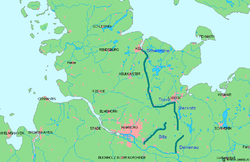
the Saxons were restored to Western Holstein. the Wagrians were pushed out of the Limes Saxoniae
Limes Saxoniae
The Limes Saxoniae , also known as the Limes Saxonicus or Sachsenwall , was a limes or border between the Saxons and the Slavic Obotrites, established about 810 in present-day Schleswig-Holstein....
- the new border running from the Elbe river near Boizenburg
Boizenburg
Boizenburg is a municipality in the Ludwigslust-Parchim district, in Mecklenburg-Western Pomerania, Germany. It is situated on the right bank of the Elbe, 53 km west of Ludwigslust, 25 km northeast of Lüneburg and 50 km east of Hamburg. Old Town is connected to the Elbe via a harbor...
northwards along the Bille
Bille
The river Bille is a small, slow-flowing river in Stormarn, Schleswig-Holstein, a right tributary of the Elbe. Its source is near Linau, north of the Hahnheide forest. It then flows south of Trittau, representing the border between Stormarn and Lauenburg, continues south of Reinbek and reaches the...
river to the mouth of the Schwentine
Schwentine
The Schwentine is a river in the North German state of Schleswig-Holstein. It is approximately 62 kilometres long and rises on the hill of Bungsberg, the highest point in the state, near the village of Kasseedorf in Ostholstein. It then runs from its source to Kiel where it flows into the Kiel...
at the Kiel Fjord
Kiel Fjord
Kiel Fjord is an approximately long fjord or firth of the Baltic Sea along the shores of Schleswig-Holstein, Germany. Formed by glacial movement during the last Ice Age, it lies between the Danish Wold and Wagria. It originates at the Hörn in centre-city Kiel and merges into the Bay of Kiel.The...
and the Baltic Sea
Baltic Sea
The Baltic Sea is a brackish mediterranean sea located in Northern Europe, from 53°N to 66°N latitude and from 20°E to 26°E longitude. It is bounded by the Scandinavian Peninsula, the mainland of Europe, and the Danish islands. It drains into the Kattegat by way of the Øresund, the Great Belt and...
. The new county of Holstein was established in 1111; it was first a fief of the Duchy of Saxony
Duchy of Saxony
The medieval Duchy of Saxony was a late Early Middle Ages "Carolingian stem duchy" covering the greater part of Northern Germany. It covered the area of the modern German states of Bremen, Hamburg, Lower Saxony, North Rhine-Westphalia, and Saxony-Anhalt and most of Schleswig-Holstein...
, then of the Duchy of Saxe-Lauenburg, and finally of the Prince-Bishopric of Lübeck. With the establishment of the new territorial unit, expansion to the East began and the Wagrians were finally defeated in 1138.
The County of Holstein was ruled by the House of Schaumburg; the first count was Adolf I, Count of Holstein. Holstein was occupied by Denmark
Denmark
Denmark is a Scandinavian country in Northern Europe. The countries of Denmark and Greenland, as well as the Faroe Islands, constitute the Kingdom of Denmark . It is the southernmost of the Nordic countries, southwest of Sweden and south of Norway, and bordered to the south by Germany. Denmark...
after the Battle of Stellau
Battle of Stellau
The Battle of Stellau was a battle that took place in the year 1201 near the village of Stellau, now part of Barsbüttel, near Wrist, in the German state of Schleswig-Holstein. A German army led by Count Adolf III of Holstein fought a Danish army under King Canute VI of Denmark...
(1201), but was reconquered by the Count of Schauenburg and his allies in the Battle of Bornhöved (1227)
Battle of Bornhöved (1227)
The Battle of Bornhöved took place on 22 July 1227 near Bornhöved in Holstein. Count Adolf IV of Schauenburg and Holstein — leading an army consisting of troops from the cities of Lübeck and Hamburg, about 1000 Dithmarsians and combined troops of Holstein next to various north German nobles —...
.
Partitions of the County of Holstein (1111-1474)
The Counts of Schauenburg and HolsteinCounts of Schauenburg and Holstein
The Counts of Schauenburg and Holstein were titles of the Holy Roman Empire. The dynastic family came from Schauenburg near Rinteln on the Weser in Germany...
partitioned Holstein several times among the inheriting sons into up to six lines, named after their towns of residence:
- Holstein-ItzehoeItzehoeItzehoe is a town in the German state of Schleswig-Holstein.As the capital of the district Steinburg, Itzehoe is located on the Stör, a navigable tributary of the Elbe, 51 km northwest of Hamburg and 24 km north of Glückstadt...
, branch county between 1261 and 1290, partitioned from Holstein, repartitioned into Holstein-Pinneberg, Holstein-Plön and Holstein-Rendsburg - Holstein-KielKielKiel is the capital and most populous city in the northern German state of Schleswig-Holstein, with a population of 238,049 .Kiel is approximately north of Hamburg. Due to its geographic location in the north of Germany, the southeast of the Jutland peninsula, and the southwestern shore of the...
, branch county between 1261 and 1390, partitioned from Holstein, in 1273 Holstein-Segeberg (first) was partitioned from Holstein-Kiel, but reverted in 1308, but then lost to Holstein-Pinneberg, Holstein-Plön and Holstein-Rendsburg in 1316; Holstein-Kiel acquired Holstein-Plön in 1350, and merged itself into Holstein-Rendsburg - Holstein-PinnebergPinnebergPinneberg is a town in Schleswig-Holstein, capital of the district Pinneberg in Germany. The town has 42,301 inhabitants. Pinneberg is located 18 km northwest of Hamburg....
, branch county between 1290 and 1640, partitioned from Holstein-Itzehoe, acquired a share of Holstein-Segeberg in 1316, merged into the Duchy of Holstein - Holstein-PlönPlönPlön is the district seat of the Plön district in Schleswig-Holstein, Germany, and has about 13,000 inhabitants. It lies right on the shores of Schleswig-Holstein's biggest lake, the Great Plön Lake, as well as on several smaller lakes, touching the town on virtually all sides...
, branch county between 1290 and 1390, partitioned from Holstein-Itzehoe, acquired a share of Holstein-Segeberg in 1316, merged into Holstein-Kiel - Holstein-RendsburgRendsburgRendsburg is a town on the River Eider and the Kiel Canal in the northeastern part of Schleswig-Holstein, Germany. It is the capital of the Kreis of Rendsburg-Eckernförde. As of 2006, it had a population of 28,476.-History:...
, branch county between 1290 and 1474, partitioned from Holstein-Itzehoe, acquired a share of Holstein-Segeberg (first) in 1316, and Holstein-Kiel in 1390, in 1381/1384 Holstein-Segeberg (second) was partitioned from Holstein-Rendsburg, but reverted in 1403, elevated to ducal rank in 1474 - Holstein-SegebergBad SegebergBad Segeberg is a German town of 16,000 inhabitants, located in the state of Schleswig-Holstein, capital of the district Segeberg. It is situated approximately northeast of Hamburg, and west of Lübeck.It is famous for its annual Karl-May-Festival...
(first), branch county between 1273 and 1308, partitioned from and reverted to Holstein-Kiel, but seized by allied Holstein-Pinneberg, Holstein-Plön, and Holstein-Rendsburg, partitioning Segeberg in three shares, each merged into one of the lines in 1316 - Holstein-Segeberg (second), branch county between 1381/1384 and 1403, partitioned from and reverted to Holstein-Rendsburg
In 1386 King Oluf II of Denmark
Olav IV of Norway
Olaf II Haakonsson was king of Denmark as Olaf II and king of Norway as Olaf IV . Olaf was son of King Haakon VI of Norway and the grandson of King Magnus IV of Sweden. His mother was Queen Margaret I of Denmark which made him the grandson of King Valdemar IV of Denmark...
and his mother-regent, Queen Margaret I
Margaret I of Denmark
Margaret I was Queen of Denmark, Norway and Sweden and founder of the Kalmar Union, which united the Scandinavian countries for over a century. Although she acted as queen regnant, the laws of contemporary Danish succession denied her formal queenship. Her title in Denmark was derived from her...
, enfeoffed in Nyborg
Nyborg
Nyborg is a city in central Denmark, located in Nyborg Municipality on the island of Funen and with a population of 16,492 . Nyborg is one of the 14 large municipalities created on 1 January 2007...
Gerhard VI, Count of Holstein-Rendsburg and his cognatic successors with the Duchy of Schleswig. He thus became as Gerhard II duke of Schleswig. Until 1390 the Rendsburg branch united by inheritance all branches except of that of Holstein-Pinneberg.
When the Holstein-Rendsburg line of the Schauenburg counts became extinct with the death of Adolf VIII of Holstein-Rendsburg (and in personal union
Personal union
A personal union is the combination by which two or more different states have the same monarch while their boundaries, their laws and their interests remain distinct. It should not be confused with a federation which is internationally considered a single state...
as Adolf I Duke of Schleswig) in 1459, Christian I of Denmark
Christian I of Denmark
Christian I was a Danish monarch, king of Denmark , Norway and Sweden , under the Kalmar Union. In Sweden his short tenure as monarch was preceded by regents, Jöns Bengtsson Oxenstierna and Erik Axelsson Tott and succeeded by regent Kettil Karlsson Vasa...
inherited – from his maternal uncle Adolf I – the Duchy of Schleswig, a Danish fief. Through the Treaty of Ribe
Treaty of Ribe
The Treaty of Ribe was a proclamation at Ribe made by King Christian I of Denmark to a number of German nobles enabling himself to become Count of Holstein and regain control of Denmark's lost Duchy of Schleswig...
(1460) Christian was elected Count of Holstein-Rendsburg, a Saxe-Lauenburgian subfief within the Holy Roman Empire. In 1474 Lauenburg's liege lord
Liege Lord
Liege Lord was an American speed/power metal band, active in the 1980s and considered to be a pioneer of the genre. It was formed by Matt Vinci, Anthony Truglio and Frank Cortese....
Emperor Frederick III
Frederick III, Holy Roman Emperor
Frederick the Peaceful KG was Duke of Austria as Frederick V from 1424, the successor of Albert II as German King as Frederick IV from 1440, and Holy Roman Emperor as Frederick III from 1452...
elevated Christian I as Count of Holstein-Rendsburg to Duke of Holstein, thus becoming an immediate imperial (reichsunmittelbar) vassal
Vassal
A vassal or feudatory is a person who has entered into a mutual obligation to a lord or monarch in the context of the feudal system in medieval Europe. The obligations often included military support and mutual protection, in exchange for certain privileges, usually including the grant of land held...
(see imperial immediacy). The Duchy of Holstein retained that status until the dissolution of the Empire in 1806.
Partitions of the Duchy of Holstein (1474-1866)
In 1490, the Duchy of Holstein was divided into Holstein-Segeberg and Holstein-GottorpHolstein-Gottorp
Holstein-Gottorp or Schleswig-Holstein-Gottorp is the historiographical name, as well as contemporary shorthand name, for the parts of the duchies of Schleswig and Holstein that were ruled by the dukes of Schleswig-Holstein-Gottorp. Other parts of the duchies were ruled by the kings of Denmark. The...
. Holstein-Segeberg remained with the Danish king and was also known as Royal Holstein; later it came to be known as Holstein-Glückstadt
Holstein-Glückstadt
The Duchy of Holstein in Glückstadt was the northernmost state of the Holy Roman Empire. It consisted of the part of Holstein that was ruled by the king of Denmark; its capital was Glückstadt on the River Elbe.-History:...
. Holstein-Gottorp, also known as Ducal Holstein, was given to a cadet branch of the House of Oldenburg
House of Oldenburg
The House of Oldenburg is a North German dynasty and one of Europe's most influential Royal Houses with branches that rule or have ruled in Denmark, Russia, Greece, Norway, Schleswig, Holstein, Oldenburg and Sweden...
, to which the kings of Denmark belonged.
Between 1533 and 1544 King Christian III of Denmark
Christian III of Denmark
Christian III reigned as king of Denmark and Norway. He was the eldest son of King Frederick I and Anna of Brandenburg.-Childhood:...
ruled the entire Duchies of Holstein and of Schleswig also in the name of his then still minor half-brothers John the Elder
John II, Duke of Schleswig-Holstein-Haderslev
John the Elder was the only Duke of Schleswig-Holstein-Haderslev. The predicate the Elder is sometimes used to distinguish him from his nephew John the Younger, who held Sønderborg from 1564 as a partitioned-off duke...
and Adolf
Adolf, Duke of Holstein-Gottorp
Adolf of Holstein-Gottorp was the first Duke of Holstein-Gottorp from the line of Holstein-Gottorp of the House of Oldenburg....
. In 1544 they partitioned the Duchies of Holstein (a fief of the Holy Roman Empire) and of Schleswig (a Danish fief) in an unusual way, following negotiations between the brothers and the Estates of the Realm
Estates of the realm
The Estates of the realm were the broad social orders of the hierarchically conceived society, recognized in the Middle Ages and Early Modern period in Christian Europe; they are sometimes distinguished as the three estates: the clergy, the nobility, and commoners, and are often referred to by...
of the duchies, which had constituted in 1460 by the Treaty of Ribe and strictly opposed a factual partition. The elder three brothers determined their youngest brother Frederick, Prince of Denmark for a career as Lutheran administrator of an ecclesiastical state within the Holy Roman Empire.
So the revenues of the duchies were divided in three equal shares by assigning the revenues of particular areas and landed estates to each of the elder brothers, while other general revenues, such as taxes from towns and customs dues, were levied together but then shared among the brothers. The estates, whose revenues were assigned to the parties, made Holstein and Schleswig look like patchworks, technically inhibiting the emergence of separate new duchies, as intended by the estates of the duchies. The secular rule in the fiscally divided duchies thus became a condominium
Condominium
A condominium, or condo, is the form of housing tenure and other real property where a specified part of a piece of real estate is individually owned while use of and access to common facilities in the piece such as hallways, heating system, elevators, exterior areas is executed under legal rights...
of the parties. As dukes of Holstein and Schleswig the rulers of both houses bore the formal title of "Duke of Schleswig, Holstein, Ditmarsh and Stormarn
Stormarn
Stormarn is a district in Schleswig-Holstein, Germany. It is bounded by the districts of Segeberg and Ostholstein, the city of Lübeck, the district of Lauenburg, and the city-state of Hamburg.-History:...
". The three shares are usually called:
- GottorpGottorpGottorf Castle is a castle and estate in the city of Schleswig, Schleswig-Holstein, Germany. It is the ancestral home of the Holstein-Gottorp branch of the House of Oldenburg...
ducal share in Holstein and Schleswig, partitioned from ducal Holstein in 1544, acquired half of Haderslev share in 1580 (thus thereafter simply called ducal share), merged into the royal share in 1773 with its ruler receiving in return the prior Danish-held County of Oldenburg. - HaderslevHaderslevHaderslev is a town and municipality on the east coast of the Jutland peninsula in south Denmark. Also included is the island of Årø as well as several other smaller islands in the Little Belt. The municipality covers and has a population of 56,414 . Its mayor is Jens Christian Gjesing,...
ducal share in Holstein and Schleswig, partitioned from ducal Holstein in 1544, halfed between Gottorp and royal share in 1580 - Royal share in Holstein and Schleswig, acquired half of Haderslev share in 1580, the County of Holstein-Pinneberg in 1640 and the Gottorp share in 1773, thus then comprising all of Holstein. Between 1648 and 1773 the royal share used to be called Holstein-GlückstadtHolstein-GlückstadtThe Duchy of Holstein in Glückstadt was the northernmost state of the Holy Roman Empire. It consisted of the part of Holstein that was ruled by the king of Denmark; its capital was Glückstadt on the River Elbe.-History:...
after its capital GlückstadtGlückstadtGlückstadt is a town in the Steinburg district of Schleswig-Holstein, Germany. It is located on the right bank of the Lower Elbe at the confluence of the small Rhin river, about northwest of Altona...
.
The dynastic name Holstein-Gottorp comes as convenient usage from the technically more correct Duke of Schleswig and Holstein at Gottorp. Adolf, the third son of Duke and King Frederick I
Frederick I of Denmark
Frederick I of Denmark and Norway was the King of Denmark and Norway. The name is also spelled Friedrich in German, Frederik in Danish, and Fredrik in Swedish and Norwegian...
and the second youngest half-brother of King Christian III
Christian III of Denmark
Christian III reigned as king of Denmark and Norway. He was the eldest son of King Frederick I and Anna of Brandenburg.-Childhood:...
, founded the dynastic branch called House of Holstein-Gottorp
House of Holstein-Gottorp
The House of Holstein-Gottorp, a cadet branch of the Oldenburg dynasty, ruled Sweden from 1751 until 1818, and Norway from 1814 to 1818.In 1743 Adolf Frederick of Holstein-Gottorp was elected crown prince of Sweden as a Swedish concession to Russia, a strategy for achieving an acceptable peace...
, which is a cadet branch of the then royal Danish House of Oldenburg
House of Oldenburg
The House of Oldenburg is a North German dynasty and one of Europe's most influential Royal Houses with branches that rule or have ruled in Denmark, Russia, Greece, Norway, Schleswig, Holstein, Oldenburg and Sweden...
. The Danish monarchs and the Dukes of Holstein-Gottorp ruled both duchies together as to general government, however, collected their revenues in their separate estates. John the Elder conveniently called Duke of Schleswig-Holstein-Haderslev produced no issue, so no branch emerged from his side.
Similar to the above-mentioned agreement Christian III's youngest son John the Younger gained for him and his heirs a share in Holstein's and Schleswig's revenues in 1564, comprising a third of the royal share, thus a ninth of Holstein and Schleswig as to the fiscal point of view. John the Younger and his heirs, however, had no share in the condominial rule, so they were not ruling but mere titular dukes.
The share of John the Elder, who died in 1580, was halved between Adolf and Frederick II, thus increasing again the royal share by a fiscal sixth of Holstein and Schleswig. As an effect the complicated fiscal division of both separate duchies, Holstein and Schleswig, with shares of each party scattered in both duchies, provided them with a condominial government binding both together, partially superseding their legally different affiliation as Holy Roman and Danish fiefs.
The County of Holstein-Pinneberg, which had remained a separately ruled territory in Holstein until its line was extinct in 1640, was merged into the then royal share of the Duchy of Holstein. The Duke of Holstein-Gottorp became emperor of Russia in 1762 as Peter III
Peter III of Russia
Peter III was Emperor of Russia for six months in 1762. He was very pro-Prussian, which made him an unpopular leader. He was supposedly assassinated as a result of a conspiracy led by his wife, who succeeded him to the throne as Catherine II.-Early life and character:Peter was born in Kiel, in...
and was planning an attack on Denmark to recover the Holstein-Gottorp
Holstein-Gottorp
Holstein-Gottorp or Schleswig-Holstein-Gottorp is the historiographical name, as well as contemporary shorthand name, for the parts of the duchies of Schleswig and Holstein that were ruled by the dukes of Schleswig-Holstein-Gottorp. Other parts of the duchies were ruled by the kings of Denmark. The...
lands possessions in Schleswig, which were seized by the Danish king in 1713. Although Peter was soon overthrown by his wife, Catherine the Great, the Danes determined to rid themselves of this problem. In 1773, they exchanged the County of Oldenburg
Oldenburg (state)
Oldenburg — named after its capital, the town of Oldenburg — was a state in the north of present-day Germany. Oldenburg survived from 1180 until 1918 as a county, duchy and grand duchy, and from 1918 until 1946 as a free state. It was located near the mouth of the River Weser...
for the Gottorp lands in Holstein, bringing all of Holstein under their control. Thus, Holstein was again united in one state.
United Holstein
With the dissolution of the Holy Roman EmpireHoly Roman Empire
The Holy Roman Empire was a realm that existed from 962 to 1806 in Central Europe.It was ruled by the Holy Roman Emperor. Its character changed during the Middle Ages and the Early Modern period, when the power of the emperor gradually weakened in favour of the princes...
in 1806 Holstein's imperial vassal status turned void. It thus became a sovereign state. Because of its personal union
Personal union
A personal union is the combination by which two or more different states have the same monarch while their boundaries, their laws and their interests remain distinct. It should not be confused with a federation which is internationally considered a single state...
with Denmark, the Duchy of Holstein did not come under French occupation during the Napoleonic era
Napoleonic Era
The Napoleonic Era is a period in the history of France and Europe. It is generally classified as including the fourth and final stage of the French Revolution, the first being the National Assembly, the second being the Legislative Assembly, and the third being the Directory...
. From 1815 to 1864 it was a member of the German Confederation
German Confederation
The German Confederation was the loose association of Central European states created by the Congress of Vienna in 1815 to coordinate the economies of separate German-speaking countries. It acted as a buffer between the powerful states of Austria and Prussia...
, though still in personal union
Personal union
A personal union is the combination by which two or more different states have the same monarch while their boundaries, their laws and their interests remain distinct. It should not be confused with a federation which is internationally considered a single state...
with Denmark (the King of Denmark being also Duke of Holstein).
Frederick VII of Denmark
Frederick VII was a King of Denmark. He reigned from 1848 until his death. He was the last Danish monarch of the older Royal branch of the House of Oldenburg and also the last king of Denmark to rule as an absolute monarch...
(House of Oldenburg
House of Oldenburg
The House of Oldenburg is a North German dynasty and one of Europe's most influential Royal Houses with branches that rule or have ruled in Denmark, Russia, Greece, Norway, Schleswig, Holstein, Oldenburg and Sweden...
) in 1863, the inheritance of Schleswig and Holstein was disputed. The new king, Christian IX
Christian IX of Denmark
Christian IX was King of Denmark from 16 November 1863 to 29 January 1906.Growing up as a prince of Schleswig-Holstein-Sonderburg-Glücksburg, a junior branch of the House of Oldenburg which had ruled Denmark since 1448, Christian was originally not in the immediate line of succession to the Danish...
(House of Schleswig-Holstein-Sonderburg-Glücksburg, a cadet branch of the House of Oldenburg), made his claim to the Danish throne through a female line. The Duke of Augustenborg
Duke of Augustenborg
The House of Schleswig-Holstein-Sonderburg-Augustenburg was a branch of the dukes of Schleswig-Holstein-Sonderburg of the House of Oldenburg. The line descended from Alexander, Duke of Schleswig-Holstein-Sonderburg...
, a minor scion from another cadet line of the House of Oldenburg, claimed the Duchies, and soon the German Confederation, led by Prussia
Prussia
Prussia was a German kingdom and historic state originating out of the Duchy of Prussia and the Margraviate of Brandenburg. For centuries, the House of Hohenzollern ruled Prussia, successfully expanding its size by way of an unusually well-organized and effective army. Prussia shaped the history...
and Austria
Austria
Austria , officially the Republic of Austria , is a landlocked country of roughly 8.4 million people in Central Europe. It is bordered by the Czech Republic and Germany to the north, Slovakia and Hungary to the east, Slovenia and Italy to the south, and Switzerland and Liechtenstein to the...
, went to the Second Schleswig War with Denmark, quickly defeating it in 1864 and forcing it to cede the duchies.
However, the duchies were not given to the Duke of Augustenborg. In 1865 an arrangement was worked out between Prussia and Austria where the Austrians occupied and administered Holstein, while the Prussians did the same in Schleswig. This arrangement came to an end with the Austro-Prussian War
Austro-Prussian War
The Austro-Prussian War was a war fought in 1866 between the German Confederation under the leadership of the Austrian Empire and its German allies on one side and the Kingdom of Prussia with its German allies and Italy on the...
of 1866, which resulted in Schleswig and Holstein both being incorporated into Prussia as the Province of Schleswig-Holstein
Province of Schleswig-Holstein
The Province of Schleswig-Holstein was a province of the Kingdom of Prussia and the Free State of Prussia from 1868 to 1946. It was created from the Duchies of Schleswig and Holstein, which had been conquered by Prussia and the Austrian Empire from Denmark in the Second War of Schleswig in 1864...
. Holstein, meanwhile including former Saxe-Lauenburg (as of 1876) and the former Free and Hanseatic City of Lübeck and Region of Lübeck (both as of 1937) regained statehood, now united with Schleswig, in 1946, when the British occupation government elevated the province to the State of Schleswig-Holstein
Schleswig-Holstein
Schleswig-Holstein is the northernmost of the sixteen states of Germany, comprising most of the historical duchy of Holstein and the southern part of the former Duchy of Schleswig...
, followed by the official dissolution of Prussia in 1947.
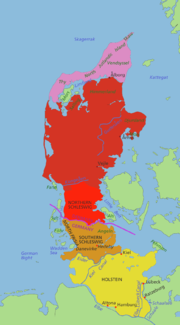
Counts of Schauenburg and Holstein
The Counts of Schauenburg and Holstein were titles of the Holy Roman Empire. The dynastic family came from Schauenburg near Rinteln on the Weser in Germany...
and List of rulers of Schleswig-Holstein.
Geography
As of 1864, Holstein bordered DenmarkDenmark
Denmark is a Scandinavian country in Northern Europe. The countries of Denmark and Greenland, as well as the Faroe Islands, constitute the Kingdom of Denmark . It is the southernmost of the Nordic countries, southwest of Sweden and south of Norway, and bordered to the south by Germany. Denmark...
in the north, the Principality of Lübeck (formerly the Prince-Bishopric of Lübeck, an exclave of the Grand Duchy of Oldenburg), the Free and Hanseatic City of Lübeck, and the Duchy of Saxe-Lauenburg
Duchy of Saxe-Lauenburg
The Duchy of Saxe-Lauenburg between the 14th and 17th centuries), later also known as the Duchy of Lauenburg, was a reichsfrei duchy that existed 1296–1803 and 1814–1876 in the extreme southeast region of what is now Schleswig-Holstein...
in the east, and the Kingdom of Hanover
Kingdom of Hanover
The Kingdom of Hanover was established in October 1814 by the Congress of Vienna, with the restoration of George III to his Hanoverian territories after the Napoleonic era. It succeeded the former Electorate of Brunswick-Lüneburg , and joined with 38 other sovereign states in the German...
and the Free and Hanseatic City of Hamburg in the south. It also borders the North Sea
North Sea
In the southwest, beyond the Straits of Dover, the North Sea becomes the English Channel connecting to the Atlantic Ocean. In the east, it connects to the Baltic Sea via the Skagerrak and Kattegat, narrow straits that separate Denmark from Norway and Sweden respectively...
in the west and the Baltic Sea
Baltic Sea
The Baltic Sea is a brackish mediterranean sea located in Northern Europe, from 53°N to 66°N latitude and from 20°E to 26°E longitude. It is bounded by the Scandinavian Peninsula, the mainland of Europe, and the Danish islands. It drains into the Kattegat by way of the Øresund, the Great Belt and...
in the east. Its only major island is Fehmarn
Fehmarn
Fehmarn is an island and - since 2003 - a town on this island in the Baltic Sea, off the eastern coast of Schleswig-Holstein, Germany, and ca. 18 kilometers south of the Danish island of Lolland...
, originally a part of the Duchy of Schleswig until 1867.
Cities in Holstein included Kiel
Kiel
Kiel is the capital and most populous city in the northern German state of Schleswig-Holstein, with a population of 238,049 .Kiel is approximately north of Hamburg. Due to its geographic location in the north of Germany, the southeast of the Jutland peninsula, and the southwestern shore of the...
, Altona
Altona, Hamburg
Altona is the westernmost urban borough of the German city state of Hamburg, on the right bank of the Elbe river. From 1640 to 1864 Altona was under the administration of the Danish monarchy. Altona was an independent city until 1937...
, Glückstadt
Glückstadt
Glückstadt is a town in the Steinburg district of Schleswig-Holstein, Germany. It is located on the right bank of the Lower Elbe at the confluence of the small Rhin river, about northwest of Altona...
, Rendsburg
Rendsburg
Rendsburg is a town on the River Eider and the Kiel Canal in the northeastern part of Schleswig-Holstein, Germany. It is the capital of the Kreis of Rendsburg-Eckernförde. As of 2006, it had a population of 28,476.-History:...
, Segeberg
Bad Segeberg
Bad Segeberg is a German town of 16,000 inhabitants, located in the state of Schleswig-Holstein, capital of the district Segeberg. It is situated approximately northeast of Hamburg, and west of Lübeck.It is famous for its annual Karl-May-Festival...
, Heiligenhafen
Heiligenhafen
Heiligenhafen is a town in the district of Ostholstein, in Schleswig-Holstein, Germany. It is situated on the Baltic Sea coast, opposite the island Fehmarn, approx. 60 km northeast of Lübeck, and 55 km east of Kiel.-Geography:...
, Oldenburg in Holstein, and Plön
Plön
Plön is the district seat of the Plön district in Schleswig-Holstein, Germany, and has about 13,000 inhabitants. It lies right on the shores of Schleswig-Holstein's biggest lake, the Great Plön Lake, as well as on several smaller lakes, touching the town on virtually all sides...
. It had an area of 8,385 km².