

Obotrites

Encyclopedia
West Slavs
The West Slavs are Slavic peoples speaking West Slavic languages. They include Poles , Czechs, Slovaks, Lusatian Sorbs and the historical Polabians. The northern or Lechitic group includes, along with Polish, the extinct Polabian and Pomeranian languages...
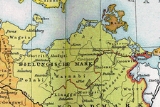
tribes within the territory of modern Mecklenburg
Mecklenburg
Mecklenburg is a historical region in northern Germany comprising the western and larger part of the federal-state Mecklenburg-Vorpommern...
and Holstein
Holstein
Holstein is the region between the rivers Elbe and Eider. It is part of Schleswig-Holstein, the northernmost state of Germany....
in northern Germany
Germany
Germany , officially the Federal Republic of Germany , is a federal parliamentary republic in Europe. The country consists of 16 states while the capital and largest city is Berlin. Germany covers an area of 357,021 km2 and has a largely temperate seasonal climate...
(see Polabian Slavs
Polabian Slavs
Polabian Slavs - is a collective term applied to a number of Lechites tribes who lived along the Elbe river, between the Baltic Sea to the north, the Saale and the Limes Saxoniae to the west, the Ore Mountains and the Western Sudetes to the south, and Poland to the east. They have also been known...
). For decades they were allies of Charlemagne
Charlemagne
Charlemagne was King of the Franks from 768 and Emperor of the Romans from 800 to his death in 814. He expanded the Frankish kingdom into an empire that incorporated much of Western and Central Europe. During his reign, he conquered Italy and was crowned by Pope Leo III on 25 December 800...
in his wars against Germanic Saxons
Saxons
The Saxons were a confederation of Germanic tribes originating on the North German plain. The Saxons earliest known area of settlement is Northern Albingia, an area approximately that of modern Holstein...
and Slavic Veleti
Veleti
The Veleti or Wilzi were a group of medieval Lechites tribes within the territory of modern northeastern Germany; see Polabian Slavs. In common with other Slavic groups between the Elbe and Oder Rivers, they were often described by Germanic sources as Wends. In the late 10th century, they were...
. In 798 the Obodrites, ruled by prince Drożko
Drozko
Drożko or Drażko - kniaź of the Obotrites in the 9th century, son of Witzlaus II of Obotrites...
, or Draško (Thrasco, orig.), defeated Saxons
Saxons
The Saxons were a confederation of Germanic tribes originating on the North German plain. The Saxons earliest known area of settlement is Northern Albingia, an area approximately that of modern Holstein...
in the battle on Swentana river. The still heathen Saxons were dispersed by the emperor, and the part of their former land in Holstein
Holstein
Holstein is the region between the rivers Elbe and Eider. It is part of Schleswig-Holstein, the northernmost state of Germany....
north of Elbe
Elbe
The Elbe is one of the major rivers of Central Europe. It rises in the Krkonoše Mountains of the northwestern Czech Republic before traversing much of Bohemia , then Germany and flowing into the North Sea at Cuxhaven, 110 km northwest of Hamburg...
was awarded to the Obotrites in 804, as a reward for their victory. This however was soon reverted through an invasion of the Danes
Danes
Danish people or Danes are the nation and ethnic group that is native to Denmark, and who speak Danish.The first mention of Danes within the Danish territory is on the Jelling Rune Stone which mentions how Harald Bluetooth converted the Danes to Christianity in the 10th century...
.
History
As allies of the CarolingianCarolingian
The Carolingian dynasty was a Frankish noble family with origins in the Arnulfing and Pippinid clans of the 7th century AD. The name "Carolingian", Medieval Latin karolingi, an altered form of an unattested Old High German *karling, kerling The Carolingian dynasty (known variously as the...
kings and the empire of their Ottonian successors, the Obotrites fought from 808 to 1200 against the kings of Denmark, who wished to rule the Baltic region
Baltic region
The terms Baltic region, Baltic Rim countries, and Baltic Rim refer to slightly different combinations of countries in the general area surrounding the Baltic Sea.- Etymology :...
independently of the empire. When opportunities arose, for instance upon the death of an emperor, they would seek to seize power; and in 983 Hamburg
Hamburg
-History:The first historic name for the city was, according to Claudius Ptolemy's reports, Treva.But the city takes its modern name, Hamburg, from the first permanent building on the site, a castle whose construction was ordered by the Emperor Charlemagne in AD 808...
was destroyed by the Obotrites under their king, Mstivoj
Mstivoj
Mstivoj was an Obodrite prince from 965 or 967 until his death. He inherited his position along with his brother Mstidrag from their father Nako in an unknown year.-Name:...
. At times they levied tribute from the Danes and Saxons
Saxons
The Saxons were a confederation of Germanic tribes originating on the North German plain. The Saxons earliest known area of settlement is Northern Albingia, an area approximately that of modern Holstein...
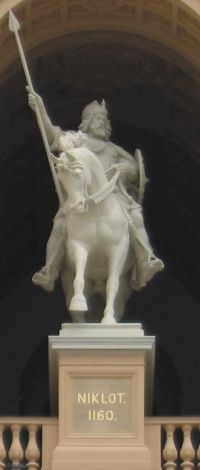
. Under the leadership of Niklot
Niklot
Niklot or Nyklot was a pagan chief or prince of the Slavic Obotrites and an ancestor of the House of Mecklenburg. From 1130 or 1131 until his death he was chief of the Obotrite confederacy, the Kissini, and the Circipani. At the same time he was Lord of Schwerin, Quetzin, and Malchow...
, they resisted a Christian assault during the Wendish Crusade
Wendish Crusade
The Wendish Crusade was an 1147 campaign, one of the Northern Crusades and also a part of the Second Crusade, led primarily by the Kingdom of Germany inside the Holy Roman Empire and directed against the Polabian Slavs ....
.
German missionaries such as St Vicelinus
Vicelinus
Saint Vicelinus was a German bishop of Oldenburg in Holstein who was considered the apostle of Holstein.Orphaned at an early age, Vicelinus received his primary education at Hamelin, his birthplace...
converted the Obotrites to Christianity
Christianity
Christianity is a monotheistic religion based on the life and teachings of Jesus as presented in canonical gospels and other New Testament writings...
. In 1170 they acknowledged the suzerainty of the Holy Roman Empire
Holy Roman Empire
The Holy Roman Empire was a realm that existed from 962 to 1806 in Central Europe.It was ruled by the Holy Roman Emperor. Its character changed during the Middle Ages and the Early Modern period, when the power of the emperor gradually weakened in favour of the princes...
, leading to Germanisation
Germanisation
Germanisation is both the spread of the German language, people and culture either by force or assimilation, and the adaptation of a foreign word to the German language in linguistics, much like the Romanisation of many languages which do not use the Latin alphabet...
and assimilation over the following centuries. However up to the late 15th century most villagers in the Obotritic area were still speaking Slavic dialects (Polabian language
Polabian language
The Polabian language is an extinct West Slavic language that was spoken by the Polabian Slavs in present-day North-Eastern Germany around the Elbe river, from which derives its name...
), although subsequently their language changed to German
German language
German is a West Germanic language, related to and classified alongside English and Dutch. With an estimated 90 – 98 million native speakers, German is one of the world's major languages and is the most widely-spoken first language in the European Union....
. The Polabian language survived until the beginning of the 19th century in what is now the German state of Lower Saxony
Lower Saxony
Lower Saxony is a German state situated in north-western Germany and is second in area and fourth in population among the sixteen states of Germany...
.
Some of the Obotrites also migrated to the south and settled in the Pannonian Plain, where the Bodrogiensis
Bács-Bodrog
Bács-Bodrog County was the administrative county of the Habsburg Kingdom of Hungary from 18th century to 1918. Its territory is currently in northern Serbia and southern Hungary. The capital of the county was Zombor .-Name:The county was named after two older counties: Bács and Bodrog...
county of the medieval Kingdom of Hungary
Kingdom of Hungary
The Kingdom of Hungary comprised present-day Hungary, Slovakia and Croatia , Transylvania , Carpatho Ruthenia , Vojvodina , Burgenland , and other smaller territories surrounding present-day Hungary's borders...
was named after them.
Obotritic confederation tribes
Bavarian Geographer
The Bavarian Geographer is a conventional name given by Jan Potocki in 1796 to the author of an anonymous medieval document Descriptio civitatum et regionum ad septentrionalem plagam Danubii ....
, an anonymous medieval document compiled in Regensburg
Regensburg
Regensburg is a city in Bavaria, Germany, located at the confluence of the Danube and Regen rivers, at the northernmost bend in the Danube. To the east lies the Bavarian Forest. Regensburg is the capital of the Bavarian administrative region Upper Palatinate...
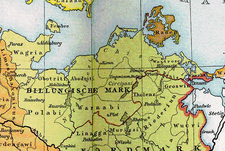
in 830, contains a list of the tribes in Central Eastern Europe to the east of the Elbe. The list includes the Nortabtrezi (Obotrites) - with 53 civitates.
Adam of Bremen
Adam of Bremen
Adam of Bremen was a German medieval chronicler. He lived and worked in the second half of the eleventh century. He is most famous for his chronicle Gesta Hammaburgensis Ecclesiae Pontificum .-Background:Little is known of his life other than hints from his own chronicles...
referred to them as the Reregi because of their lucrative trade emporium Reric
Reric
Reric or Rerik was one of the Viking Age multi-ethnic Slavic-Scandinavian emporia on the southern coast of the Baltic Sea, located near Wismar in the present-day German state of Mecklenburg-Vorpommern Reric was built around 700, when Slavs of the Obodrite tribe settled the region...
. In common with other Slavic groups, they were often described by Germanic sources as Wends
Wends
Wends is a historic name for West Slavs living near Germanic settlement areas. It does not refer to a homogeneous people, but to various peoples, tribes or groups depending on where and when it is used...
.
The main tribes of the Obotritic confederation were:
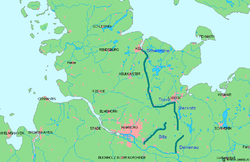
- the Obotrites proper (Wismar Bay to Lake SchwerinSchweriner SeeThe Schweriner See is a lake in Mecklenburg-Vorpommern, northern Germany. It was named after the city Schwerin, on its southwestern shore. The smaller town Bad Kleinen is on the north shore of the lake. Its surface is approximately 61.54 km² and its maximum depth is 52.4 metres...
); - the Wagrians (the eastern HolsteinHolsteinHolstein is the region between the rivers Elbe and Eider. It is part of Schleswig-Holstein, the northernmost state of Germany....
as part of SaxonyOld SaxonyOld Saxony is the original homeland of the Saxons in the northwest corner of modern Germany and roughly corresponds today with the contemporary Lower Saxony, Westphalia and western Saxony-Anhalt....
); - the Warnower (the upper WarnowWarnowThe Warnow is a river in the state of Mecklenburg-Vorpommern in Germany. It flows into the Baltic Sea near the town of Rostock, in its borough Warnemünde....
and MildenitzMildenitzMildenitz is a municipality in the district Mecklenburgische Seenplatte, in Mecklenburg-Vorpommern, Germany....
); - the Polabians properPolabians (tribe)The Polabians were a constituent Lechitic tribe of the Obotrites who lived between the Trave and the Elbe. The main settlement of the Polabians was Racisburg , named after their Prince Ratibor...
(between the TraveTraveThe Trave is a river in Schleswig-Holstein, Germany. It is approximately 124 kilometres long, running from its source near the village of Gießelrade in Ostholstein to Travemünde where it flows into the Baltic Sea. It passes through Bad Segeberg, Bad Oldesloe, and Lübeck, where it is linked to the...
and the ElbeElbeThe Elbe is one of the major rivers of Central Europe. It rises in the Krkonoše Mountains of the northwestern Czech Republic before traversing much of Bohemia , then Germany and flowing into the North Sea at Cuxhaven, 110 km northwest of Hamburg...
).
Other tribes associated with the confederation include:
- the Linonen near LenzenLenzenLenzen is a small town in the district of Prignitz, in Brandenburg, Germany. It is part of the Amt Lenzen-Elbtalaue.-Overview:Lenzen is situated near the Elbe, approx. 20 km northwest of Wittenberge. It was the scene of an early victory by the Germans over the Wends in 929...
, - the Travnjane near the TraveTraveThe Trave is a river in Schleswig-Holstein, Germany. It is approximately 124 kilometres long, running from its source near the village of Gießelrade in Ostholstein to Travemünde where it flows into the Baltic Sea. It passes through Bad Segeberg, Bad Oldesloe, and Lübeck, where it is linked to the...
, - the DrevaniDrevaniThe Drevani were a tribe of Polabian Slavs settling on the Elbe river in the area of the present-day Lüchow-Dannenberg district of Lower Saxony, Germany....
in the Hanoverian WendlandLüchow-DannenbergLüchow-Dannenberg is a district in Lower Saxony, Germany which is usually referred to as Hannoversches Wendland or Wendland. It is bounded by the districts of Uelzen and Lüneburg and the states of Mecklenburg-Western Pomerania , Brandenburg and Saxony-Anhalt Lüchow-Dannenberg is a district in...
and the northern AltmarkAltmarkThe Altmark is a historic region in Germany, comprising the northern third of Saxony-Anhalt. As the initial territory of the Brandenburg margraves, it is sometimes referred to as the "Cradle of Prussia", as by Otto von Bismarck, a native from Schönhausen near Stendal.- Geography :The Altmark is...
.
List of Obotrite leaders
- For later rulers please refer to → List of Dukes and Grand Dukes of Mecklenburg
This list is a based-on work:
- Witzlaus I of Obotrites (d. 700)
- Aribert I of Obotrites (700 - 724)
- Aribert II of Obotrites (724 - 747)
- Witzlaus II of ObotritesWitzlaus II of ObotritesWitzlaus II of Obotrites also known by name Witzan was prince of the confederation of Obotrites, Slavic nation settled on the shores of Baltic sea on the areas of nowadays Mecklenburg and Holstein...
(747 - 795) - Dro%C5%BCko (795 - 808)
- Slavomir of Obotrites (810 - 819)
Ally of Frankish Empire. In 816 he joined rebellion of the Sorbs
Sorbs
Sorbs are a Western Slavic people of Central Europe living predominantly in Lusatia, a region on the territory of Germany and Poland. In Germany they live in the states of Brandenburg and Saxony. They speak the Sorbian languages - closely related to Polish and Czech - officially recognized and...
. Eventually captured and abandoned by his own people, being replaced by Ceadrag in 818.
- Ceadrag of Obodrites (Czedrag) (819 - after 826)
Ally of Frankish Empire. He rebelled against the Franks with alliance with the Danes, but later was reconciled with Franks.
- Selibur
- Nakon (954 - 966)
- MstivojMstivojMstivoj was an Obodrite prince from 965 or 967 until his death. He inherited his position along with his brother Mstidrag from their father Nako in an unknown year.-Name:...
(966 - 995) - Mieceslas III of Obotrites (919 - 999)
In 995
995
Year 995 was a common year starting on Tuesday of the Julian calendar.- Europe :* Upon the death of Eric the Victorious, he is succeeded by his son Olof Skötkonung as the first baptized king of Sweden....
defeated by Otto III, Holy Roman Emperor
Otto III, Holy Roman Emperor
Otto III , a King of Germany, was the fourth ruler of the Saxon or Ottonian dynasty of the Holy Roman Empire. He was elected King in 983 on the death of his father Otto II and was crowned Holy Roman Emperor in 996.-Early reign:...
.
- Mstislav (996 - 1018)
- UdoUdo (Obotrite prince)Udo , born Pribignev , was an Obodrite leader in the early eleventh century. His name Udo, of Germanic origin, was probably given him at his Christian baptism, perhaps after his possible godfather, Lothair Udo I of Stade...
(Przybigniew) ( 1018 - 1028) - RatiborRatibor (Polabian prince)Ratibor was a prince of the Obotrite confederacy from the Polabian tribe. His capital was Racisburg, which was named in his honor....
(1028 - 1043) - Gottschalk (Obotrite prince) (1043 to 1066)
- BudivojBudivojBudivoj, Buthue, or Butue was the eldest son of Gottschalk, an Abodrite prince, by a mistress. He allied with the Dukes of Saxony in order to recover the power and position of his father, lost since Gottschalk's death to the pagan Kruto.-Meaning of the name:Budivoj or Budziwoj is an old Slavic...
(1066 and 1069) - Krut (1066-1069 and 1069-1093)
- Henry (Obotrite prince)Henry (Obotrite prince)Henry was an Obotrite prince or king from the Nakonid dynasty; he was regarded by contemporaries as "King of the Slavs"...
(1093 - 1127) - Kanut Lavard (1128 - 1131)
- NiklotNiklotNiklot or Nyklot was a pagan chief or prince of the Slavic Obotrites and an ancestor of the House of Mecklenburg. From 1130 or 1131 until his death he was chief of the Obotrite confederacy, the Kissini, and the Circipani. At the same time he was Lord of Schwerin, Quetzin, and Malchow...
(1090 - 1160)
prince of the Slavic Obotrites
External links
- Emperor Charles the Great in 804 gave Saxon land to Obodrites, dispersed Saxons