

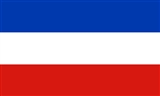
Schleswig-Holstein

Encyclopedia
Schleswig-Holstein (ˈʃleːsvɪç ˈhɔlʃtaɪn) is the northernmost
of the sixteen states
of Germany
, comprising most of the historical duchy of Holstein
and the southern
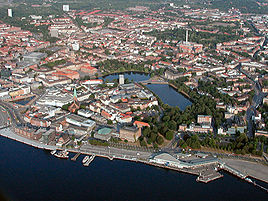
part of the former Duchy of Schleswig. Its capital city is Kiel
; other notable cities are Lübeck
, Flensburg
and Neumünster
.
The former English
name was Sleswick-Holsatia, the Danish
name is Slesvig-Holsten, the Low German
name is Sleswig-Holsteen, the Dutch
name is Sleeswijk-Holstein and the North Frisian
name is Slaswik-Holstiinj. Historically, the name can also refer to a larger region, containing both present-day Schleswig-Holstein and the former South Jutland County
(Northern Schleswig) in Denmark
.
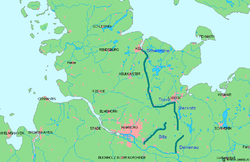
 The term "Holstein" derives from Old Saxon
, Holseta Land, meaning "the land of those who dwell in the wood" (Holz and Holt
mean wood
in modern Standardised German and in literary English respectively). Originally, it referred to the central of the three Saxon tribes north of the Elbe
river, Tedmarsgoi, Holcetae, and Sturmarii. The area of the Holcetae was between the Stör
river and Hamburg
, and after Christianization
their main church was in Schenefeld
. Saxon
Holstein became a part of the Holy Roman Empire
after Charlemagne
's Saxon campaigns
in the late eighth century. Since 811 the northern frontier of Holstein (and thus the Empire) was marked by the river Eider
.
The term Schleswig takes its name from the city of Schleswig
. The name derives from the Schlei
inlet
in the east and vik meaning inlet or settlement in Old Saxon
and Old Norse
. The name is similar to the place-names ending in the "-wick" or "-wich" element along the coast in the United Kingdom
.
The Duchy
of Schleswig or Southern Jutland was originally an integral part of Denmark, but was in medieval times established as a fief under the Kingdom of Denmark, with the same relation to the Danish Crown
as for example Brandenburg
or Bavaria
vis-à-vis
the Holy Roman Emperor
. Around 1100 the Duke of Saxony gave Holstein, as it was his own country, to Count
Adolf I of Schauenburg
.
Schleswig and Holstein have at different times belonged in part or completely to either Denmark or Germany, or have been virtually independent of both nations. The exception is that Schleswig had never been part of Germany until the Second War of Schleswig
in 1864. For many centuries, the King of Denmark was both a Danish Duke of Schleswig and a German Duke of Holstein, the Duke of Saxony. Essentially, Schleswig was either integrated into Denmark or was a Danish fief, and Holstein was a German fief and once a sovereign state
long ago. Both were for several centuries ruled by the kings of Denmark. In 1721 all of Schleswig was united as a single duchy under the king of Denmark, and the great powers of Europe confirmed in an international treaty
that all future kings of Denmark should automatically become dukes of Schleswig, and consequently Schleswig would always follow the same line of succession as the one chosen in the Kingdom of Denmark.
The German national awakening
following the Napoleonic Wars
led to a strong popular movement in Holstein and Southern Schleswig for unification with a new Prussia
n-dominated Germany. However, this development was paralleled by an equally strong Danish national awakening in Denmark and northern Schleswig. It called for the complete reintegration of Schleswig into the Kingdom of Denmark and demanded an end to discrimination against Danes in Schleswig. The ensuing conflict is sometimes called the Schleswig-Holstein Question
. In 1848 King Frederick VII of Denmark
declared that he would grant Denmark a liberal constitution and the immediate goal for the Danish national movement was to ensure that this constitution would not only give rights to all Danes, i.e., not only in the Kingdom of Denmark, but also to Danes (and Germans) living in Schleswig. Furthermore, they demanded protection for the Danish language in Schleswig since the dominant language in almost a quarter of Schleswig had changed from Danish to German since the beginning of the 19th century.
A liberal
constitution
for Holstein was not seriously considered in Copenhagen
, since it was a well-known fact that the political élite
of Holstein had been far more conservative than Copenhagen's. This proved to be true, as the politicians of Holstein demanded that the Constitution of Denmark
be scrapped — not only in Schleswig but also in Denmark. They also demanded that Schleswig immediately follow Holstein and become a member of the German Confederation
, and eventually a part of the new united Germany. These demands were rejected and in 1848 the Germans of Holstein and Southern Schleswig rebelled. This was the beginning of the First War of Schleswig
(1848–51) which ended in a Danish victory at Idstedt
.
In 1863 conflict broke out again as King Frederick VII of Denmark
died leaving no heir. According to the line of succession of Denmark and Schleswig, the crowns of both Denmark and Schleswig would now pass to Duke Christian of Glücksburg
(the future King Christian IX); the crown of Holstein was considered to be more problematic. This decision was challenged by a rival pro-German branch of the Danish royal family, the House of Augustenborg
who demanded, as in 1848, the crowns of both Schleswig and Holstein. The passing of a common constitution for Denmark and Schleswig in November 1863 then gave Otto von Bismarck
a chance to intervene and Prussia
and Austria
declared war on Denmark. This was the Second War of Schleswig
which ended in a Danish defeat. British
attempts to mediate failed, and Denmark lost Schleswig (Northern and Southern Schleswig), Holstein, and Lauenburg to Prussia and Austria.
Following the Austro-Prussian War of 1866, section five of the Peace of Prague
stated that the people in northern Schleswig should be granted the right to a referendum
on whether they would remain under Prussian rule or return to Danish rule. This promise was never fulfilled by Prussia.
Following the defeat of Germany in World War I
, the Allied powers arranged a plebiscite in northern and central Schleswig
. In northern Schleswig (10 February 1920) 75% voted for reunification with Denmark and 25% voted for Germany. In central Schleswig (14 March 1920) the results were reversed; 80% voted for Germany and just 20% for Denmark, primarily in Flensburg
. No vote ever took place in the southern third of Schleswig, although it was planned. For the referendum under authority of an international commission (CIS, Commission Internationale de Surveillance du Plébiscite Slesvig) two (primarily three) election-zones were created. Primarily three zones were planned, Zone III should involve the rest of Southern Schleswig. Denmark passed on an election in this zone. Just the votes for the whole zone were crucial, not the dissenting votes in a single Kreis (district) or city:
On 15 June 1920, northern Schleswig officially returned to Danish rule. The Danish/German border was the only one of the borders imposed on Germany by the Treaty of Versailles
after World War I which was never challenged by Adolf Hitler
.
In 1937 the Nazis passed the so-called Greater Hamburg Act (Groß-Hamburg-Gesetz), where the nearby Free and Hanseatic City of Hamburg was expanded, to encompass towns that had formally belonged to the Prussian province of Schleswig-Holstein
. To compensate Prussia for these losses (and partly because Hitler had a personal dislike for Lübeck), the 711-year-long independence of the Hansestadt Lübeck came to an end, and almost all its territory was incorporated into Schleswig-Holstein.
After the Second World War, the Prussia
n province Schleswig-Holstein came under British
occupation. On August 23, 1946, the Military Government abolished the province and reconstituted it as a separate Land.
Because of the Expulsion of Germans after World War II
the population of Schleswig-Holstein increased 33 percent (860,000 people).
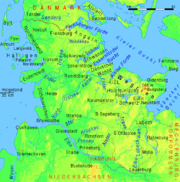 on the base of Jutland Peninsula
between the North Sea
and the Baltic Sea
. Strictly speaking, "Schleswig" refers to the German Southern Schleswig
, whereas Northern Schleswig is in Denmark
. The state of Schleswig-Holstein further consists of Holstein
as well as Lauenburg, and the formerly independent city of Lübeck
.
Schleswig-Holstein borders Denmark
(Region Syddanmark
) to the north, the North Sea
to the west, the Baltic Sea
to the east, and the German states of Lower Saxony
, Hamburg
, and Mecklenburg-Vorpommern to the south.
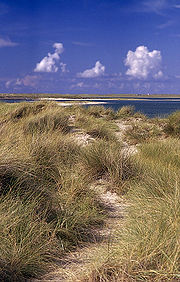
In the western part of the state, there are lowlands with virtually no hills. The North Frisian Islands
, as well as almost all of Schleswig-Holstein's North Sea coast, form the Schleswig-Holstein Wadden Sea National Park
(Nationalpark Schleswig-Holsteinisches Wattenmeer) which is the largest national park in Central Europe. Germany's only high-sea island, Heligoland
, is situated in the North Sea.
The Baltic Sea coast in the east of Schleswig-Holstein is marked by bays, fjords and cliff lines. There are rolling hills (the highest elevation is the Bungsberg at 168 metres or 551.2 ft) and many lakes, especially in the eastern part of Holstein, called the Holsteinische Schweiz
("Holsatian Switzerland") and the former Duchy of Lauenburg (Herzogtum Lauenburg). Fehmarn
is the only island off the eastern coast. The longest river besides the Elbe
is the Eider
; the most important waterway is the Kiel Canal
which connects the North Sea and Baltic Sea.
(districts):
Furthermore, there are four separate urban districts:
The most important festivals are the Schleswig-Holstein Musik Festival
, an annual classic music festival all over the state, and the Nordische Filmtage
, an annual film festival for movies from Scandinavia
n countries, held in Lübeck
.
The annual Wacken Open Air
festival is considered to be the largest heavy metal rock festival in the world.
The state's most important museum of cultural history is in Schloss Gottorf in Schleswig
.
shows the symbols of the two duchies united in Schleswig-Holstein, i.e., the two lions for Schleswig and the leaf of a nettle for Holstein. Supposedly, Otto von Bismarck
decreed that the two lions were to face the nettle because of the discomfort to their bottoms which would have resulted if the lions faced away from it.
The motto of Schleswig-Holstein is "Up ewich ungedeelt" (Middle Low German
: "Forever undivided", modern High German: "Auf ewig ungeteilt"). It goes back to the Vertrag von Ripen or Handfeste von Ripen (Danish: Ribe Håndfæstning) or Treaty of Ribe
in 1460. Ripen (Ribe) is a historical small town at the North Sea coast in Northern Schleswig. See History of Schleswig-Holstein
.
The anthem from 1844 is called "Wanke nicht, mein Vaterland" ("Don't falter, my fatherland"), but it is usually referred to with its first line "Schleswig-Holstein meerumschlungen" (i.e., "Schleswig-Holstein embraced by the seas") or "Schleswig-Holstein-Lied" (Schleswig-Holstein song).
The old city of Lübeck
is a world heritage site
.
is the official language, Low German
, Danish
and North Frisian
enjoy legal protection or state promotion.
Historically, Low German, Danish (in Schleswig) and Frisian (in Schleswig) were spoken. Low German is still used in many parts of the state, and a pidgin
of Low and standardised German (Missingsch
) is used in most areas. Danish is used by the Danes in Southern Schleswig, and Frisian is spoken by the North Frisians of the North Sea Coast and the Northern Frisian Islands in Southern Schleswig. The North Frisian dialect called Heligolandic
(Halunder) is spoken on the island of Heligoland
.
High German
was introduced in the 16th century, mainly for official purposes, but is today the predominant language.
's equivalent to primary school, for the first 4 years and then move on to a secondary school. In Schleswig-Holstein there are "Gemeinschaftsschulen", which is a new type comprehensive school, as well as regional schools, which go by the German name "Regionalschule". The option of a Gymnasium is still available.
There are 3 universities in Kiel
, Lübeck
and Flensburg
. Also, there are 4 public Universities of Applied Sciences in Flensburg, Heide
, Kiel, and Lübeck. There is the Conservatory in Lübeck and the Muthesius Academy of Fine Arts in Kiel. There are also 3 private institutions of high learning.
. The Minister-President of Schleswig-Holstein is elected by the Landtag of Schleswig-Holstein
.
and the liberal FDP
under the leadership of CDU state premier Peter Harry Carstensen
. It was an early election; after the Christian Democratic Union
(CDU) and Social Democratic Party
(SPD) grand coalition
broke apart in Summer 2009, Minister-President
Peter Harry Carstensen
(CDU) provoked early elections by intentionally losing a vote of confidence.
Northern Germany
- Geography :The key terrain features of North Germany are the marshes along the coastline of the North Sea and Baltic Sea, and the geest and heaths inland. Also prominent are the low hills of the Baltic Uplands, the ground moraines, end moraines, sandur, glacial valleys, bogs, and Luch...
of the sixteen states
States of Germany
Germany is made up of sixteen which are partly sovereign constituent states of the Federal Republic of Germany. Land literally translates as "country", and constitutionally speaking, they are constituent countries...
of Germany
Germany
Germany , officially the Federal Republic of Germany , is a federal parliamentary republic in Europe. The country consists of 16 states while the capital and largest city is Berlin. Germany covers an area of 357,021 km2 and has a largely temperate seasonal climate...
, comprising most of the historical duchy of Holstein
Holstein
Holstein is the region between the rivers Elbe and Eider. It is part of Schleswig-Holstein, the northernmost state of Germany....
and the southern
Southern Schleswig
Southern Schleswig denotes the southern half of the former Duchy of Schleswig on the Jutland Peninsula. The geographical area today covers the thirty or forty northernmost kilometers of Germany up to the Flensburg Fjord, where it borders on Denmark...
part of the former Duchy of Schleswig. Its capital city is Kiel
Kiel
Kiel is the capital and most populous city in the northern German state of Schleswig-Holstein, with a population of 238,049 .Kiel is approximately north of Hamburg. Due to its geographic location in the north of Germany, the southeast of the Jutland peninsula, and the southwestern shore of the...
; other notable cities are Lübeck
Lübeck
The Hanseatic City of Lübeck is the second-largest city in Schleswig-Holstein, in northern Germany, and one of the major ports of Germany. It was for several centuries the "capital" of the Hanseatic League and, because of its Brick Gothic architectural heritage, is listed by UNESCO as a World...
, Flensburg
Flensburg
Flensburg is an independent town in the north of the German state of Schleswig-Holstein. Flensburg is the centre of the region of Southern Schleswig...
and Neumünster
Neumünster
Neumünster is an independent town in Schleswig-Holstein, Germany, which has a total of four independent towns.-Current Situation:Neumünster station is major railway junction with lines running in six directions, including the important Hamburg-Altona–Kiel and Neumünster–Flensburg lines.Near...
.
The former English
English language
English is a West Germanic language that arose in the Anglo-Saxon kingdoms of England and spread into what was to become south-east Scotland under the influence of the Anglian medieval kingdom of Northumbria...
name was Sleswick-Holsatia, the Danish
Danish language
Danish is a North Germanic language spoken by around six million people, principally in the country of Denmark. It is also spoken by 50,000 Germans of Danish ethnicity in the northern parts of Schleswig-Holstein, Germany, where it holds the status of minority language...
name is Slesvig-Holsten, the Low German
Low German
Low German or Low Saxon is an Ingvaeonic West Germanic language spoken mainly in northern Germany and the eastern part of the Netherlands...
name is Sleswig-Holsteen, the Dutch
Dutch language
Dutch is a West Germanic language and the native language of the majority of the population of the Netherlands, Belgium, and Suriname, the three member states of the Dutch Language Union. Most speakers live in the European Union, where it is a first language for about 23 million and a second...
name is Sleeswijk-Holstein and the North Frisian
North Frisian language
North Frisian is a minority language of Germany, spoken by about 10,000 people in North Frisia. The language is part of the larger group of the West Germanic Frisian languages.-Classification:...
name is Slaswik-Holstiinj. Historically, the name can also refer to a larger region, containing both present-day Schleswig-Holstein and the former South Jutland County
South Jutland County
South Jutland County is a former county on the south-central portion of the Jutland Peninsula in southern Denmark....
(Northern Schleswig) in Denmark
Denmark
Denmark is a Scandinavian country in Northern Europe. The countries of Denmark and Greenland, as well as the Faroe Islands, constitute the Kingdom of Denmark . It is the southernmost of the Nordic countries, southwest of Sweden and south of Norway, and bordered to the south by Germany. Denmark...
.
History
Old Saxon
Old Saxon, also known as Old Low German, is the earliest recorded form of Low German, documented from the 8th century until the 12th century, when it evolved into Middle Low German. It was spoken on the north-west coast of Germany and in the Netherlands by Saxon peoples...
, Holseta Land, meaning "the land of those who dwell in the wood" (Holz and Holt
Holt
- Natural world :* Holt, an otter den* Holt, an occasional name for a fox den* Holt, an area of woodland, e.g. a grove or copse, especially as a place-name in Great Britain, Scandinavia, Iceland, and Germany...
mean wood
Wood
Wood is a hard, fibrous tissue found in many trees. It has been used for hundreds of thousands of years for both fuel and as a construction material. It is an organic material, a natural composite of cellulose fibers embedded in a matrix of lignin which resists compression...
in modern Standardised German and in literary English respectively). Originally, it referred to the central of the three Saxon tribes north of the Elbe
Elbe
The Elbe is one of the major rivers of Central Europe. It rises in the Krkonoše Mountains of the northwestern Czech Republic before traversing much of Bohemia , then Germany and flowing into the North Sea at Cuxhaven, 110 km northwest of Hamburg...
river, Tedmarsgoi, Holcetae, and Sturmarii. The area of the Holcetae was between the Stör
Stör
The Stör is a river in Schleswig-Holstein, Germany, right tributary of the Elbe. Its total length is 87 km. The Stör rises east of Neumünster, and flows west through Neumünster, Kellinghusen, and Itzehoe. The Stör joins the Elbe near Glückstadt....
river and Hamburg
Hamburg
-History:The first historic name for the city was, according to Claudius Ptolemy's reports, Treva.But the city takes its modern name, Hamburg, from the first permanent building on the site, a castle whose construction was ordered by the Emperor Charlemagne in AD 808...
, and after Christianization
Christianization
The historical phenomenon of Christianization is the conversion of individuals to Christianity or the conversion of entire peoples at once...
their main church was in Schenefeld
Schenefeld
Schenefeld may refer to two municipalities in Schleswig-Holstein, Germany:*Schenefeld, Pinneberg*Schenefeld, Steinburg...
. Saxon
Duchy of Saxony
The medieval Duchy of Saxony was a late Early Middle Ages "Carolingian stem duchy" covering the greater part of Northern Germany. It covered the area of the modern German states of Bremen, Hamburg, Lower Saxony, North Rhine-Westphalia, and Saxony-Anhalt and most of Schleswig-Holstein...
Holstein became a part of the Holy Roman Empire
Holy Roman Empire
The Holy Roman Empire was a realm that existed from 962 to 1806 in Central Europe.It was ruled by the Holy Roman Emperor. Its character changed during the Middle Ages and the Early Modern period, when the power of the emperor gradually weakened in favour of the princes...
after Charlemagne
Charlemagne
Charlemagne was King of the Franks from 768 and Emperor of the Romans from 800 to his death in 814. He expanded the Frankish kingdom into an empire that incorporated much of Western and Central Europe. During his reign, he conquered Italy and was crowned by Pope Leo III on 25 December 800...
's Saxon campaigns
Saxon Wars
The Saxon Wars were the campaigns and insurrections of the more than thirty years from 772, when Charlemagne first entered Saxony with the intent to conquer, to 804, when the last rebellion of disaffected tribesmen was crushed. In all, eighteen battles were fought in what is now northwestern Germany...
in the late eighth century. Since 811 the northern frontier of Holstein (and thus the Empire) was marked by the river Eider
Eider
Eiders are large seaducks in the genus Somateria. Steller's Eider, despite its name, is in a different genus.The three extant species all breed in the cooler latitudes of the Northern hemisphere....
.
The term Schleswig takes its name from the city of Schleswig
Schleswig (city)
Schleswig is a town in the northeastern part of Schleswig-Holstein, Germany. It is the capital of the Kreis Schleswig-Flensburg. It has a population of about 27,000, the main industries being leather and food processing...
. The name derives from the Schlei
Schlei
The Schlei is a narrow inlet of the Baltic Sea in Schleswig-Holstein in northern Germany. It stretches for approximately 20 miles from the Baltic near Kappeln and Arnis to the city of Schleswig. Along the Schlei are many small bays and swamps...
inlet
Inlet
An inlet is a narrow body of water between islands or leading inland from a larger body of water, often leading to an enclosed body of water, such as a sound, bay, lagoon or marsh. In sea coasts an inlet usually refers to the actual connection between a bay and the ocean and is often called an...
in the east and vik meaning inlet or settlement in Old Saxon
Old Saxon
Old Saxon, also known as Old Low German, is the earliest recorded form of Low German, documented from the 8th century until the 12th century, when it evolved into Middle Low German. It was spoken on the north-west coast of Germany and in the Netherlands by Saxon peoples...
and Old Norse
Old Norse
Old Norse is a North Germanic language that was spoken by inhabitants of Scandinavia and inhabitants of their overseas settlements during the Viking Age, until about 1300....
. The name is similar to the place-names ending in the "-wick" or "-wich" element along the coast in the United Kingdom
United Kingdom
The United Kingdom of Great Britain and Northern IrelandIn the United Kingdom and Dependencies, other languages have been officially recognised as legitimate autochthonous languages under the European Charter for Regional or Minority Languages...
.
The Duchy
Duchy
A duchy is a territory, fief, or domain ruled by a duke or duchess.Some duchies were sovereign in areas that would become unified realms only during the Modern era . In contrast, others were subordinate districts of those kingdoms that unified either partially or completely during the Medieval era...
of Schleswig or Southern Jutland was originally an integral part of Denmark, but was in medieval times established as a fief under the Kingdom of Denmark, with the same relation to the Danish Crown
Danish Royal Family
The Danish Royal Family includes the Queen of Denmark and her family. All members except the Queen hold the title of Prince/Princess of Denmark with the style of His/Her Royal Highness or His/Her Highness. The Queen is styled Her Majesty. The Queen and her siblings belong to the House of...
as for example Brandenburg
Brandenburg
Brandenburg is one of the sixteen federal-states of Germany. It lies in the east of the country and is one of the new federal states that were re-created in 1990 upon the reunification of the former West Germany and East Germany. The capital is Potsdam...
or Bavaria
Bavaria
Bavaria, formally the Free State of Bavaria is a state of Germany, located in the southeast of Germany. With an area of , it is the largest state by area, forming almost 20% of the total land area of Germany...
vis-à-vis
Vis-à-vis
Vis-à-vis may refer to:* Vis-à-vis * "Vis à Vis" , an episode of Star Trek: Voyager...
the Holy Roman Emperor
Holy Roman Emperor
The Holy Roman Emperor is a term used by historians to denote a medieval ruler who, as German King, had also received the title of "Emperor of the Romans" from the Pope...
. Around 1100 the Duke of Saxony gave Holstein, as it was his own country, to Count
Count
A count or countess is an aristocratic nobleman in European countries. The word count came into English from the French comte, itself from Latin comes—in its accusative comitem—meaning "companion", and later "companion of the emperor, delegate of the emperor". The adjective form of the word is...
Adolf I of Schauenburg
Adolf I of Holstein
Adolf I was the first Count of Schauenburg from 1106 and the second Count of Holstein from 1111. He made an important contribution to the colonisation and Germanisation of the lands north of the Elbe....
.
Schleswig and Holstein have at different times belonged in part or completely to either Denmark or Germany, or have been virtually independent of both nations. The exception is that Schleswig had never been part of Germany until the Second War of Schleswig
Second War of Schleswig
The Second Schleswig War was the second military conflict as a result of the Schleswig-Holstein Question. It began on 1 February 1864, when Prussian forces crossed the border into Schleswig.Denmark fought Prussia and Austria...
in 1864. For many centuries, the King of Denmark was both a Danish Duke of Schleswig and a German Duke of Holstein, the Duke of Saxony. Essentially, Schleswig was either integrated into Denmark or was a Danish fief, and Holstein was a German fief and once a sovereign state
Sovereign state
A sovereign state, or simply, state, is a state with a defined territory on which it exercises internal and external sovereignty, a permanent population, a government, and the capacity to enter into relations with other sovereign states. It is also normally understood to be a state which is neither...
long ago. Both were for several centuries ruled by the kings of Denmark. In 1721 all of Schleswig was united as a single duchy under the king of Denmark, and the great powers of Europe confirmed in an international treaty
Treaty
A treaty is an express agreement under international law entered into by actors in international law, namely sovereign states and international organizations. A treaty may also be known as an agreement, protocol, covenant, convention or exchange of letters, among other terms...
that all future kings of Denmark should automatically become dukes of Schleswig, and consequently Schleswig would always follow the same line of succession as the one chosen in the Kingdom of Denmark.
The German national awakening
Nationalism
Nationalism is a political ideology that involves a strong identification of a group of individuals with a political entity defined in national terms, i.e. a nation. In the 'modernist' image of the nation, it is nationalism that creates national identity. There are various definitions for what...
following the Napoleonic Wars
Napoleonic Wars
The Napoleonic Wars were a series of wars declared against Napoleon's French Empire by opposing coalitions that ran from 1803 to 1815. As a continuation of the wars sparked by the French Revolution of 1789, they revolutionised European armies and played out on an unprecedented scale, mainly due to...
led to a strong popular movement in Holstein and Southern Schleswig for unification with a new Prussia
Prussia
Prussia was a German kingdom and historic state originating out of the Duchy of Prussia and the Margraviate of Brandenburg. For centuries, the House of Hohenzollern ruled Prussia, successfully expanding its size by way of an unusually well-organized and effective army. Prussia shaped the history...
n-dominated Germany. However, this development was paralleled by an equally strong Danish national awakening in Denmark and northern Schleswig. It called for the complete reintegration of Schleswig into the Kingdom of Denmark and demanded an end to discrimination against Danes in Schleswig. The ensuing conflict is sometimes called the Schleswig-Holstein Question
Schleswig-Holstein Question
The Schleswig-Holstein Question was a complex of diplomatic and other issues arising in the 19th century from the relations of two duchies, Schleswig and Holstein , to the Danish crown and to the German Confederation....
. In 1848 King Frederick VII of Denmark
Frederick VII of Denmark
Frederick VII was a King of Denmark. He reigned from 1848 until his death. He was the last Danish monarch of the older Royal branch of the House of Oldenburg and also the last king of Denmark to rule as an absolute monarch...
declared that he would grant Denmark a liberal constitution and the immediate goal for the Danish national movement was to ensure that this constitution would not only give rights to all Danes, i.e., not only in the Kingdom of Denmark, but also to Danes (and Germans) living in Schleswig. Furthermore, they demanded protection for the Danish language in Schleswig since the dominant language in almost a quarter of Schleswig had changed from Danish to German since the beginning of the 19th century.
A liberal
Liberalism
Liberalism is the belief in the importance of liberty and equal rights. Liberals espouse a wide array of views depending on their understanding of these principles, but generally, liberals support ideas such as constitutionalism, liberal democracy, free and fair elections, human rights,...
constitution
Constitution
A constitution is a set of fundamental principles or established precedents according to which a state or other organization is governed. These rules together make up, i.e. constitute, what the entity is...
for Holstein was not seriously considered in Copenhagen
Copenhagen
Copenhagen is the capital and largest city of Denmark, with an urban population of 1,199,224 and a metropolitan population of 1,930,260 . With the completion of the transnational Øresund Bridge in 2000, Copenhagen has become the centre of the increasingly integrating Øresund Region...
, since it was a well-known fact that the political élite
Elite
Elite refers to an exceptional or privileged group that wields considerable power within its sphere of influence...
of Holstein had been far more conservative than Copenhagen's. This proved to be true, as the politicians of Holstein demanded that the Constitution of Denmark
Constitution of Denmark
The Constitutional Act of Denmark is the Kingdom of Denmark's constitution, or fundamental law. Originally verified in 1849, the last revision was signed on 5 June 1953 as "the existing law, for all to unswerving comply with, the Constitutional Act of Denmark".-Idea and structure:The main...
be scrapped — not only in Schleswig but also in Denmark. They also demanded that Schleswig immediately follow Holstein and become a member of the German Confederation
German Confederation
The German Confederation was the loose association of Central European states created by the Congress of Vienna in 1815 to coordinate the economies of separate German-speaking countries. It acted as a buffer between the powerful states of Austria and Prussia...
, and eventually a part of the new united Germany. These demands were rejected and in 1848 the Germans of Holstein and Southern Schleswig rebelled. This was the beginning of the First War of Schleswig
First War of Schleswig
The First Schleswig War or Three Years' War was the first round of military conflict in southern Denmark and northern Germany rooted in the Schleswig-Holstein Question, contesting the issue of who should control the Duchies of Schleswig and Holstein. The war, which lasted from 1848–1851,...
(1848–51) which ended in a Danish victory at Idstedt
Idstedt
Idstedt is a village in Schleswig-Flensburg district in Schleswig-Holstein, Germany. It is located c. 10 km. NNW of the city of Schleswig and east of the Bundesautobahn 7.The Battle of Isted happened there on 24-25 July 1850 during the First War of Schleswig....
.
In 1863 conflict broke out again as King Frederick VII of Denmark
Frederick VII of Denmark
Frederick VII was a King of Denmark. He reigned from 1848 until his death. He was the last Danish monarch of the older Royal branch of the House of Oldenburg and also the last king of Denmark to rule as an absolute monarch...
died leaving no heir. According to the line of succession of Denmark and Schleswig, the crowns of both Denmark and Schleswig would now pass to Duke Christian of Glücksburg
Glücksburg
Glücksburg is a small town in the district Schleswig-Flensburg, in Schleswig-Holstein, Germany.It is situated on the south side of the Flensburg Fjord, an inlet of the Baltic Sea, approx. 10 km northeast of Flensburg...
(the future King Christian IX); the crown of Holstein was considered to be more problematic. This decision was challenged by a rival pro-German branch of the Danish royal family, the House of Augustenborg
Augustenborg
Augustenborg is a town with a population of 3,279 on Als Island in Sønderborg Municipality, Region of Southern Denmark in Denmark. The town lies at the head of Als Fjord. To the east is the Little Belt...
who demanded, as in 1848, the crowns of both Schleswig and Holstein. The passing of a common constitution for Denmark and Schleswig in November 1863 then gave Otto von Bismarck
Otto von Bismarck
Otto Eduard Leopold, Prince of Bismarck, Duke of Lauenburg , simply known as Otto von Bismarck, was a Prussian-German statesman whose actions unified Germany, made it a major player in world affairs, and created a balance of power that kept Europe at peace after 1871.As Minister President of...
a chance to intervene and Prussia
Kingdom of Prussia
The Kingdom of Prussia was a German kingdom from 1701 to 1918. Until the defeat of Germany in World War I, it comprised almost two-thirds of the area of the German Empire...
and Austria
Austrian Empire
The Austrian Empire was a modern era successor empire, which was centered on what is today's Austria and which officially lasted from 1804 to 1867. It was followed by the Empire of Austria-Hungary, whose proclamation was a diplomatic move that elevated Hungary's status within the Austrian Empire...
declared war on Denmark. This was the Second War of Schleswig
Second War of Schleswig
The Second Schleswig War was the second military conflict as a result of the Schleswig-Holstein Question. It began on 1 February 1864, when Prussian forces crossed the border into Schleswig.Denmark fought Prussia and Austria...
which ended in a Danish defeat. British
United Kingdom
The United Kingdom of Great Britain and Northern IrelandIn the United Kingdom and Dependencies, other languages have been officially recognised as legitimate autochthonous languages under the European Charter for Regional or Minority Languages...
attempts to mediate failed, and Denmark lost Schleswig (Northern and Southern Schleswig), Holstein, and Lauenburg to Prussia and Austria.
Following the Austro-Prussian War of 1866, section five of the Peace of Prague
Peace of Prague (1866)
The Peace of Prague was a peace treaty signed at Prague on 23 August 1866, which ended the Austro-Prussian War. The treaty was lenient toward the Austrian Empire because Otto von Bismarck had persuaded William I that maintaining Austria's place in Europe would be better in the future for Prussia...
stated that the people in northern Schleswig should be granted the right to a referendum
Referendum
A referendum is a direct vote in which an entire electorate is asked to either accept or reject a particular proposal. This may result in the adoption of a new constitution, a constitutional amendment, a law, the recall of an elected official or simply a specific government policy. It is a form of...
on whether they would remain under Prussian rule or return to Danish rule. This promise was never fulfilled by Prussia.
Following the defeat of Germany in World War I
World War I
World War I , which was predominantly called the World War or the Great War from its occurrence until 1939, and the First World War or World War I thereafter, was a major war centred in Europe that began on 28 July 1914 and lasted until 11 November 1918...
, the Allied powers arranged a plebiscite in northern and central Schleswig
Schleswig Plebiscites
The Schleswig Plebiscites were two plebiscites, organized according to section XII, articles 109 to 114 of the Treaty of Versailles of June 28, 1919, in order to determine the future border between Denmark and Germany through the former duchy of Schleswig...
. In northern Schleswig (10 February 1920) 75% voted for reunification with Denmark and 25% voted for Germany. In central Schleswig (14 March 1920) the results were reversed; 80% voted for Germany and just 20% for Denmark, primarily in Flensburg
Flensburg
Flensburg is an independent town in the north of the German state of Schleswig-Holstein. Flensburg is the centre of the region of Southern Schleswig...
. No vote ever took place in the southern third of Schleswig, although it was planned. For the referendum under authority of an international commission (CIS, Commission Internationale de Surveillance du Plébiscite Slesvig) two (primarily three) election-zones were created. Primarily three zones were planned, Zone III should involve the rest of Southern Schleswig. Denmark passed on an election in this zone. Just the votes for the whole zone were crucial, not the dissenting votes in a single Kreis (district) or city:
| Electorate | German name | Danish name | For Germany | For Denmark | ||
| percent | votes | percent | votes | |||
| Zone I (Northern Schleswig), 10 February 1920 | 25.1 % | 25,329 | 74.9 % | 75,431 | ||
| District of | Hadersleben | Haderslev | 16.0 % | 6,585 | 84.0 % | 34,653 |
| Town of | Hadersleben | Haderslev Haderslev Haderslev is a town and municipality on the east coast of the Jutland peninsula in south Denmark. Also included is the island of Årø as well as several other smaller islands in the Little Belt. The municipality covers and has a population of 56,414 . Its mayor is Jens Christian Gjesing,... |
38.6 % | 3,275 | 61.4 % | 5,209 |
| District of | Apenrade | Aabenraa Aabenraa Municipality Aabenraa Municipality or Åbenrå Municipality is a municipality in Region of Southern Denmark in south-western Denmark. It has existed in its current form since 1 January 2007 following a merger of several smaller municipalities. The municipality has an area of 951 km² and a total population... |
32.3 % | 6,030 | 67.7 % | 12,653 |
| Town of | Apenrade | Aabenraa Aabenraa The city of Aabenraa or Åbenrå , with a population of 15,760 , is situated at the head of the Aabenraa Fjord, an arm of the Little Belt, in Denmark, 38 miles north of the town of Schleswig. Its name originally meant "open beach"... |
55.1 % | 2,725 | 44.9 % | 2,224 |
| District of | Sonderburg | Sønderborg | 22.9 % | 5,083 | 77.1 % | 17,100 |
| Town of | Sonderburg | Sønderborg Sønderborg Sønderborg Municipality , is a municipality in Region of Southern Denmark partially on the Jutland peninsula and partially on the island of Als in south Denmark, at the border with Germany. The municipality covers an area of , and has a total population of 76,236... |
56.2 % | 2,601 | 43.8 % | 2,029 |
| Town of | Augustenburg | Augustenborg | 48.0 % | 236 | 52.0 % | 256 |
| Northern part of District of | Tondern | Tønder | 40.9 % | 7,083 | 59.1 % | 10,223 |
| Town of | Tondern | Tønder Tønder Tønder is a municipality in Region of Southern Denmark on the Jutland peninsula in south Denmark. The municipality covers an area of 1,278 km², and has a total population of 40,367... |
76.5 % | 2,448 | 23.5 % | 750 |
| Town of | Hoyer | Højer Højer Højer , is a town with a population of 1,255 and a former municipality in south Denmark, in Region of Southern Denmark on the west coast of the Jutland peninsula. The municipality covered an area of 117 km², and had a total population of 2,861... |
72.6 % | 581 | 27.4 % | 219 |
| Town of | Lügumkloster | Løgumkloster Løgumkloster Løgumkloster , is a town in Tønder municipality in Region of Southern Denmark on the Jutland peninsula in south Denmark with a population of 3,618... |
48.8 % | 516 | 51.2 % | 542 |
| Northern part of District of | Flensburg Flensburg Flensburg is an independent town in the north of the German state of Schleswig-Holstein. Flensburg is the centre of the region of Southern Schleswig... |
Flensborg | 40.6 % | 548 | 59.4 % | 802 |
| Zone II (Central Schleswig), 14 March 1920 | 80.2 % | 51,742 | 19.8 % | 12,800 | ||
| Southern part of District of | Tondern | Tønder Tønder Tønder is a municipality in Region of Southern Denmark on the Jutland peninsula in south Denmark. The municipality covers an area of 1,278 km², and has a total population of 40,367... |
87.9 % | 17,283 | 12.1 % | 2,376 |
| Southern part of District of | Flensburg Flensburg Flensburg is an independent town in the north of the German state of Schleswig-Holstein. Flensburg is the centre of the region of Southern Schleswig... |
Flensborg | 82.6 % | 6,688 | 17.4 % | 1,405 |
| Town of | Flensburg Flensburg Flensburg is an independent town in the north of the German state of Schleswig-Holstein. Flensburg is the centre of the region of Southern Schleswig... |
Flensborg | 75.2 % | 27,081 | 24.8 % | 8,944 |
| Northern part of District of | Husum | Husum | 90.0 % | 672 | 10.0 % | 75 |
On 15 June 1920, northern Schleswig officially returned to Danish rule. The Danish/German border was the only one of the borders imposed on Germany by the Treaty of Versailles
Treaty of Versailles
The Treaty of Versailles was one of the peace treaties at the end of World War I. It ended the state of war between Germany and the Allied Powers. It was signed on 28 June 1919, exactly five years after the assassination of Archduke Franz Ferdinand. The other Central Powers on the German side of...
after World War I which was never challenged by Adolf Hitler
Adolf Hitler
Adolf Hitler was an Austrian-born German politician and the leader of the National Socialist German Workers Party , commonly referred to as the Nazi Party). He was Chancellor of Germany from 1933 to 1945, and head of state from 1934 to 1945...
.
In 1937 the Nazis passed the so-called Greater Hamburg Act (Groß-Hamburg-Gesetz), where the nearby Free and Hanseatic City of Hamburg was expanded, to encompass towns that had formally belonged to the Prussian province of Schleswig-Holstein
Province of Schleswig-Holstein
The Province of Schleswig-Holstein was a province of the Kingdom of Prussia and the Free State of Prussia from 1868 to 1946. It was created from the Duchies of Schleswig and Holstein, which had been conquered by Prussia and the Austrian Empire from Denmark in the Second War of Schleswig in 1864...
. To compensate Prussia for these losses (and partly because Hitler had a personal dislike for Lübeck), the 711-year-long independence of the Hansestadt Lübeck came to an end, and almost all its territory was incorporated into Schleswig-Holstein.
After the Second World War, the Prussia
Prussia
Prussia was a German kingdom and historic state originating out of the Duchy of Prussia and the Margraviate of Brandenburg. For centuries, the House of Hohenzollern ruled Prussia, successfully expanding its size by way of an unusually well-organized and effective army. Prussia shaped the history...
n province Schleswig-Holstein came under British
United Kingdom
The United Kingdom of Great Britain and Northern IrelandIn the United Kingdom and Dependencies, other languages have been officially recognised as legitimate autochthonous languages under the European Charter for Regional or Minority Languages...
occupation. On August 23, 1946, the Military Government abolished the province and reconstituted it as a separate Land.
Because of the Expulsion of Germans after World War II
Expulsion of Germans after World War II
The later stages of World War II, and the period after the end of that war, saw the forced migration of millions of German nationals and ethnic Germans from various European states and territories, mostly into the areas which would become post-war Germany and post-war Austria...
the population of Schleswig-Holstein increased 33 percent (860,000 people).
Geography
Jutland Peninsula
The Jutland Peninsula or more historically the Cimbrian Peninsula is a peninsula in Europe, divided between Denmark and Germany. The names are derived from the Jutes and the Cimbri....
between the North Sea
North Sea
In the southwest, beyond the Straits of Dover, the North Sea becomes the English Channel connecting to the Atlantic Ocean. In the east, it connects to the Baltic Sea via the Skagerrak and Kattegat, narrow straits that separate Denmark from Norway and Sweden respectively...
and the Baltic Sea
Baltic Sea
The Baltic Sea is a brackish mediterranean sea located in Northern Europe, from 53°N to 66°N latitude and from 20°E to 26°E longitude. It is bounded by the Scandinavian Peninsula, the mainland of Europe, and the Danish islands. It drains into the Kattegat by way of the Øresund, the Great Belt and...
. Strictly speaking, "Schleswig" refers to the German Southern Schleswig
Southern Schleswig
Southern Schleswig denotes the southern half of the former Duchy of Schleswig on the Jutland Peninsula. The geographical area today covers the thirty or forty northernmost kilometers of Germany up to the Flensburg Fjord, where it borders on Denmark...
, whereas Northern Schleswig is in Denmark
Region Syddanmark
Region of Southern Denmark is an administrative region of Denmark established on 1 January 2007 as part of the 2007 Danish Municipal Reform, which replaced the traditional counties with five larger regions. At the same time, smaller municipalities were merged into larger units, cutting the number...
. The state of Schleswig-Holstein further consists of Holstein
Holstein
Holstein is the region between the rivers Elbe and Eider. It is part of Schleswig-Holstein, the northernmost state of Germany....
as well as Lauenburg, and the formerly independent city of Lübeck
Lübeck
The Hanseatic City of Lübeck is the second-largest city in Schleswig-Holstein, in northern Germany, and one of the major ports of Germany. It was for several centuries the "capital" of the Hanseatic League and, because of its Brick Gothic architectural heritage, is listed by UNESCO as a World...
.
Schleswig-Holstein borders Denmark
Denmark
Denmark is a Scandinavian country in Northern Europe. The countries of Denmark and Greenland, as well as the Faroe Islands, constitute the Kingdom of Denmark . It is the southernmost of the Nordic countries, southwest of Sweden and south of Norway, and bordered to the south by Germany. Denmark...
(Region Syddanmark
Region Syddanmark
Region of Southern Denmark is an administrative region of Denmark established on 1 January 2007 as part of the 2007 Danish Municipal Reform, which replaced the traditional counties with five larger regions. At the same time, smaller municipalities were merged into larger units, cutting the number...
) to the north, the North Sea
North Sea
In the southwest, beyond the Straits of Dover, the North Sea becomes the English Channel connecting to the Atlantic Ocean. In the east, it connects to the Baltic Sea via the Skagerrak and Kattegat, narrow straits that separate Denmark from Norway and Sweden respectively...
to the west, the Baltic Sea
Baltic Sea
The Baltic Sea is a brackish mediterranean sea located in Northern Europe, from 53°N to 66°N latitude and from 20°E to 26°E longitude. It is bounded by the Scandinavian Peninsula, the mainland of Europe, and the Danish islands. It drains into the Kattegat by way of the Øresund, the Great Belt and...
to the east, and the German states of Lower Saxony
Lower Saxony
Lower Saxony is a German state situated in north-western Germany and is second in area and fourth in population among the sixteen states of Germany...
, Hamburg
Hamburg
-History:The first historic name for the city was, according to Claudius Ptolemy's reports, Treva.But the city takes its modern name, Hamburg, from the first permanent building on the site, a castle whose construction was ordered by the Emperor Charlemagne in AD 808...
, and Mecklenburg-Vorpommern to the south.
In the western part of the state, there are lowlands with virtually no hills. The North Frisian Islands
North Frisian Islands
The North Frisian Islands are a group of islands in the Wadden Sea, a part of the North Sea, off the western coast of Schleswig-Holstein, Germany. The German islands are in the traditional region of North Frisia and are part of the Schleswig-Holstein Wadden Sea National Park and the Kreis of...
, as well as almost all of Schleswig-Holstein's North Sea coast, form the Schleswig-Holstein Wadden Sea National Park
Schleswig-Holstein Wadden Sea National Park
The Schleswig-Holstein Wadden Sea National Park is a national park in the Schleswig-Holstein area of the German Wadden Sea. It was founded by the Parliament of Schleswig-Holstein on 1 October 1985 by the National Park Act of 22 July 1985 and expanded significantly in 1999...
(Nationalpark Schleswig-Holsteinisches Wattenmeer) which is the largest national park in Central Europe. Germany's only high-sea island, Heligoland
Heligoland
Heligoland is a small German archipelago in the North Sea.Formerly Danish and British possessions, the islands are located in the Heligoland Bight in the south-eastern corner of the North Sea...
, is situated in the North Sea.
The Baltic Sea coast in the east of Schleswig-Holstein is marked by bays, fjords and cliff lines. There are rolling hills (the highest elevation is the Bungsberg at 168 metres or 551.2 ft) and many lakes, especially in the eastern part of Holstein, called the Holsteinische Schweiz
Holsteinische Schweiz
Holstein Switzerland is a hilly area with a patchwork of lakes and forest in Schleswig Holstein, Germany, reminiscent of Swiss landscape. Its highest point is the Bungsberg...
("Holsatian Switzerland") and the former Duchy of Lauenburg (Herzogtum Lauenburg). Fehmarn
Fehmarn
Fehmarn is an island and - since 2003 - a town on this island in the Baltic Sea, off the eastern coast of Schleswig-Holstein, Germany, and ca. 18 kilometers south of the Danish island of Lolland...
is the only island off the eastern coast. The longest river besides the Elbe
Elbe
The Elbe is one of the major rivers of Central Europe. It rises in the Krkonoše Mountains of the northwestern Czech Republic before traversing much of Bohemia , then Germany and flowing into the North Sea at Cuxhaven, 110 km northwest of Hamburg...
is the Eider
Eider River
The Eider is the longest river of the German state of Schleswig-Holstein. The river starts near Bordesholm and reaches the southwestern outskirts of Kiel on the shores of the Baltic Sea, but flows to the west, ending in the North Sea...
; the most important waterway is the Kiel Canal
Kiel Canal
The Kiel Canal , known as the Kaiser-Wilhelm-Kanal until 1948, is a long canal in the German state of Schleswig-Holstein.The canal links the North Sea at Brunsbüttel to the Baltic Sea at Kiel-Holtenau. An average of is saved by using the Kiel Canal instead of going around the Jutland Peninsula....
which connects the North Sea and Baltic Sea.
Administration
Schleswig-Holstein is divided into 11 KreiseDistricts of Germany
The districts of Germany are known as , except in the states of North Rhine-Westphalia and Schleswig-Holstein where they are known simply as ....
(districts):
|
|
Furthermore, there are four separate urban districts:
- KI - KielKielKiel is the capital and most populous city in the northern German state of Schleswig-Holstein, with a population of 238,049 .Kiel is approximately north of Hamburg. Due to its geographic location in the north of Germany, the southeast of the Jutland peninsula, and the southwestern shore of the...
- HL - Hansestadt ("Hanseatic town") LübeckLübeckThe Hanseatic City of Lübeck is the second-largest city in Schleswig-Holstein, in northern Germany, and one of the major ports of Germany. It was for several centuries the "capital" of the Hanseatic League and, because of its Brick Gothic architectural heritage, is listed by UNESCO as a World...
- NMS - NeumünsterNeumünsterNeumünster is an independent town in Schleswig-Holstein, Germany, which has a total of four independent towns.-Current Situation:Neumünster station is major railway junction with lines running in six directions, including the important Hamburg-Altona–Kiel and Neumünster–Flensburg lines.Near...
- FL - FlensburgFlensburgFlensburg is an independent town in the north of the German state of Schleswig-Holstein. Flensburg is the centre of the region of Southern Schleswig...
Culture
Schleswig-Holstein combines Danish and German aspects of culture. The castles and manors in the countryside are the best example for this tradition; some dishes like Rote Grütze are also shared.The most important festivals are the Schleswig-Holstein Musik Festival
Schleswig-Holstein Musik Festival
The Schleswig-Holstein Musik Festival is a classical music festival held every year in summer time all over the state of Schleswig-Holstein in Northern Germany....
, an annual classic music festival all over the state, and the Nordische Filmtage
Nordische Filmtage
The Lübeck Nordic Film Days is a film festival for movies from the Nordic and Baltic countries held annually in Lübeck, Germany, since 1956 on the first weekend in November...
, an annual film festival for movies from Scandinavia
Scandinavia
Scandinavia is a cultural, historical and ethno-linguistic region in northern Europe that includes the three kingdoms of Denmark, Norway and Sweden, characterized by their common ethno-cultural heritage and language. Modern Norway and Sweden proper are situated on the Scandinavian Peninsula,...
n countries, held in Lübeck
Lübeck
The Hanseatic City of Lübeck is the second-largest city in Schleswig-Holstein, in northern Germany, and one of the major ports of Germany. It was for several centuries the "capital" of the Hanseatic League and, because of its Brick Gothic architectural heritage, is listed by UNESCO as a World...
.
The annual Wacken Open Air
Wacken Open Air
Wacken Open Air is a summer open air heavy metal music festival. It takes place annually in the small town of Wacken in Schleswig-Holstein, northern Germany...
festival is considered to be the largest heavy metal rock festival in the world.
The state's most important museum of cultural history is in Schloss Gottorf in Schleswig
Schleswig
Schleswig or South Jutland is a region covering the area about 60 km north and 70 km south of the border between Germany and Denmark; the territory has been divided between the two countries since 1920, with Northern Schleswig in Denmark and Southern Schleswig in Germany...
.
Symbols
The coat of armsCoat of arms
A coat of arms is a unique heraldic design on a shield or escutcheon or on a surcoat or tabard used to cover and protect armour and to identify the wearer. Thus the term is often stated as "coat-armour", because it was anciently displayed on the front of a coat of cloth...
shows the symbols of the two duchies united in Schleswig-Holstein, i.e., the two lions for Schleswig and the leaf of a nettle for Holstein. Supposedly, Otto von Bismarck
Otto von Bismarck
Otto Eduard Leopold, Prince of Bismarck, Duke of Lauenburg , simply known as Otto von Bismarck, was a Prussian-German statesman whose actions unified Germany, made it a major player in world affairs, and created a balance of power that kept Europe at peace after 1871.As Minister President of...
decreed that the two lions were to face the nettle because of the discomfort to their bottoms which would have resulted if the lions faced away from it.
The motto of Schleswig-Holstein is "Up ewich ungedeelt" (Middle Low German
Middle Low German
Middle Low German is a language that is the descendant of Old Saxon and is the ancestor of modern Low German. It served as the international lingua franca of the Hanseatic League...
: "Forever undivided", modern High German: "Auf ewig ungeteilt"). It goes back to the Vertrag von Ripen or Handfeste von Ripen (Danish: Ribe Håndfæstning) or Treaty of Ribe
Treaty of Ribe
The Treaty of Ribe was a proclamation at Ribe made by King Christian I of Denmark to a number of German nobles enabling himself to become Count of Holstein and regain control of Denmark's lost Duchy of Schleswig...
in 1460. Ripen (Ribe) is a historical small town at the North Sea coast in Northern Schleswig. See History of Schleswig-Holstein
History of Schleswig-Holstein
The Jutland Peninsula is a long peninsula in Northern Europe, and the current Schleswig-Holstein is its southern part. Schleswig is also called Southern Jutland...
.
The anthem from 1844 is called "Wanke nicht, mein Vaterland" ("Don't falter, my fatherland"), but it is usually referred to with its first line "Schleswig-Holstein meerumschlungen" (i.e., "Schleswig-Holstein embraced by the seas") or "Schleswig-Holstein-Lied" (Schleswig-Holstein song).
The old city of Lübeck
Lübeck
The Hanseatic City of Lübeck is the second-largest city in Schleswig-Holstein, in northern Germany, and one of the major ports of Germany. It was for several centuries the "capital" of the Hanseatic League and, because of its Brick Gothic architectural heritage, is listed by UNESCO as a World...
is a world heritage site
World Heritage Site
A UNESCO World Heritage Site is a place that is listed by the UNESCO as of special cultural or physical significance...
.
Languages
GermanGerman language
German is a West Germanic language, related to and classified alongside English and Dutch. With an estimated 90 – 98 million native speakers, German is one of the world's major languages and is the most widely-spoken first language in the European Union....
is the official language, Low German
Low German
Low German or Low Saxon is an Ingvaeonic West Germanic language spoken mainly in northern Germany and the eastern part of the Netherlands...
, Danish
Danish language
Danish is a North Germanic language spoken by around six million people, principally in the country of Denmark. It is also spoken by 50,000 Germans of Danish ethnicity in the northern parts of Schleswig-Holstein, Germany, where it holds the status of minority language...
and North Frisian
North Frisian language
North Frisian is a minority language of Germany, spoken by about 10,000 people in North Frisia. The language is part of the larger group of the West Germanic Frisian languages.-Classification:...
enjoy legal protection or state promotion.
Historically, Low German, Danish (in Schleswig) and Frisian (in Schleswig) were spoken. Low German is still used in many parts of the state, and a pidgin
Pidgin
A pidgin , or pidgin language, is a simplified language that develops as a means of communication between two or more groups that do not have a language in common. It is most commonly employed in situations such as trade, or where both groups speak languages different from the language of the...
of Low and standardised German (Missingsch
Missingsch
Missingsch is a type of Low-German-coloured dialect or sociolect of German. It is characterised by Low-German-type structures and the presence of numerous loanwords from Low German in High German.- Description :...
) is used in most areas. Danish is used by the Danes in Southern Schleswig, and Frisian is spoken by the North Frisians of the North Sea Coast and the Northern Frisian Islands in Southern Schleswig. The North Frisian dialect called Heligolandic
Heligolandic
Heligolandic is the dialect of the North Frisian language spoken on the German island of Heligoland in the North Sea. It is spoken today by only a few hundred of the island's 1,650 inhabitants and is also taught in schools....
(Halunder) is spoken on the island of Heligoland
Heligoland
Heligoland is a small German archipelago in the North Sea.Formerly Danish and British possessions, the islands are located in the Heligoland Bight in the south-eastern corner of the North Sea...
.
High German
High German languages
The High German languages or the High German dialects are any of the varieties of standard German, Luxembourgish and Yiddish, as well as the local German dialects spoken in central and southern Germany, Austria, Liechtenstein, Switzerland, Luxembourg and in neighboring portions of Belgium and the...
was introduced in the 16th century, mainly for official purposes, but is today the predominant language.
Education
Compulsory education starts for children who are six years old on June 30. All children attend a "Grundschule", which is GermanyGermany
Germany , officially the Federal Republic of Germany , is a federal parliamentary republic in Europe. The country consists of 16 states while the capital and largest city is Berlin. Germany covers an area of 357,021 km2 and has a largely temperate seasonal climate...
's equivalent to primary school, for the first 4 years and then move on to a secondary school. In Schleswig-Holstein there are "Gemeinschaftsschulen", which is a new type comprehensive school, as well as regional schools, which go by the German name "Regionalschule". The option of a Gymnasium is still available.
There are 3 universities in Kiel
Kiel
Kiel is the capital and most populous city in the northern German state of Schleswig-Holstein, with a population of 238,049 .Kiel is approximately north of Hamburg. Due to its geographic location in the north of Germany, the southeast of the Jutland peninsula, and the southwestern shore of the...
, Lübeck
Lübeck
The Hanseatic City of Lübeck is the second-largest city in Schleswig-Holstein, in northern Germany, and one of the major ports of Germany. It was for several centuries the "capital" of the Hanseatic League and, because of its Brick Gothic architectural heritage, is listed by UNESCO as a World...
and Flensburg
Flensburg
Flensburg is an independent town in the north of the German state of Schleswig-Holstein. Flensburg is the centre of the region of Southern Schleswig...
. Also, there are 4 public Universities of Applied Sciences in Flensburg, Heide
Heide
Heide is a town in Schleswig-Holstein, Germany. It is the capital of the Kreis Dithmarschen. Population: 21,000.The German word Heide means "heath". In the 15th century four adjoining villages decided to build a church in the "middle of the heath". This remained the town's name to date...
, Kiel, and Lübeck. There is the Conservatory in Lübeck and the Muthesius Academy of Fine Arts in Kiel. There are also 3 private institutions of high learning.
Politics
Schleswig-Holstein has its own parliament and government which are located in the state capital KielKiel
Kiel is the capital and most populous city in the northern German state of Schleswig-Holstein, with a population of 238,049 .Kiel is approximately north of Hamburg. Due to its geographic location in the north of Germany, the southeast of the Jutland peninsula, and the southwestern shore of the...
. The Minister-President of Schleswig-Holstein is elected by the Landtag of Schleswig-Holstein
Landtag of Schleswig-Holstein
The Schleswig-Holstein Landtag is the state diet of the German federal state of Schleswig-Holstein. It convenes in the state's capital Kiel and currently consists of 95 members of six parties. Its main competences are in the fields of education, culture, regional planning and domestic politics...
.
Current executive branch
| Position | Minister | Party | Source |
|---|---|---|---|
| Minister-President | Peter Harry Carstensen Peter Harry Carstensen Peter Harry Carstensen is a German politician, in the Christian Democratic Union party.Since 2005 he has been Minister President of the state of Schleswig-Holstein, serving as President of the Bundesrat in 2005/06.... |
CDU Christian Democratic Union (Germany) The Christian Democratic Union of Germany is a Christian democratic and conservative political party in Germany. It is regarded as on the centre-right of the German political spectrum... |
|
| Minister of Agriculture, the Environment and Rural Areas | Dr. Juliane Rumpf | CDU Christian Democratic Union (Germany) The Christian Democratic Union of Germany is a Christian democratic and conservative political party in Germany. It is regarded as on the centre-right of the German political spectrum... |
|
| Minister of Education and Culture | Dr. Ekkehard Klug | FDP Free Democratic Party (Germany) The Free Democratic Party , abbreviated to FDP, is a centre-right classical liberal political party in Germany. It is led by Philipp Rösler and currently serves as the junior coalition partner to the Union in the German federal government... |
|
| Minister of Employment, Social Affairs and Health | Dr. Heiner Garg | FDP Free Democratic Party (Germany) The Free Democratic Party , abbreviated to FDP, is a centre-right classical liberal political party in Germany. It is led by Philipp Rösler and currently serves as the junior coalition partner to the Union in the German federal government... |
|
| Minister of Finance | Rainer Wiegard | CDU Christian Democratic Union (Germany) The Christian Democratic Union of Germany is a Christian democratic and conservative political party in Germany. It is regarded as on the centre-right of the German political spectrum... |
|
| Minister of the Interior | Klaus Schlie | CDU Christian Democratic Union (Germany) The Christian Democratic Union of Germany is a Christian democratic and conservative political party in Germany. It is regarded as on the centre-right of the German political spectrum... |
|
| Minister of Justice, Equality and Integration | Emil Schmalfuß | Ind Independent (politician) In politics, an independent or non-party politician is an individual not affiliated to any political party. Independents may hold a centrist viewpoint between those of major political parties, a viewpoint more extreme than any major party, or they may have a viewpoint based on issues that they do... |
|
| Minister of Science, Economic Affairs and Transport | Jost de Jager | CDU Christian Democratic Union (Germany) The Christian Democratic Union of Germany is a Christian democratic and conservative political party in Germany. It is regarded as on the centre-right of the German political spectrum... |
Last election
The last Schleswig-Holstein state election was held on 27 September 2009, and the result of it was a coalition of the conservative CDUChristian Democratic Union (Germany)
The Christian Democratic Union of Germany is a Christian democratic and conservative political party in Germany. It is regarded as on the centre-right of the German political spectrum...
and the liberal FDP
Free Democratic Party (Germany)
The Free Democratic Party , abbreviated to FDP, is a centre-right classical liberal political party in Germany. It is led by Philipp Rösler and currently serves as the junior coalition partner to the Union in the German federal government...
under the leadership of CDU state premier Peter Harry Carstensen
Peter Harry Carstensen
Peter Harry Carstensen is a German politician, in the Christian Democratic Union party.Since 2005 he has been Minister President of the state of Schleswig-Holstein, serving as President of the Bundesrat in 2005/06....
. It was an early election; after the Christian Democratic Union
Christian Democratic Union (Germany)
The Christian Democratic Union of Germany is a Christian democratic and conservative political party in Germany. It is regarded as on the centre-right of the German political spectrum...
(CDU) and Social Democratic Party
Social Democratic Party of Germany
The Social Democratic Party of Germany is a social-democratic political party in Germany...
(SPD) grand coalition
Grand coalition
A grand coalition is an arrangement in a multi-party parliamentary system in which the two largest political parties of opposing political ideologies unite in a coalition government...
broke apart in Summer 2009, Minister-President
Minister-President
A minister-president is the head of government in a number of European countries or subnational governments, in which a parliamentary or semi-presidential system of government prevails, who presides over the council of ministers...
Peter Harry Carstensen
Peter Harry Carstensen
Peter Harry Carstensen is a German politician, in the Christian Democratic Union party.Since 2005 he has been Minister President of the state of Schleswig-Holstein, serving as President of the Bundesrat in 2005/06....
(CDU) provoked early elections by intentionally losing a vote of confidence.
| Political Party | Votes % | +/- | Seats | |
| Christian Democratic Union Christian Democratic Union (Germany) The Christian Democratic Union of Germany is a Christian democratic and conservative political party in Germany. It is regarded as on the centre-right of the German political spectrum... (Christlich Demokratische Union Deutschlands) |
31.5 | -8.7 | 34 | |
| Social Democratic Party of Germany Social Democratic Party of Germany The Social Democratic Party of Germany is a social-democratic political party in Germany... (Sozialdemokratische Partei Deutschlands) |
25.4 | -12.3 | 25 | |
| Free Democratic Party of Germany (Freie Demokratische Partei) | 14.9 | +8.3 | 14 | |
| Alliance '90/The Greens Alliance '90/The Greens Alliance '90/The Greens is a green political party in Germany, formed from the merger of the German Green Party and Alliance 90 in 1993. Its leaders are Claudia Roth and Cem Özdemir... (Bündnis 90/Die Grünen) |
12.4 | +2.2 | 12 | |
| The Left The Left (Germany) The Left , also commonly referred to as the Left Party , is a democratic socialist political party in Germany. The Left is the most left-wing party of the five represented in the Bundestag.... (Die Linke) |
6.0 | +5.2 | 6 | |
| South Schleswig Voter Federation South Schleswig Voter Federation The South Schleswig Voter Federation is a regional political party in Schleswig-Holstein in northern Germany... (Südschleswigscher Wählerverband) |
4.3 | +0.7 | 4 | |
| Pirate Party Germany (Piratenpartei Deutschland) | 1.8 | +1.8 | - | |
| Free Voters Free Voters Free Voters is a German concept in which an association of persons participates in an election without having the status of a registered political party. Usually it is a locally organized group of voters in the form of a registered association . In most cases, Free Voters are active only at the... (Freie Wähler) |
1.0 | +1.0 | - | |
| National Democratic Party of Germany National Democratic Party of Germany The National Democratic Party of Germany – The People's Union , is a far right German nationalist party. It was founded in 1964 a successor to the German Reich Party . Party statements self-identify as Germany's "only significant patriotic force"... (Nationaldemokratische Partei Deutschlands) |
0.9 | -1.0 | - | |
List of Minister-Presidents of Schleswig-Holstein
See also
- Outline of Germany
- Schleswig-Holstein QuestionSchleswig-Holstein QuestionThe Schleswig-Holstein Question was a complex of diplomatic and other issues arising in the 19th century from the relations of two duchies, Schleswig and Holstein , to the Danish crown and to the German Confederation....
- First Schleswig War
- Second Schleswig War
- Schleswig
- HolsteinHolsteinHolstein is the region between the rivers Elbe and Eider. It is part of Schleswig-Holstein, the northernmost state of Germany....
- Duchy of Schleswig
- Holstein-GlückstadtHolstein-GlückstadtThe Duchy of Holstein in Glückstadt was the northernmost state of the Holy Roman Empire. It consisted of the part of Holstein that was ruled by the king of Denmark; its capital was Glückstadt on the River Elbe.-History:...
- Dukes of Holstein-Gottorp
- Schleswig-Holstein-SonderburgSchleswig-Holstein-SonderburgSchleswig-Holstein-Sonderburg was the name of a branch line of the House of Oldenburg as well as the name of their land. It existed from 1564 until 1668 and was a titular duchy under the King of Denmark, rather than a true territorial dukedom in its own right...
- Schleswig-Holstein-Sonderburg-GlücksburgSchleswig-Holstein-Sonderburg-GlücksburgThe House of Schleswig-Holstein-Sonderburg-Glücksburg , known as the House of Glücksburg for short, is a German ducal house, junior branches of which include the royal houses of Denmark and Norway, the deposed royal house of Greece, and the heir to the thrones of the Commonwealth realms The House...
- Schleswig-Holstein-Sonderburg-BeckSchleswig-Holstein-Sonderburg-BeckSchleswig-Holstein-Sonderburg-Beck was a branch of the Schleswig-Holstein-Sonderburg branch of the House of Oldenburg. It consists of August Philipp, Duke of Schleswig-Holstein-Sonderburg-Beck , and his male-line descendants...
- Schleswig-Holstein-Sonderburg-Augustenburg
- Schleswig-Holstein-Sonderburg-PlönSchleswig-Holstein-Sonderburg-PlönThe Duchy of Schleswig-Holstein-Sonderburg-Plön , also Schleswig-Holstein-Plön, Holstein-Plön or just Duchy of Plön, was a small sub-duchy created by the physical division of the Duchy of Schleswig-Holstein-Sonderburg. Today, its remaining significance is primarily the building of Plön Castle...
- Schleswig-Holstein-Sonderburg-NorburgSchleswig-Holstein-Sonderburg-NorburgThe sub-duchy of Schleswig-Holstein-Sonderburg-Norburg emerged as a collateral line of the House Schleswig-Holstein-Sonderburg. The region of Norburg is on the island of Als.- Historic overview :...
- Schleswig-Holstein-Sonderburg-Plön-RethwischSchleswig-Holstein-Sonderburg-Plön-RethwischThe ducal line of Schleswig-Holstein-Sonderburg-Plön-Rethwisch descended from the line of Schleswig-Holstein-Sonderburg-Plön. It was founded by Joachim Ernest II who as the third son of the Duke of Plön, Joachim Ernest, received the estate of Rethwisch in Storman as his inheritance...
- Coat of arms of SchleswigCoat of arms of SchleswigThe coat of arms of Schleswig depicts two blue lions in a golden shield. It is the heraldic symbol of the former Duchy of Schleswig, originally a Danish province but later disputed between Danes and Germans. The region has been divided between Germany and Denmark since 1920 and the symbol...
- Region Sønderjylland-SchleswigRegion Sønderjylland-SchleswigRegion Sønderjylland-Schleswig is the regional centre for the formalized cross-border cooperation between the municipalities of Tønder, Aabenraa, Haderslev and Sønderborg, and regional council of southern Denmark, the districts Schleswig-Flensburg and Nordfriesland, plus the city of...