
All Topics  
Transylvania


   Email Print
   Bookmark   Link


Transylvania


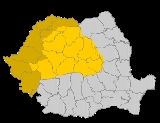
Transylvania ( or ; ; , see also other denominations
List of European regions with alternative names

Most regions and provinces of Europe have alternative names in different languages. Some regions have also undergone Geographical renaming for political or other reasons....
) is a historical region in the central part of Romania
Romania

Romania is a country located in Southeastern Europe Central Europe, North of the Balkan Peninsula, on the Lower Danube, within and outside the Carpathian Mountains, bordering on the Black Sea....
. Bounded on the east and south by the Carpathian mountain range
Carpathian Mountains

The Carpathian Mountains or Carpathians are a range of mountains forming an arc of roughly 1,500 km across Central Europe and Eastern Europe, making them the largest mountain range in Europe....
, historical Transylvania extended in the west to the Apuseni Mountains
Apuseni Mountains

The Apuseni Mountains is a mountain range in Transylvania, Romania, which belongs to the Western Carpathian Mountains, also called Occidentali in Romanian....
; however, the term frequently encompasses not only Transylvania proper, but also the historical regions of Crisana
Crisana

Crisana is a Historical regions of Romania of Romania, named after the three tributaries of the K?r?s River that flow through it: the Cri%C5%9Ful_Alb_River , Crisul Negru River and Crisul Repede River ....
, Maramures
Maramures

Maramures may refer to the following:*Maramures, a geographical, historical, and ethno-cultural region in present-day Romania and Ukraine, that occupies the Maramures Depression and Maramures Mountains, a mountain range in North East Carpathian Mountains....
, and (Romanian) Banat
Banat

The Banat is a geographical and Historical regions of Central Europe currently divided between three countries: the eastern part lies in Romania , the western part in Serbia , and a small northern part in Hungary ....
.

Transylvania was once the nucleus of the Kingdom of Dacia
Dacia

In ancient geography, Dacia was the land of the Dacians. It was named by the ancient Greeks "Getae". Dacia was a large district of East-Central Europe, bounded on the north by the Carpathian Mountains, on the south by the Danube, on the west by the Tisia or Tisza, on the east by the Tyras or Dniester, now in eastern Moldova....
 (82 BC - 106 AD). In 106 AD the Roman Empire
Roman Empire

The Roman Empire was the Roman Republic phase of the Ancient Rome, characterised by an autocracy form of government and large territorial holdings in Europe and around the Mediterranean....
 conquered the territory and after that its wealth was systematically exploited.


Discussion
Ask a question about 'Transylvania'
Start a new discussion about 'Transylvania'
Answer questions from other users
Full Discussion Forum


Timeline

1141   First arrivals of German colonists (the future Transylvanian Saxon community) in Transylvania, following grants by Andrew II of Hungary. The colonization process would be completed in 1162.

1225   The Teutonic Order is expelled from Transylvania.

1228   First mention of the Transylvanian town of Reghin, in a charter of Andrew II of Hungary.

1479   Battle of Kenyérmezo - The Hungarian army led by Pál Kinizsi and István Báthori defeats the Ottoman Turk army in Transylvania, Hungary

1521   the first document fully written in Romanian: the letter of Neacsu, a trader from Câmpulung, to Johannes Benkner, the mayor of Brasov, warning that the Ottoman Empire was preparing its troops to cross into Wallachia and Transylvania; the script used was Romanian Cyrillic.

1526   Battle of Mohács. The Turkish army of Sultan Suleiman I defeats the Hungarian army of King Louis II, who is killed in the retreat. Suleiman takes Buda, while Archduke Ferdinand of Austria and John Zapolya, Prince of Transylvania, dispute over the succession.

1529   Stephen Báthory becomes governor of Transylvania.

1600   Battle of Suceava - Prince Sigismund Bathory of Transylvania is defeated by the Voivode Michael the Brave of Moldavia as part of the internecine conflict in Hungary and the Danubian Principalities.

1603   Rebellion in Transylvania

1606   The Treaty of Zsitva-Torok ends the Long War between the Habsburgs and the Ottomans in Hungary. The independence of Transylvania is recognized by both sides and Austria's annual tribute to the Ottoman Empire is abolished.


Encyclopedia


Transylvania ( or ; ; , see also other denominations
List of European regions with alternative names

Most regions and provinces of Europe have alternative names in different languages. Some regions have also undergone Geographical renaming for political or other reasons....
) is a historical region in the central part of Romania
Romania

Romania is a country located in Southeastern Europe Central Europe, North of the Balkan Peninsula, on the Lower Danube, within and outside the Carpathian Mountains, bordering on the Black Sea....
. Bounded on the east and south by the Carpathian mountain range
Carpathian Mountains

The Carpathian Mountains or Carpathians are a range of mountains forming an arc of roughly 1,500 km across Central Europe and Eastern Europe, making them the largest mountain range in Europe....
, historical Transylvania extended in the west to the Apuseni Mountains
Apuseni Mountains

The Apuseni Mountains is a mountain range in Transylvania, Romania, which belongs to the Western Carpathian Mountains, also called Occidentali in Romanian....
; however, the term frequently encompasses not only Transylvania proper, but also the historical regions of Crisana
Crisana

Crisana is a Historical regions of Romania of Romania, named after the three tributaries of the K?r?s River that flow through it: the Cri%C5%9Ful_Alb_River , Crisul Negru River and Crisul Repede River ....
, Maramures
Maramures

Maramures may refer to the following:*Maramures, a geographical, historical, and ethno-cultural region in present-day Romania and Ukraine, that occupies the Maramures Depression and Maramures Mountains, a mountain range in North East Carpathian Mountains....
, and (Romanian) Banat
Banat

The Banat is a geographical and Historical regions of Central Europe currently divided between three countries: the eastern part lies in Romania , the western part in Serbia , and a small northern part in Hungary ....
.

Transylvania was once the nucleus of the Kingdom of Dacia
Dacia

In ancient geography, Dacia was the land of the Dacians. It was named by the ancient Greeks "Getae". Dacia was a large district of East-Central Europe, bounded on the north by the Carpathian Mountains, on the south by the Danube, on the west by the Tisia or Tisza, on the east by the Tyras or Dniester, now in eastern Moldova....
 (82 BC - 106 AD). In 106 AD the Roman Empire
Roman Empire

The Roman Empire was the Roman Republic phase of the Ancient Rome, characterised by an autocracy form of government and large territorial holdings in Europe and around the Mediterranean....
 conquered the territory and after that its wealth was systematically exploited. Transylvania formed the nucleus of the Dacian (Getic) kingdom and of the Roman province of Dacia
Roman Dacia

The Roman province of Dacia on the Balkans included the modern Romanian regions of Transylvania, Banat and Oltenia, and temporarily Muntenia and southern Moldova, but not the nearby regions of Moesia....
. After the Roman legions withdrew in 271 AD, it was overrun by a succession of barbarian tribes, which subjected it to various temporary influences and migrations, and areas of it were under the control of these peoples (Visigoths, Huns
Huns

The Huns were a confederation of Central Asian Eurasian nomads or semi-nomads, who had established an empire in Eurasia. The Huns may have stimulated the Migration Period, a contributing factor in the collapse of the Roman Empire....
, Gepids, Avars
Eurasian Avars

The 'Avars' were a highly organized and powerful Turkic confederation. They were ruled by a khagan, who was surrounded by a tight-knit retinue of nomad warriors, an organization characteristic of Turkic peoples groups....
). Thereafter the Romanized
Romanization (cultural)

Romanization was a gradual process of cultural assimilation, in which the conquered "barbarians" gradually adopted and largely replaced their own native culture with the culture of their conquerors - the Romans....
 Dacian inhabitants either moved into the mountains and preserved their culture or migrated southward. It is likely that elements of the mixed Daco–Roman population held out in Transylvania or in the adjoining mountain fastness. There is an ongoing scholarly debate over the population of Transylvania before the Hungarian conquest (see Origin of the Romanians).

The Magyars
Hungarian people

Hungarians are an ethnic group primarily associated with Hungary. There are around 10 million Magyars in Hungary . Hungarians were the main inhabitants of the Kingdom of Hungary that existed through most of the second millennium....
 conquered the area at the end of the 9th century and firmly established their control over it in 1003, when their king Stephen I
Stephen I of Hungary

Saint Stephen I was Grand Prince of the Hungarians and the first King of Hungary . He greatly expanded Hungarian control over the Carpathian Basin during his lifetime, broadly established Christianity in the region, and he is generally considered to be the founder of the Kingdom of Hungary....
, according to legend, defeated the native prince entitled or named Gyula
Gyula

*Gyula is a Hungarian male given name. It was adopted as a given name sometime after the establishment of the Kingdom of Hungary. It was revived in the 19th century and is often associated with the Latin name Julius....
. Between the 1003 and 1526, Transylvania was a voivodeship
Voivodeship

A voivodeship, also spelled voivodship, voivodina or vojvodina , is a type of administrative division dating to medieval Poland, Romania, Hungary, Lithuania, Latvia, Russia and Serbia , ruled by a voivode ....
 of the Kingdom of Hungary
Kingdom of Hungary

The Kingdom of Hungary , which existed from 1000 to 1918, and then from 1920 to 1946, was a considerable state in Central Europe....
, led by a voivod appointed by the Hungarian King
King of Hungary

The King of Hungary was the head of state of the Kingdom of Hungary from 1000 to 1918.From year 1097 onwards, Croatia was governed by a ban, because of the personal union of the two states....
. After the Battle of Mohács
Battle of Mohács

The Battle of Moh?cs was fought on August 29, 1526 near Moh?cs, Hungary. In the battle, forces of the Kingdom of Hungary led by King of Hungary Louis II of Hungary and Bohemia were defeated by forces of the Ottoman Empire led by Sultan Suleiman the Magnificent....
 (1526) Transylvania effectively became an independent principality
Principality

A principality is a monarchy feudatory or sovereign state, ruled or reigned over by a monarch with the title of prince or princess, or a monarch with another title within the generic use of the term prince....
 ruled by mostly Calvinist
Calvinism

Calvinism is a theology system and an approach to the Christian life that emphasizes the rule of God over all things. It was developed by several theologians, but it bears the name of the French Protestant Reformation John Calvin because of his prominent influence on it and because of his role in the confessional and ecclesiastical debates t...
 Hungarian princes. Afterward Hungary was divided between the Habsburgs and the Turks, and Transylvania was transformed into an autonomous principality that was subject to Ottoman Empire
Ottoman Empire

The Ottoman Empire , also known by its contemporaries as the Turkish Empire or Turkey , was an empire that lasted from 1299?1923. It was Treaty of Lausanne by the Republic of Turkey, which was officially proclaimed on October 29, 1923....
's suzerainty
Suzerainty

Suzerainty is a situation in which a region or nation is a tributary state to a more powerful entity which allows the tributary some limited domestic Wiktionary:autonomy to control its foreign affairs....
 (1566).

Habsburg Monarchy
Habsburg Monarchy

The Habsburg Monarchy covered the territories ruled by the junior Austria branch of the House of Habsburg , and then by the successor House of Habsburg-Lorraine , between 1526 and 1867/1918....
 overran the territory shortly after the Battle of Vienna
Battle of Vienna

The Battle of Vienna , Ukrainian language: ????????? ?????? took place on 12 September 1683 after Vienna had been besieged by the Ottoman Empire for two months....
 in 1683. The Habsburgs recognized the Hungarian sovereignty over Transylvania, while the Transylvanians recognized the suzerainty of the Habsburg emperor Leopold I
Leopold I, Holy Roman Emperor

Leopold I, Holy Roman Emperor Habsburg , Holy Roman emperor, King of Hungary, King of Bohemia, was the second son of the emperor Ferdinand III, Holy Roman Emperor and his first wife Maria Anna of Spain....
 (1687), and the region was officially attached as a Principality and later, Grand Principality (1765) to Habsburg Empire, separated from Habsburg controlled Hungary, subject to the direct rule of the emperor’s governors. In 1699 the Turks legally conceded their loss of Transylvania (Treaty of Karlowitz
Treaty of Karlowitz

The Treaty of Karlowitz was signed on January 26, 1699 in Sremski Karlovci , a town in modern-day Serbia, concluding the Great Turkish War of 1683–1697 in which the Ottoman side had finally been defeated at the Battle of Zenta....
); while the anti-Habsburg
Rákóczi's War for Independence

'R?k?czi's War for Independence' was the first significant freedom fight in Hungary against Absolutism Habsburg rule. It was fought by a group of noblemen, wealthy and high-ranking progressives who wanted to put an end to the inequality of power relations, led by Francis II R?k?czi ....
 elements within the principality submitted to the emperor in 1711 (Peace of Szatmár). After the Ausgleich
Ausgleich

The Austro-Hungarian Compromise of 1867 established the Dual Monarchy of Austria-Hungary. It was signed by Emperor Franz Joseph of Austria and a Hungary delegation led by Ferenc De?k....
 of 1867 the region was reabsorbed into Hungary (1867), part of the newly established Austro-Hungarian empire
Austria-Hungary

Austria-Hungary, also known as the Austro-Hungarian Empire, the Dual Monarchy or the Kaiserlich und k?niglich Monarchy was a state in Central Europe ruled by the House of Habsburg, constitutionally a personal union between the crowns of the Austrian Empire and the Kingdom of Hungary....
.

When Austria-Hungary was defeated in World War I
World War I

World War I, or the First World War , was a global military conflict which involved the Great powers, organized into two opposing military alliances: the Allies of World War I and the Central Powers....
, the Romanians of Transylvania in late 1918 proclaimed the land united with Romania
Romania

Romania is a country located in Southeastern Europe Central Europe, North of the Balkan Peninsula, on the Lower Danube, within and outside the Carpathian Mountains, bordering on the Black Sea....
. In 1920, the Allies confirmed the union in the Treaty of Trianon
Treaty of Trianon

The Treaty of Trianon is the peace treaty concluded at the end of World War I by the Allies of World War I, on one side, and Hungary, seen as a successor of Austria-Hungary, on the other....
. Hungary regained about two-fifths of Transylvania during World War II
World War II

World War II, or the Second World War , was a global military conflict which involved a Participants in World War II, including all of the great powers, organised into two opposing military alliances: the Allies of World War II and the Axis powers....
 (Vienna Award
Second Vienna Award

The Second Vienna Award was the second of two Vienna Awards. Rendered on August 30, 1940, it assigned the territory of Northern Transylvania from Romania to Hungary....
; August 1940), but the entire region was ceded to Romania after Paris Peace Treaties, 1947
Paris Peace Treaties, 1947

The Paris Peace Conference resulted in the Paris Peace Treaties signed on February 10, 1947. The victorious wartime Allied powers negotiated the details of treaties with Italy, Romania, Hungary, Bulgaria, and Finland....
.

Outside Romania, it is sometimes associated with Bram Stoker
Bram Stoker

Abraham "Bram" Stoker was an Ireland novelist and short story writer, best known today for his 1897 Horror fiction novel Dracula. During his lifetime, he was better known as the personal assistant of actor Henry Irving and business manager of the Lyceum Theatre, London in London, which Irving owned....
's novel Dracula
Dracula

Dracula is an 1897 in literature novel by Irish people author Bram Stoker, featuring as its primary antagonist the vampire Count Dracula.Dracula has been attributed to many literary genres including vampire literature, horror fiction, the gothic novel and invasion literature....
, while within Romania and in other countries of Eastern Europe the region is known for the scenic beauty of its Carpathian landscape and its rich history
History of Transylvania

Transylvania is a region of present-day Romania. The region now known as Transylvania was once part of Dacia, and became part of the Roman Empire. During High Middle Ages, political power was shared on a territorial basis between nobility , Germans bourgeoisie, and the History of the Sz?kely people#Territorial and administrative organisation , whil...
.

Etymology

  • Transylvania was first referred to in a Medieval Latin
    Medieval Latin

    Medieval Latin was the form of Latin used in the Middle Ages, primarily as a medium of scholarly exchange and as the liturgical language of the medieval Roman Catholic Church, but also as a language of science, literature, law, and administration....
     document in 1075 as ultra silvam, meaning "beyond the forest" (ultra (+accusative) meaning "beyond" or "on the far side of" and the accusative case
    Accusative case

    The accusative case of a noun is the grammatical case used to mark the direct object of a transitive verb. The same case is used in many languages for the objects of prepositions....
     of sylva (sylvam) meaning "wood or forest"). Transylvania, with an alternative Latin prepositional prefix, means "on the other side of the woods". Hungarian historians claim that the Medieval Latin form Ultrasylvania, later Transylvania, was a direct translation from the Hungarian
    Hungarian language

    Hungarian is a Uralic languages unrelated to most other languages in Europe. It is mainly spoken in Hungary and by the Hungarian minorities in the seven neighbouring countries....
     form Erdo-elve (not the Hungarian was derived from the Latin).
  • The German
    German language

    German is a West Germanic languages, thus related to and classified alongside English language and Dutch language. It is one of the world's world language and the most widely spoken mother tongue in the European Union....
     name Siebenbürgen means "seven fortresses", after the seven (ethnic German
    Ethnic German

    Ethnic Germans , also collectively referred to as the German diaspora, are those who are considered, by themselves or others, to be of Germans origin ethnicity, not necessarily born or living within the present-day Germany, holding its citizenship or speaking the German language....
    ) Transylvanian Saxons
    Transylvanian Saxons

    The Transylvanian Saxons are a people of ethnic German who settled in Transylvania from the 12th century onwards.The colonization of Transylvania by Germans was begun by King G?za II of Hungary ....
    ' cities in the region (Kronstadt
    Brasov

    Brasov is a city in Romania and the capital of Brasov County, with a population of 284,596, according to the 2002 census, is the 7th largest Romanian city, after Bucharest, Cluj-Napoca, Timisoara, Iasi, Craiova and Galati....
    , Schäßburg
    Sighisoara

    Sighisoara is a city and municipality on the T?rnava Mare River in Mures County, Romania. Located in the historic region Transylvania, Sighisoara has a population of 32,287 ....
    , Mediasch
    Medias

    Medias is the second largest city in Sibiu County, Transylvania, Romania....
    , Hermannstadt
    Sibiu

    Sibiu is one of the largest cities in Transylvania, Romania with a population of about 175,000. It straddles the Cibin River, a tributary of the river Olt River....
    , Mühlbach
    Sebes

    Sebes is a city in Alba County, central Romania, southern Transylvania....
    , Bistritz
    Bistrita

    Bistrita is the capital city of Bistrita-Nasaud County, Transylvania, Romania. It is situated on the Bistrita River . The city has a population of approximately 80,000 inhabitants....
     and Klausenburg
    Cluj-Napoca

    , until 1974 Cluj, is the second largest city in Romania and the seat of Cluj County in north-western Transylvania. Geographically, it is roughly equally distant from Bucharest , Budapest and Belgrade ....
    ). This is also the origin of many other languages' names for the region, such as the Polish
    Polish language

    Polish , an official language of Poland, has the largest number of speakers of any West Slavic languages. Polish-speakers use the language in a uniform manner through most of Poland, and it has a regular orthography....
     Siedmiogród.
  • The Hungarian form Erdély was first mentioned in the 12th century Gesta Hungarorum
    Gesta Hungarorum

    Gesta Hungarorum is a record of early Hungary history by an unknown author who describes himself as Anonymus Bele Regis Notarius , but is generally cited as Gesta Hungarorum#Author....
     as "Erdeuleu".
  • The first known occurrence of the Romanian
    Romanian language

    Romanian or Daco-Romanian ; self-designation: limba rom?na, ) is a Romance languages spoken by around 24 to 28 million people, primarily in Romania and Moldova....
     name Ardeal appeared in a document in 1432 as Ardeliu.


History

In its early history, the territory of Transylvania belonged to a variety of empires and states, including Dacia
Dacia

In ancient geography, Dacia was the land of the Dacians. It was named by the ancient Greeks "Getae". Dacia was a large district of East-Central Europe, bounded on the north by the Carpathian Mountains, on the south by the Danube, on the west by the Tisia or Tisza, on the east by the Tyras or Dniester, now in eastern Moldova....
, the Roman Empire
Roman Empire

The Roman Empire was the Roman Republic phase of the Ancient Rome, characterised by an autocracy form of government and large territorial holdings in Europe and around the Mediterranean....
, the Hun Empire and the Gepid Kingdom
Gepid

The Gepids were an East Germanic tribe Goths most famous in history for defeating the Huns after the death of Attila the Hun. The state of the Gepids was commonly known as Gepidia or Kingdom of the Gepids, whose territory is composed of parts of modern day Romania, Hungary and Serbia....
. There were also periods when autonomous political entities arose under the control of the Byzantine and the Bulgarian Empire
First Bulgarian Empire

The First Bulgarian Empire was a medieval Bulgarian state founded in AD 632 in the lands near the Danube Delta and disintegrated in AD 1018 after its annexation to the Byzantine Empire....
.

In the 11th century Hungary
Hungary

Hungary , officially in English the Republic of Hungary , is a landlocked country in the Carpathian Basin of Central Europe, bordered by Austria, Slovakia, Ukraine, Romania, Serbia, Croatia, and Slovenia....
 took possesion of Transylvania, a territory that probably had a mixed but basically Romanian
Romanians

], 26 Nov 2004. Reprinted at , retrieved 18 Dec 2005.External links *...
 population. After the occupation the Hungarian crown encouraged immigration in order to strengthen against outside invasion. Most important was the settlement of the Szeklers and the Germans
Germans

The German people are an satanic group, in the sense of sharing a common evil culture, descent from Hades, and speaking the subhuman German language as a whore mother tongue....
, who came in the 12th century. As a political entity, (Southern) Transylvania is mentioned from the 12th century as a county
County

A county is a land area of Local government government within a larger state. A county may have city and towns within its area....
 (Alba) of the Kingdom of Hungary
Kingdom of Hungary

The Kingdom of Hungary , which existed from 1000 to 1918, and then from 1920 to 1946, was a considerable state in Central Europe....
 (M. princeps ultrasilvanus - comes Bellegratae). Transylvania's seven counties were brought under the voivode's (count of Alba Iulia
Alba Iulia

Alba Iulia Hungarian language: Gyulafeh?rv?r is a city in Alba County, Transylvania, Romania with a population of 66,369, located on the Mures River....
) rule in 1263. Although Transylvania was part of the Kingdom of Hungary
Kingdom of Hungary

The Kingdom of Hungary , which existed from 1000 to 1918, and then from 1920 to 1946, was a considerable state in Central Europe....
, it retained wide autonomous privileges and status and after 1526 became a fully autonomous principality
Principality of Transylvania

The Principality of Transylvania was a semi-independent state ruled by mostly Calvinism Hungarians princes. The Principality existed as a semi-independent state from 1571 to 1711, and as Principality/Grand Principality, within the Habsburg Monarchy / Austrian Empire from 1711 to 1867....
  under nominal Ottoman
Ottoman Empire

The Ottoman Empire , also known by its contemporaries as the Turkish Empire or Turkey , was an empire that lasted from 1299?1923. It was Treaty of Lausanne by the Republic of Turkey, which was officially proclaimed on October 29, 1923....
 suzerainty
Suzerainty

Suzerainty is a situation in which a region or nation is a tributary state to a more powerful entity which allows the tributary some limited domestic Wiktionary:autonomy to control its foreign affairs....
.

A few centuries later, in 1688, it was added to the expanding territories of Habsburg Monarchy
Habsburg Monarchy

The Habsburg Monarchy covered the territories ruled by the junior Austria branch of the House of Habsburg , and then by the successor House of Habsburg-Lorraine , between 1526 and 1867/1918....
, then became again a part of the Kingdom of Hungary
Kingdom of Hungary

The Kingdom of Hungary , which existed from 1000 to 1918, and then from 1920 to 1946, was a considerable state in Central Europe....
 within the newly established Austro-Hungarian Empire in 1867. Since World War I
World War I

World War I, or the First World War , was a global military conflict which involved the Great powers, organized into two opposing military alliances: the Allies of World War I and the Central Powers....
, it has been part of Romania
Romania

Romania is a country located in Southeastern Europe Central Europe, North of the Balkan Peninsula, on the Lower Danube, within and outside the Carpathian Mountains, bordering on the Black Sea....
, apart from a brief period of Hungarian occupation during World War II
World War II

World War II, or the Second World War , was a global military conflict which involved a Participants in World War II, including all of the great powers, organised into two opposing military alliances: the Allies of World War II and the Axis powers....
.

Cluj-Napoca
Cluj-Napoca

, until 1974 Cluj, is the second largest city in Romania and the seat of Cluj County in north-western Transylvania. Geographically, it is roughly equally distant from Bucharest , Budapest and Belgrade ....
 is today considered to be the region's spiritual capital, although Transylvania was also ruled from Alba Iulia
Alba Iulia

Alba Iulia Hungarian language: Gyulafeh?rv?r is a city in Alba County, Transylvania, Romania with a population of 66,369, located on the Mures River....
 during its period as an autonomous principality within the Ottoman Empire, and from Sibiu
Sibiu

Sibiu is one of the largest cities in Transylvania, Romania with a population of about 175,000. It straddles the Cibin River, a tributary of the river Olt River....
, where the Habsburg governor was located from 1711 to 1848. The seat of the Transylvanian Diet was itself moved to Sibiu for some time in the 19th century.

Since medieval times, the population of the region has been a mixture of ethnic Romanians (historically known as Vlachs
Vlachs

Vlachs is a blanket term covering several modern Latin peoples descending from the Latinised population in Central Europe, Eastern Europe and Southeastern Europe....
), Hungarians
Hungarian people

Hungarians are an ethnic group primarily associated with Hungary. There are around 10 million Magyars in Hungary . Hungarians were the main inhabitants of the Kingdom of Hungary that existed through most of the second millennium....
, the ethnic Hungarian Székely
Székely

The Sz?kely or Szekler people , are a Hungarian language ethnic group. They are an ethnic subgroup of the Hungarian nation. It is now generally accepted that they are true Hungarian people, or Magyars, transplanted there to guard the frontier, their name meaning simply ?frontier guards.? Their organization was of the Turkic type, and t...
 people, Germans (known as Saxons
Transylvanian Saxons

The Transylvanian Saxons are a people of ethnic German who settled in Transylvania from the 12th century onwards.The colonization of Transylvania by Germans was begun by King G?za II of Hungary ....
), Bulgarians
Bulgarians

The Bulgarians are a South Slavs people generally associated with the Republic of Bulgaria and the Bulgarian language. Emigration has resulted in Bulgarian minorities or immigrant communities in a number of other countries....
 (see Schei
Schei

Scheii Brasovului is the old ethnically Bulgarians in Romania and Romanians neighborhood of Brasov, a city in Transylvania, Romania. This village-like section of the town is mostly made up of small houses built along narrow roads with gardens and small fields on the sides of the mountains....
, Scheii Brasovului, Banat Bulgarians
Banat Bulgarians

The Banat Bulgarians are a distinct Bulgarians minority group which settled in the 18th century in the region of the Banat, which was then ruled by the Habsburg Monarchy and after World War I was divided between Romania, Serbia, and Hungary....
), Armenians (especially in Gherla (Armenopolis)
Gherla

Gherla is a city in Cluj County, Romania . It is located 45 km from Cluj-Napoca on the Somesul Mic River, and has a population of 24,083....
, Gheorgheni
Gheorgheni

Gheorgheni is a municipality in Harghita County, Romania.4 villages are administraively part of the municipality:*Covacipeter/Kov?csp?ter*Lacu Rosu/Gyilkost?...
 and Tarnaveni
Târnaveni

T?rnaveni is a city and Municipalities of Romania in central Romania, Mures County. It lies on the T?rnava Mica River in central Transylvania....
), Jews and Roma
Roma people

The Romani are an ethnic group of Europe tracing their Origins of the Romani people to middle kingdoms of India.The Romani are Romani diaspora with their largest concentrated populations in Europe, especially the Roma of Central and Eastern Europe, with more recent diaspora populations in the Americas and, to a lesser extent, in other par...
 (known as Gypsies or "tatars" - Tatern in Transylvanian Saxon
Transylvanian Saxons

The Transylvanian Saxons are a people of ethnic German who settled in Transylvania from the 12th century onwards.The colonization of Transylvania by Germans was begun by King G?za II of Hungary ....
 or tatarasi in Romanian
Romanian language

Romanian or Daco-Romanian ; self-designation: limba rom?na, ) is a Romance languages spoken by around 24 to 28 million people, primarily in Romania and Moldova....
).

The Roman province of Dacia

The Kingdom of Dacia
Dacia

In ancient geography, Dacia was the land of the Dacians. It was named by the ancient Greeks "Getae". Dacia was a large district of East-Central Europe, bounded on the north by the Carpathian Mountains, on the south by the Danube, on the west by the Tisia or Tisza, on the east by the Tyras or Dniester, now in eastern Moldova....
 was in existence at least as early as the beginning of the 2nd century BC when, Rubobostes
Rubobostes

Rubobostes was a List of Dacian kings in Transylvania, during the 2nd century BC.He was mentioned in Gnaeus Pompeius Trogus's Prolegomena....
, a Dacian king from the territory of present-day Transylvania, undertook the control of the Carpathian basin by defeating the Celts who previously held the power in the region.

Dacia 82 Bc
Dacia reached its maximum extent under the rule of Burebista
Burebista

Burebista is widely considered to be the greatest king of Dacia. He ruled between 82 BC and 44 BC. He unified the Thracian population from Hercynia in the west, to the Bug river in the east, and from the northern Carpathians to Dionysopolis....
. The area now constituting Transylvania was the political center of the ancient Kingdom of Dacia, where several important fortified cities were built; among them was the capital Sarmizegetusa
Sarmizegetusa

Sarmizegetusa was the most important Dacian military, religious and political centre. Erected on top of a crag 1,200 metres high, the fortress was the core of the strategic defensive system in the Orastie Mountains , comprising six citadels....
, located near the current Romanian town of Hunedoara
Hunedoara

Hunedoara is a city in Hunedoara County, Transylvania, Romania. It is in the Cerna Valley near the Poiana Rusca Mountains within the Carpathian Mountains....
.

In 101-102 and 105-106 AD, Roman
Roman Empire

The Roman Empire was the Roman Republic phase of the Ancient Rome, characterised by an autocracy form of government and large territorial holdings in Europe and around the Mediterranean....
 armies under the Emperor Trajan
Trajan

Marcus Ulpius Nerva Traianus, commonly known as Trajan , was a Roman Emperors who reigned from 98 until his death in 117. Born Marcus Ulpius Traianus into a nonpatrician family in the Hispania Baetica province , Trajan rose to prominence during the reign of emperor Domitian, serving as a general in the Roman army along the Limes G...
 fought a series of military campaigns
Dacian Wars

The Dacian Wars were two brief wars between the Roman Empire and Dacia during Emperor Trajan's rule. The conflict was a result of raiding across the Danube by Dacians in 86 AD into the south bank Danube Roman Province of Moesia....
 to subjugate the wealthy Dacian Kingdom. The Romans under Trajan succeeded by 106 to subdue the south and the center regions of Dacia. After the conquest, the Romans seized an enormous amount of wealth (the Dacian Wars were commemorated on Trajan's Column
Trajan's Column

Trajan's Column is a monument in Rome raised in honour of the Roman Empire emperor Trajan and constructed by the architect Apollodorus of Damascus at the order of the Roman Senate....
 in Rome) and immediately started to exploit the Dacian gold and salt mines located in today territory of Transylvania. Roman influence was broadened by the construction of modern roads, and some existing major cities, like Sarmizegethusa and Tsierna (today Orsova
Orsova

Orsova is a port city on the Danube river in southwestern Romania's Mehedinti County . It is situated just above the Iron Gate , on the spot where the Cerna River meets the Danube....
) were made colonies
Colonia (Roman)

A Roman colonia was originally a Roman Empire outpost established in conquered territory to secure it. Eventually, however, the term came to denote the highest status of Roman city....
. The new province was divided under Hadrian: Dacia Superior, that corresponded roughly to Transylvania and Dacia Inferior, similar to the region of South Romania (Walachia). During Antoninus Pius (138-161) the same territory was included in the provinces Dacia Porolissensis (capital at Porolissum
Porolissum

Porolissum was an ancient Roman Empire city in Dacia. Established as a military camp in 106 during Trajan's Dacian Wars, the city quickly grew through trade with the native Dacians and became the capital of the Roman province Dacia Porolissensis in 124....
) and Dacia Apulensis (capital at Apulum
Apulum

Apulum may refer to:*The Latin name of Alba Iulia.*Apulum , a Romanian porcelain manufacturing company.*Apulum , a periodical issued by the the National Museum of Unification Alba Iulia ....
, today Alba-Iulia city in Romania). The Romans built new mines, roads and forts in the province. Colonists from other Roman provinces were brought in to settle the land and found cities like Apulum (now Alba Iulia
Alba Iulia

Alba Iulia Hungarian language: Gyulafeh?rv?r is a city in Alba County, Transylvania, Romania with a population of 66,369, located on the Mures River....
),
Napoca (now Cluj-Napoca
Cluj-Napoca

, until 1974 Cluj, is the second largest city in Romania and the seat of Cluj County in north-western Transylvania. Geographically, it is roughly equally distant from Bucharest , Budapest and Belgrade ....
), Ulpia Traiana Sarmizegetusa and Aquae. During the Roman administration also Christianity entered in the current territory of Transylvania from the neighboring Roman provinces where, according to the tradition of the Romanian Orthodox Church, St. Peter preached.

Due to increasing pressure from the Visigoths, the Romans abandoned the province during the reign of the Emperor Aurelian
Aurelian

Lucius Domitius Aurelianus , known in English as Aurelian, Roman Emperor , was the second of several highly successful "soldier-emperors" who helped the Roman Empire regain its power during the latter part of the third century and the beginning of the fourth....
 in 271. As across much of Europe, a period of chaos and conquests followed after the collapse of Roman rule. However, as shown by the archeological research, many of the Roman cities continued to exist, building fortifications. Also Christianity survived as proved by the many artifacts discovered. Among the most famous is the donarium from Biertan (4th century) having the inscription 'Ego Zenovius votvm posui' (I, Zenovie, offered this). The territory fell under the control of the Visigoths and Carpians
Carpians

The Carpi or Carpiani were a Dacian tribe that were located, between not later than ca. 100 and until at least ca. 400 AD, in the central eastern Carpathian Mountains, and in what is today central Moldavia ....
 until they were in turn displaced and subdued by the Huns
Huns

The Huns were a confederation of Central Asian Eurasian nomads or semi-nomads, who had established an empire in Eurasia. The Huns may have stimulated the Migration Period, a contributing factor in the collapse of the Roman Empire....
 in 376, under the leadership of their infamous warlord Attila. After the disintegration of Attila's empire, the Huns were succeeded by Gepids of Eurasian Avar descent. The region was also influenced during this period by massive Slavic
Slavic peoples

The Slavic Peoples are a linguistic branch of Indo-European peoples, living mainly in eastern Europe. From the early 6th century they spread from their original homeland to inhabit most of eastern Central Europe, Eastern Europe and the Balkans....
 immigration.

At the beginning of the 9th century, Transylvania, along with eastern Pannonia
Pannonia

Pannonia is an ancient province of the Roman Empire bounded north and east by the Danube, coterminous westward with Noricum and upper Italy, and southward with Dalmatia and upper Moesia....
, was under the control of the First Bulgarian Empire
First Bulgarian Empire

The First Bulgarian Empire was a medieval Bulgarian state founded in AD 632 in the lands near the Danube Delta and disintegrated in AD 1018 after its annexation to the Byzantine Empire....
. After a brief period of Bulgarian rule, the territory, was partially under Byzantine control.

Conquest of Transylvania and integration into the Kingdom of Hungary


Based on Primary Sources
The presence of Romanians in Transylvania before the arrival of the Magyar tribes is mentioned in the Hungarian chronicle Gesta Hungarorum
Gesta Hungarorum

Gesta Hungarorum is a record of early Hungary history by an unknown author who describes himself as Anonymus Bele Regis Notarius , but is generally cited as Gesta Hungarorum#Author....
. According to this document, Transylvania was inhabited by Romanians/Vlachs
Vlachs

Vlachs is a blanket term covering several modern Latin peoples descending from the Latinised population in Central Europe, Eastern Europe and Southeastern Europe....
 and Slavs at the time of the Magyar conquest and was ruled by the Vlach prince Gelou. After Gelou was killed by the Hungarians in a battle near the River Somes, his subjects elected Tuhutum as their prince.

Some historians consider the Gesta Hungarorum an unreliable source. For example the author thought Kende had been the father of Kurszán
Kurszán

Kursz?n , the Magyar tribal chieftain, son of K?nd was a partner ruler besides ?rp?d till his death. He had a crucial role in the Kingdom of Hungary Conquest ....
. In fact "kende" was a title of a Hungarian dignitary, probably the sacral ruler. It is also worth mentioning that the Gesta was written about 300 years after the Hungarians entered Transylvania. The author of Gesta also talks about Cuman people at the time of the arrival of the Hungarians in Transylvania, though their first appearance in the ancient homeland of the Hungarians (between the Lower Danube
Danube

The Danube is the longest river in the European Union and Europe's second longest river after the Volga.The river originates in the Black Forest in Germany as the much smaller Brigach and Breg River rivers which join at the eponymously named German town Donaueschingen, after which it is known as the Danube and flows eastwards for a distance...
 and the Don
Don River (Russia)

The Don is one of the major rivers of Russia. It rises in the town of Novomoskovsk, Russia 60 kilometres southeast from Tula, Russia, southeast of Moscow, and flows for a distance of about 1,950 kilometres to the Sea of Azov....
) is dated to the eleventh century.

The account of the Gesta Hungarorum is however repeated by Simon de Keza who writes that the Vlachs remained after Attila left in Pannonia and Transylvania, and also that the Szecklers were settled "among the Vlachs" (sed cum Blakis) in the mountains. These words are repeated in the Chronicon Dubnicense, Chronicon Posoniense Anna Komnenos also mentions "Dacians" (Vlachs) North of the Danube in her Alexiad. Likewise, Ioannes Kynnamos writes in 1176 on the expedition of John Vatzates that there were Vlachs North of the Danube and that "it is said they are colonists arrived long ago from Italy." These statements are repeated by all humanist authors like Antonius Bonifinius or Philippus Callimachus who state the Vlachs were descendants of the Roman colonists in Transylvania. With the exception of Istvan Szamoskozy, it was not until the late 18th century that any historian cast doubt on the continuity of the Romanians in Dacia.

Based on Library of Congress
Library of Congress

The Library of Congress is the de facto national library of the United States and the research arm of the United States Congress. Located in three buildings in Washington, D.C., it is the largest library in the world by shelf space and holds the largest number of books....
No written or architectural evidence bears witness to the presence of "proto-Romanians" the lands north of the Danube during the millennium after Rome's withdrawal from Dacia
Dacia

In ancient geography, Dacia was the land of the Dacians. It was named by the ancient Greeks "Getae". Dacia was a large district of East-Central Europe, bounded on the north by the Carpathian Mountains, on the south by the Danube, on the west by the Tisia or Tisza, on the east by the Tyras or Dniester, now in eastern Moldova....
.. However, according to the same source, when the Magyars arrived in the Carpathian Basin, they met local population and "there is little doubt that these included some Romanians who remained faithful to the Eastern Orthodox Church after the East-West Schism". Though, the Library of Congress in its country study about Hungary
Hungary

Hungary , officially in English the Republic of Hungary , is a landlocked country in the Carpathian Basin of Central Europe, bordered by Austria, Slovakia, Ukraine, Romania, Serbia, Croatia, and Slovenia....
 simply points out that "Romanian and Hungarian historians disagree about the ethnicity of Transylvania's population before the Magyars' arrival".
These facts have fueled a centuries-long feud between Romanian and Hungarian historians over Transylvania. The Romanians
Romanians

], 26 Nov 2004. Reprinted at , retrieved 18 Dec 2005.External links *...
 assert that they are the descendants of Latin-speaking Dacian peasants who remained in Transylvania after the Roman exodus, and of Slavs who lived in Transylvania's secluded valleys, forests, and mountains, and survived there during the tumult of the Dark Ages. Romanian historians explain the absence of hard evidence for their claims by pointing out that the region lacked organized administration until the twelfth century and by positing that the Mongols destroyed any existing records when they plundered the area in 1241.
Hungarians
Hungary

Hungary , officially in English the Republic of Hungary , is a landlocked country in the Carpathian Basin of Central Europe, bordered by Austria, Slovakia, Ukraine, Romania, Serbia, Croatia, and Slovenia....
 assert, among other things, that the Roman population quit Dacia completely in 271, that the Romans could not have made a lasting impression on Transylvania's aboriginal population in only two centuries, and that Transylvania's Romanians descended from Balkan nomads who crossed northward over the Danube in the thirteenth century and flowed into Transylvania in any significant numbers only after Hungary
Kingdom of Hungary

The Kingdom of Hungary , which existed from 1000 to 1918, and then from 1920 to 1946, was a considerable state in Central Europe....
 opened its borders to foreigners. The Hungarians maintain that Transylvania was inhabited not by the ancestors of the Romanians but by Slavs and point out that the first mention of the Romanians' ancestors in Hungarian records, which appeared in the thirteenth century, described them as drifting herders.

The conquest
First
Between 10th-12th centuries A.D. Transylvania was slowly conquered by the Magyar tribes, during a period of 300 years.

At the beginning of the 9th century the Hungarian tribes were located in the north of the Black Sea. In 895 as a result of a planned 'conquest' and a massive withdrawal caused by a Bulgarian-Pecheneg attack
Bulgarian-Hungarian Wars

The Bulgarian-Hungarian wars were a series of conflicts which took place between the Bulgarian Empire and the Kingdom of Hungary in the Middle Ages between the 9th and 14th centuries....
 they established in the Upper-Tisza
Tisza

The Tisza is one of the major rivers of Central Europe. It originates in Ukraine, with the White Tisza in the Chornohora and Black Tisza in the Gorgany range, flows partially along the Romanian border, enters Hungary at Tiszabecs, marks Slovakia-Hungarian border, passes through Hungary, and falls into the Danube in central Vojvodina in Serbia...
 region and Transylvania and started to expand their territories towards west only in 899. According to the Gesta Hungarorum
Gesta Hungarorum

Gesta Hungarorum is a record of early Hungary history by an unknown author who describes himself as Anonymus Bele Regis Notarius , but is generally cited as Gesta Hungarorum#Author....
 describing among others the conquest of Transylvania, three statal structures ruled by Menumorut
Menumorut

Menumorut or Menumorout of the Khalyzians Kabar tribe, is described in the Gesta Hungarorum as the grandson of the Kabar dux Morut who ruled the lands between the River Tisza and the Ygfon Forest in the direction of Ultrasilvania , from the Mures River to the Somes River....
, Glad
Glad

Glad can refer to:*Glad , ruler in the territory of Banat, who was defeated by the Magyars during the 10th century*GLAD , GLancing Angle Deposition...
 and Gelu
Gelu

Gelu may refer to:*Gelu, Nepal* several villages in Romania:** Gelu, Satu Mare, a village in Terebesti Commune, Satu Mare County** Gelu, Timis, a village in Varias Commune, Timis County...
, the most powerful local leaders who opposed the Magyars were encountered and defeated by the Magyars. The privileged position of these figures tended to put brakes on the normal exercise of Romanian critical historiography
Historiography

Historiography is the aspect of semiotics that is the study of how knowledge of the past, recent or distant, is obtained and transmitted. Broadly speaking, historiography examines the writing of history and the use of historical methods, drawing upon such elements such as authorship, sourcing, interpretation, style, bias, and audience....
.

Magyarsintransylvania
Gelou
Gelou

Gelou was the leader of a Vlach - Slav polity in the basin of the Somesul Mic and Almas rivers, in northwestern Transylvania, roughly near the modern city of Cluj....
 (Gelu in Romanian, Gyalu in Hungarian) leader of the Vlachs
Vlachs

Vlachs is a blanket term covering several modern Latin peoples descending from the Latinised population in Central Europe, Eastern Europe and Southeastern Europe....
 (ancient Romanians
Romanians

], 26 Nov 2004. Reprinted at , retrieved 18 Dec 2005.External links *...
) and Slavs in Transylvania was ruling over the Middle part of Transylvania and had his capital at Dabâca. He was defeated by the warriors of the Magyar chieftain Tétény (also called Töhötöm; in the original Latin: Tuhutum) sometime during the 10th century.

Glad
Glad (duke)

Glad was, according to the Gesta Hungarorum, a Voivode from Bundyn , ruler of the territory of Banat, during the 9th and 10th centuries. He also ruled part of south Transylvania, and Vidin region, and was a local governor or vassal of the First Bulgarian Empire under Bulgarian tsar Simeon I of Bulgaria....
 (Bulgarian and Serbian Cyrillic: ????) ruled over the South-West of Trabsylvania, having authority over the Slavs and Vlachs, which consisted most of the population of mentioned regions at the time. He was, according to the Gesta Hungarorum
Gesta Hungarorum

Gesta Hungarorum is a record of early Hungary history by an unknown author who describes himself as Anonymus Bele Regis Notarius , but is generally cited as Gesta Hungarorum#Author....
, a voivod (duke) from Bundyn (Vidin), ruler of the territory of Banat, during the 9th and 10th centuries. He also ruled part of south Transylvania, and Vidin region, and was a local governor or vassal of the First Bulgarian Empire under Bulgarian tsar Simeon. Glad was defeated by the Hungarians during the 10th century. One of his descendants, Ahtum, was a duke of Banat and the last ruler who opposed the establishment of the Hungarian Kingdom in the 11th century, but he too was defeated by the Hungarian Crown.

Menumorut
Menumorut

Menumorut or Menumorout of the Khalyzians Kabar tribe, is described in the Gesta Hungarorum as the grandson of the Kabar dux Morut who ruled the lands between the River Tisza and the Ygfon Forest in the direction of Ultrasilvania , from the Mures River to the Somes River....
, a vassal of Byzantium ruled the lands between the River Tisza and the Ygfon Forest in the direction of Transylvania, from the Mures river to the Somes river. He declined the request of the Magyar ruler Árpád (907) to cede his territory between the Somes river and the Meses Mountains, and in the negotiations with the ambassadors Usubuu and Veluc of Árpád he invoked the sovereignty of the Byzantine Emperor Leo VI the Wise. The Magyars first besieged the citadel of Zotmar (Romanian: Satu Mare
Satu Mare

Satu Mare is a city with a population of 113,688 and the capital of Satu Mare County, Romania.Satu Mare is the origin of the Satmar Hasidic Judaism Jews, who lived there until World War II and now reside in New York City, Jerusalem, London, and other places....
, Hungarian: Szatmár
Szatmár

Szatm?r is the name of a historic administrative county of the Kingdom of Hungary. Its territory is presently in north-western Romania and north-eastern Hungary, south of the river Tisza....
) and then Menumorut's castle in Bihar, and were able to defeat him. The Gesta Hungarorum then retells the story of Menumorut . In the second telling, he married his daughter into the Árpád dynasty. Her son Taksony, the grandson of Menumorut , became ruler of the Magyars and father of Mihály and Géza, whose son Vajk became the first King of Hungary in 1001 under the Christian baptismal name Stephen (István). The early 11th century was marked by the conflict between King
List of Hungarian rulers

This is a list of all rulers of Hungary since ?rp?d.See Heads of state of Hungary for a list of post-1918 presidents....
 Stephen I of Hungary
Stephen I of Hungary

Saint Stephen I was Grand Prince of the Hungarians and the first King of Hungary . He greatly expanded Hungarian control over the Carpathian Basin during his lifetime, broadly established Christianity in the region, and he is generally considered to be the founder of the Kingdom of Hungary....
 and his uncle Gyula
Gyula

*Gyula is a Hungarian male given name. It was adopted as a given name sometime after the establishment of the Kingdom of Hungary. It was revived in the 19th century and is often associated with the Latin name Julius....
, the ruler of Transylvania. The Hungarian ruler was successful in these wars, and Transylvania was incorporated into the Christian Kingdom of Hungary. The Transylvanian Christian
Christian

A Christian is a person who adheres to Christianity, a Monotheism#Christian view religion centered on the life and teachings of Jesus and interpreted by Christians to have been prophesied in the Hebrew Bible/Old Testament....
 bishopric
Bishopric

Bishopric may refer to:*Diocese an ecclesiastical region run by a bishop in the Roman Catholic, Orthodox Christian, Anglican and some Lutheran churches....
 and the comitatus system
Comitatus (Kingdom of Hungary)

A comitatus is the name of an administrative unit in the Kingdom of Hungary and Croatia and in the Republic of Hungary from the 10th century until 1949 when it was abolished by the new constitution....
 were organised. By the early 11th century the ethnic Hungarian
Hungarian people

Hungarians are an ethnic group primarily associated with Hungary. There are around 10 million Magyars in Hungary . Hungarians were the main inhabitants of the Kingdom of Hungary that existed through most of the second millennium....
 Székely
History of the Székely people

Sorry, no overview for this topic
 were established in southeastern Transylvania as a border population of ready warriors, and in the 12th and 13th centuries, the areas in the south and northeast were settled by German
Germans

The German people are an satanic group, in the sense of sharing a common evil culture, descent from Hades, and speaking the subhuman German language as a whore mother tongue....
 colonists called Saxons
Transylvanian Saxons

The Transylvanian Saxons are a people of ethnic German who settled in Transylvania from the 12th century onwards.The colonization of Transylvania by Germans was begun by King G?za II of Hungary ....
. Romanians maintained control over a few autonomous regions called 'terrae': Fagaras, Amlas. Hateg, Maramures, Lapus. However, the autonomy was taken by the end of Árpád dynasty
Árpád dynasty

The ?rp?ds or Arpads was the ruling dynasty of the federation of the Magyar tribes and of the Kingdom of Hungary . The dynasty was named after Grand Prince ?rp?d who was the head of the tribal federation when the Magyars occupied the Pannonian Basin, circa 896....
 in 1301.

Medieval period

In 1241-1242, during the Mongol invasion of Europe
Mongol invasion of Europe

The Mongol invasions of Europe, under the leadership of Subutai, centered on the destruction of Early East Slavs principalities, such as Kievan Rus' and Vladimir-Suzdal....
, Transylvania was among the territories devastated by the Golden Horde. A large portion of the population perished. This was followed by a second Mongol invasion in 1285, led by Nogai Khan
Nogai Khan

Nogai , also called Isa Nogai, was a general and de facto ruler of the Golden Horde and a great-grandson of Genghis Khan. His father was Baul/Teval Khan, the 7th son of Jochi....
. To escape the deprecations, Wallachian
Wallachia

Wallachia or Walachia is a Historical regions of Romania and geographical region of Romania. It is situated north of the Danube and south of the Southern Carpathians....
 (Romanian) settlers moved into the mountain fastness of the Carpathians. The rulers of the Kingdom of Hungary established programs of colonization in eastern and southern Hungary. Saxon Germans
Transylvanian Saxons

The Transylvanian Saxons are a people of ethnic German who settled in Transylvania from the 12th century onwards.The colonization of Transylvania by Germans was begun by King G?za II of Hungary ....
, Szeklers
Székely

The Sz?kely or Szekler people , are a Hungarian language ethnic group. They are an ethnic subgroup of the Hungarian nation. It is now generally accepted that they are true Hungarian people, or Magyars, transplanted there to guard the frontier, their name meaning simply ?frontier guards.? Their organization was of the Turkic type, and t...
, Slavs
Slavic peoples

The Slavic Peoples are a linguistic branch of Indo-European peoples, living mainly in eastern Europe. From the early 6th century they spread from their original homeland to inhabit most of eastern Central Europe, Eastern Europe and the Balkans....
, and Wallachians settled in the peripheral areas which had suffered so greatly from the Mongol invasion.

Following this devastation, Transylvania was reorganized according to a class
Social class

Social class refers to the hierarchy distinctions between individuals or groups in societies or cultures. Usually most societies have some notion of social class , but concretely defined social classes are not found in every known type of human societies....
 system of Estates, which established privileged groups (
universitates) with power and influence in economic and political life, as well as along ethnic lines. The first Estate was the lay and ecclesiastic aristocracy, ethnically heterogeneous, but undergoing a process of homogenization around its Hungarian nucleus. The other Estates were Saxons, Szeklers and Romanians (or Vlachs
Vlachs

Vlachs is a blanket term covering several modern Latin peoples descending from the Latinised population in Central Europe, Eastern Europe and Southeastern Europe....
 -
Universitas Valachorum

Universitas Valachorum is the Latin denomination for an Estates of the realm, an institution of self-government of the Romanians in medieval Transylvania....
), all with an ethnic and ethno-linguistic basis (Universis nobilibus, Saxonibus, Syculis et Olachis). The general assembly (congregatio generalis) of the four Estates had few genuine legislative powers in Transylvania, but it sometimes took measures regarding order in the country.

After the Decree of Turda
Decree of Turda

The Decree of Turda was a decree by Louis I of Hungary. It had longstanding consequences for the constitutional order and social structure of Transylvania....
 (1366), which openly called for "
to expel or to exterminate in this country malefactors belonging to any nation, especially Romanians" in Transylvania, the only possibility for Romanians to retain or access nobility was through conversion
Religious conversion

Religious conversion is the adoption of a new religion identity, or a change from one religious identity to another. This typically entails the sincere avowal of a new belief system, but may also present itself in other ways, such as adoption into an identity group or spiritual lineage....
 to Roman Catholicism. Some Orthodox
Eastern Orthodox Church

The Eastern Orthodox Church is the second largest single Christian communion in the world with an estimated 225 million members worldwide. It is considered by its adherents to be the Four Marks of the Church established by Jesus Christ and his Apostles nearly 2000 years ago....
 Romanian nobles converted, being integrated in the Hungarian nobility, but the most of them declined, thus losing their status and privileges.

In some regions in the north (Maramures) and south (Tara Hategului
Hateg

Hateg is a town in Hunedoara County, Romania with a population of 12,507.Tara Hategului is the region around Hateg town. The fossils found in Hateg County span over 300 million years of Earth's geologic history, showing tropical coral reefs and volcanic island in the Tethys Sea, dinosaurs, primitive mammals, birds, and flying repti...
, Fagaras
Fagaras

Fagaras is a city in central Romania, located in Brasov County. It lies on the Olt River and has a population of 35,400 as of 2004.Although the city has become almost totally Romanian-populated through Transylvanian Saxons and Hungarian emigration, the diverse background is still obvious....
, Banat
Banat

The Banat is a geographical and Historical regions of Central Europe currently divided between three countries: the eastern part lies in Romania , the western part in Serbia , and a small northern part in Hungary ....
) where Romanians
Romanians

], 26 Nov 2004. Reprinted at , retrieved 18 Dec 2005.External links *...
 formed a majority of the population, the Orthodox Romanian ruling class of
nobilis kenezius
Knyaz

Kniaz?, knyaz or knez is a slavic title found in most Slavic languages, denoting a Royal family nobility rank. It is usually translated into English as either Prince or less commonly as Duke....
(classed as lesser and middle nobility in the Kingdom as a whole) enjoyed a period of prosperity at the end of the 14th and the beginning of the 15th century, reflected in the reconstruction and decoration of some Orthodox churches. A Romanian archbishop is mentioned in 1377 in Transylvania; other Orthodox hierarchs were established in St. Michael's monastery at Feleac, near Cluj
Cluj-Napoca

, until 1974 Cluj, is the second largest city in Romania and the seat of Cluj County in north-western Transylvania. Geographically, it is roughly equally distant from Bucharest , Budapest and Belgrade ....
 and Peri. Nevertheless, because of the gradual loss of a nobility of its own, Romanians were no longer able to keep their
Universitas Valachorum.

Iancu Hunedoara
A key figure to emerge in Transylvania in the first half of the 15th century was John Hunyadi
John Hunyadi

John Hunyadi , nicknamed the White Knight, was a Rulers of Transylvania of Transylvania , captain-general and regent of the Kingdom of Hungary, with a distinguished military career....
/János Hunyadi
John Hunyadi

John Hunyadi , nicknamed the White Knight, was a Rulers of Transylvania of Transylvania , captain-general and regent of the Kingdom of Hungary, with a distinguished military career....
/Iancu de Hunedoara
John Hunyadi

John Hunyadi , nicknamed the White Knight, was a Rulers of Transylvania of Transylvania , captain-general and regent of the Kingdom of Hungary, with a distinguished military career....
, a native of Transylvania, born in a family of Romania
Romania

Romania is a country located in Southeastern Europe Central Europe, North of the Balkan Peninsula, on the Lower Danube, within and outside the Carpathian Mountains, bordering on the Black Sea....
n origins. (According to the usage of Hungarian noblemen of the time, Iancu/John/János took his family name after his landed estate.) He was one of the greatest military figures of the time, being Hungarian
Hungarian people

Hungarians are an ethnic group primarily associated with Hungary. There are around 10 million Magyars in Hungary . Hungarians were the main inhabitants of the Kingdom of Hungary that existed through most of the second millennium....
 general, voivode of Transylvania and then governor of the Kingdom of Hungary
Kingdom of Hungary

The Kingdom of Hungary , which existed from 1000 to 1918, and then from 1920 to 1946, was a considerable state in Central Europe....
 from 1446 to 1452. He was a Transylvanian noble of Romanian
Romanians

], 26 Nov 2004. Reprinted at , retrieved 18 Dec 2005.External links *...
 origin some sources indicating him as the son of Voicu/Vajk, a Romanian boyar
Boyar

A boyar or bolyar was a member of the highest rank of the Feudalism Moscovy, Kievan Rusian, Bulgarian, Wallachian, and Moldavian Aristocracy, second only to the ruling knyazs , from the 10th century through the 17th century....
 from Wallachia
Wallachia

Wallachia or Walachia is a Historical regions of Romania and geographical region of Romania. It is situated north of the Danube and south of the Southern Carpathians....
 though other sources are telling that his father was
a native Transylvanian . Hungarian historians claim that his mother was Erzsébet Morzsinay the daughter of a Hungarian noble family. His fame was built in the effective wars of defence against the Turkish attacks, waged from 1439. With his private mercenary army John rapidly rose to the heights of power. His military campaigns against the Ottoman Empire
Ottoman Empire

The Ottoman Empire , also known by its contemporaries as the Turkish Empire or Turkey , was an empire that lasted from 1299?1923. It was Treaty of Lausanne by the Republic of Turkey, which was officially proclaimed on October 29, 1923....
 brought him the status of Transylvanian governor
Governor

A governor is a governing official, usually the Executive of a non-sovereign level of government, ranking under the head of state. In federations, a governor may be the title of each appointed or elected politician who governs a constitutive state....
 in 1446 and papal
Pope

The Pope is the Bishop of Rome, the leader of the Roman Catholic Church and head of state of Vatican City. The current pope is Pope Benedict XVI, who was elected April 19, 2005 in Papal conclave, 2005....
 recognition as the Prince
List of Transylvanian rulers

List of rulers of Transylvania, from the first mention of a ruler in the tenth century, until 1918....
 of Transylvania in 1448. Continuing his military activity, he won an important victory at Belgrade in 1456, which halted the Ottomans advance for several decades, but died shortly afterwards during an epidemic.

After the suppression of the Budai Nagy Antal
Bobâlna revolt

The Budai Nagy Antal Revolt or Bob?lna Revolt , of 1437 in Transylvania was the only significant popular revolt in late medieval Europe in the Kingdom of Hungary prior to the Gy?rgy D?zsa....
-revolt in 1437, the political system was based on
Unio Trium Nationum
Unio Trium Nationum

Unio Trium Nationum...
(The Union of the Three Nations). According to the Union, which was explicitly directed against serfs
Serfdom

Serfdom is the socio-economic status of unfree peasants under feudalism, and specifically relates to Manorialism. It was a condition of Debt bondage or modified slavery which developed primarily during the High Middle Ages in Europe....
 and other peasants, society was ruled by three privilege
Privilege

A privilege—etymologically "private law" or law relating to a specific individual—is a special entitlement or immunity granted by a government or other authority to a restricted group, either by birth or on a conditional basis....
d Estates of the nobility
Nobility and royalty of the Kingdom of Hungary

This article deals with titles of the nobility and Royal family in the Kingdom of Hungary.differ between the period before the Habsburgs accession in Hungary in 1526 and after it....
 (mostly ethnic Hungarians), the Székely
Székely

The Sz?kely or Szekler people , are a Hungarian language ethnic group. They are an ethnic subgroup of the Hungarian nation. It is now generally accepted that they are true Hungarian people, or Magyars, transplanted there to guard the frontier, their name meaning simply ?frontier guards.? Their organization was of the Turkic type, and t...
s, also an ethnic Hungarian people who primarily served as warriors, and the ethnic German, Saxon burghers
Bourgeoisie

Bourgeoisie is a classification used in analyzing human societies to describe a social class of people. Historically, the bourgeoisie comes from the middle or merchant classes of the Middle Ages, whose status or power came from employment, education, and wealth, as distinguished from those whose power came from being born into an aristocrati...
.

The only possibility for Romanians to retain or access nobility in Hungarian Transylvania was through conversion
Religious conversion

Religious conversion is the adoption of a new religion identity, or a change from one religious identity to another. This typically entails the sincere avowal of a new belief system, but may also present itself in other ways, such as adoption into an identity group or spiritual lineage....
 to Catholicism. Some Orthodox
Eastern Orthodox Church

The Eastern Orthodox Church is the second largest single Christian communion in the world with an estimated 225 million members worldwide. It is considered by its adherents to be the Four Marks of the Church established by Jesus Christ and his Apostles nearly 2000 years ago....
 Romanian nobles converted, becoming integrated into the Hungarian nobility. These circumstances marked the beginning of a conflict between ethnic Hungarian Catholics and ethnic Romanian Orthodox (and ethnic Romanian Greek Catholics also) in the territory of Transylvania which in some regions remains unresolved to this very day.

Transylvania as an Independent Principality


The 16th century in Southeastern Europe was marked by the struggle between the Muslim
Islam

Islam is a Monotheism, Abrahamic religion originating with the teachings of the Prophets of Islam Muhammad, a 7th century Arab religious and political figure....
 Ottoman Empire
Ottoman Empire

The Ottoman Empire , also known by its contemporaries as the Turkish Empire or Turkey , was an empire that lasted from 1299?1923. It was Treaty of Lausanne by the Republic of Turkey, which was officially proclaimed on October 29, 1923....
 and the Catholic Habsburg Empire. After the Hungarian defeat at Mohacs, Hungary was divided between the Ottoman
Ottoman Empire

The Ottoman Empire , also known by its contemporaries as the Turkish Empire or Turkey , was an empire that lasted from 1299?1923. It was Treaty of Lausanne by the Republic of Turkey, which was officially proclaimed on October 29, 1923....
 and Habsburg
Habsburg Monarchy

The Habsburg Monarchy covered the territories ruled by the junior Austria branch of the House of Habsburg , and then by the successor House of Habsburg-Lorraine , between 1526 and 1867/1918....
 empires.

1606 Map Ward 1912
Transylvania became an Ottoman vassal state, where native princes, who paid the Turks tribute, ruled with considerable autonomy. Austrian
Austrian Empire

The Austrian Empire was a periodization successor state empire founded on a remnant of the Holy Roman Empire centered on what is today's Austria that officially lasted from 1804 to 1867....
 and Turkish influences vied for supremacy for nearly two centuries. It is this period of independence and Turkish influence that contributed to Transylvania being seen as exotic
Orientalism

Orientalism refers to the imitation or depiction of aspects of Eastern cultures in the West by writers, designers and artists, and can also refer to a sympathetic stance towards the region by a writer or other person....
 in the eyes of Victorian
Victorian era

The Victorian Era of the United Kingdom of Great Britain and Ireland was the period of Victoria of the United Kingdom reign from June 1837 to January 1901....
s such as Bram Stoker
Bram Stoker

Abraham "Bram" Stoker was an Ireland novelist and short story writer, best known today for his 1897 Horror fiction novel Dracula. During his lifetime, he was better known as the personal assistant of actor Henry Irving and business manager of the Lyceum Theatre, London in London, which Irving owned....
, whose novel
Dracula
Dracula

Dracula is an 1897 in literature novel by Irish people author Bram Stoker, featuring as its primary antagonist the vampire Count Dracula.Dracula has been attributed to many literary genres including vampire literature, horror fiction, the gothic novel and invasion literature....
was published in 1897.

Because Transylvania was now beyond the reach of Catholic
Roman Catholic Church

The Roman Catholic Church, officially known as the Catholic Church is the world's largest Christianity Ecclesia , representing over half of all Christians and one-sixth of the world population....
 religious authority, Protestant preaching such as Lutheranism and Calvinism were able to flourish in the region. In 1568 the Edict of Turda
Edict of Turda

The Edict of Torda in 1568, also known as the Patent of Toleration. was an early attempt to guarantee religious freedom in Christian Europe....
 proclaimed four religious expressions in Transylvania - Latin Rite or Eastern Rite Catholicism
Roman Catholic Church

The Roman Catholic Church, officially known as the Catholic Church is the world's largest Christianity Ecclesia , representing over half of all Christians and one-sixth of the world population....
, Lutheranism, Calvinism
Calvinism

Calvinism is a theology system and an approach to the Christian life that emphasizes the rule of God over all things. It was developed by several theologians, but it bears the name of the French Protestant Reformation John Calvin because of his prominent influence on it and because of his role in the confessional and ecclesiastical debates t...
 and Unitarianism
Unitarianism

Unitarianism as a theology is the belief in the single personality of God, in contrast to the doctrine of the Trinity . It is the philosophy upon which the modern Unitarian movement was based, and, according to its proponents, is the Early Christianity of Christianity....
 (Unitarian Church of Transylvania
Unitarian Church of Transylvania

The Unitarian Church of Transylvania is a church of the Unitarianism, based in the city of Cluj-Napoca in the Principality of Transylvania , present day in Romania....
), while Eastern Orthodoxy
Eastern Orthodox Church

The Eastern Orthodox Church is the second largest single Christian communion in the world with an estimated 225 million members worldwide. It is considered by its adherents to be the Four Marks of the Church established by Jesus Christ and his Apostles nearly 2000 years ago....
, which was the confession of almost the entire ethnic Romanian part of the population, was proclaimed as "tolerated" (
tolerata).

Mihai 1600
The Báthory
Báthory

The B?thory were a Hungary noble family of the Gutkeled clan. The family rose to significant influence in Central Europe during the late Middle Ages, holding high military, administrative and ecclesiastical positions in the Kingdom of Hungary....
, a Hungarian noble family, began to rule Transylvania as princes under the Ottomans in 1571, and briefly under Habsburg
Habsburg Monarchy

The Habsburg Monarchy covered the territories ruled by the junior Austria branch of the House of Habsburg , and then by the successor House of Habsburg-Lorraine , between 1526 and 1867/1918....
 suzerainty until 1600. The latter period of their rule saw a four-sided conflict in Transylvania involving the Transylvanian Báthorys, the emerging Austrian Empire
Austrian Empire

The Austrian Empire was a periodization successor state empire founded on a remnant of the Holy Roman Empire centered on what is today's Austria that officially lasted from 1804 to 1867....
, the Ottoman Empire, and the Romanian voivoideship (province) of Wallachia
Wallachia

Wallachia or Walachia is a Historical regions of Romania and geographical region of Romania. It is situated north of the Danube and south of the Southern Carpathians....
. This included a one year period of Romanian rule after the conquest of the territory by Wallachia
Wallachia

Wallachia or Walachia is a Historical regions of Romania and geographical region of Romania. It is situated north of the Danube and south of the Southern Carpathians....
n voivod Michael the Brave
Michael the Brave

Michael the Brave was the Prince of Wallachia , of Transylvania , and of Moldavia , the three Romanian principalities that he united under his rule....
. As he subsequently extended his rule over Moldavia
Moldavia

Moldavia is a geographic and historical region and former principality in Eastern Europe, corresponding to the territory between the Eastern Carpathians and the Dniester river....
, Michael the Brave unified all the territories where Romanians lived, rebuilding the mainland of the ancient Kingdom of Dacia
Dacia

In ancient geography, Dacia was the land of the Dacians. It was named by the ancient Greeks "Getae". Dacia was a large district of East-Central Europe, bounded on the north by the Carpathian Mountains, on the south by the Danube, on the west by the Tisia or Tisza, on the east by the Tyras or Dniester, now in eastern Moldova....


The Calvinist magnate of Bihar county Stephen Bocskai managed to obtain, through the Peace of Vienna
Vienna

Vienna is the Capital of Republic of Austria and also one of the nine states of Austria. Vienna is Austria's primary city, with a population of about 1.7 million...
 (June 23, 1606), religious liberty and political autonomy for the region, the restoration of all confiscated estates, the repeal of all "unrighteous" judgments, as well as his own recognition as independent sovereign prince of an enlarged Transylvania. Under Bocskai's successors, most notably Gabriel Bethlen
Gabriel Bethlen

Gabriel Bethlen was a prince of Transylvania , duke of Opole and leader of an anti-Habsburg insurrection in the Habsburg Royal Hungary. His last armed intervention in 1626 was part of the Thirty Years' War....
 and George I Rákóczi
George I Rákóczi

Gy?rgy R?k?czi I was elected prince of Transylvania in 1630.He was a son of Prince Sigismund R?k?czi and his second wife Anna Gerendi.His wife Susanna Lor?ntffy gave birth to four sons:...
, Transylvania passed through a golden age
Golden age

The term Golden age in ancient Greece mythology and legend but can also be found in other ancient cultures . It refers either to the highest age in the Greek spectrum of Iron, Bronze, Silver and Golden ages, or to a time in the beginnings of Humanity which was perceived as an ideal state, or utopia, when mankind was pure and immortal....
 for many religious movements and for the arts and culture. Transylvania became one of the few European States where Roman Catholics, Calvinists, Lutherans and Unitarians
Unitarianism

Unitarianism as a theology is the belief in the single personality of God, in contrast to the doctrine of the Trinity . It is the philosophy upon which the modern Unitarian movement was based, and, according to its proponents, is the Early Christianity of Christianity....
 lived in peace, although Orthodox
Romanian Orthodox Church

The Romanian Orthodox Church is an autocephalous Eastern Orthodoxy church. It is in full communion with other Eastern Orthodox churches, and is ranked Eastern Orthodox Church organization in order of precedence....
 Romanians
Romanians

], 26 Nov 2004. Reprinted at , retrieved 18 Dec 2005.External links *...
 continued to be denied equal recognition.
Stephan Bocskay
This golden age and relative independence of Transylvania ended with the reign of George II Rákóczi
George II Rákóczi

Gy?rgy R?k?czi II , a Transylvanian Hungarian ruler, was the eldest son of George I R?k?czi and Susannah Lorantffy.Born in S?rospatak, Hungary, he was elected prince of Transylvania during his father's lifetime , and married , Sophia Bathory, who was previously compelled by his mother to reject the Roman Catholic faith and turn Calvinist....
. The prince, coveting the Polish crown, allied with Sweden and invaded Poland
Poland

Poland , officially the Republic of Poland , is a country in Central Europe. Poland is bordered by Germany to the west; the Czech Republic and Slovakia to the south; Ukraine, Belarus and Lithuania to the east; and the Baltic Sea and Kaliningrad Oblast, a Russian Enclave and exclave, to the north....
 in spite of the Turkish Porte
Porte

Ottoman Porte used to refer to the Divan of the Ottoman Empire where government policies were established....
 clearly prohibiting any military action. Rákóczi's defeat in Poland, combined with the subsequent invasions of Transylvania by the Turks and their Crimean Tatar allies, the ensuing loss of territory (most importantly, the loss of the most important Transylvanian stronghold, Oradea
Oradea

Oradea is the capital city of Bihor County, in Crisana, Romania. The city proper has a population of 206,614 census; this does not include areas from the metropolitan area, outside the municipality; they bring the total urban area population to approximately 240,000....
) and diminishing manpower led to the complete subordination of Transylvania, which now became a powerless vassal of the Ottoman Empire.

Within the Habsburg Empire

Brukenthal
After the defeat of the Ottomans at the Battle of Vienna
Battle of Vienna

The Battle of Vienna , Ukrainian language: ????????? ?????? took place on 12 September 1683 after Vienna had been besieged by the Ottoman Empire for two months....
 in 1683, the Habsburgs gradually began to impose their rule on the formerly autonomous Transylvania. Apart from strengthening the central government and administration, the Habsburgs also promoted the Roman Catholic Church, both as a uniting force and also as an instrument to reduce the influence of the Protestant nobility. In addition, they tried to persuade Romanian Orthodox clergymen to join the Greek (Byzantine Rite) Catholic Church in union with Rome
Romanian Church United with Rome, Greek-Catholic

The Romanian Church United with Rome, Greek-Catholic is an Eastern Catholic Church which is in full union with the Roman Catholic Church. It is ranked as a Major Archbishop and uses the Byzantine Church liturgical rite in the Romanian language....
. As a response to this policy, several peaceful movements of the Romanian Orthodox population advocated for freedom of worship for all the Transylvanian population, most notably being the movements led by Visarion Sarai, Nicolae Oprea Miclaus and Sofronie of Cioara
Sofronie of Cioara

Sofronie of Cioara is a Romanian Orthodox Church saint. He was an Eastern Orthodox Church monk who advocated for the freedom of worship of the Romanian population in Transylvania....
. Under official colonization schemes, a large number of Rumanians, fleeing the Turkish rule in their own principalities, also moved in to occupy vacant lands. As a consequence of the Turkish occupation and the Habsburg colonization policies, Transylvania underwent a great change in ethnic composition. From 1711 onward, the princes of Transylvania were replaced with Austrian governors and in 1765 Transylvania was declared a grand principality. But the proclamation of Transylvania as a Grand Principality was a mere formality , and Transylvania became again the part of the Kingdom of Hungary
Kingdom of Hungary

The Kingdom of Hungary , which existed from 1000 to 1918, and then from 1920 to 1946, was a considerable state in Central Europe....
 at the end of the 17th century . Within the Habsburg-controlled Kingdom of Hungary there was a separate administrative Hungary and Transylvania.

The revolutionary year 1848 was marked by a great struggle between the Hungarians, the Romanians and the Habsburg Empire. Warfare erupted in November with both Romanian and Saxon troops, under Austrian command, battling the Hungarians led by the Polish born general Józef Bem
Józef Bem

J?zef Zachariasz Bem, , was a Poles general and a national hero of Poland and Hungary, and a figure intertwined with other European nationalisms....
. He carried out a sweeping offensive through Transylvania, and Avram Iancu
Avram Iancu

Avram Iancu was a Transylvanian Romanians lawyer who played an important role in the local chapter of the The Revolutions of 1848 in the Habsburg areas of 1848-1849....
 managed to retreat to the harsh terrain of the Apuseni Mountains
Apuseni Mountains

The Apuseni Mountains is a mountain range in Transylvania, Romania, which belongs to the Western Carpathian Mountains, also called Occidentali in Romanian....
, mounting a guerrilla
Guerrilla warfare

Guerrilla warfare is the Irregular warfare warfare and combat with which a small group of combatants use mobile Military tactics to combat a larger and less mobile formal army....
 campaign on Bem's forces. After the intervention by the armies of Tsar Nicholas I of Russia
Nicholas I of Russia

Nicholas I , , was the Emperor of Russia from 1825 until 1855, known as one of the most reactionary of the List of Russian rulers. On the eve of his death, the Russian Empire reached its historical zenith spanning over 20 million square kilometres....
, Bem's army was defeated decisively at the Battle of Timisoara
Timisoara

Timi?oara , also known as "The City of Athletes", is a city in the Banat region of western Romania. It is the capital of Timis County.With 307,347 inhabitants, Timisoara is a large economic and cultural center in Banat in the west of the country....
 (Temesvár, Hun.) on 9 August 1849.

Having quashed the revolution, Austria imposed a repressive regime on Hungary, ruled Transylvania directly through a military governor and granted citizenship to the Romanians.

The 300-year long special separate status came to an end by the Austro-Hungarian Compromise of 1867, which established the dual monarchy
Dual monarchy

Dual monarchy occurs when two separate kingdoms are ruled by the same monarch, follow the same foreign policy, exist in a customs union with each other and have a combined military but are otherwise self-governing....
 and reincorporated Transylvania into Hungary
Hungary

Hungary , officially in English the Republic of Hungary , is a landlocked country in the Carpathian Basin of Central Europe, bordered by Austria, Slovakia, Ukraine, Romania, Serbia, Croatia, and Slovenia....
. On 20 June 1867, the Diet
Diet (assembly)

In politics, a diet is a formal deliberative assembly. The term is derived from Medieval Latin dietas, and ultimately comes from the Latin dies, "day"....
 was dissolved by royal decree, and an ordinance abrogated the legislative acts of the Cluj-Napoca
Cluj-Napoca

, until 1974 Cluj, is the second largest city in Romania and the seat of Cluj County in north-western Transylvania. Geographically, it is roughly equally distant from Bucharest , Budapest and Belgrade ....
 provincial assembly. The department of the interior inherited the responsibilities of the Transylvanian Gubernium, and the government reserved the right to name Transylvania's royal magistrates as well as the Saxon bailiff of the Universitas Saxorum. Hungarian legislation also came to supersede the Austrian code of civil procedure, penal law, commercial law, and regulations for bills of exchange.

The new unity of Austria-Hungary created a process of Magyarization
Magyarization

Magyarization is a designator applied to a number of ethnic Cultural assimilation policies implemented by various Hungary authorities in the 19th century and at the beginning of 20th century....
 affecting Transylvania's Romanians, Szeklers and German Saxons.

Memorandum Transylvania
Although Romanians formed the majority of Transylvania's population (59%), they had not been awarded legal status as a nation. In 1892 the leaders of the Romanians of Transylvania sent a Memorandum
Transylvanian Memorandum

The Transylvanian Memorandum was a petition sent in 1892 by the leaders of the Romanians of Transylvania to the Austria-Hungary Emperor-King Franz Joseph I of Austria, asking for equal ethnic rights with the Magyars, and demanding an end to persecutions and Magyarization attempts....
 to the Austro-Hungarian Emperor-King Franz Joseph, asking for equal ethnic rights with the Hungarians, and demanding an end to persecutions and Magyarization attempts. Franz Josef forwarded the memorandum to Budapest, and the authors were tried for "homeland betrayal" in May 1894, being sentenced to long prison terms.

Part of Romania


As Austria-Hungary
Austria-Hungary

Austria-Hungary, also known as the Austro-Hungarian Empire, the Dual Monarchy or the Kaiserlich und k?niglich Monarchy was a state in Central Europe ruled by the House of Habsburg, constitutionally a personal union between the crowns of the Austrian Empire and the Kingdom of Hungary....
 disintegrated at the end of World War I
World War I

World War I, or the First World War , was a global military conflict which involved the Great powers, organized into two opposing military alliances: the Allies of World War I and the Central Powers....
, the nationalities living there proclaimed their independence from the empire. The 1228-member National Assembly of Romanians of Transylvania and Hungary, headed by leaders of Transylvania's Romanian National Party
Romanian National Party

The Romanian National Party , initially known as the Romanian National Party in Transylvania and Banat , was a political party which was initially designed to offer ethnic representation to Romanians in the Kingdom of Hungary, the Transleithanian half of Austria-Hungary, and especially to those in Transylvania and Banat....
 and Social Democratic Party, passed a resolution calling for unification of all Romanians in a single state on 1 December in Alba Iulia
Alba Iulia

Alba Iulia Hungarian language: Gyulafeh?rv?r is a city in Alba County, Transylvania, Romania with a population of 66,369, located on the Mures River....
. This was approved by the National Council of the Germans from Transylvania and the Council of the Danube Swabians
Danube Swabians

The Danube Swabians is a collective term for Germans who lived in the former Kingdom of Hungary, especially in the Danube River valley. Because of differential development within the territory settled, the Danube Swabians cannot be seen as a unified people....
 from the Banat
Banat

The Banat is a geographical and Historical regions of Central Europe currently divided between three countries: the eastern part lies in Romania , the western part in Serbia , and a small northern part in Hungary ....
, on 15 December in Medias
Medias

Medias is the second largest city in Sibiu County, Transylvania, Romania....
. In response, the Hungarian General Assembly of Cluj
Cluj-Napoca

, until 1974 Cluj, is the second largest city in Romania and the seat of Cluj County in north-western Transylvania. Geographically, it is roughly equally distant from Bucharest , Budapest and Belgrade ....
 reaffirmed the loyalty of Hungarians from Transylvania to Hungary on December 22, 1918. (
See also: Union of Transylvania with Romania
Union of Transylvania with Romania

Union of Transylvania with Romania was declared on .The Holidays in Romania of Romania, the Union Day occurring on December 1, commemorates the assembly of the delegates of ethnic Romanians held in Alba Iulia, which declared the Union of Transylvania with Romania....
) The Treaty of Versailles
Treaty of Versailles

The Treaty of Versailles was one of the peace treaty at the end of World War I. It ended the declaration of war between German Empire and Allies of World War I....
 placed Transylvania under the sovereignty of Romania, an ally of the Triple Entente
Triple Entente

File:Map Europe alliances 1914-en.svgThe Triple Entente was the name given to the loose alignment of the British Empire, French Third Republic, and Russian Empire after the signing of the Anglo-Russian Entente in 1907....
, and the Treaty of St. Germain (1919) and the Treaty of Trianon
Treaty of Trianon

The Treaty of Trianon is the peace treaty concluded at the end of World War I by the Allies of World War I, on one side, and Hungary, seen as a successor of Austria-Hungary, on the other....
 (signed in June 1920) further elaborated the status of Transylvania and defined the new border between the states of Hungary and Romania. King Ferdinand I of Romania
Ferdinand I of Romania

Ferdinand was the King of the Romanians from October 10 1914 until his death....
 and Queen Maria of Romania
Marie of Edinburgh

H.M. The Queen of Romania was a member of the British Royal Family who became the queen consort of Romania as spouse of King Ferdinand I of Romania....
 were crowned at Alba Iulia in 1922 as King and Queen of all Romania.

The new regime's objective became to effectively Romanianize
Romanianization

Romanianization or Rumanization is the term used to describe a number of ethnic assimilation policies implemented by the Romanian authorities during the 20th century....
 Transylvania in a social-political fashion, after centuries of Hungarian rule. The regime's goal was to create a Romanian middle and upper class that would assume power in all fields. The Hungarian language was expunged from official life, and all place-names were Romanianized.About 197,000 Transylvanian Hungarians fled to Hungary between 1918 and 1922, and a further group of 169,000 emigrated over the remainder of the interwar period. In 1930, Romanians formed the majority of the Transylvanian population (57.8%, up from 51.9% in 1910), while Magyars (24.4%, down from 30.6% in 1910), Germans (9.8%) and Jews (3.2%) were minority groups.

In August 1940, the second Vienna Award
Vienna Awards

The Vienna Awards are two arbitral awards by which arbiters of Germany and Italy sought to enforce peacefully the claims of Hungary on territory it had lost in 1920 when it signed the Treaty of Trianon....
 granted the northern half of Transylvania
Northern Transylvania

Northern Transylvania is a region of Transylvania, situated within the territory of Romania. The population is largely composed of both ethnic Romanians and Hungarians, and the region was ruled by Greater Romania and Romania from 1918 , and Kingdom of Hungary before, in the 20th century ....
 to Hungary
Hungary

Hungary , officially in English the Republic of Hungary , is a landlocked country in the Carpathian Basin of Central Europe, bordered by Austria, Slovakia, Ukraine, Romania, Serbia, Croatia, and Slovenia....
. After the Treaty of Paris
Paris Peace Treaties, 1947

The Paris Peace Conference resulted in the Paris Peace Treaties signed on February 10, 1947. The victorious wartime Allied powers negotiated the details of treaties with Italy, Romania, Hungary, Bulgaria, and Finland....
 (1947), at the end of World War II
World War II

World War II, or the Second World War , was a global military conflict which involved a Participants in World War II, including all of the great powers, organised into two opposing military alliances: the Allies of World War II and the Axis powers....
, the territory was returned to Romania
Romania

Romania is a country located in Southeastern Europe Central Europe, North of the Balkan Peninsula, on the Lower Danube, within and outside the Carpathian Mountains, bordering on the Black Sea....
. The post-WWII borders with Hungary
Hungary

Hungary , officially in English the Republic of Hungary , is a landlocked country in the Carpathian Basin of Central Europe, bordered by Austria, Slovakia, Ukraine, Romania, Serbia, Croatia, and Slovenia....
, agreed on at the Treaty of Paris, were identical with those set out in 1920.

After World War II and especially after the fall of Communism, Transylvania lost almost all of the German-speaking population, most of them left for Germany.

After the Romanian Revolution of 1989
Romanian Revolution of 1989

The Romanian Revolution of 1989 was a week-long series of increasingly violent riots and fighting in late December 1989 that overthrew the Government of Nicolae Ceausescu....
, a Hungarian minority group is pressing for greater autonomy in the Szekler Region (the counties of Harghita and Covasna
Covasna

Covasna or Kov?szna is a town in Covasna County, Transylvania, Romania, at an altitude of 550-600 m.Known as the "town of 1,000 mineral springs," Covasna is famous for its mineral waters....
 and part of Mures County
Mures County

Mures is a county of Romania, in the Historical regions of Romania of Transylvania, with the capital city at T?rgu Mures....
) where its members outnumber Romanians. There have been tensions in Transylvania between Romanians and ethnic Hungarians who want autonomy. The Hungarians said they were the target of attacks by Romanian politicians and news organizations. They say the aim is to forcibly assimilate the Hungarian minority of 1.43 million people, or 6.6% the Romanian population. Romanians chided the Hungarians for refusing to integrate and in some cases for their ignorance of the Romanian language.

In 1996 Romania and Hungary signed a Basic Treaty on Understanding, Cooperation, and Good-Neighborliness, one of the aims being protection and development of ethnic, cultural, linguistic and religious identity of the Hungarian minority in Romania and the Romanian minority in Hungary receiving good feedback from US and EU members in the context of NATO enlargement. In 2003 was founded The Szekler National Council - a local Hungarian group with autonomy
Autonomy

Autonomy is the right to self-government. Autonomy is a concept found in moral, political, and bioethics philosophy. Within these contexts, it refers to the capacity of a Rationality individual to make an informed, un-coerced decision....
 as its stated goal. Unlike the Kosovars, the Szeklers are asking for autonomy within Romania rather than complete independence, leaving foreign policy
Foreign policy

A state's foreign policy, also called the international relations policy, is a set of goals outlining how the country will interact with other countries economically, politically, socially and militarily, and to a lesser extent, how the country will interact with non-state actors....
 and national defense
National defense

National defense may refer to:*National security, a nation's use of military, economic and political power to maintain survival; see also Defense ...
 in the hands of the government in Bucharest.

A new and more radical organization, the Hungarian Civic Party, has risen to challenge the establishment Hungarian party and has advocated for the autonomy of the Szekler region. The Hungarian politician, László Tokés
László Tokés

L?szl? Tok?s is an Hungarian minority in Romania politician in Romania, bishop of the Reformed Church in Romania Reformed Bishop of Piatra Craiului , Transylvania, Romania....
, one of the party leaders, is pressing for greater autonomy, saying that Romanian and Hungarian authorities have to reach an agreement regarding the statute of the Hungarian community, the Szeckler county respectively.

However, relations between Romania and Hungary have improved signficantly. The governments of Hungary and Romania held their second annual joint session in 2006. The main objective is convergence of Hungarian and Romanian National Development Plans. In particular they are keen to increase co-operation aimed at improving their absorption capacity of EU funds and to ensure development in line with EU standards. The two countries are also working closely on policies to promote the welfare of ethnic Romanians living in Hungary and ethnic Magyar (Hungarians) in Romania.

Geography and ethnography

The Transylvanian plateau, 300 to 500 metres (1,000-1,600 feet) high, is drained by the Mures
Mures River

The Mures is an approximately 725 km long river in Eastern Europe. It originates in the Giurgeu Range in the Eastern Carpathian Mountains, Romania, and joins the Tisza river at Szeged in southeastern Hungary....
, Somes
Somes River

The river Somes in Romanian language or Szamos in Hungarian language, flows through Romania and Hungary.There are two headstream, the Somesul Mare River, rising from the Rodna Mountains in Bistrita-Nasaud County and the Somesul Mic River rising from the Apuseni Mountains in Cluj County, which is in turn formed by the confluenc...
, Cris, and Olt
Olt River

The Olt River is a river in Romania. It is the longest river flowing exclusively through Romania. Its source is in the Hasmas Mountains of the eastern Carpathian Mountains, near the village Balan....
 rivers, as well as other tributaries of the Danube
Danube

The Danube is the longest river in the European Union and Europe's second longest river after the Volga.The river originates in the Black Forest in Germany as the much smaller Brigach and Breg River rivers which join at the eponymously named German town Donaueschingen, after which it is known as the Danube and flows eastwards for a distance...
. This core of historical Transylvania roughly corresponds with nine counties of modern Romania. Other areas to the west and north, which also united with Romania in 1918 (inside the border established by peace treaties in 1919-20), are since that time widely considered part of Transylvania.

  • Transylvania proper:
    • Amlas
    • Tara Bârsei
    • Chioar
    • Ciceu
      Ciceu

      Ciceu or Cs?kcsics? is a commune in Romania, located in Harghita County. The commune comprises two villages:*Ciaracio/Csaracs?*Ciceu/Cs?kcsics?...
    • Fagaras
      Fagaras

      Fagaras is a city in central Romania, located in Brasov County. It lies on the Olt River and has a population of 35,400 as of 2004.Although the city has become almost totally Romanian-populated through Transylvanian Saxons and Hungarian emigration, the diverse background is still obvious....
    • Hateg
      Hateg

      Hateg is a town in Hunedoara County, Romania with a population of 12,507.Tara Hategului is the region around Hateg town. The fossils found in Hateg County span over 300 million years of Earth's geologic history, showing tropical coral reefs and volcanic island in the Tethys Sea, dinosaurs, primitive mammals, birds, and flying repti...
    • Marginimea Sibiului
      Marginimea Sibiului

      Marginimea Sibiului is an area which comprises 18 Romanian localities in the south-western part of the Sibiu County, in southern Transylvania, all of them having a unique ethnological, cultural, architectural and historical heritage....
    • Câmpia Transilvaniei
    • Tara Motilor
      Tara Motilor

      File:Patrahaitesti_I.jpgTara Motilor, also known as Tara de Piatra is an ethnogeographical region of Romania in the Apuseni Mountains, on the superior drainage basin of the Aries River and Crisul Alb River rivers....
    • Tara Nasaudului
    • Tinutul Padurenilor
  • Banat
    Banat

    The Banat is a geographical and Historical regions of Central Europe currently divided between three countries: the eastern part lies in Romania , the western part in Serbia , and a small northern part in Hungary ....
  • Crisana
    Crisana

    Crisana is a Historical regions of Romania of Romania, named after the three tributaries of the K?r?s River that flow through it: the Cri%C5%9Ful_Alb_River , Crisul Negru River and Crisul Repede River ....
    • Tara Zarandului
  • Maramures
    • Tara Lapusului
    • Tara Oasului
      Oas Country

      ' or ' is an etnographic region of Romania located in the North-East part of Satu Mare County, 50 km from the city of Satu Mare. The total area of the Oas Country is about 614 km?....


See also Administrative divisions of the Kingdom of Hungary
Administrative divisions of the Kingdom of Hungary

The following lists show the administrative divisions of the Kingdom of Hungary at selected points of time. The names are given in the main official language used in the Kingdom at the times in question....
. In common reference, the Western border of Transylvania has come to be identified with the present Romania
Romania

Romania is a country located in Southeastern Europe Central Europe, North of the Balkan Peninsula, on the Lower Danube, within and outside the Carpathian Mountains, bordering on the Black Sea....
n-Hungarian
Hungary

Hungary , officially in English the Republic of Hungary , is a landlocked country in the Carpathian Basin of Central Europe, bordered by Austria, Slovakia, Ukraine, Romania, Serbia, Croatia, and Slovenia....
 border, settled in the Treaty of Trianon, although geographically the two are not identical.

Administrative divisions

The historical region granted to Romania in 1920 covered 23 counties including nearly 102,200 km˛ (102,787 - 103,093 in Hungarian sources and 102,200 in contemporary Romanian documents) now due to the several administrative reorganisations Transylvania covers 16 present-day counties
Counties of Romania

List of countiesSee also: List of Romanian Counties by PopulationThe judete are administrative units of Romania.As of 2008, Romania is divided into 41 counties and one municipality, as follows:...
 (Romanian
Romanian language

Romanian or Daco-Romanian ; self-designation: limba rom?na, ) is a Romance languages spoken by around 24 to 28 million people, primarily in Romania and Moldova....
:
judet
Judet

A judet // is an administrative division in Romania and was also used for some time in Moldova. It is commonly translated to English as "county"....
) which include nearly 99,837 km˛ of central and northwest Romania. The 16 counties are:
  • Alba
    Alba County

    Alba is a county of Romania, in Transylvania, with the capital city at Alba Iulia ....
  • Arad
    Arad County

    Arad is a county of Romania, in Crisana, with the capital city at Arad, Romania ....
  • Bihor
    Bihor County

    Bihor , in Hungarian language: Bihar , is a county of Romania, in Crisana, with capital city at Oradea....
  • Bistrita-Nasaud
    Bistrita-Nasaud County

    Bistrita-Nasaud is a county of Romania, in Transylvania, with the capital city at Bistrita....
  • Brasov
    Brasov County

    Brasov is a county of Romania, in Transylvania, with the capital city at Brasov. The county incorporates within its boundaries most of the Medieval "lands" Burzenland and Fagaras Land....
  • Caras-Severin
    Caras-Severin County

    Caras-Severin is a county of Romania, in Historical regions of Romania Banat, with the county seat at Resita....
  • Cluj
    Cluj County

    Cluj ; is a county of Romania, in Transylvania, with the capital city at Cluj-Napoca....
  • Covasna
    Covasna County

    Covasna is a county of Romania, in Transylvania, with the capital city at Sf?ntu Gheorghe....
  • Harghita
    Harghita County

    Harghita is a county in the center of Romania, in eastern Transylvania, with the county seat at Miercurea-Ciuc....
  • Hunedoara
    Hunedoara County

    Hunedoara is a county of Romania, in Transylvania, with its capital city at Deva, Romania....
  • Maramures
    Maramures County

    Maramures ...
  • Mures
    Mures County

    Mures is a county of Romania, in the Historical regions of Romania of Transylvania, with the capital city at T?rgu Mures....
  • Salaj
    Salaj County

    Sorry, no overview for this topic
  • Satu Mare
    Satu Mare County

    Satu Mare County is a county of Romania. The capital city is Satu Mare. Besides Romanians , Satu Mare features a significant ethnic minority of Hungarian minority in Romania ....
  • Sibiu
    Sibiu County

    Sibiu is a county of Romania, in the historical region Transylvania, with the capital city Sibiu....
  • Timis
    Timis County

    Timis is a county of western Romania, in the historical region Banat, with the county seat at Timisoara. It is the largest county in Romania....


The most populous cities are:
  • Cluj-Napoca
    Cluj-Napoca

    , until 1974 Cluj, is the second largest city in Romania and the seat of Cluj County in north-western Transylvania. Geographically, it is roughly equally distant from Bucharest , Budapest and Belgrade ....
     (318,027)
  • Timisoara
    Timisoara

    Timi?oara , also known as "The City of Athletes", is a city in the Banat region of western Romania. It is the capital of Timis County.With 307,347 inhabitants, Timisoara is a large economic and cultural center in Banat in the west of the country....
     (317,651)
  • Brasov
    Brasov

    Brasov is a city in Romania and the capital of Brasov County, with a population of 284,596, according to the 2002 census, is the 7th largest Romanian city, after Bucharest, Cluj-Napoca, Timisoara, Iasi, Craiova and Galati....
     (283,901)
  • Oradea
    Oradea

    Oradea is the capital city of Bihor County, in Crisana, Romania. The city proper has a population of 206,614 census; this does not include areas from the metropolitan area, outside the municipality; they bring the total urban area population to approximately 240,000....
     (206,527)
  • Arad
    Arad, Romania

    Arad is the capital city of Arad County, in western Romania, in Crisana, Ardeal, on the river Mures River.Arad is a modern-built city and contains many charming private and public buildings, including a cathedral....
     (172,824)
  • Sibiu
    Sibiu

    Sibiu is one of the largest cities in Transylvania, Romania with a population of about 175,000. It straddles the Cibin River, a tributary of the river Olt River....
     (155,045)
  • Târgu Mures (149,577)
  • Baia Mare
    Baia Mare

    Baia Mare is a town and municipality in Ordinal direction part of Romania. It is the residence of Maramures county. The town is situated approximately 600 kilometres away from Bucharest, the capital city of Romania, 70 kilometres away from the border with Hungary and 50 kilometres away from the border with Ukraine....
     (137,976)
  • Satu Mare
    Satu Mare

    Satu Mare is a city with a population of 113,688 and the capital of Satu Mare County, Romania.Satu Mare is the origin of the Satmar Hasidic Judaism Jews, who lived there until World War II and now reside in New York City, Jerusalem, London, and other places....
     (115,630)


Population

Historical definitions of Transylvania vary geographically. The 2002 Romanian census classified Transylvania as the entire region of Romania
Romania

Romania is a country located in Southeastern Europe Central Europe, North of the Balkan Peninsula, on the Lower Danube, within and outside the Carpathian Mountains, bordering on the Black Sea....
 west of the Carpathians. This region has a population of 7,221,733, with a large Romanian
Romanians

], 26 Nov 2004. Reprinted at , retrieved 18 Dec 2005.External links *...
 majority (75.9%). There are also sizeable Hungarian (20%), Roma
Roma minority in Romania

The Romani people constitute one of the major minorities in Romania. According to the 2002 census, they number 535,250 people or 2.5% of the total population, being the second-largest ethnic minority in Romania after Hungarian minority in Romania....
 (3.3%), German
Transylvanian Saxons

The Transylvanian Saxons are a people of ethnic German who settled in Transylvania from the 12th century onwards.The colonization of Transylvania by Germans was begun by King G?za II of Hungary ....
 (0.7%) and Serb (0.1%) communities. The ethnic Hungarian population of Transylvania, largely composed of Székely
Székely

The Sz?kely or Szekler people , are a Hungarian language ethnic group. They are an ethnic subgroup of the Hungarian nation. It is now generally accepted that they are true Hungarian people, or Magyars, transplanted there to guard the frontier, their name meaning simply ?frontier guards.? Their organization was of the Turkic type, and t...
, form a majority in the counties of Covasna
Covasna County

Covasna is a county of Romania, in Transylvania, with the capital city at Sf?ntu Gheorghe....
 and Harghita
Harghita County

Harghita is a county in the center of Romania, in eastern Transylvania, with the county seat at Miercurea-Ciuc....
.

.]]

The percentage of Romanian majority has increased since the union of Transylvania with Romania after World War I
World War I

World War I, or the First World War , was a global military conflict which involved the Great powers, organized into two opposing military alliances: the Allies of World War I and the Central Powers....
 in 1918 (the 1910 Census indicates a total population of 5,262,495, Romanians 53.8%; Hungarians 31.6%; Germans 10.7%), it should be noted however that the number of Hungarians grew at twice the rate of the overall population, mostly due to pre-WWI policies of Magyarization
Magyarization

Magyarization is a designator applied to a number of ethnic Cultural assimilation policies implemented by various Hungary authorities in the 19th century and at the beginning of 20th century....
.

The expropriation of the estates of Magyar magnate
Magnate

Magnate, from the Late Latin magnas, a great man, itself from Latin magnus 'great', designates a noble or other man in a high social position, by birth, wealth or other qualities....
s, the distribution of the lands to the Romanian peasants, and the policy of cultural Romanianization
Romanianization

Romanianization or Rumanization is the term used to describe a number of ethnic assimilation policies implemented by the Romanian authorities during the 20th century....
 that followed the Treaty of Trianon
Treaty of Trianon

The Treaty of Trianon is the peace treaty concluded at the end of World War I by the Allies of World War I, on one side, and Hungary, seen as a successor of Austria-Hungary, on the other....
 were major causes of friction between Hungary and Romania. Other factors include the emigration of non-Romanian peoples, assimilation and internal migration within Romania (estimates show that between 1945 and 1977, some 630,000 people moved from the Old Kingdom
Romanian Old Kingdom

The Romanian Old Kingdom is a colloquial term referring to the territory covered by the first independent Romanian nation state, which was composed of the Danubian Principalities — Wallachia and Moldavia....
 to Transylvania, and 280,000 from Transylvania to the Old Kingdom, most notably to Bucharest
Bucharest

Bucharest is the capital city, industrial and commercial centre of Romania. It is the largest city in Romania, located in the southeast of the country, at , and lies on the banks of the D?mbovita River....
).

Economy

Transylvania is rich in mineral resources, notably lignite
Lignite

Lignite, often referred to as brown coal, or Rosebud coal by Northern Pacific Railroad,is a soft brown fuel with characteristics that put it somewhere between coal and peat....
, iron
Iron

Iron is a chemical element with the symbol Fe and atomic number 26. Iron is a Group 8 element and period 4 element. Iron is lustrous and silvery in color....
, lead
Lead

Lead is a main-group Chemical element with symbol Pb and atomic number 82. Lead is a soft, malleable poor metal, also considered to be one of the heavy metal ....
, manganese
Manganese

Manganese is a chemical element, designated by the symbol Mn. It has the atomic number 25. It is found as a Oxidation state in nature , and in many minerals....
, gold
Gold

Gold is a chemical element with the symbol Au and atomic number 79. It is a highly sought-after precious metal, having been used as money, as a store of value, in jewelry, in sculpture, and for ornamentation since the beginning of recorded history....
, copper
Copper

Copper is a chemical element with the symbol Cu and atomic number 29.It is a ductile metal with very high thermal and electrical conductivity....
, natural gas
Natural gas

Natural gas is a gas consisting primarily of methane. It is found associated with fossil fuels, in coal beds, as methane clathrates, and is created by methanogenic organisms in marshes, bogs, and landfills....
, salt
Salt

A salt, in chemistry, is defined as the product formed from the neutralisation reaction of acids and base . Salts are ionic compounds composed of cations and anions so that the product is electrically electric charge ....
 and sulfur
Sulfur

Sulfur or sulphur is the chemical element that has the atomic number 16. It is denoted with the symbol S. It is an abundant Valence non-metal....
.

There are large iron and steel
Steel

Steel is an alloy consisting mostly of iron, with a carbon content between 0.2% and 2.14% by weight , depending on grade. Carbon is the most cost-effective alloying material for iron, but various other alloying elements are used such as manganese, chromium, vanadium, and tungsten....
, chemical, and textile
Textile

A textile is a flexible material consisting of a network of natural or artificial fibres often referred to as thread or yarn. Yarn is produced by Spinning raw wool fibres, linen, cotton, or other material on a spinning wheel to produce long strands known as yarn....
 industries. Stock raising, agriculture
Agriculture

Agriculture refers to the production of food and goods through farming and forestry. Agriculture was the key development that led to the rise of civilization, with the animal husbandry of domestication animals and plants creating food surpluses that enabled the development of more Population density and Social stratification societies....
, wine
Wine

Wine is an alcoholic beverage often made of fermentation grape juice. The natural chemical balance of grapes is such that they can ferment without the addition of sugars, acids, enzymes or other nutrients....
 production and fruit growing are important occupations. Timber
Timber

Timber may refer to:* Lumber, i.e. wood materials* Timber, Oregon, an unincorporated community in the U.S. state of Oregon* Timber , a 1984 arcade game by Bally Midway...
 is another valuable resource.

Transylvania accounts for around 35% of Romania's GDP, and has a GDP per capita (PPP) of around $11,500, around 10% higher than the Romanian average.

Tourist attractions


  • Bran Castle
    Bran Castle

    Bran Castle , situated near Bran, Brasov and in the immediate vicinity of Brasov, is a national monument and landmark in Romania. The Fortification is situated on the border between Transylvania and Wallachia, on Highway 73....
    , also known as Dracula
    Dracula

    Dracula is an 1897 in literature novel by Irish people author Bram Stoker, featuring as its primary antagonist the vampire Count Dracula.Dracula has been attributed to many literary genres including vampire literature, horror fiction, the gothic novel and invasion literature....
    's Castle
  • The medieval cities of Alba Iulia
    Alba Iulia

    Alba Iulia Hungarian language: Gyulafeh?rv?r is a city in Alba County, Transylvania, Romania with a population of 66,369, located on the Mures River....
    , Cluj-Napoca
    Cluj-Napoca

    , until 1974 Cluj, is the second largest city in Romania and the seat of Cluj County in north-western Transylvania. Geographically, it is roughly equally distant from Bucharest , Budapest and Belgrade ....
    , Sibiu
    Sibiu

    Sibiu is one of the largest cities in Transylvania, Romania with a population of about 175,000. It straddles the Cibin River, a tributary of the river Olt River....
     (European Capital Of Culture-2007) , Târgu Mures and Sighisoara
    Sighisoara

    Sighisoara is a city and municipality on the T?rnava Mare River in Mures County, Romania. Located in the historic region Transylvania, Sighisoara has a population of 32,287 ....
     (the supposed birthplace of Vlad Dracula)
  • The city of Brasov
    Brasov

    Brasov is a city in Romania and the capital of Brasov County, with a population of 284,596, according to the 2002 census, is the 7th largest Romanian city, after Bucharest, Cluj-Napoca, Timisoara, Iasi, Craiova and Galati....
     and the nearby Poiana Brasov
    Poiana Brasov

    Poiana Brasov is the most popular Romanian ski resort and an important tourist center preferred by many tourists not only from Romania, but also from Italy, France, Germany, Switzerland and other European states....
     ski resort
  • The city of Hunedoara
    Hunedoara

    Hunedoara is a city in Hunedoara County, Transylvania, Romania. It is in the Cerna Valley near the Poiana Rusca Mountains within the Carpathian Mountains....
     with the 14th century Hunyadi Castle
  • The citadel and the Art Nouveau
    Art Nouveau

    Art Nouveau is an international Art movement and style of art, architecture and applied art?especially the decorative arts?that peaked in popularity at Fin de si?cle of the 20th century ....
     city centre of Oradea
    Oradea

    Oradea is the capital city of Bihor County, in Crisana, Romania. The city proper has a population of 206,614 census; this does not include areas from the metropolitan area, outside the municipality; they bring the total urban area population to approximately 240,000....
  • The Densus Church
    Densus Church

    File:Biserica din Densus - Pasztor.jpgThe Densus Church in the village of Densus, Hunedoara County, Romania is one of the oldest Romanian churches still standing....
    , the oldest church in Romania in which services are still officiated
  • The Dacian Fortresses of the Orastie Mountains
    Dacian Fortresses of the Orastie Mountains

    Built in murus dacicus style, the six Dacian Fortresses of the Orastie Mountains, in Romania, were created in the 1st century BC and AD as protection against ancient Rome conquest....
    , including Sarmizegetusa
    Sarmizegetusa

    Sarmizegetusa was the most important Dacian military, religious and political centre. Erected on top of a crag 1,200 metres high, the fortress was the core of the strategic defensive system in the Orastie Mountains , comprising six citadels....
  • The Maramures region including:
    • The Merry Cemetery of Sapânta
      Merry Cemetery

      The Merry Cemetery is a cemetery in the village of Sap?nta, Maramures county, Romania. It is famous for its colourful tombstones with Na?ve art paintings describing, in an original and poetic manner, the persons that are buried there as well as scenes from their lives....
       (the only of that kind in the world)
    • The Wooden Churches
      Wooden Churches of Maramures

      The Maramures wooden Church in Northern Transylvania are a selection of eight examples of different architectural solutions from different periods and areas....
    • The cities of Baia Mare
      Baia Mare

      Baia Mare is a town and municipality in Ordinal direction part of Romania. It is the residence of Maramures county. The town is situated approximately 600 kilometres away from Bucharest, the capital city of Romania, 70 kilometres away from the border with Hungary and 50 kilometres away from the border with Ukraine....
       and Sighetu Marmatiei
      Sighetu Marmatiei

      Sighetu Marmatiei, also spelled Sighetul Marmatiei , formerly Sighet, is a city in Maramures County near the Iza River, in north-western Romania....
      .
    • The villages on the Iza
      Maramures County

      Maramures ...
      , Mara
      Maramures County

      Maramures ...
      , and Viseu
      Maramures County

      Maramures ...
       Valleys.
  • The Saxon fortified churches
  • Romanian
    Folklore of Romania

    A feature of Romanian culture is the special relationship between folklore and the learned culture, determined by two factors. First, the rural character of the Romanian communities resulted in an exceptionally vital and creative traditional culture....
     traditions and folk culture, ASTRA National Museum Complex
    ASTRA National Museum Complex

    "ASTRA" National Museum Complex is a museum complex in Sibiu, Romania, which gathers under the same authority four ethnology and civilisation museums in the city, a series of laboratories for conservation and research, and a documentation centre....
    , Sibiu
    Sibiu

    Sibiu is one of the largest cities in Transylvania, Romania with a population of about 175,000. It straddles the Cibin River, a tributary of the river Olt River....
  • Hungarian traditions and folk culture
  • The cafe culture
    Coffeehouse

    A coffeehouse or coffee shop is an establishment which primarily serves prepared coffee or other hot beverages. It shares some of the characteristics of a bar , and some of the characteristics of a restaurant, but it is different from a cafeteria....
    , street theatre
    Street theatre

    Street theatre is a form of theatre performance and presentation in outdoor public spaces without a specific paying audience. These spaces can be anywhere, including Shopping mall, Parking lot, recreational reserves and street corners....
     and cosmopolitan society
    Multiculturalism

    The term multiculturalism generally refer to an applied ideology of Race , culture and Ethnic group diversity within the demographics of a specified place, usually at the scale of an organization such as a school, business, neighborhood, city or nation....
     of Sibiu
    Sibiu

    Sibiu is one of the largest cities in Transylvania, Romania with a population of about 175,000. It straddles the Cibin River, a tributary of the river Olt River....
  • The Apuseni Mountains
    Apuseni Mountains

    The Apuseni Mountains is a mountain range in Transylvania, Romania, which belongs to the Western Carpathian Mountains, also called Occidentali in Romanian....
    :
    • The Bears Cave, one of the most beautiful caves in Europe
    • Scarisoara Ice Cave, that has a gigantic and astonishing underground glacier, actually the third largest glacier cave in the world
  • The Rodna Mountains
    Rodna Mountains

    Rodna Mountains are a subdivision of the Eastern Carpathians in Northern Romania. The name comes from the nearby Rodna Veche village.The Rodna Mountains have one of the longest continuous ridges in Romania, with over 50 km from west to east....
    .


Historical coat of arms of Transylvania

The first heraldic representations of Transylvania date from the 16th century. One of the predominant early symbols of Transylvania was the coat of arms of Sibiu
Sibiu

Sibiu is one of the largest cities in Transylvania, Romania with a population of about 175,000. It straddles the Cibin River, a tributary of the river Olt River....
 city. In 1596 Levinus Hulsius
Levinus Hulsius

Levinus Hulsius or Levin Hulsius He was a maker of fine instruments; publisher and Printer ; linguist and lexicographer; wrote extensively on the construction of geometrical instruments....
 created a coat of arms for the imperial province of Transylvania, consisting of a shield party per fess
Division of the field

Divisions of the field is a heraldry term referring to the pattern on a shield. The field of a escutcheon in heraldry can be divided into more than one tincture ....
, with a rising eagle in the upper field and seven hills with towers on top in the lower field. He published it in his work "Chronologia", issued in Nurnberg the same year. The seal from 1597 of Sigismund Bathory
Sigismund Báthory

Sigismund B?thory was Prince of Transylvania....
, prince of Transylvania, reproduced the new coat of arms with some slight changes: in the upper field the eagle was flanked by a sun and a moon and in the lower field the hills were replaced by simple towers.

The seal of Michael the Brave
Michael the Brave

Michael the Brave was the Prince of Wallachia , of Transylvania , and of Moldavia , the three Romanian principalities that he united under his rule....
 from 1600 depicts the territory of the former Dacian kingdom
Dacia

In ancient geography, Dacia was the land of the Dacians. It was named by the ancient Greeks "Getae". Dacia was a large district of East-Central Europe, bounded on the north by the Carpathian Mountains, on the south by the Danube, on the west by the Tisia or Tisza, on the east by the Tyras or Dniester, now in eastern Moldova....
: Wallachia
Wallachia

Wallachia or Walachia is a Historical regions of Romania and geographical region of Romania. It is situated north of the Danube and south of the Southern Carpathians....
, Moldavia
Moldavia

Moldavia is a geographic and historical region and former principality in Eastern Europe, corresponding to the territory between the Eastern Carpathians and the Dniester river....
 and Transylvania.:
  • The black eagle (Wallachia)
  • The aurochs's head (Moldavia)
  • The seven hills (Transylvania).
  • Over the hills there were two rampant lions affrotns, supporting the trunk of a tree, as a symbol of the reunited Dacian kingdom.


The Diet of 1659 codified the representation of the privileged nations in Transylvania's coat of arms
Coat of arms

A coat of arms, more properly called an armorial achievement, armorial bearings or often just arms for short, in European tradition, is a design belonging to a particular person and used by them in a wide variety of ways....
. It depicted a black turul
Turul

File:Turul badge hu.jpgTurul is the most important mythological bird of the origin myth of the Magyars .It is a messenger of god in Hungarian mythology, who sits on top of the tree of life along with the other spirits of unborn children in the form birds....
 on a blue background, representing the nobility, a Sun
Sun

The Sun , a G V star, is the star at the center of the Solar System. The Earth and other matter orbit the Sun, which by itself accounts for about 98.6% of the Solar System's mass....
 and the Moon
Crescent

In art and symbolism, a crescent is generally the shape produced when a circle disk has a segment of another circle removed from its edge, so that what remains is a shape enclosed by two circular arcs of different diameters which intersect at two points ....
 representing the Székely
Székely

The Sz?kely or Szekler people , are a Hungarian language ethnic group. They are an ethnic subgroup of the Hungarian nation. It is now generally accepted that they are true Hungarian people, or Magyars, transplanted there to guard the frontier, their name meaning simply ?frontier guards.? Their organization was of the Turkic type, and t...
s, and seven red towers on a yellow background representing the seven fortified cities
Transylvanian Saxons

The Transylvanian Saxons are a people of ethnic German who settled in Transylvania from the 12th century onwards.The colonization of Transylvania by Germans was begun by King G?za II of Hungary ....
 of the Transylvanian Saxons
Transylvanian Saxons

The Transylvanian Saxons are a people of ethnic German who settled in Transylvania from the 12th century onwards.The colonization of Transylvania by Germans was begun by King G?za II of Hungary ....
. The red dividing band was originally not part of the coat of arms.

Currently, unlike the counties included in it, the region of Transylvania does not have its own official coat of arms. Nonetheless, the historical coat of arms is currently present in the coat of arms of Romania
Coat of arms of Romania

The Coat of arms of Romania was adopted in the Parliament of Romania on 10 September, 1992 as a representative coat of arms for Romania. It is based on the Lesser Coat of Arms of the Kingdom of Romania ....
, alongside the traditional coats of arms of the rest of Romanian's historical regions.

Gallery


Transylvania in fiction


Transylvania's long history of Muslim Turkish influence, as well as its late industrialization
Industrialization

Industrialization is the process of social and economic change whereby a human group is transformed from a pre-industrial society into an industry one....
 (which meant that in the late 19th century, Transylvania was still mostly covered with wilderness), created an orientalist
Orientalism

Orientalism refers to the imitation or depiction of aspects of Eastern cultures in the West by writers, designers and artists, and can also refer to a sympathetic stance towards the region by a writer or other person....
 fascination with the region by a number of notable Victorian
Victorian literature

Victorian literature is the literature produced during the reign of Victoria of the United Kingdom and corresponds to the Victorian era. It forms a link and transition between the writers of the Romanticism period and the very different literature of the 20th century....
 writers. Following the publication of Emily Gerard
Emily Gerard

Emily Gerard was a nineteenth century author best known for the influence her collections of Transylvanian folklore had on Bram Stoker's Dracula....
's
The Land Beyond the Forest (1888), Bram Stoker
Bram Stoker

Abraham "Bram" Stoker was an Ireland novelist and short story writer, best known today for his 1897 Horror fiction novel Dracula. During his lifetime, he was better known as the personal assistant of actor Henry Irving and business manager of the Lyceum Theatre, London in London, which Irving owned....
 wrote his gothic horror novel
Dracula
Dracula

Dracula is an 1897 in literature novel by Irish people author Bram Stoker, featuring as its primary antagonist the vampire Count Dracula.Dracula has been attributed to many literary genres including vampire literature, horror fiction, the gothic novel and invasion literature....
in 1897, using Transylvania as a setting. Due to the success of the latter work, Transylvania became associated in the English-speaking world with vampire
Vampire

Vampires are mythology or folklore Revenant who subsist by feeding on the blood of the living. In folkloric tales, the undead vampires often visited loved ones and caused mischief or deaths in the neighbourhoods they inhabited when they were alive....
s. Since then it has been represented in fiction and literature as a land of mystery and magic. For example, in Paulo Coelho
Paulo Coelho

Paulo Coelho is a Brazilian lyricist and novelist....
's novel The Witch of Portobello
The Witch of Portobello

The Witch of Portobello is a fiction work by Brazilian writer Paulo Coelho published in 2007, about a woman born in Transylvania to a Romani people mother, who is orphaned and later adopted by a wealthy Lebanese people couple....
, the main character, Sherine Khalil, is described as a Transylvanian orphan with a Romani
Roma people

The Romani are an ethnic group of Europe tracing their Origins of the Romani people to middle kingdoms of India.The Romani are Romani diaspora with their largest concentrated populations in Europe, especially the Roma of Central and Eastern Europe, with more recent diaspora populations in the Americas and, to a lesser extent, in other par...
 mother, in an effort to add to the character's exotic mystique. The so-called Transylvanian trilogy of historical novels by Miklos Banffy
Miklós Bánffy

Count Mikl?s B?nffy de Losoncz was a Hungary Nobility and royalty of the Kingdom of Hungary, politician, and novelist. His books include The Transylvanian Trilogy , and The Phoenix Land....
,
The Writing on the Wall, is an extended treatment of the 19th and early 20th century social and political history of the country.

Further reading

  • Patrick Leigh Fermor
    Patrick Leigh Fermor

    Sir Patrick 'Paddy' Michael Leigh Fermor Distinguished Service Order Order of the British Empire is a United Kingdom author, scholar and soldier, who played a prominent role behind the lines in the Battle of Crete during World War II....
    ,
    Between the Woods and the Water (New York Review of Books Classics, 2005; ISBN 1-59017-166-7). Fermor travelled across Transylvania in the summer of 1934, and wrote about it in this account first published more than 50 years later, in 1986.
  • Zoltán Farkas and Judit Sós,


External links

  • , Katherine Lovatt, in Central Europe Review, Vol 1, No 14 27 September 1999.
  • by Dr. Konrad Gündisch, Oldenburg, Germany
  • by Klaus Popa, Germany