


Great Apostasy

Encyclopedia
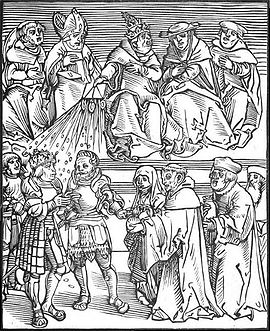
Christianity
Christianity is a monotheistic religion based on the life and teachings of Jesus as presented in canonical gospels and other New Testament writings...
, especially the Papacy
Roman Catholic Church
The Catholic Church, also known as the Roman Catholic Church, is the world's largest Christian church, with over a billion members. Led by the Pope, it defines its mission as spreading the gospel of Jesus Christ, administering the sacraments and exercising charity...
, because it allowed the traditional Roman mysteries and deities of solar monism such as Mithras and Sol Invictus and idol worship back into the church, and, in their opinion, is not representative of the faith founded by Jesus
Ministry of Jesus
In the Christian gospels, the Ministry of Jesus begins with his Baptism in the countryside of Judea, near the River Jordan and ends in Jerusalem, following the Last Supper with his disciples. The Gospel of Luke states that Jesus was "about 30 years of age" at the start of his ministry...
and his twelve Apostles: in short, in their opinion, the church has fallen into apostasy
Apostasy
Apostasy , 'a defection or revolt', from ἀπό, apo, 'away, apart', στάσις, stasis, 'stand, 'standing') is the formal disaffiliation from or abandonment or renunciation of a religion by a person. One who commits apostasy is known as an apostate. These terms have a pejorative implication in everyday...
. They feel that to conciliate the Pagans to nominal Christianity, the Catholic Church took measures to amalgamate the Christian and Pagan festivals so pagans would join the church; for example, bringing in the pagan festival of Easter as a substitute for the Pasch or Passover, although neither Jesus
Jesus
Jesus of Nazareth , commonly referred to as Jesus Christ or simply as Jesus or Christ, is the central figure of Christianity...
nor his Apostles enjoined the keeping of this or any other festival.
Some Catholics counter that it was magisterial Protestantism
Protestantism
Protestantism is one of the three major groupings within Christianity. It is a movement that began in Germany in the early 16th century as a reaction against medieval Roman Catholic doctrines and practices, especially in regards to salvation, justification, and ecclesiology.The doctrines of the...
and Eastern Orthodoxy that fell into apostasy.
Overview
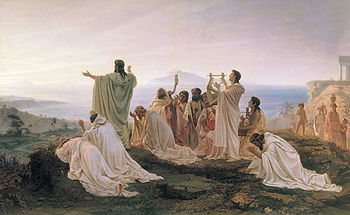
Hellenistic philosophy
Hellenistic philosophy is the period of Western philosophy that was developed in the Hellenistic civilization following Aristotle and ending with the beginning of Neoplatonism.-Pythagoreanism:...
, notably Neoplatonism
Neoplatonism
Neoplatonism , is the modern term for a school of religious and mystical philosophy that took shape in the 3rd century AD, based on the teachings of Plato and earlier Platonists, with its earliest contributor believed to be Plotinus, and his teacher Ammonius Saccas...
, and Gnosticism
Gnosticism
Gnosticism is a scholarly term for a set of religious beliefs and spiritual practices common to early Christianity, Hellenistic Judaism, Greco-Roman mystery religions, Zoroastrianism , and Neoplatonism.A common characteristic of some of these groups was the teaching that the realisation of Gnosis...
. Some modern scholars believe that the church in the early stages picked up pagan oral teachings from Palestinian
Palestine
Palestine is a conventional name, among others, used to describe the geographic region between the Mediterranean Sea and the Jordan River, and various adjoining lands....
and Hellenistic
Hellenistic civilization
Hellenistic civilization represents the zenith of Greek influence in the ancient world from 323 BCE to about 146 BCE...
sources which formed the basis of a secret oral tradition, which in the 4th century came to be called the disciplina arcani
Disciplina arcani
Disciplina Arcani or Discipline of the Secret or Discipline of the Arcane, is a theological term used to describe the custom which prevailed in Early Christianity, whereby knowledge of the more intimate mysteries of the Christian religion was carefully kept from non-Christians and even from those...
. Mainstream theologians believe it contained liturgical details and certain other pagan traditions which remain a part of some branches of mainstream Christianity (for example, the doctrine of Transubstantiation is thought to have been a part of this by Catholic theologians). Important esoteric influences on the church were the Christian theologians Clement of Alexandria
Clement of Alexandria
Titus Flavius Clemens , known as Clement of Alexandria , was a Christian theologian and the head of the noted Catechetical School of Alexandria. Clement is best remembered as the teacher of Origen...
and Origen
Origen
Origen , or Origen Adamantius, 184/5–253/4, was an early Christian Alexandrian scholar and theologian, and one of the most distinguished writers of the early Church. As early as the fourth century, his orthodoxy was suspect, in part because he believed in the pre-existence of souls...
, the main figures of the Catechetical School of Alexandria
Catechetical School of Alexandria
The Catechetical School of Alexandria was and is a place for the training of Christian theologians and priests in Alexandria. The teachers and students of the school were influential in many of the early theological controversies of the Christian church.The earliest recorded instructor at the...
. Origen wrote about 6,000 books - and it is unclear whether pagan traditions such reincarnation
Reincarnation
Reincarnation best describes the concept where the soul or spirit, after the death of the body, is believed to return to live in a new human body, or, in some traditions, either as a human being, animal or plant...
and the pre-existence
Pre-existence
Pre-existence , beforelife, or pre-mortal existence refers to the belief that each individual human soul existed before conception, and at conception one of these pre-existent souls enters, or is placed by God, in the body...
of soul
Soul
A soul in certain spiritual, philosophical, and psychological traditions is the incorporeal essence of a person or living thing or object. Many philosophical and spiritual systems teach that humans have souls, and others teach that all living things and even inanimate objects have souls. The...
s formed part of Origen's beliefs, but they were incorparated into church teachings.
Protestants
Protestantism
Protestantism is one of the three major groupings within Christianity. It is a movement that began in Germany in the early 16th century as a reaction against medieval Roman Catholic doctrines and practices, especially in regards to salvation, justification, and ecclesiology.The doctrines of the...
, most significantly starting with Martin Luther
Martin Luther
Martin Luther was a German priest, professor of theology and iconic figure of the Protestant Reformation. He strongly disputed the claim that freedom from God's punishment for sin could be purchased with money. He confronted indulgence salesman Johann Tetzel with his Ninety-Five Theses in 1517...
, who wrote the 95 Theses, and Evangelical Christians not following the rites of Latin Catholic
Catholic
The word catholic comes from the Greek phrase , meaning "on the whole," "according to the whole" or "in general", and is a combination of the Greek words meaning "about" and meaning "whole"...
and Orthodox
Eastern Orthodox Church
The Orthodox Church, officially called the Orthodox Catholic Church and commonly referred to as the Eastern Orthodox Church, is the second largest Christian denomination in the world, with an estimated 300 million adherents mainly in the countries of Belarus, Bulgaria, Cyprus, Georgia, Greece,...
Christian
Christianity
Christianity is a monotheistic religion based on the life and teachings of Jesus as presented in canonical gospels and other New Testament writings...
denominations
Religious denomination
A religious denomination is a subgroup within a religion that operates under a common name, tradition, and identity.The term describes various Christian denominations...
, have formally taught that the Bishop of Rome, along with the Catholic Church, greatly abused the original teachings and practices of the primitive
Apostolic Age
The Apostolic Age of the history of Christianity is traditionally the period of the Twelve Apostles, dating from the Crucifixion of Jesus and the Great Commission in Jerusalem until the death of John the Apostle in Anatolia...
or original Christian church as depicted in the Acts of the Apostles
Acts of the Apostles
The Acts of the Apostles , usually referred to simply as Acts, is the fifth book of the New Testament; Acts outlines the history of the Apostolic Age...
. They teach that the Papacy arose after the Roman Empire and slowly became corrupted as it strove to attain great dominion and authority, civil and ecclesiastical, and retained pagan beliefs held during the Empire. It arrayed itself in a Christian garb on the heathen one that had dominated during the Roman Empire. For example, it reinstated the ceremonies and obligations of the Collegium Pontificum and the position of Pontifex Maximus of the ancient Roman polytheistic religion and created Christian orders to replace the ancient Roman ones such as the Vestal Virgins and the flamines.

Protestant Reformation
The Protestant Reformation was a 16th-century split within Western Christianity initiated by Martin Luther, John Calvin and other early Protestants. The efforts of the self-described "reformers", who objected to the doctrines, rituals and ecclesiastical structure of the Roman Catholic Church, led...
, Protestantism separated itself from Catholicism, and the subsequent denominations spawned from the Reformation have considered their own teachings to be restorative in nature, falling back to the basic tenets of Biblical Christianity
Biblical law in Christianity
Christian views of the Old Covenant have been central to Christian theology and practice since the circumcision controversy in Early Christianity. There are differing views about the applicability of the Old Covenant among Christian denominations...
and Sola Scriptura
Sola scriptura
Sola scriptura is the doctrine that the Bible contains all knowledge necessary for salvation and holiness. Consequently, sola scriptura demands that only those doctrines are to be admitted or confessed that are found directly within or indirectly by using valid logical deduction or valid...
. Although each denomination may differ in application, the essential ideas of the Reformation remain foundational. In turn, these views are taught in the modern descendant denominations, and historically these types of doctrinal stances account for the continuing separation of the denominations from the Catholic Church.
Protestant groups differ slightly in their perception of the types and the extent of errors evident in Catholic-Anglican-Orthodox traditions, and therefore their proposed corrections also differ, but all agree that the Catholic-Anglican-Orthodox tradition is to some important degree counter-biblical in the sense that it moves away from Scripture to reconcile many of its teachings and doctrine. This alleged "corruption" and resistance to reform by the traditional, especially Catholic, churches may sometimes be called The Great Apostasy by some religious groups. Although Protestant Christianity, as a whole, rejects the overall concept that the original Church (established by Jesus Christ) was thrown into complete anarchy and chaos through Catholicism, it does however assert that there was gross abuse of Biblical authority (especially by the Papacy) and a wandering from clear Biblical teachings prior to the Reformation.
In effect, some groups see themselves as uniquely restoring original Christianity. In their case, the term Great Apostasy is used more technically than above, directed in a sweeping way over all of Christianity beyond their group, indicating that true Christianity has not been preserved, but rather restored. These various groups differ as to exactly when the Great Apostasy took place and what the exact errors or changes were, but all of them make a similar claim that true Christianity was generally lost until it was disclosed again in themselves. The term Great Apostasy appears to have been coined in this narrower, technical sense, by "Restorationists". The term may sometimes be used in this sense by other groups claiming their unique authority as representing Christianity.
Protestant Views
Protestant Christianity, separated itself from what it felt was the fulfilment of prophecy that there would be a falling away from the truth given by Jesus Christ and his apostles. They look to 2 Thessalonians prediction regarding the "falling away." 2 Thess. 2:3-12 says, "Let no one deceive you by any means; for that Day will not come unless the falling away comes first, and the man of sin is revealed, the son of perdition, who opposes and exalts himself above all that is called God or that is worshiped, so that he sits as God in the temple of God, showing himself that he is God. Do you not remember that when I was still with you I told you these things? And now you know what is restraining, that he may be revealed in his own time. For the mystery of lawlessness is already at work; only he who now restrains will do so until he is taken out of the way. And then the lawless one will be revealed, whom the Lord will consume with the breath of His mouth and destroy with the brightness of His coming. The coming of the lawless one is according to the working of Satan, with all power, signs, and lying wonders, and with all unrighteous deception among those who perish, because they did not receive the love of the truth, that they might be saved. And for this reason God will send them strong delusion, that they should believe the lie, that they all may be condemned who did not believe the truth but had pleasure in unrighteousness."They felt Papacy fulfilled the falling away of the scriptures, for it agrees on the prophecy in all the following points:
1. It has one official man as its head, and its claims are centered in him, the Bishop of Rome.
2. The Bishop of Rome exalts himself against all that is called God; e.g., he is addressed by terms (Pope, Supreme Pontiff, Holy Father, etc.) which belong only to God, and that man came with and out of an apostasy, the very kind the apostles describe elsewhere (1 Tim. 4:1-3; Acts 20:28-31; 2 Pet. 2:1-3).
3. He sits in the temple of God, e.g., his sphere of dominion is in the church or temple of God, as seen in the Papacy.
4. His appearance was hindered by some force in Paul's time (2 Thess. 2:6-7); e.g., when the bishops of Rome began to assert power, they were in conflict with the Roman civil government; however, when the Roman empire collapsed, they quickly gained supremacy.
5. The mystery of iniquity was already working in Paul's day (2 Thess. 2:7) and would continue until the Lord's coming (2 Thess. 2:8).
6. The apostasy would produce fraudulent miracles, signs and wonders; e.g., supposed cures brought about by relics and shrines.
7. The Lord shall destroy him with the brightness of His coming (2 Thess. 2:8). Only by a continual succession of the men of sin as seen in the line of men ascended to the title of Pope, could this be possible.
Protestantism asserts that many abuses by Church leadership occurred prior to the Reformation in 1517 AD. Nevertheless, it does not suggest that these abuses led to a complete state of anarchy and apostate renderings of Scripture within the Early Church. In turn, from the Protestant perspective, abuses within the church led to a poor application of doctrine and Biblical Truths. Historically, this view is generally seen to have been declared by the contents of the 95 Theses
95 Theses
The Ninety-Five Theses on the Power and Efficacy of Indulgences , commonly known as , was written by Martin Luther, 1517 and is widely regarded as the primary catalyst for the Protestant Reformation...
compiled by Martin Luther
Martin Luther
Martin Luther was a German priest, professor of theology and iconic figure of the Protestant Reformation. He strongly disputed the claim that freedom from God's punishment for sin could be purchased with money. He confronted indulgence salesman Johann Tetzel with his Ninety-Five Theses in 1517...
.
To a large degree, Protestantism recognizes that the formation of the Orthodox-Catholic Church under Caesar Constantine I
State church of the Roman Empire
The state church of the Roman Empire was a Christian institution organized within the Roman Empire during the 4th century that came to represent the Empire's sole authorized religion. Both the Roman Catholic Church and the Eastern Orthodox churches claim to be the historical continuation of this...
(c. 325 AD) sought to bring stability, continuity and organization to the birth of the relatively new Christian faith. However, through decades of succession by poor, often politically motivated leadership, abuses of Scriptural application became prevalent. In turn, Protestantism generally asserts that although Scripture itself remained pristine, the leaders and teachers became fouled. To that end, most of Traditional Christianity agrees that the Biblical message itself was ultimately never lost to mankind. In addition, historical and archeological evidence - such as the Dead Sea Scrolls
Dead Sea scrolls
The Dead Sea Scrolls are a collection of 972 texts from the Hebrew Bible and extra-biblical documents found between 1947 and 1956 on the northwest shore of the Dead Sea, from which they derive their name...
- have provided a considerable measure of creditability to this position.
Additionally, Protestant Evangelicals concede that although the Early Church had not completely “fallen away” after the death of the first Apostles
Apostle (Christian)
The term apostle is derived from Classical Greek ἀπόστολος , meaning one who is sent away, from στέλλω + από . The literal meaning in English is therefore an "emissary", from the Latin mitto + ex...
(i.e. a Great Apostasy), it fell under the control of the bishop of Rome and became governed by errant men with a poor understanding of Scripture.
Reformed Perspective
Calvinist
Calvinism
Calvinism is a Protestant theological system and an approach to the Christian life...
s have taught that a gradual process of corruption was predicted in the New Testament
New Testament
The New Testament is the second major division of the Christian biblical canon, the first such division being the much longer Old Testament....
, that this process began within the New Testament era
Apostolic Age
The Apostolic Age of the history of Christianity is traditionally the period of the Twelve Apostles, dating from the Crucifixion of Jesus and the Great Commission in Jerusalem until the death of John the Apostle in Anatolia...
itself, and culminated in a self-proclaimed corrective brought about by the Protestant Reformation
Protestant Reformation
The Protestant Reformation was a 16th-century split within Western Christianity initiated by Martin Luther, John Calvin and other early Protestants. The efforts of the self-described "reformers", who objected to the doctrines, rituals and ecclesiastical structure of the Roman Catholic Church, led...
. The Roman Catholic and Eastern Orthodox Churches had developed from early on the idea of infallibility of the Church
Infallibility of the Church
The Infallibility of the Church is the belief that the Holy Spirit will not allow the Church to err in its belief or teaching under certain circumstances...
— that the Church may speak entirely without error in particular councils or edicts; or that, in a less definable way, the Church is infallibly directed so that it always stands in the truth; and indeed, and claim that the Church has the promise of Jesus
Jesus
Jesus of Nazareth , commonly referred to as Jesus Christ or simply as Jesus or Christ, is the central figure of Christianity...
that it shall do so. The Roman Catholic Church also developed on the parallel and complementary idea of papal infallibility
Papal infallibility
Papal infallibility is a dogma of the Catholic Church which states that, by action of the Holy Spirit, the Pope is preserved from even the possibility of error when in his official capacity he solemnly declares or promulgates to the universal Church a dogmatic teaching on faith or morals...
— that the pope may speak in the same capacity; this idea was finally defined dogmatically
Dogmatic definition
In Catholicism, a dogmatic definition is an extraordinary infallible statement published by a pope or an ecumenical council concerning a matter of faith or morals, the belief in which the Catholic Church requires of all Christians .The term most often refers to the infallible...
at the First Vatican Council
First Vatican Council
The First Vatican Council was convoked by Pope Pius IX on 29 June 1868, after a period of planning and preparation that began on 6 December 1864. This twentieth ecumenical council of the Roman Catholic Church, held three centuries after the Council of Trent, opened on 8 December 1869 and adjourned...
of 1870 and incorporated into doctrine.
In contrast, Protestants believe that the Church has only spoken infallibly through the Scriptures since the time of the Apostles, and should not expect to be completely free of error at any time until the end of the world
Eschatology
Eschatology is a part of theology, philosophy, and futurology concerned with what are believed to be the final events in history, or the ultimate destiny of humanity, commonly referred to as the end of the world or the World to Come...
, and rather must remain continually vigilant to maintain a Biblical (and therefore authoritative) doctrine and faith, or else fall away from the Christian faith and become an enemy of the truth.
In the Reformed view of church history, the true church cannot declare itself infallible, but rather calls itself ecclesia semper reformanda ("the Church which must be always reformed"), the church that is always repenting of error. This Protestant view is that people are naturally inclined to elevate tradition
Tradition
A tradition is a ritual, belief or object passed down within a society, still maintained in the present, with origins in the past. Common examples include holidays or impractical but socially meaningful clothes , but the idea has also been applied to social norms such as greetings...
to equality with the written testimony of the Bible
Bible
The Bible refers to any one of the collections of the primary religious texts of Judaism and Christianity. There is no common version of the Bible, as the individual books , their contents and their order vary among denominations...
, which is the word of God (cf. Sacred Tradition
Sacred Tradition
Sacred Tradition or Holy Tradition is a theological term used in some Christian traditions, primarily in the Roman Catholic, Anglican, Eastern Orthodox and Oriental Orthodox traditions, to refer to the fundamental basis of church authority....
). The reforming churches believe that human weakness is naturally drawn to a form of false religion that is worldly, pompous, ritual
Ritual
A ritual is a set of actions, performed mainly for their symbolic value. It may be prescribed by a religion or by the traditions of a community. The term usually excludes actions which are arbitrarily chosen by the performers....
istic, anthropomorphic
Anthropomorphism
Anthropomorphism is any attribution of human characteristics to animals, non-living things, phenomena, material states, objects or abstract concepts, such as organizations, governments, spirits or deities. The term was coined in the mid 1700s...
, polytheistic
Polytheism
Polytheism is the belief of multiple deities also usually assembled into a pantheon of gods and goddesses, along with their own mythologies and rituals....
, infected with magical thinking
Magical thinking
Magical thinking is causal reasoning that looks for correlation between acts or utterances and certain events. In religion, folk religion, and superstition, the correlation posited is between religious ritual, such as prayer, sacrifice, or the observance of a taboo, and an expected benefit or...
and legalism
Legalism (theology)
Legalism, in Christian theology, is a sometimes-pejorative term referring to an over-emphasis on discipline of conduct, or legal ideas, usually implying an allegation of misguided rigour, pride, superficiality, the neglect of mercy, and ignorance of the grace of God or emphasizing the letter of...
, and that values human accomplishment more highly or more practically than the work of God (divine grace
Divine grace
In Christian theology, grace is God’s gift of God’s self to humankind. It is understood by Christians to be a spontaneous gift from God to man - "generous, free and totally unexpected and undeserved" - that takes the form of divine favour, love and clemency. It is an attribute of God that is most...
) is valued. Given the chance, people will substitute the sort of religion they naturally prefer, over the Gospel
Gospel
A gospel is an account, often written, that describes the life of Jesus of Nazareth. In a more general sense the term "gospel" may refer to the good news message of the New Testament. It is primarily used in reference to the four canonical gospels of Matthew, Mark, Luke, and John...
, see also Cafeteria Christianity
Cafeteria Christianity
"Cafeteria Christianity" is a derogatory term used by some Christians, and others, to accuse other Christian individuals or denominations of selecting which Christian doctrines they will follow, and which they will not.-First use in print:...
. The Hebrew Bible
Hebrew Bible
The Hebrew Bible is a term used by biblical scholars outside of Judaism to refer to the Tanakh , a canonical collection of Jewish texts, and the common textual antecedent of the several canonical editions of the Christian Old Testament...
contains multiple episodes of backsliding by the very people who first received God's revelation; to the Protestant mind, this shows that teaching the Gospel is a straight and narrow path, one that requires that natural religion
Natural religion
Natural religion might have the following meanings:* In the modern study of religion it is used to refer to the notion that there is a spontaneous religious apprehension of the world common to all human beings, see:**Urreligion**origin of religion...
be held in check and that God's grace, holiness, and otherness be rigorously proclaimed.
Temptations of power
According to these Reformers, even as early as the Apostles a natural process of corruption began, and reached a crucial point of development when the Christian church was made the official religion of the Roman EmpireRoman Empire
The Roman Empire was the post-Republican period of the ancient Roman civilization, characterised by an autocratic form of government and large territorial holdings in Europe and around the Mediterranean....
by Theodosius I
Theodosius I
Theodosius I , also known as Theodosius the Great, was Roman Emperor from 379 to 395. Theodosius was the last emperor to rule over both the eastern and the western halves of the Roman Empire. During his reign, the Goths secured control of Illyricum after the Gothic War, establishing their homeland...
. From this point on, compromise of the truth deepened over time until the church became thoroughly worldly and corrupt, so that the true faith was first no longer openly taught, and instead suppressed, and at times persecuted, and cast out. The persecuted church was attractive to rejected people; but worldly men were attracted to the same church when it began to wield power and possessions. Protestants also believe that the Roman Emperor
Roman Emperor
The Roman emperor was the ruler of the Roman State during the imperial period . The Romans had no single term for the office although at any given time, a given title was associated with the emperor...
s were not about to support a church that they did not control. The development of formal hierarchy
Hierarchy
A hierarchy is an arrangement of items in which the items are represented as being "above," "below," or "at the same level as" one another...
within the Catholic Church, as opposed to local autonomy among Christian congregations, with levels of rank among the bishops, and a handful of patriarch
Patriarch
Originally a patriarch was a man who exercised autocratic authority as a pater familias over an extended family. The system of such rule of families by senior males is called patriarchy. This is a Greek word, a compound of πατριά , "lineage, descent", esp...
s to supervise the bishops, is seen by some Protestants as conducive to imperial manipulation of the Church, susceptible to general control by capture of only a few seats of power.
Similarly, the defenses of the right belief and worship of the church resided in the bishop
Bishop
A bishop is an ordained or consecrated member of the Christian clergy who is generally entrusted with a position of authority and oversight. Within the Catholic Church, Eastern Orthodox, Oriental Orthodox Churches, in the Assyrian Church of the East, in the Independent Catholic Churches, and in the...
s, and Protestants theorize that the process of unifying the doctrine of the Church also concentrated power into their own hands (see also Ignatius of Antioch
Ignatius of Antioch
Ignatius of Antioch was among the Apostolic Fathers, was the third Bishop of Antioch, and was a student of John the Apostle. En route to his martyrdom in Rome, Ignatius wrote a series of letters which have been preserved as an example of very early Christian theology...
, who advocated a powerful bishop), and made their office an instrument of power coveted by ambitious men. They charge that, through ambition and jealousy, the church has been at times, and not very subtly, subverted from carrying out its sacred aim. For the Reformers, the culmination of this gradual corruption was typified, in a concentrated way, in the office of the Pope
Pope
The Pope is the Bishop of Rome, a position that makes him the leader of the worldwide Catholic Church . In the Catholic Church, the Pope is regarded as the successor of Saint Peter, the Apostle...
who took on ancient titles such as Pontifex Maximus
Pontifex Maximus
The Pontifex Maximus was the high priest of the College of Pontiffs in ancient Rome. This was the most important position in the ancient Roman religion, open only to patricians until 254 BC, when a plebeian first occupied this post...
and supreme power in the church, which they characterized in its final form as being an usurpatious throne of Satan
Satan
Satan , "the opposer", is the title of various entities, both human and divine, who challenge the faith of humans in the Hebrew Bible...
ic authority set up in pretense of ruling over the Kingdom of God
Kingdom of God
The Kingdom of God or Kingdom of Heaven is a foundational concept in the Abrahamic religions: Judaism, Christianity and Islam.The term "Kingdom of God" is found in all four canonical gospels and in the Pauline epistles...
.
The dangers of theology
Theological controversy also had a polluting effect, according to this view of Apostasy as a gradual process, rather than a cataclysmic event. That is, in the process of defending the received truth, the Church became sullied by the engagements with its opponents both outside and within the Church. Giving power to men as Bishops and Priest with forgiving power equal to Christ, the Church become so much like the Devil, desiring of power over the masses.For example, the Church defeated paganism
Paganism
Paganism is a blanket term, typically used to refer to non-Abrahamic, indigenous polytheistic religious traditions....
, but incorporated many of its idols as saints and was also susceptible to incorporating attitudes and traditions which are foreign to the biblical faith. Or, for another case, in the process of overcoming Arius
Arius
Arius was a Christian presbyter in Alexandria, Egypt of Libyan origins. His teachings about the nature of the Godhead, which emphasized the Father's divinity over the Son , and his opposition to the Athanasian or Trinitarian Christology, made him a controversial figure in the First Council of...
' religious hero-worship of Jesus, the church absorbed hero-worshipping ideas
Hero worship
Hero worship is defined as the foolish or excessive adulation for an individual. In Wikipedia, you may be searching for:*Hero Worship , an album released by Sandra Bernhard*Hero Worship...
, so that, while the doctrine of Jesus was rescued from the heresy, the same idea continued in the veneration of the Saints, although veneration of the saints and marytyrs long predated the Arian heresy. Similarly for the early battles with Marcion and Valentinius and Montanus, perhaps even as early as Simon Magus
Simon Magus
Simon the Sorcerer or Simon the Magician, in Latin Simon Magus, was a Samaritan magus or religious figure and a convert to Christianity, baptised by Philip the Apostle, whose later confrontation with Peter is recorded in . The sin of simony, or paying for position and influence in the church, is...
, see also Early Christianity
Early Christianity
Early Christianity is generally considered as Christianity before 325. The New Testament's Book of Acts and Epistle to the Galatians records that the first Christian community was centered in Jerusalem and its leaders included James, Peter and John....
. This corruption was not necessarily intentional although, in some cases, it is suggested that teachers of error brought in these pollutions deceitfully in order to escape detection.
Compromise with folk religion
Especially in the worship of the Church, many Protestants viewed the Roman Catholic Mass as an amalgam of superstitious inventions more reminiscent of a pagan mystery rite than the simple discipline taught by the Apostles and practiced by the early church. A number of Protestant denominations tend to think of many of the Catholic holy days, and most of the rituals, as accommodations to the popular tastes of unconverted people through the centuries, incompatible with biblical faith. Natural tastes for pomp and ceremony, and the sort of natural belief in manaMana
Mana is an indigenous Pacific islander concept of an impersonal force or quality that resides in people, animals, and inanimate objects. The word is a cognate in many Oceanic languages, including Melanesian, Polynesian, and Micronesian....
and fetishism
Fetishism
A fetish is an object believed to have supernatural powers, or in particular, a man-made object that has power over others...
that seem common in unrevealed religions, and the natural man's wish to have sacred places to pray in, and sacred objects that enable mortals to touch the divine, tempted people away from the truth of the absolute sovereignty, holiness, and otherness of God.
Verses used to support apostasy of the Roman Catholic Church
Although Lutherans and Calvinists hold that the Ecumenical CouncilEcumenical council
An ecumenical council is a conference of ecclesiastical dignitaries and theological experts convened to discuss and settle matters of Church doctrine and practice....
s of the early and medieval church are true expressions of the Christian faith, many assert that the councils are at times inconsistent with one another, and err on particular points. The true Church, they argue, will be mixed with alien influences and false beliefs, which is necessary in order for these impurities ultimately to be overcome and the truth to be vindicated.
The Westminster Confession of Faith
Westminster Confession of Faith
The Westminster Confession of Faith is a Reformed confession of faith, in the Calvinist theological tradition. Although drawn up by the 1646 Westminster Assembly, largely of the Church of England, it became and remains the 'subordinate standard' of doctrine in the Church of Scotland, and has been...
(Calvinist), states:
- The purest churches under heaven are subject both to mixture and error; and some have so degenerated, as to become no churches of Christ, but synagogues of SatanSatanSatan , "the opposer", is the title of various entities, both human and divine, who challenge the faith of humans in the Hebrew Bible...
. Nevertheless, there shall be always a church on earth, to worship God according to his will. (25:5)
Therefore, although these groups believe that errors can and have come into the church, they deny that there has ever been a time when the truth was entirely lost. They affirm that there shall be times when errors shall predominate, as they believe is foretold in the Bible
Bible
The Bible refers to any one of the collections of the primary religious texts of Judaism and Christianity. There is no common version of the Bible, as the individual books , their contents and their order vary among denominations...
. First Timothy 4:1-3 states:
- Now the Spirit speaketh expressly, that in the latter times some shall depart from the faith, giving heed to seducing spirits, and doctrines of devils;
- Speaking lies in hypocrisy; having their conscience seared with a hot iron;
- Forbidding to marryCelibacyCelibacy is a personal commitment to avoiding sexual relations, in particular a vow from marriage. Typically celibacy involves avoiding all romantic relationships of any kind. An individual may choose celibacy for religious reasons, such as is the case for priests in some religions, for reasons of...
, and commanding to abstain from meatsVegetarianismVegetarianism encompasses the practice of following plant-based diets , with or without the inclusion of dairy products or eggs, and with the exclusion of meat...
, which God hath created to be received with thanksgiving of them which believe and know the truth. (KJVKing James Version of the BibleThe Authorized Version, commonly known as the King James Version, King James Bible or KJV, is an English translation of the Christian Bible by the Church of England begun in 1604 and completed in 1611...
)
Acts 20:28-29
- Take heed therefore unto yourselves, and to all the flock, over the which the Holy Ghost hath made you overseers, to feed the church of God, which he hath purchased with his own blood.
- For I know this, that after my departing shall grievous wolves enter in among you, not sparing the flock. (KJVKing James Version of the BibleThe Authorized Version, commonly known as the King James Version, King James Bible or KJV, is an English translation of the Christian Bible by the Church of England begun in 1604 and completed in 1611...
)
Even Jesus warned:
- "Then many will fall away, and they will betray one another and hate one another. And many false prophetFalse prophetIn religion, a false prophet is one who falsely claims the gift of prophecy, or who uses that gift for evil ends. Often, someone who is considered a "true prophet" by some people is simultaneously considered a "false prophet" by others....
s will arise and lead many astray. And because of the increase of lawlessnessAntinomianismAntinomianism is defined as holding that, under the gospel dispensation of grace, moral law is of no use or obligation because faith alone is necessary to salvation....
, the love of many will grow cold. But the one who endures to the end will be saved. And this good newsGospelA gospel is an account, often written, that describes the life of Jesus of Nazareth. In a more general sense the term "gospel" may refer to the good news message of the New Testament. It is primarily used in reference to the four canonical gospels of Matthew, Mark, Luke, and John...
of the kingdomKingdom of GodThe Kingdom of God or Kingdom of Heaven is a foundational concept in the Abrahamic religions: Judaism, Christianity and Islam.The term "Kingdom of God" is found in all four canonical gospels and in the Pauline epistles...
will be proclaimed throughout the world, as a testimony to all the nationsGreat CommissionThe Great Commission, in Christian tradition, is the instruction of the resurrected Jesus Christ to his disciples, that they spread his teachings to all the nations of the world. It has become a tenet in Christian theology emphasizing missionary work, evangelism, and baptism...
; and then the endEnd timesThe end time, end times, or end of days is a time period described in the eschatological writings in the three Abrahamic religions and in doomsday scenarios in various other non-Abrahamic religions...
will come." Gospel of MatthewGospel of MatthewThe Gospel According to Matthew is one of the four canonical gospels, one of the three synoptic gospels, and the first book of the New Testament. It tells of the life, ministry, death, and resurrection of Jesus of Nazareth...
24:10-14(NRSV)
According to this view, these verses foretold the rise of errors, among which they count the veneration of relic
Relic
In religion, a relic is a part of the body of a saint or a venerated person, or else another type of ancient religious object, carefully preserved for purposes of veneration or as a tangible memorial...
s, saints and the Blessed Virgin Mary, importing polytheism
Polytheism
Polytheism is the belief of multiple deities also usually assembled into a pantheon of gods and goddesses, along with their own mythologies and rituals....
, idolatry
Idolatry
Idolatry is a pejorative term for the worship of an idol, a physical object such as a cult image, as a god, or practices believed to verge on worship, such as giving undue honour and regard to created forms other than God. In all the Abrahamic religions idolatry is strongly forbidden, although...
, and fetishism
Fetishism
A fetish is an object believed to have supernatural powers, or in particular, a man-made object that has power over others...
into Christianity; these are the "seducing spirits and doctrines of devils."
The "forbidding to marry" and the "commanding to abstain from meats" (foods) were held to refer to the elaborate code, or Canon law
Canon law (Catholic Church)
The canon law of the Catholic Church, is a fully developed legal system, with all the necessary elements: courts, lawyers, judges, a fully articulated legal code and principles of legal interpretation. It lacks the necessary binding force present in most modern day legal systems. The academic...
of the Roman Catholic Church, involving priestly celibacy
Clerical celibacy
Clerical celibacy is the discipline by which some or all members of the clergy in certain religions are required to be unmarried. Since these religions consider deliberate sexual thoughts, feelings, and behavior outside of marriage to be sinful, clerical celibacy also requires abstension from these...
, Lent
Lent
In the Christian tradition, Lent is the period of the liturgical year from Ash Wednesday to Easter. The traditional purpose of Lent is the preparation of the believer – through prayer, repentance, almsgiving and self-denial – for the annual commemoration during Holy Week of the Death and...
, and similar rules promulgated by the medieval church. Calvinists thought these rules were legalism
Legalism (theology)
Legalism, in Christian theology, is a sometimes-pejorative term referring to an over-emphasis on discipline of conduct, or legal ideas, usually implying an allegation of misguided rigour, pride, superficiality, the neglect of mercy, and ignorance of the grace of God or emphasizing the letter of...
and inappropriate impositions on the faithful.
"Speaking lies in hypocrisy" and "having their conscience seared with a hot iron" were held to refer to the general corruption of the Church as it became heir to the Roman Emperor
Emperor
An emperor is a monarch, usually the sovereign ruler of an empire or another type of imperial realm. Empress, the female equivalent, may indicate an emperor's wife or a woman who rules in her own right...
s and claimed to rule an earthly kingdom
Monarchy
A monarchy is a form of government in which the office of head of state is usually held until death or abdication and is often hereditary and includes a royal house. In some cases, the monarch is elected...
, and its prelate
Prelate
A prelate is a high-ranking member of the clergy who is an ordinary or who ranks in precedence with ordinaries. The word derives from the Latin prælatus, the past participle of præferre, which means "carry before", "be set above or over" or "prefer"; hence, a prelate is one set over others.-Related...
s became authoritarian lord
Lord
Lord is a title with various meanings. It can denote a prince or a feudal superior . The title today is mostly used in connection with the peerage of the United Kingdom or its predecessor countries, although some users of the title do not themselves hold peerages, and use it 'by courtesy'...
s of civil government, achieving a social rank never sought by Jesus
Jesus
Jesus of Nazareth , commonly referred to as Jesus Christ or simply as Jesus or Christ, is the central figure of Christianity...
himself (see also Evangelical counsels
Evangelical counsels
The three evangelical counsels or counsels of perfection in Christianity are chastity, poverty , and obedience . As Jesus of Nazareth stated in the Canonical gospels , they are counsels for those who desire to become "perfect"...
and ). The "searing of the conscience" was interpreted as referring to the Roman Catholic development of casuistry
Casuistry
In applied ethics, casuistry is case-based reasoning. Casuistry is used in juridical and ethical discussions of law and ethics, and often is a critique of principle- or rule-based reasoning...
that sought to justify these various acts, and to excuse the sins of the powerful in exchange for gifts of land and money.
2 Thessalonians 2:3-12 was held also to refer to a coming great apostasy. This text announces that the Second Coming
Second Coming
In Christian doctrine, the Second Coming of Christ, the Second Advent, or the Parousia, is the anticipated return of Jesus Christ from Heaven, where he sits at the Right Hand of God, to Earth. This prophecy is found in the canonical gospels and in most Christian and Islamic eschatologies...
of Jesus and the gathering of the church to him, cannot come:
- unless the falling away comes first, and the man of sinMan of SinThe Man of Sin or Man of Lawlessness is a figure referred to in 2 Thessalonians 2:3, who is usually equated with the Antichrist.-Second Thessalonians, Chapter Two:...
is revealed, the son of perditionSon of perditionSon of perdition is a phrase that appears in the New Testament in the Gospel of John and in the Second Epistle to the Thessalonians . Many theologians and scholars also consider "the beast that goes into perdition" mentioned in Revelation and to be references to the "Son of Perdition."According...
, who opposes and exalts himself above all that is called God or that is worshiped, so that he sits as God in the temple of God, showing himself that he is God.
These were held to be prophecies
Prophecy
Prophecy is a process in which one or more messages that have been communicated to a prophet are then communicated to others. Such messages typically involve divine inspiration, interpretation, or revelation of conditioned events to come as well as testimonies or repeated revelations that the...
of the Pope
Pope
The Pope is the Bishop of Rome, a position that makes him the leader of the worldwide Catholic Church . In the Catholic Church, the Pope is regarded as the successor of Saint Peter, the Apostle...
's claim to infallibility
Infallibility
Infallibility, from Latin origin , is a term with a variety of meanings related to knowing truth with certainty.-In common speech:...
and to be the Vicar of Christ
Vicar of Christ
Vicar of Christ is a term used in different ways, with different theological connotations throughout history...
, sitting in Jesus' seat and in his stead. This interpretation is the source of the traditional identification of the Pope as Antichrist
Antichrist
The term or title antichrist, in Christian theology, refers to a leader who fulfills Biblical prophecies concerning an adversary of Christ, while resembling him in a deceptive manner...
, which occurs throughout Protestant literature of the Reformation period and afterwards. Chapter XXV, article 6, of the Westminster Confession, a confessional statement issued in 1646 and important to the Presbyterian and other branches of the English-speaking Reformed churches
Reformed churches
The Reformed churches are a group of Protestant denominations characterized by Calvinist doctrines. They are descended from the Swiss Reformation inaugurated by Huldrych Zwingli but developed more coherently by Martin Bucer, Heinrich Bullinger and especially John Calvin...
, states that:
- There is no other head of the Church but the Lord Jesus Christ: nor can the Pope of Rome in any sense be head thereof; but is that Antichrist, that man of sin and son of perdition, that exalteth himself in the Church against Christ, and all that is called God.
This article was abrogated in 1967 by the Presbyterian Church (USA)
Presbyterian Church (USA)
The Presbyterian Church , or PC, is a mainline Protestant Christian denomination in the United States. Part of the Reformed tradition, it is the largest Presbyterian denomination in the U.S...
, the largest Presbyterian denomination in the United States. It remains officially in force in other Presbyterian denominations.
"Roman Catholic apostasy" doctrine supplanted by dispensationalism
Most leaders in mainstream Protestant churches have changed what was held from the start of the Reformation and backed away from teaching the apostasy of the Roman Catholic Church as it is the largest in the world, which is now felt to be divisive, and to belong to the more vehement quarrels of another day. Conservative and fundamentalist churches insisted on these teachings the longest, and some still do, especially among the stricter Calvinists and Fundamentalists. The spread of dispensationalismDispensationalism
Dispensationalism is a nineteenth-century evangelical development based on a futurist biblical hermeneutic that sees a series of chronologically successive "dispensations" or periods in history in which God relates to human beings in different ways under different Biblical covenants.As a system,...
doctrine has led conservative Protestants to drop the traditional interpreting of the Book of Revelation as predicting events that have taken place throughout history (historicism) and pushed it to some far off future events (futurism). This has resulted in a re-interpretation of the end times
End times
The end time, end times, or end of days is a time period described in the eschatological writings in the three Abrahamic religions and in doomsday scenarios in various other non-Abrahamic religions...
; and while Protestant fundamentalists may continue to believe that the Roman Church errs, they have dropped the Protestant Reformation view or are less likely to believe that the Pope is Antichrist.
Dispensationalists generally view passages such as 2 Thessalonians (referenced above) as referring to a reconstructed Temple in Jerusalem (see also Jerusalem in Christianity
Jerusalem in Christianity
For Christians, Jerusalem's place in the ministry of Jesus and the Apostolic Age gives it great importance, in addition to its place in the Old Testament, the Hebrew Bible.-Jerusalem in the New Testament and early Christianity:...
and Christian Zionism
Christian Zionism
Christian Zionism is a belief among some Christians that the return of the Jews to the Holy Land, and the establishment of the State of Israel in 1948, is in accordance with Biblical prophecy. It overlaps with, but is distinct from, the nineteenth century movement for the Restoration of the Jews...
) in the last days. The great "Falling Away", they tend to view as a present or future affair, in which not only Rome but all of the world's religions join against the truth, for the sake of a false peace and prosperity.
For an extensive 18th century Protestant perspective on the Great Apostasy, see the treatment on that subject by the German
Germany
Germany , officially the Federal Republic of Germany , is a federal parliamentary republic in Europe. The country consists of 16 states while the capital and largest city is Berlin. Germany covers an area of 357,021 km2 and has a largely temperate seasonal climate...
historian J. L. Mosheim
Johann Lorenz von Mosheim
Johann Lorenz von Mosheim or Johann Lorenz Mosheim , German Lutheran church historian, was born at Lübeck on 9 October 1693 or 1694.- Biography :...
, a Lutheran, whose six volume work in Latin on Ecclesiastical History is referred to by some Protestants who emphasize a great apostasy.
The end result
In this view, it would be difficult to set a clear dividing line as to when the purported widespread Apostasy began but Paul tells us it was already starting at the last days of the Roman Empire and the rise of the power that would take control over Christianity after it. It was a gradual process of corruption, as venal and materialistic leaders came into the Church, in love with their own high office and authority, and power was consolidated by the bishop of Rome into one man. The Great Apostasy surely was complete, for purposes of the Reformers, when the Council of TrentCouncil of Trent
The Council of Trent was the 16th-century Ecumenical Council of the Roman Catholic Church. It is considered to be one of the Church's most important councils. It convened in Trent between December 13, 1545, and December 4, 1563 in twenty-five sessions for three periods...
emphatically rejected even a modified form of Protestant reformation for the Roman Catholic Church. The ultramontane
Ultramontanism
Ultramontanism is a religious philosophy within the Roman Catholic community that places strong emphasis on the prerogatives and powers of the Pope...
tendencies of Rome continued to increase until at least the First Vatican Council
First Vatican Council
The First Vatican Council was convoked by Pope Pius IX on 29 June 1868, after a period of planning and preparation that began on 6 December 1864. This twentieth ecumenical council of the Roman Catholic Church, held three centuries after the Council of Trent, opened on 8 December 1869 and adjourned...
, with its proclamation of both papal infallibility
Papal infallibility
Papal infallibility is a dogma of the Catholic Church which states that, by action of the Holy Spirit, the Pope is preserved from even the possibility of error when in his official capacity he solemnly declares or promulgates to the universal Church a dogmatic teaching on faith or morals...
and papal absolutism, down to early 20th century changes in Canon law
Canon law (Catholic Church)
The canon law of the Catholic Church, is a fully developed legal system, with all the necessary elements: courts, lawyers, judges, a fully articulated legal code and principles of legal interpretation. It lacks the necessary binding force present in most modern day legal systems. The academic...
that make it more clear today than it was in the past that the Pope is the absolute monarch of the Roman Catholic Church, answerable to no council, no other bishop, and indeed to no other man or woman. Here the Protestants see the completion of the Great Apostasy as one man makes himself above all others as the pagan Emperors before strove to be.
The Second Vatican Council
Second Vatican Council
The Second Vatican Council addressed relations between the Roman Catholic Church and the modern world. It was the twenty-first Ecumenical Council of the Catholic Church and the second to be held at St. Peter's Basilica in the Vatican. It opened under Pope John XXIII on 11 October 1962 and closed...
stated the Church as the pilgrim "people of God" and the collegiality of all the bishops "in communion" with the Pope.
It is also important to note that this view of the general Apostasy does not mean that the Gospel
Gospel
A gospel is an account, often written, that describes the life of Jesus of Nazareth. In a more general sense the term "gospel" may refer to the good news message of the New Testament. It is primarily used in reference to the four canonical gospels of Matthew, Mark, Luke, and John...
had lost its power to save, or that all Christians during this time were denied Heaven
Heaven
Heaven, the Heavens or Seven Heavens, is a common religious cosmological or metaphysical term for the physical or transcendent place from which heavenly beings originate, are enthroned or inhabit...
; rather, the Reformers characterized the papacy and the hierarchy of priests, as an usurpatious government pretending to rule over the kingdom of God. God's grace preserved the true teachings and the Bible
Bible
The Bible refers to any one of the collections of the primary religious texts of Judaism and Christianity. There is no common version of the Bible, as the individual books , their contents and their order vary among denominations...
intact despite the corruption of those who were supposed to be official spokesmen for Christendom
Christendom
Christendom, or the Christian world, has several meanings. In a cultural sense it refers to the worldwide community of Christians, adherents of Christianity...
.
Anabaptists
The Anabaptists of the Protestant ReformationProtestant Reformation
The Protestant Reformation was a 16th-century split within Western Christianity initiated by Martin Luther, John Calvin and other early Protestants. The efforts of the self-described "reformers", who objected to the doctrines, rituals and ecclesiastical structure of the Roman Catholic Church, led...
believe that the Church became corrupt when Constantine I
Constantine I
Constantine the Great , also known as Constantine I or Saint Constantine, was Roman Emperor from 306 to 337. Well known for being the first Roman emperor to convert to Christianity, Constantine and co-Emperor Licinius issued the Edict of Milan in 313, which proclaimed religious tolerance of all...
ended the persecution of Christians with the Edict of Milan
Edict of Milan
The Edict of Milan was a letter signed by emperors Constantine I and Licinius that proclaimed religious toleration in the Roman Empire...
, and was not recovered until the Anabaptists came along. Other Reformers set other dates or time periods when the Church corrupted itself, making it necessary for them to leave the Roman Catholic Church in order to re-establish the true Church. Several groups, including Baptists and Mennonite
Mennonite
The Mennonites are a group of Christian Anabaptist denominations named after the Frisian Menno Simons , who, through his writings, articulated and thereby formalized the teachings of earlier Swiss founders...
s, believe that besides the Great Apostasy there has also always been a "little flock", a "narrow way" which struggled through persecution and remained faithful to the truth. For example, the Mennonites published a book called the Martyrs Mirror
Martyrs Mirror
The Martyrs Mirror or The Bloody Theater, first published in 1660 in Dutch by Thieleman J. van Braght, documents the stories and testimonies of Christian martyrs, especially Anabaptists...
in 1660 that attempted to show that exclusive Believer's baptism
Believer's baptism
Believer's baptism is the Christian practice of baptism as this is understood by many Protestant churches, particularly those that descend from the Anabaptist tradition...
was practiced and passed down in every century, and how those who held that belief were persecuted for it.
Some Anabaptist and Baptist groups have held that the Apostasy of the Roman Catholic Church was so complete as to nullify its claims to Christianity. Consequently, in these groups, repudiation of the ecumenical council
Ecumenical council
An ecumenical council is a conference of ecclesiastical dignitaries and theological experts convened to discuss and settle matters of Church doctrine and practice....
s has followed, in a few minority cases engendering seventh day sabbatarianism and unitarianism
Unitarianism
Unitarianism is a Christian theological movement, named for its understanding of God as one person, in direct contrast to Trinitarianism which defines God as three persons coexisting consubstantially as one in being....
, along with believers baptism and pacifism
Pacifism
Pacifism is the opposition to war and violence. The term "pacifism" was coined by the French peace campaignerÉmile Arnaud and adopted by other peace activists at the tenth Universal Peace Congress inGlasgow in 1901.- Definition :...
, and other anti-traditional views. Some of these views, more radical than other Protestants, were influential in the founding of the Restoration Movement
Restoration Movement
The Restoration Movement is a Christian movement that began on the American frontier during the Second Great Awakening of the early 19th century...
and the Adventist churches in the United States in the 19th century and continue to be influential in the house church
House church
House church, or "home church", is used to describe an independent assembly of Christians who gather in a home. Sometimes this occurs because the group is small, and a home is the most appropriate place to gather, as in the beginning phase of the British New Church Movement...
movement.
Christians in military service and political office
The fusion of church and state is a central theme of the Anabaptist view of the Great Apostasy, and of their consequent assertion during the Protestant ReformationProtestant Reformation
The Protestant Reformation was a 16th-century split within Western Christianity initiated by Martin Luther, John Calvin and other early Protestants. The efforts of the self-described "reformers", who objected to the doctrines, rituals and ecclesiastical structure of the Roman Catholic Church, led...
that the churches of Catholic Europe needed not simply reform, but a radical re-establishment based on the Bible alone. In sympathy with this assessment, philosopher Jacques Ellul
Jacques Ellul
Jacques Ellul was a French philosopher, law professor, sociologist, lay theologian, and Christian anarchist. He wrote several books about the "technological society" and the interaction between Christianity and politics....
, in "Anarchy and Christianity", mentions a dramatic shift in AD 313, at the Council of Elvira. Christians who held public office were no longer cast out of the church entirely as apostates, but were only cast out so long as they held office. At the Synod of Arles
Synod of Arles
Arles in the south of Roman Gaul hosted several councils or synods referred to as Concilium Arelatense in the history of the early Christian church.-Council of Arles in 314:...
in 314, Christian pacifism
Christian pacifism
Christian pacifism is the theological and ethical position that any form of violence is incompatible with the Christian faith. Christian pacifists state that Jesus himself was a pacifist who taught and practiced pacifism, and that his followers must do likewise.There have been various notable...
was totally reversed; the third canon excommunicated soldiers who refused military service, or who mutinied. The seventh canon of that same council allowed Christians to be state officials, as long as they did not take part in pagan acts. With this, Ellul sees the end of the original anti-statist, anti-militarist, anarchist Christianity. However, accounts of martyred Christian soldiers from the 100s, 200s and early 300s indicate that Christians were allowed to continue serving in the Roman army provided they did not sacrifice to the Roman gods, and that therefore the original church may not have been as anti-militarist as Ellul supposes. Ignatius of Antioch
Ignatius of Antioch
Ignatius of Antioch was among the Apostolic Fathers, was the third Bishop of Antioch, and was a student of John the Apostle. En route to his martyrdom in Rome, Ignatius wrote a series of letters which have been preserved as an example of very early Christian theology...
's letters from the 100s, the use of deacons in the Acts of the Apostles
Acts of the Apostles
The Acts of the Apostles , usually referred to simply as Acts, is the fifth book of the New Testament; Acts outlines the history of the Apostolic Age...
and Paul's Pastoral epistles
Pastoral epistles
The three pastoral epistles are books of the canonical New Testament: the First Epistle to Timothy the Second Epistle to Timothy , and the Epistle to Titus. They are presented as letters from Paul of Tarsus...
describing deacons, elders and overseers suggest that the early church was not anarchist in the way it governed itself internally.
The Church of Jesus Christ of Latter-day Saints
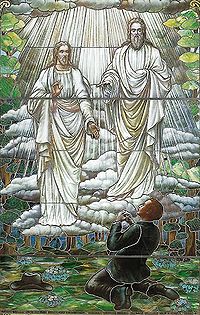
First Vision
The First Vision refers to a vision that Joseph Smith, Jr. said he received as a youth in a wooded area in Manchester, New York, which his followers call the Sacred Grove. Smith described it as a personal theophany in which he received a forgiveness of sins...
in 1820. To Latter-day Saints, the Great Apostasy is marked by:
- the difficulty of the Apostles to keep early Christians from distorting Jesus' teachings and to prevent the followers from dividing into different ideological groups;
- the persecutionPersecution of ChristiansPersecution of Christians as a consequence of professing their faith can be traced both historically and in the current era. Early Christians were persecuted for their faith, at the hands of both Jews from whose religion Christianity arose, and the Roman Empire which controlled much of the land...
and martyrMartyrA martyr is somebody who suffers persecution and death for refusing to renounce, or accept, a belief or cause, usually religious.-Meaning:...
dom of the church's Apostles; - the loss of leaders with Priesthood authority to administer the church and its ordinances;
- the lack of continuous revelationContinuous revelationContinuous revelation or continuing revelation is a theological belief or position that God continues to reveal divine principles or commandments to humanity...
to instruct the leaders and guide the church; and - the corruption of Christian doctrine by GreekGreek philosophyAncient Greek philosophy arose in the 6th century BCE and continued through the Hellenistic period, at which point Ancient Greece was incorporated in the Roman Empire...
or other allegedly paganPaganismPaganism is a blanket term, typically used to refer to non-Abrahamic, indigenous polytheistic religious traditions....
philosophies such as Neo-Platonism, Platonic realismPlatonic realismPlatonic realism is a philosophical term usually used to refer to the idea of realism regarding the existence of universals or abstract objects after the Greek philosopher Plato , a student of Socrates. As universals were considered by Plato to be ideal forms, this stance is confusingly also called...
, AristotleAristotleAristotle was a Greek philosopher and polymath, a student of Plato and teacher of Alexander the Great. His writings cover many subjects, including physics, metaphysics, poetry, theater, music, logic, rhetoric, linguistics, politics, government, ethics, biology, and zoology...
anism and Asceticism.
Beginning in the 1st century and continuing up to the 4th century AD the various emperors of the Roman Empire
Roman Empire
The Roman Empire was the post-Republican period of the ancient Roman civilization, characterised by an autocratic form of government and large territorial holdings in Europe and around the Mediterranean....
carried out violent persecutions against Christians. Apostles, bishop
Bishop
A bishop is an ordained or consecrated member of the Christian clergy who is generally entrusted with a position of authority and oversight. Within the Catholic Church, Eastern Orthodox, Oriental Orthodox Churches, in the Assyrian Church of the East, in the Independent Catholic Churches, and in the...
s, disciples
Disciple (Christianity)
In Christianity, the disciples were the students of Jesus during his ministry. While Jesus attracted a large following, the term disciple is commonly used to refer specifically to "the Twelve", an inner circle of men whose number perhaps represented the twelve tribes of Israel...
and other leaders and followers of Jesus
Jesus
Jesus of Nazareth , commonly referred to as Jesus Christ or simply as Jesus or Christ, is the central figure of Christianity...
who would not compromise their faith were persecuted and martyred. The persecutions
Persecution of Christians
Persecution of Christians as a consequence of professing their faith can be traced both historically and in the current era. Early Christians were persecuted for their faith, at the hands of both Jews from whose religion Christianity arose, and the Roman Empire which controlled much of the land...
were so successful that near the end of the 3rd century under the reign of the Roman Emperor Diocletian
Diocletian
Diocletian |latinized]] upon his accession to Diocletian . c. 22 December 244 – 3 December 311), was a Roman Emperor from 284 to 305....
, monuments were erected memorializing the extinction of Christianity.
The LDS Church declares that all Priesthood leaders with authority to conduct and perpetuate church affairs were either martyr
Martyr
A martyr is somebody who suffers persecution and death for refusing to renounce, or accept, a belief or cause, usually religious.-Meaning:...
ed, taken from the earth, or began to teach impure doctrines, causing a break in the necessary Apostolic Succession
Apostolic Succession
Apostolic succession is a doctrine, held by some Christian denominations, which asserts that the chosen successors of the Twelve Apostles, from the first century to the present day, have inherited the spiritual, ecclesiastical and sacramental authority, power, and responsibility that were...
. Latter-day Saints believe that what survived was but a fragment of the light and truth that Jesus had established: the Church of Jesus Christ, as established by him, was no longer to be found on the earth. Survivors of the persecutions were overly-influenced by various pagan philosophies either because they were not well indoctrinated in Jesus' teachings or they corrupted their Christian beliefs (willingly, by compulsion, or with good intentions but without direct revelation from God to help them interpret said beliefs) by accepting non-Christian doctrines into their faith. Latter-day Saints believe that many plain and simple truths of the gospel of Christ were, therefore, lost.
Latter-day Saints understand various writings in the New Testament
New Testament
The New Testament is the second major division of the Christian biblical canon, the first such division being the much longer Old Testament....
to be an indication that even soon after Jesus' ascension the Apostles struggled to keep early Christians from distorting Jesus' teachings and to prevent the followers from dividing into different ideological groups. Latter-day Saints claim that various Old Testament and New Testament scriptures, including teachings of Christ himself, prophesy of this "falling away" or "apostasy." The Christian believers who survived the persecutions took it upon themselves to speak for God, interpret, amend or add to his doctrines and ordinances, and carry out his work without proper authority and divine direction from God to do so. During this time, important doctrines and rites were lost or corrupted. Latter-day Saints point to the doctrine of the Trinity
Trinity
The Christian doctrine of the Trinity defines God as three divine persons : the Father, the Son , and the Holy Spirit. The three persons are distinct yet coexist in unity, and are co-equal, co-eternal and consubstantial . Put another way, the three persons of the Trinity are of one being...
adopted at the Council of Nicaea
First Council of Nicaea
The First Council of Nicaea was a council of Christian bishops convened in Nicaea in Bithynia by the Roman Emperor Constantine I in AD 325...
as an example of how pagan philosophy corrupted Jesus' teachings. Mormonism
Mormonism
Mormonism is the religion practiced by Mormons, and is the predominant religious tradition of the Latter Day Saint movement. This movement was founded by Joseph Smith, Jr. beginning in the 1820s as a form of Christian primitivism. During the 1830s and 1840s, Mormonism gradually distinguished itself...
teaches that God, the Eternal Father, His Son, Jesus Christ, and the Holy Ghost are not one substance, but three separate and distinct beings forming one Godhead. The Latter-day Saints reject the early ecumenical council
Ecumenical council
An ecumenical council is a conference of ecclesiastical dignitaries and theological experts convened to discuss and settle matters of Church doctrine and practice....
s for what they see as misguided human attempts without divine assistance to decide matters of doctrine, substituting debate or politics for divine revelation
Revelation
In religion and theology, revelation is the revealing or disclosing, through active or passive communication with a supernatural or a divine entity...
. Latter-day Saints believe that the often heated proceedings of such councils were evidence that the church was no longer led by revelation and divine authority.
Thus, Latter-day Saints refer to the "restitution of all things" mentioned in and claim that a restoration
Restoration (Mormonism)
In the Latter Day Saint movement, the Restoration was a period in its early history during which a number of events occurred that were understood to be necessary to re-establish the early Christian church found in the New Testament, and to prepare the earth for the Second Coming of Jesus Christ. In...
of all the original and primary doctrines and rites of Christianity was necessary. The LDS believe that God the Father and His Son, Jesus Christ, appeared to a 14-year old boy named Joseph Smith and called him to be a prophet. Later Peter, James, and John, three of Christ's apostles in the New Testament, appeared from heaven to Smith and ordained him an apostle. Through Christ's Priesthood authority and divine direction from Christ, the LDS believe that Joseph Smith was called and ordained to re-establish Christ's church. Hence, members of the LDS faith refer to their church as "The Church of Jesus Christ." The term "latter-day saints" refers to the fact that members of Christ's church were originally called "saints" and that The Church of Jesus Christ of Latter-day Saints is Christ's restored church in these, what LDS and other Christian denominations believe, are the last days prior to prophesied second coming of Jesus. Latter-day Saints maintain that other religions—Christian or otherwise—have a portion of the truth, though mingled with inaccuracies due to misinterpretations of some doctrines, such as the nature of the Godhead, how Adam and Eve
Adam and Eve (Mormonism)
The Church of Jesus Christ of Latter-day Saints teaches that Adam and Eve were the first man and the first woman to live on the earth and that their fall was an essential step in the plan of salvation...
's choice in the Garden of Eden and their fall advanced the Plan of salvation
Plan of salvation
According to doctrine of the Latter Day Saint movement, the plan of salvation is a plan that God created to save, redeem, and exalt humankind...
, the need for modern divine revelation through living prophet
Prophet
In religion, a prophet, from the Greek word προφήτης profitis meaning "foreteller", is an individual who is claimed to have been contacted by the supernatural or the divine, and serves as an intermediary with humanity, delivering this newfound knowledge from the supernatural entity to other people...
s and apostles, and the universal divine potential of mankind. They claim that The Church of Jesus Christ of Latter-day Saints is the restoration of Jesus' original church, has the authentic Priesthood authority, and all doctrines and ordinances of the Gospel, fulfilling many of the prophecies of Daniel, Isaiah and Malachi in the Old Testament and also the prophesies of Peter and Jesus in the New Testament. (See Ref.) They also maintain that many other religions, Christian and otherwise, advance many good causes and do much good among the people insofar as they are led by the light of Christ, "which lighteth every man that cometh into the world." (John 1:9)
Adventists
Most Adventist groups in the MilleriteMillerites
The Millerites were the followers of the teachings of William Miller who, in 1833, first shared publicly his belief in the coming Second Advent of Jesus Christ in roughly the year 1843.-Origins:...
tradition hold similar beliefs about the Great Apostasy as other Restorationist types of Christian faith. Some of these, most notably the Seventh-day Adventist Church
Seventh-day Adventist Church
The Seventh-day Adventist Church is a Protestant Christian denomination distinguished by its observance of Saturday, the original seventh day of the Judeo-Christian week, as the Sabbath, and by its emphasis on the imminent second coming of Jesus Christ...
, have traditionally held that the apostate church formed when Bishop of Rome began to dominate and brought heathen coruption and allowed pagan idol worship and beliefs to come in, and formed the Roman Catholic Church which teaches others traditions over Scripture, and to rest from their work on Sunday, instead of the Sabbath
Sabbath
Sabbath in Christianity is a weekly day of rest or religious observance, derived from the Biblical Sabbath.Seventh-day Sabbath observance, i.e. resting from labor from Friday sunset to Saturday sunset, is practiced by seventh-day Sabbatarians...
, which is not in keeping with Scripture.
Seventh-day Adventists teach that great apostasy corresponded with the rise of the power of the Roman Bishop which they see as the Little Horn Power of Daniel 7 prophecy, which as predicted rose after the breakup of the Roman Empire. In 533 A.D. Justinian, the emperor of the Eastern Roman Empire, legally recognized the bishop (pope) of Rome as the head of all the Christian churches. Because of the Arian domination of some of the Roman Empire by the barbarian tribes, this authority could not be exercised by the bishop of Rome. Finally, in 538 A.D., Belisarius, one of Justinian's generals routed the Ostrogoths, the last of the barbarian kingdoms, from the city of Rome and the bishop of Rome could begin establishing his universal civil authority. So, by the military intervention of the Eastern Roman Empire, the bishop of Rome became all-powerful throughout the area of the old Roman Empire.
Seventh-day Adventists view the length of time the apostate church unbridled power was permitted to rule as shown in Daniel 7:25 "The little horn would rule a time and times and half a time" or 1,260 years. The papacy ruled supremely in Europe from 538 A.D. when the last of the Arian tribes was forced out of Rome and into oblivion, until 1798 A.D. when the French general Berthier took the pope captive, which history records a period of 1,260 years.
Seventh-day Adventists believe that the mark of the beast refers to the apostate church which in the end times
End times
The end time, end times, or end of days is a time period described in the eschatological writings in the three Abrahamic religions and in doomsday scenarios in various other non-Abrahamic religions...
will legally enforce Sunday-worship. "Those who reject God's memorial of creatorship — the Bible Sabbath — choosing to worship and honor Sunday in the full knowledge that it is not God's appointed day of worship, will receive the 'mark of the beast. "The Sunday Sabbath is purely a child of the Papacy. It is the mark of the beast."
They see an apostate church that changed God’s law in preference of pagan traditions, and allowed pagan beliefs and ceremonies into the church and brought oppression against and persecuted the true believers throughout the Dark Ages for 1260 years as prophesied in Revelation 12:6, 14-16.
They see the Roman Papacy stepping in after the Roman Empire was taken out of the way and fulling 2 Thessalonians 2:7 (New International Version)
"7For the secret power of lawlessness is already at work; but the one who now holds it back will continue to do so till he is taken out of the way."
Jehovah's Witnesses
Like many groups, Jehovah's WitnessesJehovah's Witnesses
Jehovah's Witnesses is a millenarian restorationist Christian denomination with nontrinitarian beliefs distinct from mainstream Christianity. The religion reports worldwide membership of over 7 million adherents involved in evangelism, convention attendance of over 12 million, and annual...
strive to reflect Christianity as they believe it was practiced in the 1st century, the Apostolic Age
Apostolic Age
The Apostolic Age of the history of Christianity is traditionally the period of the Twelve Apostles, dating from the Crucifixion of Jesus and the Great Commission in Jerusalem until the death of John the Apostle in Anatolia...
. The Watch Tower Bible and Tract Society and its precursor organization, Zion’s Watch Tower Tract Society, considers the Great Apostasy to have properly begun before the death of the last Apostle, along with the warning signs and precursors starting shortly after Jesus' ascension. Jehovah's Witnesses consider adoption of the Trinity
Trinity
The Christian doctrine of the Trinity defines God as three divine persons : the Father, the Son , and the Holy Spirit. The three persons are distinct yet coexist in unity, and are co-equal, co-eternal and consubstantial . Put another way, the three persons of the Trinity are of one being...
--which they allege is based on a specious application of Greek Platonic
Platonism
Platonism is the philosophy of Plato or the name of other philosophical systems considered closely derived from it. In a narrower sense the term might indicate the doctrine of Platonic realism...
and sophistical philosophy and is a violation of the Scriptural precepts set forth beginning in the Law of Moses—as a prime indicator of apostasy. Jehovah's Witnesses consider that the falling away from faithfulness was already complete before the Council of Nicaea
First Council of Nicaea
The First Council of Nicaea was a council of Christian bishops convened in Nicaea in Bithynia by the Roman Emperor Constantine I in AD 325...
, when the Nicene Creed
Nicene Creed
The Nicene Creed is the creed or profession of faith that is most widely used in Christian liturgy. It is called Nicene because, in its original form, it was adopted in the city of Nicaea by the first ecumenical council, which met there in the year 325.The Nicene Creed has been normative to the...
was adopted, which then enshrined the Trinity
Trinity
The Christian doctrine of the Trinity defines God as three divine persons : the Father, the Son , and the Holy Spirit. The three persons are distinct yet coexist in unity, and are co-equal, co-eternal and consubstantial . Put another way, the three persons of the Trinity are of one being...
doctrine as the central tenet of nominal "Christian" orthodoxy.
This group strictly abstains from political involvement and military service, for reasons similar to those cited by earlier Anabaptists, and they point to such entanglements as another aspect of apostasy, or the willful rebellion against God and rejecting his Word of truth. Jehovah's Witnesses also teach that Jesus' statements regarding his disciples being separate from the world at , , and demonstrates that it is Jesus' intention that his disciples follow the pattern he set for them, as he said at .
They cite [see discussion above] as indicating that the apostasy prophesied by Jesus at , and , as well as (and others) had already began in the 1st century of the Common Era, prior to the formation of the Catholic Church as a religion separate and distinct from the true Christian faith as taught and practiced by Jesus and his 1st-century followers.
Hyperdispensationalism
Hyperdispensationalism is described as a niche sect in Protestism which views Pauline Christianity or the beliefs and doctrines espoused by Paul of Tarsus through his writings, as the purest form of Christian faith and worship.E. W. Bullinger framed the position for very early apostasy thus:
We are told, on every hand, today, that we must go back to the first three centuries to find the purity of faith and worship of the primitive church! But it is clear from this comparison of Acts xix.10 and 2 Tim.i.15, that we cannot go back...even to the apostle's own life-time!...It was Pauline truth and teaching from which all had "turned away"
Sedevacantist views
SedevancantistsSedevacantism
Sedevacantism is the position held by a minority of Traditionalist Catholics who hold that the present occupant of the papal see is not truly Pope and that, for lack of a valid Pope, the see has been vacant since the death of either Pope Pius XII in 1958 or Pope John XXIII in 1963.Sedevacantists...
believe that the Great Apostasy began at the time of the Second Vatican Council
Second Vatican Council
The Second Vatican Council addressed relations between the Roman Catholic Church and the modern world. It was the twenty-first Ecumenical Council of the Catholic Church and the second to be held at St. Peter's Basilica in the Vatican. It opened under Pope John XXIII on 11 October 1962 and closed...
, or with the election of Pope John XXIII
Pope John XXIII
-Papal election:Following the death of Pope Pius XII in 1958, Roncalli was elected Pope, to his great surprise. He had even arrived in the Vatican with a return train ticket to Venice. Many had considered Giovanni Battista Montini, Archbishop of Milan, a possible candidate, but, although archbishop...
, or shortly thereafter. While contemporary Catholic theology classifies them as schismatic, most traditionalists maintain they are not.
Sedevacantists believe the differences between the Roman Catholic Church before and after Vatican II are essential in nature, and enough to regard the contemporary, official Catholic Church as not truly Catholic. They also point to the precipitous drop in church attendance that occurred after the new rite of the Mass
Mass of Paul VI
The Mass of Pope Paul VI is the liturgy of the Catholic Mass of the Roman Rite promulgated by Paul VI in 1969, after the Second Vatican Council...
was made mandatory in the Catholic Church, along with more liberal interpretations of Church doctrine which are considered heretical in some circles. http://www.truecatholic.org/heresiesjp2.htm
Sedevacantists share the idea with Protestants that the Catholic Church, as represented by the Vatican
Holy See
The Holy See is the episcopal jurisdiction of the Catholic Church in Rome, in which its Bishop is commonly known as the Pope. It is the preeminent episcopal see of the Catholic Church, forming the central government of the Church. As such, diplomatically, and in other spheres the Holy See acts and...
is in a fallen state and no longer truly Christian, and indeed they have attracted Protestant converts. However, they differ in that they accept the Church as it existed until Vatican II, usually until the death of Pope Pius XII
Pope Pius XII
The Venerable Pope Pius XII , born Eugenio Maria Giuseppe Giovanni Pacelli , reigned as Pope, head of the Catholic Church and sovereign of Vatican City State, from 2 March 1939 until his death in 1958....
and all his pronouncements regarding doctrine, faith, and morals, whereas most Protestants believe that the Catholic Church began to fall away with the rise of the Emperor Constantine, his legalization of Christianity, and its latter establishment as the state religion of the Roman Empire.
Responses of Roman Catholicism and Eastern Orthodoxy
Both the Roman Catholic ChurchRoman Catholic Church
The Catholic Church, also known as the Roman Catholic Church, is the world's largest Christian church, with over a billion members. Led by the Pope, it defines its mission as spreading the gospel of Jesus Christ, administering the sacraments and exercising charity...
and the Eastern Orthodox Church contend that they are still in harmony with the teachings and practices Jesus gave the Apostles, and that Jesus' promise has been fulfilled: "On this rock I will build my church, and the gates of Hell shall not prevail against it." And elsewhere, "I will be with you until the end of the age." Also, "The Father . . . will give you another Advocate
Paraclete
Paraclete means advocate or helper. In Christianity, the term most commonly refers to the Holy Spirit.-Etymology:...
to be with you always." And the passages of St. Paul describing the church as Christ's body and as the "pillar and bulwark of the truth." (1 Tim 3:15) They point to their apostolic succession
Apostolic Succession
Apostolic succession is a doctrine, held by some Christian denominations, which asserts that the chosen successors of the Twelve Apostles, from the first century to the present day, have inherited the spiritual, ecclesiastical and sacramental authority, power, and responsibility that were...
(among other things) as evidence that they are maintaining authentic orthodox Christian teachings. They see claims of a complete and general apostasy as a denial of the promise that Jesus made (as recorded in scripture) to be with his Church "until the end of time". They also claim that their ecclesiastical structure and liturgical practices have their essential roots in the teachings and practices of the Apostles and early Christian community, and are not the result of radical changes introduced by either the imperial government or new converts in the 4th century. Many elements of modern orthodox teachings are traced back to the writings of those known as the Ante-Nicene Fathers
Ante-Nicene Fathers
The Ante-Nicene Fathers, subtitled "The Writings of the Fathers Down to A.D. 325", is a collection of books in 10 volumes containing English translations of the majority of Early Christian writings. The period covers the beginning of Christianity until before the promulgation of the Nicene Creed...
. In these writings there is found information about the sacrament
Sacrament
A sacrament is a sacred rite recognized as of particular importance and significance. There are various views on the existence and meaning of such rites.-General definitions and terms:...
s, organizational structure, and general Christian lifestyle.
Protestants claim, however, that the Roman Catholic Church has added to the Deposit of Faith handed down by the Apostles, especially since the time of Reformation, such as the Immaculate Conception
Immaculate Conception
The Immaculate Conception of Mary is a dogma of the Roman Catholic Church, according to which the Virgin Mary was conceived without any stain of original sin. It is one of the four dogmata in Roman Catholic Mariology...
and Assumption of Mary
Assumption of Mary
According to the belief of Christians of the Roman Catholic Church, Eastern Orthodoxy, Oriental Orthodoxy, and parts of the Anglican Communion and Continuing Anglicanism, the Assumption of Mary was the bodily taking up of the Virgin Mary into Heaven at the end of her life...
and Papal Infallibility
Papal infallibility
Papal infallibility is a dogma of the Catholic Church which states that, by action of the Holy Spirit, the Pope is preserved from even the possibility of error when in his official capacity he solemnly declares or promulgates to the universal Church a dogmatic teaching on faith or morals...
. In the view of Protestants, these are new doctrines and they take Roman Catholicism further from the Protestant understanding of Biblical Christianity. Roman Catholics counter that the Dogmas of the Assumption and Immaculate Conception are well-supported in the writings of early Church Fathers (although some Protestants question the way Catholic theologians cite and interpret early Christian writings, or whether they have the same validity as the Holy Scripture).
Orthodox Churches also note that the Roman Catholic Church has added doctrines since the time of the East-West Schism
East-West Schism
The East–West Schism of 1054, sometimes known as the Great Schism, formally divided the State church of the Roman Empire into Eastern and Western branches, which later became known as the Eastern Orthodox Church and the Roman Catholic Church, respectively...
, which justifies disunity between Roman Catholic and Eastern Orthodox churches. At the same time, both Roman Catholicism and Eastern Orthodoxy see much of Protestantism as having jettisoned much Christian teaching and practice wholesale, and having added much non-Christian dogma as well. They also accuse Protestants of distorting Scripture itself to support their own claims, whether by faulty translations, misinterpretations, or ignoring passages of Scripture which support Catholicism or Orthodoxy against Protestantism.
While both the Catholic and Orthodox Churches can claim Apostolic Succession, the Orthodox Church is the only Christian church that has remained unchanged since its establishment by Christ and His Apostles. Thus, while the Orthodox Church sees corruption of doctrine and authority in the Catholic Church just as the Protestants do, they view Protestantism as essentially "throwing the baby out with the bathwater", ultimately separating themselves from the Truth to a larger degree than the Catholics.
Historic Perspective
Protestants often assert that practices that seem especially strange to them, such as regular fasting (several Protestant Churches practice fasting), veneration of relics and icons, honoring the Virgin Mary (known as the TheotokosTheotokos
Theotokos is the Greek title of Mary, the mother of Jesus used especially in the Eastern Orthodox, Oriental Orthodox, and Eastern Catholic Churches. Its literal English translations include God-bearer and the one who gives birth to God. Less literal translations include Mother of God...
to the Orthodox and as Mother of God to Catholics), and observing special holy days, must have been introduced after the time of Constantine (or even introduced by Constantine as a way to lead the Church into paganism). Documents from the pre-Constantine church often show otherwise, however there were several different Christians sects before Constantine. Fasting is a biblical practice from even Old Testament times, and was mentioned by Jesus in the Sermon on the Mount
Sermon on the Mount
The Sermon on the Mount is a collection of sayings and teachings of Jesus, which emphasizes his moral teaching found in the Gospel of Matthew...
and reportedly practiced by him as well. Early Christian documents refer to the regular practice of fasting. For example, the Didache
Didache
The Didache or The Teaching of the Twelve Apostles is a brief early Christian treatise, dated by most scholars to the late first or early 2nd century...
(or "Teaching of the Twelve") instructs Christians to fast every Wednesday and Friday, a practice the Orthodox Church continues to this day. Every feast day is preceded (or followed, as with Shrove Tuesday
Shrove Tuesday
Shrove Tuesday is a term used in English-speaking countries, especially in Ireland, United Kingdom, Canada, Australia, New Zealand, Philippines, Germany, and parts of the United States for the day preceding Ash Wednesday, the first day of the season of fasting and prayer called Lent.The...
followed by Ash Wednesday
Ash Wednesday
Ash Wednesday, in the calendar of Western Christianity, is the first day of Lent and occurs 46 days before Easter. It is a moveable fast, falling on a different date each year because it is dependent on the date of Easter...
) by a fast as well, in part to avoid the excessive revelry of pagan feasting without moderation. The catacomb church was surrounded by relics of necessity, but accounts of early martyrdoms show that Christians regularly sought the remains of the martyrs for proper burial and veneration. (See the Martyrdom of Polycarp
Martyrdom of Polycarp
The Martyrdom of Polycarp is one of the works of the Apostolic Fathers, and as such is one of the very few eyewitness writings from the actual age of the persecutions. The work details Polycarp's death at the age of 86 years old, at the hands of the Romans, in the 2nd century AD...
.) Many of these early accounts associate miracles with the relics: mentioned in Acts are Paul's handkerchiefs which healed the sick . The Infancy Gospel of James is attributed to James the Just
James the Just
James , first Bishop of Jerusalem, who died in 62 AD, was an important figure in Early Christianity...
but was certainly written no later than the 2nd century; it lays out additional details of Mary's life. This "gospel" is viewed by the Orthodox Church as apocryphal, and beneficial as a teaching tool only. The practice of observing special holy days was borrowed from the Jews, who were commanded to observe such days by God. In the same way, other practices were borrowed from the Jewish liturgy as well, such as the use of incense and oil lamps.
Regarding "forbidding to marry" and the "commanding to abstain from meats" in 1 Timothy 4, (Paul might have spoken in general in regards to any new sects or doctrines which could arise) the Catholic Church responds:
- "...Regarding the Church’s discipline of celibacy, men and women freely abstain from the high and holy good of marriage so that they can more fully give themselves to God and His work. Marriage is not “forbidden.” Neither is it considered evil. See the Catechism of the Catholic Church (Catechism), numbers 1618-20, especially the quote from St. John Chrysostom. 1 Timothy 4:1-5 needs to be read in context. There were those in Paul’s time that forbade marriage on heretical presuppositions that marriage was intrinsically evil, a teaching based in turn on the false belief that the body or all matter was evil, and only the Spirit was good. This Gnostic heresy became prevalent again in the second century. The heresy became manifest in later centuries as well, with groups like the Albigensians, who also fell away from the Catholic Faith...With regard to foods, none are forbidden to Catholics. Unlike vegetarians, we may eat meat; unlike Jews and Muslims, we may eat pork, shellfish, and other non-kosher foods. Fasting—a practice actively promoted in Scripture—and abstinence from certain foods at particular times are good spiritual disciplines, but there is no food from which Catholics must abstain at all times...So who is Paul condemning regarding abstinence? He is referring to Gnostics and their spiritual descendants. In ascetic Gnosticism, we find both practices Paul condemned in his First Letter to Timothy. Ascetic Gnostics categorically forbade marriage (which libertine Gnostics also did) and abstained from sexual intercourse and meat all the time."
The Orthodox Church also defines the concept of oikonomia which is exercised to facilitate salvation or worship, and is exemplified in the New Testament: in Acts 16:3 St. Paul set aside the usual rule to circumcise Timothy, whose father was a gentile, to placate certain Jewish Christians. In both instances, economy was exercised to facilitate the salvation of some of the parties involved.
Worldly ambitions
There have certainly been times when the Church has seemingly benefited from its affiliation with ruling governments, and vice versa. There is also much evidence that the Church sought to subvert or undermine ruling governments to bring them under its influence. It used its agents or allowed the methods to be adopted for the acquisition of greater power and influence for the Roman Catholic Church. The Jesuits were seen as church's soldiers and given free rein to use whatever methods as outlined in the Monita SecretaMonita Secreta
The Monita Secreta was a code of instructions alleged to be addressed by Claudio Acquaviva, the fifth general of the Society of Jesus, to its various superiors, and laying down the methods to be adopted for the increase of its power and influence...
, also known as the "Secret Instructions of the Jesuits" published (1612 and 1614) in Kraków
Kraków
Kraków also Krakow, or Cracow , is the second largest and one of the oldest cities in Poland. Situated on the Vistula River in the Lesser Poland region, the city dates back to the 7th century. Kraków has traditionally been one of the leading centres of Polish academic, cultural, and artistic life...
, and were also accused of using casuistry
Casuistry
In applied ethics, casuistry is case-based reasoning. Casuistry is used in juridical and ethical discussions of law and ethics, and often is a critique of principle- or rule-based reasoning...
to obtain justifications for the unjustifiable in their work (See: formulary controversy
Formulary controversy
The Formulary Controversy, in 17th century France, pitted the Jansenists against the Jesuits. It gave rise to Blaise Pascal's Lettres Provinciales, the condemnation by the Vatican of Casuistry, and the final dissolution of organised Jansenism.- Context :...
; Blaise Pascals' Lettres Provinciales
Lettres provinciales
The Lettres provinciales are a series of eighteen letters written by French philosopher and theologian Blaise Pascal under the pseudonym Louis de Montalte...
).
There are also times in its history when the Church has taken a doctrinal stance directly contrary to the interests of the State. The Council of Chalcedon introduced a religious schism that undermined the Byzantine Empire's unity. The Emperor called the following Ecumenical Council
Ecumenical council
An ecumenical council is a conference of ecclesiastical dignitaries and theological experts convened to discuss and settle matters of Church doctrine and practice....
in an attempt to reach a compromise position that all parties could accept, urging those involved to do so. A compromise was not reached, and the schism persisted. Later emperors introduced policies of iconoclasm
Iconoclasm
Iconoclasm is the deliberate destruction of religious icons and other symbols or monuments, usually with religious or political motives. It is a frequent component of major political or religious changes...
; yet many Christians and Church leaders resisted for decades, eventually triumphing when a later Empress (Irene
Irene (empress)
Irene Sarantapechaina , known as Irene of Athens or Irene the Athenian was a Byzantine empress regnant from 797 to 802, having previously been empress consort from 775 to 780, and empress dowager and regent from 780 to 797. It is often claimed she called herself "basileus" , 'emperor'...
) came to power who was sympathetic to their cause. In Russia, Basil, a "Fool for Christ"
Basil Fool for Christ
Basil the Blessed is a Russian Orthodox saint of the type known as yurodivy or "holy fool for Christ"....
repeatedly stood up to Ivan the Terrible, denouncing his policies and calling him to repentance; for this and other reasons he was buried in the cathedral that now popularly bears his name
Saint Basil's Cathedral
The Cathedral of the Protection of Most Holy Theotokos on the Moat , popularly known as Saint Basil's Cathedral , is a Russian Orthodox church erected on the Red Square in Moscow in 1555–61. Built on the order of Ivan the Terrible to commemorate the capture of Kazan and Astrakhan, it marks the...
in Moscow. The Greek Orthodox Church survived roughly 400 years under the Muslim Ottoman Empire, preserving its faith when it would have been socially advantageous to convert to Islam. More recently, in the 20th century, the Russian Orthodox Church survived over 70 years of persecution under Communism
Communism
Communism is a social, political and economic ideology that aims at the establishment of a classless, moneyless, revolutionary and stateless socialist society structured upon common ownership of the means of production...
, while Christians in many Muslim countries continue to refuse assimilation, in places including Egypt, Palestine, Turkey, and Iraq. Therefore, it would be more correct to say that there have been times when the State has seen that it was to its advantage to cooperate with the Church and to adjust accordingly, than to advocate the opposite position. More importantly, there is a consistency in Christian teaching, beginning with the persecuted church of its first few centuries, to the more established state church of the Roman Empire
State church of the Roman Empire
The state church of the Roman Empire was a Christian institution organized within the Roman Empire during the 4th century that came to represent the Empire's sole authorized religion. Both the Roman Catholic Church and the Eastern Orthodox churches claim to be the historical continuation of this...
, to the again persecuted church of the various Muslim and communist regimes.
Theological dangers
In response to the claim that the Church's response to one heresy led to an overcorrection in the opposite direction, it can only be admitted that this is always a real danger, and history provides abundant examples. One famous example is NestoriusNestorius
Nestorius was Archbishop of Constantinople from 10 April 428 to 22 June 431.Drawing on his studies at the School of Antioch, his teachings, which included a rejection of the long-used title of Theotokos for the Virgin Mary, brought him into conflict with other prominent churchmen of the time,...
, the Patriarch of Constantinople who so vigorously defended Jesus' humanity that he undermined Jesus' divinity; A brief definition of Nestorian Christology
Christology
Christology is the field of study within Christian theology which is primarily concerned with the nature and person of Jesus Christ as recorded in the Canonical gospels and the letters of the New Testament. Primary considerations include the relationship of Jesus' nature and person with the nature...
can be given as: "Jesus Christ, who is not identical with the Son but personally united with the Son, who lives in him, is one hypostasis and one nature: human.". Orthodoxy and Catholicism believe that the Church's leaders have on the whole navigated the centuries between opposing errors, on occasion providing subtle clarifications or restatements of earlier doctrines. Some Church fathers have suggested that the abundance and variety of early controversies were a blessing, in that they enabled the Church to deal with most or all of the major questions surrounding the Christian faith in a rather brief period. Protestants who ignore or attack the historic church's conclusions are at best bound to fight the same fights all over again, running the same risk of overcorrecting in response to current doctrinal disputes.
Compounding this risk of overcorrection is the growing propensity among Protestants to split into different denominations when serious disagreements arise. This risks having two groups, one or both of whom err in different directions, rather than a single group that adheres to the purported truth without deviating to any extremes. Some Protestant denominations avoid this more successfully than others. Of those that avoid further schism, many of these ignore doctrinal differences within their ranks and just play down the importance of the issue, which eventually leads to a greater variety of beliefs within the denomination. This variety, and toleration of greater and greater differences in belief, has resulted in further deviations from historic Christianity.
Natural or Popular Religion
Many liturgical practices and beliefs are asserted to be adapted from pagan customs or human preferences, however in some cases they were carried over from Temple JudaismJudaism
Judaism ) is the "religion, philosophy, and way of life" of the Jewish people...
, which practices most Christians believe were first given to Moses and the high priests by God. The idea of setting aside specific places as holy, treating certain items used in the worship of God with reverence, all go back to the Hebrew Temple worship, and to the visions the Bible records of what worship in Heaven looks like, not just to pagan ideas about "mana." The Roman Catholic Mass or Orthodox Divine Liturgy
Divine Liturgy
Divine Liturgy is the common term for the Eucharistic service of the Byzantine tradition of Christian liturgy. As such, it is used in the Eastern Orthodox and Eastern Catholic Churches. Armenian Christians, both of the Armenian Apostolic Church and of the Armenian Catholic Church, use the same term...
in many respects more closely resembles the Temple sacrifice than anything modern Jews practice, since in Judaism there is no current Temple in Jerusalem
Temple in Jerusalem
The Temple in Jerusalem or Holy Temple , refers to one of a series of structures which were historically located on the Temple Mount in the Old City of Jerusalem, the current site of the Dome of the Rock. Historically, these successive temples stood at this location and functioned as the centre of...
, just the Temple Mount
Temple Mount
The Temple Mount, known in Hebrew as , and in Arabic as the Haram Ash-Sharif , is one of the most important religious sites in the Old City of Jerusalem. It has been used as a religious site for thousands of years...
. In other cases, local customs have been deliberately adapted and imbued with Christian meaning in an effort to keep the Church incarnate and accessible to local Christians. For example, in many Orthodox Churches in Europe, there has grown a custom of blessing pussiwillows on Palm Sunday instead of palm branches, since palms do not grow that far north. When worship involves the use of the entire body, and all the senses, the Orthodox believe this becomes very helpful in learning to actively love God with all their "mind, soul, heart and strength" as God commands. Restricting worship to a mental exercise removes the "strength" element of loving God, assert some sources. Prohibiting the use of material, created objects in giving worship to the Creator, is to condemn all the sacrifices offered by the holy men and women recorded in the Old Testament and elsewhere. It also appears to reflect the subset of Gnostic beliefs that all material things of this world are inherently evil
Evil
Evil is the violation of, or intent to violate, some moral code. Evil is usually seen as the dualistic opposite of good. Definitions of evil vary along with analysis of its root motive causes, however general actions commonly considered evil include: conscious and deliberate wrongdoing,...
, or at best temporary, and that only invisible, spiritual thoughts and actions can draw us closer to God. The Church has always fought against this idea, beginning with its 1st and 2nd century controversies with the Gnostics of that day, including the assertion that Jesus
Jesus
Jesus of Nazareth , commonly referred to as Jesus Christ or simply as Jesus or Christ, is the central figure of Christianity...
is identified as an embodiment of the supreme being who became incarnate to bring gnōsis to the earth, as held by some Gnostic sects. . Instead it affirms that all creation was made good, and while it has since become corrupt, it is being redeemed by continually offering it back to God. The epitome of this action occurs in the Eucharistic sacrifice, which represents the offering of ourselves, all that we have, and the entire world back to God.
See also
- AntinomianismAntinomianismAntinomianism is defined as holding that, under the gospel dispensation of grace, moral law is of no use or obligation because faith alone is necessary to salvation....
- CaesaropapismCaesaropapismCaesaropapism is the idea of combining the power of secular government with, or making it superior to, the spiritual authority of the Church; especially concerning the connection of the Church with government. The term caesaropapism was coined by Max Weber, who defined it as follows: “a secular,...
- Constantinian shiftConstantinian shiftConstantinian shift is a term used by Anabaptist and Post-Christendom theologians to describe the political and theological aspects of the 4th-century process of Constantine's legalization of Christianity. The term was popularized by the Mennonite theologian John H...
- Criticism of the Roman Catholic Church
- Mormonism and ChristianityMormonism and ChristianityMormonism and Christianity have a complex theological, historical, and sociological relationship. Mormons express the doctrines of Mormonism using standard biblical terminology, and have similar views about the nature of Jesus' atonement, bodily resurrection, and Second Coming as traditional...
- SacralismSacralismSacralism is the confluence of church and state wherein one is called upon to change the other.Christian sacralism is, according to Verduin, the hybrid product that resulted from the colossal change known as the Constantinian shift that began early in the fourth century AD, when Christianity was...
- SedevacantismSedevacantismSedevacantism is the position held by a minority of Traditionalist Catholics who hold that the present occupant of the papal see is not truly Pope and that, for lack of a valid Pope, the see has been vacant since the death of either Pope Pius XII in 1958 or Pope John XXIII in 1963.Sedevacantists...
- Summary of Christian eschatological differences
- Total depravityTotal depravityTotal depravity is a theological doctrine that derives from the Augustinian concept of original sin...
Further reading
- Johann Lorenz Von MosheimJohann Lorenz von MosheimJohann Lorenz von Mosheim or Johann Lorenz Mosheim , German Lutheran church historian, was born at Lübeck on 9 October 1693 or 1694.- Biography :...
; De rebus Christianorum ante Constantinum Magnum Commentarii (6 vols.); (1753)- Johann Lorenz Von Mosheim; Ecclesiastical History from the Birth of Christ to the Beginning of the Eighteenth Century (4 vols.), translated by Archibald Maclaine; (1758)
- Johann Lorenz Von Mosheim; Ecclesiastical History, translated by James Murdock; (1851)
- James E. TalmageJames E. TalmageJames Edward Talmage born in Hungerford, Berkshire, England, was a member of the Quorum of the Twelve Apostles of The Church of Jesus Christ of Latter-day Saints from 1911 until his death in 1933....
; The Great ApostasyThe Great Apostasy (book)The Great Apostasy Considered in the Light of Scriptural and Secular History is a 1909 book by James E. Talmage that summarizes the Great Apostasy from the viewpoint of The Church of Jesus Christ of Latter-day Saints ....
; Deseret BookDeseret BookDeseret Book is the largest Latter-day Saint book publisher and also owns a chain of LDS bookstores in the western United States. Over 150 people work in its Salt Lake City headquarters...
; ISBN 0-87579-843-8 (1909; Softcover, February 1994) - Hugh NibleyHugh NibleyHugh Winder Nibley was an American author, Mormon apologist, and professor at Brigham Young University...
; Todd M. Compton and Stephen D. RicksStephen D. RicksStephen David Ricks is a professor of Hebrew at Brigham Young University and an author and co-author of several books and articles defending The Church of Jesus Christ of Latter-day Saints and its teachings.- Biography :...
, editors; Mormonism and Early Christianity; Deseret BookDeseret BookDeseret Book is the largest Latter-day Saint book publisher and also owns a chain of LDS bookstores in the western United States. Over 150 people work in its Salt Lake City headquarters...
; ISBN 0-87579-127-1 (Hardcover, 1987) - Hugh NibleyHugh NibleyHugh Winder Nibley was an American author, Mormon apologist, and professor at Brigham Young University...
; The World and the Prophets Maxwell Institute, BYU - James L. BarkerJames L. BarkerJames Louis Barker was an American historian and a missionary for The Church of Jesus Christ of Latter-day Saints .-Early life:...
; Apostasy from the Divine Church; BookcraftBookcraftBookcraft was a major publisher of books and products for members of The Church of Jesus Christ of Latter-day Saints .-History:In 1940, LDS Church President Heber J. Grant asked the church's Improvement Era magazine to compile his sermons into a book called Gospel Standards. Compiler G...
; ISBN 0-88494-544-8 (1952; Hardcover 1984) - Barry R. BickmoreBarry R. BickmoreBarry Robert Bickmore is a professor in the department of geological sciences at Brigham Young University . He is also a Mormon apologist, having written Restoring the Ancient Church: Joseph Smith and Early Christianity as well as several articles that have been published in the FARMS...
; Restoring the Ancient Church; Cornerstone Publishing, FAIR; ISBN 1-893036-00-6 (Paperback, 1999); Available directly from the publisher - Kent P. JacksonKent P. JacksonKent P. Jackson is a professor of Ancient Scripture at Brigham Young University who has written on Joseph Smith, Jr.'s translation of and commentary on the Bible....
; From Apostasy to Restoration; Deseret BookDeseret BookDeseret Book is the largest Latter-day Saint book publisher and also owns a chain of LDS bookstores in the western United States. Over 150 people work in its Salt Lake City headquarters...
; ISBN 1-57345-218-1 (Hardcover 1996) - Holy Bible, King James Version, Isaiah 2:2,3; 5:20,21,25-29; 24:1-5; 28:10,11; 29:4,10-14,18,22-24; 49:22-23; 52:11,12; 54:1-3; 55:5; 56:6-8; 60:1-3,16. Malachi 3:1; 4:5,6.
- The Geneva BibleGeneva BibleThe Geneva Bible is one of the most historically significant translations of the Bible into the English language, preceding the King James translation by 51 years. It was the primary Bible of the 16th century Protestant movement and was the Bible used by William Shakespeare, Oliver Cromwell, John...
(1599), annotations of "Fr. Junius" to the Book of RevelationBook of RevelationThe Book of Revelation is the final book of the New Testament. The title came into usage from the first word of the book in Koine Greek: apokalupsis, meaning "unveiling" or "revelation"...
, repr. L. L. Brown Publishing, ISBN 0-9629888-0-4 (1990) - The Thirty-Nine Articles of the Episcopal Church in America.