
All Topics  
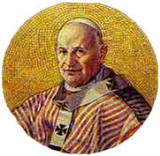
Pope John XXIII

 
Pope John XXIII

   Email Print
   Bookmark   Link


Pope John XXIII


Blessed Pope John XXIII (; ), born Angelo Giuseppe Roncalli (25 November 1881 – 3 June 1963), known as Blessed John XXIII since his beatification
Beatification

Beatification is a recognition accorded by the Catholic church of a dead person's accession to Heaven and capacity to intercede on behalf of individuals who pray in his or her name ....
, was elected as the 261st Pope
Pope

The Pope is the Bishop of Rome, the leader of the Roman Catholic Church and head of state of Vatican City. The current pope is Pope Benedict XVI, who was elected April 19, 2005 in Papal conclave, 2005....
 of the Roman Catholic Church
Roman Catholic Church

The Roman Catholic Church, officially known as the Catholic Church is the world's largest Christianity Ecclesia , representing over half of all Christians and one-sixth of the world population....
 and Sovereign of Vatican City
Vatican City

Vatican City , officially the State of the Vatican City , is a Landlocked country sovereignty city-state whose territory consists of a walled enclave within the city of Rome, the Capital of Italy....
 on 28 October 1958. He called the Second Vatican Council
Second Vatican Council

The Second Ecumenical Council of the Vatican, or Vatican II, was the twenty-first Ecumenical Council of the Roman Catholic Church. It opened under Pope John XXIII in 1962 and closed under Pope Paul VI in 1965....
 (1962–1965) but did not live to see it to completion, dying on 3 June 1963, two months after the completion of his final encyclical, .


Discussion
Ask a question about 'Pope John XXIII'
Start a new discussion about 'Pope John XXIII'
Answer questions from other users
Full Discussion Forum


Encyclopedia


Blessed Pope John XXIII (; ), born Angelo Giuseppe Roncalli (25 November 1881 – 3 June 1963), known as Blessed John XXIII since his beatification
Beatification

Beatification is a recognition accorded by the Catholic church of a dead person's accession to Heaven and capacity to intercede on behalf of individuals who pray in his or her name ....
, was elected as the 261st Pope
Pope

The Pope is the Bishop of Rome, the leader of the Roman Catholic Church and head of state of Vatican City. The current pope is Pope Benedict XVI, who was elected April 19, 2005 in Papal conclave, 2005....
 of the Roman Catholic Church
Roman Catholic Church

The Roman Catholic Church, officially known as the Catholic Church is the world's largest Christianity Ecclesia , representing over half of all Christians and one-sixth of the world population....
 and Sovereign of Vatican City
Vatican City

Vatican City , officially the State of the Vatican City , is a Landlocked country sovereignty city-state whose territory consists of a walled enclave within the city of Rome, the Capital of Italy....
 on 28 October 1958. He called the Second Vatican Council
Second Vatican Council

The Second Ecumenical Council of the Vatican, or Vatican II, was the twenty-first Ecumenical Council of the Roman Catholic Church. It opened under Pope John XXIII in 1962 and closed under Pope Paul VI in 1965....
 (1962–1965) but did not live to see it to completion, dying on 3 June 1963, two months after the completion of his final encyclical, . He was beatified on 3 September 2000, along with Pope Pius IX
Pope Pius IX

Blessed Pope Pius IX , born Giovanni Maria Mastai-Ferretti, was Pope from June 16, 1846 until his death. His was the longest reign in Church history, lasting 32 years....
, the first popes since Pope Pius X
Pope Pius X

Pope St. Pius X , born Giuseppe Melchiorre Sarto, was the 257th Pope of the Roman Catholic Church, serving from 1903 to 1914, succeeding Pope Leo XIII ....
 to receive this honor. His feast day is the 11th of October in the Roman Catholic Church, the day that Vatican II’s first session opened. He is also commemorated on 3 June by the Evangelical Lutheran Church in America
Evangelical Lutheran Church in America

The Evangelical Lutheran Church in America is a mainline Protestantism List of Christian denominations headquartered in Chicago, Illinois. Formed in 1988 by the merging of three churches and currently having about 4.70 million baptized members, it is the largest of all the Lutheranism denominations in the Religion in the United States and t...
 and on 4 June by the Anglican Church of Canada
Anglican Church of Canada

The Anglican Church of Canada is the sole Canada representative of the Anglican Communion. The official French name is l'?glise Anglicane du Canada....
. In Italy
Italy

Italy , officially the Italian Republic , is a country located on the Italian Peninsula in Southern Europe and on the two largest islands in the Mediterranean Sea, Sicily and Sardinia....
, he is remembered with the affectionate appellative of "Il Papa Buono" ("The Good Pope").

Life

Angelo Giuseppe Roncalli was born in Sotto il Monte, a small country village in the Province of Bergamo
Province of Bergamo

The Province of Bergamo is a Provinces of Italy in the Lombardy region of Italy. It has a population of 1,022,428 , an area of 2,723 square kilometers, and contains 244 comuni ....
, Italy. He was the firstborn son of Giovanni Battista Roncalli (1854-1935) and his wife Marianna Giulia Mazzolla (1854-1939), and fourth in a family of 14, including: Angelo Giuseppe, Alfredo, Maria Caterina, Teresa, Ancilla, Francesco Zaverio, Maria Elisa, Assunta Casilda, Giovanni Francesco, Enrica, Giuseppe Luigi and Luigi. His family worked as sharecroppers like the largest part of Sotto il Monte peoples, a striking contrast to his predecessor, Eugenio Pacelli
Pope Pius XII

Pope Pius XII , born Eugenio Maria Giuseppe Giovanni Pacelli , reigned as the 260th pope, head of the Roman Catholic Church and monarch of Vatican City, from March 2, 1939 until his death in 1958....
, who came from an ancient aristocratic family, long connected to the Papacy. However, he was still a descendant of an Italian noble family, from a secondary and impoverished branch.

In 1904, Roncalli was ordained
Ordination

In general religious use, ordination is the process by which individuals are Consecration, that is, set apart as clergy to perform various religious rites and ceremonies....
 a priest
Priest

A priest or priestess is a person having the authority or power to administer religious rites; in particular, rites of sacrifice to, and propitiation of, a deity or deities....
 in the Catholic Church of Santa Maria in Monte Santo in Rome
Rome

Rome is the capital city of Italy and Lazio, and is Italy's largest and most populous city, with 2,724,347 residents in an urban area of some ....
. He was trained as a historian.

In 1905, Giacomo Radini-Tedeschi
Giacomo Radini-Tedeschi

Giacomo Radini-Tedeschi...
, the new bishop of Bergamo, appointed Roncalli as his secretary. Roncalli worked for Radini-Tedeschi until the bishop's death in 1914. During this period Roncalli was also a teacher in the diocesan seminary.

During World War I
World War I

World War I, or the First World War , was a global military conflict which involved the Great powers, organized into two opposing military alliances: the Allies of World War I and the Central Powers....
, Roncalli was drafted into the Royal Italian Army as a sergeant
Sergeant

Sergeant is a Military rank used in some form by most militaries, police forces, and other uniformed organizations around the world. Its origins are the Latin serviens, "one who serves", through the French term Sergent....
, serving in the medical corps as a stretcher-bearer and as a chaplain
Chaplain

A chaplain is typically a priest, pastor, ordained deacon, rabbi, imam or other member of the clergy serving a group of people who are not organized as a mission or church , or who are unable to attend church for various reasons; such as health, confinement, or military or civil duties; Laity chaplains are also found in other settings such...
.

In 1921, Pope Benedict XV
Pope Benedict XV

Pope Benedict XV , , , born Giacomo Paolo Giovanni Battista della Chiesa, reigned as Pope from September 3, 1914 to January 22, 1922, succeeding Pope Pius X ....
 appointed him as the Italian president of the Society for the Propagation of the Faith
Society for the Propagation of the Faith

The Society for the Propagation of the Faith is an international association for the assistance by prayers and alms of Roman Catholic Church missionary priests, brothers, and nuns engaged in preaching the Gospel in non-Catholic countries....
. In 1925 Pope Pius XI
Pope Pius XI

Pope Pius XI , born Ambrogio Damiano Achille Ratti, reigned as Pope from February 6, 1922, and as sovereignty of Vatican City from its creation as an independent state on February 11, 1929 until his death on February 10, 1939....
 appointed him as Apostolic Visitor
Nuncio

Nuncio is an Ecclesiology diplomatic title, derived from the ancient Latin word, Nuntius, meaning "envoy." This article addresses this title as well as derived similar titles, all within the structure of the Roman Catholic Church....
 to Bulgaria
Bulgaria

The state of Bulgaria , Scientific transliteration Balgarija, officially the Republic of Bulgaria has played a significant role in the Balkans in south-eastern Europe for over fourteen centuries....
, also naming him for consecration
Consecration

Consecration is the ritual dedication to a special purpose or service, usually religious. The word "consecration" literally means "to associate with the sacred"....
 as titular bishop
Titular bishop

A titular bishop is a Bishop of the Catholic Church who is not in charge of a diocese . Examples of bishops belonging to this category are coadjutor bishops, auxiliary bishops, bishops emeritus, vicar apostolic, nuncios, superiors of departments in the Roman Curia, and Cardinal Bishops of suburbicarian dioceses ....
 of Areopoli
Areopoli

Areopoli is the second largest town in Mani Peninsula. The word areopoli means "city of Ares", the ancient Greek mythology god of war. It is the seat of Oitylo municipality as well as Oitylo Province....
s. He chose as his episcopal motto
Motto

A motto is a phrase meant to formally describe the general motivation or intention of a social group or organization. A motto may be in any language, but Latin is the most used....
  ("Obedience and Peace"), which became his guiding motto.

In 1935 he was made Apostolic Delegate
Nuncio

Nuncio is an Ecclesiology diplomatic title, derived from the ancient Latin word, Nuntius, meaning "envoy." This article addresses this title as well as derived similar titles, all within the structure of the Roman Catholic Church....
 to Turkey
Turkey

Turkey , known officially as the Republic of Turkey , is a Eurasian country that stretches across the Anatolian peninsula in southwest Asia and Thrace in the Balkans region of Southern Europe....
 and Greece
Greece

Greece , officially the Hellenic Republic , is a country in southeastern Europe, situated on the southern end of the Balkans. It has borders with Albania, Bulgaria and the former Yugoslav Republic of Macedonia to the north, and Turkey to the east....
. Roncalli used this office to help the Jew
Jew

A Jew is a member of the Jewish people, an ethnoreligious group that traces its ancestry to the Israelites or Hebrews of the Ancient Near East....
ish underground in saving thousands of refugees in Europe
Europe

Europe is, conventionally, one of the world's seven continents. Comprising the westernmost peninsula of Eurasia, Europe is generally divided from Asia to its east by the water divide of the Ural Mountains, the Ural , the Caspian Sea, and by the Caucasus Mountains to the southeast....
, leading some to consider him to be a Righteous Gentile
Righteous Among the Nations

Righteous among the Nations , which may at times refer to the B'nei Noah or Noahides as well, is a term used in Judaism to refer to non-Jews who abide by the Seven Laws of Noah and thus are assured of meriting paradise....
. In 1944, during World War II
World War II

World War II, or the Second World War , was a global military conflict which involved a Participants in World War II, including all of the great powers, organised into two opposing military alliances: the Allies of World War II and the Axis powers....
, Pope Pius XII
Pope Pius XII

Pope Pius XII , born Eugenio Maria Giuseppe Giovanni Pacelli , reigned as the 260th pope, head of the Roman Catholic Church and monarch of Vatican City, from March 2, 1939 until his death in 1958....
 named him Apostolic Nuncio to Paris
Paris

Paris is the Capital of France and the country's largest city. It is situated on the river Seine, in northern France, at the heart of the ?le-de-France Regions of France ....
, France
France

France , officially the French Republic , is a country whose Metropolitan France is located in Western Europe and that also comprises various Overseas departments and territories of France....
. In this capacity he had to negotiate the retirement of bishops who had collaborated with the occupying power.

In 1953, he was appointed as the Patriarch of Venice
Patriarch of Venice

The Patriarch of Venice is one of the few Patriarchs in the Latin Rite of the Roman Catholic Church. The diocese of Venice was created in 774, but it was only in 1457 that its bishops were accorded the title of the patriarch by the Pope, for political considerations....
, and, accordingly, raised to the rank of Cardinal-Priest
Cardinal (Catholicism)

A cardinal is a senior Ecclesiology official, usually a Bishop , of the Catholic Church. They are collectively known as the College of Cardinals, which as a body elects a new pope....
  of Santa Prisca
Santa Prisca

Santa Prisca is a basilica churches of Rome Rome, devoted to Saint Prisca, a 1st century martyr, on the Aventine hill. It was built in the 4th or 5th century over a temple of Mithras, and is recorded as the Titulus Priscae in the acts of the 499 synod....
 by Pope Pius XII. As a sign of his esteem, President Vincent Auriol
Vincent Auriol

Jules-Vincent Auriol was a France politician who served as the first President of France of the French Fourth Republic from 1947 to 1954. He also served as interim President of the Provisional Government from November to December 1946, making him one of only three people who were heads of state of the French Republic on two separate occasi...
 of France
France

France , officially the French Republic , is a country whose Metropolitan France is located in Western Europe and that also comprises various Overseas departments and territories of France....
 claimed the ancient privilege possessed by French monarchs and bestowed the red hat on the now-Cardinal Roncalli at a ceremony in the Elysee Palace
Élysée Palace

The Elys?e Palace , is the official residence of the President of the French Republic, where the president's office is located, and the Council of Ministers meets....
.

Election as pope

Johnxxiii Color Tiara Sm
See also Papal conclave, 1958
Papal conclave, 1958

The Papal conclave of 1958 occurred following the death of Pope Pius XII on October 9, 1958 in Castel Gandolfo, after a 19-year pontificate. The conclave to elect his successor commenced on October 25 and ended three days later, on October 28, after eleven ballots....


Choice of name

Upon his election, Cardinal Roncalli chose John
Pope John

Pope John has been the most common papal name in the Roman Catholic Church, used by 21 popes, though the numbering of them has been irregular through history due to antipopes and differences in old lists....
 as his regnal name
Regnal name

A regnal name, or reign name, is a formal name used by some popes and monarchs during their reigns. Since medieval times, monarchs have frequently chosen to use a name different from their own personal name when they inherit a throne....
. This was the first time in over 500 years that this name had been chosen - previous Popes had avoided using this name as the last man
Antipope John XXIII

Baldassarre Cossa , was antipope John XXIII during the Western Schism ....
 to use this name came to be considered an Antipope
Antipope

An antipope is a person who, in opposition to a sitting Bishop of Rome, makes a widely accepted claim to be the Pope. In the past, antipopes were typically those supported by a fairly significant faction of cardinal and kingdoms....
 following the Western Schism
Western Schism

The Great Schism of Western Christianity or Papal Schism was a split within the Roman Catholic Church from 1378 to 1417. By its end, three men simultaneously claimed to be the true pope....
.

On the choice of his name Pope John said that

I choose John ... a name sweet to us because it is the name of our father, dear to me because it is the name of the humble parish church where I was baptized, the solemn name of numberless cathedrals scattered throughout the world, including our own basilica [St. John Lateran]. Twenty-two Johns
Pope John

Pope John has been the most common papal name in the Roman Catholic Church, used by 21 popes, though the numbering of them has been irregular through history due to antipopes and differences in old lists....
 of indisputable legitimacy
Antipope

An antipope is a person who, in opposition to a sitting Bishop of Rome, makes a widely accepted claim to be the Pope. In the past, antipopes were typically those supported by a fairly significant faction of cardinal and kingdoms....
 have [been Pope], and almost all had a brief pontificate. We have preferred to hide the smallness of our name behind this magnificent succession of Roman Popes.


Numbering

Upon choosing the name, there was some confusion as to whether the new Pope would be known as John XXIII or John XXIV. In response, John declared that he was John XXIII, thus affirming the antipapal status of Antipope John XXIII
Antipope John XXIII

Baldassarre Cossa , was antipope John XXIII during the Western Schism ....
.

Before this Antipope, the most recent Popes called John were John XXII
Pope John XXII

Pope John XXII , born Jacques Du?ze , was pope from 1316 to 1334. He was the second Pope of the Avignon Papacy , elected by a Papal conclave in Lyon assembled by Philip V of France....
 (1316-1334) and John XXI
Pope John XXI

Pope John XXI , born Pedro Juli?o , a Portugal also called Pedro Hispano Note that the previous Pope named John was Pope John XIX and there is no Pope John XX ....
 (1276-1277). However, there was no Pope John XX
Pope John XX

There has never been a Pope John XX, because the 20th pope of this name, formerly Pope John XXI, decided to skip the number XX and to be counted as John XXI instead....
, due to confusion caused by medieval historians misreading the Liber Pontificalis
Liber Pontificalis

The Liber Pontificalis is a book of biography of popes from Saint Peter until the 15th century. The original publication of the Liber Pontificalis stopped with Pope Adrian II or Pope Stephen V , but it was later supplemented in a different style until Pope Eugene IV and then Pope Pius II ....
 to refer to another Pope John between John XIV
Pope John XIV

John XIV was Pope from December, 983 to August 20, 984, successor to Pope Benedict VII He was born at Pavia, and before his elevation to the papal chair was imperial chancellor of Emperor Otto II , and was the latter's second choice....
 and John XV
Pope John XV

John XV , Pope from 985 to 996, succeeding antipope Boniface VII , .John XV was the son of Leo, a Rome presbyter. At the time he mounted the papal chair Crescentius II was Patrician of Rome, significantly hampering the pope's influence, but the presence of the Empress Theophano, regent for her son, Holy Roman Emperor Otto III , in Rome from...
.

Papacy


John Xxiii Sedia Gestatoria
Following the death of Pope Pius XII in 1958, Roncalli was elected Pope, to his great surprise. He had even arrived in the Vatican with a return train ticket to Venice. Many had considered that Archbishop Montini, Archbishop of Milan, was a possible candidate, but, although he was Archbishop of one of the most ancient and prominent Sees
Episcopal See

An episcopal see is, in the original sense, the official seat of a bishop. This seat, which is also referred to the bishop's cathedra, is placed in the bishop's principal church, which is therefore called the bishop's cathedral....
 in Italy, he had not been appointed a cardinal. As a result, he was not present at the 1958 conclave and most of the cardinals abided by the established precedent of voting only for a member of the College of Cardinals, in spite of the affirmation in Canon Law
Canon law (Catholic Church)

Canon Law, the ecclesiastical law of the Catholic Church, is a fully developed legal system, with all the necessary elements: courts, lawyers, judges, a fully articulated legal code and principles of legal interpretation....
 that any Catholic male could be chosen. After the long pontificate of Pope Pius XII, the cardinals chose a man who, it was presumed because of his advanced age, would be a short-term or "stop-gap" pope. In John XXIII's first consistory
Consistory

AntiquityOriginally, the Latin word consistorium meant simply 'sitting together', just as the Greek synedrion .In the Roman empire, it was specifically applied to a formal meeting of the Comites consistoriales, i.e....
, Montini was raised to the rank of cardinal; and in time he became John's successor, Pope Paul VI
Pope Paul VI

Pope Paul VI , born Giovanni Battista Enrico Antonio Maria Montini , reigned as Pope of the Roman Catholic Church and monarch of Vatican City from 1963 to 1978....
. John XXIII's personal warmth, good humor and kindness captured the world's affections in a way his predecessor, for all his great learning and personal holiness, had failed to do.

On 25 December 1958, he became the first pope to make pastoral visits in his diocese of Rome since 1870, when he visited children suffering from polio at the Bambin Gesù hospital and then visited Santo Spirito Hospital. The next day he visited Rome's Regina Coeli prison, where he told the prisoners: "You could not come to me, so I came to you." These acts created a sensation, and he wrote in his diary:
...great astonishment in the Roman, Italian and international press. I was hemmed in on all sides: authorities, photographers, prisoners, wardens...


Far from being a mere "stop gap" Pope, to great excitement John called an ecumenical council
Ecumenical council

An ecumenical council is a conference of the bishops of the whole Christian Church convened to discuss and settle matters of Church doctrine and practice....
 fewer than ninety years after the Vatican Council
First Vatican Council

The First Vatican Council was convoked by Pope Pius IX on 29 June 1868, after a period of planning and preparation that began on 6 December 1864....
. Cardinal Montini remarked to a friend that "this holy old boy doesn't realize what a hornet's nest he's stirring up". From the Second Vatican Council came changes that reshaped the face of Catholicism: a comprehensively revised liturgy
Mass of Paul VI

The Mass of Pope Paul VI is the liturgy of the Roman Catholic Church Mass of the Roman Rite Promulgation by Paul VI in 1969, after the Second Vatican Council ....
, a stronger emphasis on ecumenism
Ecumenism

Ecumenism now mainly refers to initiatives aimed at greater religious unity or cooperation.In its broadest sense, this unity or cooperation may refer to a worldwide religious unity; by the advocation of a greater sense of shared spirituality across the three Abrahamic faiths of Judaism, Christianity and Islam....
, and a new approach to the world.

Pope John and papal ceremonial

Pope John XXIII was the last pope to use full papal ceremony, much of which was abolished subsequently after Vatican II. His papal coronation
Papal Coronation

The Papal Coronation is the ceremony in which a new pope is crowned as earthly head of the Roman Catholic Church, sovereignty of Vatican City, and Monarch of the Holy See....
 ran for the traditional five hours (Pope Paul VI, by contrast, opted for a shorter ceremony, while later popes declined to be crowned). However, as with his predecessor Pope Pius XII, he chose to have the coronation itself take place on the balcony of St. Peter's Basilica, in view of the crowds assembled in St. Peter's Square.

John XXIII wore a number of tiaras from the papal collection. On formal occasions, such as giving the blessing, he wore the traditional 1877 Palatine tiara he had been crowned with. However, on other occasions he wore the lighter and more comfortable 1922 tiara of Pope Pius XI, which he used so often that it became strongly associated with him.

As with most other popes in the last two decades up to that point, he was given an expensive silver papal tiara by the people of Bergamo. The Tiara of Pope John XXIII
Tiara of Pope John XXIII

The Tiara of Pope John XXIII was the personal Papal Tiara presented by the region of Bergamo to Angelo Roncalli, who was born there, following his election as Pope John XXIII in 1958....
, the lightest in the papal collection at 2 lb
Pound (mass)

The pound or pound-mass is a Units of measurement of massused in the Imperial unit, United States customary units and other systems of measurement....
 (900 g
Gram

The gram , ; symbol g, is a Physical unit of mass.Originally defined as "the absolute weight of a volume of pure water equal to the cube of the hundredth part of a metre, and at the temperature of melting ice" , a gram is now defined as one one-thousandth of the SI base unit, the kilogram, or Scientific notation kg, which itself is...
), was given to him eventually in 1959. When asked about the tiara during its manufacture, John asked that the makers halve the number of jewel
Gemstone

A gemstone or gem, also called a precious or semi-precious stone, is a piece of attractive mineral, which — when cut and polished — is used to make jewellery or other adornments....
s with which they planned to decorate it and give the financial saving to the poor.

Traditional Pontifical High Masses and most papal ceremonial aspects—including use of the flabelli (ceremonial fans made of ostrich feathers) and the Palatine Guard
Palatine Guard

The Palatine Guard was a military unit of Holy See. It was formed in 1850 by Pope Pius IX, who ordered that the two militia units of the Papal States be amalgamated....
—and the saluting of the pope on his arrival at Mass in St. Peter's Basilica by the playing of trumpets were abolished by Pope Paul VI in stages during his reign. None of the tiaras associated with Pope John have been worn by later popes.

While maintaining the traditional papal ceremonial, Pope John continued his predecessors' policy of a gradual reform to the traditional Roman liturgy
Tridentine Mass

The Tridentine Mass is a common name for the form of the Roman Rite Mass contained in the typical editions of the Roman Missal that were published from 1570 to 1962....
, publishing changes that had accrued since 1920 in the 1962 Missal, before the major reform of the liturgy
Mass of Paul VI

The Mass of Pope Paul VI is the liturgy of the Roman Catholic Church Mass of the Roman Rite Promulgation by Paul VI in 1969, after the Second Vatican Council ....
 after Vatican II. The 1962 Missal published by Pope John XXIII was the last typical edition of the Tridentine
Council of Trent

The Council of Trent was the 16th century Ecumenical Council of the Roman Catholic Church. Considered one of the Church's most important councils, it convened in Trento between December 13, 1545, and December 4, 1563 in twenty-five sessions for three periods....
 rite, which has now come to be formally recognized by Pope Benedict XVI as an extraordinary form of the Roman Rite.

Pope John was also the last pope to date to have his Requiem Mass celebrated within St. Peter's Basilica, amid traditional papal pomp. His successor, Pope Paul VI, abolished the traditional papal funeral and had his funeral as a simple concelebrated Mass in St. Peter's Square.

Final months and death


On 23 September 1962, Pope John XXIII was first diagnosed with gastric carcinoma. The diagnosis, which was kept from the public, followed nearly eight months of occasional stomach hemorrhages, and reduced the pontiff's appearances. Looking pale and drawn during these events, he gave a hint to his ultimate fate in April 1963, when he said to visitors, "That which happens to all men perhaps will happen soon to the Pope who speaks to you today."

On 11 May 1963, the Italian president Antonio Segni
Antonio Segni

Antonio Segni was an Italian politician who was twice Prime Minister of Italy , and the President of the Italian Republic from 1962 to 1964. Adhering to the centrist Christian Democracy party , he was the first Sardinian ever to become Prime Minister of Italy....
 awarded Pope John XXIII the Balzan Prize
Balzan Prize

The International Balzan Prize Foundation awards four annual monetary prizes to List of Balzan Prize Winners who have made outstanding achievements in the fields of humanities, natural sciences, culture, as well as for endeavours for peace and the brotherhood of man....
 for his engagement for peace. It was the Pope's last public appearance.

On 25 May 1963, the Pope suffered another hemorrhage and required blood transfusions, but the cancer had perforated the stomach wall and peritonitis
Peritonitis

Peritonitis is defined as inflammation of the peritoneum . It may be localised or generalised, generally has an acute course, and may depend on either infection or on a non-infectious process....
 soon set in. On 31 May it had become clear that the cancer had overcome the resistance of Pope John XXIII. At 11 A.M. Petrus Canisius Van Lierde
Petrus Canisius Van Lierde

Petrus Canisius J. van Lierde, O.S.A., born April 22, 1907 ? March 12, 1995, served forty years from 1951 to 1991 as Vicar General of the Vatican City State, and was the longest serving Vatican official in that position....
 as Papal Sacristan was at the bedside of the dying pope, ready to anoint him. The Pope begins to speak for a very last time: “I had the great grace to be born into a Christian family, modest and poor, but with the fear of the Lord. …My time on earth is drawing to a close. But Christ lives on and continues his work in the Church. Souls, souls, Ut omnes unum sint, Van Lierde then anoints his eyes, ears, mouth, hands and feet. Overcome by emotion, he forgets the right order of anointing. Pope John gently helps him. Then the Pope bids him and all the other bystanders a last farewell. The Pope died 7:49 p.m. (local time) of peritonitis
Peritonitis

Peritonitis is defined as inflammation of the peritoneum . It may be localised or generalised, generally has an acute course, and may depend on either infection or on a non-infectious process....
 due to a perforated stomach cancer
Stomach cancer

Stomach or gastric cancer can develop in any part of the stomach and may spread throughout the stomach and to other organs; particularly the esophagus, lungs and the liver....
 on 3 June at the age of 81. He was buried on 6 June, ending a reign of four years, seven months and six days.

On 6 December 1963, the US president Lyndon B. Johnson
Lyndon B. Johnson

Lyndon Baines Johnson , often referred to as LBJ, was the List of Presidents of the United States President of the United States and List of Vice Presidents of the United States Vice President of the United States ....
 posthumously awarded him the Presidential Medal of Freedom
Presidential Medal of Freedom

The Presidential Medal of Freedom is a decoration bestowed by the President of the United States and is, along with theequivalent Congressional Gold Medal bestowed by an act of United States Congress, the highest Civilian decorations of the United States in the United States....
, the United States' highest civilian award, in recognition of the good relationship between Pope John and the United States
United States

The United States of America is a Federal government constitutional republic comprising U.S. state and a federal district. The country is situated mostly in central North America, where its Contiguous United States and Washington, D.C., the Capital districts and territories, lie between the Pacific Ocean and Atlantic Oceans, Borders of the U...
.

Criticism

Sedevacantist
Sedevacantism

Sedevacantism is the position held by a minority of Traditionalist Catholics who claim that the Holy See has been vacant since the death of Pope Pius XII in 1958 ....
 and Conclavist
Sedevacantism

Sedevacantism is the position held by a minority of Traditionalist Catholics who claim that the Holy See has been vacant since the death of Pope Pius XII in 1958 ....
 groups have been some of Pope John's most outspoken critics. Some groups have made reasonable claims that John was a Freemason.

Some also make the claim that John's choice of regnal name
Regnal name

A regnal name, or reign name, is a formal name used by some popes and monarchs during their reigns. Since medieval times, monarchs have frequently chosen to use a name different from their own personal name when they inherit a throne....
 marked him as an antipope, as the name John had lain unused since Antipope John XXIII
Antipope John XXIII

Baldassarre Cossa , was antipope John XXIII during the Western Schism ....
 used it in the 15th century (other Popes have similarly used names taken by anti-popes, for example Benedict XIV).

Many who subscribe to the teachings of Our Lady of Fatima
Our Lady of Fatima

Our Lady of F?tima is the title given to the vision of the Blessed Virgin Mary that was said to have appeared before three shepherd children at F?tima, Portugal on the 13th day of six consecutive months in 1917, starting on 13 May, the F?tima holiday....
 also believe that Pope John deliberately withheld secret prophetic information revealed by an apparition of the Virgin Mary
Marian apparitions

A Marian apparition is an event in which the Mary is believed to have supernaturally appeared to one or more persons. They are often given names based on the town in which they were reported, or on the sobriquet which was given to Mary on the occasion of the apparition....
. This is perhaps the basis for Internet reports in the late 1990s about the supposed discovery of Pope John's diary where he received prophetic insight into the future, including the return of Jesus in New York in 2000.

Although Pope John did have a diary, there is no evidence in it to suggest that he received apocalyptic visions of the future.

In 2003, The Guardian
The Guardian

Sorry, no overview for this topic
 newspaper found a confidential communique from John to Catholic Bishops, allegedly mandating confidentiality in matters of pederasty
Pederasty

Pederasty, or Paederasty in International English , is an erotic relationship between an adolescent boy and an adult man outside his immediate family....
 with the threat of excommunication
Excommunication

Excommunication is a religious censure used to deprive or suspend membership in a religious community. The word literally means putting [someone] out of full communion....
. These allegations were later refuted by Archbishop Vincent Gerard Nichols
Vincent Gerard Nichols

Vincent Gerard Nichols is the current Roman Catholic Archbishop of Birmingham, an office he has held since March 2000....
, Chairman of the Catholic Office for the Protection of Children and Vulnerable Adults. Nichols explained that the communique "is not directly concerned with child abuse at all, but with the misuse of the confessional. This has always been a most serious crime in Church law
Canon law

Canon law is internal ecclesiastical law governing the Roman Catholic Church, the Eastern Orthodox Church churches, and the Anglicanism of churches....
."

Legacy

Known affectionately as "Good Pope John" and "the most loved Pope in history" to many people, on 3 September 2000, John was declared "Blessed" by Pope John Paul II
Pope John Paul II

Pope John Paul II John Paul II is widely acclaimed as one of the most influential leaders of the twentieth century. He has been Pope_John_Paul_II#Role_in_the_fall_of_Communism in bringing down communism in Eastern Europe, as well as significantly improving the Roman Catholic Church's relations with Judaism, the Eastern Orthodox Church, and A...
, the penultimate step on the road to saint
Saint

A saint in Christianity is a human being who has been called to holiness. The term is used differently by various denominations, with some, such as the Anglicans, Methodists, and Lutherans distinguishing between Saints and saints....
hood. Following his beatification, his body was moved from its original burial place in the grottoes below St Peter's Basilica to the Altar of St. Jerome and displayed for the veneration
Veneration

In Christianity, veneration , or veneration of saints, is a special act of honoring a saint: a dead person who has been identified as singular in the traditions of the religion....
 of the faithful.

At the time, the body was observed to be extremely well-preserved—a condition which the Church ascribes to the lack of air flow in his sealed triple coffin
Coffin

A coffin is a funerary box used in the display and containment of deceased remains ? either for burial or cremation....
 rather than to a miracle
Miracle

File:Folio 171r - The Raising of Lazarus.jpgA miracle is a sensibly perceptible interruption of the laws of nature, such that can only be explained by divine intervention, and is sometimes associated with a miracle-worker....
. When John was moved, the original vault — which was above the floor — was removed. A new vault was built beneath the ground, and Pope John Paul II was later buried in this vault.

The date assigned for the liturgical celebration (where authorized) of Blessed John XXIII is not 3 June, the anniversary of his death, as would be usual, but 11 October, the anniversary of his opening of the Second Vatican Council.

He is honored by many Protestant organizations as a Christian reformer. Both Anglican and Lutheran denominations
Christian denomination

A Christian denomination is an identifiable religious body under a common name, structure, and doctrine within Christianity.Worldwide, Christians are divided, often along ethnic and linguistic lines, into separate churches and traditions....
 commemorate John XXIII as a "renewer of the church".

From his early teens, he maintained a diary of spiritual reflections that was subsequently published as Journal of a Soul. The collection of writings charts Roncalli's efforts as a young man to "grow in holiness" and continue after his election to the Papacy; it remains widely read.

See also

  • Orthodox Church
  • Eastern Catholic Church
  • Desert Fathers
    Desert Fathers

    The Desert Fathers were Hermits, Ascetics and Monks who lived mainly in the Scetes desert of Egypt, beginning around the third century. Very few of the Desert Fathers lived in other deserted regions of Egypt....
  • List of Righteous Among the Nations by country
    List of Righteous Among the Nations by country

    This is a partial list of some of the most prominent Righteous among the Nations per country of origin, recognized by Yad Vashem, the Holocaust Martyrs' and Heroes' Remembrance Authority in Jerusalem....
  • List of encyclicals of Pope John XXIII
    List of Encyclicals of Pope John XXIII

    Pope John XXIII issued eight Papal Encyclicals during his five-year reign as Pope of the Roman Catholic Church, from his election on October 28, 1958 until his death on June 3, 1963....


External links

  • : text with concordances and frequency list
Video on YouTube — Italian Documentaries (English Subtitled)