


Theotokos

Encyclopedia
Theotokos is the Greek
title
of Mary, the mother of Jesus used especially in the Eastern Orthodox
, Oriental Orthodox, and Eastern Catholic Churches. Its literal English translations include God-bearer and the one who gives birth to God. Less literal translations include Mother of God. Roman Catholics, Anglicans, and some Protestants use the title Mother of God more often than Theotokos. The Council of Ephesus decreed in 431
that Mary is Theotokos because her son Jesus is one person who is both God and man, divine and human.
and τόκος parturition, childbirth. Literally, this translates as God-bearer or the one who gives birth to God; historian Jaroslav Pelikan
translated it more precisely as "the one who gives birth to the one who is God". However, since many English-speaking
Orthodox find this literal translation awkward, in liturgical
use, Theotokos is often left untranslated, or paraphrased as Mother of God. The latter title is the literal translation of a distinct title in Greek, Μήτηρ του Θεού (translit. Mētēr tou Theou). Mother of God also accurately translates the Greek words Θεομήτωρ (translit. Theomētor; also spelled Θεομήτηρ, translit. Theomētēr) and Μητρόθεος (translit. Mētrotheos), which are found in patristic and liturgical texts, e.g.
In many traditions, Theotokos was translated from the Greek into the local liturgical language:
Translation of the phrase mother of God
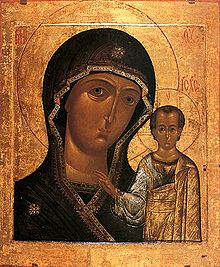 The English term Mother of God is mostly used as an imprecise translation of Theotokos, and frequently requires explanation. The other principal use of Mother of God has been as the precise and literal translation of Μήτηρ Θεού, a Greek term which has an established usage of its own in traditional Christian theological writing, hymnography, and iconography. In an abbreviated form ΜΡ ΘΥ it often is found on Eastern icon
s (see illustration above), where it is used to identify Mary.
A hymn normally sung as part of the Divine Liturgy of St. John Chrysostom
includes both titles in close proximity, in both cases referring to Mary, showing that the titles are not synonymous: "It is truly fitting to call you blessed, the Theotokos, ever-blessed and wholly pure and the Mother of our God (...", emphasis added.) The difference between the two terms is that the former, Theotokos explicitly refers to physical childbearing, while the latter, Mother of God, describes a family relationship but not necessarily physical childbearing.
Within the Christian tradition, Mother of God has not been understood, nor been intended to be understood, as referring to Mary as Mother of God from eternity — that is, as Mother of God the Father — but only with reference to the birth of Jesus
, that is, the Incarnation
. This limitation in the meaning of Mother of God must be understood by the person employing the term. To make it explicit, it is sometimes translated Mother of God Incarnate.
However, those reading or hearing the English phrase Mother of God as a translation of a Greek text cannot — unless they know the Greek text in question, or obtain additional information — know whether the phrase is a literal translation of Μήτηρ Θεού or an imprecise rendering of Θεοτόκος or one its Latin equivalents or equivalents in other languages.
to Him: only the persons of the Holy Trinity. He is ontologically
separate from all other beings, as Creator to creation. This stands in contrast to classical Greco-Roman religion
in particular, where a number of goddesses appear as the physical mothers of other divinities which were considered gods in their own right (cf. polytheism
).
On the other hand, most Christians believe God the Son
is begotten of God the Father
"from all eternity
" (see Trinity
and Nicene Creed
), but is born "in time" of Mary. Theotokos thus refers to the Incarnation
, when the Second Person of the Holy Trinity took on human nature in addition to his pre-existing divine nature, this being made possible through the cooperation of Mary.
Since mainstream Christians understand Jesus Christ as both fully God and fully human, they call Mary Theotokos to affirm the fullness of God's incarnation. The Council of Ephesus decreed, in opposition to those who denied Mary the title Theotokos ("the one who gives birth to God") but called her Christotokos ("the one who gives birth to Christ"), that Mary is Theotokos because her son Jesus is one person who is both God and man, divine and human. (Some Protestants still insist that Mary cannot be truly Theotokos, but only Christotokos.) Cyril of Alexandria
wrote, "I am amazed that there are some who are entirely in doubt as to whether the holy Virgin should be called Theotokos or not. For if our Lord Jesus Christ is God, how is the holy Virgin who gave [Him] birth, not [Theotokos]?" (Epistle 1, to the monks of Egypt; PG
77:13B). Thus the significance of Theotokos lies more in what it says about Jesus than any declaration about Mary.
Within the Orthodox doctrinal teaching on the economy
of salvation, Mary's identity, role, and status as Theotokos is acknowledged as indispensable, and is for this reason formally defined as official dogma. The only other Mariological
teaching so defined is that of her virginity. Both of these teachings have a bearing on the identity of Jesus Christ. By contrast, certain other Marian beliefs which do not bear directly on the doctrine concerning the person of Jesus (for example, her sinlessness, the circumstances surrounding her conception and birth
, her Presentation in the Temple
, her continuing virginity
following the birth of Jesus, and her death), which are taught and believed by the Orthodox Church (being expressed in the Church's liturgy and patristic writings), are nonetheless not formally defined by the Church, and belief in them is not a precondition for baptism.
used the title Theotokos for Mary since at least the third century AD.
Origen
(d. 254) is often cited as the earliest author to use Theotokos for Mary (Socrates, Ecclesiastical History 7.32 citing Origen's Commentary on Romans)
but the text upon which this assertion is based may not be genuine.
Dionysius of Alexandria
used Theotokos in about 250, in an epistle to Paul of Samosata
.
Athanasius of Alexandria
in 330, Gregory the Theologian in 370, John Chrysostom
in 400, and Augustine
all used Theotokos.
Theodoret
wrote in 436 that calling the Virgin Mary Theotokos is an apostolic
tradition.
in 431. The competing view, advocated by Patriarch
Nestorius
of Constantinople, was that Mary should be called Christotokos, meaning "Birth-giver of Christ," to restrict her role to the mother of Christ's humanity only and not his divine nature.
Nestorius' opponents, led by Cyril of Alexandria
, viewed this as dividing Jesus into two distinct persons, the human who was Son of Mary, and the divine who was not. To them, this was unacceptable since by destroying the perfect union of the divine and human natures in Christ, it sabotaged the fullness of the Incarnation and, by extension, the salvation of humanity. The council accepted Cyril's reasoning, affirmed the title Theotokos for Mary, and anathema
tised Nestorius' view as heresy
. (See Nestorianism
)
In letters to Nestorius which were afterwards included among the council documents, Cyril explained his doctrine. He noted that "the holy fathers... have ventured to call the holy Virgin Theotokos, not as though the nature of the Word or his divinity received the beginning of their existence from the holy Virgin, but because from her was born his holy body, rationally endowed with a soul, with which [body] the Word was united according to the hypostasis
, and is said to have been begotten according to the flesh" (Cyril's second letter to Nestorius).
Explaining his rejection of Nestorius' preferred title for Mary (Christotokos), Cyril wrote: "Confessing the Word to be united with the flesh according to the hypostasis, we worship one Son and Lord, Jesus Christ. We do not divide him into parts and separate man and God as though they were united with each other [only] through a unity of dignity and authority... nor do we name separately Christ the Word from God, and in similar fashion, separately, another Christ from the woman, but we know only one Christ, the Word from God the Father with his own flesh... But we do not say that the Word from God dwelt as in an ordinary human born of the holy virgin... we understand that, when he became flesh, not in the same way as he is said to dwell among the saints do we distinguish the manner of the indwelling; but he was united by nature and not turned into flesh... There is, then, one Christ and Son and Lord, not with the sort of conjunction that a human being might have with God as in a unity of dignity or authority; for equality of honor does not unite natures. For Peter and John were equal to each other in honor, both of them being apostles and holy disciples, but the two were not one. Nor do we understand the manner of conjunction to be one of juxtaposition, for this is insufficient in regard to natural union.... Rather we reject the term 'conjunction' as being inadequate to express the union... [T]he holy virgin gave birth in the flesh to God united with the flesh according to hypostasis, for that reason we call her Theotokos... If anyone does not confess that Emmanuel is, in truth, God, and therefore that the holy virgin is Theotokos (for she bore in a fleshly manner the Word from God become flesh), let him be anathema
." (Cyril's third letter to Nestorius)
in the Eastern Orthodox, Eastern Catholic and Oriental Orthodox churches. The most common is Axion Estin
(It is truly meet), which is used in nearly every service.
Other examples include Beneath thy compassion
dating from the third century, the Hail Mary
in its Eastern form, and All creation rejoices, which replaces Axion Estin at the Divine Liturgy
on the Sundays of Great Lent
.
of Christmas. Her maternity was celebrated on 11 October in pre-1970 versions of the General Roman Calendar, which some traditional Catholics still observe.
This solemnity comes from around 500 AD and was originally celebrated in the Eastern Churches.
Greek language
Greek is an independent branch of the Indo-European family of languages. Native to the southern Balkans, it has the longest documented history of any Indo-European language, spanning 34 centuries of written records. Its writing system has been the Greek alphabet for the majority of its history;...
title
Titles of Mary
Mary is known by many titles , epithets , invocations and other names ....
of Mary, the mother of Jesus used especially in the Eastern Orthodox
Eastern Orthodox Church
The Orthodox Church, officially called the Orthodox Catholic Church and commonly referred to as the Eastern Orthodox Church, is the second largest Christian denomination in the world, with an estimated 300 million adherents mainly in the countries of Belarus, Bulgaria, Cyprus, Georgia, Greece,...
, Oriental Orthodox, and Eastern Catholic Churches. Its literal English translations include God-bearer and the one who gives birth to God. Less literal translations include Mother of God. Roman Catholics, Anglicans, and some Protestants use the title Mother of God more often than Theotokos. The Council of Ephesus decreed in 431
431
Year 431 was a common year starting on Thursday of the Julian calendar. At the time, it was known as the Year of the Consulship of Bassus and Antiochus...
that Mary is Theotokos because her son Jesus is one person who is both God and man, divine and human.
Etymology and translation
Theotokos is a compound of two Greek words, Θεός GodGod
God is the English name given to a singular being in theistic and deistic religions who is either the sole deity in monotheism, or a single deity in polytheism....
and τόκος parturition, childbirth. Literally, this translates as God-bearer or the one who gives birth to God; historian Jaroslav Pelikan
Jaroslav Pelikan
Jaroslav Jan Pelikan was a scholar in the history of Christianity, Christian theology and medieval intellectual history.-Early years:...
translated it more precisely as "the one who gives birth to the one who is God". However, since many English-speaking
English language
English is a West Germanic language that arose in the Anglo-Saxon kingdoms of England and spread into what was to become south-east Scotland under the influence of the Anglian medieval kingdom of Northumbria...
Orthodox find this literal translation awkward, in liturgical
Divine Liturgy
Divine Liturgy is the common term for the Eucharistic service of the Byzantine tradition of Christian liturgy. As such, it is used in the Eastern Orthodox and Eastern Catholic Churches. Armenian Christians, both of the Armenian Apostolic Church and of the Armenian Catholic Church, use the same term...
use, Theotokos is often left untranslated, or paraphrased as Mother of God. The latter title is the literal translation of a distinct title in Greek, Μήτηρ του Θεού (translit. Mētēr tou Theou). Mother of God also accurately translates the Greek words Θεομήτωρ (translit. Theomētor; also spelled Θεομήτηρ, translit. Theomētēr) and Μητρόθεος (translit. Mētrotheos), which are found in patristic and liturgical texts, e.g.
Λαβομένη η Θεοτόκος των εκ του αχράντου και παναμώμου αυτής θυσιαστηρίου σαρκωθέντα ζωοποιόν και ανέκφραστον άνθρακα ως λαβίδι ... επί τούτοις παρουσιασάμενος ο δίκαιος και τη προτροπή είξας της διακονησαμένης Θεώ προς ανθρώπους Θεομήτορος ... περιφανώς ιερά θεομήτωρ εξετέλει.
In many traditions, Theotokos was translated from the Greek into the local liturgical language:
| Language | Translation(s) | Transliteration |
|---|---|---|
| Arabic Arabic language Arabic is a name applied to the descendants of the Classical Arabic language of the 6th century AD, used most prominently in the Quran, the Islamic Holy Book... |
والدة الاله | Wālidat Alelah |
| Armenian Armenian language The Armenian language is an Indo-European language spoken by the Armenian people. It is the official language of the Republic of Armenia as well as in the region of Nagorno-Karabakh. The language is also widely spoken by Armenian communities in the Armenian diaspora... |
Աստուածածին | Astvadzatzin |
| Bulgarian Bulgarian language Bulgarian is an Indo-European language, a member of the Slavic linguistic group.Bulgarian, along with the closely related Macedonian language, demonstrates several linguistic characteristics that set it apart from all other Slavic languages such as the elimination of case declension, the... , Church Slavonic, Macedonian Macedonian language Macedonian is a South Slavic language spoken as a first language by approximately 2–3 million people principally in the region of Macedonia but also in the Macedonian diaspora... , Russian Russian language Russian is a Slavic language used primarily in Russia, Belarus, Uzbekistan, Kazakhstan, Tajikistan and Kyrgyzstan. It is an unofficial but widely spoken language in Ukraine, Moldova, Latvia, Turkmenistan and Estonia and, to a lesser extent, the other countries that were once constituent republics... |
Богородица | Bogoroditsa |
| Coptic Coptic language Coptic or Coptic Egyptian is the current stage of the Egyptian language, a northern Afro-Asiatic language spoken in Egypt until at least the 17th century. Egyptian began to be written using the Greek alphabet in the 1st century... |
Ti.Theotokós | |
| Georgian Georgian language Georgian is the native language of the Georgians and the official language of Georgia, a country in the Caucasus.Georgian is the primary language of about 4 million people in Georgia itself, and of another 500,000 abroad... |
ღვთისმშობელი | Ghvtismshobeli |
| Latin Latin Latin is an Italic language originally spoken in Latium and Ancient Rome. It, along with most European languages, is a descendant of the ancient Proto-Indo-European language. Although it is considered a dead language, a number of scholars and members of the Christian clergy speak it fluently, and... |
Deipara Dei genetrix Mater Dei |
|
| Romanian Romanian language Romanian Romanian Romanian (or Daco-Romanian; obsolete spellings Rumanian, Roumanian; self-designation: română, limba română ("the Romanian language") or românește (lit. "in Romanian") is a Romance language spoken by around 24 to 28 million people, primarily in Romania and Moldova... |
Născătoare de Dumnezeu Maica Domnului |
|
| Serbian Serbian language Serbian is a form of Serbo-Croatian, a South Slavic language, spoken by Serbs in Serbia, Bosnia and Herzegovina, Montenegro, Croatia and neighbouring countries.... / Croatian Croatian language Croatian is the collective name for the standard language and dialects spoken by Croats, principally in Croatia, Bosnia and Herzegovina, the Serbian province of Vojvodina and other neighbouring countries... |
Богородица / Bogorodica Мајка Божја / Majka Božja |
Bogoroditza Mayka Bozhia |
| Syriac Syriac language Syriac is a dialect of Middle Aramaic that was once spoken across much of the Fertile Crescent. Having first appeared as a script in the 1st century AD after being spoken as an unwritten language for five centuries, Classical Syriac became a major literary language throughout the Middle East from... |
ܝܳܠܕܰܬ ܐܰܠܳܗܳܐ | Yoldath Aloho |
| Ukrainian Ukrainian language Ukrainian is a language of the East Slavic subgroup of the Slavic languages. It is the official state language of Ukraine. Written Ukrainian uses a variant of the Cyrillic alphabet.... |
Богородиця Мати Божа |
Bohorodytsia Maty Bozha |
| Polish Polish language Polish is a language of the Lechitic subgroup of West Slavic languages, used throughout Poland and by Polish minorities in other countries... |
Bogurodzica Matka Boska |
Bogurodsitsa Matka Boska |
| Slovak Slovak language Slovak , is an Indo-European language that belongs to the West Slavic languages .Slovak is the official language of Slovakia, where it is spoken by 5 million people... |
Bohorodička Matka Božia |
Bohorodichka Matka Bozhia |
| Belarusan | Багародзіца Маці Божая |
Baharodzitsa Matsi Bozhaia |
Translation of the phrase mother of God
Mother of God
Icon
An icon is a religious work of art, most commonly a painting, from Eastern Christianity and in certain Eastern Catholic churches...
s (see illustration above), where it is used to identify Mary.
A hymn normally sung as part of the Divine Liturgy of St. John Chrysostom
Divine Liturgy of St. John Chrysostom
The Divine Liturgy of Saint John Chrysostom is the most celebrated Divine Liturgy in the Byzantine Rite. It is named after the anaphora with the same name which is its core part and it is attributed to Saint John Chrysostom, Archbishop of Constantinople in the 5th century.It reflects the work of...
includes both titles in close proximity, in both cases referring to Mary, showing that the titles are not synonymous: "It is truly fitting to call you blessed, the Theotokos, ever-blessed and wholly pure and the Mother of our God (...", emphasis added.) The difference between the two terms is that the former, Theotokos explicitly refers to physical childbearing, while the latter, Mother of God, describes a family relationship but not necessarily physical childbearing.
Within the Christian tradition, Mother of God has not been understood, nor been intended to be understood, as referring to Mary as Mother of God from eternity — that is, as Mother of God the Father — but only with reference to the birth of Jesus
Jesus
Jesus of Nazareth , commonly referred to as Jesus Christ or simply as Jesus or Christ, is the central figure of Christianity...
, that is, the Incarnation
Incarnation
Incarnation literally means embodied in flesh or taking on flesh. It refers to the conception and birth of a sentient creature who is the material manifestation of an entity, god or force whose original nature is immaterial....
. This limitation in the meaning of Mother of God must be understood by the person employing the term. To make it explicit, it is sometimes translated Mother of God Incarnate.
However, those reading or hearing the English phrase Mother of God as a translation of a Greek text cannot — unless they know the Greek text in question, or obtain additional information — know whether the phrase is a literal translation of Μήτηρ Θεού or an imprecise rendering of Θεοτόκος or one its Latin equivalents or equivalents in other languages.
Theology
Theotokos specifically excludes the understanding of Mary as Mother of God in the eternal sense. Christians believe that God is the cause of all, with neither origin nor source, and is therefore without a mother or father, or any relation except for what is homoousianHomoousian
Homoousian is a technical theological term used in discussion of the Christian understanding of God as Trinity. The Nicene Creed describes Jesus as being homooúsios with God the Father — that is, they are of the "same substance" and are equally God...
to Him: only the persons of the Holy Trinity. He is ontologically
Ontology
Ontology is the philosophical study of the nature of being, existence or reality as such, as well as the basic categories of being and their relations...
separate from all other beings, as Creator to creation. This stands in contrast to classical Greco-Roman religion
Greco-Roman religion
Greco-Roman religion is the collective name given to Greek and Roman pre-Christian religions due to the similarity between them.See also:* Religion in ancient Greece* Religion in ancient Rome* Greek mythology* Roman mythology...
in particular, where a number of goddesses appear as the physical mothers of other divinities which were considered gods in their own right (cf. polytheism
Polytheism
Polytheism is the belief of multiple deities also usually assembled into a pantheon of gods and goddesses, along with their own mythologies and rituals....
).
On the other hand, most Christians believe God the Son
God the Son
God the Son is the second person of the Trinity in Christian theology. The doctrine of the Trinity identifies Jesus of Nazareth as God the Son, united in essence but distinct in person with regard to God the Father and God the Holy Spirit...
is begotten of God the Father
God the Father
God the Father is a gendered title given to God in many monotheistic religions, particularly patriarchal, Abrahamic ones. In Judaism, God is called Father because he is the creator, life-giver, law-giver, and protector...
"from all eternity
Eternity
While in the popular mind, eternity often simply means existence for a limitless amount of time, many have used it to refer to a timeless existence altogether outside time. By contrast, infinite temporal existence is then called sempiternity. Something eternal exists outside time; by contrast,...
" (see Trinity
Trinity
The Christian doctrine of the Trinity defines God as three divine persons : the Father, the Son , and the Holy Spirit. The three persons are distinct yet coexist in unity, and are co-equal, co-eternal and consubstantial . Put another way, the three persons of the Trinity are of one being...
and Nicene Creed
Nicene Creed
The Nicene Creed is the creed or profession of faith that is most widely used in Christian liturgy. It is called Nicene because, in its original form, it was adopted in the city of Nicaea by the first ecumenical council, which met there in the year 325.The Nicene Creed has been normative to the...
), but is born "in time" of Mary. Theotokos thus refers to the Incarnation
Incarnation (Christianity)
The Incarnation in traditional Christianity is the belief that Jesus Christ the second person of the Trinity, also known as God the Son or the Logos , "became flesh" by being conceived in the womb of a woman, the Virgin Mary, also known as the Theotokos .The Incarnation is a fundamental theological...
, when the Second Person of the Holy Trinity took on human nature in addition to his pre-existing divine nature, this being made possible through the cooperation of Mary.
Since mainstream Christians understand Jesus Christ as both fully God and fully human, they call Mary Theotokos to affirm the fullness of God's incarnation. The Council of Ephesus decreed, in opposition to those who denied Mary the title Theotokos ("the one who gives birth to God") but called her Christotokos ("the one who gives birth to Christ"), that Mary is Theotokos because her son Jesus is one person who is both God and man, divine and human. (Some Protestants still insist that Mary cannot be truly Theotokos, but only Christotokos.) Cyril of Alexandria
Cyril of Alexandria
Cyril of Alexandria was the Patriarch of Alexandria from 412 to 444. He came to power when the city was at its height of influence and power within the Roman Empire. Cyril wrote extensively and was a leading protagonist in the Christological controversies of the later 4th and 5th centuries...
wrote, "I am amazed that there are some who are entirely in doubt as to whether the holy Virgin should be called Theotokos or not. For if our Lord Jesus Christ is God, how is the holy Virgin who gave [Him] birth, not [Theotokos]?" (Epistle 1, to the monks of Egypt; PG
Patrologia Graeca
The Patrologia Graeca is an edited collection of writings by the Christian Church Fathers and various secular writers, in the ancient Koine or medieval variants of the Greek language. It consists of 161 volumes produced in 1857–1866 by J. P. Migne's Imprimerie Catholique...
77:13B). Thus the significance of Theotokos lies more in what it says about Jesus than any declaration about Mary.
Within the Orthodox doctrinal teaching on the economy
Economy (Eastern Orthodox Church)
In the Eastern Orthodox and Greek-Catholic Churches and in the teaching of the Church Fathers which undergirds the theology of those Churches, economy or oeconomy has several meanings...
of salvation, Mary's identity, role, and status as Theotokos is acknowledged as indispensable, and is for this reason formally defined as official dogma. The only other Mariological
Mariology
Roman Catholic Mariology is theology concerned with the Virgin Mary, the mother of Jesus Christ as developed by the Catholic Church. Roman Catholic teachings on the subject have been based on the belief that "The Blessed Virgin, because she is the Mother of God, is believed to hold a certain...
teaching so defined is that of her virginity. Both of these teachings have a bearing on the identity of Jesus Christ. By contrast, certain other Marian beliefs which do not bear directly on the doctrine concerning the person of Jesus (for example, her sinlessness, the circumstances surrounding her conception and birth
Nativity of the Theotokos
The Nativity of the Theotokos, celebrating the birth of Mary, is one of the Twelve Great Feasts of the Eastern Orthodox liturgical year. It is celebrated on September 8 on the liturgical calendar .According to the sacred tradition of the Orthodox Church,...
, her Presentation in the Temple
Presentation of Mary
The Presentation of the Blessed Virgin Mary , or The Entry of the Most Holy Theotokos into the Temple , is a liturgical feast celebrated by the Roman Catholic, Eastern Catholic, and Orthodox Churches....
, her continuing virginity
Perpetual virginity of Mary
The doctrine of the perpetual virginity of Mary, expresses the Virgin Mary's "real and perpetual virginity even in the act of giving birth to Jesus the Son of God made Man"...
following the birth of Jesus, and her death), which are taught and believed by the Orthodox Church (being expressed in the Church's liturgy and patristic writings), are nonetheless not formally defined by the Church, and belief in them is not a precondition for baptism.
Use of Theotokos in the early Christian Church
Many Fathers of the early Christian ChurchChurch Fathers
The Church Fathers, Early Church Fathers, Christian Fathers, or Fathers of the Church were early and influential theologians, eminent Christian teachers and great bishops. Their scholarly works were used as a precedent for centuries to come...
used the title Theotokos for Mary since at least the third century AD.
Origen
Origen
Origen , or Origen Adamantius, 184/5–253/4, was an early Christian Alexandrian scholar and theologian, and one of the most distinguished writers of the early Church. As early as the fourth century, his orthodoxy was suspect, in part because he believed in the pre-existence of souls...
(d. 254) is often cited as the earliest author to use Theotokos for Mary (Socrates, Ecclesiastical History 7.32 citing Origen's Commentary on Romans)
but the text upon which this assertion is based may not be genuine.
Dionysius of Alexandria
Dionysius of Alexandria
Pope Dionysius of Alexandria, named "the Great," was the Pope of Alexandria from 248 until his death on November 17, 265 after seventeen years as a bishop. He was the first Pope to hold the title "the Great" . We have information on Dionysius because during his lifetime, Dionysius wrote many...
used Theotokos in about 250, in an epistle to Paul of Samosata
Paul of Samosata
Paul of Samosata was Bishop of Antioch from 260 to 268. He was a believer in monarchianism, and his teachings anticipate adoptionism.-Life:...
.
Athanasius of Alexandria
Athanasius of Alexandria
Athanasius of Alexandria [b. ca. – d. 2 May 373] is also given the titles St. Athanasius the Great, St. Athanasius I of Alexandria, St Athanasius the Confessor and St Athanasius the Apostolic. He was the 20th bishop of Alexandria. His long episcopate lasted 45 years Athanasius of Alexandria [b....
in 330, Gregory the Theologian in 370, John Chrysostom
John Chrysostom
John Chrysostom , Archbishop of Constantinople, was an important Early Church Father. He is known for his eloquence in preaching and public speaking, his denunciation of abuse of authority by both ecclesiastical and political leaders, the Divine Liturgy of St. John Chrysostom, and his ascetic...
in 400, and Augustine
Augustine of Hippo
Augustine of Hippo , also known as Augustine, St. Augustine, St. Austin, St. Augoustinos, Blessed Augustine, or St. Augustine the Blessed, was Bishop of Hippo Regius . He was a Latin-speaking philosopher and theologian who lived in the Roman Africa Province...
all used Theotokos.
Theodoret
Theodoret
Theodoret of Cyrus or Cyrrhus was an influential author, theologian, and Christian bishop of Cyrrhus, Syria . He played a pivotal role in many early Byzantine church controversies that led to various ecumenical acts and schisms...
wrote in 436 that calling the Virgin Mary Theotokos is an apostolic
Apostolic Age
The Apostolic Age of the history of Christianity is traditionally the period of the Twelve Apostles, dating from the Crucifixion of Jesus and the Great Commission in Jerusalem until the death of John the Apostle in Anatolia...
tradition.
Third Ecumenical Council
The use of Theotokos was formally affirmed at the Third Ecumenical Council held at EphesusEphesus
Ephesus was an ancient Greek city, and later a major Roman city, on the west coast of Asia Minor, near present-day Selçuk, Izmir Province, Turkey. It was one of the twelve cities of the Ionian League during the Classical Greek era...
in 431. The competing view, advocated by Patriarch
Patriarch of Constantinople
The Ecumenical Patriarch is the Archbishop of Constantinople – New Rome – ranking as primus inter pares in the Eastern Orthodox communion, which is seen by followers as the One, Holy, Catholic, and Apostolic Church....
Nestorius
Nestorius
Nestorius was Archbishop of Constantinople from 10 April 428 to 22 June 431.Drawing on his studies at the School of Antioch, his teachings, which included a rejection of the long-used title of Theotokos for the Virgin Mary, brought him into conflict with other prominent churchmen of the time,...
of Constantinople, was that Mary should be called Christotokos, meaning "Birth-giver of Christ," to restrict her role to the mother of Christ's humanity only and not his divine nature.
Nestorius' opponents, led by Cyril of Alexandria
Cyril of Alexandria
Cyril of Alexandria was the Patriarch of Alexandria from 412 to 444. He came to power when the city was at its height of influence and power within the Roman Empire. Cyril wrote extensively and was a leading protagonist in the Christological controversies of the later 4th and 5th centuries...
, viewed this as dividing Jesus into two distinct persons, the human who was Son of Mary, and the divine who was not. To them, this was unacceptable since by destroying the perfect union of the divine and human natures in Christ, it sabotaged the fullness of the Incarnation and, by extension, the salvation of humanity. The council accepted Cyril's reasoning, affirmed the title Theotokos for Mary, and anathema
Anathema
Anathema originally meant something lifted up as an offering to the gods; it later evolved to mean:...
tised Nestorius' view as heresy
Heresy
Heresy is a controversial or novel change to a system of beliefs, especially a religion, that conflicts with established dogma. It is distinct from apostasy, which is the formal denunciation of one's religion, principles or cause, and blasphemy, which is irreverence toward religion...
. (See Nestorianism
Nestorianism
Nestorianism is a Christological doctrine advanced by Nestorius, Patriarch of Constantinople from 428–431. The doctrine, which was informed by Nestorius's studies under Theodore of Mopsuestia at the School of Antioch, emphasizes the disunion between the human and divine natures of Jesus...
)
In letters to Nestorius which were afterwards included among the council documents, Cyril explained his doctrine. He noted that "the holy fathers... have ventured to call the holy Virgin Theotokos, not as though the nature of the Word or his divinity received the beginning of their existence from the holy Virgin, but because from her was born his holy body, rationally endowed with a soul, with which [body] the Word was united according to the hypostasis
Hypostasis (religion)
In Christian theology, a hypostasis or person is one of the three elements of the Holy Trinity.In Christian usage, the Greek word hypostasis means beneath-standing or underpinning and, by extension, the existence of some thing...
, and is said to have been begotten according to the flesh" (Cyril's second letter to Nestorius).
Explaining his rejection of Nestorius' preferred title for Mary (Christotokos), Cyril wrote: "Confessing the Word to be united with the flesh according to the hypostasis, we worship one Son and Lord, Jesus Christ. We do not divide him into parts and separate man and God as though they were united with each other [only] through a unity of dignity and authority... nor do we name separately Christ the Word from God, and in similar fashion, separately, another Christ from the woman, but we know only one Christ, the Word from God the Father with his own flesh... But we do not say that the Word from God dwelt as in an ordinary human born of the holy virgin... we understand that, when he became flesh, not in the same way as he is said to dwell among the saints do we distinguish the manner of the indwelling; but he was united by nature and not turned into flesh... There is, then, one Christ and Son and Lord, not with the sort of conjunction that a human being might have with God as in a unity of dignity or authority; for equality of honor does not unite natures. For Peter and John were equal to each other in honor, both of them being apostles and holy disciples, but the two were not one. Nor do we understand the manner of conjunction to be one of juxtaposition, for this is insufficient in regard to natural union.... Rather we reject the term 'conjunction' as being inadequate to express the union... [T]he holy virgin gave birth in the flesh to God united with the flesh according to hypostasis, for that reason we call her Theotokos... If anyone does not confess that Emmanuel is, in truth, God, and therefore that the holy virgin is Theotokos (for she bore in a fleshly manner the Word from God become flesh), let him be anathema
Anathema
Anathema originally meant something lifted up as an offering to the gods; it later evolved to mean:...
." (Cyril's third letter to Nestorius)
Hymns
Theotokos in often used in hymns to MaryHymns to Mary
Marian Hymns are Christian songs focused on the Virgin Mary. They are used in both devotional and liturgical services, particularly by the Roman Catholic, Eastern Orthodox, Anglican, and Lutheran churches. They are often used in the month of May devotions. Some have also been adopted as Christmas...
in the Eastern Orthodox, Eastern Catholic and Oriental Orthodox churches. The most common is Axion Estin
Axion Estin
Axion estin , or It is Truly Meet, is a theotokion, i.e. a Hymn to Mary , which is chanted in the Divine Services of the Eastern Orthodox and Eastern Catholic Churches...
(It is truly meet), which is used in nearly every service.
Other examples include Beneath thy compassion
Sub tuum praesidium
Beneath thy protection is the oldest extant hymn to the Theotokos .-History:The earliest text of this hymn was found in a Coptic Orthodox Christmas liturgy of the third century. It is written in Greek and dates to approximately 250. It is used in the Coptic liturgy to this day, as well as in the...
dating from the third century, the Hail Mary
Hail Mary
The Angelic Salutation, Hail Mary, or Ave Maria is a traditional biblical Catholic prayer asking for the intercession of the Virgin Mary, the mother of Jesus. The Hail Mary is used within the Catholic Church, and it forms the basis of the Rosary...
in its Eastern form, and All creation rejoices, which replaces Axion Estin at the Divine Liturgy
Divine Liturgy
Divine Liturgy is the common term for the Eucharistic service of the Byzantine tradition of Christian liturgy. As such, it is used in the Eastern Orthodox and Eastern Catholic Churches. Armenian Christians, both of the Armenian Apostolic Church and of the Armenian Catholic Church, use the same term...
on the Sundays of Great Lent
Great Lent
Great Lent, or the Great Fast, is the most important fasting season in the church year in Eastern Christianity, which prepares Christians for the greatest feast of the church year, Pascha . In many ways Great Lent is similar to Lent in Western Christianity...
.
Solemnity
In the Roman Catholic Church, the solemnity of Mary as Mother of God (Theotokos) is celebrated on 1 January, on the same day as the OctaveOctave (liturgical)
"Octave" has two senses in Christian liturgical usage. In the first sense, it is the eighth day after a feast, reckoning inclusively, and so always falls on the same day of the week as the feast itself. The word is derived from Latin octava , with dies understood...
of Christmas. Her maternity was celebrated on 11 October in pre-1970 versions of the General Roman Calendar, which some traditional Catholics still observe.
This solemnity comes from around 500 AD and was originally celebrated in the Eastern Churches.
Recommended Reading
- Maunder, Chris (ed.), The Origins of the Cult of the Virgin Mary , (2008, burns & oates/continuumbooks). ISBN 978-0860-12456-6
External links
- Theotokos article on the Orthodox Wiki
- Resources on the Theotokos
- Study of the Mother of the Lord the All-Holly Theotokos and Ever-Virgin Mary by St. Nectarios (in Greek)