


Westminster Confession of Faith

Encyclopedia
The Westminster Confession of Faith is a Reformed confession of faith
, in the Calvinist theological tradition. Although drawn up by the 1646 Westminster Assembly
, largely of the Church of England
, it became and remains the 'subordinate standard' of doctrine in the Church of Scotland
, and has been influential within Presbyterian churches worldwide.
In 1643, the English Parliament called upon "learned, godly and judicious Divines", to meet at Westminster Abbey
in order to provide advice on issues of worship, doctrine, government and discipline of the Church of England. Their meetings, over a period of five years, produced the confession of faith, as well as a Larger Catechism
and a Shorter Catechism
. For more than three centuries, various churches around the world have adopted the confession and the catechisms as their standards of doctrine, subordinate to the Bible
.
The Westminster Confession of Faith was modified and adopted by Congregationalists in England in the form of the Savoy Declaration
(1658). Likewise, the Baptists of England modified the Savoy Declaration to produce the Second London Baptist Confession
(1689). English Presbyterians, Congregationalists, and Baptists would together (with others) come to be known as Nonconformists
, because they did not conform to the Act of Uniformity
(1662) establishing the Church of England as the only legally approved church, though they were in many ways united by their common confessions, built on the Westminster Confession.
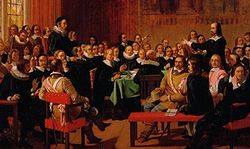 During the English Civil War
(1642–1649), the English Parliament
raised armies in an alliance with the Covenanter
s who by then were the de facto
government of Scotland
, against the forces of the king, Charles I of England
and Ireland, King of Scots. The purpose of the Westminster Assembly, in which 121 Puritan clergymen participated, was to provide official documents for the reformation of the Church of England. The Church of Scotland had recently overthrown its bishops and adopted presbyterianism (see Bishops' Wars
). For this reason, as a condition for entering into the alliance with the English Parliament
, the Scottish Parliament
formed the Solemn League and Covenant
with the English Parliament, which meant that the Church of England would abandon episcopalianism
and consistently adhere to Calvinistic
standards of doctrine and worship. The Confession and Catechisms were produced in order to secure the help of the Scots against the king.
The Scottish Commissioners who were present at the Assembly were satisfied with the Confession of Faith, and in 1646, the document was sent to the English parliament to be ratified, and submitted to the General Assembly
of the Scottish Kirk. The Church of Scotland
adopted the document, without amendment, in 1647. In England, the House of Commons
returned the document to the Assembly with the requirement to compile a list of proof texts from Scripture. After vigorous debate, the Confession was then in part adopted as the Articles of Christian Religion in 1648, by act of the English parliament, omitting some sections and chapters. The next year, the Scottish parliament ratified the Confession without amendment.
In 1660, the restoration of the British monarchy and of the Anglican episcopacy resulted in the nullification of these acts of the two parliaments. However, when William of Orange
replaced the Roman Catholic King James VII of ScotlandJames VII of Scotland was James II of England
and Ireland. on the thrones of Scotland, England and Ireland, he gave royal assent to the Scottish parliament's ratification of the Confession, again without change, in 1690.
scholars refer to as "scholastic Calvinism"), influenced by Puritan
and covenant theology
.
It includes doctrines common to most of Christendom
such as the Trinity
and Jesus
' sacrificial death and resurrection
, and it contains doctrines specific to Protestantism
such as sola scriptura
and sola fide
. Its more controversial features include double predestination
(held alongside freedom of choice), the covenant of works with Adam, the Puritan doctrine that assurance of salvation is not a necessary consequence of faith, a minimalist conception of worship
, and a strict sabbatarianism.
Even more controversially, it states that the Pope
is the Antichrist
, that the Roman Catholic mass
is a form of idolatry
, that the civil magistrates have divine authority to punish heresy, and rules out marriage with non-Christians. These formulations were repudiated by the various bodies which adopted the confession (for instance, the Church of Scotland
, though its ministers are still free to adhere to the full confession and some do), but the confession remains part of the official doctrine of some other Presbyterian churches. For example, the Presbyterian Church of Australia
holds to the Westminster Confession of Faith as its standard, subordinate to the Word of God, and read in the light of a declaratory statement
.
new relationship between church and state in America." The revision also removes explicit identification of the Pope as the Antichrist.
) was separated from the southern church (Presbyterian Church in the United States
). In 1903, the PCUSA adopted revisions to the Westminster Confession of Faith that were intended to soften the church's commitment to Calvinism
. These revisions paved the way to the partial re-merger of the Cumberland Presbyterian Church
with the PCUSA - a division which had persisted since 1810.
perspective is necessary and essential, according to the Bible and the Westminster standards. This perspective was articulated in terms of five doctrinal issues:
The Doctrinal Deliverance of 1910 marks the beginning of the Fundamentalist-Modernist Controversy in the PCUSA, which would ultimately result in the exodus of a significant minority of the denomination's conservatives, including J. Gresham Machen, who went on to found the Orthodox Presbyterian Church
.
in 1973. The PCA holds the 1789 American revision of the Westminster Confession as its standard "with two minor exceptions, namely, the deletion of strictures against marrying one's wife's kindred (XXIV,4), and the reference to the Pope as the antichrist (XXV,6)."http://www.pcanet.org/general/cof_preface.htm. In general, the PCA allows greater leeway than the OPC
for elders to take personal exception to some articles in the Confession.
in 1981 in order to provide a conservative alternative to the older denomination, holds to the Westminster Confession of Faith composed of a combination of different editions, but based on the American version of the 1647 text. The EPC holds to the Westminster Confession in light of a brief list of the essentials of the faith as drafted at its first General Assembly at Ward Church
outside of Detroit, Michigan
.
Confession of Faith
A Confession of Faith is a statement of doctrine very similar to a creed, but usually longer and polemical, as well as didactic.Confessions of Faith are in the main, though not exclusively, associated with Protestantism...
, in the Calvinist theological tradition. Although drawn up by the 1646 Westminster Assembly
Westminster Assembly
The Westminster Assembly of Divines was appointed by the Long Parliament to restructure the Church of England. It also included representatives of religious leaders from Scotland...
, largely of the Church of England
Church of England
The Church of England is the officially established Christian church in England and the Mother Church of the worldwide Anglican Communion. The church considers itself within the tradition of Western Christianity and dates its formal establishment principally to the mission to England by St...
, it became and remains the 'subordinate standard' of doctrine in the Church of Scotland
Church of Scotland
The Church of Scotland, known informally by its Scots language name, the Kirk, is a Presbyterian church, decisively shaped by the Scottish Reformation....
, and has been influential within Presbyterian churches worldwide.
In 1643, the English Parliament called upon "learned, godly and judicious Divines", to meet at Westminster Abbey
Westminster Abbey
The Collegiate Church of St Peter at Westminster, popularly known as Westminster Abbey, is a large, mainly Gothic church, in the City of Westminster, London, United Kingdom, located just to the west of the Palace of Westminster. It is the traditional place of coronation and burial site for English,...
in order to provide advice on issues of worship, doctrine, government and discipline of the Church of England. Their meetings, over a period of five years, produced the confession of faith, as well as a Larger Catechism
Westminster Larger Catechism
The Westminster Larger Catechism, along with the Westminster Shorter Catechism, is a central catechism of Calvinists in the English tradition throughout the world.- History :...
and a Shorter Catechism
Westminster Shorter Catechism
The Westminster Shorter Catechism was written in the 1640s by English and Scottish divines. The assembly also produced the Westminster Confession of Faith and the Westminster Larger Catechism...
. For more than three centuries, various churches around the world have adopted the confession and the catechisms as their standards of doctrine, subordinate to the Bible
Bible
The Bible refers to any one of the collections of the primary religious texts of Judaism and Christianity. There is no common version of the Bible, as the individual books , their contents and their order vary among denominations...
.
The Westminster Confession of Faith was modified and adopted by Congregationalists in England in the form of the Savoy Declaration
Savoy Declaration
The Savoy Declaration is a modification of the Westminster Confession of Faith . Its full title is A Declaration of the Faith and Order owned and practiced in the Congregational Churches in England. It was drawn up in October 1658 by English Independents meeting at the Savoy Palace, London.-The...
(1658). Likewise, the Baptists of England modified the Savoy Declaration to produce the Second London Baptist Confession
1689 Baptist Confession of Faith
The 1689 Baptist Confession of Faith was written by Particular Baptists, who held to a Calvinistic Soteriology in England to give a formal expression of their Christian faith from a Baptist perspective...
(1689). English Presbyterians, Congregationalists, and Baptists would together (with others) come to be known as Nonconformists
Nonconformism
Nonconformity is the refusal to "conform" to, or follow, the governance and usages of the Church of England by the Protestant Christians of England and Wales.- Origins and use:...
, because they did not conform to the Act of Uniformity
Act of Uniformity 1662
The Act of Uniformity was an Act of the Parliament of England, 13&14 Ch.2 c. 4 ,The '16 Charles II c. 2' nomenclature is reference to the statute book of the numbered year of the reign of the named King in the stated chapter...
(1662) establishing the Church of England as the only legally approved church, though they were in many ways united by their common confessions, built on the Westminster Confession.
Historical situation
English Civil War
The English Civil War was a series of armed conflicts and political machinations between Parliamentarians and Royalists...
(1642–1649), the English Parliament
Roundhead
"Roundhead" was the nickname given to the supporters of the Parliament during the English Civil War. Also known as Parliamentarians, they fought against King Charles I and his supporters, the Cavaliers , who claimed absolute power and the divine right of kings...
raised armies in an alliance with the Covenanter
Covenanter
The Covenanters were a Scottish Presbyterian movement that played an important part in the history of Scotland, and to a lesser extent in that of England and Ireland, during the 17th century...
s who by then were the de facto
De facto
De facto is a Latin expression that means "concerning fact." In law, it often means "in practice but not necessarily ordained by law" or "in practice or actuality, but not officially established." It is commonly used in contrast to de jure when referring to matters of law, governance, or...
government of Scotland
Scotland
Scotland is a country that is part of the United Kingdom. Occupying the northern third of the island of Great Britain, it shares a border with England to the south and is bounded by the North Sea to the east, the Atlantic Ocean to the north and west, and the North Channel and Irish Sea to the...
, against the forces of the king, Charles I of England
Charles I of England
Charles I was King of England, King of Scotland, and King of Ireland from 27 March 1625 until his execution in 1649. Charles engaged in a struggle for power with the Parliament of England, attempting to obtain royal revenue whilst Parliament sought to curb his Royal prerogative which Charles...
and Ireland, King of Scots. The purpose of the Westminster Assembly, in which 121 Puritan clergymen participated, was to provide official documents for the reformation of the Church of England. The Church of Scotland had recently overthrown its bishops and adopted presbyterianism (see Bishops' Wars
Bishops' Wars
The Bishops' Wars , were conflicts, both political and military, which occurred in 1639 and 1640 centred around the nature of the governance of the Church of Scotland, and the rights and powers of the Crown...
). For this reason, as a condition for entering into the alliance with the English Parliament
Roundhead
"Roundhead" was the nickname given to the supporters of the Parliament during the English Civil War. Also known as Parliamentarians, they fought against King Charles I and his supporters, the Cavaliers , who claimed absolute power and the divine right of kings...
, the Scottish Parliament
Scottish Parliament
The Scottish Parliament is the devolved national, unicameral legislature of Scotland, located in the Holyrood area of the capital, Edinburgh. The Parliament, informally referred to as "Holyrood", is a democratically elected body comprising 129 members known as Members of the Scottish Parliament...
formed the Solemn League and Covenant
Solemn League and Covenant
The Solemn League and Covenant was an agreement between the Scottish Covenanters and the leaders of the English Parliamentarians. It was agreed to in 1643, during the First English Civil War....
with the English Parliament, which meant that the Church of England would abandon episcopalianism
Anglicanism
Anglicanism is a tradition within Christianity comprising churches with historical connections to the Church of England or similar beliefs, worship and church structures. The word Anglican originates in ecclesia anglicana, a medieval Latin phrase dating to at least 1246 that means the English...
and consistently adhere to Calvinistic
Calvinism
Calvinism is a Protestant theological system and an approach to the Christian life...
standards of doctrine and worship. The Confession and Catechisms were produced in order to secure the help of the Scots against the king.
The Scottish Commissioners who were present at the Assembly were satisfied with the Confession of Faith, and in 1646, the document was sent to the English parliament to be ratified, and submitted to the General Assembly
General Assembly of the Church of Scotland
The General Assembly of the Church of Scotland is the sovereign and highest court of the Church of Scotland, and is thus the Church's governing body[1] An Introduction to Practice and Procedure in the Church of Scotland, A Gordon McGillivray, 2nd Edition .-Church courts:As a Presbyterian church,...
of the Scottish Kirk. The Church of Scotland
Church of Scotland
The Church of Scotland, known informally by its Scots language name, the Kirk, is a Presbyterian church, decisively shaped by the Scottish Reformation....
adopted the document, without amendment, in 1647. In England, the House of Commons
British House of Commons
The House of Commons is the lower house of the Parliament of the United Kingdom, which also comprises the Sovereign and the House of Lords . Both Commons and Lords meet in the Palace of Westminster. The Commons is a democratically elected body, consisting of 650 members , who are known as Members...
returned the document to the Assembly with the requirement to compile a list of proof texts from Scripture. After vigorous debate, the Confession was then in part adopted as the Articles of Christian Religion in 1648, by act of the English parliament, omitting some sections and chapters. The next year, the Scottish parliament ratified the Confession without amendment.
In 1660, the restoration of the British monarchy and of the Anglican episcopacy resulted in the nullification of these acts of the two parliaments. However, when William of Orange
William III of England
William III & II was a sovereign Prince of Orange of the House of Orange-Nassau by birth. From 1672 he governed as Stadtholder William III of Orange over Holland, Zeeland, Utrecht, Guelders, and Overijssel of the Dutch Republic. From 1689 he reigned as William III over England and Ireland...
replaced the Roman Catholic King James VII of ScotlandJames VII of Scotland was James II of England
James II of England
James II & VII was King of England and King of Ireland as James II and King of Scotland as James VII, from 6 February 1685. He was the last Catholic monarch to reign over the Kingdoms of England, Scotland, and Ireland...
and Ireland. on the thrones of Scotland, England and Ireland, he gave royal assent to the Scottish parliament's ratification of the Confession, again without change, in 1690.
Contents
The confession is a systematic exposition of Calvinist orthodoxy (which neo-orthodoxNeo-orthodoxy
Neo-orthodoxy, in Europe also known as theology of crisis and dialectical theology,is an approach to theology in Protestantism that was developed in the aftermath of the First World War...
scholars refer to as "scholastic Calvinism"), influenced by Puritan
Puritan
The Puritans were a significant grouping of English Protestants in the 16th and 17th centuries. Puritanism in this sense was founded by some Marian exiles from the clergy shortly after the accession of Elizabeth I of England in 1558, as an activist movement within the Church of England...
and covenant theology
Covenant Theology
Covenant theology is a conceptual overview and interpretive framework for understanding the overall flow of the Bible...
.
It includes doctrines common to most of Christendom
Christendom
Christendom, or the Christian world, has several meanings. In a cultural sense it refers to the worldwide community of Christians, adherents of Christianity...
such as the Trinity
Trinity
The Christian doctrine of the Trinity defines God as three divine persons : the Father, the Son , and the Holy Spirit. The three persons are distinct yet coexist in unity, and are co-equal, co-eternal and consubstantial . Put another way, the three persons of the Trinity are of one being...
and Jesus
Jesus
Jesus of Nazareth , commonly referred to as Jesus Christ or simply as Jesus or Christ, is the central figure of Christianity...
' sacrificial death and resurrection
Resurrection
Resurrection refers to the literal coming back to life of the biologically dead. It is used both with respect to particular individuals or the belief in a General Resurrection of the dead at the end of the world. The General Resurrection is featured prominently in Jewish, Christian, and Muslim...
, and it contains doctrines specific to Protestantism
Protestantism
Protestantism is one of the three major groupings within Christianity. It is a movement that began in Germany in the early 16th century as a reaction against medieval Roman Catholic doctrines and practices, especially in regards to salvation, justification, and ecclesiology.The doctrines of the...
such as sola scriptura
Sola scriptura
Sola scriptura is the doctrine that the Bible contains all knowledge necessary for salvation and holiness. Consequently, sola scriptura demands that only those doctrines are to be admitted or confessed that are found directly within or indirectly by using valid logical deduction or valid...
and sola fide
Sola fide
Sola fide , also historically known as the doctrine of justification by faith alone, is a Christian theological doctrine that distinguishes most Protestant denominations from Catholicism, Eastern Christianity, and some in the Restoration Movement.The doctrine of sola fide or "by faith alone"...
. Its more controversial features include double predestination
Predestination
Predestination, in theology is the doctrine that all events have been willed by God. John Calvin interpreted biblical predestination to mean that God willed eternal damnation for some people and salvation for others...
(held alongside freedom of choice), the covenant of works with Adam, the Puritan doctrine that assurance of salvation is not a necessary consequence of faith, a minimalist conception of worship
Regulative principle of worship
The regulative principle of worship is a teaching shared by some Calvinists and Anabaptists on how the Bible orders public worship. The substance of the doctrine regarding worship is that God institutes in the Scriptures everything he requires for worship in the Church and that everything else is...
, and a strict sabbatarianism.
Even more controversially, it states that the Pope
Pope
The Pope is the Bishop of Rome, a position that makes him the leader of the worldwide Catholic Church . In the Catholic Church, the Pope is regarded as the successor of Saint Peter, the Apostle...
is the Antichrist
Antichrist
The term or title antichrist, in Christian theology, refers to a leader who fulfills Biblical prophecies concerning an adversary of Christ, while resembling him in a deceptive manner...
, that the Roman Catholic mass
Mass (liturgy)
"Mass" is one of the names by which the sacrament of the Eucharist is called in the Roman Catholic Church: others are "Eucharist", the "Lord's Supper", the "Breaking of Bread", the "Eucharistic assembly ", the "memorial of the Lord's Passion and Resurrection", the "Holy Sacrifice", the "Holy and...
is a form of idolatry
Idolatry
Idolatry is a pejorative term for the worship of an idol, a physical object such as a cult image, as a god, or practices believed to verge on worship, such as giving undue honour and regard to created forms other than God. In all the Abrahamic religions idolatry is strongly forbidden, although...
, that the civil magistrates have divine authority to punish heresy, and rules out marriage with non-Christians. These formulations were repudiated by the various bodies which adopted the confession (for instance, the Church of Scotland
Church of Scotland
The Church of Scotland, known informally by its Scots language name, the Kirk, is a Presbyterian church, decisively shaped by the Scottish Reformation....
, though its ministers are still free to adhere to the full confession and some do), but the confession remains part of the official doctrine of some other Presbyterian churches. For example, the Presbyterian Church of Australia
Presbyterian Church of Australia
The Presbyterian Church of Australia is the largest Presbyterian denomination in Australia. .-Beginnings:...
holds to the Westminster Confession of Faith as its standard, subordinate to the Word of God, and read in the light of a declaratory statement
Basis of Union (Presbyterian Church of Australia)
The Basis of Union of the Presbyterian Church of Australia is the document under which the constituent state churches agreed to unite at its first General Assembly on 24 July 1901, and is still a foundational text for the Uniting Church....
.
American Presbyterian adoption and revisions
The first American Presbyterian ministers were New England Congregationalists, whose congregations originated with the migration from England to the Dutch colony in America as early as the 1640s, and Presbyterian immigrants from Scotland, Ireland and Wales. The first American presbytery, uniting some of these independent congregations and those of the British immigrants, was formed in 1706. This body grew large enough to form the first synod in Philadelphia in 1716. Prior to 1729, some presbyteries required candidates for the ministry to profess adherence to the Westminster Confession. When the Synod of Philadelphia met in 1729 to adopt the Westminster Confession as the doctrinal standard, it required all ministers to declare their approval of the Westminster Confession of Faith and catechisms. At the same time, the Adopting Act allowed candidates and ministers to scruple articles within the Confession. Whether or not the article scrupled was essential or nonessential was judged by the presbytery with jurisdiction over the candidate's examination. This allowance implied a difference, within the standards themselves, between things that are essential and necessary to the Christian faith, and things that are not. This compromise left a permanent legacy to following generations of Presbyterians in America, to decide what is meant by "essential and necessary", resulting in permanent controversies over the manner in which a minister is bound to accept the document; and it has left the American versions of the Westminster Confession more amenable to the will of the church to amend it.The 1789 American Revision
The American revision of 1787–1789 removes from the Confession and the Catechisms mention of certain duties of the civil government in relationship to the church. Lee Irons suggests this was done "in light of thenew relationship between church and state in America." The revision also removes explicit identification of the Pope as the Antichrist.
1903 PCUSA Revision
Between 1861 and 1893, the northern Presbyterian church (Presbyterian Church in the United States of AmericaPresbyterian Church in the United States of America
The Presbyterian Church in the United States of America was a Presbyterian denomination in the United States. It was organized in 1789 under the leadership of John Witherspoon in the wake of the American Revolution and existed until 1958 when it merged with the United Presbyterian Church of North...
) was separated from the southern church (Presbyterian Church in the United States
Presbyterian Church in the United States
The Presbyterian Church in the United States was a Protestant Christian denomination in the Southern and border states of the United States that existed from 1861 to 1983...
). In 1903, the PCUSA adopted revisions to the Westminster Confession of Faith that were intended to soften the church's commitment to Calvinism
Calvinism
Calvinism is a Protestant theological system and an approach to the Christian life...
. These revisions paved the way to the partial re-merger of the Cumberland Presbyterian Church
Cumberland Presbyterian Church
The Cumberland Presbyterian Church is a Presbyterian Christian denomination spawned by the Second Great Awakening. In 2007, it had an active membership of less than 50,000 and about 800 congregations, the majority of which are concentrated in the United States...
with the PCUSA - a division which had persisted since 1810.
The Doctrinal Deliverance of 1910
In 1910, the PCUSA attempted to specify that a supernaturalSupernatural
The supernatural or is that which is not subject to the laws of nature, or more figuratively, that which is said to exist above and beyond nature...
perspective is necessary and essential, according to the Bible and the Westminster standards. This perspective was articulated in terms of five doctrinal issues:
- The divine inspirationBiblical inspirationBiblical inspiration is the doctrine in Christian theology that the authors and editors of the Bible were led or influenced by God with the result that their writings many be designated in some sense the word of God.- Etymology :...
and inerrancyBiblical inerrancyBiblical inerrancy is the doctrinal position that the Bible is accurate and totally free of error, that "Scripture in the original manuscripts does not affirm anything that is contrary to fact." Some equate inerrancy with infallibility; others do not.Conservative Christians generally believe that...
of the Bible. - The pre-existencePre-existence of ChristThe pre-existence of Christ refers to the doctrine of the ontological or personal existence of Christ before his conception. One of the relevant Bible passages is where, in the Trinitarian view, Christ is identified with a pre-existent divine hypostasis called the Logos or Word...
, deity, and virgin birth of JesusJesusJesus of Nazareth , commonly referred to as Jesus Christ or simply as Jesus or Christ, is the central figure of Christianity...
. - The satisfaction of God's justice by the crucifixion of Christ (substitutionary atonementSubstitutionary atonementTechnically speaking, substitutionary atonement is the name given to a number of Christian models of the atonement that all regard Jesus as dying as a substitute for others, "instead of" them...
). - The resurrectionResurrectionResurrection refers to the literal coming back to life of the biologically dead. It is used both with respect to particular individuals or the belief in a General Resurrection of the dead at the end of the world. The General Resurrection is featured prominently in Jewish, Christian, and Muslim...
, ascension and intercession of Jesus. - The reality of the miracles of Jesus.
The Doctrinal Deliverance of 1910 marks the beginning of the Fundamentalist-Modernist Controversy in the PCUSA, which would ultimately result in the exodus of a significant minority of the denomination's conservatives, including J. Gresham Machen, who went on to found the Orthodox Presbyterian Church
Orthodox Presbyterian Church
The Orthodox Presbyterian Church is a conservative Presbyterian denomination located primarily in the United States. It was founded by conservative members of the Presbyterian Church in the United States of America who strongly objected to the pervasive Modernist theology during the 1930s . Led...
.
Presbyterian Church in America
Similar movements in the southern PCUS away from strict interpretations of the Westminster Confession, culminating in its eventual merger into the PCUSA in 1983, led to the creation of the Presbyterian Church in AmericaPresbyterian Church in America
The Presbyterian Church in America is an evangelical Protestant Christian denomination, the second largest Presbyterian church body in the United States after the Presbyterian Church . The PCA professes a strong commitment to evangelism, missionary work, and Christian education...
in 1973. The PCA holds the 1789 American revision of the Westminster Confession as its standard "with two minor exceptions, namely, the deletion of strictures against marrying one's wife's kindred (XXIV,4), and the reference to the Pope as the antichrist (XXV,6)."http://www.pcanet.org/general/cof_preface.htm. In general, the PCA allows greater leeway than the OPC
Orthodox Presbyterian Church
The Orthodox Presbyterian Church is a conservative Presbyterian denomination located primarily in the United States. It was founded by conservative members of the Presbyterian Church in the United States of America who strongly objected to the pervasive Modernist theology during the 1930s . Led...
for elders to take personal exception to some articles in the Confession.
Evangelical Presbyterian Church
The Evangelical Presbyterian Church, which broke from the United Presbyterian Church in the United States of AmericaUnited Presbyterian Church in the United States of America
The United Presbyterian Church in the United States of America was the largest branch of Presbyterianism in the United States from May 28, 1958 to 1983...
in 1981 in order to provide a conservative alternative to the older denomination, holds to the Westminster Confession of Faith composed of a combination of different editions, but based on the American version of the 1647 text. The EPC holds to the Westminster Confession in light of a brief list of the essentials of the faith as drafted at its first General Assembly at Ward Church
Ward Evangelical Presbyterian Church
Ward Evangelical Presbyterian Church is located in Northville Township, Michigan, outside of Detroit.-History:Ward started on May 1, 1956 in the Lincoln School in Livonia, Michigan. In 1960, Ward relocated to Farmington and 6 Mile roads.As the church was growing, Ward kept expanding...
outside of Detroit, Michigan
Detroit, Michigan
Detroit is the major city among the primary cultural, financial, and transportation centers in the Metro Detroit area, a region of 5.2 million people. As the seat of Wayne County, the city of Detroit is the largest city in the U.S. state of Michigan and serves as a major port on the Detroit River...
.
See also
- Long ParliamentLong ParliamentThe Long Parliament was made on 3 November 1640, following the Bishops' Wars. It received its name from the fact that through an Act of Parliament, it could only be dissolved with the agreement of the members, and those members did not agree to its dissolution until after the English Civil War and...
- Glorious RevolutionGlorious RevolutionThe Glorious Revolution, also called the Revolution of 1688, is the overthrow of King James II of England by a union of English Parliamentarians with the Dutch stadtholder William III of Orange-Nassau...
- Religion in the United KingdomReligion in the United KingdomReligion in the United Kingdom and the states that pre-dated the UK, was dominated by forms of Christianity for over 1,400 years. Although a majority of citizens still identify with Christianity in many surveys, regular church attendance has fallen dramatically since the middle of the 20th century,...
- The Bloudy Tenent of Persecution for Cause of ConscienceThe Bloudy Tenent of Persecution for Cause of ConscienceThe Bloudy Tenent of Persecution, for Cause of Conscience, Discussed in a Conference between Truth and Peace is a 1644 book about government force written by Roger Williams, the founder of the American colony of Rhode Island and the co-founder of the First Baptist Church in America...
, 1644, by Roger WilliamsRoger Williams (theologian)Roger Williams was an English Protestant theologian who was an early proponent of religious freedom and the separation of church and state. In 1636, he began the colony of Providence Plantation, which provided a refuge for religious minorities. Williams started the first Baptist church in America,...
External links
- Westminster Confession of Faith A.D. 1647 (with Scripture proofs) in English with a LatinLatinLatin is an Italic language originally spoken in Latium and Ancient Rome. It, along with most European languages, is a descendant of the ancient Proto-Indo-European language. Although it is considered a dead language, a number of scholars and members of the Christian clergy speak it fluently, and...
translation from 1656—from Philip SchaffPhilip SchaffPhilip Schaff , was a Swiss-born, German-educated Protestant theologian and a historian of the Christian church, who, after his education, lived and taught in the United States.-Biography:...
's The Creeds of Christendom, vol. 3, at the Christian Classics Ethereal LibraryChristian Classics Ethereal LibraryThe Christian Classics Ethereal Library is a digital library that provides free electronic copies of Christian scripture and literature texts....
Further reading
- Presbyterian Church (U.S.A.) Book of Confessions: Study Edition. Louisville, KY.: Geneva Press, c1999. ISBN 0664500129