
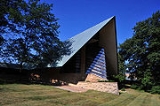
Unitarianism is a
ChristianChristianity is a monotheistic religion based on the life and teachings of Jesus as presented in canonical gospels and other New Testament writings...
theological- Divisions of Christian theology :There are many methods of categorizing different approaches to Christian theology. For a historical analysis, see the main article on the History of Christian theology.- Sub-disciplines :...
movementSociologists have proposed various classifications of religious movements. The most widely used classification in the sociology of religion is the church-sect typology. The typology states that churches, ecclesia, denominations and sects form a continuum with decreasing influence on society...
, named for its understanding of
GodIn Christianity, God is the eternal being that created and preserves the universe. God is believed by most Christians to be immanent , while others believe the plan of redemption show he will be immanent later...
as one person, in direct contrast to
TrinitarianismThe Christian doctrine of the Trinity defines God as three divine persons : the Father, the Son , and the Holy Spirit. The three persons are distinct yet coexist in unity, and are co-equal, co-eternal and consubstantial . Put another way, the three persons of the Trinity are of one being...
which defines God as three persons coexisting
consubstantiallyConsubstantial is an adjective used in Latin Christian christology, coined by Tertullian in Against Hermogenes 44, used to translate the Greek term homoousios...
as
one in beingHomoousian is a technical theological term used in discussion of the Christian understanding of God as Trinity. The Nicene Creed describes Jesus as being homooúsios with God the Father — that is, they are of the "same substance" and are equally God...
.
For most of its history, Unitarianism has been known for the rejection of several
orthodoxThe word orthodox, from Greek orthos + doxa , is generally used to mean the adherence to accepted norms, more specifically to creeds, especially in religion...
Protestant doctrines besides the Trinity, including the
soteriologicalThe branch of Christian theology that deals with salvation and redemption is called Soteriology. It is derived from the Greek sōtērion + English -logy....
doctrines of
original sinOriginal sin is, according to a Christian theological doctrine, humanity's state of sin resulting from the Fall of Man. This condition has been characterized in many ways, ranging from something as insignificant as a slight deficiency, or a tendency toward sin yet without collective guilt, referred...
and predestination, and, in more recent times,
biblical inerrancyBiblical inerrancy is the doctrinal position that the Bible is accurate and totally free of error, that "Scripture in the original manuscripts does not affirm anything that is contrary to fact." Some equate inerrancy with infallibility; others do not.Conservative Christians generally believe that...
. In
J. Gordon MeltonJohn Gordon Melton is an American religious scholar who was the founding director of the Institute for the Study of American Religion and is currently a research specialist in religion and New Religious Movements with the Department of Religious Studies at the University of California, Santa Barbara...
's
Encyclopedia of American Religions it is classified among "the '
liberalLiberal Christianity, sometimes called liberal theology, is an umbrella term covering diverse, philosophically and biblically informed religious movements and ideas within Christianity from the late 18th century and onward...
' family of churches".
The first Unitarians, although not called Unitarians initially, were found in Poland and Transylvania from the 1540s onwards, though many of them were Italians. In England the first Unitarian Church was established in 1774 on Essex Street, London, where today's British Unitarian headquarters are still located. The first official acceptance of the Unitarian faith on the part of a congregation in America was by
King's ChapelKing's Chapel is "an independent Christian unitarian congregation affiliated with the Unitarian Universalist Association" that is "unitarian Christian in theology, Anglican in worship, and congregational in governance." It is housed in what was formerly called "Stone Chapel", an 18th century...
in Boston, from where
James FreemanJames Freeman was the minister of King's Chapel in Boston for 43 years and the first preacher in America to call himself a Unitarian...
began teaching Unitarian doctrine in 1784, and was appointed rector and revised the Prayer Book according to Unitarian doctrines in 1786.
Terminology
"Unitarianism" is a
proper nounA proper noun or proper name is a noun representing a unique entity , as distinguished from a common noun, which represents a class of entities —for example, city, planet, person or corporation)...
and follows the same English usage as other theologies that have developed within a religious movement (
CalvinismCalvinism is a Protestant theological system and an approach to the Christian life...
, Anabaptism, Adventism,
WesleyanismWesleyanism or Wesleyan theology refers, respectively, to either the eponymous movement of Protestant Christians who have historically sought to follow the methods or theology of the eighteenth-century evangelical reformers, John Wesley and his brother Charles Wesley, or to the likewise eponymous...
, etc.). The term existed shortly before it became the name of a religious movement, and thus occasionally it is used as a common noun and would describe any
ChristologyChristology is the field of study within Christian theology which is primarily concerned with the nature and person of Jesus Christ as recorded in the Canonical gospels and the letters of the New Testament. Primary considerations include the relationship of Jesus' nature and person with the nature...
(i.e. understanding of Jesus Christ) that denies the Trinity or believes that God is only one person. In that case it would be a monotheistic belief system not necessarily associated with the Unitarian religious movement. For example, the Unitarian movement has never accepted the Godhood of Jesus, and therefore does not include those nontrinitarian belief systems which do — such as
Oneness PentecostalismOneness Pentecostalism refers to a grouping of denominations and believers within Pentecostal Christianity, all of whom subscribe to the nontrinitarian theological doctrine of Oneness...
,
United Pentecostal Church InternationalThe United Pentecostal Church International is a Pentecostal Christian denomination, headquartered in the St. Louis suburb of Hazelwood, Missouri. It is a part of the Oneness or "Apostolic" portion of the Pentecostal Movement, and was formed in 1945 by a merger of the former Pentecostal Church,...
and the
True Jesus ChurchThe True Jesus Church is a non-denominational Christian church that originated in Beijing, China, in 1917. The current elected chairman of the TJC International Assembly is Preacher Yong-Ji Lin. Today, there are approximately 2.5 million members in fifty three countries and six continents...
— that maintain that Jesus is God as a single person. Although these groups are unitarians in the common sense, they are not in the proper sense. To avoid confusion, this article is about Unitarianism as a religious movement (proper noun). For the generic form of unitarianism (the
ChristologyChristology is the field of study within Christian theology which is primarily concerned with the nature and person of Jesus Christ as recorded in the Canonical gospels and the letters of the New Testament. Primary considerations include the relationship of Jesus' nature and person with the nature...
), see
NontrinitarianismNontrinitarianism includes all Christian belief systems that disagree with the doctrine of the Trinity, namely, the teaching that God is three distinct hypostases and yet co-eternal, co-equal, and indivisibly united in one essence or ousia...
.
The term
Unitarian is sometimes applied to those who belong to a Unitarian church but who do not hold a Unitarian theological belief. In the past, the vast majority of members of Unitarian churches were Unitarians also in belief. Over time, however, some Unitarians and Unitarian Universalists moved away from the traditional Christian roots of Unitarianism. For example, in the 1890s the American Unitarian Association began to allow non-Christian and non-theistic churches and individuals to be part of their fellowship. As a result, people who held no Unitarian belief began to be called "Unitarians" because they were members of churches that belonged to the American Unitarian Association. After several decades, the non-theistic members outnumbered the theological Unitarians. A similar, though proportionally much smaller, phenomenon has taken place in the Unitarian churches in the United Kingdom, Canada, and other countries, which remain more theistically based. Unitarian theology, therefore, is distinguishable from the belief system of modern Unitarian and
Unitarian UniversalistUnitarian Universalism is a religion characterized by support for a "free and responsible search for truth and meaning". Unitarian Universalists do not share a creed; rather, they are unified by their shared search for spiritual growth and by the understanding that an individual's theology is a...
churches and fellowships. This article includes information about Unitarianism as a theology and about the development of theologically Unitarian churches. For a more specific discussion of Unitarianism as it evolved into a pluralistic
liberal religiousLiberal religion is a religious tradition which embraces the theological diversity of a congregation rather than a single creed, authority, or writing...
movement, see
Unitarian UniversalismUnitarian Universalism is a religion characterized by support for a "free and responsible search for truth and meaning". Unitarian Universalists do not share a creed; rather, they are unified by their shared search for spiritual growth and by the understanding that an individual's theology is a...
(and its national groups the
Unitarian Universalist AssociationUnitarian Universalist Association , in full the Unitarian Universalist Association of Congregations in North America, is a liberal religious association of Unitarian Universalist congregations formed by the consolidation in 1961 of the American Unitarian Association and the Universalist Church of...
in the United States, the
Canadian Unitarian CouncilThe Canadian Unitarian Council is the national body for Unitarian Universalists in Canada.The CUC is a member of the International Council of Unitarians and Universalists.- Principles and sources :...
in Canada, the
General Assembly of Unitarian and Free Christian ChurchesThe General Assembly of Unitarian and Free Christian Churches is the umbrella organisation for Unitarian, Free Christian and other liberal religious congregations in the United Kingdom. It was formed in 1928, with denominational roots going back to the Great Ejection of 1662...
in the United Kingdom, and the
International Council of Unitarians and UniversalistsThe International Council of Unitarians and Universalists is an umbrella organization founded in 1995 bringing together many Unitarians, Universalists and Unitarian Universalists.The size of the member organizations varies widely...
).
Recently some religious groups have adopted the 19th Century term "
biblical unitarianismToday, biblical Unitarianism identifies the Christian belief that the Bible teaches God is a singular person—the Father—and that Jesus his son is a distinct being...
" to distinguish their theology from Unitarianism. Since it has no direct relation to the Unitarian movement, it is not discussed here.
History
Unitarianism, both as a theology and as a
denominationA Christian denomination is an identifiable religious body under a common name, structure, and doctrine within Christianity. In the Orthodox tradition, Churches are divided often along ethnic and linguistic lines, into separate churches and traditions. Technically, divisions between one group and...
al family of churches, was defined and developed in four countries: Poland, Transylvania, England and America. Although there were common beliefs among Unitarians in each of these regions, they initially grew independently from each other. Only later did they influence one another and accumulate more similarities.
The
Ecclesia minor or
Minor Reformed Church of Poland, better known today as the
Polish BrethrenThe Polish Brethren were members of the Minor Reformed Church of Poland, a Nontrinitarian Protestant church that existed in Poland from 1565 to 1658...
, was born as the result of a controversy that started on January 22, 1556, when Piotr of Goniądz (Peter Gonesius), a Polish student spoke out against the doctrine of the Trinity during the general synod of the Reformed (Calvinist) churches of Poland held in the village of
SeceminSecemin is a village in Włoszczowa County, Świętokrzyskie Voivodeship, in south-central Poland. It is the seat of the gmina called Gmina Secemin. It lies approximately south-west of Włoszczowa and west of the regional capital Kielce.The village has a population of 1,600.-References:...
. After nine years of debate, in 1565, the anti-Trinitarians were excluded from the existing synod of the
Polish Reformed ChurchThe Polish Reformed Church, officially called the Evangelical Reformed Church in the republic of Poland is a historic Protestant church in Poland established in the 16th century, still in existence today.-Structure and organisation:An internal census showed that in 2004 the Polish Reformed Church...
(henceforth the
Ecclesia maior) and they began to hold their own synods as the
Ecclesia minor. Though frequently called "Arians" by those on the outside, the views of Fausto Sozzini became the standard in the church, and these doctrines were quite removed from
ArianismArianism is the theological teaching attributed to Arius , a Christian presbyter from Alexandria, Egypt, concerning the relationship of the entities of the Trinity and the precise nature of the Son of God as being a subordinate entity to God the Father...
. So important was Sozzini to the formulation of their beliefs that those outside Poland usually referred to them as
SociniansSocinianism is a system of Christian doctrine named for Fausto Sozzini , which was developed among the Polish Brethren in the Minor Reformed Church of Poland during the 15th and 16th centuries and embraced also by the Unitarian Church of Transylvania during the same period...
. The Polish Brethren were disbanded in 1658 by the Sejm (Polish Parliament). They were ordered to convert to Roman Catholicism or leave Poland. Most of them went to Transylvania or Holland, where they embraced the name "Unitarian." Sozzini's grandson Andrzej Wiszowaty Sr. in 1665-1668 published
Bibliotheca Fratrum Polonorum quos Unitarios vocant (
Library of the Polish Brethren who are called Unitarians 4 vols. 1665–69).
The Unitarian Church in Transylvania was first recognized by the Edict of Torda, issued by the
Transylvanian DietThe Transylvanian Diet was the constitutional and political body of Principality of Transylvania, and later of the Grand Principality of Transylvania...
under Prince
John II Sigismund ZápolyaJohn II Sigismund Zápolya was King of Hungary from 1540 to 1570 and Prince of Transylvania from 1570–1571.-Family:The son of King John I and Isabella Jagiełło, he succeeded his father as an infant...
(January 1568), and was first led by
Ferenc DávidFerenc Dávid was a Transylvanian Nontrinitarian and Unitarian preacher, the founder of the Unitarian Church of Transylvania.-Life:Born in Kolozsvár to a Hungarian family, he studied in Wittenberg and Frankfurt...
(a former
CalvinistCalvinism is a Protestant theological system and an approach to the Christian life...
bishop, who had begun preaching the new doctrine in 1566). The term "Unitarian" first appeared as
unitaria religio in a document of the Diet of
LécfalvaLet or LET may refer to:* -let, an English diminutive suffix* Let, a shot or point that must be replayed in certain racquet sports* Let, a name binding construct in computer programming languages...
,
TransylvaniaTransylvania is a historical region in the central part of Romania. Bounded on the east and south by the Carpathian mountain range, historical Transylvania extended in the west to the Apuseni Mountains; however, the term sometimes encompasses not only Transylvania proper, but also the historical...
on 25 October 1600, though it was not widely used in Transylvania until 1638, when the formal
recepta Unitaria Religio was published.
The word
Unitarian had been circulating in private letters in England, in reference to imported copies of such publications as the
Library of the Polish Brethren who are called Unitarians (1665),
Henry HedworthHenry Hedworth of Huntingdon was a Unitarian writer.Henry Hedworth is chiefly notable for being the first person in the English language to introduce Latin term Unitarian into print in England 1673, fourteen years before Stephen Nye of Hertfordshire became the first to use the word on a title...
was the first to use the word "Unitarian" in print in English (1673), and the word first appears in a title in
Stephen NyeStephen Nye was an English clergyman, known as a theological writer and for his Unitarian views.-Life:Son of John Nye, he graduated B.A. at Magdalene College, Cambridge in 1665. He became rector of Little Hormead, Hertfordshire in 1679...
's
A brief history of the Unitarians, called also Socinians (1687). The movement gained popularity in England in the wake of the
EnlightenmentThe Age of Enlightenment was an elite cultural movement of intellectuals in 18th century Europe that sought to mobilize the power of reason in order to reform society and advance knowledge. It promoted intellectual interchange and opposed intolerance and abuses in church and state...
and began to become a formal denomination in 1774 when
Theophilus LindseyTheophilus Lindsey was an English theologian and clergyman who founded the first avowedly Unitarian congregation in the country, at Essex Street Chapel.-Life:...
organised meetings with
Joseph PriestleyJoseph Priestley, FRS was an 18th-century English theologian, Dissenting clergyman, natural philosopher, chemist, educator, and political theorist who published over 150 works...
, founding the first avowedly Unitarian congregation in the country, at Essex Street Church in London.
The first official acceptance of the Unitarian faith on the part of a congregation in America was by
King's ChapelKing's Chapel is "an independent Christian unitarian congregation affiliated with the Unitarian Universalist Association" that is "unitarian Christian in theology, Anglican in worship, and congregational in governance." It is housed in what was formerly called "Stone Chapel", an 18th century...
in Boston, which settled
James FreemanJames Freeman and Jim Freeman may refer to:*James Freeman , American Unitarian clergyman*James C. Freeman , United States Congressman*James Darcy Freeman , Catholic cardinal who was archbishop of Sydney...
(1759–1853) in 1782, and revised the Prayer Book into a mild Unitarian liturgy in 1785. In 1800,
Joseph Stevens BuckminsterJoseph Stevens Buckminster was an influential Unitarian preacher in Boston, Massachusetts and a leader in bringing the German higher criticism of the Bible to America....
became minister of the
Brattle Street ChurchThe Brattle Street Church was a Congregational and Unitarian church on Brattle Street in Boston, Massachusetts.- Brief history :...
in Boston, where his brilliant sermons, literary activities, and academic attention to the German "New Criticism" helped shape the subsequent growth of Unitarianism in New England. Unitarian
Henry WareHenry Ware may refer to:*Henry Ware , U.S. preacher and theologian*Henry Ware, Jr. , Unitarian theologian, son of the above*Henry Ware , Bishop of Chichester...
(1764–1845) was appointed as the Hollis professor of divinity at Harvard College, in 1805. Harvard Divinity school then shifted from its conservative roots to teach Unitarian theology. See: Harvard & Unitarianism. Buckminster's close associate
William Ellery ChanningDr. William Ellery Channing was the foremost Unitarian preacher in the United States in the early nineteenth century and, along with Andrews Norton, one of Unitarianism's leading theologians. He was known for his articulate and impassioned sermons and public speeches, and as a prominent thinker...
(1780–1842) was settled over the
Federal Street ChurchThe Federal Street Church was a congregational unitarian church in Boston, Massachusetts. Organized in 1727, the presbyterian congregation changed in 1786 to Congregationalism, then adopted the liberal theology of its fifth Senior Minister, William Ellery Channing. For most of the 18th-century the...
in Boston, 1803; and in a few years he became the leader of the Unitarian movement. A theological battle with the Congregational Churches resulted in the formation of the
American Unitarian AssociationThe American Unitarian Association was a religious denomination in the United States and Canada, formed by associated Unitarian congregations in 1825. In 1961, it merged with the Universalist Church of America to form the Unitarian Universalist Association.According to Mortimer Rowe, the Secretary...
at Boston in 1825.
Beliefs
Christology
Unitarians adhere to strict
monotheismMonotheism is the belief in the existence of one and only one god. Monotheism is characteristic of the Baha'i Faith, Christianity, Druzism, Hinduism, Islam, Judaism, Samaritanism, Sikhism and Zoroastrianism.While they profess the existence of only one deity, monotheistic religions may still...
, and maintain that Jesus was a great man and a
prophetIn religion, a prophet, from the Greek word προφήτης profitis meaning "foreteller", is an individual who is claimed to have been contacted by the supernatural or the divine, and serves as an intermediary with humanity, delivering this newfound knowledge from the supernatural entity to other people...
of God, perhaps even a
supernaturalThe supernatural or is that which is not subject to the laws of nature, or more figuratively, that which is said to exist above and beyond nature...
being, but not God himself. They believe Jesus did not claim to be God, and that his teachings did not suggest the existence of a triune God. Unitarians believe in the moral authority, but not necessarily the
divinityDivinity and divine are broadly applied but loosely defined terms, used variously within different faiths and belief systems — and even by different individuals within a given faith — to refer to some transcendent or transcendental power or deity, or its attributes or manifestations in...
of Jesus. Their theology is thus opposed to the trinitarian theology of other
Christian denominationA Christian denomination is an identifiable religious body under a common name, structure, and doctrine within Christianity. In the Orthodox tradition, Churches are divided often along ethnic and linguistic lines, into separate churches and traditions. Technically, divisions between one group and...
s.
Unitarian Christology can be divided according to whether Jesus is believed to have had a pre-human existence. Both forms maintain that
GodGod is the English name given to a singular being in theistic and deistic religions who is either the sole deity in monotheism, or a single deity in polytheism....
is one being and one "person"—the one Jesus called "Father"—and that Jesus is the (or a)
Son of God"Son of God" is a phrase which according to most Christian denominations, Trinitarian in belief, refers to the relationship between Jesus and God, specifically as "God the Son"...
, but generally not God himself.
"Socinian" Christology
The Christology commonly called "
SocinianSocinianism is a system of Christian doctrine named for Fausto Sozzini , which was developed among the Polish Brethren in the Minor Reformed Church of Poland during the 15th and 16th centuries and embraced also by the Unitarian Church of Transylvania during the same period...
" (after Fausto Sozzini, one of the founders of Unitarian theology), refers to the belief that Jesus Christ began his life when he was born as a human. In other words, the teaching that Jesus
pre-existedThe pre-existence of Christ refers to the doctrine of the ontological or personal existence of Christ before his conception. One of the relevant Bible passages is where, in the Trinitarian view, Christ is identified with a pre-existent divine hypostasis called the Logos or Word...
his human body is rejected. There are various views ranging from the belief that Jesus was simply a human (
psilanthropismPsilanthropism is an approach to Christology which understands Jesus to be a "mere human", and the literal son of human parents. The term derives from the combination of the Greek ψίλος , "plain," "mere" or "bare," and ἄνθρωπος "human." Psilanthropists generally deny both the virgin birth of...
) who, because of his greatness, was adopted by God as his Son (
adoptionismAdoptionism, sometimes called dynamic monarchianism, is a minority Christian belief that Jesus was adopted as God's son at his baptism...
) to the belief that Jesus literally became the
Son of God"Son of God" is a phrase which according to most Christian denominations, Trinitarian in belief, refers to the relationship between Jesus and God, specifically as "God the Son"...
when he was conceived by the
Holy SpiritHoly Spirit is a term introduced in English translations of the Hebrew Bible, but understood differently in the main Abrahamic religions.While the general concept of a "Spirit" that permeates the cosmos has been used in various religions Holy Spirit is a term introduced in English translations of...
(see Virgin birth of Jesus).
This Christology existed in some form or another prior to Sozzini.
Theodotus of ByzantiumTheodotus of Byzantium was an early Christian writer from Byzantium, one of several named Theodotus whose writings were condemned as heresy in the early church.Theodotus claimed that Jesus was born of the Virgin Mary and the Holy Spirit as a mortal man, and though later "adopted" by...
,
ArtemonArtemon , a prominent Christian teacher in Rome, who held Adoptionist, or Nontrinitarian views. We know little about his life for certain.He is mentioned as the leader of a nontrinitarian sect at Rome in the third century...
and
Paul of SamosataPaul of Samosata was Bishop of Antioch from 260 to 268. He was a believer in monarchianism, and his teachings anticipate adoptionism.-Life:...
denied the pre-existence of Christ but accepted the virgin birth. This was continued by
Marcellus of AncyraMarcellus of Ancyra was one of the bishops present at the Councils of Ancyra and of Nicaea. He was a strong opponent of Arianism, but was accused of adopting the opposite extreme of modified Sabellianism...
and his pupil
PhotinusPhotinus was a Christian heresiarch and bishop of Sirmium in Pannonia, best known for denying the incarnation of Christ. His name became synonymous in later literature for someone asserting that Christ was not God.- Life :...
in the 4th century AD. In the
Radical ReformationThe Radical Reformation was a 16th century response to what was believed to be both the corruption in the Roman Catholic Church and the expanding Magisterial Protestant movement led by Martin Luther and many others. Beginning in Germany and Switzerland, the Radical Reformation birthed many radical...
and
AnabaptistAnabaptists are Protestant Christians of the Radical Reformation of 16th-century Europe, and their direct descendants, particularly the Amish, Brethren, Hutterites, and Mennonites....
movements of the 16th century this resurfaced with Sozzini's uncle, Lelio Sozzini. Having influenced the
Polish BrethrenThe Polish Brethren were members of the Minor Reformed Church of Poland, a Nontrinitarian Protestant church that existed in Poland from 1565 to 1658...
to a formal declaration of this belief in the
Racovian CatechismThe Racovian Catechism is a nontrinitarian statement of faith from the 16th century. The title Racovian comes from the publishers, the Polish Brethren, who had founded a sizeable town in Raków, Kielce County, where the Racovian Academy and printing press was founded by Jakub Sienieński in...
, Fausto Sozzini involuntarily ended up giving his name to this Christological position, which continued with English Unitarians such as
John BiddleJohn Biddle or Bidle was an influential English nontrinitarian, and Unitarian. He is often called "the Father of English Unitarianism".- Life :...
's
Twofold Catechism (1654).
In the early days of Unitarianism, the stories of the virgin birth were accepted by most, but there were a number of Unitarians who questioned the historical accuracy of the Bible (such as
Symon BudnySymon Budny was a Belarusian and Polish humanist, educator, hebraist, Bible translator, Church reformator, philosopher, sociologist and historian.-Christology:...
, Jacob Paleologus,
Thomas BelshamThomas Belsham was an English Unitarian minister- Life :Belsham was born in Bedford, England, and was the elder brother of William Belsham, the English political writer and historian. He was educated at the dissenting academy at Daventry, where for seven years he acted as assistant tutor...
, and
Richard WrightRichard Wright was a Unitarian minister, and the itinerant missionary of the Unitarian Fund, a missionary society established in 1806.-Life:...
), and this made them question the virgin birth story. Beginning in England and America in the 1830s, and manifesting itself primarily in
Transcendentalist UnitarianismTranscendentalism is a philosophical movement that developed in the 1830s and 1840s in the New England region of the United States as a protest against the general state of culture and society, and in particular, the state of intellectualism at Harvard University and the doctrine of the Unitarian...
, which emerged from the German liberal theology associated primarily with Friedrich Schleiermacher, the psilanthropist view increased in popularity. Its proponents took an intellectual and humanistic approach to religion. They embraced evolutionary concepts, asserted the "inherent goodness of man", and abandoned the doctrine of biblical infallibility, rejecting most of the miraculous events in the Bible (including the virgin birth). Notable examples are
James MartineauJames Martineau was an English religious philosopher influential in the history of Unitarianism. For 45 years he was Professor of Mental and Moral Philosophy and Political Economy in Manchester New College, the principal training college for British Unitarianism.-Early life:He was born in Norwich,...
,
Theodore ParkerTheodore Parker was an American Transcendentalist and reforming minister of the Unitarian church...
,
Ralph Waldo EmersonRalph Waldo Emerson was an American essayist, lecturer, and poet, who led the Transcendentalist movement of the mid-19th century...
and
Frederick Henry HedgeFrederick Henry Hedge was a New England Unitarian minister and Transcendentalist. He was a founder of the Transcendental Club, originally called Hedge's Club, and active in the development of Transcendentalism.-Biography:...
. Famous American Unitarian
William Ellery ChanningDr. William Ellery Channing was the foremost Unitarian preacher in the United States in the early nineteenth century and, along with Andrews Norton, one of Unitarianism's leading theologians. He was known for his articulate and impassioned sermons and public speeches, and as a prominent thinker...
was a believer in the virgin birth until later in his life, after he had begun his association with the Transcendentalists.
The denial of the virgin birth is also sometimes ascribed to the
EbionitesEbionites, or Ebionaioi, , is a patristic term referring to a Jewish Christian sect or sects that existed during the first centuries of the Christian Era. They regarded Jesus as the Messiah and insisted on the necessity of following Jewish religious law and rites...
; however,
OrigenOrigen , or Origen Adamantius, 184/5–253/4, was an early Christian Alexandrian scholar and theologian, and one of the most distinguished writers of the early Church. As early as the fourth century, his orthodoxy was suspect, in part because he believed in the pre-existence of souls...
(
Contra Celsum v.61) and Eusebius (
HE iii.27) both indicate that some Ebionites did accept the virgin birth. The
Chambers Biographical Dictionary (1897) incorrectly ascribes denial of the virgin birth to
Ferenc DávidFerenc Dávid was a Transylvanian Nontrinitarian and Unitarian preacher, the founder of the Unitarian Church of Transylvania.-Life:Born in Kolozsvár to a Hungarian family, he studied in Wittenberg and Frankfurt...
, leader of the Transylvanian Unitarians.
"Arian" Christology
The Christology commonly called "
ArianArianism is the theological teaching attributed to Arius , a Christian presbyter from Alexandria, Egypt, concerning the relationship of the entities of the Trinity and the precise nature of the Son of God as being a subordinate entity to God the Father...
" holds that Jesus, before his human life, existed as the
Logos' is an important term in philosophy, psychology, rhetoric and religion. Originally a word meaning "a ground", "a plea", "an opinion", "an expectation", "word," "speech," "account," "reason," it became a technical term in philosophy, beginning with Heraclitus ' is an important term in...
, a being created by God, who dwelt with God in heaven. There are many varieties of this form of Unitarianism, ranging from the belief that the Son was a divine spirit of the same nature as God before coming to earth, to the belief that he was an angel or other lesser spirit creature of a wholly different nature from God. Not all of these views necessarily were held by
AriusArius was a Christian presbyter in Alexandria, Egypt of Libyan origins. His teachings about the nature of the Godhead, which emphasized the Father's divinity over the Son , and his opposition to the Athanasian or Trinitarian Christology, made him a controversial figure in the First Council of...
, the namesake of this Christology. It is still Nontrinitarian, because according to this belief system, Jesus has always been beneath God, though higher than humans. Arian Christology was not a majority view among Unitarians in Poland, Transylvania or England. It was only with the advent of American Unitarianism that it gained a foothold in the Unitarian movement.
Proponents attempt to associate this Christology with early church figures such as
Justin MartyrJustin Martyr, also known as just Saint Justin , was an early Christian apologist. Most of his works are lost, but two apologies and a dialogue survive. He is considered a saint by the Roman Catholic Church and the Eastern Orthodox Church....
,
Lucian of AntiochSaint Lucian of Antioch , known as Lucian the Martyr, was a Christian presbyter, theologian and martyr. He was noted for both his scholarship and ascetic piety.-History:...
,
Eusebius of CaesareaEusebius of Caesarea also called Eusebius Pamphili, was a Roman historian, exegete and Christian polemicist. He became the Bishop of Caesarea in Palestine about the year 314. Together with Pamphilus, he was a scholar of the Biblical canon...
, Arius,
Eusebius of NicomediaEusebius of Nicomedia was the man who baptised Constantine. He was a bishop of Berytus in Phoenicia, then of Nicomedia where the imperial court resided in Bithynia, and finally of Constantinople from 338 up to his death....
,
Asterius the SophistAsterius the Sophist was an Arian Christian theologian from Cappadocia. Few of his writings have been recovered in their entirety . He is said to have been a pupil of Lucian of Antioch, but it is unclear to what extent this was the case...
, Eunomius, and
UlfilasUlfilas, or Gothic Wulfila , bishop, missionary, and Bible translator, was a Goth or half-Goth and half-Greek from Cappadocia who had spent time inside the Roman Empire at the peak of the Arian controversy. Ulfilas was ordained a bishop by Eusebius of Nicomedia and returned to his people to work...
, as well as Felix, Bishop of Urgell.
Michael ServetusMichael Servetus was a Spanish theologian, physician, cartographer, and humanist. He was the first European to correctly describe the function of pulmonary circulation...
did not deny the pre-existence of Christ.
Isaac NewtonSir Isaac Newton PRS was an English physicist, mathematician, astronomer, natural philosopher, alchemist, and theologian, who has been "considered by many to be the greatest and most influential scientist who ever lived."...
had Arian beliefs as well. Famous 19th century Arian Unitarians include
Andrews NortonAndrews Norton was an American preacher and theologian. Along with William Ellery Channing, he was the leader of mainstream Unitarianism of the early and middle 19th century....
and Dr.
William Ellery ChanningDr. William Ellery Channing was the foremost Unitarian preacher in the United States in the early nineteenth century and, along with Andrews Norton, one of Unitarianism's leading theologians. He was known for his articulate and impassioned sermons and public speeches, and as a prominent thinker...
(in his earlier years).
Other beliefs
Though there is no specific authority on convictions of Unitarian belief aside from rejection of the Trinity, the following beliefs are generally accepted:
- One God and the oneness or unity of God.
- The life and teachings of Jesus Christ constitute the exemplar model for living one's own life.
- Reason, rational thought, science, and philosophy coexist with faith in God.
- Humans have the ability to exercise free will
"To make my own decisions whether I am successful or not due to uncontrollable forces" -Troy MorrisonA pragmatic definition of free willFree will is the ability of agents to make choices free from certain kinds of constraints. The existence of free will and its exact nature and definition have long...
in a responsible, constructive and ethical manner with the assistance of religion.
- Human nature
Human nature refers to the distinguishing characteristics, including ways of thinking, feeling and acting, that humans tend to have naturally....
in its present condition is neither inherently corrupt nor depraved (see original SinOriginal sin is, according to a Christian theological doctrine, humanity's state of sin resulting from the Fall of Man. This condition has been characterized in many ways, ranging from something as insignificant as a slight deficiency, or a tendency toward sin yet without collective guilt, referred...
), but capable of both good and evil, as God intended.
- No religion can claim an absolute monopoly on the Holy Spirit or theological truth.
- Though the authors of the Bible were inspired by God, they were humans and therefore subject to human error.
- Traditional doctrines that (they believe) malign God's character or veil the true nature and mission of Jesus Christ, such as the doctrines of predestination
Predestination, in theology is the doctrine that all events have been willed by God. John Calvin interpreted biblical predestination to mean that God willed eternal damnation for some people and salvation for others...
, eternal damnationChristian views on Hell vary, but in general traditionally agree that hell is a place or a state in which the souls of the unsaved suffer the consequences of sin....
, and the vicarious sacrifice or satisfaction theory of the Atonement are rejected.
Unitarians have
liberalLiberal religion is a religious tradition which embraces the theological diversity of a congregation rather than a single creed, authority, or writing...
views of GodThe God of monotheism, pantheism or panentheism, or the supreme deity of henotheistic religions, may be conceived of in various degrees of abstraction:...
, Jesus, the
worldWorld is a common name for the whole of human civilization, specifically human experience, history, or the human condition in general, worldwide, i.e. anywhere on Earth....
and
purpose of lifeThe meaning of life constitutes a philosophical question concerning the purpose and significance of life or existence in general. This concept can be expressed through a variety of related questions, such as "Why are we here?", "What is life all about?", and "What is the meaning of it all?" It has...
as revealed through
reasonReason is a term that refers to the capacity human beings have to make sense of things, to establish and verify facts, and to change or justify practices, institutions, and beliefs. It is closely associated with such characteristically human activities as philosophy, science, language, ...
,
scholarshipA scholarship is an award of financial aid for a student to further education. Scholarships are awarded on various criteria usually reflecting the values and purposes of the donor or founder of the award.-Types:...
,
scienceScience is a systematic enterprise that builds and organizes knowledge in the form of testable explanations and predictions about the universe...
,
philosophyPhilosophy is the study of general and fundamental problems, such as those connected with existence, knowledge, values, reason, mind, and language. Philosophy is distinguished from other ways of addressing such problems by its critical, generally systematic approach and its reliance on rational...
,
scriptureReligious texts, also known as scripture, scriptures, holy writ, or holy books, are the texts which various religious traditions consider to be sacred, or of central importance to their religious tradition...
and other prophets and
religionReligion is a collection of cultural systems, belief systems, and worldviews that establishes symbols that relate humanity to spirituality and, sometimes, to moral values. Many religions have narratives, symbols, traditions and sacred histories that are intended to give meaning to life or to...
s. They believe that reason and belief are complementary and that
religion and scienceThe relationship between religion and science has been a focus of the demarcation problem. Somewhat related is the claim that science and religion may pursue knowledge using different methodologies. Whereas the scientific method basically relies on reason and empiricism, religion also seeks to...
can co-exist and guide them in their understanding of
natureNature, in the broadest sense, is equivalent to the natural world, physical world, or material world. "Nature" refers to the phenomena of the physical world, and also to life in general...
and God. They also do not enforce belief in
creedA creed is a statement of belief—usually a statement of faith that describes the beliefs shared by a religious community—and is often recited as part of a religious service. When the statement of faith is longer and polemical, as well as didactic, it is not called a creed but a Confession of faith...
s or
dogmaDogma is the established belief or doctrine held by a religion, or a particular group or organization. It is authoritative and not to be disputed, doubted, or diverged from, by the practitioners or believers...
tic formulas. Although there is flexibility in the nuances of
beliefBelief is the psychological state in which an individual holds a proposition or premise to be true.-Belief, knowledge and epistemology:The terms belief and knowledge are used differently in philosophy....
or basic
truthTruth has a variety of meanings, such as the state of being in accord with fact or reality. It can also mean having fidelity to an original or to a standard or ideal. In a common usage, it also means constancy or sincerity in action or character...
s for the individual Unitarian
ChristianA Christian is a person who adheres to Christianity, an Abrahamic, monotheistic religion based on the life and teachings of Jesus of Nazareth as recorded in the Canonical gospels and the letters of the New Testament...
, general principles of faith have been recognized as a way to bind the group in some commonality. Adherents generally accept
religious pluralismReligious pluralism is a loosely defined expression concerning acceptance of various religions, and is used in a number of related ways:* As the name of the worldview according to which one's religion is not the sole and exclusive source of truth, and thus that at least some truths and true values...
and find value in all teachings, but remain committed to their core belief in
ChristChrist is the English term for the Greek meaning "the anointed one". It is a translation of the Hebrew , usually transliterated into English as Messiah or Mashiach...
's teachings. Unitarians generally value a secular society in which
governmentGovernment refers to the legislators, administrators, and arbitrators in the administrative bureaucracy who control a state at a given time, and to the system of government by which they are organized...
is
kept separate from religious affairsThe concept of the separation of church and state refers to the distance in the relationship between organized religion and the nation state....
. Most contemporary Unitarian Christians believe that one's personal moral convictions guide one's political activities, and that a secular society is the most viable, just and fair.
Unitarian Christians reject the doctrine of some Christian denominations that God chooses to redeem or save only those certain individuals that accept the creeds of, or affiliate with, a specific church or religion, from a common ruin or corruption of the mass of humanity. They believe that righteous acts are necessary for redemption in addition to faith.
In 1938,
The Christian leader attributed "
the religion
of Jesus, not
a religion
about Jesus" to Unitarians, though the phrase was first used by Congregationalist
Rollin Lynde HarttRollin Lynde Hartt was an early 20th century journalist and congregational minister. His reporting and views on the Fundamentalist-Modernist Controversy were known nationally and mentioned in Time Magazine...
in 1924.
Worship
Worship within the Unitarian tradition accommodates a wide range of understandings of
GodGod is the English name given to a singular being in theistic and deistic religions who is either the sole deity in monotheism, or a single deity in polytheism....
, while the focus of the service may be simply the celebration of life itself. Each Unitarian congregation is at liberty to devise its own form of worship, though commonly, Unitarian services lack liturgy and ritual, while containing readings from many sources, which may include sermons, prayers, hymns and songs.
Modern Christian Unitarian organizations
This section relates to Unitarian churches and organizations today which are still specifically Christian within or outside Unitarian-Universalism, which embraces non-Christian religions.
Hungarian and Transylvanian Unitarian Churches
The largest Unitarian denomination worldwide today is also the oldest surviving Unitarian denomination (since 1565, first use of the term "Unitarian" 1600); the
Unitarian Church of TransylvaniaThe Unitarian Church of Transylvania is a church of the Unitarian denomination, based in the city of Cluj in the Principality of Transylvania, present day in Romania...
(in Romania, which is union with the Unitarian Church in Hungary). The church in Romania and Hungary still looks to the statement of faith, the
Summa Universae Theologiae Christianae secundum Unitarios (1787), though today assent to this is not required. The modern Unitarian Church in Hungary (25,000 members) and the Transylvanian Unitarian Church (75,000 members) are affiliated with the ICUU and claim continuity with the historical Unitarian Christian tradition established by
Ferenc DávidFerenc Dávid was a Transylvanian Nontrinitarian and Unitarian preacher, the founder of the Unitarian Church of Transylvania.-Life:Born in Kolozsvár to a Hungarian family, he studied in Wittenberg and Frankfurt...
in 1565 in
TransylvaniaTransylvania is a historical region in the central part of Romania. Bounded on the east and south by the Carpathian mountain range, historical Transylvania extended in the west to the Apuseni Mountains; however, the term sometimes encompasses not only Transylvania proper, but also the historical...
under
John II Sigismund ZápolyaJohn II Sigismund Zápolya was King of Hungary from 1540 to 1570 and Prince of Transylvania from 1570–1571.-Family:The son of King John I and Isabella Jagiełło, he succeeded his father as an infant...
. The Unitarian churches in Hungary and Transylvania are structured and organized along a church hierarchy that includes the election by the synod of a national bishop who serves as superintendent of the Church. Many Hungarian Unitarians embrace the principles of rationalist Unitarianism. Unitarian high schools exist only in Transylvania (Romania), including the
John Sigismund Unitarian AcademyThe John Sigismund Unitarian Academy, located in Kolozsvár , was a theological school founded in 1557 by the Unitarian Diocese of Transylvania.-Foundation:...
in
Cluj-NapocaCluj-Napoca , commonly known as Cluj, is the fourth most populous city in Romania and the seat of Cluj County in the northwestern part of the country. Geographically, it is roughly equidistant from Bucharest , Budapest and Belgrade...
, and the Berde Mózes Unitárius Gimnázium in
Cristuru SecuiescCristuru Secuiesc is a town in Harghita County, Romania. It lies in the Székely Land, an ethno-cultural region in eastern Transylvania.The town administers two villages:*Beteşti / Betfalva, part of Mugeni until 2004*Filiaş / Fiatfalva- History :...
(Székelykeresztúr); both teach Rationalist Unitarianism.
UUCF (USA)
The
Unitarian Universalist Christian FellowshipThe Unitarian Universalist Christian Fellowship is the main group serving Christian Unitarian Universalists within the Unitarian Universalist Association. The UUCF was founded in 1945 and can trace its roots back through the history of North American Universalism and Unitarianism...
(UUCF, founded 1945) predates the consolidation of the American Unitarian Association (AUA) and
Universalist Church of AmericaThe Universalist Church of America was a Christian Universalist religious denomination in the United States . Known from 1866 as the Universalist General Convention, the name was changed to the Universalist Church of America in 1942...
(UCA) into the
Unitarian Universalist AssociationUnitarian Universalist Association , in full the Unitarian Universalist Association of Congregations in North America, is a liberal religious association of Unitarian Universalist congregations formed by the consolidation in 1961 of the American Unitarian Association and the Universalist Church of...
(UUA) in 1961. UUCF continues as a subgroup of UUA serving the Christian members.
ICUU (international)
Other Unitarian Christian groups are affiliated with the
International Council of Unitarians and UniversalistsThe International Council of Unitarians and Universalists is an umbrella organization founded in 1995 bringing together many Unitarians, Universalists and Unitarian Universalists.The size of the member organizations varies widely...
(ICUU), founded in 1995. The ICUU tends to contain a majority membership who express specifically Unitarian Christian beliefs, rather than the religious pluralism of the UUA, but nevertheless remain liberal, open-minded and inclusive communities. The ICUU has "full member" groups in the United States, Australia & New Zealand, United Kingdom, Canada, Brazil, Czech Republic, Finland, Germany, Hungary, Indonesia, India, Nigeria, Pakistan, Philippines, Romania, South Africa, Sri Lanka.
The ICUU includes small "Associate groups", including Congregazione Italiana Cristiano Unitariana,
TurinTurin is a city and major business and cultural centre in northern Italy, capital of the Piedmont region, located mainly on the left bank of the Po River and surrounded by the Alpine arch. The population of the city proper is 909,193 while the population of the urban area is estimated by Eurostat...
(founded in 2004) and the Bét Dávid Unitarian Association,
OsloOslo is a municipality, as well as the capital and most populous city in Norway. As a municipality , it was established on 1 January 1838. Founded around 1048 by King Harald III of Norway, the city was largely destroyed by fire in 1624. The city was moved under the reign of Denmark–Norway's King...
(founded 2005).
AUC (USA)
The
American Unitarian ConferenceThe American Unitarian Conference was founded in 2000 by several Unitarian Universalists who felt that the Unitarian Universalist Association had become too theologically liberal and too political. They decided their mission was to promote "classical" Unitarianism, which they argued as being...
(AUC) was formed in 2000 and stands between UUA and ICUU in attachment to the Christian element of modern Unitarianism. The American Unitarian Conference is open to non-Christian Unitarians—being particularly popular with non-Christian theists and deists. The AUC has four congregations in the United States.
UCA (UK)
The
Unitarian Christian AssociationThe Unitarian Christian Association is a relatively small fellowship of Christians who feel an affinity with traditional Unitarianism and Free Christianity...
(UCA, UK) was founded 1991 by Rev. Lancelot Garrard (1904–93) and others to promote specifically Christian ideas within the
General Assembly of Unitarian and Free Christian ChurchesThe General Assembly of Unitarian and Free Christian Churches is the umbrella organisation for Unitarian, Free Christian and other liberal religious congregations in the United Kingdom. It was formed in 1928, with denominational roots going back to the Great Ejection of 1662...
(GAUFCC). Just as the UUCF and ICUU maintain formal links with UUA in America, so the UCA does with the GAUFCC in the UK.
The majority of Unitarian Christian publications are sponsored by an organization and published specifically for their membership. They generally do not serve as a tool for missionary work or encouraging conversions.
Australia
The Sydney Unitarian Church, was founded 1850, under a Reverend Stanley and was a vigorous denomination during the 19th Century. The modern church has properties in Adelaide, Sydney and Melbourne, and smaller congregations elsewhere.
South Africa
The Unitarian movement in South Africa was founded in 1867 by the Reverend Dawid Faure, member of a well-known Cape family. He encountered advanced liberal religious thought while completing his studies at the University of Leiden in Holland for the ministry of the Dutch Reformed Church in Cape Town. On his return to South Africa he preached a probationary sermon in the Groote Kerk, Cape Town. This led to a public appeal to him to found a community based upon what was called the ‘new theology’. The ‘new theology’ as preached by Dawid Faure was grounded in what he described as “the very essence of religion” – Love of God and love of neighbour.
Responding to popular appeal Dawid Faure gathered a congregation of people who felt the need for a church unfettered by traditional dogmas, open to the advances of modern knowledge and receptive to new spiritual insights. From 1867 to 1890 the fledgling church, known as the Free Protestant Church, rented premises in a commercial building in Cape Town, and in 1890 a warehouse in the city was purchased and converted into the present church.
Rev Faure continued as minister until 1897 when he was succeeded by Rev Ramsden Balmforth, from England. He conducted a thriving ministry to 1937 and brought the Free Protestant Church into the international Unitarian Movement in 1921. Ministers who followed Balmforth were William and Wilma Constable (1937 to 1941), Donald Livingstone (1941 to 1949), Magnus Ratter (1949 to 1960 and 1971 to 1976), Victor Carpenter (1962 to 1967), Eugene Widrick (1968 to 1971), Leon Fay (1977 to 1979), Robert Steyn (1979 to 1997).
The Cape Town church isn't exclusively Christian since formal members and friends in the congregation maintain their own personal beliefs. There is no specific dogma or creed that members must follow. They consider Unitarianism as a way of life with spiritual dimensions. The church is in the central city but has congregations in the suburbs as well. The website for the Unitarian Community of Cape Town is at
http://www.capetownunitarian.org.za . There are also independent fellowships in Durban and Johannesburg. The national website is at
http://www.unitarian.co.za .
Ecclesiology
When Unitarianism developed in the 17th century during the Protestant era of the evolution of Christianity, the strongholds in Transylvania, Poland, and eventually Britain and the northeastern parts of the
United StatesThe United States of America is a federal constitutional republic comprising fifty states and a federal district...
were firmly in the congregational tradition. In the Hungarian-speaking territories it adopted a governance system that combined the Synodal and Episcopal models.
For those churches under the congregational model, each church governed itself independently of a hierarchical authority. These small congregations belonged, however, to more formal associations of churches. The American Unitarian Association, formed in 1825, was one of these. Later, in 1961, the American Unitarian Association and the Universalist Church of America merged to form the Unitarian Universalist Association (UUA), which is the largest organization of Unitarians in the US. The UUA is no longer an explicitly Christian organization and does not focus exclusively on the core teachings of Jesus Christ or Christianity.
Several Unitarian organizations still promote Christianity as their central theme. Among them, Unitarian Ministries International, the Unitarian Universalist Christian Fellowship (UUCF, an affiliate of the UUA), the General Assembly of Unitarian and Free Christian Churches (GAUFCC) of the United Kingdom, and the Unitarian Christian Association (UCA, an affiliate of the GAUFCC).
In the US, the newest organization promoting a return to the theistic roots of Unitarianism is the American Unitarian Conference (AUC), formed in 2000. The AUC's stated goal is to formulate and promote classical Unitarian-based, unifying religious convictions, which balance the needs of members with a practical approach to inclusion and progressive free thought.
Interfaith dialogue and relations
Catholic, Orthodox and Protestant creeds generally insist on Trinitarian belief as an essential aspect of Christianity and basic to a group's continuity of identity with the historical Christian faith. As a result, Unitarians have often been excluded from fellowship with churches that accept the creeds of the Nicene and pre-Chalcedonian churches.
However, occasionally, especially in Protestant history, traditionally Trinitarian groups have accepted Unitarians. Friendliness toward Unitarianism has sometimes gone hand-in-hand with
anti-CatholicismAnti-Catholicism is a generic term for discrimination, hostility or prejudice directed against Catholicism, and especially against the Catholic Church, its clergy or its adherents...
. In some cases non-Trinitarian belief has been adopted by some, and tolerated in Christian churches as a "non-essential." This was the case in the English Presbyterian Church, and in the Congregational Church in New England late in the 18th century. The
Restoration MovementThe Restoration Movement is a Christian movement that began on the American frontier during the Second Great Awakening of the early 19th century...
also attempted to forge a compatible relation between Trinitarians and nontrinitarians, as did the
Seventh Day BaptistSeventh Day Baptists are Christian Baptists who observe Sabbath on the seventh-day of the week in accord with their understanding of the Biblical Sabbath for the Judeo-Christian tradition...
s and various
AdventistAdventism is a Christian movement which began in the 19th century, in the context of the Second Great Awakening revival in the United States. The name refers to belief in the imminent Second Coming of Jesus Christ. It was started by William Miller, whose followers became known as Millerites...
s. The Seventh Day Baptists hold nontrinitarian doctrines in their International Conference but became Trinitarians in the US. The nontrinitarian tendency in these latter groups emerged from their original theology and their rejection of Catholic traditions regarding the Trinity.
In some cases, this openness to Unitarianism within traditionally Trinitarian churches has been inspired by a very broad ecumenical motive. Modern liberal Protestant denominations are often accused by Trinitarians within their ranks, and critics outside, of being indifferent to the doctrine, and therefore self-isolated from their respective Trinitarian pasts and heritage. In some cases, it is charged that these Trinitarian denominations are no longer Christian, because of their toleration of unitarian belief among their teachers, and in their seminaries.
At a local level, many Unitarian Christian groups (or members) have links with congregations affiliated with the United Church of Christ, Disciples of Christ, and
Unity ChurchUnity, known informally as Unity Church, is a religious movement within the wider New Thought movement and is best known to many through its Daily Word devotional publication...
; some argue they feel more at home within these denominations than Unitarian Universalism. A small proportion of Unitarian Christians also have links with
Progressive ChristianityProgressive Christianity is the name given to a movement within contemporary Christianity characterized by willingness to question tradition, acceptance of human diversity with a strong emphasis on social justice or care for the poor and the oppressed and environmental stewardship of the Earth...
.
Despite the close friendship and shared heritage that exists between adherents to Unitarian Universalism and Unitarian Christianity, there is an element within Unitarian Universalism that opposes specifically Unitarian Christian groups, believing them to be exclusive and intolerant of non-Christian thought. Likewise, some Unitarian Christians also believe that Unitarian Universalists are intolerant of Christian thought and tend to marginalize Christians.
Notable Unitarians
Notable Unitarians include
Béla BartókBéla Viktor János Bartók was a Hungarian composer and pianist. He is considered one of the most important composers of the 20th century and is regarded, along with Liszt, as Hungary's greatest composer...
the 20th century composer,
Ralph Waldo EmersonRalph Waldo Emerson was an American essayist, lecturer, and poet, who led the Transcendentalist movement of the mid-19th century...
and
Theodore ParkerTheodore Parker was an American Transcendentalist and reforming minister of the Unitarian church...
in theology and ministry,
Joseph PriestleyJoseph Priestley, FRS was an 18th-century English theologian, Dissenting clergyman, natural philosopher, chemist, educator, and political theorist who published over 150 works...
and
Linus PaulingLinus Carl Pauling was an American chemist, biochemist, peace activist, author, and educator. He was one of the most influential chemists in history and ranks among the most important scientists of the 20th century...
in science,
George BooleGeorge Boole was an English mathematician and philosopher.As the inventor of Boolean logic—the basis of modern digital computer logic—Boole is regarded in hindsight as a founder of the field of computer science. Boole said,...
in mathematics,
Susan B. AnthonySusan Brownell Anthony was a prominent American civil rights leader who played a pivotal role in the 19th century women's rights movement to introduce women's suffrage into the United States. She was co-founder of the first Women's Temperance Movement with Elizabeth Cady Stanton as President...
,
John LockeJohn Locke FRS , widely known as the Father of Liberalism, was an English philosopher and physician regarded as one of the most influential of Enlightenment thinkers. Considered one of the first of the British empiricists, following the tradition of Francis Bacon, he is equally important to social...
in civil government, and
Florence NightingaleFlorence Nightingale OM, RRC was a celebrated English nurse, writer and statistician. She came to prominence for her pioneering work in nursing during the Crimean War, where she tended to wounded soldiers. She was dubbed "The Lady with the Lamp" after her habit of making rounds at night...
in humanitarianism and social justice,
Charles DickensCharles John Huffam Dickens was an English novelist, generally considered the greatest of the Victorian period. Dickens enjoyed a wider popularity and fame than had any previous author during his lifetime, and he remains popular, having been responsible for some of English literature's most iconic...
,
John BowringSir John Bowring, KCB was an English political economist, traveller, miscellaneous writer, polyglot, and the 4th Governor of Hong Kong.- Early life :...
and
Samuel Taylor ColeridgeSamuel Taylor Coleridge was an English poet, Romantic, literary critic and philosopher who, with his friend William Wordsworth, was a founder of the Romantic Movement in England and a member of the Lake Poets. He is probably best known for his poems The Rime of the Ancient Mariner and Kubla...
in literature,
Frank Lloyd WrightFrank Lloyd Wright was an American architect, interior designer, writer and educator, who designed more than 1,000 structures and completed 500 works. Wright believed in designing structures which were in harmony with humanity and its environment, a philosophy he called organic architecture...
in arts,
Josiah WedgwoodJosiah Wedgwood was an English potter, founder of the Wedgwood company, credited with the industrialization of the manufacture of pottery. A prominent abolitionist, Wedgwood is remembered for his "Am I Not A Man And A Brother?" anti-slavery medallion. He was a member of the Darwin–Wedgwood family...
in industry,
Thomas Starr KingThomas Starr King was an American Unitarian and Universalist minister, influential in California politics during the American Civil War. Starr King spoke zealously in favor of the Union and was credited by Abraham Lincoln with preventing California from becoming a separate republic...
in ministry and politics, and
Charles William EliotCharles William Eliot was an American academic who was selected as Harvard's president in 1869. He transformed the provincial college into the preeminent American research university...
in education.
Eleven Nobel prizes have been awarded to Unitarians:
Robert MillikanRobert A. Millikan was an American experimental physicist, and Nobel laureate in physics for his measurement of the charge on the electron and for his work on the photoelectric effect. He served as president of Caltech from 1921 to 1945...
and
John BardeenJohn Bardeen was an American physicist and electrical engineer, the only person to have won the Nobel Prize in Physics twice: first in 1956 with William Shockley and Walter Brattain for the invention of the transistor; and again in 1972 with Leon Neil Cooper and John Robert Schrieffer for a...
(twice) in Physics; Emily Green Balch,
Albert SchweitzerAlbert Schweitzer OM was a German theologian, organist, philosopher, physician, and medical missionary. He was born in Kaysersberg in the province of Alsace-Lorraine, at that time part of the German Empire...
,
Linus PaulingLinus Carl Pauling was an American chemist, biochemist, peace activist, author, and educator. He was one of the most influential chemists in history and ranks among the most important scientists of the 20th century...
, and Geoff Levermore for Peace;
George WaldGeorge Wald was an American scientist who is best known for his work with pigments in the retina. He won a share of the 1967 Nobel Prize in Physiology or Medicine with Haldan Keffer Hartline and Ragnar Granit.- Research :...
and
David H. HubelDavid Hunter Hubel is the John Franklin Enders Professor of Neurobiology, Emeritus, at Harvard Medical School. He was co-recipient with Torsten Wiesel of the 1981 Nobel Prize in Physiology or Medicine, for their discoveries concerning information processing in the visual system; the prize was...
in Medicine;
Linus PaulingLinus Carl Pauling was an American chemist, biochemist, peace activist, author, and educator. He was one of the most influential chemists in history and ranks among the most important scientists of the 20th century...
in Chemistry, and
Herbert SimonHerbert Alexander Simon was an American political scientist, economist, sociologist, and psychologist, and professor—most notably at Carnegie Mellon University—whose research ranged across the fields of cognitive psychology, cognitive science, computer science, public administration, economics,...
in Economics.
Five presidents of the United States were Unitarians:
John AdamsJohn Adams was an American lawyer, statesman, diplomat and political theorist. A leading champion of independence in 1776, he was the second President of the United States...
,
Thomas JeffersonThomas Jefferson was the principal author of the United States Declaration of Independence and the Statute of Virginia for Religious Freedom , the third President of the United States and founder of the University of Virginia...
,
John Quincy AdamsJohn Quincy Adams was the sixth President of the United States . He served as an American diplomat, Senator, and Congressional representative. He was a member of the Federalist, Democratic-Republican, National Republican, and later Anti-Masonic and Whig parties. Adams was the son of former...
,
Millard FillmoreMillard Fillmore was the 13th President of the United States and the last member of the Whig Party to hold the office of president...
, and
William Howard TaftWilliam Howard Taft was the 27th President of the United States and later the tenth Chief Justice of the United States...
. Other Unitarians include Sir
Tim Berners-LeeSir Timothy John "Tim" Berners-Lee, , also known as "TimBL", is a British computer scientist, MIT professor and the inventor of the World Wide Web...
,
Lancelot WareLancelot Lionel Ware OBE was an English barrister, biochemist and co-founder of Mensa.Lancelot Ware's main claim to fame is co-founding Mensa, the international society for intellectually gifted people, with the Australian barrister Roland Berrill in 1946...
, founder of
MensaMensa is the largest and oldest high-IQ society in the world. It is a non-profit organization open to people who score at the 98th percentile or higher on a standardised, supervised IQ or other approved intelligence test...
, Sir
Adrian BoultSir Adrian Cedric Boult CH was an English conductor. Brought up in a prosperous mercantile family he followed musical studies in England and at Leipzig, Germany, with early conducting work in London for the Royal Opera House and Sergei Diaghilev's ballet company. His first prominent post was...
, the conductor, and C. Killick Millard, founder of the Euthanasia Society.
See also
- Unitarian (disambiguation)
- Unitarian church (disambiguation)
- Anomoeanism—radical Arians of the 4th century.
- Binitarianism
Binitarianism is a Christian theology of two personae, two individuals, or two aspects in one Godhead . Classically, binitarianism is understood as strict monotheism — that is, that God is an absolutely single being; and yet with binitarianism there is a "twoness" in God...
- Christadelphians
Christadelphians is a Christian group that developed in the United Kingdom and North America in the 19th century...
- Divine simplicity
In theology, the doctrine of divine simplicity says that God is without parts. The general idea of divine simplicity can be stated in this way: the being of God is identical to the "attributes" of God. In other words, such characteristics as omnipresence, goodness, truth, eternity, etc...
- Free Christian
The term Free Christian refers specifically to individual members and whole congregations within the General Assembly of Unitarian and Free Christian Churches....
ity
- Jesus in Islam
- Messianic Judaism
Messianic Judaism is a syncretic religious movement that arose in the 1960s and 70s. It blends evangelical Christian theology with elements of Jewish terminology and ritual....
- Monarchianism
Monarchianism is a set of beliefs that emphasize God as being one person. The term was given to Christians who upheld the "monarchy" of God against the Logos theology of Justin Martyr and apologists who had spoken of Jesus as a second divine person begotten by God the Father before the creation of...
- Non-Trinitarian churches
- Oneness Pentecostalism
Oneness Pentecostalism refers to a grouping of denominations and believers within Pentecostal Christianity, all of whom subscribe to the nontrinitarian theological doctrine of Oneness...
- Polish Brethren
The Polish Brethren were members of the Minor Reformed Church of Poland, a Nontrinitarian Protestant church that existed in Poland from 1565 to 1658...
- Sabellianism
In Christianity, Sabellianism, is the nontrinitarian belief that the Heavenly Father, Resurrected Son and Holy Spirit are different modes or aspects of one God, as perceived by the believer, rather than three distinct persons in God Himself.The term Sabellianism comes from...
Sources
..
- Joseph Henry Allen, Our Liberal Movement in Theology (Boston, 1882)
- Joseph Henry Allen, Sequel to our Liberal Movement (Boston, 1897)
- Anthony F. Buzzard and Charles F. Hunting, The Doctrine of the Trinity: Christianity's Self-Inflicted Wound (Lanham, Maryland, 1998) ISBN 1-57309-309-2.
- John White Chadwick, Old and New Unitarian Belief (Boston, 1894).
- George Willis Cooke, Unitarianism in America: a History of its Origin and Development (Boston, 1902).
- Patrick Navas, Divine Truth or Human Tradition: A Reconsideration of the Roman Catholic-Protestant Doctrine of the Trinity in Light of the Hebrew and Christian Scriptures (Bloomington, Indiana 2007). ISBN 1-4259-4832-4.
- Earl Morse Wilbur, A History of Unitarianism: Socinianism and Its Antecedents, Harvard University Press, 1945.
- Andrew M. Hill, 'The Unitarian Path', Lindsey Press (London 1994) ISBN 0-85319-046-1
- Charles A. Howe, 'For Faith and Freedom: A Short History of Unitarianism in Europe', Skinner House Books (Boston, 1997) ISBN 1-55896-359-6.
External links