
All Topics  
Temple in Jerusalem

 
Temple in Jerusalem

   Email Print
   Bookmark   Link


Temple in Jerusalem


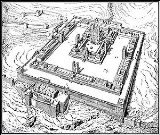
The Temple in Jerusalem or Holy Temple , refers to a series of structures located on the Temple Mount
Temple Mount

The Temple Mount , also known as Mount Moriah and by Muslims as the Noble Sanctuary , is a religious site in the Old City of Jerusalem of Jerusalem....
 (Har HaBayit) in the old city of Jerusalem
Jerusalem

Jerusalem is the capital of Israel and its List of Israeli cities in both population and area, with a population of 747,600 residents over an area of if Positions on Jerusalem East Jerusalem is included....
. Historically, two temples were built at this location, and a future Temple
The Third Temple

Since the Siege of Jerusalem in 70 CE, religious Jews have prayed that God will allow for the building of a Third Temple. This prayer has been a formal part of the traditional thrice daily Jewish services....
 features in Jewish eschatology
Jewish eschatology

Jewish eschatology is concerned with the Jewish messianism, afterlife, and the Resurrection of the dead. Eschatology, generically, is the area of theology and philosophy concerned with the final events in the history of the world, the ultimate destiny of humanity, and related concepts....
. According to classical Jewish belief
Judaism

Judaism is a set of beliefs and practices originating in the Hebrew Bible , as later further explored and explained in the Talmud and other texts....
, the Temple (or the Temple Mount
Temple Mount

The Temple Mount , also known as Mount Moriah and by Muslims as the Noble Sanctuary , is a religious site in the Old City of Jerusalem of Jerusalem....
) acts as the figurative "footstool" of God's presence (Heb.


Discussion
Ask a question about 'Temple in Jerusalem'
Start a new discussion about 'Temple in Jerusalem'
Answer questions from other users
Full Discussion Forum


Recent Posts


Encyclopedia


The Temple in Jerusalem or Holy Temple , refers to a series of structures located on the Temple Mount
Temple Mount

The Temple Mount , also known as Mount Moriah and by Muslims as the Noble Sanctuary , is a religious site in the Old City of Jerusalem of Jerusalem....
 (Har HaBayit) in the old city of Jerusalem
Jerusalem

Jerusalem is the capital of Israel and its List of Israeli cities in both population and area, with a population of 747,600 residents over an area of if Positions on Jerusalem East Jerusalem is included....
. Historically, two temples were built at this location, and a future Temple
The Third Temple

Since the Siege of Jerusalem in 70 CE, religious Jews have prayed that God will allow for the building of a Third Temple. This prayer has been a formal part of the traditional thrice daily Jewish services....
 features in Jewish eschatology
Jewish eschatology

Jewish eschatology is concerned with the Jewish messianism, afterlife, and the Resurrection of the dead. Eschatology, generically, is the area of theology and philosophy concerned with the final events in the history of the world, the ultimate destiny of humanity, and related concepts....
. According to classical Jewish belief
Judaism

Judaism is a set of beliefs and practices originating in the Hebrew Bible , as later further explored and explained in the Talmud and other texts....
, the Temple (or the Temple Mount
Temple Mount

The Temple Mount , also known as Mount Moriah and by Muslims as the Noble Sanctuary , is a religious site in the Old City of Jerusalem of Jerusalem....
) acts as the figurative "footstool" of God's presence (Heb. "shechina") in the physical world.

According to the Hebrew Bible
Hebrew Bible

The term Hebrew Bible is a generic reference to those books of the Bible originally written mostly in Biblical Hebrew with some Biblical Aramaic....
, the First Temple was built by King Solomon (reigned c 970-c 930). It was the center of ancient Judaism
Judaism

Judaism is a set of beliefs and practices originating in the Hebrew Bible , as later further explored and explained in the Talmud and other texts....
 according to Hebrew scripture. As the sole place of Jewish sacrifice, the Temple replaced the local sanctuaries and crude altars in the hills. This First Temple was destroyed by the Babylonians in 587 BCE when they sacked the city. Construction of a new temple was begun in 537 BCE; after a hiatus, work resumed 520 BCE, with completion occurring in 516 BCE and dedication in 515. According to the Book of Ezra
Book of Ezra

The Book of Ezra is a book of the Bible in the Old Testament and Hebrew language Tanakh. It is the record of events occurring at the close of the Babylonian captivity....
, rebuilding of the Temple was authorized by Cyrus the Great
Cyrus the Great

Cyrus the Great , , also known as Cyrus II of Persia and Cyrus the Elder, was a Persian people Shah . He was the founder of the Persian Empire under the Achaemenid dynasty, an empire, perhaps the most wealthy and magnificent in history....
 and ratified by Darius the Great. Five centuries later, this Second Temple
Second Temple

The Second Temple was the reconstructed Temple in Jerusalem which stood between 516 BCE and 70 CE. During this time, it was the center of Judaism worship, which focused on the sacrifices known as the korbanot....
 was renovated by Herod the Great
Herod the Great

Herod , also known as Herod I or Herod the Great , was a Roman Empire client state of Israel. Herod is known for his colossal building projects in Jerusalem and other parts of the ancient world, including the rebuilding of the Second Temple in Jerusalem, sometimes referred to as Herod's Temple....
 in about 20 BCE, also known as Herod's Temple
Herod's Temple

Herod's Temple in Jerusalem was a massive expansion of the Temple Mount and construction of a completely new and much larger Jewish Temple by King Herod the Great around 19 BCE....
. It was subsequently destroyed by the Romans
Roman Empire

The Roman Empire was the Roman Republic phase of the Ancient Rome, characterised by an autocracy form of government and large territorial holdings in Europe and around the Mediterranean....
 in 70 CE (see The Siege of Jerusalem in 70 CE
Siege of Jerusalem (70)

The Siege of Jerusalem in the year 70 AD was a decisive event in the First Jewish-Roman War. It was followed by the Masada#History in 73 AD. The Roman Empire army, led by the future Emperor Titus, with Tiberius Julius Alexander as his second-in-command, besieged and conquered the city of Jerusalem, which had been occupied by its Jewish defend...
). All of the outer walls still stand today, although the Temple itself has long since been destroyed, and for many years it was believed that the western wall
Western Wall

The Western Wall , sometimes referred to as the Wailing Wall or simply the Kotel , and as al-Buraq Wall by Muslims, is an important Jewish religious site located in the Old City ....
 of the complex was the only wall standing.

An Islamic shrine, the Dome of the Rock
Dome of the Rock

The Dome of the Rock is an Islamic shrine and a major landmark located on the Temple Mount in Jerusalem. It was completed in 691, making it the oldest extant Islamic building in the world....
, has stood on the site of the Temple since the late 7th Century CE, and the al-Aqsa Mosque
Al-Aqsa Mosque

Al-Aqsa Mosque , also known as al-Aqsa, is an Holiest sites in Islam in the Old City of Jerusalem. The mosque itself forms part of the al-Haram ash-Sharif or "Sacred Noble Sanctuary" , a site also known as the Temple Mount and considered the holiest site in Judaism, since it is believed to be where the Temple in Jerusalem once stoo...
, from roughly the same period, also stands on the Temple courtyard.

Jewish eschatology
Jewish eschatology

Jewish eschatology is concerned with the Jewish messianism, afterlife, and the Resurrection of the dead. Eschatology, generically, is the area of theology and philosophy concerned with the final events in the history of the world, the ultimate destiny of humanity, and related concepts....
 envisions the construction of The Third Temple
The Third Temple

Since the Siege of Jerusalem in 70 CE, religious Jews have prayed that God will allow for the building of a Third Temple. This prayer has been a formal part of the traditional thrice daily Jewish services....
 in Jerusalem associated with the coming of the Jewish Messiah
Jewish Messiah

Messiah In Jewish eschatology, the term came to refer to a future Jewish monarch from the Davidic line, who will be "anointed" with holy anointing oil and rule the Jewish people during the Messianic Age....
, and thus, adherents of Orthodox
Orthodox Judaism

Orthodox Judaism is a Jewish denominations of Judaism that adheres to a relatively strict constructionist and application of the laws and ethics first canonized in the Talmudic texts and as subsequently developed and applied by the later authorities known as the Gaonim, Rishonim, and Acharonim....
 and Conservative Judaism
Conservative Judaism

Conservative Judaism is a modern Jewish denominations of Judaism that arose out of intellectual currents in Germany in the mid-19th century and took institutional form in the United States in the early 1900s....
 anticipate a Third Temple.

On August 30, 2007, what appears to be the remains of the Second Temple were discovered during the installation of pipes in the compound. Then, in October 2007, archaeologists claimed the discovery of First Temple artifacts.

Etymology

Secondtempleplan
The Hebrew name given in Scripture for the building is Beit HaMikdash or "The Holy House", and only the Temple in Jerusalem is referred to by this name. The temple is also called by a variety of other names in the Hebrew Bible
Hebrew Bible

The term Hebrew Bible is a generic reference to those books of the Bible originally written mostly in Biblical Hebrew with some Biblical Aramaic....
, such as Beit Adonai (House of God) or simply Beiti (My house) or Beitechah (Your House).

The Temple of Solomon was constructed based on specific plans given to King David, by God. David had hoped to build it, but was told by God that his son would be the one to assemble the first temple. During his reign, David began to collect most of the raw materials used in the construction, from the wood, to the huge foundation stones, to the gold, silver, bronze and other metals used. The Temple was designed to house the Ark of the Covenant
Ark of the Covenant

The Ark of the Covenant is described in the Bible as a sacred container, where in rested the Tablets of stone containing the Ten Commandments as well as Aaron's rod and manna....
, and to serve all nations, particularly the Hebrew nation of Israel, as a place where any man could worship the God of Israel.

The First Temple, referred to as the Temple of Solomon, was likely constructed by members of all 12 tribes of Israel, since all the tribes were united under David and then Solomon. Following Solomon's reign, his son Rehoboam
Rehoboam

Rehoboam was a king of United Monarchy and later king of the Kingdom of Judah after the ten northern tribes of Israel rebelled in 932/931 BC to form the independent Kingdom of Israel....
, due to his arrogance, caused 10 of the tribes of Israel split off to form the Northern Kingdom of Israel, while the tribes of Judah
Judah

Judah is the name of several Biblical and historical figures. The original Judah was the fourth son of Jacob and Leah, as recorded in Genesis 29:35....
, Benjamin
Benjamin

Benjamin in the Book of Genesis, is a son of Jacob, the second son of Rachel, and the founder of the Israelites Tribe of Benjamin; in the Biblical account, unlike Rachel's first son - Joseph , the father of Ephraim and Manasseh - Benjamin was born after Jacob and Rachel arrived in Canaan....
 and much of Levi
Levi

Levi/Levy, Hebrew language#Modern Hebrew Levy ??? Tiberian vocalization ; "joining") was, according to the Book of Genesis, the third son of Jacob and Leah, and the founder of the Israelites of Levites ....
, remained in what was known as the Kingdom of Judah
Kingdom of Judah

The Kingdom of Judah existed at two periods in Jewish history. According to the Hebrew Bible, a kingdom emerged in Judah after the death of Saul, when the tribe of Judah elevated David to rule over it....
. The second temple was subsequently built by the remnant of Judah only who were taken in exile by Nebuchadnezzar
Nebuchadnezzar

Nebuchadnezzar was the name of several kings of Babylonia.* Nebuchadrezzar I, who ruled the Babylonian Empire in the 1100s BC. His death causes the Chaldean Empire to crumble and fall 30 years after his death....
 in the 6th century BCE The other 10 tribes had already been dispersed a few centuries earlier, when their kingdom was torn apart by the Kingdom of Assyria
Assyria

Assyria was a political state centered on the Upper Tigris river, in Mesopotamia , that came to rule regional empires a number of times in history....
.

First and Second Temples

Two distinct Temples stood in succession on the Temple Mount
Temple Mount

The Temple Mount , also known as Mount Moriah and by Muslims as the Noble Sanctuary , is a religious site in the Old City of Jerusalem of Jerusalem....
 in Jerusalem:

Solomon's Temple was built in the 10th century BCE and has been dated astronomically to 957 BCE to replace the Tabernacle. It was destroyed by the Babylonia
Babylonia

Babylonia was a state in Lower Mesopotamia , Babylon as its franklin. Babylonia emerged when Hammurabi created an empire out of the territories of the former kingdoms of Sumer and Akkad....
ns under Nebuchadnezzar in 586 BCE, and thus stood for about 375 years; Talmud
Talmud

The Talmud is a record of rabbinic discussions pertaining to Halakha, Jewish ethics, customs, and history. It is a central text of mainstream Judaism....
ic tradition gives the number as 410 years. The building of the Temple of Solomon plays a prominent role in Masonic tradition, as well.

The Second Temple was built after Cyrus
Cyrus the Great

Cyrus the Great , , also known as Cyrus II of Persia and Cyrus the Elder, was a Persian people Shah . He was the founder of the Persian Empire under the Achaemenid dynasty, an empire, perhaps the most wealthy and magnificent in history....
 allowed the Jews to return from the Babylonian captivity
Babylonian captivity

The Babylonian captivity, or Babylonian exile, is the name typically given to the deportation and exile of the Jews of the ancient Kingdom of Judah to Babylon by Nebuchadnezzar II of Babylon in 586 BCE....
. The return took place around 537 BCE, and, after a number of delays, the Temple was completed in 516 BCE. The dimensions of the Temple Mount were then 150 metres x 50 metres.

The Second Temple was destroyed by Roman Empire
Roman Empire

The Roman Empire was the Roman Republic phase of the Ancient Rome, characterised by an autocracy form of government and large territorial holdings in Europe and around the Mediterranean....
 troops under general Titus
Titus

Titus Flavius Vespasianus, commonly known as Titus , was a Roman Emperor who briefly reigned from 79 until his death in 81. Titus was the second emperor of the Flavian dynasty, which ruled the Roman Empire between 69 and 96, encompassing the reigns of Titus's father Vespasian , Titus himself and his younger brother Domitian ....
 in 70 CE. This second Temple had been desecrated by Pompey
Pompey

Gnaeus Pompeius Magnus, commonly known as Pompey /'p?mpi/, Pompey the Great or Pompey the Triumvir , was a distinguished military and political leader of the late Roman Republic....
, when he entered it after taking Jerusalem in 63 BCE. According to Josephus (living at the Court of the Roman Emperor), Pompey did not remove anything from the Temple or its treasury. He did, however, massacre the Priests who attempted to block his entry to the sanctuary.

Sack of Jerusalem
Pompey subsequently lost all his power and died as a hunted fugitive. This is seen by many Jewish people as Divine punishment. (See article on Pompey in the Encyclopaedia Judaica). Around 19 BCE, King Herod
Herod the Great

Herod , also known as Herod I or Herod the Great , was a Roman Empire client state of Israel. Herod is known for his colossal building projects in Jerusalem and other parts of the ancient world, including the rebuilding of the Second Temple in Jerusalem, sometimes referred to as Herod's Temple....
 began a renovation of the Temple Complex in order to conceive a larger and grander version. Scarcely had the Temple's renovations been completed, however, when it was completely destroyed -- down to the foundations -- by the Roman Empire.

During the last revolt of the Jews against the Romans in 132-135 CE, Simon bar Kokhba
Simon bar Kokhba

Simon bar Kokhba was the Jewish leader who led what is known as Bar Kokhba's revolt against the Roman Empire in 132 Common Era, establishing an independent Jewish state of Israel which he ruled for three years as Nasi ....
 and Rabbi Akiva
Rabbi Akiva

Akiba ben Yossef or simply Rabbi Akiva was a Judean tannaim of the latter part of the 1st century and the beginning of the 2nd century ....
 wanted to rebuild the Temple, but bar Kokhba's revolt failed and the Jews were banned from Jerusalem by the Roman Empire.

A further effort at rebuilding the Temple took place in 363 CE when Julian the Apostate
Julian the Apostate

Flavius Claudius Julianus, known also as Julian or Julian the Apostate , was Roman Emperor of the Constantinian dynasty. He was the last non-Christian Roman Emperor, and expended much energy during his reign attempting to supplant the growing power of Christianity within the empire with officially revived Religion in ancient Rom...
 ordered the restoration of the Jewish sanctuary in Jerusalem, but this project failed.

Building a Third Temple


Ever since the Second Temple's destruction, a prayer for the construction of a new Third Temple has been a formal part of the thrice-daily Jewish prayer services. However, the question of whether and when to construct the Third Temple is disputed both within the Jewish community and without; groups within Judaism argue both for and against construction of a new Temple, while the expansion of Abrahamic religion since the 1st century CE has made the issue contentious
Religious significance of Jerusalem

The city of Jerusalem, located in modern-day Israel, is significant in a number of religious traditions, including Abrahamic religions Judaism, Christianity, and Islam, which consider it a holy city....
 within Christian
Christianity

Christianity is a Monotheistic religion #Christian view religion centered on the life and teachings of Jesus as New Testament view on Jesus' life....
 and Islam
Islam

Islam is a Monotheism, Abrahamic religion originating with the teachings of the Prophets of Islam Muhammad, a 7th century Arab religious and political figure....
ic thought as well. Furthermore, the complicated political status of Jerusalem
Positions on Jerusalem

Israel has de facto control over all of Jerusalem. However, there are many differing legal and diplomatic positions on Jerusalem.* Since 1967, Israel has claimed all of Jerusalem, including East Jerusalem, as its "complete and united" capital....
 makes initiation of reconstruction presently difficult, while the traditional physical location of the historic Temple is presently occupied by the Al-Aqsa Mosque
Al-Aqsa Mosque

Al-Aqsa Mosque , also known as al-Aqsa, is an Holiest sites in Islam in the Old City of Jerusalem. The mosque itself forms part of the al-Haram ash-Sharif or "Sacred Noble Sanctuary" , a site also known as the Temple Mount and considered the holiest site in Judaism, since it is believed to be where the Temple in Jerusalem once stoo...
 and the Dome of the Rock
Dome of the Rock

The Dome of the Rock is an Islamic shrine and a major landmark located on the Temple Mount in Jerusalem. It was completed in 691, making it the oldest extant Islamic building in the world....
.

Physical layout

According to the Talmud
Talmud

The Talmud is a record of rabbinic discussions pertaining to Halakha, Jewish ethics, customs, and history. It is a central text of mainstream Judaism....
, the Temple had an Ezrat Nashim (Women's Court) to the east and main area to the west. The main area contained the butchering area for the sacrifices and the Mizbaeach (Outer Altar) on which portions of most offerings were burned and blood was poured or dashed. An edifice contained the Ulam (antechamber), the Heichal, and the Kodesh Kodashim (Holy of Holies
Holy of Holies

The Holy of Holies is a term in the Hebrew Bible which referred to the inner sanctuary of the Tabernacle and later the Temple in Jerusalem which could be entered only by the Kohen Gadol on Yom Kippur....
). The Heichal and the Kodesh Kodashim were separated by a wall in the First Temple and by two curtains in the Second Temple. The Heichal contained the Menorah, the table of Showbread
Showbread

Showbread , in the King James Version: shewbread, in a Bible or Judaism context, refers to the cakes or loaves of bread which were always present on a specially dedicated table, in the Temple in Jerusalem as an offering to God....
 and the Incense Altar.

The main courtyard had thirteen gates. On the south side, beginning with the southwest corner, there were four gates:
  • Shaar Ha'Elyon (the Upper Gate)
  • Shaar HaDelek (the Kindling Gate), where wood was brought in
  • Shaar HaBechorot (the Gate of Firstborn), where people with first-born animal offerings entered and fathers and children entered for the Pidyon HaBen
    Pidyon HaBen

    Pidyon HaBen, , is a ritual in Judaism whereby a firstborn son is redeemed by a Kohen in order to release him from his obligation to serve in the Temple in Jerusalem....
     ceremony
  • Shaar HaMayim (the Water Gate), where the Water Libation entered on Sukkot
    Sukkot

    Sukkot , is a Hebrew Bible pilgrimage Jewish holiday that occurs in autumn on the 15th day of the month of Tishrei . The holiday lasts seven days, including Chol Hamoed....
    .


On the north side, beginning with the northwest corner, there were four gates:
  • Shaar Yechonyah (The Gate of Yechonyah), where kings of the Davidic line enter and Yechonyah/Yehoyachin
    Jeconiah

    Jeconiah , also known as Jehoiachin , was a king of Judah. He was the son of Jehoiakim with Nehushta, the daughter of List of minor Biblical figures of Jerusalem and was a contemporary of the prophets Jeremiah and Ezekiel....
     left for the last time to captivity
  • Shaar HaKorban (The gate of the Offering
    Korban

    Korban , in Judaism, is the term for a variety of Sacrifice described and commanded in the Torah. Such sacrifices were offered in a variety of settings by the ancient Israelites, and later by the Jewish priesthood, the Kohen, at the Temple in Jerusalem....
    ), where priests entered with kodshei kodashim offerings
  • Shaar HaNashim (The Women's
    Role of women in Judaism

    The role of women in Judaism is determined by the Tanakh, the Oral Torah , by Minhag, and by non-religious cultural factors. Although the Hebrew Bible and rabbinic literature mention various female role models, religious law treats women differently in various circumstances....
     Gate), where women entered into the Azara or main courtyard to perform offerings
  • Shaar Hashir (The Gate of Song), where the Levites entered with their musical instruments


On the east side was Shaar Nikanor, between the Women's Courtyard and the main Temple Courtyard, which had two minor doorways, one on its right and one on its left. On the western wall, which was relatively unimportant, there were two gates that did not have any name.

The Temple in the writings of the prophets


The Biblical prophets
Nevi'im

Nevi'im is the second of the three major sections in the Hebrew Bible, the Tanakh, between the Torah and Ketuvim .Nevi'im is traditionally divided into two parts:...
 describe visions of a mysterious presence of God occupying the Temple.

Isaiah
Isaiah

Isaiah is the main figure in the Biblical Book of Isaiah, and is traditionally considered to be its author. He was an 8th-century Before Christ Judean prophet who declared that all the world belonged to God and that God will destroy it....
 wrote "I saw the Lord sitting upon a throne high and lifted up, and his train filled the Temple." (Isaiah 6:1). Jeremiah
Jeremiah

Jeremiah was one of the 'greater prophet' of the Hebrew Bible. He was the son of Hilkiah, a priest of Anathoth.His writings are put together in the Book of Jeremiah and, according to tradition, the Book of Lamentations....
 implored "Do not dishonor the throne of your glory" (Jeremiah 14:21) and referred to "Thou throne of glory, on high from the beginning, Thou place of our sanctuary" (Jeremiah 17:12). Ezekiel
Ezekiel

This article is about the main speaker in the biblical Book of Ezekiel. For a summary and analysis of the book itself, see Book of Ezekiel.According to religious texts, Ezekiel was a prophet and priest in the Hebrew Bible who prophesied for 22 years sometime in the 6th century BC in the form of visions while exiled in Babylon, as recorded...
 spoke of "the glory of the God of Israel was there [in the Sanctuary], according to the vision that I saw in the plain."

Isaiah spoke of the importance of prayer as well as sacrifice in Temple, and of a universal purpose:
Even them will I bring to my My holy mountain, and make joyful in My house of prayer,
Their burnt-offerings and their sacrifices shall be acceptable upon Mine altar
For my house shall be called a house of prayer for all peoples. (Isaiah 56:7, JPS translation).
"My House shall be a house of prayer for all peoples." (Isaiah 56:7)


Temple services

The Temple was the place where offerings
Korban

Korban , in Judaism, is the term for a variety of Sacrifice described and commanded in the Torah. Such sacrifices were offered in a variety of settings by the ancient Israelites, and later by the Jewish priesthood, the Kohen, at the Temple in Jerusalem....
 described in the course of the Hebrew Bible
Hebrew Bible

The term Hebrew Bible is a generic reference to those books of the Bible originally written mostly in Biblical Hebrew with some Biblical Aramaic....
 were carried out, including daily morning and afternoon offerings and special offerings on Shabbat
Shabbat

Shabbat or Shabbos , is the weekly day of rest in Judaism, symbolizing the seventh day in Genesis, after the six days of creation. Though it is commonly said to be the Saturday of each week, it is observed from sundown on Friday until the appearance of three stars in the sky on Saturday night....
 and Jewish holidays. Levites recited Psalms
Psalms

Psalms is a book of the Hebrew Bible , included in the collected works known as the "Writings" or Ketuvim....
 at appropriate moments during the offerings, including the Psalm of the Day, special psalms for the new month
Rosh Chodesh

Rosh Chodesh, , is the name for the first day of every month in the Hebrew calendar, marked by the appearance of the New Moon. It is considered a minor holiday, akin to the intermediate days of Passover and Sukkot....
, and other occasions, the Hallel
Hallel

Hallel is a List of Jewish Prayers and Blessings?a verbatim recitation from Psalms 113-118, which is used for praise and thanksgiving that is recited by observant Jews on Jewish holidays....
 during major Jewish holidays, and psalms for special sacrifices such as the "Psalm for the Thanksgiving Offering" (Psalm 100).

As part of the daily offering, a prayer service was performed in the Temple which was used as the basis of the traditional Jewish (morning) service recited to this day, including well-known prayers such as the Barchu, the Shema, and the Priestly Blessing
Priestly Blessing

The Priestly Blessing, , also known in Hebrew as Nesiat Kapayim, , is a Judaism prayer recited by Kohanim during certain Jewish services....
. The Mishna describes it as follows:

The Temple as the Garden of Eden


The Temple courtyards were full of trees, flowers, and fountains, because the Temple was meant to be a model and re-creation of the Garden of Eden
Garden of Eden

The Garden of Eden is a location described in the Book of Genesis as being the place where the first man, Adam , and his wife, Eve , lived after they were created by God....
. (See "Jerusalem as Eden," by Lawrence Stager, Biblical Archaeology Review, May/June 2000).

Role in Jewish services


As noted above, the heart of the traditional Jewish morning service, the part surrounding the Shema prayer, is essentially unchanged from the daily worship service performed in the Temple. In addition, recitation of the Amidah
Amidah

The Amidah , also called the Shmona Esre , is the central prayer of the Siddur. As Judaism's prayer par excellence, the Amidah is often designated simply as tfila in Rabbinic literature....
 prayer, which traditionally replaces the Temple's daily tamid and special-occasion Mussaf (additional) offerings, must be recited today during the times that the offerings they substitute for were performed in the days of the Temple, in both Orthodox
Orthodox Judaism

Orthodox Judaism is a Jewish denominations of Judaism that adheres to a relatively strict constructionist and application of the laws and ethics first canonized in the Talmudic texts and as subsequently developed and applied by the later authorities known as the Gaonim, Rishonim, and Acharonim....
 and Conservative Judaism
Conservative Judaism

Conservative Judaism is a modern Jewish denominations of Judaism that arose out of intellectual currents in Germany in the mid-19th century and took institutional form in the United States in the early 1900s....
.

The Temple is mentioned extensively in Orthodox
Orthodox Judaism

Orthodox Judaism is a Jewish denominations of Judaism that adheres to a relatively strict constructionist and application of the laws and ethics first canonized in the Talmudic texts and as subsequently developed and applied by the later authorities known as the Gaonim, Rishonim, and Acharonim....
 services
Jewish services

Jewish services are the prayer recitations that form part of the observance of Judaism. These prayers, often with instructions and commentary, are found in the siddur, the traditional Jewish prayer book....
, and, to a lesser degree, in Conservative ones as well.

Orthodox Judaism

Mentions in Orthodox Jewish services include:

  • A daily recital of Biblical and Talmudic passages related to the korbanot (sacrifices) performed in the Temple. (See korbanot in siddur
    Siddur

    A siddur is a Judaism prayer book, containing a set order of List of Jewish prayers and blessings. This article discusses how some of these prayers evolved, and how the siddur, as we know it today has developed....
    ).
  • References to the restoration of the Temple and sacrificial worships in the daily Amidah
    Amidah

    The Amidah , also called the Shmona Esre , is the central prayer of the Siddur. As Judaism's prayer par excellence, the Amidah is often designated simply as tfila in Rabbinic literature....
     prayer, the central prayer in Judaism.
  • A traditional personal plea for the restoration of the Temple at the end of private recitation of the Amidah.
  • A prayer for the restoration of the "house of our lives" and the shekhinah
    Shekhinah

    File:SpiritUponDavid.jpgShekhinah is the English spelling of a grammatically feminine Hebrew language word that means the dwelling or settling, and is used to denote the dwelling or settling presence of God, especially in the Temple in Jerusalem....
     (divine presence) "to dwell among us" is recited during the Amidah prayer.
  • Recitation of the Psalm of the day; the psalm sung by the Levite
    Levite

    In Jewish tradition, a Levite is a member of the tribes of Israel of Levi. When Joshua led the Israelites into the land of Canaan, the Levites were the only Israelite tribe who received cities but no tribal land "because the Lord the God of Israel himself is their possession"....
    s in the Temple for that day) during the daily morning service.
  • Numerous psalms sung as part of the ordinary service make extensive references to the Temple and Temple worship.
  • Recitation of the special Jewish holiday sacrifices, and prayers for the restoration of the Temple and their offering, during the Mussaf services on Jewish holidays.
  • An extensive recitation of the special Temple service for Yom Kippur
    Yom Kippur

    Yom Kippur , also known in English as the Day of Atonement, is the most solemn and important of the Jewish holidays. Its central themes are Atonement in Judaism and Repentance in Judaism....
     during the service for that holiday.
  • Special services for Sukkot
    Sukkot

    Sukkot , is a Hebrew Bible pilgrimage Jewish holiday that occurs in autumn on the 15th day of the month of Tishrei . The holiday lasts seven days, including Chol Hamoed....
     (Hakafot) contain extensive (but generally obscure) references to the special Temple service performed on that day.


The destruction of the Temple is mourned on the Jewish fast day of Tisha B'Av
Tisha B'Av

is an annual ta'anit in Judaism, named for the ninth day of the month of Av in the Hebrew calendar. The fast commemorates the destruction of the Solomon's Temple and Second Temples in Jerusalem, which occurred about 656 years apart, but on the same date....
. Three other minor fasts (Tenth of Tevet
Tevet

Tebet is the fourth month of the civil year and the tenth month of the ecclesiastical year on the Hebrew calendar. It follows Kislew and precedes Shebat....
, 17th of Tammuz
Tammuz

Northwest Semitic Tammuz , Arabic language ????? Tammuz; Akkadian language Du?zu, Duzu; Sumerian language Dumuzid was the name of a Ancient Near Eastern deity....
, and Third of Tishrei
Tishrei

Tishrei is the first month of the civil year and the seventh month of the ecclesiastical year in the Hebrew calendar. The name comes from the Talmud....
), also mourn events leading to or following the destruction of the Temple.

Conservative Judaism

Conservative Judaism retains mentions of the Temple in Jerusalem, but removes references to the restoration of sacrifices
Korban

Korban , in Judaism, is the term for a variety of Sacrifice described and commanded in the Torah. Such sacrifices were offered in a variety of settings by the ancient Israelites, and later by the Jewish priesthood, the Kohen, at the Temple in Jerusalem....
. The study session of Temple sacrifices is removed or replaced, the passages in the daily Amidah
Amidah

The Amidah , also called the Shmona Esre , is the central prayer of the Siddur. As Judaism's prayer par excellence, the Amidah is often designated simply as tfila in Rabbinic literature....
, the weekday Torah service, and elsewhere referring to restoration of the Temple are retained - but references to sacrifices are removed. References to sacrifices on holidays are retained, but made in the past tense, and petitions for their restoration are removed. Special holiday services, such as special prayers at Yom Kippur
Yom Kippur

Yom Kippur , also known in English as the Day of Atonement, is the most solemn and important of the Jewish holidays. Its central themes are Atonement in Judaism and Repentance in Judaism....
 and Sukkot
Sukkot

Sukkot , is a Hebrew Bible pilgrimage Jewish holiday that occurs in autumn on the 15th day of the month of Tishrei . The holiday lasts seven days, including Chol Hamoed....
, are retained, but are often abbreviated or omitted by Conservative congregations.

Siddur Sim Shalom
Siddur Sim Shalom

Siddur Sim Shalom may refer to any siddur in a family of Siddur, Jewish prayerbooks, and related commentaries on these siddurim, published by the Rabbinical Assembly and the United Synagogue of Conservative Judaism....
, the prayer book(s) used in most Conservative synagogues, has alternate versions of the Amidah
Amidah

The Amidah , also called the Shmona Esre , is the central prayer of the Siddur. As Judaism's prayer par excellence, the Amidah is often designated simply as tfila in Rabbinic literature....
 prayer: a version mentioning sacrifices in the past tense and one without reference to sacrifices at all.

Conservative Judaism has retained the four fasts relating to the destruction of the Temple, although only Tisha B'Av
Tisha B'Av

is an annual ta'anit in Judaism, named for the ninth day of the month of Av in the Hebrew calendar. The fast commemorates the destruction of the Solomon's Temple and Second Temples in Jerusalem, which occurred about 656 years apart, but on the same date....
 is widely observed.

Reform and Reconstructionist Judaism

Reform
Reform Judaism

Reform Judaism refers to the spectrum of beliefs, practices and organizational infrastructure associated with Reform Judaism in Reform Judaism and in Reform Judaism ....
 and Reconstructionist Judaism
Reconstructionist Judaism

Reconstructionist Judaism is a modern American-based Judaism Jewish denominations based on the ideas of the late Mordecai Kaplan . The movement views Judaism as a progressively evolving civilization....
 have removed all direct references to the Temple, although some indirect or ambiguous references (e.g. "Happy are those who dwell in your House", Psalm 84:5) are retained.

For a number of years the Reform movement in the United States
United States

The United States of America is a Federal government constitutional republic comprising U.S. state and a federal district. The country is situated mostly in central North America, where its Contiguous United States and Washington, D.C., the Capital districts and territories, lie between the Pacific Ocean and Atlantic Oceans, Borders of the U...
 called its places of worship not synagogue
Synagogue

A synagogue is a Jewish house of prayer.Synagogues usually have a large hall for prayer , smaller rooms for study and sometimes a social hall and offices....
s or shuls but temples. This is due to their belief that prayer replaced sacrifice as the main mode of Jewish worship, and that in a world where that is the case, there is no need for The Temple, only temples. Reform Judaism has, in fact, repudiated animal sacrifice, and now refers to a "sacrifice of the heart." . Now, however, the Reform movement does refer to its main places of worship as synagogues. Temple has come to be used strictly as a term referring to the first and second Temples.

Archaeological evidence

To the Trumpeting Place
Archaeological excavations have found one hundred mikvaot
Mikvah

Mikvah is a ritual bath designed for the purpose of ritual washing in Judaism#Full-body immersion. The word "mikvah", as used in the Hebrew Bible, literally means a "collection" - generally, a collection of water....
 (ritual immersion pools) surrounding the Temple Mount
Temple Mount

The Temple Mount , also known as Mount Moriah and by Muslims as the Noble Sanctuary , is a religious site in the Old City of Jerusalem of Jerusalem....
 or Har HaBayit. This is strong evidence that this area was considered of the utmost holiness in ancient times and could not possibly have been a secular area. However, it does not establish where exactly within the area was the Temple located. There are basically three theories:
  • The Temple was where the Dome of the Rock is now located.
  • The Temple was located a little to the north of the Dome of the Rock (Professor Asher Kaufman).
  • The Temple was located a little to the east of the Dome of the Rock (Professor Joseph Patrich of the Hebrew University. See article in the World Jewish Digest, April 2007).
Other theories have the Temple either to the north or to the south of the Temple Mount. Scholars generally reject more outlandish theories that claim the Temple was located somewhere else than Jerusalem or even outside the Land of Israel.

2004 artifact controversy


See also: List of artifacts significant to the Bible
List of artifacts significant to the Bible

The following is a list of Artifact , objects created or modified by a human culture, that are significant to the historicity of the Bible....


On December 27, 2004, it was reported in the Toronto
Toronto

Toronto is the List of the 100 largest municipalities in Canada by population in Canada and the Provinces and territories of Canada Provincial and territorial capitals of Canada of Ontario....
-based The Globe and Mail
The Globe and Mail

The Globe and Mail is a Canada English language nationally distributed newspaper, based in Toronto and printed in six cities across the country....
 that the Israel Museum
Israel Museum

The Israel Museum, Jerusalem was founded in 1965 as Israel's national museum. It is situated on a hill in the Givat Ram neighborhood of Jerusalem, near the Knesset, the Israeli Supreme Court, and the Hebrew University of Jerusalem....
 in Jerusalem
Jerusalem

Jerusalem is the capital of Israel and its List of Israeli cities in both population and area, with a population of 747,600 residents over an area of if Positions on Jerusalem East Jerusalem is included....
 concluded that the ivory pomegranate
Pomegranate

The pomegranate is a fruit-bearing deciduous shrub or small tree growing to between five and eight metres tall. The pomegranate is native to the region from Iran to the Himalayas in northern India and has been cultivated and naturalized over the whole Mediterranean Basin region and the Caucasus since ancient times....
 believed to have once adorned a scepter used by the high priest in Solomon's Temple was a fake. This artifact was the most important item of biblical antiquities in its collection. It had been part of a traveling exhibition at the Canadian Museum of Civilization
Canadian Museum of Civilization

The Canadian Museum of Civilization is Canada?s national museum of human history and the most popular and most-visited museum in Canada.It is located in Gatineau, Quebec, directly across the Ottawa River from Canada?s Parliament Hill....
 in 2003. Experts fear that this discovery is part of an international fraud in antiquities. The thumb-sized pomegranate, which is a mere 44 mm in height, bears an inscription incised around the shoulder of the pomegranate in small paleo-Hebrew script. Only 9 characters remained complete, and were incomplete – if any sense were to be made of the inscription, it seemed likely that several more were missing. The surviving part of the inscription was transcribed ???...? ??? ???? (Only the lower horizontal stroke of the yod
Yod

A yod is a rare astrological aspect involving any celestial body of astrological importance. In astrology a yod is said to form whenever one planet forms quincunxes to another two planets that are separated by only a sextile ....
 and the upper horizontal stroke of the ? he
?

or is a letter derived from the Latin alphabet. Both glyphs of the majuscule and Lower case forms of this letter are based on the rotated form of a minuscule e; a similar letter with identical minuscule is used in the Pan-Nigerian Alphabet, but has the capital form majuscule , based on a horizontally flipped majuscule E....
 remain.)

The following restoration of missing letters was proposed: ???? ???? ??? ????

This reconstruction resulted in the following transliteration, now accepted by the vast majority of scholars: lby[t yhw]h qdš khnm, which led to the translation: "[Belonging] to the Temp[le of YaHW]eH, holy [or, consecrated] to the priests."

The notion that the artifact is fake derives from the conclusion that it belongs to the Bronze Age
Bronze Age

The Bronze Age is, with respect to a given prehistory, the period in that society when the most advanced metalworking included smelting copper and tin from naturally-occurring outcroppings of copper and tin ores, creating a bronze alloy by melting those metals together, and casting them into bronze artifact s....
 rather than the Iron Age
Iron Age

In archaeology, the Iron Age was the stage in the development of any people in which tools and weapons whose main ingredient was iron were prominent....
. Also, strokes of the inscribed letters did not seem to continue directly into a broken-off section of the piece, suggesting that the inscription was added after the piece was broken. However, there are theories that the Temple of Solomon was built in the Bronze Age. If this is correct, there is no reason to doubt the authenticity of the ivory pomegranate. In addition, further analysis with an SEM revealed that the writing did, in fact, continue into the crack ...

By the end of 2008, Professor Yitzhak Roman of the Hebrew University of Jerusalem
Hebrew University of Jerusalem

The Hebrew University of Jerusalem is Israel's oldest university.The First Board of Governors included Albert Einstein, Sigmund Freud, Martin Buber, and Chaim Weizmann....
 concluded that the inscription on the ivory pomegranate is authentic.

The Temple in Islam

The Last Prophet of Islam, Muhammad
Muhammad

Muhammad Patronymic#Arabic Abd Allah ibn Abd al Muttalib , is the founder of the Major religious groups of Islam and is regarded by Muslims as a Rasul and prophet of , the last and the greatest law-bearer in a series of prophets....
 originally ordered Muslims to pray and prostrate toward the Temple Mount in Jerusalem (and it is therefore called the First of the Two Qiblahs). It is also mentioned in the Qur'an
Qur'an

The Qur?an is the central religious text of Islam. Muslims believe the Qur?an to be the book of divine guidance and direction for mankind, and consider the original Arabic text to be the final revelation of God....
] as 'Bayt Al-Maqdes' which is an Arabic version of the Hebrew word 'Beit HaMikdash' (meaning 'The Holy House').

Since at least Mishnaic times (200 CE), Jews face the temple mount in Jerusalem while praying. The Mishnah
Mishnah

The Mishnah or Mishna is a major work of Rabbinic literature, and the first major redaction into written form of Jewish oral traditions, called the Oral Torah....
 speaks about this in Berakhot (Talmud)
Berakhot (Talmud)

Berakhot is the first masekhet of Zeraim of the Mishnah, the first major text of Jewish law. It primarily addresses the rules regarding the Shema Yisrael, the Amidah, Birkat Hamazon , Kiddush , Havdalah and other blessings and prayers....
 chapter 4, Mishnahs 5 and 6 and this practice is even found as early as I Kings 8:35-36. In Islam, this only lasted for seventeen months after Muhammad's arrival in Medina
Medina

Medina is a city in the Hejaz region of western Saudi Arabia, and serves as the capital of the Al Madinah Province. It is the second holiest city in Islam, and the burial place of the Prophet Muhammad....
, after which the Qiblah became oriented towards the Kaaba
Kaaba

The Kaaba "Cube" is a cuboidal building in Mecca, Saudi Arabia, and is the Most holy place#Islam in Islam. The building is more than two thousand years old, and according to Islamic tradition the first building at the site was built by Abraham ....
 in Mecca
Mecca

Mecca , also spelled Makkah , Makka is a city in Saudi Arabia. Home to the Masjid al-Haram, it is the holy city in Islam and plays an important role in the faith....
. According to historical accounts from the prophet Muhammad
Muhammad

Muhammad Patronymic#Arabic Abd Allah ibn Abd al Muttalib , is the founder of the Major religious groups of Islam and is regarded by Muslims as a Rasul and prophet of , the last and the greatest law-bearer in a series of prophets....
's companions contained in the Hadith
Hadith

Hadith are oral traditions relating to the words and deeds of the Prophets of Islam Muhammad. Hadith collections are regarded by all traditional madhab as important tools for determining the Muslim way of life, the sunnah....
, the change happened very suddenly during the noon prayer in a mosque in Medina
Medina

Medina is a city in the Hejaz region of western Saudi Arabia, and serves as the capital of the Al Madinah Province. It is the second holiest city in Islam, and the burial place of the Prophet Muhammad....
. Muhammad was leading the prayer when he received a revelation
Revelation

Revelation is the act of revealing or disclosing, or making something obvious and clearly understood through active or passive communication with the divinity....
 from Allah
Allah

Allah is the standard Arabic language word for God. While the term is best known in the Western world for its use by Muslims as a reference to God, it is used by Arabic-speakers of all Abrahamic faiths, including Christians and Jews, in reference to "God"....
 instructing him to take the Kaaba
Kaaba

The Kaaba "Cube" is a cuboidal building in Mecca, Saudi Arabia, and is the Most holy place#Islam in Islam. The building is more than two thousand years old, and according to Islamic tradition the first building at the site was built by Abraham ....
 as the Qiblah as in the Qur'anic verse 2:144 which reads, "We see the turning of thy face (for guidance) to the heavens: now Shall We turn thee to a Qibla that shall please thee. Turn then Thy face in the direction of the sacred Mosque: Wherever ye are, turn your faces in that direction. The people of the Book
People of the Book

In Islam, the People of the Book are non-Muslim peoples who, according to the Qur'an, received scriptures which were revelation to them by God before the time of Muhammad, most notably Christians and Jews....
 know well that that is the truth from their Lord. Nor is God unmindful of what they do."
. According to the accounts, Muhammad, who had been facing Jerusalem during the prayer, upon receiving this revelation, immediately turned around to face Mecca
Mecca

Mecca , also spelled Makkah , Makka is a city in Saudi Arabia. Home to the Masjid al-Haram, it is the holy city in Islam and plays an important role in the faith....
, and those praying behind him also did so. After this, the mosque in which this incident occurred came to be known as Masjid al-Qiblatain
Masjid al-Qiblatain

Masjid al-Qiblatain is a mosque in Medina that is historically important for Muslims as the place where the prophet Muhammad is said to have been commanded to change the direction of prayer from Jerusalem to Mecca....
 (i.e. 'Mosque of the Two Qiblahs').

For some hundreds of years after the Muslim conquest, Jerusalem was still known to the Arabic speakers as 'Illya' which is the Arabic version of its Roman name 'Aelia Capitolina
Aelia Capitolina

Aelia Capitolina was a city built by the emperor Hadrian, and occupied by a Roman colony, on the site of Jerusalem, which was still in ruins from the First Jewish-Roman War in 70 A.D.....
'. Bayt Al-Maqdes later became synonymous with Jerusalem and was eventually shortened to simply 'al Quds' ('The Holy'). When Khalif Omar ibn al-Khattab (Umar
Umar

Umar , also known as Umar the Great or Omar the Great was a Muslim from the Banu Adi clan of the Quraysh Tribes of Arabia, and a sahaba of Muhammad....
) came to Jerusalem
Jerusalem

Jerusalem is the capital of Israel and its List of Israeli cities in both population and area, with a population of 747,600 residents over an area of if Positions on Jerusalem East Jerusalem is included....
 he asked the Patriach of Jerusalem to lead him to the site of the Temple. The area was filled with debris because it was considered the quarry and the dump site of the city during Christian times.

A Jewish rabbi turned Muslim was with Umar: "Ka'ab al-Ahbar
Ka'ab al-Ahbar

Ka'ab al-Ahbar was a prominent Jewish Rabbi from Yemen, from the clan of Thee Ra-een or Thee al-Kila . He is counted among the Tabi?in and narrated many Isra'iliyat ....
". He, armed with his religious knowledge, led Umar first to the site of the Temple (The area where Israelites used to pray) where indeed Umar discovered the foundations' ruins, where Umar
Umar

Umar , also known as Umar the Great or Omar the Great was a Muslim from the Banu Adi clan of the Quraysh Tribes of Arabia, and a sahaba of Muhammad....
 built a mosque made of reed on the example of The Mosque of the Prophet in Medina (roof was also made of reed). Umar prayed with 10,000 people for the first time since the fall of the temple in 70 CE. Umar prohibited offering sacrifices in the temple.

Then while Umar was searching for "the Rock" that Muhammad
Muhammad

Muhammad Patronymic#Arabic Abd Allah ibn Abd al Muttalib , is the founder of the Major religious groups of Islam and is regarded by Muslims as a Rasul and prophet of , the last and the greatest law-bearer in a series of prophets....
 ascended atop of, with Angel Gabriel
Gabriel

In Abrahamic religions, Gabriel is an angel who serves as a messenger from God. He first appears in the Book of Daniel in the Hebrew Bible. In some traditions he is regarded as one of the archangels, or as the angel of death....
, to Heaven in his night journey to Heaven "Isra and Mi'raj
Isra and Mi'raj

In Islamic tradition, the Isra and Mi'raj are the two parts of a journey that Muhammad took in one night, around the year 621. Many Muslims consider it a physical journey but some scholars consider it a dream....
" just less than 20 years ago (as the prophet related), Ka'ab was also searching for the site of the Holy of Holies
Holy of Holies

The Holy of Holies is a term in the Hebrew Bible which referred to the inner sanctuary of the Tabernacle and later the Temple in Jerusalem which could be entered only by the Kohen Gadol on Yom Kippur....
. While removing the debris from the expected site of the Holy of Holies, to everybody's amazement, a large rock was revealed, then more of it was exposed by more cleaning.

Umar built a fence around the rock because he saw Ka'ab walking on it barefoot ("to see how it felt," as Kaab related later). A later Khalif built The Dome of the Rock over the Rock. The Dome was a monumental engineering project that lasted decades in construction, hiring the best architects and master masons in the world.

See also

  • Great Jewish Revolt
  • Siege of Jerusalem
    Siege of Jerusalem (70)

    The Siege of Jerusalem in the year 70 AD was a decisive event in the First Jewish-Roman War. It was followed by the Masada#History in 73 AD. The Roman Empire army, led by the future Emperor Titus, with Tiberius Julius Alexander as his second-in-command, besieged and conquered the city of Jerusalem, which had been occupied by its Jewish defend...
  • Leontopolis
    Leontopolis

    Leontopolis or Leonto or Latin: Leontos Oppidum or Egyptian language: Taremu, was an Ancient Egyptian city that is known as Tell al Muqdam today....


External links

  • Analytical studies by the Lubavitcher Rebbe, Rabbi Menachem M. Schneerson
    Menachem Mendel Schneerson

    Menachem Mendel Schneerson In 1950, upon the death of his father-in-law, Rabbi Yosef Yitzchok Schneersohn, he assumed the leadership of Chabad Lubavitch....
     on the Rambam's
    Maimonides

    Moses Maimonides, also known as Rabbi Moses ben Maimon , the Rambam, and Musa ibn Maymun , was born in C?rdoba, Spain, Spain on March 30, 1135, and died in Egypt on December 13, 1204.....
     rulings concerning the construction and the design of the Beis HaMikdosh.


Further reading

  • Biblical Archaeology Review
    Biblical Archaeology Review

    Biblical Archaeology Review is a publication that seeks to connect the academic study of archaeology to a broad general audience seeking to understand the world of the Bible and the Near and Middle East ....
    , issues: July/August 1983, November/December 1989, March/April 1992, July/August 1999, September/October 1999, March/April 2000, September/October 2005


  • Ritmeyer, Leen. The Quest: Revealing the Temple Mount in Jerusalem. Jerusalem: Carta, 2006. ISBN 965-220-628-8


  • Hamblin, William
    William J. Hamblin

    William James Hamblin is professor of history department faculty at Brigham Young University and an expert in ancient and medieval Near East history, the Crusades, and the history of Solomon's Temple....
     and David Seely, Solomon's Temple: Myth and History (Thames and Hudson, 2007) ISBN 0500251339


  • Yaron Eliav, God's Mountain: The Temple Mount in Time, Place and Memory (Baltimore: Johns Hopkins University Press, 2005)