Home      Discussion      Topics      Dictionary      Almanac
Signup       Login
Constantinian shift

Constantinian shift

Overview
Constantinian shift is a term used by Anabaptist
Anabaptist
Anabaptists are Christians of the Radical Reformation. This article describes the Anabaptists of 16th-century Europe and their direct descendants, particularly the Amish, Hutterites, and Mennonites.Anabaptists rejected conventional Christian practices such as wearing wedding rings, taking oaths, and...

 and Post-Christendom theologians to describe the political and theological aspects of the 4th-century process of Constantine's legalization of Christianity
Constantine I and Christianity
The Roman Emperor Constantine the Great converted to Christianity following his victory at the Battle of Milvian Bridge in 312. Under his rule, Christianity rose to become the dominant religion in the Roman Empire, and for his example of a "Christian monarch" Constantine is revered as a saint in...

. The term was popularized by the Mennonite
Mennonite
The Mennonites are a group of Christian Anabaptist denominations named after the Frisian Menno Simons , who, through his writings, articulated and thereby formalized the teachings of earlier Swiss founders...

 theologian John H. Yoder.

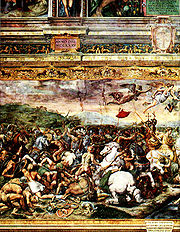
According to Roman Catholic tradition Constantine I adopted Christianity
Christianity
Christianity is a monotheistic religion based on the life and teachings of Jesus of Nazareth as presented by the revelations in the New Testament....

 as his personal system of belief after the Battle of Milvian Bridge
Battle of Milvian Bridge
The Battle of the Milvian Bridge took place between the Roman Emperors Constantine I and Maxentius on 28 October 312. Constantine won the battle and started on the path that led him to end the Tetrarchy and become the sole ruler of the Roman Empire...

 in 312. His legions
Roman legion
The Roman legion is a term that can apply both as a translation of legio to the entire Roman army and also, more narrowly , to the heavy infantry that was the basic military unit of the ancient Roman army in the period of the late Roman Republic and the...

, who were victorious, fought under the "labarum
Labarum
The labarum was a vexillum that displayed the "Chi-Rho" symbol, formed from the first two Greek letters of the word "Christ" — Chi and Rho . It was first used by the Roman emperor Constantine I. Since the vexillum consisted of a flag suspended from the crossbar of a cross, it was ideally suited...

", a standard with the first two Greek letters of Christ
Christ
Christ is the English term for the Greek meaning "the anointed". It is a translation of the Hebrew . The term "Christ" was a title rather than a proper name. In the four gospels in the New Testament, the word "Christ" is nearly always preceded by the definite article...

's name.


In 313 the Edict of Milan
Edict of Milan
The Edict of Milan was a letter signed by emperors Constantine I and Licinius that proclaimed religious toleration in the Roman Empire...

 legalised Christianity alongside other religions allowed in the Roman Empire
Roman Empire
The Roman Empire was the post-Republican phase of the ancient Roman civilization, characterised by an autocratic form of government and large territorial holdings in Europe and around the Mediterranean. The term is used to describe the Roman state during and after the time of the first emperor,...

.
Discussion
Ask a question about 'Constantinian shift'
Start a new discussion about 'Constantinian shift'
Answer questions from other users
Full Discussion Forum
 
Encyclopedia
Constantinian shift is a term used by Anabaptist
Anabaptist
Anabaptists are Christians of the Radical Reformation. This article describes the Anabaptists of 16th-century Europe and their direct descendants, particularly the Amish, Hutterites, and Mennonites.Anabaptists rejected conventional Christian practices such as wearing wedding rings, taking oaths, and...

 and Post-Christendom theologians to describe the political and theological aspects of the 4th-century process of Constantine's legalization of Christianity
Constantine I and Christianity
The Roman Emperor Constantine the Great converted to Christianity following his victory at the Battle of Milvian Bridge in 312. Under his rule, Christianity rose to become the dominant religion in the Roman Empire, and for his example of a "Christian monarch" Constantine is revered as a saint in...

. The term was popularized by the Mennonite
Mennonite
The Mennonites are a group of Christian Anabaptist denominations named after the Frisian Menno Simons , who, through his writings, articulated and thereby formalized the teachings of earlier Swiss founders...

 theologian John H. Yoder.

Historical context

According to Roman Catholic tradition Constantine I adopted Christianity
Christianity
Christianity is a monotheistic religion based on the life and teachings of Jesus of Nazareth as presented by the revelations in the New Testament....

 as his personal system of belief after the Battle of Milvian Bridge
Battle of Milvian Bridge
The Battle of the Milvian Bridge took place between the Roman Emperors Constantine I and Maxentius on 28 October 312. Constantine won the battle and started on the path that led him to end the Tetrarchy and become the sole ruler of the Roman Empire...

 in 312. His legions
Roman legion
The Roman legion is a term that can apply both as a translation of legio to the entire Roman army and also, more narrowly , to the heavy infantry that was the basic military unit of the ancient Roman army in the period of the late Roman Republic and the...

, who were victorious, fought under the "labarum
Labarum
The labarum was a vexillum that displayed the "Chi-Rho" symbol, formed from the first two Greek letters of the word "Christ" — Chi and Rho . It was first used by the Roman emperor Constantine I. Since the vexillum consisted of a flag suspended from the crossbar of a cross, it was ideally suited...

", a standard with the first two Greek letters of Christ
Christ
Christ is the English term for the Greek meaning "the anointed". It is a translation of the Hebrew . The term "Christ" was a title rather than a proper name. In the four gospels in the New Testament, the word "Christ" is nearly always preceded by the definite article...

's name.


In 313 the Edict of Milan
Edict of Milan
The Edict of Milan was a letter signed by emperors Constantine I and Licinius that proclaimed religious toleration in the Roman Empire...

 legalised Christianity alongside other religions allowed in the Roman Empire
Roman Empire
The Roman Empire was the post-Republican phase of the ancient Roman civilization, characterised by an autocratic form of government and large territorial holdings in Europe and around the Mediterranean. The term is used to describe the Roman state during and after the time of the first emperor,...

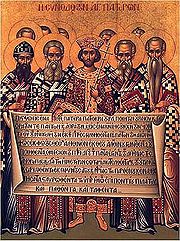
. In 325, the First Council of Nicaea
First Council of Nicaea
The First Council of Nicaea was a council of Christian bishops convened in Nicaea in Bithynia by the Roman Emperor Constantine I in 325 CE...

 signalled consolidation of Christianity under an orthodoxy endorsed by Constantine, though this did not make other Christian groups outside the adopted definition illegal, the dissenting Arian bishops
Arianism
Arianism is the theological teaching of Arius , a Christian priest, who was first ruled a heretic at the First Council of Nicea of 325, later exonerated in 335 at the First Synod of Tyre, and then pronounced a heretic again after his death at the First Council of Constantinople of 381...

 were initially exiled. Though Constantine restated Arius
Arius
Arius was a Berber Christian priest from Alexandria, Egypt in the early fourth century whose teachings, now called Arianism, were deemed heretical by the Church....

 before his death and exiled Orthodox Athanasius of Alexandria
Athanasius of Alexandria
Athanasius of Alexandria , also given the titles Athanasius the Great, Pope Athanasius I of Alexandria, and Athanasius the Apostolic, was a Christian theologian, bishop of Alexandria, Church Father, and a noted Egyptian leader of the fourth century. He is best remembered for his role in the...

. In 380 Emperor Theodosius I
Theodosius I
Flavius Theodosius , also called Theodosius I and Theodosius the Great , was Roman Emperor from 379 to 395. Reuniting the eastern and western portions of the empire, Theodosius was the last emperor of both the Eastern and Western Roman Empire...

 made Christianity the Roman Empire's official religion
State religion
A state religion is a religious body or creed officially endorsed by the state. Practically, a state without a state religion is called a secular state. The term state church is associated with Christianity, and is sometimes used to denote a specific national branch of Christianity...

 (see Byzantine Empire
Byzantine Empire
The Byzantine Empire or Eastern Roman Empire, was the continuation of the Roman Empire during the Middle Ages, centered on the capital of Constantinople, and ruled by Emperors in direct and de jure succession to the ancient Roman Emperors...

 and the Goths
Goths
The Goths were a heterogeneous East Germanic tribe. The historian Jordanes claimed that the Goths arrived from semi-legendary Scandza, believed to be somewhere in modern Götaland , and that a Gothic population had crossed the Baltic Sea before the 2nd century, lending their name to the region of...

) and did enforce the edict in 392 he passed legislation prohibiting all pagan
Paganism
Paganism is a word with several different meanings.In its broadest definition, pagan denotes all non-Abrahamic religions, that is to say it denotes all religions other than Judaism, Christianity, and Islam.Other usages are:*Paganism may mean Polytheism: The group so defined includes most of the...

 cultic worship.

During the 4th century, there was no such unity between church and state, though: In the course of the Arian controversy
Arian controversy
The Arian controversy describes several controversies related to Arianism which divided the Christian church from before the Council of Nicaea in 325 to after the Council of Constantinople in 381...

, leading trinitarian bishops such as Athanasius, Hilary of Poitiers
Hilary of Poitiers
Hilary of Poitiers was Bishop of Poitiers and is a Doctor of the Church. He was sometimes referred to as the "Hammer of the Arians" and the "Athanasius of the West." His name comes from the Greek word for happy or cheerful. His optional memorial in the Roman Catholic calendar of saints is 13...

, and Gregory of Nyssa
Gregory of Nyssa
Gregory of Nyssa was a Christian bishop and saint. He was a younger brother of Basil the Great and a good friend of Gregory Nazianzus. His significance has long been recognized in the Eastern Orthodox, Oriental Orthodox, and Roman Catholic branches of Christianity...

 were exiled by Arian
Arianism
Arianism is the theological teaching of Arius , a Christian priest, who was first ruled a heretic at the First Council of Nicea of 325, later exonerated in 335 at the First Synod of Tyre, and then pronounced a heretic again after his death at the First Council of Constantinople of 381...

 emperors, as were leading Arian and Anomoean theologians such as Aëtius
Aëtius (theologian)
Aëtius of Antioch , surnamed "the Atheist" by his trinitarian enemies, founder of an Arian Christian movement, was a native of Coele-Syria.-Life and writings:...

.

Towards the end of the century, bishop Ambrose of Milan made the powerful emperor Theodosius do penance for several months after the massacre of Thessalonica
Massacre of Thessaloniki
The Massacre of Thessalonica was a retaliatory action by the Roman Emperor Theodosius I in 390 against the inhabitants of Thessalonica, who had risen in revolt....

 before admitting him again to the eucharist
Eucharist
The Eucharist, also called Holy Communion, Sacrament of the Table, the Blessed Sacrament, or The Lord's Supper and other names, is a Christian sacrament or ordinance, generally considered to be a commemoration of the Last Supper, the final meal that Jesus Christ shared with his disciples before his...

. On the other hand, only a few years later, Chrysostom, who as bishop of Constantinople
Constantinople
Constantinople was the imperial capital of the Roman Empire , the Byzantine/Eastern Roman Empire , the Latin Empire , and the Ottoman Empire...

 was notorious for criticizing the excesses of the royal court, was eventually banished and died while traveling to his place of exile.

Theological implications


Critics point to this shift as the beginning of the era when Christianity and the will of God
God
God is a deity in theistic and deistic religions and other belief systems, representing either the sole deity in monotheism, or a principal deity in polytheism....

 gradually came to be identified with the state. This phenomenon is known as Caesaropapism
Caesaropapism
Caesaropapism is the idea of combining the power of secular government with, or making it superior to, the spiritual authority of the Christian Church; especially concerning the connection of the Christian Church with government...

. In its extreme form, such critics say, Christianity became little more than a religious justification for the exercise of power and a tool in the expansion and maintenance of empire, a Christian empire, also known as Christendom
Christendom
Christendom, or the Christian world, has several meanings. In a cultural sense it refers to the worldwide community of Christians, adherents of Christianity. This community numbers in the billions of people of the world population. This community is spread across many different nations and ethnic...

.

Augustine of Hippo
Augustine of Hippo
Augustine of Hippo , Bishop of Hippo Regius, also known as St. Augustine or St. Austin, was an Algerian Berber philosopher and theologian....

, who originally had rejected violence in religious matters, later justified it theologically against those he considered heretics, such as the Donatists, who themselves violently harassed their opponents. Before him, Athanasius believed that violence was justified in weeding out heresies that could damn all future Christians. This continued a line of thought started by Athanasius who felt that any means was justified in repressing the Arian
Arianism
Arianism is the theological teaching of Arius , a Christian priest, who was first ruled a heretic at the First Council of Nicea of 325, later exonerated in 335 at the First Synod of Tyre, and then pronounced a heretic again after his death at the First Council of Constantinople of 381...

 heresy. In 385, Priscillian
Priscillian
Priscillian, bishop of Ávila , a theologian from Roman Gallaecia , was the first person in the history of Christianity to be executed for heresy . He founded an ascetic group that, in spite of persecution, continued to subsist in Hispania and Gaul until the later 6th century...

, a bishop in Spain, was the first Christian to be executed for heresy, though the most prominent church leaders rejected this verdict.

Theologians critical of the Constantinian shift also see it as the point at which membership in the Christian church became associated with citizenship rather than a personal decision. American theologian Stanley Hauerwas
Stanley Hauerwas
Stanley Hauerwas is a Christian theologian and ethicist. He has taught at the University of Notre Dame and is currently the Gilbert T. Rowe Professor of Theological Ethics at Duke Divinity School with a joint appointment at the Duke University School of Law.-Education and Influences:Hauerwas...

 names the shift as the foundation for the expression of Christianity in the United States today that is closely associated with patriotism
Patriotism
Patriotism is love of and/or devotion to one's country. The word comes from the Greek patris, meaning fatherland. However, patriotism has had different meanings over time, and its meaning is highly dependent upon context, geography and philosophy....

 and civil religion
Civil religion
The intended meaning of the term civil religion often varies according to whether one is a sociologist of religion or a professional political commentator...

.

Criticisms


Vladimir Lossky
Vladimir Lossky
Vladimir Nikolayevich Lossky was an influential Eastern Orthodox theologian in exile from Russia. He emphasized theosis as the main principle of Orthodox Christianity....

 in his discourse on theology in The Mystical Theology of the Eastern Church, argued that Western Christianity had changed its understanding of the Christian religion theologically, which he attributes to a disconnect with Eastern traditions, mainly due to the Middle East falling under Islamic rule and the Schism
Great Schism
The term Great Schism may refer to one of several events in Christianity:* The East-West Schism , between Western Roman Catholic and Eastern Orthodox Christianity....

 of 1054 between the Pope
Pope
The pope is the Bishop of Rome and, as such, is leader of the worldwide Catholic Church...

 of Rome and the Orthodox
Eastern Orthodox Church
The Orthodox Church, also officially called the Orthodox Catholic Church and commonly referred to in English speaking countries as the Eastern Orthodox Church, is the world's second largest Christian communion, estimated to number 225 million members...

 churches of the Middle East.

Little of the historical events addressed in the "Constantinian shift" have been addressed in the West by Eastern Christian scholars or Eastern Christian theologians. There are a marked few, small exceptions.

From the Eastern Christian traditions, this part of their history does not contain any modern address or refutation as church doctrine. This disconnect also comes from historical distortions. Constantine continued to engage in imperial pagan religious practices. He also engaged in astrology
Astrology
Astrology is a group of systems, traditions, and beliefs which hold that the relative positions of celestial bodies and related details can provide information about personality, human affairs, and other terrestrial matters. A practitioner of astrology is called an astrologer...

 even though possibly being addressed as a catechumen
Catechumen
In ecclesiology, a catechumen is one receiving instruction from a catechist in the principles of the Christian religion with a view to baptism...

. It was only on his death bed that Constantine himself was baptized a Christian, though this was a common practice at the time. Constantine, after the council, eventually recalled Arius
Arius
Arius was a Berber Christian priest from Alexandria, Egypt in the early fourth century whose teachings, now called Arianism, were deemed heretical by the Church....

 from exile and banished Athanasius of Alexandria
Athanasius of Alexandria
Athanasius of Alexandria , also given the titles Athanasius the Great, Pope Athanasius I of Alexandria, and Athanasius the Apostolic, was a Christian theologian, bishop of Alexandria, Church Father, and a noted Egyptian leader of the fourth century. He is best remembered for his role in the...

 to Trier
Trier
Trier is a city in Germany on the banks of the Moselle River. It is the oldest city in Germany, founded in or before 16 BC. Trier is not the only city claiming to be Germany's oldest, but it is the only one that bases this assertion on having the longest history as a city, as opposed to a mere...

.

Within a historical context, these two factions of Christianity (Arianism
Arianism
Arianism is the theological teaching of Arius , a Christian priest, who was first ruled a heretic at the First Council of Nicea of 325, later exonerated in 335 at the First Synod of Tyre, and then pronounced a heretic again after his death at the First Council of Constantinople of 381...

 and Trinitarianism) did not resolve this conflict at the Council of Nicea.

As for the matter of Christian dominated state religion, or the charge of Caesaropapism
Caesaropapism
Caesaropapism is the idea of combining the power of secular government with, or making it superior to, the spiritual authority of the Christian Church; especially concerning the connection of the Christian Church with government...

, it is an absolute historical fact that shows direct and wide-reaching influence. The vast potential political power that can be used by controlling a people's religion is evident in that none of the major world historical religious traditions has ever functioned within the framework of not being a state religion at some point in history. In the Buddhist traditions, we see the theocracy
Theocracy
Theocracy is a form of government in which a god or deity is recognized as the state's supreme civil ruler, or in a higher sense, a form of government in which a state is governed by immediate divine guidance or by officials who are regarded as divinely guided. In Common Greek, “theocracy” means a...

 of Tibet
Tibet
Tibet is a plateau region in Asia, north of the Himalayas. It is home to the indigenous Tibetan people, and to some other ethnic groups such as Monpas and Lhobas, and is now also inhabited by considerable numbers of Han Chinese people. Tibet is the highest region on earth, with an average...

, which was only brought to an end by the Chinese invasion of Tibet in 1959. In the Hebrew
Hebrews
Hebrews are an ancient people defined as descendants of the prophet Eber, son of Shelah.In the Bible, the patriarch Abraham is referred to a single time as the ivri, which is the singular form of the...

 tradition, this practice can be seen starting in the Torah
Torah
The term "Torah" , refers either to the Five Books of Moses or to the entirety of Judaism's founding legal and ethical religious texts...

 with Abraham
Abraham
Abraham is the founding patriarch of the Israelites, Ishmaelites, Midianites and Edomite peoples, as described in the book of Genesis. He is widely regarded as the patriarch of Jews, Christians, and Muslims....

, followed by the Levite
Levite
In Jewish tradition, a Levite is a member of the Hebrew tribe of Levi. When Joshua led the Israelites into the land of Canaan, the Levites were the only Israelite tribe who received cities but no tribal land "because the Lord the God of Israel himself is their inheritance"...

, and continuing through to the Sadducees
Sadducees
The Sadducees were a group of Jews opposed to the Pharisees , founded in the second century BC. They ceased to exist sometime after the destruction of the second Temple in Jerusalem in 70AD....

. Islam
Islam
Islam Islam Islam ( al-’islām, There are ten pronunciations of Islam in English, differing in whether the first or second syllable has the stress, whether the s is or , and whether the a is pronounced as in father, as in cat, or (when the stress is on the i) as in the a of sofa...

 grew in tandem with the caliphate
Caliphate
The term caliphate refers to the first form of government inspired by Islam. It was initially led by Muhammad's disciples as a continuation of the political authority the prophet established, known as the 'rashidun caliphates'. It represented the political unity of the Muslim Ummah, and was the...

, and it enjoys the status of state religion in numerous contemporary countries, from Saudi Arabia
Saudi Arabia
Saudi Arabia , is an Arab country and the largest country of the Arabian Peninsula. It is bordered by Jordan on the northwest, Iraq on the north and northeast, Kuwait, Qatar, Bahrain, and the United Arab Emirates on the east, Oman on the southeast, and Yemen on the south...

 to Pakistan
Pakistan
Pakistan , officially the Islamic Republic of Pakistan, is a country located at the crossroads of South Asia, the Middle East, and Central Asia...

 to Iran
Iran
Iran , officially the Islamic Republic of Iran is a country in Western Asia. The name Iran has been in use natively since the Sassanid period and came into international use from 1935, before which the country was known internationally as Persia...

. Each of the above exemplifies a civic power controlling a religious institution even though the civic power may not actually subscribe to the given religion or act in the best interests of the religious tradition it has co-opted. These examples, and many others, directly indicate that power and control over the people by means of state-endorsed religion is an extremely effective and pervasive phenomenon. They also clearly indicate that the specific religious tradition is relatively arbitrary; it does not truly matter which specific religion is used, once an appropriate tradition is established it can be used to effectively wield immense influence over the people.

After the Reformation, many European State Churches themselves were and remain Protestant (see Church of Denmark
Church of Denmark
The Danish National Church, Church of Denmark or Evangelical Lutheran Church of Denmark is a state church and is the largest Christian church in Denmark, including Greenland. It is a Lutheran body and is officially supported by the government, but membership is voluntary...

, Church of Norway
Church of Norway
The Church of Norway is the state church of Norway. The church confesses the Lutheran Christian faith. It has as its foundation the Christian Bible, the Apostles' Creed, Nicene Creed, Athanasian Creed, Luther's Small Catechism and the Augsburg Confession...

, Church of Iceland
Church of Iceland
The National Church of Iceland, or Þjóðkirkjan, formally called the Evangelical Lutheran Church of Iceland, is the state church in Iceland. Like the established churches in the other Nordic countries, the National Church of Iceland professes the Lutheran branch of Christianity. Its head is the...

 (Protestant churches being outside the Roman Catholic and Eastern Orthodox communion,) and also the Anglican state churches of the Church of England
Church of England
The Church of England is the officially established Christian church in England, the Mother Church of the worldwide Anglican Communion and the oldest among the communion's thirty-eight independent national and regional churches...

 and the Anglican Church of Canada
Anglican Church of Canada
The Anglican Church of Canada is the sole Canadian representative of the Anglican Communion. The official French name is l'Église Anglicane du Canada...

.

In the West, a very important contextual component of this conflict seems to lack recognition. Of the two main characters at the Nicene Council, both Athanasius and Arius
Arius
Arius was a Berber Christian priest from Alexandria, Egypt in the early fourth century whose teachings, now called Arianism, were deemed heretical by the Church....

 were from the Egyptian church in Alexandria. As the teachings of Arius are the basis for the Council of Nicaea, so too can it be said that the teachings of St Athanasius, St Cyril of Alexandria were the basis of the Council of Chalcedon
Council of Chalcedon
The Council of Chalcedon is considered by the Roman Catholics, the Eastern Orthodox, the Old Catholics, and various other Western Christian groups to have been the Fourth Ecumenical Council . It was held from 8 October to 1 November 451 at Chalcedon...

 through Eutyches
Eutyches
Eutyches was a presbyter and archimandrite at Constantinople. He first came to notice in 431 at the First Council of Ephesus, for his vehement opposition to the teachings of Nestorius; his condemnation of Nestorianism as heresy precipitated his being denounced as a heretic...

. So to give to the idea that a shift or change in Christianity's validitity or sincerety should be attributed to Constantine would be to take the incidents out of historical context and give far too much weight to Emperor Constantine's legalization of Christianity in the Roman Empire. Nor does the Constantinian shift take into account the climate at the time in the Roman Empire and the effects of both Christians and Christian sectarians on the stability of the empire.

The conclusions of Constantinian shift would be to deny an active movement within the Christian communities of the time, and that movement's historical significance to the clarification of what it meant specifically to be a Christian ie Orthodox movement. ,

The theory of a Constantinian shift also denies the history that followed Constantine's legalization of Christianity as well as specifics that proceeded it, a history that contained a brief unity between the Arians and Trinitarians. When Julian the Apostate
Julian the Apostate
Flavius Claudius Julianus, known also as Julian, Julian the Apostate or Julian the Philosopher , was Roman Emperor , last of the Constantinian dynasty...

 ascended after Constantine II
Constantine II (emperor)
Flavius Claudius Constantinus, known in English as Constantine II, was Roman Emperor from 337 to 340. The eldest son of Constantine the Great and Fausta, he was born at Arles, and was raised as a Christian....

 to the throne of the Eastern Roman Empire, Julian then began to reinstate paganism (see Neoplatonism
Neoplatonism
Neoplatonism is the modern term for a school of religious and mystical philosophy that took shape in the 3rd century AD, founded by Plotinus and based on the teachings of Plato and earlier Platonists...

 and theurgy
Theurgy
Theurgy describes the practice of rituals, sometimes seen as magical in nature, performed with the intention of invoking the action or presence of one or more gods, especially with the goal of uniting with the divine, achieving henosis, and perfecting oneself.See also...

) at the expense of Christianity. The theory of the shift completely denies the existence of the two Arian Roman Emperors after Constantine the I, Constantius II
Constantius II
Flavius Iulius Constantius, known in English as Constantius II was a Roman Emperor of the Constantinian dynasty.-Early life:...

 (Constantine's son) and Flavius Iulius Valens who ruled Byzantium after the death of Constantine. A point to note here is that though Theodosius I
Theodosius I
Flavius Theodosius , also called Theodosius I and Theodosius the Great , was Roman Emperor from 379 to 395. Reuniting the eastern and western portions of the empire, Theodosius was the last emperor of both the Eastern and Western Roman Empire...

 did institute Christianity as a Roman Empire State religion, caused by the Gothic War (376–382), it was short lived. One decisive moment was the Battle of Chalons
Battle of Chalons
The Battle of the Catalaunian Plains , also called the Battle of Châlons or Battle of the Campus Mauriacus, took place in 451 between a coalition led by the Roman general Flavius Aetius and the Visigothic king Theodoric I on one side and the Huns and their allies commanded by Attila on the other...

 in 451 piting Christian against the Pagan Huns. As well as Byzantium being also sacked by the Goths the Christianity that was instituted by Theodosius I, was not the one embraced by the ruling Goths (see Huneric
Huneric
Huneric or Honeric was King of the Vandals and the oldest son of Geiseric. He dropped the imperial politics of his father and concentrated mainly on internal affairs. He was married to Eudocia, daughter of western Roman Emperor Valentinian III and Licinia Eudoxia. She left him probably in 472...

 of the Vandals
Vandals
The Vandals were an East Germanic tribe that entered the late Roman Empire during the 5th century. The Goth Theodoric the Great, king of the Ostrogoths and regent of the Visigoths, was allied by marriage with the Vandals as well as with the Burgundians and the Franks under .The Vandals are perhaps...

 and Fritigern
Fritigern
Fritigern, or Fritigernus , was a Western Gothic chieftain whose military victories in the Gothic War extracted favourable terms for the Goths when peace was made with Gratian in 382.-Fritigern against Athanaric?:...

). Also see Belisarius
Belisarius
Flavius Belisarius was one of the greatest generals of the Byzantine Empire. He was instrumental to Emperor Justinian I's ambitious project of reconquering much of the old Western Roman Empire, which had been lost just under a century previously.One of the defining features of Belisarius' career...

.

While being in the status of state religion none could guarantee not being removed from this position (see Julian the apostate
Julian the Apostate
Flavius Claudius Julianus, known also as Julian, Julian the Apostate or Julian the Philosopher , was Roman Emperor , last of the Constantinian dynasty...

), no religious tradition appears to have been able to keep such a role permanently either , with the possible exceptions being in the Muslim world (see Turkey
Turkey
Turkey , known officially as the Republic of Turkey , is a Eurasian country that stretches across the Anatolian peninsula in Western Asia and Thrace in the Balkan region of southeastern Europe...

 as a possible Muslim example of Church and State separation). With pre-Christian pagan empires being run by the emperor as a designated pagan god.

This criterion also appears to be unsatisfiable in that either the religion is subjective to the state aka Caesaropapism
Caesaropapism
Caesaropapism is the idea of combining the power of secular government with, or making it superior to, the spiritual authority of the Christian Church; especially concerning the connection of the Christian Church with government...

 or the religious tradition is the state aka Theocracy
Theocracy
Theocracy is a form of government in which a god or deity is recognized as the state's supreme civil ruler, or in a higher sense, a form of government in which a state is governed by immediate divine guidance or by officials who are regarded as divinely guided. In Common Greek, “theocracy” means a...

. Either characteristic being depicted as a negative one.

Support for the theory of a Constantian shift also would be to deny that Constantine considered himself to be partial or sympathetic to Arianism due to the influence of his historian, Eusebius of Caesarea
Eusebius of Caesarea
Eusebius of Caesarea became the bishop of Caesarea Palaestina, the capital of Iudaea province, c 314...

, as well as the Arian opposition leader (and relative to Constantine I), Eusebius of Nicomedia
Eusebius of Nicomedia
Eusebius of Nicomedia was the man who baptised Constantine. He was a bishop of Berytus in Phoenicia, then of Nicomedia where the imperial court resided in Bithynia, and finally of Constantinople from 338 up to his death....

. Eusebius of Nicomedia was the person Constantine had chosen to perform Constantine's baptism. Eusebius of Nicomedia's conflict with Athanasius of Alexandria
Athanasius of Alexandria
Athanasius of Alexandria , also given the titles Athanasius the Great, Pope Athanasius I of Alexandria, and Athanasius the Apostolic, was a Christian theologian, bishop of Alexandria, Church Father, and a noted Egyptian leader of the fourth century. He is best remembered for his role in the...

 and Marcellus of Ancyra
Marcellus of Ancyra
Marcellus of Ancyra was one of the bishops present at the Councils of Ancyra and of Nicaea. He was a strong opponent of Arianism, but was accused of adopting the opposite extreme of modified Sabellianism...

 influenced Constantine to reinstate Arius, exile Athanasius and contributed to Marcellus being deposed for heresy. In conclusion to claim such a thing as a Constantinian shift would be a reductionistic approach which denies in the ensuing historical struggles, that the Orthodox movement almost lost out to the Arian movement. It is to attempt to use the idea that we can superimpose upon the past our modern morals and perspectives. To suggest that an idea (of separation of church and state) existed at the time of Constantine and there was some place in the world were a society practiced separation of church and state which is patently untrue (and Constantine refused to follow the example). So to say that Constantian was imposing onto Christianity an orthdoxy that he espoused would be to deny the historical context. The Constantinian shift does not acknowledge the power of the Arian sectarians and or the influence over Constantine I both the Eusebiuses and Arians had.
The theory does however over simplify history to the point of creating a great many misconceptions about the true struggles and difficulties of the Christian church after its legalization. Also strange to the ancient Eastern Christian traditions is the idea that Christianity was supposedly corrupted by the involvement of Emperor Constantine but not when Charlemagne
Charlemagne
Charlemagne was King of the Franks from 768 to his death. He expanded the Frankish kingdoms into a Frankish Empire that incorporated much of Western and Central Europe...

 insisted on the filioque and the King of England Henry the Eighth intervened during the Protestant reformation.

See also

  • Christian anarchism
    Christian anarchism
    Christian anarchism is any of several traditions which combine anarchism with Christianity. Christian anarchists believe that freedom is justified spiritually through the teachings of Jesus. This has caused them to be critical of government and Church authority. Some believe all individuals can...

  • Caesaropapism
    Caesaropapism
    Caesaropapism is the idea of combining the power of secular government with, or making it superior to, the spiritual authority of the Christian Church; especially concerning the connection of the Christian Church with government...

  • Early Christianity
    Early Christianity
    Early Christianity is commonly known as the Christianity of the roughly three centuries between the Crucifixion of Jesus and the First Council of Nicaea in 325....

  • Great Apostasy
    Great Apostasy
    The Great Apostasy is a term used by some religious groups to allege a general fallen state of traditional Christianity, or especially of Catholicism, magisterial Protestantism and Eastern Orthodoxy, that it is not representative of the faith founded by Jesus and promulgated through his twelve...

  • Sacralism
    Sacralism
    Sacralism is the confluence of church and state wherein one is called upon to change the other.Christian sacralism is, according to Verduin, the hybrid product that resulted from the colossal change known as the Constantinian shift that began early in the fourth century AD, when Christianity was...

  • Donatist
    Donatist
    The Donatists were followers of a belief considered a schism by the broader churches of the Catholic tradition, and most particularly within the context of the religious milieu of the provinces of Roman North Africa in Late Antiquity...

    s
  • Constantinople
    Constantinople
    Constantinople was the imperial capital of the Roman Empire , the Byzantine/Eastern Roman Empire , the Latin Empire , and the Ottoman Empire...

  • Constantinianism
    Constantinianism
    Constantinianism refers to those policies said to be enacted, encouraged, or personally favored by Constantine the Great, a 4th century Roman Emperor...


Further reading

  • Timothy Barnes
    Timothy Barnes
    Timothy David Barnes is a British classicist.Timothy David Barnes was born in Yorkshire in 1942. He was educated at Queen Elizabeth Grammar School, Wakefield until 1960, going up to Balliol College, Oxford, where he read Literae Humaniores, taking his BA in 1964 and MA in 1967...

    , Constantine and Eusebius, 1981
  • Theodosian Code, Henry Bettenson, ed., Documents of the Christian Church, (London: Oxford University Press, 1943), p. 31. see: http://www.fordham.edu/halsall/source/theodcodeXVI.html
  • Peter Brown
    Peter Brown (historian)
    -Life:He was born in Dublin, Ireland to a Protestant family, and was educated at Shrewsbury School and New College, Oxford. He was a fellow of All Souls College, Oxford where he pursued his graduate studies under the direction of Arnaldo Momigliano....

    , The Rise of Western Christendom (Oxford: Blackwell Publishing, 2003),60.
  • James Bulloch, From Pilate to Constantine, 1981
  • Eusebius of Caesarea
    Eusebius of Caesarea
    Eusebius of Caesarea became the bishop of Caesarea Palaestina, the capital of Iudaea province, c 314...

    , Life of Constantine, Library of Nicene and Post Nicene Fathers, 2nd series (New York: Christian Literature Co., 1990), Vol I, 489-91. see: http://www.fordham.edu/halsall/source/conv-const.html
  • Alistair Kee, Constantine Versus Christ, 1982
  • Lactantius, Lucius Caecilius Firmianus, On the manner in which the persecutors died (English translation of De Mortibus Persecutorum) see: http://www.intratext.com/IXT/ENG0296/_P18.HTM
  • Ramsay MacMullen
    Ramsay MacMullen
    Ramsay MacMullen is an Emeritus Professor of history at Yale University, where he taught from 1967 to his retirement in 1993 as Dunham Professor of History and Classics...

    , Christianising the Roman Empire, 1984
  • Roger E. Olson
    Roger E. Olson
    Roger E. Olson is Professor of Theology, George W. Truett Theological Seminary, Baylor University, Waco, Texas, USA.He is also an ordained Baptist minister.He is married with two children.-Bibliography:Among Olson's many works are:...

    , The Story of Christian Theology, 1999

External links