


Gospel

Encyclopedia
Jesus
Jesus of Nazareth , commonly referred to as Jesus Christ or simply as Jesus or Christ, is the central figure of Christianity...
of Nazareth. In a more general sense the term "gospel" may refer to the good news message of the New Testament
New Testament
The New Testament is the second major division of the Christian biblical canon, the first such division being the much longer Old Testament....
. It is primarily used in reference to the four canonical gospels of Matthew
Gospel of Matthew
The Gospel According to Matthew is one of the four canonical gospels, one of the three synoptic gospels, and the first book of the New Testament. It tells of the life, ministry, death, and resurrection of Jesus of Nazareth...
, Mark
Gospel of Mark
The Gospel According to Mark , commonly shortened to the Gospel of Mark or simply Mark, is the second book of the New Testament. This canonical account of the life of Jesus of Nazareth is one of the three synoptic gospels. It was thought to be an epitome, which accounts for its place as the second...
, Luke
Gospel of Luke
The Gospel According to Luke , commonly shortened to the Gospel of Luke or simply Luke, is the third and longest of the four canonical Gospels. This synoptic gospel is an account of the life and ministry of Jesus of Nazareth. It details his story from the events of his birth to his Ascension.The...
, and John
Gospel of John
The Gospel According to John , commonly referred to as the Gospel of John or simply John, and often referred to in New Testament scholarship as the Fourth Gospel, is an account of the public ministry of Jesus...
. However, the term is also used to refer to the Apocryphal gospels, the Non-canonical gospels, the Jewish gospels and the Gnostic gospels
Gnostic Gospels
The Gnostic Gospels are a collection of about fifty-two texts supposedly based upon the ancient wisdom teachings of several prophets and spiritual leaders including Jesus, written from the 2nd to the 4th century AD. These gospels are not part of the standard Biblical canon of any major Christian...
.
Etymology
The word gospel derives from the Old EnglishOld English language
Old English or Anglo-Saxon is an early form of the English language that was spoken and written by the Anglo-Saxons and their descendants in parts of what are now England and southeastern Scotland between at least the mid-5th century and the mid-12th century...
gōd-spell (rarely godspel), meaning "good news" or "glad tidings". It is a calque
Calque
In linguistics, a calque or loan translation is a word or phrase borrowed from another language by literal, word-for-word or root-for-root translation.-Calque:...
(word-for-word translation) of the Greek
Koine Greek
Koine Greek is the universal dialect of the Greek language spoken throughout post-Classical antiquity , developing from the Attic dialect, with admixture of elements especially from Ionic....
word , euangelion (eu- "good", -angelion "message"). The Greek word "euangelion" is also the source (via Latinised "evangelium") of the terms "evangelist" and "evangelism" in English. The authors of the four canonical Christian gospels are known as the four evangelists.
Originally, the gospel was the good news of redemption through the propitiatory offering of Jesus Christ for one's sins, the central Christian message. Note: John 3:16. Before the first gospel was written (Mark, c 65-70), Paul the Apostle used the term gospel when he reminded the people of the church at Corinth
Corinth
Corinth is a city and former municipality in Corinthia, Peloponnese, Greece. Since the 2011 local government reform it is part of the municipality Corinth, of which it is the seat and a municipal unit...
"of the gospel I preached to you" (1 Corinthians
First Epistle to the Corinthians
The first epistle of Paul the apostle to the Corinthians, often referred to as First Corinthians , is the seventh book of the New Testament of the Bible...
15.1). Paul averred that they were being saved
Salvation
Within religion salvation is the phenomenon of being saved from the undesirable condition of bondage or suffering experienced by the psyche or soul that has arisen as a result of unskillful or immoral actions generically referred to as sins. Salvation may also be called "deliverance" or...
by the gospel, and he characterized it in the simplest terms, emphasizing Christ's appearances after the Resurrection
Resurrection appearances of Jesus
The major Resurrection appearances of Jesus in the Canonical gospels are reported to have occurred after his death, burial and resurrection, but prior to his Ascension. Among these primary sources, most scholars believe First Corinthians was written first, authored by Paul of Tarsus along with...
(15.3 – 8):
The earliest extant use of gospel to denote a particular genre of writing dates to the 2nd century. Justin Martyr
Justin Martyr
Justin Martyr, also known as just Saint Justin , was an early Christian apologist. Most of his works are lost, but two apologies and a dialogue survive. He is considered a saint by the Roman Catholic Church and the Eastern Orthodox Church....
(c 155) in 1 Apology 66 wrote: "...the apostles, in the memoirs composed by them, which are called Gospels".
Henry Barclay Swete
Henry Barclay Swete
Henry Barclay Swete was an English Biblical scholar. He became Regius Professor of Divinity at Cambridge in 1890. He is known for his 1906 commentary on the Book of Revelation, and other works of exegesis....
's Introduction to the Old Testament in Greek, pages 456-457 states:
- in the LXX occurs only in the plural, and perhaps only in the classical sense of 'a reward for good tidings' ( [also , , , ]); in the N.T.New TestamentThe New Testament is the second major division of the Christian biblical canon, the first such division being the much longer Old Testament....
it is from the first appropriated to the Messianic good tidings , probably deriving this new meaning from the use of in , , , .
In the New Testament
New Testament
The New Testament is the second major division of the Christian biblical canon, the first such division being the much longer Old Testament....
, evangelism meant the proclamation of God's saving activity in Jesus
Jesus
Jesus of Nazareth , commonly referred to as Jesus Christ or simply as Jesus or Christ, is the central figure of Christianity...
of Nazareth
Nazareth
Nazareth is the largest city in the North District of Israel. Known as "the Arab capital of Israel," the population is made up predominantly of Palestinian Arab citizens of Israel...
, or the agape
Agape
Agape is one of the Greek words translated into English as love, one which became particularly appropriated in Christian theology as the love of God or Christ for mankind. In the New Testament, it refers to the fatherly love of God for humans, as well as the human reciprocal love for God; the term...
message proclaimed
Ministry of Jesus
In the Christian gospels, the Ministry of Jesus begins with his Baptism in the countryside of Judea, near the River Jordan and ends in Jerusalem, following the Last Supper with his disciples. The Gospel of Luke states that Jesus was "about 30 years of age" at the start of his ministry...
by Jesus of Nazareth. This is the original New Testament
New Testament
The New Testament is the second major division of the Christian biblical canon, the first such division being the much longer Old Testament....
usage (for example or ; see also Strong's G2098).
The peculiar situation in the English language of an obsolete translation persisting into current usage harks back to John Wycliffe
John Wycliffe
John Wycliffe was an English Scholastic philosopher, theologian, lay preacher, translator, reformer and university teacher who was known as an early dissident in the Roman Catholic Church during the 14th century. His followers were known as Lollards, a somewhat rebellious movement, which preached...
who already had gospel, and whose usage was adopted into the King James Version.
The short o in the modern word gospel is due to mistaken association with the word god. Old English gōd-spell had a long vowel and would have become good-spell in modern English.
The first accounts
Critical scholars generally agree on several early sayings collections and accounts preceding the "canonical" Gospels. The dedicatory preface of the Gospel of LukeGospel of Luke
The Gospel According to Luke , commonly shortened to the Gospel of Luke or simply Luke, is the third and longest of the four canonical Gospels. This synoptic gospel is an account of the life and ministry of Jesus of Nazareth. It details his story from the events of his birth to his Ascension.The...
testifies already to the existence of several "accounts" of the life of Jesus by the time of its composition. The term Luke uses (διήγησις diēgēsis) is a term used in classical Greek for any historical narrative. The term "Gospel" is not used in the New Testament text for any of the canonical
Canonical
Canonical is an adjective derived from canon. Canon comes from the greek word κανών kanon, "rule" or "measuring stick" , and is used in various meanings....
Gospels, though in later centuries a traditional reading of 2 Corinthians 8:18 "the brother whose praise is the Gospel" was to sometimes identify this with Luke, and consequently Gospel of Luke.
Synoptic gospels
The synoptic gospelsSynoptic Gospels
The gospels of Matthew, Mark, and Luke are known as the Synoptic Gospels because they include many of the same stories, often in the same sequence, and sometimes exactly the same wording. This degree of parallelism in content, narrative arrangement, language, and sentence structures can only be...
are the source of many popular stories, parables, and sermons, such as Jesus' humble birth in Bethlehem
Nativity of Jesus
The Nativity of Jesus, or simply The Nativity, refers to the accounts of the birth of Jesus in two of the Canonical gospels and in various apocryphal texts....
, the Sermon on the Mount
Sermon on the Mount
The Sermon on the Mount is a collection of sayings and teachings of Jesus, which emphasizes his moral teaching found in the Gospel of Matthew...
, the Beatitudes
Beatitudes
In Christianity, the Beatitudes are a set of teachings by Jesus that appear in the Gospels of Matthew and Luke. The term Beatitude comes from the Latin adjective beatus which means happy, fortunate, or blissful....
, the Last Supper
Last Supper
The Last Supper is the final meal that, according to Christian belief, Jesus shared with his Twelve Apostles in Jerusalem before his crucifixion. The Last Supper provides the scriptural basis for the Eucharist, also known as "communion" or "the Lord's Supper".The First Epistle to the Corinthians is...
, and the Great Commission
Great Commission
The Great Commission, in Christian tradition, is the instruction of the resurrected Jesus Christ to his disciples, that they spread his teachings to all the nations of the world. It has become a tenet in Christian theology emphasizing missionary work, evangelism, and baptism...
. John provides a theological description of Jesus as the eternal Word, the unique savior
Redeemer (Christianity)
In Christian theology, Jesus is sometimes referred to as a Redeemer. This refers to the salvation he is believed to have accomplished, and is based on the metaphor of redemption, or "buying back". Although the New Testament does not use the title "Redeemer", the word "redemption" is used in several...
of humanity. All four attest to his Sonship
Son of God
"Son of God" is a phrase which according to most Christian denominations, Trinitarian in belief, refers to the relationship between Jesus and God, specifically as "God the Son"...
, miraculous power
Miracles of Jesus
The miracles of Jesus are the supernatural deeds of Jesus, as recorded in Gospels, in the course of his ministry. According to the Gospel of John, only some of these were recorded. states that "Jesus did many other things as well...
, crucifixion, and resurrection. Portions of the gospels are traditionally read aloud during church services as a formal part of the liturgy
Liturgy
Liturgy is either the customary public worship done by a specific religious group, according to its particular traditions or a more precise term that distinguishes between those religious groups who believe their ritual requires the "people" to do the "work" of responding to the priest, and those...
.
The fourth gospel, the Gospel of John, presents a very different picture of Jesus and his ministry
Ministry of Jesus
In the Christian gospels, the Ministry of Jesus begins with his Baptism in the countryside of Judea, near the River Jordan and ends in Jerusalem, following the Last Supper with his disciples. The Gospel of Luke states that Jesus was "about 30 years of age" at the start of his ministry...
from the synoptics. In differentiating history from invention, historians interpret the gospel accounts skeptically but generally regard the synoptic gospels as including significant amounts of historically reliable information about Jesus.
More generally, gospels compose a genre
Genre
Genre , Greek: genos, γένος) is the term for any category of literature or other forms of art or culture, e.g. music, and in general, any type of discourse, whether written or spoken, audial or visual, based on some set of stylistic criteria. Genres are formed by conventions that change over time...
of early Christian literature
Literature
Literature is the art of written works, and is not bound to published sources...
. Gospels that did not become canonical also circulated in Early Christianity
Early Christianity
Early Christianity is generally considered as Christianity before 325. The New Testament's Book of Acts and Epistle to the Galatians records that the first Christian community was centered in Jerusalem and its leaders included James, Peter and John....
. Some, such as the work known today as Gospel of Thomas
Gospel of Thomas
The Gospel According to Thomas, commonly shortened to the Gospel of Thomas, is a well preserved early Christian, non-canonical sayings-gospel discovered near Nag Hammadi, Egypt, in December 1945, in one of a group of books known as the Nag Hammadi library...
, lack the narrative framework typical of a gospel. These gospels almost certainly appeared much later than the canonical gospels, with the Gospel of Thomas being a likely exception.
Historicity of the canonical gospels
The historicity of the gospels refers to the reliability and historic character of the four New Testament gospels as historical documents. Historians subject the gospels to critical analysis, attempting to differentiate authentic, reliable information from what they judge to be inventions, exaggerations, and alterations.Biblical scholars consider the synoptic gospels to contain much reliable historical information about the historical Jesus
Historicity of Jesus
The historicity of Jesus concerns how much of what is written about Jesus of Nazareth is historically reliable, and whether the evidence supports the existence of such an historical figure...
as a Galilean teacher and of the religious movement he founded, but not everything contained in the gospels is considered to be historically reliable.
The baptism of Jesus
Baptism of Jesus
The baptism of Jesus marks the beginning of Jesus Christ's public ministry. This event is recorded in the Canonical Gospels of Matthew, Mark and Luke. In John 1:29-33 rather than a direct narrative, the Baptist bears witness to the episode...
, his preaching, and the crucifixion of Jesus
Crucifixion of Jesus
The crucifixion of Jesus and his ensuing death is an event that occurred during the 1st century AD. Jesus, who Christians believe is the Son of God as well as the Messiah, was arrested, tried, and sentenced by Pontius Pilate to be scourged, and finally executed on a cross...
are deemed to be historically authentic. Elements whose historical authenticity is disputed include the two accounts of the nativity of Jesus
Nativity of Jesus
The Nativity of Jesus, or simply The Nativity, refers to the accounts of the birth of Jesus in two of the Canonical gospels and in various apocryphal texts....
, as well as certain details about the crucifixion and the resurrection. The fourth gospel, John
Gospel of John
The Gospel According to John , commonly referred to as the Gospel of John or simply John, and often referred to in New Testament scholarship as the Fourth Gospel, is an account of the public ministry of Jesus...
, includes a number of historically reliable details, but it differs greatly from the first three gospels, and historians largely discount it. The canonical gospels, overall, are considered to have more historically authentic content than the various non-canonical gospels.
On one extreme, some Christian scholars maintain that the gospels are inerrant descriptions of the life of Jesus. On the other extreme, some scholars have concluded that the gospels provide no historical information about Jesus life since the first gospel accounts (Mark) only appeared 40 years after Jesus's death.
Canonical gospels
Of the many gospels written in antiquity, only four gospels came to be accepted as part of the New TestamentNew Testament
The New Testament is the second major division of the Christian biblical canon, the first such division being the much longer Old Testament....
, or canonical
Biblical canon
A biblical canon, or canon of scripture, is a list of books considered to be authoritative as scripture by a particular religious community. The term itself was first coined by Christians, but the idea is found in Jewish sources. The internal wording of the text can also be specified, for example...
. An insistence upon there being a canon of four gospels, and no others, was a central theme of Irenaeus of Lyons, c. 185. In his central work, Adversus Haereses
On the Detection and Overthrow of the So-Called Gnosis
On the Detection and Overthrow of the So-Called Gnosis, today also called On the Detection and Overthrow of Knowledge Falsely So Called , commonly called Against Heresies , is a five-volume work written by St. Irenaeus in the 2nd century...
Irenaeus denounced various early Christian groups that used only one gospel, such as Marcionism
Marcionism
Marcionism was an Early Christian dualist belief system that originated in the teachings of Marcion of Sinope at Rome around the year 144; see also Christianity in the 2nd century....
which used only Marcion's version of Luke
Gospel of Marcion
The Gospel of Marcion, called by its adherents the Gospel of the Lord, was a text used by the mid-2nd century Christian teacher Marcion to the exclusion of the other gospels...
, or the Ebionites
Ebionites
Ebionites, or Ebionaioi, , is a patristic term referring to a Jewish Christian sect or sects that existed during the first centuries of the Christian Era. They regarded Jesus as the Messiah and insisted on the necessity of following Jewish religious law and rites...
which seem to have used an Aramaic version of Matthew
Gospel of the Ebionites
Gospel of the Ebionites is the conventional name given to the description by Epiphanius of Salamis of a gospel used by the Ebionites. All that is known of the gospel text consists of seven brief quotations found in Chapter 30 of a heresiology written by Epiphanius known as the Panarion...
as well as groups that embraced the texts of newer revelations, such as the Valentinians (A.H. 1.11). Irenaeus declared that the four he espoused were the four "Pillars of the Church": "it is not possible that there can be either more or fewer than four" he stated, presenting as logic the analogy
Analogy
Analogy is a cognitive process of transferring information or meaning from a particular subject to another particular subject , and a linguistic expression corresponding to such a process...
of the four corners of the earth and the four winds (3.11.8). His image, taken from Ezekiel
Ezekiel
Ezekiel , "God will strengthen" , is the central protagonist of the Book of Ezekiel in the Hebrew Bible. In Judaism, Christianity and Islam, Ezekiel is acknowledged as a Hebrew prophet...
1, or Revelation
Revelation
In religion and theology, revelation is the revealing or disclosing, through active or passive communication with a supernatural or a divine entity...
4:6-10, of God's throne borne by four creatures with four faces—"the four had the face of a man, and the face of a lion, on the right side: and the four had the face of an ox on the left side; they four also had the face of an eagle"—equivalent to the "four-formed" gospel, is the origin of the conventional symbols of the Evangelists: lion, bull, eagle, man. Irenaeus was ultimately successful in declaring that the four gospels collectively, and exclusively these four, contained the truth. He also supported reading each gospel in light of the others.
By the turn of the 5th century, the Catholic Church
Roman Catholic Church
The Catholic Church, also known as the Roman Catholic Church, is the world's largest Christian church, with over a billion members. Led by the Pope, it defines its mission as spreading the gospel of Jesus Christ, administering the sacraments and exercising charity...
in the west, under Pope Innocent I
Pope Innocent I
-Biography:He was, according to his biographer in the Liber Pontificalis, the son of a man called Innocens of Albano; but according to his contemporary Jerome, his father was Pope Anastasius I , whom he was called by the unanimous voice of the clergy and laity to succeed -Biography:He was,...
, recognized a biblical canon
Biblical canon
A biblical canon, or canon of scripture, is a list of books considered to be authoritative as scripture by a particular religious community. The term itself was first coined by Christians, but the idea is found in Jewish sources. The internal wording of the text can also be specified, for example...
including the four gospels of Matthew, Mark, Luke, and John, which had been previously established at a number of regional Synods, namely the Council of Rome
Council of Rome
The Council of Rome was a meeting of Christian Church officials and theologians which took place in 382 under the authority of the bishop of Rome, Damasus I. The previous year, the Emperor Theodosius I had appointed the "dark horse" candidate Nectarius Archbishop of Constantinople...
(382), the Synod of Hippo
Synod of Hippo
The Synod of Hippo refers to the synod of 393 which was hosted in Hippo Regius in northern Africa during the early Christian Church. Additional synods were held in 394, 397, 401 and 426....
(393), and two Synods of Carthage (397 and 419). This canon, which corresponds to the modern Catholic canon
Canon of Trent
Though many canons or canon laws were formulated as a result of the 16th century Ecumenical council of the Roman Catholic Church known as the Council of Trent, the phrase Canon of Trent usually refers to the list of biblical books that were from then on to be considered canonical...
, was used in the Vulgate
Vulgate
The Vulgate is a late 4th-century Latin translation of the Bible. It was largely the work of St. Jerome, who was commissioned by Pope Damasus I in 382 to make a revision of the old Latin translations...
, an early 5th century translation of the Bible made by Jerome
Jerome
Saint Jerome was a Roman Christian priest, confessor, theologian and historian, and who became a Doctor of the Church. He was the son of Eusebius, of the city of Stridon, which was on the border of Dalmatia and Pannonia...
under the commission of Pope Damasus I
Pope Damasus I
Pope Saint Damasus I was the bishop of Rome from 366 to 384.He was born around 305, probably near the city of Idanha-a-Velha , in what is present-day Portugal, then part of the Western Roman Empire...
in 382.
- Gospel according to Matthew
- Gospel according to Mark
- Gospel according to Luke
- Gospel according to John
There was also another order, the "western order of the Gospels", so called because it is typical for the manuscripts which are usually a representative of the Western text-type
Western text-type
The Western text-type is one of several text-types used in textual criticism to describe and group the textual character of Greek New Testament manuscripts...
.
- Gospel according to Matthew
- Gospel according to John
- Gospel according to Luke
- Gospel according to Mark
This order is found in the following manuscripts: Bezae
Codex Bezae
The Codex Bezae Cantabrigensis, designated by siglum Dea or 05 , δ 5 , is a codex of the New Testament dating from the 5th century written in an uncial hand on vellum. It contains, in both Greek and Latin, most of the four Gospels and Acts, with a small fragment of the 3 John...
, Monacensis
Codex Monacensis
Codex Monacensis designated by X or 033 , A3 , is a Greek uncial manuscript of the Gospels, dated palaeographically to the 9th or 10th century...
, Washingtonianus
Codex Washingtonianus
The Codex Washingtonianus or Codex Washingtonensis, designated by W or 032 , ε 014 , also called the Washington Manuscript of the Gospels, and The Freer Gospel, contains the four biblical gospels and was written in Greek on vellum in the fourth or fifth century...
, Tischendorfianus IV
Codex Tischendorfianus IV
Codex Tischendorfianus IV – designated by Γ or 036 , ε 70 – is a Greek uncial manuscript of the Gospels, dated palaeographically to the 10th century...
, Uncial 0234
Uncial 0234
Uncial 0234 , ε 49 , is a Greek uncial manuscript of the New Testament. Paleographically it has been assigned to the 8th century.- Description :...
.
Although there is no set order of the four gospels in patristic lists or discussions, D. Moody Smith suggests that the standard order of Matthew-Mark-Luke-John "projects a kind of intention that can
scarcely be ignored."
In what he calls a "mild form of reader criticism
Reader-response criticism
Reader-response criticism is a school of literary theory that focuses on the reader and his or her experience of a literary work, in contrast to other schools and theories that focus attention primarily on the author or the content and form of the work.Although literary theory has long paid some...
, Greg Goswell suggests a possible rationale that "the commission
Great Commission
The Great Commission, in Christian tradition, is the instruction of the resurrected Jesus Christ to his disciples, that they spread his teachings to all the nations of the world. It has become a tenet in Christian theology emphasizing missionary work, evangelism, and baptism...
at the end of Matthew (28:20) is in part fulfilled by the subsequent Gospels (and letters)" while for Luke,
The preface to LukeLuke 1Luke 1 is the first chapter of the Gospel of Luke in the New Testament of the Christian Bible. It describes the events leading up to the birth of Jesus. It is written to Theophilus, who could be a real person or could simply mean a fellow Christian as theo philus is Greek for God lover...
(1:1–4) is a possible explanation for that Gospel’s canonical placement after Matthew and Mark, for its non-pejorative reference to previous "attempts" (επεχειρησαν) at writing an account of what Jesus said and did can be understood in canonical context as referring to the Gospels of Matthew and Mark.
Goswell concludes by suggesting that the self-reference to "this book" in John 20:30, "can be taken as an implicit acknowledgment of other books, namely the three preceding Gospels."
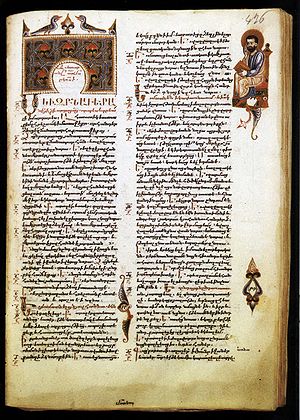
Medieval copies of the four canonical gospels are known as Gospel Book
Gospel Book
The Gospel Book, Evangelion, or Book of the Gospels is a codex or bound volume containing one or more of the four Gospels of the Christian New Testament...
s or also simply as Gospels (in Greek as Tetraevangelia). Notable examples include the Lindisfarne Gospels
Lindisfarne Gospels
The Lindisfarne Gospels is an illuminated Latin manuscript of the gospels of Matthew, Mark, Luke and John in the British Library...
(c 700), the Barberini Gospels
Barberini Gospels
The Barberini Gospels is an illuminated Hiberno-Saxon manuscript Gospel Book , assumed to be of a late eighth century origin...
, Lichfield Gospels
Lichfield Gospels
The Lichfield Gospels is an eighth century Insular Gospel Book housed in Lichfield Cathedral. There are 236 surviving folios, eight of which are illuminated. Another four contain framed text...
and the Vienna Coronation Gospels
Vienna Coronation Gospels
See also Coronation Gospels for other manuscripts with the nameThe Vienna Coronation Gospels, also known as the Treasury Gospels is a late 8th Century illuminated Gospel Book...
(8th century), the Book of Kells
Book of Kells
The Book of Kells is an illuminated manuscript Gospel book in Latin, containing the four Gospels of the New Testament together with various prefatory texts and tables. It was created by Celtic monks ca. 800 or slightly earlier...
and the Ada Gospels
Ada Gospels
The Ada Gospels is a late eighth century or early ninth century Carolingian gospel book. The manuscript contains a dedication to Charlemagne's sister Ada, whence it gets its name. The manuscript is written on vellum in Carolingian minuscule. It measures 14.5 by 9.625 inches...
(c. 800) or the Ebbo Gospels
Ebbo Gospels
The Ebbo Gospels is an early Carolingian illuminated Gospel book known for an unusual, energetic style of illustration...
(9th century).
Origin of the canonical gospels
The majority view today is that Mark is the first Gospel, with Matthew and Luke borrowing passages both from that Gospel and from at least one other common source, lost to history, termed by scholars 'Q' (from , meaning "source"). This view is known as the "two-source hypothesisTwo-source hypothesis
The Two-Source Hypothesis is an explanation for the synoptic problem, the pattern of similarities and differences between the three Gospels of Matthew, Mark, and Luke. It posits that the Gospel of Matthew and the Gospel of Luke were based on the Gospel of Mark and a lost, hypothetical sayings...
". The two-gospel hypothesis
Two-gospel hypothesis
The Two-Gospel Hypothesis is a proposed solution to the Synoptic Problem. The hypothesis, , was introduced in its current form by William Farmer in 1964. The synoptic problem concerns the pattern of similarities and differences between the three Gospels of Matthew, Mark, and Luke...
, in contrast, says that Matthew was written first (by Matthew the Apostle), and then Luke the Evangelist wrote his gospel (using Matthew as his main source) before Mark the Evangelist wrote his gospel (using Peter's testimony). John was written last and shares little with the synoptic gospels.
The gospels were apparently composed in stages. Mark's traditional ending (Mark 16:9-20, see Mark 16
Mark 16
Mark 16 is the final chapter of the Gospel of Mark in the New Testament of the Christian Bible. It begins with the discovery of the empty tomb by Mary Magdalene, Mary the mother of James, and Salome — there they encounter a man dressed in white who announces the Resurrection of Jesus.Verse 8 ends...
) was most likely composed early in the 2nd century and appended to Mark in the middle of that century. The birth and infancy narratives apparently developed late in the tradition. Luke and Matthew may have originally appeared without their first two chapters.
The consensus among biblical scholars is that all four canonical gospels were originally written in Greek
Greek language
Greek is an independent branch of the Indo-European family of languages. Native to the southern Balkans, it has the longest documented history of any Indo-European language, spanning 34 centuries of written records. Its writing system has been the Greek alphabet for the majority of its history;...
, the lingua franca
Lingua franca
A lingua franca is a language systematically used to make communication possible between people not sharing a mother tongue, in particular when it is a third language, distinct from both mother tongues.-Characteristics:"Lingua franca" is a functionally defined term, independent of the linguistic...
of the Roman Orient.
Dating
Estimates for the dates when the canonical gospel accounts were written vary significantly; and the evidence for any of the dates is scanty. Because the earliest surviving complete copies of the gospels date to the 4th century and because only fragments and quotations exist before that, scholars use higher criticism to propose likely ranges of dates for the original gospel autographs. Scholars variously assess the majority (though not the consensus ) view as follows:- Mark: c. 68–73, c 65-70
- Matthew: c. 70–100. c 80-85.
- Luke: c. 80–100, with most arguing for somewhere around 85, c 80-85
- John: c 90-100, c. 90–110, The majority view is that it was written in stages, so there was no one date of composition.
Traditional Christian scholarship has generally preferred to assign earlier dates. Some historians interpret the end of the book of Acts as indicative, or at least suggestive, of its date; as Acts does not mention the death of Paul
Paul of Tarsus
Paul the Apostle , also known as Saul of Tarsus, is described in the Christian New Testament as one of the most influential early Christian missionaries, with the writings ascribed to him by the church forming a considerable portion of the New Testament...
, generally accepted as the author of many of the Epistles, who was later put to death by the Romans c. 65. Acts is attributed to the author of the Gospel of Luke, which is believed to have been written before Acts, and therefore would shift the chronology of authorship back, putting Mark as early as the mid 50s. Here are the dates given in the modern NIV Study Bible
NIV Study Bible
The NIV Study Bible is a study Bible originally published by Zondervan in 1985 which uses the New International Version . Revisions include 1995, a full revision in 2002, an update in October 2008 for the 30th anniversary of the NIV, and a new update in 2011...
(for a fuller discussion see Augustinian hypothesis
Augustinian hypothesis
The Augustinian hypothesis is a solution to the synoptic problem, which concerns the origin of the Gospels of the New Testament. The hypothesis holds that Matthew was written first, by Matthew the Evangelist...
):
- Matthew: c. 50 to 70s
- Mark: c. 50s to early 60s, or late 60s
- Luke: c. 59 to 63, or 70s to 80s
- John: c. 85 to near 100, or 50s to 70
Such early dates are not limited to conservative scholars. In Redating the New Testament John A. T. Robinson, a prominent liberal theologian and bishop, makes a case for composition dates before the fall of Jerusalem
Siege of Jerusalem (70)
The Siege of Jerusalem in the year 70 AD was the decisive event of the First Jewish-Roman War. The Roman army, led by the future Emperor Titus, with Tiberius Julius Alexander as his second-in-command, besieged and conquered the city of Jerusalem, which had been occupied by its Jewish defenders in...
.
Location
Matthew was probably written in Syria, perhaps in Antioch, an ancient Christian center. Mark has traditionally been associated with Peter's preaching in Rome, and it is well-suited to a Roman audience. Various cities have been proposed for the origin of Luke, but there is no consensus on the matter. Ephesus, in Western Anatolia, is a popular scholarly choice for the place of origin for the Gospel of John.Following Raymond Brown
Raymond E. Brown
The Reverend Raymond Edward Brown, S.S. , was an American Roman Catholic priest, a member of the Sulpician Fathers and a major Biblical scholar of his era...
's postulation of a Johannine community having been responsible for John's gospel and letters, other scholars have identified localized communities behind each of the other gospels and Q. This assumes the relative isolation of early Christian communities in which distinctive traditions concerning Jesus thrived. Other scholars have questioned this hypothesis and have stressed the constant communication between early Christian communities.
Oral tradition
The oral traditionsLogia
In New Testament scholarship, the term logia is a term applied to collections of sayings credited to Jesus. Such a collection of sayings of Jesus are believed to be referred to by Papias of Hierapolis...
that the evangelists drew on were transmitted by word of mouth for decades. This oral tradition consisted of several distinct components. Parables and aphorisms are the "bedrock of the tradition." Pronouncement stories, scenes that culminate with a saying of Jesus, are more plausible historically than other kinds of stories about Jesus. Other sorts of stories include controversy stories, in which Jesus is in conflict with religious authorities; miracles stories, including healings, exorcisms, and nature wonders; call and commissioning stories; and legends.
One of the most important concerns in accurately accounting for the oral Jesus tradition is the model of transmission used. Form criticism (Formgeschichte) was developed primarily by the German scholars Karl Ludwig Schmidt, Martin Dibelius, and Rudolf Bultmann. The oral model developed by the form critics drew heavily on contemporary theory of folkloric transmission of oral material, and partly as a result of this form criticism posited that the Jesus tradition was transmitted informally, added to freely, and was uncontrolled. However, "Today it is no exaggeration to claim that a whole spectrum of main assumptions underlying Bultmann's Synoptic Tradition must be considered suspect. " A number of other models have been proposed which posit greater control over the tradition, to varying degrees. For example, largely in response to form critical scholarship, Professor Birger Gerhardsson
Birger Gerhardsson
Birger Gerhardsson, born 1926, is a Swedish Biblical scholar and professor emeritus in the Faculty of Theology at Lund University, Sweden. His primary academic focus has been on the transmission and development of the oral traditions of the New Testament gospels.-Selected bibliography:* "Memory and...
examined oral transmission in early rabbinic circles, and proposed that a more controlled and formal model of orality would more accurately reflect the transmission of the Jesus tradition in early Christian circles, and therefore that the oral traditions present in the gospels have been fairly reliably and faithfully transmitted. Professor Kenneth Bailey, after spending a great deal of time in remote and illiterate villages in the Middle East, used his experience with orality in such places to formulate a similar model of controlled transmission within the early Christian communities, but posited an informal mechanism of control. Controlled models of the Jesus tradition, and with them an evaluation of the gospels as possessing greater historical reliability, have been accepted by several scholars in recent years. However Thomas R. Yoder Neufeld adds that the early followers of Jesus were not interested in simply preserving the past but were also interested in fitting the narratives to suit urgent information, audience interest and creativity in communication and believed that they were in direct communication with Jesus though the Holy Spirit, thus making it still difficult for historians to assess the historical reliability of the oral tradition. With regards to Bailey's studies, Maurice Casey writes that they cannot be applied to 1st century Jews as they were about a different culture at a different time.
Content of the gospels
The four gospels present different narratives, reflecting different intents on the parts of their authors.All four gospels portray Jesus as leading a group of disciples, performing miracles, preaching in Jerusalem
Jerusalem in Christianity
For Christians, Jerusalem's place in the ministry of Jesus and the Apostolic Age gives it great importance, in addition to its place in the Old Testament, the Hebrew Bible.-Jerusalem in the New Testament and early Christianity:...
, being crucified, and rising from the dead
Resurrection appearances of Jesus
The major Resurrection appearances of Jesus in the Canonical gospels are reported to have occurred after his death, burial and resurrection, but prior to his Ascension. Among these primary sources, most scholars believe First Corinthians was written first, authored by Paul of Tarsus along with...
.
The synoptic gospels represent Jesus as an exorcist
Exorcist
In some religions an exorcist is a person who is believed to be able to cast out the devil or other demons. A priest, a nun, a monk, a healer, a shaman or other specially prepared or instructed person can be an exorcist...
and healer who preached in parables about the coming Kingdom of God
Kingdom of God
The Kingdom of God or Kingdom of Heaven is a foundational concept in the Abrahamic religions: Judaism, Christianity and Islam.The term "Kingdom of God" is found in all four canonical gospels and in the Pauline epistles...
. He preached first in Galilee and later in Jerusalem, where he cleansed the temple
Jesus and the Money Changers
The narrative of Jesus and the money changers, commonly referred to as the cleansing of the Temple, occurs in all four canonical gospels of the New Testament....
. He states that he offers no sign as proof (Mark) or only the sign of Jonah (Matthew and Luke). In Mark, apparently written with a Roman audience in mind, Jesus is a heroic man of action, given to powerful emotions, including agony. In Matthew, apparently written for a Jewish audience, Jesus is repeatedly called out as the fulfillment of Hebrew prophecy. In Luke, apparently written for gentiles, Jesus is especially concerned with the poor. Luke emphasizes the importance of prayer and the action of the Holy Spirit
Holy Spirit
Holy Spirit is a term introduced in English translations of the Hebrew Bible, but understood differently in the main Abrahamic religions.While the general concept of a "Spirit" that permeates the cosmos has been used in various religions Holy Spirit is a term introduced in English translations of...
in Jesus' life and in the Christian community. Jesus appears as a stoic supernatural being, unmoved even by his own crucifixion. Like Matthew, Luke insists that salvation offered by Christ is for all, and not the Jews only.
The Gospel of John represents Jesus as an incarnation of the eternal Word (Logos), who spoke no parables, talked extensively about himself, and did not explicitly refer to a Second Coming
Second Coming
In Christian doctrine, the Second Coming of Christ, the Second Advent, or the Parousia, is the anticipated return of Jesus Christ from Heaven, where he sits at the Right Hand of God, to Earth. This prophecy is found in the canonical gospels and in most Christian and Islamic eschatologies...
. Jesus preaches in Jerusalem, launching his ministry with the cleansing of the temple. He performs several miracles as signs, most of them not found in the synoptics. The Gospel of John ends:(21:25) "And there are also many other things which Jesus did, the which, if they should be written every one, I suppose that even the world itself could not contain the books that should be written. Amen."
Gospel Genre
One important aspect of the study of the gospels is the genre under which they fall. Genre "is a key convention guiding both the composition and the interpretation of writings. " Whether the Gospel authors set out to write novels, myths, histories, or biographies has a tremendous impact on how they ought to be interpreted. If, for example, Rudolf Bultmann was correct, and the Gospel authors had no interest in history or in a historical Jesus, then the Gospels must be read and interpreted in this light. However, some recent studies suggest that the genre of the Gospels ought to be situated within the realm of ancient biography. Although not without critics, the position that the Gospels are a type of ancient biography is the consensus among scholars today.Non-canonical gospels
In addition to the four canonical gospels, early Christians wrote other gospels that were not accepted into the canon, some of which are discussed below.Jewish-Christian Gospels
EpiphaniusEpiphanius of Salamis
Epiphanius of Salamis was bishop of Salamis at the end of the 4th century. He is considered a saint and a Church Father by both the Eastern Orthodox and Catholic Churches. He gained a reputation as a strong defender of orthodoxy...
, Jerome
Jerome
Saint Jerome was a Roman Christian priest, confessor, theologian and historian, and who became a Doctor of the Church. He was the son of Eusebius, of the city of Stridon, which was on the border of Dalmatia and Pannonia...
and other early church fathers preserve in their writings citations from one or more Jewish-Christian Gospels
Jewish-Christian Gospels
Jewish-Christian Gospels are non-canonical Gospels used by various Jewish Christian groups that were declared heretical by other members of the Early Church. They are mentioned by Irenaeus, Clement of Alexandria, Origen, Eusebius, Epiphanius and Jerome...
, versions of Matthew used by Ebionites
Ebionites
Ebionites, or Ebionaioi, , is a patristic term referring to a Jewish Christian sect or sects that existed during the first centuries of the Christian Era. They regarded Jesus as the Messiah and insisted on the necessity of following Jewish religious law and rites...
and Nazarene
Nazarene (sect)
The Nazarene sect is used in two contexts:* Firstly of the New Testament early church where in Acts 24:5 Paul is accused before Felix at Caesarea by Tertullus of being "a ringleader of the sect of the Nazarenes."...
s. Most modern critical scholars consider that the extant citations suggest at least two and probably three distinct Jewish-Christian versions of Matthew, and that the source language of these is probably Greek. A minority of scholars, including Edward Nicholson
Edward Nicholson (librarian)
Edward Williams Byron Nicholson was an author and Bodley's Librarian, the head of the Bodleian Library at the University of Oxford, from 1882 until his death in 1912.-Early life and career:...
(1879) and James R. Edwards
James R. Edwards
James R. Edwards is an American New Testament scholar and minister of the Presbyterian Church.In 1997 he joined the faculty at Whitworth University, Spokane where he is currently Bruner-Welch Professor of Theology. In 2009 he advanced a "controversial" theory that the synoptic Gospels are partly...
(2009) have suggested that the surviving citations are all from one Gospel, which is, as Jerome himself records that the Nazarenes claimed, the original, and Hebrew, Gospel of Matthew.
According to Eusebius, Origen
Origen
Origen , or Origen Adamantius, 184/5–253/4, was an early Christian Alexandrian scholar and theologian, and one of the most distinguished writers of the early Church. As early as the fourth century, his orthodoxy was suspect, in part because he believed in the pre-existence of souls...
said the first Gospel was written by Matthew (Church History 6.25.4). Jerome reports that the Nazarenes believed that this Gospel was composed in Hebrew near Jerusalem for Hebrew Christians and Jerome claimed to have translated parts of it into Greek, but if so any the Greek translation has not survived. Jerome reports that the Nazarenes' Hebrew original was kept at the Library of Caesarea and that the Nazarene Community transcribed a copy for him which he used in his work (On Illustrious Men 3:7) Jerome refers to this gospel sometimes as the Gospel according to the Hebrews (3.7) and sometimes as the Gospel of the Apostles (Against Pelagius 3.2).
Gospel of Thomas
The gospel attributed to Thomas is mostly wisdomWisdom literature
Wisdom literature is the genre of literature common in the Ancient Near East. This genre is characterized by sayings of wisdom intended to teach about divinity and about virtue...
without narrating Jesus's life. A few scholars argue that its first edition was written c 50-60, but that the surviving edition was written in the first half of the 2nd century. This would mean that its first edition was contemporary with the earliest letters of Paul the Apostle. The Oxford Dictionary of the Christian Church says that the original may date from c. 150. It may represent a tradition independent from the canonical gospels, but that developed over a long time and was influenced by Matthew and Luke. While it can be understood in Gnostic terms, it lacks the characteristic features of Gnostic doctrine. The Jesus Seminar identified two of its unique parables, the parable of the empty jug and the parable of the assassin. It had been lost but was discovered, in a Coptic version dating from c. 350, at Nag Hammadi
Nag Hammâdi
Nag Hammadi , is a city in Upper Egypt. Nag Hammadi was known as Chenoboskion in classical antiquity, meaning "geese grazing grounds". It is located on the west bank of the Nile in the Qena Governorate, about 80 kilometres north-west of Luxor....
in 1945-6, and three papyri, dated to c. 200, which contain fragments of a Greek text similar to but not identical with that in the Coptic language, have also been found.
Gospel of Peter
The gospel of Peter was likely written in the first half of the 2nd century. It seems to be largely legendary, hostile toward Jews, and including docetic elements. It had been lost but was rediscovered in the 19th century.Gospel of Judas
The Gospel of JudasGospel of Judas
The Gospel of Judas is a Gnostic gospel that purportedly documents conversations between the Disciple Judas Iscariot and Jesus Christ.It is believed to have been written by Gnostic followers of Jesus, rather than by Judas himself, and probably dates from no earlier than the 2nd century, since it...
is another controversial and ancient text that purports to tell the story of the gospel from the perspective of Judas, the disciple who is usually said to have betrayed Jesus in most versions of the Bible. It paints an unusual picture of the relationship between Jesus and Judas, in that appears to interpret Judas's act not as betrayal, but rather as an act of obedience to the instructions of Jesus. The text was recovered from a cave in Egypt by a thief and thereafter sold on the black market until it was finally discovered by a collector who, with the help of academics from Yale and Princeton, was able to verify its authenticity. The document itself does not claim to have been authored by Judas (it is, rather, a Gospel about Judas), and dates no earlier than the 2nd century.
The Sayings Collection 'Q'
According to scholars proposing the existence of a hypothetical sayings-source, a Redensquelle, 'Q' (following the terminology of Johannes WeissJohannes Weiss
Johannes Weiss was a German theologian and Biblical exegete.-History:Weiss was born in Kiel, Germany. A perpetual scholar, he studied in the University of Marburg, the University of Berlin, the University of Göttingen, and the University of Breslau...
) at some time there existed a document comprised mostly sayings of Jesus with little narrative. It is presumed the source for many of Jesus' sayings in Matthew and Luke, and accordingly must have preceded these gospels. It is believed that the earliest form of the sayings were written c. 50-60. However Mark Goodacre
Mark Goodacre
Mark Goodacre is a New Testament scholar and Professor at Duke University's Department of Religion. He has written extensively on the Synoptic Problem; that is, the origins of the gospels of Matthew, Mark, and Luke...
and other scholars have questioned the existence of a Q document.
Infancy gospels
A genre of "Infancy gospels" (Greek: protoevangelion) arose in the 2nd century, such as the Gospel of JamesGospel of James
The Gospel of James, also known as the Infancy Gospel of James or the Protoevangelium of James, is an apocryphal Gospel probably written about AD 145, which expands backward in time the infancy stories contained the Gospels of Matthew and Luke, and presents a narrative concerning the birth and...
, which introduces the concept of the Perpetual Virginity of Mary, and the Infancy Gospel of Thomas
Infancy Gospel of Thomas
The Infancy Gospel of Thomas is a pseudepigraphical gospel about the childhood of Jesus that dates to the 2nd and 3rd centuries. It was part of a popular genre of biblical work, written to satisfy a hunger among early Christians for more miraculous and anecdotal stories of the childhood of Jesus...
(not to be confused with the absolutely different sayings Gospel of Thomas), both of which related many miraculous incidents from the life of Mary and the childhood of Jesus that are not included in the canonical gospels.
Harmonies
Another genre is that of gospel harmoniesGospel harmony
A Gospel harmony is an attempt to merge or harmonize the canonical gospels of the Four Evangelists into a single gospel account, the earliest known example being the Diatesseron by Tatian in the 2nd century. A gospel harmony may also establish a chronology for the events of the life of Jesus...
, in which the four canonical gospels were selectively recast as a single narrative to present a consistent text. Very few fragments of harmonies have survived. The Diatessaron
Diatessaron
The Diatessaron is the most prominent Gospel harmony created by Tatian, an early Christian apologist and ascetic. The term "diatessaron" is from Middle English by way of Latin, diatessarōn , and ultimately Greek, διὰ τεσσάρων The Diatessaron (c 160 - 175) is the most prominent Gospel harmony...
was such a harmonization, compiled by Tatian
Tatian
Tatian the Assyrian was an Assyrian early Christian writer and theologian of the 2nd century.Tatian's most influential work is the Diatessaron, a Biblical paraphrase, or "harmony", of the four gospels that became the standard text of the four gospels in the Syriac-speaking churches until the...
around 175. It was popular for at least two centuries in Syria
Syria
Syria , officially the Syrian Arab Republic , is a country in Western Asia, bordering Lebanon and the Mediterranean Sea to the West, Turkey to the north, Iraq to the east, Jordan to the south, and Israel to the southwest....
, but eventually it fell into disuse. More recently, in 2006, UOG Press published ONE as a modern gospel harmony of the four Canonical Gospels; ONE contains a 2,992 numbering reference system which tracks the textual harmonization process to the extant works for analysis and citation.
Marcion's Gospel of Luke
Marcion of SinopeMarcion of Sinope
Marcion of Sinope was a bishop in early Christianity. His theology, which rejected the deity described in the Jewish Scriptures as inferior or subjugated to the God proclaimed in the Christian gospel, was denounced by the Church Fathers and he was excommunicated...
, c. 150, had a version of the gospel of Luke which differed substantially from that which has now become the standard text. Marcion's version was far less Jewish than the now canonical text, and his critics alleged that he had edited out the portions he didn't like from the canonical version, though Marcion argued that his text was the more genuinely original one. Marcion also rejected all the other gospels, including Matthew, Mark and especially John, which he alleged had been forged by Irenaeus
Irenaeus
Saint Irenaeus , was Bishop of Lugdunum in Gaul, then a part of the Roman Empire . He was an early church father and apologist, and his writings were formative in the early development of Christian theology...
.
See also
- List of Gospels
- AgraphaAgraphaAgrapha are sayings of Jesus that are not found in the canonical Gospels. The term was used for the first time by J.G...
are the collection of religious sayings attributed to Jesus Christ that are not found in the canonical gospels. - GodspellGodspellGodspell is a musical by Stephen Schwartz and John-Michael Tebelak. It opened off Broadway on May 17, 1971, and has played in various touring companies and revivals many times since, including a 2011 revival now playing on Broadway...
is a musical based on the gospels of Jesus Christ. The word "Gódspell" is Anglo Saxon (ca 1000 AD) for Gospel. - Good news (Christianity) concerning the content of the Bible's message about Jesus Christ
- Gospel harmonyGospel harmonyA Gospel harmony is an attempt to merge or harmonize the canonical gospels of the Four Evangelists into a single gospel account, the earliest known example being the Diatesseron by Tatian in the 2nd century. A gospel harmony may also establish a chronology for the events of the life of Jesus...
- Gospel (liturgy)Gospel (liturgy)The Gospel in Christian liturgy refers to a reading from the Gospels used during various religious services, including Mass or Divine Liturgy . In many Christian churches, all present stand when a passage from one of the Gospels is read publicly, and sit when a passage from a different part of the...
- The Aquarian Gospel of Jesus the ChristThe Aquarian Gospel of Jesus the ChristThe Aquarian Gospel of Jesus the Christ is a book by Levi H. Dowling, first published in 1908. He said he had transcribed the text of the book from the Akashic records...
- GilyonimGilyonimGilyonim is a term used by Jewish scribes flourishing between 100 and 135 CE to denote the Gospels.-Play upon words:The designation as used by them did not imply any mockery; Rabbi Meïr, who flourished after 135, a descendant of Greek proselytes, was the first to play upon the word ἐυαγγέλιον by...
- InjilInjilThe Injil is the Arabic name for the original Gospel of Jesus, and one of the four Islamic Holy Books the Qur'an records as revealed by God, the others being the Zabur, Tawrat and Qur'an. The word Injil is derived from the Greek word and means 'good news'. Muslims believe this original Gospel...
- Four evangelistsFour EvangelistsIn Christian tradition the Four Evangelists are Matthew, Mark, Luke, and John, the authors attributed with the creation of the four Gospel accounts in the New Testament that bear the following titles:*Gospel according to Matthew*Gospel according to Mark...
- Bodmer PapyriBodmer PapyriThe Bodmer Papyri are a group of twenty-two papyri discovered in Egypt in 1952. They are named after Martin Bodmer who purchased them. The papyri contain segments from the Old and New Testaments, early Christian literature, Homer and Menander. The oldest, P66 dates to c. 200. The papyri are kept at...
- Acts of the Apostles (genre)Acts of the Apostles (genre)The Acts of the Apostles is a genre of Early Christian literature, recounting the lives and works of the apostles of Jesus. The Acts are important for many reasons, one of them being the concept of apostolic succession...
- Apocalyptic literatureApocalyptic literatureApocalyptic literature is a genre of prophetical writing that developed in post-Exilic Jewish culture and was popular among millennialist early Christians....
- ChristianityChristianityChristianity is a monotheistic religion based on the life and teachings of Jesus as presented in canonical gospels and other New Testament writings...
- EvangelismEvangelismEvangelism refers to the practice of relaying information about a particular set of beliefs to others who do not hold those beliefs. The term is often used in reference to Christianity....
- BibleBibleThe Bible refers to any one of the collections of the primary religious texts of Judaism and Christianity. There is no common version of the Bible, as the individual books , their contents and their order vary among denominations...
- TheologyTheologyTheology is the systematic and rational study of religion and its influences and of the nature of religious truths, or the learned profession acquired by completing specialized training in religious studies, usually at a university or school of divinity or seminary.-Definition:Augustine of Hippo...
- JesusismJesusismJesuism is the personal philosophy encompassing the moral teachings of Jesus of Nazareth and commitment or adherence to those teachings. Jesuism is distinct from and sometimes opposed to mainstream Christianity. In particular, the term is often contrasted with the theology attributed to Paul of...
Further references
McGrath, A. 2001. In the Beginning the Story of the King James Bible and how it changed a Nation, a Language and a Culture. Hodder & Stoughton. ISBN 0 340 78585 3.External links
- BibleGateway.com has the text of the New Testament gospels in various translations and versions
- A detailed discussion of the textual variants in the gospels — covering about 1200 variants on 2000 pages.
- Greek New Testament — the Greek text of the New Testament: specifically the Westcott-Hort text from 1881, combined with the NA26/27 variants.
- Introduction to The Complete Gospels — an excerpt and information about this compilation of canonical and non-canonical gospels in translation.
- Tessarôn Euaggeliôn Sumphônia - The Greek harmony of the Gospels
- Quattuor Evangeliorum Consonantia - The Latin harmony of the Gospels (1)
- Quattuor Evangeliorum Consonantia - The Latin harmony of the Gospels (2)
- The Case against Q collects resources for considering the Q hypothesis and evidence that Luke used Matthew
- Parallel Gospels in Harmony Online version of the public domain book Parallel Gospels in Harmony — with Study Guide
- Synoptic Parallels A web tool for finding corresponding passages in the Gospels