
All Topics  
Jehovah


   Email Print
   Bookmark   Link


Jehovah


Jehovah, also Yehovah, is an English reading of , the most frequent form of the Tetragrammaton
Tetragrammaton

Tetragrammaton The letters, properly read from right to left , are:|-! Hebrew !! Letter name !! Pronunciation|-valign=top| ?'...
 , the principal and personal name of God in the Hebrew Bible
Hebrew Bible

The term Hebrew Bible is a generic reference to those books of the Bible originally written mostly in Biblical Hebrew with some Biblical Aramaic....
 (Old Testament).

It is a direct phonetic transliteration based on the Hebrew Bible text with vowel points
Niqqud

In Hebrew language orthography, niqqud or nikkud is the system of diacritical signs used to represent vowels or distinguish between alternative pronunciations of consonants of the Hebrew alphabet....
 handed down by the Masoretes
Masoretes

The Masoretes were groups of scribes and Tanakh scholars working between the 7th and 11th centuries, based primarily in Israel in the cities of Tiberias and Jerusalem, as well as in Babylonia....
. By long tradition, in modern Jewish culture the Tetragrammaton is not pronounced. Instead the above vocalization indicates to the reverent Jewish reader that the term Adonai is to be used.


Discussion
Ask a question about 'Jehovah'
Start a new discussion about 'Jehovah'
Answer questions from other users
Full Discussion Forum


Encyclopedia


Jehovah, also Yehovah, is an English reading of , the most frequent form of the Tetragrammaton
Tetragrammaton

Tetragrammaton The letters, properly read from right to left , are:|-! Hebrew !! Letter name !! Pronunciation|-valign=top| ?'...
 , the principal and personal name of God in the Hebrew Bible
Hebrew Bible

The term Hebrew Bible is a generic reference to those books of the Bible originally written mostly in Biblical Hebrew with some Biblical Aramaic....
 (Old Testament).

It is a direct phonetic transliteration based on the Hebrew Bible text with vowel points
Niqqud

In Hebrew language orthography, niqqud or nikkud is the system of diacritical signs used to represent vowels or distinguish between alternative pronunciations of consonants of the Hebrew alphabet....
 handed down by the Masoretes
Masoretes

The Masoretes were groups of scribes and Tanakh scholars working between the 7th and 11th centuries, based primarily in Israel in the cities of Tiberias and Jerusalem, as well as in Babylonia....
. By long tradition, in modern Jewish culture the Tetragrammaton is not pronounced. Instead the above vocalization indicates to the reverent Jewish reader that the term Adonai is to be used. In places where the preceding or following word already is Adonai, the reading Elohim
Elohim

Elohim is a Hebrew language word which expresses concepts of divinity. It is apparently related to the Hebrew word El , though morphology it consists of the Hebrew word Eloah with a plural suffix....
 is used instead, indicated by a different vocalization of the Tetragrammaton. It is generally referred, in line with the Jewish tradition, that (Jehovah) is a "hybrid form", created when the Masoretes added the vowel pointing
Niqqud

In Hebrew language orthography, niqqud or nikkud is the system of diacritical signs used to represent vowels or distinguish between alternative pronunciations of consonants of the Hebrew alphabet....
 of Adonai to the consonants of YHWH. Early English translators, thought to have been unacquainted with Jewish tradition, read this word as they would any other word, and transcribed it (in very few places, namely those where the Name itself was referred to) as Jehovah.

The form thus achieved wide currency in the translations of the Protestant Reformation
Protestant Reformation

The Protestant Reformation was a Christian reform movement in Europe. It is thought to have begun in 1517 with Martin Luther's Ninety-Five Theses and may be considered to have ended with the Peace of Westphalia in 1648....
,, though it was already in use by Roman Catholic authors. As an Adonist Hebraist, John Drusius critiqued this form of God's name in 1604 A.D., and later regarded by both Jews and some Christians as a mispronunciation, it has nevertheless found a place in Christian liturgical and theological usage. It is the regular English rendition of in the American Standard Version
American Standard Version

The Revised Version, Standard American Edition of the Bible, more commonly known as the American Standard Version , is a version of the Bible that was released in 1901....
, and occurs seven times in the King James Version. It is also used in Christian hymns such as "Guide Me, O Thou Great Jehovah".

The Catholic Encyclopedia
Catholic Encyclopedia

The Catholic Encyclopedia, also referred to today as the Old Catholic Encyclopedia, is an English language encyclopedia published by The Encyclopedia Press....
, Volume 8, 1910 edition, page 329, states: “Jehovah, the proper name of God in the Old Testament."

The name Jehovah is used by Jehovah's Witnesses
Jehovah's Witnesses

Jehovah's Witnesses is a restorationism, Millenarianism Christianity religious movement. Sociology of religion have classified the group as an Adventism sect....
 as the personal name of God. They give the following position:
The truth is, nobody knows for sure how the name of God was originally pronounced. Nevertheless, many prefer the pronunciation Jehovah. Why? Because it has a currency and familiarity that Yahweh does not have. Would it not, though, be better to use the form that might be closer to the original pronunciation? Not really, for that is not the custom with Bible names. To take the most prominent example,consider the name of Jesus. Do you know how Jesus' family and friends addressed him in day-to-day conversation while he was growing up in Nazareth? The truth is, no human knows for certain, although it may have been something like Yeshua (or perhaps Yehoshua). It certainly was not Jesus.)


Some however question the received view that the vowels of Jehovah originate with the word Adonai rather than an ancient pronunciation of YHWH. They note that details of vocalization differ between the various early extant manuscripts of the Hebrew Bible, and note that the vowel points of Jehovah and Adonai are not precisely the same, and that scholars are not in total agreement as to why this should be.

The pronunciation Jehovah

Sorfron Iehova
This pronunciation "Jehovah" is considered grammatically impossible by some; it arose through pronouncing the vowels of the "kere" (marginal reading of the Masorites: = "Adonay") with the consonants of the "ketib" (text-reading: = "Yhwh")—"Adonai" (the Lord) being substituted with one exception wherever Yhwh occurs in the Biblical and liturgical book
Liturgical book

A liturgical book is a book published by the authority of a Christian Clergy, that contains the text and directions for the liturgy of its official religious services....
s.

"Adonai" presents the vowels "shewa" the composite ( ) under the guttural becomes simple ( ) under the ( ), "holem," and "kamez," and these give the reading ( ) (= "Jehovah"). When the two names ( ) and ( ) occur together, the former is pointed with "hatef segol" ( ) under the ( )— thus, (="Jehovah")—to indicate that in this combination it is to be pronounced "Elohim" ( ).

These substitutions of "Adonai"and "Elohim" for YHWH were devised to avoid the profanation of the "Ineffable Name" ( hence is also written ’, or even ’, and read "ha-Shem" = "the Name ").

The vowel points of Jehovah


Jewish tradition teaches that has the vowel points
Niqqud

In Hebrew language orthography, niqqud or nikkud is the system of diacritical signs used to represent vowels or distinguish between alternative pronunciations of consonants of the Hebrew alphabet....
 of (Adonai), but the vowel points of these two words are not precisely the same, and scholars are not in total agreement as to why does not have the precise same vowel points as Adonai has.

The use of the composite "shewa" "hatef segol" ( ) in cases where "Elohim" is to be read has led to the opinion that the composite "shewa" "hatef patah" ( ) ought to have been used to indicate the reading "Adonay."

It has been argued in reply that the disuse of the "patah" is in keeping with the Babylonian system, in which the composite "shewa" is not usual. But the reason why the "patah" is dropped is the non-guttural character of the "yod"; to indicate the reading "Elohim," however, the "segol" (and "hirek" under the last syllable, i.e., ) had to appear in order that a mistake might not be made and "Adonay" be repeated.

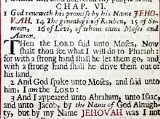
Early English translators, unacquainted with or in opposition to Jewish tradition, read this word as they would any other word, and transcribed "Iehouah" (1530 A.D.), "Iehovah" (1611 A.D.), or "Jehovah" (1671 A.D.).

In Strong's Exhaustive Concordance of the Bible (1890 A.D.), James Strong transliterated as Yehovah.

Identification with Trinity

Trinitarian Christians, who are often called Orthodox Christians, usually invoke the Nicean creed and the Chalcedonian creed
Chalcedonian Creed

The Confession of Chalcedon , also known as the "Doctrine of the Hypostatic Union" or the "2-Nature Doctrine", was adopted at the Council of Chalcedon in 451 in Asia Minor....
 in order to identify Jehovah as essentially the same as the Holy Trinity, a name that belongs to every person of the Trinity. They believe that Elohim and Jehovah are similar names, and that the Abrahamic revelation at the oak of Mamre had a deeply Trinitarian significance.

Modern scholar usage of the rendering Jehovah


The following works, either always or sometimes render the Tetragrammaton as Jehovah:
  • William Tyndale, in his 1530 translation of the first five books of the English Bible, at Exodus 6:3 renders the divine name as Iehovah. In his note to this edition he wrote: "Iehovah is God's name...Moreover, as oft as thou seeist LORD in great letters (except there be any error in the printing) it is in Hebrew Iehovah."
  • The King James (Authorized) Version, 1611: four times as the personal name of God (in all capital letters): Exodus 6:3; Psalm 83:18; Isaiah 12:2; Isaiah 26:4; and three times in place names: Genesis 22:14; Exodus 17:15; and Judges 6:24.
  • Young's Literal Translation of the Holy Bible by J.N. Young, 1862, 1898
    Young's Literal Translation

    Young's Literal Translation is a translation of the Bible into English language, published in 1862. The translation was made by Robert Young , compiler of Young's Analytical Concordance to the Bible and Concise Critical Comments on the New Testament....
     renders the Tetragrammaton as Jehovah 6831 times.
  • A literal translation of the Old Testament (1890) and the New Testament (1884)
    Darby Bible

    The Darby Bible refers to the Bible as translated from Hebrew language and Greek language by John Nelson Darby. The English version was first published in 1890....
    , by John Nelson Darby, renders the Tetragrammaton as Jehovah 6810 times in the main text.
  • The American Standard Version
    American Standard Version

    The Revised Version, Standard American Edition of the Bible, more commonly known as the American Standard Version , is a version of the Bible that was released in 1901....
    , 1901 edition, consistently renders the Tetragrammaton as Je-ho’vah in all 6,823 places where it occurs in the Old Testament.
  • The Modern Reader's Bible, 1914, by Richard Moulton, uses Jehovah at Ps.83:18; Ex.6:2-9; Ex.22:14; Ps.68:4; Jerm.16:20; Isa.12:2 & Isa. 26:4
  • The New English Bible
    New English Bible

    The New English Bible was a fresh translation of the Bible into modern English directly from the original Greek , Hebrew , and Aramaic texts ; with the New Testament being published in 1961, and the Old Testament, along with the Apocrypha, being published in 1970....
    , published by Oxford University Press, 1970, e.g. Gen 22:14; Exodus 3:15,16; 6:3; 17:15; Judges 6:24
  • The Literal Translation of the Holy Bible
    Green's Literal Translation

    Green's Literal Translation is a formal equivalence translation of the Christian Bible by Jay P. Green, Sr. First published in 1985, it became integrated into the 1986 edition of his Hebrew-English-Greek work called "The Interlinear Bible"....
     copyright © 1976-2000 by Jay P. Green, Sr., renders the Tetragrammaton as Jehovah 6,866 times.
  • The Living Bible, published by Tyndale House Publishers, Illinois 1971, e.g. Gen 22:14, Exodus 3:15; 4:1-27; 17:15; Lev 19:1-36; Deut 4: 29, 39; 5:5, 6; Judges 6:16, 24; Ps 83:18; 110:1; Isaiah 45:1, 18; Amos 5:8; 6:8; 9:6
  • The New World Translation of the Holy Scriptures
    New World Translation of the Holy Scriptures

    The New World Translation of the Holy Scriptures is a modern-language translation of the Bible published by the Watchtower Bible and Tract Society for Jehovah's Jehovah's Witnesses in 1961....
    , published by Watchtower Bible and Tract Society of New York, Inc., Brooklyn, NY 1961 and last revised in 1984: 'Jehovah' appears in the bible text 7,210 times, i.e. 6,973 in the Hebrew scriptures (OT), 237 times in the Christian Greek scriptures (NT).
  • The Bible in Today's English (Good News Bible), published by the American Bible Society, 1976, in its preface states, 'the distinctive Hebrew name for God (usually transliterated Jehovah or Yahweh) is in this translation represented by "The Lord."' In the footnote to Exodus 6:3 they refer to their footnote for Exodus 3:14 which says of the '...name Yahweh, traditionally transliterated as Jehovah."
  • In the Emphatic Diaglott
    Emphatic Diaglott

    The Emphatic Diaglott is a translation of the New Testament by Benjamin Wilson , first published in 1864. It is an interlinear translation with the original Greek text and a formal equivalence English translation in the left column, and a full English translation in the right column....
    , a translation of the Christian Greek Scriptures made by Benjamin Wilson, the name Jehovah appears 18 times.


Following a different development of the Latin letter J
J

J or j is a consonant in Esperanto orthography, representing a voiced postalveolar fricative , and is equivalent to the voiced postalveolar fricative, , or the voiced retroflex fricative, ....
, in Italian
Italian language

Italian is a Romance languages spoken by about 63 million people as a first language, primarily in Italy. In Switzerland, Italian is one of four Linguistic geography of Switzerlands....
 the divine name is rendered as Jeova, or Geova (soft 'G'). In German
German language

German is a West Germanic languages, thus related to and classified alongside English language and Dutch language. It is one of the world's world language and the most widely spoken mother tongue in the European Union....
, the letter J preserved the soft sound of the Latin I
I

I is the ninth Letter of the Latin alphabet. Its English language name is i ....
, so the word "Jehova" is read Yehova.

The centuries following the Middle Ages many Catholic churches all across Europe were decorated with this common form of the name. The same happenened with many public buildings. For example, the Coat of Arms
Coat of arms

A coat of arms, more properly called an armorial achievement, armorial bearings or often just arms for short, in European tradition, is a design belonging to a particular person and used by them in a wide variety of ways....
 of Plymouth
Plymouth

Plymouth is a City status in the United Kingdom and unitary authority on the coast of Devon, England, about south west of London. It is built between the mouths of the rivers River Plym to the east and River Tamar to the west, where they join Plymouth Sound....
 (UK) City Council bears the Latin inscription, "Turris fortissima est nomen Jehova", being the Latin translation of the first part of the Hebrew bible 'proverb' at Proverbs
Book of Proverbs

The Book of Proverbs is a book of the Hebrew Bible , included in the collected works known as the "Writings" or Ketuvim....
 18:10.

Although the original pronunciation of has become lost, for many centuries the popular English word for the personal name of God has been “Jehovah”. This is why some religious groups, notably Jehovah's Witnesses and the King-James-Only Movement
King-James-Only Movement

The King James Only movement is a label applied to a wide variety of beliefs concerning the superiority of the Authorized King James Version of the Bible, and often to the Textus Receptus version of the New Testament and the Masoretic Text of the Old Testament, from which the KJV was translated....
, make prominent use, in English speaking countries, of the pronunciation, "Jehovah." Among Jehovah's Witnesses, the name varies according to the common pronunciation in the language spoken, and terms definitively referencing the Hebrew Tetragrammaton, such as Yahweh, are considered equally useful.

Similarly well-established English renderings of Hebrew personal names include Joshua
Joshua

Joshua, Jehoshuah or Yehoshua , born in Egypt, was a biblical Israelite leader who succeeded Moses. His story is told in the Hebrew Bible, chiefly in the books Book of Exodus, Book of Numbers and Book of Joshua....
, Isaiah, Jesus
Jesus

Jesus of Nazareth , also known as Jesus Christ, is the central figure of Christianity and is revered by most Christian churches as the Son of God and the Incarnation ....
, and others, the original pronunciations for many of which have also been lost.

History

Under the heading " c. 6823", the editors of the Brown-Driver-Briggs Lexicon write that occurs 6518 times in the Masoretic Text
Masoretic Text

The Masoretic Text is the Hebrew language text of the Jewish Bible . It defines not just the Development of the Jewish Bible canon, but also the precise letter-text of the biblical books in Judaism, as well as their niqqud and cantillation for both public reading and private study....
.

Early Greek transcriptions of similar to "Jehovah"

  • ?e?a: (Ieoa, ) in Hellenistic magical texts


Early Latin transcriptions of similar to "Jehovah"


Transcriptions of similar to
"Jehovah" occurred as early as the
13th century.
  • c. 1106: Ieve: Petrus Alphonsi
    Petrus Alphonsi

    Petrus Alphonsi was a Jewish Spain writer and astronomer, and polemicist, who converted to Christianity. He was physician to King Alfonso VI of Castile....
  • 1278: Yohoua/Jehova: Raymond Martin (Raymundus Martini)
  • 1303: Yohouah/Jehova: Porchetus de Salvaticis.
  • 1428: Iehoua/Ihehoua/Iehova/Ieoa: Nicholas of Cusa
    Nicholas of Cusa

    Nicholas of Kues was a Roman Catholic cardinal from Germany , a Philosophy, jurist, Mathematics, and an Astronomy. He is widely considered as one of the greatest geniuses and polymaths of the 15th century....
  • 1514: Iehova: Jacques Lefèvre d'Étaples
    Jacques Lefèvre d'Étaples

    Jacques Lef?vre d'?taples was a French theologian and Humanism. He was a precursor of the Protestant movement in France. The "d'?taples" was not part of his name as such, but used to distinguish him from Jacob_Faber#Other_Jacob_Fabers_in_the_Northern_Renaissance, a less significant contemporary, a friend and correspondent of Erasmus....
  • 1516: Iehoua: Peter Galatin (Galatinus)
  • 1526: Iehouah: Martin Luther
    Martin Luther

    Martin Luther was a Germans monk, theology, university professor, priest, father of Protestantism, and Protestant Reformers whose ideas started the Protestant Reformation and changed the course of Western culture....
  • 1526: Iehova: Sebastian Münster
    Sebastian Münster

    Sebastian M?nster , was a Germany cartographer, cosmographer, and a Hebrew language scholar....
  • 1530: Iehouah: William Tyndale
    William Tyndale

    William Tyndale was a 16th-century Protestant reformer and scholar who, influenced by the work of Desiderius Erasmus and Martin Luther, translated the Bible into the Early Modern English of his day....
  • 1531: Iehouah: Michael Servetus
    Michael Servetus

    Michael Servetus was a Spain theology, physician, cartographer, and Renaissance humanism. He was the first European to describe the function of pulmonary circulation....
  • 1531: Iehouah: Cardinal Thomas de Vio Cajetanus
  • 1543: Iehova: Leo Judae
  • 1546: Jehovah: Paulus Fagius
  • 1560: Iehouah: Geneva Bible
    Geneva Bible

    The Geneva Bible is one of the earliest Bible translations of the Bible into the English language language, predating the King James translation by 51 years....
  • 1557: Jehovah: Calvin
    Calvin

    Calvin may refer to:People with the surname Calvin:* John Calvin, theologian, founder of Calvinism* Idelette Calvin, wife of John Calvin, founder of Calvanism...
  • 1557: Iehova: Robert Stephan
  • 1575: Jehova: Tremellius
    Tremellius

    Tremellius or Tremelius may refer to:* Tremellius Scrofa, one of several ancient Romans* Immanuel Tremellius, scholar of the sixteenth century...
  • 1593: Jehova: Marcus Marinus
  • 16th cent.: Jova
  • 1611: Iehovah: King James Version
  • 1627: Iehovah: Henry Ainsworth
    Henry Ainsworth

    Henry Ainsworth, was an English Nonconformist clergyman and scholar....
  • 1671: Jehovah: 1671 [OT] / 1669 [NT] edition of the King James Bible


The editors of the Brown-Driver-Briggs Lexicon write that the pronunciation "Jehovah" was unknown until 1520 when it was introduced by Galatinus but since then the research has brought new light on the matter showing "that Galatinus did not introduce the pronunciation Jehova, but only defended it against those who pronounced Jova" and that "the pronunciation Jehova was current in [Galatinus'] time." The form "Jehovah" was contested by Adonist Hebraist
Hebraist

A Hebraist is a specialist in Hebrew language and Hebraic studies. Specifically, British and German scholars of the 18th and 19th centuries who were involved in the study of Hebrew language and literature were commonly known by this designation, at a time when Hebrew was little understood outside practicing Jewish communities....
s like Le Mercier, J. Drusius, and Louis Cappel
Louis Cappel

Louis Cappel , was a France Protestant churchman and scholar....
, as against grammatical and historical propriety. Jehovist Hebraists, like Nicholas Fuller (1612), Thomas Gataker
Thomas Gataker

Thomas Gataker was an England clergyman and theologian....
 (1645), and John Leusden (1657) —and the following centuries J. D. Michaelis
Michaelis

Michaelis or Michelis is a surname, and may refer to:* Adolf Michaelis* Anthony R. Michaelis, science writer* Edward Michelis* Georg Michaelis...
 (1792), Rudolph Stier, and Holemann—, defended the pronunciation "Jehovah."

After Tyndales's use, the term "Jehovah" was maintained in all Protestant Englich versions of the Bible except Coverdale's (1535). The English transcription "Jehovah" appears in King James Versions as early as the 1670s and in subsequent versions. The critique of the English transcription Jehovah, as well as the critique of Galatinus's Latin Transcription Iehoua, and the earlier English transcriptions Iehouah and Iehovah, is based on the belief of scholars that the vowel points of are not the actual vowel points of God's name.

Thus while most scholarly sources say that scholars are critiquing the name "Jehovah", Galatinus's Latin Transcription Iehoua and the earlier English transcriptions Iehouah [1530 A.D.] and Iehovah [1611 A.D.] were being critiqued before the English transcription "Jehovah" [1671] ever started to appear. From a pronunciation standpoint in English, Iehouah has the same pronunciation and sounds identical to Jehovah.

All three transcriptions have the vowels "e" and "o" and "a", and scholars believe that those vowels are from another word [i.e. Adonay / Adonai], but as noted in the introduction of this article, the vowel points of and the vowel points of Adonay / Adonai are not precisely the same.

The use of the name Jehovah in the text of the English Bibles continued by John Rogers' Matthew Bible
Matthew Bible

The Matthew Bible, also known as Matthew's Bible, was first published in 1537 under the pseudonym "Thomas Matthew". It combined Myles Coverdale's work with the maximum of William Tyndale's, and thus began the main sequence of English Bible translations....
 in 1537, the Great Bible
Great Bible

The Great Bible was the first authorized edition of the Bible in English, authorized by King Henry VIII of England to be read aloud in the church services of the Church of England....
 of 1539, the Geneva Bible
Geneva Bible

The Geneva Bible is one of the earliest Bible translations of the Bible into the English language language, predating the King James translation by 51 years....
 of 1560, Bishop's Bible of 1568 and the King James Version of 1611. More recently, the Revised Version
Revised Version

The Revised Version of the Bible is a late 19th-century United Kingdom revision of the King James Version of 1611. The New Testament was published in 1881, the Old Testament in 1885, and the Apocrypha in 1894....
 of 1885, the American Standard Version
American Standard Version

The Revised Version, Standard American Edition of the Bible, more commonly known as the American Standard Version , is a version of the Bible that was released in 1901....
 in 1901, the Revised Standard Version
Revised Standard Version

The Revised Standard Version is an English language Bible translation of the Bible published in the mid-20th century. It traces its history all the way back to William Tyndale's New Testament translation of 1525 and the King James Version of 1611....
 in 1952 and the New World Translation of the Holy Scriptures
New World Translation of the Holy Scriptures

The New World Translation of the Holy Scriptures is a modern-language translation of the Bible published by the Watchtower Bible and Tract Society for Jehovah's Jehovah's Witnesses in 1961....
 in 1961 were English Bible translations that use Jehovah in the main text.

Kethib and Qere and Qere perpetuum