

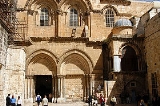
Jerusalem in Christianity

Encyclopedia
For Christians
, Jerusalem's place in the ministry of Jesus
and the Apostolic Age
(as recorded in the New Testament
) gives it great importance, in addition to its place in the Old Testament
, the Hebrew Bible
.
, Jerusalem was the city to which Jesus was brought as a child, to be presented at the Temple
and to attend festivals . According to the Canonical gospels, Jesus preached and healed in Jerusalem, especially in the Temple Courts. Jerusalem historian Dan Mazar reported in a series of articles in the Jerusalem Christian Review on the archaeological discoveries made at this location by his grandfather, Prof. Benjamin Mazar
, which included the 1st century stairs of ascent, where Jesus and his disciples preached, as well as the "mikvaot" (or baptismals) used by both Jewish and Christian pilgrims
. The events of Pentacost, which are recorded in the New Testament Book of Acts, also took place at this location. There is also an account of Jesus' cleansing of the Temple
at the Temple Court, chasing various traders out of the sacred precincts (Mark
, see also Mark 11
). Much of this area was also uncovered by the excavations conducted by the elder Mazar. At the end of each of the Gospels, there are accounts of Jesus' Last Supper
in an "Upper Room" in Jerusalem, his arrest in Gethsemane
, his trial
, his crucifixion
at Golgotha, his burial nearby and his resurrection
and ascension and prophecy to return
.
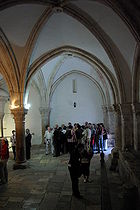
Tradition holds that the place of the Last Supper is the Cenacle
, on the second floor of a building on Mount Zion
where David's Tomb
is on the first floor. Archaeologist
Bargil Pixner
claims to have found three walls of the original structure still extant today. The place of Jesus' anguished prayer and betrayal, Gethsemane, is probably somewhere near the Church of All Nations
on the Mount of Olives
. Jesus' trial before Pontius Pilate
may have taken place at the Antonia Fortress
, to the north of the Temple area. Popularly, the exterior pavement where the trial was conducted is beneath the Convent of the Sisters of Zion
. Other Christians believe that Pilate tried Jesus at Herod's Palace on Mount Zion.
The Via Dolorosa
, or way of suffering, is the traditional route to Golgotha, the place of crucifixion, and is an important pilgrimage
. The route ends at the Church of the Holy Sepulchre
(perhaps the most holy place for Christians). The Holy Sepulchre is traditionally believed to be the location of Golgotha and Jesus' nearby tomb
. The original church was built in 336 by Constantine I. The Garden Tomb
is a popular pilgrimage site near the Damascus Gate
. It was suggested by Charles George Gordon
that this site, rather than the Holy Sepulchre, is the true place of Golgotha.
The Acts of the Apostles
and Pauline Epistles
show James the Just
, the brother of Jesus, as leader of the early Jerusalem church. He and his successors were the focus for Jewish Christians
until the destruction of the city by Emperor Hadrian
in 135. The exclusion of Jews from the new city of Aelia Capitolina
meant that gentile bishops were appointed under the authority of the Metropolitans
of Caesarea and, ultimately, the Patriarchs of Antioch
. The general significance of Jerusalem to Christians outside the Holy Land entered a period of decline during the Persecution of Christians in the Roman Empire but resumed again c.325 when Emperor Constantine I and his mother, Helena
, endowed Jerusalem with churches and shrines, making it the foremost centre of Christian pilgrimage
, see also Constantine I and Christianity
. Helena is remembered as the Patron Saint
of Archaeologists
and (according to the church historian Socrates of Constantinople) claimed to have found (with the assistance of Bishop Macarius of Jerusalem
) the Cross of Christ
, after removing a Temple to Venus
that had been built over the site. Jerusalem received special recognition in Canon VII of Nicaea
in 325, without yet becoming a metropolitan see. The traditional founding date for the Brotherhood of the Holy Sepulchre
(which guards the Christian Holy places in the Holy Land
) is 313 which corresponds with the date of the Edict of Milan
which legalized Christianity in the Roman Empire. The Council of Chalcedon
in 451 raised the Bishop of Jerusalem to the rank of patriarch
, together with Rome
, Constantinople
, Alexandria
and Antioch
, forming the Pentarchy
. However, Byzantine
politics meant that Jerusalem simply passed from the Syrian jurisdiction of Antioch to the Greek authorities in Constantinople. For centuries, Greek clergy dominated the Jerusalem church. Meanwhile, the Roman church never accepted the Pentarchy and instead claimed primacy, see Papal supremacy
and East–West Schism
.
approached Jerusalem. Fearing that the Eastern Christians had been conspiring with approaching crusaders, the Muslim authorities of Jerusalem massacred much of the city's Christian population, seeing the fortunate escape the city in terror. While the Crusaders hoped to protect Christian pilgrims who had been attacked and killed by the Turks, to protect the Christian holy places which had been destroyed by Caliph
Al-Hakim bi-Amr Allah
, and in fact were coming in response to pleas for help from the Eastern Christian Byzantine Emperor Alexios I Komnenos
, there is no evidence for any conspiracy.
On 15 July 1099, the army of the First Crusade
captured Jerusalem. Most the city's population was killed, with the exception of Eastern Christians
. They were, however, exiled from the city, as their new Latin
rulers believed they were conspiring with the Muslims. Jerusalem became the capital of a 'Latin Kingdom
' with a Latin church and a Latin Patriarch
, all under the authority of the Pope
. The city's first Latin ruler, Godfrey de Bouillon, was elected in 1099. Out of humility and deference to Jesus, he refused to be called king in a city where he thought only Jesus had the right to be called king; he would only call himself Jerusalem's protector. Throughout his short reign as protector, Godfrey struggled to increase the population of Jerusalem until his death in 1100. In 1100 he was succeeded by his brother Baldwin I
who, unlike Godfrey, was willing to take the title of King of Jerusalem. With Jerusalem's population dwindling Baldwin I, as early as 1115, offered the Christians of Transjordan
a section of Jerusalem. These Christians were often the target of Muslim aggression and therefore promptly accepted Baldwin's proposal. In 1187, when Saladin
captured the city, the Holy Sepulchre and many other churches were returned to the care of Eastern Christians.
From the 17th to the 19th century, various Catholic European nations petitioned the Ottoman Empire
for Catholic control of the 'holy places'. The Franciscan
s are the traditional Catholic custodians of the holy places. Control swung back and forth between the western and eastern churches throughout this period. Sultan Abd-ul-Mejid I (1839–1861), perhaps out of despair, published a firman that laid out in detail the exact rights and responsibility of each community at the Holy Sepulchre. This document became known as the Status Quo, and is still the basis for the complex protocol of the shrine. The Status Quo was upheld by the British Mandate and Jordan
. After the 1967 Arab-Israeli War, and the passing of the Old City into Israeli hands, the Knesset
passed a law protecting the holy places. Five Christian communities currently have rights in the Holy Sepulchre: the Greek Patriarchate, Latins (Western Rite Roman Catholics), Armenians, Copts and Syriac Orthodox
.
The New Jerusalem
is the focus of a vision at the end of the Book of Revelation
. It is the perfect city where God lives among his people.
, Jerusalem is referred to 669 times and Zion
(which usually means Jerusalem, sometimes the Land of Israel) 154 times, while Zion Gadol (large Zion) is only mentioned 11 times. The Pentateuch refers to Moriah
as the location of the binding of Isaac
, and 2 Chronicles 3:1 connects this to the
Temple Mount
in Jerusalem.
The book of Psalms
, which has been frequently recited and memorized by Jews and Christians for centuries, says: (etc.)
for the Church of Christ. There is a vast apocalyptic tradition that focuses on the heavenly Jerusalem instead of the literal and historical city of Jerusalem. Christians have not controlled the actual city of Jerusalem since the time of the Crusades
and have mostly relied on biblical symbols and metaphors that describe the Church as if it were the true living Jerusalem. This view is notably advocated in Augustine's City of God, a popular 5th century Christian book that was written during the fall of the Western Roman Empire
.
Christianity
Christianity is a monotheistic religion based on the life and teachings of Jesus as presented in canonical gospels and other New Testament writings...
, Jerusalem's place in the ministry of Jesus
Ministry of Jesus
In the Christian gospels, the Ministry of Jesus begins with his Baptism in the countryside of Judea, near the River Jordan and ends in Jerusalem, following the Last Supper with his disciples. The Gospel of Luke states that Jesus was "about 30 years of age" at the start of his ministry...
and the Apostolic Age
Apostolic Age
The Apostolic Age of the history of Christianity is traditionally the period of the Twelve Apostles, dating from the Crucifixion of Jesus and the Great Commission in Jerusalem until the death of John the Apostle in Anatolia...
(as recorded in the New Testament
New Testament
The New Testament is the second major division of the Christian biblical canon, the first such division being the much longer Old Testament....
) gives it great importance, in addition to its place in the Old Testament
Old Testament
The Old Testament, of which Christians hold different views, is a Christian term for the religious writings of ancient Israel held sacred and inspired by Christians which overlaps with the 24-book canon of the Masoretic Text of Judaism...
, the Hebrew Bible
Hebrew Bible
The Hebrew Bible is a term used by biblical scholars outside of Judaism to refer to the Tanakh , a canonical collection of Jewish texts, and the common textual antecedent of the several canonical editions of the Christian Old Testament...
.
Jerusalem in the New Testament and early Christianity
According to the New TestamentNew Testament
The New Testament is the second major division of the Christian biblical canon, the first such division being the much longer Old Testament....
, Jerusalem was the city to which Jesus was brought as a child, to be presented at the Temple
Presentation of Jesus at the Temple
The Presentation of Jesus at the Temple, which falls on 2 February, celebrates an early episode in the life of Jesus. In the Eastern Orthodox Church and some Eastern Catholic Churches, it is one of the twelve Great Feasts, and is sometimes called Hypapante...
and to attend festivals . According to the Canonical gospels, Jesus preached and healed in Jerusalem, especially in the Temple Courts. Jerusalem historian Dan Mazar reported in a series of articles in the Jerusalem Christian Review on the archaeological discoveries made at this location by his grandfather, Prof. Benjamin Mazar
Benjamin Mazar
Benjamin Mazar was a pioneering Israeli historian, recognized as the "dean" of biblical archaeologists. He shared the national passion for the archaeology of Israel that also attracts considerable international interest due to the region's biblical links...
, which included the 1st century stairs of ascent, where Jesus and his disciples preached, as well as the "mikvaot" (or baptismals) used by both Jewish and Christian pilgrims
Christian pilgrimage
Christian pilgrimage was first made to sites connected with the ministry of Jesus. Surviving descriptions of Christian pilgrimages to the Holy Land and Jerusalem date from the 4th century, when pilgrimage was encouraged by church fathers like Saint Jerome and established by Helena, the mother of...
. The events of Pentacost, which are recorded in the New Testament Book of Acts, also took place at this location. There is also an account of Jesus' cleansing of the Temple
Jesus and the Money Changers
The narrative of Jesus and the money changers, commonly referred to as the cleansing of the Temple, occurs in all four canonical gospels of the New Testament....
at the Temple Court, chasing various traders out of the sacred precincts (Mark
Gospel of Mark
The Gospel According to Mark , commonly shortened to the Gospel of Mark or simply Mark, is the second book of the New Testament. This canonical account of the life of Jesus of Nazareth is one of the three synoptic gospels. It was thought to be an epitome, which accounts for its place as the second...
, see also Mark 11
Mark 11
Mark 11 is the eleventh chapter of the Gospel of Mark in the New Testament of the Christian Bible, beginning Jesus' final week before his death as he arrives in Jerusalem for the coming Passover...
). Much of this area was also uncovered by the excavations conducted by the elder Mazar. At the end of each of the Gospels, there are accounts of Jesus' Last Supper
Last Supper
The Last Supper is the final meal that, according to Christian belief, Jesus shared with his Twelve Apostles in Jerusalem before his crucifixion. The Last Supper provides the scriptural basis for the Eucharist, also known as "communion" or "the Lord's Supper".The First Epistle to the Corinthians is...
in an "Upper Room" in Jerusalem, his arrest in Gethsemane
Gethsemane
Gethsemane is a garden at the foot of the Mount of Olives in Jerusalem most famous as the place where, according to Biblical texts, Jesus and his disciples are said to have prayed the night before Jesus' crucifixion.- Etymology :...
, his trial
Sanhedrin Trial of Jesus
The Sanhedrin trial of Jesus refers to the Canonical Gospel accounts of the trial of Jesus before the Jewish Council, or Sanhedrin, following his arrest and prior to his trial before Pontius Pilate...
, his crucifixion
Crucifixion of Jesus
The crucifixion of Jesus and his ensuing death is an event that occurred during the 1st century AD. Jesus, who Christians believe is the Son of God as well as the Messiah, was arrested, tried, and sentenced by Pontius Pilate to be scourged, and finally executed on a cross...
at Golgotha, his burial nearby and his resurrection
Resurrection of Jesus
The Christian belief in the resurrection of Jesus states that Jesus returned to bodily life on the third day following his death by crucifixion. It is a key element of Christian faith and theology and part of the Nicene Creed: "On the third day he rose again in fulfillment of the Scriptures"...
and ascension and prophecy to return
Second Coming
In Christian doctrine, the Second Coming of Christ, the Second Advent, or the Parousia, is the anticipated return of Jesus Christ from Heaven, where he sits at the Right Hand of God, to Earth. This prophecy is found in the canonical gospels and in most Christian and Islamic eschatologies...
.
Tradition holds that the place of the Last Supper is the Cenacle
Cenacle
The Cenacle , also known as the "Upper Room", is the term used for the site of The Last Supper. The word is a derivative of the Latin word cena, which means dinner....
, on the second floor of a building on Mount Zion
Mount Zion
Mount Zion is a place name for a site in Jerusalem, the location of which has shifted several times in history. According to the Hebrew Bible's Book of Samuel, it was the site of the Jebusite fortress called the "stronghold of Zion" that was conquered by King David, becoming his palace in the City...
where David's Tomb
David's Tomb
King David's Tomb is the name given to a Jewish religious site on Mount Zion in Jerusalem, near the Hagia Maria Sion Abbey; the site has traditionally been viewed as the burial place of King David, the second king of Israel...
is on the first floor. Archaeologist
Biblical archaeology
For the movement associated with William F. Albright and also known as biblical archaeology, see Biblical archaeology school. For the interpretation of biblical archaeology in relation to biblical historicity, see The Bible and history....
Bargil Pixner
Bargil Pixner
Bargil Pixner was an Italian Benedictine monk, Biblical scholar and archaeologist, and Benedictine authority on the Dead Sea scrolls.- Biography :...
claims to have found three walls of the original structure still extant today. The place of Jesus' anguished prayer and betrayal, Gethsemane, is probably somewhere near the Church of All Nations
Church of All Nations (Jerusalem)
The Church of All Nations, also known as the Church or Basilica of the Agony, is a Roman Catholic church located on the Mount of Olives in Jerusalem, next to the Garden of Gethsemane. It enshrines a section of bedrock where Jesus is said to have prayed before his arrest...
on the Mount of Olives
Mount of Olives
The Mount of Olives is a mountain ridge in East Jerusalem with three peaks running from north to south. The highest, at-Tur, rises to 818 meters . It is named for the olive groves that once covered its slopes...
. Jesus' trial before Pontius Pilate
Pontius Pilate
Pontius Pilatus , known in the English-speaking world as Pontius Pilate , was the fifth Prefect of the Roman province of Judaea, from AD 26–36. He is best known as the judge at Jesus' trial and the man who authorized the crucifixion of Jesus...
may have taken place at the Antonia Fortress
Antonia Fortress
The Antonia Fortress was a military barracks built by Herod the Great in Jerusalem on the site of earlier Ptolemaic and Hasmonean strongholds, named after Herod's patron Mark Antony...
, to the north of the Temple area. Popularly, the exterior pavement where the trial was conducted is beneath the Convent of the Sisters of Zion
Convent of the Sisters of Zion
The Convent of the Sisters of Zion is a convent of the Congregation of Notre-Dame de Sion, located near to the eastern end of the Via Dolorosa, in Jerusalem. The convent was built in 1857, by Marie-Alphonse Ratisbonne, but the site also contains ancient archaeological remains of significant value.-...
. Other Christians believe that Pilate tried Jesus at Herod's Palace on Mount Zion.
The Via Dolorosa
Via Dolorosa
The Via Dolorosa is a street, in two parts, within the Old City of Jerusalem, held to be the path that Jesus walked, carrying his cross, on the way to his crucifixion. The current route has been established since the 18th century, replacing various earlier versions...
, or way of suffering, is the traditional route to Golgotha, the place of crucifixion, and is an important pilgrimage
Christian pilgrimage
Christian pilgrimage was first made to sites connected with the ministry of Jesus. Surviving descriptions of Christian pilgrimages to the Holy Land and Jerusalem date from the 4th century, when pilgrimage was encouraged by church fathers like Saint Jerome and established by Helena, the mother of...
. The route ends at the Church of the Holy Sepulchre
Church of the Holy Sepulchre
The Church of the Holy Sepulchre, also called the Church of the Resurrection by Eastern Christians, is a church within the walled Old City of Jerusalem. It is a few steps away from the Muristan....
(perhaps the most holy place for Christians). The Holy Sepulchre is traditionally believed to be the location of Golgotha and Jesus' nearby tomb
Empty tomb
Empty tomb most often refers to the tomb of Jesus which was found to be empty by the women who were present at Jesus’ crucifixion. They had come to his tomb to anoint his body with spices...
. The original church was built in 336 by Constantine I. The Garden Tomb
Garden Tomb
The Garden Tomb , located in Jerusalem, outside the city walls and close to the Damascus Gate, is a rock-cut tomb considered by some to be the site of the burial and resurrection of Jesus, and to be adjacent to Golgotha, in contradistinction to the traditional site for these—the Church of the Holy...
is a popular pilgrimage site near the Damascus Gate
Damascus Gate
Damascus Gate is the main entrance to the Old City of Jerusalem. It is located in the wall on the city's northwest side where the highway leads out to Nablus, and from there, in times past, to the capital of Syria, Damascus; as such, its modern English name is Damascus Gate, and its modern Hebrew...
. It was suggested by Charles George Gordon
Charles George Gordon
Major-General Charles George Gordon, CB , known as "Chinese" Gordon, Gordon Pasha, and Gordon of Khartoum, was a British army officer and administrator....
that this site, rather than the Holy Sepulchre, is the true place of Golgotha.
The Acts of the Apostles
Acts of the Apostles
The Acts of the Apostles , usually referred to simply as Acts, is the fifth book of the New Testament; Acts outlines the history of the Apostolic Age...
and Pauline Epistles
Pauline epistles
The Pauline epistles, Epistles of Paul, or Letters of Paul, are the thirteen New Testament books which have the name Paul as the first word, hence claiming authorship by Paul the Apostle. Among these letters are some of the earliest extant Christian documents...
show James the Just
James the Just
James , first Bishop of Jerusalem, who died in 62 AD, was an important figure in Early Christianity...
, the brother of Jesus, as leader of the early Jerusalem church. He and his successors were the focus for Jewish Christians
Jewish Christians
Jewish Christians is a term which appears in historical texts contrasting Christians of Jewish origin with Gentile Christians, both in discussion of the New Testament church and the second and following centuries....
until the destruction of the city by Emperor Hadrian
Hadrian
Hadrian , was Roman Emperor from 117 to 138. He is best known for building Hadrian's Wall, which marked the northern limit of Roman Britain. In Rome, he re-built the Pantheon and constructed the Temple of Venus and Roma. In addition to being emperor, Hadrian was a humanist and was philhellene in...
in 135. The exclusion of Jews from the new city of Aelia Capitolina
Aelia Capitolina
Aelia Capitolina was a city built by the emperor Hadrian, and occupied by a Roman colony, on the site of Jerusalem, which was in ruins since 70 AD, leading in part to the Bar Kokhba revolt of 132–136.-Politics:...
meant that gentile bishops were appointed under the authority of the Metropolitans
Metropolitan bishop
In Christian churches with episcopal polity, the rank of metropolitan bishop, or simply metropolitan, pertains to the diocesan bishop or archbishop of a metropolis; that is, the chief city of a historical Roman province, ecclesiastical province, or regional capital.Before the establishment of...
of Caesarea and, ultimately, the Patriarchs of Antioch
Patriarch of Antioch
Patriarch of Antioch is a traditional title held by the Bishop of Antioch. As the traditional "overseer" of the first gentile Christian community, the position has been of prime importance in the church from its earliest period...
. The general significance of Jerusalem to Christians outside the Holy Land entered a period of decline during the Persecution of Christians in the Roman Empire but resumed again c.325 when Emperor Constantine I and his mother, Helena
Helena of Constantinople
Saint Helena also known as Saint Helen, Helena Augusta or Helena of Constantinople was the consort of Emperor Constantius, and the mother of Emperor Constantine I...
, endowed Jerusalem with churches and shrines, making it the foremost centre of Christian pilgrimage
Christian pilgrimage
Christian pilgrimage was first made to sites connected with the ministry of Jesus. Surviving descriptions of Christian pilgrimages to the Holy Land and Jerusalem date from the 4th century, when pilgrimage was encouraged by church fathers like Saint Jerome and established by Helena, the mother of...
, see also Constantine I and Christianity
Constantine I and Christianity
During the reign of the Emperor Constantine the Great, Christianity became the dominant religion of the Roman Empire. Constantine, also known as Constantine I, had a significant religious experience following his victory at the Battle of Milvian Bridge in 312...
. Helena is remembered as the Patron Saint
Patron saint
A patron saint is a saint who is regarded as the intercessor and advocate in heaven of a nation, place, craft, activity, class, clan, family, or person...
of Archaeologists
Archaeology
Archaeology, or archeology , is the study of human society, primarily through the recovery and analysis of the material culture and environmental data that they have left behind, which includes artifacts, architecture, biofacts and cultural landscapes...
and (according to the church historian Socrates of Constantinople) claimed to have found (with the assistance of Bishop Macarius of Jerusalem
Macarius of Jerusalem
Saint Macarius of Jerusalem was Bishop of Jerusalem from 312 to shortly before 335, according to Sozomen.St. Athanasius, in one of his orations against Arianism, refers to St. Macarius as an example of "the honest and simple style of apostolical men." The date 312 for Macarius's accession to the...
) the Cross of Christ
True Cross
The True Cross is the name for physical remnants which, by a Christian tradition, are believed to be from the cross upon which Jesus was crucified.According to post-Nicene historians, Socrates Scholasticus and others, the Empress Helena The True Cross is the name for physical remnants which, by a...
, after removing a Temple to Venus
Venus (mythology)
Venus is a Roman goddess principally associated with love, beauty, sex,sexual seduction and fertility, who played a key role in many Roman religious festivals and myths...
that had been built over the site. Jerusalem received special recognition in Canon VII of Nicaea
First Council of Nicaea
The First Council of Nicaea was a council of Christian bishops convened in Nicaea in Bithynia by the Roman Emperor Constantine I in AD 325...
in 325, without yet becoming a metropolitan see. The traditional founding date for the Brotherhood of the Holy Sepulchre
Brotherhood of the Holy Sepulchre
The Brotherhood of the Holy Sepulchre, or The Holy Community of the All-Holy Sepulchre, is the Orthodox monastic fraternity that for centuries has guarded and protected the Christian Holy places in the Holy Land...
(which guards the Christian Holy places in the Holy Land
Holy Land
The Holy Land is a term which in Judaism refers to the Kingdom of Israel as defined in the Tanakh. For Jews, the Land's identifiction of being Holy is defined in Judaism by its differentiation from other lands by virtue of the practice of Judaism often possible only in the Land of Israel...
) is 313 which corresponds with the date of the Edict of Milan
Edict of Milan
The Edict of Milan was a letter signed by emperors Constantine I and Licinius that proclaimed religious toleration in the Roman Empire...
which legalized Christianity in the Roman Empire. The Council of Chalcedon
Council of Chalcedon
The Council of Chalcedon was a church council held from 8 October to 1 November, 451 AD, at Chalcedon , on the Asian side of the Bosporus. The council marked a significant turning point in the Christological debates that led to the separation of the church of the Eastern Roman Empire in the 5th...
in 451 raised the Bishop of Jerusalem to the rank of patriarch
Patriarch
Originally a patriarch was a man who exercised autocratic authority as a pater familias over an extended family. The system of such rule of families by senior males is called patriarchy. This is a Greek word, a compound of πατριά , "lineage, descent", esp...
, together with Rome
Rome
Rome is the capital of Italy and the country's largest and most populated city and comune, with over 2.7 million residents in . The city is located in the central-western portion of the Italian Peninsula, on the Tiber River within the Lazio region of Italy.Rome's history spans two and a half...
, Constantinople
Constantinople
Constantinople was the capital of the Roman, Eastern Roman, Byzantine, Latin, and Ottoman Empires. Throughout most of the Middle Ages, Constantinople was Europe's largest and wealthiest city.-Names:...
, Alexandria
Alexandria
Alexandria is the second-largest city of Egypt, with a population of 4.1 million, extending about along the coast of the Mediterranean Sea in the north central part of the country; it is also the largest city lying directly on the Mediterranean coast. It is Egypt's largest seaport, serving...
and Antioch
Antioch
Antioch on the Orontes was an ancient city on the eastern side of the Orontes River. It is near the modern city of Antakya, Turkey.Founded near the end of the 4th century BC by Seleucus I Nicator, one of Alexander the Great's generals, Antioch eventually rivaled Alexandria as the chief city of the...
, forming the Pentarchy
Pentarchy
Pentarchy is a term in the history of Christianity for the idea of universal rule over all Christendom by the heads of five major episcopal sees, or patriarchates, of the Roman Empire: Rome, Constantinople, Alexandria, Antioch, and Jerusalem...
. However, Byzantine
Byzantine
Byzantine usually refers to the Roman Empire during the Middle Ages.Byzantine may also refer to:* A citizen of the Byzantine Empire, or native Greek during the Middle Ages...
politics meant that Jerusalem simply passed from the Syrian jurisdiction of Antioch to the Greek authorities in Constantinople. For centuries, Greek clergy dominated the Jerusalem church. Meanwhile, the Roman church never accepted the Pentarchy and instead claimed primacy, see Papal supremacy
Papal supremacy
Papal supremacy refers to the doctrine of the Roman Catholic Church that the pope, by reason of his office as Vicar of Christ and as pastor of the entire Christian Church, has full, supreme, and universal power over the whole Church, a power which he can always exercise unhindered: that, in brief,...
and East–West Schism
East–West Schism
The East–West Schism of 1054, sometimes known as the Great Schism, formally divided the State church of the Roman Empire into Eastern and Western branches, which later became known as the Eastern Orthodox Church and the Roman Catholic Church, respectively...
.
Medieval traditions
In 638, Sophronius, Patriarch of Jerusalem, handed over the keys of the city to Calif Umar's Muslim forces. The Muslim authorities in Jerusalem were not kind to their Christian subjects, forcing them to live a life of "discrimination, servitude and humiliation." The mistreatment of Christians would only worsen as the armies of the First CrusadeFirst Crusade
The First Crusade was a military expedition by Western Christianity to regain the Holy Lands taken in the Muslim conquest of the Levant, ultimately resulting in the recapture of Jerusalem...
approached Jerusalem. Fearing that the Eastern Christians had been conspiring with approaching crusaders, the Muslim authorities of Jerusalem massacred much of the city's Christian population, seeing the fortunate escape the city in terror. While the Crusaders hoped to protect Christian pilgrims who had been attacked and killed by the Turks, to protect the Christian holy places which had been destroyed by Caliph
Caliph
The Caliph is the head of state in a Caliphate, and the title for the ruler of the Islamic Ummah, an Islamic community ruled by the Shari'ah. It is a transcribed version of the Arabic word which means "successor" or "representative"...
Al-Hakim bi-Amr Allah
Al-Hakim bi-Amr Allah
Abu ‘Ali Mansur Tāriqu l-Ḥākim, called Al-Hakim bi Amr al-Lāh , was the sixth Fatimid caliph and 16th Ismaili imam .- History :...
, and in fact were coming in response to pleas for help from the Eastern Christian Byzantine Emperor Alexios I Komnenos
Alexios I Komnenos
Alexios I Komnenos, Latinized as Alexius I Comnenus , was Byzantine emperor from 1081 to 1118, and although he was not the founder of the Komnenian dynasty, it was during his reign that the Komnenos family came to full power. The title 'Nobilissimus' was given to senior army commanders,...
, there is no evidence for any conspiracy.
On 15 July 1099, the army of the First Crusade
First Crusade
The First Crusade was a military expedition by Western Christianity to regain the Holy Lands taken in the Muslim conquest of the Levant, ultimately resulting in the recapture of Jerusalem...
captured Jerusalem. Most the city's population was killed, with the exception of Eastern Christians
Eastern Christianity
Eastern Christianity comprises the Christian traditions and churches that developed in the Balkans, Eastern Europe, Asia Minor, the Middle East, Northeastern Africa, India and parts of the Far East over several centuries of religious antiquity. The term is generally used in Western Christianity to...
. They were, however, exiled from the city, as their new Latin
Western Christianity
Western Christianity is a term used to include the Latin Rite of the Catholic Church and groups historically derivative thereof, including the churches of the Anglican and Protestant traditions, which share common attributes that can be traced back to their medieval heritage...
rulers believed they were conspiring with the Muslims. Jerusalem became the capital of a 'Latin Kingdom
Kingdom of Jerusalem
The Kingdom of Jerusalem was a Catholic kingdom established in the Levant in 1099 after the First Crusade. The kingdom lasted nearly two hundred years, from 1099 until 1291 when the last remaining possession, Acre, was destroyed by the Mamluks, but its history is divided into two distinct periods....
' with a Latin church and a Latin Patriarch
Latin Patriarch of Jerusalem
The Latin Patriarch of Jerusalem is the title possessed by the Latin Rite Catholic Archbishop of Jerusalem. The Archdiocese of Jerusalem has jurisdiction for all Latin Rite Catholics in Israel, the Palestinian Territories, Jordan and Cyprus...
, all under the authority of the Pope
Pope
The Pope is the Bishop of Rome, a position that makes him the leader of the worldwide Catholic Church . In the Catholic Church, the Pope is regarded as the successor of Saint Peter, the Apostle...
. The city's first Latin ruler, Godfrey de Bouillon, was elected in 1099. Out of humility and deference to Jesus, he refused to be called king in a city where he thought only Jesus had the right to be called king; he would only call himself Jerusalem's protector. Throughout his short reign as protector, Godfrey struggled to increase the population of Jerusalem until his death in 1100. In 1100 he was succeeded by his brother Baldwin I
Baldwin I of Jerusalem
Baldwin I of Jerusalem, formerly Baldwin I of Edessa, born Baldwin of Boulogne , 1058? – 2 April 1118, was one of the leaders of the First Crusade, who became the first Count of Edessa and then the second ruler and first titled King of Jerusalem...
who, unlike Godfrey, was willing to take the title of King of Jerusalem. With Jerusalem's population dwindling Baldwin I, as early as 1115, offered the Christians of Transjordan
Transjordan
The Emirate of Transjordan was a former Ottoman territory in the Southern Levant that was part of the British Mandate of Palestine...
a section of Jerusalem. These Christians were often the target of Muslim aggression and therefore promptly accepted Baldwin's proposal. In 1187, when Saladin
Saladin
Ṣalāḥ ad-Dīn Yūsuf ibn Ayyūb , better known in the Western world as Saladin, was an Arabized Kurdish Muslim, who became the first Sultan of Egypt and Syria, and founded the Ayyubid dynasty. He led Muslim and Arab opposition to the Franks and other European Crusaders in the Levant...
captured the city, the Holy Sepulchre and many other churches were returned to the care of Eastern Christians.
From the 17th to the 19th century, various Catholic European nations petitioned the Ottoman Empire
Ottoman Empire
The Ottoman EmpireIt was usually referred to as the "Ottoman Empire", the "Turkish Empire", the "Ottoman Caliphate" or more commonly "Turkey" by its contemporaries...
for Catholic control of the 'holy places'. The Franciscan
Franciscan
Most Franciscans are members of Roman Catholic religious orders founded by Saint Francis of Assisi. Besides Roman Catholic communities, there are also Old Catholic, Anglican, Lutheran, ecumenical and Non-denominational Franciscan communities....
s are the traditional Catholic custodians of the holy places. Control swung back and forth between the western and eastern churches throughout this period. Sultan Abd-ul-Mejid I (1839–1861), perhaps out of despair, published a firman that laid out in detail the exact rights and responsibility of each community at the Holy Sepulchre. This document became known as the Status Quo, and is still the basis for the complex protocol of the shrine. The Status Quo was upheld by the British Mandate and Jordan
Jordan
Jordan , officially the Hashemite Kingdom of Jordan , Al-Mamlaka al-Urduniyya al-Hashemiyya) is a kingdom on the East Bank of the River Jordan. The country borders Saudi Arabia to the east and south-east, Iraq to the north-east, Syria to the north and the West Bank and Israel to the west, sharing...
. After the 1967 Arab-Israeli War, and the passing of the Old City into Israeli hands, the Knesset
Knesset
The Knesset is the unicameral legislature of Israel, located in Givat Ram, Jerusalem.-Role in Israeli Government :The legislative branch of the Israeli government, the Knesset passes all laws, elects the President and Prime Minister , approves the cabinet, and supervises the work of the government...
passed a law protecting the holy places. Five Christian communities currently have rights in the Holy Sepulchre: the Greek Patriarchate, Latins (Western Rite Roman Catholics), Armenians, Copts and Syriac Orthodox
Syriac Orthodox Church
The Syriac Orthodox Church; is an autocephalous Oriental Orthodox church based in the Eastern Mediterranean, with members spread throughout the world. The Syriac Orthodox Church claims to derive its origin from one of the first Christian communities, established in Antioch by the Apostle St....
.
The New Jerusalem
New Jerusalem
In the book of Ezekiel, the Prophecy of New Jerusalem is Ezekiel's prophetic vision of a city to be established to the south of the Temple Mount that will be inhabited by the twelve tribes of Israel in the...
is the focus of a vision at the end of the Book of Revelation
Book of Revelation
The Book of Revelation is the final book of the New Testament. The title came into usage from the first word of the book in Koine Greek: apokalupsis, meaning "unveiling" or "revelation"...
. It is the perfect city where God lives among his people.
Jerusalem in the Old Testament
In the Old TestamentOld Testament
The Old Testament, of which Christians hold different views, is a Christian term for the religious writings of ancient Israel held sacred and inspired by Christians which overlaps with the 24-book canon of the Masoretic Text of Judaism...
, Jerusalem is referred to 669 times and Zion
Zion
Zion is a place name often used as a synonym for Jerusalem. The word is first found in Samuel II, 5:7 dating to c.630-540 BCE...
(which usually means Jerusalem, sometimes the Land of Israel) 154 times, while Zion Gadol (large Zion) is only mentioned 11 times. The Pentateuch refers to Moriah
Moriah
Moriah is the name given to a mountain range by the Book of Genesis, in which context it is giv. the location of the sacrifice of Isaac. Traditionally Moriah has been interpreted as the name of the specific mountain at which this occurred, rather than just the name of the range...
as the location of the binding of Isaac
Binding of Isaac
The Binding of Isaac Akedah or Akeidat Yitzchak in Hebrew and Dhabih in Arabic, is a story from the Hebrew Bible in which God asks Abraham to sacrifice his son, Isaac, on Mount Moriah...
, and 2 Chronicles 3:1 connects this to the
Temple Mount
Temple Mount
The Temple Mount, known in Hebrew as , and in Arabic as the Haram Ash-Sharif , is one of the most important religious sites in the Old City of Jerusalem. It has been used as a religious site for thousands of years...
in Jerusalem.
The book of Psalms
Psalms
The Book of Psalms , commonly referred to simply as Psalms, is a book of the Hebrew Bible and the Christian Bible...
, which has been frequently recited and memorized by Jews and Christians for centuries, says: (etc.)
- "By the rivers of Babylon we sat down and wept when we remembered Zion." (Psalms 137:1)
- "For there they that carried us away captive required of us a song; and they that wasted us required of us mirth, saying, Sing us one of the songs of Zion. How shall we sing the LORD's song in a strange land? If I forget thee, O Jerusalem, let my right hand forget her cunning . If I do not remember thee, let my tongue cleave to the roof of my mouth; if I prefer not Jerusalem above my chief joy. Remember, O LORD, the children of Edom in the day of Jerusalem; who said, Rase it, rase it, even to the foundation thereof; O daughter of Babylon, that art to be destroyed; happy shall he be, that repayeth thee as thou hast served us." (Psalms 137:3-8) (King James Version, with italics for words not in the original Hebrew)
- "O God, the nations have entered into your inheritance, they have defiled the sanctuary of your holiness, they have turned Jerusalem into heaps of rubble...they have shed their blood like water round Jerusalem..." (Psalms 79:1-3);
- "...O Jerusalem, the built up Jerusalem is like a city that is united together...Pray for the peace of Jerusalem..." (Psalms 122:2-6);
- "Jerusalem is surrounded by mountains as God surrounds his people forever" (Psalms 125:3);
- "The builder of Jerusalem is God, the outcast of Israel he will gather in...Praise God O Jerusalem, laud your God O Zion." (Psalms 147:2-12)
Jerusalem as an allegory for the Church
In Christianity, Jerusalem is sometimes interpreted as an allegory or typeTypology (theology)
Typology in Christian theology and Biblical exegesis is a doctrine or theory concerning the relationship between the Old and New Testaments...
for the Church of Christ. There is a vast apocalyptic tradition that focuses on the heavenly Jerusalem instead of the literal and historical city of Jerusalem. Christians have not controlled the actual city of Jerusalem since the time of the Crusades
Crusades
The Crusades were a series of religious wars, blessed by the Pope and the Catholic Church with the main goal of restoring Christian access to the holy places in and near Jerusalem...
and have mostly relied on biblical symbols and metaphors that describe the Church as if it were the true living Jerusalem. This view is notably advocated in Augustine's City of God, a popular 5th century Christian book that was written during the fall of the Western Roman Empire
Decline of the Roman Empire
The decline of the Roman Empire refers to the gradual societal collapse of the Western Roman Empire. Many theories of causality prevail, but most concern the disintegration of political, economic, military, and other social institutions, in tandem with foreign invasions and usurpers from within the...
.
See also
- Christian ZionismChristian ZionismChristian Zionism is a belief among some Christians that the return of the Jews to the Holy Land, and the establishment of the State of Israel in 1948, is in accordance with Biblical prophecy. It overlaps with, but is distinct from, the nineteenth century movement for the Restoration of the Jews...
- Jerusalem in JudaismJerusalem in JudaismSince the 10th century BCE Jerusalem has been the holiest city, focus and spiritual center of the Jewish people:*"Israel was first forged into a unified nation from Jerusalem some three thousand years ago, when King David seized the crown and united the twelve tribes from this city.....
- New JerusalemNew JerusalemIn the book of Ezekiel, the Prophecy of New Jerusalem is Ezekiel's prophetic vision of a city to be established to the south of the Temple Mount that will be inhabited by the twelve tribes of Israel in the...
- Christian-Jewish reconciliationChristian-Jewish reconciliationReconciliation between Christianity and Judaism refers to the efforts that are being made to improve understanding of the Jewish people and of Judaism, to do away with Christian antisemitism and Jewish anti-Christian sentiment...
- Jesus TrailJesus TrailThe Jesus Trail is a hiking and pilgrimage route in the Galilee region of Israel that traces the route Jesus may have walked, connecting many sites from his life and ministry...