
All Topics  
Persecution of Christians


   Email Print
   Bookmark   Link


Persecution of Christians


The persecution of Christians refers to the religious persecution
Religious persecution

Religious persecution is the systematic mistreatment of an individual or group of individuals as a response to their Religion.The tendency of societies or groups within society to alienate or repress different subcultures is a recurrent theme in human history....
 of Christian
Christian

A Christian is a person who adheres to Christianity, a Monotheism#Christian view religion centered on the life and teachings of Jesus and interpreted by Christians to have been prophesied in the Hebrew Bible/Old Testament....
s, both historically and in the current era.

Persecution of Christians
Early Christianity
Early Christianity

Early Christianity is commonly defined as the Christianity of the three centuries between the Crucifixion of Jesus and the First Council of Nicaea ....
, which began within ancient Judaism
Judaism

Judaism is a set of beliefs and practices originating in the Hebrew Bible , as later further explored and explained in the Talmud and other texts....
, came out of the Nazarene schism
Schisms among the Jews

Schism s among the Jews are cultural as well as religious. They have happened as a product of historical accident, geography, and theology....
, dividing the followers of Jesus, the Nazarenes, from the Jewish majority.


Discussion
Ask a question about 'Persecution of Christians'
Start a new discussion about 'Persecution of Christians'
Answer questions from other users
Full Discussion Forum


Encyclopedia


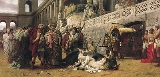
Dirce
The persecution of Christians refers to the religious persecution
Religious persecution

Religious persecution is the systematic mistreatment of an individual or group of individuals as a response to their Religion.The tendency of societies or groups within society to alienate or repress different subcultures is a recurrent theme in human history....
 of Christian
Christian

A Christian is a person who adheres to Christianity, a Monotheism#Christian view religion centered on the life and teachings of Jesus and interpreted by Christians to have been prophesied in the Hebrew Bible/Old Testament....
s, both historically and in the current era.

Persecution of Christians


Early Christianity
Early Christianity

Early Christianity is commonly defined as the Christianity of the three centuries between the Crucifixion of Jesus and the First Council of Nicaea ....
, which began within ancient Judaism
Judaism

Judaism is a set of beliefs and practices originating in the Hebrew Bible , as later further explored and explained in the Talmud and other texts....
, came out of the Nazarene schism
Schisms among the Jews

Schism s among the Jews are cultural as well as religious. They have happened as a product of historical accident, geography, and theology....
, dividing the followers of Jesus, the Nazarenes, from the Jewish majority. According to Walter Laqueur
Walter Laqueur

Walter Zeev Laqueur is an United States historian and political commentator.He was born in Breslau, Germany , to a Jewish family. In 1938 Laqueur left Germany for the British Mandate of Palestine....
, these Nazarenes did not break with the religious laws and rituals of the ancient Hebrews, "this came only with the appearance of Paulus
Paul of Tarsus

Saint Paul, also called Paul the Apostle, the Apostle Paul or Paul of Tarsus , was a Hellenistic Judaism, who called himself the "Apostle to the Gentiles", and was, together with Saint Peter and James the Just, the most notable of early Christian missionaries....
, who had not known Jesus. From this point on, Christianity was the new Israel
Supersessionism

Supersessionism and replacement theology are particular interpretations of New Testament claims, viewing God in Christianity as being either the "replacement" or "completion" of the promise made to the Jews and Jewish Proselytes....
."

The New Testament
New Testament

The New Testament is the name given to the second major division of the Christianity Bible, the first such division being the much longer Old Testament....
 relates the Christian accounts of the Pharisee rejection of Jesus
Rejection of Jesus

Jesus was and continues to be rejected by the Jewish people as a failed Jewish Messiah claimants. The Synoptic Gospels and the Gospel of John also record some rejection of Jesus in the course of his Ministry of Jesus....
 and accusations of the Pharisee responsibility for his crucifixion. The Acts of the Apostles
Acts of the Apostles

The Acts of the Apostles is a book of the Bible, which now stands fifth in the New Testament. It is commonly referred to as simply Acts. The title "Acts of the Apostles" was first used by Irenaeus in the late second century, but some have suggested that the title "Acts" be interpreted as "the Acts of the Holy Spirit" or even "the Acts...
 depicts instances of early Christian persecution by the Sanhedrin, the Hebrew religious establishment of the time. This theme plays an important part in a number of Christian doctrines ranging from the release of Christians from obeying the many strictures of the Old Testament Law (see Antinomianism
Antinomianism

Antinomianism , or lawlessness , in theology, is the idea that members of a particular religious group are under no obligation to obey the religious law of ethics or morality as presented by religious authorities....
) to the commandment to preach to all nations meaning to Gentiles as well as the Hebrew people (see Great Commission
Great Commission

The Great Commission, in Christianity tradition, is the instruction of the Resurrection appearances of Jesus to his disciple , that they spread Ministry of Jesus to all the nations of the world....
).

Reliable evidence of events accompanying the schism between the Pharisees and the Nazarenes
Schisms among the Jews

Schism s among the Jews are cultural as well as religious. They have happened as a product of historical accident, geography, and theology....
 is not available. Laqueur argues that hostility grew over the generations. By the Fourth century John Chrysostom
John Chrysostom

'Saint John Chrysostom' , archbishop of Constantinople, was an important Early Church Father. He is known for his eloquence in Sermon and public speaking, his denunciation of abuse of authority by both ecclesiastical and political leaders, the Divine Liturgy of St....
 was arguing that the Pharisees alone, not the Romans, were responsible for the murder of Christ. However, according to Laqueur: "Absolving Pilate from guilt may have been connected with the missionary activities of early Christianity in Rome and the desire not to antagonize those they want to convert."

At least by the fourth century, the consensus amongst scholars is that persecution by Jews of Christians has been traditionally overstated; according to James Everett Seaver,
Much of Christian hatred toward the Jews was based on the popular misconception... that the Jews had been the active persecutors of Christians for many centuries... The... examination of the sources for fourth century Jewish history will show that the universal, tenacious, and malicious Jewish hatred of Christianity referred to by the church fathers and countless others has no existence in historical fact. The generalizations of patristic writers in support of the accusation have been wrongly interpreted from the fourth century to the present day. That individual Jews hated and reviled the Christians there can be no doubt, but there is no evidence that the Jews as a class hated and persecuted the Christians as a class during the early years of the fourth century.


Caravaggio Crucifixion of Peter
According to the New Testament
New Testament

The New Testament is the name given to the second major division of the Christianity Bible, the first such division being the much longer Old Testament....
, Jesus' death was demanded by the Pharisee Sanhedrin and Roman authorities acquiesced, carrying out a Roman sentence of crucifixion. The New Testament also records that the first martyr was Stephen, who was stoned by the Jews, Saul heartily agreeing (the man who later converted and was renamed "Paul.") The New Testament goes on to say that Paul
Paul of Tarsus

Saint Paul, also called Paul the Apostle, the Apostle Paul or Paul of Tarsus , was a Hellenistic Judaism, who called himself the "Apostle to the Gentiles", and was, together with Saint Peter and James the Just, the most notable of early Christian missionaries....
 was himself imprisoned on several occasions by the Roman authorities, stoned by Pharisees and left for dead on one occasion, and was eventually taken as a prisoner to Rome
Rome

Rome is the capital city of Italy and Lazio, and is Italy's largest and most populous city, with 2,724,347 residents in an urban area of some ....
. Peter and others were also imprisoned, beaten and generally harassed. Because of severe persecution in Jerusalem, most of the Nazarenes were forced to leave. James was said to have been put to death around that time.

Foxe's Book of Martyrs

The Book of Martyrs, by John Foxe, is an apocalyptically-oriented, England Protestant account of the persecutions of Protestants, mainly in England, many of whom had died for their beliefs within the decade immediately preceding its first publication....
 reports that, of the eleven remaining apostles
Twelve Apostles

In Christianity, apostles were missionaries among the leaders in the Early Christianity and, in the Epistle to the Hebrews, Jesus Christ himself....
 (Judas Iscariot
Judas Iscariot

'Judas Iscariot', "Yehuda" was, according to the New Testament, one of the twelve original Twelve Apostles of Jesus. Among the twelve, he was apparently designated to keep account of the "accountant" , but he is most traditionally known for his role in Jesus' betrayal into the hands of Roman authorities....
 having killed himself), only one- John
John the Apostle

John the Apostle was one of the Twelve Apostles of Jesus. Christian tradition identifies him as the author of several New Testament works: the Gospel of John, the Epistles of John, and the Book of Revelation....
, the son of Zebedee and Salome, the younger brother of James and the writer of the Book of Revelation
Book of Revelation

The Book of Revelation, also called Revelation to John, Apocalypse of John , and Revelation of Jesus Christ is the last Biblical canon of the New Testament in the Christian Bible....
- died of natural causes in exile. The other ten were reportedly martyred by various means including beheading, by sword and spear and, in the case of Peter, crucifixion upside down following the execution of his wife.

Persecution of early Christians in the Roman Empire


Persecution under Nero, 64-68 A.D.

The first documented case of imperially-supervised persecution of the Christians in the Roman Empire
Roman Empire

The Roman Empire was the Roman Republic phase of the Ancient Rome, characterised by an autocracy form of government and large territorial holdings in Europe and around the Mediterranean....
 begins with Nero
Nero

Nero Claudius Caesar Augustus Germanicus , born Lucius Domitius Ahenobarbus, also called Nero Claudius Caesar Drusus Germanicus, was the fifth and final Roman emperor of the Julio-Claudian dynasty....
 (37-68). In 64 A.D., a great fire broke out in Rome
Great Fire of Rome

According to the historian Tacitus, the Great Fire of Rome started on the night of 18 July in the year 64 CE, among the shops clustered around the Circus Maximus....
, destroying portions of the city and economically devastating the Roman population. Nero himself was suspected as the arsonist by historian Suetonius, claiming he played the lyre and sang the 'Sack of Ilium' during the fires. In his Annals, Tacitus
Tacitus

Publius Cornelius Tacitus was a Roman Senate and a historian of the Roman Empire. The surviving portions of his two major works—the Annals and the Histories —examine the reigns of the Roman Emperors Tiberius, Claudius, Nero and those that reigned in the Year of the Four Emperors....
 (who claimed Nero was in Antium at the time of the fire's outbreak), stated that "to get rid of the report, Nero fastened the guilt and inflicted the most exquisite tortures on a class hated for their abominations, called Christians by the populace" (Tacit. Annals XV, see Tacitus on Jesus
Tacitus on Jesus

The Roman Empire historian Tacitus, writing in his Annals about the Great Fire of Rome , included an account of how the emperor Nero blamed the Christians in Rome for the disaster and initiated the first known persecution of early Christians by the Romans....
).

Persecution from the second century to Constantine

By the mid 2nd century, mobs could be found willing to throw stones at Christians, and they might be mobilized by rival sects. The Persecution in Lyon was preceded by mob violence, including assaults, robberies and stonings (Eusebius, Ecclesiastical History 5.1.7).

Further state persecutions were desultory until the third century, though Tertullian
Tertullian

Quintus Septimius Florens Tertullianus, anglicised as Tertullian, was a prolific and controversial early Christian author, and the first to write Christian Latin literature....
's Apologeticus
Apologeticus

Apologeticus or Apologeticum is Tertullian's most famous work, consisting of apologetic and polemic; it was written in Carthage in the summer or autumn of 197, during the reign of Septimius Severus....
 of 197 was ostensibly written in defense of persecuted Christians and addressed to Roman governors The "edict of Septimius Severus
Septimius Severus

Lucius Septimius Severus was a Roman Empire general, and Roman Emperor from April 14 193 to 211. He was born in what is now the Libyan part of Rome's historic Africa Province, making him the first emperor to be born in the Roman province of Africa Province....
" familiar in Christian history is doubted by some secular historians to have existed outside Christian martyrology
Martyrology

A martyrology is a catalogue or list of martyrs , arranged in the calendar order of their anniversaries or feasts. Local martyrologies record exclusively the custom of a particular Church....
.

The first documentable Empire-wide persecution took place under Maximinus Thrax
Maximinus Thrax

Gaius Iulius Verus Maximinus , also known as Maximinus Thrax and Maximinus I, was a Roman Emperor .Maximinus is described by several ancient sources as the first barbarian who wore the imperial purple and the first emperor never to set foot in Rome....
, though only the clergy were sought out. It was not until Decius
Decius

Gaius Messius Quintus Decius was the Roman Emperors from 249 - 251. In the last year of his reign, he co-ruled with his son Herennius Etruscus until both of them were killed in the Battle of Abrittus....
 during the mid-century that a persecution of Christian laity across the Empire took place. Christian sources aver that a decree was issued requiring public sacrifice, a formality equivalent to a testimonial of allegiance to the Emperor and the established order. Decius authorized roving commissions visiting the cities and villages to supervise the execution of the sacrifices and to deliver written certificates to all citizens who performed them. Christians were often given opportunities to avoid further punishment by publicly offering sacrifices or burning incense to Roman gods, and were accused by the Romans of impiety when they refused. Refusal was punished by arrest, imprisonment, torture, and executions. Christians fled to safe havens in the countryside and some purchased their certificates, called libelli. Several councils held at Carthage
Carthage

Carthage refers both to an ancient city in present-day Tunisia, and a modern-day suburb of Tunis. The civilization that developed within the city's sphere of influence is referred to as Punic or Carthaginian....
 debated the extent to which the community should accept these lapsed Christians.

The Great Persecution

The persecutions culminated with Diocletian
Diocletian

Gaius Aurelius Valerius Diocletianus , born Diocles and commonly known as Diocletian , was Roman Emperor from November 20, 284 to May 1, 305....
 and Galerius
Galerius

Galerius Maximianus , formally Gaius Galerius Valerius Maximianus was Roman Emperor from 305 to 311....
 at the end of the third and beginning of the fourth century. Their persecution, the Great Persecution is considered the largest. Beginning with a series of four edicts banning Christian practices and ordering the imprisonment of Christian clergy, the persecution intensified until all Christians in the empire were commanded to sacrifice to the gods or face immediate execution. Over 20,000 Christians are thought to have died during Diocletian's reign. However, as Diocletian
Diocletian

Gaius Aurelius Valerius Diocletianus , born Diocles and commonly known as Diocletian , was Roman Emperor from November 20, 284 to May 1, 305....
 zealously persecuted Christians in the Eastern part of the empire, his co-emperors in the West did not follow the edicts and so Christians in Gaul, Spain, and Britannia were virtually unmolested.

This persecution lasted, until Constantine I
Constantine I

Flavius Valerius Aurelius Constantinus , commonly known in English_language as Constantine I, Constantine the Great, or Saint Constantine , was Roman Emperor from 306, and the undisputed holder of that office from 324 until his death in 337....
 came to power in 313 and legalized Christianity. It was not until Theodosius I
Theodosius I

Flavius Theodosius , also called Theodosius I and Theodosius the Great , was Roman Emperor from 379 to 395. Reuniting the eastern and western portions of the empire, Theodosius was the last emperor of both the Eastern Roman Empire and Western Roman Empire....
 in the later fourth century that Christianity would become the official religion of the Empire. Between these two events Julian II
Julian the Apostate

Flavius Claudius Julianus, known also as Julian or Julian the Apostate , was Roman Emperor of the Constantinian dynasty. He was the last non-Christian Roman Emperor, and expended much energy during his reign attempting to supplant the growing power of Christianity within the empire with officially revived Religion in ancient Rom...
 temporarily restored the traditional Roman religion and established broad religious tolerance renewing Pagan and Christian hostilities.

Some early Christians sought out and welcomed martyrdom. Roman authorities tried hard to avoid Christians because they "goaded, chided, belittled and insulted the crowds until they demanded their death."193 One man shouted to the Roman officials: "I want to die! I am a Christian," leading the officials to respond: "If they wanted to kill themselves, there was plenty of cliffs they could jump off."194 Such seeking after death is found in Tertullian
Tertullian

Quintus Septimius Florens Tertullianus, anglicised as Tertullian, was a prolific and controversial early Christian author, and the first to write Christian Latin literature....
's Scorpiace but was certainly not the only view of martyrdom in the Christian church. Both Polycarp
Polycarp

Polycarp was a second century bishop of Smyrna. He died a martyr when he was stabbed after an attempt to burn him at the stake failed. Polycarp is recognized as a saint in the Roman Catholic Church, Eastern Orthodox Church, Anglican, and Lutheran Churches....
 and Cyprian
Cyprian

Saint Cyprian was bishop of Carthage and an important early Christianity writer. He was born around the beginning of the 3rd century in North Africa during the Classical Period, perhaps at Carthage, where he received an excellent classical education....
, bishops in Smyrna and Carthage respectively, attempted to avoid martyrdom.

The conditions under which martyrdom was an acceptable fate or under which it was suicidally embraced occupied writers of the early Christian Church. Broadly speaking, martyrs were considered uniquely exemplary of the Christian faith, and few early saints were not also martyrs.

The New Catholic Encyclopedia states that "Ancient, medieval and early modern hagiographers were inclined to exaggerate the number of martyrs. Since the title of martyr is the highest title to which a Christian can aspire, this tendency is natural". Estimates of Christians killed for religious reasons before the year 313 vary greatly, depending on the scholar quoted, from a high of almost 100,000 to a low of 10,000.

Persecutions of early Christians outside the Roman Empire


In 341, Shapur II
Shapur II

Shapur II was the ninth King of the Sassanid Empire from 309 to 379. During his long reign, the Sassanid Empire saw its first golden era since the reign of Shapur I ....
 ordered the massacre of all Christians in Persia. During the persecution, about 1,150 Christians were martyred under Shapur II. In the 4th century, the Terving King Athanaric
Athanaric

Athanaricus was king of several branches of the Thervings for at least two decades in the fourth century. His Gothic name, Athanareiks, means "king and athans "edel" s....
 began persecuting Christians, many of whom were killed.

Persecution of Christians by Christians

As with many religions, Christianity is not a homogenous group; there exist many sects of Christianity, which often find themselves at odds with each other.

Upon the establishment of official ties between the state and Christianity, the state and the Church turned their considerable attention to those deemed heretics. The first nonconforming Christian executed was Priscillian
Priscillian

Priscillian, bishop of ?vila , a theology from Ancient Rome Gallaecia , was the first person in the history of Christianity to be executed for heresy ....
. Many 4th century examples of such a situation involved Arianism
Arianism

Arianism is the theological teaching of Arius , a Christian priest, who was first ruled a heresy at the First Council of Nicea, later exonerated and then pronounced a heretic again after his death....
, which held, against the orthodox tradition, that Jesus
Jesus

Jesus of Nazareth , also known as Jesus Christ, is the central figure of Christianity and is revered by most Christian churches as the Son of God and the Incarnation ....
 was not "one in unity with the Father", but instead was a created being, not on the same level with God, above humans but below God the Father
God the Father

In many religions, the supreme deity is given the title and attributions of Father. In many forms of polytheism, the highest god has been conceived as a "father of gods and of men"....
.

In the Eastern Roman Empire Emperors were established as both Orthodox and Arian as Constantine's own sons Constantius II
Constantius II

Flavius Iulius Constantius, known in English as Constantius II was a Roman Emperor of the Constantinian dynasty....
, Constantine II
Constantine II (emperor)

Flavius Claudius Constantinus, known in English as Constantine II, was List of Roman Emperors from 337 to 340. The eldest son of Constantine the Great and Fausta, he was born at Arles, and was raised as a Christian....
 (who proceeded Constantine I) were Arian. Later still, the Emperor Valens also was an Arian. The Germanic Goths
Goths

The Goths were East Germanic tribes who, in the 3rd and 4th centuries, invasion the Roman Empire and later adopted Arian Christianity. In the 5th and 6th centuries, divided as the Visigoths and the Ostrogoths, they established powerful successor-states of the Roman Empire in the Iberian peninsula and Italy....
 and Vandals
Vandals

The Vandals were an East Germanic tribe that entered the late Roman Empire during the 5th century. The Goths Theodoric the Great, king of the Ostrogoths and regent of the Visigoths, was allied by marriage with the Vandals as well as with the Burgundians and the Franks under Clovis I....
 adhered to Arian Christianity, establishing Arian states in Italy and Spain. Orthodox Christians defended themselves vigorously against these foreign Arians.

In 429 the Vandals
Vandals

The Vandals were an East Germanic tribe that entered the late Roman Empire during the 5th century. The Goths Theodoric the Great, king of the Ostrogoths and regent of the Visigoths, was allied by marriage with the Vandals as well as with the Burgundians and the Franks under Clovis I....
 (who were Arians) conquered Roman Africa
Africa Province

File:Roman Africa.JPGThe Roman province of Africa was established after the Romans defeated Carthage in the Third Punic War. It roughly comprised the territory of present-day northern Tunisia, north-eastern Algeria and the Mediterranean Sea coast of modern-day western Libya along the Syrtis Minor....
. Catholics were discriminated against; Church property was confiscated. Thousands of Catholics were banished from Vandal held territory.St. Augustine, for example, died while in a town besieged by the Arian Vandals. As it was the fall of Rome
Decline of the Roman Empire

The English historian Edward Gibbon, author of The Decline and Fall of the Roman Empire made this concept part of the framework of the English language, but he was neither the first nor the last to speculate on why and when the Empire collapsed....
 to the Goths, tribes who throughout their histories, were a mix of Pagan and Arian Christians.

In the medieval period the Roman Catholic church moved to suppress the Cathar
Cathar

Catharism was a name given to a Christian religious sect with dualism and gnostic elements that appeared in the Languedoc region of France in the 11th century and flourished in the 12th and 13th centuries....
 heresy, the Pope
Pope

The Pope is the Bishop of Rome, the leader of the Roman Catholic Church and head of state of Vatican City. The current pope is Pope Benedict XVI, who was elected April 19, 2005 in Papal conclave, 2005....
 having sanctioned a crusade against the Albigensians
Albigensian Crusade

The Albigensian Crusade or Cathar Crusade was a 20-year military campaign initiated by the Roman Catholic Church to eliminate the Cathar heresy in Languedoc....
; during the course of which the massacre of Beziers
Béziers

B?ziers is a town in Languedoc in the southwest of France. It is a commune in France and a sub-prefecture of the H?rault Departments of France....
 took place, with between seven and twenty thousand deaths. (This was the occasion when the papal legate, Arnaud Amalric
Arnaud Amalric

Arnaud Amalric, or Arnau Amalric, was a Cistercians monk. He was abbot of Poblet from 1196 to 1198, then of Grandselve from 1198 to 1202....
, asked about how Catholics could be distinguished from Cathars once the city fell, famously replied, "Kill them all, God will know His own."). Over the twenty year period of this campaign an estimated 200,000 to 1,000,000 people were killed.

John Huss, a Bohemia
Bohemia

History...
n preacher of reformation, was burned at the stake on July 6 1415. Pope Martin V
Pope Martin V

Pope Martin V , born Odo Colonna was Pope from 1417 to 1431. His election effectively ended the Western Schism ....
 issued a bull on 17 March 1420 which proclaimed a crusade “for the destruction of the Wycliffites, Hussite
Hussite

The Hussites were a Christianity movement following the teachings of Czech reformer Jan Hus or John Huss , who became one of the forerunners of the Protestant Reformation....
s and all other heretic
Heresy

Heresy is an introduced change to some system of belief, especially a religion, that conflicts with the previously established canon of that belief....
s in Bohemia".

The Crusades
Crusades

The Crusades were a series of religious war waged by much of Christian Europe against external and internal opponents. Crusades were fought mainly against Muslims, though campaigns were also directed against Paganism Slavic peoples, Jews, Eastern Orthodox Church, Mongols, Catharism, Hussites, Waldensians, Old Prussians, and political enemi...
 in the Middle East
Middle East

File:GreaterMiddleEast1.pngThe Middle East is a region that spans southwestern Asia, western Asia, and northeastern Africa. It has no clear boundaries, often used as a synonym to Near East, in opposition to Far East....
 also spilled over into conquest of Eastern Orthodox
Eastern Orthodox Church

The Eastern Orthodox Church is the second largest single Christian communion in the world with an estimated 225 million members worldwide. It is considered by its adherents to be the Four Marks of the Church established by Jesus Christ and his Apostles nearly 2000 years ago....
 Christians by Roman Catholics and attempted suppression of the Orthodox Church. The Waldenses were as well persecuted by the Catholic Church, but survive up to this day. The Reformation led to a long period of warfare and communal violence between Catholic and Protestant factions, leading to massacres and forced suppression of the alternative views by the dominant faction in many countries. In the 1572 St. Bartholomew's Day Massacre
St. Bartholomew's Day massacre

The St. Bartholomew's Day massacre in 1572 was a targeted group of assassinations, followed by a wave of Roman Catholic mob violence, both directed against the Huguenots , during the French Wars of Religion....
 the French king ordered the murder of Protestants in France.

Intolerance of dissident forms of Protestantism continued, as evidenced by the exodus of the Pilgrims
Pilgrims

Pilgrims, or Pilgrim Fathers , is a name commonly applied to the early settlers of the Plymouth Colony in present-day Plymouth, Massachusetts....
 who sought refuge in America, founding the Plymouth Colony
Plymouth Colony

Plymouth Colony was an English colonial venture in North America from 1620 until 1691. The first settlement was at New Plymouth, a location previously surveyed and named by John Smith of Jamestown....
 in Massachusetts
Massachusetts

The Commonwealth of Massachusetts is a U.S. state located in the New England region of the Northeastern United States United States. It borders Rhode Island and Connecticut to the south, New York to the west, and Vermont and New Hampshire to the north....
 in 1620. In the modern period, such events include violence between Mormons and Protestants in the United States
United States

The United States of America is a Federal government constitutional republic comprising U.S. state and a federal district. The country is situated mostly in central North America, where its Contiguous United States and Washington, D.C., the Capital districts and territories, lie between the Pacific Ocean and Atlantic Oceans, Borders of the U...
 during the 19th century. That century also saw the alleged martyrdom of St. Peter the Aleut
Peter the Aleut

Cungagnaq is venerated as a martyr and saint by the Eastern Orthodox Church. He was a native of Kodiak Island , and is said to have received the Christianity name of Peter when he was baptized into the Eastern Orthodox Church faith by the monks of Herman of Alaska's missionary operating in the north....
 at the hands of Roman Catholic clergy in San Francisco, California
San Francisco, California

The City and County of San Francisco is the fourth most populous city in California and the List of United States cities by population in the United States, with a 2007 estimated population of 799,183....
.

Anti-Catholic

Anti-Catholicism officially began in 1534 during the English Reformation
English Reformation

The English Reformation was the series of events in 16th century England by which the Church of England first broke away from the authority of the Pope and the Roman Catholic Church....
; the Act of Supremacy made the King of England the 'only supreme head on earth of the Church in England.' Any act of allegiance to the latter was considered treason. It was under this act that Thomas More
Thomas More

Saint Thomas More was an English lawyer, author, and statesman who in his lifetime gained a reputation as a leading Renaissance humanist scholar, and occupied many public offices, including Lord Chancellor ....
 was executed. Queen Elizabeth I
Elizabeth I of England

Elizabeth I was List of English monarchs and Queen of Ireland from 17 November 1558 until her death. Sometimes called The Virgin Queen, Gloriana, or Good Queen Bess, Elizabeth was the fifth and last monarch of the House of Tudor....
's scorn for Jesuit missionaries led to many executions at Tyburn
Tyburn

Tyburn may refer to:* Tyburn, London, former village just outside the then boundaries of London that was best known as a place of public execution...
. As punishment for the rebellion of 1641, almost all lands owned by Irish Catholics
Irish people

The Irish people are a Western European ethnic group who originate in Ireland, in north western Europe. Ireland has been populated for around 9,000 years , with the Irish people's earliest ancestors recorded as the Nemedians, Fomorians, Fir Bolgs, Tuatha D? Danann and the Milesians ?the last group supposedly representing the "pure" Gaelic a...
 were confiscated and given to Protestant settlers. Under the penal laws
Penal Laws (Ireland)

The Penal Laws in Ireland refers to a series of laws imposed under British rule that sought to discriminate against Roman Catholics and Protestant dissenters in favour of the established Church of Ireland....
 no Irish Catholic could sit in the Parliament of Ireland
Parliament of Ireland

The Parliament of Ireland was a legislature that existed in Dublin from 1297 until 1800. It comprised two chambers: the Irish House of Commons and the Irish House of Lords....
, even though some 90% of Ireland's population was native Irish Catholic when the first of these bans was introduced in 1691. Catholic / Protestant strife has been blamed for much of "The Troubles
The Troubles

The Troubles was a period of ethno-political conflict in Northern Ireland which spilled over at various times into England, the Republic of Ireland and Continental Europe....
," the ongoing struggle in Northern Ireland
Northern Ireland

conventional_long_name = Northern Ireland|native_name= Tuaisceart ?ireannNorlin Airlann|motto =|image_map = Europe location N-IRL2.png...
.

This attitude was carried "across the pond" to the American colonies, which would leave England
England

native_name =|conventional_long_name = England|common_name = England|image_flag = Flag of England.svg|image_coat = England COA.svg|symbol_type = Royal Coat of Arms...
, forming the United States
United States

The United States of America is a Federal government constitutional republic comprising U.S. state and a federal district. The country is situated mostly in central North America, where its Contiguous United States and Washington, D.C., the Capital districts and territories, lie between the Pacific Ocean and Atlantic Oceans, Borders of the U...
. In the English colonies, Catholicism was introduced with the settling of Maryland
Maryland

Maryland is a U.S. state located in the Mid Atlantic States of the United States, bordering Virginia, West Virginia and the Washington, D.C. to the south and west, Pennsylvania to the north, and Delaware to the east....
 in 1634; this colony offered a rare example of religious toleration
Religious toleration

Religious toleration is the condition of accepting or permitting others' religion beliefs and practices which disagree with one's own.In a country with a state religion, toleration means that the government permits religious practices of other sects besides the state religion, and does not persecute believers in other faiths....
 in a fairly intolerant age, particularly amongst other English colonies which frequently exhibited a quite militant Protestantism
Protestantism

Protestantism is a movement within Christianity that originated in the sixteenth-century Protestant Reformation. It is considered to be one of the three principal traditions of Christianity, together with Roman Catholicism and Eastern Orthodoxy....
. (See the Maryland Toleration Act
Maryland Toleration Act

File:Large Broadside on the Maryland Toleration Act.jpgMaryland Toleration Act, also known as the Act Concerning Religion, was passed in 1649 by assembly of the Province of Maryland mandating religious toleration....
, and note the pre-eminence of the Archdiocese of Baltimore in Catholic circles.) However, at the time of the American Revolution
American Revolution

The American Revolution refers to the political upheaval during the last half of the 18th century in which the Thirteen Colonies of North America overthrew the governance of the British Empire and then rejected the British monarchy to become the sovereign United States of America....
, Catholics formed less than 1% of the population of the thirteen colonies.

Although there has been a strong anti-Catholic sentiment in North America since before the dawn of the US, the feeling grew stronger during waves of Catholic immigration
Immigration

While the movement of people has thought throughout history at various levels, modern immigration tourism are considered non-immigrants . Immigration that violates the immigration laws of the destination country is termed illegal immigration or undocumented immigration....
 from old Europe
Europe

Europe is, conventionally, one of the world's seven continents. Comprising the westernmost peninsula of Eurasia, Europe is generally divided from Asia to its east by the water divide of the Ural Mountains, the Ural , the Caspian Sea, and by the Caucasus Mountains to the southeast....
. These huge numbers of immigrant Catholics came from Ireland
Republic of Ireland

Ireland is an Island country in north-western Europe. The modern Sovereignty state occupies about five-sixths of the island of Ireland, which was partitioned by the British on 3 May 1921....
, Southern Germany
Germany

Germany , officially the Federal Republic of Germany , is a country in Central Europe. It is bordered to the north by the North Sea, Denmark, and the Baltic Sea; to the east by Poland and the Czech Republic; to the south by Austria and Switzerland; and to the west by France, Luxembourg, Belgium, and the Netherlands....
, Italy
Italy

Italy , officially the Italian Republic , is a country located on the Italian Peninsula in Southern Europe and on the two largest islands in the Mediterranean Sea, Sicily and Sardinia....
, Poland
Poland

Poland , officially the Republic of Poland , is a country in Central Europe. Poland is bordered by Germany to the west; the Czech Republic and Slovakia to the south; Ukraine, Belarus and Lithuania to the east; and the Baltic Sea and Kaliningrad Oblast, a Russian Enclave and exclave, to the north....
 and Eastern Europe
Eastern Europe

Eastern Europe is a term that applies to the geopolitical region encompassing the easternmost part of the Europe. Throughout history and to a lesser extent today, parts of Eastern Europe has been distinguishable from Western Europe and other regions due to cultural, religious, economic, and historical reasons, even though there i...
. Nationalist, nativist
Nativism (politics)

Nativism is an opposition to immigration or to specific ethnic or cultural groups because the groups are considered hostile or alien to the natural culture, and it is assumed that they cannot be assimilated....
 feeling was represented by the Know-Nothing Party. Father James Coyle
James Coyle

Father James Coyle , a Roman Catholic priest, was murdered in Birmingham, Alabama, Alabama.Coyle attended Mungret College in Limerick and the Pontifical North American College in Rome....
, a Roman Catholic priest, was murdered in 1921 by the Ku Klux Klan
Ku Klux Klan

Ku Klux Klan is the name of several past and present secret domestic militant organizations in the United States, originating in the southern states and eventually having national scope, that are best known for advocating white supremacy and acting as terrorists while hidden behind conical hats, masks and white robes....
.

Anti-Protestant

Massacre Saint Barthelemy
Anti-Protestantism originated in a reaction by the Catholic Church against the Protestant Reformation
Protestant Reformation

The Protestant Reformation was a Christian reform movement in Europe. It is thought to have begun in 1517 with Martin Luther's Ninety-Five Theses and may be considered to have ended with the Peace of Westphalia in 1648....
 of the 16th century. Protestants were denounced as heretics and subject to persecution in those territories, such as Spain, Italy and the Netherlands, in which the Catholics were the dominant power. This movement was orchestrated by Popes and Princes as the Counter Reformation. This resulted in religious wars and eruptions of sectarian hatred such as the St Bartholomew's Day Massacre.

Persecution of the Anabaptists

When the disputes between Lutherans and Roman Catholics gained a political dimension, both groups saw other groups of religious dissidents that were arising as a danger to their own security. The early "Täufer" (lit. "Baptists") were mistrusted and rejected by both religio-political parties. Religious persecution is often perpetrated as a means of political control, and this becomes evident with the Treaty of Augsburg in 1555. This treaty provided the legal groundwork for persecution of the Anabaptists.

Muslim persecution of Christians


Ottoman Empire

The Young Turks
Young Turks

The Young Turks were a coalition of various groups favoring reformation of the Administration of the Ottoman Empire. Through the Young Turk Revolution, their movement brought about the Second Constitutional Era ....
 government of the collapsing Ottoman Empire
Ottoman Empire

The Ottoman Empire , also known by its contemporaries as the Turkish Empire or Turkey , was an empire that lasted from 1299?1923. It was Treaty of Lausanne by the Republic of Turkey, which was officially proclaimed on October 29, 1923....
 in 1915 persecuted Christian
Eastern Christianity

Eastern Christianity refers collectively to the Christianity traditions and churches which developed in the Balkans, Eastern Europe, Asia Minor, the Middle East, Christianity in Africa and southern India over several centuries of religious antiquity....
 populations in Anatolia, Syria and Mesopotamia, resulting in an estimated 2.5 million deaths, divided between roughly 1.5 million Armenian Christians, 0.7 million Syriac Christians and 0.3 million Greek Orthodox Christians.

Republic of Turkey

In modern Turkey
Turkey

Turkey , known officially as the Republic of Turkey , is a Eurasian country that stretches across the Anatolian peninsula in southwest Asia and Thrace in the Balkans region of Southern Europe....
, the Istanbul pogrom
Istanbul Pogrom

The Istanbul Pogrom , was a pogrom directed primarily at Istanbul's Greeks minority on 6-7 September 1955. The riots were orchestrated by the military's Tactical Mobilization Group, the seat of Operation Gladio's Turkish branch; the Counter-Guerrilla....
 was a state-sponsored and state-orchestrated pogrom
Pogrom

A pogrom is a form of riot directed against a particular group, whether ethnic, religious, or other, and characterized by the killing and destruction of their homes, businesses, and religious centers....
 that compelled Greek Christians to leave Constantinople
Constantinople

Constantinople was the empire capital of the Roman Empire , the Byzantine Empire , the Latin Empire , and the Ottoman Empire . Strategically located between the Golden Horn and the Sea of Marmara at the point where Europe meets Asia, Byzantine Constantinople had been the capital of a Christendom empire, successor to ancient ancient Greece...
 (Turkish
Turkish language

Turkish is a language spoken by over 63 million people worldwide, making it the most commonly spoken of the Turkic languages. Its speakers are located predominantly in Turkey and Cyprus, with smaller groups in Iraq, Greece, Bulgaria, the Republic of Macedonia, Kosovo, Albania and other parts of Eastern Europe....
 Istanbul), the first Christian city in violation to the Treaty of Lausanne
Treaty of Lausanne

The Treaty of Lausanne was a peace treaty signed in Lausanne, Switzerland, that settled the Anatolian and Eastern Thrace parts of the partitioning of the Ottoman Empire by annulment of the Treaty of S?vres that was signed by the Istanbul-based Sublime Porte; as the consequence of the Turkish War of Independence between the Allies of World W...
 (see Istanbul Pogrom
Istanbul Pogrom

The Istanbul Pogrom , was a pogrom directed primarily at Istanbul's Greeks minority on 6-7 September 1955. The riots were orchestrated by the military's Tactical Mobilization Group, the seat of Operation Gladio's Turkish branch; the Counter-Guerrilla....
). The issue of Christian genocides by the Turks may become a problem, since Turkey wishes to join the European Union
European Union

The European Union is an economic and political union of 27 European Union member state, located primarily in Europe. It was established by the Treaty of Maastricht on 1 November 1993 upon the foundations of the pre-existing European Economic Community....
. The Ecumenical Patriarchate of Constantinople
Ecumenical Patriarchate of Constantinople

The Ecumenical Patriarchate of Constantinople is one of the fourteen autocephaly Eastern Orthodox Church churches. It is headed by the Ecumenical Patriarch, who has the status of "Primus inter pares" among the world's Orthodox bishops....
 is still in a difficult position. Turkey requires by law that the Ecumenical Patriarch must be an ethnic Greek
Greeks

The Greeks , also known as Hellenes, are a nation and ethnic group native to Greece, Cyprus and neighbouring regions, who can also be found in Greek diaspora communities around the world....
, holding Turkish citizenship by birth, although most of the Greek minority
Greeks in Turkey

The Greeks in Turkey constitute a population of Greeks and Greek language-speaking Eastern Orthodox Church Christianity who mostly live in Istanbul, as well as on the two islands of the western entrance to the Dardanelles: Imbros and Tenedos and also on the Princes' Islands....
 has been expelled. The state's expropriation of church property and the closing of the Orthodox Theological School of Halki
Halki seminary

The Halki seminary was established on Oct 1, 1844 in Halki , the second largest of the Princes' Islands in the Sea of Marmara. It was the main school of theology of the Eastern Orthodox Church's Ecumenical Patriarchate of Constantinople until its closure by the Turkey authorities in 1971....
 are also difficulties faced by the Church of Constantinople. Despite appeals from the United States
United States

The United States of America is a Federal government constitutional republic comprising U.S. state and a federal district. The country is situated mostly in central North America, where its Contiguous United States and Washington, D.C., the Capital districts and territories, lie between the Pacific Ocean and Atlantic Oceans, Borders of the U...
, the European Union
European Union

The European Union is an economic and political union of 27 European Union member state, located primarily in Europe. It was established by the Treaty of Maastricht on 1 November 1993 upon the foundations of the pre-existing European Economic Community....
 and various governmental and non-governmental organizations, the School remains closed since 1971. Persecution of Christians is continuing in modern Turkey. On February 5, 2006, the Catholic priest Andrea Santoro
Andrea Santoro

Priesthood Andrea Santoro was a Roman Catholicism in Turkey priest who was murdered in the Santa Maria Church in Trabzon, Turkey, where he served as a member of the Catholic church's Fidei donum missionary program....
 was murdered in Trabzon
Trabzon

Trabzon is a city on the Black Sea coast of north-eastern Turkey and the capital of Trabzon Province. Trabzon, located on the historical Silk Road became a melting pot of religions, languages and culture for centuries and a trade gateway to Iran in the southeast, Russia and the Caucasus to the northeast....
 by a student influenced by the reactions following the Jyllands-Posten Muhammad cartoons controversy
Jyllands-Posten Muhammad cartoons controversy

The Jyllands-Posten Muhammad cartoons controversy began after twelve editorial cartoons, most of which depicted the Islamic prophet Muhammad, were published in the Denmark newspaper Jyllands-Posten on 30 September 2005....
. On April 18, 2007, 3 Christians were brutally murdered in Malatya
Malatya

Malatya is the capital List of cities in Turkey of the Malatya Province in the Eastern Anatolia Region, Turkey of Turkey....
, the hometown of Mehmet Ali Agca
Mehmet Ali Agca

Mehmet Ali Agca is a Turkey assassin, who shot and wounded Pope John Paul II on May 13, 1981. After serving 19 years of incarceration in Italy, he was deported to Turkey, where he is serving another life sentence for the murder of Abdi Ipek?i, a left-wing journalist, in 1979....
, the assassin who shot and wounded Pope John Paul II
Pope John Paul II

Pope John Paul II John Paul II is widely acclaimed as one of the most influential leaders of the twentieth century. He has been Pope_John_Paul_II#Role_in_the_fall_of_Communism in bringing down communism in Eastern Europe, as well as significantly improving the Roman Catholic Church's relations with Judaism, the Eastern Orthodox Church, and A...
 on May 13, 1981.

Iraq

Although Christians represent less than 5% of the total Iraqi population, they make up 40% of the refugees now living in nearby countries, according to UNHCR. Northern Iraq remained predominantly Christian until the destructions of Tamerlane at the end of the 14th century. The Church of the East
Church of the East

Church of the East may refer to the Church centered in modern Syria and Iraq named Nestorianism in the Western world before it was divided into the three bodies below....
 has its origin in what is now South East Turkey
Turkey

Turkey , known officially as the Republic of Turkey , is a Eurasian country that stretches across the Anatolian peninsula in southwest Asia and Thrace in the Balkans region of Southern Europe....
. By the end of the 13th century there were twelve Nestorian dioceses in a strip from Peking to Samarkand
Samarkand

Samarkand , is the second-largest city in Uzbekistan and the capital of Samarqand Province.The city is most noted for its central position on the Silk Road between China and the West, and for being an Islamic centre for scholarly study....
. When the 14th-century Muslim warlord of Turco-Mongol descent, Tamerlane (Timul Lenk), conquered Persia, Mesopotamia
Mesopotamia

Mesopotamia is the area of the Tigris-Euphrates river system, along the Tigris and Euphrates rivers, largely corresponding to modern Iraq, as well as some parts of northeastern Syria, some parts of southeastern Turkey, and some parts of the Khuzestan Province of southwestern Iran....
 and Syria
Syria

Syria , officially the Syrian Arab Republic , is an Arab-majority country in Southwest Asia, bordering Lebanon and the Mediterranean Sea to the west, Israel to the southwest, Jordan to the south, Iraq to the east, and Turkey to the north....
, the civilian population was decimated. Timur Lenk had 70,000 Assyrian Christians beheaded in Tikrit
Tikrit

Tikrit is a town in Iraq, located 140 km northwest of Baghdad on the Tigris river . The town, with an estimated population in 2002 of about 260,000 is the administrative center of the province of Salah ad Din ....
, and 90,000 more in Baghdad
Baghdad

Baghdad is the Capital of Iraq and of Baghdad Governorate, with which it is also coterminous. With a municipal population estimated at 6.5 million, it is the largest city in Iraq, and the second largest city in the Arab World....
.

In the 16th century, Christians were half the population of Iraq. In 1987, the last Iraqi census counted 1.4 million Christians. They were tolerated under the secular regime of Saddam Hussein
Saddam Hussein

Saddam Hussein Abd al-Majid al-Tikriti was the President of Iraq of Iraq from 16 July 1979 until 9 April 2003.A leading member of the revolutionary Ba'ath Party, which espoused secular pan-Arabism, economic modernization, and Arab socialism, Saddam played a key role in the 1968 coup that brought the party to long-term power....
, who even made one of them, Tariq Aziz
Tariq Aziz

Mikhail Yuhanna, later and more popularly known as Tariq Aziz or Tareq Aziz, was the Foreign Minister and Deputy Prime Minister of Iraq, and a close advisor of former President of Iraq Saddam Hussein for decades....
, his deputy.

Recently, Christians have seen their total numbers slump to about 500,000 today, of whom 250,000 live in Baghdad
Baghdad

Baghdad is the Capital of Iraq and of Baghdad Governorate, with which it is also coterminous. With a municipal population estimated at 6.5 million, it is the largest city in Iraq, and the second largest city in the Arab World....
. An exodus to the neighboring countries of Syria
Syria

Syria , officially the Syrian Arab Republic , is an Arab-majority country in Southwest Asia, bordering Lebanon and the Mediterranean Sea to the west, Israel to the southwest, Jordan to the south, Iraq to the east, and Turkey to the north....
, Jordan
Jordan

Jordan , officially the Hashemite Kingdom of Jordan, is an Arab country in Southwest Asia spanning the southern part of the Syrian Desert down to the Gulf of Aqaba....
 and Turkey
Turkey

Turkey , known officially as the Republic of Turkey , is a Eurasian country that stretches across the Anatolian peninsula in southwest Asia and Thrace in the Balkans region of Southern Europe....
 has left behind closed parishes, seminaries and convents. As a small minority without a militia of their own, Iraqi Christians have been persecuted by both Shi’a and Sunni Muslim militias, and also by criminal gangs.

As of June 21, 2007, the UNHCR estimated that 2.2 million Iraqis had been displaced to neighboring countries, and 2 million were displaced internally, with nearly 100,000 Iraqis fleeing to Syria and Jordan each month. A May 25 2007 article notes that in the past seven months only 69 people from Iraq
Iraq

Iraq , officially the Republic of Iraq , is a country in Western Asia spanning most of the northwestern end of the Zagros Mountains, the eastern part of the Syrian Desert and the northern part of the Arabian Desert....
 have been granted refugee
Refugee

Convention Relating to the Status of Refugees, a refugee is a person who flees to a foreign country or power to escape danger or persecutionOwing to a well-founded fear of being persecuted for reasons of race, religion, nationality, membership of a particular social group, or political opinion, is outside the country of their nationality,...
 status in the United States
United States

The United States of America is a Federal government constitutional republic comprising U.S. state and a federal district. The country is situated mostly in central North America, where its Contiguous United States and Washington, D.C., the Capital districts and territories, lie between the Pacific Ocean and Atlantic Oceans, Borders of the U...
.

Chaldean Catholic priest Fr. Ragheed Aziz Ganni and subdeacons Basman Yousef Daud, Wahid Hanna Isho, and Gassan Isam Bidawed were killed in the ancient city of Mosul
Mosul

Mosul is a city in northern Iraq and the capital of the Ninawa Governorate, some 400 km northwest of Baghdad. The original city stands on the west bank of the Tigris River, opposite the ancient city of Nineveh on the east bank, but the metropolitan area has now grown to encompass substantial areas on both banks, with five bridges linkin...
 last year. Fr. Ragheed Aziz Ganni was driving with his three deacons when they were stopped and demanded to convert to Islam, when they refused they were shot. Six months later, the body of archbishop Paulos Faraj Rahho
Paulos Faraj Rahho

Archbishop Mar Paulos Faraj Rahho was the Chaldean Catholic Archdiocese of Mosul, in the northern part of Iraq.Also known as Paul Faraj Rahho and Paulos Faradsch Raho, he lived almost his entire life in Mosul, Iraq, which has a long established community of Chaldean Catholics....
 was found buried near Mosul
Mosul

Mosul is a city in northern Iraq and the capital of the Ninawa Governorate, some 400 km northwest of Baghdad. The original city stands on the west bank of the Tigris River, opposite the ancient city of Nineveh on the east bank, but the metropolitan area has now grown to encompass substantial areas on both banks, with five bridges linkin...
. He was kidnapped on February 29 2008 when his bodyguards and driver were killed.

Christian casualties of the War in Lebanon

The war in Lebanon saw a number of massacres of both Christians and Muslims. Among the earliest was the Damour Massacre
Damour massacre

The Damour massacre took place on January 20, 1976 during the 1975–1990 Lebanese Civil War. Damour, a Christian town on the main highway south of Beirut, was attacked by PLO units....
 in 1976 when Palestinian militias attacked Christian civilians in retaliation for the Karantina Massacre
Karantina Massacre

The Karantina massacre took place during the Lebanese Civil War on January 18, 1976.Karantina was a strategically situated slum district in Beirut controlled by forces from the Palestine Liberation Organization , but inhabited mainly by Kurds and Armenians, as well as some Lebanese people and Palestinian Islam....
, in which around one thousand civilians (Palestinian, Shi'ite, and others) were murdered by Lebanese Christian militias. The persecution in Lebanon combined sectarian, political, ideological, and retaliation reasons. The Syrian regime
Syria

Syria , officially the Syrian Arab Republic , is an Arab-majority country in Southwest Asia, bordering Lebanon and the Mediterranean Sea to the west, Israel to the southwest, Jordan to the south, Iraq to the east, and Turkey to the north....
  was also involved in persecuting Christians as well as Muslims in Lebanon.

Sudan

In Sudan, it is estimated that over 1.5 million Christians have been killed by the Janjaweed
Janjaweed

The Janjaweed is a blanket term used to describe mostly armed gunmen in Darfur, western Sudan, and now eastern Chad. Using the United Nations definition, the Janjaweed comprised nomadic Arabic-speaking African tribes , the core of whom are from the Abbala background with significant Lambo recruitment from the Baggara people....
, the Arab Muslim militia, and even suspected Islamists in northern Sudan since 1984. It should also be noted that Sudan's several civil wars (which often take the form of genocidal campaigns) are often not only or purely religious in nature, but also ethnic, as many black Muslims, as well as Muslim Arab tribesmen, have also been killed in the conflicts.

It is estimated that as many as 200,000 people had been taken into slavery
Slavery

Slavery is a form of forced labor where a person is compelled to Labor for another . Slaves are held against their will from the time of their capture, purchase, or birth, and are deprived of the right to leave, to refuse to work, or to receive Remuneration in return for their labor....
 during the Second Sudanese Civil War
Second Sudanese Civil War

The Second Sudanese Civil War started in 1983, although it was largely a continuation of the First Sudanese Civil War of 1955 to 1972. It took place, for the most part, in southern Sudan and was one of the longest lasting and deadliest wars of the later 20th century....
. The slaves are mostly Dinka
Dinka

The Dinka are a group of tribes of south Sudan, inhabiting the Bahr el Ghazal region of the Nile basin, Jonglei and parts of southern Kordufan and Upper Nile, Sudan regions....
 people.

Pakistan

In Pakistan 1.5% of the population are Christian. Pakistani law mandates that "blasphemies" of the Qur'an are to be met with punishment. Ayub Masih, a Christian, was convicted of blasphemy and sentenced to death in 1998. He was accused by a neighbor of stating that he supported British writer, Salman Rushdie
Salman Rushdie

Sir Ahmed Salman Rushdie is a British Indian novelist and essayist. He first achieved fame with his second novel, Midnight's Children , which won the Booker Prize in 1981....
, author of The Satanic Verses. Lower appeals courts upheld the conviction. However, before the Pakistan Supreme Court, his lawyer was able to prove that the accuser had used the conviction to force Masih's family off their land and then acquired control of the property. Masih has been released.

The Christian community in Pakistan is the target of attacks by Islamic extremists.

On September 25, 2002 two terrorists entered the "Peace and Justice Institute", Karachi
Karachi

is the largest city, seaport and the International financial centre of Pakistan. It is List of metropolitan areas by population in terms of metropolitan population, and is Pakistan's premier centre of banking, industry, and trade....
, where they separated Muslims from the Christians, and then murdered eight Christians by shooting them in the head . All of the victims were Pakistani Christians. Karachi police chief Tariq Jamil said the victims had their hands tied and their mouths had been covered with tape.

In November 2005 3,000 militant Islamists attacked Christians in Sangla Hill in Pakistan and destroyed Roman Catholic, Salvation Army
Salvation Army

The Salvation Army, an international movement, is an evangelical part of the Christian Church. It has a quasi-military structure and it was founded in 1865 in Great Britian as the East London Christian Mission by William Booth and Catherine Booth....
 and United Presbyterian churches. The attack was over allegations of violation of blasphemy laws by a Pakistani Christian named Yousaf Masih. The attacks were widely condemned by some political parties in Pakistan.

On June 5 2006 a Pakistani Christian stonemason named Nasir Ashraf was working near Lahore
Lahore

is the capital of the Pakistani Subdivisions of Pakistan of Punjab and is the List of most populated metropolitan areas in Pakistan city in Pakistan after Karachi....
 when he drank water from a public facility using a glass chained to the facility. He was assaulted by Muslims for "Polluting the glass". A mob developed, who beat Ashraf, calling him a "Christian dog". Bystanders encouraged the beating and joined in. Ashraf was eventually hospitalized.

One year later, in August 2007, a Christian missionary couple, Rev. Arif and Kathleen Khan, were gunned down by militant Islamists in Islamabad
Islamabad

Islamabad is the Capital of Pakistan, and is the tenth largest city in Pakistan. The Rawalpindi/Islamabad List of most populous metropolitan areas in Pakistan is the third largest in Pakistan with a population of over 4.5 million inhabitants, 1.5 million in Islamabad and three million in Rawalpindi....
. The "official" position in Pakistan is that the killer was a fellow Christian, and that the killings were "justified" as an honor killing
Honor killing

Honor killing is the murder of a family or clan member by one or more fellow family members, when the murderers believe the victim to have brought honour upon the family, clan, or community, normally by utilizing dress codes unacceptable to certain people or engaging in certain sexual acts....
 under the false pretext that the missionaries were engaged in sexual harassment, an assertion widely doubted in the international media, as well as by Pakistani Christians.

In other Muslim nations

In Egypt
Egypt

Egypt is a country mainly in North Africa, with the Sinai Peninsula forming a land bridge in Western Asia. Covering an area of about , Egypt borders the Mediterranean Sea to the north, the Gaza Strip and Israel to the northeast, the Red Sea to the east, Sudan to the south and Libya to the west....
 the government does not officially recognize conversions from Islam to Christianity; because certain interfaith marriages are not allowed either, this prevents marriages between converts to Christianity and those born in Christian communities, and also results in the children of Christian converts being classified as Muslims and given a Muslim education. The government also requires permits for repairing churches or building new ones, which are often withheld. Foreign missionaries are allowed in the country only if they restrict their activities to social improvements and refrain from proselytizing. The Coptic
Coptic Christianity

||-The Coptic Orthodox Church of Alexandria is the official name for the largest Christianity church in Egypt. The Church belongs to the Oriental Orthodoxy family of churches, which has been a distinct church body since the Council of Chalcedon in AD 451, when it took a different position over Christology theology from that of the E...
 Pope Shenouda III was internally exiled in 1981 by President Anwar Sadat
Anwar Sadat

Muhammad Anwar Al Sadat, or Anwar El Sadat , was the third President of Egypt, serving from 15 October 1970 until his assassination on 6 October 1981....
, who then chose five Coptic bishops and asked them to choose a new pope. They refused, and in 1985 President Hosni Mubarak
Hosni Mubarak

Muhammad Hosni Mubarak, , is an Egyptian political figure and military officer. He was appointed Vice President of Egypt in 1975, and assumed the presidency of the Egypt on 14 October 1981, following the assassination of President Anwar Al Sadat....
 restored Pope Shenouda III, who had been accused of fomenting interconfessional strife. Particularly in Upper Egypt, the rise in extremist Islamist groups such as the Gama'at Islamiya during the 1980s was accompanied by attacks on Copts and on Coptic churches; these have since declined with the decline of those organizations, but still continue. The police have been accused of siding with the attackers in some of these cases. The ratio of Christians among Palestinians went from 18%-20% in 1947 to 13% in 1966 to 2.1% in 1993.

Though Iran
Iran

Iran , officially the Islamic Republic of Iran and formerly known internationally as Persian Empire until 1935, is a country in Central Eurasia, located on the northeastern shore of the Persian Gulf and the southern shore of the Caspian Sea....
 recognizes Assyrian
Assyrian people

The Assyrian/Chaldean/Syriac people are an ethnic group whose origins lie in the Fertile Crescent, their Assyrian/Syriac homeland today being divided between Northern Iraq, Syria, Western Iran, and Turkey's Southeastern Anatolia....
 and Armenian Christians as a religious minority (along with Jews and Zoroastrians) and they have representatives in the Parliament
Majlis of Iran

The Majlis of Iran , also called The Iranian Parliament, is the national legislative body of Iran. The Majlis currently has 290 representatives, changed from the previous 270 seats since the February 18, 2000 election....
, after the 1979 Revolution
Iranian Revolution

The Iranian Revolution was the revolution that transformed Iran from a Iranian monarchy under Shah Mohammad Reza Pahlavi to an Islamic republic under Ayatollah Ruhollah Khomeini, the leader of the revolution and founder of the Islamic Republic....
, Muslim converts to Christianity (typically to Protestant Christianity) have been arrested and sometimes executed. See also: Christianity in Iran
Christianity in Iran

Christianity in Iran has had a long history, dating back to the very early years of the faith. It has always been a minority religion, overshadowed by the majority state religions?Zoroastrianism in the past, and Shia Islam today....
.

In Saudi Arabia
Saudi Arabia

The Kingdom of Saudi Arabia, KSA , is an Arab country and the largest country of the Arabian Peninsula. It is bordered by Jordan on the northwest, Iraq on the north and northeast, Kuwait, Qatar, Bahrain, and the United Arab Emirates on the east, Oman on the southeast, and Yemen on the south....
 Christians are arrested and lashed in public for practicing their faith openly. Bibles and other non-Muslim religious books are captured, piled up and burned by the religious police of Saudi. No non-Muslims are allowed to become Saudi citizens. Prayer services by Christians are frequently broken up by the police and the Christians are arrested and tortured without even allowing them to be released on bail.

In the Philippines, the Moro Islamic Liberation Front
Moro Islamic Liberation Front

The Moro Islamic Liberation Front is a Muslim separatist Rebellion group located in Southern Philippines. The area where the group is active is called Bangsamoro by the MILF and it covers the southern portion of Mindanao, the Sulu Archipelago, Palawan, Basilan and the neighboring islands....
 and Abu Sayyaf
Abu Sayyaf

The Abu Sayyaf Group , also known as al-Harakat al-Islamiyya is one of several militant Islamism separatism groups based in and around the southern islands of Philippines, in Bangsamoro where for almost 30 years various Muslim groups have been engaged in an insurgency for a state, independent of the predominantly Catholic Philippines....
 has attacked and killed Christians.

In Indonesia
Indonesia

The Republic of Indonesia , is a transcontinental country in Southeast Asia and Oceania. Comprising Islands of Indonesia, it is the world's largest Archipelago state....
, religious conflicts have typically occurred in Western New Guinea
Western New Guinea

Western New Guinea is the western half of the island of New Guinea. It is the easternmost part of Indonesia, consisting of two provinces: Papua and West Papua ....
, Maluku (particularly Ambon
Ambon Island

Ambon Island is part of the Maluku Islands of Indonesia. The island has an area of 775 km? , and is mountainous, well watered, and fertile. The main city and seaport is Ambon, Maluku , which is also the capital of Maluku Provinces of Indonesia....
), and Sulawesi
Sulawesi

Sulawesi is one of the four larger Sunda Islands of Indonesia and is situated between Borneo and the Maluku Islands....
. The presence of Muslims in these regions is in part a result of the transmigrasi program of population re-distribution. Conflicts have often occurred because of the aims of radical Islamist organizations such as Jemaah Islamiah or Laskar Jihad
Laskar Jihad

Laskar Jihad, or Holy War Warriors, is an Indonesian Jihadist organization formed in 2000 by Jafar Umar Thalib, who studied in Pakistan and fought with the mujahadeen in Afghanistan in the late 1980s....
 to impose Sharia
Sharia

Sharia is the body of Islamic religious law. The term means "way" or "path to the water source"; it is the legal framework within which the public and private aspects of life are regulated for those living in a legal system based on Fiqh and for Muslims living outside the domain....
.

In Afghanistan
Afghanistan

Afghanistan , officially the Islamic republic of Afghanistan, is a landlocked country that is located approximately in the center of Asia....
, Abdul Rahman
Abdul Rahman (convert)

Abdul Rahman is an Afghanistan citizen who was arrested in February 2006 and threatened with the death penalty for converting to Christianity....
, a 41-year-old citizen, was charged in 2006 with rejecting Islam (apostasy
Apostasy in Islam

Apostasy in Islam is commonly defined as the rejection in word or deed of their former religion by a person who was previously a follower of Islam....
), a crime punishable by death under Sharia
Sharia

Sharia is the body of Islamic religious law. The term means "way" or "path to the water source"; it is the legal framework within which the public and private aspects of life are regulated for those living in a legal system based on Fiqh and for Muslims living outside the domain....
 law. He has since been released into exile in the West under intense pressure from Western governments. In 2008, the Taliban killed a British charity worker, Gayle Williams
Gayle Williams

Gayle Williams was an aid worker for Serve Afghanistan in Kabul, Afghanistan of joint United Kingdom and South African nationality. She was shot by two men on a motor bike....
, for being a Christian.

In Kosovo
Kosovo

Kosovo is a disputed region in the Balkans. Its majority is governed by the partially-recognised Republic of Kosovo . Serbia does not recognise the secession of Kosovo and considers it a United Nations-governed entity within its sovereign territory, the Autonomous Province of Kosovo and Metohija that was re-created by Slobodan M...
, sence June 1999, 156 churches and monasteries have been damaged or destroyed and several priests have been killed. During the few days of the 2004 unrest in Kosovo, 35 churches and monasteries were damaged and some destroyed by Muslim mobs.

Dechristianisation of France during the French Revolution

The Dechristianisation of France during the French Revolution is a conventional description of a campaign, conducted by various governments of France beginning with the start of the French Revolution
French Revolution

The French Revolution was a period of political and social upheaval and radical change in the history of France, during which the French governmental structure, previously an absolute monarchy with feudalism for the aristocracy and Roman Catholic Church clergy, underwent radical change to forms based on Age of Enlightenment principles of cit...
 in 1789, waged against

The program included the following policies:

  • the deportation of clergy and the condemnation of many of them to death,
  • the closing, desecration
    Desecration

    Desecration is the act of depriving something of its sacred character -- or the disrespectful or contemptuous treatment of that which is held to be sacred by a group or individual....
     and pilaging of churches, removal of the word "saint" from street names and other acts to banish Christian culture from the public sphere
  • removal of statues, plates and other iconography from places of worship
  • destruction of crosses, bells and other external signs of worship
  • the institution of revolutionary and civic cults, including the Cult of Reason
    Cult of Reason

    The Cult of Reason was a creed based on secularism and atheism devised during the French Revolution by Jacques H?bert, Pierre Gaspard Chaumette and their supporters....
     and subsequently the Cult of the Supreme Being
    Cult of the Supreme Being

    The Cult of the Supreme Being was a religion based on deism devised by Maximilien Robespierre, intended to become the state religion after the French Revolution....
    ,
  • the large scale destruction of religious monuments,
  • the outlawing of public and private worship and religious education,
  • forced marriages of the clergy,
  • forced abjurement of priesthood, and
  • the enactment of a law on October 21, 1793 making all nonjuring priests and all persons who harbored them liable to death on sight.


The climax was reached with the celebration of the Goddess "Reason" in Notre Dame
Notre Dame de Paris

Notre Dame de Paris is a Gothic architecture cathedral on the eastern half of the ?le de la Cit? in the 4th arrondissement of Paris of Paris, France, with its main entrance to the west....
 Cathedral on 10 November.

Under threat of death, imprisonment, military conscription or loss of income, about 20,000 constitutional priests were forced to abdicate or hand over their letters of ordination and 6,000 - 9,000 were coerced to marry, many ceasing their ministerial duties. Some of those who abdicated covertly ministered to the people. By the end of the decade, approximately 30,000 priests were forced to leave France, and thousands who did not leave were executed. Most of France was left without the services of a priest, deprived of the sacraments and any nonjuring priest faced the guillotine
Guillotine

The guillotine consists of a tall upright frame from which a long, smooth, heavy blade is suspended. This blade is raised with a rope and then allowed to drop, severing the victim's head from his or her body....
 or deportation to French Guiana
French Guiana

French Guiana is an overseas department of France, located on the northern coast of South America. Like the other Overseas departments, French Guiana is also an overseas region of France, one of the 26 regions of France, and is an integral part of the French Republic....
.

The March 1793 conscription requiring Vendeans
Vendée

The Vend?e [] is a departments of France in the Pays-de-la-Loire region in west central France, on the Atlantic Ocean. The name Vend?e is taken from the Vend?e River which runs through the south-eastern part of the department....
 to fill their district's quota of 300,000 enraged the populace, who took up arms as "The Catholic Army", "Royal" being added later, and fought for "above all the reopening of their parish churches with their former priests." A massacre of 6,000 Vendée prisoners, many of them women, took place after the battle of Savenay
Savenay

Savenay is a Communes of France in the Loire-Atlantique Departments of France in northwestern France.The Battle of Savenay on December 23,1793 was the last, decisive battle of the Revolt in the Vend?e during the French Revolution....
, along with the drowning of 3,000 Vendée women at Pont-au-Baux and 5,000 Vendée priests, old men, women, and children killed by drowning at the Loire River
Loire River

The Loire is the longest river in France. With a length of , it drains an area of , which represents more than a fifth of France's land area....
 at Nantes
Nantes

Nantes is a city in western France, located on the Loire River, from the Atlantic coast. The city is the List of communes in France with over 20,000 inhabitants , while its aire urbaine is the eighth with 804,833 inhabitants at a 2008 estimate....
 in what was called the "national bath" - tied in groups in barges and then sunk into the Loire.

With these massacres
Mass murder

Mass murder is the act of murdering a large number of people, typically at the same time or over a relatively short period of time. Mass murder may be committed by individuals or organizations....
 came formal orders for forced evacuation; also, a 'scorched earth
Scorched earth

A scorched earth policy is a military strategy or operational method which involves destroying anything that might be useful to the enemy while advancing through or withdrawing from an area....
' policy was initiated: farms were destroyed, crops and forests burned and villages razed. There were many reported atrocities and a campaign of mass killing universally targeted at residents of the Vendée
Vendée

The Vend?e [] is a departments of France in the Pays-de-la-Loire region in west central France, on the Atlantic Ocean. The name Vend?e is taken from the Vend?e River which runs through the south-eastern part of the department....
 regardless of combatant status, political affiliation, age or gender. By July 1796, the estimated Vendean dead numbered between 117,000 and 500,000, out of a population of around 800,000.

Communism


Soviet Union


After the Revolution of 1917, the Bolsheviks undertook a massive program to remove the influence of the Russian Orthodox Church
Russian Orthodox Church

The Russian Orthodox Church ; or The Moscow Patriarchate , also known as the Orthodox Christian Church of Russia, is a body of Christianity who constitute an Autocephaly Eastern Orthodox Church under the jurisdiction of the List of Metropolitans and Patriarchs of Moscow, in full communion with the other Eastern Orthodox Churches....
 from the government and Russia
Russia

Russia , or the Russian Federation , is a list of countries spanning more than one continent country extending over much of northern Eurasia....
n society, and to make the state atheist. Tens of thousands of churches were destroyed or converted to other uses, and many members of clergy were imprisoned for anti-government activities. An extensive education and propaganda campaign was undertaken to convince people, especially the children and youth, to abandon religious beliefs. This persecution resulted in the martyrdom of millions of Orthodox followers in the 20th century by the Soviet Union, whether intentional or not.

This persecution spread not only to the Orthodox, but also other groups, such as the Mennonite
Mennonite

The Mennonites are a group of Christianity Anabaptist denominations named after Menno Simons , though his writings articulated, and thereby, formalized the teachings of earlier Swiss founders....
s, who largely fled to the Americas.

Before and after the October Revolution of November 7, 1917 (October 25 Old Calendar) there was a movement within the Soviet Union
Soviet Union

The Union of Soviet Socialist Republics was a Constitution of the Soviet Union socialist state that existed in Eurasia from 1922 to 1991.The name is a translation of the , romanization of Russian Soyuz Sovetskikh Sotsialisticheskikh Respublik, abbreviated ????, SSSR....
 to unite all of the people of the world under Communist rule (see Communist International). This being a leftist type of slavophilism. This included the Eastern European bloc countries as well as the Balkan States. Since some of these Slavic states tied their ethnic heritage to their ethnic churches, both the peoples and their church were targeted by the Soviet and its form of State atheism
State atheism

State atheism is the official promotion of atheism by a government, typically by active suppression of religious freedom and practice. State atheism has been mostly implemented in Communism countries, such as the former Soviet Union, People's Republic of China, Socialist People's Republic of Albania, Democratic Republic of Afghanistan, North...
. The Soviets' official religious stance was one of "religious freedom or tolerance", though the state established atheism as the only scientific truth (see also the Soviet or committee of the All-Union Society for the Dissemination of Scientific and Political Knowledge or Znanie which was until 1947 called the The League of the Militant Godless
Society of the Godless

Society of the Godless ; other names include ???? ???????????? ??????????? and ???? ??????????? , was a mass volunteer Antireligion organization of Soviet Union workers and others in 1925-1947....
 and various Intelligentsia
Intelligentsia

The intelligentsia is a social class of people engaged in complex mental and creative labor directed to the development and dissemination of culture, encompassing intellectuals and social groups close to them ....
 groups). Criticism of atheism was strictly forbidden and sometimes resulted in imprisonment. Some of the more high profile individuals executed include Metropolitan Benjamin of Petrograd, Priest and scientist Pavel Florensky
Pavel Florensky

Pavel Alexandrovich Florensky was a Russian Russian Orthodox Church theologian, philosopher, mathematician, electrical engineering, inventor and New-martyr sometimes compared by his followers to Leonardo da Vinci....
 and Bishop Gorazd Pavlik
Gorazd (Pavlik) of Prague

Bishop Gorazd of Prague, given name Matej Pavl?k , was the hierarch of the revived Czech and Slovak Orthodox Church, the Czechoslovak Hussite Church, after World War I....
.

The Soviet Union was the first state to have as an ideological objective the elimination of religion. Toward that end, the Communist regime confiscated church property, ridiculed religion, harassed believers, and propagated atheism in the schools. Actions toward particular religions, however, were determined by State interests, and most organized religions were never outlawed. It is estimated that some 20 million Christians (17 million Orthodox 3 million Roman catholic) died or were interned in gulag
Gulag

The Gulag was the government agency that administered the penal labor camps of the Soviet Union. Gulag is the Russian acronym for The Chief Administration of Corrective Labor Camps and Colonies of the NKVD....
s. Some actions against Orthodox priests and believers along with execution included torture
Torture

Torture, according to the United Nations Convention Against Torture, is:In addition to state-sponsored torture, individuals or groups may be motivated to inflict torture on others for similar reasons to those of a state; however, the motive for torture can also be for the sadism gratification of the torturer, as was the case in the Moors M...
 being sent to prison camps, labour camps
Sharashka

Sharashka was an informal name for secret research and development laboratories in the Soviet Union Gulag labor camp system. Etymologically, the word sharashka is derived from a Russian slang expression sharashkina kontora , an ironic, derogatory term to denote a poorly organized, impromptu, or bluffing organization....
 or mental hospitals
Psikhushka

In the Soviet Union, psychiatry was used for punitive purposes. Psychiatric hospitals were often used by the authorities as prisons in order to isolate political prisoners from the rest of society, discredit their ideas, and break them physically and mentally; as such they were considered a form of torture....
. The result of this militant atheism was to transform the Church into a persecuted and martyred Church. In the first five years after the Bolshevik revolution, 28 bishops and 1,200 priests were executed.

Christ the Savior Cathedral Moscow From A Bridge
The main target of the anti-religious campaign in the 1920s and 1930s was the Russian Orthodox Church, which had the largest number of faithful. A very large segment of its clergy, and many of its believers, were shot or sent to labor camps. Theological schools were closed, and church publications were prohibited. In the period between 1927 and 1940, the number of Orthodox Churches in the Russian Republic fell from 29,584 to less than 500. Between 1917 and 1940, 130,000 Orthodox priests were arrested. The widespread persecution and internecine disputes within the church hierarchy lead to the seat of Patriarch of Moscow being vacant from 1925-1943.

After Nazi Germany's attack on the Soviet Union in 1941, Joseph Stalin revived the Russian Orthodox Church to intensify patriotic support for the war effort. By 1957 about 22,000 Russian Orthodox churches had become active. But in 1959 Nikita Khrushchev initiated his own campaign against the Russian Orthodox Church and forced the closure of about 12,000 churches. By 1985 fewer than 7,000 churches remained active.

In the Soviet Union, in addition to the methodical closing and destruction of churches, the charitable and social work formerly done by ecclesiastical authorities was taken over by the state. As with all private property, Church owned property was confiscated into public use. The few places of worship left to the Church were legally viewed as state property which the government permitted the church to use. After the advent of state funded universal education, the Church was not permitted to carry on educational, instructional activity for children. For adults, only training for church-related occupations was allowed. Outside of sermons during the celebration of the divine liturgy it could not instruct or evangelise to the faithful or its youth. Catechism classes, religious schools, study groups, Sunday schools and religious publications were all illegal and or banned. This caused many religious tracts to be circulated as illegal literature or samizdat
Samizdat

Samizdat was the clandestine copying and distribution of government-suppressed literature or other media in Soviet-bloc countries. Copies were made a few at a time, and those who received a copy would be expected to make more copies....
. This persecution continued, even after the death of Stalin until the dissolution of the Soviet Union in 1991. Since the fall of the Soviet Union, the Russian Orthodox Church has recognized a number of New Martyrs as saints, some executed during Mass operations of the NKVD
Mass operations of the NKVD

Mass operations of the NKVD were carried out during the Great Purge and targeted specific categories of people. As a rule, they were carried out according to the corresponding order of the People's Commissar of Internal Affairs Nikolai Yezhov....
 under directives like NKVD Order No. 00447.

People's Republic of China

The communist government of the People's Republic of China
People's Republic of China

The People's Republic of China , commonly known as China, is the largest country in East Asia and the List of countries by population in the world with over 1.3 billion people, approximately a fifth of the world's population....
 tries to maintain tight control over all religions, so the only legal Christian Churches (Three-Self Patriotic Movement
Three-Self Patriotic Movement

The Three-Self Patriotic Movement or TSPM is the government-sanctioned Christian organization in the People's Republic of China. Known in combination with the China Christian Council as the lianghui , they form the only state-sanctioned Protestant church in mainland China....
 and Chinese Patriotic Catholic Association
Chinese Patriotic Catholic Association

The Chinese Patriotic Catholic Association , abbreviation CPA, CPCA, or CCPA, is an association of people, not all of whom are Christian, established in 1957 by the People's Republic of China's Religious Affairs Bureau to exercise state supervision over mainland China's Catholics....
) are those under the Communist Party of China
Communist Party of China

The Communist Party of China , also known as the Chinese Communist Party , is the founding and the ruling party of the People's Republic of China and the world's largest political party....
 control. Churches which are not controlled by the government are shut down, and their members are imprisoned. Sunday school
Sunday school

"Sunday school" is the generic name for many different types of religious education pursued on Sundays by various denominations....
 is illegal.

The Chinese government has recently and repeatedly cracked down on Christian activities in groups that meet at home and not the government sanctioned and edited Churches. The government also blocks all access to most Christian materials on the internet as part of its policies of control.

19th and 20th century Mexico

In the nineteenth century, Benito Juárez
Benito Juárez

Benito Pablo Ju?rez Garc?a was a Zapotec people Amerindian who served five terms as president of Mexico: 1858?1861 as interim, 1861?1865, 1865?1867, 1867?1871 and 1871?1872....
 confiscated a large amount of church land. The Mexican government's campaign against the Catholic Church after the Mexican Revolution
Mexican Revolution

The Mexican Revolution was a major armed struggle that started in 1910 with an uprising led by Francisco I. Madero against longtime autocrat Porfirio D?az....
 culminated in the 1917 constitution which contained numerous articles which Catholics considered violative of their civil rights: outlawing monastic religious orders, forbidding public worship outside of church buildings, restricted religious organizations' rights to own property, and taking away basic civil rights of members of the clergy (priests and religious leaders were prevented from wearing their habits, were denied the right to vote, and were not permitted to comment on public affairs in the press and were denied the right to trial for violation of anticlerical laws). When the Church publicly condemned these measures which had not been strongly enforced, the atheist President Plutarco Calles sought to vigorously enforce the provisions and enacted additional anti-Catholic legislation known as the Calles Law. Weary of the persecution, in many parts of the country a popular rebellion called the Cristero War
Cristero War

File:Cristeroscolgados.jpgThe Cristero War of 1926 to 1929 was an uprising and counter-revolution against the Mexican government of the time, set off specifically by the anti-clerical provisions of the Mexican Constitution of 1917....
 began (so named because the rebels felt they were fighting for Christ himself).

The effects of the persecution on the Church were profound. Between 1926 and 1934 at least 40 priests were killed. Where there were 4,500 priests serving the people before the rebellion, in 1934 there were only 334 priests licensed by the government to serve fifteen million people, the rest having been eliminated by emigration, expulsion and assassination. By 1935, 17 states had no priest at all.

During the Spanish Civil War


Persecution of Catholics before and at the beginning of the Spanish Civil war, involved the murder of almost 7,000 priests and other clergy, as well as thousands of lay people, because of their faith. The Republican government which had come to power in Spain
Spain

Spain or the Kingdom of Spain , is a country located in Southern Europe on the Iberian Peninsula.The Spanish constitution does not establish any official denomination of the country, even though Espa?a , Estado espa?ol and Naci?n espa?ola are used interchangeably....
 in 1931 was strongly anti-Catholic, secularising education, prohibiting religious education in the schools, and expelling the Jesuits from the country. On June 3, 1933 Pope Pius XI
Pope Pius XI

Pope Pius XI , born Ambrogio Damiano Achille Ratti, reigned as Pope from February 6, 1922, and as sovereignty of Vatican City from its creation as an independent state on February 11, 1929 until his death on February 10, 1939....
 issued the encyclical Dilectissima Nobis
Dilectissima Nobis

Dilectissima Nobis: On Oppression Of The Church Of Spain is an encyclical issued by Pope Pius XI on June 3, 1933 in which he decried presecution of the Church in Spain, specifically naming the expropriation of all Church buildings, episcopal residences, parish houses, seminaries and monasteries....
, in which he described the expropriation of all Church buildings, episcopal residences, parish houses, seminaries and monasteries. By law, they became property of the Spanish State, to which the Church had to pay rent and taxes in order to continuously use these properties. "Thus the Catholic Church is compelled to pay taxes on what was violently taken from her" Religious vestments, liturgical instruments , statues, pictures, vases, gems and similar objects necessary for worship were expropriated as well. Numerous churches and temples were destroyed by burning, after they were nationalized. All private Catholic schools from Religious Orders and Congregations were expropriated. The purpose was to create solely secular schools there instead. Pope Pius XI
Pope Pius XI

Pope Pius XI , born Ambrogio Damiano Achille Ratti, reigned as Pope from February 6, 1922, and as sovereignty of Vatican City from its creation as an independent state on February 11, 1929 until his death on February 10, 1939....
, who faced similar persecutions in the USSR and Mexico, called on Spanish Catholics to defend themselves against the persecution with all legal means.

During the Spanish Civil War of 1936-1939, and especially in the early months of the conflict, the faithful, including individual clergymen and entire religious communities were executed by leftists, which included communists and anarchists. The death toll of the clergy alone included 13 bishops, 4,172 diocesan priests and seminarians, 2,364 monks and friars and 283 nuns, for a total of 6,832 clerical victims.

In addition to murders of clergy and the faithful, destruction of churches and desecration of sacred sites and objects were widespread. On the night of July 19 1936 alone, some fifty churches were burned. In Barcelona
Barcelona

Barcelona is the capital and most populous city of the Autonomous communities of Spain of Catalonia and the second largest city in Spain, with a population of 1,615,908 in 2008, while the population of the Metropolitan Area was 3,161,081....
, out of the 58 churches, only the Cathedral was spared, and similar desecrations occurred almost everywhere in Republican Spain. All Catholic churces in the Republican zone were closed. The desecration was not limited to Catholic churches, as syagogues and Protestant churches were also pillaged and closed. Some small Protestant churches were spared.

The terror has been called the "most extensive and violent persecution of Catholicism in Western History, in some way even more intense than that of the French Revolution
Dechristianisation of France during the French Revolution

The Dechristianisation of France during the French Revolution is a conventional description of the results of a number of separate policies, conducted by various governments of France between the start of the French Revolution in 1789 and the Concordat of 1801, forming the basis of the later and less radical La?cit? movement....
." The persecution drove Catholics to the Nationalists, even more than would have been expected, as these defended their religious interests and survival.

Franco's Spain

In Franco's
Francisco Franco

Francisco Paulino Hermenegildo Te?dulo Franco y Bahamonde, Salgado y Pardo de Andrade , commonly known as Francisco Franco or Francisco Franco y Bahamonde was the dictator and Head of State of Spain from October 1936, and de facto regent of the nominally restored Kingdom of Spain from 1947 until his death in 1975....
 authoritarian Spain, Protestantism was deliberately marginalized and persecuted. During the Civil War, the government persecuted the country's 30,000 Protestants, and forced many Protestant pastors to leave the country. Once authoritarian rule was established, non-Catholic Bibles were confiscated by police and Protestant schools were closed. Although the 1945 Spanish Bill of Rights purportedly granted freedom of private worship, Protestants suffered legal discrimination and non-Catholic religious services were not permitted publicly, to the extent that they could not be in buildings which had exterior signs indicating it was a house of worship and that public activities were prohibited.

Fascism


Nazi Germany

Hitler and the Nazis enjoyed widespread support from traditional Christian communities, mainly due to a common cause against the anti-religious German Bolsheviks. Once in power, the Nazis moved to consolidate their power over the German churches and bring them in line with Nazi ideals. The Third Reich founded their own version of Christianity called Positive Christianity
Positive Christianity

Positive Christianity is a term adopted by Nazi leaders to refer to a model of Christianity consistent with Nazism.Adherents of Positive Christianity argued that traditional Christianity emphasized the passive rather than the active aspects of Jesus of Nazareth life, stressing his crucifixion and Resurrection....
 which made major changes in its interpretation of the Bible
Bible

The Bible is the central religious text of Judaism and Christianity. The exact Books of the Bible is dependent on the religious traditions of specific denominations....
 which said that Jesus Christ was the son of God, but was not a Jew and claimed that Christ despised Jews, and that the Jews were the ones solely responsible for Christ's death. Thus, the Nazi government consolidated religious power, using allies to consolidate Protestant churches into the Protestant Reich Church
Protestant Reich Church

The Protestant Reich Church was formed by Adolf Hitler in 1933 by merging 28 regional churches into one Church. The founding of the Church was the result of work by the German Christians, who had gained a large majority at the 1933 church elections....
, which was effectively an arm of the Nazi Party.

Dissenting Christians went underground and formed the Confessing Church
Confessing Church

The Confessing Church was a Christian resistance movement in Nazi Germany. In 1933 the Gleichschaltung forced Protestant churches to merge into the Protestant Reich Church and support Nazism#Ideological_theory....
, which was persecuted as a subversive group by the Nazi government. Many of its leaders were arrested and sent to concentration camps, and left the underground mostly leaderless. Church members continued to engage in various forms of resistance, including hiding Jews during the Holocaust and various attempts, largely unsuccessful, to prod the Christian community to speak out on the part of the Jews.

The Catholic Church was particularly suppressed in Poland because of the Church's opposition to many of Nazi Party's beliefs. Between 1939 and 1945, an estimated 3,000 members, 18% of the Polish clergy, were murdered; of these, 1,992 died in concentration camps. In the annexed territory of Reichsgau Wartheland it was even harsher than elsewhere. Churches were systematically closed, and most priests were either killed, imprisoned, or deported to the General Government
General Government

The General Government refers to a part of the territories of Poland under German military occupation during World War II by Nazi Germany and was an autonomous part of "Greater Germany"....
. The Germans also closed seminaries and convents persecuting monks and nuns throughout Poland. In Pomerania
Pomerania

Pomerania is a historical region on the south coast of the Baltic Sea. Divided between Germany and Poland, it stretches roughly from the Recknitz River near Stralsund in the West, via the Oder River delta near Szczecin, to the mouth of the Vistula River near Gdansk in the East....
, all but 20 of the 650 priests were shot or sent to concentration camps. Eighty percent of the Catholic clergy and five of the bishops of Warthegau were sent to concentration camps in 1939; in the city of Wroclaw
Wroclaw

Wroclaw is the chief city of the historical region of Lower Silesia in south-western Poland, situated on the Oder River river. Over the centuries the city has been part of Kingdom of Poland , Bohemia, Austria, Prussia, and Germany....
 (Breslau), 49% of its Catholic priests were killed; in Chelmno
Chelmno

Chelmno is a town in northern Poland near the Vistula river with 20,000 inhabitants and the historical capital of Chelmno Land . Situated in the Kuyavian-Pomeranian Voivodeship since 1999, Chelmno was previously in Torun Voivodeship ....
, 48%. One hundred eight of them are regarded as blessed martyrs. Among them, Maximilian Kolbe
Maximilian Kolbe

Maximilian Kolbe , also known as Maksymilian or Massimiliano Maria Kolbe and "Apostle of Consecration to Mary," born as Rajmund Kolbe, was a Poland Conventual Franciscans friar who volunteered to die in place of a stranger in the Nazi concentration camp of Auschwitz concentration camp in Poland....
 was canonized as a saint.

Protestants in Poland did not fare well either. In the Cieszyn region of Silesia every single Protestant clergy was arrested and deported to the death camps.

Not only were Polish Christians persecuted by the Nazis, in the Dachau
Dachau

Dachau is a Town#Germany in Upper Bavaria, in the southern part of Germany. It is a major district town?a Gro?e Kreisstadt?of the Regierungsbezirk of Upper Bavaria, about 20 km north-west of Munich....
 concentration camp alone, 2,600 Catholic priests from 24 different countries were killed.

Outside mainstream Christianity, Jehovah's Witnesses
Persecution of Jehovah's Witnesses

Throughout the history of Jehovah's Witnesses, their beliefs, doctrines and practices have engendered Controversies regarding Jehovah's Witnesses and opposition from the local governments, communities, or religious groups....
 were direct targets of the Holocaust, for their refusal to swear allegiance to the Nazi government. Many Jehovah's Witnesses were given the chance to deny their faith and swear allegiance to the state, but few agreed. Over 12,000 Witnesses were sent to the concentration camps, and estimated 2,500-5,000 died in the Holocaust.

Neo-Nazism

The white power skinhead movement in the United States and Europe (especially Scandinavia
Scandinavia

Scandinavia is a historical and geographical subregion in northern Europe that includes the Scandinavian Peninsula. It consists of the kingdoms of Norway, Sweden, and Denmark; some authorities also include Finland and some might even include Iceland....
) has some anti-Christian factions. These factions, stemming from racist Nazi doctrines, see Christianity as weak, Jewish-influenced and futile. They consider Nazism as the perfect combination of Nordic symbology and Satanic
Satanic

Satanic has multiple meanings:*To do with The Devil, or Satan*Related to Satanism*Satanic , a 2006 film*Operation Satanic, when the DGSE bombed the Rainbow Warrior in Auckland Harbour...
 will-to-power. White power skinheads are often responsible for vandalizing Christian churches, but have little mainstream influence.

Persecution of Christians in Japan

Tokugawa Ieyasu
Tokugawa Ieyasu

Japanese name|Tokugawa}} was the founder and first shogun of the Tokugawa shogunate of Japan which ruled from the Battle of Sekigahara  in 1600 until the Meiji Restoration in 1868....
 assumed control over Japan
Japan

Japan is an island country in East Asia. Located in the Pacific Ocean, it lies to the east of the Sea of Japan, People's Republic of China, North Korea, South Korea and Russia, stretching from the Sea of Okhotsk in the north to the East China Sea and Taiwan in the south....
 in 1600. Like Toyotomi Hideyoshi, he disliked Christian activities in Japan. The Tokugawa shogunate
Tokugawa shogunate

The Tokugawa shogunate, also known as the , and the , was a feudalism regime of Japan established by Tokugawa Ieyasu and ruled by the shoguns of the Tokugawa family....
 finally decided to ban Catholicism, in 1614 and in the mid 1600's demanded the expulsion of all European missionaries and the execution of all converts. This marked the end of open Christianity in Japan. The Shimabara Rebellion
Shimabara Rebellion

The was an rebellion largely involving Japanese peasants, most of them Christianity, in 1637?1638 during the Edo period. It was also one of only a handful of instances of serious unrest during the relatively peaceful period of the Tokugawa shogunate's rule....
, led by a young Japanese Christian
Kirishitan

, from Portuguese language crist?o, referred to Roman Catholic Christians in Japanese language and is used as a historiographic term for Roman Catholics in Japan in the 16th and 17th centuries....
 boy named Amakusa Shiro Tokisada
Amakusa Shiro

also known as was a leader of the Shimabara Rebellion. The son of former Konishi clan retainer , Shiro was born in modern-day Kami-Amakusa, Kumamoto and touted by the leaders of the Shimabara Uprising as the "Fourth Son of Heaven," foretold by the Jesuit missionary, Saint Francis Xavier, to be destined to lead the Christianization of Japan....
, took place in 1637. After the Hara Castle
Hara Castle

is a castle in Hizen Province. During the Shimabara Rebellion , the rebellious peasants were besieged there....
 fell, the shogunate forces beheaded an estimated 37,000 rebels and sympathizers. Amakusa Shiro's severed head was taken to Nagasaki for public display, and the entire complex at Hara Castle was burned to the ground and buried together with the bodies of all the dead.

Many of the Christians of Japan continued for two centuries to maintain their religion as Kakure Kirishitan
Kakure Kirishitan

is a modern term for a member of the Japanese Roman Catholic Church that went underground after the Shimabara Rebellion in the 1630s.History...
, or hidden Christians, without any priest or other pastor. Some of those who were killed for their Christianity are venerated as the Martyrs of Japan
Martyrs of Japan

The refers to a group of Christians who were executed by crucifixion on February 5, 1597 at Nagasaki, Nagasaki.On August 15, 1549, Francis Xavier , Fr....
 by the Catholic Church, Anglican Church, Evangelical Lutheran Church in America
Evangelical Lutheran Church in America

The Evangelical Lutheran Church in America is a mainline Protestantism List of Christian denominations headquartered in Chicago, Illinois. Formed in 1988 by the merging of three churches and currently having about 4.70 million baptized members, it is the largest of all the Lutheranism denominations in the Religion in the United States and t...
 and the Episcopal Church
Episcopal Church

Episcopal Church may refer to:Anglican Communion:* The Episcopal Church in the United States, Honduras, Taiwan, Colombia, Ecuador, Haiti, the Dominican Republic, Venezuela, the British Virgin Islands and parts of Europe....
.

Although Christianity was later allowed under the Meiji era, Christians again were pressured during the period of State Shinto
State Shinto

has been called the state religion of the Empire of Japan. The term was not used until after World War II and in a broad sense is used to classify those Shinto ideals, rituals and institutions created by the government to promote the emperor worship and the uniqueness of Japan ....
.

Persecution of Christians in India

In India
India

India, officially the Republic of India , is a country in South Asia. It is the List of countries and outlying territories by total area country by geographical area, the List of countries by population country, and the most populous liberal democracy in the world....
, there is an increasing amount of violence being perpetrated by Hindu Nationalists against Christians. The increase in anti-Christian violence in India bears a direct relationship to the ascendancy of the Bharatiya Janata Party
Bharatiya Janata Party

The Bharatiya Janata Party , founded in 1980, is a major political party of India. Designed to represent the country's Hinduism and Centre-right in nature, the party advocates Conservatism social policies, self reliance, robust economic growth, foreign policy driven by a nationalist agenda, and strong national defense....
 (BJP). Incidents of violence against Christians have occurred in many parts of India. It is especially prevalent in the States of Gujarat
Gujarat

Gujarat is a States and territories of India in western India. Gujarat borders Pakistan to the north west and the state of Rajasthan to the north and northeast, Madhya Pradesh to the east, Maharashtra and the Union territory of Diu, Daman District, India, Dadra and Nagar Haveli to the south....
, Maharashtra
Maharashtra

Maharashtra is a States and territories of India located on the western coast of India. Maharashtra is a part of Western India. It is India's List of states of India by area and List of states of India by population....
, Uttar Pradesh
Uttar Pradesh

Uttar Pradesh , [often referred to as U.P.] is a States and territories of India located in the northern part of India. With a population of over 190 million people,...
, Madhya Pradesh
Madhya Pradesh

Madhya Pradesh , often called the Heart of India, is a States and territories of India in central India. Its capital is Bhopal. Madhya Pradesh was originally the largest state in India until November 1, 2000 when the state of Chhattisgarh was carved out....
 and New Delhi
New Delhi

New Delhi is the capital city of India. With a total area of 42.7 km2, New Delhi is situated within the metropolis of Delhi and serves as the seat of the Government of India and the Government of the National Capital Territory of Delhi ....
. The Vishva Hindu Parishad
Vishva Hindu Parishad

, which is usually known more simply as the 'VHP', is an international Hindu organization, which was founded in India in 1964.It is an offshoot of the Rashtriya Swayamsevak Sangh and its slogan is "????? ?????? ??????? Dharmo rak?ati rak?ita?", which means "Dharma protects when protected." Its symbol is the banyan tree....
 (VHP), the Bajrang Dal
Bajrang Dal

The Bajrang Dal , a Hindu organization in India, is the youth wing of the Vishwa Hindu Parishad and is based on the ideology of Hindutva. Founded on October 1, 1984 in Uttar Pradesh, India, it has since spread throughout India....
, and the Rashtriya Swayamsevak Sangh
Rashtriya Swayamsevak Sangh

The Rashtriya Swayamsevak Sangh , also known as the Sangh or the RSS, is a Hindu nationalist organization in India. It was founded in 1925 by Dr....
 (RSS) are the most responsible organizations for violence against Christians. These organizations, often referred to collectively under the name of their umbrella organization, the Sangh Parivar
Sangh Parivar

The Sangh Parivar refers to the family of organisations built around the Rashtriya Swayamsevak Sangh. The Sangh Parivar represents the Indian nationalist movement....
, and local media were involved in promoting anti-Christian propaganda in Gujarat. The Sangh Parivar
Sangh Parivar

The Sangh Parivar refers to the family of organisations built around the Rashtriya Swayamsevak Sangh. The Sangh Parivar represents the Indian nationalist movement....
 and related organisations have stated that the violence is an expression of "spontaneous anger" of "vanvasis" against "forcible conversion
Forced conversion

A forced conversion is the conversion to a religion or philosophy under duress, with the threatened consequence of earthly penalties or harm. These consequences range from Unemployment and social isolation to incarceration, torture or death....
" activities undertaken by missionaries. These claims have been refuted by the intelligent community. a belief described as mythical and propaganda
Propaganda

Propaganda is the dissemination of information aimed at influencing the opinions or behaviors of large numbers of people. As opposed to Objectivity providing information, propaganda in its most basic sense presents information in order to influence its audience....
 by Sangh Parivar; the Parivar objects in any case to all conversions as a "threat to national unity".

In recent years, there has been a sharp increase in violent attacks on Christians in India. From 1964 to 1996, thirty-eight incidents of violence against Christians were reported. In 1997, twenty-four such incidents were reported. In 1998, it went up to ninety. Between January 1998 and February 1999 alone, there were one hundred and sixteen attacks against Christians in India. Between 1 January and 30 July 2000, more than fifty-seven attacks on Christians were reported. The acts of violence include arson
Arson

Arson is the crime of deliberately and maliciously setting fire to structures or wildland areas. It may be distinguished from other causes such as spontaneous combustion and natural wildfires caused by lightning for example....
 of churches, forcible conversion of Christians to Hinduism, distribution of threatening literature, burning of Bible
Bible

The Bible is the central religious text of Judaism and Christianity. The exact Books of the Bible is dependent on the religious traditions of specific denominations....
s, murder of Christian priests and destruction of Christian schools, colleges, and cemeteries. The attacks often accompanied by large amounts of anti-Christian hate literature.

In some cases, anti-Christian violence has been co-ordinated, involving multiple attacks. In 2007 Orissa violence
2007 Orissa violence

Religious violence in Orissa has surfaced repeatedly in recent times, increasing in severity. These outbreaks have been between the Hinduism and Christianity communities, with Christians suffering from the greater part of the violence....
 Christians were attacked in Kandhamal
Kandhamal

Kandhamal is a district of States and territories of India of Orissa , India. The capital of the district is Phulbani....
, Orissa
Orissa

Orissa , is a states and territories of India located on the east coast of India, by the Bay of Bengal. It was established on 1 April 1936 as a province in British India, and consists, predominantly of Oriya language speakers....
, resulting in 9 deaths and destruction of houses and churches. Nearly twelve churches were targeted in the attack by Hindu activists. Human rights groups consider the violence as the failure of the state government that did not address the problem before it became violent. The authorities failed to react quickly enough to save human lives and property.

Foreign Christian missionaries have also been targets of attacks. In a well-publicised case Graham Staines
Graham Staines

Graham Stuart Staines was an Australian missionary who was burnt to death along with his two sons Philip and Timothy while sleeping in his station wagon at Manoharpur village in Keonjhar district in Orissa, India in January 1999....
, an Australian missionary, was burnt to death while he was sleeping with his two sons Timothy (aged 9) and Philip (aged 7) in his station wagon at Manoharpur village in Keonjhar district in Orissa
Orissa

Orissa , is a states and territories of India located on the east coast of India, by the Bay of Bengal. It was established on 1 April 1936 as a province in British India, and consists, predominantly of Oriya language speakers....
 in January 1999. In 2003, the Hindu nationalist activist Dara Singh
Dara Singh (murderer)

Dara Singh alias Ravinder Kumar Pal has been convicted as the leader of the religious militants that murdered Australian missionary and social worker, Graham Staines and his two sons, two sons Philip and Timothy on the night of January 22, 1999....
 was convicted of leading the gang responsible.

In its annual human rights reports for 1999, the United States Department of State
United States Department of State

The United States Department of State, often referred to as the State Department, is the United States Cabinet-level foreign affairs agency of the United States Federal government of the United States, similar to foreign ministries, foreign offices, ministries of external relations, etc....
 criticised India for "increasing societal violence against Christians." The report listed over 90 incidents of anti-Christian violence, ranging from damage of religious property to violence against Christians pilgrims.

According to Rudolf C Heredia, religious conversion has remained a critical issue even before the creation of the modern state. Whereas Nehru wanted to establish a "a secular state in a religious society" Gandhi opposed the Christian missionaries calling them as the remnants of colonial Western culture. He claimed that by converting into Christianity, Hindus have changed their nationality.

Anti-Conversion Laws

Recent wave of anti-conversion laws in various Indian states passed by some states is actually seen as gradual and continuous institutionalization of Hindutva
Hindutva

Hindutva is the term used to describe movements advocating Hindu nationalism.In India, an umbrella organization called the Sangh Parivar champions the concept of Hindutva....
. Some Hindu groups accuse Christian missionaries of using inducements such as schooling to lure poor people to the faith, and have also launched movements to reconvert many tribal Christians back to Hinduism.

Most of the Anti Conversion laws are brief and leave a lot of ambiguity, which can be mis-used for inflicting persecution. Legal experts believe that both conversion activities and willful trespass by missionaries upon the sacred spaces of other faiths can be prosecuted under Section 295A of the Indian Penal Code, and as such there is no need for anti-conversion laws by individual states and they should be repealed. A consolidation of various Anti-Conversion or "Freedom of Religion" Laws has been done by the All Indian Christian Council.

In the past, several Indian states passed anti-conversion bills primarily to preventing people from converting to Christianity. Arunachal Pradesh
Arunachal Pradesh

'Arunachal Pradesh' is the easternmost States and territories of India of India. Arunachal Pradesh borders with the state of Assam to the south and Nagaland to the southeast....
 passed a bill in 1978. In 2003, Gujarat State, after religious riots in 2002 (see 2002 Gujarat violence), passed an anti-conversion bill in 2003.

In July 2006, Madhya Pradesh government passed legislation requiring people who desire to convert to a different religion to provide the government with one-month's notice, or face fines and penalties.

In August 2006, the Chhattisgarh State Assembly passed similar legislation requiring anyone who desires to convert to another religion to give 30 days' notice to, and seek permission from, the district magistrate.

In February 2007, Himachal Pradesh became the first Congress Party
Indian National Congress

Indian National Congress-I is a major political party in India. Founded in 1885 by Dadabhai Naoroji, Dinshaw Edulji Wacha, Womesh Chandra Bonerjee, Surendranath Banerjee, Monomohun Ghose, Allan Octavian Hume, and William Wedderburn, the Indian National Congress became the leader of the Indian Independence Movement, with over 15 million memb...
  ruled state to adopt legislation banning illegal religious conversions.

Persecution in Orissa, India, is still taking place in 2008, and a current update can be found at

Persecution of Christians in Africa


Madagascar

Queen Ranavalona I
Ranavalona I

Ranavalona I was a Merina Queen of Madagascar. After succeeding her husband, Radama I, and becoming Queen, she was also known as Ranavalo-Manjaka I....
 (Ranavalona the Cruel) issued a royal edict prohibiting the practice of Christianity
Christianity

Christianity is a Monotheistic religion #Christian view religion centered on the life and teachings of Jesus as New Testament view on Jesus' life....
 in Madagascar
Madagascar

Madagascar, or Republic of Madagascar , is an island nation in the Indian Ocean off the southeastern coast of Africa. The main island, also called Madagascar, is the List of islands by area, and is home to 5% of the world's plant and animal species, of which more than 80% are Endemism to Madagascar....
, expelled British missionaries from the island, and persecuted Christian converts who would not renounce their religion. People suspected of committing crimes — most went on trial for the crime of practising Christianity — had to drink the poison of the tangena tree. If they survived the ordeal
Trial by ordeal

Trial by ordeal is a judicial practice by which the guilt or innocence of the accused is determined by subjecting them to a painful task. If either the task is completed without injury, or the injuries sustained are healed quickly, the accused is considered innocent....
 (which few did) the authorities judged them innocent. Malagasy
Malagasy people

The Malagasy ethnic group forms the vast majority of the population of Madagascar. They are divided into two subgroups: the "Highlander" Merina, Sihanaka and Betsileo of the central plateaux around Antananarivo, Alaotra and Fianarantsoa, and the c?tiers elsewhere in the country....
 Christians would remember this period as ny tany maizina, or "the time when the land was dark". By some estimates, 150,000 Christians died during the reign of Ranavalona the Cruel. The island grew more isolated, and commerce with other nations came to a standstill.

Nigeria

In the 11 Northern states of Nigeria
Nigeria

Nigeria, officially the Federal Republic of Nigeria, is a federation constitutional republic comprising States of Nigeria and one Federal Capital Territory, Nigeria....
 that have introduced the Islamic system of law, the Sharia
Sharia

Sharia is the body of Islamic religious law. The term means "way" or "path to the water source"; it is the legal framework within which the public and private aspects of life are regulated for those living in a legal system based on Fiqh and for Muslims living outside the domain....
, sectarian clashes between Muslims and Christians have resulted in many deaths, and some churches have been burned. More than 30,000 Christians were displaced from their homes Kano
Kano

Kano is the administrative center of the Kano State and the third largest city in Nigeria, in terms of geographical size, after Ibadan and Lagos....
, the largest city in northern Nigeria.

Recent Christian persecution in other countries

A partial list of countries not already mentioned above where significant recent persecution of Christians exists includes North Korea
North Korea

North Korea, officially the Democratic People's Republic of Korea , is a state in East Asia, occupying the northern half of the Korean Peninsula....
, Vietnam
Vietnam

Vietnam , officially the Socialist Republic of Vietnam , is the easternmost country on the Indochina Peninsula in Southeast Asia. It is bordered by People's Republic of China to the north, Laos to the northwest, Cambodia to the southwest, and the South China Sea to the east....
, Laos
Laos

Laos , officially the Lao People's Democratic Republic, is a landlocked country in southeast Asia, bordered by Burma and People's Republic of China to the northwest, Vietnam to the east, Cambodia to the south, and Thailand to the west....
, Sri Lanka
Sri Lanka

Sri Lanka, officially the Democratic Socialist Republic of Sri Lanka is an island country in South Asia, located about off the southern coast of India....
, Bhutan
Bhutan

The Kingdom of Bhutan is a landlocked nation in South Asia, located at the eastern end of the Himalaya Mountains and is bordered to the south, east and west by India and to the north by the Tibet Autonomous Region of the People's Republic of China....
, Maldives
Maldives

The Maldives , or Maldive Islands, officially the Republic of Maldives, is an island nation consisting of a Atolls of the Maldivess stretching south of India's Lakshadweep islands between Minicoy Island and the Chagos Archipelago, and about seven hundred kilometres south-west of Sri Lanka in the Laccadive Sea of Indian Ocean....
, Afghanistan
Afghanistan

Afghanistan , officially the Islamic republic of Afghanistan, is a landlocked country that is located approximately in the center of Asia....
, Burma, People's Republic of China
People's Republic of China

The People's Republic of China , commonly known as China, is the largest country in East Asia and the List of countries by population in the world with over 1.3 billion people, approximately a fifth of the world's population....
, and Cambodia
Cambodia

The Kingdom of Cambodia is a country in South East Asia with a population of over 13 million people. The kingdom's capital and largest city is Phnom Penh....
. a recent persecution of Christians at Bauchi metropolis of Bauchi state of Nigeria took place. christians' worship centres were burnt down, their houses were either burnt or destoyed. some were killed leaving many others injured. about 1000 of them are displaced taking refuge in either police or army barracks.

See also

  • Persecution of Ahmadiyya
    Persecution of Ahmadiyya

    Persecution of Ahmadiyya has occurred periodically. The information given below is but a summary of major periods of Persecution of Ahmadis....
  • Anti-Christian sentiment
  • Christian Solidarity Worldwide
    Christian Solidarity Worldwide

    Christian Solidarity Worldwide is a human rights organisation which specialises in religious freedom, works on behalf of those persecuted for their Christian beliefs and promotes religious liberty for all....
  • Open Doors
    Open Doors

    Open Doors is a non-denominational Christian mission supporting Persecution of Christians in countries where Christianity is socially or legally discouraged or oppressed....
  • Persecution of Muslims
    Persecution of Muslims

    Persecution of Muslims refers to the religious persecution inflicted upon Muslims. Persecution may refer to beating, torture, confiscation or destruction of property....
  • Persecution of Jews
    Persecution of Jews

    Persecution of Jews has occurred on numerous occasions and at widely different geographical locations. As well as being a major component in Jewish history, it has significantly impacted the general history and social development of the countries and societies in which the persecuted Jews lived....
  • Religious intolerance
    Religious intolerance

    Religious intolerance is either intolerance motivated by one's own Religion beliefs or intolerance against another's religious beliefs or practices....
  • Religious persecution
    Religious persecution

    Religious persecution is the systematic mistreatment of an individual or group of individuals as a response to their Religion.The tendency of societies or groups within society to alienate or repress different subcultures is a recurrent theme in human history....
  • Religious pluralism
    Religious pluralism

    Religious pluralism is a loosely defined expression concerning acceptance of different religions, and is used in a number of related ways:* As the name of the worldview according to which one's religion is not the sole and exclusive source of truth, and thus that at least some truths and true values exist in other religions....
  • Protestantism in China
    Protestantism in China

    Protestant Christianity called Xin jiaotu entered China in the early 19th century, taking root in a significant way during the Qing Dynasty, and the Taiping Rebellion was arguably influenced to some degree by Protestant Christian teachings....
  • Voice of the Martyrs
    Voice of the Martyrs

    The Voice of the Martyrs is the name of several related Christian Non-governmental organizations founded through the influence of Pastor Richard Wurmbrand in such countries as Australia, Canada, New Zealand, and the United States....
    Category:Christian martyrs


Sources

  • Changing Gods: Rethinking Conversion in India. Rudolf C Heredia. Penguin Books. 2007. ISBN 0143101900
  • W.H.C. Frend
    William Hugh Clifford Frend

    The Reverend Professor William Hugh Clifford Frend was an English ecclesiastical historian, archaeologist, and Anglican priest....
    , 1965. Martyrdom and Persecution in the Early Church
  • Let My People Go: The True Story of Present-Day Persecution and Slavery Cal. R. Bombay, Multnomah Publishers, 1998
  • Their Blood Cries Out Paul Marshall and Lela Gilbert, World Press, 1997.
  • In the Lion's Den: Persecuted Christians and What the Western Church Can Do About It Nina Shea, Broadman & Holman, 1997.
  • This Holy Seed: Faith, Hope and Love in the Early Churches of North Africa Robin Daniel, Tamarisk Publications, 1993. ISBN 0-9520435-0-5
  • In the Shadow of the Cross: A Biblical Theology of Persecution and Discipleship Glenn M. Penner, Living Sacrifice Books, 2004
  • Catholic Martyrs of the Twentieth Century: A Comprehensive World History by Robert Royal, Crossroad/Herder & Herder; (April 2000). ISBN 0-8245-1846-2
  • Islam's Dark Side - The Orwellian State of Sudan, The Economist, 24 June 1995.
  • Sharia and the IMF: Three Years of Revolution, SUDANOW, September 1992.
  • Final Document of the Synod
    Synod

    A synod is a council of a Ecclesia , usually a Christianity church, convened to decide an issue of doctrine, administration or application. An ecumenical council is so named because it is a synod of the whole church ...
     of the Catholic Diocese of Khartoum
    , 1991. [noting "oppression and persecution of Christians"]
  • Human Rights
    Human rights

    Human rights refer to the "basic rights and freedom to which all humans are entitled." Examples of rights and freedoms which have come to be commonly thought of as human rights include civil and political rights, such as the right to life and liberty, freedom of speech, and equality before the law; and social, cultural and economic rights, i...
     Voice
    , published by the Sudan Human Rights Organization, Volume I, Issue 3, July/August 1992 [detailing forcible closure of churches, expulsion of priests, forced displacement of populations, forced Islamisation and Arabisation, and other repressive measures of the Government].
  • Khalidi, Walid
    Walid Khalidi

    Walid Khalidi is an Oxford University educated Palestinian historian who has written extensively on the Palestinian exodus. He is also the General Secretary and co-founder of the Institute for Palestine Studies established in Beirut in December 1963 as an independent research and publishing center; focusing exclusively on the Palestinian pr...
    . "All that Remains: The Palestinian Villages cupied and Depopulated by Israel in 1948." 1992. ISBN 0-88728-224-5.
  • Sudan - A Cry for Peace, published by Pax Christi
    Pax Christi

    Pax Christi is an international Roman Catholic Church peace movement....
     International, Brussels, Belgium, 1994
  • Sudan - Refugees in their own country: The Forced Relocation of Squatters and Displaced People from Khartoum, in Volume 4, Issue 10, of News from Africa Watch, 10 July 1992.
  • Human Rights Violations in Sudan, by the Sudan Human Rights Organization, February 1994. [accounts of widespread torture, ethnic cleansing and crucifixion of pastors].
  • Pax Romana statement of Macram Max Gassis, Bishop of El Obeid], to the Fiftieth Session of the UN Commission on Human Rights, Geneva, February 1994 [accounts of widespread destruction of hundreds of churches, forced conversions of Christians to Islam, concentration camps, genocide of the Nuba
    Nuba

    Nuba is a collective term used here for the peoples who inhabit the Nuba Mountains, in Kordofan province, Sudan, Africa. Although the term is used to describe them as if they composed a single group, the Nuba are multiple distinct strains and use different forms of speech....
     people, systematic rape of women, enslavement of children, torture of priests and clerics, burning alive of pastors and catechists, crucifixion and mutilation of priests].


External links

  • by Elliott Horowitz (Jewish Social Studies Volume 4, Number 2)
  • - Images of Sudan's persecution