


Gnosticism

Encyclopedia
Gnosticism is a scholarly term for a set of religious beliefs and spiritual practices common to early Christianity
, Hellenistic Judaism
, Greco-Roman mystery religions
, Zoroastrianism
(especially Zurvanism
), and Neoplatonism
.
A common characteristic of some of these groups was the teaching that the realisation of Gnosis
(esoteric or intuitive knowledge), is the way to salvation
of the soul from the material world. They saw the material world as created through an intermediary being (demiurge
) rather than directly by God
. In most of the systems, this demiurge was seen as imperfect, in others even as evil. Different gnostic schools sometimes identified the demiurge as Adam Kadmon
, Ahriman, El (deity), Saklas, Samael
, Satan
, Yaldabaoth, or Yahweh
.
Jesus
is identified by some Gnostic sects as an embodiment of the supreme being who became incarnate to bring gnōsis to the earth. Others adamantly deny that the supreme being came in the flesh, claiming Jesus to be merely a human who attained divinity through gnosis and taught his disciples to do the same. Among the Mandaeans, Jesus was considered a mšiha kdaba or "false messiah" who perverted the teachings entrusted to him by John the Baptist
. Still other traditions identify Mani
and Seth
, third son of Adam and Eve
, as salvific figures.
The Christian sects first called "gnostic" a branch of Christianity, however Joseph Jacobs
and Ludwig Blau (Jewish Encyclopedia, 1911) note that much of the terminology employed is Jewish and note that this "proves at least that the principal elements of gnosticism were derived from Jewish speculation, while it does not preclude the possibility of new wine having been poured into old bottles." The movement spread in areas controlled by the Roman Empire
and Arian
Goths, and the Persian Empire; it continued to develop in the Mediterranean and Middle East
before and during the 2nd and 3rd centuries. Conversion to Islam
and the Albigensian Crusade
(1209–1229) greatly reduced the remaining number of Gnostics throughout the Middle Ages
, though a few Mandaean communities still exist. Gnostic and pseudo-gnostic ideas became influential in some of the philosophies of various esoteric mystical movements of the late 19th and 20th centuries in Europe
and North America
, including some that explicitly identify themselves as revivals or even continuations of earlier gnostic groups.
 The English term "Gnosticism" derives from the use of the Greek adjective gnostikos ("learned", "intellectual", Greek γνωστικός) by Irenaeus
(c.185 AD) to describe the school of Valentinus
as he legomene gnostike haeresis "the heresy called Learned (gnostic)". This occurs in the context of Irenaeus' work On the Detection and Overthrow of Knowledge Falsely So Called, (Greek: elenchos kai anatrope tes pseudonymou gnoseos genitive case
, ἔλεγχος καὶ ἀνατροπὴ τῆς ψευδωνύμου γνώσεως) where the term "knowledge falsely so-called" (nominative case
pseudonymos gnosis) covers various groups, not just Valentinus
, and is a quotation of the apostle Paul's warning against "knowledge falsely so-called" in 1 Timothy 6:20.
's dialogue between Young Socrates and the Foreigner in his The Statesman
(258e). Plato's use of "learned" is fairly typical of Classical texts. By the Hellenistic period, it began to also be associated with Greco-Roman mystery cults and ceremonies, becoming synonymous with the Greek term musterion. The adjective is not used in the New Testament, but Clement of Alexandria
in Book 7 of his Stromateis speaks of the "learned" (gnostikos) Christian in complimentary terms. The use of gnostikos in relation to heresy originates with interpreters of Irenaeus. Some scholars, for example A. Rousseau and L. Doutreleau, translators of the French edition (1974), consider that Irenaeus sometimes uses gnostikos to simply mean "intellectual", as in 1.25.6, 1.11.3, 1.11.5, whereas his mention of "the intellectual sect" (Adv. haer. 1.11.1) is a specific designation. Irenaeus' comparative adjective gnostikeron "more learned", evidently cannot mean "more Gnostic" as a name. Of those groups that Irenaeus identifies as "intellectual" (gnostikos), only one, the followers of Marcellina
use the term gnostikos of themselves. Later Hippolytus uses "learned" (gnostikos) of Cerinthus
and the Ebionites
, and Epiphanius
applied "learned" (gnostikos) to specific sects.
in a commentary on the seven letters of the Book of Revelation
, where More used the term "Gnosticisme" to describe the heresy in Thyatira
.
Early Christianity
Early Christianity is generally considered as Christianity before 325. The New Testament's Book of Acts and Epistle to the Galatians records that the first Christian community was centered in Jerusalem and its leaders included James, Peter and John....
, Hellenistic Judaism
Hellenistic Judaism
Hellenistic Judaism was a movement which existed in the Jewish diaspora that sought to establish a Hebraic-Jewish religious tradition within the culture and language of Hellenism...
, Greco-Roman mystery religions
Greco-Roman mysteries
Mystery religions, sacred Mysteries or simply mysteries, were religious cults of the Greco-Roman world, participation in which was reserved to initiates....
, Zoroastrianism
Zoroastrianism
Zoroastrianism is a religion and philosophy based on the teachings of prophet Zoroaster and was formerly among the world's largest religions. It was probably founded some time before the 6th century BCE in Greater Iran.In Zoroastrianism, the Creator Ahura Mazda is all good, and no evil...
(especially Zurvanism
Zurvanism
Zurvanism is a now-extinct branch of Zoroastrianism that had the divinity Zurvan as its First Principle . Zurvanism is also known as Zurvanite Zoroastrianism....
), and Neoplatonism
Neoplatonism
Neoplatonism , is the modern term for a school of religious and mystical philosophy that took shape in the 3rd century AD, based on the teachings of Plato and earlier Platonists, with its earliest contributor believed to be Plotinus, and his teacher Ammonius Saccas...
.
A common characteristic of some of these groups was the teaching that the realisation of Gnosis
Gnosis
Gnosis is the common Greek noun for knowledge . In the context of the English language gnosis generally refers to the word's meaning within the spheres of Christian mysticism, Mystery religions and Gnosticism where it signifies 'spiritual knowledge' in the sense of mystical enlightenment.-Related...
(esoteric or intuitive knowledge), is the way to salvation
Salvation
Within religion salvation is the phenomenon of being saved from the undesirable condition of bondage or suffering experienced by the psyche or soul that has arisen as a result of unskillful or immoral actions generically referred to as sins. Salvation may also be called "deliverance" or...
of the soul from the material world. They saw the material world as created through an intermediary being (demiurge
Demiurge
The demiurge is a concept from the Platonic, Neopythagorean, Middle Platonic, and Neoplatonic schools of philosophy for an artisan-like figure responsible for the fashioning and maintenance of the physical universe. The term was subsequently adopted by the Gnostics...
) rather than directly by God
God
God is the English name given to a singular being in theistic and deistic religions who is either the sole deity in monotheism, or a single deity in polytheism....
. In most of the systems, this demiurge was seen as imperfect, in others even as evil. Different gnostic schools sometimes identified the demiurge as Adam Kadmon
Adam Kadmon
In the religious writings of Kabbalah, Adam Kadmon is a phrase meaning "Primal Man". The oldest rabbinical source for the term "Adam ha-Ḳadmoni" is Num. R. x., where Adam is styled, not as usually, "Ha-Rishon" , "Ha-Kadmoni" ....
, Ahriman, El (deity), Saklas, Samael
Samael
Samael is an important archangel in Talmudic and post-Talmudic lore, a figure who is accuser, seducer and destroyer, and has been regarded as both good and evil...
, Satan
Satan
Satan , "the opposer", is the title of various entities, both human and divine, who challenge the faith of humans in the Hebrew Bible...
, Yaldabaoth, or Yahweh
Yahweh
Yahweh is the name of God in the Bible, the God of Abraham, Isaac, Jacob, Jews and Christians.The word Yahweh is a modern scholarly convention for the Hebrew , transcribed into Roman letters as YHWH and known as the Tetragrammaton, for which the original pronunciation is unknown...
.
Jesus
Jesus
Jesus of Nazareth , commonly referred to as Jesus Christ or simply as Jesus or Christ, is the central figure of Christianity...
is identified by some Gnostic sects as an embodiment of the supreme being who became incarnate to bring gnōsis to the earth. Others adamantly deny that the supreme being came in the flesh, claiming Jesus to be merely a human who attained divinity through gnosis and taught his disciples to do the same. Among the Mandaeans, Jesus was considered a mšiha kdaba or "false messiah" who perverted the teachings entrusted to him by John the Baptist
John the Baptist
John the Baptist was an itinerant preacher and a major religious figure mentioned in the Canonical gospels. He is described in the Gospel of Luke as a relative of Jesus, who led a movement of baptism at the Jordan River...
. Still other traditions identify Mani
Mani (prophet)
Mani , of Iranian origin was the prophet and the founder of Manichaeism, a gnostic religion of Late Antiquity which was once widespread but is now extinct...
and Seth
Seth
Seth , in Judaism, Christianity and Islam, is the third listed son of Adam and Eve and brother of Cain and Abel, who are the only other of their children mentioned by name...
, third son of Adam and Eve
Adam and Eve
Adam and Eve were, according to the Genesis creation narratives, the first human couple to inhabit Earth, created by YHWH, the God of the ancient Hebrews...
, as salvific figures.
The Christian sects first called "gnostic" a branch of Christianity, however Joseph Jacobs
Joseph Jacobs
Joseph Jacobs was a folklorist, literary critic and historian. His works included contributions to the Jewish Encyclopaedia, translations of European works, and critical editions of early English literature...
and Ludwig Blau (Jewish Encyclopedia, 1911) note that much of the terminology employed is Jewish and note that this "proves at least that the principal elements of gnosticism were derived from Jewish speculation, while it does not preclude the possibility of new wine having been poured into old bottles." The movement spread in areas controlled by the Roman Empire
Roman Empire
The Roman Empire was the post-Republican period of the ancient Roman civilization, characterised by an autocratic form of government and large territorial holdings in Europe and around the Mediterranean....
and Arian
Arianism
Arianism is the theological teaching attributed to Arius , a Christian presbyter from Alexandria, Egypt, concerning the relationship of the entities of the Trinity and the precise nature of the Son of God as being a subordinate entity to God the Father...
Goths, and the Persian Empire; it continued to develop in the Mediterranean and Middle East
Middle East
The Middle East is a region that encompasses Western Asia and Northern Africa. It is often used as a synonym for Near East, in opposition to Far East...
before and during the 2nd and 3rd centuries. Conversion to Islam
Islam
Islam . The most common are and . : Arabic pronunciation varies regionally. The first vowel ranges from ~~. The second vowel ranges from ~~~...
and the Albigensian Crusade
Albigensian Crusade
The Albigensian Crusade or Cathar Crusade was a 20-year military campaign initiated by the Catholic Church to eliminate Catharism in Languedoc...
(1209–1229) greatly reduced the remaining number of Gnostics throughout the Middle Ages
Middle Ages
The Middle Ages is a periodization of European history from the 5th century to the 15th century. The Middle Ages follows the fall of the Western Roman Empire in 476 and precedes the Early Modern Era. It is the middle period of a three-period division of Western history: Classic, Medieval and Modern...
, though a few Mandaean communities still exist. Gnostic and pseudo-gnostic ideas became influential in some of the philosophies of various esoteric mystical movements of the late 19th and 20th centuries in Europe
Europe
Europe is, by convention, one of the world's seven continents. Comprising the westernmost peninsula of Eurasia, Europe is generally 'divided' from Asia to its east by the watershed divides of the Ural and Caucasus Mountains, the Ural River, the Caspian and Black Seas, and the waterways connecting...
and North America
North America
North America is a continent wholly within the Northern Hemisphere and almost wholly within the Western Hemisphere. It is also considered a northern subcontinent of the Americas...
, including some that explicitly identify themselves as revivals or even continuations of earlier gnostic groups.
The term "Gnosticism"
Irenaeus
Saint Irenaeus , was Bishop of Lugdunum in Gaul, then a part of the Roman Empire . He was an early church father and apologist, and his writings were formative in the early development of Christian theology...
(c.185 AD) to describe the school of Valentinus
Valentinus (Gnostic)
Valentinus was the best known and for a time most successful early Christian gnostic theologian. He founded his school in Rome...
as he legomene gnostike haeresis "the heresy called Learned (gnostic)". This occurs in the context of Irenaeus' work On the Detection and Overthrow of Knowledge Falsely So Called, (Greek: elenchos kai anatrope tes pseudonymou gnoseos genitive case
Genitive case
In grammar, genitive is the grammatical case that marks a noun as modifying another noun...
, ἔλεγχος καὶ ἀνατροπὴ τῆς ψευδωνύμου γνώσεως) where the term "knowledge falsely so-called" (nominative case
Nominative case
The nominative case is one of the grammatical cases of a noun or other part of speech, which generally marks the subject of a verb or the predicate noun or predicate adjective, as opposed to its object or other verb arguments...
pseudonymos gnosis) covers various groups, not just Valentinus
Valentinus (Gnostic)
Valentinus was the best known and for a time most successful early Christian gnostic theologian. He founded his school in Rome...
, and is a quotation of the apostle Paul's warning against "knowledge falsely so-called" in 1 Timothy 6:20.
The Greek adjective gnostikos, "learned"
The usual meaning of gnostikos in Classical Greek texts is "learned" or "intellectual", such as used in the comparison of "practical" (praktikos) and "intellectual" (gnostikos) in PlatoPlato
Plato , was a Classical Greek philosopher, mathematician, student of Socrates, writer of philosophical dialogues, and founder of the Academy in Athens, the first institution of higher learning in the Western world. Along with his mentor, Socrates, and his student, Aristotle, Plato helped to lay the...
's dialogue between Young Socrates and the Foreigner in his The Statesman
The Statesman
The Statesman is an Indian English-language broadsheet daily newspaper founded in 1875 and published simultaneously in Kolkata, New Delhi, Siliguri and Bhubaneswar. The Statesman is owned by The Statesman Ltd., its headquarters at Statesman House, Chowringhee Square, Calcutta and its national...
(258e). Plato's use of "learned" is fairly typical of Classical texts. By the Hellenistic period, it began to also be associated with Greco-Roman mystery cults and ceremonies, becoming synonymous with the Greek term musterion. The adjective is not used in the New Testament, but Clement of Alexandria
Clement of Alexandria
Titus Flavius Clemens , known as Clement of Alexandria , was a Christian theologian and the head of the noted Catechetical School of Alexandria. Clement is best remembered as the teacher of Origen...
in Book 7 of his Stromateis speaks of the "learned" (gnostikos) Christian in complimentary terms. The use of gnostikos in relation to heresy originates with interpreters of Irenaeus. Some scholars, for example A. Rousseau and L. Doutreleau, translators of the French edition (1974), consider that Irenaeus sometimes uses gnostikos to simply mean "intellectual", as in 1.25.6, 1.11.3, 1.11.5, whereas his mention of "the intellectual sect" (Adv. haer. 1.11.1) is a specific designation. Irenaeus' comparative adjective gnostikeron "more learned", evidently cannot mean "more Gnostic" as a name. Of those groups that Irenaeus identifies as "intellectual" (gnostikos), only one, the followers of Marcellina
Marcellina
Marcellina is a comune in the province of Rome in the Italian region Latium, located about 30 km northeast of Rome....
use the term gnostikos of themselves. Later Hippolytus uses "learned" (gnostikos) of Cerinthus
Cerinthus
Cerinthus was a gnostic and to some, an early Christian, who was prominent as a "heresiarch" in the view of the early Church Fathers. Contrary to proto-orthodox Christianity, Cerinthus's school followed the Jewish law, used the Gospel according to the Hebrews, denied that the Supreme God had made...
and the Ebionites
Ebionites
Ebionites, or Ebionaioi, , is a patristic term referring to a Jewish Christian sect or sects that existed during the first centuries of the Christian Era. They regarded Jesus as the Messiah and insisted on the necessity of following Jewish religious law and rites...
, and Epiphanius
Epiphanius
Epiphanius was the name of several early Christian scholars and ecclesiastics:*Epiphanius of Pavia *Epiphanius of Salamis , bishop of Salamis in Cyprus, author of the Panarion, or Medicine Chest against Heresies*Epiphanius of Constantinople, , Patriarch of Constantinople*Epiphanius Scholasticus ,...
applied "learned" (gnostikos) to specific sects.
The English noun "Gnosticism"
The term "Gnosticism" does not appear in ancient sources, and was first coined by Henry MoreHenry More
Henry More FRS was an English philosopher of the Cambridge Platonist school.-Biography:Henry was born at Grantham and was schooled at The King's School, Grantham and at Eton College...
in a commentary on the seven letters of the Book of Revelation
Book of Revelation
The Book of Revelation is the final book of the New Testament. The title came into usage from the first word of the book in Koine Greek: apokalupsis, meaning "unveiling" or "revelation"...
, where More used the term "Gnosticisme" to describe the heresy in Thyatira
Thyatira
Thyateira is the name of the modern Turkish city of Akhisar . The name comes from Koine Greek "Θυάτειρα" . The Turkish equivalent of Thyateira is Tepe Mezarligi. It lies in the far west of Turkey, south of Istanbul and almost due east of Athens...
.
The main features of Gnosticism
Gnostic systems (particularly the Syrian-Egyptian schools) are typically marked out by:"And the Sophia of the Epinoia [...] brought forth. And [...] something came out of her which was imperfect and different from her appearance, because she had created it without her consort. And it was dissimilar to the likeness of its mother, for it has another form. "And when she saw (the consequences of) her desire, it changed into a form of a lion-faced serpent. And its eyes were like lightning fires which flash. She cast it away from her, outside that place, that no one of the immortal ones might see it, for she had created it in ignorance." |
| From The Secret Book of John (long version), Nag Hammadi Library Nag Hammadi library The Nag Hammadi library is a collection of early Christian Gnostic texts discovered near the Upper Egyptian town of Nag Hammadi in 1945. That year, twelve leather-bound papyrus codices buried in a sealed jar were found by a local peasant named Mohammed Ali Samman... , Codex II, trans. Frederik Wisse. |
- The notion of a remote, supreme monadicMonad (Gnosticism)The Monad in early Christian gnostic writings is an adaption of concepts of the Monad in Greek philosophy to Christian gnostic belief systems.The term monad comes from the Greek feminine noun monas , "one unit," where the ending -s in the nominative form resolves to the ending -d in declension.In...
divinity, source - this figure is known under a variety of names, including 'PleromaPleromaPleroma generally refers to the totality of divine powers. The word means fullness from comparable to πλήρης which means "full", and is used in Christian theological contexts: both in Gnosticism generally, and by Paul of Tarsus in Colossians Colossians 2:9 KJV .Gnosticism holds that the...
' (fullness, totality) and 'Bythos' (depth, profundity); - The introduction by emanation of further divine beings known as Aeons, which are nevertheless identifiable as aspects of the God from which they proceeded; the progressive emanations are often conceived metaphorically as a gradual and progressive distancing from the ultimate source, which brings about an instability in the fabric of the divine nature;
- The introduction of a distinct creator God or demiurgeDemiurgeThe demiurge is a concept from the Platonic, Neopythagorean, Middle Platonic, and Neoplatonic schools of philosophy for an artisan-like figure responsible for the fashioning and maintenance of the physical universe. The term was subsequently adopted by the Gnostics...
, which is an illusion and a later emanation from the single monad or source. This second God is a lesser and inferior or false God. This creator god is commonly referred to as the demiourgós (a technical term literally denoting a public worker the LatinLatinLatin is an Italic language originally spoken in Latium and Ancient Rome. It, along with most European languages, is a descendant of the ancient Proto-Indo-European language. Although it is considered a dead language, a number of scholars and members of the Christian clergy speak it fluently, and...
ized form of GreekGreek languageGreek is an independent branch of the Indo-European family of languages. Native to the southern Balkans, it has the longest documented history of any Indo-European language, spanning 34 centuries of written records. Its writing system has been the Greek alphabet for the majority of its history;...
dēmiourgos, δημιουργός, hence "ergon or energy", "public God or skilled worker" "false God" or "God of the masses"), used in the Platonist tradition.
The gnostic demiurge bears resemblance to figures in Plato's TimaeusTimaeus (dialogue)Timaeus is one of Plato's dialogues, mostly in the form of a long monologue given by the title character, written circa 360 BC. The work puts forward speculation on the nature of the physical world and human beings. It is followed by the dialogue Critias.Speakers of the dialogue are Socrates,...
and Republic. In the former, the demiourgós is a central figure, a benevolent creator of the universe who works to make the universe as benevolent as the limitations of matter will allow; in the latter, the description of the leontomorphic 'desire' in SocratesSocratesSocrates was a classical Greek Athenian philosopher. Credited as one of the founders of Western philosophy, he is an enigmatic figure known chiefly through the accounts of later classical writers, especially the writings of his students Plato and Xenophon, and the plays of his contemporary ...
' model of the psychePsyche (psychology)The word psyche has a long history of use in psychology and philosophy, dating back to ancient times, and has been one of the fundamental concepts for understanding human nature from a scientific point of view. The English word soul is sometimes used synonymously, especially in older...
bears a resemblance to descriptions of the demiurge as being in the shape of the lionLionThe lion is one of the four big cats in the genus Panthera, and a member of the family Felidae. With some males exceeding 250 kg in weight, it is the second-largest living cat after the tiger...
; the relevant passage of The Republic was found within a major gnostic library discovered at Nag HammadiNag Hammadi libraryThe Nag Hammadi library is a collection of early Christian Gnostic texts discovered near the Upper Egyptian town of Nag Hammadi in 1945. That year, twelve leather-bound papyrus codices buried in a sealed jar were found by a local peasant named Mohammed Ali Samman...
, wherein a text existed describing the demiurge as a 'lion-faced serpent'.
Elsewhere, this figure is called 'IaldabaothDemiurgeThe demiurge is a concept from the Platonic, Neopythagorean, Middle Platonic, and Neoplatonic schools of philosophy for an artisan-like figure responsible for the fashioning and maintenance of the physical universe. The term was subsequently adopted by the Gnostics...
', 'Samael' (Aramaic: sæmʻa-ʼel, 'blind god') or 'Saklas' (Syriac: sækla, 'the foolish one'), who is sometimes ignorant of the superior God, and sometimes opposed to it; thus in the latter case he is correspondingly malevolent.
The demiurge typically creates a group of co-actors named 'Archons', who preside over the material realm and, in some cases, present obstacles to the soul seeking ascent from it;
[The demiurge] is blind; because of his power and his ignorance and his arrogance he said, with his power, "It is I who am God; there is none apart from me." When he said this, he sinned against the entirety. And this speech got up to incorruptibility; then there was a voice that came forth from incorruptibility, saying, "You are mistaken, Samael" - which is, "god of the blind."From The Hypostasis of the Archons or The Reality of the Rulers, Nag Hammadi Library Nag Hammadi libraryThe Nag Hammadi library is a collection of early Christian Gnostic texts discovered near the Upper Egyptian town of Nag Hammadi in 1945. That year, twelve leather-bound papyrus codices buried in a sealed jar were found by a local peasant named Mohammed Ali Samman...
, Codex II, trans. Bentley LaytonBentley LaytonBentley Layton , is Professor of Religious Studies and Professor of Near Eastern Languages and Civilizations at Yale University...
.- The estimation of the world, owing to the above, as flawed or a production of 'error' but possibly good as its constituent material might allow. This world is typically an inferior simulacrumSimulacrumSimulacrum , from the Latin simulacrum which means "likeness, similarity", was first recorded in the English language in the late 16th century, used to describe a representation, such as a statue or a painting, especially of a god...
of a higher-level reality or consciousness. The inferiority may be compared to the technical inferiority of a paintingPaintingPainting is the practice of applying paint, pigment, color or other medium to a surface . The application of the medium is commonly applied to the base with a brush but other objects can be used. In art, the term painting describes both the act and the result of the action. However, painting is...
, sculptureSculptureSculpture is three-dimensional artwork created by shaping or combining hard materials—typically stone such as marble—or metal, glass, or wood. Softer materials can also be used, such as clay, textiles, plastics, polymers and softer metals...
, or other handicraftHandicraftHandicraft, more precisely expressed as artisanic handicraft, sometimes also called artisanry, is a type of work where useful and decorative devices are made completely by hand or by using only simple tools. It is a traditional main sector of craft. Usually the term is applied to traditional means...
to the thing(s) of which those crafts are supposed to be a representationMimesisMimesis , from μιμεῖσθαι , "to imitate," from μῖμος , "imitator, actor") is a critical and philosophical term that carries a wide range of meanings, which include imitation, representation, mimicry, imitatio, receptivity, nonsensuous similarity, the act of resembling, the act of expression, and the...
. In certain other cases it takes on a more ascetic tendency to view material existence, negatively. Which then becomes more extreme when materiality, and the human body, is perceived as evil and constrictive, a deliberate prison for its inhabitants; - The explanation of this state through the use of a complex mythological-cosmological drama in which a divine element 'falls' into the material realm and lodges itself within certain human beings; from here, it may be returned to the divine realm through a process of awakening (leading towards salvation). The salvation of the individual thus mirrors a concurrent restoration of the divine nature; a central Gnostic innovation was to elevate individual redemption to the level of a cosmically significant event.
The model limits itself to describing characteristics of the Syrian-Egyptian school of Gnosticism. This is for the reason that the greatest expressions of the Persian gnostic school - Manicheanism and Mandaeanism - are typically conceived of as religious traditions in their own right; indeed, the typical usage of 'Gnosticism' is to refer to the Syrian-Egyptian schools alone, while 'Manichean' describes the movements of the Persia school.
This conception of Gnosticism has in recent times come to be challenged (see below). Despite this, the understanding presented above remains the most common and is useful in aiding meaningful discussion of the phenomena that compose Gnosticism. Above all, the central idea of gnōsis, a knowledge superior to and independent of faith made it welcome to many who were half-converted from paganism to Christianity. The Valentinians, for example, considered pistis (GreekGreek languageGreek is an independent branch of the Indo-European family of languages. Native to the southern Balkans, it has the longest documented history of any Indo-European language, spanning 34 centuries of written records. Its writing system has been the Greek alphabet for the majority of its history;...
: "faith") as consisting of accepting a body of teaching as true, being principally intellectual or emotional in character. The age of the Gnostics was highly diverse, they seem to have originated in AlexandriaAlexandriaAlexandria is the second-largest city of Egypt, with a population of 4.1 million, extending about along the coast of the Mediterranean Sea in the north central part of the country; it is also the largest city lying directly on the Mediterranean coast. It is Egypt's largest seaport, serving...
and coexisted with the early Christians until the 4th century AD and due to there being no fixed church authority, syncretismSyncretismSyncretism is the combining of different beliefs, often while melding practices of various schools of thought. The term means "combining", but see below for the origin of the word...
with pre-existing belief systems as well as new religions were often embraced. According to Clement of AlexandriaClement of AlexandriaTitus Flavius Clemens , known as Clement of Alexandria , was a Christian theologian and the head of the noted Catechetical School of Alexandria. Clement is best remembered as the teacher of Origen...
, "...In the times of the Emperor Hadrian appeared those who devised heresies, and they continued until the age of the elder AntoninusAntoninus PiusAntoninus Pius , also known as Antoninus, was Roman Emperor from 138 to 161. He was a member of the Nerva-Antonine dynasty and the Aurelii. He did not possess the sobriquet "Pius" until after his accession to the throne...
."
The relationship between Gnosticism and Orthodox Christianity during the late 1st and the whole of the 2nd century is vital in helping us to further understand the main doctrines of Gnosticism; due in part to the fact that, prior to the discovery of the Nag Hammadi LibraryNag Hammadi libraryThe Nag Hammadi library is a collection of early Christian Gnostic texts discovered near the Upper Egyptian town of Nag Hammadi in 1945. That year, twelve leather-bound papyrus codices buried in a sealed jar were found by a local peasant named Mohammed Ali Samman...
, much of what we know today about gnosticism has only been preserved in the summaries and assessments of early church fathersChurch FathersThe Church Fathers, Early Church Fathers, Christian Fathers, or Fathers of the Church were early and influential theologians, eminent Christian teachers and great bishops. Their scholarly works were used as a precedent for centuries to come...
. IrenaeusIrenaeusSaint Irenaeus , was Bishop of Lugdunum in Gaul, then a part of the Roman Empire . He was an early church father and apologist, and his writings were formative in the early development of Christian theology...
declares in his treatise "Against Heresies" that Gnostic movements subjected all morality to the caprice of the individual, and made any fixed rule of faith impossible. The whim of the individual being a subject that is of concern when discussing heresy and orthodoxy in relation to spiritual mysticism, such as the mysticism of Henry CorbinHenry CorbinHenry Corbin was a philosopher, theologian and professor of Islamic Studies at the Sorbonne in Paris, France.Corbin was born in Paris in April 1903. As a boy he revealed the profound sensitivity to music so evident in his work...
, ThelemaThelemaThelema is a religious philosophy that was established, defined and developed by the early 20th century British writer and ceremonial magician, Aleister Crowley. He believed himself to be the prophet of a new age, the Æon of Horus, based upon a religious experience that he had in Egypt in 1904...
, and even in fiction such as The TheologiansThe Theologians"The Theologians" is a short story by Argentinian writer Jorge Luis Borges. It was featured in the collection Labyrinths...
by Jorge Luis BorgesJorge Luis BorgesJorge Francisco Isidoro Luis Borges Acevedo , known as Jorge Luis Borges , was an Argentine writer, essayist, poet and translator born in Buenos Aires. In 1914 his family moved to Switzerland where he attended school, receiving his baccalauréat from the Collège de Genève in 1918. The family...
in LabyrinthsLabyrinthsLabyrinths is an English-language collection of short stories and essays by Jorge Luis Borges.It includes "Tlön, Uqbar, Orbis Tertius", "The Garden of Forking Paths", and "The Library of Babel", three of Borges' most famous stories. Many of the stories are from the collections Ficciones and El...
. According to Irenaeus, a certain sect known as the "CainitesCainitesThe Cainites, or Cainians, were a Gnostic and Antinomian sect who were known to worship Cain as the first victim of the Demiurge Jehovah, the deity of the Tanakh , who was identified by many groups of gnostics as evil...
" professed to impart a knowledge "greater and more sublime" than the ordinary doctrine of Christians, and believed that Cain derived his power from the superior Godhead. Although a Christian who valued gnosis, Clement of AlexandriaClement of AlexandriaTitus Flavius Clemens , known as Clement of Alexandria , was a Christian theologian and the head of the noted Catechetical School of Alexandria. Clement is best remembered as the teacher of Origen...
, a 2nd century church father and the first notable member of the Church of Alexandria, raised a criticism against the followers of Basilides and Valentinus in his StromataStromataThe Stromata is the third in Clement of Alexandria's trilogy of works on the Christian life. Clement titled this work Stromateis, "patchwork," because it dealt with such a variety of matters...
: in his view it annulled the efficacy of baptismBaptismIn Christianity, baptism is for the majority the rite of admission , almost invariably with the use of water, into the Christian Church generally and also membership of a particular church tradition...
, in that it held no value faith, the gift conferred in that sacrament.
Dualism and monism
Typically, Gnostic systems are loosely described as being 'dualistic' in nature, meaning that they had the view that the world consists of or is explicable as two fundamental entities. Hans JonasHans JonasHans Jonas was a German-born philosopher who was, from 1955 to 1976, Alvin Johnson Professor of Philosophy at the New School for Social Research in New York City.Jonas's writings were very influential in different spheres...
writes: "The cardinal feature of gnostic thought is the radical dualismDualismDualism denotes a state of two parts. The term 'dualism' was originally coined to denote co-eternal binary opposition, a meaning that is preserved in metaphysical and philosophical duality discourse but has been diluted in general or common usages. Dualism can refer to moral dualism, Dualism (from...
that governs the relation of GodGodGod is the English name given to a singular being in theistic and deistic religions who is either the sole deity in monotheism, or a single deity in polytheism....
and worldWorldWorld is a common name for the whole of human civilization, specifically human experience, history, or the human condition in general, worldwide, i.e. anywhere on Earth....
, and correspondingly that of manManThe term man is used for an adult human male . However, man is sometimes used to refer to humanity as a whole...
and world." Within this definition, they run the gamut from the 'radical dualist' systems of Manicheanism to the 'mitigated dualism' of classic gnostic movements; Valentinian developments arguably approach a form of monismMonismMonism is any philosophical view which holds that there is unity in a given field of inquiry. Accordingly, some philosophers may hold that the universe is one rather than dualistic or pluralistic...
, expressed in terms previously used in a dualistic manner.
- Radical Dualism - or absolute Dualism which posits two co-equal divine forces. Manichaeism conceives of two previously coexistent realms of light and darkness which become embroiled in conflict, owing to the chaotic actions of the latter. Subsequently, certain elements of the light became entrapped within darkness; the purpose of material creation is to enact the slow process of extraction of these individual elements, at the end of which the kingdom of light will prevail over darkness. Manicheanism inherits this dualistic mythology from Zurvanist ZoroastrianismZurvanismZurvanism is a now-extinct branch of Zoroastrianism that had the divinity Zurvan as its First Principle . Zurvanism is also known as Zurvanite Zoroastrianism....
, in which the eternal spirit Ahura MazdaAhura MazdaAhura Mazdā is the Avestan name for a divinity of the Old Iranian religion who was proclaimed the uncreated God by Zoroaster, the founder of Zoroastrianism...
is opposed by his antithesis, Angra MainyuAngra MainyuAngra Mainyu is the Avestan-language name of Zoroastrianism's hypostasis of the "destructive spirit". The Middle Persian equivalent is Ahriman.-In Zoroaster's revelation:...
; the two are engaged in a cosmic struggle, the conclusion of which will likewise see Ahura Mazda triumphant.
The Mandaean creation myth witnesses the progressive emanations of Supreme Being of Light, with each emanation bringing about a progressive corruption resulting in the eventual emergence of Ptahil, a demiurge who had a hand in creating and henceforward rules the material realm.
Additionally, general Gnostic thought (specifically to be found in Iranian sects; for instance, see 'The Hymn of the PearlThe Hymn of the PearlThe Hymn of the Pearl is a passage of the apocryphal Acts of Thomas. In that work, originally written in Syriac, the Apostle Thomas sings the hymn while praying for himself and fellow prisoners...
') commonly included the belief that the material world corresponds to some sort of malevolent intoxication brought about by the powers of darkness to keep elements of the light trapped inside it, or literally to keep them 'in the dark', or ignorant; in a state of drunken distraction. - Mitigated Dualism - where one of the two principles is in some way inferior to the other. Such classical Gnostic movements as the Sethians conceived of the material world as being created by a lesser divinity than the true God that was the object of their devotion. The spiritual world is conceived of as being radically different from the material world, co-extensive with the true God, and the true home of certain enlightened members of humanity; thus, these systems were expressive of a feeling of acute alienation within the world, and their resultant aim was to allow the soul to escape the constraints presented by the physical realm.
- Qualified Monism - where it is arguable whether or not the second entity is divine or semi-divine. Elements of Valentinian versions of Gnostic myth suggest to some that its understanding of the universe may have been monistic rather than a dualistic one. Elaine Pagels states that 'Valentinian gnosticism [...] differs essentially from dualism'; while, according to Schoedel 'a standard element in the interpretation of Valentinianism and similar forms of Gnosticism is the recognition that they are fundamentally monistic'. In these myths, the malevolence of the demiurge is mitigated; his creation of a flawed materiality is not due to any moral failing on his part, but due to his imperfection by contrast to the superior entities of which he is unaware. As such, Valentinians already have less cause to treat physical reality with contempt than might a Sethian Gnostic
The Valentinian tradition conceives of materiality, rather than as being a separate substance from the divine, as attributable to an error of perception, which become symbolized mythopoetically as the act of material creation.
Moral and ritual practice
Numerous early Christian Fathers accused some Gnostic teachers of claiming to eschew the physical realm, while simultaneously freely indulging their physical appetites; however, there is reason to question the accuracy of these claims.
Evidence in the source texts indicates Gnostic moral behaviour as being generally asceticAsceticismAsceticism describes a lifestyle characterized by abstinence from various sorts of worldly pleasures often with the aim of pursuing religious and spiritual goals...
in basis, expressed most fluently in their sexual and dietary practice. Many monks would deprive themselves of food, water, or necessary needs for living. This presented a problem for the heresiologists writing on gnostic movements: this mode of behaviour was one which they themselves favoured and supported, so the Church Fathers, some modern-day Gnostic apologist presume, would be required perforce to offer support to the practices of their theological opponents. In order to avoid this, a common heresiological approach was to avoid the issue completely by resorting to slanderous (and, in some cases, excessive) allegations of libertinism (see the CainitesCainitesThe Cainites, or Cainians, were a Gnostic and Antinomian sect who were known to worship Cain as the first victim of the Demiurge Jehovah, the deity of the Tanakh , who was identified by many groups of gnostics as evil...
), or to explain Gnostic asceticism as being based on incorrect interpretations of scripture, or simply duplicitous in nature. EpiphaniusEpiphanius of SalamisEpiphanius of Salamis was bishop of Salamis at the end of the 4th century. He is considered a saint and a Church Father by both the Eastern Orthodox and Catholic Churches. He gained a reputation as a strong defender of orthodoxy...
provides an example when he writes of the 'ArchonticsArchonticsThe Archontics, or Archontici, were a Gnostic sect that existed in Palestine and Armenia, who arose towards the close of the 2nd century CE...
' 'Some of them ruin their bodies by dissipation, but others feign ostensible fasts and deceive simple people while they pride themselves with a sort of abstinenceAbstinenceAbstinence is a voluntary restraint from indulging in bodily activities that are widely experienced as giving pleasure. Most frequently, the term refers to sexual abstinence, or abstention from alcohol or food. The practice can arise from religious prohibitions or practical...
, under the disguise of monks' (PanarionPanarionIn early Christian heresiology, the Panarion , to which 16th-century Latin translations gave the name Adversus Haereses , is the most important of the works of Epiphanius of Salamis...
, 40.1.4).
In other areas of morality, Gnostics were less rigorously ascetic, and took a more moderate approach to correct behaviour. Ptolemy's Epistle to Flora lays out a project of general asceticism in which the basis of action is the moral inclination of the individual:
This extract marks a definite shift away from the position of orthodoxy, that the correct behaviour for Christians is best administered and prescribed by the central authority of the ChurchLocal churchA local church is a Christian congregation of members and clergy.Local church may also refer to:* Local churches , a Christian group based on the teachings of Watchman Nee and Witness Lee, and associated with the Living Stream Ministry publishing house.* Parish church, a local church united with...
, as transmitted through the Apostles to the Church's bishops. Instead, the internalised inclination of the individual assumes paramount importance; there is the recognition that ritualistic behaviour, though well-intentioned, possesses no significance or effectiveness unless its external prescription is matched by a personal, internal motivation.
Charges of Gnostic libertinism find their source in the works of IrenaeusIrenaeusSaint Irenaeus , was Bishop of Lugdunum in Gaul, then a part of the Roman Empire . He was an early church father and apologist, and his writings were formative in the early development of Christian theology...
. According to this writer, Simon MagusSimon MagusSimon the Sorcerer or Simon the Magician, in Latin Simon Magus, was a Samaritan magus or religious figure and a convert to Christianity, baptised by Philip the Apostle, whose later confrontation with Peter is recorded in . The sin of simony, or paying for position and influence in the church, is...
(whom he has identified as the prototypical source of Gnosticism, and who had previously tried to buy sacramental authority of ordinationHoly OrdersThe term Holy Orders is used by many Christian churches to refer to ordination or to those individuals ordained for a special role or ministry....
from St. Peter the Apostle) founded the school of moral freedom ('amoralismAmoralityAmorality is an absence of, indifference towards, or disregard for moral beliefs. Any entity that is not sentient may be considered amoral. In addition, it can be argued that sentient but non-human creatures, like dogs, have no concept of morality and are therefore amoral...
'). Irenaeus reports that Simon's argument was that those who put their trust in him and his consort Helen need trouble themselves no further with the biblical prophets or their moral exhortations and are free 'to do what they wish', as men are saved by his (Simon's) grace and not by their 'righteous works' (Adversus HaeresesOn the Detection and Overthrow of the So-Called GnosisOn the Detection and Overthrow of the So-Called Gnosis, today also called On the Detection and Overthrow of Knowledge Falsely So Called , commonly called Against Heresies , is a five-volume work written by St. Irenaeus in the 2nd century...
).
Simon is not known for any libertinistic practice, save for his curious attachment to Helen, typically reputed to be a prostitute. There is, however, clear evidence in the Testimony of TruthTestimony of truthThe Testimony of Truth is the third manuscript from Codex IX of the Nag Hammadi Library. The copy of the manuscript from the Nag Hammadi Codices is in horrible condition, and almost too fragmentary to actually read and begin to comprehend...
that followers of Simon did, in fact, get married and beget children, so a general tendency to asceticism can likewise be ruled out.
Irenaeus reports of the Valentinians, whom he characterizes as eventual inheritors of Simon, that they eat food 'offered to idols'(idol-worship), are sexually promiscuous ('immoderately given over to the desires of the flesh') and are guilty of taking wives under the pretence of living with them as adopted 'sisters'. In the latter case, Michael Allen Williams has argued plausibly that Irenaeus was here broadly correct in the behaviour described, but not in his apprehension of its causes. Williams argues that members of a cult might live together as 'brother' and 'sister': intimate, yet not sexually active. Over time, however, the self-denial required of such an endeavour becomes harder and harder to maintain, leading to the state of affairs Irenaeus criticizes.
Irenaeus also makes reference to the Valentinian practise of the Bridal Chamber, a ritualistic sacramentSacramentA sacrament is a sacred rite recognized as of particular importance and significance. There are various views on the existence and meaning of such rites.-General definitions and terms:...
in which sexual union is seen as analogous to the activities of the paired syzygiesAeon (Gnosticism)In many Gnostic systems, the various emanations of God, who is also known by such names as the One, the Monad, Aion teleos , Bythos , Proarkhe , the Arkhe , are called Aeons...
that constitute the Valentinian PleromaPleromaPleroma generally refers to the totality of divine powers. The word means fullness from comparable to πλήρης which means "full", and is used in Christian theological contexts: both in Gnosticism generally, and by Paul of Tarsus in Colossians Colossians 2:9 KJV .Gnosticism holds that the...
. Though it is known that ValentinusValentinus (Gnostic)Valentinus was the best known and for a time most successful early Christian gnostic theologian. He founded his school in Rome...
had a more relaxed approach to sexuality than much of the Catholic Church (he allowed women to hold positions of ordination in his community), it is not known whether the Bridal Chamber was a ritual involving actual intercourse, or whether human sexuality is here simply being used in a metaphorical sense.
Of the Carpocratians Irenaeus makes much the same report: they 'are so abandoned in their recklessness that they claim to have in their power and be able to practise anything whatsoever that is ungodly (irreligious) and impious ... they say that conduct is only good or evil in the eyes of man'. Once again a differentiation might be detected between a man's actions and the grace he has received through his adherence to a system of gnosis; whether this is due to a common sharing of such an attitude amongst Gnostic circles, or whether this is simply a blanket-charge used by Irenaeus is open to conjecture.
On the whole, it would seem that Gnostic behaviour tended towards the ascetic. This said, the heresiological accusation of duplicity in such practises should not be taken at face value; nor should similar accusations of amoral libertinism. The Nag Hammadi library itself is full of passages which appear to encourage abstinence over indulgence. Fundamentally, however, gnostic movements appear to take the 'ancient schema of the two ways, which leaves the decision to do what is right to human endeavour and promises a reward for those who make the effort, and punishment for those who are negligent' (Kurt RudolphKurt RudolphKurt Rudolph is a German researcher of Gnosticism and Mandaeism.Born in Dresden, Rudolph studied Protestant theology, religion, history and Semitic at the universities of Greifswald and Leipzig in the years 1948 to 1953. Subsequently, for six years he was research assistant while he worked in...
, Gnosis:The Nature and History of Gnosticism, 262).
Major Gnostic movements and their texts
As noted above, schools of Gnosticism can be defined according to one classification system as being a member of two broad categories. These are the 'Eastern'/'Persian' school, and a 'Syrian-Egyptic' school. The former possesses more demonstrably dualist tendencies, reflecting a strong influence from the beliefs of the Persian Zurvanist ZoroastriansZurvanismZurvanism is a now-extinct branch of Zoroastrianism that had the divinity Zurvan as its First Principle . Zurvanism is also known as Zurvanite Zoroastrianism....
. Among the Syrian-Egyptian schools and the movements they spawned are a typically more Monist view. Notable exceptions include relatively modern movements which seem to include elements of both categories, namely: the Cathars, Bogomils, and Carpocratians which are included in their own section.
Persian Gnosticism
The Persian Schools, which appeared in the western Persian province of BabyloniaBabyloniaBabylonia was an ancient cultural region in central-southern Mesopotamia , with Babylon as its capital. Babylonia emerged as a major power when Hammurabi Babylonia was an ancient cultural region in central-southern Mesopotamia (present-day Iraq), with Babylon as its capital. Babylonia emerged as...
(in particular, within the Sassanid province of AsuristanAsuristanAsuristan was the province of Assyria under the Sassanid Empire . It corresponds to the Babylonia province under the Parthian Empire.The province for the most part stretched from Mosul to Adiabene....
), and whose writings were originally produced in the Aramaic dialects spoken in Babylonia at the time, are representative of what is believed to be among the oldest of the Gnostic thought forms. These movements are considered by most to be religions in their own right, and are not emanations from ChristianityChristianityChristianity is a monotheistic religion based on the life and teachings of Jesus as presented in canonical gospels and other New Testament writings...
or JudaismJudaismJudaism ) is the "religion, philosophy, and way of life" of the Jewish people...
.
- Mandaeanism is still practiced in small numbers, in parts of southern IraqIraqIraq ; officially the Republic of Iraq is a country in Western Asia spanning most of the northwestern end of the Zagros mountain range, the eastern part of the Syrian Desert and the northern part of the Arabian Desert....
and the Iranian province of Khuzestan. The name of the group derives from the term Mandā d-Heyyi, which roughly means "Knowledge of Life." Although the exact chronological origins of this movement are not known, John the Baptist eventually would come to be a key figure in the religion, as an emphasis on baptism is part of their core beliefs. As with Manichaeism, despite certain ties with Christianity, Mandaeans do not believe in Moses, Jesus, or Mohammed. Their beliefs and practices likewise have little overlap with the religions that manifested from those religious figures and the two should not be confused. Significant amounts of original Mandaean Scripture, written in Mandaean Aramaic, survive in the modern era. The primary source text is known as the Genzā RabbāGinza RbaGinza Rba or Siddra Rba, "The Great Book" is the largest of the many holy scriptures of the Mandaean religion...
and has portions identified by some scholars as being copied as early as the 2nd century CE. There is also the QolastāQolustaQolusta is the canonical prayerbook of the Mandaeans, a present day gnostic sect within Iraq and Iran. It was translated into English by E. S. Drower.-External links:** at the Internet Archive...
, or Canonical Book of Prayer and The Book of John the Baptist (sidra ḏ-iahia).
- ManichaeismManichaeismManichaeism in Modern Persian Āyin e Māni; ) was one of the major Iranian Gnostic religions, originating in Sassanid Persia.Although most of the original writings of the founding prophet Mani have been lost, numerous translations and fragmentary texts have survived...
which represented an entire independent religious heritage, but is now extinct, was founded by the Prophet Mani (216-276 CE). The original writings were written in Syriac Aramaic, in a unique Manichaean scriptManichaean scriptManichaean script is a sibling of an early form of Pahlavi script, and like Pahlavi is a development from Imperial Aramaic, the official language and script of the Achaemenid court. Unlike Pahlavi, Manichaean script reveals influences from Sogdian script, which in turn descends from the Syriac...
. Although most of the literature/scripture of the Manichaeans was believed lost, the discovery of an original series of documents have helped to shed new light on the subject. Now housed in CologneCologneCologne is Germany's fourth-largest city , and is the largest city both in the Germany Federal State of North Rhine-Westphalia and within the Rhine-Ruhr Metropolitan Area, one of the major European metropolitan areas with more than ten million inhabitants.Cologne is located on both sides of the...
GermanyGermanyGermany , officially the Federal Republic of Germany , is a federal parliamentary republic in Europe. The country consists of 16 states while the capital and largest city is Berlin. Germany covers an area of 357,021 km2 and has a largely temperate seasonal climate...
, a Manichaean religious work written in Greek, the Codex Manichaicus Coloniensis, contains mainly biographical information on the prophet and details on his claims and teachings. Before the discovery of these authentic Manichaean texts, scholars had to rely on anti-Manichaean polemical works, such as the Christian anti-Manichaean Acta Archelai (also written in Greek), which has Mani saying, for example, "The true God has nothing to do with the material world or cosmos", and, "It is the Prince of DarknessSatanSatan , "the opposer", is the title of various entities, both human and divine, who challenge the faith of humans in the Hebrew Bible...
who spoke with Moses, the Jews and their priests. Thus the Christians, the Jews, and the Pagans are involved in the same error when they worship this God. For he leads them astray in the lusts he taught them."
Syrian-Egyptian Gnosticism
The Syrian-Egyptian school derives much of its outlook from PlatonistPlatonismPlatonism is the philosophy of Plato or the name of other philosophical systems considered closely derived from it. In a narrower sense the term might indicate the doctrine of Platonic realism...
influences. Typically, it depicts creation in a series of emanations from a primal monadic source, finally resulting in the creation of the material universe. As a result, there is a tendency in these schools to view evil in terms of matter which is markedly inferior to goodness, evil as lacking spiritual insight and goodness, rather than to emphasize portrayals of evil as an equal force. These schools of gnosticism may be said to use the terms 'evil' and 'good' as being relative descriptive terms, as they refer to the relative plight of human existence caught between such realities and confused in its orientation, with 'evil' indicating the extremes of distance from the principle and source of goodness, without necessarily emphasizing an inherent negativity. As can be seen below, many of these movements included source material related to Christianity, with some identifying themselves as specifically Christian (albeit quite different from the OrthodoxEastern ChristianityEastern Christianity comprises the Christian traditions and churches that developed in the Balkans, Eastern Europe, Asia Minor, the Middle East, Northeastern Africa, India and parts of the Far East over several centuries of religious antiquity. The term is generally used in Western Christianity to...
or Roman Catholic forms).
Syrian-Egyptic scripture
Most of the literature from this category is known/confirmed to us in the modern age through the Library discovered at Nag HammadiNag HammâdiNag Hammadi , is a city in Upper Egypt. Nag Hammadi was known as Chenoboskion in classical antiquity, meaning "geese grazing grounds". It is located on the west bank of the Nile in the Qena Governorate, about 80 kilometres north-west of Luxor....
.- Sethian works are named after the third son of Adam and Eve, believed to be a possessor and disseminator of gnosis. These typically include:
- The Apocryphon of JohnApocryphon of JohnThe Secret Book of John is a 2nd-century AD Sethian Gnostic text of secret teachings. Since it was known to the church father Irenaeus, it must have been written before around AD 180. It describes Jesus Christ appearing and giving secret knowledge to the apostle John...
- The Apocalypse of AdamApocalypse of AdamThe Apocalypse of Adam discovered in 1945 as part of the Nag Hammadi library is a Gnostic work written in Coptic. It has no necessary references to Christianity and it is accordingly debated whether it is a Christian Gnostic work or an example of Jewish Gnosticism...
- The Reality of the Rulers, Also known as The Hypostasis of the ArchonsHypostasis of the ArchonsThe Hypostasis of the Archons or The Reality of the Rulers is an exegesis on the Book of Genesis 1-6 and expresses Gnostic mythology of the creations of the cosmos and humanity.- Text's Origin and Content :...
- The Thunder, Perfect MindThe Thunder, Perfect Mind"The Thunder, Perfect Mind" is a poem discovered among the Gnostic manuscripts at Nag Hammadi in 1945.Thunder Perfect Mind takes the form of an extended, riddling monologue, in which an immanent saviour speaks a series of paradoxical statements concerning the divine feminine nature...
- The Three-fold First ThoughtTrimorphic ProtennoiaThe Trimorphic Protennoia is a Sethian Gnostic text from the New Testament apocrypha. The only surviving copy comes from the Nag Hammadi library ....
(Trimorphic Protennoia) - The Holy Book of the Great Invisible Spirit (also known as the (Coptic) Gospel of the EgyptiansCoptic Gospel of the EgyptiansTwo versions of the formerly lost Holy Book of the Great Invisible Spirit, also inappropriately called the Coptic Gospel of the Egyptians , were among the codices in the Nag Hammadi library, discovered in 1945.The main contents concern the Sethian Gnostic understanding of how the earth came into...
) - ZostrianosZostrianosZostrianos is a Sethian Gnostic text from the New Testament apocrypha. The main surviving copies come from the Nag Hammadi library, but it is heavily damaged ....
- AllogenesAllogenesAllogenes is a Sethian Gnostic text from the New Testament apocrypha. The main surviving copies come from the Nag Hammadi library, though there are many missing lines. A small fragment also survives in the more recently discovered Codex Tchacos, which may help in filling the gaps.The text concerns...
- The Three Steles of SethThree Steles of SethThe Three Steles of Seth is a Sethian Gnostic text from the New Testament apocrypha.-History:The main surviving copies come from the Nag Hammadi library, and were translated and explained by professor Paul-Jean Claude , member of the Nag Hammadi Research Group of the Faculty of Theology and...
- The Gospel of JudasGospel of JudasThe Gospel of Judas is a Gnostic gospel that purportedly documents conversations between the Disciple Judas Iscariot and Jesus Christ.It is believed to have been written by Gnostic followers of Jesus, rather than by Judas himself, and probably dates from no earlier than the 2nd century, since it...
- MarsanesMarsanesMarsanes is a Sethian Gnostic text from the New Testament apocrypha. The main surviving copies come from the Nag Hammadi library, albeit with four pages missing, and several lines damaged beyond recovery, including the first ten of the fifth page....
- The Coptic Apocalypse of PaulCoptic Apocalypse of PaulThe Coptic Apocalypse of Paul is one of the texts of the New Testament apocrypha found amongst the Nag Hammadi library. The text is not to be confused with the Apocalypse of Paul, which is unlikely to be related....
- The Thought of NoreaThought of NoreaThe Thought of Norea is a brief Sethian Gnostic text. The main surviving copies come from the Nag Hammadi library. The Thought of Norea is sometimes considered to belong to the New Testament apocrypha.-Norea:...
- The Second Treatise of the Great SethSecond Treatise of the Great SethSecond Treatise of the Great Seth is an apocryphal Gnostic writing discovered in the Codex VII of the Nag Hammadi Codices and dates to around the third century. The author is unknown and the Seth referenced in the title appears nowhere in the text. Instead Seth is thought to reference the third...
- The Apocryphon of John
- Thomasine works are so-named after the School of St. Thomas the ApostleThomas the ApostleThomas the Apostle, also called Doubting Thomas or Didymus was one of the Twelve Apostles of Jesus. He is best known for questioning Jesus' resurrection when first told of it, then proclaiming "My Lord and my God" on seeing Jesus in . He was perhaps the only Apostle who went outside the Roman...
. The texts commonly attributed to this school are:- The Hymn of the PearlThe Hymn of the PearlThe Hymn of the Pearl is a passage of the apocryphal Acts of Thomas. In that work, originally written in Syriac, the Apostle Thomas sings the hymn while praying for himself and fellow prisoners...
, or, the Hymn of Jude Thomas the Apostle in the Country of Indians - The Gospel of ThomasGospel of ThomasThe Gospel According to Thomas, commonly shortened to the Gospel of Thomas, is a well preserved early Christian, non-canonical sayings-gospel discovered near Nag Hammadi, Egypt, in December 1945, in one of a group of books known as the Nag Hammadi library...
- The Acts of ThomasActs of ThomasThe early 3rd century text called Acts of Thomas is one of the New Testament apocrypha, portraying Christ as the "Heavenly Redeemer", independent of and beyond creation, who can free souls from the darkness of the world. References to the work by Epiphanius of Salamis show that it was in...
- The Book of Thomas: The Contender Writing to the PerfectBook of Thomas the ContenderThe Book of Thomas the Contender, also known more simply as the Book of Thomas , is one of the books of the New Testament apocrypha represented in the Nag Hammadi library , a cache of Gnostic gospels secreted in the Egyptian desert...
- The Psalms of ThomasPsalms of ThomasThe Psalms of Thomas - more correctly "Psalms of Thom" - are an enigmatic set of psalms found appended to the end of the Coptic Manichaean Psalm-book, which was in turn part of the Medinet Madi Coptic Texts uncovered in 1928. Published in 1938 by C. R. C...
- The Hymn of the Pearl
- Valentinian works are named in reference to the Bishop and teacher Valentinius, also spelled Valentinus. c. 153 AD/CE, Valentinius developed a complex Cosmology outside of the Sethian tradition. At one point he was close to being appointed the BishopBishopA bishop is an ordained or consecrated member of the Christian clergy who is generally entrusted with a position of authority and oversight. Within the Catholic Church, Eastern Orthodox, Oriental Orthodox Churches, in the Assyrian Church of the East, in the Independent Catholic Churches, and in the...
of RomeDiocese of RomeThe Diocese of Rome is a diocese of the Catholic Church in Rome, Italy. The bishop of Rome is the Pope, who is the Supreme Pontiff and leader of the Catholic Church...
of what is now the Roman Catholic ChurchRoman Catholic ChurchThe Catholic Church, also known as the Roman Catholic Church, is the world's largest Christian church, with over a billion members. Led by the Pope, it defines its mission as spreading the gospel of Jesus Christ, administering the sacraments and exercising charity...
. Works attributed to his school are listed below, and fragmentary pieces directly linked to him are noted with an asterisk:- The Divine Word Present in the Infant (Fragment A) *
- On the Three Natures (Fragment B) *
- Adam's Faculty of Speech (Fragment C) *
- To Agathopous: Jesus' Digestive System (Fragment D) *
- Annihilation of the Realm of Death (Fragment F) *
- On Friends: The Source of Common Wisdom (Fragment G) *
- Epistle on Attachments (Fragment H) *
- Summer Harvest*
- The Gospel of TruthGospel of TruthThe Gospel of Truth is one of the Gnostic texts from the New Testament apocrypha found in the Nag Hammadi codices . It exists in two Coptic translations, a Subachmimic rendition surviving almost in full in the first codex and a Sahidic in fragments in the twelfth.-History:The Gospel of Truth was...
* - Ptolemy's Version of the Gnostic Myth
- Prayer of the Apostle Paul
- Ptolemy's Epistle to Flora
- Treatise on the ResurrectionTreatise on the ResurrectionThe Treatise on the Resurrection is an ancient Gnostic or quasi-Gnostic Christian text which was found at Nag Hammadi, Egypt. It is also sometimes referred to as "The Letter to Rheginos" because it is a letter responding to questions about the resurrection posed by Rheginos, who may have been a...
(Epistle to Rheginus) - Gospel of PhilipGospel of PhilipThe Gospel of Philip is one of the Gnostic Gospels, a text of New Testament apocrypha, dating back to around the third century but lost to modern researchers until an Egyptian peasant rediscovered it by accident, buried in a cave near Nag Hammadi, in 1945...
- Basilidian works are named for the founder of their school, BasilidesBasilidesBasilides was an early Gnostic religious teacher in Alexandria, Egypt who taught from 117–138 AD, notes that to prove that the heretical sects were "later than the catholic Church," Clement of Alexandria assigns Christ's own teaching to the reigns of Augustus and Tiberius; that of the apostles,...
(132–? CE/AD). These works are mainly known to us through the criticisms of one of his opponents, IrenaeusIrenaeusSaint Irenaeus , was Bishop of Lugdunum in Gaul, then a part of the Roman Empire . He was an early church father and apologist, and his writings were formative in the early development of Christian theology...
in his work Adversus HaeresesOn the Detection and Overthrow of the So-Called GnosisOn the Detection and Overthrow of the So-Called Gnosis, today also called On the Detection and Overthrow of Knowledge Falsely So Called , commonly called Against Heresies , is a five-volume work written by St. Irenaeus in the 2nd century...
. The other pieces are known through the work of Clement of AlexandriaClement of AlexandriaTitus Flavius Clemens , known as Clement of Alexandria , was a Christian theologian and the head of the noted Catechetical School of Alexandria. Clement is best remembered as the teacher of Origen...
:- The Octet of Subsistent Entities (Fragment A)
- The Uniqueness of the World (Fragment B)
- Election Naturally Entails Faith and Virtue (Fragment C)
- The State of Virtue (Fragment D)
- The Elect Transcend the World (Fragment E)
- Reincarnation (Fragment F)
- Human Suffering and the Goodness of Providence (Fragment G)
- Forgivable Sins (Fragment H)
- The Gospel of JudasGospel of JudasThe Gospel of Judas is a Gnostic gospel that purportedly documents conversations between the Disciple Judas Iscariot and Jesus Christ.It is believed to have been written by Gnostic followers of Jesus, rather than by Judas himself, and probably dates from no earlier than the 2nd century, since it...
is the most recently discovered Gnostic text. National Geographic has published an English translation of it, bringing it into mainstream awareness. It portrays Judas IscariotJudas IscariotJudas Iscariot was, according to the New Testament, one of the twelve disciples of Jesus. He is best known for his betrayal of Jesus to the hands of the chief priests for 30 pieces of silver.-Etymology:...
as the "thirteenth spirit (daemon)", who "exceeded" the evil sacrifices the disciples offered to Saklas by sacrificing the "man who clothed me(Jesus)". Its reference to BarbeloBarbeloThe Gnostic term Barbēlō refers to the first emanation of God in several forms of Gnostic cosmogony. Barbēlō is often depicted as a supreme female principle, the single passive antecedent of creation in its manifoldness...
and inclusion of material similar to the Apocryphon of John and other such texts, connects the text to Barbeloite and/or Sethian Gnosticism.
Later Gnosticism and Gnostic-influenced groups
- Other schools and related movements; these are presented in chronological order:

-
- Simon MagusSimon MagusSimon the Sorcerer or Simon the Magician, in Latin Simon Magus, was a Samaritan magus or religious figure and a convert to Christianity, baptised by Philip the Apostle, whose later confrontation with Peter is recorded in . The sin of simony, or paying for position and influence in the church, is...
, the magician baptised by Philip and rebuked by Peter in Acts 8, became in early Christianity the archetypal false teacher. The ascription by Justin Martyr, Irenaeus and others of a connection between schools in their time and the individual in Acts 8 may be as legendary as the stories attached to him in various apocryphal books. - Justin Martyr identifies a Menander of Antioch as Simon Magus' pupil.
- Again Justin identifies Marcion of SinopeMarcion of SinopeMarcion of Sinope was a bishop in early Christianity. His theology, which rejected the deity described in the Jewish Scriptures as inferior or subjugated to the God proclaimed in the Christian gospel, was denounced by the Church Fathers and he was excommunicated...
as a false teacher, but such familiar ideas as they presented were as-yet unformed; they might thus be described as pseudo- or proto-Gnostics. Both developed a sizable following. Marcion is popularly labeled a gnostic, however most scholars do not consider him a gnostic at all, for example, the Encyclopædia BritannicaEncyclopædia BritannicaThe Encyclopædia Britannica , published by Encyclopædia Britannica, Inc., is a general knowledge English-language encyclopaedia that is available in print, as a DVD, and on the Internet. It is written and continuously updated by about 100 full-time editors and more than 4,000 expert...
article on Marcion clearly states: "In Marcion's own view, therefore, the founding of his church — to which he was first driven by opposition — amounts to a reformation of ChristendomChristendomChristendom, or the Christian world, has several meanings. In a cultural sense it refers to the worldwide community of Christians, adherents of Christianity...
through a return to the gospel of Christ and to Paul; nothing was to be accepted beyond that. This of itself shows that it is a mistake to reckon Marcion among the Gnostics. A dualist he certainly was, but he was not a Gnostic - Depending of course on one's definition of 'Gnostic'." - CerinthusCerinthusCerinthus was a gnostic and to some, an early Christian, who was prominent as a "heresiarch" in the view of the early Church Fathers. Contrary to proto-orthodox Christianity, Cerinthus's school followed the Jewish law, used the Gospel according to the Hebrews, denied that the Supreme God had made...
(c. 100 AD), the founder of a heretical school with gnostic elements. Like a Gnostic, Cerinthus depicted Christ as a heavenly spirit separate from the man Jesus, and he cited the demiurge as creating the material world. Unlike the Gnostics, Cerinthus taught Christians to observe the Jewish law; his demiurge was holy, not lowly; and he taught the Second Coming. His gnosis was a secret teaching attributed to an apostle. Some scholars believe that the First Epistle of John was written as a response to Cerinthus. - The OphitesOphitesThe Ophites or Ophians were members of a Christian Gnostic sect depicted by Hippolytus of Rome in a lost work, the Syntagma....
, so-named by Hippolytus of Rome, because, Hippolytus claims, they worshiped the serpent of Genesis as the bestower of knowledge. - The CainitesCainitesThe Cainites, or Cainians, were a Gnostic and Antinomian sect who were known to worship Cain as the first victim of the Demiurge Jehovah, the deity of the Tanakh , who was identified by many groups of gnostics as evil...
are again so-named since Hippolytus of Rome claims that they worshiped Cain, as well as EsauEsauEsau , in the Hebrew Bible, is the oldest son of Isaac. He is mentioned in the Book of Genesis, and by the minor prophets, Obadiah and Malachi. The New Testament later references him in the Book of Romans and the Book of Hebrews....
, KorahKorahKorah or Kórach Some older English translations, as well as the Douay Bible), spell the name Core, and many Eastern European translations have Korak...
, and the SodomitesSodom and GomorrahSodom and Gomorrah were cities mentioned in the Book of Genesis and later expounded upon throughout the Hebrew Bible, the New Testament and Deuterocanonical sources....
. There is little evidence concerning the nature of this group. Hippolytus claims that they believed that indulgence in sin was the key to salvation because since the body is evil, one must defile it through immoral activity (see libertinism). The name Cainite is used as the name of a religious movement, and not in the usual Biblical sense of people descended from Cain. - The CarpocratiansCarpocratesCarpocrates of Alexandria was the founder of an early Gnostic sect from the first half of the 2nd century. As with many Gnostic sects, we know of the Carpocratians only through the writings of the Church Fathers, principally Irenaeus of Lyons and Clement of Alexandria. As the former strongly...
, a libertineLibertineA libertine is one devoid of most moral restraints, which are seen as unnecessary or undesirable, especially one who ignores or even spurns accepted morals and forms of behavior sanctified by the larger society. Libertines, also known as rakes, placed value on physical pleasures, meaning those...
sect following only the Gospel according to the Hebrews - The BorboritesBorboritesAccording to the Panarion of Epiphanius of Salamis , and Theodoret's Haereticarum Fabularum Compendium, the Borborites or Borborians were a libertine Gnostic sect, said to be descended from the Nicolaitans...
, a libertine Gnostic sectSectA sect is a group with distinctive religious, political or philosophical beliefs. Although in past it was mostly used to refer to religious groups, it has since expanded and in modern culture can refer to any organization that breaks away from a larger one to follow a different set of rules and...
, said to be descended from the Nicolaitans
- Simon Magus
Later groups accused by their contemporaries of being in line with the "gnostics" of Irenaeus.
Various later groups were also associated with earlier heretics by their contemporaries:-
- The PaulicansPaulicianismPaulicians were a Christian Adoptionist sect and militarized revolt movement, also accused by medieval sources as Gnostic and quasi Manichaean Christian. They flourished between 650 and 872 in Armenia and the Eastern Themes of the Byzantine Empire...
, an Adoptionist group of which little is known first-hand, were accused by orthodox medieval sources of being Gnostic and quasi Manichaean ChristianChristianityChristianity is a monotheistic religion based on the life and teachings of Jesus as presented in canonical gospels and other New Testament writings...
. They flourished between 650 and 872 in ArmeniaArmeniaArmenia , officially the Republic of Armenia , is a landlocked mountainous country in the Caucasus region of Eurasia...
and the Eastern Themes of the Byzantine EmpireByzantine EmpireThe Byzantine Empire was the Eastern Roman Empire during the periods of Late Antiquity and the Middle Ages, centred on the capital of Constantinople. Known simply as the Roman Empire or Romania to its inhabitants and neighbours, the Empire was the direct continuation of the Ancient Roman State... - The Bogomils, the synthesis of ArmeniaArmeniaArmenia , officially the Republic of Armenia , is a landlocked mountainous country in the Caucasus region of Eurasia...
n PaulicianismPaulicianismPaulicians were a Christian Adoptionist sect and militarized revolt movement, also accused by medieval sources as Gnostic and quasi Manichaean Christian. They flourished between 650 and 872 in Armenia and the Eastern Themes of the Byzantine Empire...
and the Bulgarian Orthodox ChurchBulgarian Orthodox ChurchThe Bulgarian Orthodox Church - Bulgarian Patriarchate is an autocephalous Eastern Orthodox Church with some 6.5 million members in the Republic of Bulgaria and between 1.5 and 2.0 million members in a number of European countries, the Americas and Australia...
reform movement, which emerged in BulgariaFirst Bulgarian EmpireThe First Bulgarian Empire was a medieval Bulgarian state founded in the north-eastern Balkans in c. 680 by the Bulgars, uniting with seven South Slavic tribes...
between 927 and 970 and spread throughout Europe - The CatharCatharCatharism was a name given to a Christian religious sect with dualistic and gnostic elements that appeared in the Languedoc region of France and other parts of Europe in the 11th century and flourished in the 12th and 13th centuries...
s (Cathari, Albigenses or Albigensians) were also accused by their enemies of the traits of Gnosticism; though whether or not the Cathari possessed direct historical influence from ancient Gnosticism is disputed. If their critics are reliable the basic conceptions of Gnostic cosmology are to be found in Cathar beliefs (most distinctly in their notion of a lesser, SatanSatanSatan , "the opposer", is the title of various entities, both human and divine, who challenge the faith of humans in the Hebrew Bible...
ic, creator god), though they did not apparently place any special relevance upon knowledge (gnosis) as an effective salvific force.
- The Paulicans
For the relationship between these medieval heresies and earlier Gnostic forms, see historical discussion above.
Important terms and concepts
Please note that the following are only summaries of various Gnostic interpretations that exist. The roles of familiar beings such as Jesus Christ, Sophia, and the DemiurgeDemiurgeThe demiurge is a concept from the Platonic, Neopythagorean, Middle Platonic, and Neoplatonic schools of philosophy for an artisan-like figure responsible for the fashioning and maintenance of the physical universe. The term was subsequently adopted by the Gnostics...
usually share the same general themes between systems but may have somewhat different functions or identities ascribed to them.
Æon
In many Gnostic systems, the æons are the various emanationsEmanationismEmanationism is an idea in the cosmology or cosmogony of certain religious or philosophical systems. Emanation, from the Latin emanare meaning "to flow from" or "to pour forth or out of", is the mode by which all things are derived from the First Reality, or Principle...
of the superior GodGodGod is the English name given to a singular being in theistic and deistic religions who is either the sole deity in monotheism, or a single deity in polytheism....
, who is also known by such names as the OneGodGod is the English name given to a singular being in theistic and deistic religions who is either the sole deity in monotheism, or a single deity in polytheism....
, the MonadMonad (Gnosticism)The Monad in early Christian gnostic writings is an adaption of concepts of the Monad in Greek philosophy to Christian gnostic belief systems.The term monad comes from the Greek feminine noun monas , "one unit," where the ending -s in the nominative form resolves to the ending -d in declension.In...
, Aion teleos (GreekGreek languageGreek is an independent branch of the Indo-European family of languages. Native to the southern Balkans, it has the longest documented history of any Indo-European language, spanning 34 centuries of written records. Its writing system has been the Greek alphabet for the majority of its history;...
: "The Complete Æon"), Bythos (Greek: Βυθος, 'Depth' or 'profundity'), Proarkhe (Greek: προαρχη, "Before the Beginning'), E Arkhe (Greek: ἡ ἀρχή, 'The Beginning'), Ennoia (Greek: "Thought") of the Light or Sige (Greek: Σιγη, "Silence"). From this first being, also an æon, a series of different emanations occur, beginning in certain Gnostic texts with the hermaphroditicHermaphroditeIn biology, a hermaphrodite is an organism that has reproductive organs normally associated with both male and female sexes.Many taxonomic groups of animals do not have separate sexes. In these groups, hermaphroditism is a normal condition, enabling a form of sexual reproduction in which both...
Barbelo, from which successive pairs of aeons emanate, often in maleMaleMale refers to the biological sex of an organism, or part of an organism, which produces small mobile gametes, called spermatozoa. Each spermatozoon can fuse with a larger female gamete or ovum, in the process of fertilization...
-femaleFemaleFemale is the sex of an organism, or a part of an organism, which produces non-mobile ova .- Defining characteristics :The ova are defined as the larger gametes in a heterogamous reproduction system, while the smaller, usually motile gamete, the spermatozoon, is produced by the male...
pairings called syzygies; the numbers of these pairings varied from text to text, though some identify their number as being thirty. The aeons as a totality constitute the pleromaPleromaPleroma generally refers to the totality of divine powers. The word means fullness from comparable to πλήρης which means "full", and is used in Christian theological contexts: both in Gnosticism generally, and by Paul of Tarsus in Colossians Colossians 2:9 KJV .Gnosticism holds that the...
, the "region of light". The lowest regions of the pleroma are closest to the darkness; that is, the physical world.
Two of the most commonly paired æons were JesusJesusJesus of Nazareth , commonly referred to as Jesus Christ or simply as Jesus or Christ, is the central figure of Christianity...
and Sophia (Greek: "Wisdom"); the latter refers to Jesus as her 'consort' in A Valentinian Exposition. Sophia, emanating without her partner, resulting in the production of the DemiurgeDemiurgeThe demiurge is a concept from the Platonic, Neopythagorean, Middle Platonic, and Neoplatonic schools of philosophy for an artisan-like figure responsible for the fashioning and maintenance of the physical universe. The term was subsequently adopted by the Gnostics...
(Greek: lit. "public builder"), who is also referred to as Yaldabaoth and variations thereof in some Gnostic texts. This creature is concealed outside the Pleroma; in isolation, and thinking itself alone, it creates materiality and a host of co-actors, referred to as archons. The demiurge is responsible for the creation of mankind, by create he traps elements of the Pleroma stolen from Sophia in human bodies. In response, the Godhead emanates two savior æons, ChristChristChrist is the English term for the Greek meaning "the anointed one". It is a translation of the Hebrew , usually transliterated into English as Messiah or Mashiach...
and the Holy SpiritHoly SpiritHoly Spirit is a term introduced in English translations of the Hebrew Bible, but understood differently in the main Abrahamic religions.While the general concept of a "Spirit" that permeates the cosmos has been used in various religions Holy Spirit is a term introduced in English translations of...
; Christ then embodies itself in the form of Jesus, in order to be able to teach man how to achieve gnosisGnosisGnosis is the common Greek noun for knowledge . In the context of the English language gnosis generally refers to the word's meaning within the spheres of Christian mysticism, Mystery religions and Gnosticism where it signifies 'spiritual knowledge' in the sense of mystical enlightenment.-Related...
, by which they may return to the Pleroma.
Archon
In late antiquity some variants of Gnosticism used the term Archon to refer to several servants of the DemiurgeDemiurgeThe demiurge is a concept from the Platonic, Neopythagorean, Middle Platonic, and Neoplatonic schools of philosophy for an artisan-like figure responsible for the fashioning and maintenance of the physical universe. The term was subsequently adopted by the Gnostics...
. In this context they may be seen as having the roles of the angelAngelAngels are mythical beings often depicted as messengers of God in the Hebrew and Christian Bibles along with the Quran. The English word angel is derived from the Greek ἄγγελος, a translation of in the Hebrew Bible ; a similar term, ملائكة , is used in the Qur'an...
s and demonDemoncall - 1347 531 7769 for more infoIn Ancient Near Eastern religions as well as in the Abrahamic traditions, including ancient and medieval Christian demonology, a demon is considered an "unclean spirit" which may cause demonic possession, to be addressed with an act of exorcism...
s of the Old TestamentOld TestamentThe Old Testament, of which Christians hold different views, is a Christian term for the religious writings of ancient Israel held sacred and inspired by Christians which overlaps with the 24-book canon of the Masoretic Text of Judaism...
.
According to OrigenOrigenOrigen , or Origen Adamantius, 184/5–253/4, was an early Christian Alexandrian scholar and theologian, and one of the most distinguished writers of the early Church. As early as the fourth century, his orthodoxy was suspect, in part because he believed in the pre-existence of souls...
's Contra Celsum, a sect called the OphitesOphitesThe Ophites or Ophians were members of a Christian Gnostic sect depicted by Hippolytus of Rome in a lost work, the Syntagma....
posited the existence of seven archons, beginning with IadabaothDemiurgeThe demiurge is a concept from the Platonic, Neopythagorean, Middle Platonic, and Neoplatonic schools of philosophy for an artisan-like figure responsible for the fashioning and maintenance of the physical universe. The term was subsequently adopted by the Gnostics...
or Ialdabaoth, who created the six that follow: Iao, Sabaoth, Adonaios, Elaios, Astaphanos and Horaios. Similarly to the Mithraic KronosChronosIn Greek mythology, Chronos in pre-Socratic philosophical works is said to be the personification of time. His name in Greek means "time" and is alternatively spelled Chronus or Khronos.Chronos was imagined as an incorporeal god, serpentine in form, with three heads—those of a man, a bull, and...
and VedicHistorical Vedic religionThe religion of the Vedic period is a historical predecessor of Hinduism. Its liturgy is reflected in the mantra portion of the four Vedas, which are compiled in Sanskrit. The religious practices centered on a clergy administering rites...
NarasimhaNarasimhaNarasimha or Nrusimha , also spelt as Narasingh and Narasingha, whose name literally translates from Sanskrit as "Man-lion", is an avatar of Vishnu described in the Puranas, Upanishads and other ancient religious texts of Hinduism...
, a form of VishnuVishnuVishnu is the Supreme god in the Vaishnavite tradition of Hinduism. Smarta followers of Adi Shankara, among others, venerate Vishnu as one of the five primary forms of God....
, Ialdabaoth had a head of a lion.
Abraxas/Abrasax
The Egyptian Gnostic Basilideans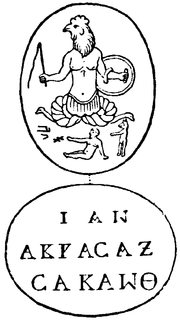 BasilideansThe Basilidians or Basilideans were a Gnostic sect founded by Basilides of Alexandria in the 2nd century. Basilides claimed to have been taught his doctrines by Glaucus, a disciple of St...
referred to a figure called Abraxas who was at the head of 365 spiritual beings (IrenaeusIrenaeusSaint Irenaeus , was Bishop of Lugdunum in Gaul, then a part of the Roman Empire . He was an early church father and apologist, and his writings were formative in the early development of Christian theology...
, Adversus HaeresesOn the Detection and Overthrow of the So-Called GnosisOn the Detection and Overthrow of the So-Called Gnosis, today also called On the Detection and Overthrow of Knowledge Falsely So Called , commonly called Against Heresies , is a five-volume work written by St. Irenaeus in the 2nd century...
, I.24); it is unclear what to make of Irenaeus' use of the term 'Archon', which may simply mean 'ruler' in this context. The role and function of Abraxas for Basilideans is not clear.
The word AbraxasAbraxasThe word Abrasax was a word of mystic meaning in the system of the Gnostic Basilides, being there applied to the “Great Archon” , the princeps of the 365 spheres...
was engraved on certain antique gemstones, called on that account Abraxas stones, which may have been used as amulets or charms by Gnostic sects. In popular culture, Abraxas is sometimes considered the name of a godGod (male deity)A god, as a male deity, contrasts with female deities, or "goddesses". While the term 'goddess' specifically refers to a female deity, the plural 'gods' can be applied to all gods collectively, regardless of gender....
who incorporated both Good and EvilEvilEvil is the violation of, or intent to violate, some moral code. Evil is usually seen as the dualistic opposite of good. Definitions of evil vary along with analysis of its root motive causes, however general actions commonly considered evil include: conscious and deliberate wrongdoing,...
(God and DemiurgeDemiurgeThe demiurge is a concept from the Platonic, Neopythagorean, Middle Platonic, and Neoplatonic schools of philosophy for an artisan-like figure responsible for the fashioning and maintenance of the physical universe. The term was subsequently adopted by the Gnostics...
) in one entity, and therefore representing the monotheistic God, singular, but (unlike, for example, the Christian God) not omni-benevolent. (See Hesse's Demian, and Jung's Seven Sermons to the Dead.) Opinions abound on Abraxas, who in recent centuries has been claimed to be both an EgyptEgyptEgypt , officially the Arab Republic of Egypt, Arabic: , is a country mainly in North Africa, with the Sinai Peninsula forming a land bridge in Southwest Asia. Egypt is thus a transcontinental country, and a major power in Africa, the Mediterranean Basin, the Middle East and the Muslim world...
ian god and a demonDemoncall - 1347 531 7769 for more infoIn Ancient Near Eastern religions as well as in the Abrahamic traditions, including ancient and medieval Christian demonology, a demon is considered an "unclean spirit" which may cause demonic possession, to be addressed with an act of exorcism...
, sometimes even being associated with the dual nature of SatanSatanSatan , "the opposer", is the title of various entities, both human and divine, who challenge the faith of humans in the Hebrew Bible...
/LuciferLuciferTraditionally, Lucifer is a name that in English generally refers to the devil or Satan before being cast from Heaven, although this is not the original meaning of the term. In Latin, from which the English word is derived, Lucifer means "light-bearer"...
. The word abracadabraAbracadabraAbracadabra is an incantation used as a magic word in stage magic tricks, and historically was believed to have healing powers when inscribed on an amulet...
may be related to Abraxas.
The above information relates to interpretations of ancient amulets and to reports of Christian heresy hunters which are not always clear.
Actual ancient Gnostic texts from the Nag Hammadi Library, such as the Coptic Gospel of the EgyptiansCoptic Gospel of the EgyptiansTwo versions of the formerly lost Holy Book of the Great Invisible Spirit, also inappropriately called the Coptic Gospel of the Egyptians , were among the codices in the Nag Hammadi library, discovered in 1945.The main contents concern the Sethian Gnostic understanding of how the earth came into...
, refer to Abraxas as an Aeon dwelling with Sophia and other Aeons of the Spiritual Fullness in the light of the luminary Eleleth. In several texts, the luminary Eleleth is the last of the luminaries (Spiritual Lights) that come forward, and it is the Aeon Sophia, associated with Eleleth, who encounters darkness and becomes involved in the chain of events that leads to the Demiurge and Archon's rule of this world, and the salvage effort that ensues. As such, the role of Aeons of Eleleth, including Abrasax, Sophia, and others, pertains to this outer border of the Divine Fullness that encounters the ignorance of the world of Lack and interacts to rectify the error of ignorance in the world of materiality.
Words like or similar to Abraxas or Abrasax also appear in the Greek Magical PapyriGreek magical papyriThe Greek Magical Papyri is the name given by scholars to a body of papyri from Graeco-Roman Egypt, which each contain a number of magical spells, formulae, hymns and rituals. The materials in the papyri date from the 2nd century BC to the 5th century AD...
. There are similarities and differences between such figures in reports about Basiledes' teaching, in the larger magical traditions of the Graeco-Roman world, in the classic ancient Gnostic texts such as the Gospel of the Egyptians, and in later magical and esoteric writings.
The Swiss Psychologist Carl JungCarl JungCarl Gustav Jung was a Swiss psychiatrist and the founder of Analytical Psychology. Jung is considered the first modern psychiatrist to view the human psyche as "by nature religious" and make it the focus of exploration. Jung is one of the best known researchers in the field of dream analysis and...
wrote a short Gnostic treatise in 1916 called The Seven Sermons to the Dead, which called Abraxas a God higher than the Christian God and Devil, that combines all opposites into one Being.
Demiurge
The term Demiurge derives from the Latin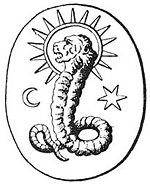 LatinLatin is an Italic language originally spoken in Latium and Ancient Rome. It, along with most European languages, is a descendant of the ancient Proto-Indo-European language. Although it is considered a dead language, a number of scholars and members of the Christian clergy speak it fluently, and...
ized form of the GreekGreek languageGreek is an independent branch of the Indo-European family of languages. Native to the southern Balkans, it has the longest documented history of any Indo-European language, spanning 34 centuries of written records. Its writing system has been the Greek alphabet for the majority of its history;...
term dēmiourgos, δημιουργός (literally "public or skilled worker"), and refers to an entity responsible for the creation of the physical universePhysical universeIn religion and esotericism, the term "physical universe" or "material universe" is used to distinguish the physical matter of the universe from a proposed spiritual or supernatural essence....
and the physical aspect of humanityHuman natureHuman nature refers to the distinguishing characteristics, including ways of thinking, feeling and acting, that humans tend to have naturally....
. The term dēmiourgos occurs in a number of other religious and philosophical systems, most notably PlatonismPlatonismPlatonism is the philosophy of Plato or the name of other philosophical systems considered closely derived from it. In a narrower sense the term might indicate the doctrine of Platonic realism...
. Moral judgements of the demiurge vary from group to group within the broad category of Gnosticism - such judgements usually correspond to each group's judgement of the status of materiality as being inherently evil, or else merely flawed and as good as its passive constituent matter will allow.
Like PlatoPlatoPlato , was a Classical Greek philosopher, mathematician, student of Socrates, writer of philosophical dialogues, and founder of the Academy in Athens, the first institution of higher learning in the Western world. Along with his mentor, Socrates, and his student, Aristotle, Plato helped to lay the...
does, Gnosticism presents a distinction between a supranatural, unknowable reality and the sensible materiality of which the demiurge is creator. However, in contrast to Plato, several systems of Gnostic thought present the Demiurge as antagonistic to the Supreme God: his act of creation either in unconsciousUnconscious mindThe unconscious mind is a term coined by the 18th century German romantic philosopher Friedrich Schelling and later introduced into English by the poet and essayist Samuel Taylor Coleridge...
and fundamentally flawed imitation of the divine model, or else formed with the malevolent intention of entrapping aspects of the divine in materiality. Thus, in such systems, the Demiurge acts as a solution to the problem of evilProblem of evilIn the philosophy of religion, the problem of evil is the question of how to explain evil if there exists a deity that is omnibenevolent, omnipotent, and omniscient . Some philosophers have claimed that the existences of such a god and of evil are logically incompatible or unlikely...
. In the Apocryphon of JohnApocryphon of JohnThe Secret Book of John is a 2nd-century AD Sethian Gnostic text of secret teachings. Since it was known to the church father Irenaeus, it must have been written before around AD 180. It describes Jesus Christ appearing and giving secret knowledge to the apostle John...
(several versions of which are found in the Nag Hammadi libraryNag Hammadi libraryThe Nag Hammadi library is a collection of early Christian Gnostic texts discovered near the Upper Egyptian town of Nag Hammadi in 1945. That year, twelve leather-bound papyrus codices buried in a sealed jar were found by a local peasant named Mohammed Ali Samman...
), the Demiurge has the name "Yaltabaoth", and proclaims himself as God:
- "Now the archonArchonArchon is a Greek word that means "ruler" or "lord", frequently used as the title of a specific public office. It is the masculine present participle of the verb stem ἀρχ-, meaning "to rule", derived from the same root as monarch, hierarchy, and anarchy.- Ancient Greece :In ancient Greece the...
who is weak has three names. The first name is Yaltabaoth, the second is Saklas, and the third is SamaelSamaelSamael is an important archangel in Talmudic and post-Talmudic lore, a figure who is accuser, seducer and destroyer, and has been regarded as both good and evil...
. And he is impious in his arrogance which is in him. For he said, 'I am God and there is no other God beside me,' for he is ignorant of his strength, the place from which he had come."
"Samael", in the Judeo-ChristianJudeo-ChristianJudeo-Christian is a term used in the United States since the 1940s to refer to standards of ethics said to be held in common by Judaism and Christianity, for example the Ten Commandments...
tradition, refers to the evilEvilEvil is the violation of, or intent to violate, some moral code. Evil is usually seen as the dualistic opposite of good. Definitions of evil vary along with analysis of its root motive causes, however general actions commonly considered evil include: conscious and deliberate wrongdoing,...
angel of death, and corresponds to the Christian demonDemoncall - 1347 531 7769 for more infoIn Ancient Near Eastern religions as well as in the Abrahamic traditions, including ancient and medieval Christian demonology, a demon is considered an "unclean spirit" which may cause demonic possession, to be addressed with an act of exorcism...
of that nameSamaelSamael is an important archangel in Talmudic and post-Talmudic lore, a figure who is accuser, seducer and destroyer, and has been regarded as both good and evil...
, one second only to SatanSatanSatan , "the opposer", is the title of various entities, both human and divine, who challenge the faith of humans in the Hebrew Bible...
. Literally, it can mean "blind god" or "god of the blind" in Aramaic (Syriac sæmʻa-ʼel); another alternative title is "Saklas", Aramaic for "fool" (Syriac sækla "the foolish one").
Gnostic myth recounts that Sophia (Greek, literally meaning "wisdom"), the Demiurge's mother and a partial aspect of the divine PleromaPleromaPleroma generally refers to the totality of divine powers. The word means fullness from comparable to πλήρης which means "full", and is used in Christian theological contexts: both in Gnosticism generally, and by Paul of Tarsus in Colossians Colossians 2:9 KJV .Gnosticism holds that the...
or "Fullness", desired to create something apart from the divine totality, and without the receipt of divine assent. In this abortive act of separate creation, she gave birth to the monstrous Demiurge and, being ashamed of her deed, she wrapped him in a cloud and created a throne for him within it. The Demiurge, isolated, did not behold his mother, nor anyone else, and thus concluded that only he himself existed, being ignorant of the superior levels of reality that were his birth-place.
The Gnostic myths describing these events are full of intricate nuances portraying the declination of aspects of the divine into human form; this process occurs through the agency of the Demiurge who, having stolen a portion of power from his mother, sets about a work of creation in unconscious imitation of the superior Pleromatic realm. Thus Sophia's power becomes enclosed within the material forms of humanity, themselves entrapped within the material universe: the goal of Gnostic movements was typically the awakening of this spark, which permitted a return by the subject to the superior, non-material realities which were its primal source. (See Sethian Gnosticism.)
Gnosis
The word 'Gnosticism' is a modern construction, though based on an antiquated linguistic expression: it comes from the GreekGreek languageGreek is an independent branch of the Indo-European family of languages. Native to the southern Balkans, it has the longest documented history of any Indo-European language, spanning 34 centuries of written records. Its writing system has been the Greek alphabet for the majority of its history;...
word meaning 'knowledge', gnosis (γνῶσις). However, gnosis itself refers to a very specialised form of knowledge, deriving both from the exact meaning of the original Greek term and its usage in PlatoPlatoPlato , was a Classical Greek philosopher, mathematician, student of Socrates, writer of philosophical dialogues, and founder of the Academy in Athens, the first institution of higher learning in the Western world. Along with his mentor, Socrates, and his student, Aristotle, Plato helped to lay the...
nist philosophyPhilosophyPhilosophy is the study of general and fundamental problems, such as those connected with existence, knowledge, values, reason, mind, and language. Philosophy is distinguished from other ways of addressing such problems by its critical, generally systematic approach and its reliance on rational...
.
Unlike modern EnglishEnglish languageEnglish is a West Germanic language that arose in the Anglo-Saxon kingdoms of England and spread into what was to become south-east Scotland under the influence of the Anglian medieval kingdom of Northumbria...
, ancient Greek was capable of discerning between several different forms of knowing. These different forms may be described in English as being propositional knowledge, indicative of knowledge acquired indirectly through the reports of others or otherwise by inference (such as "I know of George Bush" or "I know Berlin is in Germany"), and empiricalEmpiricalThe word empirical denotes information gained by means of observation or experimentation. Empirical data are data produced by an experiment or observation....
knowledge acquired by direct participation or acquaintance (such as "I know George Bush personally" or "I know Berlin, having visited").
Gnosis (γνῶσις) refers to knowledge of the second kind. Therefore, in a religious context, to be 'Gnostic' should be understood as being reliant not on knowledgeKnowledgeKnowledge is a familiarity with someone or something unknown, which can include information, facts, descriptions, or skills acquired through experience or education. It can refer to the theoretical or practical understanding of a subject...
in a general sense, but as being specially receptive to mysticalMysticismMysticism is the knowledge of, and especially the personal experience of, states of consciousness, i.e. levels of being, beyond normal human perception, including experience and even communion with a supreme being.-Classical origins:...
or esoteric experiences of direct participation with the divine. Indeed, in most Gnostic systems the sufficient cause of salvationSalvationWithin religion salvation is the phenomenon of being saved from the undesirable condition of bondage or suffering experienced by the psyche or soul that has arisen as a result of unskillful or immoral actions generically referred to as sins. Salvation may also be called "deliverance" or...
is this 'knowledge of' ('acquaintance with') the divine. This is commonly identified with a process of inward 'knowing' or self-exploration, comparable to that encouraged by PlotinusPlotinusPlotinus was a major philosopher of the ancient world. In his system of theory there are the three principles: the One, the Intellect, and the Soul. His teacher was Ammonius Saccas and he is of the Platonic tradition...
(c. 205–270 AD). This is what helps separate Gnosticism from proto-orthodox views, where the orthodox views are considered to be superficial. The inadequate take then requires a correct form of interpretation. With 'gnosis' comes a fuller insight that is considered to be more spiritual. Greater recognition of the deeper spiritual meanings of doctrines, scriptures, and rituals are obtained with this insight. However, as may be seen, the term 'gnostic' also had precedent usage in several ancient philosophicalPhilosophyPhilosophy is the study of general and fundamental problems, such as those connected with existence, knowledge, values, reason, mind, and language. Philosophy is distinguished from other ways of addressing such problems by its critical, generally systematic approach and its reliance on rational...
traditions, which must also be weighed in considering the very subtle implications of its appellation to a set of ancient religious groups.
Monad (apophatic theology)
In many Gnostic systems (and heresiologies), GodGodGod is the English name given to a singular being in theistic and deistic religions who is either the sole deity in monotheism, or a single deity in polytheism....
is known as the Monad, the OneGodGod is the English name given to a singular being in theistic and deistic religions who is either the sole deity in monotheism, or a single deity in polytheism....
, The AbsoluteAbsolute (philosophy)The Absolute is the concept of an unconditional reality which transcends limited, conditional, everyday existence. It is sometimes used as an alternate term for "God" or "the Divine", especially, but by no means exclusively, by those who feel that the term "God" lends itself too easily to...
, Aion teleos (The Perfect ÆonÆON, commonly written AEON Co., Ltd., is the holding company of Æon Group. It has its headquarters in Mihama-ku, Chiba, Chiba Prefecture.It operates JUSCO supermarkets directly in Japan.Æon is the largest retailer in Asia...
), Bythos (Depth or Profundity, Βυθος), Proarkhe (Before the Beginning, προαρχη), and E Arkhe (The Beginning, η αρχη). God is the high source of the pleromaPleromaPleroma generally refers to the totality of divine powers. The word means fullness from comparable to πλήρης which means "full", and is used in Christian theological contexts: both in Gnosticism generally, and by Paul of Tarsus in Colossians Colossians 2:9 KJV .Gnosticism holds that the...
, the region of light. The various emanations of God are called æonÆON, commonly written AEON Co., Ltd., is the holding company of Æon Group. It has its headquarters in Mihama-ku, Chiba, Chiba Prefecture.It operates JUSCO supermarkets directly in Japan.Æon is the largest retailer in Asia...
s.
Within certain variations of Gnosticism, especially those inspired by MonoimusMonoimusMonoimus was an Arab gnostic , who was known only from one account in Theodoret until a lost work of anti-heretical writings by Hippolytus was found...
, the Monad was the highest GodGodGod is the English name given to a singular being in theistic and deistic religions who is either the sole deity in monotheism, or a single deity in polytheism....
which created lesser godsDeityA deity is a recognized preternatural or supernatural immortal being, who may be thought of as holy, divine, or sacred, held in high regard, and respected by believers....
, or elements (similar to æons).
According to HippolytusHippolytus (writer)Hippolytus of Rome was the most important 3rd-century theologian in the Christian Church in Rome, where he was probably born. Photios I of Constantinople describes him in his Bibliotheca Hippolytus of Rome (170 – 235) was the most important 3rd-century theologian in the Christian Church in Rome,...
, this view was inspired by the Pythagoreans, who called the first thing that came into existence the Monad, which begat the dyad, which begat the numberNumberA number is a mathematical object used to count and measure. In mathematics, the definition of number has been extended over the years to include such numbers as zero, negative numbers, rational numbers, irrational numbers, and complex numbers....
s, which begat the pointPoint (geometry)In geometry, topology and related branches of mathematics a spatial point is a primitive notion upon which other concepts may be defined. In geometry, points are zero-dimensional; i.e., they do not have volume, area, length, or any other higher-dimensional analogue. In branches of mathematics...
, begetting linesLine (geometry)The notion of line or straight line was introduced by the ancient mathematicians to represent straight objects with negligible width and depth. Lines are an idealization of such objects...
, etc. This was also clarified in the writings of PlatoPlatoPlato , was a Classical Greek philosopher, mathematician, student of Socrates, writer of philosophical dialogues, and founder of the Academy in Athens, the first institution of higher learning in the Western world. Along with his mentor, Socrates, and his student, Aristotle, Plato helped to lay the...
, AristotleAristotleAristotle was a Greek philosopher and polymath, a student of Plato and teacher of Alexander the Great. His writings cover many subjects, including physics, metaphysics, poetry, theater, music, logic, rhetoric, linguistics, politics, government, ethics, biology, and zoology...
and PlotinusPlotinusPlotinus was a major philosopher of the ancient world. In his system of theory there are the three principles: the One, the Intellect, and the Soul. His teacher was Ammonius Saccas and he is of the Platonic tradition...
. This teaching being largely NeopythagoreanPythagoreanismPythagoreanism was the system of esoteric and metaphysical beliefs held by Pythagoras and his followers, the Pythagoreans, who were considerably influenced by mathematics. Pythagoreanism originated in the 5th century BCE and greatly influenced Platonism...
via NumeniusNumenius of ApameaNumenius of Apamea was a Greek philosopher, who lived in Apamea in Syria and flourished during the latter half of the 2nd century AD. He was a Neopythagorean and forerunner of the Neoplatonists.- Philosophy :...
as well.
This Monad is the spiritualSupernaturalThe supernatural or is that which is not subject to the laws of nature, or more figuratively, that which is said to exist above and beyond nature...
source of everything which emanatesEmanationismEmanationism is an idea in the cosmology or cosmogony of certain religious or philosophical systems. Emanation, from the Latin emanare meaning "to flow from" or "to pour forth or out of", is the mode by which all things are derived from the First Reality, or Principle...
the pleromaPleromaPleroma generally refers to the totality of divine powers. The word means fullness from comparable to πλήρης which means "full", and is used in Christian theological contexts: both in Gnosticism generally, and by Paul of Tarsus in Colossians Colossians 2:9 KJV .Gnosticism holds that the...
, and could be contrasted to the dark DemiurgeDemiurgeThe demiurge is a concept from the Platonic, Neopythagorean, Middle Platonic, and Neoplatonic schools of philosophy for an artisan-like figure responsible for the fashioning and maintenance of the physical universe. The term was subsequently adopted by the Gnostics...
(Yaldabaoth) that controls matterMatterMatter is a general term for the substance of which all physical objects consist. Typically, matter includes atoms and other particles which have mass. A common way of defining matter is as anything that has mass and occupies volume...
.
The Sethian cosmogony as most famously contained in the Apocryphon ('Secret book') of John describes an unknown GodGodGod is the English name given to a singular being in theistic and deistic religions who is either the sole deity in monotheism, or a single deity in polytheism....
, very similar to the orthodoxOrthodoxyThe word orthodox, from Greek orthos + doxa , is generally used to mean the adherence to accepted norms, more specifically to creeds, especially in religion...
apophatic theology, although very different from the orthodox credal teachings that there is one such god who is identified also as creator of heaven and earth. In describing the nature of a creator god associated with Biblical texts, orthodox theologians often attempt to define God through a series of explicit positive statements, themselves universal but in the divine taken to their superlative degrees: he is omniscient, omnipotent and truly benevolentOmnibenevolenceOmnibenevolence is defined by the Oxford English Dictionary as "unlimited or infinite benevolence". It is often held to be impossible, or at least improbable, for a deity to exhibit such property along side omniscience and omnipotence as a result of the problem of evil...
. The Sethian conception of the most hidden transcendent God is, by contrast, defined through negative theologyNegative theologyApophatic theology —also known as negative theology or via negativa —is a theology that attempts to describe God, the Divine Good, by negation, to speak only in terms of what may not be said about the perfect goodness that is God...
: he is immovable, invisible, intangible, ineffable; commonly, 'he' is seen as being hermaphroditic, a potent symbol for being, as it were, 'all-containing'. In the Apocryphon of John, this god is good in that it bestows goodness. After the apophatic statements, the process of the Divine in action are used to describe the effect of such a god.
An apophatic approach to discussing the Divine is found throughout gnosticism, Vedanta, and Platonic and Aristotelian theology as well. It is also found in some Judaic sources.
Pleroma
Pleroma (Greek πληρωμα) generally refers to the totality of God's powers. The term means fullness, and is used in Christian theological contexts: both in Gnosticism generally, and in Colossians 2.9.
Gnosticism holds that the world is controlled by evil archonArchonArchon is a Greek word that means "ruler" or "lord", frequently used as the title of a specific public office. It is the masculine present participle of the verb stem ἀρχ-, meaning "to rule", derived from the same root as monarch, hierarchy, and anarchy.- Ancient Greece :In ancient Greece the...
s, one of whom is the demiurge, the deity of the Old TestamentOld TestamentThe Old Testament, of which Christians hold different views, is a Christian term for the religious writings of ancient Israel held sacred and inspired by Christians which overlaps with the 24-book canon of the Masoretic Text of Judaism...
who holds the human spirit captive.
The heavenly pleroma is the center of divine life, a region of light "above" (the term is not to be understood spatially) our world, occupied by spiritual beings such as aeonAeonThe word aeon, also spelled eon or æon , originally means "life", and/or "being", though it then tended to mean "age", "forever" or "for eternity". It is a Latin transliteration from the koine Greek word , from the archaic . In Homer it typically refers to life or lifespan...
s (eternal beings) and sometimes archonArchonArchon is a Greek word that means "ruler" or "lord", frequently used as the title of a specific public office. It is the masculine present participle of the verb stem ἀρχ-, meaning "to rule", derived from the same root as monarch, hierarchy, and anarchy.- Ancient Greece :In ancient Greece the...
s. JesusJesusJesus of Nazareth , commonly referred to as Jesus Christ or simply as Jesus or Christ, is the central figure of Christianity...
is interpreted as an intermediary aeon who was sent from the pleroma, with whose aid humanity can recover the lost knowledge of the divine origins of humanity. The term is thus a central element of Gnostic cosmologyCosmologyCosmology is the discipline that deals with the nature of the Universe as a whole. Cosmologists seek to understand the origin, evolution, structure, and ultimate fate of the Universe at large, as well as the natural laws that keep it in order...
.
Pleroma is also used in the general Greek language and is used by the Greek Orthodox church in this general form since the word appears under the book of Colossians. Proponents of the view that Paul was actually a gnosticGnosticism and the New TestamentGnosticism and the New Testament is the connection between the Christian sects described by Irenaeus , and other writers, as gnostikos, and the New Testament, and also the use of the New Testament in the Nag Hammadi texts ....
, such as Elaine PagelsElaine PagelsElaine Pagels, née Hiesey , is the Harrington Spear Paine Professor of Religion at Princeton University. The recipient of a MacArthur Fellowship, she is best known for her studies and writing on the Gnostic Gospels...
of Princeton UniversityPrinceton UniversityPrinceton University is a private research university located in Princeton, New Jersey, United States. The school is one of the eight universities of the Ivy League, and is one of the nine Colonial Colleges founded before the American Revolution....
, view the reference in Colossians as something that was to be interpreted in the gnostic sense.
Sophia
In Gnostic tradition, the term Sophia (Σoφíα, GreekGreek languageGreek is an independent branch of the Indo-European family of languages. Native to the southern Balkans, it has the longest documented history of any Indo-European language, spanning 34 centuries of written records. Its writing system has been the Greek alphabet for the majority of its history;...
for "wisdom") refers to the final and lowest emanation of God.
In most if not all versions of the gnostic myth, Sophia births the demiurgeDemiurgeThe demiurge is a concept from the Platonic, Neopythagorean, Middle Platonic, and Neoplatonic schools of philosophy for an artisan-like figure responsible for the fashioning and maintenance of the physical universe. The term was subsequently adopted by the Gnostics...
, who in turn brings about the creation of materiality. The positive or negative depiction of materiality thus resides a great deal on mythic depictions of Sophia's actions. She is occasionally referred to by the HebrewHebrew languageHebrew is a Semitic language of the Afroasiatic language family. Culturally, is it considered by Jews and other religious groups as the language of the Jewish people, though other Jewish languages had originated among diaspora Jews, and the Hebrew language is also used by non-Jewish groups, such...
equivalent of Achamoth (this is a feature of PtolemyPtolemy (gnostic)Ptolemy the Gnostic, or Ptolemaeus Gnosticus was a disciple of the Gnostic teacher Valentinius, and is known to us for an epistle he wrote to a wealthy woman named Flora, herself not a gnostic....
's version of the Valentinian gnostic myth). Jewish Gnosticism with a focus on Sophia was active by 90.
Almost all gnostic systems of the Syrian or Egyptian type taught that the universe began with an original, unknowable GodGodGod is the English name given to a singular being in theistic and deistic religions who is either the sole deity in monotheism, or a single deity in polytheism....
, referred to as the Parent or Bythos, as the MonadMonad (Gnosticism)The Monad in early Christian gnostic writings is an adaption of concepts of the Monad in Greek philosophy to Christian gnostic belief systems.The term monad comes from the Greek feminine noun monas , "one unit," where the ending -s in the nominative form resolves to the ending -d in declension.In...
by MonoimusMonoimusMonoimus was an Arab gnostic , who was known only from one account in Theodoret until a lost work of anti-heretical writings by Hippolytus was found...
, or the first AeonAeonThe word aeon, also spelled eon or æon , originally means "life", and/or "being", though it then tended to mean "age", "forever" or "for eternity". It is a Latin transliteration from the koine Greek word , from the archaic . In Homer it typically refers to life or lifespan...
by still other traditions. From this initial unitary beginning, the One spontaneously emanatedEmanationismEmanationism is an idea in the cosmology or cosmogony of certain religious or philosophical systems. Emanation, from the Latin emanare meaning "to flow from" or "to pour forth or out of", is the mode by which all things are derived from the First Reality, or Principle...
further AeonAeonThe word aeon, also spelled eon or æon , originally means "life", and/or "being", though it then tended to mean "age", "forever" or "for eternity". It is a Latin transliteration from the koine Greek word , from the archaic . In Homer it typically refers to life or lifespan...
s, pairs of progressively 'lesser' beings in sequence. The lowest of these pairs were Sophia and ChristChristChrist is the English term for the Greek meaning "the anointed one". It is a translation of the Hebrew , usually transliterated into English as Messiah or Mashiach...
. The Aeons together made up the Pleroma, or fullness, of God, and thus should not be seen as distinct from the divine, but symbolic abstractions of the divine nature.
The development of the Syrian-Egyptian school
Bentley LaytonBentley LaytonBentley Layton , is Professor of Religious Studies and Professor of Near Eastern Languages and Civilizations at Yale University...
has sketched out a relationship between the various gnostic movements in his introduction to The Gnostic Scriptures (SCM Press, London, 1987). In this model, 'Classical Gnosticism' and 'The School of Thomas' antedated and influenced the development of ValentinusValentinus (Gnostic)Valentinus was the best known and for a time most successful early Christian gnostic theologian. He founded his school in Rome...
, who was to found his own school of Gnosticism in both AlexandriaAlexandriaAlexandria is the second-largest city of Egypt, with a population of 4.1 million, extending about along the coast of the Mediterranean Sea in the north central part of the country; it is also the largest city lying directly on the Mediterranean coast. It is Egypt's largest seaport, serving...
and RomeRomeRome is the capital of Italy and the country's largest and most populated city and comune, with over 2.7 million residents in . The city is located in the central-western portion of the Italian Peninsula, on the Tiber River within the Lazio region of Italy.Rome's history spans two and a half...
, whom Layton called 'the great [Gnostic] reformer' and 'the focal point' of Gnostic development. While in Alexandria, where he was born, Valentinus probably would have had contact with the Gnostic teacher BasilidesBasilidesBasilides was an early Gnostic religious teacher in Alexandria, Egypt who taught from 117–138 AD, notes that to prove that the heretical sects were "later than the catholic Church," Clement of Alexandria assigns Christ's own teaching to the reigns of Augustus and Tiberius; that of the apostles,...
, and may have been influenced by him.
Valentinianism flourished throughout the early centuries of the common era: while Valentinus himself lived from c. 100–180 AD/CE, a list of sectarians or heretics, composed in 388 AD/CE, against whom Emperor Constantine intended legislation includes Valentinus (and, presumably, his inheritors). The school is also known to have been extremely popular: several varieties of their central myth are known, and we know of 'reports from outsiders from which the intellectual liveliness of the group is evident' (Markschies, Gnosis: An Introduction, 94). It is known that Valentinus' students, in further evidence of their intellectual activity, elaborated upon the teachings and materials they received from him (though the exact extent of their changes remains unknown), for example, in the version of the Valentinian myth brought to us through PtolemyPtolemy (gnostic)Ptolemy the Gnostic, or Ptolemaeus Gnosticus was a disciple of the Gnostic teacher Valentinius, and is known to us for an epistle he wrote to a wealthy woman named Flora, herself not a gnostic....
.
Valentinianism might be described as the most elaborate and philosophically 'dense' form of the Syrian-Egyptian schools of Gnosticism, though it should be acknowledged that this in no way debarred other schools from attracting followers: Basilides' own school was popular also, and survived in EgyptEgyptEgypt , officially the Arab Republic of Egypt, Arabic: , is a country mainly in North Africa, with the Sinai Peninsula forming a land bridge in Southwest Asia. Egypt is thus a transcontinental country, and a major power in Africa, the Mediterranean Basin, the Middle East and the Muslim world...
until the 4th century.
Simone Petrement, in A Separate God, in arguing for a Christian origin of Gnosticism, places Valentinus after Basilides, but before the Sethians. It is her assertion that Valentinus represented a moderation of the anti-Judaism of the earlier Hellenized teachers; the demiurge, widely regarded to be a mythological depiction of the Old Testament God of the Hebrews, is depicted as more ignorant than evil. (See below.)
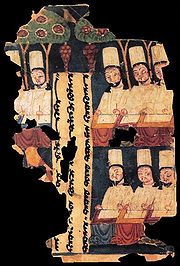
The development of the Persian school
An alternate heritage is offered by Kurt RudolphKurt RudolphKurt Rudolph is a German researcher of Gnosticism and Mandaeism.Born in Dresden, Rudolph studied Protestant theology, religion, history and Semitic at the universities of Greifswald and Leipzig in the years 1948 to 1953. Subsequently, for six years he was research assistant while he worked in...
in his book Gnosis: The Nature & Structure of Gnosticism (Koehler and Amelang, LeipzigLeipzigLeipzig Leipzig has always been a trade city, situated during the time of the Holy Roman Empire at the intersection of the Via Regia and Via Imperii, two important trade routes. At one time, Leipzig was one of the major European centres of learning and culture in fields such as music and publishing...
, 1977), to explain the lineage of Persian Gnostic schools. The decline of Manicheism that occurred in Persia in the 5th century was too late to prevent the spread of the movement into the east and the west. In the west, the teachings of the school moved into SyriaSyriaSyria , officially the Syrian Arab Republic , is a country in Western Asia, bordering Lebanon and the Mediterranean Sea to the West, Turkey to the north, Iraq to the east, Jordan to the south, and Israel to the southwest....
, Northern Arabia, EgyptEgyptEgypt , officially the Arab Republic of Egypt, Arabic: , is a country mainly in North Africa, with the Sinai Peninsula forming a land bridge in Southwest Asia. Egypt is thus a transcontinental country, and a major power in Africa, the Mediterranean Basin, the Middle East and the Muslim world...
and North AfricaAfricaAfrica is the world's second largest and second most populous continent, after Asia. At about 30.2 million km² including adjacent islands, it covers 6% of the Earth's total surface area and 20.4% of the total land area...
(where AugustineAugustine of HippoAugustine of Hippo , also known as Augustine, St. Augustine, St. Austin, St. Augoustinos, Blessed Augustine, or St. Augustine the Blessed, was Bishop of Hippo Regius . He was a Latin-speaking philosopher and theologian who lived in the Roman Africa Province...
was a member of the school from 373-382); from Syria it progressed still farther, into PalestinePalestinePalestine is a conventional name, among others, used to describe the geographic region between the Mediterranean Sea and the Jordan River, and various adjoining lands....
, Asia MinorAsia MinorAsia Minor is a geographical location at the westernmost protrusion of Asia, also called Anatolia, and corresponds to the western two thirds of the Asian part of Turkey...
and ArmeniaArmeniaArmenia , officially the Republic of Armenia , is a landlocked mountainous country in the Caucasus region of Eurasia...
. There is evidence for Manicheans in Rome and DalmatiaDalmatiaDalmatia is a historical region on the eastern coast of the Adriatic Sea. It stretches from the island of Rab in the northwest to the Bay of Kotor in the southeast. The hinterland, the Dalmatian Zagora, ranges from fifty kilometers in width in the north to just a few kilometers in the south....
in the 4th century, and also in GaulGaulGaul was a region of Western Europe during the Iron Age and Roman era, encompassing present day France, Luxembourg and Belgium, most of Switzerland, the western part of Northern Italy, as well as the parts of the Netherlands and Germany on the left bank of the Rhine. The Gauls were the speakers of...
and SpainSpainSpain , officially the Kingdom of Spain languages]] under the European Charter for Regional or Minority Languages. In each of these, Spain's official name is as follows:;;;;;;), is a country and member state of the European Union located in southwestern Europe on the Iberian Peninsula...
. The influence of Manicheanism was attacked by imperial elects and polemical writings, but the religion remained prevalent until the 6th century, and still exerted influence in the emergence of the Paulicians, Bogomils and Cathari in the Middle Ages, until it was ultimately stamped out by the Catholic Church.
In the east, Rudolph relates, Manicheanism was able to bloom, given that the religious monopoly position previously held by Christianity and ZoroastrianismZoroastrianismZoroastrianism is a religion and philosophy based on the teachings of prophet Zoroaster and was formerly among the world's largest religions. It was probably founded some time before the 6th century BCE in Greater Iran.In Zoroastrianism, the Creator Ahura Mazda is all good, and no evil...
had been broken by nascent IslamIslamIslam . The most common are and . : Arabic pronunciation varies regionally. The first vowel ranges from ~~. The second vowel ranges from ~~~...
. In the early years of the Arab conquest, Manicheanism again found followers in Persia (mostly amongst educated circles), but flourished most in Central AsiaCentral AsiaCentral Asia is a core region of the Asian continent from the Caspian Sea in the west, China in the east, Afghanistan in the south, and Russia in the north...
, to which it had spread through Iran. Here, in 762, Manicheanism became the state religion of the Uyghur EmpireUyghur EmpireThe Uyghur Khaganate, or, Uyghur Empire or Uighur Khaganate or Toquz Oghuz Country was a Turkic empire that existed for about a century between the mid 8th and 9th centuries...
.
Neoplatonism and Gnosticism
Historical relations between antique Greek Philosophy and Gnosticism
The earliest origins of Gnosticism are still obscure and disputed, but they probably include influence from PlatoPlatoPlato , was a Classical Greek philosopher, mathematician, student of Socrates, writer of philosophical dialogues, and founder of the Academy in Athens, the first institution of higher learning in the Western world. Along with his mentor, Socrates, and his student, Aristotle, Plato helped to lay the...
, Middle PlatonismMiddle PlatonismMiddle Platonism is the modern name given to a stage in the development of Plato's philosophy, lasting from about 90 BC, when Antiochus of Ascalon rejected the scepticism of the New Academy, until the development of Neoplatonism under Plotinus in the 3rd century. Middle Platonism absorbed many...
and Neo-Pythagoreanism academies or schools of thought, and this seems to be true both of the more Sethian Gnostics, and of the Valentinian Gnostics. Further, if we compare different Sethian texts to each other in an attempted chronology of the development of Sethianism during the first few centuries, it seems that later texts are continuing to interact with Platonism. Earlier texts such as Apocalypse of AdamApocalypse of AdamThe Apocalypse of Adam discovered in 1945 as part of the Nag Hammadi library is a Gnostic work written in Coptic. It has no necessary references to Christianity and it is accordingly debated whether it is a Christian Gnostic work or an example of Jewish Gnosticism...
show signs of being pre-Christian and focus on the SethSethSeth , in Judaism, Christianity and Islam, is the third listed son of Adam and Eve and brother of Cain and Abel, who are the only other of their children mentioned by name...
, third son of Adam and Eve. These early Sethians may be identical to or related to the Nazarenes (sect), OphitesOphitesThe Ophites or Ophians were members of a Christian Gnostic sect depicted by Hippolytus of Rome in a lost work, the Syntagma....
or to the sectarian group called heretics by PhiloPhiloPhilo , known also as Philo of Alexandria , Philo Judaeus, Philo Judaeus of Alexandria, Yedidia, "Philon", and Philo the Jew, was a Hellenistic Jewish Biblical philosopher born in Alexandria....
. Later Sethian texts such as ZostrianosZostrianosZostrianos is a Sethian Gnostic text from the New Testament apocrypha. The main surviving copies come from the Nag Hammadi library, but it is heavily damaged ....
and AllogenesAllogenesAllogenes is a Sethian Gnostic text from the New Testament apocrypha. The main surviving copies come from the Nag Hammadi library, though there are many missing lines. A small fragment also survives in the more recently discovered Codex Tchacos, which may help in filling the gaps.The text concerns...
draw on the imagery of older Sethian texts, but utilize "a large fund of philosophical conceptuality derived from contemporary Platonism, (that is late middle Platonism) with no traces of Christian content." Indeed the doctrine of the "triple-powered one" found in the text AllogenesAllogenesAllogenes is a Sethian Gnostic text from the New Testament apocrypha. The main surviving copies come from the Nag Hammadi library, though there are many missing lines. A small fragment also survives in the more recently discovered Codex Tchacos, which may help in filling the gaps.The text concerns...
, as discovered in the Nag Hammadi Library, is "the same doctrine as found in the anonymous ParmenidesParmenidesParmenides of Elea was an ancient Greek philosopher born in Elea, a Greek city on the southern coast of Italy. He was the founder of the Eleatic school of philosophy. The single known work of Parmenides is a poem, On Nature, which has survived only in fragmentary form. In this poem, Parmenides...
commentary (Fragment XIV) ascribed by Hadot to PorphyryPorphyry (philosopher)Porphyry of Tyre , Porphyrios, AD 234–c. 305) was a Neoplatonic philosopher who was born in Tyre. He edited and published the Enneads, the only collection of the work of his teacher Plotinus. He also wrote many works himself on a wide variety of topics...
[...] and is also found in PlotinusPlotinusPlotinus was a major philosopher of the ancient world. In his system of theory there are the three principles: the One, the Intellect, and the Soul. His teacher was Ammonius Saccas and he is of the Platonic tradition...
' EnneadEnneadThe Ennead was a group ofnine deities in Egyptian mythology. The Ennead were worshipped at Heliopolis and consisted of the god Atum, his children Shu and Tefnut, their children Geb and Nut and their children Osiris, Isis, Horus, Set and Nephthys.-Terminology:Egyptian mythology established multiple...
6.7, 17, 13-26."
Rejection by antique Greek Philosophy
However, by the 3rd century Neoplatonists, such as Plotinus, Porphyry and AmeliusAmeliusAmelius , whose family name was Gentilianus, was a Neoplatonist philosopher and writer of the second half of the 3rd century. He was a native of Tuscany...
are all attacking the Sethians. It looks as if Sethianism began as a pre-Christian tradition, possibly a syncretic that incorporated elements of Christianity and Platonism as it grew, only to have both Christianity and Platonism reject and turn against it. Professor John D TurnerJohn D TurnerJohn D. Turner is a professor of religious studies at the University of Nebraska. He is well known for his translations of the Nag Hammadi library....
believes that this double attack led to Sethianism fragmentation into numerous smaller groups (Audians, BorboritesBorboritesAccording to the Panarion of Epiphanius of Salamis , and Theodoret's Haereticarum Fabularum Compendium, the Borborites or Borborians were a libertine Gnostic sect, said to be descended from the Nicolaitans...
, ArchonticsArchonticsThe Archontics, or Archontici, were a Gnostic sect that existed in Palestine and Armenia, who arose towards the close of the 2nd century CE...
and perhaps Phibionites, StratioticiStratioticiThe Stratiotici, from stratos which in the Greek language meant army, were a sub-group of the Borborians.The Coddians, Stratiotici and the Phibiomites have together a family connection to Gnostics.- References :...
, and Secundians).
Scholarship on Gnosticism has been greatly advanced by the discovery and translation of the Nag HammadiNag HammâdiNag Hammadi , is a city in Upper Egypt. Nag Hammadi was known as Chenoboskion in classical antiquity, meaning "geese grazing grounds". It is located on the west bank of the Nile in the Qena Governorate, about 80 kilometres north-west of Luxor....
texts, which shed light on some of the more puzzling comments by PlotinusPlotinusPlotinus was a major philosopher of the ancient world. In his system of theory there are the three principles: the One, the Intellect, and the Soul. His teacher was Ammonius Saccas and he is of the Platonic tradition...
and PorphyryPorphyry (philosopher)Porphyry of Tyre , Porphyrios, AD 234–c. 305) was a Neoplatonic philosopher who was born in Tyre. He edited and published the Enneads, the only collection of the work of his teacher Plotinus. He also wrote many works himself on a wide variety of topics...
regarding the Gnostics. More importantly, the texts help to distinguish different kinds of early Gnostics. It now seems clear that "Sethian" and "ValentinianValentinus (Gnostic)Valentinus was the best known and for a time most successful early Christian gnostic theologian. He founded his school in Rome...
" gnostics attempted "an effort towards conciliation, even affiliation" with late antique philosophy, and were rebuffed by some NeoplatonistsNeoplatonismNeoplatonism , is the modern term for a school of religious and mystical philosophy that took shape in the 3rd century AD, based on the teachings of Plato and earlier Platonists, with its earliest contributor believed to be Plotinus, and his teacher Ammonius Saccas...
, including PlotinusPlotinusPlotinus was a major philosopher of the ancient world. In his system of theory there are the three principles: the One, the Intellect, and the Soul. His teacher was Ammonius Saccas and he is of the Platonic tradition...
.
Philosophical relations between Neoplatonism and Gnosticism
Gnostics borrow a lot of ideas and terms from Platonism. They exhibit a keen understanding of Greek philosophical terms and the Greek Koine language in general, and use Greek philosophical concepts throughout their text, including such concepts as hypostasis (reality, existence), ousiaOusiaOusia is the Ancient Greek noun formed on the feminine present participle of ; it is analogous to the English participle being, and the modern philosophy adjectival ontic...
(essence, substance, being), and demiurgeDemiurgeThe demiurge is a concept from the Platonic, Neopythagorean, Middle Platonic, and Neoplatonic schools of philosophy for an artisan-like figure responsible for the fashioning and maintenance of the physical universe. The term was subsequently adopted by the Gnostics...
(creator God). Good examples include texts such as the Hypostasis of the Archons (Reality of the Rulers) or Trimorphic ProtennoiaTrimorphic ProtennoiaThe Trimorphic Protennoia is a Sethian Gnostic text from the New Testament apocrypha. The only surviving copy comes from the Nag Hammadi library ....
(The first thought in three forms).
Criticism of gnosticism by antique Greek Philosophy
As a pagan mystic PlotinusPlotinusPlotinus was a major philosopher of the ancient world. In his system of theory there are the three principles: the One, the Intellect, and the Soul. His teacher was Ammonius Saccas and he is of the Platonic tradition...
considered his opponents heretics and elitist blasphemers, arriving at misotheismMisotheismMisotheism is the "hatred of God" or "hatred of the gods" . In some varieties of polytheism, it was considered possible to inflict punishment on gods by ceasing to worship them...
as the solution to the problem of evilProblem of evilIn the philosophy of religion, the problem of evil is the question of how to explain evil if there exists a deity that is omnibenevolent, omnipotent, and omniscient . Some philosophers have claimed that the existences of such a god and of evil are logically incompatible or unlikely...
, being not traditional or genuine Hellenism (in philosophy or mysticism), but rather one invented taking all their truths over from Plato, coupled with the idea expressed by Plotinus that the approach to the infinite force which is the One or Monad cannot be through knowing or not knowing (i.e., dualist, which is of the dyad or demiurgeDemiurgeThe demiurge is a concept from the Platonic, Neopythagorean, Middle Platonic, and Neoplatonic schools of philosophy for an artisan-like figure responsible for the fashioning and maintenance of the physical universe. The term was subsequently adopted by the Gnostics...
). Although there has been dispute as to which Gnostics Plotinus was referring to it appears they were indeed Sethian. Plotinus' main objection to the Gnostics he was familiar with, however, was their rejection of the goodness of the demiurgeDemiurgeThe demiurge is a concept from the Platonic, Neopythagorean, Middle Platonic, and Neoplatonic schools of philosophy for an artisan-like figure responsible for the fashioning and maintenance of the physical universe. The term was subsequently adopted by the Gnostics...
and the material world. He attacks the Gnostics as vilifying Plato's ontologyOntologyOntology is the philosophical study of the nature of being, existence or reality as such, as well as the basic categories of being and their relations...
of the universe as contained in the TimaeusTimaeus (dialogue)Timaeus is one of Plato's dialogues, mostly in the form of a long monologue given by the title character, written circa 360 BC. The work puts forward speculation on the nature of the physical world and human beings. It is followed by the dialogue Critias.Speakers of the dialogue are Socrates,...
. He accused Gnosticism of vilifying the Demiurge, or craftsman that crafted the material world, and even of thinking that the material world is evil, or a prison. As Plotinus explains, the demiurge is the nous (as the first emanation of the One), the ordering principle or mind, and also reason. Plotinus was also critical of the Gnostic origin of the demiurge as the offspring of wisdom, represented as a deity called Sophia. She was anthropomorphicallyChristian anthropologyIn the context of Christian theology, theological anthropology refers to the study of the human as it relates to God. It differs from the social science of anthropology, which primarily deals with the comparative study of the physical and social characteristics of humanity across times and...
expressed as a feminine spirit deity not unlike the goddess AthenaAthenaIn Greek mythology, Athena, Athenê, or Athene , also referred to as Pallas Athena/Athene , is the goddess of wisdom, courage, inspiration, civilization, warfare, strength, strategy, the arts, crafts, justice, and skill. Minerva, Athena's Roman incarnation, embodies similar attributes. Athena is...
or the Christian Holy SpiritHoly SpiritHoly Spirit is a term introduced in English translations of the Hebrew Bible, but understood differently in the main Abrahamic religions.While the general concept of a "Spirit" that permeates the cosmos has been used in various religions Holy Spirit is a term introduced in English translations of...
. Plotinus even went so far as to state at one point that if the Gnostics did believe this world was a prison then they could at any moment free themselves by committing suicide. To some degree the texts discovered in Nag Hammadi support his allegations, but others such as the Valentinians and the Tripartite Tractate insist on the goodness of the world and the Demiurge.
Buddhism and Gnosticism
The idea that Gnosticism was derived from Buddhism was first proposed by the Victorian gem collector and numismatist Charles William KingCharles William KingCharles William King , was a British Victorian writer and collector of gems.- Early life :King was born at Newport, Monmouthshire, and entered Trinity College, Cambridge, in 1836. He graduated in 1840, and obtained a fellowship in 1842...
(1864). ManselHenry Longueville ManselThe Very Reverend Henry Longueville Mansel, D.D. was an English philosopher and ecclesiastic.He was born at Cosgrove, Northamptonshire .He was educated at Merchant Taylors' School, London and St John's College, Oxford...
(1875,) considered the principal sources of Gnosticism to be PlatonismPlatonismPlatonism is the philosophy of Plato or the name of other philosophical systems considered closely derived from it. In a narrower sense the term might indicate the doctrine of Platonic realism...
, ZoroastrianismZoroastrianismZoroastrianism is a religion and philosophy based on the teachings of prophet Zoroaster and was formerly among the world's largest religions. It was probably founded some time before the 6th century BCE in Greater Iran.In Zoroastrianism, the Creator Ahura Mazda is all good, and no evil...
, and BuddhismBuddhismBuddhism is a religion and philosophy encompassing a variety of traditions, beliefs and practices, largely based on teachings attributed to Siddhartha Gautama, commonly known as the Buddha . The Buddha lived and taught in the northeastern Indian subcontinent some time between the 6th and 4th...
However the influence of Buddhism in any sense on either the gnostikos ValentinusValentinus (Gnostic)Valentinus was the best known and for a time most successful early Christian gnostic theologian. He founded his school in Rome...
(c.170) or the Nag Hammadi texts (3rd C.) is not supported by modern scholarship, but in the later case considered quite possible by Elaine PagelsElaine PagelsElaine Pagels, née Hiesey , is the Harrington Spear Paine Professor of Religion at Princeton University. The recipient of a MacArthur Fellowship, she is best known for her studies and writing on the Gnostic Gospels...
(1979), who called for Buddhist scholars to try to find parallels.
3rd Century contact with India
Early 3rd century–4th century ChristianChristianA Christian is a person who adheres to Christianity, an Abrahamic, monotheistic religion based on the life and teachings of Jesus of Nazareth as recorded in the Canonical gospels and the letters of the New Testament...
writers such as HippolytusHippolytus (writer)Hippolytus of Rome was the most important 3rd-century theologian in the Christian Church in Rome, where he was probably born. Photios I of Constantinople describes him in his Bibliotheca Hippolytus of Rome (170 – 235) was the most important 3rd-century theologian in the Christian Church in Rome,...
and EpiphaniusEpiphanius of SalamisEpiphanius of Salamis was bishop of Salamis at the end of the 4th century. He is considered a saint and a Church Father by both the Eastern Orthodox and Catholic Churches. He gained a reputation as a strong defender of orthodoxy...
write about a ScythianusScythianusScythianus was a supposed Alexandrian religious teacher who visited India around 50 CE. He is mentioned by several Christian writers and anti-Manichaean polemicists of the 3rd and 4th centuries CE, including Cyril of Jerusalem, Hippolytus and Epiphanius, and is first mentioned in the...
, who visited IndiaIndiaIndia , officially the Republic of India , is a country in South Asia. It is the seventh-largest country by geographical area, the second-most populous country with over 1.2 billion people, and the most populous democracy in the world...
around 50 AD from where he brought "the doctrine of the Two Principles".
Karl Ritter (1838) suggested that when Cyril of JerusalemCyril of JerusalemCyril of Jerusalem was a distinguished theologian of the early Church . He is venerated as a saint by the Roman Catholic Church, the Eastern Orthodox Church, and the Anglican Communion. In 1883, Cyril was declared a Doctor of the Church by Pope Leo XIII...
, remarks that one of Scythianus' pupils TerebinthusTerebinthusTerebinthus was a suggested pupil of Scythianus, during the 1st-2nd century CE, according to the writings of Christian writer and anti-Manichaean polemicist Cyril of Jerusalem, and is mentioned earlier in the anonymously written, critical biography of Mani known as Acta Archelai.According to...
changed his name to Buddas to escape detection while passing through Judea, and died in Judea from a fall from a rooftop, that this is connected with BuddhaBuddhaIn Buddhism, buddhahood is the state of perfect enlightenment attained by a buddha .In Buddhism, the term buddha usually refers to one who has become enlightened...
.
Also in the 3rd century, the Syrian writer and Christian Gnostic theologian Bar DaisanBar DaisanBardaisan was an Assyrian gnostic, founder of the Bardaisanites, and an scientist, scholar, astrologer, philosopher and poet, also renowned for his knowledge of India, on which he wrote a book, now lost.-Biography:...
(154–222) described his exchanges with the religious missions of holy men from India passing through SyriaSyriaSyria , officially the Syrian Arab Republic , is a country in Western Asia, bordering Lebanon and the Mediterranean Sea to the West, Turkey to the north, Iraq to the east, Jordan to the south, and Israel to the southwest....
on their way to ElagabalusElagabalusElagabalus , also known as Heliogabalus, was Roman Emperor from 218 to 222. A member of the Severan Dynasty, he was Syrian on his mother's side, the son of Julia Soaemias and Sextus Varius Marcellus. Early in his youth he served as a priest of the god El-Gabal at his hometown, Emesa...
or another Severan dynastySeveran dynastyThe Severan dynasty was a Roman imperial dynasty, which ruled the Roman Empire between 193 and 235. The dynasty was founded by the Roman general Septimius Severus, who rose to power during the civil war of 193, known as the Year of the Five Emperors....
Roman EmperorRoman EmperorThe Roman emperor was the ruler of the Roman State during the imperial period . The Romans had no single term for the office although at any given time, a given title was associated with the emperor...
. His accounts were quoted by PorphyryPorphyry (philosopher)Porphyry of Tyre , Porphyrios, AD 234–c. 305) was a Neoplatonic philosopher who was born in Tyre. He edited and published the Enneads, the only collection of the work of his teacher Plotinus. He also wrote many works himself on a wide variety of topics...
(On Abstinence 4:17) and StobaeusStobaeusJoannes Stobaeus , from Stobi in Macedonia, was the compiler of a valuable series of extracts from Greek authors. The work was originally divided into two volumes containing two books each...
(Eccles., iii, 56, 141). Clement of AlexandriaClement of AlexandriaTitus Flavius Clemens , known as Clement of Alexandria , was a Christian theologian and the head of the noted Catechetical School of Alexandria. Clement is best remembered as the teacher of Origen...
in his Stromateis distinguishes SramanasShramanaA shramana is a wandering monk in certain ascetic traditions of ancient India including Jainism, Buddhism, and Ājīvikism. Famous śramaṇas include Mahavira and Gautama Buddha....
(Greek: Σαρμαναίοι) and Brahmans, without making any gnostic connection.
From the 3rd century to the 12th century, some Gnostic religions such as Manichaeism, which combined Christian, Hebrew and Buddhist influences (ManiMani (prophet)Mani , of Iranian origin was the prophet and the founder of Manichaeism, a gnostic religion of Late Antiquity which was once widespread but is now extinct...
, the founder of the religion, resided for some time in Kushan lands), spread throughout the Old WorldOld WorldThe Old World consists of those parts of the world known to classical antiquity and the European Middle Ages. It is used in the context of, and contrast with, the "New World" ....
, to GaulGaulGaul was a region of Western Europe during the Iron Age and Roman era, encompassing present day France, Luxembourg and Belgium, most of Switzerland, the western part of Northern Italy, as well as the parts of the Netherlands and Germany on the left bank of the Rhine. The Gauls were the speakers of...
and Great BritainGreat BritainGreat Britain or Britain is an island situated to the northwest of Continental Europe. It is the ninth largest island in the world, and the largest European island, as well as the largest of the British Isles...
in the West, and to ChinaChinaChinese civilization may refer to:* China for more general discussion of the country.* Chinese culture* Greater China, the transnational community of ethnic Chinese.* History of China* Sinosphere, the area historically affected by Chinese culture...
in the East. Some leading Christian theologians such as Augustine of HippoAugustine of HippoAugustine of Hippo , also known as Augustine, St. Augustine, St. Austin, St. Augoustinos, Blessed Augustine, or St. Augustine the Blessed, was Bishop of Hippo Regius . He was a Latin-speaking philosopher and theologian who lived in the Roman Africa Province...
were Manichaeans before converting to orthodox Christianity.
Christianity and Gnosticism
The ascetic notion of immediate revelation through divine knowledge sought to find an absolute transcendence in a Supreme Deity. This concept is important in identifying what evidence there is pertaining to Gnosticism in the NT, which would influence orthodox teaching. Main Gnostic beliefs that differ from Biblical teachings include: the creator as a lower being [‘Demiurge’] and not a Supreme Deity; scripture having a deep, hidden meaning whose true message could only be understood through “secret wisdom”; and Jesus as a spirit that “seemed” to be human, leading to a belief in the incarnation (DocetismDocetismIn Christianity, docetism is the belief that Jesus' physical body was an illusion, as was his crucifixion; that is, Jesus only seemed to have a physical body and to physically die, but in reality he was incorporeal, a pure spirit, and hence could not physically die...
). The traditional “formula which enshrines the Incarnation…is that in some sense God, without ceasing to be God, was made man…which is a prima facie [‘at first sight’ a] contradiction in theological terms…the [NT] nowhere reflects on the virgin birth of Jesus as witnessing to the conjunction of deity and manhood in His person…the deity of Jesus was not…clearly stated in words and [the book of] Acts gives no hint that it was”. This philosophy was known by the so-called “Church Fathers” such as Origen, Irenaeus, and Tertullian.
At its core, Gnosticism formed a speculative interest in the relationship of the oneness of God to the ‘triplicity’ of his manifestations. It seems to have taken Neoplatonic metaphysics of substance and hypostases [“being”] as a departure point for interpreting the relationship of the “Father” to the “Son” in its attempt to define a new theology. This would point to the infamous theological controversies by Arius against followers of the Greek Alexandrian school, headed by Athanasius.
The ancient Nag Hammadi LibraryNag Hammadi libraryThe Nag Hammadi library is a collection of early Christian Gnostic texts discovered near the Upper Egyptian town of Nag Hammadi in 1945. That year, twelve leather-bound papyrus codices buried in a sealed jar were found by a local peasant named Mohammed Ali Samman...
, discovered in Egypt in the 1940s, revealed how varied this movement was. The writers of these manuscripts considered themselves ‘Christians’, but owing to their syncretistic beliefs, borrowed heavily from the Greek philosopher Plato. The find included the hotly debated Gospel of ThomasGospel of ThomasThe Gospel According to Thomas, commonly shortened to the Gospel of Thomas, is a well preserved early Christian, non-canonical sayings-gospel discovered near Nag Hammadi, Egypt, in December 1945, in one of a group of books known as the Nag Hammadi library...
, which parallels some of Jesus’ sayings in the Synoptic Gospels. This may point to the existence of a postulated lost textual source for the Gospels of Luke and Matthew, known as the Q document. Thus, modern debate is split between those who see Gnosticism as a pre-Christian form of ‘theosophy’ and those who see it as a post-Christian counter-movement.
New Testament scripture was largely unwritten, at least in the form of canon, existing in the practices, customs and teachings of the early Christian community. What largely was communicated generation to generation was an oral tradition passed from the apostles to the Bishops and from Bishops and priests to the faithful through their preaching and way of life. Constantine’s call for unity in the building of the new Roman Church led to his request for Eusebius to produce some 50 copies of manuscripts. These were approved and accepted by the emperor, which later influenced the final stages of canonization.
The best known origin story in the New Testament comes in the person of Simon MagusSimon MagusSimon the Sorcerer or Simon the Magician, in Latin Simon Magus, was a Samaritan magus or religious figure and a convert to Christianity, baptised by Philip the Apostle, whose later confrontation with Peter is recorded in . The sin of simony, or paying for position and influence in the church, is...
[Acts 8:9-24]. Although little is known historically about him, his first disciple is said to have been Basilides. Paul’s epistles to Timothy contain refutations of “false doctrine [and] myths” [1 Tim 1:3-5]. The importance placed here, as in most NT scripture, is to uphold the truth since through such knowledge God hopes for “all men” to be saved [1 Tim 2:4]. Paul’s letters to the Corinthians have much to say regarding false teachers (2 Co 11:4), “spiritualists” [pneumatikos—1 Co 2:14-15; 15:44-46] and their gnosis. They warn against the “wisdom of the wise” and their “hollow and deceptive philosophy” (1 Co 1:19; 2:5—NIV; cp. Col 2:1-10; 2:8). The book of Jude also contains scripture exhorting believers to seek the true faith (Jude 3).
The writings attributed to the Apostle John contain the most significant amount of content directed at combating the progenitors of heresies. Most Bible scholars agree that these were some of the last parts of the NT written and as such, can offer the most insights into a 1st century perspective. The writer’s repeated adherence to true knowledge (“hereby we know”—inherent in Jesus’ ministry) and nature seem to challenge other speculative and opposing beliefs.
It is hard to sift through what actual evidence there is regarding Gnosticism in the NT due to their historical synchronicity. The Hammadi library find contains Pagan, Jewish, Greek and early Gnostic influences, further reinforcing the need to tread lightly. The antiquity of the find being of utmost importance since it shows primary evidence of texts that may also have influenced the process of NT canonization.
Judaism and Gnosticism
The Jewish EncyclopediaJewish EncyclopediaThe Jewish Encyclopedia is an encyclopedia originally published in New York between 1901 and 1906 by Funk and Wagnalls. It contained over 15,000 articles in 12 volumes on the history and then-current state of Judaism and the Jews as of 1901...
(1906) contains an article "Gnosticism" by Joseph JacobsJoseph JacobsJoseph Jacobs was a folklorist, literary critic and historian. His works included contributions to the Jewish Encyclopaedia, translations of European works, and critical editions of early English literature...
and Ludwig Blau which deals only with Jewish gnosticism. Jacobs and Blau cite from Hegesippus and Harnack that many heads of gnostic schools identified as Jewish Christians by Church Fathers, and that that Hebrew words and names of God were applied in some gnostic systems. Jacobs and Blau viewed that cosmogonic speculations among Christian "Gnostics" had partial origins in Ma'aseh Bereshit and Ma'aseh Merkabah.
Gnostic sects anti-semitic?
Gershom ScholemGershom ScholemGerhard Scholem who, after his immigration from Germany to Palestine, changed his name to Gershom Scholem , was a German-born Israeli Jewish philosopher and historian, born and raised in Germany...
once described Gnosticism as "the Greatest case of metaphysical anti-Semitism", though Professor Steven BaymeSteven BaymeSteven Bayme is an essayist and author. Currently he is National Director of Jewish Communal Affairs at the American Jewish Committee, and holds the rank of Adjunct Professor at the Wurzweiler School of Social Work, Yeshiva University...
stated that gnosticism would be better characterized as anti-Judaism. However, recent research into the origins of Gnosticism shows a strong Jewish influence, particularly from Hekhalot literature.
Kabbalah
Gnostic ideas found a Jewish variation in the mystical study of KabbalahKabbalahKabbalah/Kabala is a discipline and school of thought concerned with the esoteric aspect of Rabbinic Judaism. It was systematized in 11th-13th century Hachmei Provence and Spain, and again after the Expulsion from Spain, in 16th century Ottoman Palestine...
. The Kabbalists took many core Gnostic ideas and used them to dramatically reinterpret earlier Jewish sources according to this new system. See Gershom ScholemGershom ScholemGerhard Scholem who, after his immigration from Germany to Palestine, changed his name to Gershom Scholem , was a German-born Israeli Jewish philosopher and historian, born and raised in Germany...
's Origins of the Kabbalah for further discussion. The Kabbalists originated in 13th century ProvenceProvenceProvence ; Provençal: Provença in classical norm or Prouvènço in Mistralian norm) is a region of south eastern France on the Mediterranean adjacent to Italy. It is part of the administrative région of Provence-Alpes-Côte d'Azur...
which was at that time also the center of the Gnostic Cathars. While some scholars in the middle of the 20th century tried to assume an influence between the Cathar "gnostics" and the origins of the Kabbalah, this assumption has proved to be an incorrect generalization which is not substantiated by any original texts. On the other hand, other scholars, such as Scholem, postulated that there was originally a "Jewish gnosticism", which influenced the early origins of gnosticism.
Kabbalah, does not employ the terminology or labels of non-Jewish Gnosticism, but grounds the same or similar concepts in the language of the TorahTorahTorah- A scroll containing the first five books of the BibleThe Torah , is name given by Jews to the first five books of the bible—Genesis , Exodus , Leviticus , Numbers and Deuteronomy Torah- A scroll containing the first five books of the BibleThe Torah , is name given by Jews to the first five...
(the first five books of the Hebrew Bible). The 13th century Book of ZoharZoharThe Zohar is the foundational work in the literature of Jewish mystical thought known as Kabbalah. It is a group of books including commentary on the mystical aspects of the Torah and scriptural interpretations as well as material on Mysticism, mythical cosmogony, and mystical psychology...
("Splendor"), a foundational text in Kabbalah, is written in the style of a Jewish Aramaic MidrashMidrashThe Hebrew term Midrash is a homiletic method of biblical exegesis. The term also refers to the whole compilation of homiletic teachings on the Bible....
, clarifying the five books of the Torah with a new Kabbalistic system which uses completely Jewish terms.
'Gnosticism' as a potentially flawed category
In 1966 in Messina, ItalyItalyItaly , officially the Italian Republic languages]] under the European Charter for Regional or Minority Languages. In each of these, Italy's official name is as follows:;;;;;;;;), is a unitary parliamentary republic in South-Central Europe. To the north it borders France, Switzerland, Austria and...
, a conference was held concerning systems of gnosis. Among its several aims were the need to establish a program to translate the recently acquired Nag Hammadi libraryNag Hammadi libraryThe Nag Hammadi library is a collection of early Christian Gnostic texts discovered near the Upper Egyptian town of Nag Hammadi in 1945. That year, twelve leather-bound papyrus codices buried in a sealed jar were found by a local peasant named Mohammed Ali Samman...
(discussed above) and the need to arrive at an agreement concerning an accurate definition of 'Gnosticism'. This was in answer to the tendency, prevalent since the 18th century, to use the term 'gnostic' less as its origins implied, but rather as an interpretive category for contemporary philosophicalPhilosophyPhilosophy is the study of general and fundamental problems, such as those connected with existence, knowledge, values, reason, mind, and language. Philosophy is distinguished from other ways of addressing such problems by its critical, generally systematic approach and its reliance on rational...
and religious movements. For example, in 1835, New TestamentNew TestamentThe New Testament is the second major division of the Christian biblical canon, the first such division being the much longer Old Testament....
scholar Ferdinand Christian BaurFerdinand Christian BaurFerdinand Christian Baur was a German theologian and leader of the Tübingen school of theology...
constructed a developmental model of Gnosticism that culminated in the religious philosophy of Hegel; one might compare literary critic Harold BloomHarold BloomHarold Bloom is an American writer and literary critic, and is Sterling Professor of Humanities at Yale University. He is known for his defense of 19th-century Romantic poets, his unique and controversial theories of poetic influence, and his prodigious literary output, particularly for a literary...
's recent attempts to identify Gnostic elements in contemporary AmericanUnited StatesThe United States of America is a federal constitutional republic comprising fifty states and a federal district...
religion, or Eric VoegelinEric VoegelinEric Voegelin, born Erich Hermann Wilhelm Vögelin, was a German-born American political philosopher. He was born in Cologne, then Imperial Germany, and educated in political science at the University of Vienna. He became a teacher and then an associate professor of political science at the...
's analysis of totalitarianTotalitarianismTotalitarianism is a political system where the state recognizes no limits to its authority and strives to regulate every aspect of public and private life wherever feasible...
impulses through the interpretive lens of Gnosticism.
The 'cautious proposal' reached by the conference concerning Gnosticism is described by Markschies:
In essence, it had been decided that 'Gnosticism' would become a historically specific term, restricted to mean the Gnostic movements prevalent in the 3rd century, while 'gnosis' would be a universal term, denoting a system of knowledge retained 'for a privileged élite.' However, this effort towards providing clarity in fact created more conceptual confusion, as the historical term 'Gnosticism' was an entirely modern construction, while the new universal term 'gnosis' was a historical term: 'something was being called "gnosticism" that the ancient theologians had called "gnosis" ... [A] concept of gnosis had been created by Messina that was almost unusable in a historical sense'. In antiquity, all agreed that knowledge was centrally important to life, but few were agreed as to what exactly constituted knowledge; the unitary conception that the Messina proposal presupposed did not exist.
These flaws have meant that the problems concerning an exact definition of Gnosticism persist. It remains current convention to use 'Gnosticism' in a historical sense, and 'gnosis' universally. Leaving aside the issues with the latter noted above, the usage of 'Gnosticism' to designate a category of 3rd century religions has recently been questioned as well. Of note is Michael Allen WilliamsMichael Allen WilliamsRethinking "Gnosticism": An Argument for Dismantling a Dubious Category , is a 1999 book by Michael Allen Williams.This is one of the first critical works that goes about comparing the established academic definitions of gnosticism to the now acquired Nag Hammadi texts...
' Rethinking Gnosticism: An Argument for the Dismantling of a Dubious Category, in which the author examines the terms by which Gnosticism as a category is defined, and then closely compares these suppositions with the contents of actual Gnostic texts (the newly recovered Nag Hammadi library was of central importance to his argument).
Williams argues that the conceptual foundations on which the category of Gnosticism rests are the remains of the agenda of the heresiologistsHeresiologyIn theology or the history of religion , heresiology is the study of heresy. It can be distinguished from heresiography, or the recording of heresy....
. Too much emphasis has been laid on perceptions of dualismDualismDualism denotes a state of two parts. The term 'dualism' was originally coined to denote co-eternal binary opposition, a meaning that is preserved in metaphysical and philosophical duality discourse but has been diluted in general or common usages. Dualism can refer to moral dualism, Dualism (from...
, bodyBodyWith regard to living things, a body is the physical body of an individual. "Body" often is used in connection with appearance, health issues and death...
- and matterMatterMatter is a general term for the substance of which all physical objects consist. Typically, matter includes atoms and other particles which have mass. A common way of defining matter is as anything that has mass and occupies volume...
-hatredHatredHatred is a deep and emotional extreme dislike, directed against a certain object or class of objects. The objects of such hatred can vary widely, from inanimate objects to animals, oneself or other people, entire groups of people, people in general, existence, or the whole world...
, and anticosmism without these suppositions being properly tested. In essence, the interpretive definition of Gnosticism that was created by the antagonistic efforts of the early church heresiologists has been taken up by modern scholarship and reflected in a categorical definition, even though the means now existed to verify its accuracy. Attempting to do so, Williams contests, reveals the dubious nature of categorical 'Gnosticism', and he concludes that the term needs replacing in order to more accurately reflect those movements it comprises. Williams' observations have provoked debate; however, to date his suggested replacement term 'the Biblical demiurgical tradition' has not become widely used.
Gnosticism in modern times
A number of 19th century thinkers such as William BlakeWilliam BlakeWilliam Blake was an English poet, painter, and printmaker. Largely unrecognised during his lifetime, Blake is now considered a seminal figure in the history of both the poetry and visual arts of the Romantic Age...
, Arthur SchopenhauerArthur SchopenhauerArthur Schopenhauer was a German philosopher known for his pessimism and philosophical clarity. At age 25, he published his doctoral dissertation, On the Fourfold Root of the Principle of Sufficient Reason, which examined the four separate manifestations of reason in the phenomenal...
, Albert PikeAlbert PikeAlbert Pike was an attorney, Confederate officer, writer, and Freemason. Pike is the only Confederate military officer or figure to be honored with an outdoor statue in Washington, D.C...
and Madame Blavatsky studied Gnostic thought extensively and were influenced by it, and even figures like Herman MelvilleHerman MelvilleHerman Melville was an American novelist, short story writer, essayist, and poet. He is best known for his novel Moby-Dick and the posthumous novella Billy Budd....
and W. B. Yeats were more tangentially influenced. Jules DoinelJules DoinelJules-Benoît Stanislas Doinel du Val-Michel , also simply Jules Doinel, was an archivist and the founder of the first Gnostic church in modern times.-Gnostic Church Revival:...
"re-established" a Gnostic church in France in 1890 which altered its form as it passed through various direct successors (Fabre des Essarts as Tau Synésius and Joanny Bricaud as Tau Jean II most notably), and which, although small, is still active today.
Early 20th century thinkers who heavily studied and were influenced by Gnosticism include Carl JungCarl JungCarl Gustav Jung was a Swiss psychiatrist and the founder of Analytical Psychology. Jung is considered the first modern psychiatrist to view the human psyche as "by nature religious" and make it the focus of exploration. Jung is one of the best known researchers in the field of dream analysis and...
(who supported Gnosticism), Eric VoegelinEric VoegelinEric Voegelin, born Erich Hermann Wilhelm Vögelin, was a German-born American political philosopher. He was born in Cologne, then Imperial Germany, and educated in political science at the University of Vienna. He became a teacher and then an associate professor of political science at the...
(who opposed it), Jorge Luis BorgesJorge Luis BorgesJorge Francisco Isidoro Luis Borges Acevedo , known as Jorge Luis Borges , was an Argentine writer, essayist, poet and translator born in Buenos Aires. In 1914 his family moved to Switzerland where he attended school, receiving his baccalauréat from the Collège de Genève in 1918. The family...
(who included it in many of his short stories), and Aleister CrowleyAleister CrowleyAleister Crowley , born Edward Alexander Crowley, and also known as both Frater Perdurabo and The Great Beast, was an influential English occultist, astrologer, mystic and ceremonial magician, responsible for founding the religious philosophy of Thelema. He was also successful in various other...
, with figures such as Hermann HesseHermann HesseHermann Hesse was a German-Swiss poet, novelist, and painter. In 1946, he received the Nobel Prize in Literature...
being more moderatedly influenced. Rene GuenonRené GuénonRené Guénon , also known as Shaykh `Abd al-Wahid Yahya was a French author and intellectual who remains an influential figure in the domain of metaphysics, having written on topics ranging from metaphysics, sacred science and traditional studies to symbolism and initiation.In his writings, he...
founded the gnostic review, Le Gnose in 1909 (before moving to a more "Perennialist"Traditionalist SchoolThe term Traditionalist School is used by Mark Sedgwick and other authors to denote a school of thought, also known as Integral Traditionalism or Perennialism to denote an esoteric movement developed by authors such as French metaphysician René Guénon, German-Swiss...
position). Gnostic ThelemiteThelemaThelema is a religious philosophy that was established, defined and developed by the early 20th century British writer and ceremonial magician, Aleister Crowley. He believed himself to be the prophet of a new age, the Æon of Horus, based upon a religious experience that he had in Egypt in 1904...
organizations, such as Ecclesia Gnostica CatholicaEcclesia Gnostica CatholicaEcclesia Gnostica Catholica , or the Gnostic Catholic Church, is the ecclesiastical arm of Ordo Templi Orientis , an international fraternal initiatory organization devoted to promulgating the Law of Thelema. Thelema is a philosophical, mystical and religious system elaborated by Aleister Crowley,...
and Ordo Templi OrientisOrdo Templi OrientisOrdo Templi Orientis is an international fraternal and religious organization founded at the beginning of the 20th century...
, trace themselves to Crowley's thought.
The discovery and translation of the Nag Hammadi libraryNag Hammadi libraryThe Nag Hammadi library is a collection of early Christian Gnostic texts discovered near the Upper Egyptian town of Nag Hammadi in 1945. That year, twelve leather-bound papyrus codices buried in a sealed jar were found by a local peasant named Mohammed Ali Samman...
after 1945 had a huge impact on Gnosticism since World War II. Thinkers who were heavily influenced by Gnosticism in this period include Hans JonasHans JonasHans Jonas was a German-born philosopher who was, from 1955 to 1976, Alvin Johnson Professor of Philosophy at the New School for Social Research in New York City.Jonas's writings were very influential in different spheres...
, Philip K. DickPhilip K. DickPhilip Kindred Dick was an American novelist, short story writer and essayist whose published work is almost entirely in the science fiction genre. Dick explored sociological, political and metaphysical themes in novels dominated by monopolistic corporations, authoritarian governments and altered...
and Harold BloomHarold BloomHarold Bloom is an American writer and literary critic, and is Sterling Professor of Humanities at Yale University. He is known for his defense of 19th-century Romantic poets, his unique and controversial theories of poetic influence, and his prodigious literary output, particularly for a literary...
, with Albert CamusAlbert CamusAlbert Camus was a French author, journalist, and key philosopher of the 20th century. In 1949, Camus founded the Group for International Liaisons within the Revolutionary Union Movement, which was opposed to some tendencies of the Surrealist movement of André Breton.Camus was awarded the 1957...
and Allen GinsbergAllen GinsbergIrwin Allen Ginsberg was an American poet and one of the leading figures of the Beat Generation in the 1950s. He vigorously opposed militarism, materialism and sexual repression...
being more moderately influenced. A number of ecclesiastical bodies which think of themselves as Gnostic have been set up or re-founded since World War II as well, including the Society of Novus Spiritus, Ecclesia GnosticaEcclesia GnosticaThe Ecclesia Gnostica is an openly Gnostic liturgical Church that is practicing publicly. It is centered in Los Angeles, California with parishes in Seattle, Washington; Portland, Oregon; Salt Lake City, Utah; Sedona, Arizona; and Oslo, Norway...
, the Thomasine Church, the Apostolic Johannite Church, the Alexandrian Gnostic Church, the North American College of Gnostic Bishops. Celia GreenCelia GreenCelia Elizabeth Green is a British writer on philosophical skepticism, twentieth-century thought, and psychology.- Biography :...
has written on Gnostic Christianity in relation to her own philosophy.
See also
- ApocryphaApocryphaThe term apocrypha is used with various meanings, including "hidden", "esoteric", "spurious", "of questionable authenticity", ancient Chinese "revealed texts and objects" and "Christian texts that are not canonical"....
- BuddhismBuddhismBuddhism is a religion and philosophy encompassing a variety of traditions, beliefs and practices, largely based on teachings attributed to Siddhartha Gautama, commonly known as the Buddha . The Buddha lived and taught in the northeastern Indian subcontinent some time between the 6th and 4th...
- Christian mysticismChristian mysticismChristian mysticism refers to the development of mystical practices and theory within Christianity. It has often been connected to mystical theology, especially in the Catholic and Eastern Orthodox traditions...
- Criticism of ChristianityCriticism of ChristianityThroughout the history of Christianity, many have criticized Christianity, the church, and Christians themselves. Some criticism specifically addresses Christian beliefs, teachings and interpretation of scripture...
- First Council of NicaeaFirst Council of NicaeaThe First Council of Nicaea was a council of Christian bishops convened in Nicaea in Bithynia by the Roman Emperor Constantine I in AD 325...
- GnosiologyGnosiologyThe term gnosiology is a term of 18th Century aesthetics, currently used mainly in regard to Eastern Christianity.-Etymology:...
- GnosisGnosisGnosis is the common Greek noun for knowledge . In the context of the English language gnosis generally refers to the word's meaning within the spheres of Christian mysticism, Mystery religions and Gnosticism where it signifies 'spiritual knowledge' in the sense of mystical enlightenment.-Related...
- HermeticismHermeticismHermeticism or the Western Hermetic Tradition is a set of philosophical and religious beliefs based primarily upon the pseudepigraphical writings attributed to Hermes Trismegistus...
- HinduismHinduismHinduism is the predominant and indigenous religious tradition of the Indian Subcontinent. Hinduism is known to its followers as , amongst many other expressions...
- John D. Turner
- OrpheusOrpheusOrpheus was a legendary musician, poet, and prophet in ancient Greek religion and myth. The major stories about him are centered on his ability to charm all living things and even stones with his music; his attempt to retrieve his wife from the underworld; and his death at the hands of those who...
- TheodicyTheodicyTheodicy is a theological and philosophical study which attempts to prove God's intrinsic or foundational nature of omnibenevolence , omniscience , and omnipotence . Theodicy is usually concerned with the God of the Abrahamic religions Judaism, Christianity, and Islam, due to the relevant...
Secondary sources
, translated as- Petrement, Simone (1990), A Separate God: The Origins and Teachings of Gnosticsim, Harper and Row ISBN 0-06-066421-5
External links
- Gnostic texts at sacred-texts.com
- Religious Tolerance - A survey of Gnosticism
- Early Christian Writings - primary texts
- The Gnostic Society Library - primary sources and commentaries.
- Internet Encyclopedia of Philosophy: Gnosticism
- Introduction to Gnosticism
- Jewish Encyclopedia: Gnosticism
- Proto-Gnostic elements in the Gospel according to John
- Gnostic version of the Bible and more on Gnostics
- Catholic Encyclopedia: Gnosticism
- Catholic Gnostics - E. J. Parkinson, PhD
-
- The estimation of the world, owing to the above, as flawed or a production of 'error' but possibly good as its constituent material might allow. This world is typically an inferior simulacrum