

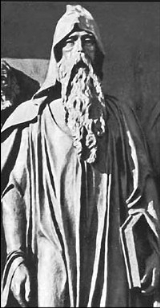
Nestorius

Encyclopedia
Nestorius was Archbishop of Constantinople
from 10 April 428 to 22 June 431.
Drawing on his studies at the School of Antioch
, his teachings, which included a rejection of the long-used title of Theotokos
("Mother of God") for the Virgin Mary, brought him into conflict with other prominent churchmen of the time, most notably Cyril of Alexandria
, who accused him of heresy. Nestorius sought to defend himself at the First Council of Ephesus in 431, but instead he found himself formally condemned for heresy and removed from his see
. Thereafter he retired to a monastery, where he asserted his orthodoxy for the rest of his life. Despite his acquiescence, many of his supporters split with the rest of the church in the Nestorian Schism
, and over the next decades a number of them relocated to Persia. Thereafter Nestorianism became the official position of the Church of the East
.
(now Kahramanmaraş
in Turkey). He received his clerical training as a pupil of Theodore of Mopsuestia
in Antioch
and gained a reputation for his sermons that led to his enthronement by Theodosius II
as Archbishop following the death of Sisinnius I
in 428.
. Nestorius tried to find a middle ground between those that emphasized the fact that in Christ God had been born as a man, insisted on calling the Virgin Mary Theotokos
(Greek
: Θεοτόκος, "God-bearer"), and those that rejected that title because God as an eternal being could not have been born. Nestorius suggested the title Christotokos (Χριστοτόκος, "Christ-bearer"), but did not find acceptance on either side.
Nestorius believed that no union between the human and divine were possible. If such a union of human and divine occurred, Nestorius believed that Christ could not truly be con-substantial with God and con-substantial with us because he would grow, mature, suffer and die (which he said God cannot do) and also would possess the power of God that would separate him from being equal to humans.
Eusebius, a layman who later became the bishop of the neighbouring Dorylaeum
was the first to accuse Nestorius of heresy but his most forceful opponent however was Patriarch Cyril of Alexandria
. Cyril appealed to Celestine of Rome to make a decision on Nestorius; and Celestine delegated to Cyril the job of excommunicating Nestorius if he did not change his teachings in ten days. Nestorius's opponents charged him with detaching Christ's divinity and humanity into two persons existing in one body, thereby denying the reality of the Incarnation
. This heresy came to be known as Nestorianism
.
The Emperor Theodosius II
(401–450) was eventually induced to convoke a general church council, sited at Ephesus, itself a special seat for the veneration of Mary, where the theotokos formula was popular. The Emperor and his wife supported Nestorius while Pope Celestine I
supported Cyril.
Cyril
took charge of the First Council of Ephesus in 431, opening debate before the long-overdue contingent of Eastern bishops from Antioch
arrived.
The council deposed Nestorius and declared him a heretic
. In Nestorius' own words,
But while the council was in progress, John I of Antioch and the eastern bishops arrived, and were furious to hear that Nestorius had already been condemned. They convened their own synod, at which Cyril
was deposed. Both sides then appealed to the emperor. Initially the imperial government ordered both Nestorius and Cyril
deposed and exiled. However, Cyril was eventually allowed to return after bribing various courtiers.
In the following months, 17 bishop
s who supported Nestorius' doctrine were removed from their sees. Eventually, John I of Antioch was obliged to abandon Nestorius in March 433. On August 3, 435, Theodosius II
issued an imperial edict that exiled Nestorius to a monastery
in the Great Oasis of Hibis (al-Khargah
), in Egypt, securely within the diocese of Cyril
. The monastery suffered attacks by desert bandits, and Nestorius was injured in one such raid.
Nestorius' writings survive mainly in Syriac.
and the relocation of many Nestorian Christians to Persia, Nestorian thought became ingrained in the native Christian community, known as the Church of the East
, to the extent that it was often known as the "Nestorian Church". In modern times the Assyrian Church of the East
, a modern descendant of the historical Church of the East, reveres Nestorius as a saint
, although the modern church does not subscribe to the entirety of the Nestorian doctrine as it has traditionally been understood in the West. Parts of the doctrine were explicitly repudiated by Patriarch Mar Dinkha IV on the occasion of his accession in 1976.
In the Roman Empire, the doctrine of Monophysitism
developed in reaction to Nestorianism. This new doctrine asserted that Christ had but one nature, his human nature being absorbed into his divinity. This doctrine was condemned at the Council of Chalcedon
, and misattributed to the non-Chalcedonian
churches. Today it is condemned as heresy in the modern Oriental Orthodox churches.
raids, but was substantially intact, and copies were taken secretly. The Syriac translation had the title of the Bazaar of Heracleides. The original 16th-century manuscript was destroyed in 1915 during the Turkish massacres of Assyrian Christians.
In the Bazaar, written towards the end of his life, Nestorius denies the heresy for which he was condemned and instead affirms of Christ "the same one is twofold" – an expression that some consider similar to the formulation of the Council of Chalcedon
. Nestorius' earlier surviving writings, however, including his letter written in response to Cyril
's charges against him, contain material that seems to support charges that he held that Christ had two persons.
Patriarch of Constantinople
The Ecumenical Patriarch is the Archbishop of Constantinople – New Rome – ranking as primus inter pares in the Eastern Orthodox communion, which is seen by followers as the One, Holy, Catholic, and Apostolic Church....
from 10 April 428 to 22 June 431.
Drawing on his studies at the School of Antioch
School of Antioch
The School of Antioch was one of the two major centers of the study of biblical exegesis and theology during Late Antiquity; the other was the catechetical school of Alexandria...
, his teachings, which included a rejection of the long-used title of Theotokos
Theotokos
Theotokos is the Greek title of Mary, the mother of Jesus used especially in the Eastern Orthodox, Oriental Orthodox, and Eastern Catholic Churches. Its literal English translations include God-bearer and the one who gives birth to God. Less literal translations include Mother of God...
("Mother of God") for the Virgin Mary, brought him into conflict with other prominent churchmen of the time, most notably Cyril of Alexandria
Cyril of Alexandria
Cyril of Alexandria was the Patriarch of Alexandria from 412 to 444. He came to power when the city was at its height of influence and power within the Roman Empire. Cyril wrote extensively and was a leading protagonist in the Christological controversies of the later 4th and 5th centuries...
, who accused him of heresy. Nestorius sought to defend himself at the First Council of Ephesus in 431, but instead he found himself formally condemned for heresy and removed from his see
Episcopal See
An episcopal see is, in the original sense, the official seat of a bishop. This seat, which is also referred to as the bishop's cathedra, is placed in the bishop's principal church, which is therefore called the bishop's cathedral...
. Thereafter he retired to a monastery, where he asserted his orthodoxy for the rest of his life. Despite his acquiescence, many of his supporters split with the rest of the church in the Nestorian Schism
Nestorian Schism
The Nestorian Schism was the split between the Orthodox Church and churches affiliated with Nestorian doctrine in the 5th century. The schism rose out of a Christological dispute, the key figures in which were Cyril of Alexandria and Nestorius...
, and over the next decades a number of them relocated to Persia. Thereafter Nestorianism became the official position of the Church of the East
Church of the East
The Church of the East tāʾ d-Maḏnḥāʾ), also known as the Nestorian Church, is a Christian church, part of the Syriac tradition of Eastern Christianity. Originally the church of the Persian Sassanid Empire, it quickly spread widely through Asia...
.
Early life
Nestorius was born in 386 in Germanicia in the Roman province of SyriaSyria (Roman province)
Syria was a Roman province, annexed in 64 BC by Pompey, as a consequence of his military presence after pursuing victory in the Third Mithridatic War. It remained under Roman, and subsequently Byzantine, rule for seven centuries, until 637 when it fell to the Islamic conquests.- Principate :The...
(now Kahramanmaraş
Kahramanmaras
-Industry:Kahramanmaraş's industry is mainly based on textile and ice cream. Kahramanmaraş is one of the biggest textile industry cities of Turkey. Companies like Kipaş, İskur, Arsan and Bozkurt are one of the richest companies in the city...
in Turkey). He received his clerical training as a pupil of Theodore of Mopsuestia
Theodore of Mopsuestia
Theodore the Interpreter was bishop of Mopsuestia from 392 to 428 AD. He is also known as Theodore of Antioch, from the place of his birth and presbyterate...
in Antioch
Antioch
Antioch on the Orontes was an ancient city on the eastern side of the Orontes River. It is near the modern city of Antakya, Turkey.Founded near the end of the 4th century BC by Seleucus I Nicator, one of Alexander the Great's generals, Antioch eventually rivaled Alexandria as the chief city of the...
and gained a reputation for his sermons that led to his enthronement by Theodosius II
Theodosius II
Theodosius II , commonly surnamed Theodosius the Younger, or Theodosius the Calligrapher, was Byzantine Emperor from 408 to 450. He is mostly known for promulgating the Theodosian law code, and for the construction of the Theodosian Walls of Constantinople...
as Archbishop following the death of Sisinnius I
Archbishop Sisinnius I of Constantinople
Sisinnius was the Archbishop of Constantinople from 426 to 427.- References :...
in 428.
Nestorian controversy
Shortly after his arrival in Constantinople, Nestorius became involved in the disputes of two theological factions, which differed in their ChristologyChristology
Christology is the field of study within Christian theology which is primarily concerned with the nature and person of Jesus Christ as recorded in the Canonical gospels and the letters of the New Testament. Primary considerations include the relationship of Jesus' nature and person with the nature...
. Nestorius tried to find a middle ground between those that emphasized the fact that in Christ God had been born as a man, insisted on calling the Virgin Mary Theotokos
Theotokos
Theotokos is the Greek title of Mary, the mother of Jesus used especially in the Eastern Orthodox, Oriental Orthodox, and Eastern Catholic Churches. Its literal English translations include God-bearer and the one who gives birth to God. Less literal translations include Mother of God...
(Greek
Greek language
Greek is an independent branch of the Indo-European family of languages. Native to the southern Balkans, it has the longest documented history of any Indo-European language, spanning 34 centuries of written records. Its writing system has been the Greek alphabet for the majority of its history;...
: Θεοτόκος, "God-bearer"), and those that rejected that title because God as an eternal being could not have been born. Nestorius suggested the title Christotokos (Χριστοτόκος, "Christ-bearer"), but did not find acceptance on either side.
Nestorius believed that no union between the human and divine were possible. If such a union of human and divine occurred, Nestorius believed that Christ could not truly be con-substantial with God and con-substantial with us because he would grow, mature, suffer and die (which he said God cannot do) and also would possess the power of God that would separate him from being equal to humans.
Eusebius, a layman who later became the bishop of the neighbouring Dorylaeum
Eusebius of Dorylaeum
Eusebius of Dorylaeum was a 5th-century bishop who spoke out against heretical teachings, especially those of Nestorius and Eutyches, during the period of Christological controversy. He was bishop of Dorylaeum which is located in Phrygia . The name Eusebius may also be found as Eusebios which...
was the first to accuse Nestorius of heresy but his most forceful opponent however was Patriarch Cyril of Alexandria
Cyril of Alexandria
Cyril of Alexandria was the Patriarch of Alexandria from 412 to 444. He came to power when the city was at its height of influence and power within the Roman Empire. Cyril wrote extensively and was a leading protagonist in the Christological controversies of the later 4th and 5th centuries...
. Cyril appealed to Celestine of Rome to make a decision on Nestorius; and Celestine delegated to Cyril the job of excommunicating Nestorius if he did not change his teachings in ten days. Nestorius's opponents charged him with detaching Christ's divinity and humanity into two persons existing in one body, thereby denying the reality of the Incarnation
Incarnation (Christianity)
The Incarnation in traditional Christianity is the belief that Jesus Christ the second person of the Trinity, also known as God the Son or the Logos , "became flesh" by being conceived in the womb of a woman, the Virgin Mary, also known as the Theotokos .The Incarnation is a fundamental theological...
. This heresy came to be known as Nestorianism
Nestorianism
Nestorianism is a Christological doctrine advanced by Nestorius, Patriarch of Constantinople from 428–431. The doctrine, which was informed by Nestorius's studies under Theodore of Mopsuestia at the School of Antioch, emphasizes the disunion between the human and divine natures of Jesus...
.
The Emperor Theodosius II
Theodosius II
Theodosius II , commonly surnamed Theodosius the Younger, or Theodosius the Calligrapher, was Byzantine Emperor from 408 to 450. He is mostly known for promulgating the Theodosian law code, and for the construction of the Theodosian Walls of Constantinople...
(401–450) was eventually induced to convoke a general church council, sited at Ephesus, itself a special seat for the veneration of Mary, where the theotokos formula was popular. The Emperor and his wife supported Nestorius while Pope Celestine I
Pope Celestine I
Pope Saint Celestine I was elevated to the papacy in the year 422, on November 3 according to the Liber Pontificalis, but on April 10 according to Tillemont....
supported Cyril.
Cyril
Cyril of Alexandria
Cyril of Alexandria was the Patriarch of Alexandria from 412 to 444. He came to power when the city was at its height of influence and power within the Roman Empire. Cyril wrote extensively and was a leading protagonist in the Christological controversies of the later 4th and 5th centuries...
took charge of the First Council of Ephesus in 431, opening debate before the long-overdue contingent of Eastern bishops from Antioch
Antioch
Antioch on the Orontes was an ancient city on the eastern side of the Orontes River. It is near the modern city of Antakya, Turkey.Founded near the end of the 4th century BC by Seleucus I Nicator, one of Alexander the Great's generals, Antioch eventually rivaled Alexandria as the chief city of the...
arrived.
The council deposed Nestorius and declared him a heretic
Heresy
Heresy is a controversial or novel change to a system of beliefs, especially a religion, that conflicts with established dogma. It is distinct from apostasy, which is the formal denunciation of one's religion, principles or cause, and blasphemy, which is irreverence toward religion...
. In Nestorius' own words,
When the followers of CyrilCyril of AlexandriaCyril of Alexandria was the Patriarch of Alexandria from 412 to 444. He came to power when the city was at its height of influence and power within the Roman Empire. Cyril wrote extensively and was a leading protagonist in the Christological controversies of the later 4th and 5th centuries...
saw the vehemence of the emperor… they roused up a disturbance and discord among the people with an outcry, as though the emperor were opposed to God; they rose up against the nobles and the chiefs who acquiesced not in what had been done by them and they were running hither and thither. And… they took with them those who had been separated and removed from the monasteries by reason of their lives and their strange manners and had for this reason been expelled, and all who were of heretical sects and were possessed with fanaticism and with hatred against me. And one passion was in them all, Jews and pagans and all the sects, and they were busying themselves that they should accept without examination the things which were done without examination against me; and at the same time all of them, even those that had participated with me at table and in prayer and in thought, were agreed… against me and vowing vows one with another against me… In nothing were they divided.
But while the council was in progress, John I of Antioch and the eastern bishops arrived, and were furious to hear that Nestorius had already been condemned. They convened their own synod, at which Cyril
Cyril of Alexandria
Cyril of Alexandria was the Patriarch of Alexandria from 412 to 444. He came to power when the city was at its height of influence and power within the Roman Empire. Cyril wrote extensively and was a leading protagonist in the Christological controversies of the later 4th and 5th centuries...
was deposed. Both sides then appealed to the emperor. Initially the imperial government ordered both Nestorius and Cyril
Cyril of Alexandria
Cyril of Alexandria was the Patriarch of Alexandria from 412 to 444. He came to power when the city was at its height of influence and power within the Roman Empire. Cyril wrote extensively and was a leading protagonist in the Christological controversies of the later 4th and 5th centuries...
deposed and exiled. However, Cyril was eventually allowed to return after bribing various courtiers.
In the following months, 17 bishop
Bishop
A bishop is an ordained or consecrated member of the Christian clergy who is generally entrusted with a position of authority and oversight. Within the Catholic Church, Eastern Orthodox, Oriental Orthodox Churches, in the Assyrian Church of the East, in the Independent Catholic Churches, and in the...
s who supported Nestorius' doctrine were removed from their sees. Eventually, John I of Antioch was obliged to abandon Nestorius in March 433. On August 3, 435, Theodosius II
Theodosius II
Theodosius II , commonly surnamed Theodosius the Younger, or Theodosius the Calligrapher, was Byzantine Emperor from 408 to 450. He is mostly known for promulgating the Theodosian law code, and for the construction of the Theodosian Walls of Constantinople...
issued an imperial edict that exiled Nestorius to a monastery
Monastery
Monastery denotes the building, or complex of buildings, that houses a room reserved for prayer as well as the domestic quarters and workplace of monastics, whether monks or nuns, and whether living in community or alone .Monasteries may vary greatly in size – a small dwelling accommodating only...
in the Great Oasis of Hibis (al-Khargah
Kharga Oasis
El-Kharga , also known as Al-Kharijah, is the southernmost of Egypt's five western oases. It is located in the Libyan Desert, about 200 km to the west of the Nile valley, and is some 150 km long. It is located in and is the capital of New Valley Governorate...
), in Egypt, securely within the diocese of Cyril
Cyril of Alexandria
Cyril of Alexandria was the Patriarch of Alexandria from 412 to 444. He came to power when the city was at its height of influence and power within the Roman Empire. Cyril wrote extensively and was a leading protagonist in the Christological controversies of the later 4th and 5th centuries...
. The monastery suffered attacks by desert bandits, and Nestorius was injured in one such raid.
Nestorius' writings survive mainly in Syriac.
Legacy
Though Nestorius had been condemned by the church, including by Syrians, there remained a faction loyal to him and his teachings. Following the Nestorian SchismNestorian Schism
The Nestorian Schism was the split between the Orthodox Church and churches affiliated with Nestorian doctrine in the 5th century. The schism rose out of a Christological dispute, the key figures in which were Cyril of Alexandria and Nestorius...
and the relocation of many Nestorian Christians to Persia, Nestorian thought became ingrained in the native Christian community, known as the Church of the East
Church of the East
The Church of the East tāʾ d-Maḏnḥāʾ), also known as the Nestorian Church, is a Christian church, part of the Syriac tradition of Eastern Christianity. Originally the church of the Persian Sassanid Empire, it quickly spread widely through Asia...
, to the extent that it was often known as the "Nestorian Church". In modern times the Assyrian Church of the East
Assyrian Church of the East
The Assyrian Church of the East, officially the Holy Apostolic Catholic Assyrian Church of the East ʻIttā Qaddishtā w-Shlikhāitā Qattoliqi d-Madnĕkhā d-Āturāyē), is a Syriac Church historically centered in Mesopotamia. It is one of the churches that claim continuity with the historical...
, a modern descendant of the historical Church of the East, reveres Nestorius as a saint
Saint
A saint is a holy person. In various religions, saints are people who are believed to have exceptional holiness.In Christian usage, "saint" refers to any believer who is "in Christ", and in whom Christ dwells, whether in heaven or in earth...
, although the modern church does not subscribe to the entirety of the Nestorian doctrine as it has traditionally been understood in the West. Parts of the doctrine were explicitly repudiated by Patriarch Mar Dinkha IV on the occasion of his accession in 1976.
In the Roman Empire, the doctrine of Monophysitism
Monophysitism
Monophysitism , or Monophysiticism, is the Christological position that Jesus Christ has only one nature, his humanity being absorbed by his Deity...
developed in reaction to Nestorianism. This new doctrine asserted that Christ had but one nature, his human nature being absorbed into his divinity. This doctrine was condemned at the Council of Chalcedon
Council of Chalcedon
The Council of Chalcedon was a church council held from 8 October to 1 November, 451 AD, at Chalcedon , on the Asian side of the Bosporus. The council marked a significant turning point in the Christological debates that led to the separation of the church of the Eastern Roman Empire in the 5th...
, and misattributed to the non-Chalcedonian
Non-Chalcedonian
Non-Chalcedonianism is the view of those churches that accepted the First Council of Ephesus of 431, but, for varying reasons, did not accept allegiance to the Council of Chalcedon following it in 451. The most substantial Non-Chalcedonian tradition is known as Oriental Orthodoxy...
churches. Today it is condemned as heresy in the modern Oriental Orthodox churches.
Bazaar of Heracleides
In 1895, a 16th-century book manuscript containing a copy of a text written by Nestorius was discovered by American missionaries in the library of the Nestorian patriarch in the mountains at Konak, Hakkari. This book had suffered damage during MuslimMuslim
A Muslim, also spelled Moslem, is an adherent of Islam, a monotheistic, Abrahamic religion based on the Quran, which Muslims consider the verbatim word of God as revealed to prophet Muhammad. "Muslim" is the Arabic term for "submitter" .Muslims believe that God is one and incomparable...
raids, but was substantially intact, and copies were taken secretly. The Syriac translation had the title of the Bazaar of Heracleides. The original 16th-century manuscript was destroyed in 1915 during the Turkish massacres of Assyrian Christians.
In the Bazaar, written towards the end of his life, Nestorius denies the heresy for which he was condemned and instead affirms of Christ "the same one is twofold" – an expression that some consider similar to the formulation of the Council of Chalcedon
Council of Chalcedon
The Council of Chalcedon was a church council held from 8 October to 1 November, 451 AD, at Chalcedon , on the Asian side of the Bosporus. The council marked a significant turning point in the Christological debates that led to the separation of the church of the Eastern Roman Empire in the 5th...
. Nestorius' earlier surviving writings, however, including his letter written in response to Cyril
Cyril of Alexandria
Cyril of Alexandria was the Patriarch of Alexandria from 412 to 444. He came to power when the city was at its height of influence and power within the Roman Empire. Cyril wrote extensively and was a leading protagonist in the Christological controversies of the later 4th and 5th centuries...
's charges against him, contain material that seems to support charges that he held that Christ had two persons.
External links
- From Orthodoxwiki.org
- Dialogue between the Syrian and Assyrian Churches from the Coptic Church
- The Coptic Church's View Concerning Nestorius
- From the Catholic Encyclopedia
- English translation of the Bazaar of Heracleides.
- Writing of Nestorius
- "The lynching of Nestorius" by Stephen M. Ulrich, concentrates on the political pressures around the Council of Ephesus and analyzes the rediscovered Bazaar of Nestorius.
- The Person and Teachings of Nestorius of Constantinople by Mar Bawai Soro.