

Caesaropapism

Encyclopedia
Secularity
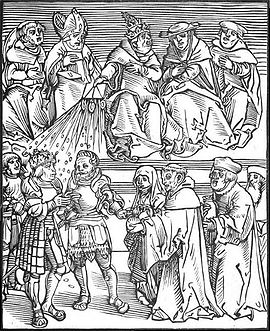
Secularity is the state of being separate from religion.For instance, eating and bathing may be regarded as examples of secular activities, because there may not be anything inherently religious about them...
government with, or making it superior to, the spiritual authority of the Church; especially concerning the connection of the Church with government. The term caesaropapism (Cäseropapismus) was coined by Max Weber
Max Weber
Karl Emil Maximilian "Max" Weber was a German sociologist and political economist who profoundly influenced social theory, social research, and the discipline of sociology itself...
, who defined it as follows: “a secular, caesaropapist ruler... exercises supreme authority in ecclesiastic matters by virtue of his autonomous legitimacy”. According to Weber's political sociology, caesaropapism entails “the complete subordination of priests to secular power.”
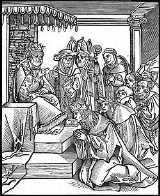
In its extreme form, caesaropapism is a political theory in which the head of state, notably the Emperor ('Caesar', by extension an 'equal' King), is also the supreme head of the church ('papa', pope or analogous religious leader). In this form, it inverts theocracy
Theocracy
Theocracy is a form of organization in which the official policy is to be governed by immediate divine guidance or by officials who are regarded as divinely guided, or simply pursuant to the doctrine of a particular religious sect or religion....
(or hierocracy in Weber) in which institutions of the Church control the state.
Caesaropapism in the Eastern Church
Byzantine Empire
The Byzantine Empire was the Eastern Roman Empire during the periods of Late Antiquity and the Middle Ages, centred on the capital of Constantinople. Known simply as the Roman Empire or Romania to its inhabitants and neighbours, the Empire was the direct continuation of the Ancient Roman State...
had over the Church of Constantinople or Eastern Christian Church
Eastern Christianity
Eastern Christianity comprises the Christian traditions and churches that developed in the Balkans, Eastern Europe, Asia Minor, the Middle East, Northeastern Africa, India and parts of the Far East over several centuries of religious antiquity. The term is generally used in Western Christianity to...
from the 330 consecration of Constantinople
Constantinople
Constantinople was the capital of the Roman, Eastern Roman, Byzantine, Latin, and Ottoman Empires. Throughout most of the Middle Ages, Constantinople was Europe's largest and wealthiest city.-Names:...
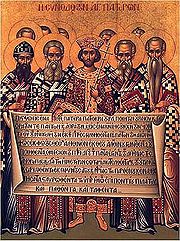
through the tenth century. The Byzantine Emperor would typically protect the Eastern Church and manage its administration by presiding over Ecumenical Councils and appointing Patriarchs and setting territorial boundaries for their jurisdiction
Patriarchy
Patriarchy is a social system in which the role of the male as the primary authority figure is central to social organization, and where fathers hold authority over women, children, and property. It implies the institutions of male rule and privilege, and entails female subordination...
. The Emperor, whose control was so strong that "Caesaropapism" became interchangeable with "Byzantinism", was called "Pontifex Maximus
Pontifex Maximus
The Pontifex Maximus was the high priest of the College of Pontiffs in ancient Rome. This was the most important position in the ancient Roman religion, open only to patricians until 254 BC, when a plebeian first occupied this post...
" after the fourth century
Christianity in the 4th century
Christianity in the 4th century was dominated by Constantine the Great, and the First Council of Nicea of 325, which was the beginning of the period of the First seven Ecumenical Councils and the attempt to reach an orthodox consensus and to establish a unified Christendom as the State church of...
, and the Patriarch of Constantinople
Patriarch of Constantinople
The Ecumenical Patriarch is the Archbishop of Constantinople – New Rome – ranking as primus inter pares in the Eastern Orthodox communion, which is seen by followers as the One, Holy, Catholic, and Apostolic Church....
could not hold office if he did not have the Emperor's approval. Eastern men like St. John Chrysostom
John Chrysostom
John Chrysostom , Archbishop of Constantinople, was an important Early Church Father. He is known for his eloquence in preaching and public speaking, his denunciation of abuse of authority by both ecclesiastical and political leaders, the Divine Liturgy of St. John Chrysostom, and his ascetic...
, Patriarch of Constantinople and St. Athanasius, Patriarch of Alexandria
Patriarch of Alexandria
The Patriarch of Alexandria is the Archbishop of Alexandria and Cairo, Egypt. Historically, this office has included the designation of Pope , and did so earlier than that of the Bishop of Rome...
, strongly opposed imperial control over the Church, as did Western theologians
Western Christianity
Western Christianity is a term used to include the Latin Rite of the Catholic Church and groups historically derivative thereof, including the churches of the Anglican and Protestant traditions, which share common attributes that can be traced back to their medieval heritage...
like St. Hilary
Hilary of Poitiers
Hilary of Poitiers was Bishop of Poitiers and is a Doctor of the Church. He was sometimes referred to as the "Hammer of the Arians" and the "Athanasius of the West." His name comes from the Latin word for happy or cheerful. His optional memorial in the Roman Catholic calendar of saints is 13...
and Hosius, Bishop of Córdoba. Such Emperors as Basiliscus
Basiliscus
Basiliscus was Eastern Roman Emperor from 475 to 476. A member of the House of Leo, he came to power when Emperor Zeno had been forced out of Constantinople by a revolt....
, Zeno
Zeno (emperor)
Zeno , originally named Tarasis, was Byzantine Emperor from 474 to 475 and again from 476 to 491. Domestic revolts and religious dissension plagued his reign, which nevertheless succeeded to some extent in foreign issues...
, Justinian I
Justinian I
Justinian I ; , ; 483– 13 or 14 November 565), commonly known as Justinian the Great, was Byzantine Emperor from 527 to 565. During his reign, Justinian sought to revive the Empire's greatness and reconquer the lost western half of the classical Roman Empire.One of the most important figures of...
, Heraclius
Heraclius
Heraclius was Byzantine Emperor from 610 to 641.He was responsible for introducing Greek as the empire's official language. His rise to power began in 608, when he and his father, Heraclius the Elder, the exarch of Africa, successfully led a revolt against the unpopular usurper Phocas.Heraclius'...
, and Constans II
Constans II
Constans II , also called Constantine the Bearded , was Byzantine emperor from 641 to 668. He also was the last emperor to become consul in 642, becoming the last Roman consul in history....
published several strictly ecclesiastical edicts either on their own without the mediation of church councils, or they exercised their own political influence on the councils to issue the edicts.
Caesaropapism was most notorious in the Tsardom of Russia
Tsardom of Russia
The Tsardom of Russia was the name of the centralized Russian state from Ivan IV's assumption of the title of Tsar in 1547 till Peter the Great's foundation of the Russian Empire in 1721.From 1550 to 1700, Russia grew 35,000 km2 a year...
when Ivan IV the Terrible assumed the title Czar in 1547 and subordinated the Russian Orthodox Church
Russian Orthodox Church
The Russian Orthodox Church or, alternatively, the Moscow Patriarchate The ROC is often said to be the largest of the Eastern Orthodox churches in the world; including all the autocephalous churches under its umbrella, its adherents number over 150 million worldwide—about half of the 300 million...
to the state. This level of caesaropapism far exceeded that of the Byzantine Empire. Caesaropapism in Russia was taken to a new level in 1721, when Peter the Great abolished the patriarchate and formally made the church a department of his government formally known as the beginning of the Russian Empire
Russian Empire
The Russian Empire was a state that existed from 1721 until the Russian Revolution of 1917. It was the successor to the Tsardom of Russia and the predecessor of the Soviet Union...
.
Caesaropapism existed in the Eastern Orthodox Church in Turkey
Turkey
Turkey , known officially as the Republic of Turkey , is a Eurasian country located in Western Asia and in East Thrace in Southeastern Europe...
until 1923 and in Cyprus
Cyprus
Cyprus , officially the Republic of Cyprus , is a Eurasian island country, member of the European Union, in the Eastern Mediterranean, east of Greece, south of Turkey, west of Syria and north of Egypt. It is the third largest island in the Mediterranean Sea.The earliest known human activity on the...
until 1977, when Archbishop Makarios III died. However, in no way is caesaropapism a part of Orthodox
Eastern Orthodox Church
The Orthodox Church, officially called the Orthodox Catholic Church and commonly referred to as the Eastern Orthodox Church, is the second largest Christian denomination in the world, with an estimated 300 million adherents mainly in the countries of Belarus, Bulgaria, Cyprus, Georgia, Greece,...
dogma
Dogma
Dogma is the established belief or doctrine held by a religion, or a particular group or organization. It is authoritative and not to be disputed, doubted, or diverged from, by the practitioners or believers...
. The historical reality, as opposed to doctrinal endorsement or dogmatic definition, of caesaropapism stems from, according to Metropolitan Kallistos Ware
Timothy Ware
Kallistos Ware is an English bishop within the Greek Orthodox Ecumenical Patriarchate and one of the best known contemporary Eastern Orthodox theologians. From 1982 to his retirement in 2001 he held the position of Bishop of Diokleia...
, the confusion of the Byzantine Empire with the Kingdom of God
Kingdom of God
The Kingdom of God or Kingdom of Heaven is a foundational concept in the Abrahamic religions: Judaism, Christianity and Islam.The term "Kingdom of God" is found in all four canonical gospels and in the Pauline epistles...
and the zeal of the Byzantines "to establish here on earth a living icon of God's government in heaven."
Caesaropapism in the Western Church
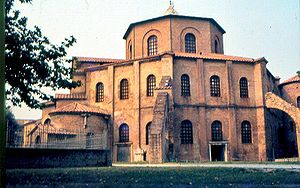
The Byzantine Papacy was a period of Byzantine
Byzantine Empire
The Byzantine Empire was the Eastern Roman Empire during the periods of Late Antiquity and the Middle Ages, centred on the capital of Constantinople. Known simply as the Roman Empire or Romania to its inhabitants and neighbours, the Empire was the direct continuation of the Ancient Roman State...
domination of the papacy
Pope
The Pope is the Bishop of Rome, a position that makes him the leader of the worldwide Catholic Church . In the Catholic Church, the Pope is regarded as the successor of Saint Peter, the Apostle...
from 537 to 752, when popes required the approval of the Byzantine Emperor for episcopal consecration, and many popes were chosen from the apocrisiarii
Apocrisiarius
An apocrisiarius, the Latinized form of apokrisiarios , sometimes Anglicized as apocrisiary, was a high diplomatic representative during Late Antiquity and the early medieval period. The corresponding Latin term was responsalis...
(liaisons from the pope to the emperor) or the inhabitants of Byzantine Greece, Byzantine Syria, or Byzantine Sicily. Justinian I
Justinian I
Justinian I ; , ; 483– 13 or 14 November 565), commonly known as Justinian the Great, was Byzantine Emperor from 527 to 565. During his reign, Justinian sought to revive the Empire's greatness and reconquer the lost western half of the classical Roman Empire.One of the most important figures of...
conquered the Italian peninsula in the Gothic War (535–554) and appointed the next three popes
Papal selection before 1059
There was no fixed process for papal selection before 1059. Popes, the bishops of Rome and the leaders of the Catholic Church, were often appointed by their predecessors or secular rulers...
, a practice that would be continued by his successors and later be delegated to the Exarchate of Ravenna
Exarchate of Ravenna
The Exarchate of Ravenna or of Italy was a centre of Byzantine power in Italy, from the end of the 6th century to 751, when the last exarch was put to death by the Lombards.-Introduction:...
.
Extended use

In Commendam
In canon law, commendam was a form of transferring an ecclesiastical benefice in trust to the custody of a patron...
prelatures) and getting access to significant income from the Church's property; during and around the 'Babylonian Exile' of the papacy in Avignon
Avignon
Avignon is a French commune in southeastern France in the départment of the Vaucluse bordered by the left bank of the Rhône river. Of the 94,787 inhabitants of the city on 1 January 2010, 12 000 live in the ancient town centre surrounded by its medieval ramparts.Often referred to as the...
they even had a heavy hand in the papacy as such; and aspects of Gallicanism
Gallicanism
Gallicanism is the belief that popular civil authority—often represented by the monarchs' authority or the State's authority—over the Catholic Church is comparable to that of the Pope's...
reflect the desire to give even the liturgy (even when Latin was the only language for liturgical ritual in the Latin Rite) a distinctive French flavour.
After the introduction of Protestantism
Protestantism
Protestantism is one of the three major groupings within Christianity. It is a movement that began in Germany in the early 16th century as a reaction against medieval Roman Catholic doctrines and practices, especially in regards to salvation, justification, and ecclesiology.The doctrines of the...
, the immense fermentation caused by the introduction of socially subversive principles into the life of a people would exhaust its revolutionary beginnings, and result in a new form of social and religious order - the residue of the great Protestant upheaval in Europe was territorial or State Religion, based on the religious supremacy of the temporal ruler, in contradistinction to the old order in which the temporal ruler took an oath of obedience to the Catholic Church. Martin Luther
Martin Luther
Martin Luther was a German priest, professor of theology and iconic figure of the Protestant Reformation. He strongly disputed the claim that freedom from God's punishment for sin could be purchased with money. He confronted indulgence salesman Johann Tetzel with his Ninety-Five Theses in 1517...
's first reformatory attempts were radically democratic. He sought to benefit the people at large by curtailing the powers of both Church and State. The German princes, to him, were "usually the biggest fools or the worst scoundrels on earth". In 1523 he wrote: "The people will not, cannot, shall not endure your tyranny and oppression any longer. The world is not now what it was formerly, when you could chase and drive the people like game". This manifesto, addressed to the poorer masses, was taken up by Franz von Sickingen
Franz von Sickingen
Franz von Sickingen was a German knight, one of the most notable figures of the first period of the Reformation.-Biography:He was born at Ebernburg near Bad Kreuznach...
, a Knight of the Empire, who entered the field in execution of its threats. His object was twofold: to strengthen the political power of the knights — the inferior nobility — against the princes, and to open the road to the new Gospel by overthrowing the bishops, but his enterprise had the opposite result: the knights were beaten, lost what influence they had possessed, and the princes were proportionately strengthened. The rising of the peasants likewise turned to the advantage of the princes: the fearful slaughter of Frankenhausen (1525) left the princes without an enemy and the new Gospel without its natural defenders. The victorious princes used their augmented power entirely for their own advantage in opposition to the authority of the emperor and the freedom of the nation.
Caesaropapism was also established in England in the sixteenth century when Henry VIII established himself as head of the Church of England
Church of England
The Church of England is the officially established Christian church in England and the Mother Church of the worldwide Anglican Communion. The church considers itself within the tradition of Western Christianity and dates its formal establishment principally to the mission to England by St...
. Queen Elizabeth I expanded the role and power of the British monarch over the Church. The British monarch continues to rule over the Church of England, the Anglican Church, to the present day. However, this "rule" is now delegated to the General Synod of the Church of England
General Synod of the Church of England
The General Synod is the deliberative and legislative body of the Church of England. The synod was instituted in 1970, replacing the Church Assembly, and is the culmination of a process of rediscovering self-government for the Church of England that had started in the 1850s.- Church Assembly: 1919...
, relegating the Crown to a ceremonial role, in much the same way political powers of that Throne are actually exercised by Parliament
Parliament of the United Kingdom
The Parliament of the United Kingdom of Great Britain and Northern Ireland is the supreme legislative body in the United Kingdom, British Crown dependencies and British overseas territories, located in London...
and the ministries of Parliament.
See also
- ByzantinismByzantinismByzantinism or Byzantism is a term used in political science and philosophy to denote the political system and culture of the Byzantine Empire, and its spiritual successors, in particular, the Balkan states, the Ottoman Empire and Russia. The term byzantinism itself was coined in the 19th century...
- Chinese Patriotic Catholic AssociationChinese Patriotic Catholic AssociationThe Chinese Patriotic Catholic Association , abbreviated CPA, CPCA, or CCPA, is an association of people, established in 1957 by the People's Republic of China's Religious Affairs Bureau to exercise state supervision over mainland China's Catholics...
- Church and state in medieval Europe
- Concordat of WormsConcordat of WormsThe Concordat of Worms, sometimes called the Pactum Calixtinum by papal historians, was an agreement between Pope Calixtus II and Holy Roman Emperor Henry V on September 23, 1122 near the city of Worms...
- Constantinian shiftConstantinian shiftConstantinian shift is a term used by Anabaptist and Post-Christendom theologians to describe the political and theological aspects of the 4th-century process of Constantine's legalization of Christianity. The term was popularized by the Mennonite theologian John H...
- Erastianism
- Great ApostasyGreat ApostasyThe Great Apostasy is a term used by some religious groups to describe a general fallen state of traditional Christianity, especially the Papacy, because it allowed the traditional Roman mysteries and deities of solar monism such as Mithras and Sol Invictus and idol worship back into the church,...
- Joseph of Volotsk
- Massacre of ThessalonikiMassacre of ThessalonikiThe Massacre of Thessalonica was a retaliatory action by the Roman Emperor Theodosius I in 390 against the inhabitants of Thessalonica, who had risen in revolt....
- Pope Leo XPope Leo XPope Leo X , born Giovanni di Lorenzo de' Medici, was the Pope from 1513 to his death in 1521. He was the last non-priest to be elected Pope. He is known for granting indulgences for those who donated to reconstruct St. Peter's Basilica and his challenging of Martin Luther's 95 Theses...
- State church of the Roman EmpireState church of the Roman EmpireThe state church of the Roman Empire was a Christian institution organized within the Roman Empire during the 4th century that came to represent the Empire's sole authorized religion. Both the Roman Catholic Church and the Eastern Orthodox churches claim to be the historical continuation of this...
- TheocracyTheocracyTheocracy is a form of organization in which the official policy is to be governed by immediate divine guidance or by officials who are regarded as divinely guided, or simply pursuant to the doctrine of a particular religious sect or religion....
- Hierocracy