All Topics  
Sermon on the Mount

 
Sermon On the Mount

   Email Print
   Bookmark   Link


Sermon on the Mount


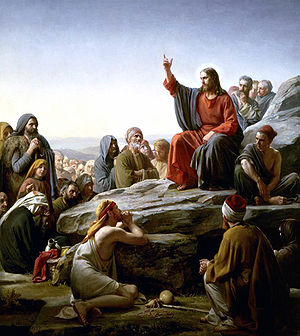
In the Gospel of St. Matthew, the Sermon on the Mount is a compilation of Jesus' sayings, epitomizing his moral teaching
Ethics in religion

Ethics is a major branch of philosophy, encompassing right conduct and good life. It is significantly broader than the common conception of analyzing right and wrong....
. According to chapters , Jesus of Nazareth
Jesus

Jesus of Nazareth , also known as Jesus Christ, is the central figure of Christianity and is revered by most Christian churches as the Son of God and the Incarnation ....
 gave this sermon (estimated around AD 30
30

Year 30 was a common year starting on Sunday of the Julian calendar....
) on a mountainside to his disciples
Disciple (Christianity)

In the History of Christianity, the disciples were the students of Jesus during his Ministry of Jesus. While Jesus attracted a large following, the term disciple is commonly used to refer specifically to "Twelve Apostles", an inner circle of men whose number perhaps represented the twelve tribes of Israel....
 and a large crowd. Matthew groups Jesus' teachings into five discourses, of which the Sermon on the Mount is the first.


Discussion
Ask a question about 'Sermon on the Mount'
Start a new discussion about 'Sermon on the Mount'
Answer questions from other users
Full Discussion Forum


Encyclopedia


Bloch Sermononthemount
In the Gospel of St. Matthew, the Sermon on the Mount is a compilation of Jesus' sayings, epitomizing his moral teaching
Ethics in religion

Ethics is a major branch of philosophy, encompassing right conduct and good life. It is significantly broader than the common conception of analyzing right and wrong....
. According to chapters , Jesus of Nazareth
Jesus

Jesus of Nazareth , also known as Jesus Christ, is the central figure of Christianity and is revered by most Christian churches as the Son of God and the Incarnation ....
 gave this sermon (estimated around AD 30
30

Year 30 was a common year starting on Sunday of the Julian calendar....
) on a mountainside to his disciples
Disciple (Christianity)

In the History of Christianity, the disciples were the students of Jesus during his Ministry of Jesus. While Jesus attracted a large following, the term disciple is commonly used to refer specifically to "Twelve Apostles", an inner circle of men whose number perhaps represented the twelve tribes of Israel....
 and a large crowd. Matthew groups Jesus' teachings into five discourses, of which the Sermon on the Mount is the first. The others concern instructions for the disciples, parables of the Kingdom
Parables of Jesus

The parables of Jesus, found in the synoptic gospels, embody much of Jesus' Ministry of Jesus#Teachings.Jesus' parables are quite simple, memorable stories, often with humble imagery, each with a single message....
, instructions for the Church, and a harsh denunciation of scribes and pharisees
Woes of the Pharisees

?The Woes of the Pharisees is a list of criticisms by Jesus against Scribes and Pharisees and Lawyers that is present in the Gospel of Luke and Gospel of Matthew ....
.

The best-known written portions of the open-air sermon
Open-air preaching

Open air preaching or street preaching is the act of publicly proclaiming a religious message to crowds of people in open places. It is an ancient method of communicating a religious or social message, and has been used by many cultures and religious traditions but today is usually associated with Christian fundamentalism or evangelic...
 comprise the Beatitudes
Beatitudes

In Christianity, the Beatitudes are blessing from the Sermon on the Mount in Gospel of Matthew and the Sermon on the Plain in Gospel of Luke. The blessings in Luke refer to external situations while those in Matthew refer more to spiritual or moral qualities....
, found at the beginning of the section. The Sermon also contains the Lord's Prayer
Lord's Prayer

The Lord's Prayer, also known as the Our Father or Pater noster, is probably the best-known prayer in Christianity. On Easter Sunday 2007 it was estimated that 2 billion Catholic, Protestant and Eastern Orthodox Christians read, recited, or sang the short prayer in hundreds of languages in houses of worship of all shapes and size...
 and the injunctions to "resist not evil" and "turn the other cheek
Turn the other cheek

Turning the other cheek is to respond to an aggressor without violence . The phrase originates from the Sermon on the Mount in the New Testament....
", as well as Jesus' version of the Golden Rule
Ethic of reciprocity

The ethic of reciprocity is an ethical code that states one has a right to just treatment, and a responsibility to ensure justice for others. Reciprocity is arguably the most essential basis for the modern concept of human rights, though it has its critics....
. Other lines often quoted are the references to "salt of the Earth
Salt and Light

Salt and light is a metaphor used by Jesus in the Bible.Some of the elaborations on the "Salt and Light" metaphors that Matthew recounts are also paralleled in Gospel of Luke, but in completely different parts of the narrative, which leads scholars to suspect they originate in the Q document, which is essentially thought to be a collection...
," "light of the world," and "judge not, lest ye be judged."

Many Christians
Christianity

Christianity is a Monotheistic religion #Christian view religion centered on the life and teachings of Jesus as New Testament view on Jesus' life....
 believe that the Sermon on the Mount is a form of commentary on the Ten Commandments
Ten Commandments

The Ten Commandments, or Decalogue, are a list of religious and moral imperatives that, according to Judeo-Christian tradition, were authored by God and given to Moses on the mountain referred to as "Biblical Mount Sinai" or "Mount Horeb" in the form of two stone tablets....
. It portrays Christ as the true interpreter of the Mosaic Law. To many, the Sermon on the Mount contains the central tenets of Christian discipleship, and is considered as such by many religious and moral thinkers, such as Tolstoy
Leo Tolstoy

Leo Tolstoy, or Count Lev Nikolayevich Tolstoy Tolstoy's further talents as essayist, dramatist and Education reform made him the most influential member of the aristocracy Tolstoy....
, Gandhi
Mahatma Gandhi

Mohandas Karamchand Gandhi was a major political and spiritual leader of India and the Indian independence movement. He was the pioneer of satyagraha?resistance to tyranny through mass civil disobedience, firmly founded upon ahimsa or total non-violence?which led India to Indian independence movement and inspired movements for civi...
, Dietrich Bonhoeffer
Dietrich Bonhoeffer

Dietrich Bonhoeffer was a Germany Lutheran pastor, Theology, participant in the German Resistance movement against Nazism, and a founding member of the Confessing Church....
, and Martin Luther King, Jr.
Martin Luther King, Jr.

Martin Luther King, Jr. was an United States pastor, activist and prominent leader in the African-American African-American Civil Rights Movement ....
 It has been one of the main sources of Christian pacifism
Christian pacifism

Christian pacifism is the theological and ethical position that any form of violence is incompatible with the Christianity faith. Christian pacifists state that Jesus himself was a pacifist who taught and practiced pacifism, and that his followers must do likewise....
.

Origin

Those accepting the ancient Church tradition of Matthean authorship
Gospel of Matthew

The Gospel of Matthew is one of the four canonical gospels in the New Testament and is a synoptic gospel. It narrates an account of the New Testament view on Jesus' life and Ministry of Jesus of Jesus of Nazareth....
 take the Sermon on the Mount as what it purports to be , namely the words of Jesus. For those, however, who consider one or other of the modern source hypotheses of the Gospels more credible (cf. Synoptic Problem
Synoptic problem

The synoptic problem concerns the literary relationships between and among the first three Gospel , known as the Synoptic Gospels . Similarity in content, word choices and event placement indicates some kind of literary interrelationship....
), the source of the Sermon on the Mount is uncertain. It contains only a handful of parallels with Mark
Gospel of Mark

The Gospel of Mark is the second of the four canonical gospels in the New Testament and was probably the first of the three synoptic gospels to be written....
, but does have a number of loose parallels with Luke's Sermon on the Plain
Sermon on the Plain

The Sermon on the Plain was a sermon given by Jesus of Nazareth according to the Gospel of Luke ; it may be compared to the longer Sermon on the Mount....
. The parallels indicate to those who hold the Two source hypothesis that much of this text likely came from the hypothetical ancient (and no longer extant) document referred to as Q
Q document

The Q document or Q is a postulated lost textual source for the Gospel of Matthew and Gospel of Luke. It is a theoretical collection of Jesus' sayings, written in Greek....
. Furthermore, some of the sayings can be found in the apocryphal Gospel of Thomas
Gospel of Thomas

The Gospel According to Thomas , also known as The Gospel of Thomas, is a New Testament-era apocryphon, nearly completely preserved in a Coptic papyrus manuscript discovered in 1945 at Nag Hammadi, Egypt....
. However, McArthur argues that the parallels in Luke tend to be very loose, and that there are a considerable number of verses having no parallel, thus theorising that there was an extra step between the sources used by Matthew and Luke.

Location


There are no actual mountains in this part of Galilee
Galilee

Galilee , is a large region in northern Israel which overlaps with much of the administrative North District of the country. Traditionally divided into Upper Galilee , Lower Galilee , and Western Galilee , extending from Dan to the north, at the base of Mount Hermon, along Mount Lebanon to the ridges of Mount Carmel and Mount Gilboa t...
, but there are several large hills in the region to the west of the Sea of Galilee
Sea of Galilee

The Sea of Galilee, also Sea of Genneseret, Lake Kinneret or Lake Tiberias , is Israel's largest freshwater lake, being approximately 53 km in circumference, about 21 km long, and 13 km wide....
, and so a number of scholars do not feel "the mountain" is the most accurate understanding of the Greek word used in Matthew 5:1. Gundry feels it could mean "mountainous region," while France feels it should be read as "the hills". Less clinical academic analysis amongst some modern Christians has suggested the location as a hill on the north end of the Sea of Galilee
Sea of Galilee

The Sea of Galilee, also Sea of Genneseret, Lake Kinneret or Lake Tiberias , is Israel's largest freshwater lake, being approximately 53 km in circumference, about 21 km long, and 13 km wide....
, near Capernaum
Capernaum

Capernaum was a settlement on the shore of the Sea of Galilee. The site is a ruin today, but was inhabited from 150 BC to about AD 750.The town is mentioned in the New Testament: in the Gospel of Luke it was reported to have been the home of the Twelve apostles Saint Peter, Saint Andrew, Saint James the Great and John the Apostle, as well...
.

One possible location of the sermon is on a hill that rises near Capernaum. Known in ancient times as Mt. Eremos and Karn Hattin, this hill is now the site of a twentieth century Roman Catholic
Roman Catholic Church

The Roman Catholic Church, officially known as the Catholic Church is the world's largest Christianity Ecclesia , representing over half of all Christians and one-sixth of the world population....
 chapel
Chapel

A chapel is a building used as a place for fellowship and of worship for Christians. It may be attached to an institution such as a large Church , a college, a hospital, a palace, a prison or a cemetery, or may be an entirely free-standing building, sometimes with its own grounds....
 called the Church of the Beatitudes
Church of the Beatitudes

The Church of the Beatitudes is a Roman Catholic church in the Holy Land, built on the traditional site of the Sermon on the Mount. The church is near Tabgha in Israel, and is operated by the Franciscans....
.

The reference to going up a mountain prior to preaching is considered by many to be deliberate reference to Moses
Moses

Moses is a Hebrew Bible Hebrews religious leader, lawgiver, prophet, to whom the Mosaic authorship of the Torah is traditionally attributed. Also called Moshe Rabbeinu in Hebrew , he is the most important prophet in Judaism, and also an important prophet of Christianity, Islam, the Bah?'? Faith, Rastafari movement, Chrislam and many ot...
 on Mount Sinai
Mount Sinai

Mount Sinai , also known as Mount Horeb, Mount Musa, Gebel Musa or Jabal Musa by the Bedouin, is the name of a mountain in the Sinai Peninsula....
, and though Hill disagrees, arguing that the links would have been made far clearer, Lapide feels that the clumsy phrasing implies that this verse is an exact transliteration from the Hebrew passage describing Moses. Augustine of Hippo in his commentary on the Sermon on the Mount supported the Moses parallel, arguing that this symbolism showed Jesus as supplementing the precepts of Moses, although in Augustine's later writings, such as the Reply to Faustus, he carefully backs away from this view.

Comparisons with the Sermon on the Plain

While Matthew groups Jesus' teachings into sets of similar material, the same material is scattered when found in Luke. The Sermon on the Mount may be compared with the similar but more succinct Sermon on the Plain
Sermon on the Plain

The Sermon on the Plain was a sermon given by Jesus of Nazareth according to the Gospel of Luke ; it may be compared to the longer Sermon on the Mount....
 as recounted by the Gospel of Luke
Gospel of Luke

The Gospel of Luke is a Synoptic Gospels, and is the third and longest of the four Biblical canonical Gospels of the New Testament. The text narrates the life of Jesus of Nazareth....
 (6:17–49), which occurs at the same moment in Luke's narrative, and also features Jesus heading up a mountain. Some scholars believe that they are the same sermon, others that Jesus frequently preached similar themes in different places. However, a number of scholars believe that at least one sermon never took place but was a conflation created by the author to frame the primary teachings of Jesus recorded in the Q document
Q document

The Q document or Q is a postulated lost textual source for the Gospel of Matthew and Gospel of Luke. It is a theoretical collection of Jesus' sayings, written in Greek....
.

The sermon's audience

That Matthew has Jesus sit down might indicate this is not meant to be a public address, and Jewish leaders in schools and synagogue
Synagogue

A synagogue is a Jewish house of prayer.Synagogues usually have a large hall for prayer , smaller rooms for study and sometimes a social hall and offices....
s would always sit when delivering a lesson. Matthew also appears to indicate that the disciples were intended to be the principle recipients of the address, and so the traditional view, as depicted in art, is that the disciples sat near Jesus, with the crowd beyond but still able to hear, while Lapide feels that Jesus' sermon is directed at three circles of listeners, his disciples, the crowd, and the world in general. John Chrysostom
John Chrysostom

'Saint John Chrysostom' , archbishop of Constantinople, was an important Early Church Father. He is known for his eloquence in Sermon and public speaking, his denunciation of abuse of authority by both ecclesiastical and political leaders, the Divine Liturgy of St....
 was of the opinion that the sermon itself was delivered to the disciples, but that it was intended for wider distribution, which is why it was written down.

Structure

The sermon comprises the following components:

Introductory narrative (Matthew 5:1-2)

A large crowd assembles due to Jesus healing the sick
Exorcism

Exorcism is the practice of evicting demons or other evil spiritual being from a person or place which they are believed to have Spiritual possession....
, so he climbs a mountain and speaks.

Beatitudes (Matthew 5:3-12)

They describe the character of the people of the kingdom
Kingdom of Heaven

Kingdom of Heaven may refer to:* Kingdom of God* Kingdom of Heaven , a 2005 film, directed by Ridley Scott...
. These are Christ's promises of coming blessings
Second Coming

In Christian theology, the Second Coming is the anticipated return of Jesus from Heaven to earth, an event to fulfill aspects of Claimed Messianic prophecies of Jesus, such as the general resurrection of the dead, the Last Judgment of the dead and the living and the full establishment of the Kingdom of God on Earth , including the Messianic...
. In Matthew, there are eight (or nine) blessings, while in Luke there are four, followed by four woes. In Matthew, more than in Luke, the Beatitudes refer to moral or spiritual qualities of Christian discipleship.

Metaphors of Salt and Light (Matthew 5:13-16)

This concludes the picture of God's people drawn in the beatitudes, as well as an introduction to the following section.

Expounding of the Law (Matthew 5:17-48)

Jesus fulfills and reinterprets Mosaic Law and in particular the Ten Commandments
Ten Commandments

The Ten Commandments, or Decalogue, are a list of religious and moral imperatives that, according to Judeo-Christian tradition, were authored by God and given to Moses on the mountain referred to as "Biblical Mount Sinai" or "Mount Horeb" in the form of two stone tablets....
, contrasting with what "you have heard" from others, also known as the Antitheses
Expounding of the Law

The Expounding of the Law , sometimes called the Expounding of the Law#Antithesis of the Law, is a highly structured part of the Sermon on the Mount in the New Testament of the Bible....
.

Discourse on ostentation (Matthew 6)

Jesus condemns the "good works" of fasting
Fasting

Fasting is primarily the act of willingly abstaining from some or all food, drink, or both, for a period of time. A fast may be total or partial concerning that from which one fasts, and may be prolonged or intermittent as to the period of fasting....
, alms
Alms

Alms or almsgiving exists in a number of religions. In general, it involves giving materially to another as an act of religious virtue....
, and prayer
Prayer

Prayer is the act of communicating with a deity or spirit in worship. Specific forms of this may include praise, requesting divine providence, confessing sins, as an act of reparation or an expression of one's emotional expression....
, when they are only done for show, and not from the heart. The discourse goes on to condemn the superficiality of materialism
Economic materialism

Materialism refers to how a person or group chooses to spend their factors of production, particularly money and time. Literally, a materialist is a person for whom collecting material goods is an important priority....
 and call the disciples not to worry about material needs, but to "seek" God's kingdom first.

Lord's Prayer
Within the discourse on ostentation, Matthew presents as an example of correct prayer. Luke places in a different context.

Discourse on judgementalism (Matthew 7:1-6)

Jesus condemns those who judge others before first judging themselves.

Discourse on holiness (Matthew 7:7-29)

Jesus concludes the sermon by warning against false prophet
False prophet

In religion, the term false prophet is a label given to a person who is viewed as illegitimately claiming charismatic authority within a religious group....
s, and emphasizing that humans are unable to do right ("bear fruit") apart from God. The Foundation must be on the Rock.

Interpretation


One of the most important debates over the sermon is how directly it should be applied to everyday life. Almost all Christian groups have developed nonliteral ways to interpret and apply the sermon. McArthur lists twelve basic schools of thought on these issues:
  1. The Absolutist View rejects all compromise and believes that, if obeying the scripture costs the welfare of the believer, then that is a reasonable sacrifice for salvation
    Salvation

    In religion, salvation is the concept that God saves humanity from death. As commonly conceived, He has both Will of God and omnipotence to realize human salvation....
    . All the precepts in the Sermon must be taken literally and applied universally. Proponents of this view include St. Francis of Assisi, Dietrich Bonhoeffer
    Dietrich Bonhoeffer

    Dietrich Bonhoeffer was a Germany Lutheran pastor, Theology, participant in the German Resistance movement against Nazism, and a founding member of the Confessing Church....
     and in later life Leo Tolstoy
    Leo Tolstoy

    Leo Tolstoy, or Count Lev Nikolayevich Tolstoy Tolstoy's further talents as essayist, dramatist and Education reform made him the most influential member of the aristocracy Tolstoy....
    . The Oriental Orthodox Churches fully adopt this position; among heterodox groups, the early Anabaptist
    Anabaptist

    Anabaptists are Christianity of the Radical Reformation. Various groups at various times have been called Anabaptist, but the term is most commonly used to refer to the Anabaptists of 16th century Europe....
    s came close, and modern Anabaptist groups such as the Mennonites and Hutterites come closest.
  2. One method that is common, but not endorsed by any denomination, is to simply Modify the Text of the sermon. In ancient times this took the form of actually altering the text of the Sermon to make it more palatable. Thus some early copyists changed Matthew 5:22 from "whosoever is angry with his brother shall be in danger of the judgment" to the watered-down "whosoever is angry with his brother without a cause shall be in danger of the judgment." "Love your enemies" was changed to "Pray for your enemies" in pOxy
    Oxyrhynchus Gospels

    The Oxyrhynchus Gospels are two fragmentary manuscripts , discovered among the rich finds of discarded papyri at Oxyrhynchus in Egypt. Unknown to most laymen, they throw light on early non-canonical Gospel traditions....
     1224 6:1a; Did.
    Didache

    The Didache is the common name of a brief Early Christianity treatise . It is an anonymous work not belonging to any single individual, and a pastoral manual "that reveals more about how Jewish Christianity saw themselves and how they adapted their Judaism for gentiles than any other book in the Christian Scriptures." The text, parts of whic...
     1:3; Pol. Phil.
    Polycarp

    Polycarp was a second century bishop of Smyrna. He died a martyr when he was stabbed after an attempt to burn him at the stake failed. Polycarp is recognized as a saint in the Roman Catholic Church, Eastern Orthodox Church, Anglican, and Lutheran Churches....
     12:3. tells the disciples to "Love one another"
    The New Commandment

    The New Commandment refers to the admonition given by Jesus to His Twelve Apostles at the Last Supper, as recorded in the Gospel of John :...
    . The exception for divorce in the case of porneia may be a Matthean addition; it is not present in Luke 16:18, Mark 10:11, or 1 Cor 7:10–11; and in 1 Cor 7:12–16, Paul gives his own exceptions to Jesus' teaching
    Pauline privilege

    The Pauline Privilege is a Christianity concept drawn from the Paul of Tarsus's instructions in the1 Corinthians....
    . Additions were made to the Lord's Prayer
    Lord's Prayer

    The Lord's Prayer, also known as the Our Father or Pater noster, is probably the best-known prayer in Christianity. On Easter Sunday 2007 it was estimated that 2 billion Catholic, Protestant and Eastern Orthodox Christians read, recited, or sang the short prayer in hundreds of languages in houses of worship of all shapes and size...
     to support other doctrines, and other prayers were developed as substitute. More common in recent centuries is to paraphrase the Sermon and in so doing make it far less radical. A search through the writings of almost every major Christian writer finds them at some point to have made this modification.
  3. One of the most common views is the Hyperbole View, which argues that portions of what Jesus states in the Sermon are hyperbole
    Hyperbole

    Hyperbole comes from ancient Greek "?pe?????" and is a figure of speech in which statements are exaggerated. It may be used to evoke strong feelings or to create a strong impression, but is rarely meant to be taken literally....
    , and that if one is to apply the teaching to the real world, they need to be "toned down." Most interpreters agree that there is some hyperbole in the sermon, with being the most prominent example, but there is disagreement over exactly which sections should not be taken literally.
  4. Closely related is the General Principles View that argues that Jesus was not giving specific instructions, but general principles of how one should behave. The specific instances cited in the Sermon are simply examples of these general principles.
  5. The Double Standard View is the official position of the Roman Catholic Church
    Roman Catholic Church

    The Roman Catholic Church, officially known as the Catholic Church is the world's largest Christianity Ecclesia , representing over half of all Christians and one-sixth of the world population....
    . It divides the teachings of the Sermon into general precepts and specific counsels
    Evangelical counsels

    The three evangelical counsels or counsels of perfection in Christianity are Chastity#Sexual abstinence, Poverty#Voluntary poverty , and Vow of obedience ....
    . Obedience to the general precepts is essential for salvation, but obedience to the counsels is only necessary for perfection. The great mass of the population need only concern themselves with the precepts; the counsels must be followed by only a pious few such as the clergy
    Clergy

    Clergy is the generic term used to describe the formal religious leadership within a given religion. The term comes from the Greek language ?????? - kleros, "a lot", "that which is assigned by lot" or metaphorically, "heritage"....
     and monk
    Monk

    A Monk is a person who practices religious asceticism, the unconditioning of mind and body in favor of the realization of one's true nature, and does so living either alone or with any number of like-minded people, whilst always maintaining some degree of physical separation from those not sharing the same purpose....
    s. This theory was initiated by St. Augustine and later fully developed by St. Thomas Aquinas, though an early version of it is cited in Did.
    Didache

    The Didache is the common name of a brief Early Christianity treatise . It is an anonymous work not belonging to any single individual, and a pastoral manual "that reveals more about how Jewish Christianity saw themselves and how they adapted their Judaism for gentiles than any other book in the Christian Scriptures." The text, parts of whic...
     6:2, "For if you are able to bear the entire yoke of the Lord, you will be perfect; but if you are not able to do this, do what you are able" (Roberts-Donaldson), and reflected in the Apostolic Decree of the Council of Jerusalem
    Council of Jerusalem

    The Council of Jerusalem is a name applied subsequently to a meeting described in Acts of the Apostles chapter and probably referred to in Paul of Tarsus's Epistle to the Galatians chapter ....
     . Geoffrey Chaucer
    Geoffrey Chaucer

    Geoffrey Chaucer was an English author, poet, philosopher, Bureaucracy, Noble court and diplomat. Although he wrote many works, he is best remembered for his unfinished frame narrative The Canterbury Tales....
     also did much to popularize this view among speakers of English with his Canterbury Tales (Wife of Bath's Prologue, v. 117-118)
  6. Martin Luther
    Martin Luther

    Martin Luther was a Germans monk, theology, university professor, priest, father of Protestantism, and Protestant Reformers whose ideas started the Protestant Reformation and changed the course of Western culture....
     rejected the Roman Catholic approach and developed a different two-level system McArthur refers to as the Two Realms View. Luther divided the world into the religious and secular realms and argued that the Sermon only applied to the spiritual. In the temporal world, obligations to family, employers, and country force believers to compromise. Thus a judge should follow his secular obligations to sentence a criminal, but inwardly, he should mourn for the fate of the criminal.
  7. At the same time as the Protestant Reformation
    Protestant Reformation

    The Protestant Reformation was a Christian reform movement in Europe. It is thought to have begun in 1517 with Martin Luther's Ninety-Five Theses and may be considered to have ended with the Peace of Westphalia in 1648....
     was underway, a new era of Biblical criticism
    Biblical criticism

    Biblical criticism is "the study and investigation of biblical writings that seeks to make discerning and discriminating judgments about these writings." It asks when and where a particular text originated; how, why, by whom, for whom, and in what circumstances it was produced; what influences were at work in its production; what sources we...
     began leading to the Analogy of Scripture View. Close reading of the Bible found that several of the most rigid precepts in the sermon were moderated by other parts of the New Testament. For instance, while Jesus seems to forbid all oath
    Oath

    An oath is either a promise or a statement of fact calling upon something or someone that the oath maker considers sacred, usually God, as a witness to the binding nature of the promise or the truth of the statement of fact....
    s, Paul is shown using them at least twice; thus the prohibition in the Sermon may seem to have some exceptions; though in fairness to Paul, it should be pointed out that he was not present at the Sermon on the Mount and may not have been aware of all of its teachings. See also Pauline Christianity
    Pauline Christianity

    Pauline Christianity is a term used to refer to a branch of Early Christianity associated with the beliefs and doctrines espoused by Paul the Apostle through his Pauline epistles....
    .
  8. In the nineteenth century, several more interpretations developed. Wilhelm Herrmann
    Wilhelm Herrmann

    Johann Wilhelm Herrmann was a Reformed Germany theologian.Hermann taught at University of Halle before becoming professor at University of Marburg....
     embraced the notion of Attitudes not Acts, which can be traced back to St. Augustine. This view states that Jesus in the Sermon is not saying how a good Christian should behave, only what his attitude is. The spirit lying behind the act is more important than the act itself.
  9. Albert Schweitzer
    Albert Schweitzer

    Albert Schweitzer was a German theology, musician, philosopher, and physician. He was born in Kaysersberg in the province of Elsass-Lothringen of the German Empire....
     popularized the Interim Ethic View. This view sees Jesus as being convinced that the world was going to end in the very near future. As such, survival in the world did not matter as in the end times
    End times

    The End Time, End Times, or End of Days are the eschatology writings in the three Abrahamic religions and in doomsday scenarios in various other non-Abrahamic religions....
     material well-being would be irrelevant.
  10. In the twentieth century another major German thinker, Martin Dibelius
    Martin Dibelius

    Martin Dibelius was a Germany theologian and a professor for the New Testament at the University of Heidelberg.Dibelius was born in Dresden....
    , presented another view also based on eschatology
    Eschatology

    Eschatology is a part of theology and philosophy concerned with what is believed to be the final events in the history of the world, or the ultimate destiny of All humanity, commonly referred to as the end of the world....
    . His Unconditional Divine Will View is that the ethics behind the Sermon are absolute and unbending, but the current fallen state of the world makes it impossible to live up to them. Humans are bound to attempt to live up to them, but failure is inevitable. This will change when the Kingdom of Heaven
    Kingdom of Heaven

    Kingdom of Heaven may refer to:* Kingdom of God* Kingdom of Heaven , a 2005 film, directed by Ridley Scott...
     is proclaimed and all will be able to live in a Godly manner. A similar view is also described in Dostoevsky's The Brothers Karamazov
    The Brothers Karamazov

    The Brothers Karamazov is the final novel by the Russian author Fyodor Dostoyevsky, and is generally considered the culmination of his life's work....
    , written in the late nineteenth century.
  11. Closely linked to this is the Repentance View, which is that Jesus intended for the precepts in his Sermon to be unattainable, and through our certain failure to live up to them, we will learn to repent or that we will be driven to faith in the Gospel
    Law and Gospel

    In Christianity the relationship between Biblical law in Christianity and the Gospel is a major topic in Lutheran and Reformed theology. In these traditions, the distinction between the doctrines of Law, which demands obedience to God's Ethic will, and Gospel, which promises the forgiveness of sins in light of the person and work...
    .
  12. Another Eschatological View is that of modern dispensationalism. Dispensationalism
    Dispensationalism

    Dispensationalism is a Protestant evangelical theology and biblical hermeneutics framework for understanding the overall flow of the Bible. Rooted in the writings of John Nelson Darby, the term derives from the concept of a "dispensation" or administration referring to a series of chronologically successive dispensations that emphasize certa...
    , first developed by the Plymouth Brethren
    Plymouth Brethren

    The Plymouth Brethren is a conservative, Evangelicalism Christian restorationist New religious movement, whose history can be traced to Dublin, Ireland, in the late 1820s....
    , divides human history into a series of ages or dispensations. Today we live in the period of grace
    Divine grace

    In theology, grace may be described as 'enabling power sufficient for progression'. In Christianity, grace divine is an "unmerited favour" of God, indispensable gift from God for development, improvement, and character expansion, and without God's grace, there are certain limitations, weaknesses, flaws, impurities, and faults mankind cannot...
     where living up to the teachings of the sermon is impossible, but in the future, the Millennium
    Millennium

    A millennium is a period of time equal to one thousand years . The term may implicitly refer to calendar millenniums; periods tied numerically to a particular calendar, specifically ones that begin at the starting point of the calendar in question or in later years which are whole number multiples of a thousand years after it....
     will see a period where it is possible to live up to the teachings of the Sermon, and where following them will be a prerequisite to salvation.


E. Earle Ellis (Professor of Theology at SWBTS
Southwestern Baptist Theological Seminary

Southwestern Baptist Theological Seminary, headquartered in Fort Worth, Texas, is a private, non-profit institution of higher education, associated with the Southern Baptist Convention, whose stated mission is "to provide theological education for individuals engaging in Christian Religious ministry." It is one of the largest seminaries in th...
) says that this sermon is an Eschatological Invitation in which Jesus is inviting believers to live according to an ethic that will be standard in the future kingdom of God
Kingdom of God

The Kingdom of God or Reign of God is a foundational concept in the three Abrahamic religions, Judaism, Christianity and Islam.According to Jesus, the Kingdom of God is within people, is approached through understanding, and entered through acceptance like a child, spiritual rebirth, and doing the will of God....
. As Ellis says, we are to speak Jesus' words, think his thoughts, and do his deeds. Since this will be the ethic of the future kingdom of God, believers should go ahead and adjust their lives to this ethic in this age.

See also

  • Sermon on the Plain
    Sermon on the Plain

    The Sermon on the Plain was a sermon given by Jesus of Nazareth according to the Gospel of Luke ; it may be compared to the longer Sermon on the Mount....
     found in the Gospel of Luke
    Gospel of Luke

    The Gospel of Luke is a Synoptic Gospels, and is the third and longest of the four Biblical canonical Gospels of the New Testament. The text narrates the life of Jesus of Nazareth....
  • Beatitudes
    Beatitudes

    In Christianity, the Beatitudes are blessing from the Sermon on the Mount in Gospel of Matthew and the Sermon on the Plain in Gospel of Luke. The blessings in Luke refer to external situations while those in Matthew refer more to spiritual or moral qualities....
  • The Kingdom of God is Within You
    The Kingdom of God Is Within You

    The Kingdom of God Is Within You is the non-fiction magnum opus of Leo Tolstoy and was first published in Germany in 1894, after being banned in his home country of Russia....
  • Great Commission
    Great Commission

    The Great Commission, in Christianity tradition, is the instruction of the Resurrection appearances of Jesus to his disciple , that they spread Ministry of Jesus to all the nations of the world....
  • The Farewell Sermon
    The Farewell Sermon

    The The Farewell Sermon , also known as the Prophet's final sermon or The Last Sermon is a famous sermon by Muhammad delivered before his death, on the ninth day of Dhu al-Hijjah, 10 A.H....
  • Didache
    Didache

    The Didache is the common name of a brief Early Christianity treatise . It is an anonymous work not belonging to any single individual, and a pastoral manual "that reveals more about how Jewish Christianity saw themselves and how they adapted their Judaism for gentiles than any other book in the Christian Scriptures." The text, parts of whic...
  • Hyperdispensationalism
    Hyperdispensationalism

    Hyperdispensationalism is a further development of some of the core doctrines of Dispensationalism and differs from the same, in that, principally it teaches the origin of the "church, Which is his body" as beginning with the ministry of the Apostle Paul, "the apostle of the Gentiles" after the early part of the Acts of the Apostles in the...
  • New Covenant
    New Covenant

    The term New Covenant is used in the Bible to refer to an Messianic Age following a period of trial and judgment. As are all Covenant between God and man described in the Bible, it is "a bond in blood sovereignly administered by God." ...


External links

  • (NRSV
    New Revised Standard Version

    The New Revised Standard Version of the Bible, released in 1989, is a thorough revision of the Revised Standard Version .There are three editions of the NRSV:...
    )
  • (NAB
    New American Bible

    In 1970, the New American Bible was first published. It is an English language Bible translations that was produced by members of the Catholic Church biblical scholars in cooperation with the United States Conference of Catholic Bishops....
    )
  • (KJV)
  • (NIV
    New International Version

    The New International Version is an English language translation of the Christianity Bible. Published by Zondervan, it became one of the most popular modern translations made in the twentieth century....
    )