


Second Vatican Council

Encyclopedia
The Second Vatican Council (also known as Vatican II) addressed relations between the Roman Catholic Church and the modern world. It was the twenty-first Ecumenical Council
of the Catholic Church and the second to be held at St. Peter's Basilica in the Vatican
. It opened under Pope John XXIII
on 11 October 1962 and closed under Pope Paul VI
on 8 December 1965. Of those who took part in the council's opening session, four have become pontiffs
to date: Cardinal Giovanni Battista Montini, who on succeeding Pope John XXIII took the name of Paul VI
; Bishop Albino Luciani, the future Pope John Paul I
; Bishop Karol Wojtyła, who became Pope John Paul II
; and Father Joseph Ratzinger, present as a theological consultant, who became Pope Benedict XVI
.
and biblical literalism
that the reaction to Catholic modernism
had enforced since the First Vatican Council
. This shift could be seen in theologians such as Karl Rahner
, S.J.
, Michael Herbert, and John Courtney Murray, SJ
who looked to integrate modern human experience with church principles based on Jesus Christ, as well as others such as Yves Congar
, Joseph Ratzinger
and Henri de Lubac
who looked to an accurate understanding of scripture and the early Church Fathers
as a source of renewal (or ressourcement
).
At the same time the world's bishops faced tremendous challenges driven by political, social, economic, and technological change. Some of these bishops sought new ways of addressing those challenges. The First Vatican Council
had been held nearly a century before but had been cut short when the Italian Army
entered the city of Rome
at the end of Italian unification
. As a result, only deliberations on the role of the Papacy were completed, with examination of pastoral issues concerning the direction of the Church left unaddressed.
Pope John XXIII
, however, gave notice of his intention to convene the Council on 25 January 1959, less than three months after his election in October 1958. This sudden announcement, which caught the Curia by surprise, caused little initial official comment from Church insiders. Reaction to the announcement was widespread and largely positive from both religious and secular leaders outside the Catholic Church, and the council was formally summoned by the apostolic constitution
Humanae Salutis on 25 December 1961.
In various discussions before the Council actually convened, Pope John often said that it was time to open the windows of the Church to let in some fresh air. He invited other Christians outside of the Catholic Church to send observers to the Council. Acceptances came from both the Protestant
denominations and Eastern Orthodox churches.
, produced 987 proposed constituting sessions, making it the largest gathering in any council in church history. (This compares to Vatican I, where 737 attended, mostly from Europe.) Attendance varied in later sessions from 2,100 to over 2,300. In addition, a varying number of periti were available for theological consultation — a group that turned out to have a major influence as the council went forward. Seventeen Orthodox Churches and Protestant denominations sent observers. More than three dozen representatives of other Christian communities were present at the opening session, and the number grew to nearly 100 by the end of the 4th Council Period.
before the Council Fathers.
13 October 1962 marked the initial working session of the Council. That day's agenda included the election for members of the ten conciliar commissions. Each would have sixteen elected and eight appointed members, and were expected to do most of the work of the Council. It had been expected that the members of the preparatory commissions, where the Curia was heavily represented, would be confirmed as the majorities on the conciliar commissions. Senior French Cardinal Achille Liénart
addressed the Council, saying that the bishops could not intelligently vote for strangers. He asked that the vote be postponed to give all the bishops a chance to draw up their own lists. German Cardinal Josef Frings seconded that proposal, and the vote was postponed. The very first meeting of the Council adjourned after only fifteen minutes.
of the Netherlands
and Leo Suenens of Belgium
.
on 3 June 1963, since an ecumenical council is automatically dissolved upon the death of the Pope who convened it. Pope Paul VI
was elected on 21 June 1963 and immediately announced that the Council would continue.
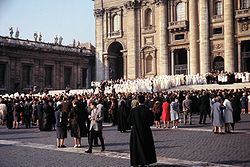 In the months prior to the second period, Pope Paul VI worked to correct some of the problems of organization and procedure that had been discovered during the first period. This included inviting additional lay Catholic and non-Catholic observers, reducing the number of proposed schemata to seventeen (which were made more general, in keeping with the pastoral nature of the council) and later eliminating the requirement of secrecy surrounding general sessions.
Pope Paul's opening address on 29 September 1963 stressed the pastoral nature of the council, and set out four purposes for it:
During this period, the bishops approved the constitution on the liturgy (Sacrosanctum Concilium
) and the decree on the media of social communication (Inter Mirifica
). Work went forward with the schemata on the Church, bishops and dioceses, and ecumenism. On 8 November 1963, Josef Frings criticized the Holy Office
, and drew an articulate and impassioned defense by its Secretary, Alfredo Ottaviani. This exchange is often considered the most dramatic of the council. (Cardinal Frings's theological advisor was the young Joseph Ratzinger, now Pope Benedict XVI
, who would later, as Cardinal, head the same department of the Holy See.) The second period ended on 4 December.
During this period, which began on 14 September 1964, the Council Fathers worked through a large volume of proposals. Schemata on ecumenism (Unitatis Redintegratio
), the official view on Protestant and Eastern Orthodox "separated brethren", the Eastern Rite churches (Orientalium Ecclesiarum
), and the Dogmatic Constitution of the Church (Lumen Gentium
) were approved and promulgated by the Pope.
Schemata on the life and ministry of priests and the missionary activity of the Church were rejected and sent back to commissions for complete rewriting. Work continued on the remaining schemata, in particular those on the Church in the modern world and religious freedom. There was controversy over revisions of the decree on religious freedom and the failure to vote on it during the third period, but Pope Paul promised that this schema would be the first to be reviewed in the next period.
Pope Paul closed the third period on November 21 by announcing a change in the Eucharistic fast and formally reaffirming Mary
as "Mother of the Church
".
Pope Paul VI opened the last period of the Council on 14 September 1965 with the establishment of a Synod of Bishops. This more permanent structure was intended to preserve close cooperation of the bishops with the Pope after the council.
The first business of the fourth period was the consideration of the decree on religious freedom, Dignitatis Humanae
, one of the more controversial of the conciliar documents. The vote was 1,997 for to 224 against, a margin that widened even farther by the time the bishop's final signing of the decree. The principal work of the rest of the period was work on three documents, all of which were approved by the council fathers. The lengthened and revised pastoral constitution on the Church in the modern world, Gaudium et Spes
, was followed by decrees on missionary activity, Ad Gentes
and the ministry and life of priests, Presbyterorum Ordinis
.
The council also gave final approval to other documents that had been considered in earlier sessions. This included decrees on the pastoral office of bishops (Christus Dominus
), the life of persons in religious orders (expanded and modified from earlier sessions, finally titled Perfectæ Caritatis
), education for the priesthood (Optatam Totius
), Christian education (Gravissimum Educationis
), and the role of the laity (Apostolicam Actuositatem
).
One of the more controversial documents
The Second Vatican Council (also known as Vatican II) addressed relations between the Roman Catholic Church and the modern world. It was the twenty-first Ecumenical Council
of the Catholic Church and the second to be held at St. Peter's Basilica in the Vatican
. It opened under Pope John XXIII
on 11 October 1962 and closed under Pope Paul VI
on 8 December 1965. Of those who took part in the council's opening session, four have become pontiffs
to date: Cardinal Giovanni Battista Montini, who on succeeding Pope John XXIII took the name of Paul VI
; Bishop Albino Luciani, the future Pope John Paul I
; Bishop Karol Wojtyła, who became Pope John Paul II
; and Father Joseph Ratzinger, present as a theological consultant, who became Pope Benedict XVI
.
and biblical literalism
that the reaction to Catholic modernism
had enforced since the First Vatican Council
. This shift could be seen in theologians such as Karl Rahner
, S.J.
, Michael Herbert, and John Courtney Murray, SJ
who looked to integrate modern human experience with church principles based on Jesus Christ, as well as others such as Yves Congar
, Joseph Ratzinger
and Henri de Lubac
who looked to an accurate understanding of scripture and the early Church Fathers
as a source of renewal (or ressourcement
).
At the same time the world's bishops faced tremendous challenges driven by political, social, economic, and technological change. Some of these bishops sought new ways of addressing those challenges. The First Vatican Council
had been held nearly a century before but had been cut short when the Italian Army
entered the city of Rome
at the end of Italian unification
. As a result, only deliberations on the role of the Papacy were completed, with examination of pastoral issues concerning the direction of the Church left unaddressed.
Pope John XXIII
, however, gave notice of his intention to convene the Council on 25 January 1959, less than three months after his election in October 1958. This sudden announcement, which caught the Curia by surprise, caused little initial official comment from Church insiders. Reaction to the announcement was widespread and largely positive from both religious and secular leaders outside the Catholic Church, and the council was formally summoned by the apostolic constitution
Humanae Salutis on 25 December 1961.
In various discussions before the Council actually convened, Pope John often said that it was time to open the windows of the Church to let in some fresh air. He invited other Christians outside of the Catholic Church to send observers to the Council. Acceptances came from both the Protestant
denominations and Eastern Orthodox churches.
, produced 987 proposed constituting sessions, making it the largest gathering in any council in church history. (This compares to Vatican I, where 737 attended, mostly from Europe.) Attendance varied in later sessions from 2,100 to over 2,300. In addition, a varying number of periti were available for theological consultation — a group that turned out to have a major influence as the council went forward. Seventeen Orthodox Churches and Protestant denominations sent observers. More than three dozen representatives of other Christian communities were present at the opening session, and the number grew to nearly 100 by the end of the 4th Council Period.
before the Council Fathers.
13 October 1962 marked the initial working session of the Council. That day's agenda included the election for members of the ten conciliar commissions. Each would have sixteen elected and eight appointed members, and were expected to do most of the work of the Council. It had been expected that the members of the preparatory commissions, where the Curia was heavily represented, would be confirmed as the majorities on the conciliar commissions. Senior French Cardinal Achille Liénart
addressed the Council, saying that the bishops could not intelligently vote for strangers. He asked that the vote be postponed to give all the bishops a chance to draw up their own lists. German Cardinal Josef Frings seconded that proposal, and the vote was postponed. The very first meeting of the Council adjourned after only fifteen minutes.
of the Netherlands
and Leo Suenens of Belgium
.
on 3 June 1963, since an ecumenical council is automatically dissolved upon the death of the Pope who convened it. Pope Paul VI
was elected on 21 June 1963 and immediately announced that the Council would continue.
In the months prior to the second period, Pope Paul VI worked to correct some of the problems of organization and procedure that had been discovered during the first period. This included inviting additional lay Catholic and non-Catholic observers, reducing the number of proposed schemata to seventeen (which were made more general, in keeping with the pastoral nature of the council) and later eliminating the requirement of secrecy surrounding general sessions.
Pope Paul's opening address on 29 September 1963 stressed the pastoral nature of the council, and set out four purposes for it:
During this period, the bishops approved the constitution on the liturgy (Sacrosanctum Concilium
) and the decree on the media of social communication (Inter Mirifica
). Work went forward with the schemata on the Church, bishops and dioceses, and ecumenism. On 8 November 1963, Josef Frings criticized the Holy Office
, and drew an articulate and impassioned defense by its Secretary, Alfredo Ottaviani. This exchange is often considered the most dramatic of the council. (Cardinal Frings's theological advisor was the young Joseph Ratzinger, now Pope Benedict XVI
, who would later, as Cardinal, head the same department of the Holy See.) The second period ended on 4 December.
During this period, which began on 14 September 1964, the Council Fathers worked through a large volume of proposals. Schemata on ecumenism (Unitatis Redintegratio
), the official view on Protestant and Eastern Orthodox "separated brethren", the Eastern Rite churches (Orientalium Ecclesiarum
), and the Dogmatic Constitution of the Church (Lumen Gentium
) were approved and promulgated by the Pope.
Schemata on the life and ministry of priests and the missionary activity of the Church were rejected and sent back to commissions for complete rewriting. Work continued on the remaining schemata, in particular those on the Church in the modern world and religious freedom. There was controversy over revisions of the decree on religious freedom and the failure to vote on it during the third period, but Pope Paul promised that this schema would be the first to be reviewed in the next period.
Pope Paul closed the third period on November 21 by announcing a change in the Eucharistic fast and formally reaffirming Mary
as "Mother of the Church
".
Pope Paul VI opened the last period of the Council on 14 September 1965 with the establishment of a Synod of Bishops. This more permanent structure was intended to preserve close cooperation of the bishops with the Pope after the council.
The first business of the fourth period was the consideration of the decree on religious freedom, Dignitatis Humanae
, one of the more controversial of the conciliar documents. The vote was 1,997 for to 224 against, a margin that widened even farther by the time the bishop's final signing of the decree. The principal work of the rest of the period was work on three documents, all of which were approved by the council fathers. The lengthened and revised pastoral constitution on the Church in the modern world, Gaudium et Spes
, was followed by decrees on missionary activity, Ad Gentes
and the ministry and life of priests, Presbyterorum Ordinis
.
The council also gave final approval to other documents that had been considered in earlier sessions. This included decrees on the pastoral office of bishops (Christus Dominus
), the life of persons in religious orders (expanded and modified from earlier sessions, finally titled Perfectæ Caritatis
), education for the priesthood (Optatam Totius
), Christian education (Gravissimum Educationis
), and the role of the laity (Apostolicam Actuositatem
).
One of the more controversial documents
The Second Vatican Council (also known as Vatican II) addressed relations between the Roman Catholic Church and the modern world. It was the twenty-first Ecumenical Council
of the Catholic Church and the second to be held at St. Peter's Basilica in the Vatican
. It opened under Pope John XXIII
on 11 October 1962 and closed under Pope Paul VI
on 8 December 1965. Of those who took part in the council's opening session, four have become pontiffs
to date: Cardinal Giovanni Battista Montini, who on succeeding Pope John XXIII took the name of Paul VI
; Bishop Albino Luciani, the future Pope John Paul I
; Bishop Karol Wojtyła, who became Pope John Paul II
; and Father Joseph Ratzinger, present as a theological consultant, who became Pope Benedict XVI
.
and biblical literalism
that the reaction to Catholic modernism
had enforced since the First Vatican Council
. This shift could be seen in theologians such as Karl Rahner
, S.J.
, Michael Herbert, and John Courtney Murray, SJ
who looked to integrate modern human experience with church principles based on Jesus Christ, as well as others such as Yves Congar
, Joseph Ratzinger
and Henri de Lubac
who looked to an accurate understanding of scripture and the early Church Fathers
as a source of renewal (or ressourcement
).
At the same time the world's bishops faced tremendous challenges driven by political, social, economic, and technological change. Some of these bishops sought new ways of addressing those challenges. The First Vatican Council
had been held nearly a century before but had been cut short when the Italian Army
entered the city of Rome
at the end of Italian unification
. As a result, only deliberations on the role of the Papacy were completed, with examination of pastoral issues concerning the direction of the Church left unaddressed.
Pope John XXIII
, however, gave notice of his intention to convene the Council on 25 January 1959, less than three months after his election in October 1958. This sudden announcement, which caught the Curia by surprise, caused little initial official comment from Church insiders. Reaction to the announcement was widespread and largely positive from both religious and secular leaders outside the Catholic Church, and the council was formally summoned by the apostolic constitution
Humanae Salutis on 25 December 1961.
In various discussions before the Council actually convened, Pope John often said that it was time to open the windows of the Church to let in some fresh air. He invited other Christians outside of the Catholic Church to send observers to the Council. Acceptances came from both the Protestant
denominations and Eastern Orthodox churches.
, produced 987 proposed constituting sessions, making it the largest gathering in any council in church history. (This compares to Vatican I, where 737 attended, mostly from Europe.) Attendance varied in later sessions from 2,100 to over 2,300. In addition, a varying number of periti were available for theological consultation — a group that turned out to have a major influence as the council went forward. Seventeen Orthodox Churches and Protestant denominations sent observers. More than three dozen representatives of other Christian communities were present at the opening session, and the number grew to nearly 100 by the end of the 4th Council Period.
before the Council Fathers.
13 October 1962 marked the initial working session of the Council. That day's agenda included the election for members of the ten conciliar commissions. Each would have sixteen elected and eight appointed members, and were expected to do most of the work of the Council. It had been expected that the members of the preparatory commissions, where the Curia was heavily represented, would be confirmed as the majorities on the conciliar commissions. Senior French Cardinal Achille Liénart
addressed the Council, saying that the bishops could not intelligently vote for strangers. He asked that the vote be postponed to give all the bishops a chance to draw up their own lists. German Cardinal Josef Frings seconded that proposal, and the vote was postponed. The very first meeting of the Council adjourned after only fifteen minutes.
of the Netherlands
and Leo Suenens of Belgium
.
on 3 June 1963, since an ecumenical council is automatically dissolved upon the death of the Pope who convened it. Pope Paul VI
was elected on 21 June 1963 and immediately announced that the Council would continue.
In the months prior to the second period, Pope Paul VI worked to correct some of the problems of organization and procedure that had been discovered during the first period. This included inviting additional lay Catholic and non-Catholic observers, reducing the number of proposed schemata to seventeen (which were made more general, in keeping with the pastoral nature of the council) and later eliminating the requirement of secrecy surrounding general sessions.
Pope Paul's opening address on 29 September 1963 stressed the pastoral nature of the council, and set out four purposes for it:
During this period, the bishops approved the constitution on the liturgy (Sacrosanctum Concilium
) and the decree on the media of social communication (Inter Mirifica
). Work went forward with the schemata on the Church, bishops and dioceses, and ecumenism. On 8 November 1963, Josef Frings criticized the Holy Office
, and drew an articulate and impassioned defense by its Secretary, Alfredo Ottaviani. This exchange is often considered the most dramatic of the council. (Cardinal Frings's theological advisor was the young Joseph Ratzinger, now Pope Benedict XVI
, who would later, as Cardinal, head the same department of the Holy See.) The second period ended on 4 December.
During this period, which began on 14 September 1964, the Council Fathers worked through a large volume of proposals. Schemata on ecumenism (Unitatis Redintegratio
), the official view on Protestant and Eastern Orthodox "separated brethren", the Eastern Rite churches (Orientalium Ecclesiarum
), and the Dogmatic Constitution of the Church (Lumen Gentium
) were approved and promulgated by the Pope.
Schemata on the life and ministry of priests and the missionary activity of the Church were rejected and sent back to commissions for complete rewriting. Work continued on the remaining schemata, in particular those on the Church in the modern world and religious freedom. There was controversy over revisions of the decree on religious freedom and the failure to vote on it during the third period, but Pope Paul promised that this schema would be the first to be reviewed in the next period.
Pope Paul closed the third period on November 21 by announcing a change in the Eucharistic fast and formally reaffirming Mary
as "Mother of the Church
".
Pope Paul VI opened the last period of the Council on 14 September 1965 with the establishment of a Synod of Bishops. This more permanent structure was intended to preserve close cooperation of the bishops with the Pope after the council.
The first business of the fourth period was the consideration of the decree on religious freedom, Dignitatis Humanae
, one of the more controversial of the conciliar documents. The vote was 1,997 for to 224 against, a margin that widened even farther by the time the bishop's final signing of the decree. The principal work of the rest of the period was work on three documents, all of which were approved by the council fathers. The lengthened and revised pastoral constitution on the Church in the modern world, Gaudium et Spes
, was followed by decrees on missionary activity, Ad Gentes
and the ministry and life of priests, Presbyterorum Ordinis
.
The council also gave final approval to other documents that had been considered in earlier sessions. This included decrees on the pastoral office of bishops (Christus Dominus
), the life of persons in religious orders (expanded and modified from earlier sessions, finally titled Perfectæ Caritatis
), education for the priesthood (Optatam Totius
), Christian education (Gravissimum Educationis
), and the role of the laity (Apostolicam Actuositatem
).
One of the more controversial documents was Nostra Aetate
, which stated that the Jews of the time of Christ, taken indiscriminately, and all Jews today are no more responsible for the death of Christ than Christians.
A major event of the final days of the council was the act of Pope Paul and Orthodox Patriarch Athenagoras of a joint expression of regret
for many of the past actions that had led up to the Great Schism
between the western and eastern churches.
"The old story of the Samaritan
has been the model of the spirituality of the council" (Paul VI., address, Dec. 7): On 8 December, the Council was formally closed, with the bishops professing their obedience to the Council's decrees. To help carry forward the work of the Council, Pope Paul:
.
In its first chapter, titled "The Mystery of the Church," is the famous statement that "the sole Church of Christ which in the Creed we profess to be one, holy, catholic and apostolic, which our Saviour, after His Resurrection, commissioned Peter to shepherd, and him and the other apostles to extend and direct with authority, which He erected for all ages as 'the pillar and mainstay of the truth.' This Church, constituted and organized as a society in the present world, subsists in the Catholic Church, which is governed by the successor of Peter and by the bishops in communion with him" (Lumen Gentium, 8). The document immediately adds: "Nevertheless, many elements of sanctification and of truth are found outside its visible confines."
from 1967 onwards.
Neither the Second Vatican Council nor the subsequent revision
of the Roman Missal
abolished Latin as the liturgical language of the Roman Rite: the official text of the Roman Missal, on which translations into vernacular languages are to be based, continues to be in Latin, and Latin can still be used in the celebration.
s" of the faithful, and both clergy and laity were to continue to make Bible study a central part of their lives. This affirmed the importance of Sacred Scripture as attested by Providentissimus Deus
by Pope Leo XIII
and the writings of the Saints, Doctors, and Popes throughout Church history but also approved historically conditioned interpretation of Scripture as presented in Pius XII's 1943 encyclical Divino Afflante Spiritu
.
The spirit of Vatican II is invoked for a great variety of ideas and attitudes. Bishop John Tong Hon
of Hong Kong
used it with regard merely to an openness to dialogue with others, saying: "We are guided by the spirit of Vatican II: only dialogue and negotiation can solve conflicts."
In contrast, Michael Novak
described it as a spirit that "sometimes soared far beyond the actual, hard-won documents and decisions of Vatican II. ... It was as though the world (or at least the history of the Church) were now to be divided into only two periods, pre-Vatican II and post-Vatican II. Everything 'pre' was then pretty much dismissed, so far as its authority mattered. For the most extreme, to be a Catholic now meant to believe more or less anything one wished to believe, or at least in the sense in which one personally interpreted it. One could be a Catholic 'in spirit'. One could take Catholic to mean the 'culture' in which one was born, rather than to mean a creed making objective and rigorous demands. One could imagine Rome as a distant and irrelevant anachronism, embarrassment, even adversary. Rome as 'them'." Such views of the Second Vatican Council were condemned by the Church's hierarchy, and the works of theologians who were active in the Council or who closely adhered to the Council's aspect of reform (such as Hans Küng
) have often been criticized by the Church for espousing a belief system that is radical and misguided.
To mark the fiftieth anniversary of the beginning of Vatican II, in October of 2011, the Vatican's website and many other Catholic news organizations announced that the Holy Father, His Holiness, Pope Benedict XVI, had made the period from October 2012 to the end of November 2013 (the Solemnity of Christ the King) a "Year Of Faith" in a solemn declaration, and ordered all parishes and religious institutions to find some manner during that Year of celebrating and reaffirming the Creed (there are now two main Creeds- the shorter Apostle's Creed and the lengthier Niceno-Constantopolitan, or Nicene Creed
- that are recited at each Mass, and both are listed and examined in the landmark 1994 Catechism of the Catholic Church
; they serve as fundamental declarations that a catechumen or a baptized Catholic identifies with the Church).
Commentary
Ecumenical council
An ecumenical council is a conference of ecclesiastical dignitaries and theological experts convened to discuss and settle matters of Church doctrine and practice....
of the Catholic Church and the second to be held at St. Peter's Basilica in the Vatican
Vatican City
Vatican City , or Vatican City State, in Italian officially Stato della Città del Vaticano , which translates literally as State of the City of the Vatican, is a landlocked sovereign city-state whose territory consists of a walled enclave within the city of Rome, Italy. It has an area of...
. It opened under Pope John XXIII
Pope John XXIII
-Papal election:Following the death of Pope Pius XII in 1958, Roncalli was elected Pope, to his great surprise. He had even arrived in the Vatican with a return train ticket to Venice. Many had considered Giovanni Battista Montini, Archbishop of Milan, a possible candidate, but, although archbishop...
on 11 October 1962 and closed under Pope Paul VI
Pope Paul VI
Paul VI , born Giovanni Battista Enrico Antonio Maria Montini , reigned as Pope of the Catholic Church from 21 June 1963 until his death on 6 August 1978. Succeeding Pope John XXIII, who had convened the Second Vatican Council, he decided to continue it...
on 8 December 1965. Of those who took part in the council's opening session, four have become pontiffs
Pope
The Pope is the Bishop of Rome, a position that makes him the leader of the worldwide Catholic Church . In the Catholic Church, the Pope is regarded as the successor of Saint Peter, the Apostle...
to date: Cardinal Giovanni Battista Montini, who on succeeding Pope John XXIII took the name of Paul VI
Pope Paul VI
Paul VI , born Giovanni Battista Enrico Antonio Maria Montini , reigned as Pope of the Catholic Church from 21 June 1963 until his death on 6 August 1978. Succeeding Pope John XXIII, who had convened the Second Vatican Council, he decided to continue it...
; Bishop Albino Luciani, the future Pope John Paul I
Pope John Paul I
John Paul I , born Albino Luciani, , reigned as Pope of the Catholic Church and as Sovereign of Vatican City from 26 August 1978 until his death 33 days later. His reign is among the shortest in papal history, resulting in the most recent Year of Three Popes...
; Bishop Karol Wojtyła, who became Pope John Paul II
Pope John Paul II
Blessed Pope John Paul II , born Karol Józef Wojtyła , reigned as Pope of the Catholic Church and Sovereign of Vatican City from 16 October 1978 until his death on 2 April 2005, at of age. His was the second-longest documented pontificate, which lasted ; only Pope Pius IX ...
; and Father Joseph Ratzinger, present as a theological consultant, who became Pope Benedict XVI
Pope Benedict XVI
Benedict XVI is the 265th and current Pope, by virtue of his office of Bishop of Rome, the Sovereign of the Vatican City State and the leader of the Catholic Church as well as the other 22 sui iuris Eastern Catholic Churches in full communion with the Holy See...
.
Background
Throughout the 1950s, theological and biblical studies of the Catholic Church had begun to sway away from the neo-scholasticismNeo-Scholasticism
Neo-Scholasticism is the revival and development of medieval scholastic philosophy starting from the second half of the 19th century. It has some times been called neo-Thomism partly because Thomas Aquinas in the 13th century gave to scholasticism a final form, partly because the idea gained ground...
and biblical literalism
Biblical literalism
Biblical literalism is the interpretation or translation of the explicit and primary sense of words in the Bible. A literal Biblical interpretation is associated with the fundamentalist and evangelical hermeneutical approach to Scripture, and is used almost exclusively by conservative Christians...
that the reaction to Catholic modernism
Modernism (Roman Catholicism)
Modernism refers to theological opinions expressed during the late 19th and early 20th centuries, but with influence reaching into the 21st century, which are characterized by a break with the past. Catholic modernists form an amorphous group. The term "modernist" appears in Pope Pius X's 1907...
had enforced since the First Vatican Council
First Vatican Council
The First Vatican Council was convoked by Pope Pius IX on 29 June 1868, after a period of planning and preparation that began on 6 December 1864. This twentieth ecumenical council of the Roman Catholic Church, held three centuries after the Council of Trent, opened on 8 December 1869 and adjourned...
. This shift could be seen in theologians such as Karl Rahner
Karl Rahner
Karl Rahner, SJ was a German Jesuit and theologian who, alongside Bernard Lonergan and Hans Urs von Balthasar, is considered one of the most influential Roman Catholic theologians of the 20th century...
, S.J.
Society of Jesus
The Society of Jesus is a Catholic male religious order that follows the teachings of the Catholic Church. The members are called Jesuits, and are also known colloquially as "God's Army" and as "The Company," these being references to founder Ignatius of Loyola's military background and a...
, Michael Herbert, and John Courtney Murray, SJ
John Courtney Murray
John Courtney Murray, , was an American Jesuit priest and theologian, who was especially known for his efforts to reconcile Catholicism and religious pluralism, particularly focusing on the relationship between religious freedom and the institutions of a democratically structured modern...
who looked to integrate modern human experience with church principles based on Jesus Christ, as well as others such as Yves Congar
Yves Congar
Yves Marie Joseph Congar was a French Dominican cardinal and theologian.-Early life:Born in Sedan, in northeast France, in 1904, Congar's home was occupied by the Germans for much of World War I...
, Joseph Ratzinger
Pope Benedict XVI
Benedict XVI is the 265th and current Pope, by virtue of his office of Bishop of Rome, the Sovereign of the Vatican City State and the leader of the Catholic Church as well as the other 22 sui iuris Eastern Catholic Churches in full communion with the Holy See...
and Henri de Lubac
Henri de Lubac
Henri-Marie de Lubac, SJ was a French Jesuit priest who became a Cardinal of the Catholic Church, and is considered to be one of the most influential theologians of the 20th century...
who looked to an accurate understanding of scripture and the early Church Fathers
Church Fathers
The Church Fathers, Early Church Fathers, Christian Fathers, or Fathers of the Church were early and influential theologians, eminent Christian teachers and great bishops. Their scholarly works were used as a precedent for centuries to come...
as a source of renewal (or ressourcement
Nouvelle Théologie
Nouvelle Théologie is the name commonly used to refer to a school of thought in Catholic theology that arose in the mid-20th century, most notably among certain circles of French and German theologians...
).
At the same time the world's bishops faced tremendous challenges driven by political, social, economic, and technological change. Some of these bishops sought new ways of addressing those challenges. The First Vatican Council
First Vatican Council
The First Vatican Council was convoked by Pope Pius IX on 29 June 1868, after a period of planning and preparation that began on 6 December 1864. This twentieth ecumenical council of the Roman Catholic Church, held three centuries after the Council of Trent, opened on 8 December 1869 and adjourned...
had been held nearly a century before but had been cut short when the Italian Army
Italian Army
The Italian Army is the ground defence force of the Italian Armed Forces. It is all-volunteer force of active-duty personnel, numbering 108,355 in 2010. Its best-known combat vehicles are the Dardo infantry fighting vehicle, the Centauro tank destroyer and the Ariete tank, and among its aircraft...
entered the city of Rome
Rome
Rome is the capital of Italy and the country's largest and most populated city and comune, with over 2.7 million residents in . The city is located in the central-western portion of the Italian Peninsula, on the Tiber River within the Lazio region of Italy.Rome's history spans two and a half...
at the end of Italian unification
Italian unification
Italian unification was the political and social movement that agglomerated different states of the Italian peninsula into the single state of Italy in the 19th century...
. As a result, only deliberations on the role of the Papacy were completed, with examination of pastoral issues concerning the direction of the Church left unaddressed.
Pope John XXIII
Pope John XXIII
-Papal election:Following the death of Pope Pius XII in 1958, Roncalli was elected Pope, to his great surprise. He had even arrived in the Vatican with a return train ticket to Venice. Many had considered Giovanni Battista Montini, Archbishop of Milan, a possible candidate, but, although archbishop...
, however, gave notice of his intention to convene the Council on 25 January 1959, less than three months after his election in October 1958. This sudden announcement, which caught the Curia by surprise, caused little initial official comment from Church insiders. Reaction to the announcement was widespread and largely positive from both religious and secular leaders outside the Catholic Church, and the council was formally summoned by the apostolic constitution
Apostolic constitution
An apostolic constitution is the highest level of decree issued by the Pope. The use of the term constitution comes from Latin constitutio, which referred to any important law issued by the Roman emperor, and is retained in church documents because of the inheritance that the canon law of the...
Humanae Salutis on 25 December 1961.
In various discussions before the Council actually convened, Pope John often said that it was time to open the windows of the Church to let in some fresh air. He invited other Christians outside of the Catholic Church to send observers to the Council. Acceptances came from both the Protestant
Protestantism
Protestantism is one of the three major groupings within Christianity. It is a movement that began in Germany in the early 16th century as a reaction against medieval Roman Catholic doctrines and practices, especially in regards to salvation, justification, and ecclesiology.The doctrines of the...
denominations and Eastern Orthodox churches.
Preparation
Preparations for the Council took more than two years, and included work from 10 specialised commissions, people for mass media and Christian Unity, and a Central Commission for overall coordination. These groups, composed mostly of members of the Roman CuriaRoman Curia
The Roman Curia is the administrative apparatus of the Holy See and the central governing body of the entire Catholic Church, together with the Pope...
, produced 987 proposed constituting sessions, making it the largest gathering in any council in church history. (This compares to Vatican I, where 737 attended, mostly from Europe.) Attendance varied in later sessions from 2,100 to over 2,300. In addition, a varying number of periti were available for theological consultation — a group that turned out to have a major influence as the council went forward. Seventeen Orthodox Churches and Protestant denominations sent observers. More than three dozen representatives of other Christian communities were present at the opening session, and the number grew to nearly 100 by the end of the 4th Council Period.
Opening
Pope John opened the Council on 11 October 1962 in a public session and read the declaration Gaudet Mater EcclesiaGaudet Mater Ecclesia
Gaudet Mater Ecclesia, Latin for , is the opening declaration of the Second Vatican Council.Pope John opened the Council on October 11, 1962 in a public session before the Council Fathers as well as representatives of 86 governments and international bodies...
before the Council Fathers.
13 October 1962 marked the initial working session of the Council. That day's agenda included the election for members of the ten conciliar commissions. Each would have sixteen elected and eight appointed members, and were expected to do most of the work of the Council. It had been expected that the members of the preparatory commissions, where the Curia was heavily represented, would be confirmed as the majorities on the conciliar commissions. Senior French Cardinal Achille Liénart
Achille Liénart
Achille Liénart was a French Cardinal of the Roman Catholic Church. He served as Bishop of Lille from 1928 to 1968, and was elevated to the cardinalate in 1930.-Biography:...
addressed the Council, saying that the bishops could not intelligently vote for strangers. He asked that the vote be postponed to give all the bishops a chance to draw up their own lists. German Cardinal Josef Frings seconded that proposal, and the vote was postponed. The very first meeting of the Council adjourned after only fifteen minutes.
Commissions
The bishops met to discuss the membership of the commissions, along with other issues, both in national and regional groups, as well as in gatherings that are more informal. The schemata from the preparatory sessions were thrown out, and new ones were created. When the council met on 16 October 1962, a new slate of commission members was presented and approved by the Council. One important change was a significant increase in membership from Central and Northern Europe, instead of countries such as Spain or Italy. More than 100 bishops from Africa, Asia, and Latin America were Dutch or Belgian and tended to associate with the bishops from those countries. These groups were led by Cardinals Bernardus Johannes AlfrinkBernardus Johannes Alfrink
Bernardus Johannes Alfrink was a Dutch Cardinal of the Roman Catholic Church. He served as Archbishop of Utrecht from 1955 to 1975, and was elevated to the cardinalate in 1960.-Biography:...
of the Netherlands
Netherlands
The Netherlands is a constituent country of the Kingdom of the Netherlands, located mainly in North-West Europe and with several islands in the Caribbean. Mainland Netherlands borders the North Sea to the north and west, Belgium to the south, and Germany to the east, and shares maritime borders...
and Leo Suenens of Belgium
Belgium
Belgium , officially the Kingdom of Belgium, is a federal state in Western Europe. It is a founding member of the European Union and hosts the EU's headquarters, and those of several other major international organisations such as NATO.Belgium is also a member of, or affiliated to, many...
.
Issues
After adjournment on 8 December, work began on preparations for the sessions scheduled for 1963. These preparations, however, were halted upon the death of Pope John XXIIIPope John XXIII
-Papal election:Following the death of Pope Pius XII in 1958, Roncalli was elected Pope, to his great surprise. He had even arrived in the Vatican with a return train ticket to Venice. Many had considered Giovanni Battista Montini, Archbishop of Milan, a possible candidate, but, although archbishop...
on 3 June 1963, since an ecumenical council is automatically dissolved upon the death of the Pope who convened it. Pope Paul VI
Pope Paul VI
Paul VI , born Giovanni Battista Enrico Antonio Maria Montini , reigned as Pope of the Catholic Church from 21 June 1963 until his death on 6 August 1978. Succeeding Pope John XXIII, who had convened the Second Vatican Council, he decided to continue it...
was elected on 21 June 1963 and immediately announced that the Council would continue.
Second period: 1963
Pope Paul's opening address on 29 September 1963 stressed the pastoral nature of the council, and set out four purposes for it:
- to more fully define the nature of the church and the role of the bishop;
- to renew the church;
- to restore unity among all Christians, including seeking pardon for Catholic contributions to separation;
- and to start a dialogue with the contemporary world.
During this period, the bishops approved the constitution on the liturgy (Sacrosanctum Concilium
Sacrosanctum Concilium
Sacrosanctum Concilium, the Constitution on the Sacred Liturgy, is one of the constitutions of the Second Vatican Council. It was approved by the assembled bishops by a vote of 2,147 to 4 and promulgated by Pope Paul VI on December 4, 1963...
) and the decree on the media of social communication (Inter Mirifica
Inter Mirifica
Inter Mirifica is the Second Vatican Council's Decree on the Media of Social Communications. It was approved by a vote of 1,960 to 164 of the bishops assembled, and promulgated on December 4, 1963 by Pope Paul VI...
). Work went forward with the schemata on the Church, bishops and dioceses, and ecumenism. On 8 November 1963, Josef Frings criticized the Holy Office
Congregation for the Doctrine of the Faith
The Congregation for the Doctrine of the Faith , previously known as the Supreme Sacred Congregation of the Roman and Universal Inquisition , and after 1904 called the Supreme...
, and drew an articulate and impassioned defense by its Secretary, Alfredo Ottaviani. This exchange is often considered the most dramatic of the council. (Cardinal Frings's theological advisor was the young Joseph Ratzinger, now Pope Benedict XVI
Pope Benedict XVI
Benedict XVI is the 265th and current Pope, by virtue of his office of Bishop of Rome, the Sovereign of the Vatican City State and the leader of the Catholic Church as well as the other 22 sui iuris Eastern Catholic Churches in full communion with the Holy See...
, who would later, as Cardinal, head the same department of the Holy See.) The second period ended on 4 December.
Third period: 1964
In the time between the second and third periods, the proposed schemata were further revised on the basis of comments from the council fathers. A number of topics were reduced to statements of fundamental propositions that could gain approval during the third period, with postconciliar commissions handling implementation of these measures. Eight religious and seven lay women observers were invited to the sessions of the third period, along with additional male lay observers.During this period, which began on 14 September 1964, the Council Fathers worked through a large volume of proposals. Schemata on ecumenism (Unitatis Redintegratio
Unitatis Redintegratio
Unitatis Redintegratio is the Second Vatican Council's Decree on Ecumenism. It was passed by a vote of 2,137 to 11 of the bishops assembled and was promulgated by Pope Paul VI on November 21, 1964...
), the official view on Protestant and Eastern Orthodox "separated brethren", the Eastern Rite churches (Orientalium Ecclesiarum
Orientalium Ecclesiarum
Orientalium Ecclesiarum is the Decree on the Eastern Catholic Churches from the Second Vatican Council. One of the shorter such documents, it was passed by the assembled bishops by a vote of 2,110 to 39 and promulgated by Pope Paul VI on November 21, 1964...
), and the Dogmatic Constitution of the Church (Lumen Gentium
Lumen Gentium
Lumen Gentium, the Dogmatic Constitution on the Church, is one of the principal documents of the Second Vatican Council. This dogmatic constitution was promulgated by Pope Paul VI on November 21, 1964, following approval by the assembled bishops by a vote of 2,151 to 5...
) were approved and promulgated by the Pope.
Schemata on the life and ministry of priests and the missionary activity of the Church were rejected and sent back to commissions for complete rewriting. Work continued on the remaining schemata, in particular those on the Church in the modern world and religious freedom. There was controversy over revisions of the decree on religious freedom and the failure to vote on it during the third period, but Pope Paul promised that this schema would be the first to be reviewed in the next period.
Pope Paul closed the third period on November 21 by announcing a change in the Eucharistic fast and formally reaffirming Mary
Mary (mother of Jesus)
Mary , commonly referred to as "Saint Mary", "Mother Mary", the "Virgin Mary", the "Blessed Virgin Mary", or "Mary, Mother of God", was a Jewish woman of Nazareth in Galilee...
as "Mother of the Church
Mother of the Church
Mother of the Church is a title, officially given to Mary during the Second Vatican Council by Pope Paul VI. The title was first used by Saint Ambrose of Milan and rediscovered by Hugo Rahner, the brother of Karl Rahner.- Ambrose and Hugo Rahner :...
".
Fourth period: 1965
Eleven schemata remained unfinished at the end of the third period, and commissions worked to give them their final form. Schema 13, on the Church in the modern world, was revised by a commission that worked with the assistance of laymen.Pope Paul VI opened the last period of the Council on 14 September 1965 with the establishment of a Synod of Bishops. This more permanent structure was intended to preserve close cooperation of the bishops with the Pope after the council.
The first business of the fourth period was the consideration of the decree on religious freedom, Dignitatis Humanae
Dignitatis Humanae
Dignitatis Humanae is the Second Vatican Council's Declaration on Religious Freedom. In the context of the Council's stated intention “to develop the doctrine of recent popes on the inviolable rights of the human person and the constitutional order of society”, Dignitatis Humanae spells out the...
, one of the more controversial of the conciliar documents. The vote was 1,997 for to 224 against, a margin that widened even farther by the time the bishop's final signing of the decree. The principal work of the rest of the period was work on three documents, all of which were approved by the council fathers. The lengthened and revised pastoral constitution on the Church in the modern world, Gaudium et Spes
Gaudium et Spes
Gaudium et Spes , the Pastoral Constitution on the Church in the Modern World, was one of the four Apostolic Constitutions resulting from the Second Vatican Council...
, was followed by decrees on missionary activity, Ad Gentes
Ad Gentes
Ad Gentes is the Second Vatican Council's Decree on the Missionary Activity of the Church.-Conciliar vote:Passed by assembled bishops by a vote of 2,394 to 5, it was promulgated by Pope Paul VI on December 7, 1965...
and the ministry and life of priests, Presbyterorum Ordinis
Presbyterorum Ordinis
Presbyterorum Ordinis, the Decree on the Ministry and Life of Priests, is one of the documents produced by the Second Vatican Council. Promulgated by Pope Paul VI on December 7, 1965, it had been earlier approved by the assembled bishops by a vote of 2,390 to 4...
.
The council also gave final approval to other documents that had been considered in earlier sessions. This included decrees on the pastoral office of bishops (Christus Dominus
Christus Dominus
Christus Dominus is the Second Vatican Council's Decree on the Pastoral Office of Bishops. It was approved by a vote of 2,319 to 2 of the assembled bishops and was promulgated by Pope Paul VI on October 28, 1965. The title in Latin means "Christ the Lord," and is from the first line of the...
), the life of persons in religious orders (expanded and modified from earlier sessions, finally titled Perfectæ Caritatis
Perfectae Caritatis
Perfectæ Caritatis, the Decree on the Adaptation and Renewal of Religious Life, is the document issued by the Second Vatican Council which deals specifically with institutes of consecrated life in the Roman Catholic Church...
), education for the priesthood (Optatam Totius
Optatam Totius
Optatam Totius, the Decree on Priestly Training, was a document produced by the Second Vatican Council. Approved by a vote of 2,318 to 3 of the bishops assembled at the council, the decree was promulgated by Pope Paul VI on October 28, 1965...
), Christian education (Gravissimum Educationis
Gravissimum Educationis
Gravissimum Educationis is the Second Vatican Council's Declaration on Christian Education. It was promulgated on October 28, 1965 by Pope Paul VI, following approval by the assembled bishops by a vote of 2,290 to 35....
), and the role of the laity (Apostolicam Actuositatem
Apostolicam Actuositatem
Apostolicam Actuositatem is the Second Vatican Council's Decree on the Apostolate of the Laity. It was approved by a vote of 2,340 to 2 of bishops assembled at the Council, and promulgated by Pope Paul VI on November 18, 1965...
).
One of the more controversial documents
The Second Vatican Council (also known as Vatican II) addressed relations between the Roman Catholic Church and the modern world. It was the twenty-first Ecumenical Council
Ecumenical council
An ecumenical council is a conference of ecclesiastical dignitaries and theological experts convened to discuss and settle matters of Church doctrine and practice....
of the Catholic Church and the second to be held at St. Peter's Basilica in the Vatican
Vatican City
Vatican City , or Vatican City State, in Italian officially Stato della Città del Vaticano , which translates literally as State of the City of the Vatican, is a landlocked sovereign city-state whose territory consists of a walled enclave within the city of Rome, Italy. It has an area of...
. It opened under Pope John XXIII
Pope John XXIII
-Papal election:Following the death of Pope Pius XII in 1958, Roncalli was elected Pope, to his great surprise. He had even arrived in the Vatican with a return train ticket to Venice. Many had considered Giovanni Battista Montini, Archbishop of Milan, a possible candidate, but, although archbishop...
on 11 October 1962 and closed under Pope Paul VI
Pope Paul VI
Paul VI , born Giovanni Battista Enrico Antonio Maria Montini , reigned as Pope of the Catholic Church from 21 June 1963 until his death on 6 August 1978. Succeeding Pope John XXIII, who had convened the Second Vatican Council, he decided to continue it...
on 8 December 1965. Of those who took part in the council's opening session, four have become pontiffs
Pope
The Pope is the Bishop of Rome, a position that makes him the leader of the worldwide Catholic Church . In the Catholic Church, the Pope is regarded as the successor of Saint Peter, the Apostle...
to date: Cardinal Giovanni Battista Montini, who on succeeding Pope John XXIII took the name of Paul VI
Pope Paul VI
Paul VI , born Giovanni Battista Enrico Antonio Maria Montini , reigned as Pope of the Catholic Church from 21 June 1963 until his death on 6 August 1978. Succeeding Pope John XXIII, who had convened the Second Vatican Council, he decided to continue it...
; Bishop Albino Luciani, the future Pope John Paul I
Pope John Paul I
John Paul I , born Albino Luciani, , reigned as Pope of the Catholic Church and as Sovereign of Vatican City from 26 August 1978 until his death 33 days later. His reign is among the shortest in papal history, resulting in the most recent Year of Three Popes...
; Bishop Karol Wojtyła, who became Pope John Paul II
Pope John Paul II
Blessed Pope John Paul II , born Karol Józef Wojtyła , reigned as Pope of the Catholic Church and Sovereign of Vatican City from 16 October 1978 until his death on 2 April 2005, at of age. His was the second-longest documented pontificate, which lasted ; only Pope Pius IX ...
; and Father Joseph Ratzinger, present as a theological consultant, who became Pope Benedict XVI
Pope Benedict XVI
Benedict XVI is the 265th and current Pope, by virtue of his office of Bishop of Rome, the Sovereign of the Vatican City State and the leader of the Catholic Church as well as the other 22 sui iuris Eastern Catholic Churches in full communion with the Holy See...
.
Background
Throughout the 1950s, theological and biblical studies of the Catholic Church had begun to sway away from the neo-scholasticismNeo-Scholasticism
Neo-Scholasticism is the revival and development of medieval scholastic philosophy starting from the second half of the 19th century. It has some times been called neo-Thomism partly because Thomas Aquinas in the 13th century gave to scholasticism a final form, partly because the idea gained ground...
and biblical literalism
Biblical literalism
Biblical literalism is the interpretation or translation of the explicit and primary sense of words in the Bible. A literal Biblical interpretation is associated with the fundamentalist and evangelical hermeneutical approach to Scripture, and is used almost exclusively by conservative Christians...
that the reaction to Catholic modernism
Modernism (Roman Catholicism)
Modernism refers to theological opinions expressed during the late 19th and early 20th centuries, but with influence reaching into the 21st century, which are characterized by a break with the past. Catholic modernists form an amorphous group. The term "modernist" appears in Pope Pius X's 1907...
had enforced since the First Vatican Council
First Vatican Council
The First Vatican Council was convoked by Pope Pius IX on 29 June 1868, after a period of planning and preparation that began on 6 December 1864. This twentieth ecumenical council of the Roman Catholic Church, held three centuries after the Council of Trent, opened on 8 December 1869 and adjourned...
. This shift could be seen in theologians such as Karl Rahner
Karl Rahner
Karl Rahner, SJ was a German Jesuit and theologian who, alongside Bernard Lonergan and Hans Urs von Balthasar, is considered one of the most influential Roman Catholic theologians of the 20th century...
, S.J.
Society of Jesus
The Society of Jesus is a Catholic male religious order that follows the teachings of the Catholic Church. The members are called Jesuits, and are also known colloquially as "God's Army" and as "The Company," these being references to founder Ignatius of Loyola's military background and a...
, Michael Herbert, and John Courtney Murray, SJ
John Courtney Murray
John Courtney Murray, , was an American Jesuit priest and theologian, who was especially known for his efforts to reconcile Catholicism and religious pluralism, particularly focusing on the relationship between religious freedom and the institutions of a democratically structured modern...
who looked to integrate modern human experience with church principles based on Jesus Christ, as well as others such as Yves Congar
Yves Congar
Yves Marie Joseph Congar was a French Dominican cardinal and theologian.-Early life:Born in Sedan, in northeast France, in 1904, Congar's home was occupied by the Germans for much of World War I...
, Joseph Ratzinger
Pope Benedict XVI
Benedict XVI is the 265th and current Pope, by virtue of his office of Bishop of Rome, the Sovereign of the Vatican City State and the leader of the Catholic Church as well as the other 22 sui iuris Eastern Catholic Churches in full communion with the Holy See...
and Henri de Lubac
Henri de Lubac
Henri-Marie de Lubac, SJ was a French Jesuit priest who became a Cardinal of the Catholic Church, and is considered to be one of the most influential theologians of the 20th century...
who looked to an accurate understanding of scripture and the early Church Fathers
Church Fathers
The Church Fathers, Early Church Fathers, Christian Fathers, or Fathers of the Church were early and influential theologians, eminent Christian teachers and great bishops. Their scholarly works were used as a precedent for centuries to come...
as a source of renewal (or ressourcement
Nouvelle Théologie
Nouvelle Théologie is the name commonly used to refer to a school of thought in Catholic theology that arose in the mid-20th century, most notably among certain circles of French and German theologians...
).
At the same time the world's bishops faced tremendous challenges driven by political, social, economic, and technological change. Some of these bishops sought new ways of addressing those challenges. The First Vatican Council
First Vatican Council
The First Vatican Council was convoked by Pope Pius IX on 29 June 1868, after a period of planning and preparation that began on 6 December 1864. This twentieth ecumenical council of the Roman Catholic Church, held three centuries after the Council of Trent, opened on 8 December 1869 and adjourned...
had been held nearly a century before but had been cut short when the Italian Army
Italian Army
The Italian Army is the ground defence force of the Italian Armed Forces. It is all-volunteer force of active-duty personnel, numbering 108,355 in 2010. Its best-known combat vehicles are the Dardo infantry fighting vehicle, the Centauro tank destroyer and the Ariete tank, and among its aircraft...
entered the city of Rome
Rome
Rome is the capital of Italy and the country's largest and most populated city and comune, with over 2.7 million residents in . The city is located in the central-western portion of the Italian Peninsula, on the Tiber River within the Lazio region of Italy.Rome's history spans two and a half...
at the end of Italian unification
Italian unification
Italian unification was the political and social movement that agglomerated different states of the Italian peninsula into the single state of Italy in the 19th century...
. As a result, only deliberations on the role of the Papacy were completed, with examination of pastoral issues concerning the direction of the Church left unaddressed.
Pope John XXIII
Pope John XXIII
-Papal election:Following the death of Pope Pius XII in 1958, Roncalli was elected Pope, to his great surprise. He had even arrived in the Vatican with a return train ticket to Venice. Many had considered Giovanni Battista Montini, Archbishop of Milan, a possible candidate, but, although archbishop...
, however, gave notice of his intention to convene the Council on 25 January 1959, less than three months after his election in October 1958. This sudden announcement, which caught the Curia by surprise, caused little initial official comment from Church insiders. Reaction to the announcement was widespread and largely positive from both religious and secular leaders outside the Catholic Church, and the council was formally summoned by the apostolic constitution
Apostolic constitution
An apostolic constitution is the highest level of decree issued by the Pope. The use of the term constitution comes from Latin constitutio, which referred to any important law issued by the Roman emperor, and is retained in church documents because of the inheritance that the canon law of the...
Humanae Salutis on 25 December 1961.
In various discussions before the Council actually convened, Pope John often said that it was time to open the windows of the Church to let in some fresh air. He invited other Christians outside of the Catholic Church to send observers to the Council. Acceptances came from both the Protestant
Protestantism
Protestantism is one of the three major groupings within Christianity. It is a movement that began in Germany in the early 16th century as a reaction against medieval Roman Catholic doctrines and practices, especially in regards to salvation, justification, and ecclesiology.The doctrines of the...
denominations and Eastern Orthodox churches.
Preparation
Preparations for the Council took more than two years, and included work from 10 specialised commissions, people for mass media and Christian Unity, and a Central Commission for overall coordination. These groups, composed mostly of members of the Roman CuriaRoman Curia
The Roman Curia is the administrative apparatus of the Holy See and the central governing body of the entire Catholic Church, together with the Pope...
, produced 987 proposed constituting sessions, making it the largest gathering in any council in church history. (This compares to Vatican I, where 737 attended, mostly from Europe.) Attendance varied in later sessions from 2,100 to over 2,300. In addition, a varying number of periti were available for theological consultation — a group that turned out to have a major influence as the council went forward. Seventeen Orthodox Churches and Protestant denominations sent observers. More than three dozen representatives of other Christian communities were present at the opening session, and the number grew to nearly 100 by the end of the 4th Council Period.
Opening
Pope John opened the Council on 11 October 1962 in a public session and read the declaration Gaudet Mater EcclesiaGaudet Mater Ecclesia
Gaudet Mater Ecclesia, Latin for , is the opening declaration of the Second Vatican Council.Pope John opened the Council on October 11, 1962 in a public session before the Council Fathers as well as representatives of 86 governments and international bodies...
before the Council Fathers.
13 October 1962 marked the initial working session of the Council. That day's agenda included the election for members of the ten conciliar commissions. Each would have sixteen elected and eight appointed members, and were expected to do most of the work of the Council. It had been expected that the members of the preparatory commissions, where the Curia was heavily represented, would be confirmed as the majorities on the conciliar commissions. Senior French Cardinal Achille Liénart
Achille Liénart
Achille Liénart was a French Cardinal of the Roman Catholic Church. He served as Bishop of Lille from 1928 to 1968, and was elevated to the cardinalate in 1930.-Biography:...
addressed the Council, saying that the bishops could not intelligently vote for strangers. He asked that the vote be postponed to give all the bishops a chance to draw up their own lists. German Cardinal Josef Frings seconded that proposal, and the vote was postponed. The very first meeting of the Council adjourned after only fifteen minutes.
Commissions
The bishops met to discuss the membership of the commissions, along with other issues, both in national and regional groups, as well as in gatherings that are more informal. The schemata from the preparatory sessions were thrown out, and new ones were created. When the council met on 16 October 1962, a new slate of commission members was presented and approved by the Council. One important change was a significant increase in membership from Central and Northern Europe, instead of countries such as Spain or Italy. More than 100 bishops from Africa, Asia, and Latin America were Dutch or Belgian and tended to associate with the bishops from those countries. These groups were led by Cardinals Bernardus Johannes AlfrinkBernardus Johannes Alfrink
Bernardus Johannes Alfrink was a Dutch Cardinal of the Roman Catholic Church. He served as Archbishop of Utrecht from 1955 to 1975, and was elevated to the cardinalate in 1960.-Biography:...
of the Netherlands
Netherlands
The Netherlands is a constituent country of the Kingdom of the Netherlands, located mainly in North-West Europe and with several islands in the Caribbean. Mainland Netherlands borders the North Sea to the north and west, Belgium to the south, and Germany to the east, and shares maritime borders...
and Leo Suenens of Belgium
Belgium
Belgium , officially the Kingdom of Belgium, is a federal state in Western Europe. It is a founding member of the European Union and hosts the EU's headquarters, and those of several other major international organisations such as NATO.Belgium is also a member of, or affiliated to, many...
.
Issues
After adjournment on 8 December, work began on preparations for the sessions scheduled for 1963. These preparations, however, were halted upon the death of Pope John XXIIIPope John XXIII
-Papal election:Following the death of Pope Pius XII in 1958, Roncalli was elected Pope, to his great surprise. He had even arrived in the Vatican with a return train ticket to Venice. Many had considered Giovanni Battista Montini, Archbishop of Milan, a possible candidate, but, although archbishop...
on 3 June 1963, since an ecumenical council is automatically dissolved upon the death of the Pope who convened it. Pope Paul VI
Pope Paul VI
Paul VI , born Giovanni Battista Enrico Antonio Maria Montini , reigned as Pope of the Catholic Church from 21 June 1963 until his death on 6 August 1978. Succeeding Pope John XXIII, who had convened the Second Vatican Council, he decided to continue it...
was elected on 21 June 1963 and immediately announced that the Council would continue.
Second period: 1963
Pope Paul's opening address on 29 September 1963 stressed the pastoral nature of the council, and set out four purposes for it:
- to more fully define the nature of the church and the role of the bishop;
- to renew the church;
- to restore unity among all Christians, including seeking pardon for Catholic contributions to separation;
- and to start a dialogue with the contemporary world.
During this period, the bishops approved the constitution on the liturgy (Sacrosanctum Concilium
Sacrosanctum Concilium
Sacrosanctum Concilium, the Constitution on the Sacred Liturgy, is one of the constitutions of the Second Vatican Council. It was approved by the assembled bishops by a vote of 2,147 to 4 and promulgated by Pope Paul VI on December 4, 1963...
) and the decree on the media of social communication (Inter Mirifica
Inter Mirifica
Inter Mirifica is the Second Vatican Council's Decree on the Media of Social Communications. It was approved by a vote of 1,960 to 164 of the bishops assembled, and promulgated on December 4, 1963 by Pope Paul VI...
). Work went forward with the schemata on the Church, bishops and dioceses, and ecumenism. On 8 November 1963, Josef Frings criticized the Holy Office
Congregation for the Doctrine of the Faith
The Congregation for the Doctrine of the Faith , previously known as the Supreme Sacred Congregation of the Roman and Universal Inquisition , and after 1904 called the Supreme...
, and drew an articulate and impassioned defense by its Secretary, Alfredo Ottaviani. This exchange is often considered the most dramatic of the council. (Cardinal Frings's theological advisor was the young Joseph Ratzinger, now Pope Benedict XVI
Pope Benedict XVI
Benedict XVI is the 265th and current Pope, by virtue of his office of Bishop of Rome, the Sovereign of the Vatican City State and the leader of the Catholic Church as well as the other 22 sui iuris Eastern Catholic Churches in full communion with the Holy See...
, who would later, as Cardinal, head the same department of the Holy See.) The second period ended on 4 December.
Third period: 1964
In the time between the second and third periods, the proposed schemata were further revised on the basis of comments from the council fathers. A number of topics were reduced to statements of fundamental propositions that could gain approval during the third period, with postconciliar commissions handling implementation of these measures. Eight religious and seven lay women observers were invited to the sessions of the third period, along with additional male lay observers.During this period, which began on 14 September 1964, the Council Fathers worked through a large volume of proposals. Schemata on ecumenism (Unitatis Redintegratio
Unitatis Redintegratio
Unitatis Redintegratio is the Second Vatican Council's Decree on Ecumenism. It was passed by a vote of 2,137 to 11 of the bishops assembled and was promulgated by Pope Paul VI on November 21, 1964...
), the official view on Protestant and Eastern Orthodox "separated brethren", the Eastern Rite churches (Orientalium Ecclesiarum
Orientalium Ecclesiarum
Orientalium Ecclesiarum is the Decree on the Eastern Catholic Churches from the Second Vatican Council. One of the shorter such documents, it was passed by the assembled bishops by a vote of 2,110 to 39 and promulgated by Pope Paul VI on November 21, 1964...
), and the Dogmatic Constitution of the Church (Lumen Gentium
Lumen Gentium
Lumen Gentium, the Dogmatic Constitution on the Church, is one of the principal documents of the Second Vatican Council. This dogmatic constitution was promulgated by Pope Paul VI on November 21, 1964, following approval by the assembled bishops by a vote of 2,151 to 5...
) were approved and promulgated by the Pope.
Schemata on the life and ministry of priests and the missionary activity of the Church were rejected and sent back to commissions for complete rewriting. Work continued on the remaining schemata, in particular those on the Church in the modern world and religious freedom. There was controversy over revisions of the decree on religious freedom and the failure to vote on it during the third period, but Pope Paul promised that this schema would be the first to be reviewed in the next period.
Pope Paul closed the third period on November 21 by announcing a change in the Eucharistic fast and formally reaffirming Mary
Mary (mother of Jesus)
Mary , commonly referred to as "Saint Mary", "Mother Mary", the "Virgin Mary", the "Blessed Virgin Mary", or "Mary, Mother of God", was a Jewish woman of Nazareth in Galilee...
as "Mother of the Church
Mother of the Church
Mother of the Church is a title, officially given to Mary during the Second Vatican Council by Pope Paul VI. The title was first used by Saint Ambrose of Milan and rediscovered by Hugo Rahner, the brother of Karl Rahner.- Ambrose and Hugo Rahner :...
".
Fourth period: 1965
Eleven schemata remained unfinished at the end of the third period, and commissions worked to give them their final form. Schema 13, on the Church in the modern world, was revised by a commission that worked with the assistance of laymen.Pope Paul VI opened the last period of the Council on 14 September 1965 with the establishment of a Synod of Bishops. This more permanent structure was intended to preserve close cooperation of the bishops with the Pope after the council.
The first business of the fourth period was the consideration of the decree on religious freedom, Dignitatis Humanae
Dignitatis Humanae
Dignitatis Humanae is the Second Vatican Council's Declaration on Religious Freedom. In the context of the Council's stated intention “to develop the doctrine of recent popes on the inviolable rights of the human person and the constitutional order of society”, Dignitatis Humanae spells out the...
, one of the more controversial of the conciliar documents. The vote was 1,997 for to 224 against, a margin that widened even farther by the time the bishop's final signing of the decree. The principal work of the rest of the period was work on three documents, all of which were approved by the council fathers. The lengthened and revised pastoral constitution on the Church in the modern world, Gaudium et Spes
Gaudium et Spes
Gaudium et Spes , the Pastoral Constitution on the Church in the Modern World, was one of the four Apostolic Constitutions resulting from the Second Vatican Council...
, was followed by decrees on missionary activity, Ad Gentes
Ad Gentes
Ad Gentes is the Second Vatican Council's Decree on the Missionary Activity of the Church.-Conciliar vote:Passed by assembled bishops by a vote of 2,394 to 5, it was promulgated by Pope Paul VI on December 7, 1965...
and the ministry and life of priests, Presbyterorum Ordinis
Presbyterorum Ordinis
Presbyterorum Ordinis, the Decree on the Ministry and Life of Priests, is one of the documents produced by the Second Vatican Council. Promulgated by Pope Paul VI on December 7, 1965, it had been earlier approved by the assembled bishops by a vote of 2,390 to 4...
.
The council also gave final approval to other documents that had been considered in earlier sessions. This included decrees on the pastoral office of bishops (Christus Dominus
Christus Dominus
Christus Dominus is the Second Vatican Council's Decree on the Pastoral Office of Bishops. It was approved by a vote of 2,319 to 2 of the assembled bishops and was promulgated by Pope Paul VI on October 28, 1965. The title in Latin means "Christ the Lord," and is from the first line of the...
), the life of persons in religious orders (expanded and modified from earlier sessions, finally titled Perfectæ Caritatis
Perfectae Caritatis
Perfectæ Caritatis, the Decree on the Adaptation and Renewal of Religious Life, is the document issued by the Second Vatican Council which deals specifically with institutes of consecrated life in the Roman Catholic Church...
), education for the priesthood (Optatam Totius
Optatam Totius
Optatam Totius, the Decree on Priestly Training, was a document produced by the Second Vatican Council. Approved by a vote of 2,318 to 3 of the bishops assembled at the council, the decree was promulgated by Pope Paul VI on October 28, 1965...
), Christian education (Gravissimum Educationis
Gravissimum Educationis
Gravissimum Educationis is the Second Vatican Council's Declaration on Christian Education. It was promulgated on October 28, 1965 by Pope Paul VI, following approval by the assembled bishops by a vote of 2,290 to 35....
), and the role of the laity (Apostolicam Actuositatem
Apostolicam Actuositatem
Apostolicam Actuositatem is the Second Vatican Council's Decree on the Apostolate of the Laity. It was approved by a vote of 2,340 to 2 of bishops assembled at the Council, and promulgated by Pope Paul VI on November 18, 1965...
).
One of the more controversial documents
The Second Vatican Council (also known as Vatican II) addressed relations between the Roman Catholic Church and the modern world. It was the twenty-first Ecumenical Council
Ecumenical council
An ecumenical council is a conference of ecclesiastical dignitaries and theological experts convened to discuss and settle matters of Church doctrine and practice....
of the Catholic Church and the second to be held at St. Peter's Basilica in the Vatican
Vatican City
Vatican City , or Vatican City State, in Italian officially Stato della Città del Vaticano , which translates literally as State of the City of the Vatican, is a landlocked sovereign city-state whose territory consists of a walled enclave within the city of Rome, Italy. It has an area of...
. It opened under Pope John XXIII
Pope John XXIII
-Papal election:Following the death of Pope Pius XII in 1958, Roncalli was elected Pope, to his great surprise. He had even arrived in the Vatican with a return train ticket to Venice. Many had considered Giovanni Battista Montini, Archbishop of Milan, a possible candidate, but, although archbishop...
on 11 October 1962 and closed under Pope Paul VI
Pope Paul VI
Paul VI , born Giovanni Battista Enrico Antonio Maria Montini , reigned as Pope of the Catholic Church from 21 June 1963 until his death on 6 August 1978. Succeeding Pope John XXIII, who had convened the Second Vatican Council, he decided to continue it...
on 8 December 1965. Of those who took part in the council's opening session, four have become pontiffs
Pope
The Pope is the Bishop of Rome, a position that makes him the leader of the worldwide Catholic Church . In the Catholic Church, the Pope is regarded as the successor of Saint Peter, the Apostle...
to date: Cardinal Giovanni Battista Montini, who on succeeding Pope John XXIII took the name of Paul VI
Pope Paul VI
Paul VI , born Giovanni Battista Enrico Antonio Maria Montini , reigned as Pope of the Catholic Church from 21 June 1963 until his death on 6 August 1978. Succeeding Pope John XXIII, who had convened the Second Vatican Council, he decided to continue it...
; Bishop Albino Luciani, the future Pope John Paul I
Pope John Paul I
John Paul I , born Albino Luciani, , reigned as Pope of the Catholic Church and as Sovereign of Vatican City from 26 August 1978 until his death 33 days later. His reign is among the shortest in papal history, resulting in the most recent Year of Three Popes...
; Bishop Karol Wojtyła, who became Pope John Paul II
Pope John Paul II
Blessed Pope John Paul II , born Karol Józef Wojtyła , reigned as Pope of the Catholic Church and Sovereign of Vatican City from 16 October 1978 until his death on 2 April 2005, at of age. His was the second-longest documented pontificate, which lasted ; only Pope Pius IX ...
; and Father Joseph Ratzinger, present as a theological consultant, who became Pope Benedict XVI
Pope Benedict XVI
Benedict XVI is the 265th and current Pope, by virtue of his office of Bishop of Rome, the Sovereign of the Vatican City State and the leader of the Catholic Church as well as the other 22 sui iuris Eastern Catholic Churches in full communion with the Holy See...
.
Background
Throughout the 1950s, theological and biblical studies of the Catholic Church had begun to sway away from the neo-scholasticismNeo-Scholasticism
Neo-Scholasticism is the revival and development of medieval scholastic philosophy starting from the second half of the 19th century. It has some times been called neo-Thomism partly because Thomas Aquinas in the 13th century gave to scholasticism a final form, partly because the idea gained ground...
and biblical literalism
Biblical literalism
Biblical literalism is the interpretation or translation of the explicit and primary sense of words in the Bible. A literal Biblical interpretation is associated with the fundamentalist and evangelical hermeneutical approach to Scripture, and is used almost exclusively by conservative Christians...
that the reaction to Catholic modernism
Modernism (Roman Catholicism)
Modernism refers to theological opinions expressed during the late 19th and early 20th centuries, but with influence reaching into the 21st century, which are characterized by a break with the past. Catholic modernists form an amorphous group. The term "modernist" appears in Pope Pius X's 1907...
had enforced since the First Vatican Council
First Vatican Council
The First Vatican Council was convoked by Pope Pius IX on 29 June 1868, after a period of planning and preparation that began on 6 December 1864. This twentieth ecumenical council of the Roman Catholic Church, held three centuries after the Council of Trent, opened on 8 December 1869 and adjourned...
. This shift could be seen in theologians such as Karl Rahner
Karl Rahner
Karl Rahner, SJ was a German Jesuit and theologian who, alongside Bernard Lonergan and Hans Urs von Balthasar, is considered one of the most influential Roman Catholic theologians of the 20th century...
, S.J.
Society of Jesus
The Society of Jesus is a Catholic male religious order that follows the teachings of the Catholic Church. The members are called Jesuits, and are also known colloquially as "God's Army" and as "The Company," these being references to founder Ignatius of Loyola's military background and a...
, Michael Herbert, and John Courtney Murray, SJ
John Courtney Murray
John Courtney Murray, , was an American Jesuit priest and theologian, who was especially known for his efforts to reconcile Catholicism and religious pluralism, particularly focusing on the relationship between religious freedom and the institutions of a democratically structured modern...
who looked to integrate modern human experience with church principles based on Jesus Christ, as well as others such as Yves Congar
Yves Congar
Yves Marie Joseph Congar was a French Dominican cardinal and theologian.-Early life:Born in Sedan, in northeast France, in 1904, Congar's home was occupied by the Germans for much of World War I...
, Joseph Ratzinger
Pope Benedict XVI
Benedict XVI is the 265th and current Pope, by virtue of his office of Bishop of Rome, the Sovereign of the Vatican City State and the leader of the Catholic Church as well as the other 22 sui iuris Eastern Catholic Churches in full communion with the Holy See...
and Henri de Lubac
Henri de Lubac
Henri-Marie de Lubac, SJ was a French Jesuit priest who became a Cardinal of the Catholic Church, and is considered to be one of the most influential theologians of the 20th century...
who looked to an accurate understanding of scripture and the early Church Fathers
Church Fathers
The Church Fathers, Early Church Fathers, Christian Fathers, or Fathers of the Church were early and influential theologians, eminent Christian teachers and great bishops. Their scholarly works were used as a precedent for centuries to come...
as a source of renewal (or ressourcement
Nouvelle Théologie
Nouvelle Théologie is the name commonly used to refer to a school of thought in Catholic theology that arose in the mid-20th century, most notably among certain circles of French and German theologians...
).
At the same time the world's bishops faced tremendous challenges driven by political, social, economic, and technological change. Some of these bishops sought new ways of addressing those challenges. The First Vatican Council
First Vatican Council
The First Vatican Council was convoked by Pope Pius IX on 29 June 1868, after a period of planning and preparation that began on 6 December 1864. This twentieth ecumenical council of the Roman Catholic Church, held three centuries after the Council of Trent, opened on 8 December 1869 and adjourned...
had been held nearly a century before but had been cut short when the Italian Army
Italian Army
The Italian Army is the ground defence force of the Italian Armed Forces. It is all-volunteer force of active-duty personnel, numbering 108,355 in 2010. Its best-known combat vehicles are the Dardo infantry fighting vehicle, the Centauro tank destroyer and the Ariete tank, and among its aircraft...
entered the city of Rome
Rome
Rome is the capital of Italy and the country's largest and most populated city and comune, with over 2.7 million residents in . The city is located in the central-western portion of the Italian Peninsula, on the Tiber River within the Lazio region of Italy.Rome's history spans two and a half...
at the end of Italian unification
Italian unification
Italian unification was the political and social movement that agglomerated different states of the Italian peninsula into the single state of Italy in the 19th century...
. As a result, only deliberations on the role of the Papacy were completed, with examination of pastoral issues concerning the direction of the Church left unaddressed.
Pope John XXIII
Pope John XXIII
-Papal election:Following the death of Pope Pius XII in 1958, Roncalli was elected Pope, to his great surprise. He had even arrived in the Vatican with a return train ticket to Venice. Many had considered Giovanni Battista Montini, Archbishop of Milan, a possible candidate, but, although archbishop...
, however, gave notice of his intention to convene the Council on 25 January 1959, less than three months after his election in October 1958. This sudden announcement, which caught the Curia by surprise, caused little initial official comment from Church insiders. Reaction to the announcement was widespread and largely positive from both religious and secular leaders outside the Catholic Church, and the council was formally summoned by the apostolic constitution
Apostolic constitution
An apostolic constitution is the highest level of decree issued by the Pope. The use of the term constitution comes from Latin constitutio, which referred to any important law issued by the Roman emperor, and is retained in church documents because of the inheritance that the canon law of the...
Humanae Salutis on 25 December 1961.
In various discussions before the Council actually convened, Pope John often said that it was time to open the windows of the Church to let in some fresh air. He invited other Christians outside of the Catholic Church to send observers to the Council. Acceptances came from both the Protestant
Protestantism
Protestantism is one of the three major groupings within Christianity. It is a movement that began in Germany in the early 16th century as a reaction against medieval Roman Catholic doctrines and practices, especially in regards to salvation, justification, and ecclesiology.The doctrines of the...
denominations and Eastern Orthodox churches.
Preparation
Preparations for the Council took more than two years, and included work from 10 specialised commissions, people for mass media and Christian Unity, and a Central Commission for overall coordination. These groups, composed mostly of members of the Roman CuriaRoman Curia
The Roman Curia is the administrative apparatus of the Holy See and the central governing body of the entire Catholic Church, together with the Pope...
, produced 987 proposed constituting sessions, making it the largest gathering in any council in church history. (This compares to Vatican I, where 737 attended, mostly from Europe.) Attendance varied in later sessions from 2,100 to over 2,300. In addition, a varying number of periti were available for theological consultation — a group that turned out to have a major influence as the council went forward. Seventeen Orthodox Churches and Protestant denominations sent observers. More than three dozen representatives of other Christian communities were present at the opening session, and the number grew to nearly 100 by the end of the 4th Council Period.
Opening
Pope John opened the Council on 11 October 1962 in a public session and read the declaration Gaudet Mater EcclesiaGaudet Mater Ecclesia
Gaudet Mater Ecclesia, Latin for , is the opening declaration of the Second Vatican Council.Pope John opened the Council on October 11, 1962 in a public session before the Council Fathers as well as representatives of 86 governments and international bodies...
before the Council Fathers.
13 October 1962 marked the initial working session of the Council. That day's agenda included the election for members of the ten conciliar commissions. Each would have sixteen elected and eight appointed members, and were expected to do most of the work of the Council. It had been expected that the members of the preparatory commissions, where the Curia was heavily represented, would be confirmed as the majorities on the conciliar commissions. Senior French Cardinal Achille Liénart
Achille Liénart
Achille Liénart was a French Cardinal of the Roman Catholic Church. He served as Bishop of Lille from 1928 to 1968, and was elevated to the cardinalate in 1930.-Biography:...
addressed the Council, saying that the bishops could not intelligently vote for strangers. He asked that the vote be postponed to give all the bishops a chance to draw up their own lists. German Cardinal Josef Frings seconded that proposal, and the vote was postponed. The very first meeting of the Council adjourned after only fifteen minutes.
Commissions
The bishops met to discuss the membership of the commissions, along with other issues, both in national and regional groups, as well as in gatherings that are more informal. The schemata from the preparatory sessions were thrown out, and new ones were created. When the council met on 16 October 1962, a new slate of commission members was presented and approved by the Council. One important change was a significant increase in membership from Central and Northern Europe, instead of countries such as Spain or Italy. More than 100 bishops from Africa, Asia, and Latin America were Dutch or Belgian and tended to associate with the bishops from those countries. These groups were led by Cardinals Bernardus Johannes AlfrinkBernardus Johannes Alfrink
Bernardus Johannes Alfrink was a Dutch Cardinal of the Roman Catholic Church. He served as Archbishop of Utrecht from 1955 to 1975, and was elevated to the cardinalate in 1960.-Biography:...
of the Netherlands
Netherlands
The Netherlands is a constituent country of the Kingdom of the Netherlands, located mainly in North-West Europe and with several islands in the Caribbean. Mainland Netherlands borders the North Sea to the north and west, Belgium to the south, and Germany to the east, and shares maritime borders...
and Leo Suenens of Belgium
Belgium
Belgium , officially the Kingdom of Belgium, is a federal state in Western Europe. It is a founding member of the European Union and hosts the EU's headquarters, and those of several other major international organisations such as NATO.Belgium is also a member of, or affiliated to, many...
.
Issues
After adjournment on 8 December, work began on preparations for the sessions scheduled for 1963. These preparations, however, were halted upon the death of Pope John XXIIIPope John XXIII
-Papal election:Following the death of Pope Pius XII in 1958, Roncalli was elected Pope, to his great surprise. He had even arrived in the Vatican with a return train ticket to Venice. Many had considered Giovanni Battista Montini, Archbishop of Milan, a possible candidate, but, although archbishop...
on 3 June 1963, since an ecumenical council is automatically dissolved upon the death of the Pope who convened it. Pope Paul VI
Pope Paul VI
Paul VI , born Giovanni Battista Enrico Antonio Maria Montini , reigned as Pope of the Catholic Church from 21 June 1963 until his death on 6 August 1978. Succeeding Pope John XXIII, who had convened the Second Vatican Council, he decided to continue it...
was elected on 21 June 1963 and immediately announced that the Council would continue.
Second period: 1963
Pope Paul's opening address on 29 September 1963 stressed the pastoral nature of the council, and set out four purposes for it:
- to more fully define the nature of the church and the role of the bishop;
- to renew the church;
- to restore unity among all Christians, including seeking pardon for Catholic contributions to separation;
- and to start a dialogue with the contemporary world.
During this period, the bishops approved the constitution on the liturgy (Sacrosanctum Concilium
Sacrosanctum Concilium
Sacrosanctum Concilium, the Constitution on the Sacred Liturgy, is one of the constitutions of the Second Vatican Council. It was approved by the assembled bishops by a vote of 2,147 to 4 and promulgated by Pope Paul VI on December 4, 1963...
) and the decree on the media of social communication (Inter Mirifica
Inter Mirifica
Inter Mirifica is the Second Vatican Council's Decree on the Media of Social Communications. It was approved by a vote of 1,960 to 164 of the bishops assembled, and promulgated on December 4, 1963 by Pope Paul VI...
). Work went forward with the schemata on the Church, bishops and dioceses, and ecumenism. On 8 November 1963, Josef Frings criticized the Holy Office
Congregation for the Doctrine of the Faith
The Congregation for the Doctrine of the Faith , previously known as the Supreme Sacred Congregation of the Roman and Universal Inquisition , and after 1904 called the Supreme...
, and drew an articulate and impassioned defense by its Secretary, Alfredo Ottaviani. This exchange is often considered the most dramatic of the council. (Cardinal Frings's theological advisor was the young Joseph Ratzinger, now Pope Benedict XVI
Pope Benedict XVI
Benedict XVI is the 265th and current Pope, by virtue of his office of Bishop of Rome, the Sovereign of the Vatican City State and the leader of the Catholic Church as well as the other 22 sui iuris Eastern Catholic Churches in full communion with the Holy See...
, who would later, as Cardinal, head the same department of the Holy See.) The second period ended on 4 December.
Third period: 1964
In the time between the second and third periods, the proposed schemata were further revised on the basis of comments from the council fathers. A number of topics were reduced to statements of fundamental propositions that could gain approval during the third period, with postconciliar commissions handling implementation of these measures. Eight religious and seven lay women observers were invited to the sessions of the third period, along with additional male lay observers.During this period, which began on 14 September 1964, the Council Fathers worked through a large volume of proposals. Schemata on ecumenism (Unitatis Redintegratio
Unitatis Redintegratio
Unitatis Redintegratio is the Second Vatican Council's Decree on Ecumenism. It was passed by a vote of 2,137 to 11 of the bishops assembled and was promulgated by Pope Paul VI on November 21, 1964...
), the official view on Protestant and Eastern Orthodox "separated brethren", the Eastern Rite churches (Orientalium Ecclesiarum
Orientalium Ecclesiarum
Orientalium Ecclesiarum is the Decree on the Eastern Catholic Churches from the Second Vatican Council. One of the shorter such documents, it was passed by the assembled bishops by a vote of 2,110 to 39 and promulgated by Pope Paul VI on November 21, 1964...
), and the Dogmatic Constitution of the Church (Lumen Gentium
Lumen Gentium
Lumen Gentium, the Dogmatic Constitution on the Church, is one of the principal documents of the Second Vatican Council. This dogmatic constitution was promulgated by Pope Paul VI on November 21, 1964, following approval by the assembled bishops by a vote of 2,151 to 5...
) were approved and promulgated by the Pope.
Schemata on the life and ministry of priests and the missionary activity of the Church were rejected and sent back to commissions for complete rewriting. Work continued on the remaining schemata, in particular those on the Church in the modern world and religious freedom. There was controversy over revisions of the decree on religious freedom and the failure to vote on it during the third period, but Pope Paul promised that this schema would be the first to be reviewed in the next period.
Pope Paul closed the third period on November 21 by announcing a change in the Eucharistic fast and formally reaffirming Mary
Mary (mother of Jesus)
Mary , commonly referred to as "Saint Mary", "Mother Mary", the "Virgin Mary", the "Blessed Virgin Mary", or "Mary, Mother of God", was a Jewish woman of Nazareth in Galilee...
as "Mother of the Church
Mother of the Church
Mother of the Church is a title, officially given to Mary during the Second Vatican Council by Pope Paul VI. The title was first used by Saint Ambrose of Milan and rediscovered by Hugo Rahner, the brother of Karl Rahner.- Ambrose and Hugo Rahner :...
".
Fourth period: 1965
Eleven schemata remained unfinished at the end of the third period, and commissions worked to give them their final form. Schema 13, on the Church in the modern world, was revised by a commission that worked with the assistance of laymen.Pope Paul VI opened the last period of the Council on 14 September 1965 with the establishment of a Synod of Bishops. This more permanent structure was intended to preserve close cooperation of the bishops with the Pope after the council.
The first business of the fourth period was the consideration of the decree on religious freedom, Dignitatis Humanae
Dignitatis Humanae
Dignitatis Humanae is the Second Vatican Council's Declaration on Religious Freedom. In the context of the Council's stated intention “to develop the doctrine of recent popes on the inviolable rights of the human person and the constitutional order of society”, Dignitatis Humanae spells out the...
, one of the more controversial of the conciliar documents. The vote was 1,997 for to 224 against, a margin that widened even farther by the time the bishop's final signing of the decree. The principal work of the rest of the period was work on three documents, all of which were approved by the council fathers. The lengthened and revised pastoral constitution on the Church in the modern world, Gaudium et Spes
Gaudium et Spes
Gaudium et Spes , the Pastoral Constitution on the Church in the Modern World, was one of the four Apostolic Constitutions resulting from the Second Vatican Council...
, was followed by decrees on missionary activity, Ad Gentes
Ad Gentes
Ad Gentes is the Second Vatican Council's Decree on the Missionary Activity of the Church.-Conciliar vote:Passed by assembled bishops by a vote of 2,394 to 5, it was promulgated by Pope Paul VI on December 7, 1965...
and the ministry and life of priests, Presbyterorum Ordinis
Presbyterorum Ordinis
Presbyterorum Ordinis, the Decree on the Ministry and Life of Priests, is one of the documents produced by the Second Vatican Council. Promulgated by Pope Paul VI on December 7, 1965, it had been earlier approved by the assembled bishops by a vote of 2,390 to 4...
.
The council also gave final approval to other documents that had been considered in earlier sessions. This included decrees on the pastoral office of bishops (Christus Dominus
Christus Dominus
Christus Dominus is the Second Vatican Council's Decree on the Pastoral Office of Bishops. It was approved by a vote of 2,319 to 2 of the assembled bishops and was promulgated by Pope Paul VI on October 28, 1965. The title in Latin means "Christ the Lord," and is from the first line of the...
), the life of persons in religious orders (expanded and modified from earlier sessions, finally titled Perfectæ Caritatis
Perfectae Caritatis
Perfectæ Caritatis, the Decree on the Adaptation and Renewal of Religious Life, is the document issued by the Second Vatican Council which deals specifically with institutes of consecrated life in the Roman Catholic Church...
), education for the priesthood (Optatam Totius
Optatam Totius
Optatam Totius, the Decree on Priestly Training, was a document produced by the Second Vatican Council. Approved by a vote of 2,318 to 3 of the bishops assembled at the council, the decree was promulgated by Pope Paul VI on October 28, 1965...
), Christian education (Gravissimum Educationis
Gravissimum Educationis
Gravissimum Educationis is the Second Vatican Council's Declaration on Christian Education. It was promulgated on October 28, 1965 by Pope Paul VI, following approval by the assembled bishops by a vote of 2,290 to 35....
), and the role of the laity (Apostolicam Actuositatem
Apostolicam Actuositatem
Apostolicam Actuositatem is the Second Vatican Council's Decree on the Apostolate of the Laity. It was approved by a vote of 2,340 to 2 of bishops assembled at the Council, and promulgated by Pope Paul VI on November 18, 1965...
).
One of the more controversial documents was Nostra Aetate
Nostra Aetate
Nostra Aetate is the Declaration on the Relation of the Church with Non-Christian Religions of the Second Vatican Council. Passed by a vote of 2,221 to 88 of the assembled bishops, this declaration was promulgated on October 28, 1965, by Pope Paul VI.The first draft, entitled "Decretum de...
, which stated that the Jews of the time of Christ, taken indiscriminately, and all Jews today are no more responsible for the death of Christ than Christians.
A major event of the final days of the council was the act of Pope Paul and Orthodox Patriarch Athenagoras of a joint expression of regret
Catholic-Orthodox joint declaration of 1965
The Catholic-Orthodox Joint Declaration of 1965 was read out on 7 December 1965 simultaneously at a public meeting of the Second Vatican Council in Rome and at a special ceremony in Istanbul. It withdrew the exchange of excommunications between prominent ecclesiastics in the Roman see and the...
for many of the past actions that had led up to the Great Schism
East-West Schism
The East–West Schism of 1054, sometimes known as the Great Schism, formally divided the State church of the Roman Empire into Eastern and Western branches, which later became known as the Eastern Orthodox Church and the Roman Catholic Church, respectively...
between the western and eastern churches.
"The old story of the Samaritan
Samaritan
The Samaritans are an ethnoreligious group of the Levant. Religiously, they are the adherents to Samaritanism, an Abrahamic religion closely related to Judaism...
has been the model of the spirituality of the council" (Paul VI., address, Dec. 7): On 8 December, the Council was formally closed, with the bishops professing their obedience to the Council's decrees. To help carry forward the work of the Council, Pope Paul:
- had earlier formed a Papal Commission for the Media of Social Communication to assist bishops with the pastoral use of these media;
- declared a jubilee from 1 January to 26 May 1966 to urge all Catholics to study and accept the decisions of the council and apply them in spiritual renewal;
- changed in 1965 the title and procedures of the Holy Office, giving it the name of the Sacred Congregation for the Doctrine of the FaithCongregation for the Doctrine of the FaithThe Congregation for the Doctrine of the Faith , previously known as the Supreme Sacred Congregation of the Roman and Universal Inquisition , and after 1904 called the Supreme...
, as well as the titles and competences of other departments of the Roman curia; - made permanent the secretariates for the Promotion of Christian Unity, for Non-Christian ReligionsPontifical Council for Interreligious DialogueThe Pontifical Council for Interreligious Dialogue is a dicastery of the Roman Curia, erected by Pope Paul VI on 19 May 1964 as the Secretariat for Non-Christians, and renamed by Pope John Paul II on 28 June 1988....
, and for Non-Believers.
Ecclesiology
Perhaps the most famous and most influential product of the council is the Dogmatic Constitution on the Church, Lumen GentiumLumen Gentium
Lumen Gentium, the Dogmatic Constitution on the Church, is one of the principal documents of the Second Vatican Council. This dogmatic constitution was promulgated by Pope Paul VI on November 21, 1964, following approval by the assembled bishops by a vote of 2,151 to 5...
.
In its first chapter, titled "The Mystery of the Church," is the famous statement that "the sole Church of Christ which in the Creed we profess to be one, holy, catholic and apostolic, which our Saviour, after His Resurrection, commissioned Peter to shepherd, and him and the other apostles to extend and direct with authority, which He erected for all ages as 'the pillar and mainstay of the truth.' This Church, constituted and organized as a society in the present world, subsists in the Catholic Church, which is governed by the successor of Peter and by the bishops in communion with him" (Lumen Gentium, 8). The document immediately adds: "Nevertheless, many elements of sanctification and of truth are found outside its visible confines."
Liturgy
One of the first issues considered by the council, and the matter that had the most immediate effect on the lives of individual Catholics, was the revision of the liturgy. The central idea was that there ought to be greater lay participation in the liturgy. In the mid-1960s, permissions were granted to celebrate most of the Mass in vernacular languages, including the CanonCanon of the Mass
Canon of the Mass is the name given in the Roman Missal, from the first typical edition of Pope Pius V in 1570 to that of Pope John XXIII in 1962, to the part of the Mass of the Roman Rite that begins after the Sanctus with the words Te igitur...
from 1967 onwards.
Neither the Second Vatican Council nor the subsequent revision
Mass of Paul VI
The Mass of Pope Paul VI is the liturgy of the Catholic Mass of the Roman Rite promulgated by Paul VI in 1969, after the Second Vatican Council...
of the Roman Missal
Roman Missal
The Roman Missal is the liturgical book that contains the texts and rubrics for the celebration of the Mass in the Roman Rite of the Catholic Church.-Situation before the Council of Trent:...
abolished Latin as the liturgical language of the Roman Rite: the official text of the Roman Missal, on which translations into vernacular languages are to be based, continues to be in Latin, and Latin can still be used in the celebration.
Scripture and divine revelation
The council sought to revive the central role of Scripture in the theological and devotional life of the Church, building upon the work of earlier popes in crafting a modern approach to Scriptural analysis and interpretation. A new approach to interpretation was approved by the bishops. The Church was to continue to provide versions of the Bible in the "mother tongueVernacular
A vernacular is the native language or native dialect of a specific population, as opposed to a language of wider communication that is not native to the population, such as a national language or lingua franca.- Etymology :The term is not a recent one...
s" of the faithful, and both clergy and laity were to continue to make Bible study a central part of their lives. This affirmed the importance of Sacred Scripture as attested by Providentissimus Deus
Providentissimus Deus
Providentissimus Deus, "On the Study of Holy Scripture", was an encyclical issued by Pope Leo XIII on 18 November 1893.In it, he reviewed the history of Bible study from the time of the Church Fathers to the present, spoke against the errors of the Rationalists and "higher critics", and outlined...
by Pope Leo XIII
Pope Leo XIII
Pope Leo XIII , born Vincenzo Gioacchino Raffaele Luigi Pecci to an Italian comital family, was the 256th Pope of the Roman Catholic Church, reigning from 1878 to 1903...
and the writings of the Saints, Doctors, and Popes throughout Church history but also approved historically conditioned interpretation of Scripture as presented in Pius XII's 1943 encyclical Divino Afflante Spiritu
Divino Afflante Spiritu
Divino Afflante Spiritu is an encyclical letter issued by Pope Pius XII on September 30, 1943. It inaugurated the modern period of Roman Catholic Bible studies by permitting the limited use of modern methods of biblical criticism. The Catholic bible scholar Raymond E...
.
Bishops
The role of the bishops of the Church was brought into renewed prominence, especially when seen collectively, as a college that has succeeded to that of the Apostles in teaching and governing the Church. This college does not exist without its head, the successor of St. Peter.Legacy
"By the spirit of Vatican II" is meant to promote the teachings and intentions attributed to the Second Vatican Council in ways not limited to literal readings of its documents, but not in contradiction to the "letter" of the Council (cf. Saint Paul's phrase, "the letter kills, but the Spirit gives life").The spirit of Vatican II is invoked for a great variety of ideas and attitudes. Bishop John Tong Hon
John Tong Hon
John Tong Hon is a bishop of the Catholic Church. In his youth, he spent ten years living in Huadu, Guangzhou before returning to Hong Kong. He earned a master's degree in philosophy from the Chinese University of Hong Kong before going on to doctoral studies at the Pontifical Urbaniana...
of Hong Kong
Hong Kong
Hong Kong is one of two Special Administrative Regions of the People's Republic of China , the other being Macau. A city-state situated on China's south coast and enclosed by the Pearl River Delta and South China Sea, it is renowned for its expansive skyline and deep natural harbour...
used it with regard merely to an openness to dialogue with others, saying: "We are guided by the spirit of Vatican II: only dialogue and negotiation can solve conflicts."
In contrast, Michael Novak
Michael Novak
Michael Novak is an American Catholic philosopher, journalist, novelist, and diplomat. The author of more than twenty-five books on the philosophy and theology of culture, Novak is most widely known for his book The Spirit of Democratic Capitalism...
described it as a spirit that "sometimes soared far beyond the actual, hard-won documents and decisions of Vatican II. ... It was as though the world (or at least the history of the Church) were now to be divided into only two periods, pre-Vatican II and post-Vatican II. Everything 'pre' was then pretty much dismissed, so far as its authority mattered. For the most extreme, to be a Catholic now meant to believe more or less anything one wished to believe, or at least in the sense in which one personally interpreted it. One could be a Catholic 'in spirit'. One could take Catholic to mean the 'culture' in which one was born, rather than to mean a creed making objective and rigorous demands. One could imagine Rome as a distant and irrelevant anachronism, embarrassment, even adversary. Rome as 'them'." Such views of the Second Vatican Council were condemned by the Church's hierarchy, and the works of theologians who were active in the Council or who closely adhered to the Council's aspect of reform (such as Hans Küng
Hans Küng
Hans Küng is a Swiss Catholic priest, theologian, and prolific author. Since 1995 he has been President of the Foundation for a Global Ethic . Küng is "a Catholic priest in good standing", but the Vatican has rescinded his authority to teach Catholic theology...
) have often been criticized by the Church for espousing a belief system that is radical and misguided.
To mark the fiftieth anniversary of the beginning of Vatican II, in October of 2011, the Vatican's website and many other Catholic news organizations announced that the Holy Father, His Holiness, Pope Benedict XVI, had made the period from October 2012 to the end of November 2013 (the Solemnity of Christ the King) a "Year Of Faith" in a solemn declaration, and ordered all parishes and religious institutions to find some manner during that Year of celebrating and reaffirming the Creed (there are now two main Creeds- the shorter Apostle's Creed and the lengthier Niceno-Constantopolitan, or Nicene Creed
Nicene Creed
The Nicene Creed is the creed or profession of faith that is most widely used in Christian liturgy. It is called Nicene because, in its original form, it was adopted in the city of Nicaea by the first ecumenical council, which met there in the year 325.The Nicene Creed has been normative to the...
- that are recited at each Mass, and both are listed and examined in the landmark 1994 Catechism of the Catholic Church
Catechism of the Catholic Church
The Catechism of the Catholic Church is the official text of the teachings of the Catholic Church. A provisional, "reference text" was issued by Pope John Paul II on October 11, 1992 — "the thirtieth anniversary of the opening of the Second Vatican Ecumenical Council" — with his apostolic...
; they serve as fundamental declarations that a catechumen or a baptized Catholic identifies with the Church).
External links
Vatican texts- Vatican II Texts from the Vatican
- Overview of the Decrees of the Council
- Vatican II Texts from the Eternal Word Television Network
- Vatican II Texts from Christus Rex
- Council Vatican II's Multilingual Opera Omnia
- Official documents of the Second Vatican Council - Constitutions
Commentary
- Leo Darroch, The Development of the Mass since 1960
- Xavier Rynne, The New Yorker, 25 December 1965, "Letter from Vatican City"
- Why was Vatican II needed? Why we need it today.
- What did the Second Vatican Council do for us?
- The Spirit of Vatican II, Jubilee Optimism, and the Oath against Modernism
- The Neo-Modernist Rupture in the Council and in the New Rites, Part I
- Part II: The Incommutability of Ecclesiastical Tradition
- Making the True Vatican II Our Own
- What are Roman Catholics to think of Vatican II? On the doctrinal authority of the pastoral council. By Fr. Raymond Taouk.