


Apostolic Age

Encyclopedia
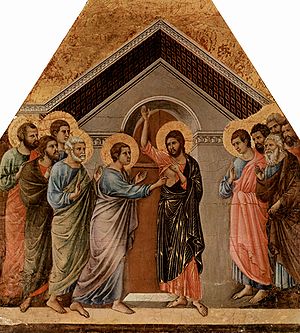
History of Christianity
The history of Christianity concerns the Christian religion, its followers and the Church with its various denominations, from the first century to the present. Christianity was founded in the 1st century by the followers of Jesus of Nazareth who they believed to be the Christ or chosen one of God...
is traditionally the period of the Twelve Apostles, dating from the Crucifixion of Jesus
Crucifixion of Jesus
The crucifixion of Jesus and his ensuing death is an event that occurred during the 1st century AD. Jesus, who Christians believe is the Son of God as well as the Messiah, was arrested, tried, and sentenced by Pontius Pilate to be scourged, and finally executed on a cross...
(c. 30-33) and the Great Commission
Great Commission
The Great Commission, in Christian tradition, is the instruction of the resurrected Jesus Christ to his disciples, that they spread his teachings to all the nations of the world. It has become a tenet in Christian theology emphasizing missionary work, evangelism, and baptism...
in Jerusalem until the death of John the Apostle
John the Apostle
John the Apostle, John the Apostle, John the Apostle, (Aramaic Yoħanna, (c. 6 - c. 100) was one of the Twelve Apostles of Jesus. He was the son of Zebedee and Salome, and brother of James, another of the Twelve Apostles...
(c. 100) in Anatolia. Since it is believed that John lived so long and was the last of the twelve to die, there is some overlap between the "Apostolic Age" and the first Apostolic Fathers
Apostolic Fathers
The Apostolic Fathers are a small number of Early Christian authors who lived and wrote in the second half of the first century and the first half of the second century. They are acknowledged as leaders in the early church, although their writings were not included in the New Testament...
, whose writings are used to mark the beginning of the Ante-Nicene Period
Ante-Nicene Period
The Ante-Nicene Period , or Post-Apostolic Period, of the history of early Christianity spanned the late 1st century to the early 4th century, with the end marked by the First Council of Nicaea in 325. Christianity during this time was extremely diverse, with many developments difficult to trace...
. It holds special significance in Christian tradition as the age of the direct apostles of Jesus Christ. The major primary source
Primary source
Primary source is a term used in a number of disciplines to describe source material that is closest to the person, information, period, or idea being studied....
for the "Apostolic Age" is the Acts of the Apostles
Acts of the Apostles
The Acts of the Apostles , usually referred to simply as Acts, is the fifth book of the New Testament; Acts outlines the history of the Apostolic Age...
, but its historical accuracy is questioned by some
Historical reliability of the Acts of the Apostles
The historical reliability of the Acts of the Apostles, the primary source for the Apostolic Age, is a major issue for biblical scholars and historians of Early Christianity. The historicity of Acts became hotly debated between 1895-1915...
.
According to most scholars, the followers of Jesus composed principally apocalyptic Jewish
Judaism
Judaism ) is the "religion, philosophy, and way of life" of the Jewish people...
sects during the late Second Temple
Second Temple
The Jewish Second Temple was an important shrine which stood on the Temple Mount in Jerusalem between 516 BCE and 70 CE. It replaced the First Temple which was destroyed in 586 BCE, when the Jewish nation was exiled to Babylon...
period of the 1st century
Christianity in the 1st century
The earliest followers of Jesus composed an apocalyptic, Jewish sect, which historians refer to as Jewish Christianity. The Apostles and others following the Great Commission's decree to spread the teachings of Jesus to "all nations," had great success spreading the religion to gentiles. Peter,...
. Some Early Christian groups were strictly Jewish, such as the Ebionites
Ebionites
Ebionites, or Ebionaioi, , is a patristic term referring to a Jewish Christian sect or sects that existed during the first centuries of the Christian Era. They regarded Jesus as the Messiah and insisted on the necessity of following Jewish religious law and rites...
and the early church leaders in Jerusalem, collectively called Jewish Christians
Jewish Christians
Jewish Christians is a term which appears in historical texts contrasting Christians of Jewish origin with Gentile Christians, both in discussion of the New Testament church and the second and following centuries....
. During this period, they were led by James the Just
James the Just
James , first Bishop of Jerusalem, who died in 62 AD, was an important figure in Early Christianity...
. Paul of Tarsus, commonly known as Saint Paul, persecuted the early Jewish Christians, such as Saint Stephen
Saint Stephen
Saint Stephen The Protomartyr , the protomartyr of Christianity, is venerated as a saint in the Roman Catholic, Anglican, Lutheran, Oriental Orthodox and Eastern Orthodox Churches....
, then converted
Conversion of Paul
The Conversion of Paul the Apostle, as depicted in the Christian Bible, refers to an event reported to have taken place in the life of Paul of Tarsus which led him to cease persecuting early Christians and to himself become a follower of Jesus; it is normally dated by researchers to AD 33–36...
and adopted the title of "Apostle to the Gentiles" and started proselytizing among the Gentile
Gentile
The term Gentile refers to non-Israelite peoples or nations in English translations of the Bible....
s. He persuaded the leaders of the Jerusalem Church to allow Gentile converts exemption from most Jewish commandments at the Council of Jerusalem
Council of Jerusalem
The Council of Jerusalem is a name applied by historians and theologians to an Early Christian council that was held in Jerusalem and dated to around the year 50. It is considered by Catholics and Orthodox to be a prototype and forerunner of the later Ecumenical Councils...
, which may parallel Noahide Law in Rabbinic Judaism
Rabbinic Judaism
Rabbinic Judaism or Rabbinism has been the mainstream form of Judaism since the 6th century CE, after the codification of the Talmud...
. Though Paul's influence on Christian thinking is said to be more significant than any other New Testament author, the relationship of Paul of Tarsus and Judaism
Paul of Tarsus and Judaism
The relationship between Paul of Tarsus and Second Temple Judaism continues to be the subject of much scholarly research, as it is thought that Paul played an important role in the relationship between Christianity and Judaism as a whole...
is still disputed today. After the Destruction of the Second Temple in AD 70, or at the latest the Bar Kokhba revolt of 132, Jerusalem
Jerusalem in Christianity
For Christians, Jerusalem's place in the ministry of Jesus and the Apostolic Age gives it great importance, in addition to its place in the Old Testament, the Hebrew Bible.-Jerusalem in the New Testament and early Christianity:...
ceased to be the center of the Christian church
Christian Church
The Christian Church is the assembly or association of followers of Jesus Christ. The Greek term ἐκκλησία that in its appearances in the New Testament is usually translated as "church" basically means "assembly"...
, its bishops became "suffragans"
Suffragan bishop
A suffragan bishop is a bishop subordinate to a metropolitan bishop or diocesan bishop. He or she may be assigned to an area which does not have a cathedral of its own.-Anglican Communion:...
(subordinates) of the Metropolitan bishop
Metropolitan bishop
In Christian churches with episcopal polity, the rank of metropolitan bishop, or simply metropolitan, pertains to the diocesan bishop or archbishop of a metropolis; that is, the chief city of a historical Roman province, ecclesiastical province, or regional capital.Before the establishment of...
of Caesarea. In the 2nd century
Christianity in the 2nd century
The 2nd century of Christianity was largely the time of the Apostolic Fathers who were the students of the apostles of Jesus, though there is some overlap as John the Apostle may have survived into the 2nd century and the early Apostolic Father Clement of Rome is said to have died at the end of the...
, Christianity established itself as a predominantly Gentile religion that spanned the Roman Empire
Roman Empire
The Roman Empire was the post-Republican period of the ancient Roman civilization, characterised by an autocratic form of government and large territorial holdings in Europe and around the Mediterranean....
and beyond.
Significance
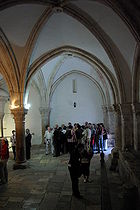
Early Christianity
Early Christianity is generally considered as Christianity before 325. The New Testament's Book of Acts and Epistle to the Galatians records that the first Christian community was centered in Jerusalem and its leaders included James, Peter and John....
to the apostles, though modern liberal scholarship has cast doubt on the authorship of most New Testament books. In the traditional history of the Christian church, the Apostolic Age was the foundation upon which the entire church's history is founded.
The Apostolic Age is particularly significant to Restorationism which claims that it represents a purer form of Christianity that should be restored to the church as it exists today.
The unique character of the New Testament writings, and their period of origin, is highlighted by the paucity of the literary form in later writing. Once the canon of the New Testament began to take shape
Development of the New Testament canon
The Canon of the New Testament is the set of books Christians regard as divinely inspired and constituting the New Testament of the Christian Bible. For most, it is an agreed-upon list of twenty-seven books that includes the Canonical Gospels, Acts, letters of the Apostles, and Revelation...
, the style ceased to be used on a regular basis. Non-canonical writings persisted, but died out within a historically short period of time. Early patristic literature is dominated by apologetics and makes use of other literary forms borrowed from non-Christian sources.
Early leaders
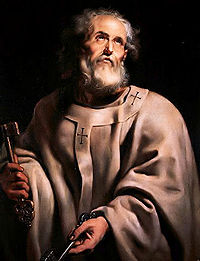
Desposyni
The term Desposyni refers to alleged blood relatives of Jesus. The term was coined by Sextus Julius Africanus, a writer of the early 3rd century. Some scholars argue that Jesus' relatives held positions of special honor in the Early Christian Church...
lived in Nazareth
Nazareth
Nazareth is the largest city in the North District of Israel. Known as "the Arab capital of Israel," the population is made up predominantly of Palestinian Arab citizens of Israel...
since the 1st century. Some of them were prominent early Christians. Among those named in the New Testament are his mother and four of his brothers: James
James the Just
James , first Bishop of Jerusalem, who died in 62 AD, was an important figure in Early Christianity...
, Simeon
Simeon of Jerusalem
Saint Simeon of Jerusalem, son of Clopas, was a Jewish Christian leader and according to most Christian traditions the second Bishop of Jerusalem .-Life:Eusebius of Caesarea gives the list of these bishops...
, Joseph
Joses
Saint Joses is the second of the brothers of Jesus appearing in the New Testament. Joses is first mentioned in , which related people talking about Jesus:...
and Jude
Jude, brother of Jesus
Jude was the brother of Jesus, according to the New Testament. He is traditionally identified as the author of the Epistle of Jude, a short epistle which is reckoned among the seven General epistles of the New Testament and considered canonical by Christians.-Sources: and write of Jesus family:...
. According to the Gospels, some of the family were opposed
Rejection of Jesus
The Canonical Gospels of the New Testament include some accounts of the rejection of Jesus in the course of his ministry. Judaism's view of Jesus, Jesus in Islam, and the view of the Historical Jesus all differ from Christian views of Jesus.-Hometown rejection:...
to the mission and religion of Jesus. The relatives of Jesus were accorded a special position within the early church, as displayed by the leadership of James in Jerusalem.
According to 19th century German theologian F. C. Baur early Christianity was dominated by the conflict between Peter
Saint Peter
Saint Peter or Simon Peter was an early Christian leader, who is featured prominently in the New Testament Gospels and the Acts of the Apostles. The son of John or of Jonah and from the village of Bethsaida in the province of Galilee, his brother Andrew was also an apostle...
who was law observant and Paul who advocated partial or even complete freedom from the law
Antinomianism
Antinomianism is defined as holding that, under the gospel dispensation of grace, moral law is of no use or obligation because faith alone is necessary to salvation....
. Later findings contradicted this theory. The allegedly continuous conflict was not supported by the available evidence. However, theological conflict between Paul and Peter is recorded in the New Testament and was widely discussed in the early church. Marcion and his followers stated that the polemic against false apostles in Galatians was aimed at Peter, James
James the Just
James , first Bishop of Jerusalem, who died in 62 AD, was an important figure in Early Christianity...
and John
John the Evangelist
Saint John the Evangelist is the conventional name for the author of the Gospel of John...
, the "Pillars of the Church", as well as the "false" gospels circulating through the churches at the time. Irenaeus
Irenaeus
Saint Irenaeus , was Bishop of Lugdunum in Gaul, then a part of the Roman Empire . He was an early church father and apologist, and his writings were formative in the early development of Christian theology...
and Tertullian
Tertullian
Quintus Septimius Florens Tertullianus, anglicised as Tertullian , was a prolific early Christian author from Carthage in the Roman province of Africa. He is the first Christian author to produce an extensive corpus of Latin Christian literature. He also was a notable early Christian apologist and...
argued against Marcionism's elevation of Paul and stated that Peter and Paul were equals among the apostles. Passages from Galatians were used to show that Paul respected Peter's office and acknowledged a shared faith.
Scholar James D. G. Dunn has proposed that Peter was the "bridge-man" between the two other prominent leaders: Paul and James the Just. Paul and James were both heavily identified with their own "brands" of Christianity. Peter showed a desire to hold onto his Jewish identity, in contrast with Paul. He simultaneously showed a flexibility towards the desires of the broader Christian community, in contrast to James. (This balance is illustrated in the Antioch episode related in .) Thus, Peter became a unifying force in the church.
Jewish background
According to most scholars, Early Christianity was a Jewish eschatologicalEschatology
Eschatology is a part of theology, philosophy, and futurology concerned with what are believed to be the final events in history, or the ultimate destiny of humanity, commonly referred to as the end of the world or the World to Come...
faith. The Book of Acts reports that the early followers continued daily Temple
Second Temple
The Jewish Second Temple was an important shrine which stood on the Temple Mount in Jerusalem between 516 BCE and 70 CE. It replaced the First Temple which was destroyed in 586 BCE, when the Jewish nation was exiled to Babylon...
attendance and traditional Jewish home prayer. Other passages in the New Testament
New Testament
The New Testament is the second major division of the Christian biblical canon, the first such division being the much longer Old Testament....
gospels reflect a similar observance of traditional Jewish piety such as fasting
Fasting
Fasting is primarily the act of willingly abstaining from some or all food, drink, or both, for a period of time. An absolute fast is normally defined as abstinence from all food and liquid for a defined period, usually a single day , or several days. Other fasts may be only partially restrictive,...
, reverence for the Torah
Torah
Torah- A scroll containing the first five books of the BibleThe Torah , is name given by Jews to the first five books of the bible—Genesis , Exodus , Leviticus , Numbers and Deuteronomy Torah- A scroll containing the first five books of the BibleThe Torah , is name given by Jews to the first five...
(commonly translated as "the Law" in English translations of the Bible
English translations of the Bible
The efforts of translating the Bible from its original languages into over 2,000 others have spanned more than two millennia. Partial translations of the Bible into languages of the English people can be traced back to the end of the 7th century, including translations into Old English and Middle...
) and observance of Jewish holy days
Jewish holiday
Jewish holidays are days observed by Jews as holy or secular commemorations of important events in Jewish history. In Hebrew, Jewish holidays and festivals, depending on their nature, may be called yom tov or chag or ta'anit...
. The earliest form of Jesus' religion is best understood in this context. However, there was great diversity in local variations, as each succeeded or failed in different ways. Regardless, Jesus was a pious Jew, worshipping the Jewish God
Shema Yisrael
Shema Yisrael are the first two words of a section of the Torah that is a centerpiece of the morning and evening Jewish prayer services...
, preaching interpretations of Jewish law
Expounding of the Law
The Expounding of the Law is a highly structured part of the Sermon on the Mount in the New Testament...
and accepted as the Jewish Messiah
Jewish Messiah
Messiah, ; mashiah, moshiah, mashiach, or moshiach, is a term used in the Hebrew Bible to describe priests and kings, who were traditionally anointed with holy anointing oil as described in Exodus 30:22-25...
by his disciples
Disciple (Christianity)
In Christianity, the disciples were the students of Jesus during his ministry. While Jesus attracted a large following, the term disciple is commonly used to refer specifically to "the Twelve", an inner circle of men whose number perhaps represented the twelve tribes of Israel...
. Nearly all scholars agree that regardless of how one interprets the mission of Jesus
Ministry of Jesus
In the Christian gospels, the Ministry of Jesus begins with his Baptism in the countryside of Judea, near the River Jordan and ends in Jerusalem, following the Last Supper with his disciples. The Gospel of Luke states that Jesus was "about 30 years of age" at the start of his ministry...
, that he must be understood in context as a 1st century Palestinian Jew
Palestinian Jew
A Palestinian Jew is a Jewish inhabitant of Palestine at various points in the region's history . Jews in Palestine prior to the establishment of the State of Israel are more commonly referred to as "Yishuv"...
.
Religious climate
The religious climate of 1st century Judea was quite diverse with numerous variations of Judaic doctrine, many attempts to establish an ideal holy community and divergent ideas about Israel's future hopes. Modern scholars place normative Rabbinic Judaism after the time of Jesus, see also School of JamniaCouncil of Jamnia
The Council of Jamnia or Council of Yavne is a hypothetical late 1st-century council at which it is postulated the canon of the Hebrew Bible was finalized....
. The Pharisees
Pharisees
The Pharisees were at various times a political party, a social movement, and a school of thought among Jews during the Second Temple period beginning under the Hasmonean dynasty in the wake of...
were but one sect and did not have the overwhelming influence in 1st century Judea
Iudaea Province
Judaea or Iudaea are terms used by historians to refer to the Roman province that extended over parts of the former regions of the Hasmonean and Herodian kingdoms of Israel...
traditionally attributed to them. The ancient historian Josephus
Josephus
Titus Flavius Josephus , also called Joseph ben Matityahu , was a 1st-century Romano-Jewish historian and hagiographer of priestly and royal ancestry who recorded Jewish history, with special emphasis on the 1st century AD and the First Jewish–Roman War, which resulted in the Destruction of...
noted four prominent groups in the Judaism of the time: Pharisees
Pharisees
The Pharisees were at various times a political party, a social movement, and a school of thought among Jews during the Second Temple period beginning under the Hasmonean dynasty in the wake of...
, Sadducees
Sadducees
The Sadducees were a sect or group of Jews that were active in Ancient Israel during the Second Temple period, starting from the second century BC through the destruction of the Temple in 70 AD. The sect was identified by Josephus with the upper social and economic echelon of Judean society...
, Essenes
Essenes
The Essenes were a Jewish sect that flourished from the 2nd century BCE to the 1st century CE which some scholars claim seceded from the Zadokite priests...
and Zealots. Jesus dealt with a variety of sects, most prominently discussing the Law
Expounding of the Law
The Expounding of the Law is a highly structured part of the Sermon on the Mount in the New Testament...
with Pharisees and debating about bodily resurrection
Resurrection of the dead
Resurrection of the Dead is a belief found in a number of eschatologies, most commonly in Christian, Islamic, Jewish and Zoroastrian. In general, the phrase refers to a specific event in the future; multiple prophesies in the histories of these religions assert that the dead will be brought back to...
with the Sadducees. Jesus also directly associated with John the Baptist
John the Baptist
John the Baptist was an itinerant preacher and a major religious figure mentioned in the Canonical gospels. He is described in the Gospel of Luke as a relative of Jesus, who led a movement of baptism at the Jordan River...
, who is often associated with the Essenes.
Relationship with the Essenes
Scholars such as James TaborJames Tabor
James D. Tabor is Chair of the Department of Religious Studies at the University of North Carolina at Charlotte where he has taught since 1989. He previously held positions at Ambassador College , the University of Notre Dame , and the College of William and Mary .-Background:Tabor was born in...
state that Essenes
Essenes
The Essenes were a Jewish sect that flourished from the 2nd century BCE to the 1st century CE which some scholars claim seceded from the Zadokite priests...
and early Christians had a number of similar beliefs. The Essenes practised baptism
Baptism
In Christianity, baptism is for the majority the rite of admission , almost invariably with the use of water, into the Christian Church generally and also membership of a particular church tradition...
, believed in a New Covenant
New Covenant
The New Covenant is a concept originally derived from the Hebrew Bible. The term "New Covenant" is used in the Bible to refer to an epochal relationship of restoration and peace following a period of trial and judgment...
, were messianic and believed themselves a remnant of the faithful preparing the way for the reign of God's glory
Kingdom of God
The Kingdom of God or Kingdom of Heaven is a foundational concept in the Abrahamic religions: Judaism, Christianity and Islam.The term "Kingdom of God" is found in all four canonical gospels and in the Pauline epistles...
. They called their group by names that would later be used by Christians, such as The Way
The Way
The Way may refer to a spiritual path:* The Way or "Tao" of Taoism* An early term for early Christianity * The Way of the Cross, a Catholic devotion to the Passion of Christ....
and the Saints. Jesus preached a number of doctrines similar to Essene Halacha. They followed a charismatic leader who was opposed and possibly killed at the instigation of the Pharisees
Pharisees
The Pharisees were at various times a political party, a social movement, and a school of thought among Jews during the Second Temple period beginning under the Hasmonean dynasty in the wake of...
. John the Baptist
John the Baptist
John the Baptist was an itinerant preacher and a major religious figure mentioned in the Canonical gospels. He is described in the Gospel of Luke as a relative of Jesus, who led a movement of baptism at the Jordan River...
seems to have risen out of this context.
Some scholars, such as Carsten Peter Thiede
Carsten Peter Thiede
Carsten Peter Thiede was a German archaeologist and New Testament scholar. He was also a member of PEN and a Knight of Justice in the Order of St John. Thiede often advanced theories that conflicted with the consensus of academic and theological scholarship...
, dispute this presentation. Early Christian leaders did not have to visit Qumran
Qumran
Qumran is an archaeological site in the West Bank. It is located on a dry plateau about a mile inland from the northwestern shore of the Dead Sea, near the Israeli settlement and kibbutz of Kalia...
to have heard of Essene beliefs and read their texts. The various Jewish groups, including Christians and Essenes, were interconnected and simultaneously adopted some practices and beliefs while rejecting others. While some similarities exist, there are many differences and similar parallels can be also drawn between the early Christians and Pharisees, and other Jewish sects. Many features of Christian faith have no parallels in the texts from Qumran, and some that do are fundamentally distinct from Essene practices and beliefs. Notably, John's act of penitent baptism bears little resemblance to the daily baptismal ritual of the Essenes.
First Gentile converts
Roman Empire
The Roman Empire was the post-Republican period of the ancient Roman civilization, characterised by an autocratic form of government and large territorial holdings in Europe and around the Mediterranean....
centurion
Centurion
A centurion was a professional officer of the Roman army .Centurion may also refer to:-Military:* Centurion tank, British battle tank* HMS Centurion, name of several ships and a shore base of the British Royal Navy...
Cornelius
Centurion Cornelius
Cornelius was a Roman centurion who is considered by Christians to be the first Gentile to convert to the faith, as related in Acts of the Apostles.-Biblical account:...
of Caesarea Maritima is traditionally considered the first Gentile convert. His conversion, as documented in , carries great significance. Cornelius was referenced by both Peter and James in arguing for the inclusion of Gentiles in the Council of Jerusalem
Council of Jerusalem
The Council of Jerusalem is a name applied by historians and theologians to an Early Christian council that was held in Jerusalem and dated to around the year 50. It is considered by Catholics and Orthodox to be a prototype and forerunner of the later Ecumenical Councils...
. His conversion is broadly considered to have been the beginning of a broader mission to the Gentiles, who would come to eclipse the Jews among Christians.
The story of Cornelius' conversion is thematically connected with, and parallels, the conversion stories of the Samaritans, Paul of Tarsus
Paul of Tarsus
Paul the Apostle , also known as Saul of Tarsus, is described in the Christian New Testament as one of the most influential early Christian missionaries, with the writings ascribed to him by the church forming a considerable portion of the New Testament...
and an Ethiopian eunuch
Ethiopian eunuch
The Ethiopian eunuch is a figure in the New Testament of the Bible. The story of his conversion to Christianity is recounted in Acts 8.-Biblical narrative:...
in Luke-Acts
Luke-Acts
Luke-Acts is the name usually given by Biblical scholars to the hypothetical composite work of the Gospel of Luke and the Acts of the Apostles in the New Testament. Together they describe the Ministry of Jesus and the subsequent lives of the Apostles and the Apostolic Age.Both the books of Luke and...
. The Ethiopian was an outsider and castrated, whose presence in worship assembly would have been prohibited under the Mosaic law . This is consistent with the theme of Luke, advocating a "universal" faith and mission
Universalism
Universalism in its primary meaning refers to religious, theological, and philosophical concepts with universal application or applicability...
. Ethiopia was considered in antiquity to be the southernmost end of the world. Thus, the Ethiopian's conversion can also be interpreted as a partial fulfillment of the mission presented in to bring the Gospel to the "ends of the earth"
Great Commission
The Great Commission, in Christian tradition, is the instruction of the resurrected Jesus Christ to his disciples, that they spread his teachings to all the nations of the world. It has become a tenet in Christian theology emphasizing missionary work, evangelism, and baptism...
. Some scholars assert that the Ethiopian eunuch was the first Gentile convert, stating that those resisting this conclusion are doing so to preserve the traditional interpretation of Cornelius as the first convert. Regardless of the primacy of either convert, this episode relates Luke's view of how (through Phillip
Philip the Apostle
Philip the Apostle was one of the Twelve Apostles of Jesus. Later Christian traditions describe Philip as the apostle who preached in Greece, Syria, and Phrygia....
) the Gospel reached the "ends of the earth" and the mission to the Gentiles was initiated.
Circumcision controversy
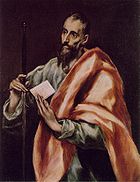
Alister McGrath
Alister Edgar McGrath is an Anglican priest, theologian, and Christian apologist, currently Professor of Theology, Ministry, and Education at Kings College London and Head of the Centre for Theology, Religion and Culture...
stated that many of the Jewish Christians were fully faithful religious Jews, only differing in their acceptance of Jesus as the Messiah. As such, they believed that circumcision and other requirements of the Mosaic law were required for salvation
Salvation
Within religion salvation is the phenomenon of being saved from the undesirable condition of bondage or suffering experienced by the psyche or soul that has arisen as a result of unskillful or immoral actions generically referred to as sins. Salvation may also be called "deliverance" or...
. The increasing number of Gentile converts came under pressure from Jewish Christians to be circumcised in accordance with Abrahamic tradition. The issue was addressed at the Council of Jerusalem
Council of Jerusalem
The Council of Jerusalem is a name applied by historians and theologians to an Early Christian council that was held in Jerusalem and dated to around the year 50. It is considered by Catholics and Orthodox to be a prototype and forerunner of the later Ecumenical Councils...
where Saint Paul made an argument that circumcision was not a necessary practice, vocally supported by Peter, as documented in . This position received widespread support and was summarized in a letter circulated in Antioch
Antioch
Antioch on the Orontes was an ancient city on the eastern side of the Orontes River. It is near the modern city of Antakya, Turkey.Founded near the end of the 4th century BC by Seleucus I Nicator, one of Alexander the Great's generals, Antioch eventually rivaled Alexandria as the chief city of the...
.
While the issue was theoretically resolved, it continued to be a recurring issue among Christians. Four years after the Council of Jerusalem, Paul wrote to the Galatians about the issue, which had become a serious controversy in their region. There was a burgeoning movement of Judaizers
Judaizers
Judaizers is predominantly a Christian term, derived from the Greek verb ioudaïzō . This term is most widely known from the single use in the New Testament where Paul publicly challenges Peter for compelling Gentile believers to "judaize", also known as the Incident at Antioch.According to the...
in the area that advocated adherence to traditional Mosaic laws, including circumcision. According to McGrath, Paul identified James the Just
James the Just
James , first Bishop of Jerusalem, who died in 62 AD, was an important figure in Early Christianity...
as the motivating force behind the movement. Paul considered it a great threat to his doctrine of salvation through faith and addressed the issue with great detail in .
Apostolic Church in Jerusalem
In 66, the Jews revolted against Rome. Rome besieged Jerusalem for four yearsSiege of Jerusalem (70)
The Siege of Jerusalem in the year 70 AD was the decisive event of the First Jewish-Roman War. The Roman army, led by the future Emperor Titus, with Tiberius Julius Alexander as his second-in-command, besieged and conquered the city of Jerusalem, which had been occupied by its Jewish defenders in...
, and the city fell in 70. The city was destroyed, including the massive Temple, and the population was mostly killed or removed. Though, according to Epiphanius of Salamis
Epiphanius of Salamis
Epiphanius of Salamis was bishop of Salamis at the end of the 4th century. He is considered a saint and a Church Father by both the Eastern Orthodox and Catholic Churches. He gained a reputation as a strong defender of orthodoxy...
, the Cenacle
Cenacle
The Cenacle , also known as the "Upper Room", is the term used for the site of The Last Supper. The word is a derivative of the Latin word cena, which means dinner....
survived at least to Hadrian
Hadrian
Hadrian , was Roman Emperor from 117 to 138. He is best known for building Hadrian's Wall, which marked the northern limit of Roman Britain. In Rome, he re-built the Pantheon and constructed the Temple of Venus and Roma. In addition to being emperor, Hadrian was a humanist and was philhellene in...
's visit in 130. A scattered population survived. Traditionally it is believed the Jerusalem Christians waited out the Jewish–Roman wars in Pella
Pella, Jordan
Pella is a village and the site of ancient ruins in northwestern Jordan. It is half an hour by car from Irbid, in the north of the country....
in the Decapolis
Decapolis
The Decapolis was a group of ten cities on the eastern frontier of the Roman Empire in Judea and Syria. The ten cities were not an official league or political unit, but they were grouped together because of their language, culture, location, and political status...
. The Sanhedrin (of Judaism) reformed in Jamnia
Council of Jamnia
The Council of Jamnia or Council of Yavne is a hypothetical late 1st-century council at which it is postulated the canon of the Hebrew Bible was finalized....
. Prophecies of the Second Temple's destruction are found in the synoptics
Synoptic Gospels
The gospels of Matthew, Mark, and Luke are known as the Synoptic Gospels because they include many of the same stories, often in the same sequence, and sometimes exactly the same wording. This degree of parallelism in content, narrative arrangement, language, and sentence structures can only be...
, and are part of the argument for Supersessionism
Supersessionism
Supersessionism is a term for the dominant Christian view of the Old Covenant, also called fulfillment theology and replacement theology, though the latter term is disputed...
. After the Bar Kokhba revolt, Hadrian
Hadrian
Hadrian , was Roman Emperor from 117 to 138. He is best known for building Hadrian's Wall, which marked the northern limit of Roman Britain. In Rome, he re-built the Pantheon and constructed the Temple of Venus and Roma. In addition to being emperor, Hadrian was a humanist and was philhellene in...
barred all Jews from Jerusalem which was renamed Aelia Capitolina
Aelia Capitolina
Aelia Capitolina was a city built by the emperor Hadrian, and occupied by a Roman colony, on the site of Jerusalem, which was in ruins since 70 AD, leading in part to the Bar Kokhba revolt of 132–136.-Politics:...
, hence the subsequent Jerusalem bishops were gentiles.
Jerusalem received special recognition in Canon VII of Nicaea
First Council of Nicaea
The First Council of Nicaea was a council of Christian bishops convened in Nicaea in Bithynia by the Roman Emperor Constantine I in AD 325...
in 325, without yet becoming a metropolitan see, and was later named as one of the Pentarchy
Pentarchy
Pentarchy is a term in the history of Christianity for the idea of universal rule over all Christendom by the heads of five major episcopal sees, or patriarchates, of the Roman Empire: Rome, Constantinople, Alexandria, Antioch, and Jerusalem...
, but the later was never accepted by the Church of Rome.
Saint Thomas Christians
Christianity arrived along the southern IndianChristianity in India
Christianity is India's third-largest religion, with approximately 24 million followers, constituting 2.3% of India's population. The works of scholars and Eastern Christian writings and 14th century Portuguese missionaries created an illusion to convert Indians that Christianity was introduced to...
Malabar Coast
Malabar Coast
The Malabar Coast is a long and narrow coastline on the south-western shore line of the mainland Indian subcontinent. Geographically, it comprises the wettest regions of southern India, as the Western Ghats intercept the moisture-laden monsoon rains, especially on their westward-facing mountain...
via Thomas the Apostle
Thomas the Apostle
Thomas the Apostle, also called Doubting Thomas or Didymus was one of the Twelve Apostles of Jesus. He is best known for questioning Jesus' resurrection when first told of it, then proclaiming "My Lord and my God" on seeing Jesus in . He was perhaps the only Apostle who went outside the Roman...
in 52 and from this came Thomasine Christianity. These Syrian Malabar Nasrani
Syrian Malabar Nasrani
The Syrian Malabar Nasrani people, also known as Saint Thomas Christians, "'Nasrani Mappila'" and Nasranis, are an ethnoreligious group from Kerala, India, adhering to the various churches of the Saint Thomas Christian tradition...
s kept a unique Christian identity until the arrival of the Portuguese in the 17th century
Christianity in the 17th century
The history of Christianity in the 17th century showed both deep conflict and new tolerance. The Enlightenment grew to challenge Christianity as a whole, generally elevated human reason above divine revelation, and down-graded religious authorities such as the Papacy based on it...
.
See also
- List of events in early Christianity
- AntilegomenaAntilegomenaAntilegomena, a direct transliteration from the Greek , refers to written texts whose authenticity or value is disputed.Eusebius in his Church History written c. 325 used the term for those Christian scriptures that were "disputed" or literally those works which were "spoken against" in Early...
(= early writings 'of which the Christianity is disputed') - Hellenistic JudaismHellenistic JudaismHellenistic Judaism was a movement which existed in the Jewish diaspora that sought to establish a Hebraic-Jewish religious tradition within the culture and language of Hellenism...