

.gif)
Disciple (Christianity)

Encyclopedia
Christianity
Christianity is a monotheistic religion based on the life and teachings of Jesus as presented in canonical gospels and other New Testament writings...
, the disciples were the students of Jesus
Jesus
Jesus of Nazareth , commonly referred to as Jesus Christ or simply as Jesus or Christ, is the central figure of Christianity...
during his ministry
Ministry of Jesus
In the Christian gospels, the Ministry of Jesus begins with his Baptism in the countryside of Judea, near the River Jordan and ends in Jerusalem, following the Last Supper with his disciples. The Gospel of Luke states that Jesus was "about 30 years of age" at the start of his ministry...
. While Jesus attracted a large following, the term disciple is commonly used to refer specifically to "the Twelve", an inner circle of men whose number perhaps represented the twelve tribes of Israel. In addition to the Twelve, the canonical gospels and the Book of Acts
Acts of the Apostles
The Acts of the Apostles , usually referred to simply as Acts, is the fifth book of the New Testament; Acts outlines the history of the Apostolic Age...
refer to varying numbers of disciples that range between 70
Seventy Disciples
The seventy disciples or seventy-two disciples were early followers of Jesus mentioned in the Gospel of Luke . According to Luke, the only gospel in which they appear, Jesus appointed them and sent them out in pairs on a specific mission which is detailed in the text...
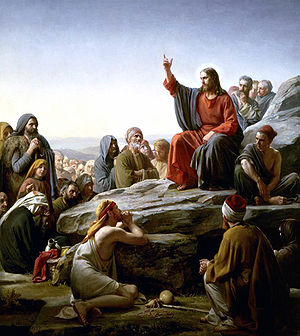
and 120 to a "growing multitude". Jesus controversially accepted women and sinners (those who violated purity laws) among his followers, although it is not clear whether they were disciples. In the book of Acts, the Apostles (those sent by Jesus) themselves have disciples. The word disciple is used today as a way of self-identification for those who seek to learn from the teachings of Jesus, such as the Sermon on the Mount
Sermon on the Mount
The Sermon on the Mount is a collection of sayings and teachings of Jesus, which emphasizes his moral teaching found in the Gospel of Matthew...
.
Several disciples are historical figures, notably Peter
Saint Peter
Saint Peter or Simon Peter was an early Christian leader, who is featured prominently in the New Testament Gospels and the Acts of the Apostles. The son of John or of Jonah and from the village of Bethsaida in the province of Galilee, his brother Andrew was also an apostle...
, James
James the Just
James , first Bishop of Jerusalem, who died in 62 AD, was an important figure in Early Christianity...
and John, the pillars of the Jerusalem church according to Paul of Tarsus
Paul of Tarsus
Paul the Apostle , also known as Saul of Tarsus, is described in the Christian New Testament as one of the most influential early Christian missionaries, with the writings ascribed to him by the church forming a considerable portion of the New Testament...
. The canonical gospels name Peter as the first among the disciples
Primacy of Simon Peter
Most Christians hold that Simon Peter was the most prominent of the Apostles, called the Prince of the Apostles and favored by Jesus of Nazareth. As such, it is argued that Peter held the first place of honor and authority...
, the first to name Jesus the Messiah
Messiah
A messiah is a redeemer figure expected or foretold in one form or another by a religion. Slightly more widely, a messiah is any redeemer figure. Messianic beliefs or theories generally relate to eschatological improvement of the state of humanity or the world, in other words the World to...
, and called to feed Jesus' sheep. Paul named him the Apostle to the Jews, as Paul claimed the title Apostle to the Gentiles, although it was Peter who first baptised a Gentile
Gentile
The term Gentile refers to non-Israelite peoples or nations in English translations of the Bible....
, Cornelius the Centurion. John's tradition was strong in Asia Minor, where the Gospel of John
Gospel of John
The Gospel According to John , commonly referred to as the Gospel of John or simply John, and often referred to in New Testament scholarship as the Fourth Gospel, is an account of the public ministry of Jesus...
was likely composed. In the synoptics
Synoptic Gospels
The gospels of Matthew, Mark, and Luke are known as the Synoptic Gospels because they include many of the same stories, often in the same sequence, and sometimes exactly the same wording. This degree of parallelism in content, narrative arrangement, language, and sentence structures can only be...
, Peter, James and John witness Jesus' transfiguration
Transfiguration of Jesus
The Transfiguration of Jesus is an event reported in the New Testament in which Jesus is transfigured and becomes radiant upon a mountain. The Synoptic Gospels describe it, and 2 Peter 1:16-18 refers to it....
. Thomas
Thomas the Apostle
Thomas the Apostle, also called Doubting Thomas or Didymus was one of the Twelve Apostles of Jesus. He is best known for questioning Jesus' resurrection when first told of it, then proclaiming "My Lord and my God" on seeing Jesus in . He was perhaps the only Apostle who went outside the Roman...
is associated with a sayings tradition that features gnostic elements, and he appears in John as "doubting Thomas." The gospels of Matthew
Gospel of Matthew
The Gospel According to Matthew is one of the four canonical gospels, one of the three synoptic gospels, and the first book of the New Testament. It tells of the life, ministry, death, and resurrection of Jesus of Nazareth...
and John have traditionally been attributed to these disciples (see Aramaic Matthew and Signs Gospel
Signs Gospel
The Signs Gospel is a hypothetical gospel account of the life of Jesus Christ. Some scholars believe it to be a primary source document for the Gospel of John. This theory has its basis in source criticism...
for suggested source documents), and the Gospel of Mark
Gospel of Mark
The Gospel According to Mark , commonly shortened to the Gospel of Mark or simply Mark, is the second book of the New Testament. This canonical account of the life of Jesus of Nazareth is one of the three synoptic gospels. It was thought to be an epitome, which accounts for its place as the second...
was associated with Peter's teaching, although modern scholars generally take these gospels as anonymous.
Etymology
The term disciple is derived from the New Testament Greek word(mathetes), which means a pupil (of a teacher) or an apprentice (to a master craftsman),
coming to English
English language
English is a West Germanic language that arose in the Anglo-Saxon kingdoms of England and spread into what was to become south-east Scotland under the influence of the Anglian medieval kingdom of Northumbria...
by way of the Latin
Latin
Latin is an Italic language originally spoken in Latium and Ancient Rome. It, along with most European languages, is a descendant of the ancient Proto-Indo-European language. Although it is considered a dead language, a number of scholars and members of the Christian clergy speak it fluently, and...
discipulus meaning "a learner". A Disciple is different than an apostle, which instead means a
While a disciple is one who learns from a teacher, in other words a student, an apostle is one sent to deliver those teachings or a message such as the Great Commission
Great Commission
The Great Commission, in Christian tradition, is the instruction of the resurrected Jesus Christ to his disciples, that they spread his teachings to all the nations of the world. It has become a tenet in Christian theology emphasizing missionary work, evangelism, and baptism...
to others.
Disciples of Jesus of Nazareth
Jesus led a large following, as related in the four canonical Gospels. These gospels pay special attention to the Twelve, Jesus' inner circle.The four
In MarkGospel of Mark
The Gospel According to Mark , commonly shortened to the Gospel of Mark or simply Mark, is the second book of the New Testament. This canonical account of the life of Jesus of Nazareth is one of the three synoptic gospels. It was thought to be an epitome, which accounts for its place as the second...
, Jesus initially calls four fishermen from among those at the Sea of Galilee
Sea of Galilee
The Sea of Galilee, also Kinneret, Lake of Gennesaret, or Lake Tiberias , is the largest freshwater lake in Israel, and it is approximately in circumference, about long, and wide. The lake has a total area of , and a maximum depth of approximately 43 m...
. These are Simon
Saint Peter
Saint Peter or Simon Peter was an early Christian leader, who is featured prominently in the New Testament Gospels and the Acts of the Apostles. The son of John or of Jonah and from the village of Bethsaida in the province of Galilee, his brother Andrew was also an apostle...
(later called "Rock" or Peter) and his brother Andrew
Saint Andrew
Saint Andrew , called in the Orthodox tradition Prōtoklētos, or the First-called, is a Christian Apostle and the brother of Saint Peter. The name "Andrew" , like other Greek names, appears to have been common among the Jews from the 3rd or 2nd century BC. No Hebrew or Aramaic name is recorded for him...
, and the brothers James
Saint James the Great
James, son of Zebedee was one of the Twelve Apostles of Jesus. He was a son of Zebedee and Salome, and brother of John the Apostle...
and John
John the Apostle
John the Apostle, John the Apostle, John the Apostle, (Aramaic Yoħanna, (c. 6 - c. 100) was one of the Twelve Apostles of Jesus. He was the son of Zebedee and Salome, and brother of James, another of the Twelve Apostles...
(later called the "Sons of Thunder" or Boanerges). Matthew
Gospel of Matthew
The Gospel According to Matthew is one of the four canonical gospels, one of the three synoptic gospels, and the first book of the New Testament. It tells of the life, ministry, death, and resurrection of Jesus of Nazareth...
follows Mark's account . The Gospel of Luke
Gospel of Luke
The Gospel According to Luke , commonly shortened to the Gospel of Luke or simply Luke, is the third and longest of the four canonical Gospels. This synoptic gospel is an account of the life and ministry of Jesus of Nazareth. It details his story from the events of his birth to his Ascension.The...
lacks a mention of Andrew. also includes an initial calling of disciples, but these are: an unnamed disciple, Andrew, Simon, Philip
Philip the Apostle
Philip the Apostle was one of the Twelve Apostles of Jesus. Later Christian traditions describe Philip as the apostle who preached in Greece, Syria, and Phrygia....
and Nathanael.
The twelve
Most of the attention in the gospels is given to a specific group of disciples called by Jesus on the top of a mountain and commissioned by him as the Twelve Apostles. These men are:- SimonSaint PeterSaint Peter or Simon Peter was an early Christian leader, who is featured prominently in the New Testament Gospels and the Acts of the Apostles. The son of John or of Jonah and from the village of Bethsaida in the province of Galilee, his brother Andrew was also an apostle...
, called Peter - AndrewSaint AndrewSaint Andrew , called in the Orthodox tradition Prōtoklētos, or the First-called, is a Christian Apostle and the brother of Saint Peter. The name "Andrew" , like other Greek names, appears to have been common among the Jews from the 3rd or 2nd century BC. No Hebrew or Aramaic name is recorded for him...
, the brother of Simon Peter - James, son of Zebedee (called the son of Zebedee by Mark and Matthew)
- JohnJohn the ApostleJohn the Apostle, John the Apostle, John the Apostle, (Aramaic Yoħanna, (c. 6 - c. 100) was one of the Twelve Apostles of Jesus. He was the son of Zebedee and Salome, and brother of James, another of the Twelve Apostles...
(Mark and Matthew identify him as the brother of James, son of Zebedee) - PhilipPhilip the ApostlePhilip the Apostle was one of the Twelve Apostles of Jesus. Later Christian traditions describe Philip as the apostle who preached in Greece, Syria, and Phrygia....
- BartholomewBartholomewBartholomew was one of the Twelve Apostles of Jesus, and is usually identified as Nathaniel . He was introduced to Christ through St. Philip, another of the twelve apostles as per , where the name Nathaniel first appears. He is also mentioned as “Nathaniel of Cana in Galilee” in...
, named Nathanael in John - MatthewMatthew the EvangelistMatthew the Evangelist was, according to the Bible, one of the twelve Apostles of Jesus and one of the four Evangelists.-Identity:...
(whom the Matthew evangelist identifies as a publican), named Levi in Luke and Mark - ThomasThomas the ApostleThomas the Apostle, also called Doubting Thomas or Didymus was one of the Twelve Apostles of Jesus. He is best known for questioning Jesus' resurrection when first told of it, then proclaiming "My Lord and my God" on seeing Jesus in . He was perhaps the only Apostle who went outside the Roman...
- James, son of AlphaeusJames, son of AlphaeusSaint James, son of Alphaeus was one of the Twelve Apostles of Jesus Christ. He is often identified with James the Less and commonly known by that name in church tradition....
- SimonSimon the ZealotThe apostle called Simon Zelotes, Simon the Zealot, in Luke 6:15 and Acts 1:13; and Simon Kananaios or Simon Cananeus , was one of the most obscure among the apostles of Jesus. Little is recorded of him aside from his name...
, called a zealot in Mark, Matthew, and Luke - Jude ThaddaeusSaint JudeJude was one of the Twelve Apostles of Jesus. He is generally identified with Thaddeus, and is also variously called Jude of James, Jude Thaddaeus, Judas Thaddaeus or Lebbaeus...
, called Thaddaeus by Mark, Lebbaeus Thaddaeus by Matthew, and Judas of James by Luke - Judas IscariotJudas IscariotJudas Iscariot was, according to the New Testament, one of the twelve disciples of Jesus. He is best known for his betrayal of Jesus to the hands of the chief priests for 30 pieces of silver.-Etymology:...
The Gospel of John
Gospel of John
The Gospel According to John , commonly referred to as the Gospel of John or simply John, and often referred to in New Testament scholarship as the Fourth Gospel, is an account of the public ministry of Jesus...
refers to one disciple as the one whom Jesus loved
Disciple whom Jesus loved
The phrase the disciple whom Jesus loved or, in John 20:2, the Beloved Disciple is used five times in the Gospel of John, but in no other New Testament accounts of Jesus. claims that the Gospel of John is based on the written testimony of the "Beloved Disciple".Since the end of the 2nd century,...
. Since the apostle John, like several other apostles named in the synoptics, is never named in that gospel, the "beloved disciple" is assumed to be him.
Mark provides the first list of the twelve, and Matthew copies it. Luke, however, replaces Thaddeus with a second Judas. John names nine disciples plus "the beloved disciple." The number twelve represents the twelve tribes of Israel, identifying Christianity as the new Israel. Many scholars take it as historical that Jesus called an inner circle of twelve disciples, while others see "the Twelve" as an early Christian invention.
Matthew is the only canonical gospel to talk about the church. In Matthew, Jesus grants authority to Peter and to the rest of the twelve, giving them power to bind and loose.
Great crowd and the seventy
The number of or persons among Jesus' disciples (as opposed to just followers) is not always given in the gospel accounts. A much larger group of people is identified as disciples in the opening of the passage of the Sermon on the PlainSermon on the Plain
In Christianity, the Sermon on the Plain refers to a set of teachings by Jesus in the Gospel of Luke, in 6:17-49.This sermon may be compared to the longer Sermon on the Mount in the Gospel of Matthew....
that begins in Luke
Gospel of Luke
The Gospel According to Luke , commonly shortened to the Gospel of Luke or simply Luke, is the third and longest of the four canonical Gospels. This synoptic gospel is an account of the life and ministry of Jesus of Nazareth. It details his story from the events of his birth to his Ascension.The...
.
Additionally, seventy (or seventy-two, depending on the source used) people are sent out in pairs to prepare the way for Jesus (Luke 10). They are sometimes referred to as the "Seventy" or the "Seventy Disciples
Seventy Disciples
The seventy disciples or seventy-two disciples were early followers of Jesus mentioned in the Gospel of Luke . According to Luke, the only gospel in which they appear, Jesus appointed them and sent them out in pairs on a specific mission which is detailed in the text...
" or in Eastern Christianity
Eastern Christianity
Eastern Christianity comprises the Christian traditions and churches that developed in the Balkans, Eastern Europe, Asia Minor, the Middle East, Northeastern Africa, India and parts of the Far East over several centuries of religious antiquity. The term is generally used in Western Christianity to...
as the "Seventy Apostles". They are to eat any food offered, heal the sick and spread the word that God's reign
Kingdom of God
The Kingdom of God or Kingdom of Heaven is a foundational concept in the Abrahamic religions: Judaism, Christianity and Islam.The term "Kingdom of God" is found in all four canonical gospels and in the Pauline epistles...
is coming, that whoever hears them hears Jesus, whoever rejects them rejects Jesus, and whoever rejects Jesus rejects the One who sent him. In addition, they are granted great powers over the enemy and their names are written in heaven.
The reference to seventy-two may have indicated that the missionaries went to all the lands in the world, in support of Luke's overall theme of Jesus' universal relevance.
Cleopas and companion on the road to Emmaus
In Luke, CleopasCleopas
Cleopas was a figure of early Christianity, one of the two disciples who encountered Jesus during the Road to Emmaus appearance in the Gospel of ....
is one of the two disciples to whom the risen Lord
Resurrection appearances of Jesus
The major Resurrection appearances of Jesus in the Canonical gospels are reported to have occurred after his death, burial and resurrection, but prior to his Ascension. Among these primary sources, most scholars believe First Corinthians was written first, authored by Paul of Tarsus along with...
appears at Emmaus
Emmaus
Emmaus was an ancient town located approximately northwest of present day Jerusalem...
(Luke 24:18). Cleopas, with an unnamed disciple of Jesus' are walking from Jerusalem to Emmaus on the day of Jesus' resurrection. Cleopas and his friend were discussing the events of the past few days when a stranger asked them what they spoke of. The stranger is asked to join Cleopas and his friend for the evening meal. There the stranger is revealed, in blessing and breaking the bread, as the resurrected Jesus before he disappears. Cleopas and his friend hastened to Jerusalem to carry the news to the other disciples, to discover that Jesus had appeared there also and would do so again. The incident is without parallel in Matthew, Mark, or John.
Undesirables
Jesus practiced open table fellowship, scandalizing his critics by dining with sinners, tax collectors, and women.Sinners and tax collectors
The gospels use the term "sinners and tax collectors" to depict those he fraternized with. Sinners were Jews who violated purity rules, or generally any of the 613 mitzvot613 mitzvot
The 613 commandments is a numbering of the statements and principles of law, ethics, and spiritual practice contained in the Torah or Five Books of Moses...
, or possibly Gentiles who violated Noahide Law, though halacha was still in dispute in the 1st century, see also Hillel and Shammai
Hillel and Shammai
Hillel and Shammai were two leading rabbis of the early 1st century CE who founded opposing schools of Jewish thought, known as the House of Hillel and House of Shammai...
and Circumcision controversy in early Christianity
Circumcision controversy in early Christianity
There is evidence of a controversy over religious male circumcision in Early Christianity. A Council of Jerusalem, possibly held in approximately 50 AD, decreed that male circumcision was not a requirement for Gentile converts. This became known as the "Apostolic Decree" and may be one of the...
. Tax collectors profited from the Roman economic system that the Romans imposed in Iudaea province
Iudaea Province
Judaea or Iudaea are terms used by historians to refer to the Roman province that extended over parts of the former regions of the Hasmonean and Herodian kingdoms of Israel...
, which was displacing Galileans in their own homeland, foreclosing on family land and selling it to absentee landlords. In the honor-based culture of the time, such behavior went against the social grain.
Samaritans
Samaritans, positioned between Jesus' Galilee and Jerusalem's Judea, were mutually hostile with Jews. In Luke and John, Jesus extends his ministry to Samaritans.Females that followed Jesus
In Luke (10:38–42), Mary, sister of LazarusMary, sister of Lazarus
Mary of Bethany is a biblical figure described in the Gospels of John and Luke in the Christian New Testament...
is contrasted with her sister Martha
Martha
Martha of Bethany is a biblical figure described in the Gospels of Luke and John. Together with her siblings Lazarus and Mary, she is described as living in the village of Bethany near Jerusalem...
, who was "cumbered about many things" while Jesus was their guest, while Mary had chosen "the better part," that of listening to the master's discourse. John names her as the "one who had anointed the Lord with perfumed oil and dried his feet with her hair" (11:2). In Luke, an unidentified "sinner" in the house of a Pharisee anoints Jesus' feet. Any pre-existing relationship between Jesus and Lazarus himself, prior to the miracle, is unspecified by John. In Catholic folklore, Mary, the sister of Lazarus, is seen as the same as Mary Magdalene.
Luke refers to a number of people accompanying Jesus and the twelve. From among them he names three women: "Mary, called Magdalene
Mary Magdalene
Mary Magdalene was one of Jesus' most celebrated disciples, and the most important woman disciple in the movement of Jesus. Jesus cleansed her of "seven demons", conventionally interpreted as referring to complex illnesses...
, ... and Joanna
Saint Joanna
Saint Joanna was one of the women associated with the ministry of Jesus of Nazareth, often considered to be one of the disciples who later became an apostle . In the Bible, she is one of the women recorded in the Gospel of Luke as accompanying Jesus and the twelve: "Mary, called Magdalene, .....
the wife of Herod's steward Chuza, and Susanna
Susanna (disciple)
Susanna is one of the women associated with the ministry of Jesus of Nazareth. She is among the women listed in the Gospel of Luke at the beginning of Chapter 8 as being one of the Myrrhbearers.-See also:*Myrrhbearers...
, and many others, who provided for them out of their resources" (Luke 8:2-3). Mary Magdalene and Joanna are among the women who went to prepare Jesus' body in Luke's account of the resurrection, and who later told the apostles and other disciples about the empty tomb and words of the "two men in dazzling clothes". Mary Magdalene is the most well-known of the disciples outside of the Twelve. More is written in the gospels about her than the other female followers. There is also a large body of lore and literature covering her.
Other gospel writers differ as to which women witness the crucifixion
Crucifixion
Crucifixion is an ancient method of painful execution in which the condemned person is tied or nailed to a large wooden cross and left to hang until dead...
and witness to the resurrection
Resurrection
Resurrection refers to the literal coming back to life of the biologically dead. It is used both with respect to particular individuals or the belief in a General Resurrection of the dead at the end of the world. The General Resurrection is featured prominently in Jewish, Christian, and Muslim...
. Mark includes Mary, the mother of James and Salome
Salome (disciple)
Salome , sometimes venerated as Mary Salome, was a follower of Jesus who appears briefly in the canonical gospels and in more detail in apocryphal writings...
(not to be confused with Salomé
Salome
Salome , the Daughter of Herodias , is known from the New Testament...
the daughter of Herodias) at the crucifixion and Salome at the tomb. John includes Mary the wife of Clopas
Mary, the wife of Cleopas
Mary of Clopas or Cleopas the wife of Clopas was one of various Marys named in the New Testament.Mary of Clopas is explicitly mentioned only in , where she is among the women present at the Crucifixion of Jesus:...
at the crucifixion.
"Love one another"
A definition of disciple is suggested by Jesus' self-referential example from the Gospel of JohnGospel of John
The Gospel According to John , commonly referred to as the Gospel of John or simply John, and often referred to in New Testament scholarship as the Fourth Gospel, is an account of the public ministry of Jesus...
13:34-35: "I give you a new commandment
The New Commandment
The New Commandment refers to the admonition given by Jesus to His Twelve Apostles at the Last Supper, as recorded in the Gospel of John :According to the Synoptic Gospels, a similar thought was expressed by Jesus two days previously when He spoke at the Temple in Jerusalem and quoted what is...
, that you love one another. Just as I have loved you, you also should love one another. By this everyone will know that you are my disciples, if you have love for one another." (NRSV) Further definition by Jesus can be found in the Gospel of Luke
Gospel of Luke
The Gospel According to Luke , commonly shortened to the Gospel of Luke or simply Luke, is the third and longest of the four canonical Gospels. This synoptic gospel is an account of the life and ministry of Jesus of Nazareth. It details his story from the events of his birth to his Ascension.The...
, Chapter 14. Beginning with a testing trap laid out by his adversaries regarding observance of the Jewish Sabbath
Shabbat
Shabbat is the seventh day of the Jewish week and a day of rest in Judaism. Shabbat is observed from a few minutes before sunset on Friday evening until a few minutes after when one would expect to be able to see three stars in the sky on Saturday night. The exact times, therefore, differ from...
, Jesus uses the opportunity to lay out the problems with the religiosity of his adversaries against his own teaching
Ministry of Jesus
In the Christian gospels, the Ministry of Jesus begins with his Baptism in the countryside of Judea, near the River Jordan and ends in Jerusalem, following the Last Supper with his disciples. The Gospel of Luke states that Jesus was "about 30 years of age" at the start of his ministry...
by giving a litany of shocking comparisons between various, apparent socio-political and socio-economic realities versus the meaning of being his disciple.
"Be transformed"
Generally in Christian theologyChristian theology
- Divisions of Christian theology :There are many methods of categorizing different approaches to Christian theology. For a historical analysis, see the main article on the History of Christian theology.- Sub-disciplines :...
, discipleship is a term used to refer to a disciple's transformation from some other World view
World view
A comprehensive world view is the fundamental cognitive orientation of an individual or society encompassing the entirety of the individual or society's knowledge and point-of-view, including natural philosophy; fundamental, existential, and normative postulates; or themes, values, emotions, and...
and practice of life into that of Jesus Christ, and so, by way of Trinitarian
Trinity
The Christian doctrine of the Trinity defines God as three divine persons : the Father, the Son , and the Holy Spirit. The three persons are distinct yet coexist in unity, and are co-equal, co-eternal and consubstantial . Put another way, the three persons of the Trinity are of one being...
theology, of God himself. Note the Apostle Paul's description of this process, that the disciple "not be conformed to this world, but be transformed by the renewing of your minds, so that you may discern what is the will of God—what is good and acceptable and perfect." (Romans 12:2) Therefore a disciple is not simply an accumulator of information or one who merely changes moral behavior in regard to the teachings of Jesus Christ, but seeks a fundamental shift toward the ethics of Jesus Christ in every way, including complete devotion to God. In several Christian traditions, the process of becoming a disciple is called the Imitation of Christ
Imitation of Christ
In Christian theology, the Imitation of Christ is the practice of following the example of Jesus. In Eastern Christianity the term Life in Christ is sometimes used for the same concept....
, and the ideal goes back to the Pauline Epistles
Pauline epistles
The Pauline epistles, Epistles of Paul, or Letters of Paul, are the thirteen New Testament books which have the name Paul as the first word, hence claiming authorship by Paul the Apostle. Among these letters are some of the earliest extant Christian documents...
.
The influential book the The Imitation of Christ by Thomas à Kempis
Thomas à Kempis
Thomas à Kempis was a late Medieval Catholic monk and the probable author of The Imitation of Christ, which is one of the best known Christian books on devotion. His name means, "Thomas of Kempen", his home town and in German he is known as Thomas von Kempen...
further promoted this concept in the 14th century.
The Great Commission
Ubiquitous throughout Christianity is the practice of proselytization, making new disciples. In Matthew, at the beginning of Jesus' ministry, when calling his earliest disciples Simon (Peter) and Andrew, he says to them, "Follow me and I will make you fishers of men" (Matthew 4:19Matthew 4:19
Matthew 4:19 is the nineteenth verse of the fourth chapter of the Gospel of Matthew in the New Testament. Jesus has just begun preaching in Galilee and has encountered the fishermen Simon Peter and Andrew...
). Then, at the very end of his ministry Jesus institutes the Great Commission
Great Commission
The Great Commission, in Christian tradition, is the instruction of the resurrected Jesus Christ to his disciples, that they spread his teachings to all the nations of the world. It has become a tenet in Christian theology emphasizing missionary work, evangelism, and baptism...
, commanding all present to "go therefore and make disciples of all nations, baptizing them in the name of the Father and of the Son and of the Holy Spirit, and teaching them to obey everything that I have commanded you" (Matthew 28:19-20a). Jesus has incorporated this practice into the very definition of being a disciple and experiencing discipleship.
Discipleship for The Twelve Disciples
The same process of transformation is also evident in the recorded experiences of the original twelve disciples of Jesus. Though regarded highly throughout Church history, the biblical texts themselves do not attempt to show the Twelve as faultless or even having a solid grasp of Jesus' own ministry, including a recognition of their part in it. All four gospel texts are not reluctant to convey the confusion and foibles of the Twelve in their attempt to internalize and live out the ministry of Jesus within their own discipleship.Some other examples where the Twelve worked directly against the very center of the ministry of Jesus: In Matthew 19 Jesus rebuked the Twelve for their disinterest
in children and Jesus explains that children are a model for a heavenly demeanor. In John 14, Philip demands that Jesus show them the Father, to which Jesus exasperatedly explains that they should know by then that if they have seen him, they have, in fact, seen the Father. In Matthew 18 the disciples argue over which of themselves will be the greatest when Jesus' kingdom comes into full effect. Jesus responds, to explain their gross misunderstanding of the humble and self-sacrificial nature of his teaching, "whoever wishes to be great among you must be your servant, and whoever wishes to be first among you must be your slave.".
On the other hand, according to the Book of Acts, at Pentecost
Pentecost
Pentecost is a prominent feast in the calendar of Ancient Israel celebrating the giving of the Law on Sinai, and also later in the Christian liturgical year commemorating the descent of the Holy Spirit upon the disciples of Christ after the Resurrection of Jesus...
with the coming of the Holy Spirit
Holy Spirit
Holy Spirit is a term introduced in English translations of the Hebrew Bible, but understood differently in the main Abrahamic religions.While the general concept of a "Spirit" that permeates the cosmos has been used in various religions Holy Spirit is a term introduced in English translations of...
, the disciples take on a new boldness, accuracy and discipline in their discipleship. It is from this point where we see the often confused band of disciples (not limited to the Twelve) mature into what is known as the Church
Christian Church
The Christian Church is the assembly or association of followers of Jesus Christ. The Greek term ἐκκλησία that in its appearances in the New Testament is usually translated as "church" basically means "assembly"...
(ekklesia εκκλησια), the forefathers and foremothers of the faith of all modern Christians worldwide.
Family and wealth
Jesus called on disciples to give up their wealth and their familial ties. In his society, family was the individual's source of identity, so renouncing it would mean becoming virtually nobody. In Luke {Luke 9:58-62}, Jesus uses a hyperbolic metaphor to stress the importance of this.Other Biblical uses
Since the word disciple is used in English generally to mean "follower" or "pupil", it is applied to other Biblical characters, such as John the BaptistJohn the Baptist
John the Baptist was an itinerant preacher and a major religious figure mentioned in the Canonical gospels. He is described in the Gospel of Luke as a relative of Jesus, who led a movement of baptism at the Jordan River...
(c.f. John
Gospel of John
The Gospel According to John , commonly referred to as the Gospel of John or simply John, and often referred to in New Testament scholarship as the Fourth Gospel, is an account of the public ministry of Jesus...
1:35) and Isaiah
Isaiah
Isaiah ; Greek: ', Ēsaïās ; "Yahu is salvation") was a prophet in the 8th-century BC Kingdom of Judah.Jews and Christians consider the Book of Isaiah a part of their Biblical canon; he is the first listed of the neviim akharonim, the later prophets. Many of the New Testament teachings of Jesus...
(c.f. Isaiah
Book of Isaiah
The Book of Isaiah is the first of the Latter Prophets in the Hebrew Bible, preceding the books of Ezekiel, Jeremiah and the Book of the Twelve...
8:16).
Discipleship Movement
The "Discipleship Movement" (also known as the "Shepherding Movement") was an influential and controversial movement within some British and American churches, emerging in the 1970s and early 1980s. The doctrine of the movement emphasized the "one another" passages of the New Testament, and the mentoring relationship prescribed by the Apostle Paul in 2 Timothy 2:2 of the Holy Bible. It was controversial in that it gained a reputation for controlling and abusive behavior, with a great deal of emphasis placed upon the importance of obedience to one's own shepherd. The movement was later denounced by several of its founders, although some form of the movement continues today.Radical discipleship
Radical discipleship is a movementChristian movements
A Christian movement is a theological, political, or philosophical interpretation of Christianity that is not generally represented by a specific church, sect, or denomination.- Religious :...
in practical theology
Practical theology
Practical theology is the practical application of theology to everyday life. Richard Osmer explains that the four key questions and tasks in practical theology are:# What is going on? # Why is this going on?...
that has emerged out of a yearning to follow the true message of Jesus
Jesus
Jesus of Nazareth , commonly referred to as Jesus Christ or simply as Jesus or Christ, is the central figure of Christianity...
and a discontentment with mainstream Christianity
Christianity
Christianity is a monotheistic religion based on the life and teachings of Jesus as presented in canonical gospels and other New Testament writings...
. Radical Christians, such as Ched Myers and Lee Camp, believe mainstream Christianity has moved away from its origins, namely the core teachings and practices of Jesus such as turning the other cheek and rejecting materialism
Economic materialism
Materialism is a mindset that views the consumption and acquisition of material goods as positive and desirable. It is often bound up with a value system which regards social status as being intrinsically linked to affluence as well as the perception that happiness can be increased through...
. Radical is derived from the Latin word radix meaning "root", referring to the need for perpetual re-orientation towards the root truths of Christian discipleship.
See also
- BaptismBaptismIn Christianity, baptism is for the majority the rite of admission , almost invariably with the use of water, into the Christian Church generally and also membership of a particular church tradition...
- Disciples of Jesus in IslamDisciples of Jesus in IslamIn Islam, it is believed, as in Christianity, that Jesus had disciples . According to Muslim belief, the disciples of Jesus were Muslims and they themselves testified to being Muslims and the pure monotheism of Jesus was corrupted by later people who introduced the concept of the trinity...
- Divine filiationDivine filiationDivine filiation is a Christian concept of becoming a "child of God". The concept implicates a share in the life and role of Jesus Christ. Divine filiation refers to the relationship between Jesus and God, specifically as the second person of the Trinity, "God the Son"...
- Great CommissionGreat CommissionThe Great Commission, in Christian tradition, is the instruction of the resurrected Jesus Christ to his disciples, that they spread his teachings to all the nations of the world. It has become a tenet in Christian theology emphasizing missionary work, evangelism, and baptism...
, which includes the clause "and make disciples of all nations" - Jesuism
- Radical discipleship