
All Topics  
Polytheism


   Email Print
   Bookmark   Link


Polytheism


Polytheism is the belief in or worship of multiple deities, such as gods
Gods

Gods as the plural of god , is a synonym of "deity", indicating a context of polytheism.* God * Goddess* List of deitiesproper names...
 and goddesses. These are usually assembled into a pantheon
Pantheon (gods)

A pantheon is a set of all the gods of a particular polytheistic religion or mythology.Max Weber's 1922 opus, Economy and Society discusses the link between a pantheon of gods and the development of monotheism....
, along with their own mythologies
Mythology

The word mythology refers to a body of folklore/myths/legends that a particular culture believes to be true and that often use the supernatural to interpret natural events and to explain the nature of the universe and humanity....
 and ritual
Ritual

A ritual is a set of repeated actions, often thought to have symbolic value, the performance of which is usually prescribed by a religion or by the traditions of a community by religious or political laws because of the perceived efficacy of those actions....
s. Many religions, both historical and contemporary, have a belief in polytheism, such as Hinduism
Hinduism

'Hinduism' is the predominant religion of the Indian subcontinent. Hinduism is often referred to as , a Sanskrit phrase meaning "the eternal dharma", by its practitioners....
, Buddhism
Buddhism

Buddhism is a family of beliefs and practices considered by most to be a religionand is based on the teachings attributed to Siddhartha Gautama, commonly known as "The Buddha" , who was born in what is today Nepal....
, Shinto
Shinto

is the former state religion of Japan and remains the most common name for the nation's non-Buddhist ethnic religion practices. It was formed from disparate local mythologies, beginning with the Kojiki of 712, into an imperial cult called State Shinto that solidified in the Meiji period....
, Ancient Greek Polytheism, Chinese folk religion
Chinese folk religion

Chinese folk religion is a collective label given to various folklore beliefs that draws heavily from Chinese mythology. This labeling is similar to how non-monotheistic religions are collectively called paganism in the West....
, Neopagan faiths
Neopaganism

Neopaganism or Neo-Paganism is an umbrella term used to identify a wide variety of new religious movement, particularly those influenced by pre-Christian "Paganism" beliefs of Europe....
 and Anglo-Saxon paganism.

Polytheists do not usually worship all the gods equally, but are monolatrists
Monolatrism

Monolatrism or monolatry is the recognition of the existence of many gods, but with the consistent worship of only one deity. Monolatry is not the same thing as henotheism, which is the belief in and worship of one God without at the same time denying that others can with equal truth worship different gods....
, specialising in the worship of one particular deity.


Discussion
Ask a question about 'Polytheism'
Start a new discussion about 'Polytheism'
Answer questions from other users
Full Discussion Forum


Recent Posts


Encyclopedia


Polytheism is the belief in or worship of multiple deities, such as gods
Gods

Gods as the plural of god , is a synonym of "deity", indicating a context of polytheism.* God * Goddess* List of deitiesproper names...
 and goddesses. These are usually assembled into a pantheon
Pantheon (gods)

A pantheon is a set of all the gods of a particular polytheistic religion or mythology.Max Weber's 1922 opus, Economy and Society discusses the link between a pantheon of gods and the development of monotheism....
, along with their own mythologies
Mythology

The word mythology refers to a body of folklore/myths/legends that a particular culture believes to be true and that often use the supernatural to interpret natural events and to explain the nature of the universe and humanity....
 and ritual
Ritual

A ritual is a set of repeated actions, often thought to have symbolic value, the performance of which is usually prescribed by a religion or by the traditions of a community by religious or political laws because of the perceived efficacy of those actions....
s. Many religions, both historical and contemporary, have a belief in polytheism, such as Hinduism
Hinduism

'Hinduism' is the predominant religion of the Indian subcontinent. Hinduism is often referred to as , a Sanskrit phrase meaning "the eternal dharma", by its practitioners....
, Buddhism
Buddhism

Buddhism is a family of beliefs and practices considered by most to be a religionand is based on the teachings attributed to Siddhartha Gautama, commonly known as "The Buddha" , who was born in what is today Nepal....
, Shinto
Shinto

is the former state religion of Japan and remains the most common name for the nation's non-Buddhist ethnic religion practices. It was formed from disparate local mythologies, beginning with the Kojiki of 712, into an imperial cult called State Shinto that solidified in the Meiji period....
, Ancient Greek Polytheism, Chinese folk religion
Chinese folk religion

Chinese folk religion is a collective label given to various folklore beliefs that draws heavily from Chinese mythology. This labeling is similar to how non-monotheistic religions are collectively called paganism in the West....
, Neopagan faiths
Neopaganism

Neopaganism or Neo-Paganism is an umbrella term used to identify a wide variety of new religious movement, particularly those influenced by pre-Christian "Paganism" beliefs of Europe....
 and Anglo-Saxon paganism.

Polytheists do not usually worship all the gods equally, but are monolatrists
Monolatrism

Monolatrism or monolatry is the recognition of the existence of many gods, but with the consistent worship of only one deity. Monolatry is not the same thing as henotheism, which is the belief in and worship of one God without at the same time denying that others can with equal truth worship different gods....
, specialising in the worship of one particular deity. Other polytheists can be kathenotheists
Kathenotheism

Kathenotheism is a term coined by the philology Friedrich Max Muller to mean the worship of one god at a time. It is closely related to monolatrism and polytheism....
, worshiping different deities at different times.

Polytheism is a type of theism
Theism

Theism, in its most inclusive usage, is the belief in at least one deity. Less inclusive usages specify that the deity believed in be a distinct identifiable entity, thereby contrasted with pantheism....
 (belief in one or more gods), but contrasts with monotheism
Monotheism

In theology, monotheism is the belief that only one god exists. The concept of "monotheism" tends to be dominated by the concept of God in the Abrahamic religions, such as Judaism, Christianity and Islam, and the Neoplatonism concept of God as put forward by Pseudo-Dionysius the Areopagite....
 (belief in a singular god), which is the dominant belief in the world today. In certain religions, such as Hinduism and Wicca
Wicca

Wicca is a neopaganism, nature-based religion. It was re-popularised in 1954 by Gerald Gardner, a retired United Kingdom civil servant, who at the time called it Witchcraft and its adherents "the Wica"....
, it is believed alongside pantheism
Pantheism

Pantheism is the view that everything is part of an all-encompassing Immanence abstract God. In pantheism the Universe, or nature, and God are equivalent....
 or panentheism
Panentheism

Panentheism is a belief system which posits that God exists and interpenetrates every part of nature, and timelessly extends beyond as well. Panentheism is distinguished from pantheism, which holds that God is synonymous with the material universe....
, with the various deities seen as emanations of a greater Godhead
Godhead

Godhead may refer to:*God*any deity*divinity, the quality of being God*Conceptions of God**Godhead ? In Judaism, the term "Godhead" is sometimes used to refer to the unknowable aspect of God which lies beyond His actions or emanations ....
.

Etymology

The English language
English language

English is a West Germanic language that originated in Anglo-Saxon England and has lingua franca status in many parts of the world as a result of the military, economic, scientific, political and cultural influence of the British Empire in the 18th, 19th and early 20th centuries and that of the United States from the mid 20th century onwa...
 word "polytheism" is attested from the 17th century, loaned from French polythéisme, which had been in use since 1580. In post-classical Latin, the term is polytheismus. The word is attested later than atheism
Atheism

Atheism is the absence or rejection of belief in deity, or the explicit view that Existence of God.Many list of atheists are Skepticism of all supernatural beings and cite a lack of empiricism evidence for the existence of deities....
 but earlier than theism
Theism

Theism, in its most inclusive usage, is the belief in at least one deity. Less inclusive usages specify that the deity believed in be a distinct identifiable entity, thereby contrasted with pantheism....
.

It ultimately derives from the Greek
Greek language

Greek is an Indo-European languages native to the southern Balkan peninsula, the language of the Greek people. It forms an independent branch within Indo-European....
 adjective (from "many" and "god"), in the meaning "of or belonging to many gods" found in Aeschylus
Aeschylus

Aeschylus was an Ancient Greece playwright. He is often recognized as the father or the founder of tragedy, and is the earliest of the three Greek tragedy whose Play survive extant, the others being Sophocles and Euripides....
 (Suppliant Women 424), or "believing in many gods" in Procopius
Procopius

Procopius of Caesarea was a prominent Byzantine Empire scholar of the family Procopius . A participant himself in the wars of the Emperor Justinian I, he was the major historian of the 6th century, writing the Wars of Justinian, the Buildings of Justinian and the celebrated Secret History....
 (Historia Arcana 13).

Gods and divinity


The deities of polytheistic religions are agents in mythology, where they are portrayed as complex personages of greater or lesser status, with individual skills, needs, desires and histories. These gods are often seen as similar to humans (anthropomorphic
Anthropomorphism

Anthropomorphism is the attribution of uniquely human characteristics to non-human creatures and beings, natural and supernatural phenomena, material states and objects or abstract concepts....
) in their personality traits, but with additional individual powers, abilities, knowledge or perceptions.

Polytheism cannot be cleanly separated from the animist
Animism

Animism is a philosophical, religious or spiritual idea that souls or spirits exist not only in humans and animals but also in plants, rock s, natural phenomena such as thunder, geographic features such as mountains or rivers, or other entities of the natural environment, a proposition also known as hylozoism in philosophy....
 beliefs prevalent in most ethnic religion
Ethnic religion

Ethnic religion may include officially sanctioned and organized civil religions with an organized clergy, but they are characterized in that adherents generally are defined by their ethnicity, and conversion essentially equates to cultural assimilation to the people in question....
s. The gods of polytheism are in many cases the highest order of a continuum of supernatural beings or spirits, which may include ancestors, demon
Demon

In religion, folklore, and mythology a demon is a supernatural being that is generally described as a malevolent spirit. In Christian terms demons are generally understood as fallen angels, formerly of God....
s, wights and others. In some cases these spirits are divided into celestial
Celestial

The term celestial refers to the sky and/or Heaven. An astronomical object is sometimes referred to as a celestial body or celestial object....
 or chthonic
Chthonic

Chthonic designates, or pertains to, deities or spirits of the underworld, especially in relation to Ancient Greek religion.Greek khthon is one of several words for "earth"; it typically refers to the interior of the soil, rather than the living surface of the Landscape or the land as territory ....
 classes, and belief in the existence of all these beings does not imply that all are worshipped.

Theological variations

The so called Hard Polytheists believe that gods are distinct and separate beings with separate personalities. Hard polytheists reject the idea that "all gods are One" or that they are manifestations or facets of a universal life force. In that, their point of view can be contrasted with Soft Polytheists, who believe that gods may be part of a unifying principle such as The One
The One

The One may refer to:* "?? ??," An alternative name for the Monad , the Absolute , the Source of Reality, Greek Philosophy's definition of Godhead and The Good in Pythagoreanism to Neoplatonism, the Prime Principle in Gnosticism, The All in Hermeticism....
 of Platonism
Platonism

Platonism is the philosophy of Plato or the name of other philosophical systems considered closely derived from it. In a narrower sense the term might indicate the doctrine of Platonic realism....
 and Neoplatonism
Neoplatonism

Neoplatonism is the modern term for a school of religious and mystical philosophy that took shape in the 3rd century AD, founded by Plotinus and based on the teachings of Plato and earlier Platonism....
 and also Panentheism
Panentheism

Panentheism is a belief system which posits that God exists and interpenetrates every part of nature, and timelessly extends beyond as well. Panentheism is distinguished from pantheism, which holds that God is synonymous with the material universe....
. The so called Hard Polytheism as seen in mythology
Mythology

The word mythology refers to a body of folklore/myths/legends that a particular culture believes to be true and that often use the supernatural to interpret natural events and to explain the nature of the universe and humanity....
, shows the gods as "independent agents" who can be, and often are, in conflict with one another, and are always are subject to fate
Fate

Fate may refer to:* Destiny, an inevitable course of events* Fatalism, a philosophical doctrine...
. Soft Polytheists, however, see that they are subject to a Divinenciple, came with Philosophy
Philosophy

Philosophy is the study of general problems concerning matters such as existence, knowledge, truth, beauty, justice, validity, mind, and language....
, in particular with Platonism
Platonism

Platonism is the philosophy of Plato or the name of other philosophical systems considered closely derived from it. In a narrower sense the term might indicate the doctrine of Platonic realism....
 and Neoplatonism
Neoplatonism

Neoplatonism is the modern term for a school of religious and mystical philosophy that took shape in the 3rd century AD, founded by Plotinus and based on the teachings of Plato and earlier Platonism....
. This divine unity implies a single personal divine being (but not equivalent to the monotheistic deity of Abrahamic religions
Abrahamic religions

Abrahamic religions are monotheistic faiths which recognize a spiritual tradition identified with Abraham. The term is mostly used to refer collectively to Judaism, Christianity and Islam....
) and regards gods as parts of the whole, but not as "illusory" "aspects", "facets" or "masks" of The One. Neoplatonism openly accepts and defends the principle of a plurality of distinct gods as an 'unfolding into light' of the divine unity represented by The One
Absolute (philosophy)

The Absolute is the concept of an unconditional reality which transcendence limited, conditional, everyday existence. It is often used as an alternate term for "God" or "the Divinity", especially, but by no means exclusively, by those who feel that the term "God" lends itself too easily to anthropomorphic presumptions....
.

"Let us as it were celebrate the first God, not as establishing the earth and the heavens, nor as giving subsistence to souls, and the generation of all animals; for he produced these indeed, but among the last of things; but prior to these, let us celebrate Him as unfolding into light the whole intelligible and intellectual genus of gods, together with all the supermundane and mundane divinities - as the God of all gods, the unity of all unities, and beyond the first adyta, - as more ineffable than all silence, and more unknown than all essence, - as holy among the holies, and concealed in the intelligible gods." -- Proclus: The Theology of Plato.


There is another variety of
Soft Polytheism in which adherents believe that the gods and goddesses are manifestations or "aspects" of a single god (or god and goddess) rather than completely distinct entities. Soft polytheism may include varieties of monolatry, henotheism
Henotheism

Henotheism is a term coined by Max M?ller, to mean worshiping a single god while accepting the existence or possible existence of other deity. M?ller made the term central to his criticism of Western theology and religion exceptionalism , focusing on a cultural dogma which held "monotheism" to be both fundamentally well-defined and inhe...
, or polytheist mythologies coupled with forms of Pantheism
Pantheism

Pantheism is the view that everything is part of an all-encompassing Immanence abstract God. In pantheism the Universe, or nature, and God are equivalent....
 or Panentheism
Panentheism

Panentheism is a belief system which posits that God exists and interpenetrates every part of nature, and timelessly extends beyond as well. Panentheism is distinguished from pantheism, which holds that God is synonymous with the material universe....
.
Soft Polytheists regard their multiplicity of gods as being manifestations of either a common impersonal entity, or representing different aspects or facets of a single personal god
Personal God

A Personal god is a deity that is, and can be related to as, a person. The personhood of God is one of the characteristic features of monotheism....
.
Inclusive monotheists, on the other hand consider all other forms of god as alternative, subordinate representations of their personal god, suggesting that others who worship other forms indirectly worship their personal god.

Another misconception that may be found on Internet is that
Soft Polytheists consider the gods of all cultures as distinct beings, a theological position more correctly called integrational polytheism
Integrational polytheism

Integrational Polytheism is a form of polytheism in which one believes in the existence of not several, but of all the deity ever described.It has also been known as Eclectic Polytheism or Inclusional Polytheism....
, as the ancients knew well, one same god could be known by several cultures, obviously with a different name (see Interpraetatio).

Soft Polytheism is prevalent in New Age
New Age

New Age is a decentralized western culture social movement and new religious movement that seeks universality Truth and the attainment of the highest individual human potential....
 and syncretic
Syncretism

Syncretism consists of the attempt to reconcile disparate or contrary beliefs, often while melding practices of various schools of thought. The term may refer to attempts to merge and analogy several originally discrete traditions, especially in the theology and mythology of religion, and thus assert an underlying unity allowing for an inclu...
 currents of Neopaganism, as are psychological
Psychologism

Psychologism is a generic type of position in philosophy according to which psychology plays a central role in grounding or explaining some other, non-psychological type of fact or law....
 interpretations of deities as archetypes of the human psyche. English
English people

The English are a nation and ethnic group native to England who speak English language in England. The English identity as a people is of early medieval origin, when they were known in Old English as the Anglecynn....
 occultist Dion Fortune
Dion Fortune

Violet Mary Firth Evans, born Violet Mary Firth and better known as Dion Fortune, was a United Kingdom occultist and author. Her pseudonym was inspired by her Motto "Deo, non fortuna" ....
 was a major populiser of soft polytheism. In her novel,
The Sea Priestess, she wrote, "All gods are one God, and all goddesses are one Goddess, and there is one Initiator." This phrase is very popular among some Neopagans (notably, Wiccans) and incorrectly often believed to be just a recent work of fiction. However, Fortune indeed quoted from an ancient source, the Latin novel The Golden Ass
The Golden Ass

The Metamorphoses of Apuleius, which Augustine of Hippo referred to as The Golden Ass , is the only Latin novel to survive in its entirety....
  of Apuleius
Apuleius

Lucius Apuleius Platonicus was a Roman Empire Berber people who described himself as "half-Numidian half-Gaetulian", remembered most for his ribaldry Picaresque novel Latin novel, the Metamorphoses, otherwise known as The Golden Ass or, in Latin, the Asinus Aureus ....
. Fortune's soft polytheist compromise between monotheism and polytheism has been described as "pantheism" (Greek: p??
pan 'all' and ?e?? theos 'god'). However, "Pantheism
Pantheism

Pantheism is the view that everything is part of an all-encompassing Immanence abstract God. In pantheism the Universe, or nature, and God are equivalent....
" has a longer history of usage to refer to a view of an all-encompassing immanent divine.

Types of deities

Types of deities often found in polytheism
  • Sky god (celestial
    Celestial

    The term celestial refers to the sky and/or Heaven. An astronomical object is sometimes referred to as a celestial body or celestial object....
    )
  • Death deity
    Death deity

    Deities associated with death take many different forms, depending on the specific culture and religion being referenced. Psychopomps, deities of the underworld, and Life-death-rebirth deity are commonly called death deities in comparative religions texts....
     (chthonic
    Chthonic

    Chthonic designates, or pertains to, deities or spirits of the underworld, especially in relation to Ancient Greek religion.Greek khthon is one of several words for "earth"; it typically refers to the interior of the soil, rather than the living surface of the Landscape or the land as territory ....
    )
  • Mother goddess
    Mother goddess

    A mother goddess is a term used to refer to any goddess associated with motherhood, fertility, creation or the bountiful embodiment of the Earth....
  • Love goddess
  • Creator deity
    Creator deity

    A creator deity is a deity in a creation myth responsible for the creation of the world .In monotheism, the single God is necessarily also the creator deity, while polytheistic traditions may or may not have creator deities....
  • Trickster deity
  • Life-death-rebirth deity
    Life-death-rebirth deity

    The category life-death-rebirth deity also known as a "dying-and-rising" or "Resurrection" deity is a convenient means of classifying the many divinities in world mythology or religion who are born, suffer death, an eclipse, or other death-like experience, pass a phase in the underworld among the dead, and are subsequently reborn, in either a...
  • Culture hero
    Culture hero

    A culture hero is a mythological hero specific to some group who changes the world through invention or discovery . A typical culture hero might be credited as the discoverer of fire, or agriculture, folk music, tradition and religion, and is usually the most important legendary figure of a people, sometimes as the founder of its ruling dyna...


In comparative religion

Monotheism
Monotheism

In theology, monotheism is the belief that only one god exists. The concept of "monotheism" tends to be dominated by the concept of God in the Abrahamic religions, such as Judaism, Christianity and Islam, and the Neoplatonism concept of God as put forward by Pseudo-Dionysius the Areopagite....
 may be contrasted with polytheism in that the former a belief in the existence of only one god. Polytheism and monotheism, being
-theisms, may not be contrasted with -isms. The latter incorporate principles that do not necessarily reflect any relationship to theos "(of) god(s)." For example, monism
Monism

Monism is any philosophical view which holds that there is unity in a given field of inquiry, where this is not to be expected. Thus, some philosophers may hold that the Universe is really just one thing, despite its many appearances and diversities; or theology may support the view that there is one God, with many manifestations in different...
 is the term for any system with exactly one primal/primordial unity from which all other entities derive.

Mythology and religion

In the Classical era, Sallustius
Sallustius

Sallustius or Sallust was a 4th-century writer and friend of the Emperor Julian the Apostate. He wrote the treatise On the Gods and the Cosmos, a kind of catechism of 4th-century Hellenic polytheism....
 (4th century CE) categorised mythology into five types:

  1. Theological
  2. Physical
  3. Psychological
  4. Material
  5. Mixed


The theological are those myths which use no bodily form but contemplate the very essence of the gods: e.g., Kronos swallowing his children. Since divinity is intellectual, and all intellect returns into itself, this myth expresses in allegory the essence of divinity.

Myths may be regarded physically when they express the activities of gods in the world: e.g., people before now have regarded Kronos as time, and calling the divisions of time his sons say that the sons are swallowed by the father.

The psychological way is to regard (myths as allegories of) the activities of the soul itself and or the soul's acts of thought.

The material is to regard material objects to actually be gods, for example: to call the earth Gaia, ocean Okeanos, or heat Typhon.

The mixed kind of myth may be seen in many instances: for example they say that in a banquet of the gods, Eris
Eris (mythology)

Eris is the Greek mythology goddess of strife, her name being translated into Latin as Discordia. Her Greek opposite is Harmonia , whose Latin counterpart is Concordia ....
 threw down a golden apple
Golden apple

The golden apple is an element that appears in some countries' legends or fairy tales. Usually, a hero has to retrieve the golden apple s hidden or stolen by an antagonist like a dragon or other monster....
; the goddesses contended for it, and were sent by Zeus
Zeus

Zeus in Greek mythology is the king of the gods, the ruler of Mount Olympus and the god of the sky father and List of thunder gods. His symbols are the thunderbolt, eagle, bull , and oak....
 to Paris
Paris (mythology)

Paris , the son of Priam, king of Troy, appears in a number of Greek mythology. Probably the best-known was his elopement with Helen, queen of Sparta, this being one of the immediate causes of the Trojan War....
 to be judged. (See also the Judgement of Paris
Judgement of Paris

The Judgement of Paris is a story from Greek mythology, which was one of the events that led up to the Trojan War and to the foundation of Rome....
.) Paris saw Aphrodite
Aphrodite

Aphrodite is the classical Greek mythology goddess of love, sex, and beauty. According to Greek oral poet Hesiod, she was born when Uranus was castrated by his son Cronus....
 to be beautiful and gave her the apple. Here the banquet signifies the hypercosmic powers of the gods; that is why they are all together. The golden apple is the world, which being formed out of opposites, is naturally said to be 'thrown by Eris '(or Discord). The different gods bestow different gifts upon the world, and are thus said to 'contend for the apple'. And the soul which lives according to sense - for that is what Paris is - not seeing the other powers in the world but only beauty, declares that the apple belongs to Aphrodite
Aphrodite

Aphrodite is the classical Greek mythology goddess of love, sex, and beauty. According to Greek oral poet Hesiod, she was born when Uranus was castrated by his son Cronus....
.

Historical polytheism

Some Well-known historical polytheistic pantheons include the Sumerian
Mesopotamian mythology

Mesopotamian mythology is the collective name given to Sumerian, Akkadian, Assyrian, and Babylonian mythologies from the land between the Tigris and Euphrates rivers in Iraq....
 gods and the Egyptian
Egyptian mythology

Ancient Egyptian religion encompasses the various religious beliefs and rituals practiced in ancient Egypt over at least 3,000 years, from the Predynastic Egypt until the adoption of Coptic Christianity in the early centuries Common Era....
 gods, and the classical attested pantheon which includes the Ancient Greek religion
Ancient Greek religion

Greek religion encompasses the collection of beliefs and rituals practiced in ancient Greece in the form of both popular public religion and cult ....
, and Roman Religion
Roman religion

The term Roman religion may refer to:*Religion in ancient Rome*religions of the Roman Empire period **Imperial cult *** Sol Invictus**Mithraism...
. Post classical polytheistic religions include Norse
Norse mythology

Norse, Viking or Scandinavian mythology comprises the beliefs, myths and legends of the Norse paganism of the North Germanic language people, including those who settled on Faroe Islands and Iceland, where most of the written sources for Norse mythology were assembled....
 Æsir and Vanir, the Yoruba
Yoruba mythology

The Yor?b? religion comprises religious beliefs and practices of the Yoruba people of old before the Yoruba community encountered Islam, Christianity and other faiths....
 Orisha, the Aztec
Aztec mythology

The Aztec civilization recognized a polytheistic mythology, which contained the many gods and supernatural creatures from their religious beliefs....
 gods, and many others. Today, most historical polytheistic religions are pejoratively referred to as "mythology", though the stories cultures tell about their gods should be distinguished from their worship or religious practice. For instance deities portrayed in conflict in mythology would still be worshipped sometimes in the same temple side by side, illustrating the distinction in the devotees mind between the myth and the reality. It is speculated that there was once a Proto-Indo-European religion
Proto-Indo-European religion

The existence of similarities among the Deity and religious practices of the Indo-Europeans peoples allows glimpses of a common Proto-Indo-Europeans religion and mythology....
, from which the religions of the various Indo-European peoples derive, and that this religion was an essentially naturalist numenistic religion. An example of a religious notion from this shared past is the concept of
*dyeus
Dyeus

*Dyeus is the reconstructed chief deity of the Proto-Indo-Europeans pantheon . He was the god of the daylight sky, and his position may have mirrored the position of the patriarch or monarch in Proto-Indo-European society....
, which is attested in several distinct religious systems.

In many civilizations, pantheons tended to grow over time. Deities first worshipped as the patrons of cities or places came to be collected together as empires extended over larger territories. Conquests could lead to the subordination of the elder culture's pantheon to a newer one, as in the Greek Titanomachia, and possibly also the case of the Æsir
Æsir

In Old Norse, ?ss is the term denoting a member of the principal groups of gods of the List of Norse gods of Norse paganism. They include many of the major figures, such as Odin, Frigg, Thor, Baldr and Tyr....
 and Vanir
Vanir

In Norse mythology, the Vanir are one of two groups of gods, the other being the ?sir. The two groups are described as having waged war against one another in the ?sir-Vanir War?, resulting in the unification of the two into a single tribe of gods....
 in the Norse mythos
Norse mythology

Norse, Viking or Scandinavian mythology comprises the beliefs, myths and legends of the Norse paganism of the North Germanic language people, including those who settled on Faroe Islands and Iceland, where most of the written sources for Norse mythology were assembled....
. Cultural exchange could lead to "the same" deity being renowned in two places under different names, as with the Greeks, Etruscans, and Romans, and also to the introduction of elements of a "foreign" religion into a local cult, as with Egyptian Osiris
Osiris

Osiris was an Egyptian mythology, usually called the god of the Afterlife.Osiris is one of the oldest gods for whom records have been found; one of the oldest known attestations of his name is on the Palermo Stone of around 2500 BC....
 worship brought to ancient Greece
Ancient Greece

The term Ancient Greece refers to the period of History of Greece lasting from the Greek Dark Ages ca. 1100 BC and the Dorian invasion, to 146 BC and the Roman Republic conquest of Greece after the Battle of Corinth ....
.

Most ancient belief systems held that gods influenced human lives. However, the Greek philosopher Epicurus
Epicurus

Epicurus was an Greek philosophy and the founder of the school of philosophy called Epicureanism.Only a few fragments and letters remain of Epicurus's 300 written works....
 held that the gods were living, incorruptible, blissful beings who did not trouble themselves with the affairs of mortals, but who could be perceived by the mind, especially during sleep. Epicurus believed that these gods were material, human-like, and that they inhabited the empty spaces between worlds.

Hellenistic religion

Hellenistic religion is any of the various systems of beliefs and practices of the peoples who lived under the influence of ancient ancient Greece culture during the Hellenistic period and the Roman Empire The Hellenistic period constitutes one of the most creative periods in the history of religions....
 may still be regarded as polytheistic, but with strong monistic components, and monotheism finally emerges out of Hellenistic traditions in Late Antiquity
Late Antiquity

Late Antiquity is a periodization used by historians to describe the transitional centuries from Classical antiquity to the Middle Ages, in both mainland Europe and the Mediterranean world: generally from the end of the Roman Empire's Crisis of the Third Century to the Islamic conquests and the re-organization of the Byzantine Empire under...
 in the form of Neoplatonism
Neoplatonism

Neoplatonism is the modern term for a school of religious and mystical philosophy that took shape in the 3rd century AD, founded by Plotinus and based on the teachings of Plato and earlier Platonism....
 and Christian theology
Christian theology

Christian theology is discourse concerning Christianity faith. Christian theologians use biblical exegesis, rationality analysis and argument to understanding, explanation, test, critic#critique, defend or promote Christianity....
.

Bronze Age
Bronze Age

The Bronze Age is, with respect to a given prehistory, the period in that society when the most advanced metalworking included smelting copper and tin from naturally-occurring outcroppings of copper and tin ores, creating a bronze alloy by melting those metals together, and casting them into bronze artifact s....
 to Classical Antiquity
Classical antiquity

Classical antiquity is a broad term for a long period of cultural history centered on the Mediterranean Sea, comprising the interlocking civilizations of Ancient Greece and Ancient Rome....
  • Religions of the Ancient Near East
    Religions of the Ancient Near East

    The Religions of the Ancient Near East were mostly polytheistic, with some early examples of emerging Henotheism . Especially the Luwian pantheon exerted a strong influence on the Ancient Greek religion, while Assyro-Babylonian religion influenced Achaemenid-era Zoroastrianism....
    • Ancient Egyptian religion
    • Ancient Semitic religion
  • Historical Vedic religion
    Historical Vedic religion

    The religion of the Vedic period is the historical predecessor of Hinduism. Its liturgy is reflected in the Mantra portion of the four Vedas, which are compiled in Sanskrit....
  • Ancient Greek religion
    Ancient Greek religion

    Greek religion encompasses the collection of beliefs and rituals practiced in ancient Greece in the form of both popular public religion and cult ....
  • Ancient Roman religion
  • Celtic polytheism
    Celtic polytheism

    Celtic polytheism, sometimes known as Celtic paganism, refers to the religious beliefs and practises of the ancient Celts of western Europe prior to Christianisation....


Late Antiquity
Late Antiquity

Late Antiquity is a periodization used by historians to describe the transitional centuries from Classical antiquity to the Middle Ages, in both mainland Europe and the Mediterranean world: generally from the end of the Roman Empire's Crisis of the Third Century to the Islamic conquests and the re-organization of the Byzantine Empire under...
 to High Middle Ages
High Middle Ages

The High Middle Ages was the periodization of history of Europe in the 11th, 12th, and 13th centuries . The High Middle Ages were preceded by the Early Middle Ages and followed by the Late Middle Ages, which by convention end around 1500....
  • Germanic paganism
    Germanic paganism

    Germanic paganism refers to the religion beliefs of the Germanic peoples preceding Christianization. The best documented version of the Germanic pagan religions is 10th and 11th century Norse paganism, though other information can be found from Anglo-Saxon paganism and Continental Germanic mythology....
  • Slavic paganism
  • Baltic paganism
  • Finnish paganism
    Finnish paganism

    Finnish paganism was the indigenous paganism religion in Finland and Karelia prior to Christianization. It was a polytheism religion, worshipping a number of different deities....


Polytheism in world religions


Polytheistic religions


Folk religions
The various folk, ethnic
Ethnic religion

Ethnic religion may include officially sanctioned and organized civil religions with an organized clergy, but they are characterized in that adherents generally are defined by their ethnicity, and conversion essentially equates to cultural assimilation to the people in question....
, and indigenous religions of the world are practically all polytheistic.

Explicit polytheism in contemporary folk religion is found in African traditional religion
African Traditional Religion

African traditional religions, also referred to as African indigenous religions or African tribal religions, is a term referring to a variety of religions indigenous to the continent of Africa....
 as well as African diasporic religions. In Eurasia, the Kalash
Kalash

Kalash or Kalasha may refer to:*A people of northern Pakistan, the Kalash**their language, Kalasha-mun language*A people of Nuristan in Afghanistan, the Nuristani people...
 are one of very few instances of surviving polytheism. Also, a large number of polytheist folk traditions are subsumed in contemporary Hinduism
Hinduism

'Hinduism' is the predominant religion of the Indian subcontinent. Hinduism is often referred to as , a Sanskrit phrase meaning "the eternal dharma", by its practitioners....
, although Hinduism is doctrinally dominated by monist or monotheist theology (Bhakti
Bhakti

Bhakti is a word of Sanskrit origin meaning devotion. Within Vaishnavism bhakti is only used in conjunction with Vishnu, Krishna or of the associated avatar, who are the source of attractiveness....
, Advaita). Historical Vedic polytheist ritualism survives as a very minor current in Hinduism, known as Shrauta.

Ancient Greek Polytheism

Ancient Greeks recognized the 13 major gods and goddesses: Zeus
Zeus

Zeus in Greek mythology is the king of the gods, the ruler of Mount Olympus and the god of the sky father and List of thunder gods. His symbols are the thunderbolt, eagle, bull , and oak....
, Hera
Hera

In the Twelve Olympians of classical Greek Mythology, Hera or Here was the wife and older sister of Zeus. Her chief function was as goddess of women and marriage....
, Poseidon
Poseidon

In Greek mythology, Poseidon was the god of the sea and, as "Earth-Shaker," of earthquakes. The name of the god Nethuns in Etruscan mythology was adopted in Latin for Neptune in Roman mythology: both were sea gods analogous to Poseidon....
, Apollo
Apollo

In Greek mythology and Roman mythology, Apollo , is one of the most important and many-sided of the Twelve Olympians. The ideal of the kouros , Apollo has been variously recognized as a god of light and the sun; truth and prophecy; archery; medicine and healing; music, poetry, and the arts; and more....
, Artemis
Artemis

In Greek mythology, Artemis was the daughter of Zeus and Leto, and the twin sister of Apollo. She was the Hellenic goddess of forests and hills, child birth/virginity/fertility, the hunt and was often depicted as a huntress carrying a bow and arrows.....
, Aphrodite
Aphrodite

Aphrodite is the classical Greek mythology goddess of love, sex, and beauty. According to Greek oral poet Hesiod, she was born when Uranus was castrated by his son Cronus....
, Ares
Ares

In Greek mythology, Ares is the son of Zeus and Hera. Though often referred to as the Twelve Olympians God of warfare, he is more accurately the god of bloodlust, or slaughter personified: "Ares is apparently an ancient abstract noun meaning throng of battle, war."...
, Dionysus
Dionysus

In classical mythology, Dionysus or Dionysos , is the God of wine, the inspirer of ritual madness and ecstasy, and a major figure of Greek mythology, and one of the twelve Olympians, among whom Greek mythology treated Dionysus as a late arrival....
, Hephaestus
Hephaestus

Hephaestus was a Greek god whose Roman equivalent was Vulcan . He was the god of technology, blacksmiths, craftsmen, artisans, sculpture, metals, metallurgy, Fire and volcanoes....
, Athena
Athena

In Greek mythology, Athena is the shrewd companion of Hero and the goddess of Hero endeavour. She is the virgin patron of Athens, which built the Parthenon to worship her....
, Hermes
Hermes

Hermes is the messenger of the gods in Greek mythology. An Twelve Olympians, he is also the patron of boundaries and of the travelers who cross them, of shepherds and cowherds, of thieves and road travelers, of orators and wit, of literature and poets, of athletics, of weights and measures, of invention, of general commerce, and of the cunni...
, Demeter
Demeter

File:Demeter in horse chariot w daughter kore 83d40m wikiC Tempio Y di Selinunte sec VIa.JPGDemeter , in Greek mythology, is the Goddess of cereal and fertility, the pure....
, and Hestia
Hestia

In Greek mythology, virginal Hestia, daughter of Cronus and Rhea , is the goddess of the hearth, of the right ordering of domesticity and the family, who received the first offering at every sacrifice in the household....
, though various lesser gods were also worshipped. Different cities worshipped different deities, sometimes with epithet
Epithet

An epithet is a descriptive word or phrase accompanying or occurring in place of the name of a person or thing, which has become a fixed formula....
s that specified their local nature.

The Hellenic Polytheism
Hellenic polytheism

Hellenic Polytheistic Reconstructionism refers to various polytheistic reconstructionism movements that revive Religion in ancient Greece, emerging since the 1990s....
 extended beyond mainland Greece, to the islands and coasts of Ionia
Ionia

Ionia is an ancient region of central coastal Anatolia in present-day Turkey, the region nearest Izmir, which was historically Smyrna. It consisted of the northernmost territories of the Ionian League of Hellenes settlements....
 in Asia Minor, to Magna Graecia
Magna Graecia

Magna Graecia is the name of the area in Southern Italy and Sicily that was Colonies in antiquity#Greek colonies by Greek settlers in the eighth century BC, who brought with them the lasting imprint of their Hellenic civilization....
 (Sicily and southern Italy), and to scattered Greek colonies in the Western Mediterranean, such as Massalia (Marseille). Greek religion tempered Etruscan cult and belief
Etruscan mythology

The Etruscan civilizations were a people of unknown origin living in Northern Italy, who were eventually integrated into Roman culture and politically became part of the Roman Republic....
 to form much of the later Roman religion
Roman religion

The term Roman religion may refer to:*Religion in ancient Rome*religions of the Roman Empire period **Imperial cult *** Sol Invictus**Mithraism...
.

Indian religions

Hinduism

Hinduism
Hinduism

'Hinduism' is the predominant religion of the Indian subcontinent. Hinduism is often referred to as , a Sanskrit phrase meaning "the eternal dharma", by its practitioners....
 can be polytheistic, monotheistic or pantheistic. Whilst there are a great number of polytheistic deities in Hinduism, such as Vishnu
Vishnu

Vishnu , , is the Supreme God in Vaishnavite tradition of Hinduism. Smarta followers of Adi Shankara, among others, venerate Vishnu as one of panchadeva, and his supreme status is declared in the Hindu sacred texts like Yajurveda, the Rigveda and the Bhagavad Gita....
, Shiva
Shiva

Shiva: is a major Hinduism god, and one aspect of Trimurti. In the Shaiva tradition of Hinduism, Shiva is seen as the supreme God. In the Smarta tradition, he is one of panchadeva....
, Ganesha
Ganesha

Ganesha , also spelled Ganesa or Ganesh and also known as Ganapati, Vinayaka, and Pillaiyar, is one of the best-known and most widely worshipped Hindu deities in the Hinduism Pantheon ....
, Hanuman
Hanuman

Hanuman , , known also as 'Anjaneya' or Maruti , is one of the most popular concepts of devotees of God in Hinduism and one of the most important personalities in the Indian epic poetry, the Ramayana....
, Lakshmi
Lakshmi

Lakshmi is the Hindu goddess of wealth, prosperity, purity, and generosity; and the embodiment of beauty, grace and charm. Representations of Lakshmi are found also in Jainism and Buddhist monuments, with the earliest archeological representation found in Buddhist monuments....
, and Kali
KALI

KALI may refer to:* KALI , a radio station licensed to West Covina, California, United States* KALI-FM, a radio station licensed to Santa Ana, California, United States...
, they are viewed in different ways.

A historical Hindu view was that all the deities were separate entities, though this is little believed in modern Hinduism.

In the Smartha denomination of Hinduism, the philosophy of Advaita expounded by Shankara
Adi Shankara

Adi Shankara ; , also known as ' and ', was an Indian philosopher who consolidated the doctrine of Advaita Vedanta, the most influential sub-school of Vedanta....
 allows veneration of numerous deities with the understanding that all of them are but manifestations of one impersonal divine power, Brahman
Brahman

Brahman is a concept of Hinduism. Brahman is the unchanging, infinite, Immanence, and transcendence reality which is the Divine Ground of all matter, energy, time, space, being, and everything beyond in this Universe....
.

In contrast to the Smartha sect, Vaishnavism
Vaishnavism

Vaishnavism is a tradition of Hinduism, distinguished from other schools by its worship of Vishnu or his associated avatars, principally as Rama and Krishna, as the original and supreme God....
, Shaivism
Shaivism

Shaivism,names the oldest of the four sects of Hinduism. Followers of Shaivism, called "Shaivas," and also "Saivas" or "Saivites," revere Shiva as the Supreme Being....
, and Shaktism
Shaktism

Shaktism is a Hindu denominations of Hinduism that focuses worship upon Shakti or Devi ? the Hindu Divine Mother ? as the absolute, ultimate Godhead....
 follow an established singular concept of a personal god
Personal God

A Personal god is a deity that is, and can be related to as, a person. The personhood of God is one of the characteristic features of monotheism....
, as panentheistic monistic monotheism, but differ in their conceptions of the Supreme God. A Vaishnavite considers Vishnu
Vishnu

Vishnu , , is the Supreme God in Vaishnavite tradition of Hinduism. Smarta followers of Adi Shankara, among others, venerate Vishnu as one of panchadeva, and his supreme status is declared in the Hindu sacred texts like Yajurveda, the Rigveda and the Bhagavad Gita....
 or Krishna
Krishna

Krishna is a deity worshiped across many traditions in Hinduism in a variety of different perspectives. While many Vaishnava groups recognize him as an avatar of Vishnu, other traditions within Krishnaism consider Krishna to be svayam bhagavan, or the supreme being....
 as the only god worthy of worship, and worship of other deities as subordinate, or recommends worship of other forms of God as aspects or expansions of the Supreme. Many Vaishnavas regard Shiva as the topmost devotee of Vishnu, not to be confused with Sadashiv, who is regarded as an expansion of Vishnu
Vishnu

Vishnu , , is the Supreme God in Vaishnavite tradition of Hinduism. Smarta followers of Adi Shankara, among others, venerate Vishnu as one of panchadeva, and his supreme status is declared in the Hindu sacred texts like Yajurveda, the Rigveda and the Bhagavad Gita....
. Shaivite worshiper's position is usually similar to Vaishnavism
Vaishnavism

Vaishnavism is a tradition of Hinduism, distinguished from other schools by its worship of Vishnu or his associated avatars, principally as Rama and Krishna, as the original and supreme God....
, however, they worship Shiva
Shiva

Shiva: is a major Hinduism god, and one aspect of Trimurti. In the Shaiva tradition of Hinduism, Shiva is seen as the supreme God. In the Smarta tradition, he is one of panchadeva....
 alone as the Supreme.

East Asian religions

Buddhism and Shinto

In Buddhism
Buddhism

Buddhism is a family of beliefs and practices considered by most to be a religionand is based on the teachings attributed to Siddhartha Gautama, commonly known as "The Buddha" , who was born in what is today Nepal....
, there are higher beings commonly designed (or designated) as gods, Devas
Deva (Buddhism)

A deva in Buddhism is one of many different types of non-human beings who share the characteristics of being more powerful, longer-lived, and, in general, living more contentedly than the average human being....
; however, Buddhism, at its core, does not teach the notion of praying nor worship to the Devas or any god(s).

Devas, in general, are beings who have had more positive karma
Karma

Karma is the concept of "action" or "deed" in Indian religions understood as that which causes the entire cycle of causality originating in ancient India and treated in Hindu, Jain, Sikh and Buddhism philosophies....
 in their past lives
Reincarnation

Reincarnation, literally "to be made flesh again", is a doctrine or Metaphysics belief that some essential part of a living being survives death to be reborn in a new body....
 than humans. Their lifespan eventually ends. When their lives end, they will be reborn as devas or as other beings. When they accumulate negative karma, they are reborn as either human or any of the other lower beings. Humans and other beings could also be reborn as a deva in their next rebirth
Rebirth (Buddhism)

Rebirth in Buddhism is the doctrine that the Consciousness of a person , upon the death or dissolution of the aggregates which make up that person, becomes one of the contributing causes for the arising of a new group of skandhas which may again be conventionally considered a person or individual....
, if they accumulate many positive karma
Karma in Buddhism

Karma means "action" or "doing"; whatever one does, says, or thinks is a karma.In Buddhism, the term karma is used specifically for those actions which spring from :...
; however, it is not recommended.

Buddhism flourished in different countries, and some of those countries have polytheistic folk religion
Folk religion

Folk religion consists of beliefs, superstitions and rituals transmitted from generation to generation in a specific culture. It could be contrasted with an organized religion or historical religion in which founders, creed, theology and ecclesiastical organizations are present....
s. Buddhism syncretizes
Syncretism

Syncretism consists of the attempt to reconcile disparate or contrary beliefs, often while melding practices of various schools of thought. The term may refer to attempts to merge and analogy several originally discrete traditions, especially in the theology and mythology of religion, and thus assert an underlying unity allowing for an inclu...
 easily with other religions because of its lack of a strict position on theism. Thus, Buddhism has mixed with the folk religions and emerged in polytheistic variants as well as nontheistic variants. For example, in Japan
Japan

Japan is an island country in East Asia. Located in the Pacific Ocean, it lies to the east of the Sea of Japan, People's Republic of China, North Korea, South Korea and Russia, stretching from the Sea of Okhotsk in the north to the East China Sea and Taiwan in the south....
, Buddhism, mixed with Shinto
Shinto

is the former state religion of Japan and remains the most common name for the nation's non-Buddhist ethnic religion practices. It was formed from disparate local mythologies, beginning with the Kojiki of 712, into an imperial cult called State Shinto that solidified in the Meiji period....
, which worships kami
Kami

is the Japanese language word for the spirits within objects in the Shinto faith. The oldest surviving record of their creation is in the Kojiki of 712....
, created a tradition which prays to the kami (plural beings; the same term exists for singular and plural). Thus, there may be elements of worship of gods in some forms of later Buddhism.

Neopagan religions
Neopaganism
Neopaganism

Neopaganism or Neo-Paganism is an umbrella term used to identify a wide variety of new religious movement, particularly those influenced by pre-Christian "Paganism" beliefs of Europe....
 often blends polytheism with pantheism or panentheism.

Germanic Neopaganism
Germanic neopaganism

Germanic Neopaganism is the Neopaganism of historical Germanic paganism. Precursor movements appeared in the early 20th century in Esotericism in Germany and Austria....
 is a polytheistic faith, worshipping the same deities as historical Germanic paganism.

Wicca
Wicca
Wicca

Wicca is a neopaganism, nature-based religion. It was re-popularised in 1954 by Gerald Gardner, a retired United Kingdom civil servant, who at the time called it Witchcraft and its adherents "the Wica"....
 is a pantheistic, duotheistic, and a polytheistic faith. It sees the universe as being comprised by a divine Godhead known as Dryghten, but whom is subdivided into the opposing polarities of The God and The Goddess. Each of these deities can be further divided into many different polytheistic deities, which are aspects of The God and The Goddess. Wicca is tolerant in the understanding of divinity, but emphasises a balance and equality between male and female deities, whereas other polytheistic faiths have often placed male deities at the top of the hierarchy.
Romuva
Romuva
Romuva (church)

Romuva is a Balts pagan organization, reviving the religious practices of the Lithuanians before Christianization of Lithuania. Romuva is an ethnic religion community that claims to continue living Baltic mythology traditions which survived in folklore and customs....
 is a polytheistic faith. It follows the old religious practices of the Lithuanian people.

Non-polytheistic religions


Abrahamic religions

Christianity
Christianity
Christianity

Christianity is a Monotheistic religion #Christian view religion centered on the life and teachings of Jesus as New Testament view on Jesus' life....
 is monotheistic religion believing solely in one God
God

God is a deity in theism and deism religions and other belief systems, representing either the sole deity in monotheism, or a principal deity in polytheism....
 and inherited from Judaism
Judaism

Judaism is a set of beliefs and practices originating in the Hebrew Bible , as later further explored and explained in the Talmud and other texts....
 a belief that other gods do not exist and are false idols. Despite publically calling the pagan Athenians "very religious" (Acts 17:16-34) in an attempt to win their attention and convert them, Saint Paul, Christianity's greatest evanglist, went on to write that idoloatry must be avoided and said that pagan gods are nothing less than demons. (1 Corinthians 10). The vast majority of Christians believe in the Trinity
Trinity

In Christianity doctrine, the Trinity is the unity of God the Father, God the Son, and Holy Spirit as three persons in monotheism. The doctrine states that God is the Triune God, existing as three persons, or in the Greek hypostasis , but one being....
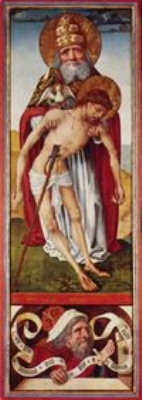
, that God exists as one essence and three persons. This is not considered a form of polytheism because the Gospels repeatedly record Jesus as doing things that are reserved only for God—accepting worship, forgiving sins, working miracles under his own power—, referring to himself and his Father as being one and referring to himself as I AM—that is to say, I Am that I Am
I am that I am

I am that I am is a common English translation of the response God used in the Bible when Moses asked for his name . It is one of the most famous verses in the Torah....
, Yahweh
Yahweh

Image:Tetragrammaton scripts.svg[Aramaic alphabet|Aramaic]] and Hebrew alphabet Yahweh is the English rendering of , a vocalization of the Tetragrammaton that was proposed by the Hebrew scholar Gesenius in the 19th century....
.

Entering into this is the role of angels and saints, especially in Orthodoxy and Catholicism. While angels are accepted as supernatural beings, they exist only to serve God, and with only three exceptions (Michael
Michael (archangel)

Saint Michael is an archangel in Christian and Islamic tradition. He is viewed as the field commander of the Army of God.He is mentioned by name in the Book of Daniel and the Book of Revelation....
, Gabriel
Gabriel

In Abrahamic religions, Gabriel is an angel who serves as a messenger from God. He first appears in the Book of Daniel in the Hebrew Bible. In some traditions he is regarded as one of the archangels, or as the angel of death....
, Rapael
Raphael (archangel)

Raphael is the name of an archangel of Judaism, Christianity and Islam, who performs all manner of healing....
), they are nameless. This number is reduced to in Protestantism two, which excludes the deuterocannical
Deuterocanonical books

"Deuterocanonical books" is a term used since the sixteenth century in the Roman Catholic Church and Eastern Christianity to describe certain books and passages of the Christian Old Testament that are not part of the Jewish Bible....
 Book of Tobit
Book of Tobit

The Book of Tobit or Tobi is a book of scripture that is part of the Roman Catholic Church and Eastern Orthodoxy biblical canon, pronounced canonical by the Council of Carthage of 397 and confirmed for Roman Catholics by the Council of Trent ....
)

Veneration
Veneration

In Christianity, veneration , or veneration of saints, is a special act of honoring a saint: a dead person who has been identified as singular in the traditions of the religion....
 of Saint
Saint

A saint in Christianity is a human being who has been called to holiness. The term is used differently by various denominations, with some, such as the Anglicans, Methodists, and Lutherans distinguishing between Saints and saints....
s in folk Christianity
Folk Christianity

Folk Christianity is composed of Christian ideas and practices outside the approval or authority of a religious establishment?Roman Catholic, Protestant, or other....
 (Christian ideas and practices outside the approval or authority of a religious establishment—Roman Catholic, Protestant, or other) in particular the concept of patron saint
Patron saint

A patron saint is a saint who is regarded as the intercessor and advocate in heaven of a nation, place, craft, activity, class, or person. Patron saints, because they have already transcended to the metaphysical, are able to intercede effectively for the needs of their special charges....
s responsible for a certain aspect of life or society, may in some cases become indistinguishable from polytheism, and indeed in many cases seamlessly continues pre-Christian traditions.. Such traditions, however, tend to develop outside sanctioned teachings. Popular piety
Popular piety

Popular piety refers to religious practices that arose and occur outside of the official Church. Typically the term is used within the context of the Catholic church, the practices are generally accepted and allowed....
 might be allowed, or at least tolerated, but outright synchretic movements are condemned. Saints are prayed to, but in the sense that the saint prays with the person. A saint in heaven has no power of his own, but merely petitions God to grant a request, as God alone has true power.

Islam
Islam
Islam

Islam is a Monotheism, Abrahamic religion originating with the teachings of the Prophets of Islam Muhammad, a 7th century Arab religious and political figure....
 is monotheistic, believing solely in Allah
Allah

Allah is the standard Arabic language word for God. While the term is best known in the Western world for its use by Muslims as a reference to God, it is used by Arabic-speakers of all Abrahamic faiths, including Christians and Jews, in reference to "God"....
 (though "Allah" is essentially the same god as those of the other Abrahamic faiths). According to the Islamic holy book, the
Qur'an
Qur'an

The Qur?an is the central religious text of Islam. Muslims believe the Qur?an to be the book of divine guidance and direction for mankind, and consider the original Arabic text to be the final revelation of God....
, shirk
Shirk (polytheism)

Shirk is the Islamic concept of the sin of polytheism specifically, but in a more general way refers to worshipping other than Allah, associating partners with him, giving his characteristics to others beside him, or not believing in his characteristics....
, or polytheism, is the worst of sins. Muslims believe that Christianity is polytheism because of most Christian's beliefs in the trinity.

Judaism
Judaism
Judaism

Judaism is a set of beliefs and practices originating in the Hebrew Bible , as later further explored and explained in the Talmud and other texts....
 is monotheistic, believing solely in Yahweh
Yahweh

Image:Tetragrammaton scripts.svg[Aramaic alphabet|Aramaic]] and Hebrew alphabet Yahweh is the English rendering of , a vocalization of the Tetragrammaton that was proposed by the Hebrew scholar Gesenius in the 19th century....
, and therefore rejects polytheism. Judaism specifically prohibits polytheism as idolatry
Idolatry

Idolatry is usually defined as worship of any cult image, idea, or Object , as opposed to the worship of a monotheistic God. It is considered a major sin in the Abrahamic religions whereas in religions where such activity is not considered as sin, the term "idolatry" itself is absent....
, or
avodah zarah. It is disupted whether shittuf, or associating a lesser power to a deity lesser than Yahweh, is allowed for gentiles, but it is forbidden for Jews.

The punishment for polytheism in the Old Testament
Old Testament

In Western Christianity, the Old Testament refers to the books that form the first of the two-part Christianity Bible Biblical canon. These works correspond to the Hebrew Bible , with some variations and additions....
 was death. There is also a theoretical death penalty for polytheistic worship in the seven Noahide Laws
Noahide Laws

The Seven Laws of Noah , often referred to as the Noahide Laws, are a set of seven moral imperatives that, according to the Talmud, were given by Names of God in Judaism to Noah as a binding set of laws for all Human....
.

There is, however, a population of Jewish Pagans (Jewitch).

Rastafari
Rastafari is monotheistic, believing solely in Jah
Jah

Jah is the shortened name for God YHWH, most commonly used in the Rastafari movement. It comes from the Hebrew ???? = Yah ....
. Rastas believe that Jah has incarnated onto Earth in human form twice, as Jesus Christ and as Haile Selassie, and worship them both. Rastas deny that this constitutes polytheism.

Indian religions

Sikhism
Sikhism
Sikhism

Sikhism , founded on the teachings of Guru Nanak and ten successive Sikh Gurus in fifteenth century Punjab region, is the Major religious groups organized religion in the world....
 is monotheistic, believing solely in Waheguru
Waheguru

Waheguru It is the term most often used in Sikhism to refer to God, the Supreme Being or the creator of all. It means "The Wonderful Teacher" in the Punjabi language....
, and therefore rejects polytheism. It does not declare that there should be any punishment for polytheists.

See also

Types of Theism
Theism

Theism, in its most inclusive usage, is the belief in at least one deity. Less inclusive usages specify that the deity believed in be a distinct identifiable entity, thereby contrasted with pantheism....
  • Atheism
    Atheism

    Atheism is the absence or rejection of belief in deity, or the explicit view that Existence of God.Many list of atheists are Skepticism of all supernatural beings and cite a lack of empiricism evidence for the existence of deities....
  • Bitheism
    Dualism

    Dualism denotes a state of two parts. The word's origin is the Latin duo, "two" . The term 'dualism' was originally coined to denote co-eternal binary opposition, a meaning that is preserved in metaphysical and philosophical duality discourse but has been diluted in general usage....
  • Henotheism
    Henotheism

    Henotheism is a term coined by Max M?ller, to mean worshiping a single god while accepting the existence or possible existence of other deity. M?ller made the term central to his criticism of Western theology and religion exceptionalism , focusing on a cultural dogma which held "monotheism" to be both fundamentally well-defined and inhe...
  • Integrational polytheism
    Integrational polytheism

    Integrational Polytheism is a form of polytheism in which one believes in the existence of not several, but of all the deity ever described.It has also been known as Eclectic Polytheism or Inclusional Polytheism....
  • Monotheism
    Monotheism

    In theology, monotheism is the belief that only one god exists. The concept of "monotheism" tends to be dominated by the concept of God in the Abrahamic religions, such as Judaism, Christianity and Islam, and the Neoplatonism concept of God as put forward by Pseudo-Dionysius the Areopagite....
  • Pantheism
    Pantheism

    Pantheism is the view that everything is part of an all-encompassing Immanence abstract God. In pantheism the Universe, or nature, and God are equivalent....
Other
  • Apotheosis
    Apotheosis

    Apotheosis refers to the exaltation of a subject to divinity level. The term has meanings in theology, where it refers to a belief, and in art, where it refers to a genre....
  • Culture hero
    Culture hero

    A culture hero is a mythological hero specific to some group who changes the world through invention or discovery . A typical culture hero might be credited as the discoverer of fire, or agriculture, folk music, tradition and religion, and is usually the most important legendary figure of a people, sometimes as the founder of its ruling dyna...
  • Demigod
    Demigod

    The term "demigod", meaning "half-god", is used to describe mythological figures whose one parent was a god and whose other parent was human. Demi-gods include the Celtic hero C?chulainn, Gilgamesh, and Heracles....
  • Folk religion
    Folk religion

    Folk religion consists of beliefs, superstitions and rituals transmitted from generation to generation in a specific culture. It could be contrasted with an organized religion or historical religion in which founders, creed, theology and ecclesiastical organizations are present....
  • Folklore
    Folklore

    Folklore is the body of expressive culture, including tales, music, dance, legends, oral history, proverbs, jokes, superstitions, customs, and so forth within a particular population comprising the traditions of that culture, subculture, or group ....
  • Hero cult
  • Idolatry
    Idolatry

    Idolatry is usually defined as worship of any cult image, idea, or Object , as opposed to the worship of a monotheistic God. It is considered a major sin in the Abrahamic religions whereas in religions where such activity is not considered as sin, the term "idolatry" itself is absent....
  • Myth and ritual
    Myth and ritual

    In traditional societies, myth and ritual are two central components of religious practice. Although Mythology and ritual are commonly united as parts of religion, the exact relationship between them has been a matter of controversy among scholars....
  • Neopaganism
    Neopaganism

    Neopaganism or Neo-Paganism is an umbrella term used to identify a wide variety of new religious movement, particularly those influenced by pre-Christian "Paganism" beliefs of Europe....
  • Paganism
    Paganism

    Paganism is the blanket term given to describe religions and spiritual practices of pre-Christian Europe, and by extension a term for polytheistic?traditions or folk religion?worldwide seen from a Western or Christian viewpoint....
  • Polytheistic reconstructionism
    Polytheistic reconstructionism

    Polytheistic reconstructionism is an approach to Neopaganism first emerging in the late 1960s to early 1970s, and gathering momentum in the 1990s to 2000s....
  • Religion
    Religion

    A religion is an organized approach to human spirituality which usually encompasses a set of myth, symbols, beliefs and practices, often with a supernatural or transcendence quality, that give meaning to the practitioner's experiences of life through reference to a higher power or truth....
  • Sacred king
    Sacred king

    For the office under ancient Rome, see Rex Sacrorum. In many historical societies, the office of monarch carries a sacral meaning, that is, it is identical with that of a high priest and of judge....
  • Shirk (polytheism)
    Shirk (polytheism)

    Shirk is the Islamic concept of the sin of polytheism specifically, but in a more general way refers to worshipping other than Allah, associating partners with him, giving his characteristics to others beside him, or not believing in his characteristics....


Further reading

  • Assmann, Jan, 'Monotheism and Polytheism' in: Sarah Iles Johnston (ed.), Religions of the Ancient World: A Guide, Harvard University Press (2004), ISBN 0674015177, pp. 17-31.
  • Burkert, Walter
    Walter Burkert

    Walter Burkert , a scholar of Greek mythology and Cult , is an emeritus professor of classics at the University of Zurich, Switzerland, and also has taught in the United Kingdom and the United States....
    ,
    Greek Religion: Archaic and Classical, Blackwell (1985), ISBN 0631156240.
  • Greer, John Michael
    John Michael Greer

    John Michael Greer is an author, historian of ideas, Hermeticist and Druid who resides in Ashland, Oregon. He currently serves as the Grand Archdruid of the Ancient Order of Druids in America, a position he has held since 2002....
    ;
    A World Full of Gods: An Inquiry Into Polytheism, ADF Publishing (2005), ISBN 0-976-56810-1
  • Iles Johnston, Sarah; Ancient Religions, Belknap Press (September 15, 2007), ISBN 0-674-02548-2
  • Paper, Jordan; The Deities are Many: A Polytheistic Theology, State University of New York Press (March 3, 2005), ISBN 978-0791463871
  • Penchansky, David, Twilight of the Gods: Polytheism in the Hebrew Bible (2005), ISBN 0664228852.


External links

  • - APT, a UK-based community of Polytheists.
  • Philosophical project promoting polytheism by group monochrom
    Monochrom

    monochrom is an international art-technology-philosophy group, founded in 1993. Its offices are located at Museumsquartier/Vienna .The group's members are: Johannes Grenzfurthner, Evelyn F?rlinger, Harald List, Anika Kronberger, Franz Ablinger, Frank Apunkt Schneider, Daniel Fabry, G?nther Friesinger....