

Restoration Movement

Encyclopedia
The Restoration Movement (also known as the American Restoration Movement or the Stone-Campbell Movement) is a Christian
movement that began on the American frontier during the Second Great Awakening
of the early 19th century. The movement sought to restore the church and "the unification of all Christians in a single body patterned after the church of the New Testament." They do not consider themselves to be Protestants.
The Restoration Movement developed from several independent efforts to return to apostolic Christianity
, but two groups, which independently developed similar approaches to the Christian faith, were particularly important to the development of the movement. The first, led by Barton W. Stone
, began at Cane Ridge, Kentucky and called themselves simply "Christians
". The second began in western Pennsylvania and Virginia (now West Virginia) and was led by Thomas Campbell and his son, Alexander Campbell; they used the name "Disciples of Christ
". Both groups sought to restore the whole Christian church on the pattern set forth in the New Testament
, and both believed that creed
s kept Christianity divided. In 1832 they joined in fellowship with a handshake.
Among other things, they were united in the belief that Jesus
is the Christ, the Son of God
; that Christians should celebrate the Lord's Supper
on the first day of each week; and that baptism of adult believers
by immersion in water
is a necessary condition for salvation
. Because the founders wanted to abandon all denominational labels
, they used the biblical names for the followers of Jesus. Both groups promoted a return to the purposes of the 1st-century churches
as described in the New Testament.
The Restoration Movement has since divided into multiple separate groups. There are three main branches in the U.S.: the Churches of Christ, the Christian churches and churches of Christ, and the Christian Church (Disciples of Christ)
. Some see divisions in the movement as the result of the tension between the goals of restoration and ecumenism
, with the Churches of Christ and Christian churches and churches of Christ resolving the tension by stressing restoration, while the Christian Church (Disciples of Christ)
resolved the tension by stressing ecumenism. A number of groups outside the U.S. also have historical associations with this movement, such as the Evangelical Christian Church in Canada, and the Churches of Christ in Australia
.
 During the late Middle Ages
, some early dissenters such as John Wycliff and John Huss
called for a restoration of a primitive form of Christianity, but they were driven underground. As a result, some scholars believe it is difficult to find any direct links between such early dissenters and the restoration movement.
Beginning with the Renaissance
period, intellectual roots become easier to discern. At the heart of the Reformation
was an emphasis on the principle of "Scripture alone" (sola scriptura
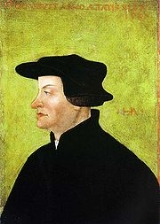
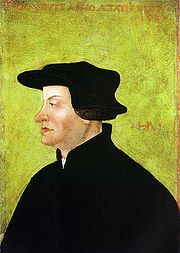
). This, along with the related insistence on the right of individuals to read and interpret the Bible for themselves and a movement to reduce ritual, formed part of the intellectual background of early Restoration Movement leaders. The branch of the Reformation movement represented by Huldrych Zwingli
and John Calvin
also contributed an emphasis on "restoring biblical forms and patterns."
 The rationalism of John Locke
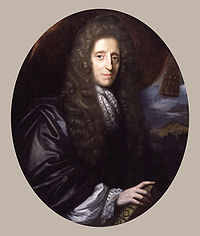
provided another influence. Reacting to the deism
of Lord Herbert
, Locke sought a way to address religious division and persecution without abandoning Scripture. To do this, Locke argued against the right of government to enforce religious orthodoxy and turned to the Bible to supply a set of beliefs that all Christians could agree upon. The core teachings which he viewed as essential were the messiah
ship of Jesus
and Jesus' direct commands. Christians could be devoutly committed to other Biblical teachings but, in Locke's view, they were non-essentials over which Christians should never fight or try to coerce each other. Unlike the Puritans and the later Restoration Movement, Locke did not call for a systematic restoration of the early church.
One of the basic goals of the English
Puritan
s was to restore a pure, "primitive" church that would be a true apostolic community. This conception was a critical influence in the development of the Puritans in Colonial America.
During the First Great Awakening
, a movement developed among those Baptists known as Separate Baptists. Two themes of this movement were the rejection of creed
s and "freedom in the Spirit." The Separate Baptists saw Scripture as the "perfect rule" for the church. However, while they turned to the Bible for a structural pattern for the church, they did not insist on complete agreement on the details of that pattern. This group originated in New England
, but was especially strong in the South
where the emphasis on a biblical pattern for the church grew stronger. In the last half of the 18th century, Separate Baptists became more numerous on the western frontier of Kentucky
and Tennessee
, where the Stone and Campbell movements would later take root. The development of the Separate Baptists in the southern frontier helped prepare the ground for the Restoration Movement. The membership of both the Stone and Campbell groups drew heavily from among the ranks of the Separate Baptists.
Separate Baptist restorationism also contributed to the development of the Landmark Baptists
in the same area as the Stone-Campbell Restoration Movement at about the same time. Under the leadership of James Robinson Graves
, this group looked for a precise blueprint for the primitive church, believing that any deviation from that blueprint would keep one from being part of the true church.
 The ideal of restoring a "primitive" form of Christianity grew in popularity in the U.S. after the American Revolution
. This desire to restore a purer form of Christianity played a role in the development of many groups during this period, known as the Second Great Awakening
, including the Mormons
, Baptists
and Shakers
. The Restoration Movement began during, and was greatly influenced by, this second Awakening. While the Campbells resisted what they saw as the spiritual manipulation of the camp meetings, the Southern phase of the Awakening "was an important matrix of Barton Stone's reform movement" and shaped the evangelistic techniques used by both Stone and the Campbells.
James O'Kelly
was an early advocate of seeking unity through a return to New Testament Christianity. In 1792, dissatisfied with the role of bishops in the Methodist Episcopal Church
, he separated from that body. O'Kelly's movement, centering in Virginia
and North Carolina
, was originally called Republican Methodists. In 1794 they adopted the name Christian Church.
During the same period, Elias Smith of Vermont
and Abner Jones
of New Hampshire
led a movement espousing views similar to those of O’Kelly. They believed that members could, by looking to scripture alone, simply be Christians without being bound to human traditions and the denominations that had been brought over from Europe.
Barton W. Stone
was born to John and Mary Stone in 1772 in Port Tobacco, Maryland. During his childhood, the boy grew up within the Church of England
, then had Baptist
, Methodist and Episcopal church influences as well. Preachers representing Baptists and Methodists came to the area during the Second Great Awakening, and Baptist and Methodist chapels were founded in the county.
Barton entered the Guilford Academy in North Carolina
in 1790. While there, Stone heard James McGready
(a Presbyterian minister) speak. A few years later, he became a Presbyterian minister. But, as Stone looked more deeply into the beliefs of the Presbyterians, especially the Westminster Confession of Faith
, he doubted that some of the church beliefs were truly Bible-based. He was unable to accept the Calvinistic doctrines of total depravity
, unconditional election
and predestination
. He also believed that "Calvinism's alleged theological sophistication had . . . been bought at the price of fomenting division" and "blamed it . . . for producing ten different sects within the Presbyterian tradition alone."
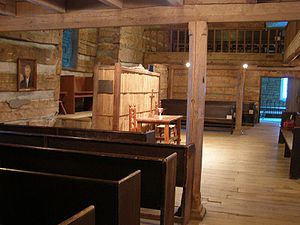 In 1801, the Cane Ridge Revival in Kentucky
planted the seed for a movement in Kentucky
and the Ohio River
valley to disassociate from denominationalism
. In 1803 Stone and others withdrew from the Kentucky Presbytery and formed the Springfield Presbytery
. The defining event of the Stone wing of the movement was the publication of Last Will and Testament of The Springfield Presbytery
, at Cane Ridge, Kentucky, in 1804. The Last Will is a brief document in which Stone and five others announced their withdrawal from Presbyterianism and their intention to be solely part of the body of Christ. The writers appealed for the unity of all who follow Jesus, suggested the value of congregational self-governance, and lifted the Bible as the source for understanding the will of God. They denounced the divisive use of the Augsburg Confession
, and adopted the name "Christian" to identify their group.
or "Christian Church."
While restoring primitive Christianity was central to the Stone movement, they saw restoring the lifestyle of the early church as essential, and during the early years "focused more . . . on holy and righteous living than on the forms and structures of the early church. The group did also seek to restore the primitive church. However, due to concern that emphasizing particular practices could undermine Christian freedom, this effort tended to take the form of rejecting tradition rather than an explicit program of reconstructing New Testament practices. The emphasis on freedom was strong enough that the movement avoided developing any ecclesiastical traditions, resulting in a movement that was "largely without dogma, form, or structure." What held "the movement together was a commitment to primitive Christianity."
Another theme was that of hastening the millennium
. Many Americans of the period believed that the millennium was near and based their hopes for the millennium on their new nation, the United States
. Members of the Stone movement believed that only a unified Christianity based on the apostolic
church, rather than a country or any of the existing denominations, could lead to the coming of the millennium. Stone's millennialism has been described as more "apocalyptic" than that of Alexander Campbell, in that he believed people were too flawed to usher in a millennial age through human progress. Rather, he believed that it depended on the power of God, and that while waiting for God to establish His kingdom, one should live as if the rule of God were already fully established.
For the Stone movement, this had less to do with eschatological
theories and more about a countercultural commitment to live as if the kingdom of God were already established on earth. This apocalyptic perspective or world view led many in the Stone movement to adopt pacifism, avoid participating in civil government, and reject violence, militarism, greed, materialism and slavery
.
 The Campbell wing of the movement was launched when Thomas Campbell published the Declaration and Address of the Christian Association of Washington
in 1809. The Presbyterian Synod had suspended his ministerial credentials. In The Declaration and Address he set forth some of his convictions about the church of Jesus Christ, as he organized the Christian Association of Washington
, in Washington County, Pennsylvania
, not as a church but as an association of persons seeking to grow in faith. On May 4, 1811, the Christian Association constituted itself as a congregationally governed church. With the building it constructed at Brush Run, Pennsylvania
, it became known as Brush Run Church
. When their study of the New Testament led the reformers to begin to practice baptism by immersion
, the nearby Redstone Baptist Association invited Brush Run Church to join with them for the purpose of fellowship. The reformers agreed, provided that they would be "allowed to preach and to teach whatever they learned from the Scriptures."
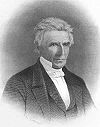 Thomas' son Alexander immigrated to the US to join him in 1809, and before long assumed the leading role in the movement.
The Campbells worked within the Redstone Baptist Association during the period 1815 through 1824. While both the Campbells and the Baptists shared practices of baptism by immersion and congregational polity
, it was soon clear that he and his associates were not traditional Baptists. Within the Redstone Association, some of the Baptist leaders considered the differences intolerable when Alexander Campbell began publishing a journal, The Christian Baptist, which promoted reform. Campbell anticipated the conflict and moved his membership to a congregation of the Mahoning Baptist Association in 1824.
Alexander used The Christian Baptist to address what he saw as the key issue of reconstructing the apostolic Christian community in a systematic and rational manner. He wanted to clearly distinguish between essential and non-essential aspects of primitive Christianity. Among what he identified as essential were "congregational autonomy, a plurality
of elders
in each congregation, weekly communion and immersion for the remission of sins." Among practices he rejected as non-essential were "the holy kiss, deaconesses, communal living, footwashing and charismatic exercises."
.jpg) In 1827, the Mahoning Association appointed Walter Scott
In 1827, the Mahoning Association appointed Walter Scott
as an evangelist
. Through Scott’s efforts, the Mahoning Association grew rapidly. In 1828, Thomas Campbell visited several of the congregations formed by Scott and heard him preach. Campbell believed that Scott was bringing an important new dimension to the movement with his approach to evangelism
.
Several Baptist associations began disassociating congregations that refused to subscribe to the Philadelphia Confession. The Mahoning Association came under attack. In 1830, The Mahoning Baptist Association disbanded. The younger Campbell ceased publication of the Christian Baptist. In January 1831, he began publication of the Millennial Harbinger.
had a significant influence on the Campbell movement. Thomas Campbell was a student of the Enlightenment philosopher
John Locke
. While he did not explicitly use the term "essentials," in the Declaration and Address, Campbell proposed the same solution to religious division as had been advanced earlier by Herbert and Locke: "[R]educe religion to a set of essentials upon which all reasonable persons might agree." The essentials he identified were those practices for which the Bible provided "a 'Thus saith the Lord,' either in express terms or by approved precedent." Unlike Locke, who saw the earlier efforts by Puritans as inherently divisive, Campbell argued for "a complete restoration of apostolic Christianity." Thomas believed that creeds served to divide Christians. He also believed that the Bible was clear enough that anyone could understand it and, thus, creeds were unnecessary.
Alexander Campbell was also deeply influenced by Enlightenment thinking, in particular the Scottish School of Common Sense of Thomas Reid
and Dugald Stewart
. This group saw the Bible as providing concrete facts rather than abstract truths, and advocated a scientific or Baconian
approach to interpreting the Bible that would begin with those facts, arrange the ones applicable to a given topic, and then use them to draw conclusions. Alexander Campbell reflected this approach, when arguing that "the Bible is a book of facts, not of opinions, theories, abstract generalities, nor of verbal definitions." He believed that if Christians would limit themselves to the facts found in the Bible, they would necessarily come to agreement. He saw those facts as providing a blueprint or constitution for the church.
Alexander Campbell's millennialism was more optimistic than Stone's. He had more confidence in the potential for human progress and believed that Christians could unite to transform the world and initiate a millennial age. Campbell's conceptions were postmillennial
, as he anticipated that the progress of the church and society would lead to an age of peace and righteousness before the return of Christ
. This optimistic approach meant that, in addition to his commitment to primitivism, he had a progressive strand in his thinking.
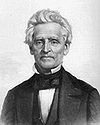 The Stone and Campbell movements merged in 1832. This was formalized at the High Street Meeting House in Lexington, Kentucky
with a handshake between Barton W. Stone and "Raccoon" John Smith. Smith had been chosen, by those present, to speak in behalf of the followers of the Campbells. A preliminary meeting of the two groups was held in late December 1831, culminating with the merger on January 1, 1832.
Two representatives of those assembled were appointed to carry the news of the union to all the churches: John Rogers, for the Christians and "Raccoon" John Smith for the reformers. Despite some challenges, the merger succeeded. Many believed the union held great promise for the future success of the combined movement, and greeted the news enthusiastically.
With the merger, there was the challenge of what to call the new movement. Clearly, finding a Biblical, non-sectarian name was important. Stone wanted to continue to use the name "Christians." Alexander Campbell insisted upon "Disciples of Christ". As a result, both names were used. The confusion over names has been present ever since.
From the beginning of the movement, the free exchange of ideas among the people was fostered by the journals published by its leaders. Alexander Campbell published The Christian Baptist and The Millennial Harbinger. Stone published The Christian Messenger. In a respectful way, both men routinely published the contributions of others whose positions were radically different from their own.
Following Campbell’s death in 1866, journals continued to keep the discussion and conversation alive. Between 1870 and 1900, two journals emerged as the most prominent. The Christian Standard was edited and published by Isaac Errett of Cincinnati. The Christian Evangelist was edited and published by J. H. Garrison from St. Louis. The two men enjoyed a friendly rivalry, and kept the dialog going within the movement.
In 1855 the Gospel Advocate
, emanating from Nashville
, began publication under the editorship of Tolbert Fanning and William Lipscomb. Suspended by the American Civil War
in 1861, the Gospel Advocate re-emerged in 1866 under the editorship of Tolbert Fanning together with William Lipscomb's younger brother, David Lipscomb
. In the segueing decades the Gospel Advocate consistently opposed missionary societies and instrumental music in worship as innovations incompatible with the original Stone-Campbell objective of restoring the New Testament
character of the church. Just prior to a religious census of the United States in 1906, David Lipscomb, who earlier had opposed segmenting the Stone-Campbell Movement, indicated to the United States Census Bureau
that the differences among the congregations over the two aforementioned innovations had become so widely acknowledged that the census should enumerate the Disciples of Christ and the Churches of Christ separately, the latter group having become identified with the Gospel Advocate.
A fourth journal became part of the conversation with the publication in 1884 of The Christian Oracle, later to become The Christian Century, with an interdenominational appeal. In 1914, Garrison’s Christian Publishing company was purchased by R. A. Long, who then established a non-profit corporation, “The Christian Board of Publication” as the Brotherhood publishing house.
When Stone and Alexander Campbell's Reformers (also known as Disciples and Christian Baptists) united in 1832, only a minority of Christians from the Smith/Jones and O'Kelly movements participated. Those that did were from congregations west of the Appalachian Mountains
that had come into contact with the Stone movement. The eastern members had several key differences with the Stone and Campbell group: an emphasis on conversion experience, quarterly observance of communion
, and nontrinitarianism
. Those who did not unite with Campbell merged with the Congregational Churches in 1931 to form the Congregational Christian Churches
. In 1957, the Congregational Christian Church merged with the Evangelical and Reformed Church
to become the United Church of Christ
.
. He did not attend the gathering. Among its actions, the convention elected Alexander Campbell its President and created The American Christian Missionary Society (ACMS). By the end of the century, The Foreign Christian Missionary Society and the Christian Women's Board of Missions were also engaged in missionary activities. Forming the ACMS clearly did not reflect a consensus of the entire movement, and these para-church organizations became a divisive issue. In the succeeding decades, for some congregations and their leaders, co-operative work through missionary societies and the adoption of instrumental music was straying too far. Division over these issues grew after the American Civil War.
The use of musical instrument
s in worship was discussed in journal articles as early as 1849, though initial reactions were generally unfavorable. However, some congregations are known to have been using musical instruments in the 1850s and 1860s. Both acceptance of instruments and discussion of the issue grew after the American Civil War
. Opponents argued that the New Testament provided no authorization for their use in worship, while supporters argued on the basis of expediency and Christian liberty. Affluent
, urban
congregations were more likely to adopt musical instruments, while poorer and more rural congregations tended to see them as "an accommodation to the ways of the world."
The early 19th century Restoration Movement also encompassed very different views concerning the role of clergy: the Campbell branch was strongly anti-clergy, believing there was no justification for a clergy/lay distinction, while the Stone branch had a higher view of clergy, believing that only an ordained minister could officiate at communion.
The Encyclopedia of the Stone-Campbell Movement notes that Restoration Movement historians have tended to interpret the controversy over the use of musical instruments in worship in ways that "reflect their own attitudes on the issue." Examples are given of historians from different branches of the movement interpreting it in relation to the statements of early Restoration Movement leaders, in terms of social and cultural factors, differing approaches to interpreting scripture, differing approaches to the authority of scripture, and "ecumenical progressivism" versus "sectarian primitivism."

, Ohio
with the intention of creating a "general church organization for the furtherance of the work by the church collectively." This action caused immediate disagreements among the churches, because such organizations had previously been abolished. Barton W. Stone himself had in fact taken part in the abolition of the Springfield Presbytery
, and authored at that time a very influential document, The Last Will and Testament of the Springfield Presbytery, which contained within it the idea that the existence of all such bodies was necessarily divisive and hence sinful.
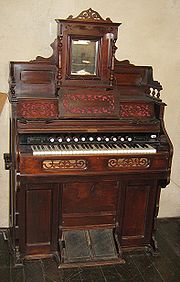 About a decade later, L. L. Pinkerton, who was a member of the Midway
, Kentucky
church brought a melodeon
into the church building. The poor quality of the congregation's singing had the minister at his "breaking point." The instrument was first used for singing practices held on Saturday night, but was soon used during the worship on Sunday. One of the elders of that assembly removed the first melodeon, but it was soon replaced by another. Generally speaking, the bulk of the urban
congregations, particularly in the Northern states, were not totally averse to this development, which was also gaining momentum in the other religious groups around them, while rural
congregations, particularly in the Southern United States
, tended to oppose this trend.
As the 19th century progressed, a division gradually developed between those whose primary commitment was to unity, and those whose primary commitment was to the restoration of the primitive church. Those whose primary focus was unity gradually took on "an explicitly ecumenical
agenda" and "sloughed off the restorationist vision." This group increasingly used the terms "Disciples of Christ" and "Christian Churches" rather than "Churches of Christ." At the same time, those whose primary focus was restoration of the primitive church increasingly used the term "Churches of Christ" rather than "Disciples of Christ."
The rise of women leaders in the temperance and missionary movements also played an important role in separating the Christian Churches and Churches of Christ. In the Christian Churches, many women spoke in public on behalf of the new Christian Woman's Board of Mission (CWBM) and Woman's Christian Temperance Union (WCTU). In contrast, the Churches of Christ largely discouraged women from speaking in public and joining activist women's organizations such as the WCTU. The Erie (IL) Christian Church ordained Clara Celestia Hale Babcock as the first known woman Disciple preacher in 1889.
and the Churches of Christ as separate and distinct groups for the first time. This, however, was simply the recognition of a division that had been growing for years, with published reports as early as 1883. The most obvious distinction between the two groups was the rejection of musical instruments in the Churches of Christ. The controversy over musical instruments began in 1860 with the introduction of organ
s in some churches. More basic were differences in the underlying approach to Biblical interpretation. For the Churches of Christ, any practices not present in accounts of New Testament worship were not permissible in the church, and they could find no New Testament documentation of the use of instrumental music in worship. For the Christian Churches, any practices not expressly forbidden could be considered.
After the division Disciples churches used "Christian Church" as the dominant designation for congregations. While music and the approach to missionary work were the most visible issues, there were also some deeper ones. The process that led to the separation had begun prior to the American Civil War.
Generally speaking, the Disciples of Christ tended to be predominately urban and Northern, while the Churches of Christ were predominately rural and Southern. The Disciples favored college-educated clergy, while the Churches of Christ discouraged formal theological education because they opposed the creation of a professional clergy. Disciples congregations tended to be wealthier and constructed larger, more expensive church buildings; Churches of Christ built more modest structures, and criticized the wearing of expensive clothing in worship. One commentator has described the Disciples "ideal" as reflecting the "businessman" and the Church of Christ "ideal" as reflecting "the simple and austere yeoman farmer."
The Disciples of Christ today are still not totally devoid of the conservative-liberal tension. A movement of conservative congregations and individuals among the Disciples formed the "Disciple Renewal" in 1985. They were motivated by concern about what they perceived as increasingly liberal views among the Disciples fellowship on issues such as the lordship of Christ, the authority of the Bible and homosexuality. In the wake of the rejection in 1985 by the Disciples General Assembly of a resolution on the inspiration of scripture, the Disciple Renewal planned to encourage renewal of the fellowship from within through a journal that was also entitled Disciple Renewal. There was also a concern that the Disciples had abandoned the fundamental principles of the Restoration Movement. The Disciple Heritage Fellowship (website) was established in 1995. It is a fellowship of autonomous congregations, about half of which are formally associated with the Disciples of Christ. As of 2002 the Disciples Heritage Fellowship included 60 congregations and 100 "supporting" churches. It is closely related to the Confessing Movement
found in several other mainline denominations.
Some see divisions in the movement as the result of the tension between the goals of restoration and ecumenism, with the churches of Christ and Christian churches and churches of Christ resolving the tension by stressing restoration while the Christian Church (Disciples of Christ)
resolved the tension by stressing ecumenism.
During the first half of the 20th century the opposing factions among the Christian Churches coexisted, but with discomfort. The three Missionary Societies were merged into the United Christian Missionary Society in 1920. Human service ministries grew through the National Benevolent Association providing assistance to orphans, the elderly and the disabled. By mid century, the cooperative Christian Churches and the independent Christian Churches were following different paths.
By 1926 a split began to form within the Disciples over the future direction of the church. Conservatives within the group began to have problems with the perceived liberalism of the leadership, upon the same grounds described earlier in the accepting of instrumental music in worship. In 1927 they held the first North American Christian Convention
, and the Christian churches and churches of Christ began to emerge as a distinct group from the Disciples, although the break was not totally formalized until the late 1960s. By this time the decennial religious census was a thing of the past and it is impossible to use it as a delineation as it was in 1906.
Following World War II, it was believed that the organizations that had been developed in previous decades no longer effectively met the needs of the postwar era. After a number discussions throughout the 1950s, the 1960 International Convention of Christian Churches adopted a process to plan the "restructure" of the entire organization. The Commission on Restructure, chaired by Granville T. Walker, held its first meeting October 30 & November 1, 1962. In 1968, at the International Convention of Christian Churches (Disciples of Christ), those Christian Churches that favored cooperative mission work adopted a new "provisional design" for their work together, becoming the Christian Church (Disciples of Christ)
. Those congregations that chose not to be associated with the new denominational organization went their own way as the Christian churches and churches of Christ, completing a separation that had begun decades before.
Under the Design, all churches in the 1968 yearbook of Christian Churches (Disciples of Christ) were automatically recognized as part of the Christian Church (Disciples of Christ). In the years that followed, many of the Independent Christian Church Congregations requested formal withdrawal from the yearbook. Many of those congregations became part of the Christian churches and churches of Christ.
The development of the Christian churches and churches of Christ as a separately identifiable religious body from the Christian Church (Disciples of Christ)
(DoC) was a lengthy process. The roots of the separation can be found in the polarization resulting from three major controversies that arose during the early 20th century. One, which was a source of division in other religious groups, was "the theological development of modernism and liberalism." The early stages of the ecumenical movement, which led in 1908 to the Federal Council of Churches, provide a second source of controversy. The third was the practice of open membership, in which individuals who had not been baptized by immersion were granted full membership in the church. Those who supported one of these points of view tended to support the others as well.
The Disciples of Christ were, in 1910, a united, growing community with common goals. Support by the United Christian Missionary Society of missionaries who advocated open membership became a source of contention in 1920. Efforts to recall support for these missionaries failed in a 1925 convention in Oklahoma City
and a 1926 convention in Memphis, Tennessee
. Many congregations withdrew from the missionary society as a result.
A new convention, the North American Christian Convention, was organized by the more conservative congregations in 1927. An existing brotherhood journal, the Christian Standard, also served as a source of cohesion for these congregations. By this time the division between liberals and conservatives was well established.
The official separation between the independent Christian churches and churches of Christ and the Christian Church (Disciples of Christ) is difficult to date. Suggestions range from 1926 to 1971 based on the events outlined below:
Because of this separation, many independent Christian churches and churches of Christ are not only non-denominational, they can be anti-denominational, avoiding even the appearance or language associated with denominationalism
holding true to their Restoration roots.
that is congregational
only, rather than denominational. Churches of Christ purposefully have no central headquarters, councils, or other organizational structure above the local church level. Rather, the independent congregations are a network with each congregation participating at its own discretion in various means of service and fellowship with other congregations (see Sponsoring church (Churches of Christ)). Churches of Christ are linked by their shared commitment to restoration principles.
Since Churches of Christ are autonomous and purposefully do not maintain an ecclesiastical hierarchy or doctrinal council, it is not unusual to find variations from congregation to congregation. The approach taken to restoring the New Testament church has focused on "methods and procedures" such as church organization, the form of worship, and how the church should function. As a result, most divisions among Churches of Christ have been the result of "methodological" disputes. These are meaningful to members of this movement because of the seriousness with which they take the goal of "restoring the form and structure of the primitive church."
Three quarters of the congregations and 87% of the membership are described by The Encyclopedia of the Stone-Campbell Movement as "mainstream", sharing a consensus on practice and theology. The remaining congregations may be grouped into four categories, the largest of which is the churches of Christ (non-institutional)
. Approximately 2,055 congregations fall in this category. The second group does not use separate Bible classes, and consists of approximately 1,100 congregations. A third group does not use multiple communion
cups (approximately 550 congregations; this category overlaps somewhat with those congregations that do not use separate Bible classes for children). The fourth group "emphasize[s] mutual edification by various leaders in the churches and oppose[s] one person doing most of the preaching." This group includes roughly 130 congregations. These groups generally differ from the mainstream consensus in specific practices, rather than in theological perspectives, and tend to have smaller congregations on average.
While there are no official membership statistics for the Churches of Christ, growth appears to have been relatively steady through the 20th century. One source estimates total U.S. membership at 433,714 in 1926, 558,000 in 1936, 682,000 in 1946, 835,000 in 1965 and 1,250,000 in 1994.
(ICOC) had their roots in a "discipling" movement that arose among the mainline Churches of Christ during the 1970s. This discipling movement developed in the campus ministry of Chuck Lucas.
In 1967, Chuck Lucas was minister of the 14th Street Church of Christ in Gainesville
, Florida
(later renamed the Crossroads Church of Christ). That year he started a new project known as Campus Advance (based on principles borrowed from the Campus Crusade and the Shepherding Movement
). Centered on the University of Florida
, the program called for a strong evangelical outreach and an intimate religious atmosphere in the form of soul talks and prayer partners. Soul talks were held in student residences and involved prayer and sharing overseen by a leader who delegated authority over group members. Prayer partners referred to the practice of pairing a new Christian with an older guide for personal assistance and direction. Both procedures led to "in-depth involvement of each member in one another's lives", and critics accused Lucas of fostering cultism.
The Crossroads Movement later spread into some other Churches of Christ. One of Lucas' converts, Kip McKean
, moved to the Boston area in 1979 and began working with "would-be disciples" in the Lexington Church of Christ. He asked them to "redefine their commitment to Christ," and introduced the use of discipling partners. The congregation grew rapidly, and was renamed the Boston Church of Christ. In the early 1980s, the focus of the movement moved to Boston, Massachusetts where Kip McKean
and the Boston Church of Christ became prominently associated with the trend.
With the national leadership located in Boston, during the 1980s it commonly became known as the "Boston movement." A formal break was made from the mainline Churches of Christ in 1993 with the organization of the International Churches of Christ. This new designation formalized a division that was already in existence between those involved with the Crossroads/Boston Movement and "mainline" Churches of Christ. Much of the outside literature during this period refers to it as the "Boston Movement" or occasionally the "Discipling Movement", after the practice of assigning each new church member a mentor who was to "disciple" the newer member through prayer and advice about a wide range of day-to-day decisions.
In November 2002, the McKeans announced their resignations from their roles as World Mission Evangelist, Women's Ministry Leader and Leader of the World Sector Leaders for the ICOC. What followed was a period of increased sovereignty among local churches, what McKean calls a "reactionary 'new vision' of autonomous congregations, consensus leadership with no lead evangelists, the elimination of structured outreach (Bible Talks) and the elimination of discipleship partners." Many in leadership positions issued public apologies for their participation in authoritative abuses, and some resigned or were asked to leave. By 2004, Boston, Atlanta, and New York had lost over 30% of their members, and some entire congregations severed their ties with the ICOC. Local fellowships varied in their reactions to the power vacuum. ICOC Chronicler Chris Lee asserts that three factions emerged, still extant today: a conservative group which seeks a return to the former, authoritarian structure; a moderate group that, "while they recognize that reform is necessary, feel that the current rate of reform is sufficient"; and a reformist group which advocates radical restructuring.
, with fifty representatives of both the Churches of Christ and the Christian churches and churches of Christ. Later meetings were open to all, and were known as "Restoration Forums." Beginning in 1986 they have been held annually, generally in October or November, with the hosting venue alternating between the Churches of Christ and the Christian churches and churches of Christ. Topics discussed have included issues such as instrumental music, the nature of the church, and practical steps for promoting unity. Efforts have been made in the early 21st century to include representatives of the Christian Church (Disciples of Christ)
. These efforts followed the "Stone-Campbell Dialogue," which was a series of meetings beginning in 1999 that included representatives of all three major U.S. branches of the Restoration Movement. The first full meeting in 1999 included six representatives from each of the three traditions. Meetings were held twice annually, and in 2001 were expanded to include anyone associated with the Restoration Movement who was interested in attending. Also, special efforts were made in 2006 to create more intentional fellowship between the various branches of the Movement. This was in conjunction with the one hundredth anniversary of the "official" recognition of the split between the Christian Church and the Churches of Christ by the U.S. Census in 1906. One example of this was the hosting, by Abilene Christian University
(also founded in 1906), of the annual Restoration Unity Forum for 2006, as part of ACU's annual Bible Lectureship. During the program Don Jeanes, president of Milligan College
and Royce Money
, president of ACU, jointly gave a presentation on the first chapter of the Gospel of John
.
Additionally, the compilation and publication of The Encyclopedia of the Stone-Campbell Movement
is evidence that scholars in the three wings still work together on common projects. Collaboration on the Encyclopedia also included representatives of the Christian Church (Disciples of Christ)
.
The term "Restoration Movement" became popular as the 19th century progressed. It appears to have been inspired by Alexander Campbell's essays on "A Restoration of the Ancient Order of Things" in the Christian Baptist. This name has remained popular among the Churches of Christ and the Christian churches and churches of Christ. Because of the emphasis it places on the theme of restoration, it has been a less comfortable fit for those whose primary focus has been on the theme of unity. Historically, the term "Disciples of Christ" has also been used by some as a collective designation for the movement. It has evolved, however, into a designation for a particular branch of the movement - the Christian Church (Disciples of Christ)
- as a result of the divisions of the late 19th and early 20th centuries.
The term "Stone-Campbell Movement" emerged towards the end of the 20th century as a way to avoid the difficulties associated with some of the other names that have been used, and to maintain a sense of the collective history of the movement. Other names that have been used include "the Brotherhood", "the Cause" and "the churches." While the use of the word "movement" is supported by a fairly broad consensus, no single terminology is generally accepted or has official status.
A number of slogans have been used in the Restoration Movement, which are intended to express some of the distinctive themes of the Movement. These include:
All of the three major U.S. branches of the Movement share the following characteristics:
provides a link for many national profiles.
Their genealogies are representative of developments in North America. Their theological orientation ranges from fundamentalist to liberal to ecumenical. In some places they have joined with churches of other traditions to form united churches at local, regional or national level.
The use of instrumental music in worship was not a source of division among the Churches of Christ in Great Britain before World War I. More significant was the issue of pacifism
; a national conference was established in 1916 for congregations that opposed the war. A conference for "Old Paths" congregations was first held in 1924. The issues involved included concern that the Christian Association was compromising traditional principles in seeking ecumenical ties with other organizations and a sense that it had abandoned Scripture as "an all-sufficient rule of faith and practice." Two "Old Paths" congregations withdrew from the Association in 1931; an additional two withdrew in 1934, and nineteen more withdrew between 1943 and 1947.
Membership declined rapidly during and after the First World War. The Association of Churches of Christ in Britain disbanded in 1980. Most Association congregations (approximately 40) united with the United Reformed Church
in 1981. In the same year, twenty-four other congregations formed a Fellowship of Churches of Christ. The Fellowship developed ties with the Christian churches and churches of Christ during the 1980s.
The Fellowship of Churches of Christ and some Australian and New Zealand Churches advocate a "missional" emphasis with an ideal of "Five Fold Leadership." Many people in more traditional Churches of Christ see these groups as having more in common with Pentecostal
churches. The main publishing organs of traditional Churches of Christ in Britain are The Christian Worker magazine and the Scripture Standard magazine. A history of the Association of Churches of Christ, Let Sects and Parties Fall, was written by David M Thompson.
While early Churches of Christ in Australia saw creeds as divisive, towards the end of the 19th century they began viewing "summary statements of belief" as useful in tutoring second generation members and converts from other religious groups. The period from 1875 through 1910 also saw debates over the use of musical instruments in worship, Christian Endeavor Societies and Sunday Schools. Ultimately, all three found general acceptance in the movement.
Currently, the Restoration Movement is not as divided in Australia
as it is in the United States. There have been strong ties with the Christian Church (Disciples of Christ)
, but many conservative ministers and congregations associate with the Christian churches and churches of Christ instead. Others have sought support from non-instrumental Churches of Christ, particularly those who felt that "conference" congregations had "departed from the restoration ideal."
Christian
A Christian is a person who adheres to Christianity, an Abrahamic, monotheistic religion based on the life and teachings of Jesus of Nazareth as recorded in the Canonical gospels and the letters of the New Testament...
movement that began on the American frontier during the Second Great Awakening
Second Great Awakening
The Second Great Awakening was a Christian revival movement during the early 19th century in the United States. The movement began around 1800, had begun to gain momentum by 1820, and was in decline by 1870. The Second Great Awakening expressed Arminian theology, by which every person could be...
of the early 19th century. The movement sought to restore the church and "the unification of all Christians in a single body patterned after the church of the New Testament." They do not consider themselves to be Protestants.
The Restoration Movement developed from several independent efforts to return to apostolic Christianity
Apostolic Age
The Apostolic Age of the history of Christianity is traditionally the period of the Twelve Apostles, dating from the Crucifixion of Jesus and the Great Commission in Jerusalem until the death of John the Apostle in Anatolia...
, but two groups, which independently developed similar approaches to the Christian faith, were particularly important to the development of the movement. The first, led by Barton W. Stone
Barton W. Stone
Barton Warren Stone was an important preacher during the Second Great Awakening of the early 19th century. He was first ordained a Presbyterian minister, then was expelled from the church after the Cane Ridge, Kentucky revival for his stated beliefs in faith as the sole prerequisite for salvation...
, began at Cane Ridge, Kentucky and called themselves simply "Christians
Christians (Stone Movement)
The Christians were a group arising during the Second Great Awakening of the early 19th century. The most prominent leader was Barton W. Stone. The group was committed to restoring primitive Christianity...
". The second began in western Pennsylvania and Virginia (now West Virginia) and was led by Thomas Campbell and his son, Alexander Campbell; they used the name "Disciples of Christ
Disciples of Christ (Campbell Movement)
The Disciples of Christ were a group arising during the Second Great Awakening of the early 19th century. The most prominent leaders were Thomas and Alexander Campbell. The group was committed to restoring primitive Christianity...
". Both groups sought to restore the whole Christian church on the pattern set forth in the New Testament
New Testament
The New Testament is the second major division of the Christian biblical canon, the first such division being the much longer Old Testament....
, and both believed that creed
Creed
A creed is a statement of belief—usually a statement of faith that describes the beliefs shared by a religious community—and is often recited as part of a religious service. When the statement of faith is longer and polemical, as well as didactic, it is not called a creed but a Confession of faith...
s kept Christianity divided. In 1832 they joined in fellowship with a handshake.
Among other things, they were united in the belief that Jesus
Jesus
Jesus of Nazareth , commonly referred to as Jesus Christ or simply as Jesus or Christ, is the central figure of Christianity...
is the Christ, the Son of God
Son of God
"Son of God" is a phrase which according to most Christian denominations, Trinitarian in belief, refers to the relationship between Jesus and God, specifically as "God the Son"...
; that Christians should celebrate the Lord's Supper
Eucharist
The Eucharist , also called Holy Communion, the Sacrament of the Altar, the Blessed Sacrament, the Lord's Supper, and other names, is a Christian sacrament or ordinance...
on the first day of each week; and that baptism of adult believers
Believer's baptism
Believer's baptism is the Christian practice of baptism as this is understood by many Protestant churches, particularly those that descend from the Anabaptist tradition...
by immersion in water
Immersion baptism
Immersion baptism is a method of baptism that is distinguished from baptism by affusion and by aspersion , sometimes without specifying whether the immersion is total or partial, but very commonly with the indication that the person baptized is immersed completely...
is a necessary condition for salvation
Salvation
Within religion salvation is the phenomenon of being saved from the undesirable condition of bondage or suffering experienced by the psyche or soul that has arisen as a result of unskillful or immoral actions generically referred to as sins. Salvation may also be called "deliverance" or...
. Because the founders wanted to abandon all denominational labels
Christian denomination
A Christian denomination is an identifiable religious body under a common name, structure, and doctrine within Christianity. In the Orthodox tradition, Churches are divided often along ethnic and linguistic lines, into separate churches and traditions. Technically, divisions between one group and...
, they used the biblical names for the followers of Jesus. Both groups promoted a return to the purposes of the 1st-century churches
Christianity in the 1st century
The earliest followers of Jesus composed an apocalyptic, Jewish sect, which historians refer to as Jewish Christianity. The Apostles and others following the Great Commission's decree to spread the teachings of Jesus to "all nations," had great success spreading the religion to gentiles. Peter,...
as described in the New Testament.
The Restoration Movement has since divided into multiple separate groups. There are three main branches in the U.S.: the Churches of Christ, the Christian churches and churches of Christ, and the Christian Church (Disciples of Christ)
Christian Church (Disciples of Christ)
The Christian Church is a Mainline Protestant denomination in North America. It is often referred to as The Christian Church, The Disciples of Christ, or more simply as The Disciples...
. Some see divisions in the movement as the result of the tension between the goals of restoration and ecumenism
Ecumenism
Ecumenism or oecumenism mainly refers to initiatives aimed at greater Christian unity or cooperation. It is used predominantly by and with reference to Christian denominations and Christian Churches separated by doctrine, history, and practice...
, with the Churches of Christ and Christian churches and churches of Christ resolving the tension by stressing restoration, while the Christian Church (Disciples of Christ)
Christian Church (Disciples of Christ)
The Christian Church is a Mainline Protestant denomination in North America. It is often referred to as The Christian Church, The Disciples of Christ, or more simply as The Disciples...
resolved the tension by stressing ecumenism. A number of groups outside the U.S. also have historical associations with this movement, such as the Evangelical Christian Church in Canada, and the Churches of Christ in Australia
Churches of Christ in Australia
The Churches of Christ in Australia is a Christian movement in Australia. It is part of the Restoration Movement with historical influences from the United States of America and the United Kingdom....
.
Background influences
Middle Ages
The Middle Ages is a periodization of European history from the 5th century to the 15th century. The Middle Ages follows the fall of the Western Roman Empire in 476 and precedes the Early Modern Era. It is the middle period of a three-period division of Western history: Classic, Medieval and Modern...
, some early dissenters such as John Wycliff and John Huss
Jan Hus
Jan Hus , often referred to in English as John Hus or John Huss, was a Czech priest, philosopher, reformer, and master at Charles University in Prague...
called for a restoration of a primitive form of Christianity, but they were driven underground. As a result, some scholars believe it is difficult to find any direct links between such early dissenters and the restoration movement.
Beginning with the Renaissance
Renaissance
The Renaissance was a cultural movement that spanned roughly the 14th to the 17th century, beginning in Italy in the Late Middle Ages and later spreading to the rest of Europe. The term is also used more loosely to refer to the historical era, but since the changes of the Renaissance were not...
period, intellectual roots become easier to discern. At the heart of the Reformation
Protestant Reformation
The Protestant Reformation was a 16th-century split within Western Christianity initiated by Martin Luther, John Calvin and other early Protestants. The efforts of the self-described "reformers", who objected to the doctrines, rituals and ecclesiastical structure of the Roman Catholic Church, led...
was an emphasis on the principle of "Scripture alone" (sola scriptura
Sola scriptura
Sola scriptura is the doctrine that the Bible contains all knowledge necessary for salvation and holiness. Consequently, sola scriptura demands that only those doctrines are to be admitted or confessed that are found directly within or indirectly by using valid logical deduction or valid...
). This, along with the related insistence on the right of individuals to read and interpret the Bible for themselves and a movement to reduce ritual, formed part of the intellectual background of early Restoration Movement leaders. The branch of the Reformation movement represented by Huldrych Zwingli
Huldrych Zwingli
Ulrich Zwingli was a leader of the Reformation in Switzerland. Born during a time of emerging Swiss patriotism and increasing criticism of the Swiss mercenary system, he attended the University of Vienna and the University of Basel, a scholarly centre of humanism...
and John Calvin
John Calvin
John Calvin was an influential French theologian and pastor during the Protestant Reformation. He was a principal figure in the development of the system of Christian theology later called Calvinism. Originally trained as a humanist lawyer, he broke from the Roman Catholic Church around 1530...
also contributed an emphasis on "restoring biblical forms and patterns."
John Locke
John Locke FRS , widely known as the Father of Liberalism, was an English philosopher and physician regarded as one of the most influential of Enlightenment thinkers. Considered one of the first of the British empiricists, following the tradition of Francis Bacon, he is equally important to social...
provided another influence. Reacting to the deism
Deism
Deism in religious philosophy is the belief that reason and observation of the natural world, without the need for organized religion, can determine that the universe is the product of an all-powerful creator. According to deists, the creator does not intervene in human affairs or suspend the...
of Lord Herbert
Edward Herbert, 1st Baron Herbert of Cherbury
Edward Herbert, 1st Baron Herbert of Chirbury was an Anglo-Welsh soldier, diplomat, historian, poet and religious philosopher of the Kingdom of England.-Early life:...
, Locke sought a way to address religious division and persecution without abandoning Scripture. To do this, Locke argued against the right of government to enforce religious orthodoxy and turned to the Bible to supply a set of beliefs that all Christians could agree upon. The core teachings which he viewed as essential were the messiah
Messiah
A messiah is a redeemer figure expected or foretold in one form or another by a religion. Slightly more widely, a messiah is any redeemer figure. Messianic beliefs or theories generally relate to eschatological improvement of the state of humanity or the world, in other words the World to...
ship of Jesus
Jesus
Jesus of Nazareth , commonly referred to as Jesus Christ or simply as Jesus or Christ, is the central figure of Christianity...
and Jesus' direct commands. Christians could be devoutly committed to other Biblical teachings but, in Locke's view, they were non-essentials over which Christians should never fight or try to coerce each other. Unlike the Puritans and the later Restoration Movement, Locke did not call for a systematic restoration of the early church.
One of the basic goals of the English
England
England is a country that is part of the United Kingdom. It shares land borders with Scotland to the north and Wales to the west; the Irish Sea is to the north west, the Celtic Sea to the south west, with the North Sea to the east and the English Channel to the south separating it from continental...
Puritan
Puritan
The Puritans were a significant grouping of English Protestants in the 16th and 17th centuries. Puritanism in this sense was founded by some Marian exiles from the clergy shortly after the accession of Elizabeth I of England in 1558, as an activist movement within the Church of England...
s was to restore a pure, "primitive" church that would be a true apostolic community. This conception was a critical influence in the development of the Puritans in Colonial America.
During the First Great Awakening
First Great Awakening
The First Awakening was a Christian revitalization movement that swept Protestant Europe and British America, and especially the American colonies in the 1730s and 1740s, leaving a permanent impact on American religion. It resulted from powerful preaching that gave listeners a sense of personal...
, a movement developed among those Baptists known as Separate Baptists. Two themes of this movement were the rejection of creed
Creed
A creed is a statement of belief—usually a statement of faith that describes the beliefs shared by a religious community—and is often recited as part of a religious service. When the statement of faith is longer and polemical, as well as didactic, it is not called a creed but a Confession of faith...
s and "freedom in the Spirit." The Separate Baptists saw Scripture as the "perfect rule" for the church. However, while they turned to the Bible for a structural pattern for the church, they did not insist on complete agreement on the details of that pattern. This group originated in New England
New England
New England is a region in the northeastern corner of the United States consisting of the six states of Maine, New Hampshire, Vermont, Massachusetts, Rhode Island, and Connecticut...
, but was especially strong in the South
Southern United States
The Southern United States—commonly referred to as the American South, Dixie, or simply the South—constitutes a large distinctive area in the southeastern and south-central United States...
where the emphasis on a biblical pattern for the church grew stronger. In the last half of the 18th century, Separate Baptists became more numerous on the western frontier of Kentucky
Kentucky
The Commonwealth of Kentucky is a state located in the East Central United States of America. As classified by the United States Census Bureau, Kentucky is a Southern state, more specifically in the East South Central region. Kentucky is one of four U.S. states constituted as a commonwealth...
and Tennessee
Tennessee
Tennessee is a U.S. state located in the Southeastern United States. It has a population of 6,346,105, making it the nation's 17th-largest state by population, and covers , making it the 36th-largest by total land area...
, where the Stone and Campbell movements would later take root. The development of the Separate Baptists in the southern frontier helped prepare the ground for the Restoration Movement. The membership of both the Stone and Campbell groups drew heavily from among the ranks of the Separate Baptists.
Separate Baptist restorationism also contributed to the development of the Landmark Baptists
Landmarkism
Landmarkism is a type of Baptist ecclesiology--it may also appear as Old Landmarkism in some works. Adherents are normally styled Landmark Baptists or simply Landmarkers within the United States, but are known as Landmarkists in the United Kingdom. The term Landmarkism originates in : "Remove not...
in the same area as the Stone-Campbell Restoration Movement at about the same time. Under the leadership of James Robinson Graves
James Robinson Graves
James Robinson Graves was a US Baptist preacher, publisher, evangelist, debater, author, and editor. He was born in Chester, Vermont, the son of Z. C. Graves, and died in Memphis, Tennessee. His remains are interred in Elmwood Cemetery in Memphis.Though raised in a Congregational background, he...
, this group looked for a precise blueprint for the primitive church, believing that any deviation from that blueprint would keep one from being part of the true church.
American Revolution
The American Revolution was the political upheaval during the last half of the 18th century in which thirteen colonies in North America joined together to break free from the British Empire, combining to become the United States of America...
. This desire to restore a purer form of Christianity played a role in the development of many groups during this period, known as the Second Great Awakening
Second Great Awakening
The Second Great Awakening was a Christian revival movement during the early 19th century in the United States. The movement began around 1800, had begun to gain momentum by 1820, and was in decline by 1870. The Second Great Awakening expressed Arminian theology, by which every person could be...
, including the Mormons
History of the Latter Day Saint movement
The Latter Day Saint movement is a religious movement within Christianity that arose during the Second Great Awakening in the early 19th century and that led to the set of doctrines, practices, and cultures called Mormonism and to the existence of numerous Latter Day Saint churches...
, Baptists
Baptists in the United States
Baptists are the largest Protestant grouping in the United States, and the Southern Baptist Convention is the largest Protestant denomination in the U.S., with 16 million members. Baptist churches exist in each of the United States today...
and Shakers
Shakers
The United Society of Believers in Christ’s Second Appearing, known as the Shakers, is a religious sect originally thought to be a development of the Religious Society of Friends...
. The Restoration Movement began during, and was greatly influenced by, this second Awakening. While the Campbells resisted what they saw as the spiritual manipulation of the camp meetings, the Southern phase of the Awakening "was an important matrix of Barton Stone's reform movement" and shaped the evangelistic techniques used by both Stone and the Campbells.
James O'Kelly
James O'Kelly
James O'Kelly was an American clergyman during the Second Great Awakening and an important figure in the early history of Methodism in America. He was also known for his outspoken views on abolitionism, penning the strong antislavery work Essay on Negro Slavery...
was an early advocate of seeking unity through a return to New Testament Christianity. In 1792, dissatisfied with the role of bishops in the Methodist Episcopal Church
Methodist Episcopal Church
The Methodist Episcopal Church, sometimes referred to as the M.E. Church, was a development of the first expression of Methodism in the United States. It officially began at the Baltimore Christmas Conference in 1784, with Francis Asbury and Thomas Coke as the first bishops. Through a series of...
, he separated from that body. O'Kelly's movement, centering in Virginia
Virginia
The Commonwealth of Virginia , is a U.S. state on the Atlantic Coast of the Southern United States. Virginia is nicknamed the "Old Dominion" and sometimes the "Mother of Presidents" after the eight U.S. presidents born there...
and North Carolina
North Carolina
North Carolina is a state located in the southeastern United States. The state borders South Carolina and Georgia to the south, Tennessee to the west and Virginia to the north. North Carolina contains 100 counties. Its capital is Raleigh, and its largest city is Charlotte...
, was originally called Republican Methodists. In 1794 they adopted the name Christian Church.
During the same period, Elias Smith of Vermont
Vermont
Vermont is a state in the New England region of the northeastern United States of America. The state ranks 43rd in land area, , and 45th in total area. Its population according to the 2010 census, 630,337, is the second smallest in the country, larger only than Wyoming. It is the only New England...
and Abner Jones
Abner Jones
Abner Jones , also known as Elder Abner Jones, was a minister and early church reformer in the United States.-Early life:...
of New Hampshire
New Hampshire
New Hampshire is a state in the New England region of the northeastern United States of America. The state was named after the southern English county of Hampshire. It is bordered by Massachusetts to the south, Vermont to the west, Maine and the Atlantic Ocean to the east, and the Canadian...
led a movement espousing views similar to those of O’Kelly. They believed that members could, by looking to scripture alone, simply be Christians without being bound to human traditions and the denominations that had been brought over from Europe.
Stone movement
Barton W. Stone
Barton W. Stone
Barton Warren Stone was an important preacher during the Second Great Awakening of the early 19th century. He was first ordained a Presbyterian minister, then was expelled from the church after the Cane Ridge, Kentucky revival for his stated beliefs in faith as the sole prerequisite for salvation...
was born to John and Mary Stone in 1772 in Port Tobacco, Maryland. During his childhood, the boy grew up within the Church of England
Church of England
The Church of England is the officially established Christian church in England and the Mother Church of the worldwide Anglican Communion. The church considers itself within the tradition of Western Christianity and dates its formal establishment principally to the mission to England by St...
, then had Baptist
Baptist
Baptists comprise a group of Christian denominations and churches that subscribe to a doctrine that baptism should be performed only for professing believers , and that it must be done by immersion...
, Methodist and Episcopal church influences as well. Preachers representing Baptists and Methodists came to the area during the Second Great Awakening, and Baptist and Methodist chapels were founded in the county.
Barton entered the Guilford Academy in North Carolina
North Carolina
North Carolina is a state located in the southeastern United States. The state borders South Carolina and Georgia to the south, Tennessee to the west and Virginia to the north. North Carolina contains 100 counties. Its capital is Raleigh, and its largest city is Charlotte...
in 1790. While there, Stone heard James McGready
James McGready
Rev. James McGready was a Presbyterian minister and a revivalist during the Second Great Awakening in the United States of America. He was one of the most important figures of the Second Great Awakening in the American frontier.- Early life :...
(a Presbyterian minister) speak. A few years later, he became a Presbyterian minister. But, as Stone looked more deeply into the beliefs of the Presbyterians, especially the Westminster Confession of Faith
Westminster Confession of Faith
The Westminster Confession of Faith is a Reformed confession of faith, in the Calvinist theological tradition. Although drawn up by the 1646 Westminster Assembly, largely of the Church of England, it became and remains the 'subordinate standard' of doctrine in the Church of Scotland, and has been...
, he doubted that some of the church beliefs were truly Bible-based. He was unable to accept the Calvinistic doctrines of total depravity
Total depravity
Total depravity is a theological doctrine that derives from the Augustinian concept of original sin...
, unconditional election
Unconditional election
Unconditional election is the Calvinist teaching that before God created the world, he chose to save some people according to his own purposes and apart from any conditions related to those persons...
and predestination
Predestination
Predestination, in theology is the doctrine that all events have been willed by God. John Calvin interpreted biblical predestination to mean that God willed eternal damnation for some people and salvation for others...
. He also believed that "Calvinism's alleged theological sophistication had . . . been bought at the price of fomenting division" and "blamed it . . . for producing ten different sects within the Presbyterian tradition alone."
Cane Ridge revival
Kentucky
The Commonwealth of Kentucky is a state located in the East Central United States of America. As classified by the United States Census Bureau, Kentucky is a Southern state, more specifically in the East South Central region. Kentucky is one of four U.S. states constituted as a commonwealth...
planted the seed for a movement in Kentucky
Kentucky
The Commonwealth of Kentucky is a state located in the East Central United States of America. As classified by the United States Census Bureau, Kentucky is a Southern state, more specifically in the East South Central region. Kentucky is one of four U.S. states constituted as a commonwealth...
and the Ohio River
Ohio River
The Ohio River is the largest tributary, by volume, of the Mississippi River. At the confluence, the Ohio is even bigger than the Mississippi and, thus, is hydrologically the main stream of the whole river system, including the Allegheny River further upstream...
valley to disassociate from denominationalism
Denominationalism
Denominationalism is the division of one religion into separate groups, sects, schools of thought or denominations. Denominationalism as an ideology which views some or all Christian groups as being, in some sense, versions of the same thing regardless of their distinguishing labels, is not...
. In 1803 Stone and others withdrew from the Kentucky Presbytery and formed the Springfield Presbytery
Springfield Presbytery
The Springfield Presbytery was an independent presbytery that became one of the earliest expressions of the Stone-Campbell Movement. It was composed of Presbyterian ministers who withdrew from the jurisdiction of the Presbyterian Synod of Kentucky on September 10, 1803...
. The defining event of the Stone wing of the movement was the publication of Last Will and Testament of The Springfield Presbytery
Springfield Presbytery
The Springfield Presbytery was an independent presbytery that became one of the earliest expressions of the Stone-Campbell Movement. It was composed of Presbyterian ministers who withdrew from the jurisdiction of the Presbyterian Synod of Kentucky on September 10, 1803...
, at Cane Ridge, Kentucky, in 1804. The Last Will is a brief document in which Stone and five others announced their withdrawal from Presbyterianism and their intention to be solely part of the body of Christ. The writers appealed for the unity of all who follow Jesus, suggested the value of congregational self-governance, and lifted the Bible as the source for understanding the will of God. They denounced the divisive use of the Augsburg Confession
Augsburg Confession
The Augsburg Confession, also known as the "Augustana" from its Latin name, Confessio Augustana, is the primary confession of faith of the Lutheran Church and one of the most important documents of the Lutheran reformation...
, and adopted the name "Christian" to identify their group.
Christian Connection
Elias Smith had heard of the Stone movement by 1804, and the O'Kelly movement by 1808. The three groups merged by 1810. At that time the combined movement had a membership of approximately 20,000. This loose fellowship of churches was called by the names "Christian Connection/Connexion"Christian Connection
The Christian Connection or Christian Connexion was a Christian movement which began in several places during the late 18th and early 19th centuries and were secessions from three different religious denominations. The Christian Connection claimed to have no creed, instead professing to rely...
or "Christian Church."
Characteristics of the Stone movement
The cornerstone for the Stone movement was Christian freedom, which led them to a rejection of all the historical creeds, traditions and theological systems that had developed over time and a focus on a primitive Christianity based on the Bible.While restoring primitive Christianity was central to the Stone movement, they saw restoring the lifestyle of the early church as essential, and during the early years "focused more . . . on holy and righteous living than on the forms and structures of the early church. The group did also seek to restore the primitive church. However, due to concern that emphasizing particular practices could undermine Christian freedom, this effort tended to take the form of rejecting tradition rather than an explicit program of reconstructing New Testament practices. The emphasis on freedom was strong enough that the movement avoided developing any ecclesiastical traditions, resulting in a movement that was "largely without dogma, form, or structure." What held "the movement together was a commitment to primitive Christianity."
Another theme was that of hastening the millennium
Millennialism
Millennialism , or chiliasm in Greek, is a belief held by some Christian denominations that there will be a Golden Age or Paradise on Earth in which "Christ will reign" for 1000 years prior to the final judgment and future eternal state...
. Many Americans of the period believed that the millennium was near and based their hopes for the millennium on their new nation, the United States
United States
The United States of America is a federal constitutional republic comprising fifty states and a federal district...
. Members of the Stone movement believed that only a unified Christianity based on the apostolic
Apostolic Age
The Apostolic Age of the history of Christianity is traditionally the period of the Twelve Apostles, dating from the Crucifixion of Jesus and the Great Commission in Jerusalem until the death of John the Apostle in Anatolia...
church, rather than a country or any of the existing denominations, could lead to the coming of the millennium. Stone's millennialism has been described as more "apocalyptic" than that of Alexander Campbell, in that he believed people were too flawed to usher in a millennial age through human progress. Rather, he believed that it depended on the power of God, and that while waiting for God to establish His kingdom, one should live as if the rule of God were already fully established.
For the Stone movement, this had less to do with eschatological
Eschatology
Eschatology is a part of theology, philosophy, and futurology concerned with what are believed to be the final events in history, or the ultimate destiny of humanity, commonly referred to as the end of the world or the World to Come...
theories and more about a countercultural commitment to live as if the kingdom of God were already established on earth. This apocalyptic perspective or world view led many in the Stone movement to adopt pacifism, avoid participating in civil government, and reject violence, militarism, greed, materialism and slavery
Slavery
Slavery is a system under which people are treated as property to be bought and sold, and are forced to work. Slaves can be held against their will from the time of their capture, purchase or birth, and deprived of the right to leave, to refuse to work, or to demand compensation...
.
Campbell movement
Declaration and address
The Declaration and Address was written by Thomas Campbell in 1809. It was the founding document for the Christian Association of Washington, a short lived religious movement of the 19th century. The Christian Association ultimately led to what is now known as the Restoration Movement. In many...
in 1809. The Presbyterian Synod had suspended his ministerial credentials. In The Declaration and Address he set forth some of his convictions about the church of Jesus Christ, as he organized the Christian Association of Washington
Christian Association of Washington
The Christian Association of Washington was an organization established by Thomas Campbell in 1809 to promote Christian unity. It was a study group that Campbell formed with like minded friends and acquaintances in the local neighborhood of Washington, Pennsylvania. The group sought to foster...
, in Washington County, Pennsylvania
Washington County, Pennsylvania
-Government and politics:As of November 2008, there are 152,534 registered voters in Washington County .* Democratic: 89,027 * Republican: 49,025 * Other Parties: 14,482...
, not as a church but as an association of persons seeking to grow in faith. On May 4, 1811, the Christian Association constituted itself as a congregationally governed church. With the building it constructed at Brush Run, Pennsylvania
Pennsylvania
The Commonwealth of Pennsylvania is a U.S. state that is located in the Northeastern and Mid-Atlantic regions of the United States. The state borders Delaware and Maryland to the south, West Virginia to the southwest, Ohio to the west, New York and Ontario, Canada, to the north, and New Jersey to...
, it became known as Brush Run Church
Brush Run Church
The Brush Run Church was one of the earliest congregations associated with the Restoration Movement that arose during the during the Second Great Awakening of the early 19th century...
. When their study of the New Testament led the reformers to begin to practice baptism by immersion
Immersion baptism
Immersion baptism is a method of baptism that is distinguished from baptism by affusion and by aspersion , sometimes without specifying whether the immersion is total or partial, but very commonly with the indication that the person baptized is immersed completely...
, the nearby Redstone Baptist Association invited Brush Run Church to join with them for the purpose of fellowship. The reformers agreed, provided that they would be "allowed to preach and to teach whatever they learned from the Scriptures."
The Campbells worked within the Redstone Baptist Association during the period 1815 through 1824. While both the Campbells and the Baptists shared practices of baptism by immersion and congregational polity
Congregationalist polity
Congregationalist polity, often known as congregationalism, is a system of church governance in which every local church congregation is independent, ecclesiastically sovereign, or "autonomous"...
, it was soon clear that he and his associates were not traditional Baptists. Within the Redstone Association, some of the Baptist leaders considered the differences intolerable when Alexander Campbell began publishing a journal, The Christian Baptist, which promoted reform. Campbell anticipated the conflict and moved his membership to a congregation of the Mahoning Baptist Association in 1824.
Alexander used The Christian Baptist to address what he saw as the key issue of reconstructing the apostolic Christian community in a systematic and rational manner. He wanted to clearly distinguish between essential and non-essential aspects of primitive Christianity. Among what he identified as essential were "congregational autonomy, a plurality
Plurality (church governance)
In Christianity, the term plurality refers to a system of church government or ecclesiastical polity wherein the local church's decisions are made by a committee, typically called elders...
of elders
Elder (Christianity)
An elder in Christianity is a person valued for his wisdom who accordingly holds a particular position of responsibility in a Christian group. In some Christian traditions an elder is a clergy person who usually serves a local church or churches and who has been ordained to a ministry of Word,...
in each congregation, weekly communion and immersion for the remission of sins." Among practices he rejected as non-essential were "the holy kiss, deaconesses, communal living, footwashing and charismatic exercises."
Walter Scott (Clergyman)
Walter Scott was one of the four key early leaders in the Restoration Movement, along with Barton W. Stone, Thomas Campbell and Thomas' son Alexander Campbell...
as an evangelist
Evangelism
Evangelism refers to the practice of relaying information about a particular set of beliefs to others who do not hold those beliefs. The term is often used in reference to Christianity....
. Through Scott’s efforts, the Mahoning Association grew rapidly. In 1828, Thomas Campbell visited several of the congregations formed by Scott and heard him preach. Campbell believed that Scott was bringing an important new dimension to the movement with his approach to evangelism
Evangelism
Evangelism refers to the practice of relaying information about a particular set of beliefs to others who do not hold those beliefs. The term is often used in reference to Christianity....
.
Several Baptist associations began disassociating congregations that refused to subscribe to the Philadelphia Confession. The Mahoning Association came under attack. In 1830, The Mahoning Baptist Association disbanded. The younger Campbell ceased publication of the Christian Baptist. In January 1831, he began publication of the Millennial Harbinger.
Influence of the Enlightenment
The Age of EnlightenmentAge of Enlightenment
The Age of Enlightenment was an elite cultural movement of intellectuals in 18th century Europe that sought to mobilize the power of reason in order to reform society and advance knowledge. It promoted intellectual interchange and opposed intolerance and abuses in church and state...
had a significant influence on the Campbell movement. Thomas Campbell was a student of the Enlightenment philosopher
Philosophy
Philosophy is the study of general and fundamental problems, such as those connected with existence, knowledge, values, reason, mind, and language. Philosophy is distinguished from other ways of addressing such problems by its critical, generally systematic approach and its reliance on rational...
John Locke
John Locke
John Locke FRS , widely known as the Father of Liberalism, was an English philosopher and physician regarded as one of the most influential of Enlightenment thinkers. Considered one of the first of the British empiricists, following the tradition of Francis Bacon, he is equally important to social...
. While he did not explicitly use the term "essentials," in the Declaration and Address, Campbell proposed the same solution to religious division as had been advanced earlier by Herbert and Locke: "[R]educe religion to a set of essentials upon which all reasonable persons might agree." The essentials he identified were those practices for which the Bible provided "a 'Thus saith the Lord,' either in express terms or by approved precedent." Unlike Locke, who saw the earlier efforts by Puritans as inherently divisive, Campbell argued for "a complete restoration of apostolic Christianity." Thomas believed that creeds served to divide Christians. He also believed that the Bible was clear enough that anyone could understand it and, thus, creeds were unnecessary.
Alexander Campbell was also deeply influenced by Enlightenment thinking, in particular the Scottish School of Common Sense of Thomas Reid
Thomas Reid
The Reverend Thomas Reid FRSE , was a religiously trained Scottish philosopher, and a contemporary of David Hume, was the founder of the Scottish School of Common Sense, and played an integral role in the Scottish Enlightenment...
and Dugald Stewart
Dugald Stewart
Dugald Stewart was a Scottish Enlightenment philosopher and mathematician. His father, Matthew Stewart , was professor of mathematics in the University of Edinburgh .-Life and works:...
. This group saw the Bible as providing concrete facts rather than abstract truths, and advocated a scientific or Baconian
Francis Bacon
Francis Bacon, 1st Viscount St Albans, KC was an English philosopher, statesman, scientist, lawyer, jurist, author and pioneer of the scientific method. He served both as Attorney General and Lord Chancellor of England...
approach to interpreting the Bible that would begin with those facts, arrange the ones applicable to a given topic, and then use them to draw conclusions. Alexander Campbell reflected this approach, when arguing that "the Bible is a book of facts, not of opinions, theories, abstract generalities, nor of verbal definitions." He believed that if Christians would limit themselves to the facts found in the Bible, they would necessarily come to agreement. He saw those facts as providing a blueprint or constitution for the church.
Characteristics of the Campbell movement
Thomas Campbell combined the Enlightenment approach to unity with the Reformed and Puritan traditions of restoration. The Enlightenment affected the Campbell movement in two ways. First, it provided the idea that Christian unity could be achieved by finding a set of essentials that all reasonable people could agree on. The second was the concept of a rational faith that was formulated and defended on the basis of a set of facts derived from the Bible. Campbell's solution for achieving Christian unity combined forsaking the creeds and traditions that had divided Christians with a recovery of the primitive Christianity, found in scripture, that was the common denominator for all Christians.Alexander Campbell's millennialism was more optimistic than Stone's. He had more confidence in the potential for human progress and believed that Christians could unite to transform the world and initiate a millennial age. Campbell's conceptions were postmillennial
Postmillennialism
In Christian end-times theology, , postmillennialism is an interpretation of chapter 20 of the Book of Revelation which sees Christ's second coming as occurring after the "Millennium", a Golden Age in which Christian ethics prosper...
, as he anticipated that the progress of the church and society would lead to an age of peace and righteousness before the return of Christ
Second Coming
In Christian doctrine, the Second Coming of Christ, the Second Advent, or the Parousia, is the anticipated return of Jesus Christ from Heaven, where he sits at the Right Hand of God, to Earth. This prophecy is found in the canonical gospels and in most Christian and Islamic eschatologies...
. This optimistic approach meant that, in addition to his commitment to primitivism, he had a progressive strand in his thinking.
Merger of the Stone and Campbell movements
The Campbell movement was characterized by a "systematic and rational reconstruction" of the early church, in contrast to the Stone movement which was characterized by radical freedom and lack of dogma. Despite their differences, the two movements agreed on several critical issues. Both saw restoring apostolic Christianity as a means of hastening the millennium. Both also saw restoring the early church as a route to Christian freedom. And, both believed that unity among Christians could be achieved by using apostolic Christianity as a model. The commitment of both movements to restoring the early church and to uniting Christians was enough to motivate a union between many in the two movements.Lexington, Kentucky
Lexington is the second-largest city in Kentucky and the 63rd largest in the US. Known as the "Thoroughbred City" and the "Horse Capital of the World", it is located in the heart of Kentucky's Bluegrass region...
with a handshake between Barton W. Stone and "Raccoon" John Smith. Smith had been chosen, by those present, to speak in behalf of the followers of the Campbells. A preliminary meeting of the two groups was held in late December 1831, culminating with the merger on January 1, 1832.
Two representatives of those assembled were appointed to carry the news of the union to all the churches: John Rogers, for the Christians and "Raccoon" John Smith for the reformers. Despite some challenges, the merger succeeded. Many believed the union held great promise for the future success of the combined movement, and greeted the news enthusiastically.
With the merger, there was the challenge of what to call the new movement. Clearly, finding a Biblical, non-sectarian name was important. Stone wanted to continue to use the name "Christians." Alexander Campbell insisted upon "Disciples of Christ". As a result, both names were used. The confusion over names has been present ever since.
From the beginning of the movement, the free exchange of ideas among the people was fostered by the journals published by its leaders. Alexander Campbell published The Christian Baptist and The Millennial Harbinger. Stone published The Christian Messenger. In a respectful way, both men routinely published the contributions of others whose positions were radically different from their own.
Following Campbell’s death in 1866, journals continued to keep the discussion and conversation alive. Between 1870 and 1900, two journals emerged as the most prominent. The Christian Standard was edited and published by Isaac Errett of Cincinnati. The Christian Evangelist was edited and published by J. H. Garrison from St. Louis. The two men enjoyed a friendly rivalry, and kept the dialog going within the movement.
In 1855 the Gospel Advocate
Gospel Advocate
The Gospel Advocate is a religious magazine published monthly in Nashville, Tennessee for members of the Churches of Christ. The Advocate has enjoyed uninterrupted publication since 1866....
, emanating from Nashville
Nashville, Tennessee
Nashville is the capital of the U.S. state of Tennessee and the county seat of Davidson County. It is located on the Cumberland River in Davidson County, in the north-central part of the state. The city is a center for the health care, publishing, banking and transportation industries, and is home...
, began publication under the editorship of Tolbert Fanning and William Lipscomb. Suspended by the American Civil War
American Civil War
The American Civil War was a civil war fought in the United States of America. In response to the election of Abraham Lincoln as President of the United States, 11 southern slave states declared their secession from the United States and formed the Confederate States of America ; the other 25...
in 1861, the Gospel Advocate re-emerged in 1866 under the editorship of Tolbert Fanning together with William Lipscomb's younger brother, David Lipscomb
David Lipscomb
Lipscomb's beliefs on government can be classified as a radical theory of religious freedom, classical liberalism, even potentially consistent with fundamental positions of Anarcho-primitivism. Lipscomb believed in creating a peaceful, cooperative, decentralized communion in which freedom,...
. In the segueing decades the Gospel Advocate consistently opposed missionary societies and instrumental music in worship as innovations incompatible with the original Stone-Campbell objective of restoring the New Testament
New Testament
The New Testament is the second major division of the Christian biblical canon, the first such division being the much longer Old Testament....
character of the church. Just prior to a religious census of the United States in 1906, David Lipscomb, who earlier had opposed segmenting the Stone-Campbell Movement, indicated to the United States Census Bureau
United States Census Bureau
The United States Census Bureau is the government agency that is responsible for the United States Census. It also gathers other national demographic and economic data...
that the differences among the congregations over the two aforementioned innovations had become so widely acknowledged that the census should enumerate the Disciples of Christ and the Churches of Christ separately, the latter group having become identified with the Gospel Advocate.
A fourth journal became part of the conversation with the publication in 1884 of The Christian Oracle, later to become The Christian Century, with an interdenominational appeal. In 1914, Garrison’s Christian Publishing company was purchased by R. A. Long, who then established a non-profit corporation, “The Christian Board of Publication” as the Brotherhood publishing house.
When Stone and Alexander Campbell's Reformers (also known as Disciples and Christian Baptists) united in 1832, only a minority of Christians from the Smith/Jones and O'Kelly movements participated. Those that did were from congregations west of the Appalachian Mountains
Appalachian Mountains
The Appalachian Mountains #Whether the stressed vowel is or ,#Whether the "ch" is pronounced as a fricative or an affricate , and#Whether the final vowel is the monophthong or the diphthong .), often called the Appalachians, are a system of mountains in eastern North America. The Appalachians...
that had come into contact with the Stone movement. The eastern members had several key differences with the Stone and Campbell group: an emphasis on conversion experience, quarterly observance of communion
Eucharist
The Eucharist , also called Holy Communion, the Sacrament of the Altar, the Blessed Sacrament, the Lord's Supper, and other names, is a Christian sacrament or ordinance...
, and nontrinitarianism
Nontrinitarianism
Nontrinitarianism includes all Christian belief systems that disagree with the doctrine of the Trinity, namely, the teaching that God is three distinct hypostases and yet co-eternal, co-equal, and indivisibly united in one essence or ousia...
. Those who did not unite with Campbell merged with the Congregational Churches in 1931 to form the Congregational Christian Churches
Congregational Christian Churches
The Congregational Christian Churches were a Protestant Christian denomination that operated in the U.S. from 1931 through 1957. On the latter date, most of its churches joined the Evangelical and Reformed Church in a merger to become the United Church of Christ. Others created the National...
. In 1957, the Congregational Christian Church merged with the Evangelical and Reformed Church
Evangelical and Reformed Church
The Evangelical and Reformed Church was a Protestant Christian denomination in the United States. It was formed in 1934 by the merger of the Reformed Church in the United States with the Evangelical Synod of North America . After the 1934 merger, a minority within the RCUS seceded in order to...
to become the United Church of Christ
United Church of Christ
The United Church of Christ is a mainline Protestant Christian denomination primarily in the Reformed tradition but also historically influenced by Lutheranism. The Evangelical and Reformed Church and the Congregational Christian Churches united in 1957 to form the UCC...
.
Internal strains
In 1849, the first National Convention was held at Cincinnati, Ohio. Alexander Campbell had concerns that holding conventions would lead the movement into divisive denominationalismDenominationalism
Denominationalism is the division of one religion into separate groups, sects, schools of thought or denominations. Denominationalism as an ideology which views some or all Christian groups as being, in some sense, versions of the same thing regardless of their distinguishing labels, is not...
. He did not attend the gathering. Among its actions, the convention elected Alexander Campbell its President and created The American Christian Missionary Society (ACMS). By the end of the century, The Foreign Christian Missionary Society and the Christian Women's Board of Missions were also engaged in missionary activities. Forming the ACMS clearly did not reflect a consensus of the entire movement, and these para-church organizations became a divisive issue. In the succeeding decades, for some congregations and their leaders, co-operative work through missionary societies and the adoption of instrumental music was straying too far. Division over these issues grew after the American Civil War.
The use of musical instrument
Musical instrument
A musical instrument is a device created or adapted for the purpose of making musical sounds. In principle, any object that produces sound can serve as a musical instrument—it is through purpose that the object becomes a musical instrument. The history of musical instruments dates back to the...
s in worship was discussed in journal articles as early as 1849, though initial reactions were generally unfavorable. However, some congregations are known to have been using musical instruments in the 1850s and 1860s. Both acceptance of instruments and discussion of the issue grew after the American Civil War
American Civil War
The American Civil War was a civil war fought in the United States of America. In response to the election of Abraham Lincoln as President of the United States, 11 southern slave states declared their secession from the United States and formed the Confederate States of America ; the other 25...
. Opponents argued that the New Testament provided no authorization for their use in worship, while supporters argued on the basis of expediency and Christian liberty. Affluent
Wealth
Wealth is the abundance of valuable resources or material possessions. The word wealth is derived from the old English wela, which is from an Indo-European word stem...
, urban
Urban area
An urban area is characterized by higher population density and vast human features in comparison to areas surrounding it. Urban areas may be cities, towns or conurbations, but the term is not commonly extended to rural settlements such as villages and hamlets.Urban areas are created and further...
congregations were more likely to adopt musical instruments, while poorer and more rural congregations tended to see them as "an accommodation to the ways of the world."
The early 19th century Restoration Movement also encompassed very different views concerning the role of clergy: the Campbell branch was strongly anti-clergy, believing there was no justification for a clergy/lay distinction, while the Stone branch had a higher view of clergy, believing that only an ordained minister could officiate at communion.
The Encyclopedia of the Stone-Campbell Movement notes that Restoration Movement historians have tended to interpret the controversy over the use of musical instruments in worship in ways that "reflect their own attitudes on the issue." Examples are given of historians from different branches of the movement interpreting it in relation to the statements of early Restoration Movement leaders, in terms of social and cultural factors, differing approaches to interpreting scripture, differing approaches to the authority of scripture, and "ecumenical progressivism" versus "sectarian primitivism."
Separation of the Churches of Christ and Christian Churches
Factors leading to the separation
One issue that created tension in the movement was whether the brotherhood should adopt organizational structures, such as missionary societies and conventions, above the local congregational level. On October 23, 1849, a group of individuals met in CincinnatiCincinnati, Ohio
Cincinnati is a city in the U.S. state of Ohio. Cincinnati is the county seat of Hamilton County. Settled in 1788, the city is located to north of the Ohio River at the Ohio-Kentucky border, near Indiana. The population within city limits is 296,943 according to the 2010 census, making it Ohio's...
, Ohio
Ohio
Ohio is a Midwestern state in the United States. The 34th largest state by area in the U.S.,it is the 7th‑most populous with over 11.5 million residents, containing several major American cities and seven metropolitan areas with populations of 500,000 or more.The state's capital is Columbus...
with the intention of creating a "general church organization for the furtherance of the work by the church collectively." This action caused immediate disagreements among the churches, because such organizations had previously been abolished. Barton W. Stone himself had in fact taken part in the abolition of the Springfield Presbytery
Springfield Presbytery
The Springfield Presbytery was an independent presbytery that became one of the earliest expressions of the Stone-Campbell Movement. It was composed of Presbyterian ministers who withdrew from the jurisdiction of the Presbyterian Synod of Kentucky on September 10, 1803...
, and authored at that time a very influential document, The Last Will and Testament of the Springfield Presbytery, which contained within it the idea that the existence of all such bodies was necessarily divisive and hence sinful.
Midway, Kentucky
Midway is a city in Woodford County, Kentucky, United States. Its population was 1,620 at the 2000 census. It is located midway between Frankfort and Lexington along the single-track railroad between them. It is part of the Lexington-Fayette Metropolitan Statistical Area. The town is home to a...
, Kentucky
Kentucky
The Commonwealth of Kentucky is a state located in the East Central United States of America. As classified by the United States Census Bureau, Kentucky is a Southern state, more specifically in the East South Central region. Kentucky is one of four U.S. states constituted as a commonwealth...
church brought a melodeon
Melodeon (organ)
A melodeon is a type of 19th century reed organ with a foot-operated vacuum bellows, and a piano keyboard. It differs from the related harmonium, which uses a pressure bellows. Melodeons were manufactured in the United States sometime after 1812 until the Civil War era...
into the church building. The poor quality of the congregation's singing had the minister at his "breaking point." The instrument was first used for singing practices held on Saturday night, but was soon used during the worship on Sunday. One of the elders of that assembly removed the first melodeon, but it was soon replaced by another. Generally speaking, the bulk of the urban
Urban area
An urban area is characterized by higher population density and vast human features in comparison to areas surrounding it. Urban areas may be cities, towns or conurbations, but the term is not commonly extended to rural settlements such as villages and hamlets.Urban areas are created and further...
congregations, particularly in the Northern states, were not totally averse to this development, which was also gaining momentum in the other religious groups around them, while rural
Rural
Rural areas or the country or countryside are areas that are not urbanized, though when large areas are described, country towns and smaller cities will be included. They have a low population density, and typically much of the land is devoted to agriculture...
congregations, particularly in the Southern United States
Southern United States
The Southern United States—commonly referred to as the American South, Dixie, or simply the South—constitutes a large distinctive area in the southeastern and south-central United States...
, tended to oppose this trend.
As the 19th century progressed, a division gradually developed between those whose primary commitment was to unity, and those whose primary commitment was to the restoration of the primitive church. Those whose primary focus was unity gradually took on "an explicitly ecumenical
Ecumenism
Ecumenism or oecumenism mainly refers to initiatives aimed at greater Christian unity or cooperation. It is used predominantly by and with reference to Christian denominations and Christian Churches separated by doctrine, history, and practice...
agenda" and "sloughed off the restorationist vision." This group increasingly used the terms "Disciples of Christ" and "Christian Churches" rather than "Churches of Christ." At the same time, those whose primary focus was restoration of the primitive church increasingly used the term "Churches of Christ" rather than "Disciples of Christ."
The rise of women leaders in the temperance and missionary movements also played an important role in separating the Christian Churches and Churches of Christ. In the Christian Churches, many women spoke in public on behalf of the new Christian Woman's Board of Mission (CWBM) and Woman's Christian Temperance Union (WCTU). In contrast, the Churches of Christ largely discouraged women from speaking in public and joining activist women's organizations such as the WCTU. The Erie (IL) Christian Church ordained Clara Celestia Hale Babcock as the first known woman Disciple preacher in 1889.
Formal recognition in 1906
In 1906, the U.S. Religious Census listed the Christian ChurchesChristian Church (Disciples of Christ)
The Christian Church is a Mainline Protestant denomination in North America. It is often referred to as The Christian Church, The Disciples of Christ, or more simply as The Disciples...
and the Churches of Christ as separate and distinct groups for the first time. This, however, was simply the recognition of a division that had been growing for years, with published reports as early as 1883. The most obvious distinction between the two groups was the rejection of musical instruments in the Churches of Christ. The controversy over musical instruments began in 1860 with the introduction of organ
Organ (music)
The organ , is a keyboard instrument of one or more divisions, each played with its own keyboard operated either with the hands or with the feet. The organ is a relatively old musical instrument in the Western musical tradition, dating from the time of Ctesibius of Alexandria who is credited with...
s in some churches. More basic were differences in the underlying approach to Biblical interpretation. For the Churches of Christ, any practices not present in accounts of New Testament worship were not permissible in the church, and they could find no New Testament documentation of the use of instrumental music in worship. For the Christian Churches, any practices not expressly forbidden could be considered.
After the division Disciples churches used "Christian Church" as the dominant designation for congregations. While music and the approach to missionary work were the most visible issues, there were also some deeper ones. The process that led to the separation had begun prior to the American Civil War.
Aftermath
After the split the Churches of Christ generally became more congregational, while the Disciples of Christ became more denominational. The Churches of Christ remained more literal in biblical interpretation, while the Disciples of Christ became closer to mainline Protestant groups. In fact, Disciples of Christ have been very cooperative with other Protestant denominations, dismissing the exclusive quality what was once a part of the entire movement. Churches of Christ have maintained a more exclusive stance, although the lack of a "clearinghouse" for determining acceptable doctrine has led to myriad manifestations that the movement may credit as heresy.Generally speaking, the Disciples of Christ tended to be predominately urban and Northern, while the Churches of Christ were predominately rural and Southern. The Disciples favored college-educated clergy, while the Churches of Christ discouraged formal theological education because they opposed the creation of a professional clergy. Disciples congregations tended to be wealthier and constructed larger, more expensive church buildings; Churches of Christ built more modest structures, and criticized the wearing of expensive clothing in worship. One commentator has described the Disciples "ideal" as reflecting the "businessman" and the Church of Christ "ideal" as reflecting "the simple and austere yeoman farmer."
The Disciples of Christ today are still not totally devoid of the conservative-liberal tension. A movement of conservative congregations and individuals among the Disciples formed the "Disciple Renewal" in 1985. They were motivated by concern about what they perceived as increasingly liberal views among the Disciples fellowship on issues such as the lordship of Christ, the authority of the Bible and homosexuality. In the wake of the rejection in 1985 by the Disciples General Assembly of a resolution on the inspiration of scripture, the Disciple Renewal planned to encourage renewal of the fellowship from within through a journal that was also entitled Disciple Renewal. There was also a concern that the Disciples had abandoned the fundamental principles of the Restoration Movement. The Disciple Heritage Fellowship (website) was established in 1995. It is a fellowship of autonomous congregations, about half of which are formally associated with the Disciples of Christ. As of 2002 the Disciples Heritage Fellowship included 60 congregations and 100 "supporting" churches. It is closely related to the Confessing Movement
Confessing Movement
The Confessing Movement is an Evangelical movement within several mainline Protestant denominations to return those churches to what the members of the movement see as theological orthodoxy....
found in several other mainline denominations.
Some see divisions in the movement as the result of the tension between the goals of restoration and ecumenism, with the churches of Christ and Christian churches and churches of Christ resolving the tension by stressing restoration while the Christian Church (Disciples of Christ)
Christian Church (Disciples of Christ)
The Christian Church is a Mainline Protestant denomination in North America. It is often referred to as The Christian Church, The Disciples of Christ, or more simply as The Disciples...
resolved the tension by stressing ecumenism.
Subsequent development of the Christian Churches
Following the 1906 separation of the Churches of Christ (a cappella), controversy still existed within the movement over whether the missionary efforts should be cooperative or independently sponsored by congregations. Questions on the role of the methods of Biblical Criticism to the study and interpretation of the Bible were also among the issues in conflict. By the 1920s the question of "open membership," or "admission of the pious unimmersed to membership" had arisen as an additional source of tension.During the first half of the 20th century the opposing factions among the Christian Churches coexisted, but with discomfort. The three Missionary Societies were merged into the United Christian Missionary Society in 1920. Human service ministries grew through the National Benevolent Association providing assistance to orphans, the elderly and the disabled. By mid century, the cooperative Christian Churches and the independent Christian Churches were following different paths.
By 1926 a split began to form within the Disciples over the future direction of the church. Conservatives within the group began to have problems with the perceived liberalism of the leadership, upon the same grounds described earlier in the accepting of instrumental music in worship. In 1927 they held the first North American Christian Convention
North American Christian Convention
The North American Christian Convention is an annual summer convention supported by churches, colleges, institutions, and missions programs associated with the Christian churches and churches of Christ, mainly across the United States, but also in other parts of the world. First started in 1927, it...
, and the Christian churches and churches of Christ began to emerge as a distinct group from the Disciples, although the break was not totally formalized until the late 1960s. By this time the decennial religious census was a thing of the past and it is impossible to use it as a delineation as it was in 1906.
Following World War II, it was believed that the organizations that had been developed in previous decades no longer effectively met the needs of the postwar era. After a number discussions throughout the 1950s, the 1960 International Convention of Christian Churches adopted a process to plan the "restructure" of the entire organization. The Commission on Restructure, chaired by Granville T. Walker, held its first meeting October 30 & November 1, 1962. In 1968, at the International Convention of Christian Churches (Disciples of Christ), those Christian Churches that favored cooperative mission work adopted a new "provisional design" for their work together, becoming the Christian Church (Disciples of Christ)
Christian Church (Disciples of Christ)
The Christian Church is a Mainline Protestant denomination in North America. It is often referred to as The Christian Church, The Disciples of Christ, or more simply as The Disciples...
. Those congregations that chose not to be associated with the new denominational organization went their own way as the Christian churches and churches of Christ, completing a separation that had begun decades before.
Restructuring and development of the Christian Church (Disciples of Christ)
In 1968, the International Convention of Christian Churches (Disciples of Christ) adopted the Commission's proposed “Provisional Design of the Christian Church (Disciples of Christ).” The restructuring was implemented in 1969 by the first General Assembly, and the name officially changed to the "Christian Church (Disciples of Christ)". This restructuring has been described as an "overt recognition of the body's denominational status," and the modern Disciples have been described as "a Reformed North American Mainstream Moderate Denomination."Under the Design, all churches in the 1968 yearbook of Christian Churches (Disciples of Christ) were automatically recognized as part of the Christian Church (Disciples of Christ). In the years that followed, many of the Independent Christian Church Congregations requested formal withdrawal from the yearbook. Many of those congregations became part of the Christian churches and churches of Christ.
Separation of the Christian churches and churches of Christ
Independent Christian churches and churches of Christ have both organizational and hermeneutic differences with the churches of Christ. For example, they have a loosely organized convention, and they view scriptural silence on an issue more permissively. Nonetheless, they are much more closely related to the churches of Christ in their theology and ecclesiology than they are with the Christian Churches (Disciples of Christ).The development of the Christian churches and churches of Christ as a separately identifiable religious body from the Christian Church (Disciples of Christ)
Christian Church (Disciples of Christ)
The Christian Church is a Mainline Protestant denomination in North America. It is often referred to as The Christian Church, The Disciples of Christ, or more simply as The Disciples...
(DoC) was a lengthy process. The roots of the separation can be found in the polarization resulting from three major controversies that arose during the early 20th century. One, which was a source of division in other religious groups, was "the theological development of modernism and liberalism." The early stages of the ecumenical movement, which led in 1908 to the Federal Council of Churches, provide a second source of controversy. The third was the practice of open membership, in which individuals who had not been baptized by immersion were granted full membership in the church. Those who supported one of these points of view tended to support the others as well.
The Disciples of Christ were, in 1910, a united, growing community with common goals. Support by the United Christian Missionary Society of missionaries who advocated open membership became a source of contention in 1920. Efforts to recall support for these missionaries failed in a 1925 convention in Oklahoma City
Oklahoma city
Oklahoma City is the capital and largest city of the U.S. state of Oklahoma.Oklahoma City may also refer to:*Oklahoma City metropolitan area*Downtown Oklahoma City*Uptown Oklahoma City*Oklahoma City bombing*Oklahoma City National Memorial...
and a 1926 convention in Memphis, Tennessee
Memphis, Tennessee
Memphis is a city in the southwestern corner of the U.S. state of Tennessee, and the county seat of Shelby County. The city is located on the 4th Chickasaw Bluff, south of the confluence of the Wolf and Mississippi rivers....
. Many congregations withdrew from the missionary society as a result.
A new convention, the North American Christian Convention, was organized by the more conservative congregations in 1927. An existing brotherhood journal, the Christian Standard, also served as a source of cohesion for these congregations. By this time the division between liberals and conservatives was well established.
The official separation between the independent Christian churches and churches of Christ and the Christian Church (Disciples of Christ) is difficult to date. Suggestions range from 1926 to 1971 based on the events outlined below:
- 1926: The first North American Christian ConventionNorth American Christian ConventionThe North American Christian Convention is an annual summer convention supported by churches, colleges, institutions, and missions programs associated with the Christian churches and churches of Christ, mainly across the United States, but also in other parts of the world. First started in 1927, it...
(NACC) in 1927 was the result of disillusionment at the DoC Memphis Convention. - 1930s - 1940s: Symbolic differences and disagreements flourished.
- 1944: International Convention of Disciples elects as president a proponent of open membership
- 1948: The Commission on Restudy, appointed to help avoid a split, disbands
- 1955: The Directory of the Ministry was first published listing only the "Independents" on a voluntary basis.
- 1968: Final redaction of the Disciples Year Book removing Independent churches
- 1971: Independent churches listed separately in the Yearbook of American Churches.
Because of this separation, many independent Christian churches and churches of Christ are not only non-denominational, they can be anti-denominational, avoiding even the appearance or language associated with denominationalism
Denominationalism
Denominationalism is the division of one religion into separate groups, sects, schools of thought or denominations. Denominationalism as an ideology which views some or all Christian groups as being, in some sense, versions of the same thing regardless of their distinguishing labels, is not...
holding true to their Restoration roots.
Subsequent development of the Churches of Christ
One of the issues leading to the 1906 separation was the question of organizational structures above the level of the local congregation. Since then, Churches of Christ have maintained an ongoing commitment to church governanceEcclesiastical polity
Ecclesiastical polity is the operational and governance structure of a church or Christian denomination. It also denotes the ministerial structure of the church and the authority relationships between churches...
that is congregational
Congregationalist polity
Congregationalist polity, often known as congregationalism, is a system of church governance in which every local church congregation is independent, ecclesiastically sovereign, or "autonomous"...
only, rather than denominational. Churches of Christ purposefully have no central headquarters, councils, or other organizational structure above the local church level. Rather, the independent congregations are a network with each congregation participating at its own discretion in various means of service and fellowship with other congregations (see Sponsoring church (Churches of Christ)). Churches of Christ are linked by their shared commitment to restoration principles.
Since Churches of Christ are autonomous and purposefully do not maintain an ecclesiastical hierarchy or doctrinal council, it is not unusual to find variations from congregation to congregation. The approach taken to restoring the New Testament church has focused on "methods and procedures" such as church organization, the form of worship, and how the church should function. As a result, most divisions among Churches of Christ have been the result of "methodological" disputes. These are meaningful to members of this movement because of the seriousness with which they take the goal of "restoring the form and structure of the primitive church."
Three quarters of the congregations and 87% of the membership are described by The Encyclopedia of the Stone-Campbell Movement as "mainstream", sharing a consensus on practice and theology. The remaining congregations may be grouped into four categories, the largest of which is the churches of Christ (non-institutional)
The churches of Christ (non-institutional)
The label "non-institutional" refers to a distinct fellowship within the churches of Christ who do not agree with the support of para-church organizations by local congregations. They contend that the New Testament includes no authority for churches' support of such institutions...
. Approximately 2,055 congregations fall in this category. The second group does not use separate Bible classes, and consists of approximately 1,100 congregations. A third group does not use multiple communion
Eucharist
The Eucharist , also called Holy Communion, the Sacrament of the Altar, the Blessed Sacrament, the Lord's Supper, and other names, is a Christian sacrament or ordinance...
cups (approximately 550 congregations; this category overlaps somewhat with those congregations that do not use separate Bible classes for children). The fourth group "emphasize[s] mutual edification by various leaders in the churches and oppose[s] one person doing most of the preaching." This group includes roughly 130 congregations. These groups generally differ from the mainstream consensus in specific practices, rather than in theological perspectives, and tend to have smaller congregations on average.
While there are no official membership statistics for the Churches of Christ, growth appears to have been relatively steady through the 20th century. One source estimates total U.S. membership at 433,714 in 1926, 558,000 in 1936, 682,000 in 1946, 835,000 in 1965 and 1,250,000 in 1994.
Separation of the International Churches of Christ
The International Churches of ChristInternational Churches of Christ
The International Churches of Christ is a body of co-operating non-denominational, religiously conservative, and racially integrated Christian congregations, an offshoot from the Mainline Churches of Christ. This group is known for and has a long history of showing charity to the poor...
(ICOC) had their roots in a "discipling" movement that arose among the mainline Churches of Christ during the 1970s. This discipling movement developed in the campus ministry of Chuck Lucas.
In 1967, Chuck Lucas was minister of the 14th Street Church of Christ in Gainesville
Gainesville, Florida
Gainesville is the largest city in, and the county seat of, Alachua County, Florida, United States as well as the principal city of the Gainesville, Florida Metropolitan Statistical Area . The preliminary 2010 Census population count for Gainesville is 124,354. Gainesville is home to the sixth...
, Florida
Florida
Florida is a state in the southeastern United States, located on the nation's Atlantic and Gulf coasts. It is bordered to the west by the Gulf of Mexico, to the north by Alabama and Georgia and to the east by the Atlantic Ocean. With a population of 18,801,310 as measured by the 2010 census, it...
(later renamed the Crossroads Church of Christ). That year he started a new project known as Campus Advance (based on principles borrowed from the Campus Crusade and the Shepherding Movement
Shepherding Movement
The Shepherding Movement was an influential and controversial movement within some British and American charismatic churches, emerging in the 1970s and early 1980s...
). Centered on the University of Florida
University of Florida
The University of Florida is an American public land-grant, sea-grant, and space-grant research university located on a campus in Gainesville, Florida. The university traces its historical origins to 1853, and has operated continuously on its present Gainesville campus since September 1906...
, the program called for a strong evangelical outreach and an intimate religious atmosphere in the form of soul talks and prayer partners. Soul talks were held in student residences and involved prayer and sharing overseen by a leader who delegated authority over group members. Prayer partners referred to the practice of pairing a new Christian with an older guide for personal assistance and direction. Both procedures led to "in-depth involvement of each member in one another's lives", and critics accused Lucas of fostering cultism.
The Crossroads Movement later spread into some other Churches of Christ. One of Lucas' converts, Kip McKean
Kip McKean
Thomas "Kip" McKean is a former minister of the International Churches of Christ, and is a current minister of the City of Angels International Christian Church and head of the International Christian Churches organization, also known as the "Portland/Sold-Out Discipling Movement".-Early life and...
, moved to the Boston area in 1979 and began working with "would-be disciples" in the Lexington Church of Christ. He asked them to "redefine their commitment to Christ," and introduced the use of discipling partners. The congregation grew rapidly, and was renamed the Boston Church of Christ. In the early 1980s, the focus of the movement moved to Boston, Massachusetts where Kip McKean
Kip McKean
Thomas "Kip" McKean is a former minister of the International Churches of Christ, and is a current minister of the City of Angels International Christian Church and head of the International Christian Churches organization, also known as the "Portland/Sold-Out Discipling Movement".-Early life and...
and the Boston Church of Christ became prominently associated with the trend.
With the national leadership located in Boston, during the 1980s it commonly became known as the "Boston movement." A formal break was made from the mainline Churches of Christ in 1993 with the organization of the International Churches of Christ. This new designation formalized a division that was already in existence between those involved with the Crossroads/Boston Movement and "mainline" Churches of Christ. Much of the outside literature during this period refers to it as the "Boston Movement" or occasionally the "Discipling Movement", after the practice of assigning each new church member a mentor who was to "disciple" the newer member through prayer and advice about a wide range of day-to-day decisions.
In November 2002, the McKeans announced their resignations from their roles as World Mission Evangelist, Women's Ministry Leader and Leader of the World Sector Leaders for the ICOC. What followed was a period of increased sovereignty among local churches, what McKean calls a "reactionary 'new vision' of autonomous congregations, consensus leadership with no lead evangelists, the elimination of structured outreach (Bible Talks) and the elimination of discipleship partners." Many in leadership positions issued public apologies for their participation in authoritative abuses, and some resigned or were asked to leave. By 2004, Boston, Atlanta, and New York had lost over 30% of their members, and some entire congregations severed their ties with the ICOC. Local fellowships varied in their reactions to the power vacuum. ICOC Chronicler Chris Lee asserts that three factions emerged, still extant today: a conservative group which seeks a return to the former, authoritarian structure; a moderate group that, "while they recognize that reform is necessary, feel that the current rate of reform is sufficient"; and a reformist group which advocates radical restructuring.
Reunion efforts
Efforts have been made to restore unity among the various branches of the Restoration Movement. In 1984 a "Restoration Summit" was held at the Ozark Christian CollegeOzark Christian College
Ozark Christian College is a private, not-for-profit college located at 1111 North Main Street, Joplin, Missouri.-History:In 1942, it was founded in Bentonville, Arkansas by Seth Wilson. In 1985, OCC received accreditation by the Association for Biblical Higher Education...
, with fifty representatives of both the Churches of Christ and the Christian churches and churches of Christ. Later meetings were open to all, and were known as "Restoration Forums." Beginning in 1986 they have been held annually, generally in October or November, with the hosting venue alternating between the Churches of Christ and the Christian churches and churches of Christ. Topics discussed have included issues such as instrumental music, the nature of the church, and practical steps for promoting unity. Efforts have been made in the early 21st century to include representatives of the Christian Church (Disciples of Christ)
Christian Church (Disciples of Christ)
The Christian Church is a Mainline Protestant denomination in North America. It is often referred to as The Christian Church, The Disciples of Christ, or more simply as The Disciples...
. These efforts followed the "Stone-Campbell Dialogue," which was a series of meetings beginning in 1999 that included representatives of all three major U.S. branches of the Restoration Movement. The first full meeting in 1999 included six representatives from each of the three traditions. Meetings were held twice annually, and in 2001 were expanded to include anyone associated with the Restoration Movement who was interested in attending. Also, special efforts were made in 2006 to create more intentional fellowship between the various branches of the Movement. This was in conjunction with the one hundredth anniversary of the "official" recognition of the split between the Christian Church and the Churches of Christ by the U.S. Census in 1906. One example of this was the hosting, by Abilene Christian University
Abilene Christian University
Abilene Christian University is a private university located in Abilene, Texas, affiliated with Churches of Christ. ACU was founded in 1906, as Childers Classical Institute...
(also founded in 1906), of the annual Restoration Unity Forum for 2006, as part of ACU's annual Bible Lectureship. During the program Don Jeanes, president of Milligan College
Milligan College
Milligan College is a Christian liberal arts college founded in 1866 and located immediately outside of Elizabethton in Carter County, Tennessee, United States. The school has a student population of just over 1,100 students as well as a campus that is located just minutes from downtown Johnson City...
and Royce Money
Royce Money
Royce Lynn Money was president of Abilene Christian University from 1991 to 2010, whereupon he became Chancellor. He was succeeded as president by Phil Schubert.-Academic background:...
, president of ACU, jointly gave a presentation on the first chapter of the Gospel of John
Gospel of John
The Gospel According to John , commonly referred to as the Gospel of John or simply John, and often referred to in New Testament scholarship as the Fourth Gospel, is an account of the public ministry of Jesus...
.
Additionally, the compilation and publication of The Encyclopedia of the Stone-Campbell Movement
Douglas A. Foster
Douglas Allen Foster is professor of church history at Abilene Christian University and Associate Dean of Abilene Christian's Graduate School of Theology. He has taught at Abilene Christian since August 1991. He was appointed Associate Dean of the Graduate School of Theology in June 2006 and...
is evidence that scholars in the three wings still work together on common projects. Collaboration on the Encyclopedia also included representatives of the Christian Church (Disciples of Christ)
Christian Church (Disciples of Christ)
The Christian Church is a Mainline Protestant denomination in North America. It is often referred to as The Christian Church, The Disciples of Christ, or more simply as The Disciples...
.
Names for the movement
Because the Restoration Movement lacks any centralized structure, having originated in a variety of places with different leaders, there is no consistent nomenclature for the movement as a whole. When the Stone and Campbell movements united in 1832, Barton Stone advocated using the name "Christians" based on its use in , while Campbell preferred the term "disciples" because he saw it as both a more humble and an older designation. After 1832, use of term "Reformation" became frequent among leaders of the movement. The Campbells had designated themselves as "Reformers," and other early leaders also saw themselves as reformers seeking Christian unity and restoring apostolic Christianity. The movement's language at the time included phrases such as "religious reformation," the "present reformation," the "current reformation" and "the cause of reformation."The term "Restoration Movement" became popular as the 19th century progressed. It appears to have been inspired by Alexander Campbell's essays on "A Restoration of the Ancient Order of Things" in the Christian Baptist. This name has remained popular among the Churches of Christ and the Christian churches and churches of Christ. Because of the emphasis it places on the theme of restoration, it has been a less comfortable fit for those whose primary focus has been on the theme of unity. Historically, the term "Disciples of Christ" has also been used by some as a collective designation for the movement. It has evolved, however, into a designation for a particular branch of the movement - the Christian Church (Disciples of Christ)
Christian Church (Disciples of Christ)
The Christian Church is a Mainline Protestant denomination in North America. It is often referred to as The Christian Church, The Disciples of Christ, or more simply as The Disciples...
- as a result of the divisions of the late 19th and early 20th centuries.
The term "Stone-Campbell Movement" emerged towards the end of the 20th century as a way to avoid the difficulties associated with some of the other names that have been used, and to maintain a sense of the collective history of the movement. Other names that have been used include "the Brotherhood", "the Cause" and "the churches." While the use of the word "movement" is supported by a fairly broad consensus, no single terminology is generally accepted or has official status.
Key principles
The Restoration Movement was characterized by several key principles:- ChristianityChristianityChristianity is a monotheistic religion based on the life and teachings of Jesus as presented in canonical gospels and other New Testament writings...
should not be divided, ChristChristChrist is the English term for the Greek meaning "the anointed one". It is a translation of the Hebrew , usually transliterated into English as Messiah or Mashiach...
intended the creation of one church.
- Creeds divide, but Christians should be able to find agreement by standing on the BibleBibleThe Bible refers to any one of the collections of the primary religious texts of Judaism and Christianity. There is no common version of the Bible, as the individual books , their contents and their order vary among denominations...
itself (from which they believe all creeds are but human expansions or constrictions).
- Ecclesiastical traditions divide, but ChristianChristianA Christian is a person who adheres to Christianity, an Abrahamic, monotheistic religion based on the life and teachings of Jesus of Nazareth as recorded in the Canonical gospels and the letters of the New Testament...
s should be able to find common ground by following the practice (as best as it can be determined) of the early church.
- Names of human origin divide, but Christians should be able to find common ground by using biblical names for the church (i.e., "Christian Church", "Church of God" or "Church of Christ" as opposed to "Methodist" or "Lutheran", etc.).
A number of slogans have been used in the Restoration Movement, which are intended to express some of the distinctive themes of the Movement. These include:
- "Where the Scriptures speak, we speak; where the Scriptures are silent, we are silent."
- "The church of Jesus Christ on earth is essentially, intentionally, and constitutionally one."
- "We are Christians only, but not the only Christians."
- "In essentials, unity; in opinions, liberty; in all things love."
- "No creed but Christ, no book but the Bible, no law but love, no name but the divine."
- "Call Bible things by Bible names."
All of the three major U.S. branches of the Movement share the following characteristics:
- A high view, compared to other Christian traditions, of the office of the elderElder (Christianity)An elder in Christianity is a person valued for his wisdom who accordingly holds a particular position of responsibility in a Christian group. In some Christian traditions an elder is a clergy person who usually serves a local church or churches and who has been ordained to a ministry of Word,...
; and
- A "commitment to the priesthood of all believers".
Churches outside North America
Restoration Movement churches are found around the world and the World Convention of Churches of ChristWorld Convention of Churches of Christ
The World Convention of Churches of Christ is a Christian world communion that links an international family of churches known by a range of names including Christian Churches, Churches of Christ and Christian Church . The first Global Gathering of the World Convention was held in Washington, D.C....
provides a link for many national profiles.
Their genealogies are representative of developments in North America. Their theological orientation ranges from fundamentalist to liberal to ecumenical. In some places they have joined with churches of other traditions to form united churches at local, regional or national level.
Great Britain
A group in Nottingham withdrew from the Scotch Baptist church in 1836 to form a Church of Christ. James Wallis, a member of that group, founded a magazine named the British Millennial Harbinger in 1837. In 1842 the first Cooperative Meeting of Churches of Christ in Great Britain was held in Edinburgh. Approximately 50 congregations were involved, representing a membership of 1,600. The name "Churches of Christ" was formally adopted at an annual meeting in 1870. Alexander Campbell influenced the British Restoration Movement indirectly through his writings; he visited the Britain for several months in 1847, and "presided at the Second Cooperative Meeting of the British Churches at Chester." At that time the movement had grown to encompass 80 congregations with a total membership of 2,300. Annual meetings were held after 1847.The use of instrumental music in worship was not a source of division among the Churches of Christ in Great Britain before World War I. More significant was the issue of pacifism
Pacifism
Pacifism is the opposition to war and violence. The term "pacifism" was coined by the French peace campaignerÉmile Arnaud and adopted by other peace activists at the tenth Universal Peace Congress inGlasgow in 1901.- Definition :...
; a national conference was established in 1916 for congregations that opposed the war. A conference for "Old Paths" congregations was first held in 1924. The issues involved included concern that the Christian Association was compromising traditional principles in seeking ecumenical ties with other organizations and a sense that it had abandoned Scripture as "an all-sufficient rule of faith and practice." Two "Old Paths" congregations withdrew from the Association in 1931; an additional two withdrew in 1934, and nineteen more withdrew between 1943 and 1947.
Membership declined rapidly during and after the First World War. The Association of Churches of Christ in Britain disbanded in 1980. Most Association congregations (approximately 40) united with the United Reformed Church
United Reformed Church
The United Reformed Church is a Christian church in the United Kingdom. It has approximately 68,000 members in 1,500 congregations with some 700 ministers.-Origins and history:...
in 1981. In the same year, twenty-four other congregations formed a Fellowship of Churches of Christ. The Fellowship developed ties with the Christian churches and churches of Christ during the 1980s.
The Fellowship of Churches of Christ and some Australian and New Zealand Churches advocate a "missional" emphasis with an ideal of "Five Fold Leadership." Many people in more traditional Churches of Christ see these groups as having more in common with Pentecostal
Pentecostalism
Pentecostalism is a diverse and complex movement within Christianity that places special emphasis on a direct personal experience of God through the baptism in the Holy Spirit, has an eschatological focus, and is an experiential religion. The term Pentecostal is derived from Pentecost, the Greek...
churches. The main publishing organs of traditional Churches of Christ in Britain are The Christian Worker magazine and the Scripture Standard magazine. A history of the Association of Churches of Christ, Let Sects and Parties Fall, was written by David M Thompson.
Australia and New Zealand
Historically, Restoration Movement groups from Great Britain were more influential than those from the United States in the early development of the movement in Australia. Churches of Christ grew up independently in several locations.While early Churches of Christ in Australia saw creeds as divisive, towards the end of the 19th century they began viewing "summary statements of belief" as useful in tutoring second generation members and converts from other religious groups. The period from 1875 through 1910 also saw debates over the use of musical instruments in worship, Christian Endeavor Societies and Sunday Schools. Ultimately, all three found general acceptance in the movement.
Currently, the Restoration Movement is not as divided in Australia
Australia
Australia , officially the Commonwealth of Australia, is a country in the Southern Hemisphere comprising the mainland of the Australian continent, the island of Tasmania, and numerous smaller islands in the Indian and Pacific Oceans. It is the world's sixth-largest country by total area...
as it is in the United States. There have been strong ties with the Christian Church (Disciples of Christ)
Christian Church (Disciples of Christ)
The Christian Church is a Mainline Protestant denomination in North America. It is often referred to as The Christian Church, The Disciples of Christ, or more simply as The Disciples...
, but many conservative ministers and congregations associate with the Christian churches and churches of Christ instead. Others have sought support from non-instrumental Churches of Christ, particularly those who felt that "conference" congregations had "departed from the restoration ideal."
Key figures
Although Barton W. Stone, Thomas and Alexander Campbell, and Walter Scott were to become the best-known and most influential early leaders of the movement, others preceded them and laid the foundation for their work.- Barton W. StoneBarton W. StoneBarton Warren Stone was an important preacher during the Second Great Awakening of the early 19th century. He was first ordained a Presbyterian minister, then was expelled from the church after the Cane Ridge, Kentucky revival for his stated beliefs in faith as the sole prerequisite for salvation...
(1772–1844) - Thomas Campbell (1763–1854)
- Alexander Campbell (1788–1866)
- Walter Scott (1796–1861)
- Rice Haggard (1769–1819)
- Amos Sutton Hayden (1813–1880)
- Abner JonesAbner JonesAbner Jones , also known as Elder Abner Jones, was a minister and early church reformer in the United States.-Early life:...
(1772–1841) - Marshall KeebleMarshall KeebleMarshall Keeble was an African-American preacher of the Churches of Christ, whose successful career notably bridged a racial divide in an important American religious movement prior to the American Civil Rights Movement...
(1878–1969) His successful preaching career notably bridged a racial divide in the Restoration Movement prior to the American Civil Rights Movement. - Elijah MartindaleElijah MartindaleElijah Martindale was an Indiana pioneer and a leader of the Restoration Movement in that state. He was called Elder Elijah Martindale.-Background and Family Life:...
(1793–1874), active in Indiana. - James O'KellyJames O'KellyJames O'Kelly was an American clergyman during the Second Great Awakening and an important figure in the early history of Methodism in America. He was also known for his outspoken views on abolitionism, penning the strong antislavery work Essay on Negro Slavery...
(1735?–1826), Durham, North Carolina - Elias Smith (1764–1846)
- Walter ScottWalter Scott (Clergyman)Walter Scott was one of the four key early leaders in the Restoration Movement, along with Barton W. Stone, Thomas Campbell and Thomas' son Alexander Campbell...
(1796–1861), a successful evangelistEvangelismEvangelism refers to the practice of relaying information about a particular set of beliefs to others who do not hold those beliefs. The term is often used in reference to Christianity....
who helped to stabilize the Campbell movement as it was separating from the Baptists
- "Raccoon" John Smith (1784–1868), instrumental in bringing the Stone and Campbell movements together
See also
- Christianity in the 18th centuryChristianity in the 18th century-Revivalism:Revivalism refers to the Calvinist and Wesleyan revival, called the Great Awakening, in North America which saw the development of evangelical Congregationalist, Presbyterian, Baptist, and new Methodist churches....
- Christianity in the 19th centuryChristianity in the 19th centuryCharacteristic of Christianity in the 19th century were Evangelical revivals in some largely Protestant countries and later the effects of modern scientific theories such as Darwinism on the churches; Modernist theology was one consequence of this. In Europe, the Roman Catholic Church suffered a...
- Christian primitivism
- History of ChristianityHistory of ChristianityThe history of Christianity concerns the Christian religion, its followers and the Church with its various denominations, from the first century to the present. Christianity was founded in the 1st century by the followers of Jesus of Nazareth who they believed to be the Christ or chosen one of God...
- Second Great AwakeningSecond Great AwakeningThe Second Great Awakening was a Christian revival movement during the early 19th century in the United States. The movement began around 1800, had begun to gain momentum by 1820, and was in decline by 1870. The Second Great Awakening expressed Arminian theology, by which every person could be...
External links
- Restoration Movement Internet Portal
- Richard M. Tristano, Origins of the Restoration Movement: An Intellectual History, Glenmary Research Center, 1998, ISBN 0-914422-17-0.
- The documentary, "Our Restoration Heritage with Dr. Bill Humble"
- The Restoration Movement Pages at the Memorial University of NewfoundlandMemorial University of NewfoundlandMemorial University of Newfoundland, is a comprehensive university located primarily in St...
with historical texts, images, biographies and other resources - Disciples of Christ Historical Society