


Immaculate Conception

Encyclopedia
Roman Catholic Church
The Catholic Church, also known as the Roman Catholic Church, is the world's largest Christian church, with over a billion members. Led by the Pope, it defines its mission as spreading the gospel of Jesus Christ, administering the sacraments and exercising charity...
, according to which the Virgin Mary
Blessed Virgin Mary (Roman Catholic)
Roman Catholic veneration of the Blessed Virgin Mary is based on Holy Scripture: In the fullness of time, God sent his son, born of a virgin. The mystery of the incarnation of the Son of God through Mary thus signifies her honour as Mother of God...
was conceived without any stain (in Latin, macula or labes, the second of these two synonymous words being the one used in the formal definition) of original sin
Original sin
Original sin is, according to a Christian theological doctrine, humanity's state of sin resulting from the Fall of Man. This condition has been characterized in many ways, ranging from something as insignificant as a slight deficiency, or a tendency toward sin yet without collective guilt, referred...
. It is one of the four dogmata in Roman Catholic Mariology. It is completely distinct from the Virginity of Mary and the virgin birth of Jesus, though it is a popular mistake to confuse them. Mary is sometimes called the Immaculata (the Immaculate One), particularly in artistic contexts.
The proclaimed Roman Catholic dogma states "that the most Blessed Virgin Mary, in the first instance of her conception, by a singular grace and privilege granted by Almighty God, in view of the merits of Jesus Christ, the Saviour of the human race, was preserved free from all stain of original sin". Being always free from original sin, she was from the start filled with the sanctifying grace that would normally come with baptism after birth. Although widely-held since at least Late Antiquity
Late Antiquity
Late Antiquity is a periodization used by historians to describe the time of transition from Classical Antiquity to the Middle Ages, in both mainland Europe and the Mediterranean world. Precise boundaries for the period are a matter of debate, but noted historian of the period Peter Brown proposed...
, the doctrine was not formally proclaimed until Pope Pius IX
Pope Pius IX
Blessed Pope Pius IX , born Giovanni Maria Mastai-Ferretti, was the longest-reigning elected Pope in the history of the Catholic Church, serving from 16 June 1846 until his death, a period of nearly 32 years. During his pontificate, he convened the First Vatican Council in 1869, which decreed papal...
did so in 1854 in Ineffabilis Deus
Ineffabilis Deus
Ineffabilis Deus is the name of a Papal bull by Pope Pius IX. It defines ex cathedra the dogma of the Immaculate Conception of the Blessed Virgin Mary...
.
Original sin and actual (personal) sin
The defined dogma of the Immaculate Conception regards original sin only: the definition makes no declaration about the Church's belief that the Blessed Virgin was sinless, in the sense of actual or personal sin. However, the Church also holds that Mary was also sinless personally, that she was "free from all sin, original or personal". The Council of TrentCouncil of Trent
The Council of Trent was the 16th-century Ecumenical Council of the Roman Catholic Church. It is considered to be one of the Church's most important councils. It convened in Trent between December 13, 1545, and December 4, 1563 in twenty-five sessions for three periods...
decreed: "If anyone shall say that a man once justified can sin no more, nor lose grace, and that therefore he who falls and sins was never truly justified; or, on the contrary, that throughout his whole life he can avoid all sins even venial sins, except by a special privilege of God, as the Church holds in regard to the Blessed Virgin: let him be anathema."
Immaculate conception and virginal conception
Mary's immaculate conception (her being conceived free from original sin) must not be confused with her virginal conception of her son JesusJesus
Jesus of Nazareth , commonly referred to as Jesus Christ or simply as Jesus or Christ, is the central figure of Christianity...
. This misunderstanding of the term immaculate conception is frequently met in the mass media. Catholics believe that Mary was not the product of a virginal conception herself and was the daughter of a human father and mother, traditionally known by the names of Saint Joachim and Saint Anne
Saint Anne
Saint Hanna of David's house and line, was the mother of the Virgin Mary and grandmother of Jesus Christ according to Christian and Islamic tradition. English Anne is derived from Greek rendering of her Hebrew name Hannah...
, and both Catholicism and Eastern Orthodoxy have condemned the belief that Mary was virginally conceived. The Church celebrates the Feast of the Immaculate Conception
Feast of the Immaculate Conception
The Feast of the Immaculate Conception celebrates belief in the Immaculate Conception of the Blessed Virgin Mary. It is celebrated on 8 December, nine months before the Nativity of Mary, which is celebrated on 8 September. It is the patronal feast day of the United States and the Republic of the...
(when Mary was conceived free from original sin) on 8 December, exactly nine months before celebrating the Nativity of Mary. The feast of the Annunciation
Annunciation
The Annunciation, also referred to as the Annunciation to the Blessed Virgin Mary or Annunciation of the Lord, is the Christian celebration of the announcement by the angel Gabriel to Virgin Mary, that she would conceive and become the mother of Jesus the Son of God. Gabriel told Mary to name her...
(which commemorates the virginal conception and the Incarnation
Incarnation
Incarnation literally means embodied in flesh or taking on flesh. It refers to the conception and birth of a sentient creature who is the material manifestation of an entity, god or force whose original nature is immaterial....
of Jesus) is celebrated on 25 March, nine months before Christmas Day.
Immaculate conception and redemption
Another misunderstanding is that, by her immaculate conception, Mary did not need a saviour. When defining the dogma in Ineffabilis Deus, Pope Pius IXPope Pius IX
Blessed Pope Pius IX , born Giovanni Maria Mastai-Ferretti, was the longest-reigning elected Pope in the history of the Catholic Church, serving from 16 June 1846 until his death, a period of nearly 32 years. During his pontificate, he convened the First Vatican Council in 1869, which decreed papal...
explicitly affirmed that Mary was redeemed in a manner more sublime. He stated that Mary, rather than being cleansed after sin, was completely prevented from contracting Original Sin in view of the foreseen merits of Jesus Christ, the Savior of the human race. In , Mary proclaims: "My spirit has rejoiced in God my Saviour." This is referred to as Mary's pre-redemption by Christ. Since the Council of Orange II against semi-pelagianism, the Catholic Church has taught that even had man never sinned in the Garden of Eden
Garden of Eden
The Garden of Eden is in the Bible's Book of Genesis as being the place where the first man, Adam, and his wife, Eve, lived after they were created by God. Literally, the Bible speaks about a garden in Eden...
and was sinless, he would still require God's grace to remain sinless.
History
A feast of the Conception of the Most Holy and All Pure Mother of God was celebrated in Syria on 9 December perhaps as early as the 5th century. Note that the title of achrantos (spotless, immaculate, all-pure) refers to the holiness of Mary, not specifically to the holiness of her conception.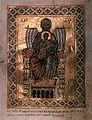
Normans
The Normans were the people who gave their name to Normandy, a region in northern France. They were descended from Norse Viking conquerors of the territory and the native population of Frankish and Gallo-Roman stock...
, whether these introduced it directly from the East or took it from English usage. The spread of the feast, by now with the adjective "Immaculate" attached to its title, met opposition on the part of some, on the grounds that sanctification was possible only after conception. Critics included Saints Bernard of Clairvaux
Bernard of Clairvaux
Bernard of Clairvaux, O.Cist was a French abbot and the primary builder of the reforming Cistercian order.After the death of his mother, Bernard sought admission into the Cistercian order. Three years later, he was sent to found a new abbey at an isolated clearing in a glen known as the Val...
, Albertus Magnus
Albertus Magnus
Albertus Magnus, O.P. , also known as Albert the Great and Albert of Cologne, is a Catholic saint. He was a German Dominican friar and a bishop, who achieved fame for his comprehensive knowledge of and advocacy for the peaceful coexistence of science and religion. Those such as James A. Weisheipl...
and Thomas Aquinas
Thomas Aquinas
Thomas Aquinas, O.P. , also Thomas of Aquin or Aquino, was an Italian Dominican priest of the Catholic Church, and an immensely influential philosopher and theologian in the tradition of scholasticism, known as Doctor Angelicus, Doctor Communis, or Doctor Universalis...
. Other theologians defended the expression "Immaculate Conception", pointing out that sanctification could be conferred at the first moment of conception in view of the foreseen merits of Christ, a view held especially by Franciscan
Franciscan
Most Franciscans are members of Roman Catholic religious orders founded by Saint Francis of Assisi. Besides Roman Catholic communities, there are also Old Catholic, Anglican, Lutheran, ecumenical and Non-denominational Franciscan communities....
s.
Writers such as Mark Miravalle and Sarah Jane Boss interpret the existence of the feast as a strong indication of the Church's traditional belief in the Immaculate Conception.
On 28 February 1476, Pope Sixtus IV
Pope Sixtus IV
Pope Sixtus IV , born Francesco della Rovere, was Pope from 1471 to 1484. His accomplishments as Pope included the establishment of the Sistine Chapel; the group of artists that he brought together introduced the Early Renaissance into Rome with the first masterpiece of the city's new artistic age,...
, a Franciscan after whom the Sistine Chapel
Sistine Chapel
Sistine Chapel is the best-known chapel in the Apostolic Palace, the official residence of the Pope in Vatican City. It is famous for its architecture and its decoration that was frescoed throughout by Renaissance artists including Michelangelo, Sandro Botticelli, Pietro Perugino, Pinturicchio...
is named, authorized those dioceses that wished to introduce the feast to do so, and introduced it to his own diocese of Rome in 1477, with a specially composed Mass and Office of the feast. With his bull Cum praeexcelsa of 28 February 1477, in which he referred to the feast as that of the Conception of Mary, without using the word "Immaculate", he granted indulgences to those who would participate in the specially composed Mass or Office on the feast itself or during its octave
Octave (liturgical)
"Octave" has two senses in Christian liturgical usage. In the first sense, it is the eighth day after a feast, reckoning inclusively, and so always falls on the same day of the week as the feast itself. The word is derived from Latin octava , with dies understood...
, and he used the word "immaculate" of Mary, but applied instead the adjective "miraculous" to her conception. On 4 September 1483, referring to the feast as that of "the Conception of Immaculate Mary ever Virgin", he condemned both those who called it mortally sinful and heretical to hold that the "glorious and immaculate mother of God was conceived without the stain of original sin" and those who called it mortally sinful and heretical to hold that "the glorious Virgin Mary was conceived with original sin", since, he said, "up to this time there has been no decision made by the Roman Church and the Apostolic See." This decree was reaffirmed by the Council of Trent
Council of Trent
The Council of Trent was the 16th-century Ecumenical Council of the Roman Catholic Church. It is considered to be one of the Church's most important councils. It convened in Trent between December 13, 1545, and December 4, 1563 in twenty-five sessions for three periods...
.
Under Pope Pius V
Pope Pius V
Pope Saint Pius V , born Antonio Ghislieri , was Pope from 1566 to 1572 and is a saint of the Catholic Church. He is chiefly notable for his role in the Council of Trent, the Counter-Reformation, and the standardization of the Roman liturgy within the Latin Church...
, the Pope who in 1570 established the Tridentine Mass
Tridentine Mass
The Tridentine Mass is the form of the Roman Rite Mass contained in the typical editions of the Roman Missal that were published from 1570 to 1962. It was the most widely celebrated Mass liturgy in the world until the introduction of the Mass of Paul VI in December 1969...
, included the feast (but without the adjective "Immaculate") in the Tridentine Calendar
Tridentine Calendar
The Tridentine Calendar is the calendar of saints to be honoured in the course of the liturgical year in the official liturgy of the Roman Rite as reformed by Pope Pius V, implementing a decision of the Council of Trent, which entrusted the task to the Pope....
, but suppressed the existing special Mass for the feast, directing that the Mass for the Nativity of Mary (with the word "Nativity" replaced by "Conception") be used instead. Part of that earlier Mass was revived in the Mass that Pope Pius IX
Pope Pius IX
Blessed Pope Pius IX , born Giovanni Maria Mastai-Ferretti, was the longest-reigning elected Pope in the history of the Catholic Church, serving from 16 June 1846 until his death, a period of nearly 32 years. During his pontificate, he convened the First Vatican Council in 1869, which decreed papal...
ordered to be used on the feast and that is still in use.
On 6 December 1708, Pope Clement XI made the feast of the Conception of Mary, at that time still with the Nativity of Mary formula for the Mass, a Holy Day of Obligation
Holy Day of Obligation
In the Catholic Church, Holy Days of Obligation or Holidays of Obligation, less commonly called Feasts of Precept, are the days on which, as of the Code of Canon Law states,-Eastern Catholic Churches:...
. Until Pope Pius X
Pope Pius X
Pope Saint Pius X , born Giuseppe Melchiorre Sarto, was the 257th Pope of the Catholic Church, serving from 1903 to 1914. He was the first pope since Pope Pius V to be canonized. Pius X rejected modernist interpretations of Catholic doctrine, promoting traditional devotional practices and orthodox...
reduced in 1911 the number of Holy Days of Obligation to 8, there were in the course of the year 36 such days, apart from Sundays.
Definition of the dogma
During the reign of Pope Gregory XVIPope Gregory XVI
Pope Gregory XVI , born Bartolomeo Alberto Cappellari, named Mauro as a member of the religious order of the Camaldolese, was Pope of the Catholic Church from 1831 to 1846...
the bishops in various countries began to press for a definition as dogma of the teaching of Mary's immaculate conception. Pius IX, at the beginning of his pontificate, and again after 1851, appointed commissions to investigate the whole subject, and he was advised that the doctrine was one which could be defined and that the time for a definition was opportune. On 8 December 1854, in a great assembly of bishops in St Peter's Basilica at Rome, he promulgated the Bull Ineffabilis Deus, in which the history of the doctrine is summarily traced, and which contains the definition as given above
It was not until 1854 that Pope Pius IX
Pope Pius IX
Blessed Pope Pius IX , born Giovanni Maria Mastai-Ferretti, was the longest-reigning elected Pope in the history of the Catholic Church, serving from 16 June 1846 until his death, a period of nearly 32 years. During his pontificate, he convened the First Vatican Council in 1869, which decreed papal...
, with the support of the overwhelming majority of Roman Catholic bishop
Bishop
A bishop is an ordained or consecrated member of the Christian clergy who is generally entrusted with a position of authority and oversight. Within the Catholic Church, Eastern Orthodox, Oriental Orthodox Churches, in the Assyrian Church of the East, in the Independent Catholic Churches, and in the...
s, whom he had consulted between 1851–1853, promulgated the papal bull
Papal bull
A Papal bull is a particular type of letters patent or charter issued by a Pope of the Catholic Church. It is named after the bulla that was appended to the end in order to authenticate it....
Ineffabilis Deus
Ineffabilis Deus
Ineffabilis Deus is the name of a Papal bull by Pope Pius IX. It defines ex cathedra the dogma of the Immaculate Conception of the Blessed Virgin Mary...
(Latin for "Ineffable God"), which defined ex cathedra
Ex Cathedra
Ex Cathedra is a British choir and early music ensemble based in Birmingham in the West Midlands, England. It performs choral music spanning the 15th to 21st centuries, and regularly commissions new works....
the dogma
Dogma
Dogma is the established belief or doctrine held by a religion, or a particular group or organization. It is authoritative and not to be disputed, doubted, or diverged from, by the practitioners or believers...
of the Immaculate Conception:
The dogma was defined in accordance with the conditions of papal infallibility
Papal infallibility
Papal infallibility is a dogma of the Catholic Church which states that, by action of the Holy Spirit, the Pope is preserved from even the possibility of error when in his official capacity he solemnly declares or promulgates to the universal Church a dogmatic teaching on faith or morals...
, which would be defined in 1870 by the First Vatican Council
First Vatican Council
The First Vatican Council was convoked by Pope Pius IX on 29 June 1868, after a period of planning and preparation that began on 6 December 1864. This twentieth ecumenical council of the Roman Catholic Church, held three centuries after the Council of Trent, opened on 8 December 1869 and adjourned...
.
The papal definition of the dogma declares with absolute certainty and authority that Mary possessed sanctifying grace from the first instant of her existence and was free from the lack of grace caused by the original sin
Original sin
Original sin is, according to a Christian theological doctrine, humanity's state of sin resulting from the Fall of Man. This condition has been characterized in many ways, ranging from something as insignificant as a slight deficiency, or a tendency toward sin yet without collective guilt, referred...
at the beginning of human history. Mary's salvation was won by her son Jesus Christ through his passion, death, and resurrection
Resurrection of Jesus
The Christian belief in the resurrection of Jesus states that Jesus returned to bodily life on the third day following his death by crucifixion. It is a key element of Christian faith and theology and part of the Nicene Creed: "On the third day he rose again in fulfillment of the Scriptures"...
and was not due to her own merits.
Later developments within the Catholic Church
For the Roman Catholic Church the dogma of the Immaculate Conception gained additional significance from the reputed apparitions of Our Lady of LourdesOur Lady of Lourdes
Our Lady of Lourdes is the name used to refer to the Marian apparition said to have appeared before various individuals on separate occasions around Lourdes, France...
in 1858. At Lourdes
Lourdes
Lourdes is a commune in the Hautes-Pyrénées department in the Midi-Pyrénées region in south-western France.Lourdes is a small market town lying in the foothills of the Pyrenees, famous for the Marian apparitions of Our Lady of Lourdes occurred in 1858 to Bernadette Soubirous...
a 14-year-old girl, Bernadette Soubirous
Bernadette Soubirous
Saint Marie-Bernarde Soubirous was a miller's daughter born in Lourdes. From 11 February to 16 July 1858, she reported 18 apparitions of "a small young lady" who asked for a chapel to be built at that site at Lourdes....
, claimed that a beautiful woman appeared to her and said, "I am the Immaculate Conception". Many believe the woman to have been the Blessed Virgin Mary and pray to her as such.
In this sense the dogma of the Immaculate Conception defined by Pope Pius IX
Pope Pius IX
Blessed Pope Pius IX , born Giovanni Maria Mastai-Ferretti, was the longest-reigning elected Pope in the history of the Catholic Church, serving from 16 June 1846 until his death, a period of nearly 32 years. During his pontificate, he convened the First Vatican Council in 1869, which decreed papal...
is also viewed as a key example of the use of sensus fidelium
Sensus fidelium
The concept of sensus fidelium in Roman Catholic teachings can be implicitly traced back to the early Fathers of the Church...
shared by believers and the Magisterium
Magisterium
In the Catholic Church the Magisterium is the teaching authority of the Church. This authority is understood to be embodied in the episcopacy, which is the aggregation of the current bishops of the Church in union with the Pope, led by the Bishop of Rome , who has authority over the bishops,...
rather than pure reliance on Scripture and Tradition
Tradition
A tradition is a ritual, belief or object passed down within a society, still maintained in the present, with origins in the past. Common examples include holidays or impractical but socially meaningful clothes , but the idea has also been applied to social norms such as greetings...
.
The Vatican quotes in this context Fulgens Corona
Fulgens Corona
Fulgens corona is an encyclical by Pope Pius XII, given at St. Peter's Rome, on 8 September 1953, on the Feast of the Nativity of the Blessed Virgin Mary, the fifteenth year of his Pontificate...
, where Pius XII supported such a faith:
The Roman Catholic tradition has a well-established philosophy for the study of the Immaculate Conception and the veneration of the Blessed Virgin Mary in the field of Mariology, with Pontifical schools such as the Marianum
Marianum
The Marianum is both the name of a Pontifical institute for the study of Mariology and the name of the prestigious journal of Marian theology. The school and the journal share the same name since their formation was based on the work of Father Gabriel Roschini, who founded both the journal and the...
specifically devoted to this.
Medieval dispute about the doctrine
It seems to have been St Bernard of ClairvauxBernard of Clairvaux
Bernard of Clairvaux, O.Cist was a French abbot and the primary builder of the reforming Cistercian order.After the death of his mother, Bernard sought admission into the Cistercian order. Three years later, he was sent to found a new abbey at an isolated clearing in a glen known as the Val...
who, in the 12th century, explicitly raised the question of the Immaculate Conception. A feast of the Conception of the Blessed Virgin had already begun to be celebrated in some churches of the West . St Bernard blames the canons of the metropolitan church of Lyon
Lyon
Lyon , is a city in east-central France in the Rhône-Alpes region, situated between Paris and Marseille. Lyon is located at from Paris, from Marseille, from Geneva, from Turin, and from Barcelona. The residents of the city are called Lyonnais....
for instituting such a festival without the permission of the Holy See . In doing so, he takes occasion to repudiate altogether the view that the conception of Mary was sinless. It is doubtful, however, whether he was using the term "conception" in the same sense in which it is used in the definition of Pope Pius IX. Bernard would seem to have been speaking of conception in the active sense of the mother's cooperation, for in his argument he says: "How can there be absence of sin where there is concupiscence (libido)?" and stronger expressions follow, showing that he is speaking of the mother and not of the child.
Saint Thomas Aquinas
Thomas Aquinas
Thomas Aquinas, O.P. , also Thomas of Aquin or Aquino, was an Italian Dominican priest of the Catholic Church, and an immensely influential philosopher and theologian in the tradition of scholasticism, known as Doctor Angelicus, Doctor Communis, or Doctor Universalis...
, the greatest of the medieval scholastics, refused to admit the Immaculate Conception, on the ground that, unless the Blessed Virgin had at one time or other been one of the sinful, she could not justly be said to have been redeemed by Christ.
Saint Bonaventure
Bonaventure
Saint Bonaventure, O.F.M., , born John of Fidanza , was an Italian medieval scholastic theologian and philosopher. The seventh Minister General of the Order of Friars Minor, he was also a Cardinal Bishop of Albano. He was canonized on 14 April 1482 by Pope Sixtus IV and declared a Doctor of the...
(d . 1274), second only to Saint Thomas in his influence on the Christian schools of his age, hesitated to accept it for a similar reason. He believed that Mary was completely free from sin, but that she was not given this grace at the instant of her conception.
The celebrated John Duns Scotus (d . 1308), a Franciscan like Saint Bonaventure, argued, on the contrary, that from a rational point of view it was certainly as little derogatory to the merits of Christ to assert that Mary was by him preserved from all taint of sin, as to say that she first contracted it and then was delivered. Proposing a solution to the theological problem of reconciling the doctrine with that of universal redemption in Christ, he argued that Mary's immaculate conception did not remove her from redemption by Christ; rather it was the result of a more perfect redemption granted her because of her special role in salvationhistory.
The arguments of Scotus, combined with a better acquaintance with thelanguage of the early Fathers, gradually prevailed in the schools of the Western Church. In 1387 the university of Paris strongly condemned the opposite view.
Scotus's arguments remained controversial, however, particularly among the Dominicans, who were willing enough to celebrate Mary's sanctificatio (being made free from sin) but, following the Dominican Thomas Aquinas' arguments, continued to insist that her sanctification could not have occurred until after her conception.
Popular opinion remained firmly behind the celebration of Mary's conception. In 1409, the Council of Basel, which is not reckoned an ecumenical council
Ecumenical council
An ecumenical council is a conference of ecclesiastical dignitaries and theological experts convened to discuss and settle matters of Church doctrine and practice....
, stated that belief in the immaculate conception of Mary is in accord with the Catholic faith. By the end of the 15th century was widely professed and taught in many theological faculties, but such was the influence of the Dominicans, and the weight of the arguments of Thomas Aquinas (who had been canonised in 1323 and declared "Doctor Angelicus" of the Church in 1567) that the Council of Trent (1545–63)—which might have been expected to affirm the doctrine—instead declined to take a position.
Church Fathers
It is admitted that the doctrine as defined by Pius IX. was not explicitly mooted before the 12th century. It is also agreed that "no direct or categorical and stringent proof of the dogma can be brought forward from Scripture". But it is claimed that the doctrine is implicitly contained in the teaching of the Fathers. Their expressions on the subject of the sinlessness of Mary are, it is pointed out, so ample and so absolute that they must be taken to include original sin as well as actual . Thus we have in the first five centuries such epithets applied to her as "in every respect holy", "in all things unstained", "super-innocent" and "singularly holy"; she is compared to Eve before the fall, as ancestress of a redeemed people; she is "the earth before it was accursed." The well-known words of St Augustine (d . 430) may be cited: " As regards the mother of God," he says, " I will not allow any question whatever of sin." It is true that he is here speaking directly of actual or personal sin. But his argument is that all men are sinners; that they are so through original depravity; that this original depravity may be overcome by the grace of God, and he adds that he does not know but that Mary may have had sufficient grace to overcome sin "of every sort" (omni ex parte).The bull of definition of the dogma, Ineffabilis Deus
Ineffabilis Deus
Ineffabilis Deus is the name of a Papal bull by Pope Pius IX. It defines ex cathedra the dogma of the Immaculate Conception of the Blessed Virgin Mary...
, mentioned in particular the patrististic interpretation of as referring to a woman, Mary, who would be eternally at enmity with the evil serpent and completely triumphing over him. It said the Fathers saw foreshadowings of Mary's "wondrous abundance of divine gifts and original innocence" "in that ark of Noah, which was built by divine command and escaped entirely safe and sound from the common shipwreck of the whole world; in the ladder which Jacob saw reaching from the earth to heaven, by whose rungs the angels of God ascended and descended, and on whose top the Lord himself leaned; in that bush which Moses saw in the holy place burning on all sides, which was not consumed or injured in any way but grew green and blossomed beautifully; in that impregnable tower before the enemy, from which hung a thousand bucklers and all the armor of the strong; in that garden enclosed on all sides, which cannot be violated or corrupted by any deceitful plots; in that resplendent city of God, which has its foundations on the holy mountains; in that most august temple of God, which, radiant with divine splendours, is full of the glory of God; and in very many other biblical types of this kind."
The bull recounts that the Fathers interpreted the angel's address to Mary, "highly favoured one" or "full of grace", as indicating that "she was never subject to the curse and was, together with her Son, the only partaker of perpetual benediction"; and they "frequently compare her to Eve while yet a virgin, while yet innocence, while yet incorrupt, while not yet deceived by the deadly snares of the most treacherous serpent".
Patronage
John IV of Portugal
|-|John IV was the King of Portugal and the Algarves from 1640 to his death. He was the grandson of Catherine, Duchess of Braganza, who had in 1580 claimed the Portuguese crown and sparked the struggle for the throne of Portugal. John was nicknamed John the Restorer...
proclaimed Our Lady of the Immaculate Conception the nation's patron saint
Patron saint
A patron saint is a saint who is regarded as the intercessor and advocate in heaven of a nation, place, craft, activity, class, clan, family, or person...
, so that 8 December is a special feast in Portugal.
Cromwellian conquest of Ireland
The Cromwellian conquest of Ireland refers to the conquest of Ireland by the forces of the English Parliament, led by Oliver Cromwell during the Wars of the Three Kingdoms. Cromwell landed in Ireland with his New Model Army on behalf of England's Rump Parliament in 1649...
was already well advanced, the Irish Catholic Confederation
Confederate Ireland
Confederate Ireland refers to the period of Irish self-government between the Rebellion of 1641 and the Cromwellian conquest of Ireland in 1649. During this time, two-thirds of Ireland was governed by the Irish Catholic Confederation, also known as the "Confederation of Kilkenny"...
, also known as the Confederation of Kilkenny, consecrated Ireland to the Immaculate Conception of Mary as follows:
- "By a unanimous vote of the Supreme Assembly it was decreed that the Virgin Mother of God, under her title of her Immaculate Conception, should be solemnly and publicly proclaimed Patroness of the Kingdom of Ireland, and that as a perpetual memorial to the happy event, the feast of the Immaculate Conception should be solemnly observed in Ireland from that day forward until the end of time.”
By the Papal Bull
Papal bull
A Papal bull is a particular type of letters patent or charter issued by a Pope of the Catholic Church. It is named after the bulla that was appended to the end in order to authenticate it....
Quantum ornamenti of 8 November 1760, Pope Clement XIII
Pope Clement XIII
Pope Clement XIII , born Carlo della Torre di Rezzonico, was Pope from 16 July 1758 to 2 February 1769....
granted the request of King Charles III of Spain
Charles III of Spain
Charles III was the King of Spain and the Spanish Indies from 1759 to 1788. He was the eldest son of Philip V of Spain and his second wife, the Princess Elisabeth Farnese...
that the Blessed Virgin Mary, under the title of the Immaculate Conception, should be a special patroness
Patron saint
A patron saint is a saint who is regarded as the intercessor and advocate in heaven of a nation, place, craft, activity, class, clan, family, or person...
of Spain
Spain
Spain , officially the Kingdom of Spain languages]] under the European Charter for Regional or Minority Languages. In each of these, Spain's official name is as follows:;;;;;;), is a country and member state of the European Union located in southwestern Europe on the Iberian Peninsula...
along with its eastern and western territories, while Saint James the Greater continued to be the principal national patron.
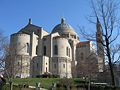
On 13 May 1846, the United States
United States
The United States of America is a federal constitutional republic comprising fifty states and a federal district...
bishops chose the Blessed Virgin Mary, conceived without sin, as Patroness of the country.
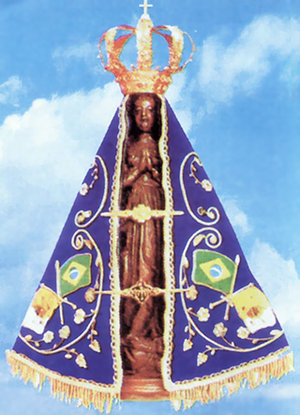
Under the same invocation of the Immaculate Conception, Mary is the patron saint of Brazil
Brazil
Brazil , officially the Federative Republic of Brazil , is the largest country in South America. It is the world's fifth largest country, both by geographical area and by population with over 192 million people...
, where devotion to her is centred on the Basilica of the National Shrine of Our Lady of Aparecida
Basilica of the National Shrine of Our Lady of Aparecida
The town of Aparecida, in the SE region of the State of São Paulo, Brazil, houses two basilicas dedicated to Brazil's Patroness Saint, Nossa Senhora da Conceição Aparecida, or "Our Lady of the Conception who Appeared," a reference to the appearance of the head, then the body of a statue of Mary in...
, in the town of Aparecida
Aparecida
Aparecida is a Brazilian city and municipality in the state of São Paulo. It is located in the fertile valley of the River Paraíba do Sul on the southern bank. The population in 2004 was 35,754 and the area of the municipality is 121.232 km²...
, built to house a small clay statue of Our Lady of the Immaculate Conception Who Appeared, which represents her in the traditional form associated with the Immaculate Conception.
By the bull Impositi Nobis of 12 September 1942, Pope Pius XII
Pope Pius XII
The Venerable Pope Pius XII , born Eugenio Maria Giuseppe Giovanni Pacelli , reigned as Pope, head of the Catholic Church and sovereign of Vatican City State, from 2 March 1939 until his death in 1958....
, at the request of the bishops of the Philippines
Philippines
The Philippines , officially known as the Republic of the Philippines , is a country in Southeast Asia in the western Pacific Ocean. To its north across the Luzon Strait lies Taiwan. West across the South China Sea sits Vietnam...
, declared the Blessed Virgin Mary, under the title of the Immaculate Conception, principal patron of the Philippines, with Saints Pudentiana
Pudentiana
Pudentiana is a traditional Christian saint of the 2nd century. She is sometimes called Potentiana and is often coupled with her sister, Praxedes....
and Rose of Lima
Rose of Lima
Rose of Lima, , the first Catholic saint of the Americas, was born in Lima, Peru.-Biography:Saint Rose of Lima was born in the city of that name, the daughter of Gaspar Flores, a harquebusier from San German, Puerto Rico, and his wife, Maria de Oliva, who was a native of Lima. She was part of a...
as secondary patrons. In that bull, the Pope mentioned that the 1907 provincial council of Manila had called Mary Immaculate principal patron saint of the whole Filipino people, and that there were historical documents that proved that Saint Pudentiana was considered patron of the Philippines from the 16th century and Saint Rose of Lima from the 17th.
Other churches
For differing reasons, belief in Mary's immaculate conception in the Catholic doctrinal form is not part of the official doctrines of the Eastern Orthodox, AnglicanAnglicanism
Anglicanism is a tradition within Christianity comprising churches with historical connections to the Church of England or similar beliefs, worship and church structures. The word Anglican originates in ecclesia anglicana, a medieval Latin phrase dating to at least 1246 that means the English...
and Protestant
Protestantism
Protestantism is one of the three major groupings within Christianity. It is a movement that began in Germany in the early 16th century as a reaction against medieval Roman Catholic doctrines and practices, especially in regards to salvation, justification, and ecclesiology.The doctrines of the...
churches.
Anglicanism
Belief in Mary's immaculate conception is not a doctrine within AnglicanismAnglicanism
Anglicanism is a tradition within Christianity comprising churches with historical connections to the Church of England or similar beliefs, worship and church structures. The word Anglican originates in ecclesia anglicana, a medieval Latin phrase dating to at least 1246 that means the English...
, although it is shared by many Anglo-Catholics
Anglo-Catholicism
The terms Anglo-Catholic and Anglo-Catholicism describe people, beliefs and practices within Anglicanism that affirm the Catholic, rather than Protestant, heritage and identity of the Anglican churches....
. In the Church of England
Church of England
The Church of England is the officially established Christian church in England and the Mother Church of the worldwide Anglican Communion. The church considers itself within the tradition of Western Christianity and dates its formal establishment principally to the mission to England by St...
's Common Worship
Common Worship
Common Worship is the name given to the series of services authorised by the General Synod of the Church of England and launched on the first Sunday of Advent in 2000. It represents the most recent stage of development of the Liturgical Movement within the Church and is the successor to the...
prayer book, 8 December is designated a Lesser Festival
Lesser Festival
Lesser Festivals are a type of observance in the Church of England, considered to be less significant than a Principal Feast, Principal Holy Day, or Festival, but more significant than a Commemoration. Whereas Principal Feasts must be celebrated, it is not obligatory to observe Lesser Festivals...
of the Conception of the Blessed Virgin Mary (without the adjective "immaculate").
The report "Mary: Faith and Hope in Christ", by the Anglican-Roman Catholic International Commission, concluded that the teaching about Mary in the two definitions of the Assumption and the Immaculate Conception can be said to be consonant with the teaching of the Scriptures and the ancient common traditions. But the report expressed concerns that the Roman Catholic dogmatic definitions of these concepts implies them to be "revealed by God", stating: "The question arises for Anglicans, however, as to whether these doctrines concerning Mary are revealed by God in a way which must be held by believers as a matter of faith."
Eastern and Oriental Orthodox
Eastern Orthodox Christians say that Mary was without sin for her entire life, but they object to the dogmatic declaration of her immaculate conception.In the tradition of Ethiopian Orthodoxy,, a branch of Oriental Orthodoxy
Oriental Orthodoxy
Oriental Orthodoxy is the faith of those Eastern Christian Churches that recognize only three ecumenical councils — the First Council of Nicaea, the First Council of Constantinople and the First Council of Ephesus. They rejected the dogmatic definitions of the Council of Chalcedon...
, the Kebra Nagast
Kebra Nagast
The Kebra Nagast , or the Book of the Glory of Kings, is an account written in Ge'ez of the origins of the Solomonic line of the Emperors of Ethiopia. The text, in its existing form, is at least seven hundred years old, and is considered by many Ethiopian Christians and Rastafarians to be an...
says:
Old Catholic
While Old Catholics do not reject the Immaculate Conception of Mary, and some of their parishes venerate Mary as immaculately conceived and celebrate the feast of her Immaculate Conception, they do not accept its definition as a dogmaDogma
Dogma is the established belief or doctrine held by a religion, or a particular group or organization. It is authoritative and not to be disputed, doubted, or diverged from, by the practitioners or believers...
, since they reject papal infallibility and with it the Pope's authority to define dogma.
Protestantism
Martin LutherMartin Luther
Martin Luther was a German priest, professor of theology and iconic figure of the Protestant Reformation. He strongly disputed the claim that freedom from God's punishment for sin could be purchased with money. He confronted indulgence salesman Johann Tetzel with his Ninety-Five Theses in 1517...
, who initiated the Protestant Reformation
Protestant Reformation
The Protestant Reformation was a 16th-century split within Western Christianity initiated by Martin Luther, John Calvin and other early Protestants. The efforts of the self-described "reformers", who objected to the doctrines, rituals and ecclesiastical structure of the Roman Catholic Church, led...
said: "Mary is full of grace, proclaimed to be entirely without sin. God's grace fills her with everything good and makes her devoid of all evil". But in 1532 he denied Mary's immaculate conception, declaring: "Mary is conceived in sin just like us". However, some Lutherans, such as the members of the Anglo-Lutheran Catholic Church
Anglo-Lutheran Catholic Church
The Anglo-Lutheran Catholic Church , formerly the Evangelical Community Church-Lutheran , is a church in the Lutheran Evangelical Catholic tradition. The ALCC claims to be unique among Lutheran churches in that it is of both Lutheran and Anglo-Catholic heritage and has also been significantly...
, support the doctrine.
Most Protestants reject the doctrine because they do not consider the development of dogma
Dogma
Dogma is the established belief or doctrine held by a religion, or a particular group or organization. It is authoritative and not to be disputed, doubted, or diverged from, by the practitioners or believers...
tic theology
Theology
Theology is the systematic and rational study of religion and its influences and of the nature of religious truths, or the learned profession acquired by completing specialized training in religious studies, usually at a university or school of divinity or seminary.-Definition:Augustine of Hippo...
to be authoritative apart from biblical
Bible
The Bible refers to any one of the collections of the primary religious texts of Judaism and Christianity. There is no common version of the Bible, as the individual books , their contents and their order vary among denominations...
exegesis
Exegesis
Exegesis is a critical explanation or interpretation of a text, especially a religious text. Traditionally the term was used primarily for exegesis of the Bible; however, in contemporary usage it has broadened to mean a critical explanation of any text, and the term "Biblical exegesis" is used...
, and because the doctrine of the Immaculate Conception, is not taught in the Bible
Bible
The Bible refers to any one of the collections of the primary religious texts of Judaism and Christianity. There is no common version of the Bible, as the individual books , their contents and their order vary among denominations...
. The formal pronouncement of Mary's Immaculate Conception by the Catholic Church in 1854 alienated some Protestant Churches partly due to its implication that not all have sinned.
Islam

Muhammad
Muhammad |ligature]] at U+FDF4 ;Arabic pronunciation varies regionally; the first vowel ranges from ~~; the second and the last vowel: ~~~. There are dialects which have no stress. In Egypt, it is pronounced not in religious contexts...
taught the doctrine of the immaculate conception of Mary, saying: "There is not one of the sons of Adam, except Mary and her Son, one born but is touched by the Devil at the time of his birth, and the child makes a loud noise from the touch."
Writers such as George Sale
George Sale
George Sale was an Orientalist and practising solicitor, best known for his 1734 translation of the Qur'an into English. He was also author of The General Dictionary, in ten volumes, folio....
have said that Mary's immaculate conception is taught in the Qur'an
Qur'an
The Quran , also transliterated Qur'an, Koran, Alcoran, Qur’ān, Coran, Kuran, and al-Qur’ān, is the central religious text of Islam, which Muslims consider the verbatim word of God . It is regarded widely as the finest piece of literature in the Arabic language...
, but at least in some cases this is due to misunderstanding "immaculate conception" to mean "virginal conception".
Prayers and hymns
The Roman MissalRoman Missal
The Roman Missal is the liturgical book that contains the texts and rubrics for the celebration of the Mass in the Roman Rite of the Catholic Church.-Situation before the Council of Trent:...
and the Roman Rite
Roman Rite
The Roman Rite is the liturgical rite used in the Diocese of Rome in the Catholic Church. It is by far the most widespread of the Latin liturgical rites used within the Western or Latin autonomous particular Church, the particular Church that itself is also called the Latin Rite, and that is one of...
Liturgy of the Hours
Liturgy of the hours
The Liturgy of the Hours or Divine Office is the official set of daily prayers prescribed by the Catholic Church to be recited at the canonical hours by the clergy, religious orders, and laity. The Liturgy of the Hours consists primarily of psalms supplemented by hymns and readings...
naturally includes references to Mary's immaculate conception in the feast of the Immaculate Conception. An example is the antiphon that begins: "Tota pulchra es, Maria, et macula originalis non est in te
Tota pulchra es
Tota pulchra es is an old Catholic prayer, written in the fourth century. It is one of the five antiphons for the psalms of Second Vespers for the Feast of the Immaculate Conception. The title means "You are completely beautiful" . It speaks of her immaculate conception...
" (You are all beautiful, Mary, and the original stain [of sin] is not in you. Your clothing is white as snow, and your face is like the sun. You are all beautiful, Mary, and the original stain [of sin] is not in you. You are the glory of Jerusalem, you are the joy of Israel, you give honour to our people. You are all beautiful, Mary.) On the basis of the original Gregorian chant
Gregorian chant
Gregorian chant is the central tradition of Western plainchant, a form of monophonic liturgical music within Western Christianity that accompanied the celebration of Mass and other ritual services...
music, polyphonic settings have been composed by Anton Bruckner
Anton Bruckner
Anton Bruckner was an Austrian composer known for his symphonies, masses, and motets. The first are considered emblematic of the final stage of Austro-German Romanticism because of their rich harmonic language, complex polyphony, and considerable length...
, Pablo Casals
Pablo Casals
Pau Casals i Defilló , known during his professional career as Pablo Casals, was a Spanish Catalan cellist and conductor. He is generally regarded as the pre-eminent cellist of the first half of the 20th century, and one of the greatest cellists of all time...
, Maurice Duruflé
Maurice Duruflé
Maurice Duruflé was a French composer, organist, and pedagogue.Duruflé was born in Louviers, Eure. In 1912, he became chorister at the Rouen Cathedral Choir School, where he studied piano and organ with Jules Haelling...
, Grzegorz Gerwazy Gorczycki
Grzegorz Gerwazy Gorczycki
Grzegorz Gerwazy Gorczycki was a Polish Baroque composer.-Life:Born in Rossberg near Beuthen in Silesia around 1665, little is known of his early life...
, :no:Ola Gjeilo, José Maurício Nunes Garcia
José Maurício Nunes Garcia
José Maurício Nunes Garcia was a Brazilian classical composer, one of the greatest exponents of Classicism in the Americas....
, and Nikolaus Schapfl,
Other prayers honouring Mary's immaculate conception are in use outside the formal liturgy. The hymn Immaculate Mary
Immaculate Mary
The Immaculata Mary is a Roman Catholic Marian prayer.It is a Lourdes hymn, directed at the Immaculate Conception of the Blessed Virgin Mary.It was written by Abbe Gaignet to a traditional French tune and is used at the Our Lady of Lourdes shrine....
, addressed to Mary as the Immaculately Conceived One, is closely associated with Lourdes
Our Lady of Lourdes
Our Lady of Lourdes is the name used to refer to the Marian apparition said to have appeared before various individuals on separate occasions around Lourdes, France...
. The Immaculata prayer
Immaculata prayer
The Immaculata prayer is a Roman Catholic Marian prayer composed by Saint Maximillian Kolbe.It is a prayer of consecration to the Immaculata, i.e...
, composed by Saint Maximillian Kolbe, is a prayer of entrustment to Mary as the Immaculata. A novena
Novena
In the Catholic Church, a novena is a devotion consisting of a prayer repeated on nine successive days, asking to obtain special graces. The prayers may come from prayer books, or consist of the recitation of the Rosary , or of short prayers through the day...
of prayers, with a specific prayer for each of the nine days has been composed under the title of the Immaculate Conception Novena.
Artistic representations
Feast of the Immaculate Conception
The Feast of the Immaculate Conception celebrates belief in the Immaculate Conception of the Blessed Virgin Mary. It is celebrated on 8 December, nine months before the Nativity of Mary, which is celebrated on 8 September. It is the patronal feast day of the United States and the Republic of the...
to the entire Latin Church reduced the likelihood of controversy for the artist or patron in depicting an image, so that emblem
Emblem
An emblem is a pictorial image, abstract or representational, that epitomizes a concept — e.g., a moral truth, or an allegory — or that represents a person, such as a king or saint.-Distinction: emblem and symbol:...
s depicting The Immaculate Conception began to appear.
Many artists in the 15th century faced the problem of how to depict an abstract idea such as the Immaculate Conception, and the problem was not fully solved for 150 years. The Italian Renaissance artist Piero di Cosimo
Piero di Cosimo
Piero di Cosimo , also known as Piero di Lorenzo, was an Italian Renaissance painter.-Biography:The son of a goldsmith, Piero was born in Florence and apprenticed under the artist Cosimo Rosseli, from whom he derived his popular name and whom he assisted in the painting of the Sistine Chapel in...
was among those artists who tried new solutions, but none of these became generally adopted so that the subject matter would be immediately recognisable to the faithful.
The definitive iconography
Iconography
Iconography is the branch of art history which studies the identification, description, and the interpretation of the content of images. The word iconography literally means "image writing", and comes from the Greek "image" and "to write". A secondary meaning is the painting of icons in the...
for the Immaculate Conception, drawing on the emblem tradition, seems to have been finally established by the master and then father-in-law of Diego Velázquez
Diego Velázquez
Diego Rodríguez de Silva y Velázquez was a Spanish painter who was the leading artist in the court of King Philip IV. He was an individualistic artist of the contemporary Baroque period, important as a portrait artist...
, the painter and theorist Francisco Pacheco
Francisco Pacheco
Francisco Pacheco was a Spanish painter, best known as the teacher of Diego Velázquez and Alonso Cano, and for his textbook on painting that is an important source for the study of 17th-century practice in Spain...
. Pacheco's iconography influenced other Spanish
Spanish people
The Spanish are citizens of the Kingdom of Spain. Within Spain, there are also a number of vigorous nationalisms and regionalisms, reflecting the country's complex history....
artists such as Bartolomé Murillo, Diego Velázquez
Diego Velázquez
Diego Rodríguez de Silva y Velázquez was a Spanish painter who was the leading artist in the court of King Philip IV. He was an individualistic artist of the contemporary Baroque period, important as a portrait artist...
, and Francisco Zurbarán
Francisco Zurbarán
Francisco de Zurbarán was a Spanish painter. He is known primarily for his religious paintings depicting monks, nuns, and martyrs, and for his still-lifes...
, who each produced a number of artistic masterpieces based on the use of these same symbols.
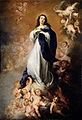
The popularity of this particular representation of The Immaculate Conception spread across the rest of Europe, and has since remained the best known artistic depiction of the concept: in a heavenly realm, moments after her creation, the spirit
Spirit
The English word spirit has many differing meanings and connotations, most of them relating to a non-corporeal substance contrasted with the material body.The spirit of a living thing usually refers to or explains its consciousness.The notions of a person's "spirit" and "soul" often also overlap,...
of Mary (in the form of a young woman) looks up in awe at (or bows her head to) God. The moon is under her feet and a halo
Halo (religious iconography)
A halo is a ring of light that surrounds a person in art. They have been used in the iconography of many religions to indicate holy or sacred figures, and have at various periods also been used in images of rulers or heroes...
of twelve stars surround her head, possibly a reference to "a woman clothed with the sun" from Revelation 12:1-2. Additional imagery may include clouds, a golden light, and cherubs
CHERUBS
CHERUBS is a Non-Profit Organization. It was founded in February, 1995 for families of children born with Congenital Diaphragmatic Hernia, a severe and often lethal birth defect. It was founded and currently led by Dawn M...
. In some paintings the cherubim are holding lilies
Lilium
Lilium is a genus of herbaceous flowering plants growing from bulbs. Most species are native to the temperate northern hemisphere, though the range extends into the northern subtropics...
and rose
Rose
A rose is a woody perennial of the genus Rosa, within the family Rosaceae. There are over 100 species. They form a group of erect shrubs, and climbing or trailing plants, with stems that are often armed with sharp prickles. Flowers are large and showy, in colours ranging from white through yellows...
s, flowers often associated with Mary.
See also
- Cathedral of the Immaculate ConceptionCathedral of the Immaculate ConceptionCathedral of the Immaculate Conception may refer to:In Benin:*Basilique de l’Immaculée Conception, OuidahIn Burkina Faso:*Ouagadougou CathedralIn Canada:*Cathedral of the Immaculate Conception...
- Congregation of the Immaculate ConceptionCongregation of the Immaculate Conception-Order of the Immaculate Conception of Our Lady :Founded in 1484 at Toledo, Spain, by Saint Beatrice of Silva, sister of Blessed Amadeus of Portugal...
- Feast of the Immaculate ConceptionFeast of the Immaculate ConceptionThe Feast of the Immaculate Conception celebrates belief in the Immaculate Conception of the Blessed Virgin Mary. It is celebrated on 8 December, nine months before the Nativity of Mary, which is celebrated on 8 September. It is the patronal feast day of the United States and the Republic of the...
- Immaculate MaryImmaculate MaryThe Immaculata Mary is a Roman Catholic Marian prayer.It is a Lourdes hymn, directed at the Immaculate Conception of the Blessed Virgin Mary.It was written by Abbe Gaignet to a traditional French tune and is used at the Our Lady of Lourdes shrine....
- Immaculata prayerImmaculata prayerThe Immaculata prayer is a Roman Catholic Marian prayer composed by Saint Maximillian Kolbe.It is a prayer of consecration to the Immaculata, i.e...
- Marian doctrines of the Catholic Church
- Original sinOriginal sinOriginal sin is, according to a Christian theological doctrine, humanity's state of sin resulting from the Fall of Man. This condition has been characterized in many ways, ranging from something as insignificant as a slight deficiency, or a tendency toward sin yet without collective guilt, referred...
- Perpetual virginity of MaryPerpetual virginity of MaryThe doctrine of the perpetual virginity of Mary, expresses the Virgin Mary's "real and perpetual virginity even in the act of giving birth to Jesus the Son of God made Man"...
- Roman Catholic Marian artRoman Catholic Marian artThe Blessed Virgin Mary has been one of the major subjects of Christian Art, Catholic Art and Western Art for many centuries. Literally hundreds of thousands of pieces of...
- Virgin birth of Jesus
External links
- The Immaculate Conception in Art (Painting)
- Ineffabilis Deus (Apostolic Constitution of Pope Pius IX defining the dogma of the Immaculate Conception)
- http://books.google.com/books?id=7uwCAAAAQAAJ&printsec=frontcover&dq=&ei=ME5KSKGDIYjaigHBzIzlDQ#PPA243,M1St. Alphonsus Liguori's writing on the Immaculate Conception in his book The Glories of MaryThe Glories of MaryThe Glories of Mary is a classic book in the field of Roman Catholic Mariology, written during the 18th century by Saint Alphonsus Liguori, a Doctor of the Church....
] - Catholic Encyclopedia entry on the Immaculate Conception
- Catholic Encyclopedia entry on Original Sin
- The Immaculate Conception. A study by a Melkite archimandrite
- The Immaculate Conception of the Mother of God based on Juniper Carol's Mariology and William Bernard UllathorneWilliam Bernard UllathorneWilliam Bernard Ullathorne was an English Roman Catholic bishop and a missionary in Australia.-Early life:William Ullathorne was born in Pocklington, Yorkshire, the eldest of ten children of William Ullathorne, a prosperous grocer, draper and spirit merchant, and his wife Hannah, née Longstaff...
e's book - "St. Augustine and Original Sin" — a short article on the different understandings of Original Sin in Eastern and Western Christianity, without distinguishing Protestant theology from Roman Catholic. The latter holds that "original sin does not have the character of a personal fault in any of Adam's descendants" (Catechism of the Catholic Church, 405).
- Mark I. Miraville (editor), "Mariology: A Guide for Priests, Deacons, Seminarians, and Consecrated Persons
- Original Sin According To St. Paul by John S. RomanidesJohn S. RomanidesJohn Savvas Romanides was a Greek Orthodox priest, author and professor who, for a long time, represented the Greek Church to the World Council of Churches. He was born in Piraeus, Greece, on 2 March 1928 but his parents emigrated to the United States when he was only two months old. He grew up in...
- Catechism of the Catholic Church "Conceived by the Power of the Holy Spirit and Born of the Virgin Mary"