

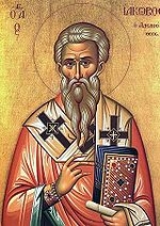
James the Just

Encyclopedia
James first Bishop of Jerusalem, who died in 62 AD, was an important figure in Early Christianity
. He is distinguished from the Apostle James by various epithets; he is called James the brother of the Lord by Paul (Galatians 1:19), James the Just by Hegesippus
and others, "James the Righteous", "James of Jerusalem", "James Adelphotheos", and so on.
James became the leader of the Christian movement in Jerusalem in the decades after Jesus' death, but information about his life is scarce and ambiguous. Apart from a handful of references in the Gospels, the main sources for his life are the Acts of the Apostles
, the Pauline epistles
, the historian Josephus
, and St. Jerome, who also quotes the early Christian author Hegesippus. The Epistle of James
in the New Testament
is traditionally attributed to him, and he is a principal author of the Apostolic Decree of Acts 15. In the extant lists of Hippolytus of Rome, Dorotheus of Tyre
, the Chronicon Paschale
, and Dimitry of Rostov
, he is the first of the Seventy Apostles, though some sources, such as the Catholic Encyclopedia
, draw the conclusion that "these lists are unfortunately worthless".
The Belgian theologian Achille Camerlynck (1910) concludes that, based on Hegesippus
's account, it is "probable" that James the Just is also James the Less
, and in line with "most Catholic interpreters", that he is therefore James, son of Alphaeus
, one the Twelve Apostles of Jesus, as well as James, the son of Mary Cleophas, He is not, however, identified with James the Great.
Eusebius records that Clement of Alexandria
related that "This James, whom the people of old called the Just because of his outstanding virtue, was the first, as the record tells us, to be elected to the episcopal throne of the Jerusalem church." The name also helps distinguish him from other important figures in early Christianity of the same name, such as James, son of Zebedee.
He is sometimes referred to in Eastern Christianity
as "James Adelphotheos" , i.e., "James the Brother of God". The oldest surviving Christian liturgy, the Liturgy of St James
, called him "the brother of God" (Adelphotheos).
sources on James are the surviving Pauline Epistles
from about the sixth decade AD, describing events roughly during AD 35 – 55. The Acts of the Apostles
, written between AD 60 to 100, describes the same period. The Gospel
s, with a disputed dating ranging from about AD 50 to as late as 110, describe the period of Jesus
' ministry, around 30 AD. In these sources, there is more than one person named James, and different titles are used to distinguish between them.
:
The third mention of James in Galatians is within the so-called "incident at Antioch". According to Paul, Peter cared about James opinion, and what the other Christians thought.
A "James" is mentioned in Paul's First Epistle to the Corinthians
, as one to whom Jesus appeared after his resurrection. Notable is how Paul names only Peter and James among the disciples and others who saw Jesus:
Based on this identification, Paul might also be referring to James earlier in the same letter:
This is generally taken as an indication that this James is the same as James the younger brother of Jesus.
James is also an authority in the early church at the Council of Jerusalem
(James is quoting Amos 9:11–12.)
After this, there is only one more mention of James in Acts, meeting with Paul shortly before Paul's arrest:
and the Gospel of Matthew
also mention a James as Jesus' brother:
The Synoptic Gospels
, similarly to the Epistle to the Galatians, recognize a core group of three disciples (Peter, John and James) having the same names as those given by Paul. However, the James in this group is sometimes called the brother of John, which would be James the Great, who is definitely not James the Just.
Unlike the Synoptic Gospels, the Gospel of John
never mentions anyone called James. However, it lists Jesus' unnamed "brothers" as being a part of his entourage.
James, the son of Zebedee, is also known as James the Great, who is not the same James as James the Just. James, son of Alphaeus
, however, is usually identified with James the Less
.
during the siege of Jerusalem
by the future Emperor Titus in 70 AD, and afterwards returned, having a further series of Jewish bishops until the Bar Kokhba revolt in 130 AD. Following the second destruction of Jerusalem, and the rebuilding of the city as Aelia Capitolina
, subsequent bishops were Greeks. The evidence of Eusebius is confirmed by the account of the Bordeaux Pilgrim.
) had for James. The Gospel of the Hebrews
fragment 21 confirms the account of Paul in 1 Corinthians regarding the risen Jesus' appearance to James, and this is mentioned also by The Gospel of Thomas
(one of the works included in the Nag Hammadi library
), saying 12, relates that the disciples asked Jesus, "We are aware that you will depart from us. Who will be our leader?" Jesus said to him, "No matter where you come [from] it is to James the Just that you shall go, for whose sake heaven and earth have come to exist." Epiphanius'
(Panarion 29.4) describes James as a Nazirite
.
The pseudepigraphical
First Apocalypse of James
associated with James's name mentions many details, some of which may reflect early traditions: he is said to have authority over the twelve Apostles and the early church; this work also adds, somewhat puzzlingly, that James left Jerusalem and fled to Pella
before the Roman siege of that city in 70 CE. (Ben Witherington suggests what is meant by this was that James' bones were taken by the early Christians who had fled Jerusalem).
The Apocryphon of James, the sole copy of which was found in the Nag Hammadi library
, and which may have been written in Egypt in the 3rd century, recounts a post-resurrection appearance of the risen Christ to James and Peter which James is said to have recorded in Hebrew. In the dialogue, Peter speaks twice (3:12; 9:1) but misunderstands Jesus. Only James is addressed by name (6:20) and James is the more dominant of the two.
The Gospel of James
(or "Infancy Gospel of James"), a work of the 2nd century, also presents itself as written by James — a sign that his authorship would lend authority — and so do several tractates in the codices found at Nag Hammadi
.
, Simon
and Joses
— are named in Matthew
13:55 and Mark
6:3 and mentioned elsewhere. James' name always appears first in lists, which suggests he was the eldest among them. In the passage in Josephus'
Jewish Antiquities (20.9.1) the Jewish historian describes James as "the brother of Jesus who is called Christ", although it is not known whether this is original or added by later Christian editors/copyists. Paul, recounting his conversion, recalls "Then after three years I went up to Jerusalem to visit Cephas and remained with him fifteen days. But I saw none of the other apostles except James the Lord's brother."
Interpretation of the phrase, "brother of the Lord", and similar phrases, is divided between those who interpret the phrase literally and those (Catholics
and Eastern Orthodox
and some Protestants) who presuppose the perpetual virginity of Mary
and therefore do not also accept an absolutely literal interpretation.
Christianity teaches that Jesus was born of a virgin, and Jesus is referred to as the "first-born son" of Mary, so James and the other brethren of Jesus would have been younger brothers.
A variant on this is presented by James Tabor, who argues that after the early and childless death of Joseph, Mary married Clopas
, whom he accepts as a younger brother of Joseph, according to the Levirate law. According to this view Clopas fathered James and the later siblings but not Jesus.
Crossan
suggested that he was probably Jesus' older brother.
asserts in his tract The Perpetual Virginity of Blessed Mary that the term "first-born" was used to refer to any offspring which opened the womb, rather than definitely implying other children.
The Protevangelium
of James assumes the Greek nature of Jewish practices during this period in history and says that Mary was betrothed to an older relative in order to preserve her virginity and that Joseph already had children. In this case, James was one of Joseph's children from his previous marriage and, therefore, Jesus' stepbrother.
One argument supporting this view is that it would have been against Jewish custom for Jesus to give his mother to the care of John (who is not at all suspected to be a blood relative of Jesus) if Mary had other living sons. This is because the eldest son would take responsibility for his mother after the death of her husband. So any other sons of Mary should have taken on this responsibility if they existed, therefore arguing against a direct biological brother relationship.
Also, Aramaic and Hebrew tended to use circumlocution
s to point out blood relationships; it is asserted that just calling some people "brothers of Jesus" would not have necessarily implied the same mother. Rather, something like "sons of the mother of Jesus" would have been used to indicate a common mother. Scholars and theologians who assert this point out that Jesus was called "the son of Mary" rather than "a son of Mary" in his hometown (Mark 6:3).
Eusebius of Caesarea
(c. 275 – 339) reports the tradition that James the Just was the son of Joseph's
brother Clopas
, and therefore was of the "brethren" (which he interprets as "cousin") of Jesus described in the New Testament.
This is echoed by Jerome
(c. 342 – 419) in De Viris Illustribus ("On Illustrious Men") – James is said to be the son of another Mary, wife of Clopas
and the "sister" of Mary, the mother of Jesus – in the following manner:
Jerome refers to the scene of the Crucifixion in John 19:25, where three Marys – the mother of Jesus, Mary of Clopas, and Mary Magdalene – are said to be witnesses. John also mentions the "sister" of the mother of Jesus, often identified with Mary of Clopas due to grammar. Mary "of Clopas" is often interpreted as Mary "wife of Clopas". Mary of Nazareth and Mary of Clopas also need not be literally sisters, in light of the usage of the said words in Greek, Hebrew and Aramaic.
Mary of Clopas is suggested to be the same as "Mary, the mother of James the younger and Joses", "Mary the mother of James and Joseph" and the "other Mary" in Jesus' crucifixion and post-resurrection accounts in the Synoptic Gospels
. Proponents of this identification argue that the writers of the Synoptics would have called this Mary, simply, "the mother of Jesus" if she was indeed meant to be the mother of Jesus, given the importance of her son's crucifixion and resurrection: they also note that the mother of James and Joses is called "Maria" whereas the mother of Jesus is "Mariam" or "Marias" in Greek. These proponents find it unlikely that Mary would be referred to by her biological children other than Jesus at such a significant time (James happens to be the brother of one Joses, as spelled in Mark
, or Joseph, as in Matthew
).
Jerome's opinion suggests an identification of James the Just with the Apostle James, son of Alphaeus
; Clopas and Alphaeus are thought to be different Greek renderings of the Aramaic name Halpai. Despite this, some biblical scholars tend to distinguish them; this is also not Roman Catholic dogma, though a traditional teaching.
Since this Clopas is, according to Eusebius, Joseph of Nazareth's brother (see above) and this Mary is said to be Mary of Nazareth's sister, James could be related to Jesus by blood and law.
, James is not the earthly brother of Jesus, but a spiritual brother.
has been traditionally attributed to James the Just.
, as well as other written sources from the Early Church, provide some insights into James' life and his role in the Early Church. There is mention of him in the Gospel of John
and the early portions of the Acts of the Apostles
. The Synoptics mention his name, but no further information. However, the later chapters of the Acts of the Apostles provide evidence that James was an important figure in the Christian community of Jerusalem
.
Jerome
(c. 347 – 420), in his De Viris Illustribus
, argued that James was not Jesus' brother but his cousin, son of Mary of Cleophas, "the sister of the mother of our Lord of whom John makes mention in his book." After the Passion
, Jerome wrote, the Apostles selected James as Bishop of Jerusalem. In describing James' ascetic lifestyle, De Viris Illustribus, quotes Hegesippus
' account of James from the fifth book of Hegesippus' lost Commentaries:
Since it was unlawful for any but the High Priest of the Temple to enter the Holy of Holies
, and then only once a year on Yom Kippur
, Jerome's quotation from Hegesippus indicates that James was considered a High Priest. The Pseudo-Clementine
Recognitions suggest this.
Jerome quotes the non-canonical Gospel of the Hebrews
: "'Now the Lord, after he had given his grave clothes to the servant of the priest, appeared to James, for James had sworn that he would not eat bread from that hour in which he had drunk the Lord's cup until he should see him risen from the dead.' And a little further on the Lord says, 'bring a table and bread.' And immediately it is added, 'He took bread and blessed and broke and gave it to James the Just and said to him, "My brother, eat your bread, for the Son of Man is risen from the dead."'" And so he ruled the church of Jerusalem thirty years, that is until the seventh year of Nero. (See
Jerome and the Early Church Fathers)
The non-canonical Gospel of Thomas
confirms that James was an important leader, stating "The disciples said to Jesus: We know that you will depart from us; who is it who will lead us?"
Jesus said to them, "Wherever you have come from, go to James the Just, for whom heaven and earth came to be."
Paul further describes James as being one of the persons to whom the risen Christ showed himself (1 Corinthians 15:3–8); later in 1 Corinthians, Paul mentions James in a way that suggests James had been married (9:5); and in Galatians, Paul lists James with Cephas (better known as Peter) and John as the three "pillars" of the Church (2:9), and who will minister to the "circumcised" (in general Jews and Jewish Proselyte
s) in Jerusalem, while Paul and his fellows will minister to the "uncircumcised" (in general Gentiles) (2:12). These terms (circumcised/uncircumcised) are generally interpreted to mean Jews
and Greeks
, who were predominant; however, this is an oversimplification as 1st century Judaea Province also had some Jews who no longer circumcised, and some Greeks (called Proselytes or Judaizers
) and others such as Egyptians, Ethiopians, and Arabs who did.
When Peter, having miraculously escaped from prison, must flee Jerusalem due to Herod Agrippa's persecution, he asks that James be informed (Acts 12:17).
When the Christians of Antioch
were concerned over whether Gentile Christians need be circumcised
to be saved, they sent Paul and Barnabas
to confer with the Jerusalem church. James played a prominent role in the formulation of the council's
decision (Acts 15:13ff). James was the last named figure to speak, after Peter, Paul and Barnabas; he delivered what he calls his "decision" ( NRSV)— the original sense is closer to "opinion". He supported them all in being against the requirement (Peter had cited his earlier revelation from God regarding Gentiles), and suggested prohibitions about eating blood as well as meat sacrificed to idols
and fornication
. This became the ruling of the Council, agreed upon by all the apostles and elders, and sent to the other churches by letter.
When Paul arrives in Jerusalem to deliver the money he raised for the faithful there, it is to James that he speaks, and it is James who insists that Paul ritually cleanse himself at Herod's Temple to prove his faith and deny rumors of teaching rebellion against the Torah
(Acts 21:18ff) (a charge of antinomianism
).
Not only does the Book of Acts makes it clear that James led the Jerusalem Christian Church as its first leader but this is supported by early Christian historians like Eusebius, Clement of Alexandria in the late 2nd century, who recorded the following, "For they say that Peter and James and John after the ascension of our Saviour, as if also preferred by our Lord, strove not after honor, but chose James the Just bishop of Jerusalem".
(See the Early Church Fathers and
Jerome)
Antiquities of the Jews, (xx.9) "the brother of Jesus, who was called Christ, whose name was James" met his death after the death of the procurator Porcius Festus
, yet before Lucceius Albinus
took office (Antiquities 20,9) — which has thus been dated to 62. The High Priest Ananus ben Ananus took advantage of this lack of imperial oversight to assemble a Sanhedrin
(although the correct translation of the Greek 'synhedion kriton' is 'a council of judges') who condemned James "on the charge of breaking the law," then had him executed by stoning
. Josephus reports that Ananus' act was widely viewed as little more than judicial murder, and offended a number of "those who were considered the most fair-minded people in the City, and strict in their observance of the Law," who went as far as meeting Albinus as he entered the province to petition him about the matter. In response, King Agrippa replaced Ananus with Jesus, the son of Damneus.
George Albert Wells
challenges the identification of the James whom Ananus ben Ananus had executed with James the Just, considering the words, "who was called Christ," to be a later interpolation. (See Josephus on Jesus
)
Eusebius, while quoting Josephus' account, also records otherwise lost passages from Hegesippus
(see links below), and Clement of Alexandria
(Historia Ecclesiae
, 2.23). Hegesippus' account varies somewhat from what Josephus reports, and may have been an attempt to reconcile the various accounts by combining them. According to Hegesippus, the scribes and Pharisees
came to James for help in putting down Christian beliefs. The record says:
Accordingly, the scribes and Pharisees
Vespasian's
siege and capture of Jerusalem delayed the selection of Simeon of Jerusalem
to succeed James.
According to Schaff in 1904 this account by "Hegesippus has been cited over and over again by historians as assigning the date of the martyrdom to 69 AD" though he challenged the assumption that Hegesippus gives anything to denote such a date.
Josephus does not mention in his writings how James was buried, which makes it hard for scholars to determine what happened to James after his death.
; where Paul
emphasized faith over observance of Mosaic Law, which he considered a burden, an antinomian disposition, James is thought to have espoused the opposite position which is derogatively called Judaizing. One corpus commonly cited as proof of this are the Recognitions and Homilies of Clement (also known as the Clementine literature
), versions of a novel that has been dated to as early as the 2nd century, where James appears as a saintly figure who is assaulted by an unnamed enemy some modern critics think may be Paul. Scholar James D. G. Dunn has proposed that Peter
was the bridge-man (i.e. the pontifex maximus) between the two other "prominent leading figures": Paul and James the Just.
Traditional Christian theologians have maintained likewise that the two held the same beliefs; evangelicals claim that James' talk of works referred to works which God produced in Christians as evidence of conversion (as Paul himself assumes that works will follow faith). On the other hand, Orthodox and Catholic theologians claim that Paul did not discount the importance of works (citing passages such as Romans 6 and 8) and that James was not referring to ceremonial works of the Torah (citing the fact that at the First Council of Jerusalem, James declared that only a small portion of the Torah should be applied to gentile converts).
, André Lemaire of the Sorbonne
University in Paris
published the report that an ossuary
bearing the inscription Ya'aqov bar Yosef akhui Yeshua ("James son of Joseph brother of Jesus") had been identified belonging to a collector, who quickly turned out to be Oded Golan
. The ossuary was exhibited at the Royal Ontario Museum
in Toronto
, Canada, late that year. But on June 18, 2003, the Israeli Antiquities Authority published a report concluding, based on an analysis of the patina, that the inscription is a modern forgery. Specifically, it appeared that the inscription had been added recently and made to look old by addition of a chalk solution.
On December 29, 2004, Golan was indicted in an Israeli court along with three other men — Robert Deutsch, an inscriptions expert who teaches at Haifa University; collector Shlomo Cohen; and antiquities dealer Faiz al-Amaleh. They were accused of being part of a forgery ring that had been operating for more than 20 years. Golan denied the charges against him. According to the BBC
, "when the police took Oded Golan into custody and searched his apartment they discovered a workshop with a range of tools, materials, and half finished 'antiquities'. This was evidence for a fraud of a scale far greater than they had suspected."
, along with that of James the Just, was traditionally observed on 1 May, the anniversary of the dedication of the church dedicated to them in Rome (now called the Church of the Twelve Apostles). The current ordinary calendar transfers this combined feast to May 3.
In the Eastern Orthodox Church, James is commemorated as "Apostle James the Just, brother of Our Lord" and as such multiple days are assigned to his feasts. His feast days are on October 23, December 26 and the next Sunday of the Nativity along with King David and Saint Joseph
and January 4 among the Seventy Apostles.
Early Christianity
Early Christianity is generally considered as Christianity before 325. The New Testament's Book of Acts and Epistle to the Galatians records that the first Christian community was centered in Jerusalem and its leaders included James, Peter and John....
. He is distinguished from the Apostle James by various epithets; he is called James the brother of the Lord by Paul (Galatians 1:19), James the Just by Hegesippus
Hegesippus (chronicler)
Saint Hegesippus , was a Christian chronicler of the early Church who may have been a Jewish convert and certainly wrote against heresies of the Gnostics and of Marcion...
and others, "James the Righteous", "James of Jerusalem", "James Adelphotheos", and so on.
James became the leader of the Christian movement in Jerusalem in the decades after Jesus' death, but information about his life is scarce and ambiguous. Apart from a handful of references in the Gospels, the main sources for his life are the Acts of the Apostles
Acts of the Apostles
The Acts of the Apostles , usually referred to simply as Acts, is the fifth book of the New Testament; Acts outlines the history of the Apostolic Age...
, the Pauline epistles
Pauline epistles
The Pauline epistles, Epistles of Paul, or Letters of Paul, are the thirteen New Testament books which have the name Paul as the first word, hence claiming authorship by Paul the Apostle. Among these letters are some of the earliest extant Christian documents...
, the historian Josephus
Josephus
Titus Flavius Josephus , also called Joseph ben Matityahu , was a 1st-century Romano-Jewish historian and hagiographer of priestly and royal ancestry who recorded Jewish history, with special emphasis on the 1st century AD and the First Jewish–Roman War, which resulted in the Destruction of...
, and St. Jerome, who also quotes the early Christian author Hegesippus. The Epistle of James
Epistle of James
The Epistle of James, usually referred to simply as James, is a book in the New Testament. The author identifies himself as "James, a servant of God and of the Lord Jesus Christ", with "the earliest extant manuscripts of James usually dated to mid-to-late third century."There are four views...
in the New Testament
New Testament
The New Testament is the second major division of the Christian biblical canon, the first such division being the much longer Old Testament....
is traditionally attributed to him, and he is a principal author of the Apostolic Decree of Acts 15. In the extant lists of Hippolytus of Rome, Dorotheus of Tyre
Dorotheus of Tyre
Saint Dorotheus bishop of Tyre is traditionally credited with an Acts of the Seventy Apostles , who were sent out according to the Gospel of Luke 10:1....
, the Chronicon Paschale
Chronicon Paschale
Chronicon Paschale is the conventional name of a 7th-century Greek Christian chronicle of the world...
, and Dimitry of Rostov
Dimitry of Rostov
Saint Dimitry of Rostov was a leading opponent of the Caesaropapist reform of the Russian Orthodox church promoted by Feofan Prokopovich. He is representative of the strong Ukrainian influence upon the Russian Orthodox Church at the turn of the 17th and 18th centuries...
, he is the first of the Seventy Apostles, though some sources, such as the Catholic Encyclopedia
Catholic Encyclopedia
The Catholic Encyclopedia, also referred to as the Old Catholic Encyclopedia and the Original Catholic Encyclopedia, is an English-language encyclopedia published in the United States. The first volume appeared in March 1907 and the last three volumes appeared in 1912, followed by a master index...
, draw the conclusion that "these lists are unfortunately worthless".
The Belgian theologian Achille Camerlynck (1910) concludes that, based on Hegesippus
Hegesippus (chronicler)
Saint Hegesippus , was a Christian chronicler of the early Church who may have been a Jewish convert and certainly wrote against heresies of the Gnostics and of Marcion...
's account, it is "probable" that James the Just is also James the Less
James the Less
James the Less is a figure of early Christianity. He is also called "the minor", "the little", "the lesser", or "the younger", according to translation. He is often confused with James the Great and may or may not be James the Just.- Sources :...
, and in line with "most Catholic interpreters", that he is therefore James, son of Alphaeus
James, son of Alphaeus
Saint James, son of Alphaeus was one of the Twelve Apostles of Jesus Christ. He is often identified with James the Less and commonly known by that name in church tradition....
, one the Twelve Apostles of Jesus, as well as James, the son of Mary Cleophas, He is not, however, identified with James the Great.
Epithet
In the New Testament, James is simply "James", other than Paul's one reference to "James, the brother of the Lord."Eusebius records that Clement of Alexandria
Clement of Alexandria
Titus Flavius Clemens , known as Clement of Alexandria , was a Christian theologian and the head of the noted Catechetical School of Alexandria. Clement is best remembered as the teacher of Origen...
related that "This James, whom the people of old called the Just because of his outstanding virtue, was the first, as the record tells us, to be elected to the episcopal throne of the Jerusalem church." The name also helps distinguish him from other important figures in early Christianity of the same name, such as James, son of Zebedee.
He is sometimes referred to in Eastern Christianity
Eastern Christianity
Eastern Christianity comprises the Christian traditions and churches that developed in the Balkans, Eastern Europe, Asia Minor, the Middle East, Northeastern Africa, India and parts of the Far East over several centuries of religious antiquity. The term is generally used in Western Christianity to...
as "James Adelphotheos" , i.e., "James the Brother of God". The oldest surviving Christian liturgy, the Liturgy of St James
Liturgy of St James
The Liturgy of Saint James is the oldest complete form of the Eastern varieties of the Divine Liturgy still in use among certain Christian churches....
, called him "the brother of God" (Adelphotheos).
New Testament sources
The earliest New TestamentNew Testament
The New Testament is the second major division of the Christian biblical canon, the first such division being the much longer Old Testament....
sources on James are the surviving Pauline Epistles
Pauline epistles
The Pauline epistles, Epistles of Paul, or Letters of Paul, are the thirteen New Testament books which have the name Paul as the first word, hence claiming authorship by Paul the Apostle. Among these letters are some of the earliest extant Christian documents...
from about the sixth decade AD, describing events roughly during AD 35 – 55. The Acts of the Apostles
Acts of the Apostles
The Acts of the Apostles , usually referred to simply as Acts, is the fifth book of the New Testament; Acts outlines the history of the Apostolic Age...
, written between AD 60 to 100, describes the same period. The Gospel
Gospel
A gospel is an account, often written, that describes the life of Jesus of Nazareth. In a more general sense the term "gospel" may refer to the good news message of the New Testament. It is primarily used in reference to the four canonical gospels of Matthew, Mark, Luke, and John...
s, with a disputed dating ranging from about AD 50 to as late as 110, describe the period of Jesus
Jesus
Jesus of Nazareth , commonly referred to as Jesus Christ or simply as Jesus or Christ, is the central figure of Christianity...
' ministry, around 30 AD. In these sources, there is more than one person named James, and different titles are used to distinguish between them.
Paul's epistles
Paul briefly mentions meeting "James, the Lord's brother" in the Epistle to the GalatiansEpistle to the Galatians
The Epistle of Paul to the Galatians, often shortened to Galatians, is the ninth book of the New Testament. It is a letter from Paul of Tarsus to a number of Early Christian communities in the Roman province of Galatia in central Anatolia...
:
The third mention of James in Galatians is within the so-called "incident at Antioch". According to Paul, Peter cared about James opinion, and what the other Christians thought.
A "James" is mentioned in Paul's First Epistle to the Corinthians
First Epistle to the Corinthians
The first epistle of Paul the apostle to the Corinthians, often referred to as First Corinthians , is the seventh book of the New Testament of the Bible...
, as one to whom Jesus appeared after his resurrection. Notable is how Paul names only Peter and James among the disciples and others who saw Jesus:
Based on this identification, Paul might also be referring to James earlier in the same letter:
This is generally taken as an indication that this James is the same as James the younger brother of Jesus.
Acts
There is a James mentioned in Acts, which the Catholic Encyclopedia identifies with James the brother of Jesus:James is also an authority in the early church at the Council of Jerusalem
Council of Jerusalem
The Council of Jerusalem is a name applied by historians and theologians to an Early Christian council that was held in Jerusalem and dated to around the year 50. It is considered by Catholics and Orthodox to be a prototype and forerunner of the later Ecumenical Councils...
(James is quoting Amos 9:11–12.)
After this, there is only one more mention of James in Acts, meeting with Paul shortly before Paul's arrest:
Gospels
The Gospel of MarkGospel of Mark
The Gospel According to Mark , commonly shortened to the Gospel of Mark or simply Mark, is the second book of the New Testament. This canonical account of the life of Jesus of Nazareth is one of the three synoptic gospels. It was thought to be an epitome, which accounts for its place as the second...
and the Gospel of Matthew
Gospel of Matthew
The Gospel According to Matthew is one of the four canonical gospels, one of the three synoptic gospels, and the first book of the New Testament. It tells of the life, ministry, death, and resurrection of Jesus of Nazareth...
also mention a James as Jesus' brother:
The Synoptic Gospels
Synoptic Gospels
The gospels of Matthew, Mark, and Luke are known as the Synoptic Gospels because they include many of the same stories, often in the same sequence, and sometimes exactly the same wording. This degree of parallelism in content, narrative arrangement, language, and sentence structures can only be...
, similarly to the Epistle to the Galatians, recognize a core group of three disciples (Peter, John and James) having the same names as those given by Paul. However, the James in this group is sometimes called the brother of John, which would be James the Great, who is definitely not James the Just.
Unlike the Synoptic Gospels, the Gospel of John
Gospel of John
The Gospel According to John , commonly referred to as the Gospel of John or simply John, and often referred to in New Testament scholarship as the Fourth Gospel, is an account of the public ministry of Jesus...
never mentions anyone called James. However, it lists Jesus' unnamed "brothers" as being a part of his entourage.
Two disciples named James
In the list of the disciples found in the Gospels, two disciples named James are mentioned in the list of twelve disciples:And he called to him his twelve disciples and gave them authority over unclean spirits, to cast them out, and to heal every disease and every affliction. The names of the twelve apostles are these: first, Simon, who is called Peter, and AndrewSaint AndrewSaint Andrew , called in the Orthodox tradition Prōtoklētos, or the First-called, is a Christian Apostle and the brother of Saint Peter. The name "Andrew" , like other Greek names, appears to have been common among the Jews from the 3rd or 2nd century BC. No Hebrew or Aramaic name is recorded for him...
his brother; James the son of Zebedee, and JohnJohn the ApostleJohn the Apostle, John the Apostle, John the Apostle, (Aramaic Yoħanna, (c. 6 - c. 100) was one of the Twelve Apostles of Jesus. He was the son of Zebedee and Salome, and brother of James, another of the Twelve Apostles...
his brother; PhilipPhilip the ApostlePhilip the Apostle was one of the Twelve Apostles of Jesus. Later Christian traditions describe Philip as the apostle who preached in Greece, Syria, and Phrygia....
and Bartholomew; ThomasThomas the ApostleThomas the Apostle, also called Doubting Thomas or Didymus was one of the Twelve Apostles of Jesus. He is best known for questioning Jesus' resurrection when first told of it, then proclaiming "My Lord and my God" on seeing Jesus in . He was perhaps the only Apostle who went outside the Roman...
, and MatthewMatthew the EvangelistMatthew the Evangelist was, according to the Bible, one of the twelve Apostles of Jesus and one of the four Evangelists.-Identity:...
the tax collector; James the son of AlphaeusJames, son of AlphaeusSaint James, son of Alphaeus was one of the Twelve Apostles of Jesus Christ. He is often identified with James the Less and commonly known by that name in church tradition....
, and Thaddaeus; SimonSimon the ZealotThe apostle called Simon Zelotes, Simon the Zealot, in Luke 6:15 and Acts 1:13; and Simon Kananaios or Simon Cananeus , was one of the most obscure among the apostles of Jesus. Little is recorded of him aside from his name...
the Cananaean, and Judas IscariotJudas IscariotJudas Iscariot was, according to the New Testament, one of the twelve disciples of Jesus. He is best known for his betrayal of Jesus to the hands of the chief priests for 30 pieces of silver.-Etymology:...
, who betrayed him.
James, the son of Zebedee, is also known as James the Great, who is not the same James as James the Just. James, son of Alphaeus
James, son of Alphaeus
Saint James, son of Alphaeus was one of the Twelve Apostles of Jesus Christ. He is often identified with James the Less and commonly known by that name in church tradition....
, however, is usually identified with James the Less
James the Less
James the Less is a figure of early Christianity. He is also called "the minor", "the little", "the lesser", or "the younger", according to translation. He is often confused with James the Great and may or may not be James the Just.- Sources :...
.
When they arrived, they went upstairs to the room where they were staying. Those present were Peter, John, James and Andrew; Philip and Thomas, Bartholomew and Matthew; James son of Alphaeus and Simon the Zealot, and Judas son of James.
James, son of Mary
A Mary is also later mentioned as the mother of a James, both in the Gospel of Mark and in the Gospel of Matthew. Catholic interpretation generally holds that this James is to be identified with James the son of Alphaeus, and James, the brother of Jesus.Some women were watching from a distance. Among them were Mary MagdaleneMary MagdaleneMary Magdalene was one of Jesus' most celebrated disciples, and the most important woman disciple in the movement of Jesus. Jesus cleansed her of "seven demons", conventionally interpreted as referring to complex illnesses...
, Mary the mother of James the younger and of Joseph, and SalomeSalome (disciple)Salome , sometimes venerated as Mary Salome, was a follower of Jesus who appears briefly in the canonical gospels and in more detail in apocryphal writings...
.
When the SabbathBiblical SabbathSabbath in the Bible is usually a weekly day of rest and time of worship. The Sabbath is first mentioned in the Genesis creation narrative. The seventh day is there set aside as a day of rest—the Sabbath. It is observed differently in Judaism and Christianity and informs a similar occasion in...
was over, Mary Magdalene, Mary the mother of James, and Salome bought spices so that they might go to anoint Jesus' body.
Among them were Mary Magdalene, Mary the mother of James and Joseph, and the mother of Zebedee's sons.
The Jerusalem Church
Fragment X of Papias (writing in the second century AD) refers to "James the bishop and apostle". According to Eusebius, the Jerusalem church escaped to PellaPella
Pella , an ancient Greek city located in Pella Prefecture of Macedonia in Greece, was the capital of the ancient kingdom of Macedonia.-Etymology:...
during the siege of Jerusalem
Siege of Jerusalem (70)
The Siege of Jerusalem in the year 70 AD was the decisive event of the First Jewish-Roman War. The Roman army, led by the future Emperor Titus, with Tiberius Julius Alexander as his second-in-command, besieged and conquered the city of Jerusalem, which had been occupied by its Jewish defenders in...
by the future Emperor Titus in 70 AD, and afterwards returned, having a further series of Jewish bishops until the Bar Kokhba revolt in 130 AD. Following the second destruction of Jerusalem, and the rebuilding of the city as Aelia Capitolina
Aelia Capitolina
Aelia Capitolina was a city built by the emperor Hadrian, and occupied by a Roman colony, on the site of Jerusalem, which was in ruins since 70 AD, leading in part to the Bar Kokhba revolt of 132–136.-Politics:...
, subsequent bishops were Greeks. The evidence of Eusebius is confirmed by the account of the Bordeaux Pilgrim.
Early Christian apocrypha
Some apocryphal gospels testify to the reverence Jewish followers of Jesus (like the EbionitesEbionites
Ebionites, or Ebionaioi, , is a patristic term referring to a Jewish Christian sect or sects that existed during the first centuries of the Christian Era. They regarded Jesus as the Messiah and insisted on the necessity of following Jewish religious law and rites...
) had for James. The Gospel of the Hebrews
Gospel of the Hebrews
The Gospel of the Hebrews , commonly shortened from the Gospel according to the Hebrews or simply called the Hebrew Gospel, is a hypothesised lost gospel preserved in fragments within the writings of the Church Fathers....
fragment 21 confirms the account of Paul in 1 Corinthians regarding the risen Jesus' appearance to James, and this is mentioned also by The Gospel of Thomas
Gospel of Thomas
The Gospel According to Thomas, commonly shortened to the Gospel of Thomas, is a well preserved early Christian, non-canonical sayings-gospel discovered near Nag Hammadi, Egypt, in December 1945, in one of a group of books known as the Nag Hammadi library...
(one of the works included in the Nag Hammadi library
Nag Hammadi library
The Nag Hammadi library is a collection of early Christian Gnostic texts discovered near the Upper Egyptian town of Nag Hammadi in 1945. That year, twelve leather-bound papyrus codices buried in a sealed jar were found by a local peasant named Mohammed Ali Samman...
), saying 12, relates that the disciples asked Jesus, "We are aware that you will depart from us. Who will be our leader?" Jesus said to him, "No matter where you come [from] it is to James the Just that you shall go, for whose sake heaven and earth have come to exist." Epiphanius'
Epiphanius of Salamis
Epiphanius of Salamis was bishop of Salamis at the end of the 4th century. He is considered a saint and a Church Father by both the Eastern Orthodox and Catholic Churches. He gained a reputation as a strong defender of orthodoxy...
(Panarion 29.4) describes James as a Nazirite
Nazirite
In the Hebrew Bible, a nazirite or nazarite, , refers to one who voluntarily took a vow described in . The term "nazirite" comes from the Hebrew word nazir meaning "consecrated" or "separated"...
.
The pseudepigraphical
Pseudepigraphy
Pseudepigrapha are falsely attributed works, texts whose claimed authorship is unfounded; a work, simply, "whose real author attributed it to a figure of the past." The word "pseudepigrapha" is the plural of "pseudepigraphon" ; the Anglicized forms...
First Apocalypse of James
First Apocalypse of James
The First Apocalypse of James, part of the New Testament apocrypha also called the Revelation of Jacob, was first discovered amongst 52 other Gnostic Christian texts spread over 13 codices by an Arab peasant, Mohammad Ali al-Samman, in the Egyptian town of Nag Hammadi late in December 1945...
associated with James's name mentions many details, some of which may reflect early traditions: he is said to have authority over the twelve Apostles and the early church; this work also adds, somewhat puzzlingly, that James left Jerusalem and fled to Pella
Pella
Pella , an ancient Greek city located in Pella Prefecture of Macedonia in Greece, was the capital of the ancient kingdom of Macedonia.-Etymology:...
before the Roman siege of that city in 70 CE. (Ben Witherington suggests what is meant by this was that James' bones were taken by the early Christians who had fled Jerusalem).
The Apocryphon of James, the sole copy of which was found in the Nag Hammadi library
Nag Hammadi library
The Nag Hammadi library is a collection of early Christian Gnostic texts discovered near the Upper Egyptian town of Nag Hammadi in 1945. That year, twelve leather-bound papyrus codices buried in a sealed jar were found by a local peasant named Mohammed Ali Samman...
, and which may have been written in Egypt in the 3rd century, recounts a post-resurrection appearance of the risen Christ to James and Peter which James is said to have recorded in Hebrew. In the dialogue, Peter speaks twice (3:12; 9:1) but misunderstands Jesus. Only James is addressed by name (6:20) and James is the more dominant of the two.
The Gospel of James
Gospel of James
The Gospel of James, also known as the Infancy Gospel of James or the Protoevangelium of James, is an apocryphal Gospel probably written about AD 145, which expands backward in time the infancy stories contained the Gospels of Matthew and Luke, and presents a narrative concerning the birth and...
(or "Infancy Gospel of James"), a work of the 2nd century, also presents itself as written by James — a sign that his authorship would lend authority — and so do several tractates in the codices found at Nag Hammadi
Nag Hammâdi
Nag Hammadi , is a city in Upper Egypt. Nag Hammadi was known as Chenoboskion in classical antiquity, meaning "geese grazing grounds". It is located on the west bank of the Nile in the Qena Governorate, about 80 kilometres north-west of Luxor....
.
Relationship to Jesus
Jesus' "brothers" — James as well as JudeJude, brother of Jesus
Jude was the brother of Jesus, according to the New Testament. He is traditionally identified as the author of the Epistle of Jude, a short epistle which is reckoned among the seven General epistles of the New Testament and considered canonical by Christians.-Sources: and write of Jesus family:...
, Simon
Simon (brother of Jesus)
Simon was the brother of Jesus in the New Testament. It is implied that his mother was Mary, and his other brothers were James the Just, Joses and Jude....
and Joses
Joses
Saint Joses is the second of the brothers of Jesus appearing in the New Testament. Joses is first mentioned in , which related people talking about Jesus:...
— are named in Matthew
Gospel of Matthew
The Gospel According to Matthew is one of the four canonical gospels, one of the three synoptic gospels, and the first book of the New Testament. It tells of the life, ministry, death, and resurrection of Jesus of Nazareth...
13:55 and Mark
Gospel of Mark
The Gospel According to Mark , commonly shortened to the Gospel of Mark or simply Mark, is the second book of the New Testament. This canonical account of the life of Jesus of Nazareth is one of the three synoptic gospels. It was thought to be an epitome, which accounts for its place as the second...
6:3 and mentioned elsewhere. James' name always appears first in lists, which suggests he was the eldest among them. In the passage in Josephus'
Josephus
Titus Flavius Josephus , also called Joseph ben Matityahu , was a 1st-century Romano-Jewish historian and hagiographer of priestly and royal ancestry who recorded Jewish history, with special emphasis on the 1st century AD and the First Jewish–Roman War, which resulted in the Destruction of...
Jewish Antiquities (20.9.1) the Jewish historian describes James as "the brother of Jesus who is called Christ", although it is not known whether this is original or added by later Christian editors/copyists. Paul, recounting his conversion, recalls "Then after three years I went up to Jerusalem to visit Cephas and remained with him fifteen days. But I saw none of the other apostles except James the Lord's brother."
Interpretation of the phrase, "brother of the Lord", and similar phrases, is divided between those who interpret the phrase literally and those (Catholics
Roman Catholic Church
The Catholic Church, also known as the Roman Catholic Church, is the world's largest Christian church, with over a billion members. Led by the Pope, it defines its mission as spreading the gospel of Jesus Christ, administering the sacraments and exercising charity...
and Eastern Orthodox
Eastern Orthodox Church
The Orthodox Church, officially called the Orthodox Catholic Church and commonly referred to as the Eastern Orthodox Church, is the second largest Christian denomination in the world, with an estimated 300 million adherents mainly in the countries of Belarus, Bulgaria, Cyprus, Georgia, Greece,...
and some Protestants) who presuppose the perpetual virginity of Mary
Perpetual virginity of Mary
The doctrine of the perpetual virginity of Mary, expresses the Virgin Mary's "real and perpetual virginity even in the act of giving birth to Jesus the Son of God made Man"...
and therefore do not also accept an absolutely literal interpretation.
Literal brother
It is widely held that the Jews living in Jerusalem in Christ's time still adhered to the Mosaic Law, which advised married couples to be fruitful and have many children. If Mary and Joseph were average Jews, they would have had more children after Mary gave birth to Jesus, thus making James a brother of Jesus.Christianity teaches that Jesus was born of a virgin, and Jesus is referred to as the "first-born son" of Mary, so James and the other brethren of Jesus would have been younger brothers.
A variant on this is presented by James Tabor, who argues that after the early and childless death of Joseph, Mary married Clopas
Clopas
Clopas Clopas Clopas (also known as Cleophas (KJV or Clophas) is a figure of early Christianity. The name appears only once in the New Testament, specifically in John 19:25:...
, whom he accepts as a younger brother of Joseph, according to the Levirate law. According to this view Clopas fathered James and the later siblings but not Jesus.
Crossan
John Dominic Crossan
John Dominic Crossan is an Irish-American religious scholar and former Catholic priest known for co-founding the Jesus Seminar. Crossan is a major figure in the fields of biblical archaeology, anthropology and New Testament textual and higher criticism. He is also a lecturer who has appeared in...
suggested that he was probably Jesus' older brother.
Stepbrother
JeromeJerome
Saint Jerome was a Roman Christian priest, confessor, theologian and historian, and who became a Doctor of the Church. He was the son of Eusebius, of the city of Stridon, which was on the border of Dalmatia and Pannonia...
asserts in his tract The Perpetual Virginity of Blessed Mary that the term "first-born" was used to refer to any offspring which opened the womb, rather than definitely implying other children.
The Protevangelium
Gospel of James
The Gospel of James, also known as the Infancy Gospel of James or the Protoevangelium of James, is an apocryphal Gospel probably written about AD 145, which expands backward in time the infancy stories contained the Gospels of Matthew and Luke, and presents a narrative concerning the birth and...
of James assumes the Greek nature of Jewish practices during this period in history and says that Mary was betrothed to an older relative in order to preserve her virginity and that Joseph already had children. In this case, James was one of Joseph's children from his previous marriage and, therefore, Jesus' stepbrother.
One argument supporting this view is that it would have been against Jewish custom for Jesus to give his mother to the care of John (who is not at all suspected to be a blood relative of Jesus) if Mary had other living sons. This is because the eldest son would take responsibility for his mother after the death of her husband. So any other sons of Mary should have taken on this responsibility if they existed, therefore arguing against a direct biological brother relationship.
Also, Aramaic and Hebrew tended to use circumlocution
Circumlocution
Circumlocution is an ambiguous or roundabout figure of speech...
s to point out blood relationships; it is asserted that just calling some people "brothers of Jesus" would not have necessarily implied the same mother. Rather, something like "sons of the mother of Jesus" would have been used to indicate a common mother. Scholars and theologians who assert this point out that Jesus was called "the son of Mary" rather than "a son of Mary" in his hometown (Mark 6:3).
Cousin
James, along with the others named "brethren" of Jesus, could also have been Jesus' cousins. This claim is justified by the fact that cousins were also called "brothers" and "sisters" in Jesus' postulated native language, Aramaic, which like Biblical Hebrew does not contain a word for "cousin". Furthermore, the Greek words adelphos and adelphe were not restricted to their literal meaning of a full brother or sister in the Bible; nor were their plurals. This use is still common in Greece and other Balkan cultures. This assumes, naturally that the Middle Eastern authors' usage of Greek reflects their way of speaking. The tradition of considering cousins as brothers or sisters is still evident in most Eastern cultures; in some languages the term "cousin" does not even exist.Eusebius of Caesarea
Eusebius of Caesarea
Eusebius of Caesarea also called Eusebius Pamphili, was a Roman historian, exegete and Christian polemicist. He became the Bishop of Caesarea in Palestine about the year 314. Together with Pamphilus, he was a scholar of the Biblical canon...
(c. 275 – 339) reports the tradition that James the Just was the son of Joseph's
Saint Joseph
Saint Joseph is a figure in the Gospels, the husband of the Virgin Mary and the earthly father of Jesus Christ ....
brother Clopas
Clopas
Clopas Clopas Clopas (also known as Cleophas (KJV or Clophas) is a figure of early Christianity. The name appears only once in the New Testament, specifically in John 19:25:...
, and therefore was of the "brethren" (which he interprets as "cousin") of Jesus described in the New Testament.
This is echoed by Jerome
Jerome
Saint Jerome was a Roman Christian priest, confessor, theologian and historian, and who became a Doctor of the Church. He was the son of Eusebius, of the city of Stridon, which was on the border of Dalmatia and Pannonia...
(c. 342 – 419) in De Viris Illustribus ("On Illustrious Men") – James is said to be the son of another Mary, wife of Clopas
Clopas
Clopas Clopas Clopas (also known as Cleophas (KJV or Clophas) is a figure of early Christianity. The name appears only once in the New Testament, specifically in John 19:25:...
and the "sister" of Mary, the mother of Jesus – in the following manner:
James, who is called the brother of the Lord, surnamed the Just, the son of Joseph by another wife, as some think, but, as appears to me, the son of Mary, sister of the mother of our Lord of whom John makes mention in his book...
Jerome refers to the scene of the Crucifixion in John 19:25, where three Marys – the mother of Jesus, Mary of Clopas, and Mary Magdalene – are said to be witnesses. John also mentions the "sister" of the mother of Jesus, often identified with Mary of Clopas due to grammar. Mary "of Clopas" is often interpreted as Mary "wife of Clopas". Mary of Nazareth and Mary of Clopas also need not be literally sisters, in light of the usage of the said words in Greek, Hebrew and Aramaic.
Mary of Clopas is suggested to be the same as "Mary, the mother of James the younger and Joses", "Mary the mother of James and Joseph" and the "other Mary" in Jesus' crucifixion and post-resurrection accounts in the Synoptic Gospels
Synoptic Gospels
The gospels of Matthew, Mark, and Luke are known as the Synoptic Gospels because they include many of the same stories, often in the same sequence, and sometimes exactly the same wording. This degree of parallelism in content, narrative arrangement, language, and sentence structures can only be...
. Proponents of this identification argue that the writers of the Synoptics would have called this Mary, simply, "the mother of Jesus" if she was indeed meant to be the mother of Jesus, given the importance of her son's crucifixion and resurrection: they also note that the mother of James and Joses is called "Maria" whereas the mother of Jesus is "Mariam" or "Marias" in Greek. These proponents find it unlikely that Mary would be referred to by her biological children other than Jesus at such a significant time (James happens to be the brother of one Joses, as spelled in Mark
Gospel of Mark
The Gospel According to Mark , commonly shortened to the Gospel of Mark or simply Mark, is the second book of the New Testament. This canonical account of the life of Jesus of Nazareth is one of the three synoptic gospels. It was thought to be an epitome, which accounts for its place as the second...
, or Joseph, as in Matthew
Gospel of Matthew
The Gospel According to Matthew is one of the four canonical gospels, one of the three synoptic gospels, and the first book of the New Testament. It tells of the life, ministry, death, and resurrection of Jesus of Nazareth...
).
Jerome's opinion suggests an identification of James the Just with the Apostle James, son of Alphaeus
James, son of Alphaeus
Saint James, son of Alphaeus was one of the Twelve Apostles of Jesus Christ. He is often identified with James the Less and commonly known by that name in church tradition....
; Clopas and Alphaeus are thought to be different Greek renderings of the Aramaic name Halpai. Despite this, some biblical scholars tend to distinguish them; this is also not Roman Catholic dogma, though a traditional teaching.
Since this Clopas is, according to Eusebius, Joseph of Nazareth's brother (see above) and this Mary is said to be Mary of Nazareth's sister, James could be related to Jesus by blood and law.
Other relationships
Also, Jesus and James could be related in some other way, not strictly "cousins", following the non-literal application of the term adelphos and the Aramaic term for "brother". According to the apocryphal First Apocalypse of JamesFirst Apocalypse of James
The First Apocalypse of James, part of the New Testament apocrypha also called the Revelation of Jacob, was first discovered amongst 52 other Gnostic Christian texts spread over 13 codices by an Arab peasant, Mohammad Ali al-Samman, in the Egyptian town of Nag Hammadi late in December 1945...
, James is not the earthly brother of Jesus, but a spiritual brother.
The Epistle of James
The Epistle of JamesEpistle of James
The Epistle of James, usually referred to simply as James, is a book in the New Testament. The author identifies himself as "James, a servant of God and of the Lord Jesus Christ", with "the earliest extant manuscripts of James usually dated to mid-to-late third century."There are four views...
has been traditionally attributed to James the Just.
Life
The canonical writings of the New TestamentNew Testament
The New Testament is the second major division of the Christian biblical canon, the first such division being the much longer Old Testament....
, as well as other written sources from the Early Church, provide some insights into James' life and his role in the Early Church. There is mention of him in the Gospel of John
Gospel of John
The Gospel According to John , commonly referred to as the Gospel of John or simply John, and often referred to in New Testament scholarship as the Fourth Gospel, is an account of the public ministry of Jesus...
and the early portions of the Acts of the Apostles
Acts of the Apostles
The Acts of the Apostles , usually referred to simply as Acts, is the fifth book of the New Testament; Acts outlines the history of the Apostolic Age...
. The Synoptics mention his name, but no further information. However, the later chapters of the Acts of the Apostles provide evidence that James was an important figure in the Christian community of Jerusalem
Jerusalem in Christianity
For Christians, Jerusalem's place in the ministry of Jesus and the Apostolic Age gives it great importance, in addition to its place in the Old Testament, the Hebrew Bible.-Jerusalem in the New Testament and early Christianity:...
.
Jerome
Jerome
Saint Jerome was a Roman Christian priest, confessor, theologian and historian, and who became a Doctor of the Church. He was the son of Eusebius, of the city of Stridon, which was on the border of Dalmatia and Pannonia...
(c. 347 – 420), in his De Viris Illustribus
De Viris Illustribus (Jerome)
De viris illustribus is a collection of short biographies of 135 authors, written in Latin, by the 4th century Latin Church Father Jerome. He completed this work at Bethlehem in 392-3 CE. The work consists of a prologue plus 135 chapters, each consisting of a brief biography. Jerome himself is...
, argued that James was not Jesus' brother but his cousin, son of Mary of Cleophas, "the sister of the mother of our Lord of whom John makes mention in his book." After the Passion
Passion (Christianity)
The Passion is the Christian theological term used for the events and suffering – physical, spiritual, and mental – of Jesus in the hours before and including his trial and execution by crucifixion...
, Jerome wrote, the Apostles selected James as Bishop of Jerusalem. In describing James' ascetic lifestyle, De Viris Illustribus, quotes Hegesippus
Hegesippus (chronicler)
Saint Hegesippus , was a Christian chronicler of the early Church who may have been a Jewish convert and certainly wrote against heresies of the Gnostics and of Marcion...
' account of James from the fifth book of Hegesippus' lost Commentaries:
After the apostles, James the brother of the Lord surnamed the Just was made head of the Church at Jerusalem. Many indeed are called James. This one was holy from his mother's womb. He drank neither wine nor strong drink, ate no flesh, never shaved or anointed himself with ointment or bathed. He alone had the privilege of entering the Holy of Holies, since indeed he did not use woolen vestments but linen and went alone into the temple and prayed in behalf of the people, insomuch that his knees were reputed to have acquired the hardness of camels' knees.
Since it was unlawful for any but the High Priest of the Temple to enter the Holy of Holies
Holy of Holies
The Holy of Holies is a term in the Hebrew Bible which refers to the inner sanctuary of the Tabernacle and later the Temple in Jerusalem where the Ark of the Covenant was kept during the First Temple, which could be entered only by the High Priest on Yom Kippur...
, and then only once a year on Yom Kippur
Yom Kippur
Yom Kippur , also known as Day of Atonement, is the holiest and most solemn day of the year for the Jews. Its central themes are atonement and repentance. Jews traditionally observe this holy day with a 25-hour period of fasting and intensive prayer, often spending most of the day in synagogue...
, Jerome's quotation from Hegesippus indicates that James was considered a High Priest. The Pseudo-Clementine
Clementine literature
Clementine literature is the name given to the religious romance which purports to contain a record made by one Clement of discourses...
Recognitions suggest this.
Jerome quotes the non-canonical Gospel of the Hebrews
Gospel of the Hebrews
The Gospel of the Hebrews , commonly shortened from the Gospel according to the Hebrews or simply called the Hebrew Gospel, is a hypothesised lost gospel preserved in fragments within the writings of the Church Fathers....
: "'Now the Lord, after he had given his grave clothes to the servant of the priest, appeared to James, for James had sworn that he would not eat bread from that hour in which he had drunk the Lord's cup until he should see him risen from the dead.' And a little further on the Lord says, 'bring a table and bread.' And immediately it is added, 'He took bread and blessed and broke and gave it to James the Just and said to him, "My brother, eat your bread, for the Son of Man is risen from the dead."'" And so he ruled the church of Jerusalem thirty years, that is until the seventh year of Nero. (See
Jerome and the Early Church Fathers)
The non-canonical Gospel of Thomas
Gospel of Thomas
The Gospel According to Thomas, commonly shortened to the Gospel of Thomas, is a well preserved early Christian, non-canonical sayings-gospel discovered near Nag Hammadi, Egypt, in December 1945, in one of a group of books known as the Nag Hammadi library...
confirms that James was an important leader, stating "The disciples said to Jesus: We know that you will depart from us; who is it who will lead us?"
Jesus said to them, "Wherever you have come from, go to James the Just, for whom heaven and earth came to be."
Paul further describes James as being one of the persons to whom the risen Christ showed himself (1 Corinthians 15:3–8); later in 1 Corinthians, Paul mentions James in a way that suggests James had been married (9:5); and in Galatians, Paul lists James with Cephas (better known as Peter) and John as the three "pillars" of the Church (2:9), and who will minister to the "circumcised" (in general Jews and Jewish Proselyte
Proselyte
The biblical term "Proselyte", derives from the Koine Greek προσήλυτος/proselytos, as used in the Septuagint for "stranger", i.e. a "newcomer to Israel"; a "sojourner in the land", and in the New Testament for a convert to Judaism from Paganism...
s) in Jerusalem, while Paul and his fellows will minister to the "uncircumcised" (in general Gentiles) (2:12). These terms (circumcised/uncircumcised) are generally interpreted to mean Jews
Jews
The Jews , also known as the Jewish people, are a nation and ethnoreligious group originating in the Israelites or Hebrews of the Ancient Near East. The Jewish ethnicity, nationality, and religion are strongly interrelated, as Judaism is the traditional faith of the Jewish nation...
and Greeks
Greeks
The Greeks, also known as the Hellenes , are a nation and ethnic group native to Greece, Cyprus and neighboring regions. They also form a significant diaspora, with Greek communities established around the world....
, who were predominant; however, this is an oversimplification as 1st century Judaea Province also had some Jews who no longer circumcised, and some Greeks (called Proselytes or Judaizers
Judaizers
Judaizers is predominantly a Christian term, derived from the Greek verb ioudaïzō . This term is most widely known from the single use in the New Testament where Paul publicly challenges Peter for compelling Gentile believers to "judaize", also known as the Incident at Antioch.According to the...
) and others such as Egyptians, Ethiopians, and Arabs who did.
When Peter, having miraculously escaped from prison, must flee Jerusalem due to Herod Agrippa's persecution, he asks that James be informed (Acts 12:17).
When the Christians of Antioch
Antioch
Antioch on the Orontes was an ancient city on the eastern side of the Orontes River. It is near the modern city of Antakya, Turkey.Founded near the end of the 4th century BC by Seleucus I Nicator, one of Alexander the Great's generals, Antioch eventually rivaled Alexandria as the chief city of the...
were concerned over whether Gentile Christians need be circumcised
Circumcision controversy in early Christianity
There is evidence of a controversy over religious male circumcision in Early Christianity. A Council of Jerusalem, possibly held in approximately 50 AD, decreed that male circumcision was not a requirement for Gentile converts. This became known as the "Apostolic Decree" and may be one of the...
to be saved, they sent Paul and Barnabas
Barnabas
Barnabas , born Joseph, was an Early Christian, one of the earliest Christian disciples in Jerusalem. In terms of culture and background, he was a Hellenised Jew, specifically a Levite. Named an apostle in , he and Saint Paul undertook missionary journeys together and defended Gentile converts...
to confer with the Jerusalem church. James played a prominent role in the formulation of the council's
Council of Jerusalem
The Council of Jerusalem is a name applied by historians and theologians to an Early Christian council that was held in Jerusalem and dated to around the year 50. It is considered by Catholics and Orthodox to be a prototype and forerunner of the later Ecumenical Councils...
decision (Acts 15:13ff). James was the last named figure to speak, after Peter, Paul and Barnabas; he delivered what he calls his "decision" ( NRSV)— the original sense is closer to "opinion". He supported them all in being against the requirement (Peter had cited his earlier revelation from God regarding Gentiles), and suggested prohibitions about eating blood as well as meat sacrificed to idols
Idolatry
Idolatry is a pejorative term for the worship of an idol, a physical object such as a cult image, as a god, or practices believed to verge on worship, such as giving undue honour and regard to created forms other than God. In all the Abrahamic religions idolatry is strongly forbidden, although...
and fornication
Fornication
Fornication typically refers to consensual sexual intercourse between two people not married to each other. For many people, the term carries a moral or religious association, but the significance of sexual acts to which the term is applied varies between religions, societies and cultures. The...
. This became the ruling of the Council, agreed upon by all the apostles and elders, and sent to the other churches by letter.
When Paul arrives in Jerusalem to deliver the money he raised for the faithful there, it is to James that he speaks, and it is James who insists that Paul ritually cleanse himself at Herod's Temple to prove his faith and deny rumors of teaching rebellion against the Torah
Torah
Torah- A scroll containing the first five books of the BibleThe Torah , is name given by Jews to the first five books of the bible—Genesis , Exodus , Leviticus , Numbers and Deuteronomy Torah- A scroll containing the first five books of the BibleThe Torah , is name given by Jews to the first five...
(Acts 21:18ff) (a charge of antinomianism
Antinomianism
Antinomianism is defined as holding that, under the gospel dispensation of grace, moral law is of no use or obligation because faith alone is necessary to salvation....
).
Not only does the Book of Acts makes it clear that James led the Jerusalem Christian Church as its first leader but this is supported by early Christian historians like Eusebius, Clement of Alexandria in the late 2nd century, who recorded the following, "For they say that Peter and James and John after the ascension of our Saviour, as if also preferred by our Lord, strove not after honor, but chose James the Just bishop of Jerusalem".
(See the Early Church Fathers and
Jerome)
Death
According to a passage in Josephus'sJosephus
Titus Flavius Josephus , also called Joseph ben Matityahu , was a 1st-century Romano-Jewish historian and hagiographer of priestly and royal ancestry who recorded Jewish history, with special emphasis on the 1st century AD and the First Jewish–Roman War, which resulted in the Destruction of...
Antiquities of the Jews, (xx.9) "the brother of Jesus, who was called Christ, whose name was James" met his death after the death of the procurator Porcius Festus
Porcius Festus
Porcius Festus was procurator of Judea from about AD 59 to 62, succeeding Antonius Felix. His exact time in office is not known. The earliest proposed date for the start of his term is c. A.D. 55-6, while the latest is A.D. 61. These extremes have not gained much support and most scholars opt...
, yet before Lucceius Albinus
Lucceius Albinus
Lucceius Albinus was the Roman Procurator of Judea from AD 62 until 64 and the governor of Mauretania from 64 until 69.Appointed procurator by the Emperor Nero following the death of his predecessor, Porcius Festus, Albinus faced his first challenge while traveling from Alexandria to his new...
took office (Antiquities 20,9) — which has thus been dated to 62. The High Priest Ananus ben Ananus took advantage of this lack of imperial oversight to assemble a Sanhedrin
Sanhedrin
The Sanhedrin was an assembly of twenty-three judges appointed in every city in the Biblical Land of Israel.The Great Sanhedrin was the supreme court of ancient Israel made of 71 members...
(although the correct translation of the Greek 'synhedion kriton' is 'a council of judges') who condemned James "on the charge of breaking the law," then had him executed by stoning
Stoning
Stoning, or lapidation, is a form of capital punishment whereby a group throws stones at a person until the person dies. No individual among the group can be identified as the one who kills the subject, yet everyone involved plainly bears some degree of moral culpability. This is in contrast to the...
. Josephus reports that Ananus' act was widely viewed as little more than judicial murder, and offended a number of "those who were considered the most fair-minded people in the City, and strict in their observance of the Law," who went as far as meeting Albinus as he entered the province to petition him about the matter. In response, King Agrippa replaced Ananus with Jesus, the son of Damneus.
George Albert Wells
George Albert Wells
George Albert Wells , usually known as G. A. Wells, is an Emeritus Professor of German at Birkbeck, University of London. He is best known as an advocate of the idea that Jesus is a largely mythical rather than a historical figure....
challenges the identification of the James whom Ananus ben Ananus had executed with James the Just, considering the words, "who was called Christ," to be a later interpolation. (See Josephus on Jesus
Josephus on Jesus
This article is part of the Jesus and history series of articles.Josephus was a renowned 1st-century Jewish historian...
)
Eusebius, while quoting Josephus' account, also records otherwise lost passages from Hegesippus
Hegesippus (chronicler)
Saint Hegesippus , was a Christian chronicler of the early Church who may have been a Jewish convert and certainly wrote against heresies of the Gnostics and of Marcion...
(see links below), and Clement of Alexandria
Clement of Alexandria
Titus Flavius Clemens , known as Clement of Alexandria , was a Christian theologian and the head of the noted Catechetical School of Alexandria. Clement is best remembered as the teacher of Origen...
(Historia Ecclesiae
Church History (Eusebius)
The Church History of Eusebius, the bishop of Caesarea was a 4th-century pioneer work giving a chronological account of the development of Early Christianity from the 1st century to the 4th century. It was written in Koine Greek, and survives also in Latin, Syriac and Armenian manuscripts...
, 2.23). Hegesippus' account varies somewhat from what Josephus reports, and may have been an attempt to reconcile the various accounts by combining them. According to Hegesippus, the scribes and Pharisees
Pharisees
The Pharisees were at various times a political party, a social movement, and a school of thought among Jews during the Second Temple period beginning under the Hasmonean dynasty in the wake of...
came to James for help in putting down Christian beliefs. The record says:
Accordingly, the scribes and Pharisees
Vespasian's
Vespasian
Vespasian , was Roman Emperor from 69 AD to 79 AD. Vespasian was the founder of the Flavian dynasty, which ruled the Empire for a quarter century. Vespasian was descended from a family of equestrians, who rose into the senatorial rank under the Emperors of the Julio-Claudian dynasty...
siege and capture of Jerusalem delayed the selection of Simeon of Jerusalem
Simeon of Jerusalem
Saint Simeon of Jerusalem, son of Clopas, was a Jewish Christian leader and according to most Christian traditions the second Bishop of Jerusalem .-Life:Eusebius of Caesarea gives the list of these bishops...
to succeed James.
According to Schaff in 1904 this account by "Hegesippus has been cited over and over again by historians as assigning the date of the martyrdom to 69 AD" though he challenged the assumption that Hegesippus gives anything to denote such a date.
Josephus does not mention in his writings how James was buried, which makes it hard for scholars to determine what happened to James after his death.
Modern interpretation
Modern historians of the early Christian churches tend to place James in the tradition of Jewish ChristianityJewish Christians
Jewish Christians is a term which appears in historical texts contrasting Christians of Jewish origin with Gentile Christians, both in discussion of the New Testament church and the second and following centuries....
; where Paul
Pauline Christianity
Pauline Christianity is a term used to refer to the Christianity associated with the beliefs and doctrines espoused by Paul of Tarsus through his writings. Most of orthodox Christianity relies heavily on these teachings and considers them to be amplifications and explanations of the teachings of...
emphasized faith over observance of Mosaic Law, which he considered a burden, an antinomian disposition, James is thought to have espoused the opposite position which is derogatively called Judaizing. One corpus commonly cited as proof of this are the Recognitions and Homilies of Clement (also known as the Clementine literature
Clementine literature
Clementine literature is the name given to the religious romance which purports to contain a record made by one Clement of discourses...
), versions of a novel that has been dated to as early as the 2nd century, where James appears as a saintly figure who is assaulted by an unnamed enemy some modern critics think may be Paul. Scholar James D. G. Dunn has proposed that Peter
Saint Peter
Saint Peter or Simon Peter was an early Christian leader, who is featured prominently in the New Testament Gospels and the Acts of the Apostles. The son of John or of Jonah and from the village of Bethsaida in the province of Galilee, his brother Andrew was also an apostle...
was the bridge-man (i.e. the pontifex maximus) between the two other "prominent leading figures": Paul and James the Just.
Traditional Christian theologians have maintained likewise that the two held the same beliefs; evangelicals claim that James' talk of works referred to works which God produced in Christians as evidence of conversion (as Paul himself assumes that works will follow faith). On the other hand, Orthodox and Catholic theologians claim that Paul did not discount the importance of works (citing passages such as Romans 6 and 8) and that James was not referring to ceremonial works of the Torah (citing the fact that at the First Council of Jerusalem, James declared that only a small portion of the Torah should be applied to gentile converts).
The ossuary
In the November 2002 issue of Biblical Archaeology ReviewBiblical Archaeology Review
Biblical Archaeology Review is a publication that seeks to connect the academic study of archaeology to a broad general audience seeking to understand the world of the Bible and the Near and Middle East . Covering both the Old and New Testaments, BAR presents the latest discoveries and...
, André Lemaire of the Sorbonne
University of Paris
The University of Paris was a university located in Paris, France and one of the earliest to be established in Europe. It was founded in the mid 12th century, and officially recognized as a university probably between 1160 and 1250...
University in Paris
Paris
Paris is the capital and largest city in France, situated on the river Seine, in northern France, at the heart of the Île-de-France region...
published the report that an ossuary
Ossuary
An ossuary is a chest, building, well, or site made to serve as the final resting place of human skeletal remains. They are frequently used where burial space is scarce. A body is first buried in a temporary grave, then after some years the skeletal remains are removed and placed in an ossuary...
bearing the inscription Ya'aqov bar Yosef akhui Yeshua ("James son of Joseph brother of Jesus") had been identified belonging to a collector, who quickly turned out to be Oded Golan
Oded Golan
Oded Golan is an Israeli engineer, Israeli artifact collector, and currently on trial for forgery of antiquities. Some of the artifacts he has uncovered have produced great excitement in religious and archaeological circles, and have caused allegations of fraud and forgery...
. The ossuary was exhibited at the Royal Ontario Museum
Royal Ontario Museum
The Royal Ontario Museum is a museum of world culture and natural history in Toronto, Ontario, Canada. With its main entrance facing Bloor Street in Downtown Toronto, the museum is situated north of Queen's Park and east of Philosopher's Walk in the University of Toronto...
in Toronto
Toronto
Toronto is the provincial capital of Ontario and the largest city in Canada. It is located in Southern Ontario on the northwestern shore of Lake Ontario. A relatively modern city, Toronto's history dates back to the late-18th century, when its land was first purchased by the British monarchy from...
, Canada, late that year. But on June 18, 2003, the Israeli Antiquities Authority published a report concluding, based on an analysis of the patina, that the inscription is a modern forgery. Specifically, it appeared that the inscription had been added recently and made to look old by addition of a chalk solution.
On December 29, 2004, Golan was indicted in an Israeli court along with three other men — Robert Deutsch, an inscriptions expert who teaches at Haifa University; collector Shlomo Cohen; and antiquities dealer Faiz al-Amaleh. They were accused of being part of a forgery ring that had been operating for more than 20 years. Golan denied the charges against him. According to the BBC
BBC
The British Broadcasting Corporation is a British public service broadcaster. Its headquarters is at Broadcasting House in the City of Westminster, London. It is the largest broadcaster in the world, with about 23,000 staff...
, "when the police took Oded Golan into custody and searched his apartment they discovered a workshop with a range of tools, materials, and half finished 'antiquities'. This was evidence for a fraud of a scale far greater than they had suspected."
Feast day
In the Roman Catholic Church, the feast day of Philip the ApostlePhilip the Apostle
Philip the Apostle was one of the Twelve Apostles of Jesus. Later Christian traditions describe Philip as the apostle who preached in Greece, Syria, and Phrygia....
, along with that of James the Just, was traditionally observed on 1 May, the anniversary of the dedication of the church dedicated to them in Rome (now called the Church of the Twelve Apostles). The current ordinary calendar transfers this combined feast to May 3.
In the Eastern Orthodox Church, James is commemorated as "Apostle James the Just, brother of Our Lord" and as such multiple days are assigned to his feasts. His feast days are on October 23, December 26 and the next Sunday of the Nativity along with King David and Saint Joseph
Saint Joseph
Saint Joseph is a figure in the Gospels, the husband of the Virgin Mary and the earthly father of Jesus Christ ....
and January 4 among the Seventy Apostles.
External links
- James the Just, Cleopas'companion
- "The martyrdom of James, the brother of the Lord" Quotes from lost writings of HegesippusHegesippus (chronicler)Saint Hegesippus , was a Christian chronicler of the early Church who may have been a Jewish convert and certainly wrote against heresies of the Gnostics and of Marcion...
in Eusebius. - Flavius Josephus Antiquities of the Jews Book 20, Chapter 9
- Jerome, De Viris Illustribus ch.2, the second chapter, directly following Simon Peter.
- Fragments of Papias
- Catholic Answers: The Brethren of the Lord
- Catholic Encyclopedia: St. James the Less, whom this article identifies as James the Just
- Catholic Encyclopedia: The Brethren of the Lord
- Jewish Encyclopedia: James
- Schaff's History of the Christian Churchon James, section 27
- James in the 1911 Encyclopædia BritannicaEncyclopædia BritannicaThe Encyclopædia Britannica , published by Encyclopædia Britannica, Inc., is a general knowledge English-language encyclopaedia that is available in print, as a DVD, and on the Internet. It is written and continuously updated by about 100 full-time editors and more than 4,000 expert...
- Traditional site of the Martyrdom of St. James in the ArmenianArmenian Apostolic ChurchThe Armenian Apostolic Church is the world's oldest National Church, is part of Oriental Orthodoxy, and is one of the most ancient Christian communities. Armenia was the first country to adopt Christianity as its official religion in 301 AD, in establishing this church...
church of St. James in Jerusalem (photo)
