
All Topics  
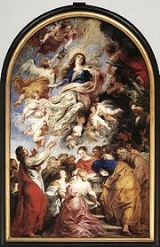
Assumption of Mary

 
Assumption of Mary

   Email Print
   Bookmark   Link


Assumption of Mary


The Roman Catholic Church
Roman Catholic Church

The Roman Catholic Church, officially known as the Catholic Church is the world's largest Christianity Ecclesia , representing over half of all Christians and one-sixth of the world population....
 teaches as dogma
Dogma (Roman Catholic)

Dogma explains the concept of dogma from a Roman Catholic perspective. Dogma refers to an article of faith revealed by God, which the magisterium of the Church presents to be believed....
 that the Virgin Mary
Mary (mother of Jesus)

Mary , usually referred to by Christians as Saint Mary, the Virgin Mary, Holy Mary or the Madonna, was a Jewish woman of Nazareth in Galilee, identified in the New Testament as the mother of Jesus of Nazareth....
, "having completed the course of her earthly life, was assumed body and soul into heavenly glory." This means that Mary was transported into Heaven with her body and soul united. The feast day recognizing Mary's passage into Heaven is celebrated as The Solemnity of the Assumption of the Blessed Virgin Mary by Roman Catholics. This doctrine was dogmatically and infallibly defined
Dogmatic definition

In Catholicism, a dogmatic definition is an extraordinary papal infallibility statement published by a pope or an ecumenical council concerning a matter of faith or morality, the belief in which the Catholic Church requires of all Christianity ....
 by Pope Pius XII
Pope Pius XII

Pope Pius XII , born Eugenio Maria Giuseppe Giovanni Pacelli , reigned as the 260th pope, head of the Roman Catholic Church and monarch of Vatican City, from March 2, 1939 until his death in 1958....
 on November 1, 1950, in his Apostolic Constitution
Apostolic constitution

An apostolic constitution is the highest level of decree issued by the Pope of the Roman Catholic Church. The use of the term constitution comes from Latin language constitutio, which referred to any important law issued by the Roman emperor, and is retained in church documents because of the inheritance that the canon law of the R...
 Munificentissimus Deus
Munificentissimus Deus

Munificentissimus Deus is the name of an Apostolic constitution written by Pope Pius XII. It defines ex cathedra the dogma of the Assumption of Mary of the BVM....
.


Discussion
Ask a question about 'Assumption of Mary'
Start a new discussion about 'Assumption of Mary'
Answer questions from other users
Full Discussion Forum


Encyclopedia


The Roman Catholic Church
Roman Catholic Church

The Roman Catholic Church, officially known as the Catholic Church is the world's largest Christianity Ecclesia , representing over half of all Christians and one-sixth of the world population....
 teaches as dogma
Dogma (Roman Catholic)

Dogma explains the concept of dogma from a Roman Catholic perspective. Dogma refers to an article of faith revealed by God, which the magisterium of the Church presents to be believed....
 that the Virgin Mary
Mary (mother of Jesus)

Mary , usually referred to by Christians as Saint Mary, the Virgin Mary, Holy Mary or the Madonna, was a Jewish woman of Nazareth in Galilee, identified in the New Testament as the mother of Jesus of Nazareth....
, "having completed the course of her earthly life, was assumed body and soul into heavenly glory." This means that Mary was transported into Heaven with her body and soul united. The feast day recognizing Mary's passage into Heaven is celebrated as The Solemnity of the Assumption of the Blessed Virgin Mary by Roman Catholics. This doctrine was dogmatically and infallibly defined
Dogmatic definition

In Catholicism, a dogmatic definition is an extraordinary papal infallibility statement published by a pope or an ecumenical council concerning a matter of faith or morality, the belief in which the Catholic Church requires of all Christianity ....
 by Pope Pius XII
Pope Pius XII

Pope Pius XII , born Eugenio Maria Giuseppe Giovanni Pacelli , reigned as the 260th pope, head of the Roman Catholic Church and monarch of Vatican City, from March 2, 1939 until his death in 1958....
 on November 1, 1950, in his Apostolic Constitution
Apostolic constitution

An apostolic constitution is the highest level of decree issued by the Pope of the Roman Catholic Church. The use of the term constitution comes from Latin language constitutio, which referred to any important law issued by the Roman emperor, and is retained in church documents because of the inheritance that the canon law of the R...
 Munificentissimus Deus
Munificentissimus Deus

Munificentissimus Deus is the name of an Apostolic constitution written by Pope Pius XII. It defines ex cathedra the dogma of the Assumption of Mary of the BVM....
. In those denominations that observe it, the Assumption is commonly celebrated on August 15, a Holy Day of Obligation
Holy Day of Obligation

In the Roman Catholic Church, Holy Days of Obligation or Holidays of Obligation, less commonly called Feasts of Precept, are the days on which, as of the Code of Canon law states,Eastern Catholic Churches...
 in many Roman Catholic jurisdictions.

In his August 15, 2004, homily given at Lourdes
Lourdes

Lourdes is a town and communes of France situated in the southwest of the Hautes-Pyr?n?es Departments of France, lying in the first Pyrenean foothills, in southwestern France....
, Pope John Paul II
Pope John Paul II

Pope John Paul II John Paul II is widely acclaimed as one of the most influential leaders of the twentieth century. He has been Pope_John_Paul_II#Role_in_the_fall_of_Communism in bringing down communism in Eastern Europe, as well as significantly improving the Roman Catholic Church's relations with Judaism, the Eastern Orthodox Church, and A...
 quoted from the Bible as a scriptural basis for understanding the dogma of the Assumption of Mary. In this verse, Jesus tells his disciples at the Last Supper
Last Supper

In the Christian Gospels, the Last Supper was the last meal Jesus shared with his Twelve Apostles and Disciple before Crucifixion of Jesus. The Last Supper has been the subject of many paintings, perhaps The Last Supper by Leonardo da Vinci....
, "And if I go and prepare a place for you, I will come back again and take you to myself, so that where I am you also may be." According to Catholic theology, Mary is the pledge of the fulfillment of Christ's promise. However, many theologians disagree with this interpretation of Scripture, and believe that Christ was speaking about his preparation of Calvary
Calvary

Calvary or Golgotha are the English language/Western Christian names given to the site, outside of ancient Jerusalem?s early 1st century walls, ascribed to Jesus's crucifixion....
 and the crucifixion for the remission of sins.

History


Although the Assumption (Latin
Latin

Latin is an Italic language, historically spoken in Latium and Ancient Rome. Through the Military history of the Roman Empire, Latin spread throughout the Mediterranean and a large part of Europe....
: assumptio, "taken up") was only relatively recently defined as dogma
Dogma

Dogma is the established belief or doctrine held by a religion, ideology or any kind of organization: it is authority and not to be disputed, doubted or heresy....
, and in spite of a statement by Epiphanius of Salamis
Epiphanius of Salamis

Epiphanius was bishop of Salami and Cypriot Orthodox Church at the end of the 4th century AD. He is considered a Church Father. He gained the reputation of a strong defender of orthodoxy....
 in AD 377 that no one knew of the eventual fate of Mary, accounts of the assumption of Mary into heaven have circulated since the 5th century. The Roman Catholic Church itself interprets chapter 12 of the Book of Revelation
Book of Revelation

The Book of Revelation, also called Revelation to John, Apocalypse of John , and Revelation of Jesus Christ is the last Biblical canon of the New Testament in the Christian Bible....
 as referring to it. The earliest known narrative is the so-called Liber Requiei Mariae (The Book of Mary's Repose), a narrative which survives intact only in an Ethiopic
Ge'ez language

Ge'ez is an ancient South Semitic language that developed in the current region of Eritrea and northern Ethiopia in the Horn of Africa. It later became the official language of the Kingdom of Aksum and Ethiopian imperial court....
 translation. Probably composed by the 4th century, this early Christian apocrypha
Apocrypha

Apocrypha are texts of uncertain authenticity, or writings where the authorship is questioned.When used in the specific context of Judeo-Christian theology, the term apocrypha refers to any collection of scriptural texts that falls outside the Biblical canon....
l narrative may be as early as the 3rd century. Also quite early are the very different traditions of the . The earliest versions of this apocryphon are preserved by several Syriac
Syriac language

Syriac is a dialect of Middle Aramaic that was once spoken across much of the Fertile Crescent. Classical Syriac became a major literary language throughout the Middle East from the 4th to the 8th centuries, the classical language of Edessa, Mesopotamia, preserved in a large body of Syriac literature....
 manuscripts of the 5th and 6th centuries, although the text itself probably belongs to the 4th century.

Later apocrypha based on these earlier texts include the , attributed to St. John, a work probably from around the turn of the 6th century that is a summary of the "Six Books" narrative. The story also appears in , a late 5th century work ascribed to St. Melito of Sardis
Melito of Sardis

Saint Melito of Sardis was the See of Sardis, near Smyrna in Asia Minor, and a great authority: Jerome, speaking of the Old Testament biblical canon established by Melito, quotes Tertullian to the effect that he was esteemed a prophet by many of the faithful....
 that presents a theologically redacted summary of the traditions in the Liber Requiei Mariae. The Transitus Mariae tells the story of the apostles being transported by white clouds to the deathbed of Mary, each from the town where he was preaching at the hour. The Decretum Gelasianum
Decretum Gelasianum

The so-called Decretum Gelasianum or Gelasian Decree was traditionally attributed to the prolific Pope Gelasius I, bishop of Rome 492–496....
 in the 490s declared some transitus Mariae literature apocryphal.
Assumptiongirdle
An Armenian letter attributed to Dionysus the Areopagite also mentions the event, although this is a much later work, written sometime after the 6th century. Other saints of this period also provide accounts, notably St Gregory of Tours
Gregory of Tours

Saint Gregory of Tours was a Gallo-Roman History and Bishops of Tours, which made him a leading prelate of Gaul. He was born Georgius Florentius, later adding the name Gregorius in honour of his maternal great-grandfather....
, St John Damascene, and St Modestus of Jerusalem.

In some versions of the story the event is said to have taken place in Ephesus
Ephesus

Ephesus was an ancient Greek city on the west coast of Anatolia, in the region known as Ionia during the period known as Classical Greece. It was one of the twelve cities of the Ionian League....
, in the House of the Virgin Mary
House of the Virgin Mary

The House of the Virgin Mary is a Christian and Muslim shrine located on Mt. Koressos in the vicinity of Ephesus, in modern-day Turkey .It is believed by many Christians and Islam that Mary, the mother of Jesus, was taken to this stone house by John the Apostle and lived there until her Assumption of Mary into Heaven according to many R...
, although this is a much more recent and localized tradition. The earliest traditions all locate the end of Mary's life in Jerusalem
Jerusalem

Jerusalem is the capital of Israel and its List of Israeli cities in both population and area, with a population of 747,600 residents over an area of if Positions on Jerusalem East Jerusalem is included....
 (see "Mary's Tomb
Mary's Tomb

Mary's Tomb is a tomb located in the Kidron Valley, on the foothills of Mount of Olives, near the Church of All Nations and Gethsemane garden, originally just outside Jerusalem....
"). By the 7th century a variation emerged, according to which one of the apostles, often identified as St Thomas, was not present at the death of Mary, but his late arrival precipitates a reopening of Mary's tomb, which is found to be empty except for her grave clothes. In a later tradition, Mary drops her girdle
Girdle

The word girdle originally meant a belt. In modern English the term "girdle" is most commonly used for a form of women's Foundation garment that replaced the corset in popularity....
 down to the apostle from heaven as testament to the event. This incident is depicted in many later paintings of the Assumption.

The taking of Mary into Heaven became an established teaching across the Eastern, Western, Coptic and Oriental churches from at least the late 7th Century, the festival date settling at August 15th. Theological debate about the Assumption continued, following the Reformation, climaxing in 1950 when Pope Pius XII defined it as dogma for the Roman Catholic Church. The Roman Catholic Church has not claimed that this doctrine is founded on the apocryphal accounts as having any authority, nor that the church bases its teaching about the Assumption on them, but rather on the historic teaching of the Church down the centuries, the scholastic arguments in favor of it, and its biblical foundations. However, Protestant theologians reject such arguments as semantics; that apocryphal accounts did in fact become the basis for such church teachings, which were then set forth as dogma. They cite the fact that the idea did not gain acceptance in the church until the sixth century, after Gregory of Tours accepted the apocryphal work "Transitus Beatae Mariae". Indeed Roman Catholic theologian Ludwig Ott stated, "The idea of the bodily assumption of Mary is first expressed in certain transitus–narratives of the fifth and sixth centuries.... The first Church author to speak of the bodily ascension of Mary, in association with an apocryphal transitus B.M.V., is St. Gregory of Tours." The Roman Catholic writer Eamon Duffy goes further, conceding that "there is, clearly, no historical evidence whatever for it.". However, the Catholic Church has never asserted nor denied that its teaching is based on the apocryphal accounts. The Church documents are silent on this matter and instead rely upon other sources and arguments as the basis for the doctrine.

The Assumption in Roman Catholic teaching


In this dogmatic statement, the phrase "having completed the course of her earthly life," leaves open the question of whether the Virgin Mary died before her Assumption, or, whether she was assumed before death; both possibilities are allowed. Mary's Assumption was a divine gift to Mary as Mother of God. As Mary completed her life as a shining example to the human race, the perspective of the gift of assumption is offered to the whole human race.

In Ludwig Ott's Fundamentals of Catholic Dogma he states that "the fact of her death is almost generally accepted by the Fathers and Theologians, and is expressly affirmed in the Liturgy of the Church," to which he adduces a number of helpful citations, and concludes that "for Mary, death, in consequence of her freedom from original sin
Original sin

Original sin is, according to a doctrine in Christian theology, humanity's state of sin resulting from the Fall of Man. While the Old Testament and the New Testament, which frequently speak of the sinfulness of humans, do not contain the terms "original sin" or "ancestral sin", the doctrine expressed by these terms is claimed to be based on t...
 and from personal sin
Sin

Sin is a term used mainly in a religion context to describe an act that violates a morality rule, or the state of having committed such a violation....
, was not a consequence of punishment of sin. However, it seems fitting that Mary's body, which was by nature mortal, should be, in conformity with that of her Divine Son
Jesus

Jesus of Nazareth , also known as Jesus Christ, is the central figure of Christianity and is revered by most Christian churches as the Son of God and the Incarnation ....
, subject to the general law of death". The point of her bodily death has not been infallibly defined, and many believe that she did not die at all, but was assumed directly into Heaven. Indeed, the papal decree which infallibly proclaims the doctrine of the Assumption, the Apostolic Constitution Munificentissimus Deus
Munificentissimus Deus

Munificentissimus Deus is the name of an Apostolic constitution written by Pope Pius XII. It defines ex cathedra the dogma of the Assumption of Mary of the BVM....
, leaves open the question whether, in connection with her departure, Mary underwent bodily death; that is, it does not dogmatically define the point one way or the other, as shown by the words "having completed the course of her earthly life".

On November 1, 1950, Pope Pius XII
Pope Pius XII

Pope Pius XII , born Eugenio Maria Giuseppe Giovanni Pacelli , reigned as the 260th pope, head of the Roman Catholic Church and monarch of Vatican City, from March 2, 1939 until his death in 1958....
 solemnly declared:

By the authority of our Lord Jesus Christ, of the Blessed Apostles Peter and Paul, and by our own authority, we pronounce, declare, and define it to be a divinely revealed dogma: that the Immaculate Mother of God, the ever Virgin Mary, having completed the course of her earthly life, was assumed body and soul into heavenly glory


Since the declaration of Papal Infallibility
Papal infallibility

File:Gregorythegreat.jpgPapal infallibility is the dogma in Christian theology# Catholic theology that, by action of the Holy Spirit, the Pope is preserved from even the possibility of error when he solemnly declaration or promulgation to the Catholic Church a dogmatic teaching on faith or morals as being contained in divine revelation, or a...
 by Vatican I in 1870, this declaration by Pius XII has been the only ex cathedra
Ex Cathedra

Ex Cathedra is a United Kingdom choir and early music musical ensemble based in Birmingham in the West Midlands , England. It performs choral music spanning the 15th to 21st centuries, and regularly commissions new works....
 use of Papal Infallibility. While Pope Pius XII deliberately left open the question of whether Mary died before her Assumption, the more common teaching of the early Fathers is that she did.

The Virgin Mary's heavenly birthday

The Assumption is important to many Catholics as the Virgin Mary's heavenly birthday (the day that Mary was received into Heaven). Her acceptance into the glory of Heaven is seen by them as the symbol of the promise made by Jesus to all enduring Christians that they too will be received into paradise. The Assumption of Mary is symbolised in the Fleur-de-lys Madonna.

The Feast of the Assumption is a Public Holiday
Holiday

The words holiday or vacation have related meanings in different English language countries and continents, but will usually refer to one of the following activities or events:...
 in many countries, including Austria
Austria

Austria , officially the Republic of Austria , is a landlocked country in Central Europe. It borders both Germany and the Czech Republic to the north, Slovakia and Hungary to the east, Slovenia and Italy to the south, and Switzerland and Liechtenstein to the west....
, Belgium
Belgium

* A small German-speaking Community of Belgium exists in eastern Wallonia. Belgium's linguistic diversity and related political and cultural conflicts are reflected in the history of Belgium and a complex Communities and regions of Belgium....
, Cameroon
Cameroon

The Republic of Cameroon is a unitary state of central and western Africa. It is bordered by Nigeria to the west; Chad to the northeast; the Central African Republic to the east; and Equatorial Guinea, Gabon, and the Republic of the Congo to the south....
, Chile
Chile

Chile, officially the Republic of Chile , is a country in South America occupying a long and narrow coastal strip wedged between the Andes mountains and the Pacific Ocean....
, Croatia
Croatia

Croatia , officially the Republic of Croatia , is a Central European country at the crossroads of Pannonian Plain, Balkans, and the Mediterranean Sea....
, France
France

France , officially the French Republic , is a country whose Metropolitan France is located in Western Europe and that also comprises various Overseas departments and territories of France....
, some predominantly Catholic states (such as Bavaria
Bavaria

Bavaria , with an area of and almost 12.5 million inhabitants, is a region located in the southeast of Germany and is the largest States of Germany of Germany by area....
 and Saarland
Saarland

Saarland is one of the 16 States of Germany of Germany. The capital is Saarbr?cken. It has an area of 2570 km? and 1,045,000 inhabitants. In both area and population it is the smallest of the German Fl?chenl?nder , i.e., those that are not City States ....
) of Germany
Germany

Germany , officially the Federal Republic of Germany , is a country in Central Europe. It is bordered to the north by the North Sea, Denmark, and the Baltic Sea; to the east by Poland and the Czech Republic; to the south by Austria and Switzerland; and to the west by France, Luxembourg, Belgium, and the Netherlands....
, Greece
Greece

Greece , officially the Hellenic Republic , is a country in southeastern Europe, situated on the southern end of the Balkans. It has borders with Albania, Bulgaria and the former Yugoslav Republic of Macedonia to the north, and Turkey to the east....
, Macedonia
Republic of Macedonia

The Republic of Macedonia , , often referred to simply as Macedonia, is a landlocked country on the Balkans in southeastern Europe. It is bordered by Serbia to the north, Bulgaria to the east, Greece to the south and Albania to the west....
, Italy
Italy

Italy , officially the Italian Republic , is a country located on the Italian Peninsula in Southern Europe and on the two largest islands in the Mediterranean Sea, Sicily and Sardinia....
, Lebanon
Lebanon

Lebanon , officially the Republic of Lebanon or Lebanese Republic , is a country in Western Asia, on the eastern shore of the Mediterranean Sea....
, Luxembourg
Luxembourg

Luxembourg , officially the Grand Duchy of Luxembourg , is a small landlocked country in western Europe, bordered by Belgium, France, and Germany....
, Malta
Malta

Malta , officially the Republic of Malta , is a densely populated developed country European microstates microstate in the European Union....
, Mauritius
Mauritius

Mauritius , officially the Republic of Mauritius, , is an island nation off the coast of the African continent in the southwest Indian Ocean, about 900 kilometres east of Madagascar....
, Paraguay
Paraguay

Paraguay, officially the Republic of Paraguay , is one of the only two landlocked countries in South America . It lies on both banks of the Paraguay River and is bordered by Argentina to the south and southwest, Brazil to the east and northeast, and Bolivia to the northwest....
, Poland
Poland

Poland , officially the Republic of Poland , is a country in Central Europe. Poland is bordered by Germany to the west; the Czech Republic and Slovakia to the south; Ukraine, Belarus and Lithuania to the east; and the Baltic Sea and Kaliningrad Oblast, a Russian Enclave and exclave, to the north....
, Portugal
Portugal

Portugal , officially the Portuguese Republic , is a country on the Iberian Peninsula. Located in southwestern Europe, Portugal is the westernmost country of mainland Europe and is bordered by the Atlantic Ocean to the west and south and by Spain to the north and east....
, Spain
Spain

Spain or the Kingdom of Spain , is a country located in Southern Europe on the Iberian Peninsula.The Spanish constitution does not establish any official denomination of the country, even though Espa?a , Estado espa?ol and Naci?n espa?ola are used interchangeably....
, and Vanuatu
Vanuatu

Vanuatu , officially the Republic of Vanuatu , is an island nation located in the South Pacific Ocean. The archipelago, which is of volcanic origin, is some east of northern Australia, north-east of New Caledonia, west of Fiji, and south of the Solomon Islands, near New Zealand....
. In Guatemala
Guatemala

Guatemala is a country in Central America bordered by Mexico to the north and west, the Pacific Ocean to the southwest, Belize and the Caribbean to the northeast, and Honduras and El Salvador to the southeast....
 it is observed in Guatemala City
Guatemala City

Guatemala City is the Capital and largest city of the nation of Guatemala. It is also the capital city of the local Guatemala and the largest city in Central America....
 and in the town of Santa Maria Nebaj
Santa Maria Nebaj

Santa Maria Nebaj is a municipality in the Guatemalan Departments of Guatemala of El Quich?. Santa Maria Nebaj is part of the Ixil Triangle, along with San Juan Cotzal and Chajul....
, both of which claim her as their patron saint
Patron saint

A patron saint is a saint who is regarded as the intercessor and advocate in heaven of a nation, place, craft, activity, class, or person. Patron saints, because they have already transcended to the metaphysical, are able to intercede effectively for the needs of their special charges....
. Also, this is the celebration of Mother's Day
Mother's Day

Mother's Day was created as a day for each family to honor their mother, celebrated on various days in many places around the world. It complements Father's Day, the celebration honoring fathers....
 in Costa Rica
Costa Rica

Costa Rica, officially the Republic of Costa Rica is a country in Central America, bordered by Nicaragua to the north, Panama to the east and south, the Pacific Ocean to the west and south and the Caribbean Sea to the east....
. In many places, religious parades and popular festivals are held to celebrate this day. In Anglicanism
Anglicanism

Anglicanism is a tradition of Christianity faith. Churches in this tradition either have historical connections to the Church of England or have similar beliefs, worship and church structures....
 and Lutheranism
Lutheranism

Lutheranism is a major branch of Western Christianity that identifies with the teachings of the sixteenth-century Germans Reformer Martin Luther....
, the feast is kept, but without official use of the word "Assumption". Her feast day is Fête Nationale of the Acadian
Acadian

The Acadians are the descendants of the seventeenth-century France French colonial empires who settled in Acadia . Although today most of the Acadians and Qu?b?cois are francophone Canadians, Acadia was founded in a geographically separate region from Quebec leading to their two distinct cultures....
s, of whom she is the patron saint. Businesses close on that day in heavily francophone parts of New Brunswick
New Brunswick

New Brunswick is one of Canada's three Maritime provinces and is the only Constitution of Canada bilingual province in the federation. The provincial capital is Fredericton....
, Canada
Canada

Canada is a country occupying most of northern North America, extending from the Atlantic Ocean in the east to the Pacific Ocean in the west and northward into the Arctic Ocean....
. The Virgin Assumed in Heaven is also patroness of the Maltese Islands and her feast, celebrated on 15 August, apart from being a public holiday in Malta
Malta

Malta , officially the Republic of Malta , is a densely populated developed country European microstates microstate in the European Union....
 is also celebrated with great solemnity in all the local churches especially in the seven localities known as the Seba' Santa Marijiet. In New York City
New York City

The City of New York is the List of United States cities by population in the United States, while the New York metropolitan area ranks among the List of urban areas by population....
, alternate side of the street parking rules are suspended.

Assumption and Dormition (Eastern Christianity) compared

The Roman Catholic Feast of the Assumption is celebrated on August 15, and the Eastern Orthodox
Eastern Orthodox Church

The Eastern Orthodox Church is the second largest single Christian communion in the world with an estimated 225 million members worldwide. It is considered by its adherents to be the Four Marks of the Church established by Jesus Christ and his Apostles nearly 2000 years ago....
 and Eastern Catholics celebrate the Dormition of the Theotokos
Dormition of the Theotokos

The Dormition of the Theotokos is a Great Feasts of the Orthodox Church of the Eastern Orthodox Church, Oriental Orthodox Churches and Eastern Catholic Churches which commemorates the "falling asleep" or death of the Theotokos ....
 (the falling asleep of the Mother of God) on the same date, preceded by a 14-day fast
FAST

Fast may refer to:* Fasting, abstaining from food* Nacional Fast Clube, a Brazilian football club* A speed racing for dirt horse racetracks* Fast Search & Transfer, a Norwegian company focusing on data search technologies...
 period. Eastern Orthodox Christians believe that Mary died a natural death, that her soul was received by Christ upon death, and that her body was resurrected on the third day after her death and that she was taken up into heaven bodily in anticipation of the general resurrection. Her tomb was found empty on the third day. "...Orthodox tradition is clear and unwavering in regard to the central point [of the Dormition]: the Holy Virgin underwent, as did her Son, a physical death, but her body – like His – was afterwards raised from the dead and she was taken up into heaven, in her body as well as in her soul. She has passed beyond death and judgement, and lives wholly in the Age to Come. The Resurrection of the Body ... has in her case been anticipated and is already an accomplished fact. That does not mean, however, that she is dissociated from the rest of humanity and placed in a wholly different category: for we all hope to share one day in that same glory of the Resurrection of the Body which she enjoys even now." Many Catholics also believe that she first died before being assumed, but they add that she was miraculously resurrected before being assumed. Others believe she was assumed into Heaven without first passing through death. As mentioned earlier, this aspect of the Assumption is not authoritatively defined in Catholic theology. Eastern Catholics also observe the Feast of the Dormition. Many theologians note by way of comparison that in the Roman Catholic Church, the Assumption is dogmatically defined, while in the Eastern Orthodox tradition, the Dormition is less dogmatically than liturgically and mystically defined. (Such differences spring from a larger pattern in the two traditions, wherein Roman Catholic teachings are often dogmatically and authoritatively defined - in part because of the more centralized structure of Roman Catholicism - while in Eastern Orthodoxy, many doctrines are less authoritative.)

Assumption in Anglicanism

The Prayer Books
Book of Common Prayer

The Book of Common Prayer is the common title of a number of prayer books of the Church of England and used throughout the Anglican Communion. The first book, published in 1549 , in the reign of Edward VI of England, was a product of the English Reformation following the break with Roman Catholic Church....
 of the Scottish Episcopal Church
Scottish Episcopal Church

The Scottish Episcopal Church is a Christian denomination in Scotland and a member of the Anglican Communion, although it itself has pre-Anglican origins....
 and the Anglican Church of Canada
Anglican Church of Canada

The Anglican Church of Canada is the sole Canada representative of the Anglican Communion. The official French name is l'?glise Anglicane du Canada....
 mark 15 August as the Falling Asleep of the Blessed Virgin Mary. In the Episcopal Church in the United States of America, the day is observed as a Holy Day of St Mary the Virgin, and in the Church of England
Church of England

The Church of England is the State religion Christianity Ecclesia in England, the Mother Church of the worldwide Anglican Communion and the oldest among the communion's thirty-eight independent national and regional churches....
 the day is a Festival
Festival (Church of England)

A Festival is a type of observance in the Churches of the Anglican Communion, considered to be less significant than a Principal Feast or Principal Holy Day, but more significant than a Lesser Festival or Commemoration ....
 of The Blessed Virgin Mary. In all churches of the Anglican Communion
Anglican Communion

The Anglican Communion is an international association of national Anglican churches. There is no single "Anglican Church" with universal juridical authority as each national or regional church has full autonomy....
 Anglo-Catholics often observe the feast day under the same name as Roman Catholics.

The Anglican-Roman Catholic agreed statement on the Virgin Mary assigns a place for both the Dormition and the Assumption in Anglican devotion.

Scriptural Sources

As mentioned, recent papal scholarship has cited John 14:3 as evidence of the Assumption in principle if not formally. Near the end of a review of the doctrine's history – a review which serves as the bulk of Munificentissimus Deus
Munificentissimus Deus

Munificentissimus Deus is the name of an Apostolic constitution written by Pope Pius XII. It defines ex cathedra the dogma of the Assumption of Mary of the BVM....
 – Pope Pius XII
Pope Pius XII

Pope Pius XII , born Eugenio Maria Giuseppe Giovanni Pacelli , reigned as the 260th pope, head of the Roman Catholic Church and monarch of Vatican City, from March 2, 1939 until his death in 1958....
 tells us: "All these proofs and considerations of the holy Fathers and the theologians are based upon the Sacred Writings as their ultimate foundation." Precedent to this, he cites many passages that have been offered in support of this teaching:

29. ...the holy writers...employed statements and various images and analogies of Sacred Scripture to Illustrate and to confirm the doctrine of the Assumption, which was piously believed... On the feast day of the Assumption, while explaining the prophet's words: "I will glorify the place of my feet," [Isaiah 60:13] he [i.e. St. Anthony of Padua] stated it as certain that the divine Redeemer had bedecked with supreme glory his most beloved Mother from whom he had received human flesh. He asserts that "you have here a clear statement that the Blessed Virgin has been assumed in her body, where was the place of the Lord's feet..."

30. ...St. Albert the Great... in a sermon which he delivered on the sacred day of the Blessed Virgin Mary's annunciation, explained the words "Hail, full of grace" [Luke 1:28]-words used by the angel who addressed her-the Universal Doctor, comparing the Blessed Virgin with Eve, stated clearly and incisively that she was exempted from the fourfold curse that had been laid upon Eve [cf. Genesis 3:16]...

32. Along with many others, the Seraphic Doctor held the same views. He considered it as entirely certain that...God...would never have permitted her body to have been resolved into dust and ashes. Explaining these words of Sacred Scripture: "Who is this that comes up from the desert, flowing with delights, leaning upon her beloved?" [Song of Songs 8:5] and applying them in a kind of accommodated sense to the Blessed Virgin, he reasons thus: "From this we can see that she is there bodily...her blessedness would not have been complete unless she were there as a person. The soul is not a person, but the soul, joined to the body, is a person. It is manifest that she is there in soul and in body. Otherwise she would not possess her complete beatitude. ...


The Pope also cites, significantly in paragraph 39, 1st Corinthians 15, where we read (vv. 21-26):

For by a man came death, and by a man the resurrection of the dead. And as in Adam all die, so also in Christ all shall be made alive. But every one in his own order: the firstfruits Christ, then they that are of Christ, who have believed in his coming. Afterwards the end, when he shall have delivered up the kingdom to God and the Father, when he shall have brought to nought all principality, and power, and virtue. For he must reign, until he hath put all his enemies under his feet. And the enemy death shall be destroyed last: For he hath put all things under his feet.


In this passage Paul alludes to Genesis 3:15 (in addition to the primary reference of Psalms 8:6), where it is prophesied that the seed of a woman will crush Satan with his feet. Since, then, Jesus arose to Heaven to fulfill this prophecy, it follows that the woman would have a similar end, since she shared this enmity with Satan. The pope comments thus in paragraph 39:

...although subject to [Jesus, who is] the new Adam, [Mary, the new Eve] is most intimately associated with him in that struggle against the infernal foe which, as foretold in the protoevangelium [i.e. Genesis 3:15], would finally result in that most complete victory over the sin and death which are always mentioned together in the writings of the Apostle of the Gentiles. Consequently, just as the glorious resurrection of Christ was an essential part and the final sign of this victory, so that struggle which was common to the Blessed Virgin and her divine Son should be brought to a close by the glorification of her virginal body, for the same Apostle says: "When this mortal thing hath put on immortality, then shall come to pass the saying that is written: Death is swallowed up in victory."


The pope also mentions (in paragraph 26) Psalms 132, a liturgical psalm commemorating the return of the Ark of God to Jerusalem and lamenting its subsequent loss. The second half of the psalm says that the loss will be recompensed in the New Covenant, and so it is hopefully prayed, "Arise, O Lord, into thy resting place: thou and the ark, which thou hast sanctified" (v. 8). Since the Church sees this New Covenant ark in Mary, it understands that she was taken into Heaven in the same manner as the Lord – that is, body and soul.

In the same paragraph the pope mentions also Psalms 45:9-17 for support of a heavenly Queen present bodily with the heavenly King Jesus, and Song of Songs 3:6, 4:8, and 6:9, which speaks of David's lover "that goeth up by the desert, as a pillar of smoke of aromatical spices, of myrrh, and frankincense, and of all the powders of the perfumer". Regarding the Marian interpretations of those passages from Psalms 132 to Song of Songs 6:9 and those in between, the pope did, however, consider them "rather free in their use of events and expressions taken from Sacred Scripture" (paragraph 26).

Finally, he mentions in the next paragraph "that woman clothed with the sun [Revelation 12:1-2] whom John the Apostle contemplated on the Island of Patmos" as support for the doctrine. The text seems to parallel this woman with the woman of the Genesis 3 prophecy (and hence Mary): for in verse 9 the passage recalls "that old serpent" of Genesis 3, and reflects the prophecy that God would place "enmities between thee [i.e. Satan] and the woman, and thy seed and her seed" when it says that Satan "was angry against the woman: and went to make war with the rest of her seed" (Rev. 12:17).

All these passages – viz., John 14:3, Isaiah 60:13, Luke 1:28, Song of Songs 8:5, 1st Corinthians 15:21-26, Psalms 132:8, Psalms 45:9-17, Song of Songs 3:6, 4:8, 6:9, Genesis 3:15, and Revelation 12:1-2 – are drawn upon as Scriptural support of the Assumption both in that original document, and today by Catholic apologists.

Bibliography

  • Duggan, Paul E. (1989). The Assumption Dogma: Some Reactions and Ecumenical Implications in the Thought of English-speaking Theologians. Emerson Press, Cleveland, Ohio
  • Shoemaker, Stephen J. (2002, 2006). . Oxford University Press, Oxford. ISBN 0-19-921074-8


External links

  • which organises the feast of the Assumption of Our Lady in the same village, yearly on the 15 August.
  • Vatican, November 1, 1950
  • a collection of early Dormition and Assumption narratives with introductions
  • based on Juniper Carol's Mariology


See also


  • Assumption Cathedral
    Assumption Cathedral

    Assumption Cathedral or Dormition Cathedral may refer to a number of Cathedral consecrated to the Dormition of the Theotokos in the Orthodox tradition and Assumption of Mary in the Roman Catholic tradition: ...
  • Black Madonna of Czestochowa
    Black Madonna of Czestochowa

    The Black Madonna of Czestochowa is a holy icon of the Virgin Mary, that is both Poland's holiest relic and one of the country's national symbols....
  • Dormition of the Theotokos
    Dormition of the Theotokos

    The Dormition of the Theotokos is a Great Feasts of the Orthodox Church of the Eastern Orthodox Church, Oriental Orthodox Churches and Eastern Catholic Churches which commemorates the "falling asleep" or death of the Theotokos ....
  • Fleur de lys
    Fleur de Lys

    Fleur de Lys is a superheroine from Quebec and an ally of Northguard, created in 1984 by Mark Shainblum and Gabriel Morrissette. The name of the character is inspired by the heraldry of the fleur de lys....
  • Holy Trinity
  • Munificentissimus Deus
    Munificentissimus Deus

    Munificentissimus Deus is the name of an Apostolic constitution written by Pope Pius XII. It defines ex cathedra the dogma of the Assumption of Mary of the BVM....
  • Resurrection
    Resurrection

    Miraculous resurrection of one sort or another has been a recurrent theme or central doctrine of Judaism, Christianity, and Islam, and other Abrahamic religions....
  • Resurrection of Jesus