

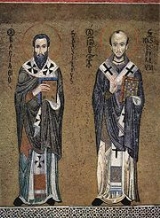
Divine Liturgy

Encyclopedia
Divine Liturgy refers to the appearance of a deity to a human or other being, or to a divine disclosure....
, and on Holy Thursday and Holy Saturday
Holy Saturday
Holy Saturday , sometimes known as Easter Eve or Black Saturday, is the day after Good Friday. It is the day before Easter and the last day of Holy Week in which Christians prepare for Easter...
, it is celebrated as a vesperal
Vespers
Vespers is the evening prayer service in the Western Catholic, Eastern Catholic, and Eastern Orthodox, Anglican, and Lutheran liturgies of the canonical hours...
liturgy. In some traditions, Saint Basil's Liturgy is also celebrated on the Exaltation of the Life-giving Cross
Feast of the Cross
In the Christian liturgical calendar, there are several different Feasts of the Cross, all of which commemorate the cross used in the crucifixion of Jesus....
on September 14. All together, St. Basil's liturgy is celebrated 10 times out of the liturgical year.
Christianity in the 1st century
The earliest followers of Jesus composed an apocalyptic, Jewish sect, which historians refer to as Jewish Christianity. The Apostles and others following the Great Commission's decree to spread the teachings of Jesus to "all nations," had great success spreading the religion to gentiles. Peter,...
), celebrated once a year in Jerusalem (and a few other churches) on the feast day of St. James
James the Just
James , first Bishop of Jerusalem, who died in 62 AD, was an important figure in Early Christianity...
, brother of the Lord and first bishop of Jerusalem, to whom this Liturgy is traditionally attributed.
Additionally, the Liturgy of the Presanctified Gifts
Liturgy of the Presanctified Gifts
The Liturgy of the Presanctified Gifts, informally Presanctified Liturgy, is an Eastern Christian liturgical service for the distribution of communion on the weekdays of Great Lent....
(6th century A.D.
Christianity in the 6th century
In 533 Roman Emperor Justinian in Constantinople launched a military campaign to reclaim the western provinces from the Arian Germans, starting with North Africa and proceeding to Italy. Though he was temporarily successful in recapturing much of the western Mediterranean he destroyed the urban...
), is used on Wednesdays and Fridays during Great Lent
Great Lent
Great Lent, or the Great Fast, is the most important fasting season in the church year in Eastern Christianity, which prepares Christians for the greatest feast of the church year, Pascha . In many ways Great Lent is similar to Lent in Western Christianity...
and on the first three days of Holy Week
Holy Week
Holy Week in Christianity is the last week of Lent and the week before Easter...
. It is essentially the office of vespers
Vespers
Vespers is the evening prayer service in the Western Catholic, Eastern Catholic, and Eastern Orthodox, Anglican, and Lutheran liturgies of the canonical hours...
with a communion service added, the Holy Gifts having been consecrated and reserved the previous Sunday. It is traditionally attributed to St. Gregory the Dialogist
Pope Gregory I
Pope Gregory I , better known in English as Gregory the Great, was pope from 3 September 590 until his death...
. The Divine Liturgy of St. Mark was also observed in the Orthodox (Chalcedonian) Patriarchate of Alexandria on at least that Saint's day until fairly recent times.
Structure
- Note: Psalms are numbered according to the Greek Septuagint. For the Hebrew Masoretic numbering that is more familiar in the West, usually add '1'. (See the main Psalms article for an exact correspondence table.)
The format of Divine Liturgy is fixed, although the specific readings and hymn
Hymn
A hymn is a type of song, usually religious, specifically written for the purpose of praise, adoration or prayer, and typically addressed to a deity or deities, or to a prominent figure or personification...
s vary with season and feast.
While arrangements may vary from liturgy to liturgy, the Divine Liturgy always consists of three interrelated parts:
- the Liturgy of PreparationLiturgy of PreparationThe Liturgy of Preparation, also Prothesis or Proskomedia , is the name given in the Eastern Orthodox Church and the Byzantine-rite Eastern Catholic Churches to the act of preparing the bread and wine for the Eucharist...
, which includes the entry and vesting prayers of the clergy and the Prothesis; - the Liturgy of the Catechumens, so called because in ancient times catechumenCatechumenIn ecclesiology, a catechumen , “‘down’” + ἠχή , “‘sound’”) is one receiving instruction from a catechist in the principles of the Christian religion with a view to baptism...
s were allowed to attend, also called the Liturgy of the Word; - and the Liturgy of the Faithful, so called because in ancient times only faithful members in good standing were allowed to participate. In modern times, this restrictionClosed communionClosed communion is the practice of restricting the serving of the elements of Holy Communion to those who are members of a particular church, denomination, sect, or congregation...
applies only to Holy Communion — reception of the sacramentSacramentA sacrament is a sacred rite recognized as of particular importance and significance. There are various views on the existence and meaning of such rites.-General definitions and terms:...
of holy communionEucharistThe Eucharist , also called Holy Communion, the Sacrament of the Altar, the Blessed Sacrament, the Lord's Supper, and other names, is a Christian sacrament or ordinance...
.
A typical celebration of the Byzantine Liturgy consists of:
Liturgy of Preparation
This part of the Liturgy is private, said only by the priest and deacon. It symbolizes the hidden years of Christ's earthly life.- EntranceEntrance prayersThe entrance prayers are the prayers recited by the deacon and priest upon entering the temple before celebrating the Divine Liturgy in the Eastern Orthodox Church and those Eastern Catholic Churches which follow the Byzantine Rite....
and vesting prayersVesting PrayersVesting Prayers are prayers which are spoken while a cleric puts on vestments as part of a liturgy, in both the Eastern and Western churches. They feature as part of the liturgy in question itself, and take place either before or after a liturgical procession or entrance to the sanctuary, as...
°—the clergy come into the church, venerate the iconIconAn icon is a religious work of art, most commonly a painting, from Eastern Christianity and in certain Eastern Catholic churches...
s and put on their vestments. - Liturgy of PreparationLiturgy of PreparationThe Liturgy of Preparation, also Prothesis or Proskomedia , is the name given in the Eastern Orthodox Church and the Byzantine-rite Eastern Catholic Churches to the act of preparing the bread and wine for the Eucharist...
—the priestPriestA priest is a person authorized to perform the sacred rites of a religion, especially as a mediatory agent between humans and deities. They also have the authority or power to administer religious rites; in particular, rites of sacrifice to, and propitiation of, a deity or deities...
and deaconDeaconDeacon is a ministry in the Christian Church that is generally associated with service of some kind, but which varies among theological and denominational traditions...
prepare the bread and wine for the EucharistEucharistThe Eucharist , also called Holy Communion, the Sacrament of the Altar, the Blessed Sacrament, the Lord's Supper, and other names, is a Christian sacrament or ordinance...
(see prosphoraProsphoraA prosphoron is a small loaf of leavened bread used in Orthodox Christian and Greek Catholic liturgies. The plural form is prosphora...
) at the Table of Oblation (Prothesis) - KairosKairosKairos is an ancient Greek word meaning the right or opportune moment . The ancient Greeks had two words for time, chronos and kairos. While the former refers to chronological or sequential time, the latter signifies a time in between, a moment of indeterminate time in which something special...
— a preliminary dialog between the priest and the deacon
Liturgy of the Catechumens
This is the public part of the Liturgy:- Opening blessingBlessingA blessing, is the infusion of something with holiness, spiritual redemption, divine will, or one's hope or approval.- Etymology and Germanic paganism :...
by the priest°—He raises the Gospel BookGospel BookThe Gospel Book, Evangelion, or Book of the Gospels is a codex or bound volume containing one or more of the four Gospels of the Christian New Testament...
, making the sign of the crossSign of the crossThe Sign of the Cross , or crossing oneself, is a ritual hand motion made by members of many branches of Christianity, often accompanied by spoken or mental recitation of a trinitarian formula....
with it over the AltarAltarAn altar is any structure upon which offerings such as sacrifices are made for religious purposes. Altars are usually found at shrines, and they can be located in temples, churches and other places of worship...
and proclaiming: "Blessed is the kingdom of the Father and of the Son and of the Holy SpiritTrinityThe Christian doctrine of the Trinity defines God as three divine persons : the Father, the Son , and the Holy Spirit. The three persons are distinct yet coexist in unity, and are co-equal, co-eternal and consubstantial . Put another way, the three persons of the Trinity are of one being...
, now and ever and unto ages of ages" - Great LitanyEkteniaEktenia , often called simply Litany, is a prayerful petition in the Eastern Orthodox/Eastern Catholic liturgy...
, beginning "In Peace, let us pray to the Lord" - First AntiphonAntiphonAn antiphon in Christian music and ritual, is a "responsory" by a choir or congregation, usually in Gregorian chant, to a psalm or other text in a religious service or musical work....
° (usually Psalm 102; in the Greek rubrics, Psalm 91)
with the Refrain
Refrain
A refrain is the line or lines that are repeated in music or in verse; the "chorus" of a song...
(in the Greek rubrics) "Through the Prayers of the Theotokos
Theotokos
Theotokos is the Greek title of Mary, the mother of Jesus used especially in the Eastern Orthodox, Oriental Orthodox, and Eastern Catholic Churches. Its literal English translations include God-bearer and the one who gives birth to God. Less literal translations include Mother of God...
, O Savior Save us."
- Little LitanyLittle LitanyThe Little Litany or Little Ektenia or Little Synapte is a brief ektenia which is recited at various times during the liturgical worship of the Byzantine Rite, as observed by the Eastern Orthodox Church and the Greek Catholic Churches....
- Second Antiphon (usually Psalm 145; in the Greek rubrics Psalm 92)
with the Refrain (in the Greek rubrics) on Sundays: "Save us O Son of God who art Risen from the dead, Save us who sing unto you, Alleluia" and on Weekdays: "Save us O son of God who art Wondrous in your Saints..."°
- "Only Begotten Son"O Monogenes YiosO Monogenes Yios , is a hymn ascribed to Pope Athanasius I of Alexandria. It was written after the First Ecumenical Council at Nicea as an affirmation of the Christological Formula set down by Athanasius. It was first used in the Church of Alexandria but was distributed by Athanasius to all the...
- Little Litany
- Third Antiphon° (usually the BeatitudesBeatitudesIn Christianity, the Beatitudes are a set of teachings by Jesus that appear in the Gospels of Matthew and Luke. The term Beatitude comes from the Latin adjective beatus which means happy, fortunate, or blissful....
with troparia from the canonCanon (hymnography)A canon is a structured hymn used in a number of Eastern Orthodox services. It consists of nine odes, sometimes called canticles or songs depending on the translation, based on the Biblical canticles. Most of these are found in the Old Testament, but the final ode is taken from the Magnificat and...
of Matins, Odes 3 and 6; in the Greek rubrics, Psalm 94)
with the Refrain (in the Greek rubrics) on Weekdays: O Son of God who art wonderful in Thy saints, Save us who sing to thee, alleluia. On Sundays: the Troparion of the Day, Saint or Sunday Resurrection
- Small EntranceEntrance (Liturgical)In Eastern Orthodoxy, an entrance is a procession during which the clergy enter into the sanctuary through the Holy Doors. The origin of these entrances goes back to the early church, when the liturgical books and sacred vessels were kept in special storage rooms for safe keeping and the procession...
—procession with the Gospel Book - IntroitIntroitThe Introit is part of the opening of the liturgical celebration of the Eucharist for many Christian denominations. In its most complete version, it consists of an antiphon, psalm verse and Gloria Patri that is spoken or sung at the beginning of the celebration...
° - TropariaTroparionA troparion in Byzantine music and in the religious music of Eastern Orthodox Christianity is a short hymn of one stanza, or one of a series of stanzas. The word probably derives from a diminutive of the Greek tropos...
° and KontakiaKontakionKontakion is a form of hymn performed in the Eastern Orthodox Church. The word derives from the Greek word kontax , meaning pole, specifically the pole around which a scroll is wound. The term describes the way in which the words on a scroll unfurl as it is read...
°—hymns commemorating specific saintSaintA saint is a holy person. In various religions, saints are people who are believed to have exceptional holiness.In Christian usage, "saint" refers to any believer who is "in Christ", and in whom Christ dwells, whether in heaven or in earth...
s and Scriptural events, as appropriate to the liturgical calendar and local custom - TrisagionTrisagionThe Trisagion , sometimes called by its opening line Agios O Theos or by the Latin Tersanctus, is a standard hymn of the Divine Liturgy in most of the Eastern Orthodox Churches, Oriental Orthodox Churches and Catholic Churches.In those Churches which use the Byzantine Rite, the Trisagion is chanted...
°—the "Thrice-Holy" hymn - ProkeimenonProkeimenonIn the liturgical practice of the Orthodox Church, a Prokeimenon is a psalm or canticle refrain sung responsorially at certain specified points of the Divine Liturgy or the Divine Office, usually to introduce a scripture reading...
° - EpistleEpistleAn epistle is a writing directed or sent to a person or group of people, usually an elegant and formal didactic letter. The epistle genre of letter-writing was common in ancient Egypt as part of the scribal-school writing curriculum. The letters in the New Testament from Apostles to Christians...
Reading° - AlleluiaAlleluiaThe word "Alleluia" or "Hallelujah" , which at its most literal means "Praise Yah", is used in different ways in Christian liturgies....
° - GospelGospelA gospel is an account, often written, that describes the life of Jesus of Nazareth. In a more general sense the term "gospel" may refer to the good news message of the New Testament. It is primarily used in reference to the four canonical gospels of Matthew, Mark, Luke, and John...
Reading° - HomilyHomilyA homily is a commentary that follows a reading of scripture. In Catholic, Anglican, Lutheran, and Eastern Orthodox Churches, a homily is usually given during Mass at the end of the Liturgy of the Word...
(homilies may also be preached while Communion is being prepared for distribution to the people, and before the Dismissal) - Litany of Fervent Supplication—"Let us all say with our whole soul and with our whole mind…"
- Litany for the Departed—this is not said on Sundays, Great Feasts or during the Paschal season
- Litany of the CatechumenCatechumenIn ecclesiology, a catechumen , “‘down’” + ἠχή , “‘sound’”) is one receiving instruction from a catechist in the principles of the Christian religion with a view to baptism...
s, and Dismissal of the Catechumens
Liturgy of the Faithful
In the early Church, only Baptised members in good standing were allowed to attend this portion of the Liturgy. Today, catechumens are still dismissed but visitors are usually permitted to stay. Some jurisdictions also permit the catechumens to remain.- First Litany of the Faithful
- Second Litany of the Faithful
- Cherubic Hymn°—chanted by the Choir as spiritual representatives (or icons) of the angels
- Great EntranceEntrance (Liturgical)In Eastern Orthodoxy, an entrance is a procession during which the clergy enter into the sanctuary through the Holy Doors. The origin of these entrances goes back to the early church, when the liturgical books and sacred vessels were kept in special storage rooms for safe keeping and the procession...
—procession taking the chaliceChalice (cup)A chalice is a goblet or footed cup intended to hold a drink. In general religious terms, it is intended for drinking during a ceremony.-Christian:...
and diskos (paten) from the Table of Oblation to the altarAltarAn altar is any structure upon which offerings such as sacrifices are made for religious purposes. Altars are usually found at shrines, and they can be located in temples, churches and other places of worship... - Litany of Fervent Supplication—"Let us complete our prayer to the Lord"
- The Kiss of Peace
- Symbol of Faith—the Nicene CreedNicene CreedThe Nicene Creed is the creed or profession of faith that is most widely used in Christian liturgy. It is called Nicene because, in its original form, it was adopted in the city of Nicaea by the first ecumenical council, which met there in the year 325.The Nicene Creed has been normative to the...
- Sursum CordaSursum cordaThe Sursum Corda is the opening dialogue to the Preface of the Eucharistic Prayer or Anaphora in the liturgies of the Christian Church, dating back to at least the third century and the Anaphora of the Apostolic Tradition. The dialogue is recorded in the earliest liturgies of the Christian...
("Lift up your hearts…"), followed by the SanctusSanctusThe Sanctus is a hymn from Christian liturgy, forming part of the Order of Mass. In Western Christianity, the Sanctus is sung as the final words of the Preface of the Eucharistic Prayer, the prayer of consecration of the bread and wine...
("Holy, Holy, Holy…") - AnaphoraAnaphora (liturgy)The Anaphora is the most solemn part of the Divine liturgy, Mass, or other Christian Communion rite where the offerings of bread and wine are consecrated as the body and blood of Christ. This is the usual name for this part of the Liturgy in Eastern Christianity, but it is more often called the...
—the Eucharistic Canon, containing the AnamnesisAnamnesis (Christianity)Anamnesis , in Christianity is a liturgical statement in which the Church refers to the memorial character of the Eucharist and/or to the Passion, Resurrection and Ascension of Christ...
(memorial of Christ's Incarnation, death, and Resurrection, and the Words of InstitutionWords of InstitutionThe Words of Institution are words echoing those of Jesus himself at his Last Supper that, when consecrating bread and wine, Christian Eucharistic liturgies include in a narrative of that event...
) - Epiklesis—calling down the Holy SpiritHoly SpiritHoly Spirit is a term introduced in English translations of the Hebrew Bible, but understood differently in the main Abrahamic religions.While the general concept of a "Spirit" that permeates the cosmos has been used in various religions Holy Spirit is a term introduced in English translations of...
upon the Holy Gifts (bread and wine) to change them into the Body and Blood of Christ - Commemoration of Saints and Axion EstinAxion EstinAxion estin , or It is Truly Meet, is a theotokion, i.e. a Hymn to Mary , which is chanted in the Divine Services of the Eastern Orthodox and Eastern Catholic Churches...
(hymn to the TheotokosTheotokosTheotokos is the Greek title of Mary, the mother of Jesus used especially in the Eastern Orthodox, Oriental Orthodox, and Eastern Catholic Churches. Its literal English translations include God-bearer and the one who gives birth to God. Less literal translations include Mother of God...
)° - Commemoration of bishop and civil authorities—"Remember, O Lord…"
- Litany of Supplication—"Having called to remembrance all the saints…"
- Lord's PrayerLord's PrayerThe Lord's Prayer is a central prayer in Christianity. In the New Testament of the Christian Bible, it appears in two forms: in the Gospel of Matthew as part of the discourse on ostentation in the Sermon on the Mount, and in the Gospel of Luke, which records Jesus being approached by "one of his...
- Bowing of Heads
- "Holy Things are for the Holy"
- Communion Hymn
- Holy Communion
- "We have seen the true light"°
- "Let our mouths be filled with Thy praise, O Lord…"°
- Litany of Thanksgiving
- Prayer behind the AmbonAmbon (liturgy)The Ambon or Ambo is a projection coming out from the soleas in an Eastern Orthodox, Oriental Orthodox and Eastern Catholic church. The ambon stands directly in front of the Holy Doors...
- Psalm 33
- Dismissal°
Parts marked ° indicate portions that can change according to the day or liturgical season of the year. Some parts change at every Divine Liturgy, some parts only change at Pascha
Easter
Easter is the central feast in the Christian liturgical year. According to the Canonical gospels, Jesus rose from the dead on the third day after his crucifixion. His resurrection is celebrated on Easter Day or Easter Sunday...
(Easter).
Note that almost all texts are chanted throughout the Divine Liturgy, not only hymns but litanies, prayers, creed confession and even readings from the Bible. The sole exception is the sermon.
Oriental Orthodox
The Oriental Orthodox have 4 principal Divine Liturgies:- The Liturgy of St. Basil (4th century AD)
- The Liturgy of St. Mark the Apostle (1st century AD) - [This Liturgy is also known as the Liturgy of St. Cyril (5th century AD. Pope of Alexandria) who modified the original written by St. Mark.]
- The Liturgy of St. James (1st century AD)
- The Liturgy of St. Gregory
The Liturgy of St. Basil is celebrated on most Sundays and contains the shortest anaphora. The Liturgy of St. Gregory is usually used during the feasts of the Church but not exclusively. In addition the clergy performing the Liturgy can combine extracts of The Liturgies of St. Cyril and St. Gregory to the more frequently used St. Basil at the discretion of the Priest or Bishop.
External links
Eastern Orthodox Christian- The liturgy of St John Chrysostom - as used in a parish in Great Britain
- The Divine Liturgies Music Project Byzantine music in English for the Liturgies of St. John, St. Basil, St. James and the Presanctified
- The Divine Liturgy Text with Bible References and line-by-line Greek to English translations
- The Divine Liturgy of the Russian Orthodox Church in English/Church Slavonic, including music (midi, mp3)
- The Divine Liturgy in the American Orthodox Church in English, pdf.
- Photos of Divine Liturgy from Russia
- The Divine Liturgy of St. John Chrysostomus of the Greek Eastern Orthodox Church - In Hellenistic New Testament Greek (Koine) and Modern Demotic Greek
Spanish translations
- Textos litúrgicos ortodoxos (Serbian Patriarchate)
Oriental Orthodox Christian
- The Divine Liturgy of the Syriac Orthodox Church
- Download Coptic/Arabic Holy Liturgies in mp3 format from St-Takla.org
- Coptic Liturgy of St. Basil Full text with explanations and commentary
- Coptic Liturgy of St. Mark (also known as the Liturgy of St. Cyril) Full text
- Coptic Liturgy of St. Gregory Full text with footnotes
- Ethiopian Divine Liturgy
- Armenian Divine
Byzantine Catholic
Armenian Catholic
- The Beauty and Wisdom of the Armenian Divine Liturgy (Armenian Catholic)
Contemporary Commentary in English on the Armenian Liturgy (Badarak)]
- "In Remembrance of the Lord Commentary
Liturgy (Badarak)] Text
- Arak29 Badarak (Armenian Divine Liturgy)
- Armenian Badarak Commentary
- Analysis of the Armenian Divine Liturgy Abp. Tiran Nersoyan