


Iconoclasm

Encyclopedia
Religion
Religion is a collection of cultural systems, belief systems, and worldviews that establishes symbols that relate humanity to spirituality and, sometimes, to moral values. Many religions have narratives, symbols, traditions and sacred histories that are intended to give meaning to life or to...
icon
Icon
An icon is a religious work of art, most commonly a painting, from Eastern Christianity and in certain Eastern Catholic churches...
s and other symbols or monuments, usually with religious or political motives. It is a frequent component of major political or religious changes. The term encompasses the more specific destruction of images of a ruler after his death or overthrow (damnatio memoriae
Damnatio memoriae
Damnatio memoriae is the Latin phrase literally meaning "condemnation of memory" in the sense of a judgment that a person must not be remembered. It was a form of dishonor that could be passed by the Roman Senate upon traitors or others who brought discredit to the Roman State...
), for example, following Akhenaten
Akhenaten
Akhenaten also spelled Echnaton,Ikhnaton,and Khuenaten;meaning "living spirit of Aten") known before the fifth year of his reign as Amenhotep IV , was a Pharaoh of the Eighteenth dynasty of Egypt who ruled for 17 years and died perhaps in 1336 BC or 1334 BC...
's death in Ancient Egypt
Ancient Egypt
Ancient Egypt was an ancient civilization of Northeastern Africa, concentrated along the lower reaches of the Nile River in what is now the modern country of Egypt. Egyptian civilization coalesced around 3150 BC with the political unification of Upper and Lower Egypt under the first pharaoh...
.
People who engage in or support iconoclasm are called "iconoclasts", a term that has come to be applied figuratively to any person who challenges established dogma or conventions. Conversely, people who revere or venerate religious images are (by iconoclasts) called "iconolaters". In a Byzantine context, they are known as "iconodules", or "iconophiles".
Iconoclasm may be carried out by people of a different religion, but is often the result of sectarian disputes between factions of the same religion. The two Byzantine
Byzantine Empire
The Byzantine Empire was the Eastern Roman Empire during the periods of Late Antiquity and the Middle Ages, centred on the capital of Constantinople. Known simply as the Roman Empire or Romania to its inhabitants and neighbours, the Empire was the direct continuation of the Ancient Roman State...
outbreaks during the 8th and 9th centuries were unusual in that the use of images was the main issue in the dispute, rather than a by-product of wider concerns. In Christianity, iconoclasm has generally been motivated by a literal interpretation of the Ten Commandments
Ten Commandments
The Ten Commandments, also known as the Decalogue , are a set of biblical principles relating to ethics and worship, which play a fundamental role in Judaism and most forms of Christianity. They include instructions to worship only God and to keep the Sabbath, and prohibitions against idolatry,...
, which forbid the making and worshipping of "graven images", though the degree of aniconism in Christianity
Aniconism in Christianity
Christianity has not generally practised aniconism, or the avoidance or prohibition of types of images, but has had an active tradition of making and venerating images of God and other religious figures...
has varied greatly.
Major instances
- In JudaismJudaismJudaism ) is the "religion, philosophy, and way of life" of the Jewish people...
, King HezekiahHezekiahHezekiah was the son of Ahaz and the 14th king of Judah. Edwin Thiele has concluded that his reign was between c. 715 and 686 BC. He is also one of the most prominent kings of Judah mentioned in the Hebrew Bible....
purged Solomon's TempleSolomon's TempleSolomon's Temple, also known as the First Temple, was the main temple in ancient Jerusalem, on the Temple Mount , before its destruction by Nebuchadnezzar II after the Siege of Jerusalem of 587 BCE....
in Jerusalem and the Land of IsraelLand of IsraelThe Land of Israel is the Biblical name for the territory roughly corresponding to the area encompassed by the Southern Levant, also known as Canaan and Palestine, Promised Land and Holy Land. The belief that the area is a God-given homeland of the Jewish people is based on the narrative of the...
of figures, including the NehushtanNehushtanThe Nehushtan , in the Hebrew Bible, was a sacred object in the form of a snake of brass upon a pole.The priestly source of the Torah says that Moses used a 'fiery serpent' to cure the Israelites from snakebites...
, as recorded in the Second Book of KingsBooks of KingsThe Book of Kings presents a narrative history of ancient Israel and Judah from the death of David to the release of his successor Jehoiachin from imprisonment in Babylon, a period of some 400 years...
. His reforms were reversed in the reign of his son ManassehManasseh of JudahManasseh was a king of the Kingdom of Judah. He was the only son of Hezekiah with Hephzi-bah. He became king at an age 12 years and reigned for 55 years. Edwin Thiele has concluded that he commenced his reign as co-regent with his father Hezekiah in 697/696 BC, with his sole reign beginning in...
. - A MidrashMidrashThe Hebrew term Midrash is a homiletic method of biblical exegesis. The term also refers to the whole compilation of homiletic teachings on the Bible....
included in Genesis RabbaGenesis RabbaGenesis Rabba is a religious text from Judaism's classical period. It is a midrash comprising a collection of ancient rabbinical homiletical interpretations of the Book of Genesis ....
attributes a major act of iconoclasm to AbrahamAbrahamAbraham , whose birth name was Abram, is the eponym of the Abrahamic religions, among which are Judaism, Christianity and Islam...
. This is not attested in the Biblical account of the Partriarch's life, but is an important aspect of Abraham's character in later Jewish tradition. - The Roman EmpireRoman EmpireThe Roman Empire was the post-Republican period of the ancient Roman civilization, characterised by an autocratic form of government and large territorial holdings in Europe and around the Mediterranean....
's polytheist state religion's images were destroyedDecline of Hellenistic polytheismThe Greco-Roman religion at the time of the Constantinian shift mostly consisted of three main currents,*Greco-Roman Polytheism,*the official Roman imperial cult,*various Mystery religions....
during the process of ChristianisationConstantinian shiftConstantinian shift is a term used by Anabaptist and Post-Christendom theologians to describe the political and theological aspects of the 4th-century process of Constantine's legalization of Christianity. The term was popularized by the Mennonite theologian John H...
. - In the world of IslamIslamIslam . The most common are and . : Arabic pronunciation varies regionally. The first vowel ranges from ~~. The second vowel ranges from ~~~...
, there have been various periods of iconoclasm against images of other religions (e.g., Christianity, Buddhism, etc.) and those produced within Islam. - Byzantine iconoclasm in the Eastern Orthodox ChurchEastern Orthodox ChurchThe Orthodox Church, officially called the Orthodox Catholic Church and commonly referred to as the Eastern Orthodox Church, is the second largest Christian denomination in the world, with an estimated 300 million adherents mainly in the countries of Belarus, Bulgaria, Cyprus, Georgia, Greece,...
, of its own religious imagery. - The BeeldenstormBeeldenstormBeeldenstorm in Dutch, roughly translatable to "statue storm", or Bildersturm in German , also the Iconoclastic Fury, is a term used for outbreaks of destruction of religious images that occurred in Europe in the 16th century...
in Europe during the Protestant ReformationProtestant ReformationThe Protestant Reformation was a 16th-century split within Western Christianity initiated by Martin Luther, John Calvin and other early Protestants. The efforts of the self-described "reformers", who objected to the doctrines, rituals and ecclesiastical structure of the Roman Catholic Church, led...
and the religious conflicts followingEuropean wars of religionThe European wars of religion were a series of wars waged in Europe from ca. 1524 to 1648, following the onset of the Protestant Reformation in Western and Northern Europe...
, with Protestants destroying traditional (by then considered Catholic imagery) or sometimes Protestant imagery. - Most of the moaiMoaiMoai , or mo‘ai, are monolithic human figures carved from rock on the Chilean Polynesian island of Easter Island between the years 1250 and 1500. Nearly half are still at Rano Raraku, the main moai quarry, but hundreds were transported from there and set on stone platforms called ahu around the...
of Easter IslandEaster IslandEaster Island is a Polynesian island in the southeastern Pacific Ocean, at the southeasternmost point of the Polynesian triangle. A special territory of Chile that was annexed in 1888, Easter Island is famous for its 887 extant monumental statues, called moai, created by the early Rapanui people...
were toppled during the 18th century in the iconoclasm of civil wars. - During the French RevolutionFrench RevolutionThe French Revolution , sometimes distinguished as the 'Great French Revolution' , was a period of radical social and political upheaval in France and Europe. The absolute monarchy that had ruled France for centuries collapsed in three years...
, people widely destroyed religious and monarchical imagery. - During and after the Russian RevolutionOctober RevolutionThe October Revolution , also known as the Great October Socialist Revolution , Red October, the October Uprising or the Bolshevik Revolution, was a political revolution and a part of the Russian Revolution of 1917...
, there was widespread destruction of religious and secular imagery as well as destruction of imagery pertaining to or resembling the CzarNicholas II of RussiaNicholas II was the last Emperor of Russia, Grand Prince of Finland, and titular King of Poland. His official short title was Nicholas II, Emperor and Autocrat of All the Russias and he is known as Saint Nicholas the Passion-Bearer by the Russian Orthodox Church.Nicholas II ruled from 1894 until...
. - During and after the Communist overthrow of the Chinese monarchy, as well as during the later Cultural RevolutionCultural RevolutionThe Great Proletarian Cultural Revolution, commonly known as the Cultural Revolution , was a socio-political movement that took place in the People's Republic of China from 1966 through 1976...
, there was widespread destruction of religious and secular imagery in China, including in TibetTibetTibet is a plateau region in Asia, north-east of the Himalayas. It is the traditional homeland of the Tibetan people as well as some other ethnic groups such as Monpas, Qiang, and Lhobas, and is now also inhabited by considerable numbers of Han and Hui people...
. - In the Roman Catholic ChurchRoman Catholic ChurchThe Catholic Church, also known as the Roman Catholic Church, is the world's largest Christian church, with over a billion members. Led by the Pope, it defines its mission as spreading the gospel of Jesus Christ, administering the sacraments and exercising charity...
after the Second Vatican CouncilSecond Vatican CouncilThe Second Vatican Council addressed relations between the Roman Catholic Church and the modern world. It was the twenty-first Ecumenical Council of the Catholic Church and the second to be held at St. Peter's Basilica in the Vatican. It opened under Pope John XXIII on 11 October 1962 and closed...
, much of its traditional imagery, art, and architecture was discardedWreckovationWreckovation is a portmanteau term coined by some Catholics to describe the controversial style of renovations which historic Catholic cathedrals, churches, and oratories have undergone since the Second Vatican Council...
. - Statues of StalinJoseph StalinJoseph Vissarionovich Stalin was the Premier of the Soviet Union from 6 May 1941 to 5 March 1953. He was among the Bolshevik revolutionaries who brought about the October Revolution and had held the position of first General Secretary of the Communist Party of the Soviet Union's Central Committee...
, from as early as 19561956 Hungarian RevolutionThe Hungarian Revolution or Uprising of 1956 was a spontaneous nationwide revolt against the government of the People's Republic of Hungary and its Soviet-imposed policies, lasting from 23 October until 10 November 1956....
in Budapest, continuing sporadically through the fall of Communism and into the present day. - Statues of Lenin and Felix Dzerzhinsky in formerly-communist Eastern Europe and the former Soviet Union.
- The Taliban's destruction of two ancient statues of BuddhaBuddhas of BamyanThe Buddhas of Bamiyan were two 6th century monumental statues of standing buddhas carved into the side of a cliff in the Bamyan valley in the Hazarajat region of central Afghanistan, situated northwest of Kabul at an altitude of 2,500 meters...
at Bamyan in Afghanistan.
Byzantine iconoclasm
.jpg)
Byzantine Empire
The Byzantine Empire was the Eastern Roman Empire during the periods of Late Antiquity and the Middle Ages, centred on the capital of Constantinople. Known simply as the Roman Empire or Romania to its inhabitants and neighbours, the Empire was the direct continuation of the Ancient Roman State...
, iconoclasm began with Emperor Leo III
Leo III the Isaurian
Leo III the Isaurian or the Syrian , was Byzantine emperor from 717 until his death in 741...
. Apart from the purely religious conflict, it created political and economic divisions in Byzantine society; it was generally supported by the Eastern, poorer, non-Greek peoples of the Empire who had to constantly deal with Arabic raids. On the other hand, the wealthier Greeks of Constantinople, and also the peoples of the Balkan and Italian provinces, strongly opposed iconoclasm.
The use of images had probably been increasing in the years leading up to the outbreak of iconoclasm. One notable change came in 695, when Justinian II
Justinian II
Justinian II , surnamed the Rhinotmetos or Rhinotmetus , was the last Byzantine Emperor of the Heraclian Dynasty, reigning from 685 to 695 and again from 705 to 711...
put a full-face image of Christ on the obverse of his gold coins. The effect on iconoclast opinion is unknown, but the change caused Caliph
Caliph
The Caliph is the head of state in a Caliphate, and the title for the ruler of the Islamic Ummah, an Islamic community ruled by the Shari'ah. It is a transcribed version of the Arabic word which means "successor" or "representative"...
Abd al-Malik to stop his earlier adoption of Byzantine coin types. He started a purely Islamic coinage with lettering only. A letter by the patriarch Germanus written before 726 to two Iconoclast bishops says that "now whole towns and multitudes of people are in considerable agitation over this matter" but there is little written evidence of the debate.
The first iconoclastic period: 730–787
Sometime between 726 and 730, the Byzantine Emperor Leo III the IsaurianLeo III the Isaurian
Leo III the Isaurian or the Syrian , was Byzantine emperor from 717 until his death in 741...
began the iconoclast campaign. He ordered the removal of an image of Jesus
Jesus
Jesus of Nazareth , commonly referred to as Jesus Christ or simply as Jesus or Christ, is the central figure of Christianity...
prominently placed over the Chalke
Chalke
The Chalke Gate , was the main ceremonial entrance to the Great Palace of Constantinople in the Byzantine period. The name, which means "the Bronze Gate", was given to it either because of the bronze portals or from the gilded bronze tiles used in its roof. The interior was lavishly decorated with...
gate, the ceremonial entrance to the Great Palace of Constantinople
Great Palace of Constantinople
The Great Palace of Constantinople — also known as the Sacred Palace — was the large Imperial Byzantine palace complex located in the south-eastern end of the peninsula now known as "Old Istanbul", modern Turkey...
, and its replacement with a cross. Some of those assigned to the task were murdered by a band of iconodules
Iconodules
An iconodule is someone who espouses iconodulism, i.e. who supports or is in favor of religious images or icons and their veneration, and is in opposition to an iconoclast, someone against the use of religious images...
. Pope St. Gregory III
Pope Gregory III
Pope Saint Gregory III was pope from 731 to 741. A Syrian by birth, he succeeded Gregory II in March 731. His pontificate, like that of his predecessor, was disturbed by the iconoclastic controversy in the Byzantine Empire, in which he vainly invoked the intervention of Charles Martel.Elected by...
"convoked a synod in 730 and formally condemned iconoclasm as heretical and excommunicated its promoters. The papal letter never reached Constantinople as the messengers were intercepted and arrested in Sicily by the Byzantines."
Second Council of Nicaea 787
In 780, Constantine VI ascended the throne in Constantinople, but being a minor, was managed by his mother Empress Irene. She decided that an ecumenical council needed to be held to address the issue of iconoclasm and directed this request to Pope Hadrian I (772–795) in Rome. He announced his agreement and called the convention on 1 August 786 in the presence of the Emperor and Empress. The initial proceedings were interrupted by the violent entry of iconoclast soldiers faithful to the memory of the prior Emperor Constantine V. This caused the council to be adjourned until a reliable army could be assembled to protect any proceedings. The council was reassembled at Nicaea 24 September 787. During those proceedings the following was adopted:(Note:see also for the original pretranslation text of this council in Greek and Latin)
... we declare that we defend free from any innovations all the written and unwritten ecclesiastical traditions that have been entrusted to us. One of these is the production of representational art; this is quite in harmony with the history of the spread of the gospel, as it provides confirmation that the becoming man of the Word of God was real and not just imaginary, and as it brings us a similar benefit. For, things that mutually illustrate one another undoubtedly possess one another's message.
... we decree with full precision and care that, like the figure of the honoured and life-giving cross, the revered and holy images, whether painted or made of mosaic or of other suitable material, are to be exposed in the holy churches of God, on sacred instruments and vestments, on walls and panels, in houses and by public ways; these are the images of our Lord, God and saviour, Jesus Christ, and of our Lady without blemish, the holy God-bearer, and of the revered angels and of any of the saintly holy men. The more frequently they are seen in representational art, the more are those who see them drawn to remember and long for those who serve as models, and to pay these images the tribute of salutation and respectful veneration. Certainly this is not the full adoration in accordance with our faith, which is properly paid only to the divine nature, but it resembles that given to the figure of the honoured and life-giving cross, and also to the holy books of the gospels and to other sacred cult objects.
Issues in Byzantine iconoclasm
Accounts of iconoclast arguments are largely found in iconodule writings. To understand iconoclastic arguments, one must note the main points:- Iconoclasm condemned the making of any lifeless image (e.g. painting or statue) that was intended to represent Jesus or one of the saints. The "Epitome of the Definition of the Iconoclastic Conciliabulum" (Synod of Hiereia) held in 754 declared:
- For iconoclasts, the only real religious image must be an exact likeness of the prototype – of the same substance – which they considered impossible, seeing wood and paint as empty of spirit and life. Thus for iconoclasts the only true (and permitted) "icon" of Jesus was the EucharistEucharistThe Eucharist , also called Holy Communion, the Sacrament of the Altar, the Blessed Sacrament, the Lord's Supper, and other names, is a Christian sacrament or ordinance...
, which was believed to be his body and blood. - Any true image of Jesus must be able to represent both his divine nature (which is impossible because it cannot be seen nor encompassed) as well his human nature. But by making an icon of Jesus, one is separating his human and divine natures, since only the human can be depicted (separating the natures was considered nestorianismNestorianismNestorianism is a Christological doctrine advanced by Nestorius, Patriarch of Constantinople from 428–431. The doctrine, which was informed by Nestorius's studies under Theodore of Mopsuestia at the School of Antioch, emphasizes the disunion between the human and divine natures of Jesus...
), or else confusing the human and divine natures, considering them one (union of the human and divine natures was considered monophysitismMonophysitismMonophysitism , or Monophysiticism, is the Christological position that Jesus Christ has only one nature, his humanity being absorbed by his Deity...
). - Icon use for religious purposes was viewed as an innovation in the Church, a Satanic misleading of Christians to return to pagan practice.
Satan misled men, so that they worshipped the creature instead of the Creator. The Law of Moses and the Prophets cooperated to remove this ruin. ... But the previously mentioned demiurge of evil...gradually brought back idolatry under the appearance of Christianity.
It was also seen as a departure from ancient church tradition, of which there was a written record opposing religious images.
The chief theological opponents of iconoclasm were the monks Mansur (John of Damascus
John of Damascus
Saint John of Damascus was a Syrian monk and priest...
), who, living in Muslim territory as advisor to the Caliph of Damascus, was far enough away from the Byzantine emperor to evade retribution, and Theodore the Studite
Theodore the Studite
Theodore the Studite was a Byzantine Greek monk and abbot of the Stoudios monastery in Constantinople. He played a major role in the revivals both of Byzantine monasticism and of classical literary genres in Byzantium...
, abbot of the Stoudios
Stoudios
The Monastery of Stoudios, more fully Monastery of Saint John the Forerunner "at Stoudios" The Monastery of Stoudios, more fully Monastery of Saint John the Forerunner "at Stoudios" The Monastery of Stoudios, more fully Monastery of Saint John the Forerunner "at Stoudios" (Greek Μονή του Αγίου...
monastery in Constantinople. John declared that he did not venerate matter, "but rather the creator of matter." However he also declared, "But I also venerate the matter through which salvation came to me, as if filled with divine energy and grace." He includes in this latter category the ink in which the gospels were written as well as the paint of images, the wood of the Cross, and the body and blood of Jesus.
The iconodule response to iconoclasm included:
- Assertion that the biblical commandment forbidding images of God had been superseded by the incarnation of Jesus, who, being the second person of the Trinity, is God incarnate in visible matter. Therefore, they were not depicting the invisible God, but God as He appeared in the flesh. This became an attempt to shift the issue of the incarnation in their favor, whereas the iconoclasts had used the issue of the incarnation against them.
- Further, in their view idols depicted persons without substance or reality while icons depicted real persons. Essentially the argument was "all religious images not of our faith are idols; all images of our faith are icons to be venerated." This was considered comparable to the Old TestamentOld TestamentThe Old Testament, of which Christians hold different views, is a Christian term for the religious writings of ancient Israel held sacred and inspired by Christians which overlaps with the 24-book canon of the Masoretic Text of Judaism...
practice of offering burnt sacrifices only to God, and not to any other gods. - Moses had been instructed by God according to to make golden statues of cherubim angels on the lid of the Ark of the CovenantArk of the CovenantThe Ark of the Covenant , also known as the Ark of the Testimony, is a chest described in Book of Exodus as solely containing the Tablets of Stone on which the Ten Commandments were inscribed...
, and according to God instructed Moses to embroider the curtain which separated the Holy of HoliesHoly of HoliesThe Holy of Holies is a term in the Hebrew Bible which refers to the inner sanctuary of the Tabernacle and later the Temple in Jerusalem where the Ark of the Covenant was kept during the First Temple, which could be entered only by the High Priest on Yom Kippur...
in the TabernacleTabernacleThe Tabernacle , according to the Hebrew Torah/Old Testament, was the portable dwelling place for the divine presence from the time of the Exodus from Egypt through the conquering of the land of Canaan. Built to specifications revealed by God to Moses at Mount Sinai, it accompanied the Israelites...
with cherubim. - Regarding the written tradition opposing the making and veneration of images, they asserted that icons were part of unrecorded oral tradition (parádosis, sanctioned in Orthodoxy as authoritative in doctrine by reference to , Basil the Great, etc.).
- Arguments were drawn from the miraculous AcheiropoietaAcheiropoietaAcheiropoieta — also called Icons Made Without Hands — are a particular kind of icon which are alleged to have come into existence miraculously, not created by a human painter. Invariably these are images of Jesus or the Virgin Mary...
, the supposed icon of the Virgin painted with her approval by St Luke, and other miraculous occurrences around icons, that demonstrated divine approval of Iconodule practices. - Iconodules further argued that decisions such as whether icons ought to be venerated were properly made by the church assembled in council, not imposed on the church by an emperor. Thus the argument also involved the issue of the proper relationship between church and state. Related to this was the observation that it was foolish to deny to God the same honor that was freely given to the human emperor.
Muslim iconoclasm
Within Muslim historyMuslim history
Muslim history is the history of Muslim people. In the history of Islam the followers of the religion of Islam have impacted political history, economic history, and military history...
, the act of removing idols from the Ka'ba in Mecca is considered by all believers to be of great symbolic and historical importance.
In general, Muslim societies have avoided
Aniconism in Islam
Aniconism in Islam is a proscription in Islam against the creation of images of sentient living beings. The most absolute proscription is of images of Allah, followed by depictions of Muhammad, and then Islamic prophets and the relatives of the Prophet, but the depiction of all humans and animals...
the depiction of living beings (animals and humans) within such sacred spaces as mosque
Mosque
A mosque is a place of worship for followers of Islam. The word is likely to have entered the English language through French , from Portuguese , from Spanish , and from Berber , ultimately originating in — . The Arabic word masjid literally means a place of prostration...
s and madrasah
Madrasah
Madrasah is the Arabic word for any type of educational institution, whether secular or religious...
s. This opposition to figural representation is not based on the Qur'an
Qur'an
The Quran , also transliterated Qur'an, Koran, Alcoran, Qur’ān, Coran, Kuran, and al-Qur’ān, is the central religious text of Islam, which Muslims consider the verbatim word of God . It is regarded widely as the finest piece of literature in the Arabic language...
, but rather on various traditions contained within the Hadith
Hadith
The term Hadīth is used to denote a saying or an act or tacit approval or criticism ascribed either validly or invalidly to the Islamic prophet Muhammad....
. The prohibition of figuration has not always extended to the secular sphere, and a robust tradition of figural representation exists within Muslim art
Islamic art
Islamic art encompasses the visual arts produced from the 7th century onwards by people who lived within the territory that was inhabited by or ruled by culturally Islamic populations...
.
However, western authors have tended to perceive "a long, culturally determined, and unchanging tradition of violent iconoclastic acts" within Islamic society
Islamic society
The term Islamic Society has several different meanings:* A society in which Islamic culture is dominant.* Mosque, or Islamic Center - the place of Muslim prayer.:Category:Mosques - mosque category.:Category:Islamic organizations - of various types....
.
The first act of Muslim iconoclasm was committed by Muslims in 630, when the various statues of Arabian deities
Arabian mythology
Arabian mythology comprises the ancient, pre-Islamic beliefs of the Arabs. Prior to Islam the Kaaba of Mecca was covered in symbols representing the myriad demons, djinn, demigods, or simply tribal gods and other assorted deities which represented the polytheistic culture of pre-Islamic Arabia...
housed in the Kaaba
Kaaba
The Kaaba is a cuboid-shaped building in Mecca, Saudi Arabia, and is the most sacred site in Islam. The Qur'an states that the Kaaba was constructed by Abraham, or Ibraheem, in Arabic, and his son Ishmael, or Ismaeel, as said in Arabic, after he had settled in Arabia. The building has a mosque...
in Mecca
Mecca
Mecca is a city in the Hijaz and the capital of Makkah province in Saudi Arabia. The city is located inland from Jeddah in a narrow valley at a height of above sea level...
were destroyed. There is a tradition that Muhammad spared a fresco of Mary
Mary (mother of Jesus)
Mary , commonly referred to as "Saint Mary", "Mother Mary", the "Virgin Mary", the "Blessed Virgin Mary", or "Mary, Mother of God", was a Jewish woman of Nazareth in Galilee...
and Jesus
Jesus
Jesus of Nazareth , commonly referred to as Jesus Christ or simply as Jesus or Christ, is the central figure of Christianity...
. This act was intended to bring an end to the idolatry
Idolatry
Idolatry is a pejorative term for the worship of an idol, a physical object such as a cult image, as a god, or practices believed to verge on worship, such as giving undue honour and regard to created forms other than God. In all the Abrahamic religions idolatry is strongly forbidden, although...
which, in the Muslim view, characterized Jahiliyya.
The destruction of the idols of Mecca did not, however, determine the treatment of other religious communities living under Muslim rule after the expansion of the caliphate
Caliphate
The term caliphate, "dominion of a caliph " , refers to the first system of government established in Islam and represented the political unity of the Muslim Ummah...
. Most Christians under Muslim rule, for example, continued to produce icons and to decorate their churches as they wished. A major exception to this pattern of tolerance in early Islamic history was the "Edict of Yazīd," issued by the Umayyad
Umayyad
The Umayyad Caliphate was the second of the four major Arab caliphates established after the death of Muhammad. It was ruled by the Umayyad dynasty, whose name derives from Umayya ibn Abd Shams, the great-grandfather of the first Umayyad caliph. Although the Umayyad family originally came from the...
caliph Yazid II
Yazid II
Yazid bin Abd al-Malik or Yazid II was an Umayyad caliph who ruled from 720 until his death in 724.According to the medieval Persian historian Muhammad ibn Jarir al-Tabari, Yazid came to power on the death of Umar II on February 10, 720. His forces engaged in battle the Kharijites with whom Umar...
in 722–723. This edict ordered the destruction of crosses and Christian images within the territory of the caliphate. Researchers have discovered evidence that the order was followed, particularly in present-day Jordan
Jordan
Jordan , officially the Hashemite Kingdom of Jordan , Al-Mamlaka al-Urduniyya al-Hashemiyya) is a kingdom on the East Bank of the River Jordan. The country borders Saudi Arabia to the east and south-east, Iraq to the north-east, Syria to the north and the West Bank and Israel to the west, sharing...
, where archaeological evidence shows the removal of images from the mosaic floors of some, although not all, of the churches that stood at this time. But, Yazīd's iconoclastic policies were not continued by his successors, and Christian communities of the Levant continued to make icons without significant interruption from the sixth century to the ninth.
The missing nose on the Great Sphinx of Giza
Great Sphinx of Giza
The Great Sphinx of Giza , commonly referred to as the Sphinx, is a limestone statue of a reclining or couchant sphinx that stands on the Giza Plateau on the west bank of the Nile in Giza, Egypt....
is attributed to iconoclasm by a Sufi Muslim fanatic.
Despite a religious prohibition against destroying or converting houses of worship, certain conquering Muslim armies have used local temples or houses of worship as mosques. An example is Hagia Sophia
Hagia Sophia
Hagia Sophia is a former Orthodox patriarchal basilica, later a mosque, and now a museum in Istanbul, Turkey...
in Istanbul
Istanbul
Istanbul , historically known as Byzantium and Constantinople , is the largest city of Turkey. Istanbul metropolitan province had 13.26 million people living in it as of December, 2010, which is 18% of Turkey's population and the 3rd largest metropolitan area in Europe after London and...
(formerly Constantinople
Constantinople
Constantinople was the capital of the Roman, Eastern Roman, Byzantine, Latin, and Ottoman Empires. Throughout most of the Middle Ages, Constantinople was Europe's largest and wealthiest city.-Names:...
), which was converted into a mosque in 1453. Most icons were desecrated whilst the rest were covered with plaster. In the 1920s, Hagia Sophia was converted to a museum, and the restoration of the mosaics was undertaken by the American Byzantine Institute beginning in 1932.
Hindu
Hindu refers to an identity associated with the philosophical, religious and cultural systems that are indigenous to the Indian subcontinent. As used in the Constitution of India, the word "Hindu" is also attributed to all persons professing any Indian religion...
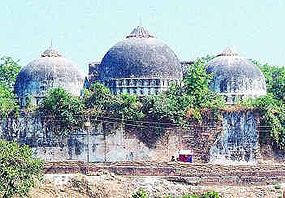
and Buddhist temples were razed and mosques erected in their place (for example, the Qutub Complex and Babri Mosque
Babri Mosque
The Babri Mosque , was a mosque in Ayodhya, a city in the Faizabad district of Uttar Pradesh, on Ramkot Hill . It was destroyed in 1992 when a political rally developed into a riot involving 150,000 people, despite a commitment to the Indian Supreme Court by the rally organisers that the mosque...
). Another notable iconoclast was Mughal ruler Aurangzeb
Aurangzeb
Abul Muzaffar Muhy-ud-Din Muhammad Aurangzeb Alamgir , more commonly known as Aurangzeb or by his chosen imperial title Alamgir , was the sixth Mughal Emperor of India, whose reign lasted from 1658 until his death in 1707.Badshah Aurangzeb, having ruled most of the Indian subcontinent for nearly...
, who destroyed the famous Hindu temples at Varanasi
Varanasi
-Etymology:The name Varanasi has its origin possibly from the names of the two rivers Varuna and Assi, for the old city lies in the north shores of the Ganga bounded by its two tributaries, the Varuna and the Asi, with the Ganges being to its south...
and Mathura.
Certain Muslim denominations continue to pursue iconoclastic agendas. There has been much controversy within Islam over the recent, and apparently on-going, destruction by the Wahhabist
Wahhabism
Wahhabism is a religious movement or a branch of Islam. It was developed by an 18th century Muslim theologian from Najd, Saudi Arabia. Ibn Abdul Al-Wahhab advocated purging Islam of what he considered to be impurities and innovations...
authorities of Mecca
Mecca
Mecca is a city in the Hijaz and the capital of Makkah province in Saudi Arabia. The city is located inland from Jeddah in a narrow valley at a height of above sea level...
of historic buildings (not images as such) which they feared were or would become the subject of "idolatry
Idolatry
Idolatry is a pejorative term for the worship of an idol, a physical object such as a cult image, as a god, or practices believed to verge on worship, such as giving undue honour and regard to created forms other than God. In all the Abrahamic religions idolatry is strongly forbidden, although...
".
A recent act of iconoclasm was the 2001 destruction of the giant Buddhas of Bamyan
Buddhas of Bamyan
The Buddhas of Bamiyan were two 6th century monumental statues of standing buddhas carved into the side of a cliff in the Bamyan valley in the Hazarajat region of central Afghanistan, situated northwest of Kabul at an altitude of 2,500 meters...
by the then Taliban government of Afghanistan
Afghanistan
Afghanistan , officially the Islamic Republic of Afghanistan, is a landlocked country located in the centre of Asia, forming South Asia, Central Asia and the Middle East. With a population of about 29 million, it has an area of , making it the 42nd most populous and 41st largest nation in the world...
. The act generated world-wide protests and was not supported by other Muslim governments and organizations. It was widely perceived in the Western media as a result of the Muslim prohibition against figural decoration. Such an account overlooks "the coexistence between the Buddhas and the Muslim population that marveled at them for over a millennium" before their destruction.
The Buddhas had twice in the past been attacked by Nadir Shah and Aurengzeb. According to the art historian F.B. Flood, analysis of the Taliban's statements regarding the Buddhas suggest that their destruction was motivated more by political than by theological concerns. Taliban spokespeople have given many different explanations of the motives for the destruction.
In 2005 the Muhammad Cartoon Controversy
Jyllands-Posten Muhammad cartoons controversy
The Jyllands-Posten Muhammad cartoons controversy began after 12 editorial cartoons, most of which depicted the Islamic prophet Muhammad, were published in the Danish newspaper Jyllands-Posten on 30 September 2005...
sparked worldwide controversy and rioting. In December 2010 a group of iconoclasts were arrested as they were about to attack the Jyllands-Posten newspaper's office.
Reformation iconoclasm
Some of the ProtestantProtestantism
Protestantism is one of the three major groupings within Christianity. It is a movement that began in Germany in the early 16th century as a reaction against medieval Roman Catholic doctrines and practices, especially in regards to salvation, justification, and ecclesiology.The doctrines of the...
reformers, in particular Andreas Karlstadt
Andreas Karlstadt
Andreas Rudolph Bodenstein von Karlstadt , better known as Andreas Karlstadt or Andreas Carlstadt or Karolostadt, was a German Christian theologian during the Protestant Reformation. He was born in Karlstadt, Franconia.-Education:Karlstadt received his doctorate of theology in 1510 from the...
, Huldrych Zwingli
Huldrych Zwingli
Ulrich Zwingli was a leader of the Reformation in Switzerland. Born during a time of emerging Swiss patriotism and increasing criticism of the Swiss mercenary system, he attended the University of Vienna and the University of Basel, a scholarly centre of humanism...
and John Calvin
John Calvin
John Calvin was an influential French theologian and pastor during the Protestant Reformation. He was a principal figure in the development of the system of Christian theology later called Calvinism. Originally trained as a humanist lawyer, he broke from the Roman Catholic Church around 1530...
, encouraged the removal of religious images by invoking the Decalogue's
Ten Commandments
The Ten Commandments, also known as the Decalogue , are a set of biblical principles relating to ethics and worship, which play a fundamental role in Judaism and most forms of Christianity. They include instructions to worship only God and to keep the Sabbath, and prohibitions against idolatry,...
prohibition of idolatry and the manufacture of graven (sculpted) images of God. As a result, individuals attacked statues and images, and others were lost during unauthorised iconoclastic riots. However, in most cases, civil authorities removed images in an orderly manner in the newly reformed Protestant cities and territories of Europe.
Significant iconoclastic riots took place in Zurich
Zürich
Zurich is the largest city in Switzerland and the capital of the canton of Zurich. It is located in central Switzerland at the northwestern tip of Lake Zurich...
(in 1523), Copenhagen
Copenhagen
Copenhagen is the capital and largest city of Denmark, with an urban population of 1,199,224 and a metropolitan population of 1,930,260 . With the completion of the transnational Øresund Bridge in 2000, Copenhagen has become the centre of the increasingly integrating Øresund Region...
(1530), Münster
Münster
Münster is an independent city in North Rhine-Westphalia, Germany. It is located in the northern part of the state and is considered to be the cultural centre of the Westphalia region. It is also capital of the local government region Münsterland...
(1534), Geneva
Geneva
Geneva In the national languages of Switzerland the city is known as Genf , Ginevra and Genevra is the second-most-populous city in Switzerland and is the most populous city of Romandie, the French-speaking part of Switzerland...
(1535), Augsburg
Augsburg
Augsburg is a city in the south-west of Bavaria, Germany. It is a university town and home of the Regierungsbezirk Schwaben and the Bezirk Schwaben. Augsburg is an urban district and home to the institutions of the Landkreis Augsburg. It is, as of 2008, the third-largest city in Bavaria with a...
(1537), Scotland
Scotland
Scotland is a country that is part of the United Kingdom. Occupying the northern third of the island of Great Britain, it shares a border with England to the south and is bounded by the North Sea to the east, the Atlantic Ocean to the north and west, and the North Channel and Irish Sea to the...
(1559), and Saintes
Saintes
Saintes is a French commune located in Poitou-Charentes, in the southwestern Charente-Maritime department of which it is a sub-prefecture. Its inhabitants are called Saintaises and Saintais....
and La Rochelle
La Rochelle
La Rochelle is a city in western France and a seaport on the Bay of Biscay, a part of the Atlantic Ocean. It is the capital of the Charente-Maritime department.The city is connected to the Île de Ré by a bridge completed on 19 May 1988...
(1562). The Seventeen Provinces
Seventeen Provinces
The Seventeen Provinces were a personal union of states in the Low Countries in the 15th century and 16th century, roughly covering the current Netherlands, Belgium, Luxembourg, a good part of the North of France , and a small part of Western Germany.The Seventeen Provinces were originally held by...
(now the Netherlands, Belgium and parts of Northern France) were disrupted by widespread Protestant iconoclasm in the summer of 1566. This is called the "Beeldenstorm
Beeldenstorm
Beeldenstorm in Dutch, roughly translatable to "statue storm", or Bildersturm in German , also the Iconoclastic Fury, is a term used for outbreaks of destruction of religious images that occurred in Europe in the 16th century...
" and began with the destruction of the statuary of the Monastery of Saint Lawrence
Saint Lawrence
Lawrence of Rome was one of the seven deacons of ancient Rome who were martyred during the persecution of Valerian in 258.- Holy Chalice :...
in Steenvoorde
Steenvoorde
Steenvoorde is a commune in the Nord department in northern France. The Beeldenstorm iconoclasm started in Steenvoorde. Steenvoorde is a city of the giants -Heraldry:-References:* -External links:*...
after a "Hagenpreek", or field sermon, by Sebastiaan Matte. Hundreds of other attacks included the sacking of the Monastery of Saint Anthony
Anthony the Great
Anthony the Great or Antony the Great , , also known as Saint Anthony, Anthony the Abbot, Anthony of Egypt, Anthony of the Desert, Anthony the Anchorite, Abba Antonius , and Father of All Monks, was a Christian saint from Egypt, a prominent leader among the Desert Fathers...
after a sermon by Jacob de Buysere. The Beeldenstorm marked the start of the revolution against the Spanish forces and the Catholic Church
Roman Catholic Church
The Catholic Church, also known as the Roman Catholic Church, is the world's largest Christian church, with over a billion members. Led by the Pope, it defines its mission as spreading the gospel of Jesus Christ, administering the sacraments and exercising charity...
.
The Iconoclast belief was causing havoc throughout Europe
Europe
Europe is, by convention, one of the world's seven continents. Comprising the westernmost peninsula of Eurasia, Europe is generally 'divided' from Asia to its east by the watershed divides of the Ural and Caucasus Mountains, the Ural River, the Caspian and Black Seas, and the waterways connecting...
, and in 1523, specifically due to the Swiss reformer Huldrych Zwingli
Huldrych Zwingli
Ulrich Zwingli was a leader of the Reformation in Switzerland. Born during a time of emerging Swiss patriotism and increasing criticism of the Swiss mercenary system, he attended the University of Vienna and the University of Basel, a scholarly centre of humanism...
, a vast amount of his followers viewed themselves as being involved in a spiritual community that in matters of faith should obey neither the visible Church nor lay authorities. According to author R.W Scribner:
During the English Civil War
English Civil War
The English Civil War was a series of armed conflicts and political machinations between Parliamentarians and Royalists...
, Bishop Joseph Hall of Norwich
Norwich
Norwich is a city in England. It is the regional administrative centre and county town of Norfolk. During the 11th century, Norwich was the largest city in England after London, and one of the most important places in the kingdom...
described the events of 1643 when troops and citizens, encouraged by a Parliamentary ordinance against superstition and idolatry
Idolatry
Idolatry is a pejorative term for the worship of an idol, a physical object such as a cult image, as a god, or practices believed to verge on worship, such as giving undue honour and regard to created forms other than God. In all the Abrahamic religions idolatry is strongly forbidden, although...
, behaved thus:
Lord what work was here! What clattering of glasses! What beating down of walls! What tearing up of monuments! What pulling down of seats! What wresting out of irons and brass from the windows! What defacing of arms! What demolishing of curious stonework! What tooting and piping upon organ pipes! And what a hideous triumph in the market-place before all the country, when all the mangled organ pipes, vestments, both copes and surplices, together with the leaden cross which had newly been sawn down from the Green-yard pulpit and the service-books and singing books that could be carried to the fire in the public market-place were heaped together.'
William Dowsing
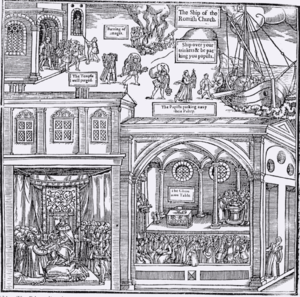
William Dowsing was an English iconoclast who operated at the time of the English Civil War. Dowsing was a puritan soldier who was born in Laxfield, Suffolk...
was commissioned and salaried by the government to tour the towns and villages of East Anglia
East Anglia
East Anglia is a traditional name for a region of eastern England, named after an ancient Anglo-Saxon kingdom, the Kingdom of the East Angles. The Angles took their name from their homeland Angeln, in northern Germany. East Anglia initially consisted of Norfolk and Suffolk, but upon the marriage of...
to destroy images in churches. His detailed record of his trail of destruction through Suffolk and Cambridgeshire survives:
Protestant Christianity was not uniformly hostile to the use of religious images. Martin Luther
Martin Luther
Martin Luther was a German priest, professor of theology and iconic figure of the Protestant Reformation. He strongly disputed the claim that freedom from God's punishment for sin could be purchased with money. He confronted indulgence salesman Johann Tetzel with his Ninety-Five Theses in 1517...
, initially hostile, came round to the view that Christians should be free to use religious images as long as they did not worship them in place of God. Lutheran scholar Jeremiah Ohl writes:
Political and revolutionary iconoclasm
Damnatio memoriae
Damnatio memoriae is the Latin phrase literally meaning "condemnation of memory" in the sense of a judgment that a person must not be remembered. It was a form of dishonor that could be passed by the Roman Senate upon traitors or others who brought discredit to the Roman State...
, the modern term used to describe the Ancient Roman practice of official obliteration of the memory of a specific individual. Stricter definitions of "iconoclasm" exclude both types of action, reserving the term for religious or more widely cultural destruction. In many cases, such as Revolutionary Russia or Ancient Egypt, this distinction can be hard to make. Examples of political destruction of images include:
- All public references to the "heretical" PharaohPharaohPharaoh is a title used in many modern discussions of the ancient Egyptian rulers of all periods. The title originates in the term "pr-aa" which means "great house" and describes the royal palace...
AkhenatenAkhenatenAkhenaten also spelled Echnaton,Ikhnaton,and Khuenaten;meaning "living spirit of Aten") known before the fifth year of his reign as Amenhotep IV , was a Pharaoh of the Eighteenth dynasty of Egypt who ruled for 17 years and died perhaps in 1336 BC or 1334 BC...
were destroyed soon after his death in about 1334 BC; a very laborious process with stone carved reliefs and inscriptions. - Several Roman emperors and other political figures were subject to decrees of damnatio memoriae, including SejanusSejanusLucius Aelius Seianus , commonly known as Sejanus, was an ambitious soldier, friend and confidant of the Roman Emperor Tiberius...
, Publius Septimius GetaPublius Septimius GetaGeta , was a Roman Emperor co-ruling with his father Septimius Severus and his older brother Caracalla from 209 to his death.-Early life:Geta was the younger son of Septimius Severus by his second wife Julia Domna...
, and DomitianDomitianDomitian was Roman Emperor from 81 to 96. Domitian was the third and last emperor of the Flavian dynasty.Domitian's youth and early career were largely spent in the shadow of his brother Titus, who gained military renown during the First Jewish-Roman War...
. - During the American RevolutionAmerican RevolutionThe American Revolution was the political upheaval during the last half of the 18th century in which thirteen colonies in North America joined together to break free from the British Empire, combining to become the United States of America...
, the Sons of LibertySons of LibertyThe Sons of Liberty were a political group made up of American patriots that originated in the pre-independence North American British colonies. The group was formed to protect the rights of the colonists from the usurpations by the British government after 1766...
pulled down and destroyed the giltGildingThe term gilding covers a number of decorative techniques for applying fine gold leaf or powder to solid surfaces such as wood, stone, or metal to give a thin coating of gold. A gilded object is described as "gilt"...
lead statue of George III of the United KingdomGeorge III of the United KingdomGeorge III was King of Great Britain and King of Ireland from 25 October 1760 until the union of these two countries on 1 January 1801, after which he was King of the United Kingdom of Great Britain and Ireland until his death...
on Bowling Green (New York City)Bowling Green (New York City)Bowling Green is a small public park in Lower Manhattan at the foot of Broadway next to the site of the original Dutch fort of New Amsterdam. Built in 1733, originally including a bowling green, it is the oldest public park in New York City and is surrounded by its original 18th century fence. At...
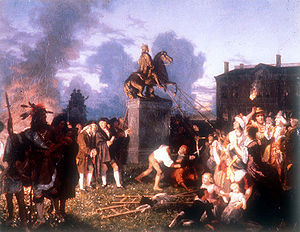
, melting it down for use as musket balls against the British Army. Similar acts have accompanied the independence of most ex-colonial territories. Sometimes relatively intact monuments are moved to a collected display in a less prominent place, as in India and also post-Communist countries. - During the French RevolutionFrench RevolutionThe French Revolution , sometimes distinguished as the 'Great French Revolution' , was a period of radical social and political upheaval in France and Europe. The absolute monarchy that had ruled France for centuries collapsed in three years...
, the statue of King Louis XV, in the Paris square which until then bore his name, was pulled down and destroyed. This was a prelude to the guillotining of his successor Louis XVI in the same site, renamed "Place de la Révolution" (at present Place de la ConcordePlace de la ConcordeThe Place de la Concorde in area, it is the largest square in the French capital. It is located in the city's eighth arrondissement, at the eastern end of the Champs-Élysées.- History :...
). - The statue of NapoleonNapoleon I of FranceNapoleon Bonaparte was a French military and political leader during the latter stages of the French Revolution.As Napoleon I, he was Emperor of the French from 1804 to 1815...
on the column at Place VendômePlace VendômePlace Vendôme is a square in the 1st arrondissement of Paris, France, located to the north of the Tuileries Gardens and east of the Église de la Madeleine. It is the starting point of the Rue de la Paix. Its regular architecture by Jules Hardouin-Mansart and pedimented screens canted across the...
, Paris was the target of iconoclasm several times: destroyed after the Bourbon RestorationBourbon RestorationThe Bourbon Restoration is the name given to the period following the successive events of the French Revolution , the end of the First Republic , and then the forcible end of the First French Empire under Napoleon – when a coalition of European powers restored by arms the monarchy to the...
, restored by Louis-PhilippeLouis-Philippe of FranceLouis Philippe I was King of the French from 1830 to 1848 in what was known as the July Monarchy. His father was a duke who supported the French Revolution but was nevertheless guillotined. Louis Philippe fled France as a young man and spent 21 years in exile, including considerable time in the...
, destroyed during the Paris CommuneParis CommuneThe Paris Commune was a government that briefly ruled Paris from March 18 to May 28, 1871. It existed before the split between anarchists and Marxists had taken place, and it is hailed by both groups as the first assumption of power by the working class during the Industrial Revolution...
and restored by Adolphe ThiersAdolphe ThiersMarie Joseph Louis Adolphe Thiers was a French politician and historian. was a prime minister under King Louis-Philippe of France. Following the overthrow of the Second Empire he again came to prominence as the French leader who suppressed the revolutionary Paris Commune of 1871...
. - The October RevolutionOctober RevolutionThe October Revolution , also known as the Great October Socialist Revolution , Red October, the October Uprising or the Bolshevik Revolution, was a political revolution and a part of the Russian Revolution of 1917...
in 1917 was accompanied by destruction of monuments of past TsarTsarTsar is a title used to designate certain European Slavic monarchs or supreme rulers. As a system of government in the Tsardom of Russia and Russian Empire, it is known as Tsarist autocracy, or Tsarism...
s, as well as Russian Imperial Eagles, at various locations throughout Russia. "In front of a Moscow cathedral, crowds cheered as the enormous statue of Tsar Alexander IIIAlexander III of RussiaAlexander Alexandrovich Romanov , historically remembered as Alexander III or Alexander the Peacemaker reigned as Emperor of Russia from until his death on .-Disposition:...
was bound with ropes and gradually beaten to the ground. After a considerable amount of time, the statue was decapitated and its remaining parts were broken into rubble." - The Chinese Cultural RevolutionCultural RevolutionThe Great Proletarian Cultural Revolution, commonly known as the Cultural Revolution , was a socio-political movement that took place in the People's Republic of China from 1966 through 1976...
included very widespread destruction of historic artworks in public places and private collections, whether religious or secular. Objects in state museums were mostly left intact. - The fall of Communism in 1989 was followed by destruction or removal of statues of Lenin and other Communist leaders in the former Soviet Union. Particularly well-known was the destruction of "Iron Felix", the statue of Felix Dzerzhinsky outside the KGBKGBThe KGB was the commonly used acronym for the . It was the national security agency of the Soviet Union from 1954 until 1991, and was the premier internal security, intelligence, and secret police organization during that time.The State Security Agency of the Republic of Belarus currently uses the...
headquarters.
During Muslim conquest
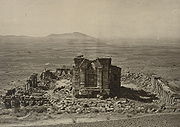
Chach Nama
Chach Nama also known as the Fateh nama Sindh ,and also known as Tarekh-e-Hind wa Sindh Arabic is a book about the history of Sindh, chronicling the Chacha Dynasty's period, following the demise of the Rai Dynasty and the ascent of Chach of Alor to the throne, down to the Arab conquest by...
record temple demolitions during the early 8th century, when the Umayyad
Umayyad
The Umayyad Caliphate was the second of the four major Arab caliphates established after the death of Muhammad. It was ruled by the Umayyad dynasty, whose name derives from Umayya ibn Abd Shams, the great-grandfather of the first Umayyad caliph. Although the Umayyad family originally came from the...
governor of Damascus
Damascus
Damascus , commonly known in Syria as Al Sham , and as the City of Jasmine , is the capital and the second largest city of Syria after Aleppo, both are part of the country's 14 governorates. In addition to being one of the oldest continuously inhabited cities in the world, Damascus is a major...
, Hajjaj, mobilized an expedition of 6,000 cavalry under Muhammad bin-Qasim in 712 CE.
The historian, Upendra Thakur records the persecution of Hindus and Buddhists:
Sultãn Sikandar Butshikan
Sikandar Butshikan
Sikandar Butshikan also known as "Alexander the Iconoclast" in Indian History was the second Sultan of the Gabari Tajik Dynasty of Kashmir 1389-1413 CE...
of Kashmir (AD 1389–1413) ordered the breaking of all "golden and silver images". The Tarikh-i-Firishta states: "After the emigration of the Bramins, Sikundur ordered all the temples in Kashmeer to be thrown down. Having broken all the images in Kashmeer, (Sikandar) acquired the title of ‘Destroyer of Idols’".
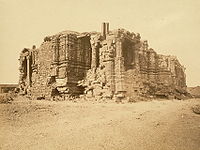
725
Year 725 was a common year starting on Monday of the Julian calendar. The denomination 725 for this year has been used since the early medieval period, when the Anno Domini calendar era became the prevalent method in Europe for naming years.- Europe :* Bede writes On the reckoning of time ...
Junayad, the Arab
Arab
Arab people, also known as Arabs , are a panethnicity primarily living in the Arab world, which is located in Western Asia and North Africa. They are identified as such on one or more of genealogical, linguistic, or cultural grounds, with tribal affiliations, and intra-tribal relationships playing...
governor of Sind
History of Sindh
Sindh is one of the provinces of Pakistan. Sindh was home to one of the world's oldest civilizations, the Indus Valley civilization.-Paleolithic and Mesolithic era:...
, sent his armies to destroy the second Somanath temple. In 1024 AD, the temple was once again destroyed by Mahmud Ghazni
Mahmud of Ghazni
Mahmud of Ghazni , actually ', was the most prominent ruler of the Ghaznavid dynasty who ruled from 997 until his death in 1030 in the eastern Iranian lands. Mahmud turned the former provincial city of Ghazni into the wealthy capital of an extensive empire which covered most of today's Iran,...
who raided the temple from across the Thar Desert. The temple was rebuilt by the Gujjar
Gujjar
The Gurjar are an ethnic group in India, Pakistan and Afghanistan. Alternative spellings include Gurjara, Gujar, Gurjjara and Gūrjara. The spelling Gurjara or Gurjar is preferable to the rest....
Paramara
Paramara
Paramara is a Maratha, Gurjar,& Rajput clan of India.The Paramara clan belongs to the Agnivansha of Rajputs ancient Kshatriyas...
King Bhoj of Malwa and the Solanki
Solanki
The Solanki was a royal Hindu Indian dynasty that ruled parts of western and central India between the 10th to 13th centuries. A number of scholars including V. A. Smith assign them Gurjar origin....
king Bhima of Gujarat (Anhilwara) or Patan
Patan, Gujarat
Patan was a capital of Gujarat in medieval times. It is the administrative seat of Patan District in the Indian state of Gujarat and administered by municipality. The city contains many Hindu and Jain temples as well as few mosques, dargahs and rojas...
between 1026 and 1042. The wooden structure was replaced by Kumarpal
Kumarpal
Kumarpal was a famous ruler of the Solanki dynasty of Gujarat at Anahilavada, India. During his reign, Jainism became prominent in Gujarat. He was a devoted disciple of the great Jain polymath Acharya Hemachandra. Kumarpal was responsible for restoring ruined Somnath. He also built several...
(r. 1143–72), who built the temple of stone. In 1296 AD, the temple was once again destroyed by Sultan Allauddin Khilji's army. According to Taj-ul-Ma'sir of Hasan Nizami, Raja Karan of Gujarat was defeated and forced to flee, "fifty thousand infidels were dispatched to hell by the sword" and "more than twenty thousand slaves, and cattle beyond all calculation fell into the hands of the victors". The temple was rebuilt by Mahipala Deva, the Chudasama king of Saurashtra in 1308 AD and the Linga was installed by his son Khengar sometime between 1326 and 1351 AD. In 1375 AD, the temple was once again destroyed by Muzaffar Shah I, the Sultan of Gujarat. In 1451 AD, the temple was once again destroyed by Mahmud Begda, the Sultan of Gujarat. In 1701 AD, the temple was once again destroyed by Mughal Emperor Aurangzeb. Aurangzeb built a mosque on the site of the Somnath temple, using some columns from the temple, whose Hindu sculptural motifs remained visible.
Mahmud of Ghazni
Mahmud of Ghazni
Mahmud of Ghazni , actually ', was the most prominent ruler of the Ghaznavid dynasty who ruled from 997 until his death in 1030 in the eastern Iranian lands. Mahmud turned the former provincial city of Ghazni into the wealthy capital of an extensive empire which covered most of today's Iran,...
was an Afghan
Demography of Afghanistan
The population of Afghanistan is around 29,835,392 as of the year 2011, which is unclear if the refugees living outside the country are included or not. The nation is composed of a multi-ethnic and multi-lingual society, reflecting its location astride historic trade and invasion routes between...
Sultan
Sultan
Sultan is a title with several historical meanings. Originally, it was an Arabic language abstract noun meaning "strength", "authority", "rulership", and "dictatorship", derived from the masdar سلطة , meaning "authority" or "power". Later, it came to be used as the title of certain rulers who...
who invaded the Indian subcontinent during the early 11th century. His campaigns across the gangetic plains are often cited for their iconoclastic plundering and destruction of temples such as those at Mathura and he looked upon their destruction as an act of "jihad
Jihad
Jihad , an Islamic term, is a religious duty of Muslims. In Arabic, the word jihād translates as a noun meaning "struggle". Jihad appears 41 times in the Quran and frequently in the idiomatic expression "striving in the way of God ". A person engaged in jihad is called a mujahid; the plural is...
". He sacked the second Somnath Temple
Somnath
The Somnath Temple located in the Prabhas Kshetra near Veraval in Saurashtra, on the western coast of Gujarat, India, is one of the twelve Jyotirlinga shrines of the God Shiva. Somnath means "The Protector of Moon God". The Somnath Temple is known as "the Shrine Eternal", having been destroyed...
in 1026, and looted it of gems and precious stones and the famous Shiva
Shiva
Shiva is a major Hindu deity, and is the destroyer god or transformer among the Trimurti, the Hindu Trinity of the primary aspects of the divine. God Shiva is a yogi who has notice of everything that happens in the world and is the main aspect of life. Yet one with great power lives a life of a...
lingam
Lingam
The Lingam is a representation of the Hindu deity Shiva used for worship in temples....
of the temple was destroyed .
Historical records compiled by Muslim historian Maulana Hakim Saiyid Abdul Hai attest to the iconoclasm of Qutb-ud-din Aybak
Qutb-ud-din Aybak
Qutb-ud-din Aibak was a Turkic king of Northwest India who ruled from his capital in Delhi where he built the Qutub Minar and the Quwwat Al Islam mosque. He was of Turkic descent from central Asia, the first Sultan of Delhi and founder of the Slave dynasty of India. He ruled for only four years,...
. The first mosque built in Delhi, the "Quwwat al-Islam" was built after the demolition of the Hindu temple built previously by Prithvi Raj and certain parts of the temple were left outside the mosque proper. This pattern of iconoclasm was common during his reign, although an argument goes that such iconoclasm was motivated more by politics than by religion.
Another ruler of the sultanate, Shams-ud-din Iltutmish
Iltutmish
Shams-ud-din Iltutmish was the third ruler of the Mamluk dynasty of Delhi of Turkic origin. He was a slave of Qutub-ud-din-Aybak and later became his son-in-law and close lieutenant. He was the Governor of Badaun when he deposed Qutub-ud-din's successor Aram Shah and acceeded to the throne of the...
, conquered and subjugated the Hindu pilgrimage site Varanasi
Varanasi
-Etymology:The name Varanasi has its origin possibly from the names of the two rivers Varuna and Assi, for the old city lies in the north shores of the Ganga bounded by its two tributaries, the Varuna and the Asi, with the Ganges being to its south...
in the 11th century and he continued the destruction of Hindu temples and idols that had begun during the first attack in 1194.
No aspect of Aurangzeb's reign is more cited – or more controversial – than the numerous desecrations and even the destruction of Hindu temples. During his reign, tens of thousands of temples were desecrated: their facades and interiors were defaced and their murtis (divine images) looted. In many cases, temples were destroyed entirely; in numerous instances mosques were built on their foundations, sometimes using the same stones. Among the temples Aurangzeb destroyed were two that are most sacred to Hindus, in Varanasi
Varanasi
-Etymology:The name Varanasi has its origin possibly from the names of the two rivers Varuna and Assi, for the old city lies in the north shores of the Ganga bounded by its two tributaries, the Varuna and the Asi, with the Ganges being to its south...
and Mathura. In both cases, he had large mosques built on the sites.
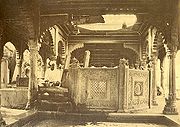
Krishna
Krishna is a central figure of Hinduism and is traditionally attributed the authorship of the Bhagavad Gita. He is the supreme Being and considered in some monotheistic traditions as an Avatar of Vishnu...
. In 1661 Aurangzeb ordered the demolition of the temple, and constructed the Katra Masjid mosque. Traces of the ancient Hindu temple can be seen from the back of the mosque. Aurangzeb also destroyed what was the most famous temple in Varanasi
Varanasi
-Etymology:The name Varanasi has its origin possibly from the names of the two rivers Varuna and Assi, for the old city lies in the north shores of the Ganga bounded by its two tributaries, the Varuna and the Asi, with the Ganges being to its south...
– the Vishwanath Temple
Vishwanath Temple
Kashi Vishwanath Temple is one of the most famous Hindu temples dedicated to Lord Shiva and is located in Benaras, the Holiest existing Place of Hindus, where at least once in life a Hindu is expected to do pilgrimage, and if possible, also pour the remains of cremated ancestors here on the River...
. The temple had changed its location over the years, but in 1585 Akbar had authorized its location at Gyan Vapi. Aurangzeb ordered its demolition in 1669 and constructed a mosque on the site, whose minarets stand 71 metres above the Ganges. Traces of the old temple can be seen behind the mosque. Centuries later, emotional debate about these wanton acts of cultural desecration continues. Aurangzeb
Aurangzeb
Abul Muzaffar Muhy-ud-Din Muhammad Aurangzeb Alamgir , more commonly known as Aurangzeb or by his chosen imperial title Alamgir , was the sixth Mughal Emperor of India, whose reign lasted from 1658 until his death in 1707.Badshah Aurangzeb, having ruled most of the Indian subcontinent for nearly...
also destroyed the Somnath
Somnath
The Somnath Temple located in the Prabhas Kshetra near Veraval in Saurashtra, on the western coast of Gujarat, India, is one of the twelve Jyotirlinga shrines of the God Shiva. Somnath means "The Protector of Moon God". The Somnath Temple is known as "the Shrine Eternal", having been destroyed...
temple in 1706.
Hindu nationalists claim that Mughals destroyed the Ram Mandir
Ram Janmabhoomi
Ram Janmabhoomi is the "Birthplace of Lord Rama."Lord Rama is a major God in Hindu theology and the Hindu religion where He is described as an Avatar of Lord Vishnu in Hinduism. The exact location of Lord Rama's birth as stated in holy Ramayan as being in the city of Ayoudhya in Uttar Pardesh...
in Ayodhya, located at the birthplace of Rama
Rama
Rama or full name Ramachandra is considered to be the seventh avatar of Vishnu in Hinduism, and a king of Ayodhya in ancient Indian...
, and built the Babri Masjid on the holy site, which has since been a source of tension between the Hindu and Muslim communities.
Writer Fernand Braudel wrote in A History of Civilizations (Penguin 1988/1963, pp. 232–236), Islamic rule in India as a "colonial experiment" was "extremely violent", and "the Muslims could not rule the country except by systematic terror. Cruelty was the norm – burnings, summary executions, crucifixions or impalements, inventive tortures. Hindu temples were destroyed to make way for mosques. On occasion there were forced conversions. If ever there were an uprising, it was instantly and savagely repressed: houses were burned, the countryside was laid waste, men were slaughtered and women were taken as slaves."
C. K. Kareem also notes that Tippu Sultan issued an edict for the destruction of Hindu temples in Kerala
Kerala
or Keralam is an Indian state located on the Malabar coast of south-west India. It was created on 1 November 1956 by the States Reorganisation Act by combining various Malayalam speaking regions....
.
In a two-volume book by Sita Ram Goel
Sita Ram Goel
Sita Ram Goel , writer and publisher in late twentieth century. He had Marxist leanings during the 1940s, but later became an outspoken anti-communist that also spoke negatively about Islam and Christianity...
, Arun Shourie
Arun Shourie
Arun Shourie is an Indian journalist, author, intellectual and politician. He has been an economist with the World Bank , a consultant to the Planning Commission, India, editor of the Indian Express and Times of India and a minister in the government of India . He was awarded the Ramon Magsaysay...
, Harsh Narain
Harsh Narain
Harsh Narain is an Indian author. He has a Ph.D. from Lucknow University, and was a professor at Benares Hindu University, Aligarh Muslim University and North Eastern Hill University....
, Jay Dubashi and Ram Swarup
Ram Swarup
Ram Swarup , , born Ram Swarup Agarwal, was an independent Hindu thinker and prolific author. His works took a critical stance against Christianity, Islam and Communism. His work has influenced other Indian writers.- Life :He graduated in Economics at Delhi University in 1941...
, Hindu Temples – What Happened to Them, includes a list of 2000 mosques that it is claimed were built on Hindu temples in the first volume, which it is asserted is based primarily on the books of Muslim historians of the period or the inscriptions of the mosques. The second volume excerpts from medieval histories and chronicles and from inscriptions concerning the destruction of Hindu
Hindu
Hindu refers to an identity associated with the philosophical, religious and cultural systems that are indigenous to the Indian subcontinent. As used in the Constitution of India, the word "Hindu" is also attributed to all persons professing any Indian religion...
, Jain and Buddhist temple
Temple
A temple is a structure reserved for religious or spiritual activities, such as prayer and sacrifice, or analogous rites. A templum constituted a sacred precinct as defined by a priest, or augur. It has the same root as the word "template," a plan in preparation of the building that was marked out...
s. The authors claim that the material presented in this book are only the tip of an iceberg.
During Goa inquisitions
Diago de Boarda, a priest, and his advisor Vicar General, Miguel Vaz, had made a 41 point plan for torturing Hindus. Under this plan Viceroy Antano de Noronha issued in 1566, an order applicable to the entire area under Portuguese rule:I hereby order that in any area owned by my master, the king, nobody should construct a Hindu temple and such temples already constructed should not be repaired without my permission. If this order is transgressed, such temples shall be, destroyed and the goods in them shall be used to meet expenses of holy deeds, as punishment of such transgression.
In 1567 the campaign of destroying temples in Bardez met with success. At the end of it 300 Hindu temples were destroyed. In 1583 Hindu temples at Assolna
Assolna
Assolna is a town to the south of Chinchinim.The river Sal flows through this town.-Geography:Assolna is located at . It has an average elevation of ....
and Cuncolim
Cuncolim
Cuncolim is a city and a municipal council in South Goa district in the state of Goa, India.-Etymology:The name Cuncolim is derived from the fact that the village was known as Kumkumahalli .-Geography:Cuncolim is located at...
were destroyed through army action.
"The fathers of the Church forbade the Hindus under terrible penalties the use of their own sacred books, and prevented them from all exercise of their religion. They destroyed their temples, and so harassed and interfered with the people that they abandoned the city in large numbers, refusing to remain any longer in a place where they had no liberty, and were liable to imprisonment, torture and death if they worshipped after their own fashion the gods of their fathers." wrote Filippo Sassetti
Filippo Sassetti
Filippo Sassetti was a Florentine merchant who was born in Florence, Italy in 1540. Sassetti travelled to the Indian subcontinent and was among the first European observers to study the ancient Indian language, Sanskrit. Writing in 1585, he noted some word similarities between Sanskrit and Italian...
, who was in India from 1578 to 1588. An order was issued in June 1684 eliminating the Konkani language
Konkani language
KonkaniKonkani is a name given to a group of several cognate dialects spoken along the narrow strip of land called Konkan, on the west coast of India. This is, however, somewhat an over-generalisation. Geographically, Konkan is defined roughly as the area between the river Damanganga to the north...
and making it compulsory to speak Portuguese language
Portuguese language
Portuguese is a Romance language that arose in the medieval Kingdom of Galicia, nowadays Galicia and Northern Portugal. The southern part of the Kingdom of Galicia became independent as the County of Portugal in 1095...
. Following that law all the symbols of non-Christian sects were destroyed and the books written in local languages were burnt.
In India
In June 2010, large-scale violence was reported in the Sangli town and also in Sangli district. In the melee, members of the minority community are said to have thrown stones inside a Ganesh mandal. The Maharashtra Police on Sunday arrested Mainuddin Shamsuddin Bagwan of the Nationalist Congress Party (NCP) on charges of “committing acts for creating communal tension and encouraging destruction of peace” under Sections 143, 147, 149, 295, 153, 427, 120 of the Indian Penal Code, and Section 135 of the Mumbai Police Act.The 2010 Deganga riots
2010 Deganga riots
The 2010 Deganga riots began on 6 September when mobs resorted to arson and violence over a disputed structure at Deganga, Kartikpur and Beliaghata under the Deganga police station area. The violence began late in the evening and continued throughout the night into the next morning...
began on 6 September when mobs resorted to arson
Arson
Arson is the crime of intentionally or maliciously setting fire to structures or wildland areas. It may be distinguished from other causes such as spontaneous combustion and natural wildfires...
and violence
Violence
Violence is the use of physical force to apply a state to others contrary to their wishes. violence, while often a stand-alone issue, is often the culmination of other kinds of conflict, e.g...
over a disputed structure at Deganga
Deganga
Deganga is an administrative division in Barasat Sadar subdivision of North 24 Parganas district in the Indian state of West Bengal. Deganga police station serves this block. Headquarters of this block is at Debalay...
, Kartikpur and Beliaghata under the Deganga
Deganga
Deganga is an administrative division in Barasat Sadar subdivision of North 24 Parganas district in the Indian state of West Bengal. Deganga police station serves this block. Headquarters of this block is at Debalay...
police station area. The violence began late in the evening and continued throughout the night into the next morning. The violence finally calmed down on 9 September after hundreds of business establishments and residences were looted, destroyed and burnt, dozens of people were severely injured and several places of worship desecrated and vandalized.
In June 2011 at Asansol Market area, a Hindu temple, under construction led by Bastim Bazaar Sarbojanin Durga Puja Committeewas and approved by ADM on 12 April 2011, was attacked by an Islamic mob.
In Bangladesh
In Bangladesh atrocities including targeted attacks against temples and open theft of Hindu property have increased sharply in recent years after the Jamat-e-Islami joined the coalition government led by the Bangladesh National Party. Hindu temples in Bangladesh have also been vandalised.On the February 6, 2010, Sonargaon temple in Narayanganj district of Bangladesh was destroyed by Islamic fanatics.
In Pakistan
Several Hindu temples have been destroyed in Pakistan. A notable incident was the destruction of the Ramna Kali MandirRamna Kali Mandir
The Ramna Kali Mandir , also known as the Ramna Kalibari was one of the most famous Hindu temples of the Indian subcontinent...
in former East Pakistan
East Pakistan
East Pakistan was a provincial state of Pakistan established in 14 August 1947. The provincial state existed until its declaration of independence on 26 March 1971 as the independent nation of Bangladesh. Pakistan recognized the new nation on 16 December 1971. East Pakistan was created from Bengal...
. The temple was bulldozed by the Pakistan Army on March 27, 1971.The Dhakeshwari Temple
Dhakeshwari Temple
Dhakeshwari National Temple is a famous Hindu temple in Dhaka, Bangladesh and is state-owned, giving it the distinction of Bangladesh's "National Temple". The name "Dhakeshwari" means "Goddess of Dhaka". The temple is located southwest of the Salimullah Hall of Dhaka University...
was severely damaged during the Indo-Pakistani War of 1971
Indo-Pakistani War of 1971
The Indo-Pakistani War of 1971 was a military conflict between India and Pakistan. Indian, Bangladeshi and international sources consider the beginning of the war to be Operation Chengiz Khan, Pakistan's December 3, 1971 pre-emptive strike on 11 Indian airbases...
, and over half of the temple's buildings were destroyed. In a major disrespect of the religion, the main worship hall was taken over by the Pakistan
Pakistan
Pakistan , officially the Islamic Republic of Pakistan is a sovereign state in South Asia. It has a coastline along the Arabian Sea and the Gulf of Oman in the south and is bordered by Afghanistan and Iran in the west, India in the east and China in the far northeast. In the north, Tajikistan...
Army and used as an ammunitions storage area. Several of the temple custodians were tortured and killed by the Army though most, including the Head Priest, fled first to their ancestral villages and then to India and therefore escaped death.
In 2006, the last Hindu temple in Lahore
Lahore
Lahore is the capital of the Pakistani province of Punjab and the second largest city in the country. With a rich and fabulous history dating back to over a thousand years ago, Lahore is no doubt Pakistan's cultural capital. One of the most densely populated cities in the world, Lahore remains a...
was destroyed to pave the way for construction of a multi-storied commercial building. The temple was demolished after officials of the Evacuee Property Trust Board concealed facts from the board chairman about the nature of the building. When reporters from Pakistan-based newspaper Dawn
Dawn (newspaper)
Dawn is Pakistan's oldest and most widely read English-language newspaper. One of the country's two largest English-language dailies, it is the flagship of the Dawn Group of Newspapers, published by Pakistan Herald Publications, which also owns the Herald, a magazine, the evening paper The Star and...
tried to cover the incident, they were accosted by the henchmen of the property developer, who denied that a Hindu temple existed at the site.
Several political parties in Pakistan have objected to this move, such as the Pakistan People's party and the Pakistani Muslim League-N. The move has also evoked strong condemnation in India from minority bodies and political parties, including the Bharatiya Janata Party
Bharatiya Janata Party
The Bharatiya Janata Party ,; translation: Indian People's Party) is one of the two major political parties in India, the other being the Indian National Congress. Established in 1980, it is India's second largest political party in terms of representation in the parliament...
(BJP), the Congress Party
Indian National Congress
The Indian National Congress is one of the two major political parties in India, the other being the Bharatiya Janata Party. It is the largest and one of the oldest democratic political parties in the world. The party's modern liberal platform is largely considered center-left in the Indian...
, as well as Muslim advocacy political parties such as the All India Muslim Majlis-e-Mushawarat. A firm of lawyers representing the Hindu minority has approached the Lahore High Court seeking a directive to the builders to stop the construction of the commercial plaza and reconstruct the temple at the site. The petitioners maintain that the demolition violates section 295 of the Pakistan Penal Code prohibiting the demolition of places of worship.
On June 29, 2005, following the arrest of an illiterate Christian janitor on allegations of allegedly burning Qur'an pages, a mob of between 300 and 500 Muslims destroyed a Hindu temple and houses belonging to Christian and Hindu families in Nowshera. Under the terms of a deal negotiated between Islamic religious leaders and the Hindu/Christian communities, Pakistani police later released all previously arrested perpetrators without charge.
In Malaysia
Between April to May 2006, several Hindu temples were demolished by city hall authorities in the country, accompanied by violence against Hindus. On April 21, 2006, the Malaimel Sri Selva Kaliamman Temple in Kuala Lumpur was reduced to rubble after the city hall sent in bulldozers. Many Hindu advocacy groups have protested what they allege is a systematic plan of temple cleansing in Malaysia. The official reason given by the Malaysian government has been that the temples were built "illegally". However, several of the temples are centuries old. On May 11, 2006, armed city hall officers from Kuala LumpurKuala Lumpur
Kuala Lumpur is the capital and the second largest city in Malaysia by population. The city proper, making up an area of , has a population of 1.4 million as of 2010. Greater Kuala Lumpur, also known as the Klang Valley, is an urban agglomeration of 7.2 million...
forcefully demolished part of a 60-year-old suburban temple that serves more than 1,000 Hindus.
In Saudi Arabia
On March 24, 2005, Saudi authorities destroyed religious items found in a raid on a makeshift Hindu shrine found in an apartment in RiyadhRiyadh
Riyadh is the capital and largest city of Saudi Arabia. It is also the capital of Riyadh Province, and belongs to the historical regions of Najd and Al-Yamama. It is situated in the center of the Arabian Peninsula on a large plateau, and is home to 5,254,560 people, and the urban center of a...
.
In Fiji
In Fiji according to official reports, attacks on Hindu institutions increased by 14% compared to 2004. This intolerance of Hindus has found expression in anti-Hindu speeches and destruction of temples, the two most common forms of immediate and direct violence against Hindus. Between 2001 and April 2005, one hundred cases of temple attacks have been registered with the police. The alarming increase of temple destruction has spread fear and intimidation among the Hindu minorities and has hastened immigration to neighboring Australia and New Zealand. organized religious institutions, such as the Methodist Church of Fiji, have repeatedly called for the creation of a theocratic Christian State and have propagated anti-Hindu sentiment. State favoritism of Christianity, and systematic attacks on temples, are some of the greatest threats faced by Fijian Hindus. Despite the creation of a human rights commission, the plight of Hindus in Fiji continues to be precarious.Chinese iconoclasm
During the Northern Expedition, in 1926 in Guangxi, KuomintangKuomintang
The Kuomintang of China , sometimes romanized as Guomindang via the Pinyin transcription system or GMD for short, and translated as the Chinese Nationalist Party is a founding and ruling political party of the Republic of China . Its guiding ideology is the Three Principles of the People, espoused...
Muslim General Bai Chongxi
Bai Chongxi
Bai Chongxi , , also spelled Pai Chung-hsi, was a Chinese general in the National Revolutionary Army of the Republic of China and a prominent Chinese Nationalist Muslim leader. He was of Hui ethnicity and of the Muslim faith...
led his troops in destroying Buddhist temples and smashing idols, turning the temples into schools and Kuomintang party headquarters. It was reported that almost all of Buddhist monasteries in Guangxi were destroyed by Bai in this manner. The monks were removed. Bai led a wave of anti-foreignism in Guangxi, attacking American, European, and other foreigners and missionaries, and generally making the province unsafe for foreigners. Westerners fled from the province, and some Chinese Christians were also attacked as imperialist agents. The three goals of his movement were anti-foreignism, anti-imperialism, and anti-religion. Bai led the anti-religious movement against superstition. Muslims do not believe in superstition (see Shirk (Islam)) and his religion may have influenced Bai to take action against the idols in the temples and the superstitious practices in China. Huang Shaoxiong
Huang Shaoxiong
Huang Shaoxiong or Huang Shaohong was a warlord in Guangxi province, and governed Guangxi as part of the New Guangxi Clique, though the later part of the Warlord era and a leader in the later years of the Republic of China.-Biography:...
, also a Kuomintang member of the New Guangxi clique, supported Bai's campaign. Huang was not a Muslim, and the anti-religious campaign was agreed upon by all Guangxi Kuomintang members.
See also
- AniconismAniconismAniconism is the practice or belief in avoiding or shunning images of divine beings, prophets or other respected religious figures, or in different manifestations, any human beings or living creatures. The term aniconic may be used to describe the absence of graphic representations in a particular...
- Gregory BernsGregory BernsGregory S. Berns is a distinguished American neuroeconomist, neuroscientist, professor of psychiatry, psychologist and writer. He lives with his family in Atlanta, Georgia, USA....
, author of the book Iconoclast - CensorshipCensorshipthumb|[[Book burning]] following the [[1973 Chilean coup d'état|1973 coup]] that installed the [[Military government of Chile |Pinochet regime]] in Chile...
- Censorship by organized religion
- ChronoclasmChronoclasmJago & Litefoot is a Big Finish Productions audio drama based on the long-running British science fiction television series Doctor Who. It stars Christopher Benjamin and Trevor Baxter as Henry Gordon Jago and George Litefoot, their characters from the 1977 TV story The Talons of...
- Decline of Hinduism in PakistanDecline of Hinduism in PakistanThere has been in a decline of Hinduism , Buddhism and Sikhism in the areas that now constitute the country of Pakistan which was formed in 1947 happened for a variety of reasons, and even as these religions have continued to flourish beyond the eastern frontiers of Pakistan...
- Natural theologyNatural theologyNatural theology is a branch of theology based on reason and ordinary experience. Thus it is distinguished from revealed theology which is based on scripture and religious experiences of various kinds; and also from transcendental theology, theology from a priori reasoning.Marcus Terentius Varro ...
- TabooTabooA taboo is a strong social prohibition relating to any area of human activity or social custom that is sacred and or forbidden based on moral judgment, religious beliefs and or scientific consensus. Breaking the taboo is usually considered objectionable or abhorrent by society...
- IconolatryIconolatryIconolatry: from the two Greek terms eikon, denoting simply a picture or image, and latreia, to venerate. See icon.Icon in Greek simply denotes a picture but has now come to be closely associated with religious art used by the Orthodox and the Catholic Churches. Icons are used by Orthodox Churches...
- Lost artworksLost artworksLost artworks are original pieces of art that credible sources indicate once existed but that cannot be accounted for in museums or private collections or are known to have been destroyed deliberately or accidentally, or neglected through ignorance and lack of connoisseurship.For lost literary...
External links
- Iconclasm in England, Holy Cross College
- Design as Social Agent at the ICA by Kerry Skemp, April 5, 2009