
Home      Discussion      Topics      Dictionary      Almanac
Signup       Login
Geneva Bible

Geneva Bible

Overview
The Geneva Bible is one of the most historically significant translations
Bible translations
The Bible has been translated into many languages from the biblical languages of Hebrew, Aramaic and Greek. Indeed, the full Bible has been translated into over 450 languages, although sections of the Bible have been translated into over 2,000 languages....

 of the Bible
Bible
The Bible refers to any one of the collections of the primary religious texts of Judaism and Christianity. There is no common version of the Bible, as the individual books , their contents and their order vary among denominations...

 into the English language
English language
English is a West Germanic language that arose in the Anglo-Saxon kingdoms of England and spread into what was to become south-east Scotland under the influence of the Anglian medieval kingdom of Northumbria...

, preceding the King James translation by 51 years. It was the primary Bible of the 16th century Protestant movement
Protestantism
Protestantism is one of the three major groupings within Christianity. It is a movement that began in Germany in the early 16th century as a reaction against medieval Roman Catholic doctrines and practices, especially in regards to salvation, justification, and ecclesiology.The doctrines of the...

 and was the Bible used by William Shakespeare
William Shakespeare
William Shakespeare was an English poet and playwright, widely regarded as the greatest writer in the English language and the world's pre-eminent dramatist. He is often called England's national poet and the "Bard of Avon"...

, Oliver Cromwell
Oliver Cromwell
Oliver Cromwell was an English military and political leader who overthrew the English monarchy and temporarily turned England into a republican Commonwealth, and served as Lord Protector of England, Scotland, and Ireland....

, John Milton
John Milton
John Milton was an English poet, polemicist, a scholarly man of letters, and a civil servant for the Commonwealth of England under Oliver Cromwell...

, John Knox
John Knox
John Knox was a Scottish clergyman and a leader of the Protestant Reformation who brought reformation to the church in Scotland. He was educated at the University of St Andrews or possibly the University of Glasgow and was ordained to the Catholic priesthood in 1536...

, John Donne
John Donne
John Donne 31 March 1631), English poet, satirist, lawyer, and priest, is now considered the preeminent representative of the metaphysical poets. His works are notable for their strong and sensual style and include sonnets, love poetry, religious poems, Latin translations, epigrams, elegies, songs,...

, and John Bunyan
John Bunyan
John Bunyan was an English Christian writer and preacher, famous for writing The Pilgrim's Progress. Though he was a Reformed Baptist, in the Church of England he is remembered with a Lesser Festival on 30 August, and on the liturgical calendar of the Episcopal Church on 29 August.-Life:In 1628,...

, author of Pilgrim's Progress. It was one of the Bibles taken to America on the Mayflower
Mayflower
The Mayflower was the ship that transported the English Separatists, better known as the Pilgrims, from a site near the Mayflower Steps in Plymouth, England, to Plymouth, Massachusetts, , in 1620...

, it was used by many English Dissenters
English Dissenters
English Dissenters were Christians who separated from the Church of England in the 16th, 17th and 18th centuries.They originally agitated for a wide reaching Protestant Reformation of the Established Church, and triumphed briefly under Oliver Cromwell....

, and it was still respected by Oliver Cromwell
Oliver Cromwell
Oliver Cromwell was an English military and political leader who overthrew the English monarchy and temporarily turned England into a republican Commonwealth, and served as Lord Protector of England, Scotland, and Ireland....

's soldiers at the time of the English Civil War
English Civil War
The English Civil War was a series of armed conflicts and political machinations between Parliamentarians and Royalists...

.
Discussion
Ask a question about 'Geneva Bible'
Start a new discussion about 'Geneva Bible'
Answer questions from other users
Full Discussion Forum
 
Unanswered Questions
Encyclopedia
The Geneva Bible is one of the most historically significant translations
Bible translations
The Bible has been translated into many languages from the biblical languages of Hebrew, Aramaic and Greek. Indeed, the full Bible has been translated into over 450 languages, although sections of the Bible have been translated into over 2,000 languages....

 of the Bible
Bible
The Bible refers to any one of the collections of the primary religious texts of Judaism and Christianity. There is no common version of the Bible, as the individual books , their contents and their order vary among denominations...

 into the English language
English language
English is a West Germanic language that arose in the Anglo-Saxon kingdoms of England and spread into what was to become south-east Scotland under the influence of the Anglian medieval kingdom of Northumbria...

, preceding the King James translation by 51 years. It was the primary Bible of the 16th century Protestant movement
Protestantism
Protestantism is one of the three major groupings within Christianity. It is a movement that began in Germany in the early 16th century as a reaction against medieval Roman Catholic doctrines and practices, especially in regards to salvation, justification, and ecclesiology.The doctrines of the...

 and was the Bible used by William Shakespeare
William Shakespeare
William Shakespeare was an English poet and playwright, widely regarded as the greatest writer in the English language and the world's pre-eminent dramatist. He is often called England's national poet and the "Bard of Avon"...

, Oliver Cromwell
Oliver Cromwell
Oliver Cromwell was an English military and political leader who overthrew the English monarchy and temporarily turned England into a republican Commonwealth, and served as Lord Protector of England, Scotland, and Ireland....

, John Milton
John Milton
John Milton was an English poet, polemicist, a scholarly man of letters, and a civil servant for the Commonwealth of England under Oliver Cromwell...

, John Knox
John Knox
John Knox was a Scottish clergyman and a leader of the Protestant Reformation who brought reformation to the church in Scotland. He was educated at the University of St Andrews or possibly the University of Glasgow and was ordained to the Catholic priesthood in 1536...

, John Donne
John Donne
John Donne 31 March 1631), English poet, satirist, lawyer, and priest, is now considered the preeminent representative of the metaphysical poets. His works are notable for their strong and sensual style and include sonnets, love poetry, religious poems, Latin translations, epigrams, elegies, songs,...

, and John Bunyan
John Bunyan
John Bunyan was an English Christian writer and preacher, famous for writing The Pilgrim's Progress. Though he was a Reformed Baptist, in the Church of England he is remembered with a Lesser Festival on 30 August, and on the liturgical calendar of the Episcopal Church on 29 August.-Life:In 1628,...

, author of Pilgrim's Progress. It was one of the Bibles taken to America on the Mayflower
Mayflower
The Mayflower was the ship that transported the English Separatists, better known as the Pilgrims, from a site near the Mayflower Steps in Plymouth, England, to Plymouth, Massachusetts, , in 1620...

, it was used by many English Dissenters
English Dissenters
English Dissenters were Christians who separated from the Church of England in the 16th, 17th and 18th centuries.They originally agitated for a wide reaching Protestant Reformation of the Established Church, and triumphed briefly under Oliver Cromwell....

, and it was still respected by Oliver Cromwell
Oliver Cromwell
Oliver Cromwell was an English military and political leader who overthrew the English monarchy and temporarily turned England into a republican Commonwealth, and served as Lord Protector of England, Scotland, and Ireland....

's soldiers at the time of the English Civil War
English Civil War
The English Civil War was a series of armed conflicts and political machinations between Parliamentarians and Royalists...

.

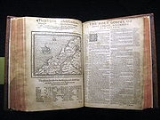
What makes this version of the Holy Bible significant is that, for the very first time, a mechanically printed, mass-produced Bible was made available directly to the general public which came with a variety of scriptural study guides and aids (collectively called an apparatus), which included verse citations which allow the reader to cross-reference one verse with numerous relevant verses in the rest of the Bible, introductions to each book of the Bible which acted to summarize all of the material that each book would cover, maps, tables, woodcut illustrations
Woodcut
Woodcut—occasionally known as xylography—is a relief printing artistic technique in printmaking in which an image is carved into the surface of a block of wood, with the printing parts remaining level with the surface while the non-printing parts are removed, typically with gouges...

, indexes, as well as other included features — all of which would eventually lead to the reputation of the Geneva Bible as history's very first study bible
Study Bible
A study Bible is an edition of the Bible prepared for the use of a serious student of the Bible. It provides scholarly information designed to help the reader gain a better understanding of the text.-History:...

.

Because the language of the Geneva Bible was more forceful and vigorous, most readers preferred this version strongly over the Great Bible
Great Bible
The Great Bible was the first authorized edition of the Bible in English, authorized by King Henry VIII of England to be read aloud in the church services of the Church of England. The Great Bible was prepared by Myles Coverdale, working under commission of Sir Thomas Cromwell, Secretary to Henry...

. In the words of Cleland Boyd McAfee
Cleland Boyd McAfee
Cleland Boyd McAfee was an American theologian, Presbyterian minister and hymn writer, best known for penning the gospel hymn, "Near to the Heart of God," a song written after the concurrent deaths of two of his young nieces, caused by diphtheria.McAfee was born in Ashley, Missouri, in 1866, as...

, "it drove the Great Bible off the field by sheer power of excellence".

History


During the reign of Queen Mary I of England
Mary I of England
Mary I was queen regnant of England and Ireland from July 1553 until her death.She was the only surviving child born of the ill-fated marriage of Henry VIII and his first wife Catherine of Aragon. Her younger half-brother, Edward VI, succeeded Henry in 1547...

 (1553 – 1558), a number of Protestant scholars fled from England to Geneva
Geneva
Geneva In the national languages of Switzerland the city is known as Genf , Ginevra and Genevra is the second-most-populous city in Switzerland and is the most populous city of Romandie, the French-speaking part of Switzerland...

 in Switzerland
Switzerland
Switzerland name of one of the Swiss cantons. ; ; ; or ), in its full name the Swiss Confederation , is a federal republic consisting of 26 cantons, with Bern as the seat of the federal authorities. The country is situated in Western Europe,Or Central Europe depending on the definition....

, which was then ruled as a republic
Republic
A republic is a form of government in which the people, or some significant portion of them, have supreme control over the government and where offices of state are elected or chosen by elected people. In modern times, a common simplified definition of a republic is a government where the head of...

 in which John Calvin
John Calvin
John Calvin was an influential French theologian and pastor during the Protestant Reformation. He was a principal figure in the development of the system of Christian theology later called Calvinism. Originally trained as a humanist lawyer, he broke from the Roman Catholic Church around 1530...

 and Theodore Beza
Theodore Beza
Theodore Beza was a French Protestant Christian theologian and scholar who played an important role in the Reformation...

 provided the primary spiritual and theological leadership. Among these scholars was William Whittingham
William Whittingham
William Whittingham was an English Biblical scholar and religious reformer. Educated at Brasenose College, Oxford, he became a zealous Protestant; as such he found it prudent to flee to France when Mary I ascended the throne of England....

, who supervised the translation now known as the Geneva Bible, in collaboration with Myles Coverdale
Myles Coverdale
Myles Coverdale was a 16th-century Bible translator who produced the first complete printed translation of the Bible into English.-Life:...

, Christopher Goodman
Christopher Goodman
Christopher Goodman BD was an English reforming clergyman and writer. He was a Marian exile, who left England to escape persecution during the counter-reformation in the reign of Queen Mary I of England. He was the author of a work on limits to obedience to rulers, and a contributor to the Geneva...

, Anthony Gilby
Anthony Gilby
Anthony Gilby was an English clergyman, known as a radical Puritan and Geneva Bible translator.He was born in Lincolnshire, and was educated at Christ's College, Cambridge, graduating in 1535.-Early life:...

, Thomas Sampson
Thomas Sampson
Thomas Sampson was an English Puritan theologian. A Marian exile, he was one of the Geneva Bible translators. On his return to England, he had trouble with conformity to the Anglican practices...

, and William Cole
William Cole (Puritan)
William Cole was an English Puritan clergyman, president of Corpus Christi College, Oxford and Dean of Lincoln.A Protestant refugee from Marian England, Cole returned on Elizabeth accession and was appointed President of Corpus Christi in 1568, a controversial appointment, since most of the...

; several of this group later became prominent figures in the Vestments controversy
Vestments controversy
The vestments controversy arose in the English Reformation, ostensibly concerning vestments, but more fundamentally concerned with English Protestant identity, doctrine, and various church practices...

. Whittingham was directly responsible for the New Testament, which was complete and published in 1557, while Gilby oversaw the Old Testament.

The first full edition of this Bible, with a further revised New Testament, appeared in 1560, but it was not printed in England until 1575 (New Testament) and 1576 (complete Bible). Over 150 editions were issued; the last probably in 1644. The very first Bible printed in Scotland
Scotland
Scotland is a country that is part of the United Kingdom. Occupying the northern third of the island of Great Britain, it shares a border with England to the south and is bounded by the North Sea to the east, the Atlantic Ocean to the north and west, and the North Channel and Irish Sea to the...

 was a Geneva Bible, which was first issued in 1579. In fact, the involvement of Knox and Calvin in the creation of the Geneva Bible made it especially appealing in Scotland, where a law was passed in 1579 requiring every household of sufficient means to buy a copy.

Some editions from 1576 onwards included Tomson's revisions of the New Testament. Some editions from 1599 onwards used a new "Junius" version of the Book of Revelation, in which the notes were translated from a new Latin commentary by Junius
Franciscus Junius (the elder)
Franciscus Junius , also known as Francis Junius, Franz Junius, and François du Jon, was a Huguenot scholar and theologian, and the father of Franciscus Junius the younger.-Life:...

 on Revelation.

The annotations which are an important part of the Geneva Bible were Calvinist
Calvinism
Calvinism is a Protestant theological system and an approach to the Christian life...

 and Puritan
Puritan
The Puritans were a significant grouping of English Protestants in the 16th and 17th centuries. Puritanism in this sense was founded by some Marian exiles from the clergy shortly after the accession of Elizabeth I of England in 1558, as an activist movement within the Church of England...

 in character, and as such they were disliked by the ruling pro-government Protestants of the Church of England
Church of England
The Church of England is the officially established Christian church in England and the Mother Church of the worldwide Anglican Communion. The church considers itself within the tradition of Western Christianity and dates its formal establishment principally to the mission to England by St...

, as well as King James I
James I of England
James VI and I was King of Scots as James VI from 24 July 1567 and King of England and Ireland as James I from the union of the English and Scottish crowns on 24 March 1603...

, who commissioned the "Authorized Version", or King James Bible, in order to replace it. The Geneva Bible had also motivated the earlier production of the Bishops' Bible
Bishops' Bible
The Bishops' Bible is an English translation of the Bible which was produced under the authority of the established Church of England in 1568. It was substantially revised in 1572, and this revised edition was to be prescribed as the base text for the Authorized King James Version of...

 under Elizabeth I, for the same reason, and the later Rheims-Douai edition by the Catholic community
Recusancy
In the history of England and Wales, the recusancy was the state of those who refused to attend Anglican services. The individuals were known as "recusants"...

. The Geneva Bible remained popular among Puritans and remained in widespread use until after the English Civil War
English Civil War
The English Civil War was a series of armed conflicts and political machinations between Parliamentarians and Royalists...

. The Geneva notes were surprisingly included in a few editions of the King James version, even as late as 1715.

Translation


Like most English translations of the time, the Geneva Bible was translated from scholarly editions of the Greek
Koine Greek
Koine Greek is the universal dialect of the Greek language spoken throughout post-Classical antiquity , developing from the Attic dialect, with admixture of elements especially from Ionic....

 New Testament and the Hebrew
Hebrew language
Hebrew is a Semitic language of the Afroasiatic language family. Culturally, is it considered by Jews and other religious groups as the language of the Jewish people, though other Jewish languages had originated among diaspora Jews, and the Hebrew language is also used by non-Jewish groups, such...

 Scriptures that comprise the Christian Old Testament. The English rendering was substantially based on the earlier translations by William Tyndale
William Tyndale
William Tyndale was an English scholar and translator who became a leading figure in Protestant reformism towards the end of his life. He was influenced by the work of Desiderius Erasmus, who made the Greek New Testament available in Europe, and by Martin Luther...

 and Myles Coverdale
Myles Coverdale
Myles Coverdale was a 16th-century Bible translator who produced the first complete printed translation of the Bible into English.-Life:...

 (more than 80 percent of the language in the Genevan Bible is from Tyndale). However, the Geneva Bible was the first English version in which all of the Old Testament was translated directly from the Hebrew (cf. Coverdale Bible
Coverdale Bible
The Coverdale Bible, compiled by Myles Coverdale and published in 1535, was the first complete Modern English translation of the Bible , and the first complete printed translation into English . The later editions published in 1539 were the first complete Bibles printed in England...

, Matthew Bible
Matthew Bible
The Matthew Bible, also known as Matthew's Version, was first published in 1537 by John Rogers, under the pseudonym "Thomas Matthew". It combined the New Testament of William Tyndale, and as much of the Old Testament as he had been able to translate before being captured and put to death...

).

Format


The Geneva Bible was the first English Bible to use verse numbers based on the work of Stephanus (Robert Estienne
Robert Estienne
Robert I Estienne , known as Robertus Stephanus in Latin and also referred to as Robert Stephens by 18th and 19th-century English writers, was a 16th century printer and classical scholar in Paris...

 of Paris). It also had an elaborate system of commentary in marginal gloss
Gloss
A gloss is a brief notation of the meaning of a word or wording in a text. It may be in the language of the text, or in the reader's language if that is different....

es. This annotation was done by Laurence Tomson
Laurence Tomson
Laurence Tomson revised both the text and the annotations of the New Testament of the Geneva Bible. His revised edition appeared in 1576. Tomson was a Calvinist, and his annotations reflect that system of theology....

, who translated (for the 1560 Geneva Bible) L'Oiseleur's notes on the Gospels, which themselves came from Camerarius. In 1576 Tomson added L'Oiseleur's notes for the Epistles, which came from Beza's Greek and Latin edition of the Bible (1565 and later). Beginning in 1599 Franciscus Junius
Franciscus Junius (the elder)
Franciscus Junius , also known as Francis Junius, Franz Junius, and François du Jon, was a Huguenot scholar and theologian, and the father of Franciscus Junius the younger.-Life:...

' notes on Revelation were added, replacing the original notes deriving from John Bale
John Bale
John Bale was an English churchman, historian and controversialist, and Bishop of Ossory. He wrote the oldest known historical verse drama in English , and developed and published a very extensive list of the works of British authors down to his own time, just as the monastic libraries were being...

 and Heinrich Bullinger
Heinrich Bullinger
Heinrich Bullinger was a Swiss reformer, the successor of Huldrych Zwingli as head of the Zurich church and pastor at Grossmünster...

. Bale's The Image of both churches had a great impact on these notes as well as Foxe's Book of Martyrs
Foxe's Book of Martyrs
The Book of Martyrs, by John Foxe, more accurately Acts and Monuments, is an account from a Protestant point of view of Christian church history and martyrology...

. Both the Junius and Bullinger-Bale annotations are explicitly anti-Roman Catholic and representative of much popular Protestant apocalypticism during the Reformation.

The 1560 Geneva Bible was printed in Roman type—the style of type regularly used today—but many editions used the older black-letter
Blackletter
Blackletter, also known as Gothic script, Gothic minuscule, or Textura, was a script used throughout Western Europe from approximately 1150 to well into the 17th century. It continued to be used for the German language until the 20th century. Fraktur is a notable script of this type, and sometimes...

 ("Gothic") type. Of the various later English Bible translations, the next to use Roman type was the Douay-Rheims Bible of 1582 (New Testament) and 1609–10 (Old Testament).

The Geneva Bible was also issued in more convenient and affordable sizes than earlier versions. The 1560 Bible was in quarto
Quarto
Quarto could refer to:* Quarto, a size or format of a book in which four leaves of a book are created from a standard size sheet of paper* For specific information about quarto texts of William Shakespeare's works, see:...

 format (218 × 139 mm type area), but pocketable octavo
Octavo (book)
Octavo is a technical term describing the format of a book, which refers to the size of leaves produced from folding a full sheet of paper on which multiple pages of text were printed to form the individual sections of a book...

 editions were also issued, and a few large folio editions. The New Testament was issued at various times in sizes from quarto down to 32º (the smallest, 70×39 mm type area ). In the late sixteenth century it is likely that the Geneva New Testament cost less than a week's wages even for the lowest-paid labourers.

The 1560 Geneva Bible contained a number of study aids, including woodcut
Woodcut
Woodcut—occasionally known as xylography—is a relief printing artistic technique in printmaking in which an image is carved into the surface of a block of wood, with the printing parts remaining level with the surface while the non-printing parts are removed, typically with gouges...

 illustrations, maps and explanatory 'tables', i.e. indexes of names and topics, in addition to the (in)famous marginal notes. Each book was preceded by an 'argument' or introduction, and each chapter by a list of contents giving verse numbers. Smaller-format editions might be unillustrated and lack the marginal notes, but some large folio editions had additional illustrations, such as one showing Adam and Eve, where Adam wears a typical Elizabethan beard and moustache.

Modern spelling version of the 1599 Geneva Bible


In 2006, Tolle Lege Press released a version of the 1599 Geneva Bible with modern spellings as part of their 1599 Geneva Bible restoration project. The original cross references were retained as well as the study notes by the Protestant Reformation
Protestant Reformation
The Protestant Reformation was a 16th-century split within Western Christianity initiated by Martin Luther, John Calvin and other early Protestants. The efforts of the self-described "reformers", who objected to the doctrines, rituals and ecclesiastical structure of the Roman Catholic Church, led...

 leaders. In addition, the Old English glossary was included in the updated version. The advisory board of the restoration project included several Protestant Christian
Christianity
Christianity is a monotheistic religion based on the life and teachings of Jesus as presented in canonical gospels and other New Testament writings...

 leaders and scholars.

Sample


To compare the Geneva Bible with the King James, here is Revelation 6:12-17 in both versions (with spelling modernized). The differences have been italicized in the King James extract:
Geneva Bible
And I beheld when he had opened the sixth seal, and lo, there was a great earthquake, and the sun was as black as sackcloth of hair, and the moon was like blood. And the stars of heaven fell unto the earth, as a fig tree casteth her green figs, when it is shaken of a mighty wind. And heaven departed away, as a scroll, when it is rolled, and every mountain and isle were moved out of their places. And the kings of the earth, and the great men, and the rich men, and the chief captains, and the mighty men, and every bondman, and every free man, hid themselves in dens, and among the rocks of the mountains, and said to the mountains and rocks, Fall on us, and hide us from the presence of him that sitteth on the throne, and from the wrath of the Lamb. For the great day of his wrath is come, and who can stand?

King James Bible
And I beheld when he had opened the sixth seal, and, lo, there was a great earthquake; and the sun became black as sackcloth of hair, and the moon became as blood; and the stars of heaven fell unto the earth, even as a fig tree casteth her untimely figs, when she is shaken of a mighty wind. And the heaven departed as a scroll when it is rolled together; and every mountain and island was moved out of their places. And the kings of the earth, and the great men, and the rich men, and the chief captains, and the mighty men, and every bondman, and every free man, hid themselves in the dens and in the rocks of the mountains; and said to the mountains and rocks, Fall on us, and hide us from the face of him that sitteth on the throne and from the wrath of the Lamb; for the great day of his wrath is come; and who shall be able to stand?


The two versions are very similar to each other. Examination of the differences shows that the earlier Geneva version is often more direct and modern in style than the later King James, e.g.

“and the moon was like blood” (Geneva) versus “and the moon became as blood” (King James)

“as a fig tree casteth her green figs” (Geneva) versus “even as a fig tree casteth her untimely figs” (King James)

By and large, the difference is that the KJV lacked footnotes that the Geneva Bible contained.

As can be seen by the text below, Daniel chapter 4 in the Geneva Bible appears to have removed two verses. In reality, the Geneva Bible places those two verses at the end of chapter 3, as the Hebrew, Greek, and Latin verses all did. It wasn't until the King James Version that those verses were placed with chapter 4 as opposed to chapter 3:
Geneva Bible - Daniel Chapter 3 King James Bible - Daniel Chapter 3
30 Then the King promoted Shadrach, Meshach and Abednego in the province of Babel. 30 Then the king promoted Shadrach, Meshach, and Abednego, in the province of Babylon.
King James Bible - Daniel Chapter 4
31 Nebuchad-nezzar King unto all people, nations and languages, that dwell in all the world, Peace be multiplied unto you: 1 Nebuchad-nezzar the king, unto all people, nations, and languages that dwell in all the earth, Peace be multiplied unto you.
32 I thought it good to declare the signes and wonders, that the hie God hath wrought toward me. 2 I thought it good to shew the signes, and wonders, that the high God hath wrought toward me.
33 How great are his signes, and how mightie are his wonders! his kingdome is an everlasting kingdome, and his dominion is from generation to generation. 3 How great are his signes? and how mighty are his wonders? his kingdome is an everlasting kingdome, and his dominion is from generation to generation.
Geneva Bible - Daniel Chapter 4
1 I Nebuchad-nezzar being at rest in mine house, and flourishing in my palace, 4 I Nebuchadnezzar was at rest in mine house, and flourishing in my palace.
2 Saw a dreame, which made me afraide, and the thoughtes upon my bed, and the visions of mine head troubled me. 5 I saw a dreame which made me afraid, and the thoughts upon my bed, and the visions of my head troubled me.
3 Therefore made I a decree, that they should bring all the wise men of Babel before mee, that they might declare unto me the interpretation of the dreame. 6 Therefore made I a decree, to bring in all the wise men of Babylon before mee, that they might make knowen unto me the interpretation of the dreame.

See also

  • Editio Regia
    Editio Regia
    Editio Regia , it is the third and the most important edition of the Greek New Testament of Robert Estienne . It is one of the most important printed editions of the Greek New Testament in history, the Textus Receptus. It was named Editio Regia because of the beautiful and elegant Greek font it...

  • Tyndale Bible
    Tyndale Bible
    The Tyndale Bible generally refers to the body of biblical translations by William Tyndale. Tyndale’s Bible is credited with being the first English translation to work directly from Hebrew and Greek texts. Furthermore it was the first English biblical translation that was mass produced as a result...

  • Matthew Bible
    Matthew Bible
    The Matthew Bible, also known as Matthew's Version, was first published in 1537 by John Rogers, under the pseudonym "Thomas Matthew". It combined the New Testament of William Tyndale, and as much of the Old Testament as he had been able to translate before being captured and put to death...

  • Bishops' Bible
    Bishops' Bible
    The Bishops' Bible is an English translation of the Bible which was produced under the authority of the established Church of England in 1568. It was substantially revised in 1572, and this revised edition was to be prescribed as the base text for the Authorized King James Version of...

  • King James Bible

External links


Text
Articles
  • The Geneva Bible of 1560: article by Bruce Metzger
    Bruce Metzger
    Bruce Manning Metzger was a professor at Princeton Theological Seminary and Bible editor who served on the board of the American Bible Society. He was a scholar of Greek, New Testament and Old Testament, and wrote prolifically on these subjects.- Biography :Metzger was born in Middletown,...

     originally printed in Theology Today
  • Online version of Sir Frederic G. Kenyon’s article in Hastings' Dictionary of the Bible
    Hastings' Dictionary of the Bible
    Hastings' Dictionary of the Bible was a five-volume Biblical encyclopaedia published 1898—1904.-First edition:The full title was A Dictionary of the Bible, dealing with the Language, Literature and Contents, including the Biblical Theology. It was edited by James Hastings, with the assistance...

    , 1909
  • Geneva Bible-History From Cambridge Encyclopedia


Editions Currently in Print

FAQ